
Judge, 1930-12-27 · page 15 of 37
Judge — December 27, 1930 — page 15: what you’re looking at
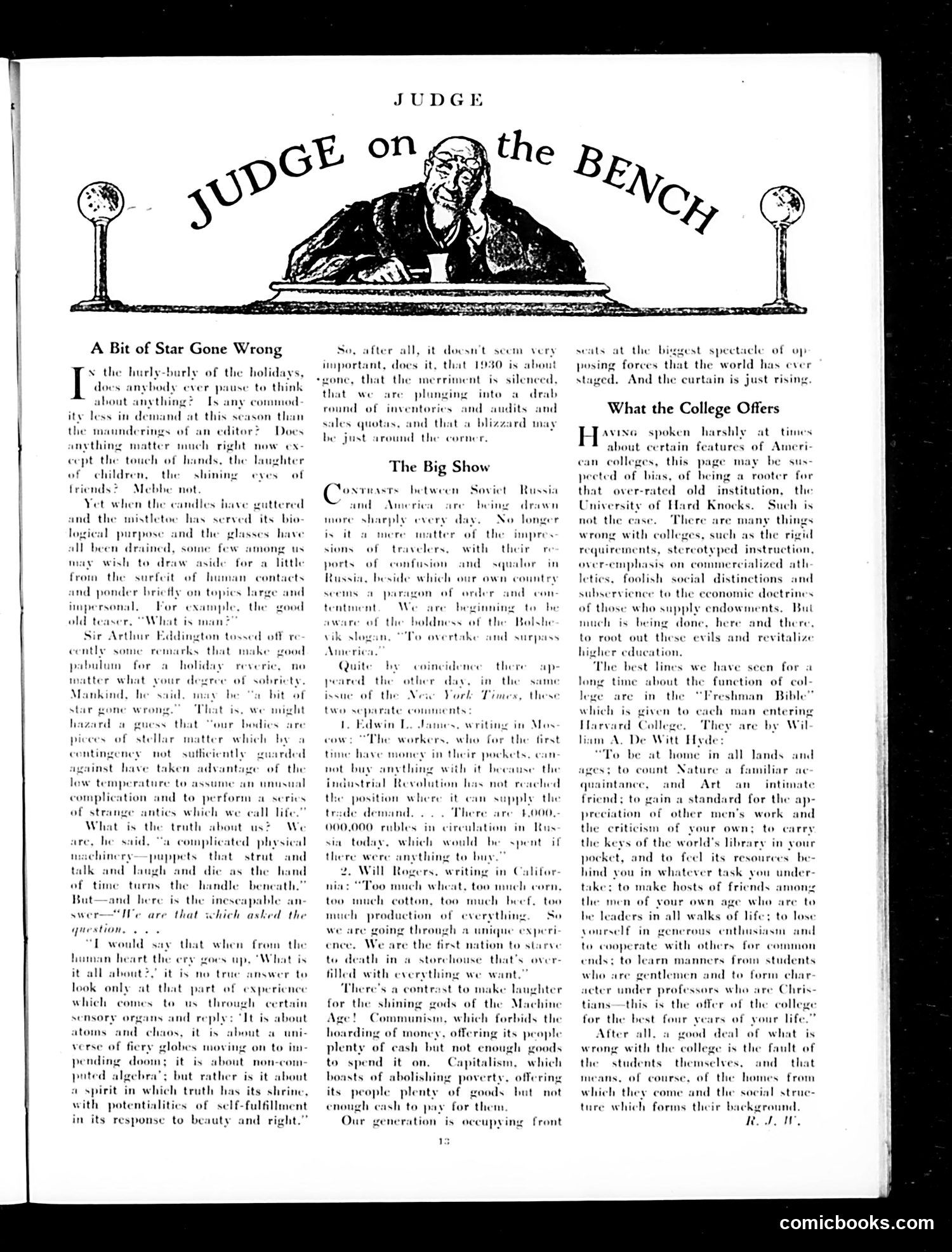
A restored page from Judge, 1930-12-27. Page through the whole issue in the reader above.
📄 Transcribed text from this page (OCR, searchable)
Machine-transcribed from the original scan — historical spelling and the odd misread are preserved.
JUDGE A Bit of Star Gone Wrong S the hurly-burly of the holidays, does anybody ever pause to think about anything? [sy any commod ity less in demand at this scason than the maunderings of an editor? Does vnything matter much right now ex cept the touch of hands, the laughter of children, the shining eves of Mebhe not Yet when the candles have guttered ind the mistletoe has served its t le Ul been drained, some few among us may wish to draw aside for a little from the surfeit of human contacts friends? cal purpose and the glasses have and ind ponder briefly on topics impersonal, For example. the old t ro WI Sir Arthur F 1 off re cently some remarks that make tis mar idington toss pabulum for a holiday matter what your degree of sobriety. id, hes one wrong reverie, 1 id. nay be “a bit of hit our bodies are That is. we mi 4 guess that picees of stellar matter which by a contingency not suthciently irded igainst have taken advant of the W temperature to assume an unusual complication nd to perform a series of strange antics which we call life.” What is the truth about us? We ure, he said, “a complicated: physical machinery—puppets that strut) and talk and laugh and die as the hand of time turns the handle beneath.” But—and here is the ineseapable an swer—“We are that which asked the questions sos “T would say that when from the human heart the ery goes up, ‘What is it all true answer to look only at that part of experience which ¢ out? it isn igh certain ins and reply: ‘It is about > teous th sensory or! toms and chaos, it is about a uni- verse of fiery globes moving on to im pending doom; it is about non-cony pated algebra’; but rather is it about i spirit in which truth has its shrine, with potentialities of self-fulfillment in its response to beauty and right.” Se, after all, it doesn't seem very important, does it, that 1930 is about syone, that the merriment is silenced, that we are plunging into a drab round of inventories and audits and sales quotas, and that a blizzard may be just areund the corner, The Big Show NTRASTS tween Soviet Russia C more sharply every day. is ita mere inatter of th sions of tr ind Amerien are being drawn lo impres with their rv cer vele ports of fusion and squalor in tussia. beside which our own countey seems a parucon of order and con tentment. We are be vware of the inning to f the Bolst yovertake and. surpass boldness vik slogan America, Quite by coin peared the other day, in’ the scame issue of the New York Times, these two separate comments 1. Rdwin T cow: “The workers, who for the first time have 1 dence there ap: James. writing in Mos ney in their pockets, can pot buy anythi hit beeause the industrial Revolution has not reached the position where it can ply the trade demand. . There are $000, 000,000 rubles in circulation in Kus sia today, which would | there were anything to buy 2. Will Rogers. writing “Too much wheat, too much corn, too much cotton, too much beef, too ho production of everythin we are going through a unique experi We are the first nation to starve te death in a storchouse that’s over- pent if y Califor Se enc filled with everything we want.” ‘There's a contrast tom. laughter for the shining gods of the Machine Communism, which forbids the hoarding its peopl plenty of cash but not enough goods to spend it on, Capitalism, whiel boasts of abolishing poverty. offering its people plenty of goods but not enough cash to pay for them Our generation is occupying front f money, offerix seats at the biggest spectacle of op posing forces that the world has ever sti 1. And the curtain is just rising What the College Offers F818 spoken Iarshly at times ut certain features of Ameri s, this pa; pected of bias, of bein, rooter for that over-rated old institution, the University of Hard Knocks. Sueh is not the case. There are many thin the rigid requirements, stereotyped instruction, over-emphasis on commercialized ath can coll smay be sus- wrong with colleges, such leties. foolish soc distinctions and subservience to the economic doctrines of those who supply endowments. But much is being done, here and there, to root out these evils and revitalize higher education. i best lines we have seen for a long time about the function of col ge are in the “Freshman Bible” which is given to cach man entering Harvard College. They are by Wil liam A. De Witt Hyde: “To be at home in all lands and to count Nature a familiar quaintance, and Art an intimate friend; to gain a standard for the preciation of other men’s work the criticism of your own; to carry the keys of the world’s library in your pocket, and to feel its resources be- hind you in whatever task you under- take; to make hosts of friends among the men of your own age who are to he 1 walks of life sourself in’ generous enthusiasm and ders in 3 to lose to cooperate with others for common to Jearn manners from students who are ends ntlemen and te form char. acter under professors who are Chris- tians—this is the offer of the colley for the best four years of your life After all. a good deal of what is wrong with the college is the fault of the students themselves, and that means, of course, of the homes from which they come and the social struc- ture which forms their backgrou RS comicbooks.com