
Judge, 1930-12-27 · page 18 of 37
Judge — December 27, 1930 — page 18: what you’re looking at
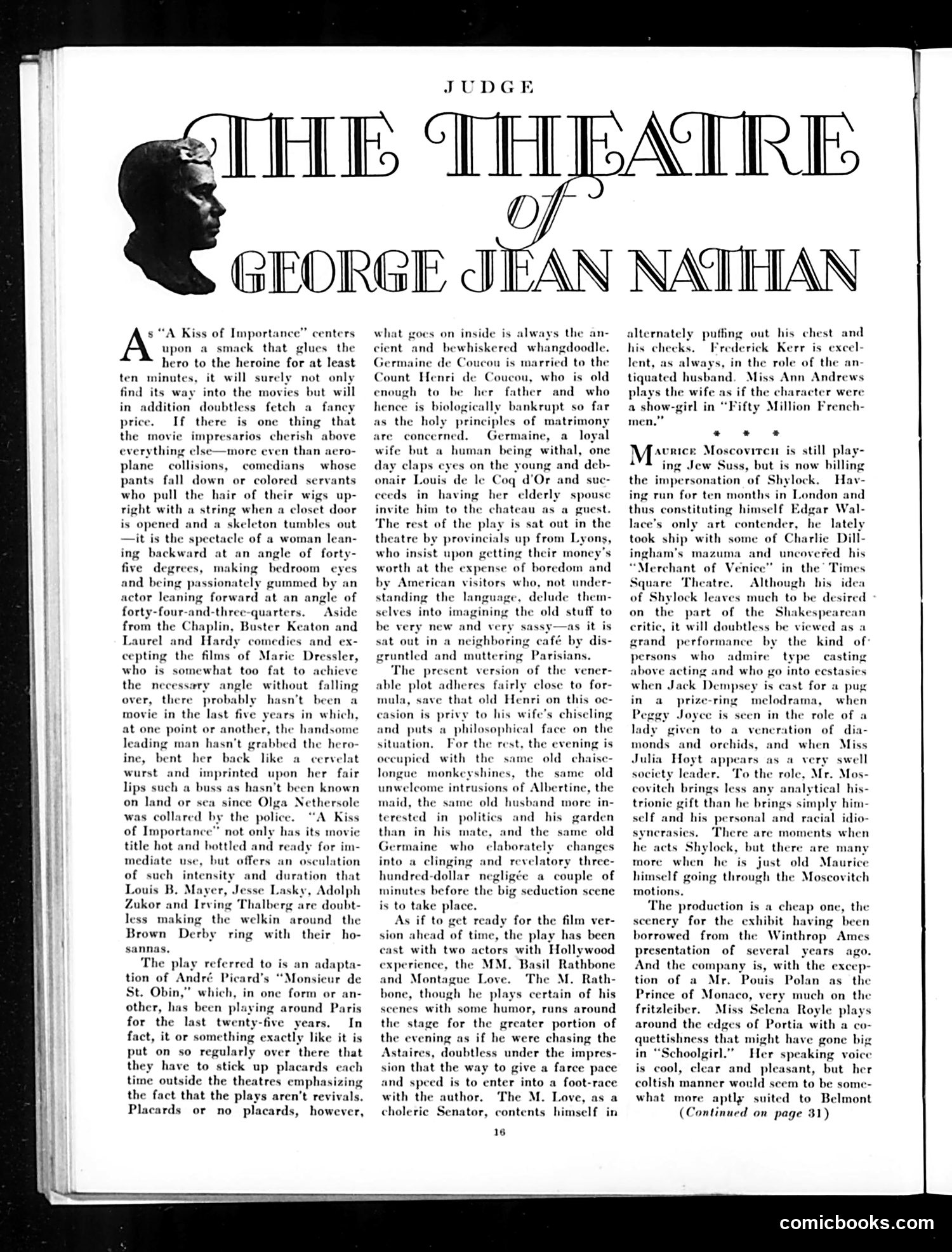
A restored page from Judge, 1930-12-27. Page through the whole issue in the reader above.
📄 Transcribed text from this page (OCR, searchable)
Machine-transcribed from the original scan — historical spelling and the odd misread are preserved.
‘A Kiss of Importance” centers A upon a smack that glues the hero to the heroine for at least ten minutes, it will surely not only find its way into the movies but will uddition doubtless fetch a fancy If there is one thing that the movie impresarios cherish everything else—more even than aero- plane collisions, comedians whose pants fall down or colored servants who pull the hair of th right with a string when a closet door is opened and a skeleton tumbles out —it is the spectacle of a woman lean- ing backward at an angle of forty- five degrees, making bedroom eyes S up- and being passionately gummed by an actor leaning forward at an angle of Aside ‘on and from the Chaplin, Buster K Laurel and Hardy comedies and ex- cepting the films of Marie Dressler, who is somewhat too fat to achieve the necessary angle without falling over, there probably hasn't been a movie in the last five years in which, at one point or another, the handsome leading man hasn't grabbed the hero- ine, bent her back like a cervelat wurst and imprinted upon her f lips such a buss as hasn’t been known on land or sea since Olga Nethersole was collared by the polic Kiss of Importance” not only has its movie title hot and bottled and re mediate use, but offers an of such intensity Louis B. Mayer, Zukor and Irving dy for im- culation and duration that Jesse Lasky, Adolph halberg are doubt- less making the welkin around the Brown Derby ring with their ho- sannas. The play referred to is an adapta- tion of André Picard’s “Monsieur de . Obin,” which, in one form or an- other, has been playing around Paris for the last twenty-five years. In fact, it or something exactly like it is put on so regularly over there that they have to stick up placards e time outside the theatres emphas the fact that the plays aren't re Placards or no placards, how JUDGE O what cient xcs on inside is always the an- nd bewhiskered wha Germaine de Coucon is mart Count Henri de Coucou, who is old gh to be her father and who hence is biologically bankrupt so far as the holy principles of matrimony are concerned. Germaine, a loyal but a human being withal, one day claps eyes on the young and deb- onair Louis de le Coq d'Or and suc- ceeds in having her elderly invite him to the chat The rest of the play is sat out in the theatre by provincials up from Lyons, who insist upon getting their mone worth at the expense of boredom : by American visitors who, not under- standing the language, delude them- selves into imagining the old stuff to be very new and very sassy—as it is sat out in a neighboring café by dis- untled and muttering Parisians. The present version of the vener- able plot adheres fairly close to for- mula, save that old Henri on this casion is privy to his wife’ and puts a philosophical face on the situatic For the rest, the evening is oceupied with the same old longue monkeyshines, the unwelcome intrusions of Albertine, the maid, the same old husband more terested in polities and his garden than in his mate, and the same old Germaine who elaborately changes into a clinging and revelatory three- hundred-dollar negligée a couple of minutes before the big seduction scene is to take plac As if to get ready for the film ver- sion ahead of time, the play has been st with two actors with Hollywood experience, the MM. Basil Rathbone and Montague Love. The M. Rath- bone, though he plays certain of his scenes with some humor, runs around the stage for the greater portion of the evening as if he were chasing the Astaires, doubtless under the impres sion that the way to give a farce pace and speed is to enter into a foot-race with the author. The M. Love, as a cholerie Senator, contents himself in spouse De- chiselin chaise- me old 16 Ib SUATBACORE GEORGE J NATHAN alternately puffing out his chest and his cheeks. Frederick Kerr is excel- lent, as always, in the role of the an tiquated husband. Miss Ann Andrews plays the wife as if the character were a show-girl in “Fifty Million French- men.” * * «# Mowerce Moscoviren is still play- AVE ing Jew Suss, but is now billing the impersonation of Shylock. Hav- ing run for ten months in London and thus constituting himself Edgar Wal- lace’s only art contender, he lately took ship with some of Charlie Dill- ingham’s mazuma and ur “Merchant of Venice” in the’ Times Square Theatre. Although his idea of Shylock leaves much to be desired on the part of the Shakespe critic, it will doubtless be viewed as vered his grand performance by the kind of persons who type casting above acting into eestasies when Jack Dempsey is cast for a pug in a prize-ring melodrama, whe Joyce is seen in the role of given to a veneration of di monds and orchids, and when Miss Julia Hoyt appears as a very swell To the role, Mr. Mos- coviteh brings less any ytical his- trionic gift than he brings si mply him- self and his personal and al idio- synerasies. Ther moments when ts Shylock, but there are many when he is just old Mauri himself going through the Moscovitch motions. The production is a cheap one, the scenery for the exhibit having been borrowed from the Winthrop Ames presentation of several years ago. And the company with the excep- tion of a Mr. Pouis Polan as the Prince of Monaco, very much on the fritzleiber. Miss Selena Royle plays around the of Portia with a co- quettishness that might have gone big n “Schoolgirl.” Her speaking voice is cool, clear and pleasant, but her coltish manner would m to be some- what more aptly suited to Belmont (Continued on page 31) are comicbooks.com