A complete issue · 37 pages · 1930
Judge — June 28, 1930
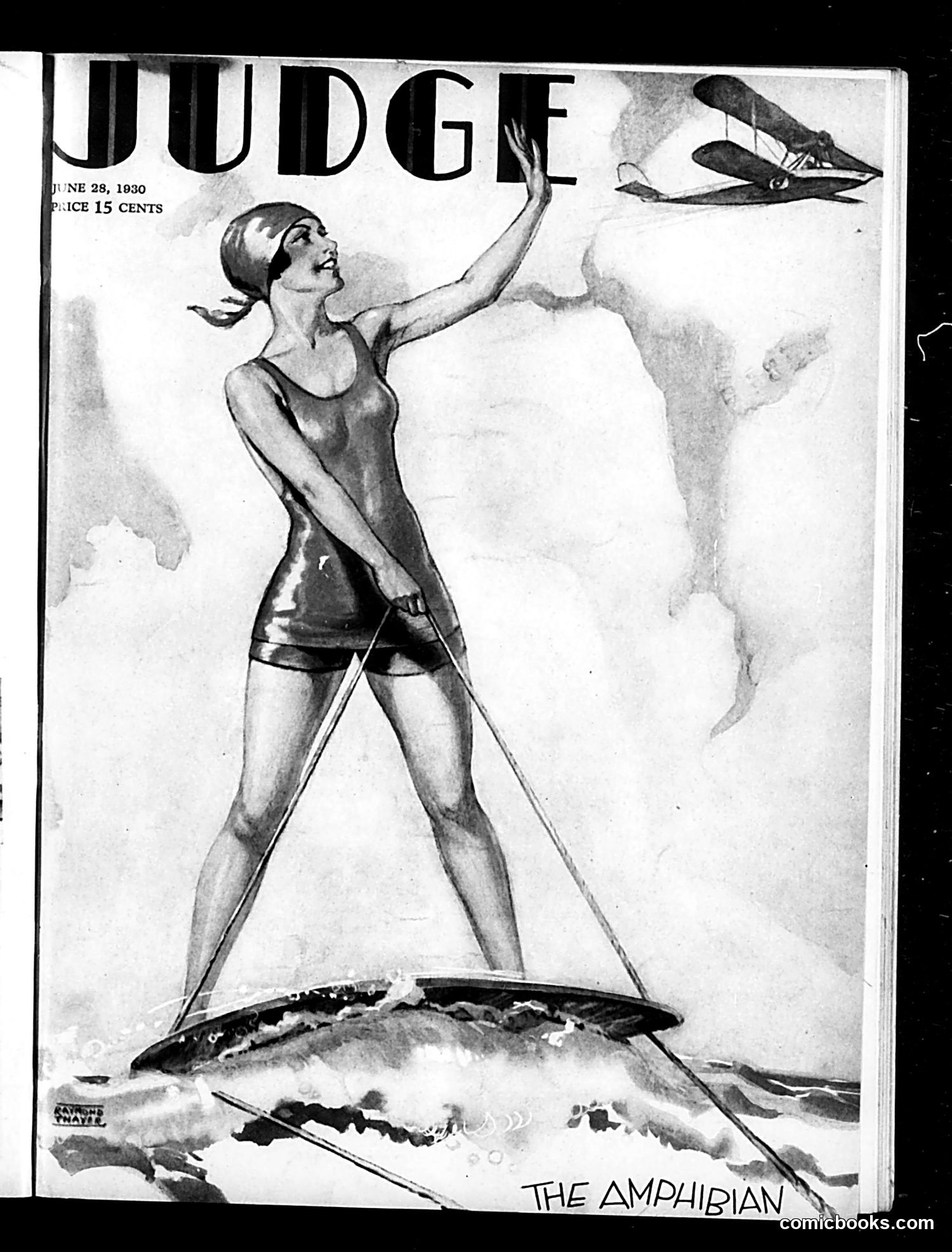
# "The Amphibian" - Judge Magazine, June 28, 1930 This cover satirizes women's expanding roles in modern recreation. The illustration shows a woman in a bathing suit standing confidently on an amphibious aircraft, reaching skyward while piloting or operating the plane. The title "The Amphibian" plays on both the aircraft type and the woman's ability to navigate multiple environments—water, air, and land. In 1930, women aviators and recreational activities were becoming increasingly visible and controversial. The cartoon celebrates (or possibly mocks, depending on the magazine's tone) the "modern woman" who participates in adventurous sports like aviation and swimming rather than conforming to traditional domestic roles. The figure embodies the independent "New Woman" of the interwar period.
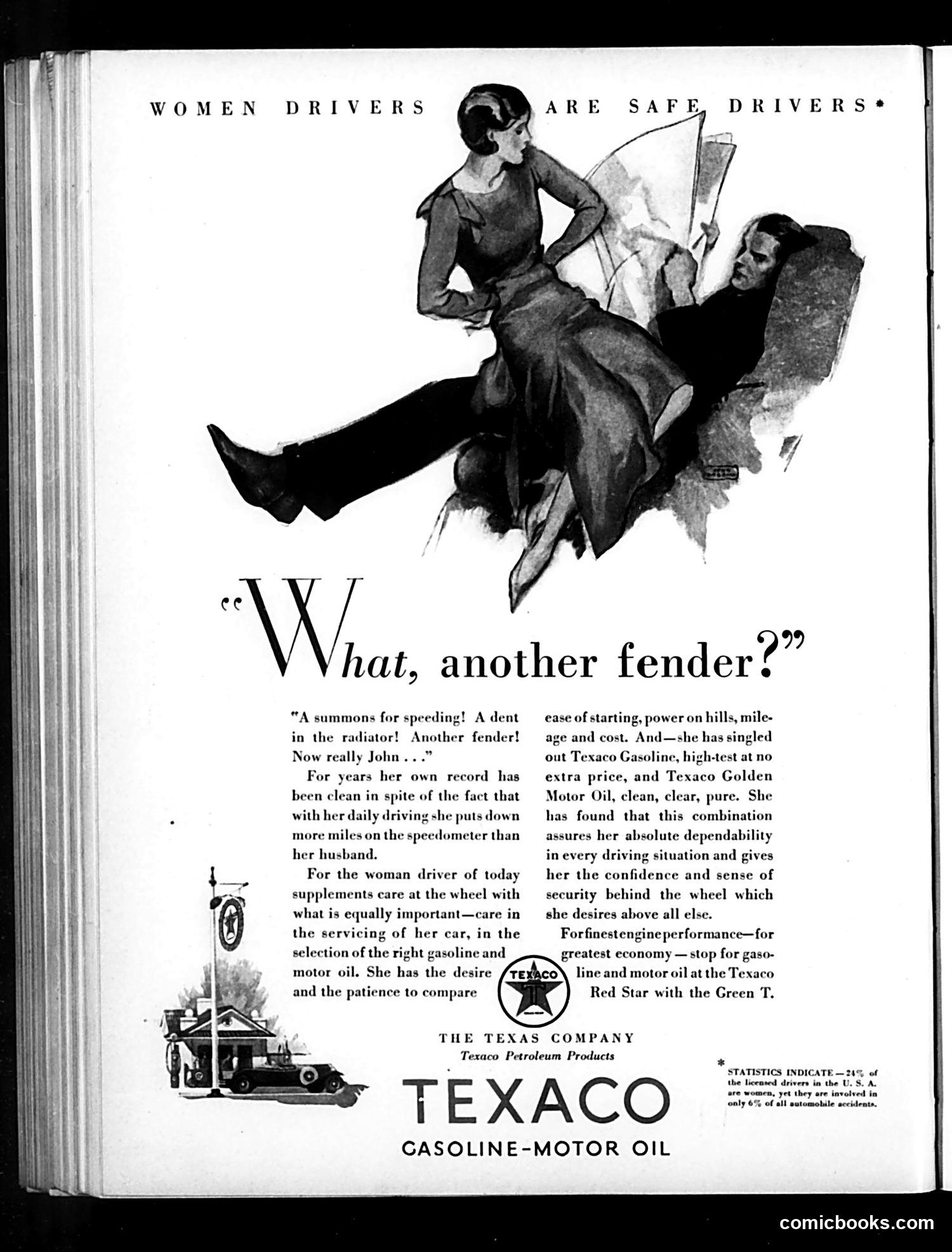
This is primarily a **Texaco gasoline advertisement** rather than political satire. The headline "Women Drivers Are Safe Drivers" challenges contemporary stereotypes about female motorists. The illustration shows a man apparently injured or distressed while a composed woman sits nearby—a visual joke suggesting women drivers cause accidents to men (humorously reversing expected gender roles in 1920s-30s driving culture). The ad's actual message promotes Texaco products to women drivers by emphasizing reliability and dependability. It claims women appreciate careful car maintenance and compares brands meticulously—suggesting they're intelligent consumers deserving serious product marketing. A footnote cites statistics: 24.5% of licensed U.S. drivers are women, yet they're involved in only 6% of automobile accidents, supporting the safety claim.
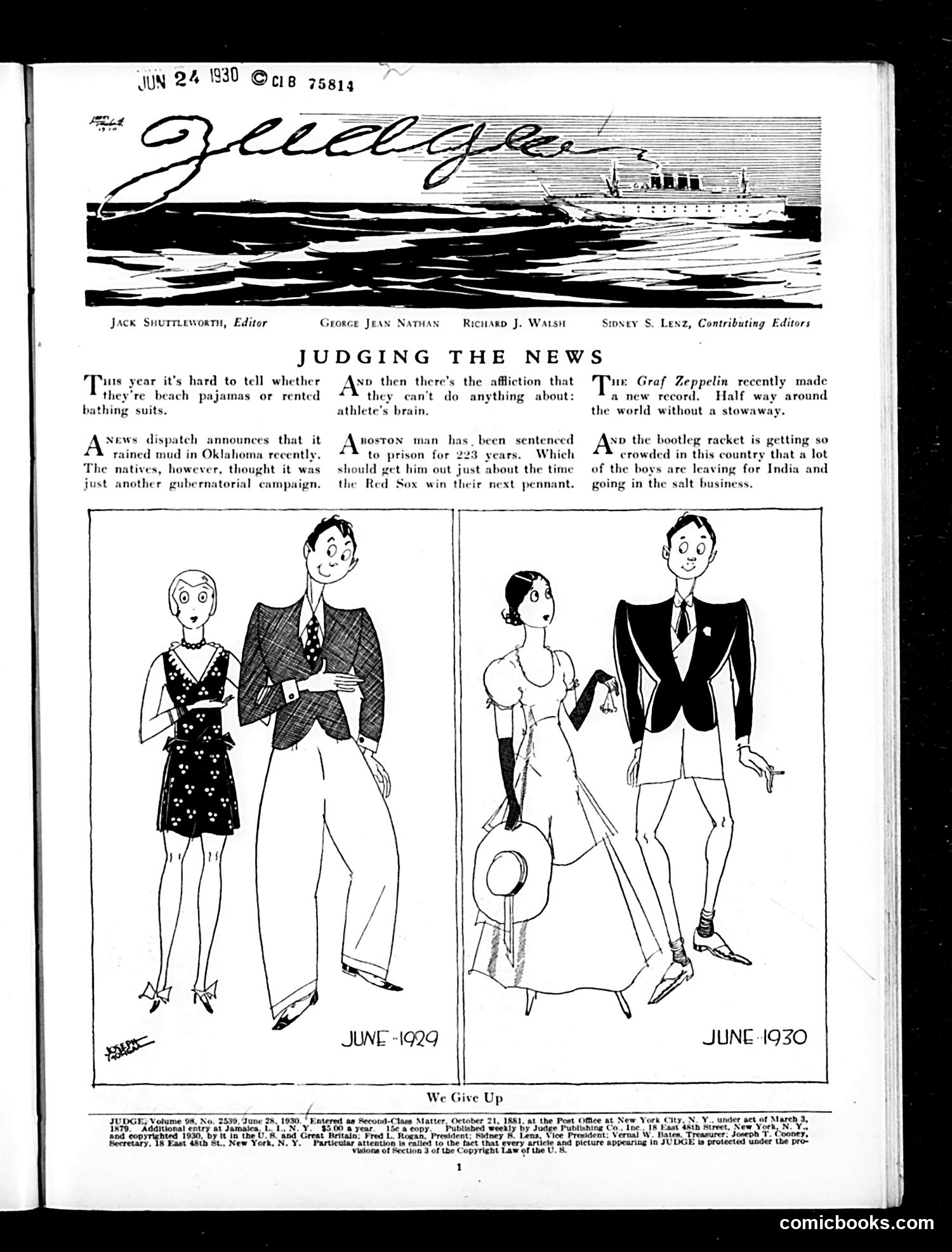
# "We Give Up" — Judge Magazine, June 1930 This cartoon compares fashion and social trends between June 1929 and June 1930. The left panel shows 1929 styles: a woman in a short, patterned dress with bobbed hair and a man in a plaid suit with normal proportions. The right panel depicts 1930 fashions: the same couple now wears exaggerated, androgynous clothing—the woman in a longer dress with masculine styling, the man in oversized formal wear with notably broader shoulders. The title "We Give Up" suggests the cartoonist's satirical surrender to rapidly changing, seemingly illogical fashion trends. The joke mocks how quickly fashion dictates transformed clothing silhouettes and gender presentation in early 1930s style, reflecting contemporary anxiety about modernism's effects on traditional gender norms.
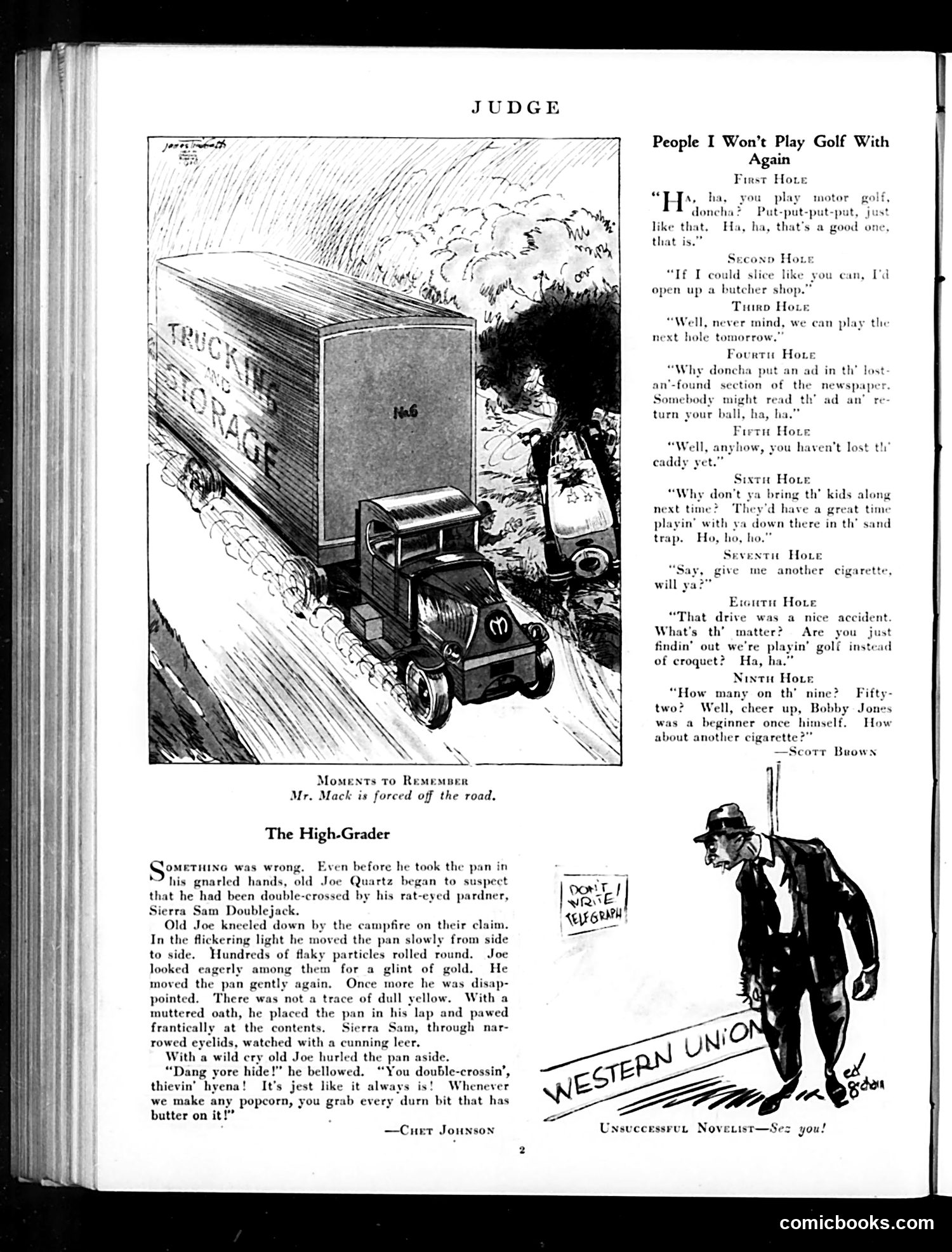
# Analysis of Judge Page **"People I Won't Play Golf With Again"** is a humorous dialogue spanning nine holes, where a golfer complains about his partner's annoying behavior—motor-golfing, suggesting opening a butcher shop, placing lost-ball ads, bringing children, chain-smoking, and general carelessness. It's satirizing irritating golf companions through exaggerated dialogue. **"The High-Grader"** tells of Old Joe discovering gold in a mining pan, believing he's struck it rich. The story reveals deception: his rat-eyed pardner has salted the pan with gold flakes as a con. The satire criticizes gullible prospectors easily duped by mining fraud—a common concern during early 20th-century gold-rush schemes. **"Unsuccessful Novelist"** cartoon (right) shows a dejected man at Western Union, likely depicting struggling writers of the era.
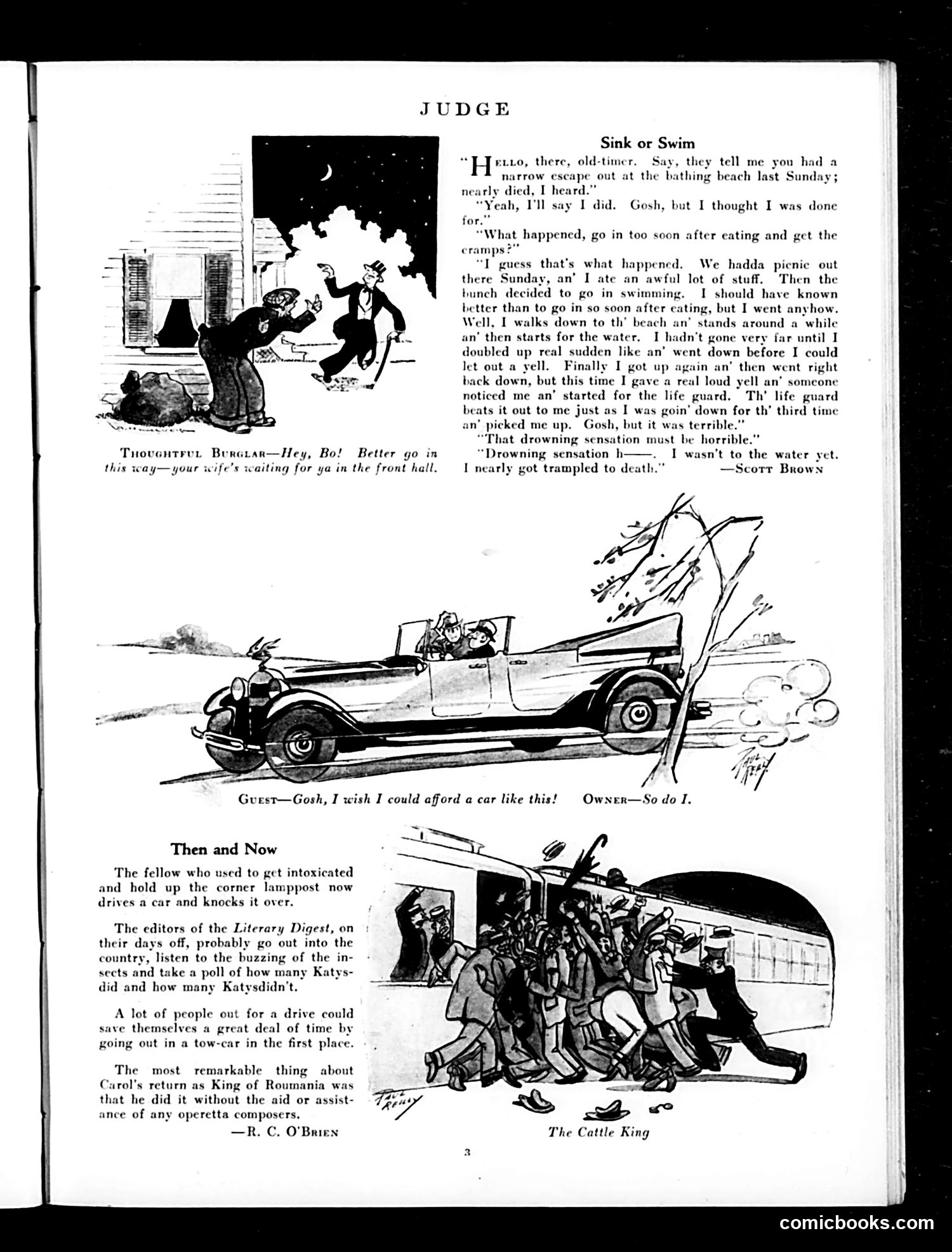
# Page Analysis: Judge Magazine Humor This page contains three separate humorous pieces: 1. **"Sink or Swim"**: A dialogue joke about a man's near-drowning at the beach after eating too much. The humor relies on physical comedy—he nearly drowns, gets rescued by a lifeguard, then ironically gets trampled by the lifeguard rushing to help someone else. It's straightforward slapstick satire on the dangers of swimming after meals (a common warning of that era). 2. **"Then and Now"**: Social commentary contrasting past and present behaviors—formerly intoxicated men caused trouble on foot; now they drive cars dangerously. It satirizes how technology amplifies human recklessness. 3. **"The Cattle King"**: An illustration labeled simply "The Cattle King" showing people crowded into what appears to be a vehicle or enclosed space. The specific reference is unclear without additional context. The page uses typical Judge-style satirical humor targeting everyday social behaviors and modern inconveniences.
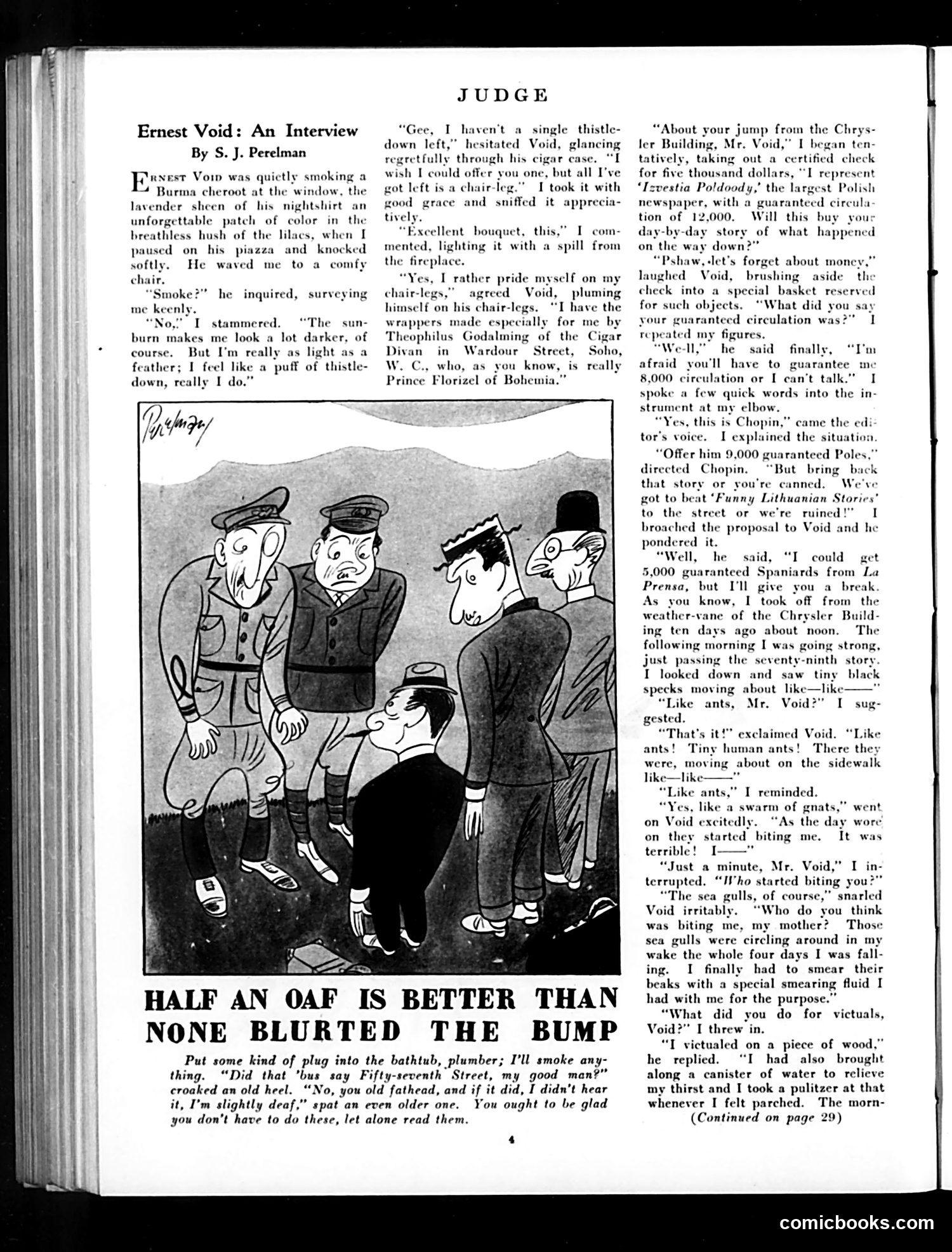
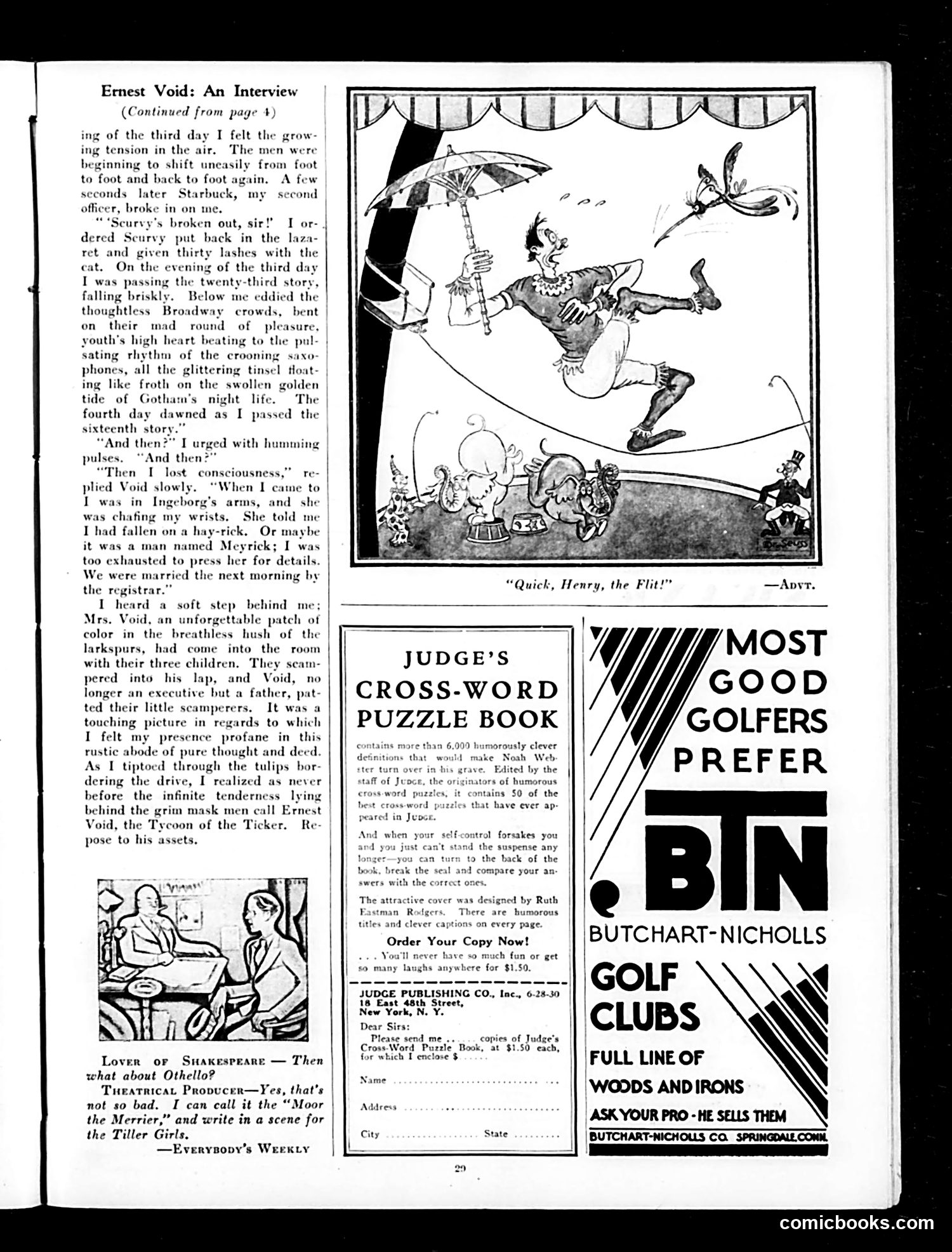
# Analysis of "Ernest Void: An Interview" This satirical interview features Ernest Void recounting his harrowing fall from the Chrysler Building in New York. The cartoon depicts policemen or authority figures surrounding Void as he describes his experience. The satire mocks Void's implausible survival story: he claims to have fallen from the building's weather vane, then encountered increasingly absurd obstacles—sea gulls biting him for four days, tiny black specks "like ants" and "gnats" attacking him. He "virtualed" his landing by imagining himself on wood. The piece ridicules tall-tale exaggeration and obvious fabrication. The title—"Half an Oaf Is Better Than None Blurted the Bump"—suggests Void is foolish or dishonest. Judge uses this interview to satirize either a specific dubious public figure or the broader phenomenon of unbelievable celebrity anecdotes.
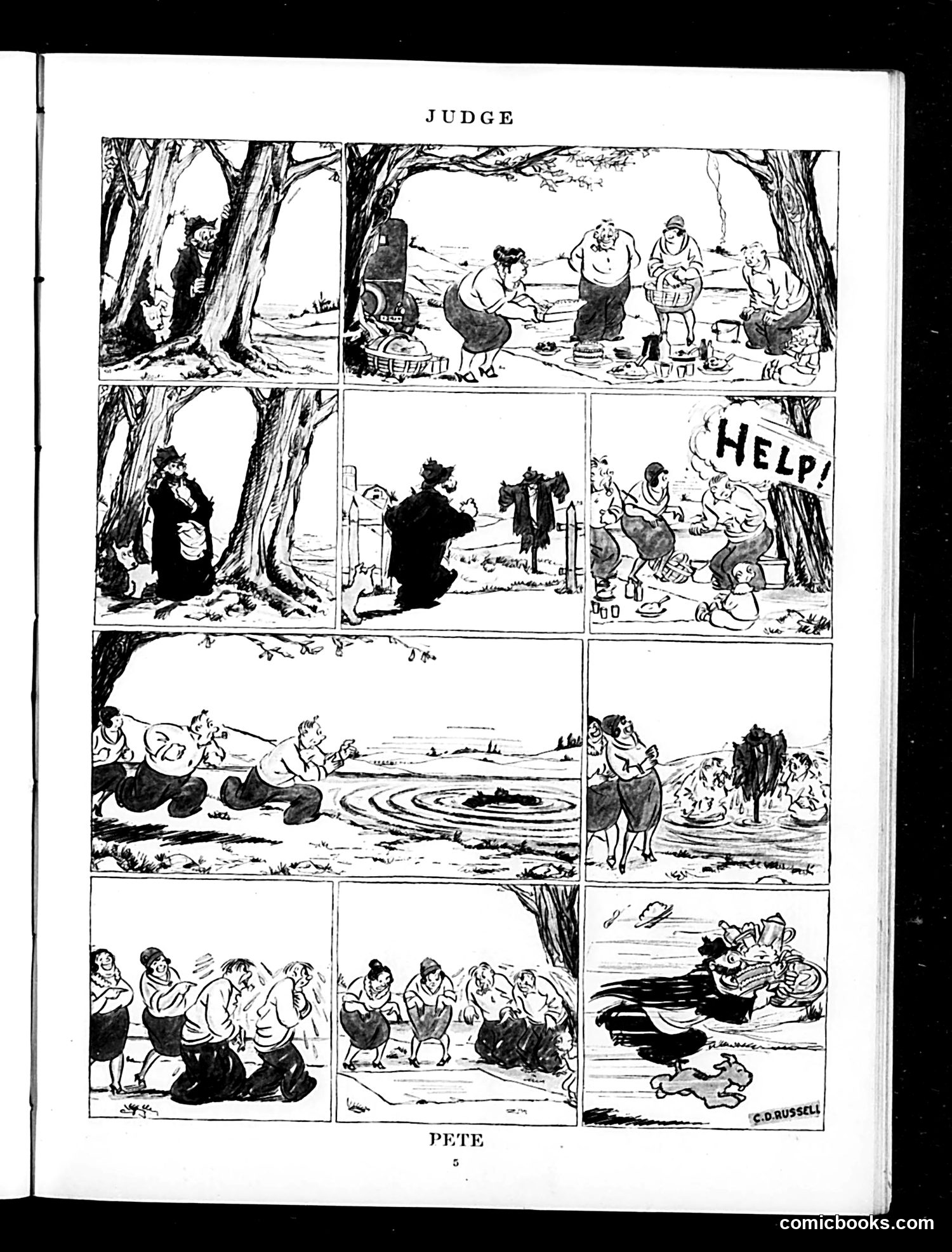
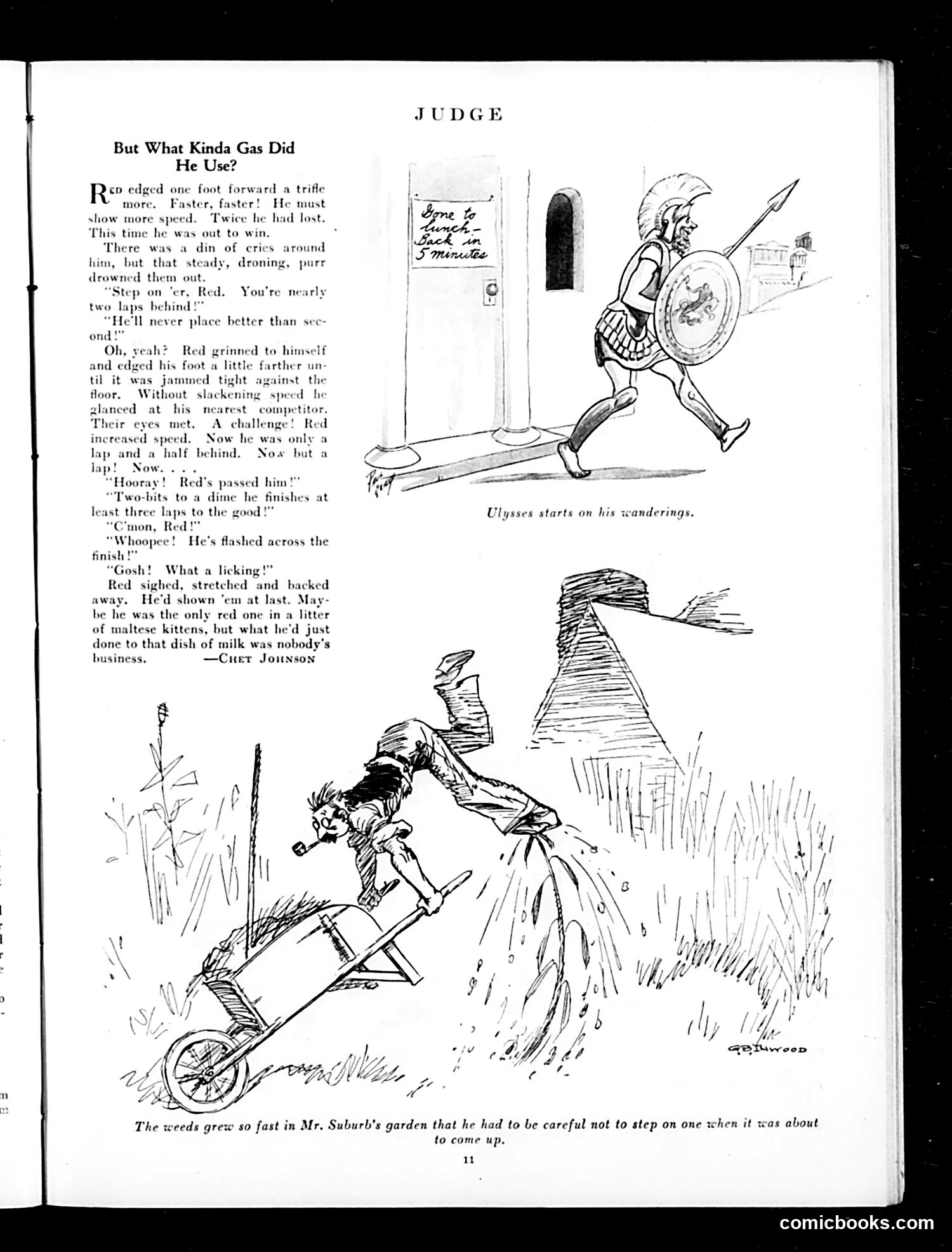
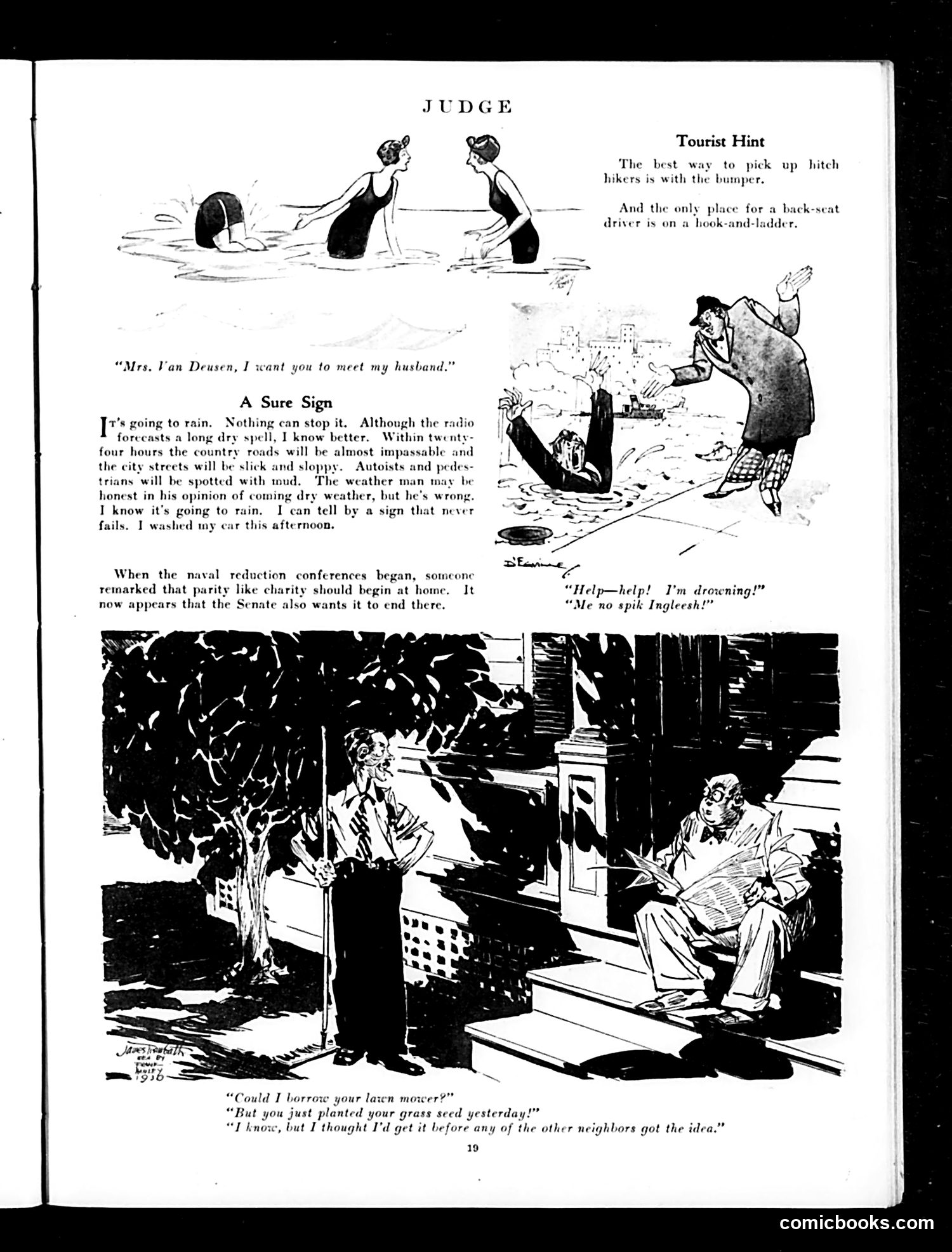
# Analysis of "Judge" Page - "Judge" and "Pete" This appears to be a two-panel comic strip narrative. The top panel titled "JUDGE" shows what seems to be a legal or authority figure encountering a group of people engaged in an outdoor gathering or picnic near trees. The figure in dark clothing (appearing to be the "judge") observes the scene, which escalates through subsequent panels into chaos—someone cries "HELP!", and the situation deteriorates into apparent disorder involving water and multiple figures. The bottom panel "PETE" continues the narrative with similar characters in increasingly frantic situations, culminating in what appears to be a drowning or water-related emergency scene. The satire likely critiques judicial authority, social gatherings, or public behavior, though the specific political/social reference remains unclear without additional historical context about when this was published.
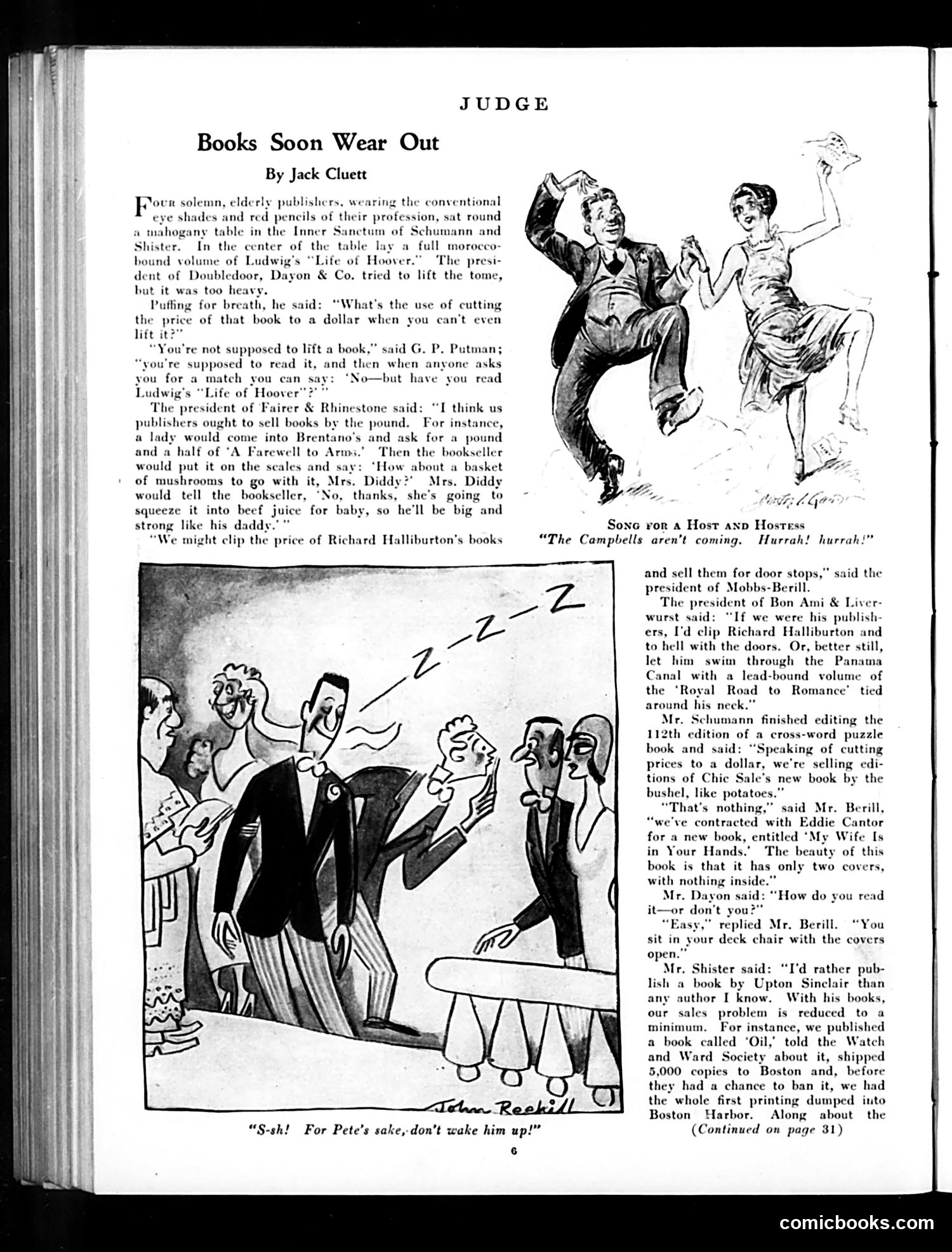
# "Books Soon Wear Out" by Jack Cluett This satirical article mocks 1920s-30s publishers' complaints about book durability and sales. Four elderly publishers debate solutions around a mahogany table while attempting to lift Ludwig's "Life of Hoover"—too heavy to manage. The satire targets publishers' absurd cost-cutting proposals: selling books by the pound, clipping prices of Richard Halliburton's volumes, using books as door stops, or even having customers read books in deck chairs without opening them. The cartoons ridicule publisher desperation during economic hardship. One illustration shows a sleeping figure labeled "Pete" while colleagues scheme nearby, capturing the exhausted state of the publishing industry. The piece's humor derives from the industry's increasingly ridiculous survival tactics rather than addressing fundamental market problems.
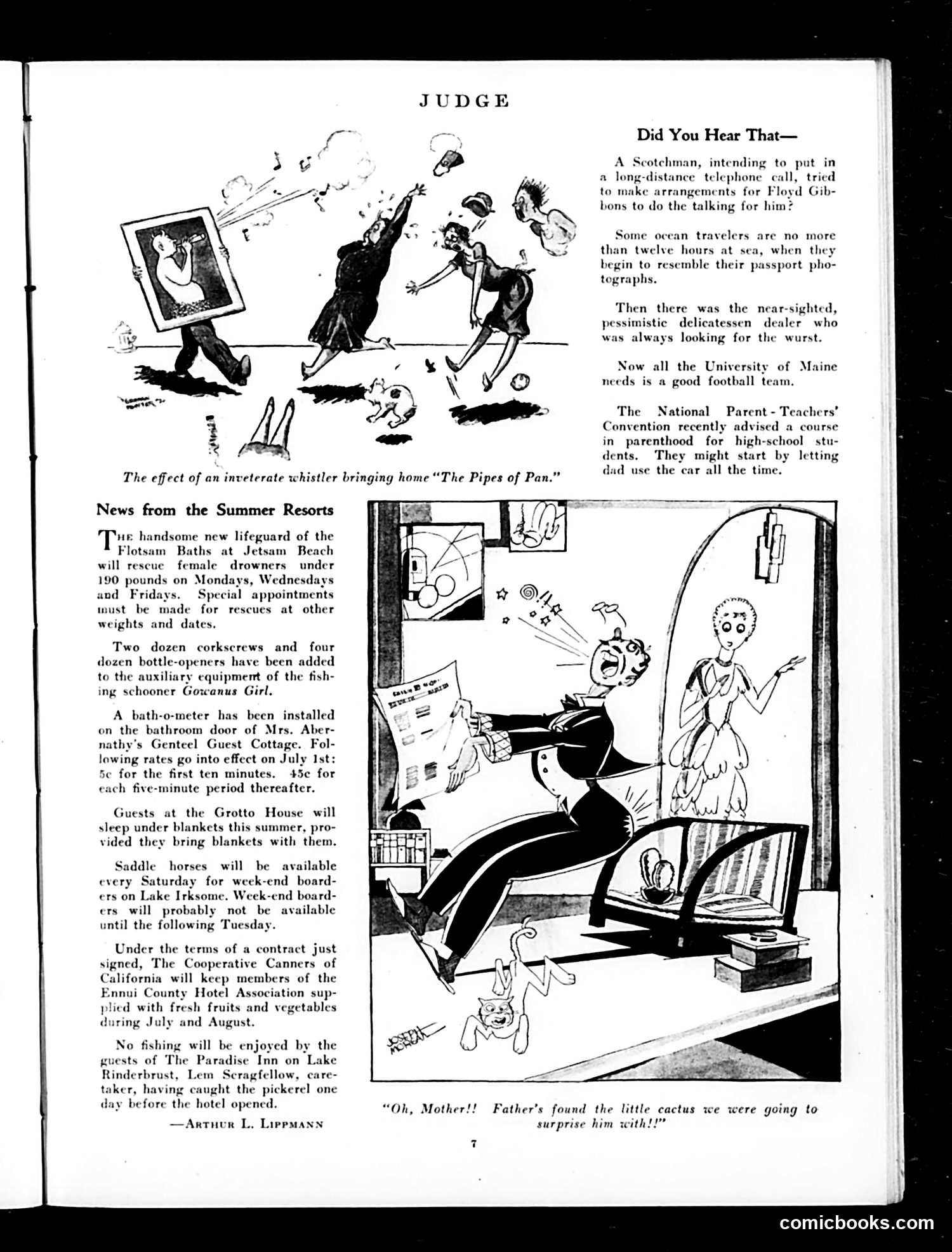
# Explanation for Modern Readers This is a humor page from *Judge* magazine featuring absurdist comedy typical of the 1920s-30s era. **"News from the Summer Resorts"** consists of mock announcements satirizing resort amenities and their petty absurdities: a lifeguard who only rescues women under 190 pounds (requiring appointments for heavier women), a guest cottage charging by the minute for bathroom use, horses available only on Saturdays (guests unavailable Sundays-Tuesdays), and a lake where fishing is impossible because the caretaker caught the only fish before opening. **"Did You Hear That"** presents brief gag jokes: a Scottish person arranging a paid speaker for a long-distance call (playing on Scottish frugality stereotypes), seasickness making travelers unrecognizable from passport photos, and a pessimistic delicatessen owner seeking "the wurst" (pun on German sausage). **The cartoon** shows a chaotic domestic scene where a father discovers a cactus the family planned as a surprise, depicted with slapstick visual humor typical of the era's comic illustration style. All content relies on wordplay, exaggeration, and gentle social mockery rather than topical references.
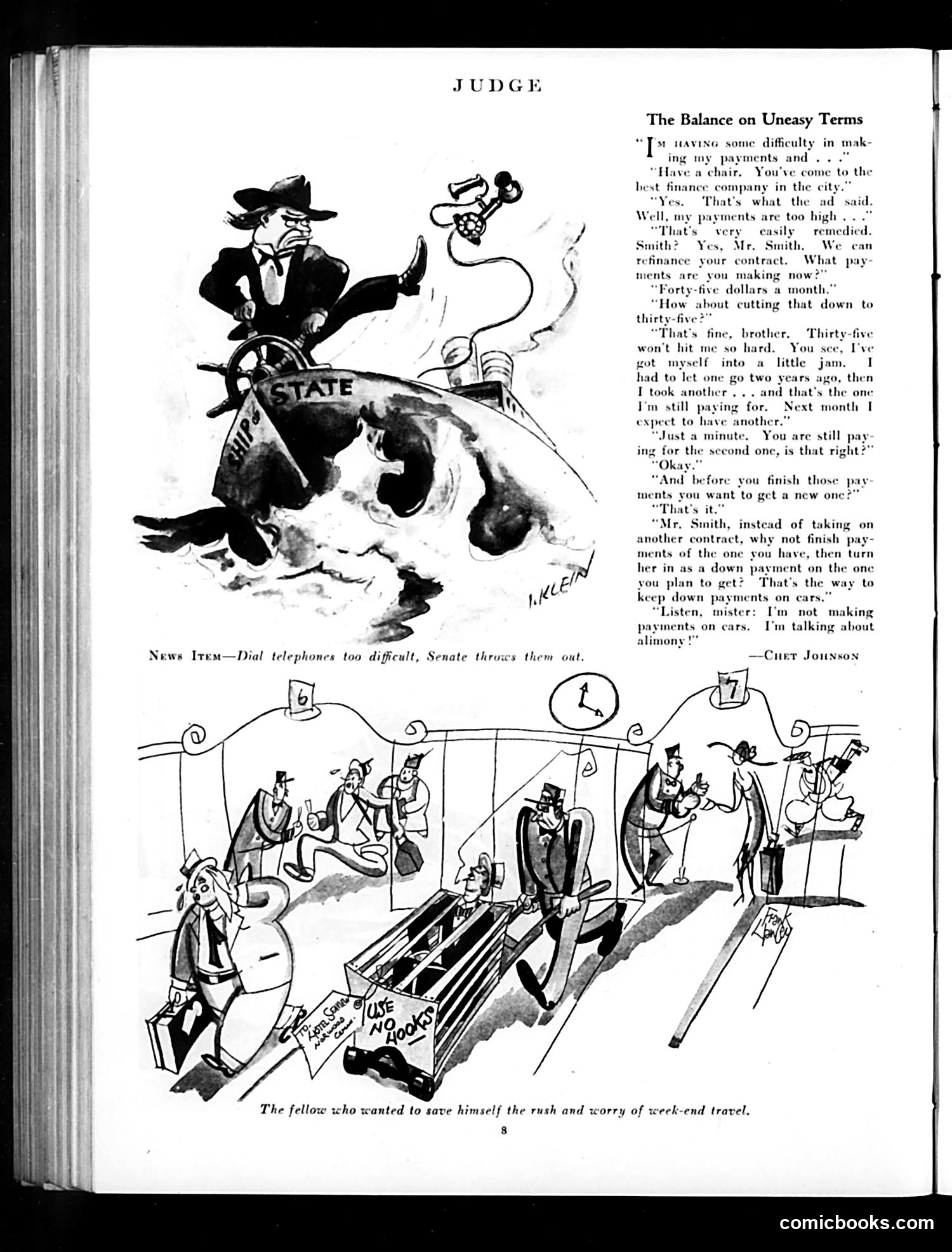
# Analysis of "The Balance on Uneasy Terms" This two-panel satirical piece critiques the finance industry's predatory lending practices during the early 20th century. **Top cartoon:** A judge-like figure (representing a finance company manager) steers a sinking ship labeled "STATE" while a creditor clings to the rigging. The imagery suggests financial institutions are capsizing the economy through reckless lending. **Main dialogue scene:** A customer named Mr. Smith seeks relief from high car payments ($45/month), but the finance company manager offers only superficial solutions—reducing one payment while trapping him in an endless cycle of debt. Smith reveals he's already in a "jam," having purchased multiple cars through refinancing, each loan creating new obligations. **The satire's point:** Rather than solving customers' financial problems, finance companies exploit desperation by perpetually rolling debt forward, keeping borrowers permanently enslaved to monthly payments. The joke is that Smith can't afford cars *or* make payments on them—yet the system keeps him buying anyway. The bottom cartoon caption suggests another scheme: pressuring customers into unnecessary weekend travel purchases to maintain payment momentum.
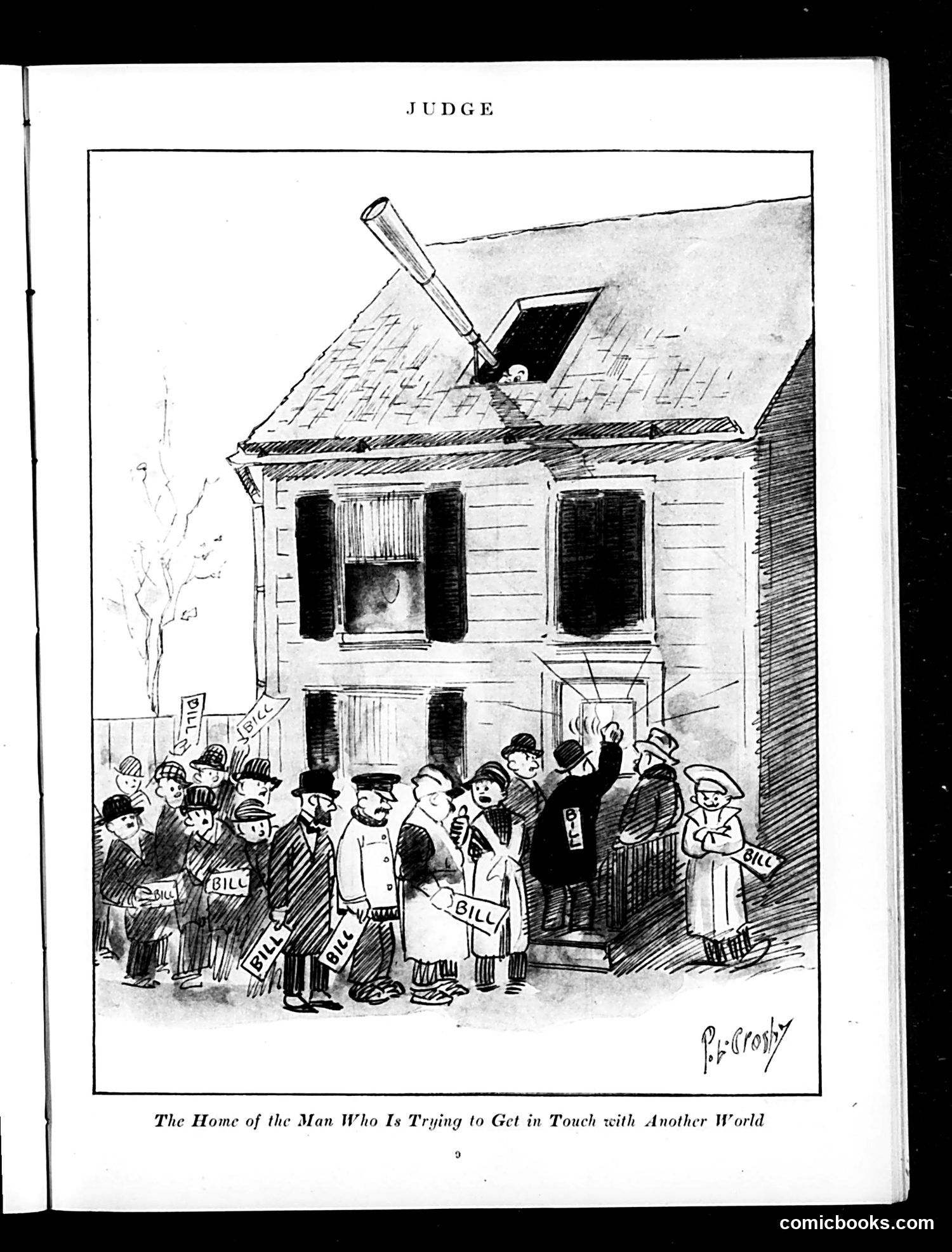
# "Judge" Cartoon Analysis This cartoon satirizes **spiritualism and séance culture**, which was popular in early 20th-century America. The caption indicates a man attempting to contact "another world"—a reference to spiritualist practices claiming to communicate with the dead. The image shows a modest house being literally dismantled by a large hammer and chisel on the roof, while crowds holding "BILL" signs gather at the entrance. This visualizes the financial ruin caused by the man's spiritualist obsession. The bills represent mounting debts, likely from paying spiritualist mediums and charlatans. The satire mocks both the credulity of spiritualism believers and the economic damage their pursuit causes their families. The physical destruction of the home literalizes how spiritualist expenses were destroying households—a common critique of the spiritualist movement's exploitation of vulnerable, grieving people seeking contact with deceased loved ones.
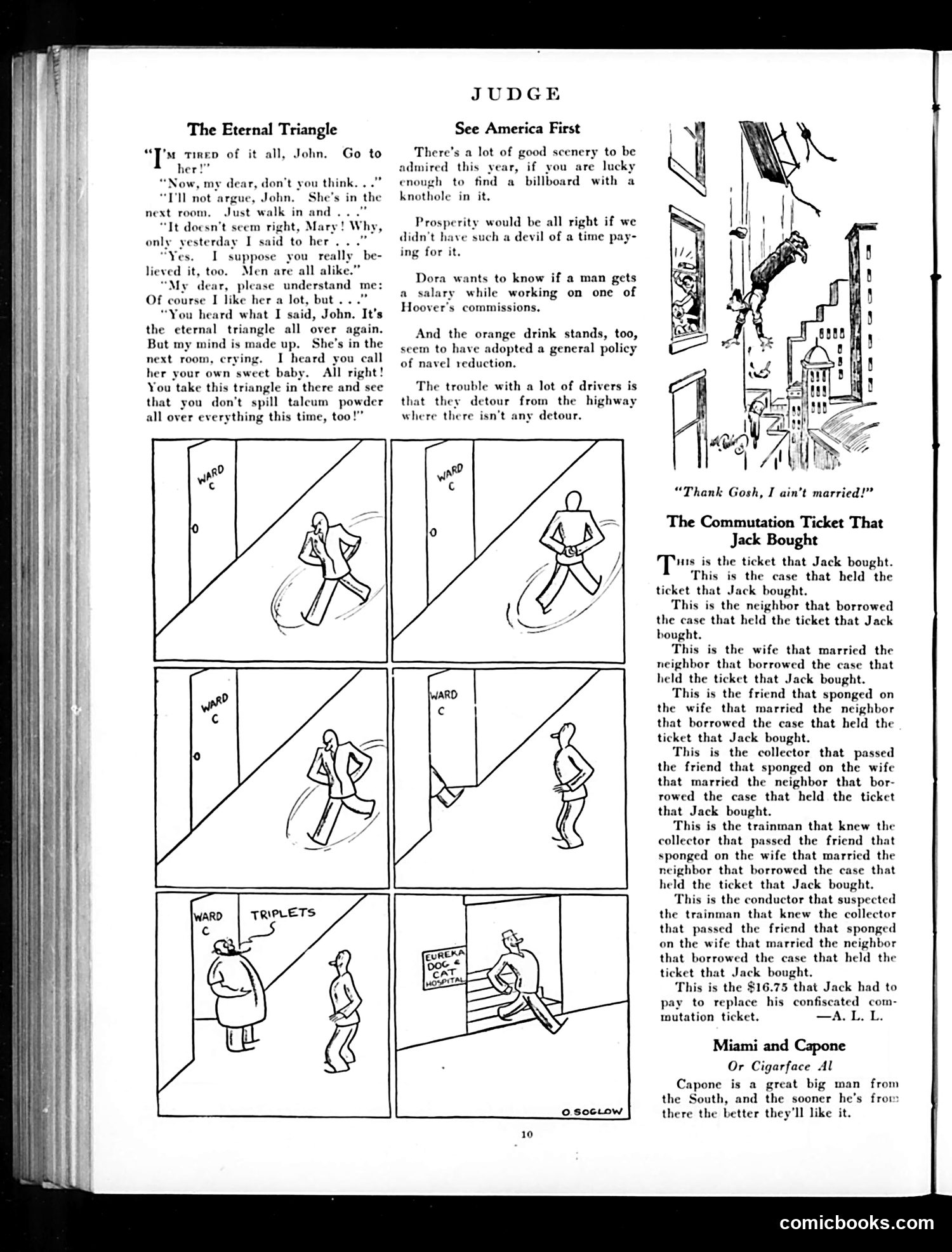
# Judge Magazine Page Analysis This page from *Judge* contains three distinct satirical pieces: **"The Eternal Triangle"**: A domestic comedy where a wife insists her husband visit their baby in the next room, sarcastically calling the situation an "eternal triangle"—a play on the melodramatic phrase typically meaning romantic infidelity. The joke is the mundane domestic reality versus the dramatic language. **"See America First"**: Brief one-liners mocking 1920s-30s American life, including jibes at billboards blocking scenic views, the difficulty of affording prosperity, Hoover's commissions, and reckless drivers. **"The Commutation Ticket That Jack Bought"**: A cumulative-verse satire (mimicking "This Is the House That Jack Built") about a commutation ticket's chaotic journey through multiple people, ending with Jack paying $16.75 to replace it—mocking bureaucratic inefficiency and the domino-effect consequences of minor losses. **"Miami and Capone"**: A brief, cryptic jab at Al Capone, suggesting the famous Chicago gangster should leave the South—likely referencing contemporary Prohibition-era organized crime concerns.