
Judge, 1930-06-28 · page 25 of 37
Judge — June 28, 1930 — page 25: what you’re looking at
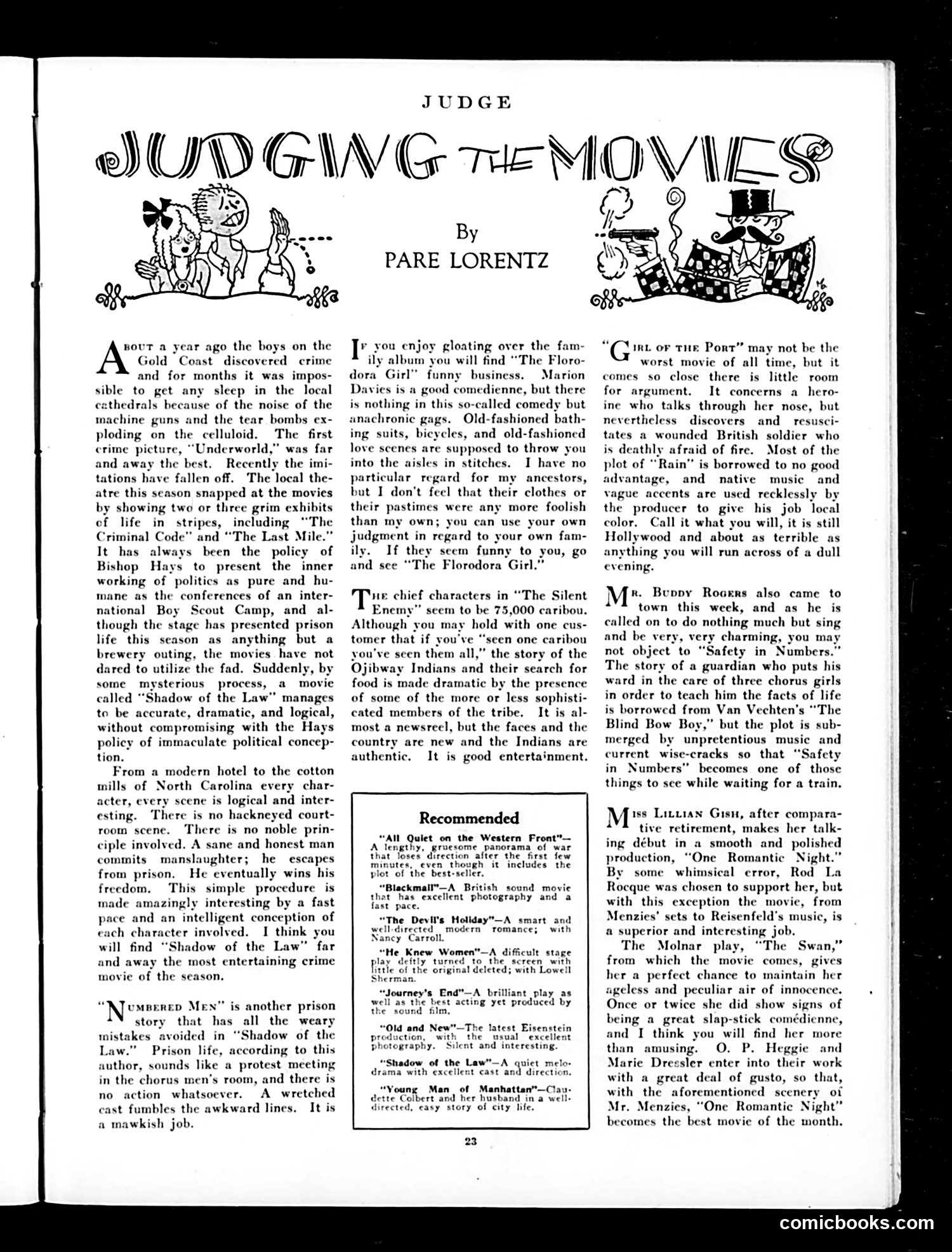
A restored page from Judge, 1930-06-28. Page through the whole issue in the reader above.
📄 Transcribed text from this page (OCR, searchable)
Machine-transcribed from the original scan — historical spelling and the odd misread are preserved.
JUV GING THI Bout a year ago the boys on the A Gold Coast discovered crime and for months it was impos- sible to get any sleep in the local hedrals because of the noise of the machine guns and the tear bombs ex- ploding on the celluloid. The first crime picture, “Underworld,” was far and away the best. Recently the imi- tations have fallen off. The local the- atre this season snapped at the movies by showing two or three grim exhibits of life in stripes, including “The Criminal Code” and “The Last Mile.” It has always been the policy of Bishop Hays to present the inner working of politics as pure and hu- mane as the conferences of an inter- national Boy Scout Camp, and al- though the stage has presented prison life this season as anything but a brewery outing, the movies have not dared to utilize the fad. Suddenly, by some mysterious process, a movie called “Shadow of the Law” manages to be accurate, dramatic, and logical, without compromising with the Hays policy of immaculate political concep- tion. From a modern hotel to the cotton mills of North Carolina every char- acter, every scene is logical and inter- esting. There is no hackneyed court- room scene. There is no noble prin- ciple involved. A sane and honest man commits manslaughter; he escapes from prison. He eventually wins his freedom. This simple procedure is made amazingly interesting by a fast pace and an intelligent conception of each character involved. 1 think you will find “Shadow of the Law” far and away the most entertaining crime movie of the season, “Nounene Mes” is another prison story that has all the weary mistakes avoided in “Shadow of the Law.” Prison life, according to this author, sounds like a protest meeting in the chorus men’s room, and there is no action whatsoever. A wretched cast fumbles the awkward lines. It is a mawkish job. JUDGE By PARE LORENTZ I you enjoy gloating over the fam- ily album you will find “The Floro- dora Girl” funny business. Marion Davies is a good comedienne, but there is nothing in this so-called comedy but anachronic Old-fashioned bath- ing suits, bicycles, and old-fashioned love scenes are supposed to throw you into the aisles in stitches. I have no particular regard for my ancestors, but I don’t feel that their clothes or their pastimes were any more foolish than my own; you can use your own judgment in regard to your own fam- ily. If they seem funny to you, go and see “The Florodora Girl.” Tie chief characters in “The Silent Enemy” seem to be 75,000 caribou. Although you may hold with one cus- tomer that if you've “seen one caribou you've seen them all,” the story of the Ojibway Indians and their search for food is made dramatic by the presence of some of the more or less sophis cated members of the tribe. It is al- most a newsreel, but the faces and the country are new and the Indians are authentic. It is good entertainment. Recommended “AM Quiet on the Western Front”— A lengthy, gruesome panorama of war that loses direction after the first few minutes, even though it includes the plot of the best-seller, “Blackmail”—A British sound movie that has excellent photography and a fast pace. e Devil's Holiday”—A smart and irected modern romance; with Carroll. “He Knew Women"—A dificult stage lay deftly turned to the screen with jttle of the original deleted; with Lowell Sherman. “Journey's End"—A brilliant play as well as the best acting yet produced by the sound film, well Nancy “Old and New"—The latest Eisenstein production, with the usual excellent photography. Silent and interesting. shadow of the drama with excel w"—A quiet melo- cast and direction. “Young Man of Manhattan”—Cta lette Colbert and her husband in a well rected, easy story of city life, "G IRL oF THE Port” may not be the worst movie of all time, but it comes so close there is little room for argument. It concerns a_hero- ine who talks through her nose, but nevertheless discovers and resusci- tates a wounded British soldier who is deathly afraid of fire. Most of the plot of “Rain” is borrowed to no good advantage, and native music and vague accents are used recklessly by the producer to give his job local color, Call it what you will, it is still Hollywood and about as terrible as anything you will run across of a dull evening. M: Buppy Rooers also came to town this week, and as he is called on to do nothing much but sing and be very, very charming, you may not object to “Safety in Numbers.” The story of a guardian who puts his ward in the care of three chorus girls in order to teach him the facts of life is borrowed from Van Vechten’s “The Blind Bow Boy,” but the plot is sub- merged by unpretentious music and current wise-cracks so that “Safety in Numbers” becomes one of those things to sce while waiting for a train. iss Littian Gist, after compara- tive retirement, makes her talk- ing début in a smooth and_ polis! production, “One Romantic By some whimsical error, Rocque was chosen to support her, but with this exception the movie, from Menzies’ sets to Reisenfeld’s music, is a superior and interesting job. The Molnar play, “The Swan,” from which the movie comes, g her a perfect chance to maintain her ageless and peculiar air of innocence. Once or twice she did show being a great slap-stick cc and I think you will find her more than amusing. O, P. Heggie and Marie Dressler enter into their work h a great deal of gusto, so that, with the aforementioned scenery of Mr. Menzies, “One Romantic Night” becomes the best movie of the month. comicbooks.com