
Judge, 1930-06-28 · page 18 of 37
Judge — June 28, 1930 — page 18: what you’re looking at
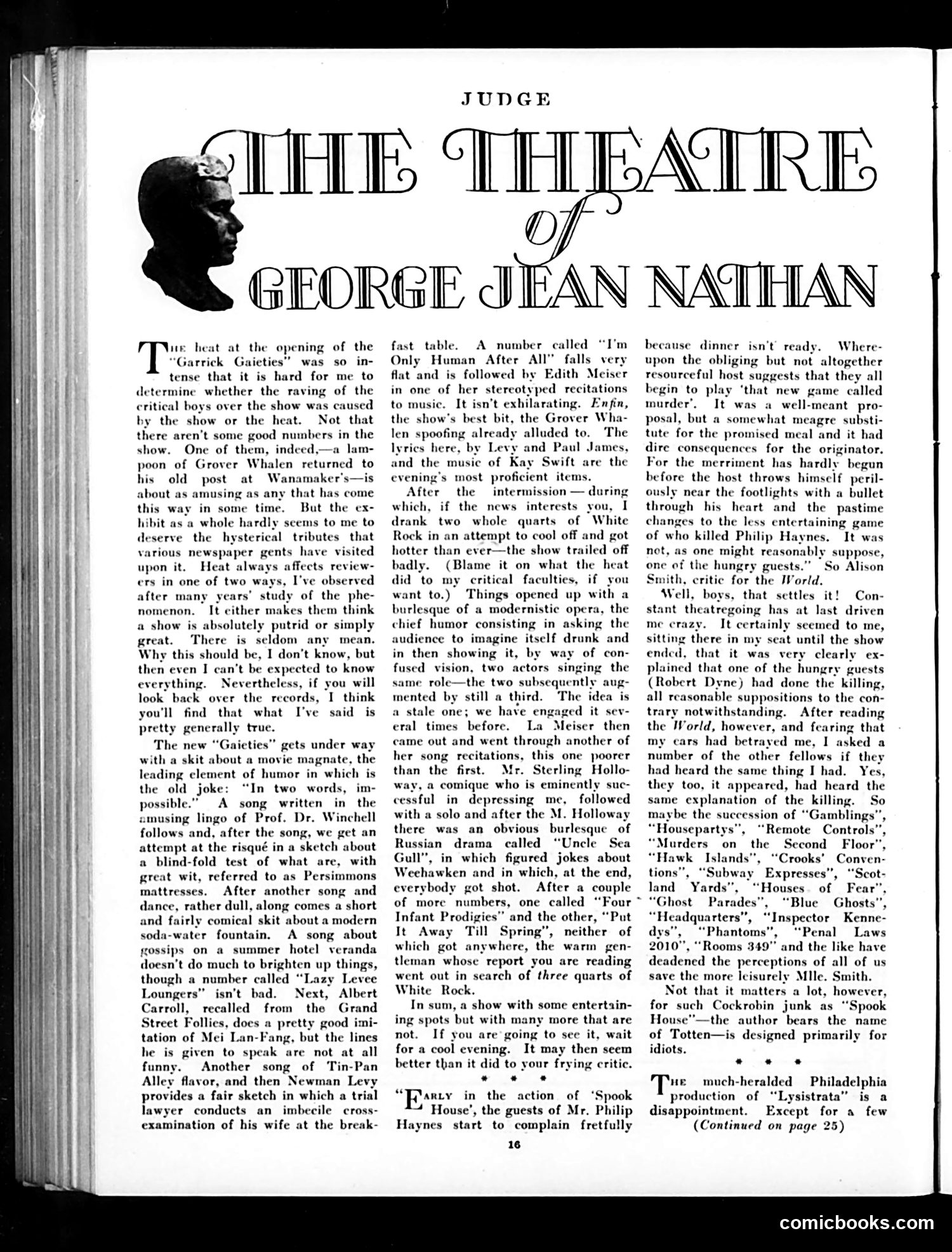
A restored page from Judge, 1930-06-28. Page through the whole issue in the reader above.
📄 Transcribed text from this page (OCR, searchable)
Machine-transcribed from the original scan — historical spelling and the odd misread are preserved.
O GEORGE J ue heat at the opening of the “Garrick Gaieti was so in- tense that it is hard for me to determine whether the raving of the critical boys over the show was caused by the show or the heat. Not that there aren't some good numbers in the show. One of them, indced,—a lam- poon of Grover Whalen returned to his old post at Wanamaker's—is about as amusing as any that has come this way in some time. But the ex- hibit as'a whole hardly seems to me to deserve the hysterical tributes that various newspaper gents have visited upon it. Heat always affects review- ers in one of two ways, I've observed after many years’ study of the phe- nomenon. It either makes them think a show is absolutely putrid or simply There is seldom any mean. this should be, I don’t know, but then even I can’t be expected to know everything. Nevertheless, if you will look back over the records, I think you'll find that what I've said is pretty generally true. The new “Gaieties” gets under way with a skit about a movie magnate, the leading clement of humor in which is the old joke: “In two words, im- possible.” A song written in the amusing lingo of Prof. Dr. Winchell follows and, after the song, we get an attempt at the risqué in a sketch about a blind-fold test of what are, with great wit, referred to as Persimmons mattresses. After another song and dance, rather dull, along comes a short and fairly comical skit about a modern ja-water founta A song about gossips on a summer hotel veranda doesn't do much to brighten up things, though a number called “Lazy Levee Loungers” isn't bad. Next, Albert Carroll, recalled from the Grand Street Follies, does a pretty good imi- tation of Mei Lan-Fang, but the lines he is given to speak are not at all Another song of Tin-Pan y flavor, and then Newman Levy provides a fair sketch in which a trial lawyer conducts an imbecile cross- examination of his wife at the break- fast table. A number called “I'm Only Human After All” falls very flat and is followed by Edith M in one of her stereotyped recita to music. It isn’t exhi the show's best bit, the Grover Wha- len spoofing already alluded to. The lyrics here, by Levy and Paul James, and the music of Kay Swift are the evening's most proficient items. After the — intermission — during which, if the news interests you, I drank two whole quarts of White Rock in an attempt to cool off and got hotter than ever—the show trailed off badly. (Blame it on what the heat did to my critical faculties, if you want to.) Things opened up with a burlesque of a modernistic opera, the chief humor consisting in asking the audience to imagine itself drunk and in then showing it, by way of con- fused vision, two actors singing the same role—the two subsequently aug- mented by still a third. The idea is a stale one; we have engaged it sev- eral times before. La Meiser then came out and went through another of her song recitations, this one poorer than the first. Mr. Sterling Hollo- way, a comique who is eminently suc- cessful in depressing me, followed with a solo and after the M. Holloway there was an obvious burlesque of Russian drama called “Uncle Sea Gull", in which figured jokes about Weehawken and in which, at the end, everybody got shot. After a couple of more numbers, one called Infant Prodigies” and the other, “Put It Away Till Spring”, neither of which got anywhere, the warm gen- tleman whose report you are reading went out in search of three quarts of White Rock. In sum, a show with some entertain- ing spots but with many more that are not. If you are going to see it, wait for a cool evening. It may then seem better than it did to your frying critic. * * « “Fianey in the action of ‘Spook ~ House’, the guests of Mr. Philip Haynes start to complain fretfully 16 Pour ~ ACI Es NATHAN because dinner isn't’ ready. Where- upon the obliging but not altogether resourceful host suggests that they all begin to play ‘that new game called murder’, It was a well-meant_ pro- posal, but a somewhat meagre substi- tute for the promised meal and it had dire consequences for the originator. For the merriment has hardly begun before the host throws himself peril- ously near the footlights with a bullet through his heart and the pastime changes to the less entertaining game of who killed Philip Hayn It was not, as one might reasonably suppose, one of the hungry gue: So Alison Smith, critic for the World. Well, boys, that settles i stant theatregoing has at 1s It certainly seemed to me, i, that it was very clearly ex- plained that one of the hungry guests (Robert Dyne) had done the killing, all reasonable suppositions to the con- trary notwithstanding. After reading the World, however, and fearing that my cars had betrayed me, I asked a number of the other fellows if they had heard the same thing I had. Ye they too, it appeared, had heard the same explanation of the killing. So maybe the succession of ‘“Gamblings”, lousepartys”, “Remote Controls”, “Murders on the Second Floor”, “Hawk Islands”, “Crooks’ Conven- tions”, “Subway Expresses”, ‘Scot- land Yards", “Houses of Fear’, host Parades”, “Blue Ghosts”, “Headquarters”, “Inspector Kenne- dys”, “Phantoms”, “Penal Laws 2010", “Rooms 349" and the like have deadened the perceptions of all of us save the more leisurely Mlle. Smith. Not that it matters a lot, however, for such Cockrobin junk as “Spook House"—the author bears the name of Totten—is designed primarily for idiots. * #8 « ‘ne ~=much-heralded Philadelphia production of “Lysistrata” is a disappointment. Except for a few (Continued on page 25) comicbooks.com