
Judge, 1930-06-28 · page 15 of 37
Judge — June 28, 1930 — page 15: what you’re looking at
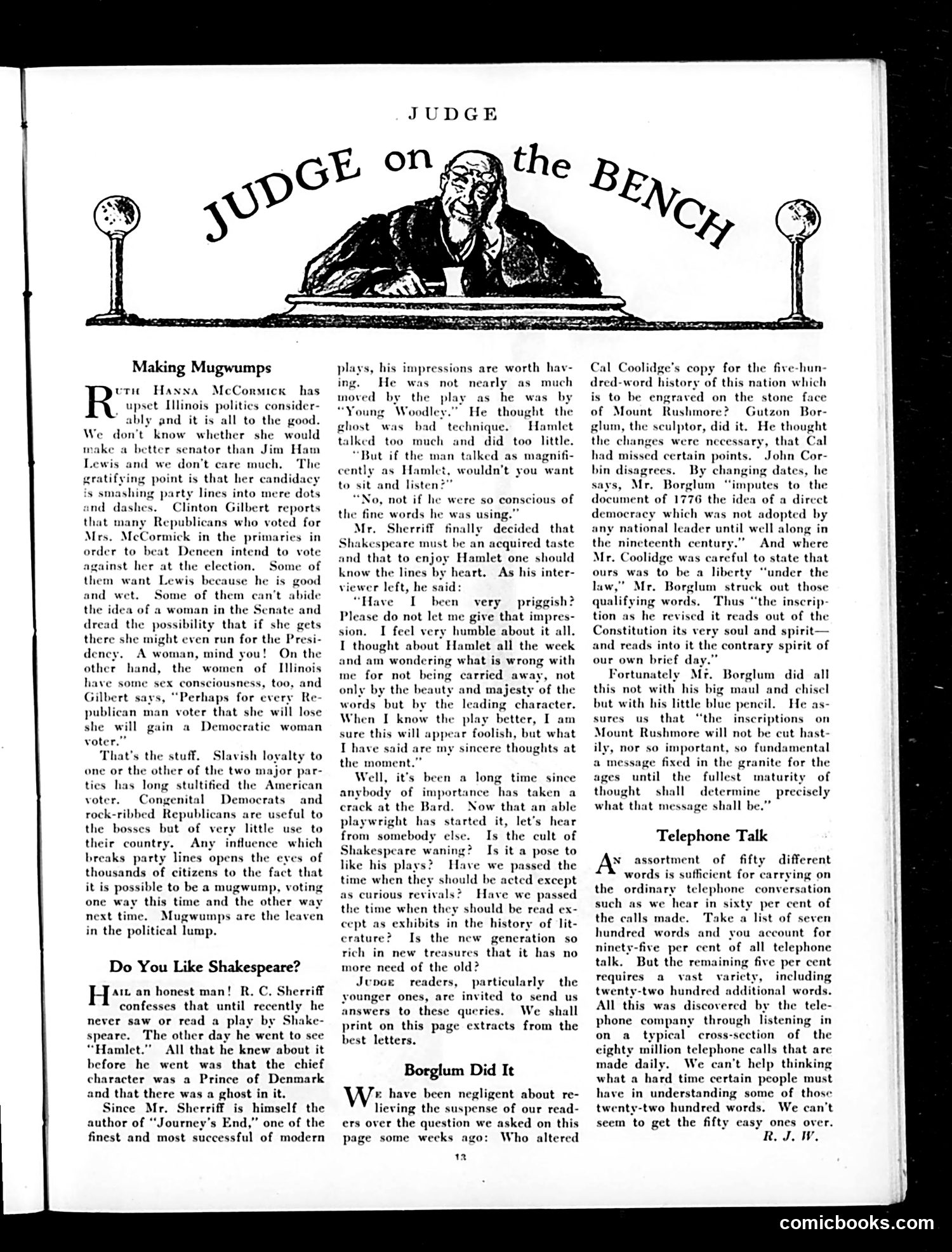
A restored page from Judge, 1930-06-28. Page through the whole issue in the reader above.
📄 Transcribed text from this page (OCR, searchable)
Machine-transcribed from the original scan — historical spelling and the odd misread are preserved.
Making Mugwumps uti Hanna McCormick has R upset Illinois politics consider- ably and it is all to the good. We don't know whether she would make a better senator than Jim I Lewis and we don’t care much, gratifying point is that her candidacy s smashing party lines into mere dots and dashes. Clinton Gilbert reports that many Republicans who voted for Mrs. McCormick in the primaries in order to beat Deneen intend to vote against her at the election, Some of them want Lewis because he is good nd wet. Some of them can't abide the idea of a woman in the Senate and dread the possibility that if she gets there she might even run for the Presi- dency. A woman, mind you! On the other hand, the women of Illinois have some sex consciousness, too, and Gilbert says, “Perhaps for every Re publican man voter that she will lose she will gain a Democratic woman voter.” That's the stuff. Slavish loyalty to one or the other of the two major par- ties has long stultified the American voter. Congenital Democrats and rock-ribbed Republicans are useful to the bosses but of very little use to their country. Any influence which breaks party lines opens the eyes of thousands of citizens to the fact that it is possible to be a mugwump, voting one way this time and the other w next time. Mugwumps are the lea in the political lump. Do You Like Shakespeare? ait an honest man! R. C, Sherriff confesses that until recently he never saw or read a play by Shake- speare. The other day he went to see “Hamlet.” All that he knew about it before he went was that the chief character was a Prince of Denmark and that there was a ghost in it. Since Mr. Sherriff is himself the author of “Journey's End,” one of the finest and most successful of modern JUDGE s, his impressions are worth hav- He was not nearly as muc moved by the play as he was by “Young Woodley.” He thought the ghost was bad’ technique. Hamlet talked too much and did too little. “But if the man talked as magnifi- cently as Hamlet, wouldn't you want to sit and listen “No, not if he were so conscious of the fine words he was using.” Mr. Sherriff finally decided that Shakespeare must be an acquired taste and that to enjoy Hamlet one should know the lines by heart. As his inter- ewer left, he said: “Have I been very priggish? Please do not let me give that impres- sion. I feel very humble about it all. I thought about Hamlet all the week and am wondering what is wrong with me for not being carried away, not only by the beauty and majesty of the words but by the leading character. When I know the play better, I am sure this will appear foolish, but what I have said are my sincere thoughts at the moment.” Well, it's been a long time since anybody of importance has t crack at the Bard. Now thi playwright has started it, let from somebody else. Is the cult of Shakespeare waning? Is it a pose to like his plays? Have we passed the time when they should be acted except as curious revivals? Have we passed the time when they should be read ¢ cept as exhibits in the history of lit- erature Is the new gencration so rich in new treasures that it has no more need of the old? Jvpoe readers, particularly _ the ounger ones, are invited to send us nswers to these queries. We shall print on this page extracts from the best letters. Borglum Did It have been negligent about re- ieving the suspense of our read- W. ers over the question we asked on this page some wecks ago: Who altered 12 Cal Coolidge’s copy for the five-hun- dred-word history of this nation which is to be engraved on the stone face of Mount Rushmore? Gutzon Bor- glum, the sculptor, did it. He thought the changes were necessary, that Cal had missed certain points. John Cor- bin disagrees. By changing dates, he , Mr. Borglam “imputes to. the document of 1776 the idea of a direct democracy which was not adopted by any national leader until well along in the nineteenth century.” And where Mr. Coolidge was careful to state that ours was to be a liberty “under the law,” Mr. Borglum struck out those qualifying words. Thus “the inscrip- tion as he revised it reads out of the Constitution its very soul and spirit— and reads into it the contrary spirit of our own brief day.” Fortunately Mr. Borglum did all this not with his big maul and chisel but with his little blue pencil. He as- sures us that “the inscriptions on Mount Rushmore will not be cut hast- ily, nor so important, so fundamental a message fixed in the granite for the ages until the fullest’ maturity of thought shall determine precisely what that message shall be.” Telephone Talk AY assortment of fifty different words is sufficient for carrying on the ordinary telephone conversation such as we hear in si: per cent of the calls made. Take a list of seven hundred words and you account for ninety-five per cent of all telephone talk. But the remaining five per cent requires a vast variety, including twenty-two hundred additional words. All this was discovered by the tel phone company through listening in on a typi cros: tion of the cighty million telephone calls that are made daily. We can't help thinking what a hard time certain people must have in understanding some of those twenty-two hundred words. We can't seem to get the fifty easy ones over. RJLW. comicbooks.com