A complete issue · 36 pages · 1930
Judge — February 8, 1930
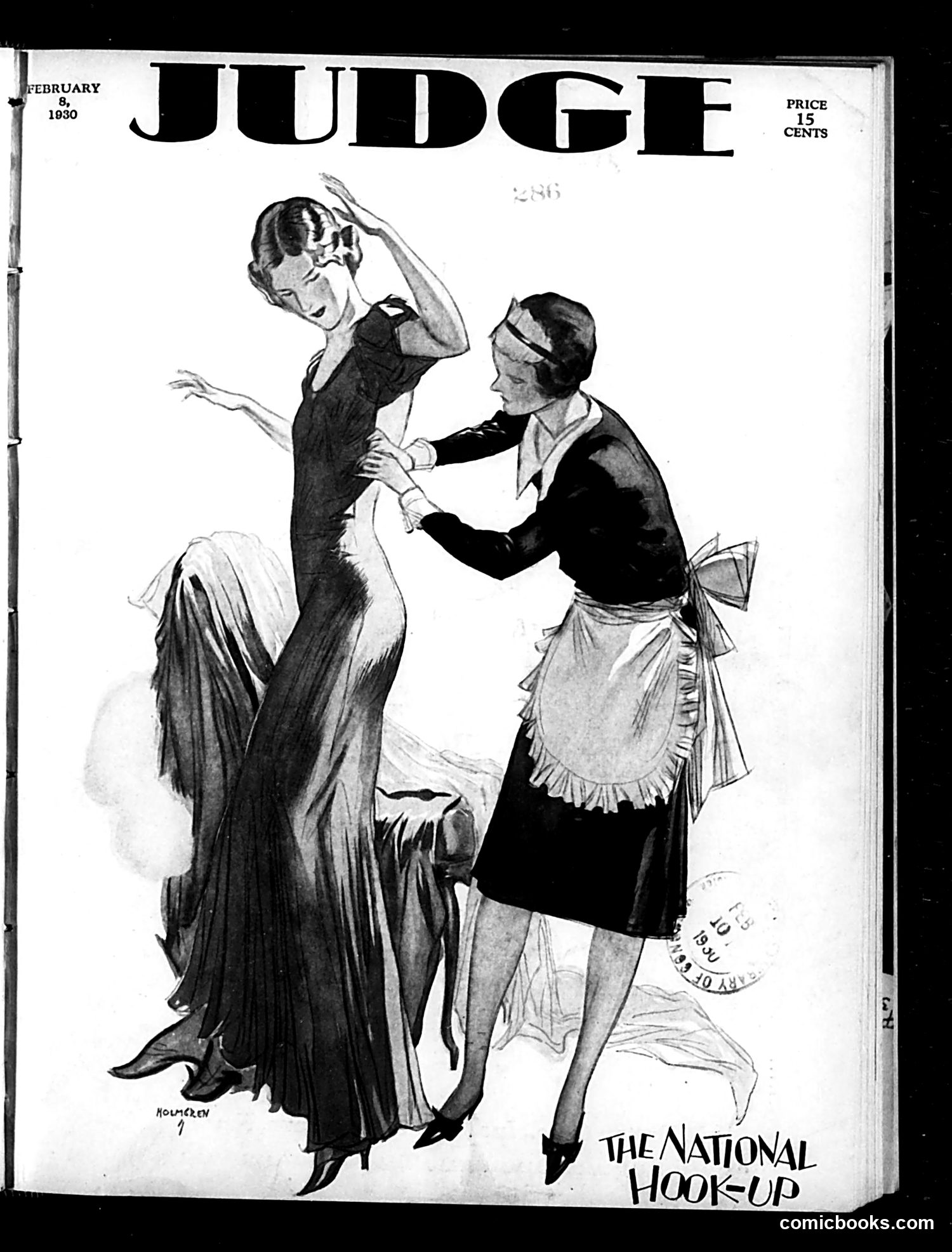
# "The National Hook-Up" - Judge Magazine, February 1930 This cartoon satirizes the emerging phenomenon of **radio network broadcasting**. The illustration shows two women: one elegantly dressed, being "hooked up" or connected by another woman dressed as a maid or servant. The title "The National Hook-Up" references the newly-formed radio networks that "connected" America through synchronized broadcasts. The visual pun plays on the phrase—literally depicting women being physically linked together, mirroring how radio networks linked cities and audiences nationwide. This reflects 1930s anxieties about rapid technological change and mass media's power to standardize American culture. The satirical tone suggests ambivalence toward this new interconnected society, using the intimate domestic scene to make the abstract concept of national broadcasting tangible and somewhat absurd.
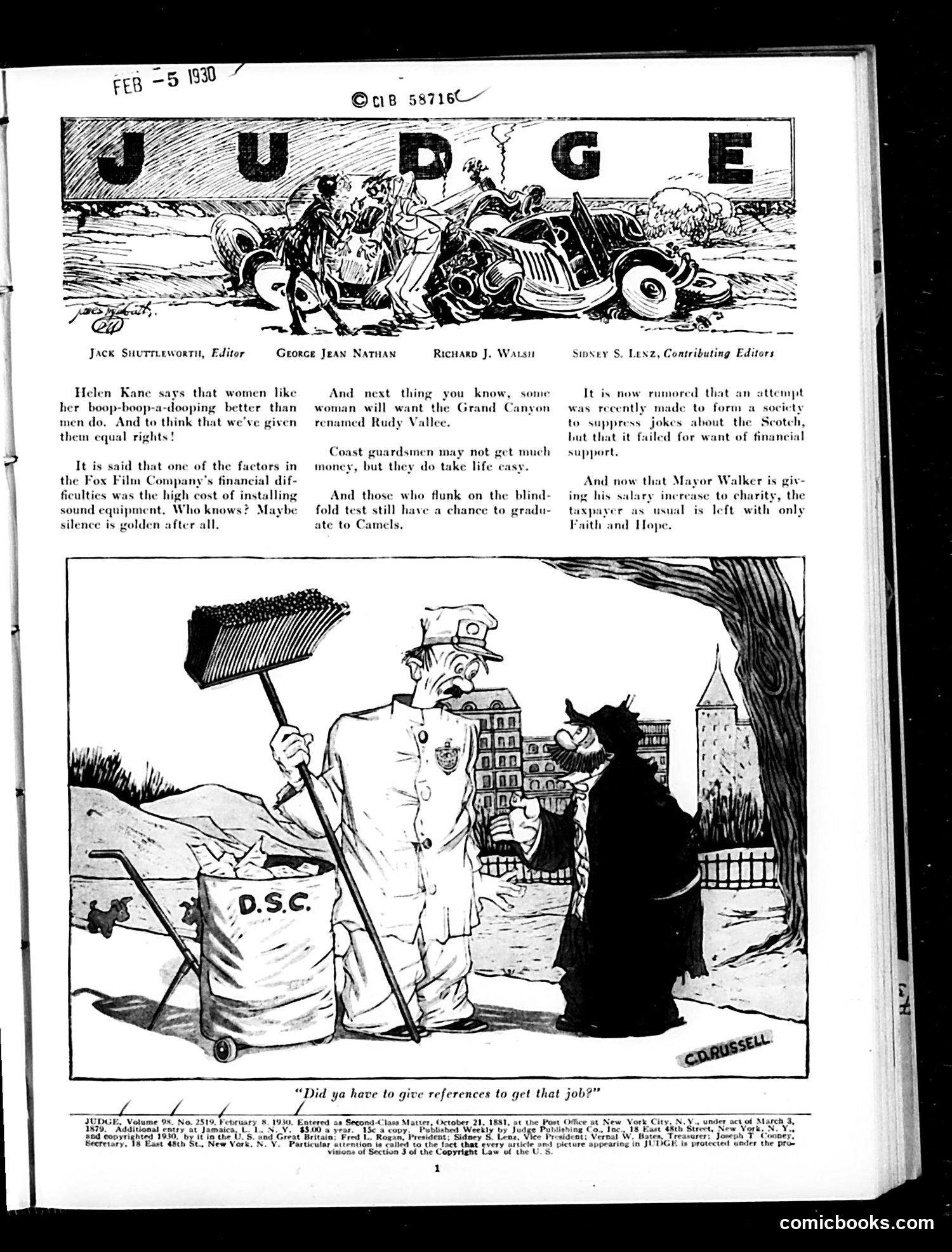
# Explanation of This Judge Magazine Page (February 5, 1930) The main cartoon depicts a figure labeled "D.S.C." (likely the District of Columbia or a government agency) sweeping filth while confronting a sinister dark figure—apparently representing political corruption or misconduct in Washington, D.C. The caption "Did ya have to give references to get that job?" suggests satirical commentary on nepotism, patronage, or unqualified appointments in government employment. The surrounding text contains brief satirical commentary on contemporary issues: Helen Kane and women in entertainment, the Fox Film Company's financial troubles with sound equipment, and Mayor Walker's salary increase despite taxpayer hardship—references to 1920s-30s New York politics and the early Depression era. The overall message critiques government inefficiency and corruption during this period.
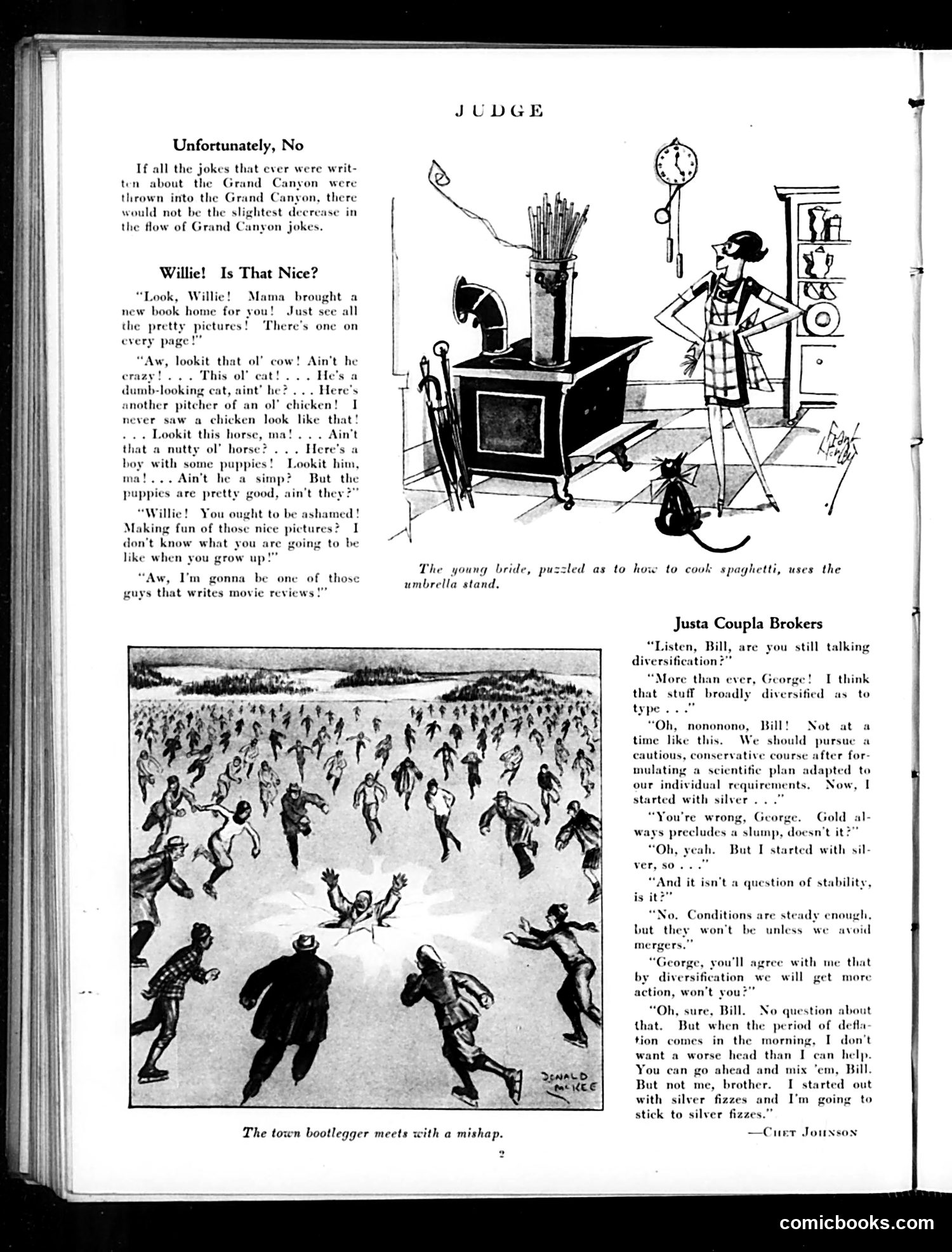
# Analysis of Judge Magazine Page This page contains three unrelated pieces: 1. **"Unfortunately, No"** - A humorous piece about Grand Canyon jokes with a child named Willie mispronouncing animals in a picture book (calling a horse a "simp," etc.). 2. **"Willie! Is That Nice?"** - A cartoon showing a young bride confused about cooking spaghetti, using an umbrella stand as a pasta holder. The joke relies on domestic incompetence humor common to the era. 3. **"Justa Coupla Brokers"** - A dialogue between Bill and George about investment diversification, debating whether to use gold or silver for financial stability. This appears to be financial satire, though the specific market conditions referenced are unclear without dating information. The page reflects early-to-mid 20th century American humor: domestic stereotypes, financial speculation commentary, and wordplay.
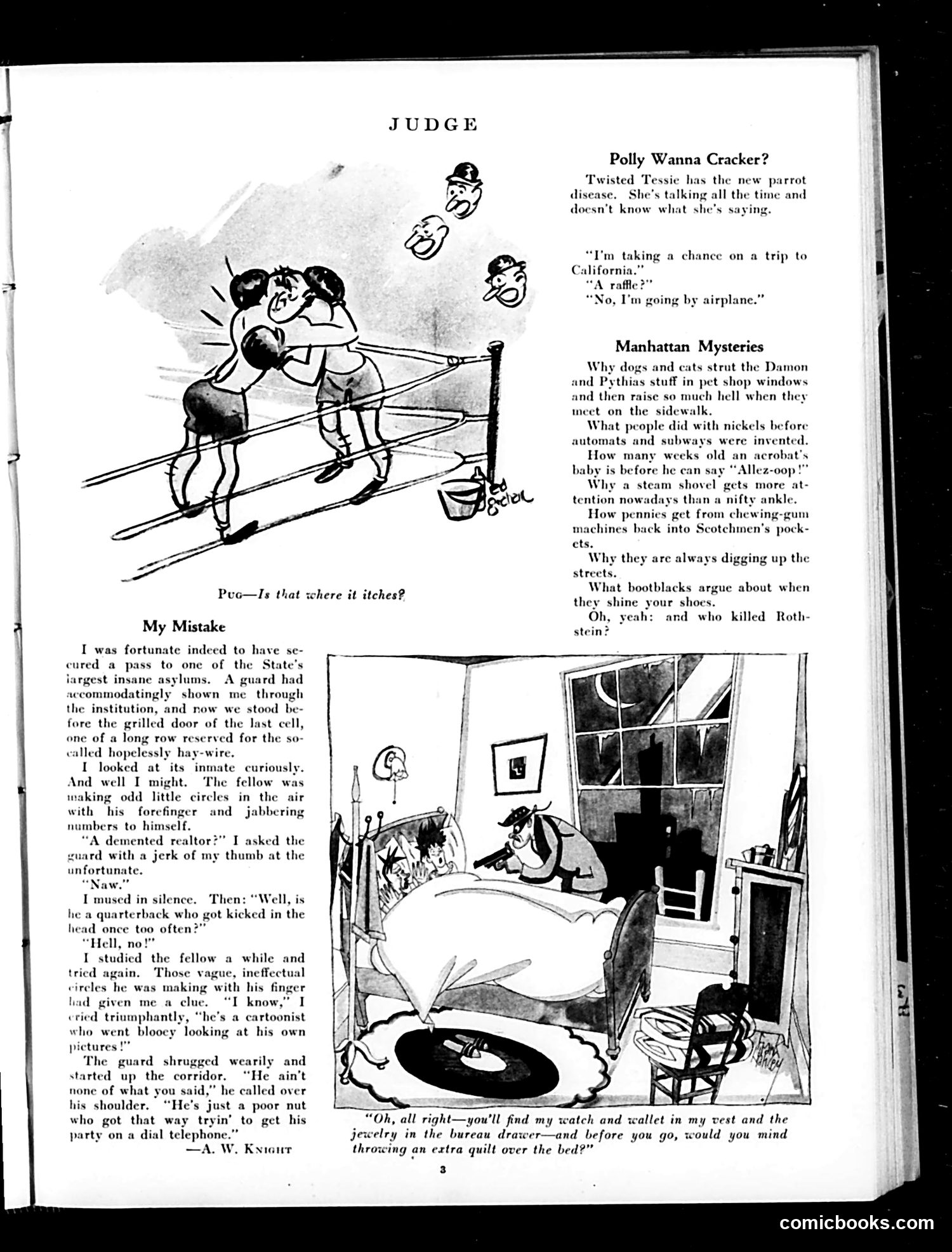
# Analysis of Judge Magazine Page **Top Cartoon ("Pug—Is that where it itches?"):** A person scratches a pug dog while three fleas leap away. The humor is visual wordplay—"pug" sounds like "poke" or suggests scratching, and the fleas' exaggerated expressions convey annoyance at being disturbed. **"My Mistake" Story:** A narrator describes visiting a state insane asylum and misidentifying a patient making circular finger motions as a "demented sailor." The guard corrects him: the man is actually a cartoonist drawing his own pictures. The joke mocks both cartoonists' seemingly mindless repetitive work and the thin line between artistic obsession and mental illness—common contemporary humor about creative professions. **Right Column:** "Manhattan Mysteries" lists absurdist urban questions typical of Judge's humorous filler content.
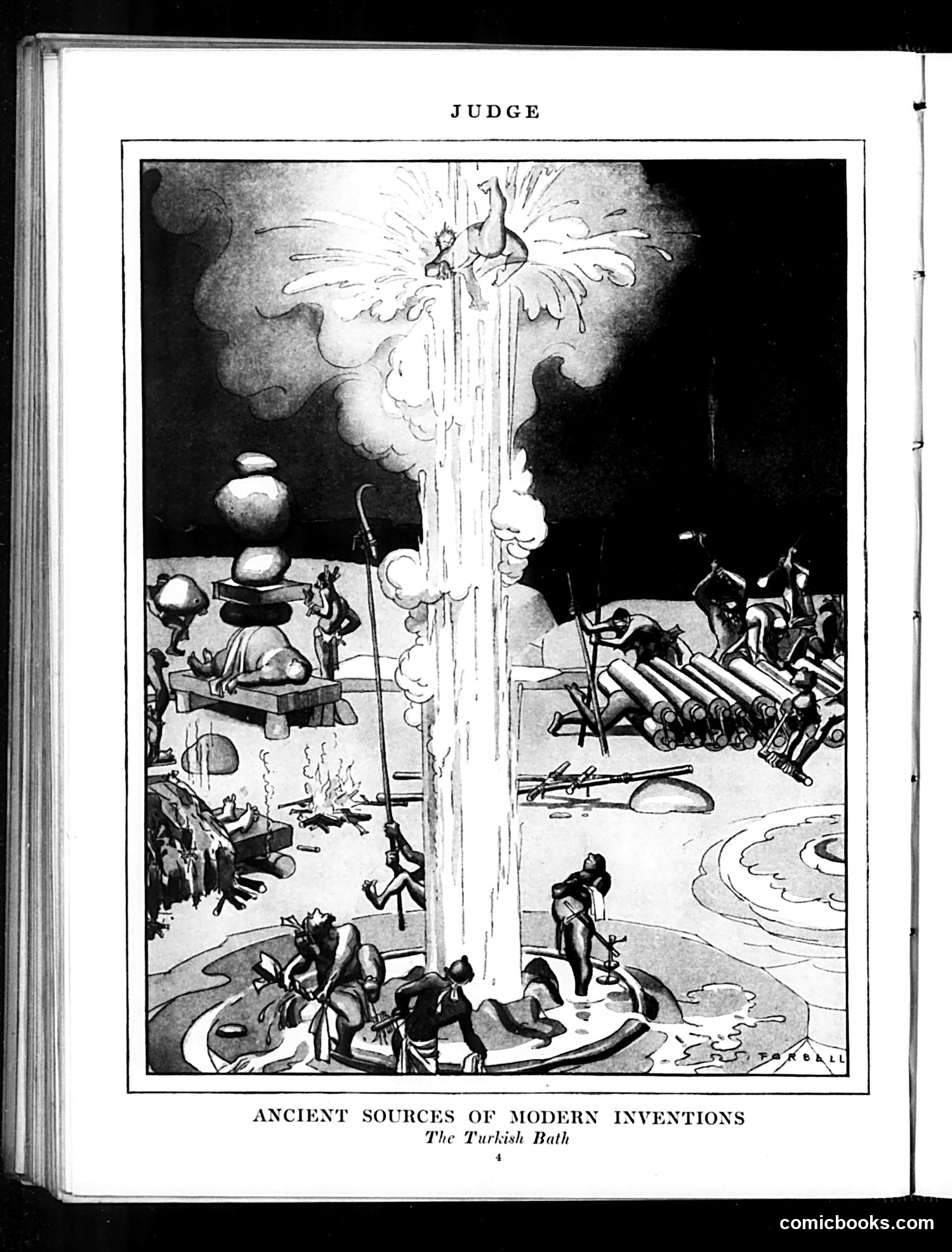
# Analysis This Judge magazine page presents a satirical cartoon titled "Ancient Sources of Modern Inventions: The Turkish Bath." The illustration depicts a split scene contrasting two bathing scenarios. On the left appears to be an ancient Turkish bath setup with primitive heating apparatus and small figures. On the right is a modern bathroom with more sophisticated equipment and plumbing. The satire's point is likely that modern bathroom innovations—particularly steam bathing and hot-water systems—derive from ancient Turkish bathing practices. By labeling these "ancient sources," Judge humorously suggests that despite considering themselves modern inventors, contemporary Americans were actually reviving or copying long-established practices from other cultures. The cartoon criticizes either Western claims to originality or perhaps mocks the fashionable adoption of "exotic" Ottoman customs among Americans.
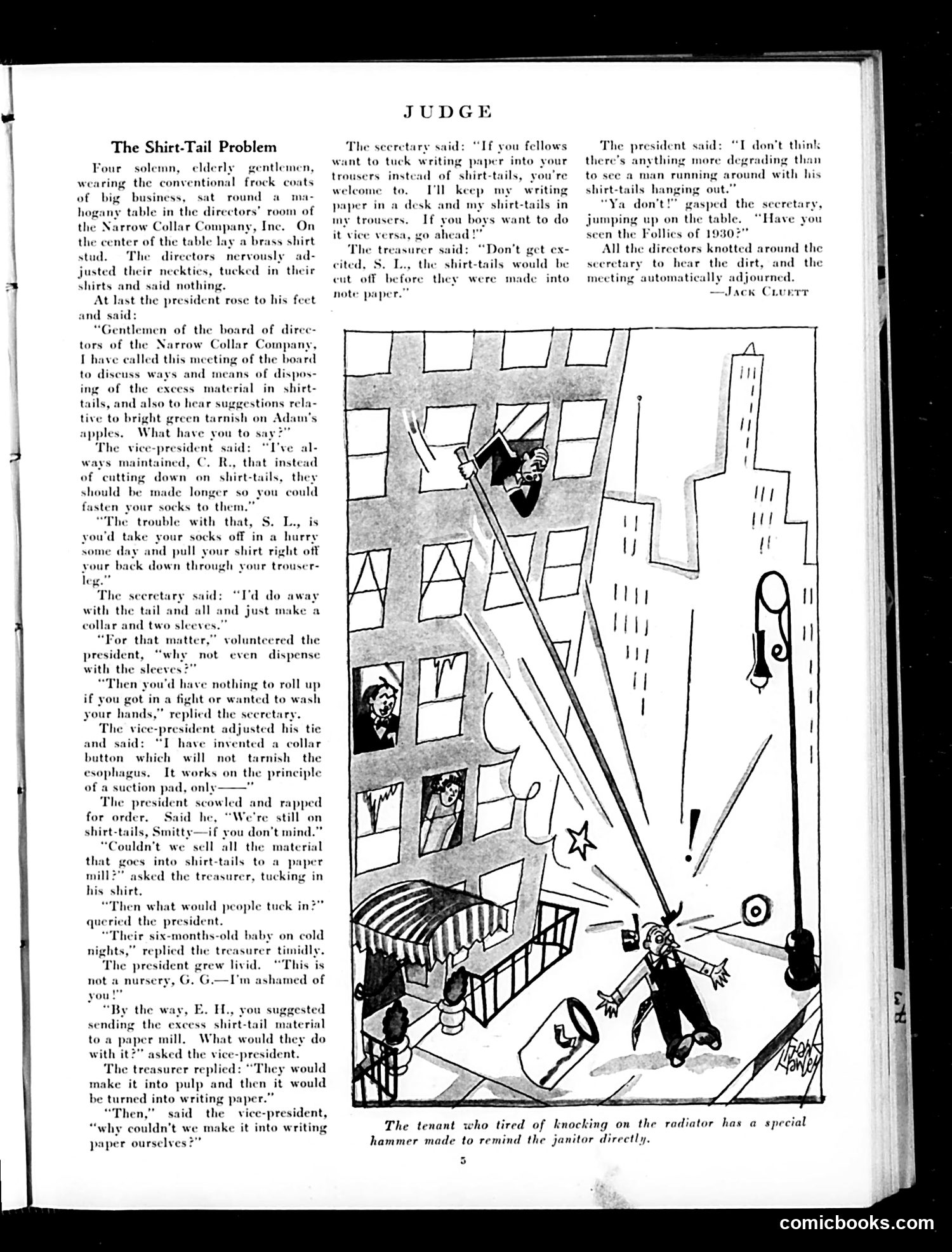
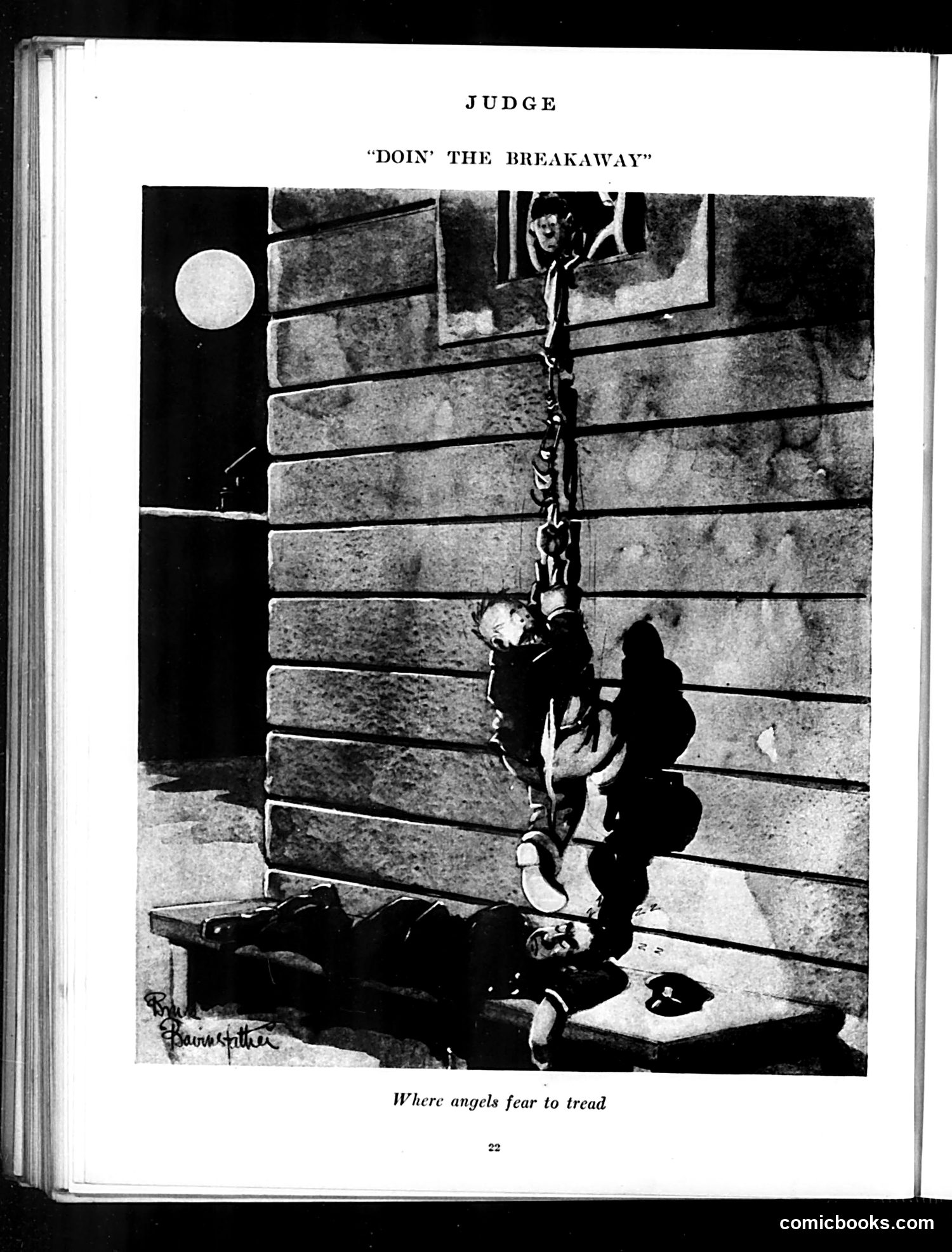
# "The Shirt-Tail Problem" This satirical piece mocks a board meeting of the Narrow Collar Company debating how to market shirt-tails—the loose fabric extending below a shirt's hem. The joke hinges on absurd corporate problem-solving: executives propose increasingly ridiculous solutions, from removing shirt-tails entirely to inventing special collar buttons. The accompanying cartoon illustrates the chaos this creates: a man hangs from a building's exterior, his shirt-tail caught or tangled, while a janitor below uses a hammer on the radiator to signal him. The visual gag satirizes how impractical clothing "innovations" create real-world hazards. The satire targets corporate meeting culture—how businessmen earnestly debate trivial matters while ignoring obvious practical consequences.
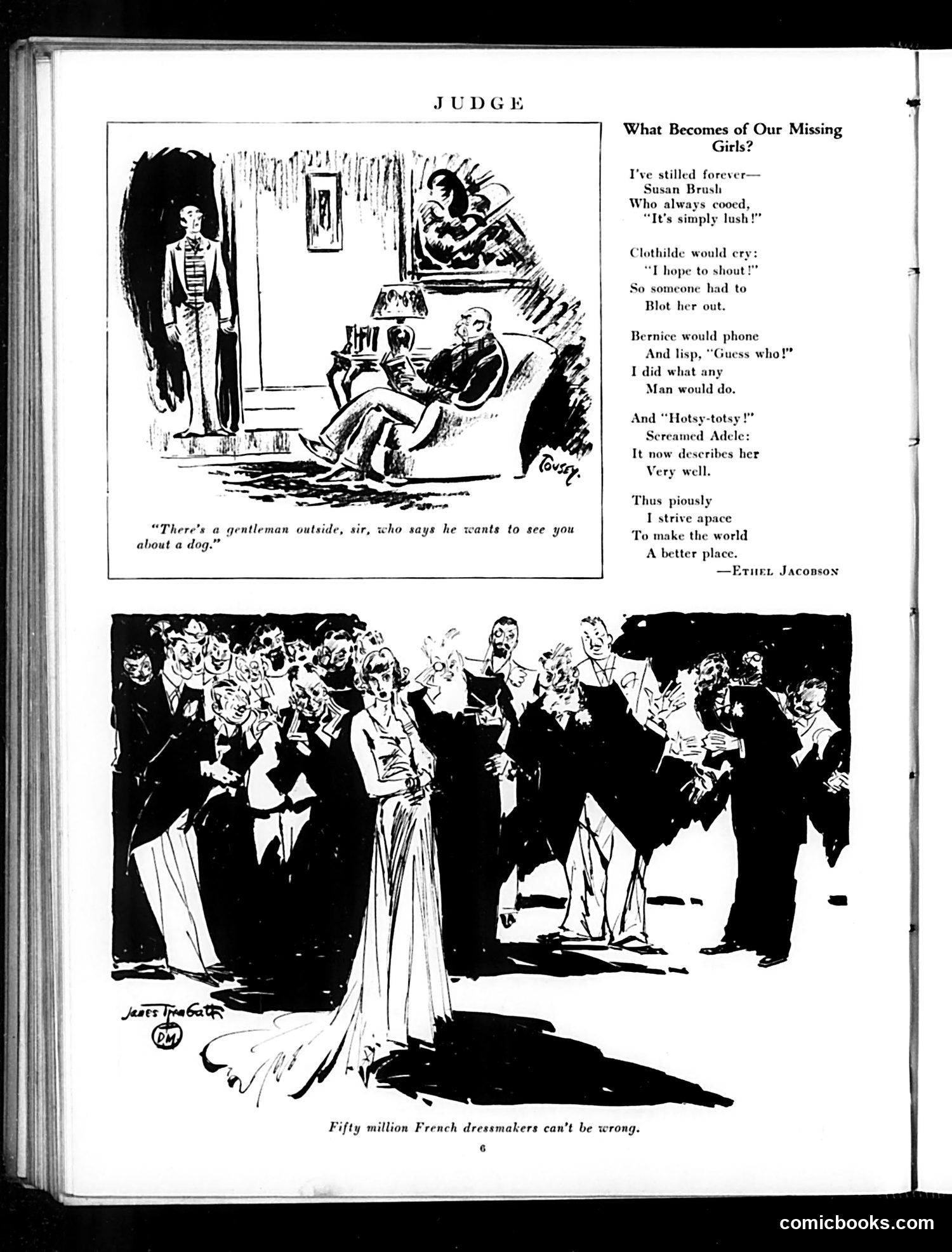
# Analysis of Judge Page This page contains two satirical cartoons about women and gender roles. The **top cartoon** shows a man claiming a gentleman outside wants to see the man "about a dog"—a euphemism for illicit affairs or improper business. The joke targets men's excuses and deceptions. The **bottom cartoon**, captioned "Fifty million French dressmakers can't be wrong," depicts an elegant woman in a flowing gown surrounded by admiring men in formal attire at what appears to be a social event. The satire mocks both female fashion dependence and male susceptibility to women's appearance—suggesting that fashion (specifically French fashion) manipulates both women and men through vanity. The accompanying poem "What Becomes of Our Missing Girls?" by Ethel Jacobson satirizes women who use their attractiveness and wit to disappear from respectable society, with dark humor about their fates.
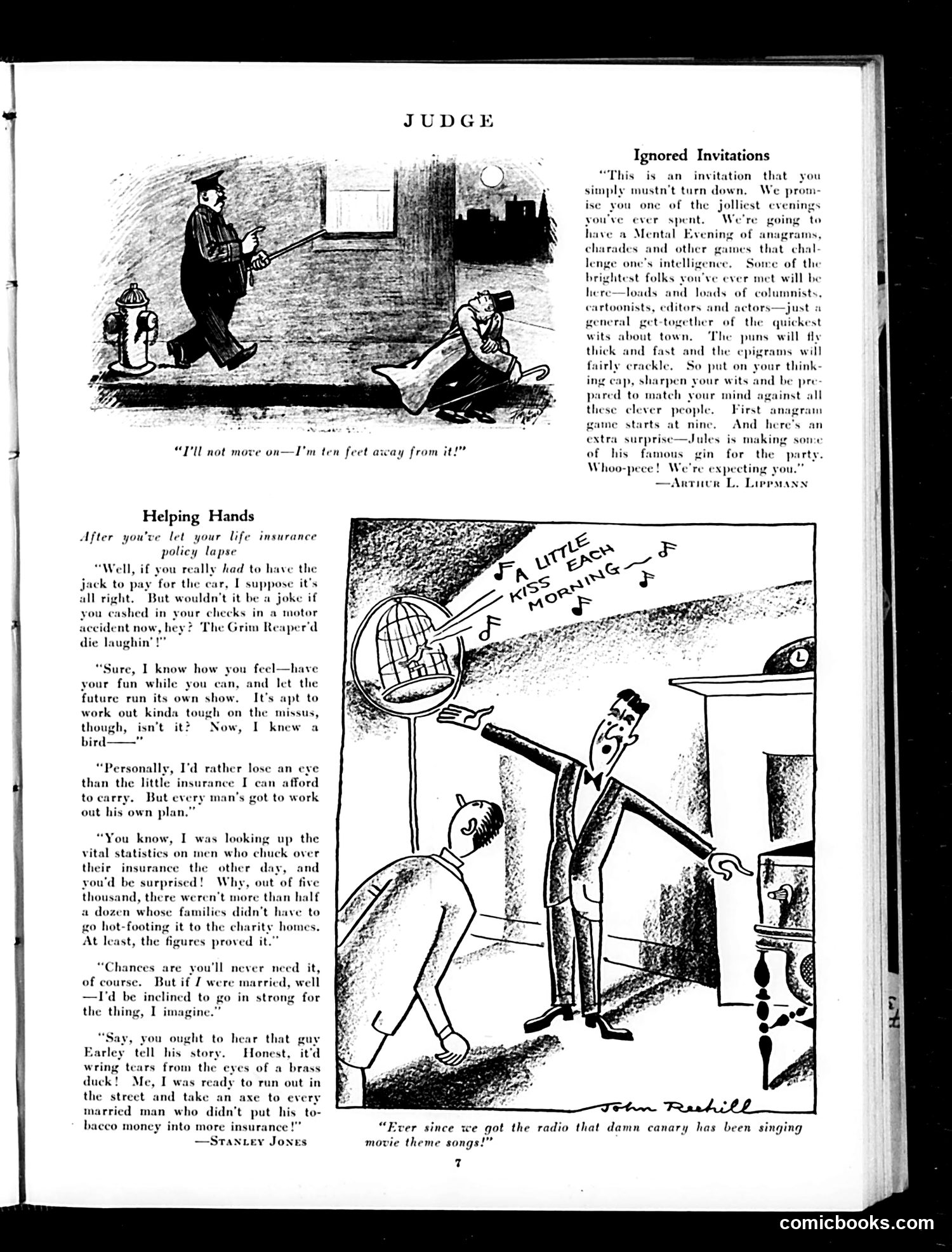
# Judge Magazine Page Analysis This page contains two satirical pieces typical of early-20th-century American humor magazine content. **"Ignored Invitations"** mocks pretentious social gatherings. The invitation promises an evening with "the brightest folks"—columnists, cartoonists, editors, and actors—who will engage in witty wordplay and anagrams. The satire targets the affected intellectualism of such events and the social pressure to attend gatherings where one must perform cleverness. The cartoon shows someone literally unable to approach the event ("I'll not move on—I'm ten feet away from it!"), suggesting the difficulty or unpleasantness of such obligatory socializing. **"Helping Hands"** satirizes life insurance through a series of conversations where one character persuades another not to let their policy lapse. The piece mocks both the insurance industry's scare tactics and human shortsightedness about financial responsibility. The cartoon features a man being pestered by a radio about an annoying canary singing movie theme songs—a humorous non-sequitur illustrating life's irritations, paralleling how financial mistakes create long-term troubles. Both pieces critique human behavior: social pretension and financial irresponsibility.
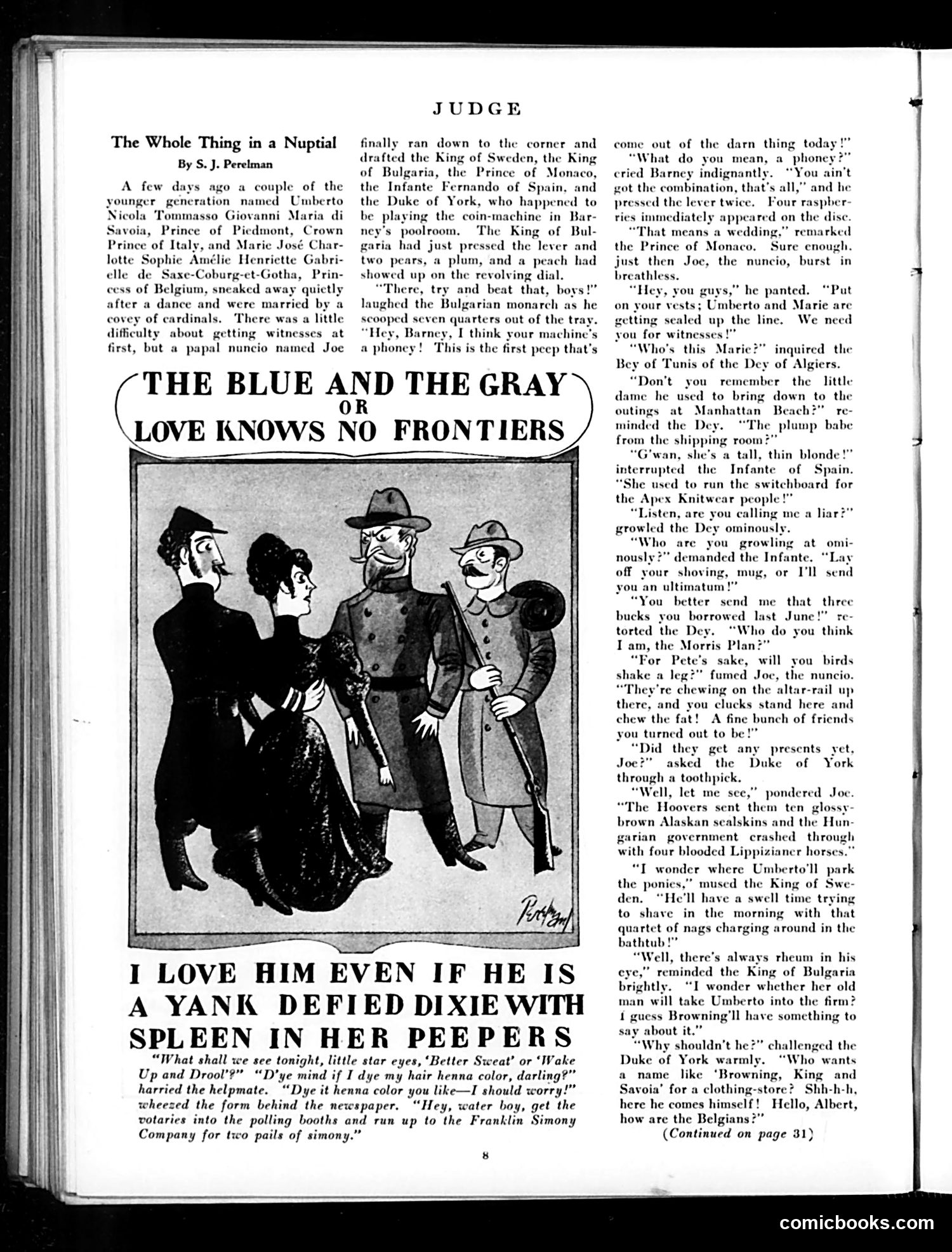
# "The Blue and the Gray" Cartoon Analysis This satirical piece mocks the international marriages of European royalty to American wealth during the Gilded Age. The cartoon depicts four European nobility—apparently including the King of Sweden, King of Bulgaria, Prince of Monaco, and Duke of York—gathered in casual conversation, discussing a wedding involving "Umberto and Marie." The humor derives from contrasting their elevated status with mundane American concerns: they discuss a coin-operated machine, borrowed money, and practical wedding gifts (Hoover vacuum cleaners, horses). The dialogue peppers their speech with slang and American colloquialisms ("For Pete's sake," "mug") while they obsess over petty debts and gossip. The title "Love Knows No Frontiers" is ironic—these marriages are transparently transactional, uniting European titles with American money. The satire targets both the European aristocracy (reduced to caricature) and American high society's willingness to trade wealth for social prestige through these unions. The nuncio (papal representative) present underscores the Catholic dynasties involved in such matches.
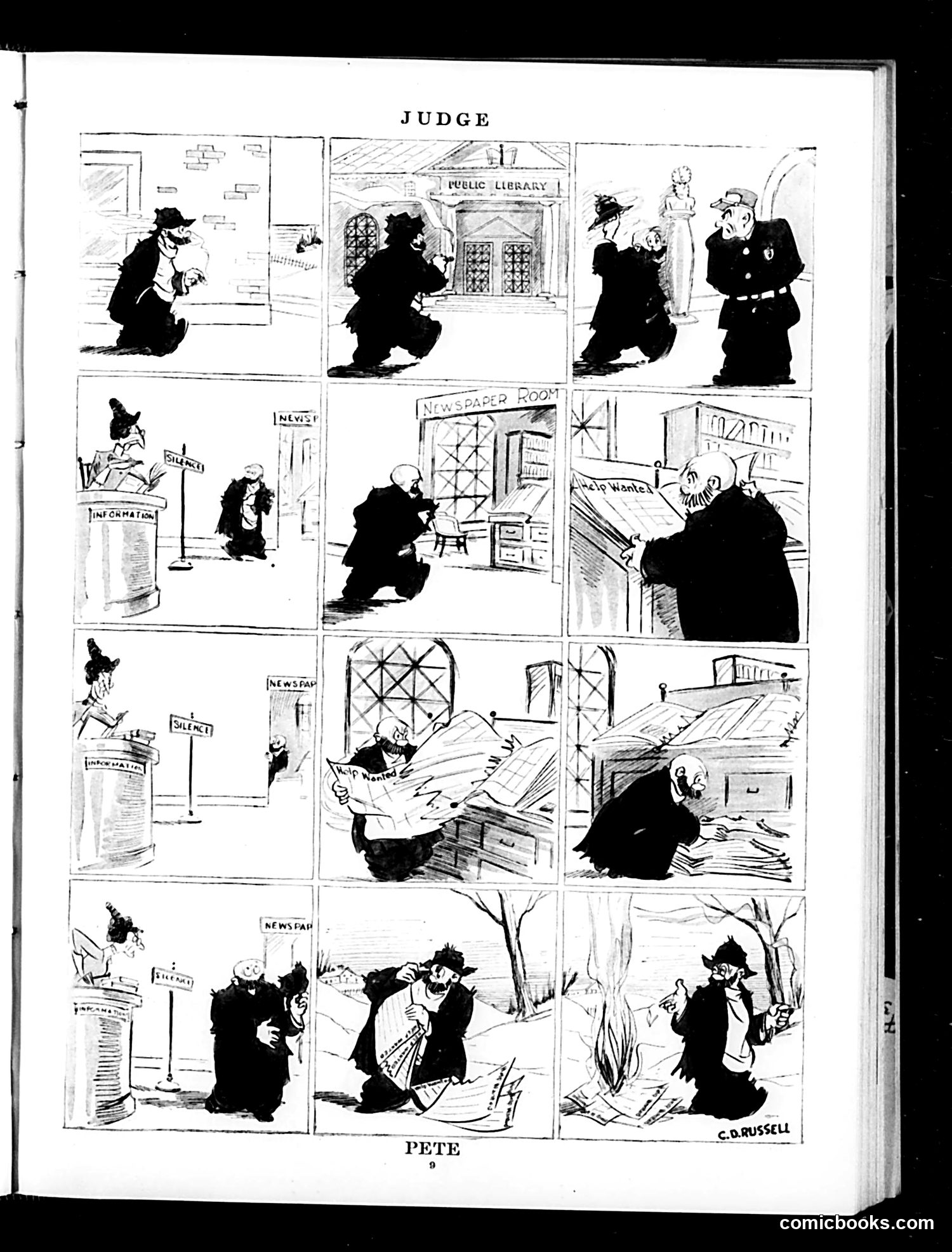
# "Judge" Page: "Judge" and "Pete" This page contains two sequential comic strips by C.B. Russell satirizing bureaucratic incompetence. **"Judge"** (top) follows a judge moving through various public institutions—a library, newspaper room, and bedroom—appearing increasingly disheveled and frantic. The strip seems to mock judicial inefficiency or the judge's inability to maintain composure across different settings. **"Pete"** (bottom) depicts a character repeatedly consulting newspapers and information boards, then eventually destroying them in frustration. The satire likely critiques either newspaper reliability, information overload, or public confusion created by media contradictions. Both strips employ exaggerated physical comedy and visual progression typical of early-20th-century editorial cartooning. The specific political targets remain unclear without additional context about contemporary events Judge was referencing.
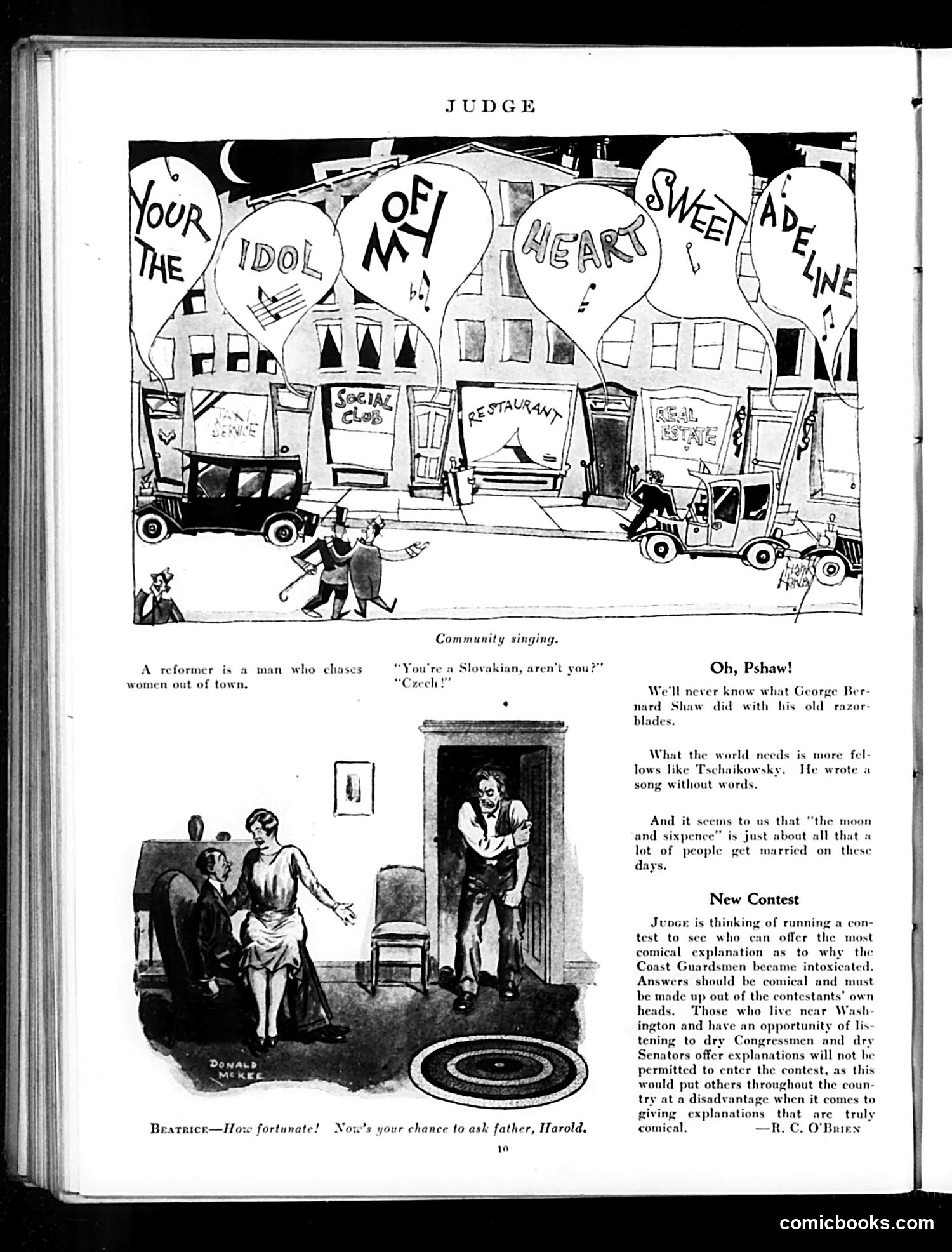
# Analysis The top cartoon depicts "community singing" on a city street, with storefronts and cars. Speech bubbles contain cultural/ethnic stereotypes ("You're a Slovakian, aren't you?"), satirizing how diverse immigrant communities were viewed and mocked in 1920s America. Below are brief jokes: one mocking "reformers" who chase women from towns; references to George Bernard Shaw and Tchaikovsky; and commentary on marriage ("the moon and sixpence"). The "New Contest" section announces Judge's satirical contest seeking humorous explanations for why "Coast Guardsmen became intoxicated"—a Prohibition-era joke. The rule excluding people near Washington from entering cleverly mocks Congressmen and Senators as naturally dry speakers, implying they could offer genuinely funny explanations simply by speaking normally. The bottom illustration shows a couple, with "Beatrice" telling Harold he can finally ask his father a question—likely about marriage or courtship.