
Judge, 1930-02-08 · page 28 of 36
Judge — February 8, 1930 — page 28: what you’re looking at
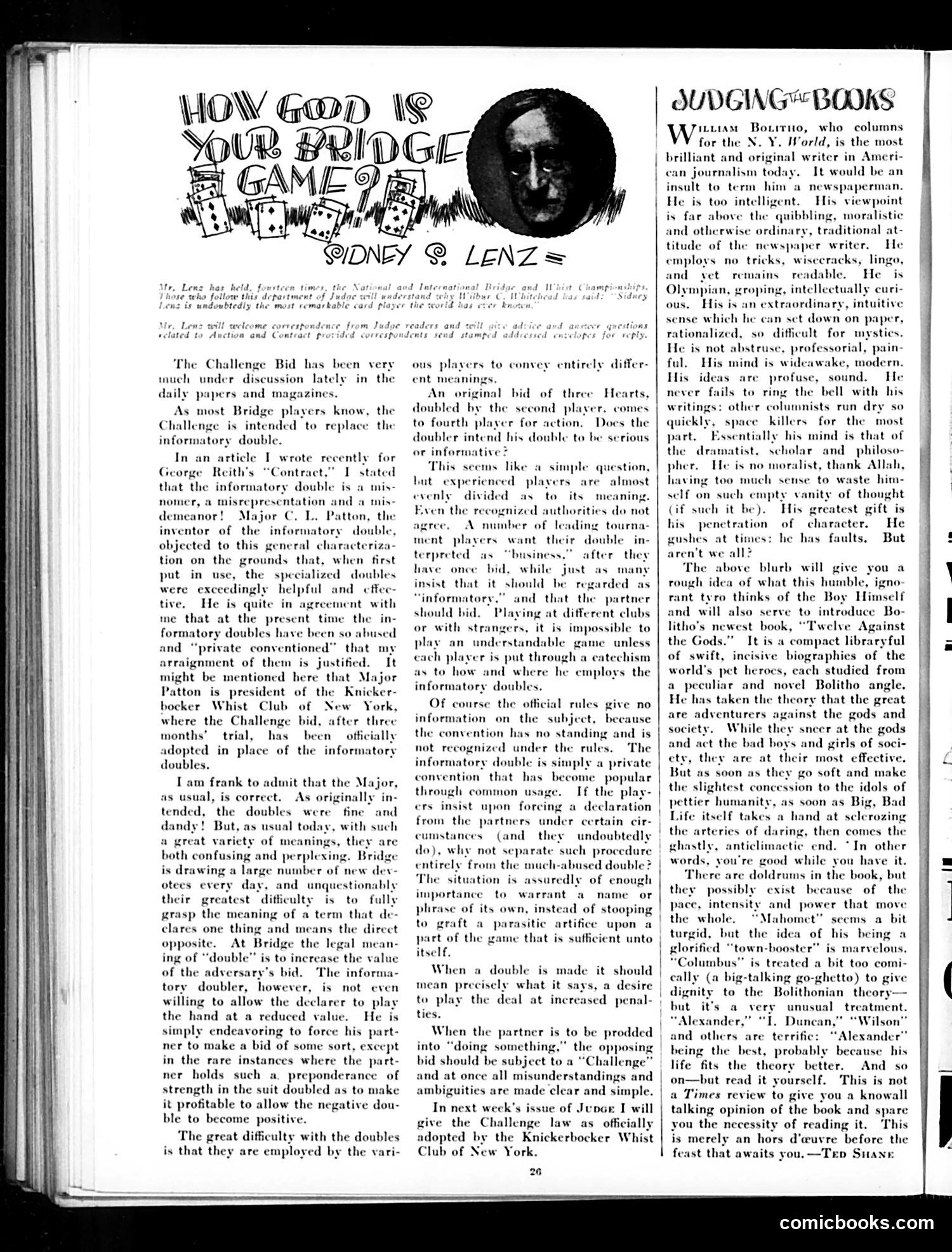
A restored page from Judge, 1930-02-08. Page through the whole issue in the reader above.
📄 Transcribed text from this page (OCR, searchable)
Machine-transcribed from the original scan — historical spelling and the odd misread are preserved.
HOW GwmD Ie The Challe much under discussic ¢ Bid has been very lately in the daily papers and 1 nes. As most Bridge playe rs know, the Challenge is intended to replace the informatory double. In an article I wrote recently for George Reith’s “Contract.” 1 stated that the informatory double is a mis- nomer, a misrepresentation and a mis- demeanor! L. Patton, the inventor of the double, objected to this general characteri tion on the grounds that, when first put in use, the speci 1 doubles were exccedingly helpful and effec- tive. He is quite in agreement with me that at the present time the in- formatory doubles have b sed and “private conventioned” ignment of them is justified. It ight be mentioned here that Major Patton is president of the Knicker- bocker Whist Club of New York, where the Challenge bid, after three months’ trial, has been officially adopted in place of the informatory doubles. I am frank to admit that the Major, as usual, is correct. As originally in- tended, the doubles were dandy! But, as usual today, with such a great varicty of meanings, they are both confusing and perplexing. Bridge is drawing a large number of new dev- otees every day, and unquesti their greatest difficulty is asp the meaning of s one thing and means the direct opposite. At Bridge the ing of “double” is to incr of the adversary’s bid. The informa- tory doubler, however, is not even willing to allow the declarer to play the hand at a reduced value. simply endeavoring to force his part- ner to make a bid of some sort, except in the rare instances where the part- ner holds such a. preponderance of strength in the suit doubled as to make it profitable to allow the ne; ble to become positive. The great difficulty with the doubles is that they are employed by the vari- gative dou- estions for reply. bid of three Hearts, d by the second player. comes to fourth player for action. Does the doubler intend his double to be serious or informative? This seems like a simple question, but experienced players almost evenly divided ay to its me is ven the recognized authorities do not A number of leading tourns rs want their double in- terpreted as after t have once bid, while just as many insist that it should be regarded as “informatory.”” and that the partner should bid. Playing at different clubs or with strangers, it is impossible to play an understandable game unless or is put through echism and where he employs the ory doubles. “business.” informs Of course the official rules give no information on the subject, because the convention has no standing and is not recognized under the rules. The informatory double is simply a private convention that has become popular through common us If the play- ers insist upon forcing a declaration | from the cumstances partners under certain (and they undoubtedly do), why not sep such procedure entirely from the much-abused double? The situation is ly of enough importance to warrant name or phrase of its own, instead of stooping to graft a artifice upon a art of the game that is sufficient unto itself. When a double it should mean precisely wh ys, a desire to play the deal at increased penal- ties. assure paras is made When the partner is to be prodded into “doing something,” the opposing bid should be subject to a “Challenge” and at once all misunderstandings and ambiguities are made clear and simple. In next week's issue of Junge I will give the Challenge law as officially adopted by the Knickerbocker Whist Club of New York. 26 | brill | is far above the quibbling, SUDGING“ BOOKS intiam Boritiio, who columns for the N. Y. World, is the most nt and original writer in Ameri- can journalism today. It would be an insult to term him perman. He is too intelligent. wpoint ralistic and otherwise ordinary, traditional at- titude of the newspaper writer. He employs no tricks, wisecracks, lingo, do yet remains readable. He is Olympian, groping, intellectually curi- ous. His is an extraordinary, intuitive sense which he can set down on paper, rationalized, so ditficult: for mystics. He is not abstruse, professorial, pain- ful. His mind is wi ke, modern. His ideas are profuse, sound. He never fails to ring the bell with his writings: other columnists run dry so quickly, space killers for the most part. Essentially his mind is that of the dramatist, scholar and philos pher. He is no moralist, thank Al having too much sense to waste him- self on such empty vanity of thought (if such it be). His greatest gift is his penetration of character. He he has faults. But a news} His vi gushes at. tin bove blurb will give you a rough idea of what this humble, igno rant tyro thinks of the Boy Himself and will also serve to introduce Bo- litho’s newest book, “Twelve Against the Gods.” It is a compact libraryful of swift, incisive biographies of the world’s pet herocs, each studied from and novel Bolitho angle. taken the theory that the great adventurers against the gods and y snecr at the gods and girls of soci- ety, they are at their most effective. But as soon as they go soft and make the slightest concession to the idols of pettier humanity, as soon as Big, Bad Life itself takes a hand at sclerozing the arteries of daring, then comes the ghastly, anticlimactie end. “In other words, you're good while you have it. There are doldrums in the book, but exist because of the and power that move Mahomet” seems a bit but the idea of his being a glorificd “‘town-booster" is marvelous. “Columbus” is treated a bit too comi- lly (a big-talking go-ghetto) to give dignity to the Bolithonian theory— but it’s a very unusual treatment. “Alexander,” “I, Duncan,” “Wilson” and others are terrific: “Alexander” being the best, probably because his life fits the theory better. And so on—but read it rae This is not a Times re you the necessity of sealing it. is merely an hors d’cuvre before the feast that awaits you. —Trp Suanr comicbooks.com _——