
Judge, 1930-02-08 · page 25 of 36
Judge — February 8, 1930 — page 25: what you’re looking at
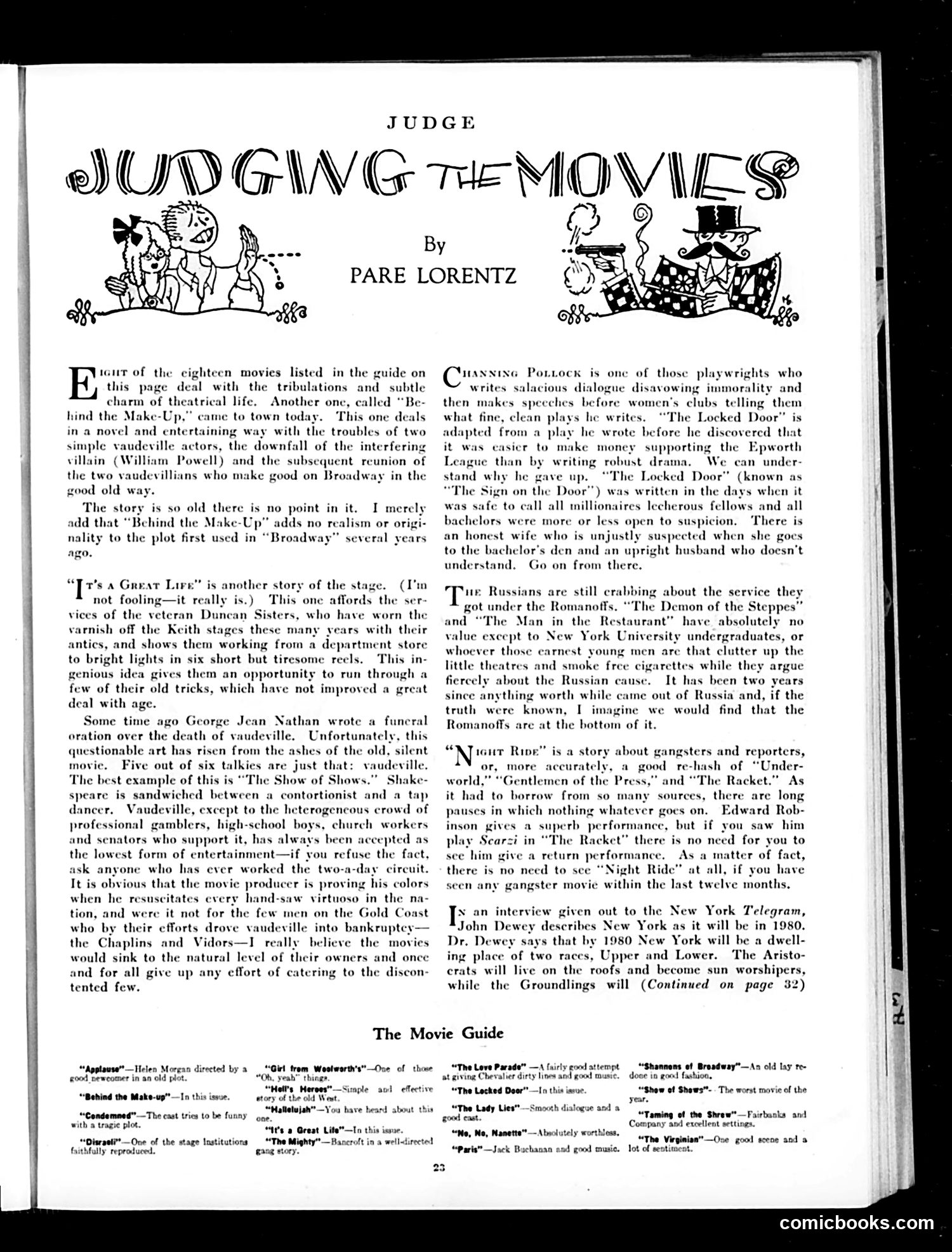
A restored page from Judge, 1930-02-08. Page through the whole issue in the reader above.
📄 Transcribed text from this page (OCR, searchable)
Machine-transcribed from the original scan — historical spelling and the odd misread are preserved.
i alias pence JUDGE JUVGING TEMOVIES 1cur of the eighteen movies listed in the guide on this page ¢ with the tribulations and subtle charm of theatrical life. Another one, called “Be- hind the Make-Up,” came to town today. This one de: in a novel and entertaining way with the troubles of two simple vaudev rtors, the downfall of the interfering villain (William Powell) and the subsequent reunion of the two vaudevillians who make good on Broadway in the good old way. Is The story is so old there is no point in it. I merely add that “Behind the Make-Up” adds no realism or origi- nality to the plot first used in “Broadway” ago. several years (I'm “T's a Great I another story of the stage. This one affords the ser- not fooling—it really is.) vices of the veteran Duncan Sisters, who have worn the varnish off the Keith stages these many years with their antics, and shows them working from a department store to bright lights in six short but tiresome reels. This in- nious idea gives them an opportunity to run through a few of their old tricks, which have not improved a great deal with age. Some time ago George Jes oration over the death of vauc questiona ic athan wrote a funera ville. Unfortunately, this le art has risen from the ashes of the old, silent Five out of six talkies are just th: vaudeville, nest example of this is : speare is sandwiched between a contortionist and a tap dancer. Vaudeville, except to the heterogencous crowd of professional gamblers, high-school boys, church workers and senators who support it, has alw n accepted as the lowest form of entertainment—if you refuse the fact, ask anyone who has ever worked the two- circuit. It is obvious that the movie producer is proving his colors when he resuscitates every hand-saw virtuoso in the na- tion, and were it not for the few men on the Gold who by their efforts drove vaudeville into bankrupte: the Chaplins and Vidors—I really believe the mo would sink to the natural level of their owners and once and for all give up any effort of catering to the discon- tented few. s “Applause” —Hlelen M: good _neweomer in an old directed by a “Girt trem Westwerth’s"—One of those “Oh, yeah” things. “Hell's Heroes” —Simple story of the old West “Hallelujah” —You have heard about this one. “t's a Great Life”—In this issue. “The Mighty"—B. a gang story. al effective “Behind the Make-up” “Condemned” —The cast tries to be funny with a tragi¢ plot. “Disracii”—One of the stage Institutions faithfully reproduced. In this issue. By PARE LORENTZ The Movie Guide Te Chsssixe Portocn is one of those playwrights who writes salacious dialogue disavowing immorality and then makes speeches before women’s clubs telling them what fine, clean plays he writes. “The Locked Door” is adapted from a play he wrote before he discovered that it was easier to make money supporting the Epworth League than by writing robust drama. We can under- stand why he gave up. “The Locked Door” (known as “The Sign on the Door”) was written in the days when it was safe to call all millionaires lecherous fellows and all bachelors were more or less open to suspicion. ‘There is an honest wife who is unjustly suspected when she goes to the bachelor’s den and an upright husband who doesn’t understand. Go on from there. TTur Russians are still crabbing about the service they got under the Romanoffs. “The Demon of the Steppes” and “The Man in the Restaurant’ have absolutely no value except to New York University undergraduates, or whoever those carnest young men are that clutter up the little theatres and smoke free cigarettes while they « truth were known, [it Romanoffs are at the bot ne we would find that the v of it. about gangsters and reporters, a good re-hash of “Under- world,” “Gentlemen of the Press,” and “The Racket.” As d to borrow from so many sources, the +s in which nothing whatever goes on. Ed “rh performance re long ard Rob- but if you saw him Scar. » Racket” there is no need for you to n give a return performance. As a matter of fact, there is no need to si ight F at all, if you have seen any gangster movie within the last twelve months, pl see h [x 27 interview given out to the New York Teleg John Dewey describes New York as it will be in 1980. Dr. Dewey says that by 1980 New York will be a dwell- ing place of two races, Upper and Lower. The A crats will live on the roofs and become sun worshipers, while the Groundlings will (Continued on page 32) “The Love Parade” —A fairly good attempt “Shannoms of Breadway”—An old lay te- at giving Chevalier dirty lines and good music. doce in good fashion, "The Locked Door’ —Io this iswue. “Show of Shows”-. The worst movie of the year. “ "Smooth dialogue and a wae naa alee 5 “T of the Shrew —Fairbaoks and Company and excellent settings. “The Vieginisn”—Ove gool scene and a “Me, No, Nanette” —Absolutely wo comicbooks.com