
Judge, 1930-02-08 · page 20 of 36
Judge — February 8, 1930 — page 20: what you’re looking at
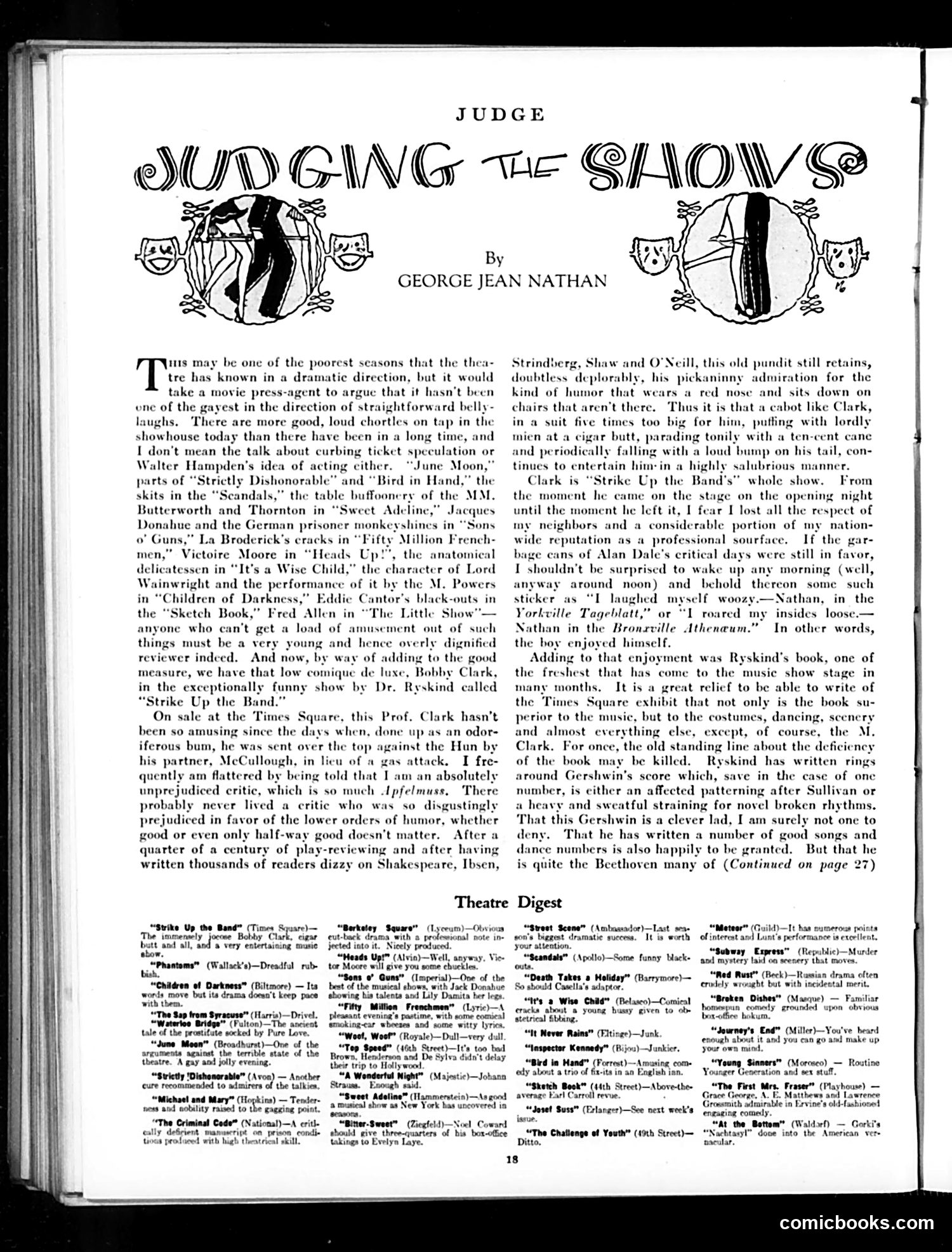
A restored page from Judge, 1930-02-08. Page through the whole issue in the reader above.
📄 Transcribed text from this page (OCR, searchable)
Machine-transcribed from the original scan — historical spelling and the odd misread are preserved.
JUDGE GEORGE ee NATHAN is may be one of the poorest seasons that the thea- | tre has known in a dramatic direction, but it would take a movie press-agent to argue that it hasn't been one of the gayest in the direction of straightforward belly- laughs. There are more good, loud chortles on tap in the showhouse today than there have been in a long time, and I don't mean the talk about curbing ticket speculs ion or Walter H a of acting either, “June Moon,” parts of * “and “Bird in Hand,” the skits in the able buffoonery of the MM. Butterworth and Thornton in “Sweet Adel Donahue and the German prisoner monkeyshines in o’ Guns,” La Broderick’s cracks in “Fifty Million French- men,” Victoire Moore in “Heads Up!", the ans delicatessen in “It’s a Wise Child,” the character of Lord Wainwright and the performance of it by the M. in “Children of Darknes: Eddie Cantor's black-outs in the “Sketch Book,” Fred Allen in “The Little Show anyone who can't get a load of amusement out of such things must be a very > overly dignified reviewer indeed. And now, by way of adding to the good measure, we have that low comique de luxe, Bobby Clark, in the exceptionally funny show by Dr. Ryskind called “Strike Up the Band.” On sale at the Times Squar been so amusing since the days when, done up a iferous bum, he was sent over the his partner, McCullough, in li quently am flatte ng told that I am an absolutely unprejudiced er his so much Apfelmuss, There probably never lived a critic who was so disgustingly prejudiced in favor of the lower orders of humor, whether good or even only half-way good doesn't matter. After a quarter of a century of play-reviewing and after having written thousands of readers dizzy on Shakespeare, Ibsen, Powers this Prof. Clark hasn't an odor- ainst the Hun by attack, I fre- Theatre “Strike Up the Band” (Times Syuare)— ‘The immensely jocse Bobby Clark, cigar batt anf al ada very entertaicang asic “Berkeley Square” (1.yceum)—Ob eut-back drama with a profesional pot jected into it. Nicely produced. “Heads Upt™ (Alvin)—Well, anyway. Vie~ tor Moore will give you some chuckles. “Sens of Guns” (Imperial) —One of the best of the musical shows, with Jack Donahue Dreadful rub- “Children of Darkness” (Biltmore) — Its “Phantoms” (Wallsck’s) bish, Strindberg, Shaw and O'Neill, this old pundit still retains, doubtless deplorably, his pic! Imiration for the kind of humor that wears a red nose and sits down on chairs that aren't there. Thus it is that a cabot like Clark, in a suit five times too big for him, putting with lordly mien at a cigar butt, parading tonily with a ten-cent cane nd periodically falling with a loud bump on his tail, con tinues to entertain him-in a highly salubrious manner. Clark is “Strike Up the Band's” whole show. From the moment he came on the stage on the oper night until the moment he left it, I fear I lost all the respect of my neighbors and a considerable portion of my nation- wide reputation as a professional sourface. If the bage cans of Alan Dale's critical days were still in I shouldn’t be surprised to wake up anyway around noon) sticker as “IT laughed avor, : morning (well, and behold thereon some such myself —Nathan, in the Yorkville Tageblatt,” or “1 roared my insides loose.— ‘athan in the Bronzeville Atheneum.” In other words, the boy enjoyed himself. Adding to that enjoyment was Ryskind’s book, one of the freshest that has come to the music show stage in many months. It is a great relief to be able to write of the Times Square exhibit that not only is the book su- perior to the music, but to the costumes, dancing, scenery and almost everything else, except, of course, the M. Clark. For once, the old standing bout the deficiency of the book m: be killed. Ryskind has written rings around Gershwin’s score which, save in the case of one number, n affected patterning after Sullivan or a heavy aining for novel broken rhythms. That this clever lad, I am surely not one to deny. That he has written a number of good songs and dance numbers is also happily to be granted. But that he is quite the Beethoven many of (Continued on page 27) woo: Digest “Street Scene” (Ambasador)—Last sea son's biggest dramatic success. It is worth Your attention. “Scandals” (Apollo)—Some funny black- a “Meteor” (Guild)—It has numerous points of interest and Lunt's performance is excellent, “Subway Express™ (Resublic)—Murder and mystery laid on scenery that moves. “Red Rust” (Beck)—Rassian drama often erodely wrought but with ineide ou ath Takes a Holiday” (Barrymore)— words move but its drama doesn't keep pace ‘Sap trom Syracuse” (Harris)—Drivel. jatertoe Bridge” (Fulton)—The ancient tale of the prostitute socked by Pure Love. “June Moon” (Broadhurst)—One of the arguments againat the terrible state of the theatre. “A gay and jolly evening. “Swietly 'Dishenorable” (Avon) — Another ‘cure recommended to admirers of the talkies. “Michael and Mary” (Hopkins) — Tender- ness and nobility raised to the gagging point. “The Criminal Cede” (National)—A critl- manuscript on prison condi ed with high theatrical skill, showing his talenta and Lily Damita her legs “Fitty Million Frenchmen” (Lyric)—\ pleasant evening's pastime, with some comical smoking-car wheeses and some witty lyrica. “woot, Wet” (Royale)—Dull—very dull. “Top Speed” (46h Street)—It's too bad Brown, Henlerson and De Sylva didn't delay their trip to Holly wood. “A Wondertul Might” (Majestic)—Jobann Straus. Enough said. “Sweet Adeline” (Hammerstein)—As good a musical show as New York has uncovered in eeanona “Biter-Sweet” (Ziegfeld) —Noel Coward should give three-quarters of bis box-office takings to Evelyn Laye. So about Gartiv's adaptor. “t's a Wise Chi” (Belaseo)—Comical cracks about a young husy given to ob- stetrical Sbbing. “Wt Never Rains” (Fltinge)—Junk. “Vaspecter Kennedy” (13:jou)—Junkier, “Bird in Hand™ (Forrest)—Amasing com- edy about a trio of fiz-its in an English ian. “Sketch Book™ (44th Street)—Above-the- average Earl Carroll revue. “deset Suss” (Erlanger)—See next week's issue. Pd Chatlenge of Youth” (49th Street)— itto, al merit, “Broken Dishes” (Maoque) — Familiar homespun comedy grounded box-office bokum. “Journey's End” (Miller)—You've heand ‘enough about it and you can go and make up your own mind. “Young Sinners” (Moroseo) — Routine unger Generation and sex stuff. “The First Mrs. Fraser” (Playhouse) — Grace George, A. E. Matthews and Lawrence Gronsmith adtairable in Exvine’s old-fashionet engaging comedy. “At the Bottom” (Waldorf) — Gorki's “Nachtasyl” dove into the American ver nacular. upon obvious comicbooks.com