
A complete issue · 36 pages · 1929
Judge — May 4, 1929
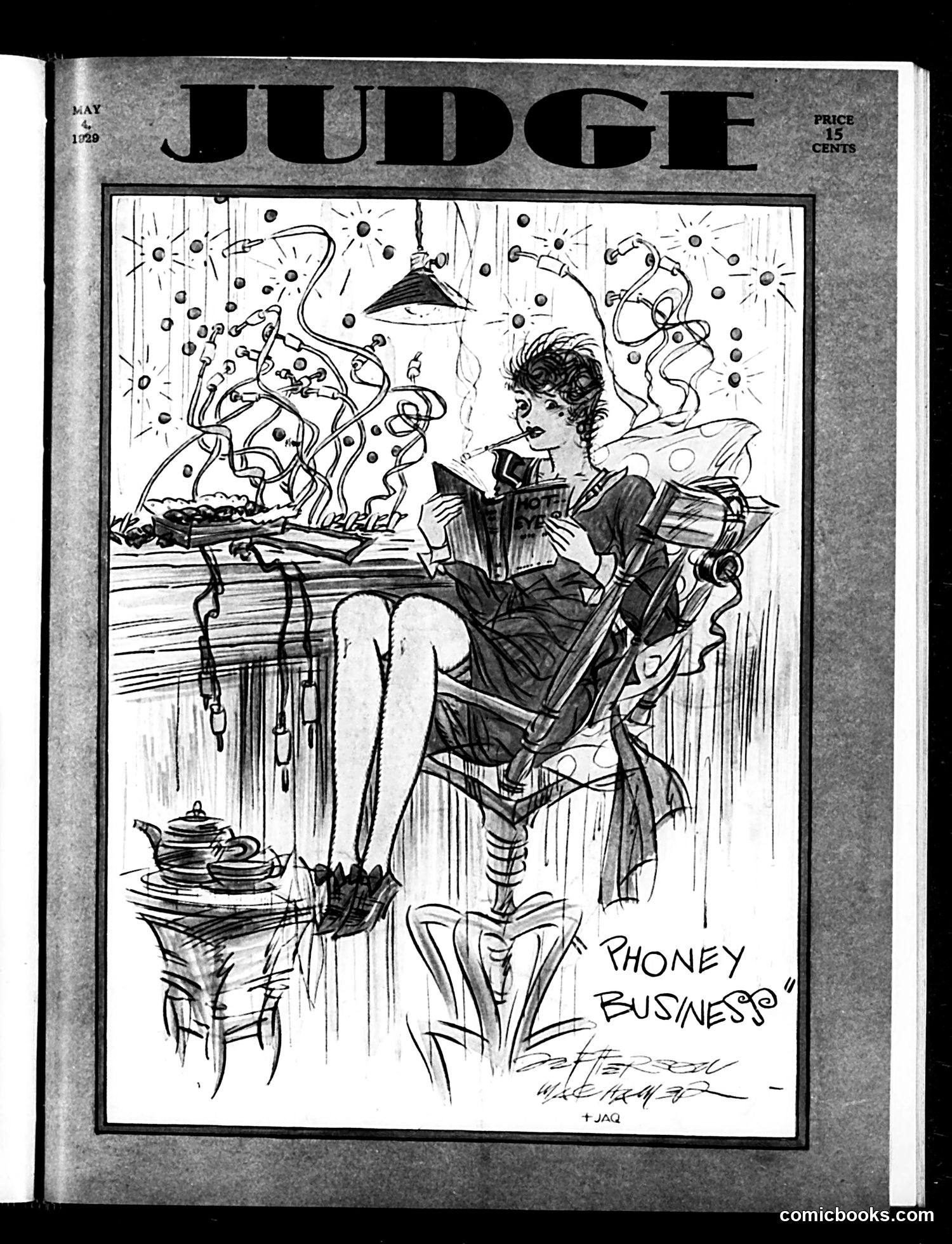
This cartoon satirizes telephone operators or switchboard workers, depicted as a woman managing a chaotic mess of tangled telephone wires and plugs. The title "Phoney Business" is a pun on "phone" business, suggesting the work is both literally phone-related and figuratively dishonest or unreliable. The visual chaos—with wires exploding outward, receiver components flying, and an overwhelmed operator—mocks the telephone system's inefficiency or the operators' harried working conditions. The period (1929) marks the era when telephone switching was manually operated by workers, predominantly women, who connected calls by hand. The cartoon likely criticizes either the technology's unreliability or satirizes the operators' job stress during America's early telephone infrastructure expansion.
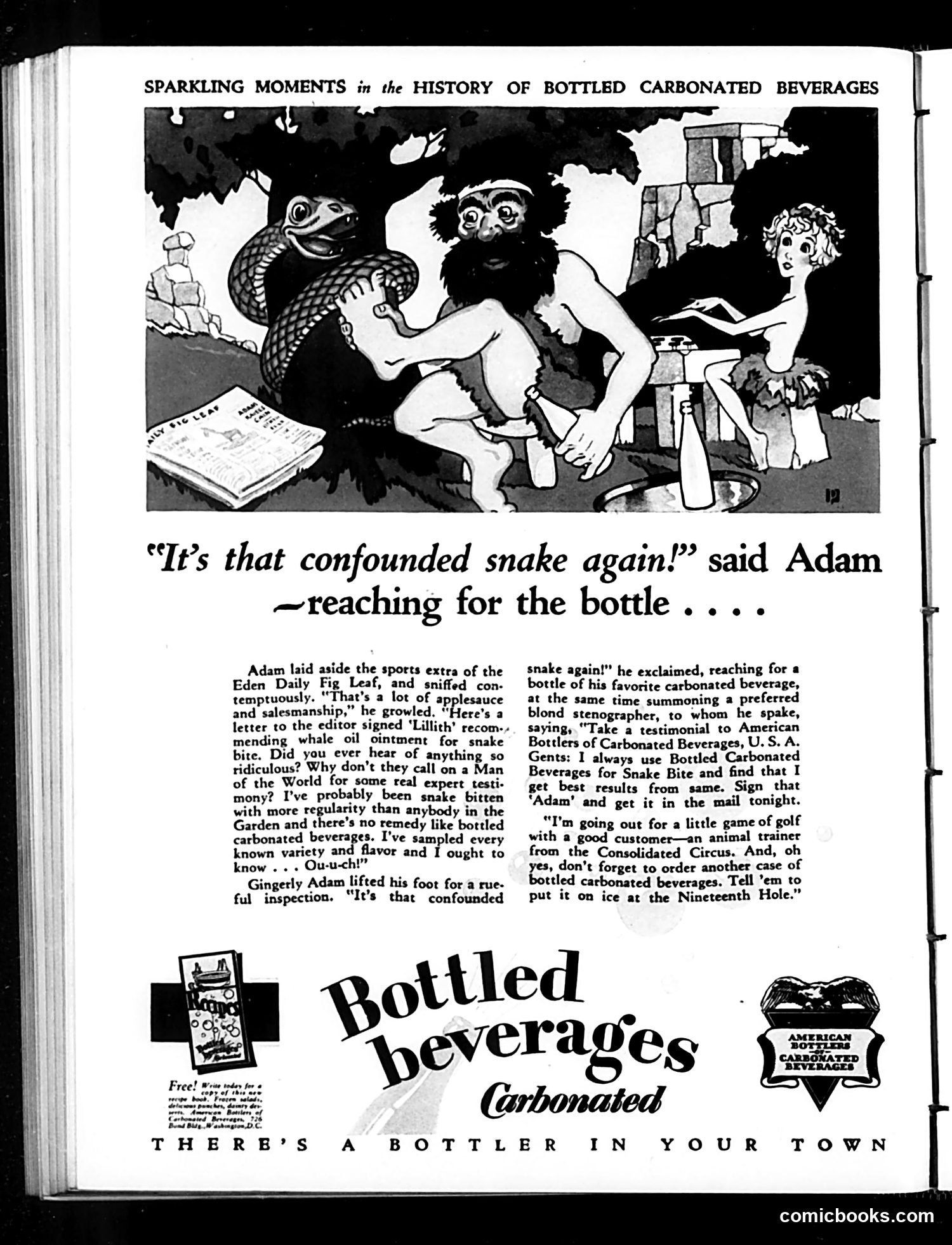
This is primarily a **vintage advertisement** for bottled carbonated beverages, disguised as editorial content in Judge magazine's satirical style. The cartoon depicts Adam (from the Biblical Garden of Eden) complaining about a snake bite, then reaching for a bottle of carbonated beverage as remedy. The joke plays on the historical association between carbonated drinks and medicinal remedies—beverages were often marketed with health claims in early 20th-century advertising. The figures are: - **Adam**: the biblical figure - **The Snake**: literal serpent (the confounding creature causing trouble) - **Eve and other onlookers**: witnesses to the scene The satire mocks both the absurdity of using soda as medicine and the exaggerated testimonial advertising common of the era, where celebrities and historical figures were humorously invoked to endorse products. The tagline "There's a bottler in your town" encourages purchasing.
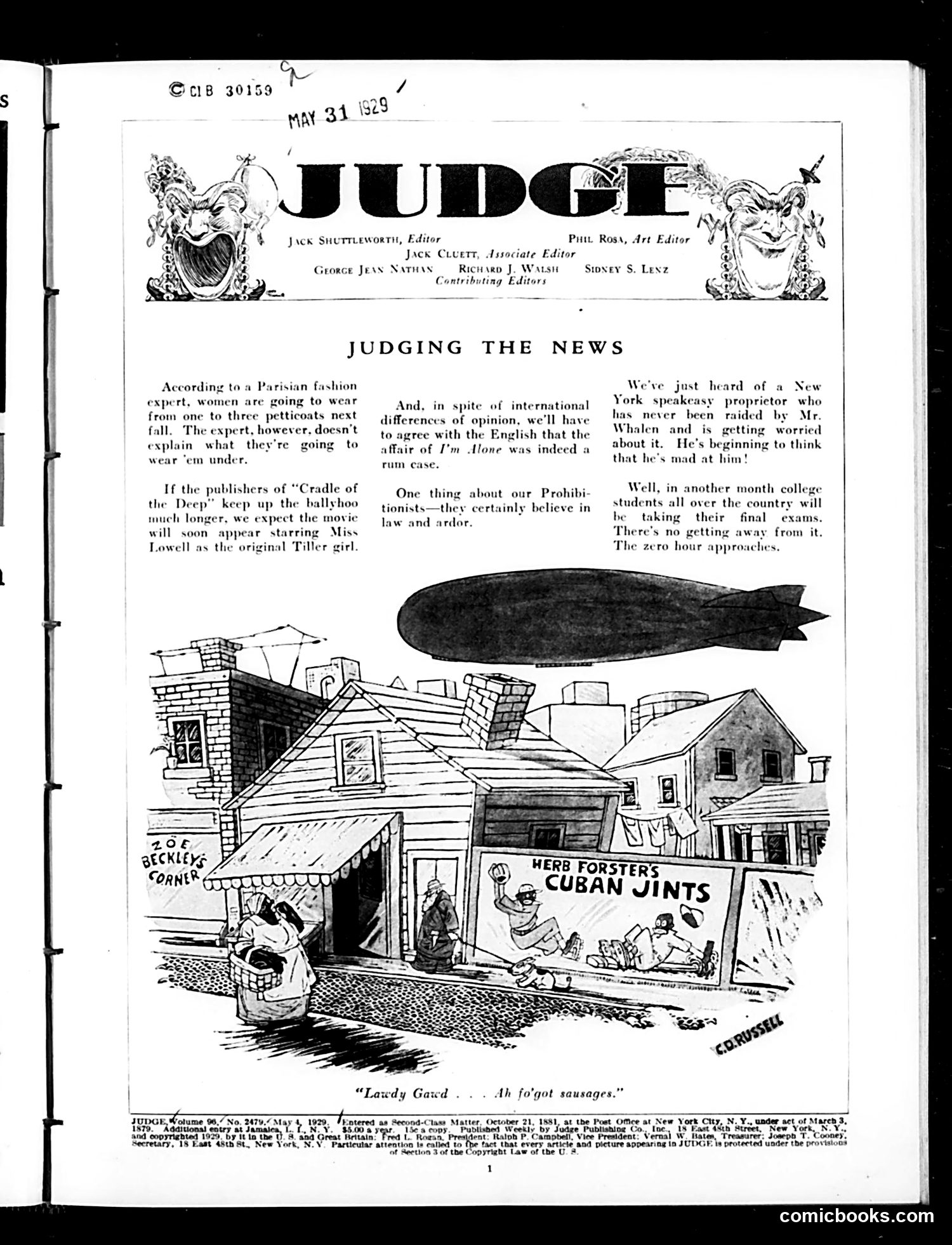
The main cartoon depicts a tenement corner storefront displaying "Herb Forster's Cuban Joints" with an airship hovering above. The caption reads "Lordy Gawd . . . Ah fo'got sausages." The satire appears to target Prohibition-era speakeasies disguised as legitimate businesses. "Cuban Joints" likely refers to establishments serving alcohol during the alcohol ban (1920-1933). The airship suggests surveillance or threat of discovery by authorities. The comic dialect and tenement setting employ period racial stereotyping common to Judge's era. The "Judging the News" section discusses fashion predictions, the film "I'm Alone," Prohibitionists' beliefs in law and order, and approaching college exams—typical 1929 social commentary reflecting the magazine's satirical focus on contemporary events and attitudes.
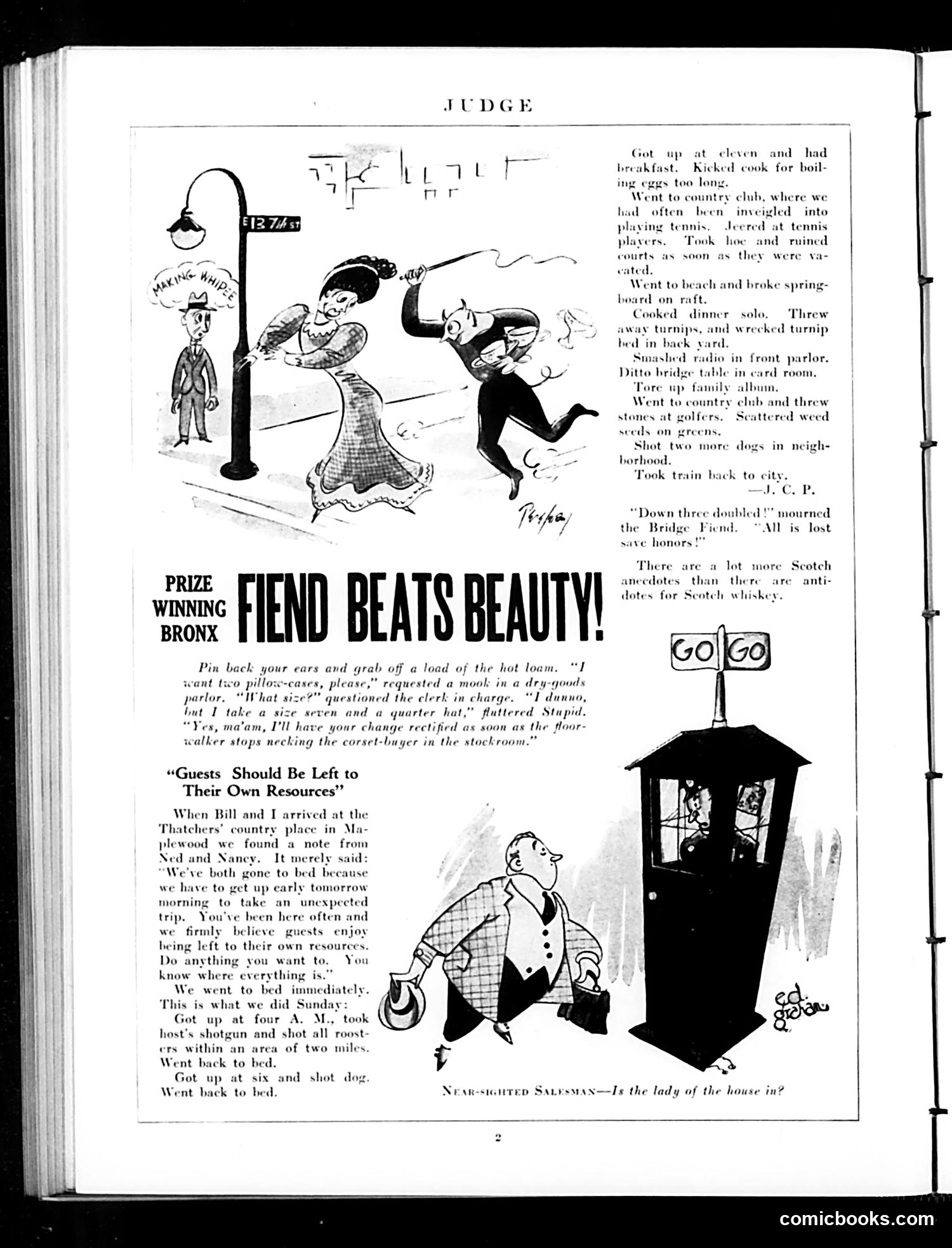
This page contains two separate humorous pieces. The top cartoon "Fiend Beats Beauty" depicts slapstick humor involving a woman at a street lamp being chased by what appears to be a demon or devilish figure—likely satirizing melodramatic silent-film tropes popular in that era. The main feature, "Guests Should Be Left to Their Own Resources," humorously recounts a guest's chaotic weekend at a country house. The host couple left early, instructing guests to help themselves. The narrative escalates from mundane activities (shooting roosters at 4 AM) to shooting dogs, with the punchline showing a disheveled salesman asking if "the lady of the house" is home—implying the guest's destructive rampage has caused considerable damage to the property.
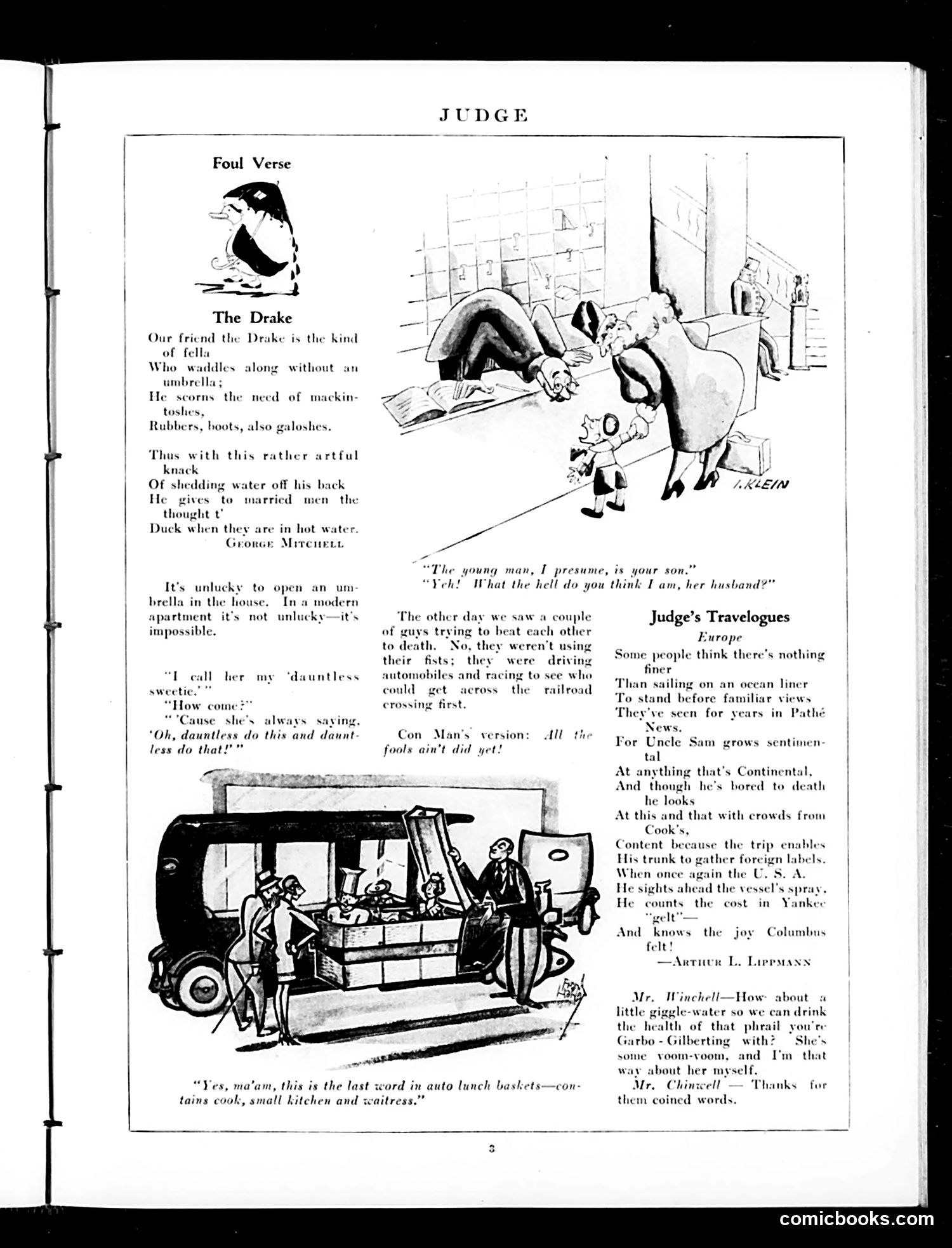
This page contains two main cartoon sections satirizing early automobile culture: **"The Drake"** section mocks a particular type of vehicle owner—someone who avoids umbrellas and embraces getting wet, using the car's design to shed water like a duck. It's a humorous commentary on automobile enthusiasts' pride in their vehicles' features. **"Judge's Travelogues"** features a cartoon showing a couple in an automobile, with a caption about people "trying to beat each other to death" using cars and racing across railroads. Below, another cartoon depicts the interior of an early auto "lunch basket," mocking the novelty of motorized vehicles as tourist attractions where people could eat while driving—a remarkable new convenience being satirized for its impracticality and presumed luxury. The overall theme celebrates automobile culture's growing absurdity.
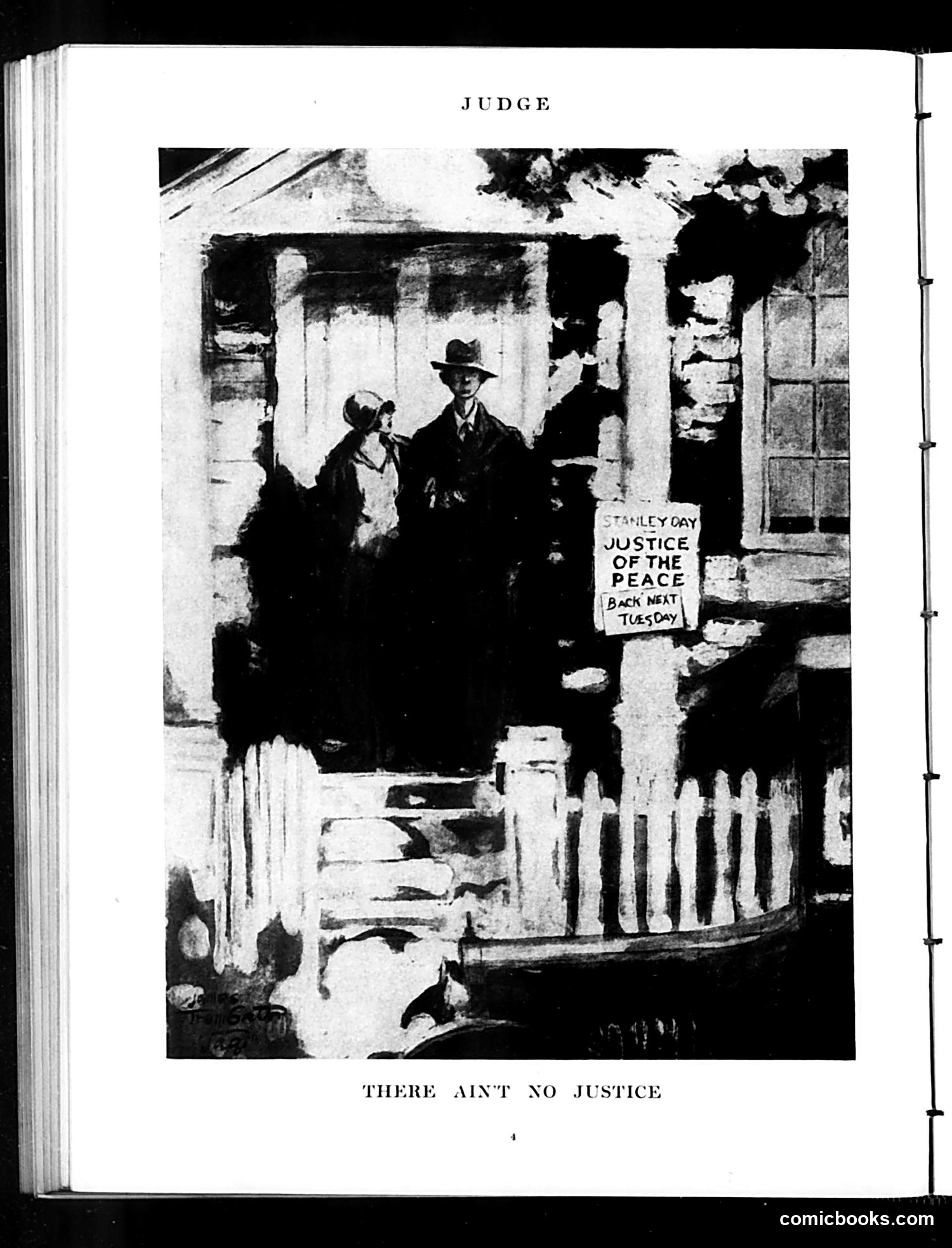
This Judge magazine page satirizes judicial incompetence or corruption. The header "JUDGE" and caption "THERE AIN'T NO JUSTICE" frame the scene cynically. The image shows a "Justice of the Peace" office with a sign reading "BACK NEXT TUESDAY"—suggesting the magistrate is absent or negligent. A man in a hat (likely Stanley Daw, credited in the signage) stands with what appear to be plaintiffs or defendants waiting outside a ramshackle structure. The satire targets small-town or rural justice systems where justices of the peace were often unavailable, incompetent, or corrupt—a common criticism in early 20th-century American reform journalism. The rickety building and casual "back next Tuesday" notice mock the inadequacy of local legal institutions. The title's resigned tone suggests systemic failure rather than individual mishap.
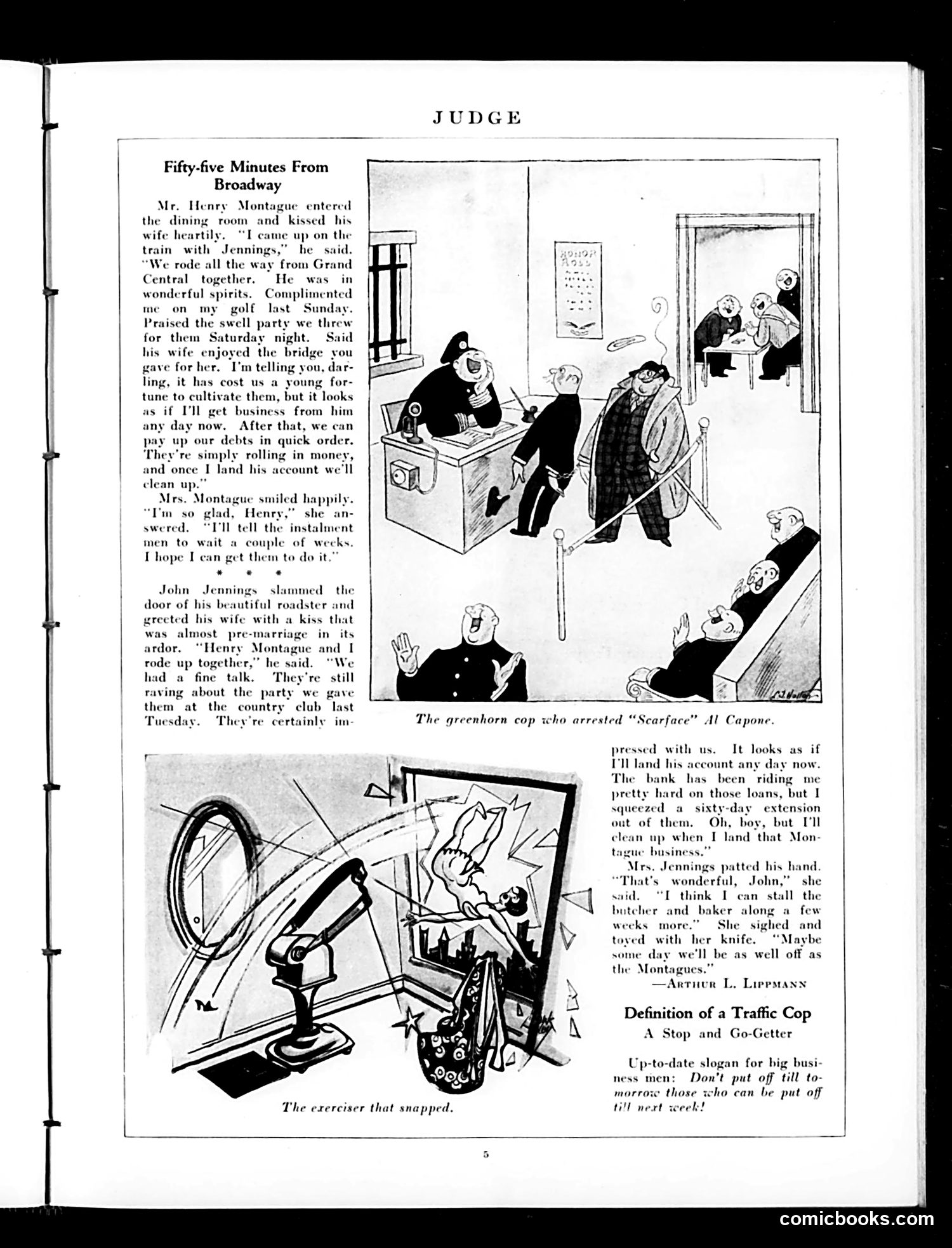
This page contains a short story titled "Fifty-five Minutes From Broadway" about a businessman named Henry Montague who successfully cultivates wealthy friends for financial advantage. The narrative satirizes social climbing and financial opportunism among the upper class. Two cartoon illustrations accompany the text: 1. **"The greenhorn cop who arrested 'Scarface' Al Capone"** depicts police arresting a criminal, referencing contemporary organized crime. 2. **"The exerciser that snapped"** shows a broken piece of exercise equipment, likely satirizing the health-and-fitness industry trends of the era. The page concludes with a humorous definition of a "Traffic Cop" as a "Stop and Go-Getter," punning on business terminology. The overall content satirizes American materialism, crime, and modern conveniences.
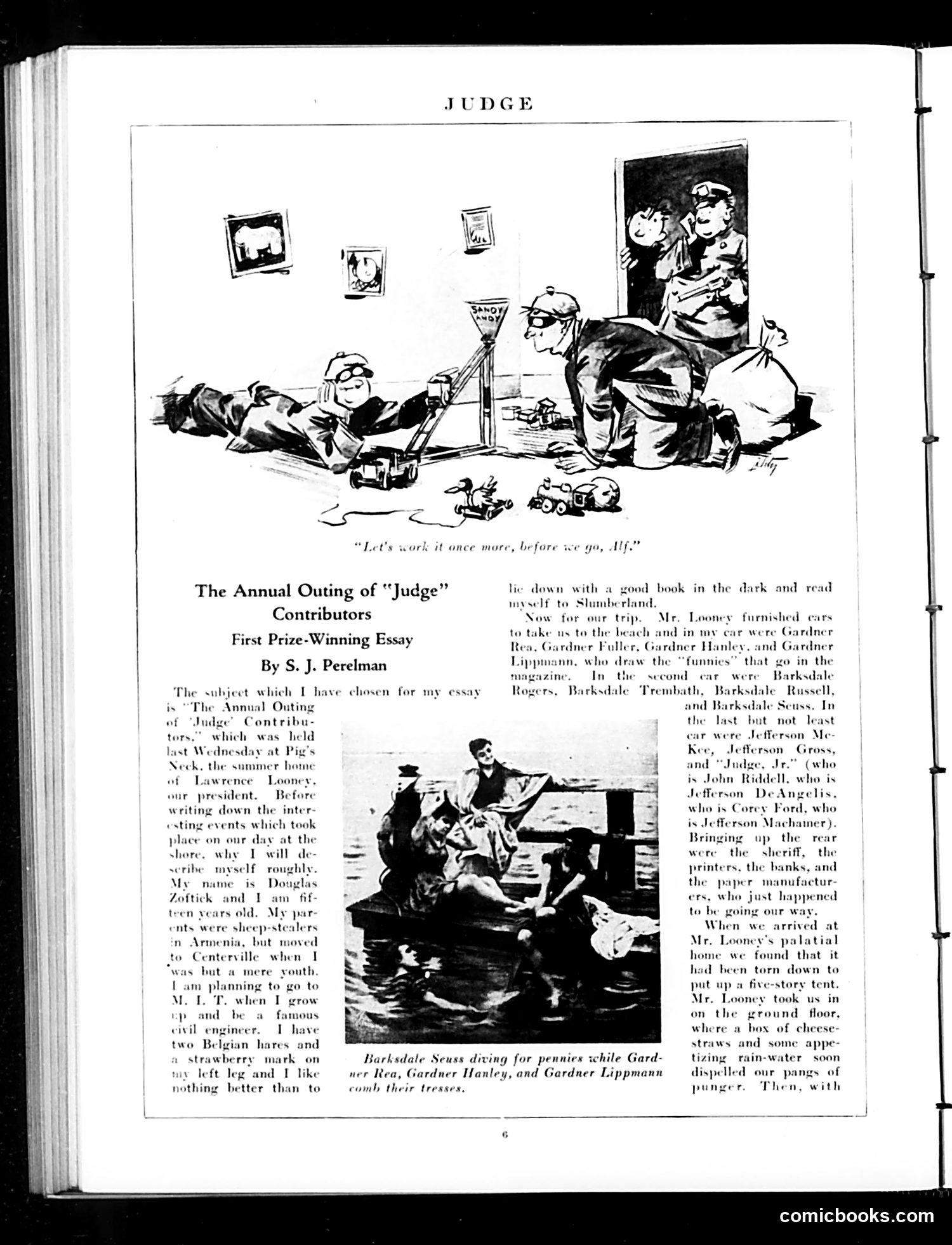
This page features **"The Annual Outing of 'Judge' Contributors,"** a humorous essay by S. L. Perelman describing a magazine staff picnic. The **top cartoon** shows men in suits and hats at a beach, examining toy construction equipment and vehicles. The caption "Let's work it once more, before we go, Al!" suggests they're treating the outing like work rather than recreation—a joke about editorial staff unable to relax. The **bottom photograph** shows men in a rowboat, identified as "Barksdale Seuss driving for pennies while Gardner Rea, Gardner Hanley, and Gardner Lippmann coach their horses." This appears to be a playful record of actual staff members at the outing, with the absurd scenario (driving for pennies, coaching horses from a boat) adding comedic exaggeration to what was likely an ordinary recreational gathering.
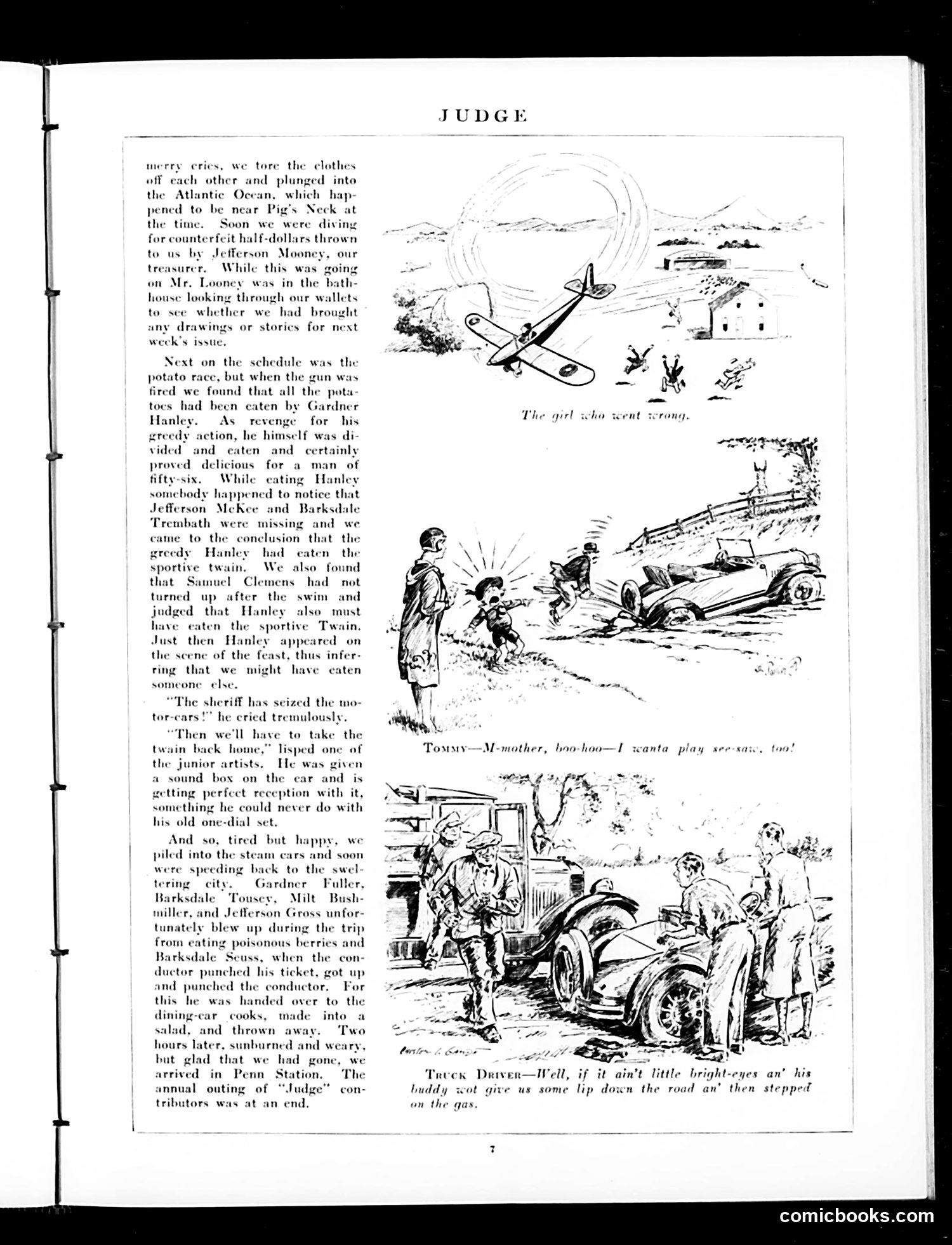
This is a humorous narrative about Judge magazine's annual outing/company picnic, told as absurdist comedy. The text describes increasingly ridiculous mishaps: staff members (Jefferson Mooney, Gardner Hanley, and others named) engage in chaotic activities—swimming, potato races where potatoes are eaten, people being "divided and eaten"—with darkly comedic cannibalism jokes. The three accompanying illustrations depict: (1) a crashed airplane with a girl nearby ("The girl who went wrong"), (2) a woman and children watching the disaster, and (3) a truck driver scene with the caption about "bright-eyes" and road etiquette. The satire appears to mock the magazine's own staff and contributors through exaggerated, surreal mishaps. The specific individuals named (Mooney, Hanley, Fuller, Clemens references) were likely recognizable to contemporary Judge readers as actual contributors or staff, making this inside-joke humor. The cartoons illustrate slapstick consequences of chaos rather than direct political commentary.
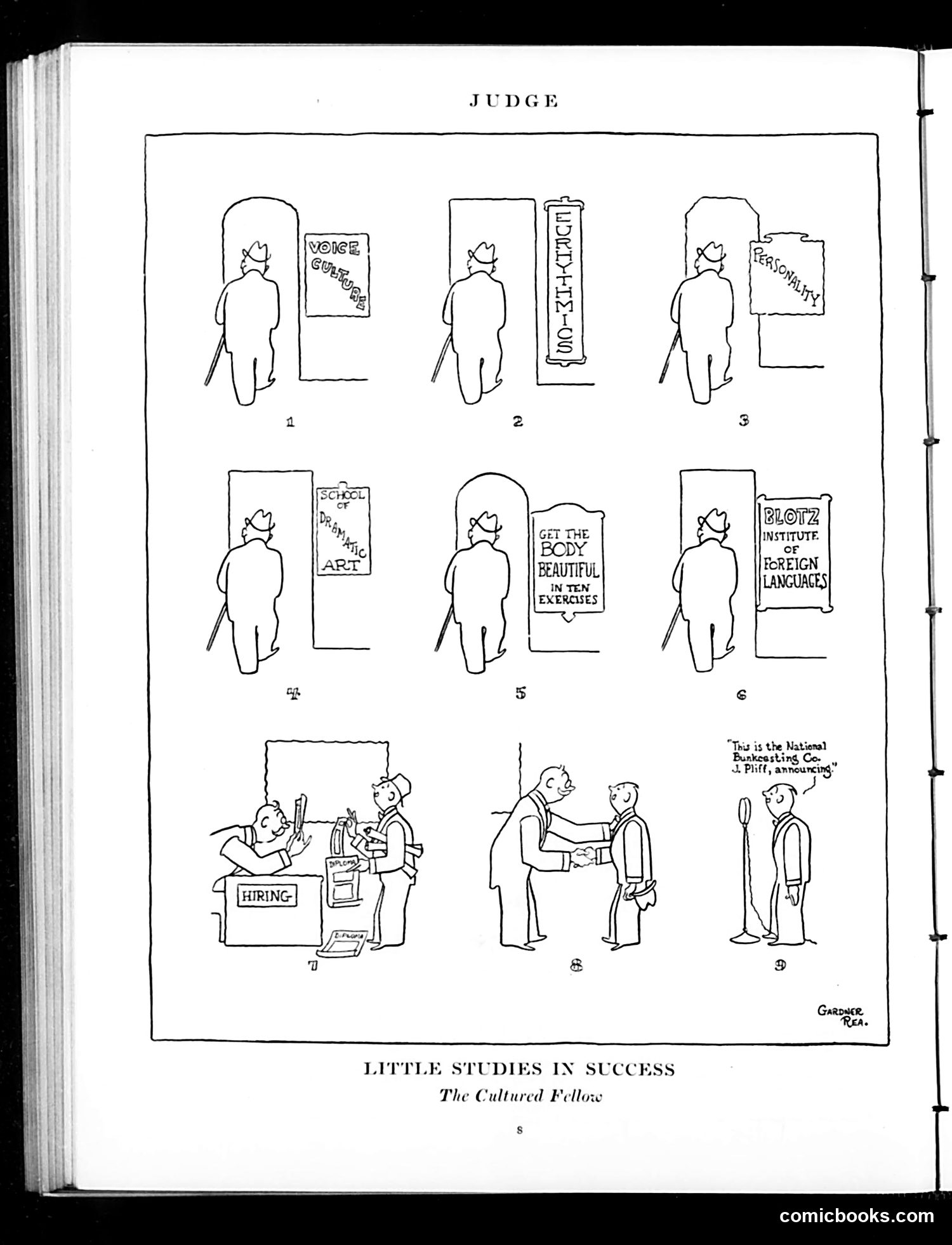
This comic mocks the pretentious pursuit of "culture" as a path to success. The top six panels show a figure repeatedly viewing signs advertising cultural credentials: "Voice Culture," "Music," "Elocution," "School of Dramatic Art," "Get the Body Beautiful in Ten Exercises," and the "Blotz Institute of Foreign Languages." The bottom panels reveal the joke: despite acquiring all these cultural refinements, the figure ends up at a "Hiring" desk and later at the "National Bunkesting Co." run by "J. Pliff"—suggesting that this accumulated cultural veneer is worthless in actual employment. The satire targets early 20th-century American social climbing, where self-improvement schemes and cultural pretension were marketed as tickets to success, but practical business connections mattered far more. The figure's effort to become "cultured" ironically leads to obscure, low-status employment.
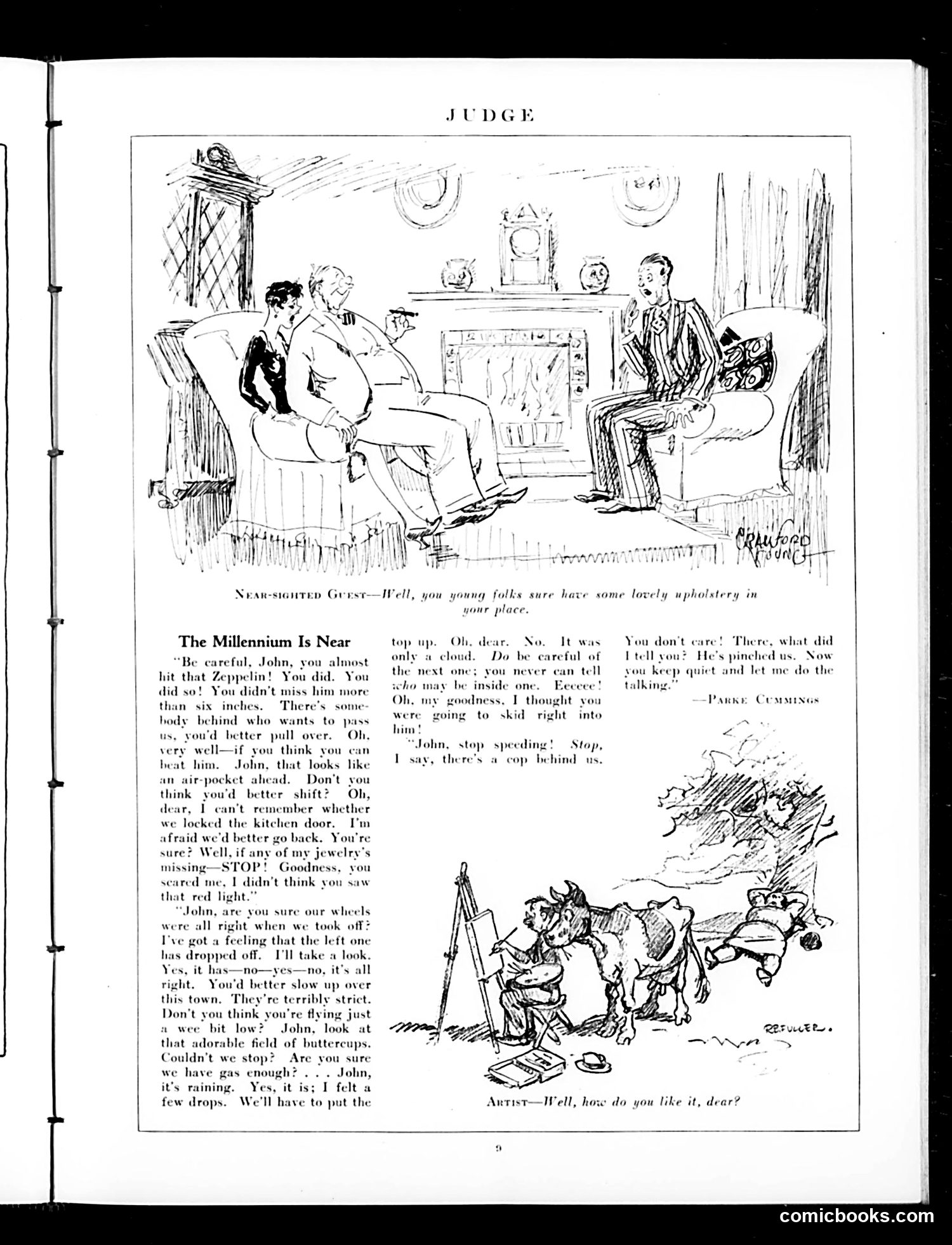
This page satirizes early aviation anxiety through two complementary cartoons about early aircraft travel (circa 1910s-1920s). **Top cartoon:** A nervous passenger lectures a pilot about flying dangers—zeppelins, air pockets, mechanical failures, speed limits, and weather. The satire targets the absurdity of applying automobile-era caution to a fundamentally new, dangerous technology. The passenger's constant backseat nagging reflects public fear of aviation as reckless and uncontrollable. **Bottom cartoon:** An artist and companion observe the chaotic wreckage of a crashed plane with debris scattered about. The artist's casual "Well, how do you like it, dear?" suggests dark humor about aviation's frequent, spectacular failures. Together, the page mocks both the overly-anxious passenger and the actual dangers of early flight—implying that the "millennium" (future age) of safe aviation remains distant. The Zeppelin reference suggests wartime era (WWI period), when aircraft were new, unreliable, and genuinely dangerous.
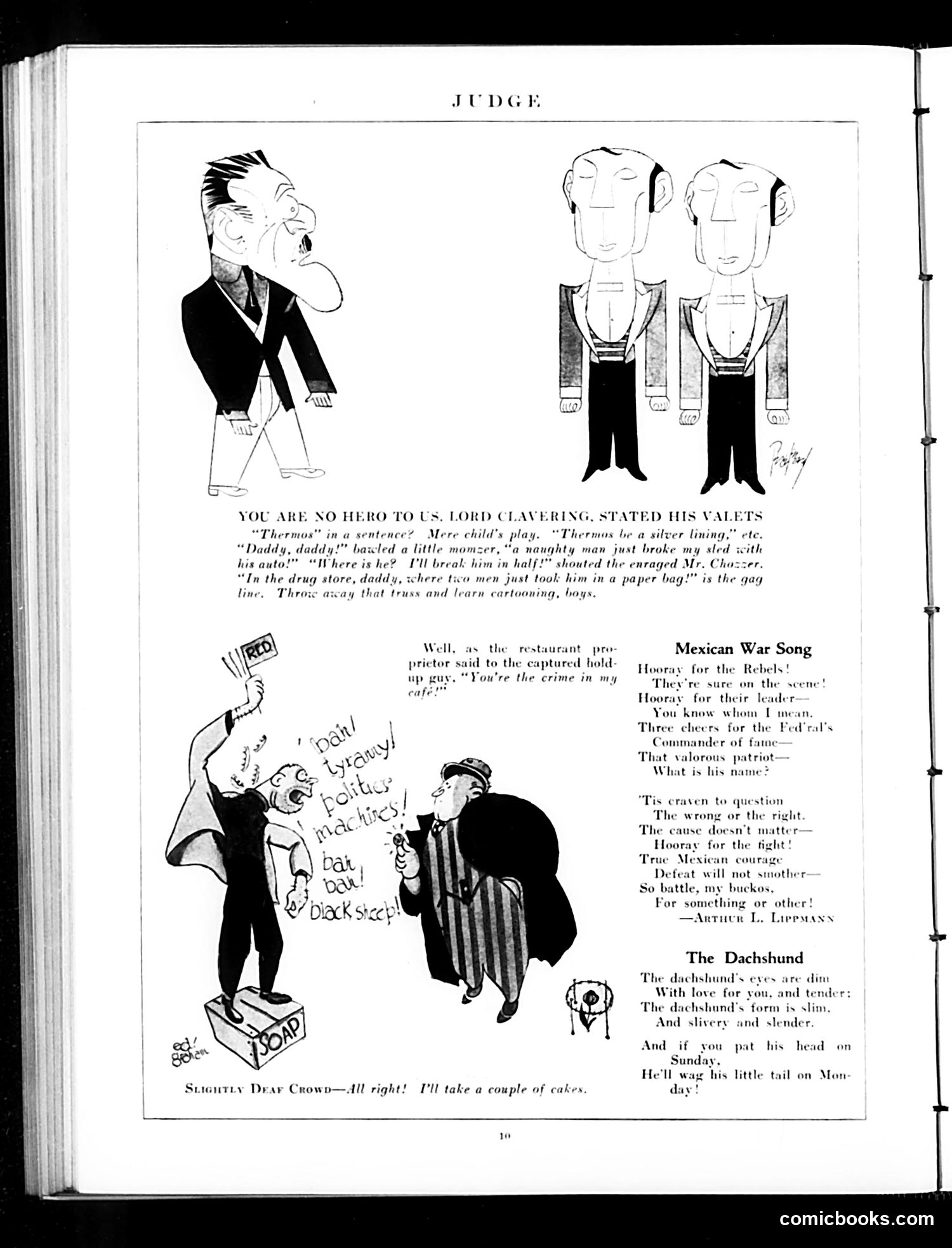
This page contains multiple satirical pieces typical of Judge's humor: **Top cartoon**: "You Are No Hero to Us, Lord Clavering" mocks valets who are unimpressed by their employer's pretensions. The joke involves wordplay and absurdist humor about "Thermos" bottles and child's pranks. **Middle section**: A restaurant scene satirizes a "Slightly Deaf Crowd" unable to hear properly, a common period joke about communication mishaps. **Right column**: Includes a "Mexican War Song" (likely referencing the Mexican-American War era) that sarcastically celebrates fighting "for something or other"—mocking meaningless patriotism and the vagueness of war justifications. **Bottom**: "The Dachshund" is sentimental doggerel poetry poking fun at overly cutesy animal verse popular in the era. Overall, the page represents Judge's blend of visual caricature, wordplay, and social satire targeting contemporary manners, pretension, and jingoism.
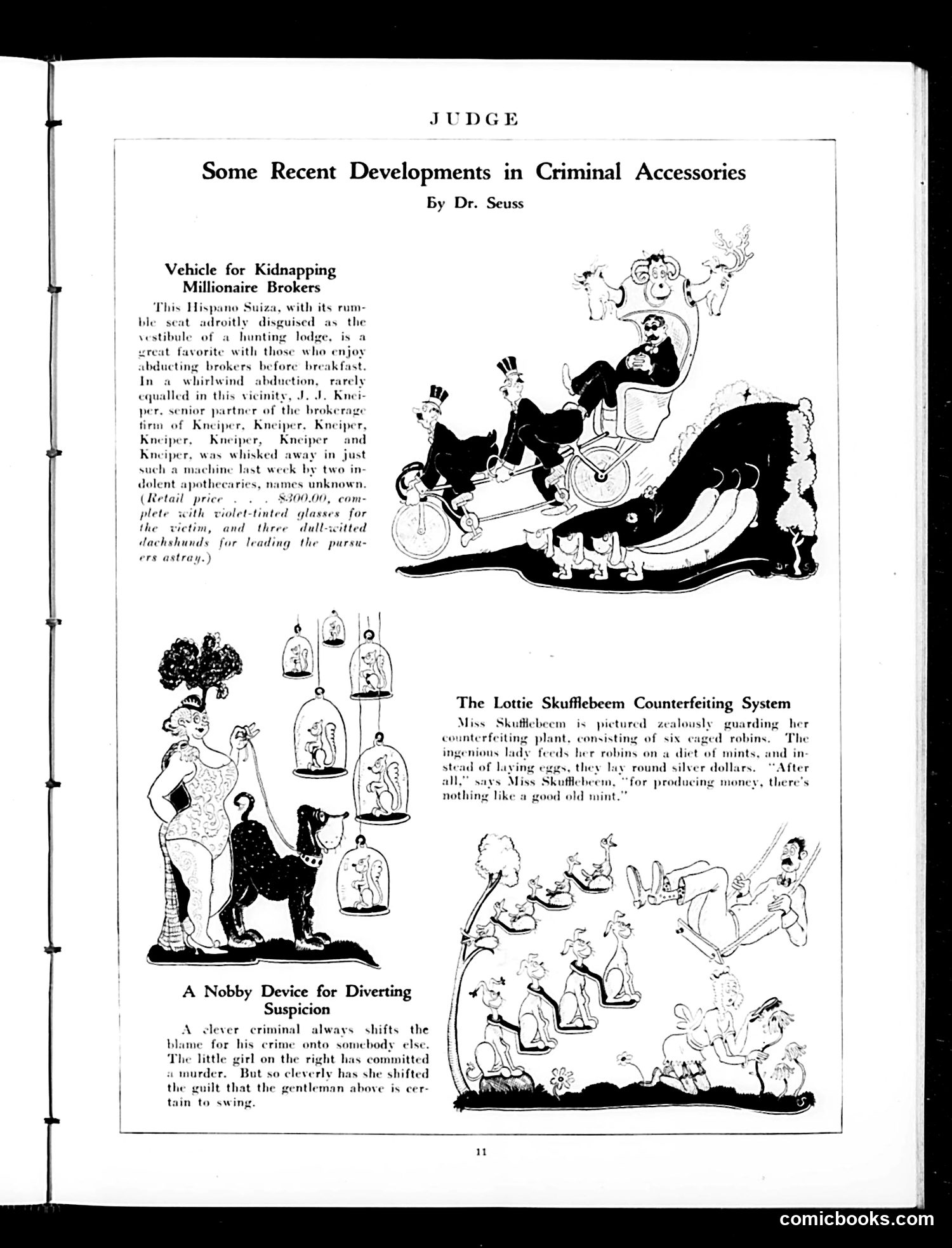
This is a humorous 1920s-30s satirical piece by Dr. Seuss (Theodor Geisel) in *Judge* magazine, presenting fake "criminal innovations" as dark comedy. **The three cartoons mock contemporary crime and social anxieties:** 1. **Kidnapping Device**: References actual 1920s kidnappings of wealthy businesspeople. The joke satirizes both the crime epidemic and wealthy brokers' vulnerability by imagining an absurdly elaborate kidnap-vehicle disguised as a hunting lodge. 2. **Counterfeiting System**: A surreal scheme where robins fed mints lay silver dollars instead of eggs—absurdist humor poking fun at counterfeiting operations. 3. **Murder Frame-up**: Shows a child successfully framing an innocent man for her crime, darkly commenting on how criminals exploit others' trust and legal systems' limitations. The satire targets crime's prevalence in 1920s-30s America while using Seussian whimsy to defuse anxiety about kidnapping, counterfeiting, and justice system failures that plagued the era.
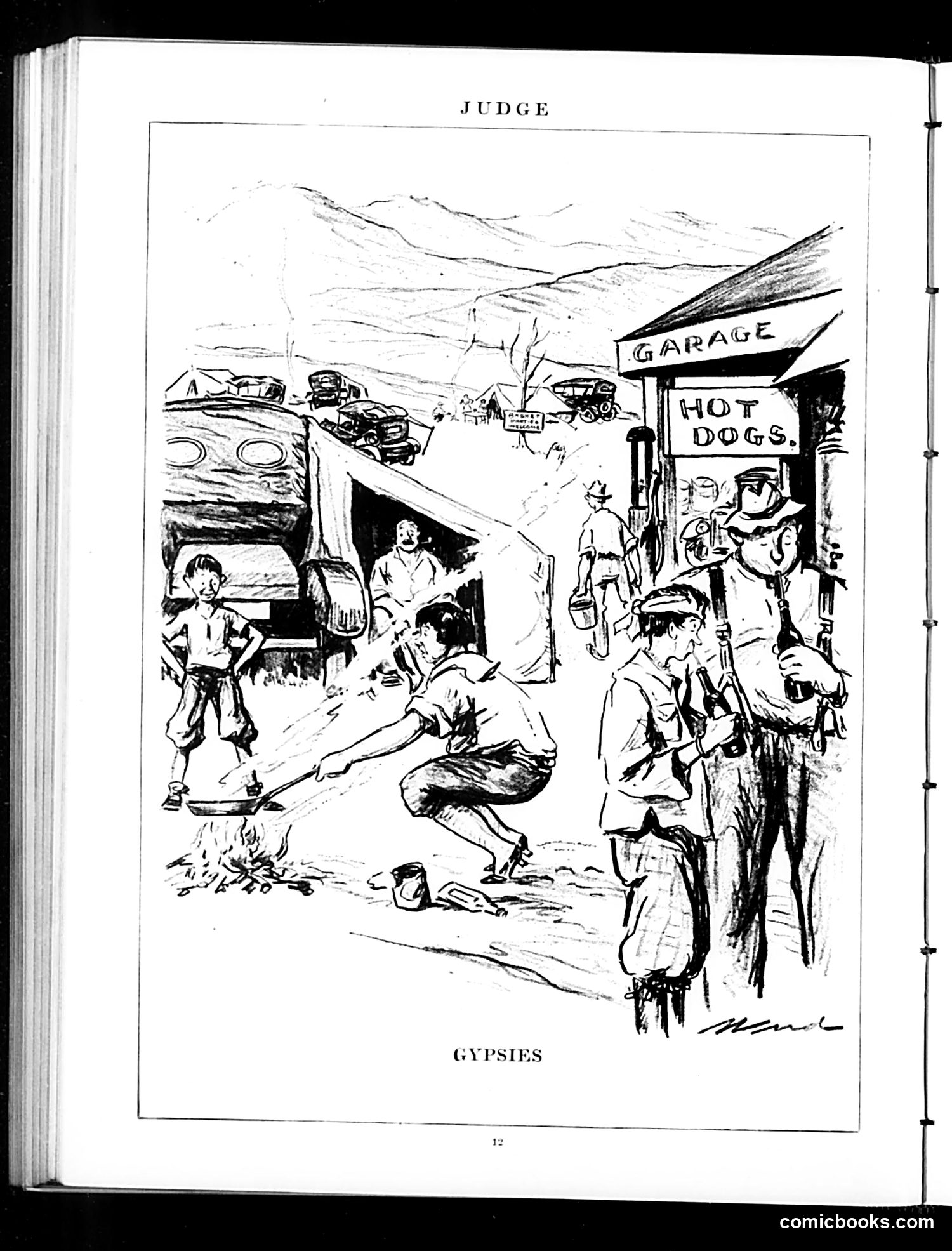
This cartoon depicts an encampment of Romani people ("Gypsies") at what appears to be an early 20th-century roadside settlement. The scene shows a temporary camp with tents, vehicles, and multiple figures, including children around a campfire. A garage and hot-dog stand are visible in the background, suggesting the encampment exists alongside American commercial establishments. The satire likely mocks contemporary anxieties about Romani communities—stereotyping them as transient, poor, and socially marginal. The juxtaposition with American businesses underscores the contrast between settled, "civilized" commerce and the perceived otherness of traveling communities. Judge magazine frequently featured satirical commentary on immigrant and marginalized groups, and this appears to be commentary on American social attitudes toward Romani people during this era.
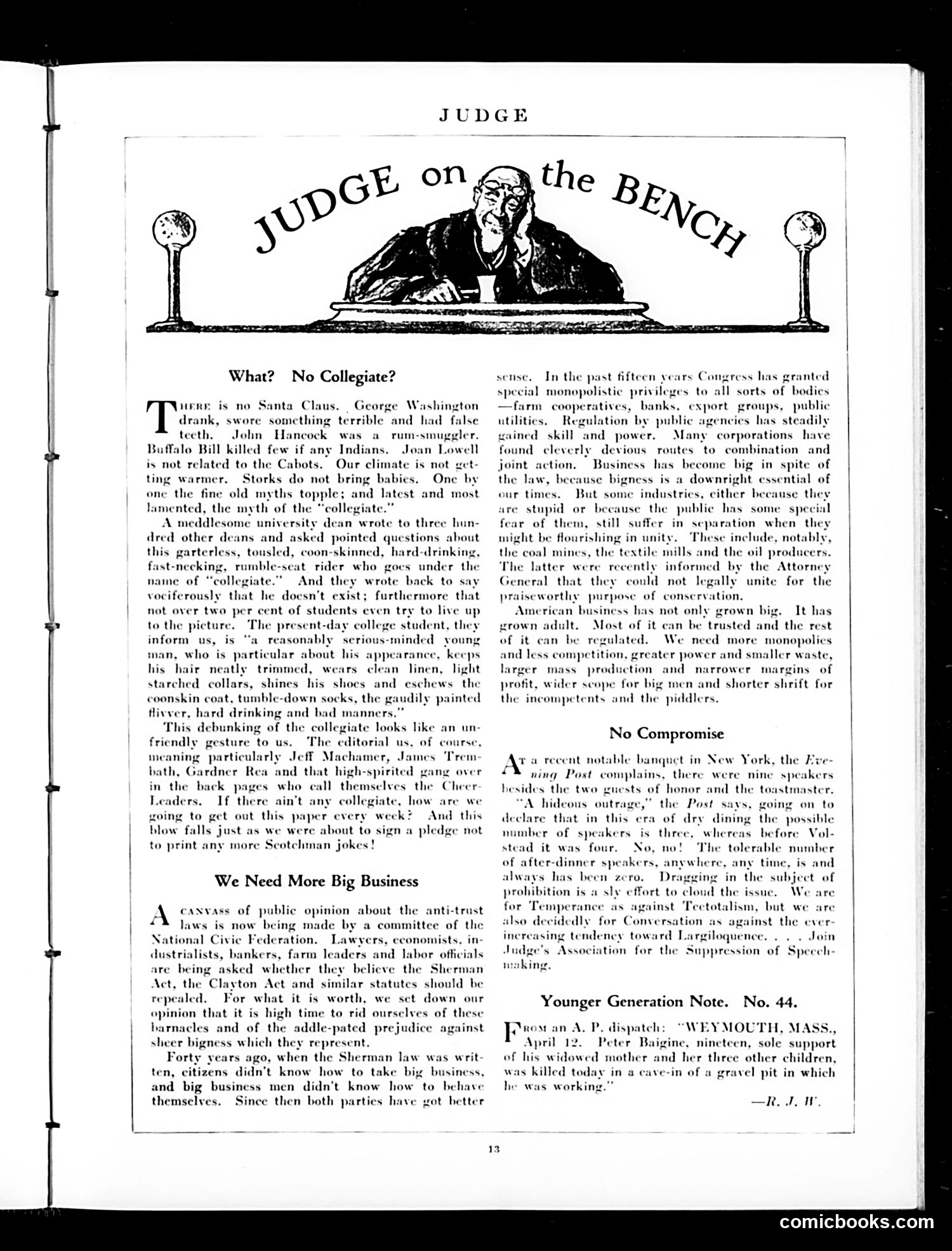
## The Cartoons and Articles **Main Illustration:** A judge sits at his bench, introducing the page's content. **"What? No Collegiate?"** satirizes a university dean's survey debunking the popular stereotype of the rowdy college student—the gin-drinking, hard-partying "collegiate" who drives fast cars and ignores etiquette. The article reveals that modern college students are actually serious and well-behaved. Judge magazine humorously laments this, since their comedic content relies on mocking these collegiate stereotypes. The piece targets figures like "Jeff Machamer" and the magazine's "Cheerleaders" (staff contributors), joking they won't survive losing this reliable subject matter. **"We Need More Big Business"** argues for repealing anti-trust laws (Sherman Act, Clayton Act). The editor contends that large corporations have matured and self-regulate better than government agencies can. He advocates for consolidated industries like coal and oil, claiming monopolies produce efficiency, lower costs, and higher quality—views opposing progressive anti-monopoly sentiment of the era. Both pieces reflect 1920s-era Judge editorial positions on youth culture and business regulation.
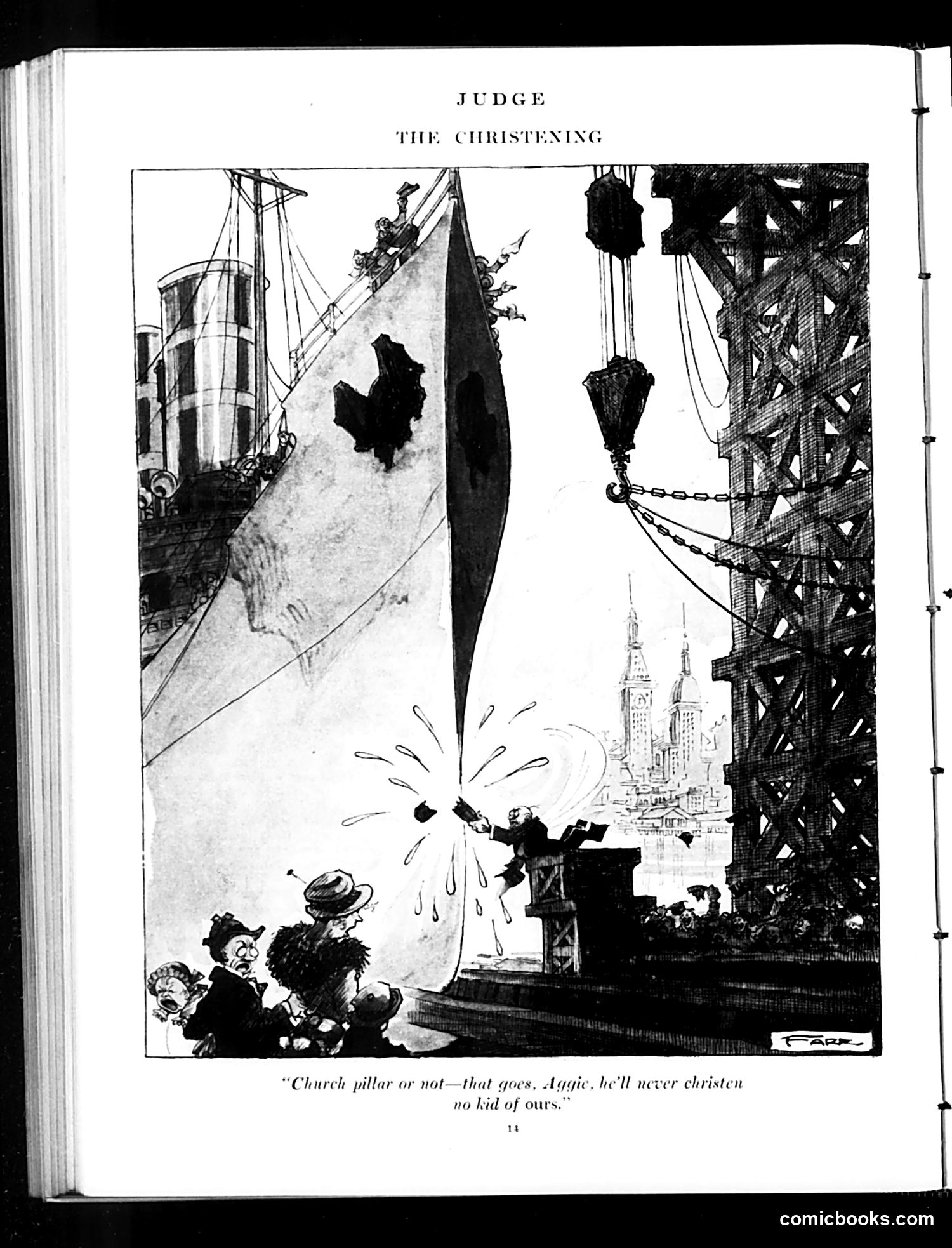
This satirical cartoon depicts a christening ceremony at what appears to be a London dock (visible Tower Bridge and cathedral in background). A ship is being christened—a traditional ceremony where a bottle is smashed against a vessel's hull for good luck. The humor centers on the dialogue: a man named Aggie refuses to have their child christened by this particular ship, joking that the vessel is so unlucky it will "never christen no kid of ours." The cartoon inverts the typical christening concept—instead of blessing a child, the ship itself is being blessed, yet it appears so destined for misfortune that the speaker wouldn't trust it near his offspring. The satire likely mocks superstitions surrounding ships and maritime luck, or possibly comments on particular vessels or maritime incidents of the period.
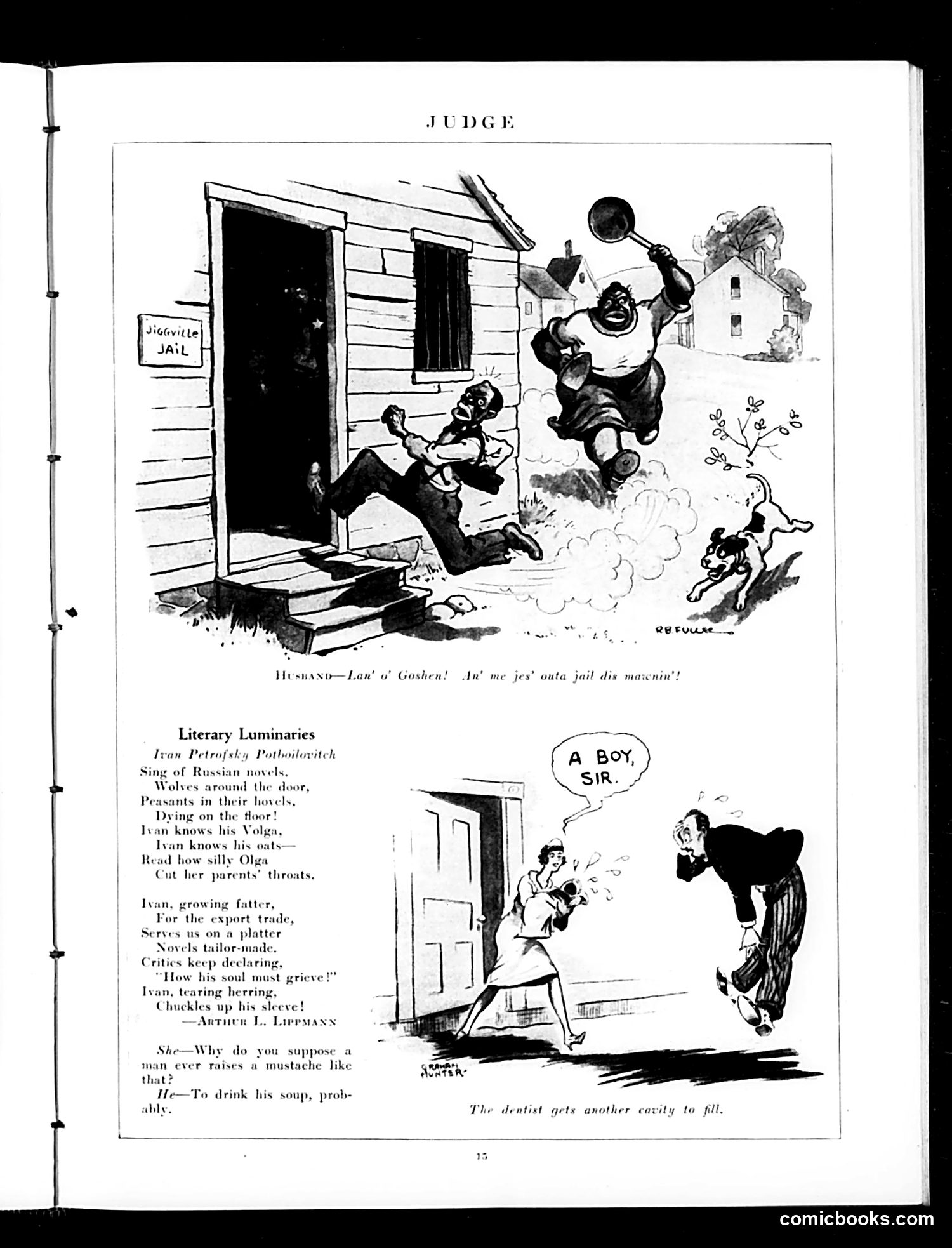
This Judge page contains two satirical pieces: **Top cartoon**: A domestic scene where a husband, freshly released from jail, is being ejected by his wife through the doorway. The humor relies on the wife's dialect ("Lan' o' Goshen") and the absurdity of her timing—he's literally just gotten out that morning. **"Literary Luminaries" section**: This mocks Russian literature's popularity in America, specifically targeting authors like Tolstoy and Dostoevsky. The satire critiques their grim subject matter (poverty, suicide, violence) and suggests critics pretend to find it profound while actually finding it ridiculous. The poem ridicules both the dark themes and the assumption that publishing such novels represents genuine artistic merit or even ethical seriousness. **Bottom cartoon**: A brief joke about facial hair and dental hygiene—a man grows a mustache to contain soup while eating, though the punchline suggests he actually just needs dental work. The page represents American satirical attitudes toward highbrow European culture and domestic life.
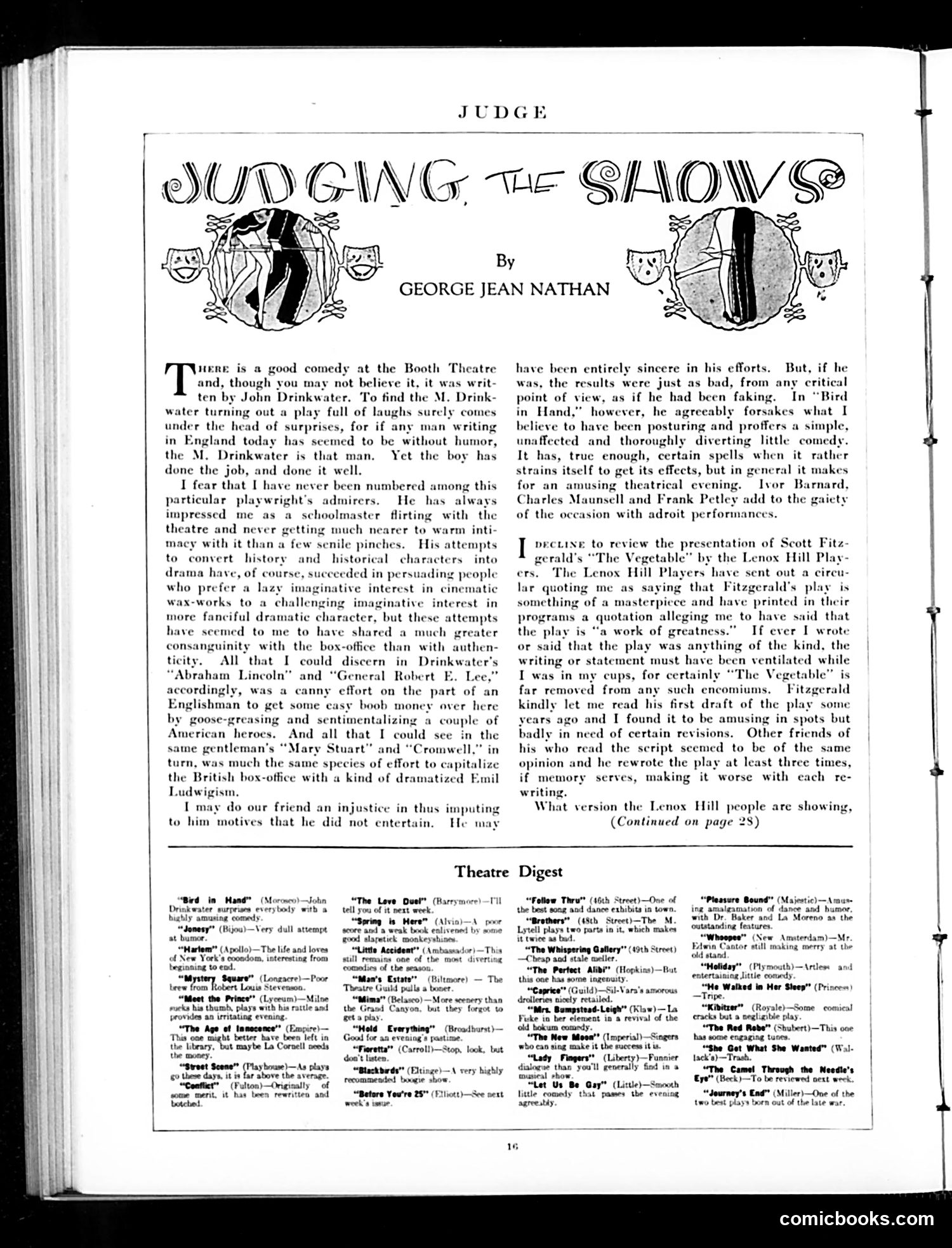
This page contains theater reviews by prominent critic George Jean Nathan, not a political cartoon. The main review critiques John Drinkwater's play "Abraham Lincoln," arguing that while Drinkwater is an earnest playwright, he lacks genuine humor and authenticity. Nathan suggests Drinkwater artificially dramatizes historical figures to capitalize on British box-office success—what Nathan dismissively calls "dramatized Emil Ludwigism" (referring to German biographer Emil Ludwig's popular but formulaic approach). Nathan also reviews F. Scott Fitzgerald's "The Vegetable," claiming the Lenox Hill Players' current production shows Fitzgerald rewrote it multiple times, making it progressively worse. The "Theatre Digest" section below lists brief contemporary Broadway reviews. The page primarily serves as highbrow theater criticism rather than satire or humor.
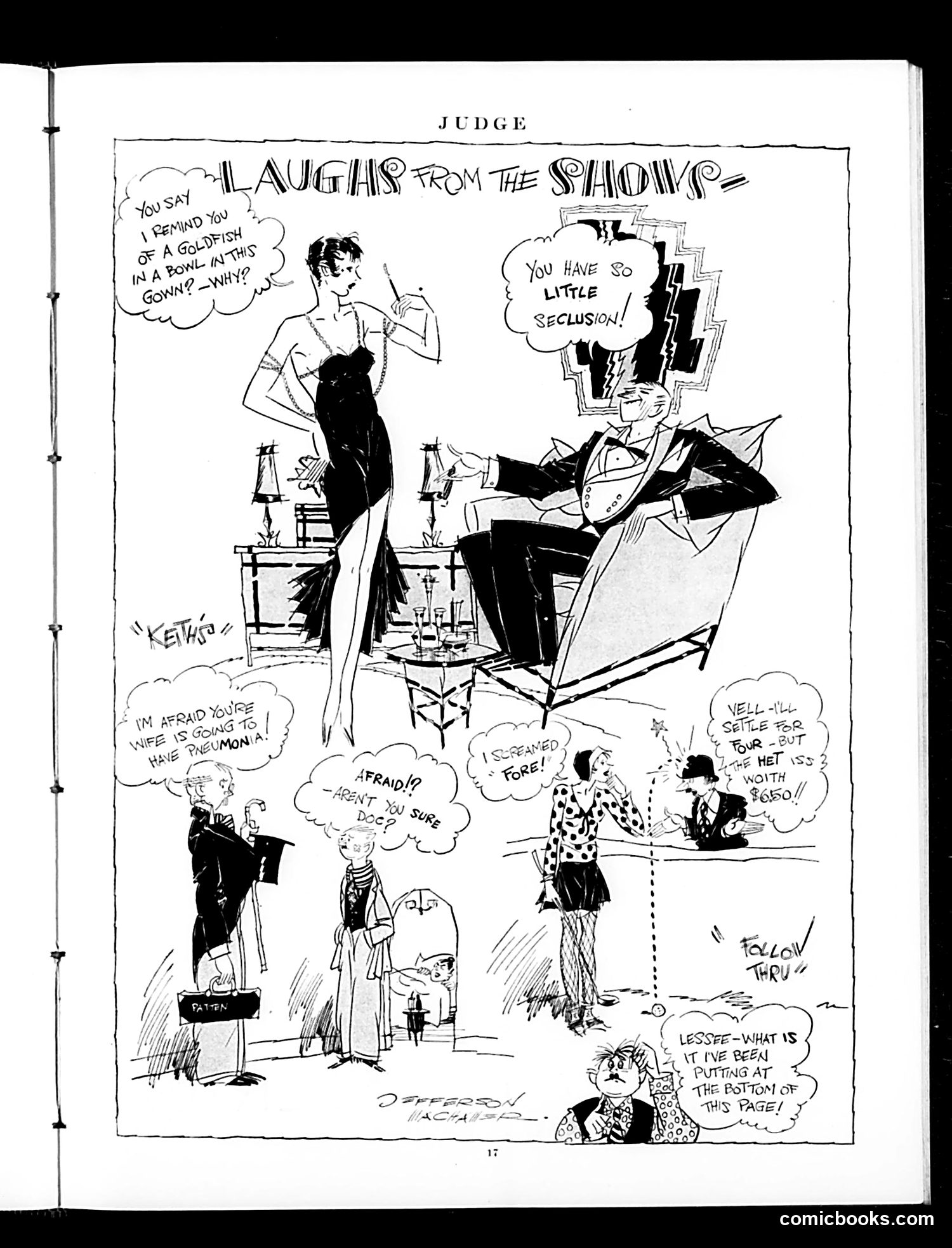
This page from *Judge* magazine presents a satirical scene titled "Laughs from the Showgirl." The central figure is a wealthy, portly gentleman lounging in a chair, being entertained by a showgirl. He boasts to her about having "so little seclusion"—a humorous contradiction suggesting his life is actually quite public and exposed despite his wealth. The surrounding vignettes mock upper-class anxieties: a man fears his wife will discover his infidelity; another worries about settling a lawsuit; figures discuss financial troubles. The humor targets wealthy men's pretensions and their various domestic and social complications. The bottom panel shows an artist (likely the cartoonist, signed "KESWICK") noting his recurring practice of putting similar satirical commentary at the page bottoms. The satire ridicules affluent men's self-importance and their genuine vulnerabilities despite their money and power.
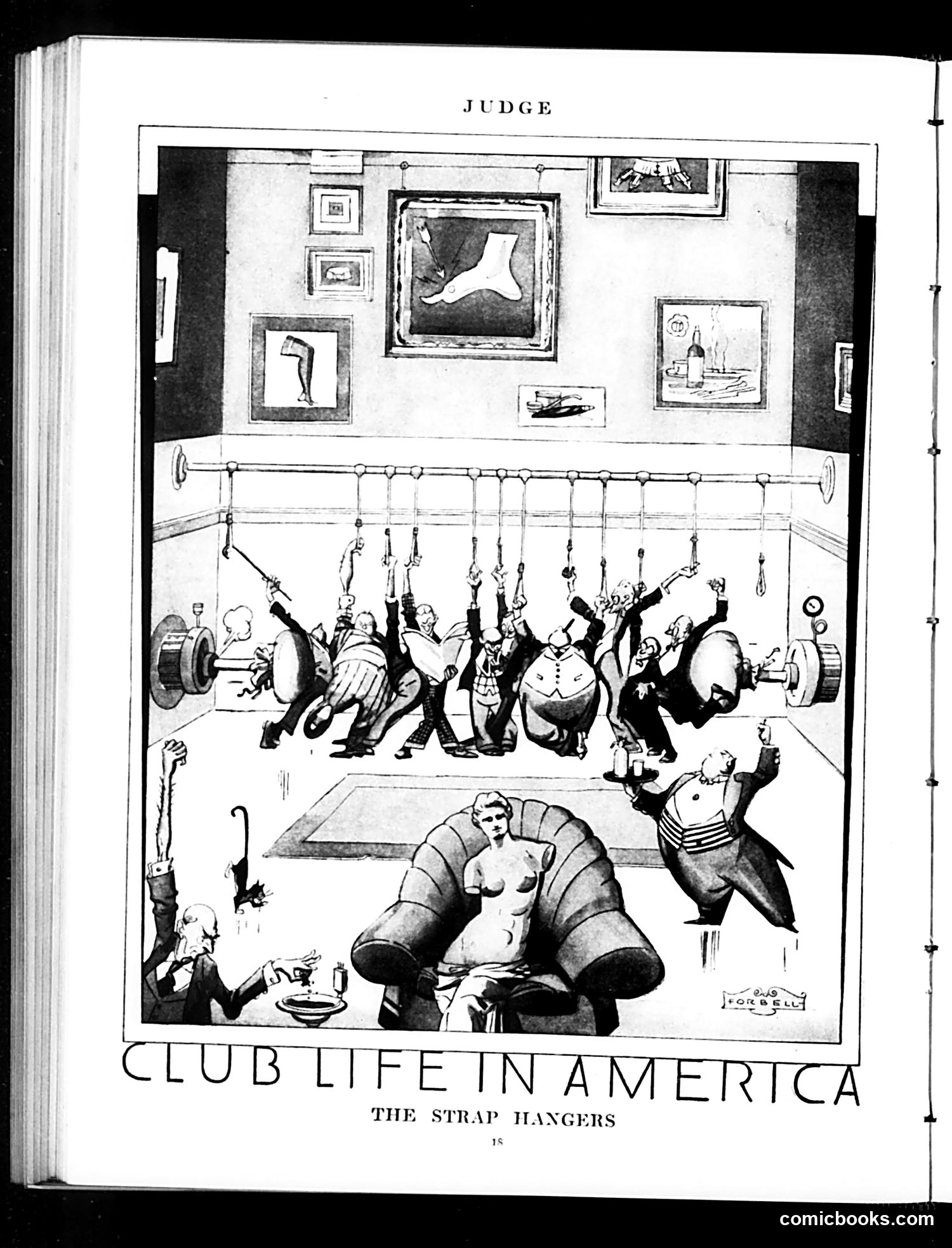
This cartoon satirizes the experience of commuting on crowded public transportation, likely subway or streetcar systems in major American cities. The title "The Strap Hangers" refers to passengers literally clinging to overhead straps during rush hour. The scene depicts a gymnasium-like gymnasium where well-dressed men hang from overhead bars and straps in exaggerated, contorted poses—treating the crowded commute as involuntary exercise. A woman reclines prominently in the foreground, while spectators and attendants observe. The artwork mocks how passengers are packed together, suggesting the absurdity and physical strain of urban commuting has become an unintentional, involuntary "sport" or performance. The cartoon criticizes crowded public transit conditions as dehumanizing and ridiculous.
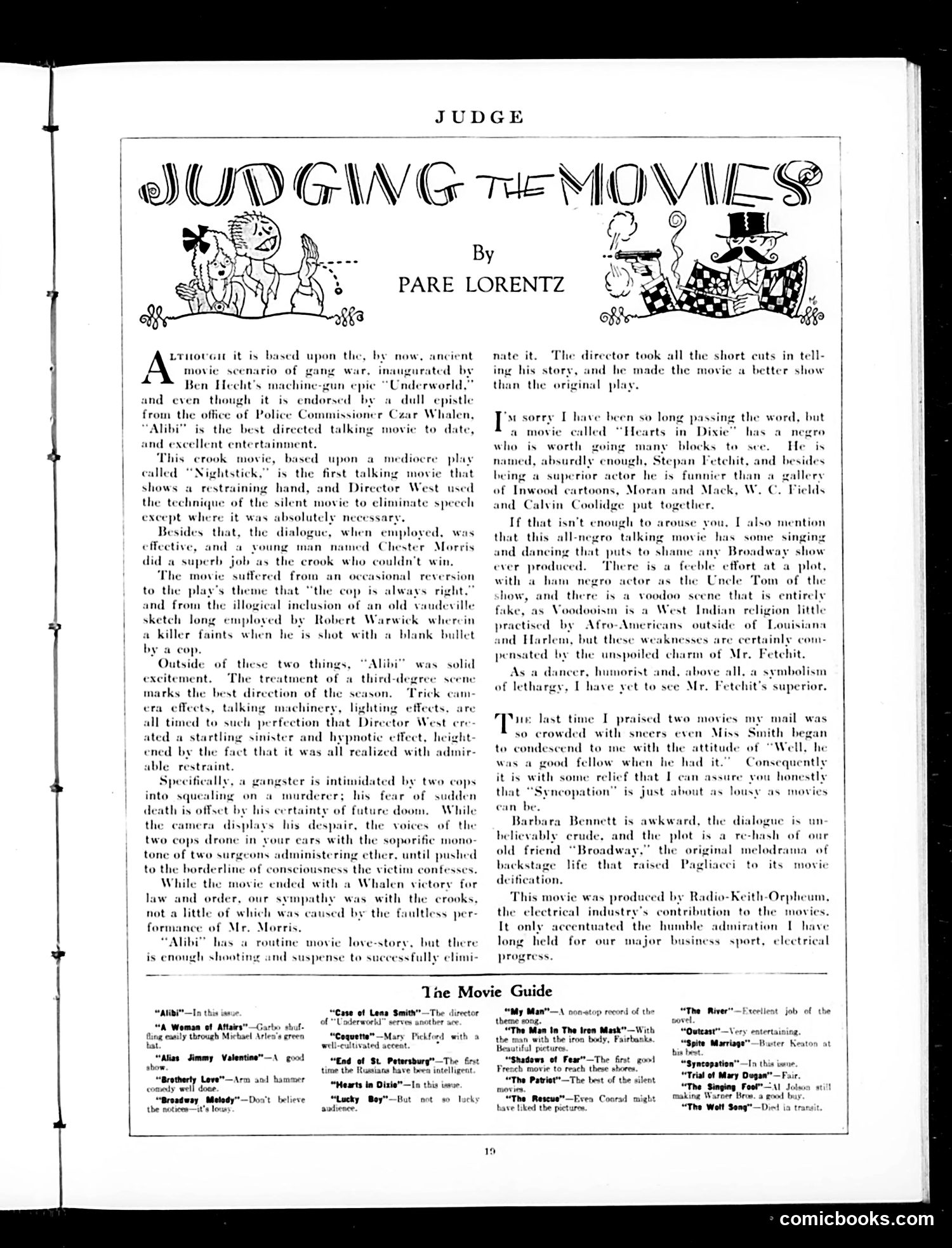
This is a film review column, not a political cartoon. Lorentz critiques several early talking pictures, notably "Alibi" (a gangster film) and "Hearts in Dixie" (an all-Black cast film). **Key references:** - "Alibi" is praised as well-directed despite based on a mediocre play called "Nightstick" - "Hearts in Dixie" features actor Stepan Fetchit, whom Lorentz admires - The review uses period-typical racial language describing it as a "negro talking movie" - References to "Broadway," silent film techniques, and early sound film technology - Police Commissioner Czar Whalen is mentioned (likely NYC official) **The satire:** Lorentz mocks critics who gave him grief for praising previous films, noting even "Miss Smith began to condescend to me." He jokes that "Syncopation" is acceptable entertainment "if movies can be" that bad. The column represents 1920s-early 1930s film criticism before sound standardized cinema.
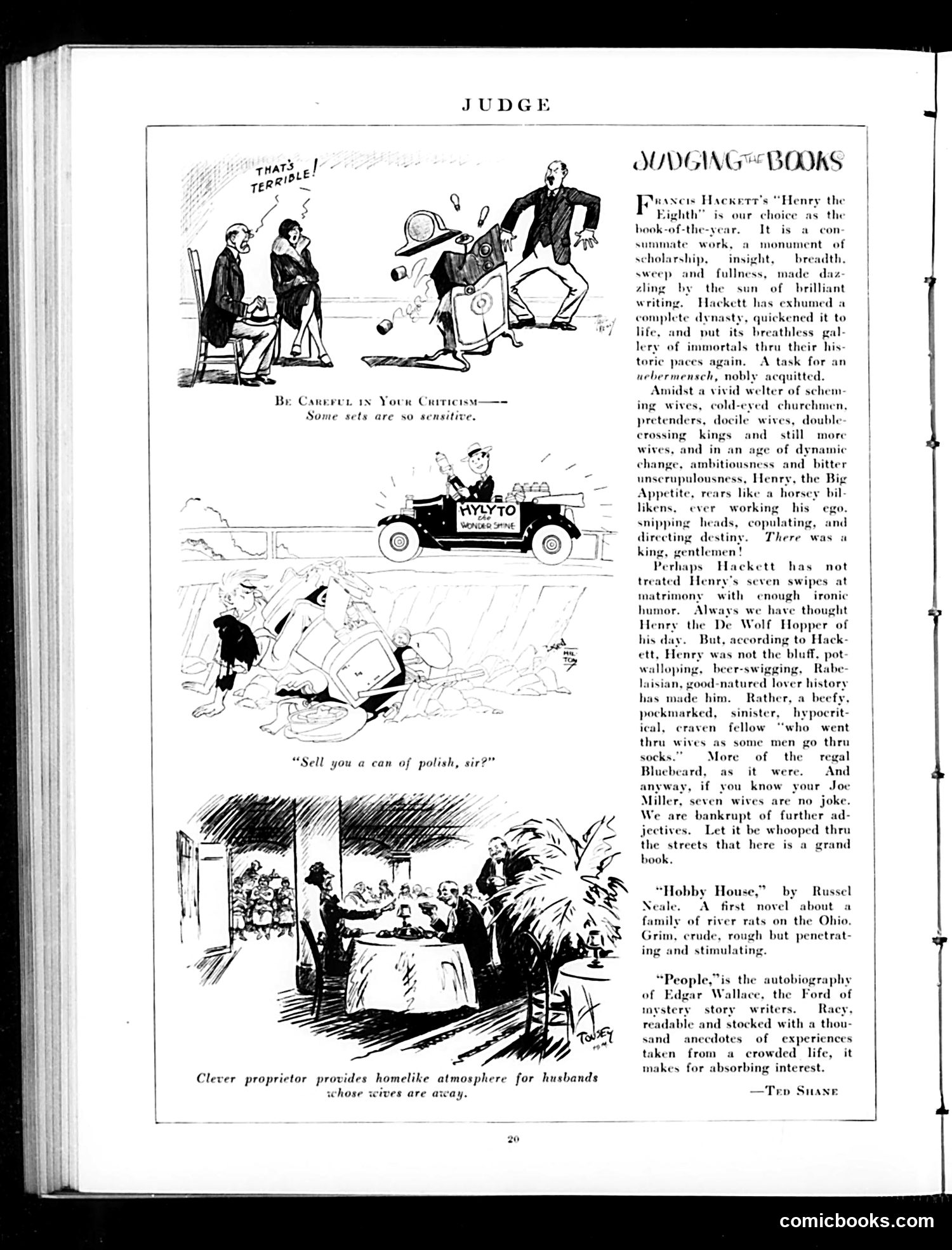
This page reviews three books, with satirical cartoons illustrating editorial commentary on literary criticism itself. **Top cartoon**: "Be Careful in Your Criticism—Some sets are so sensitive" mocks oversensitive authors or critics who react defensively to negative reviews. **Middle cartoon**: A car accident illustrates the review of Francis Hackett's "Henry the Eighth," praising it as book-of-the-year. The text humorously describes Henry VIII as resembling "De Wolf Hopper" (a famous actor), emphasizing his serial marriages by quipping he "went thru wives as some men go thru socks"—dark comedy about his six marriages/beheadings. **Bottom cartoon**: Shows a crowded dinner scene with caption "Clever proprietor provides homelike atmosphere for husbands whose wives are away"—a wry joke about establishments serving abandoned husbands, accompanying the review of Edgar Wallace's autobiography "People." The page satirizes both contemporary books and the pretensions of literary criticism itself through Tad Dorgan's illustrations, a signature Judge approach.
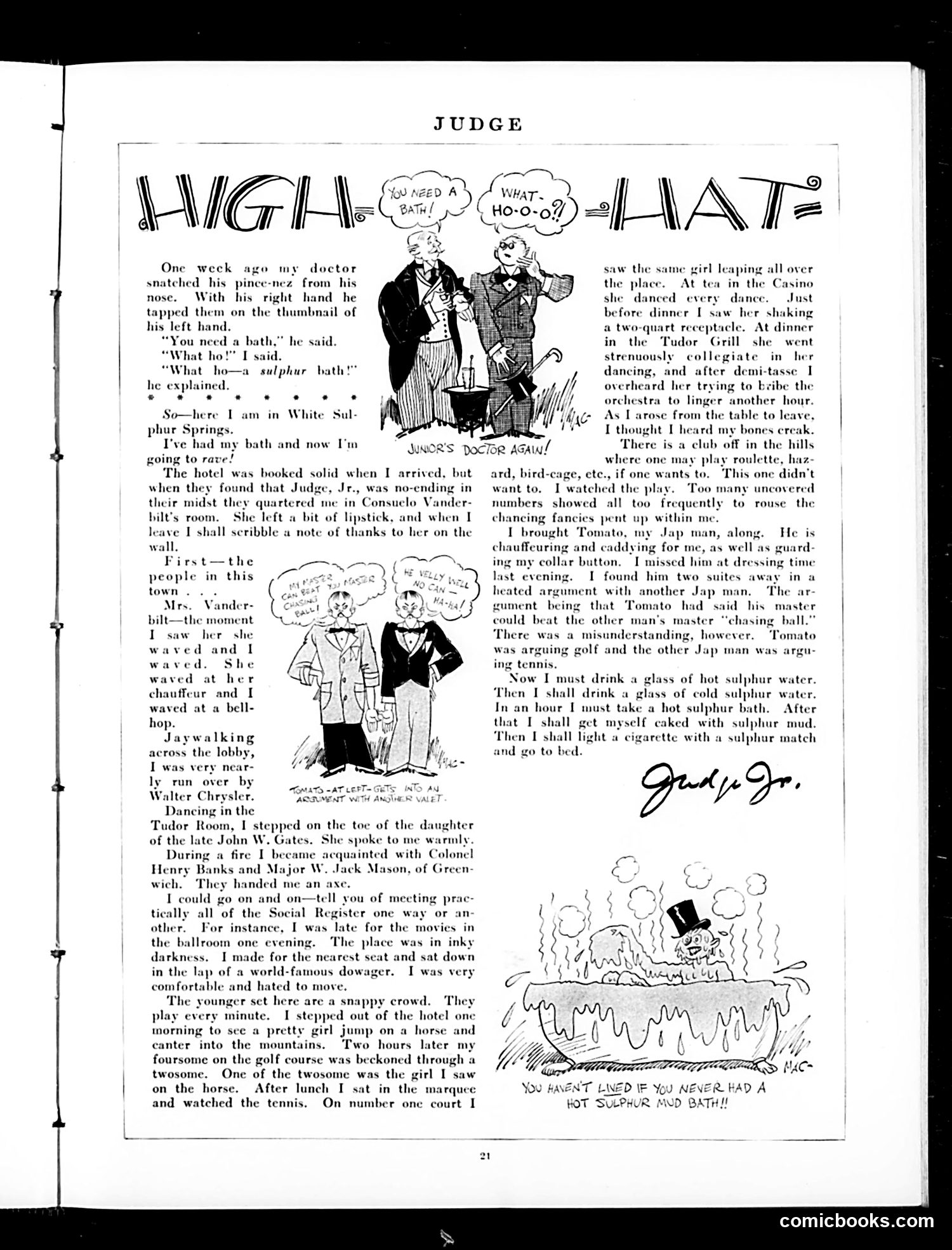
This is a humorous first-person account by "Judge, Jr." about his stay at White Sulphur Springs, a famous spa resort. The satire targets wealthy American society and the author's own pretensions. **Key Social References:** - **Consuelo Vanderbilt**: The famous heiress is name-dropped casually, with the narrator staying in her room - **Walter Chrysler**: Industrial magnate whose presence is treated as comedic collision - **John W. Gates's daughter**: Society figures casually encountered - **The spa itself**: White Sulphur Springs was an exclusive resort where the wealthy gathered **The Joke:** Despite receiving medicinal baths for health, the narrator spends his time pursuing a girl across tennis courts, casinos, and golf courses—completely neglecting the treatment. The cartoons show his doctor's exasperation and his increasingly exhausted state. The final cartoon mocks the sulphur-bath regimen's questionable efficacy. **Satire:** Judge ridicules upper-class frivolity, name-dropping, and the hollow pretense that wealthy people actually rest at resorts rather than socialize obsessively.
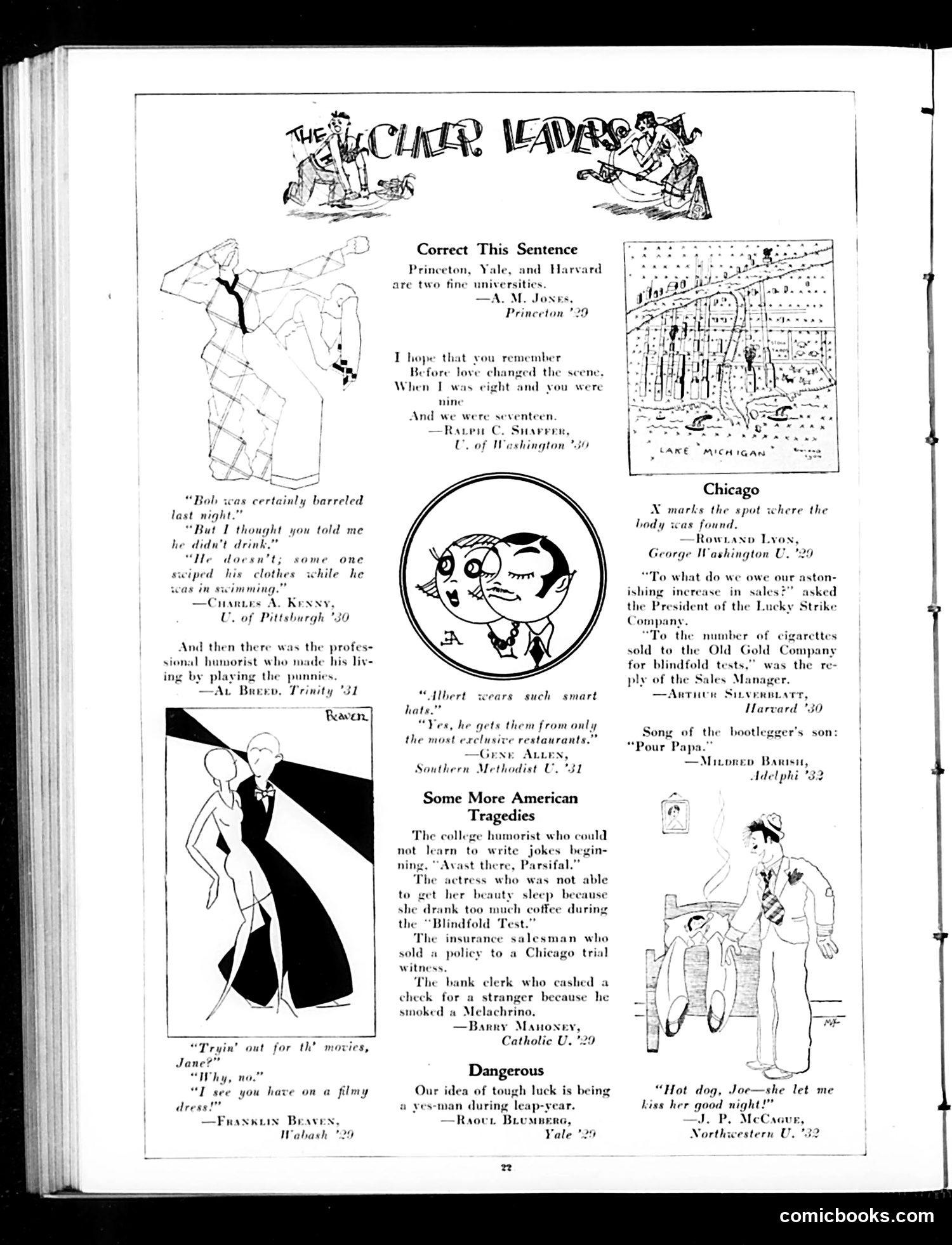
This page from Judge magazine contains college humor submissions from 1929-1932, during Prohibition. The jokes target campus life and contemporary social issues: **"Correct This Sentence"** satirizes pretentious grammar correction—the submitted sentence is intentionally wrong (three universities can't be "two fine"). **The drinking jokes** reference Prohibition (1920-1933): "barreled" means drunk; the swimming anecdote plays on illegal alcohol consumption. One submission mocks a professional joke-writer's terrible puns. **"Some More American Tragedies"** section lists absurdist scenarios, including a bank clerk trusting someone who smokes expensive cigarettes (Melachrino brand), and cigarette company cross-promotion—the Lucky Strike/Old Gold reference jokes about rival tobacco companies using "blindfold tests" in marketing. **The "Dangerous" section** includes a leap-year dating reference (when women traditionally propose). The cartoons are generic illustrations of flirting couples and 1920s fashion. The overall tone reflects college-era satire mocking Prohibition-era contradictions, consumerism, and romantic mishaps.
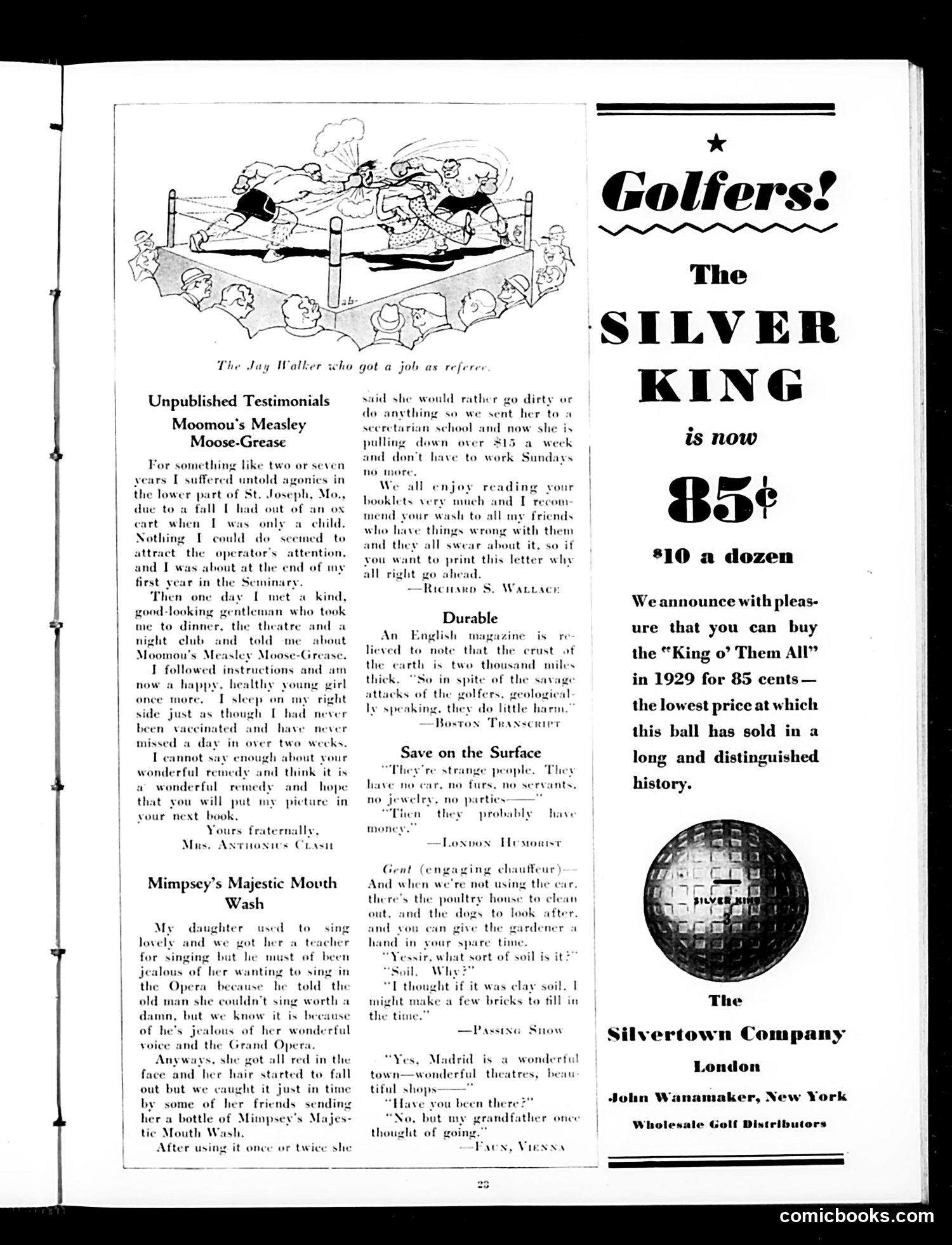
This page combines satire with advertising. The cartoon at top depicts "The Jay Walker who got a job as referee"—a visual pun showing a pedestrian (jay walker) comically officiating a boxing match, likely mocking incompetent referees or the absurdity of unqualified people holding authority positions. The bulk of the page features fake testimonials mocking patent medicine advertising, a common practice in early 20th-century magazines. Fabricated "unpublished testimonials" with ridiculous names ("Moomou's Measley Moose-Grease," "Mimpsey's Majestic Mouth Wash") claim miracle cures for everything from back pain to opera singing ability—satire of the snake-oil industry's false health claims. The bottom half is genuine advertising for Silver King golf balls, priced at 85 cents in 1929, contrasting sharply with the fraudulent product pitches above.
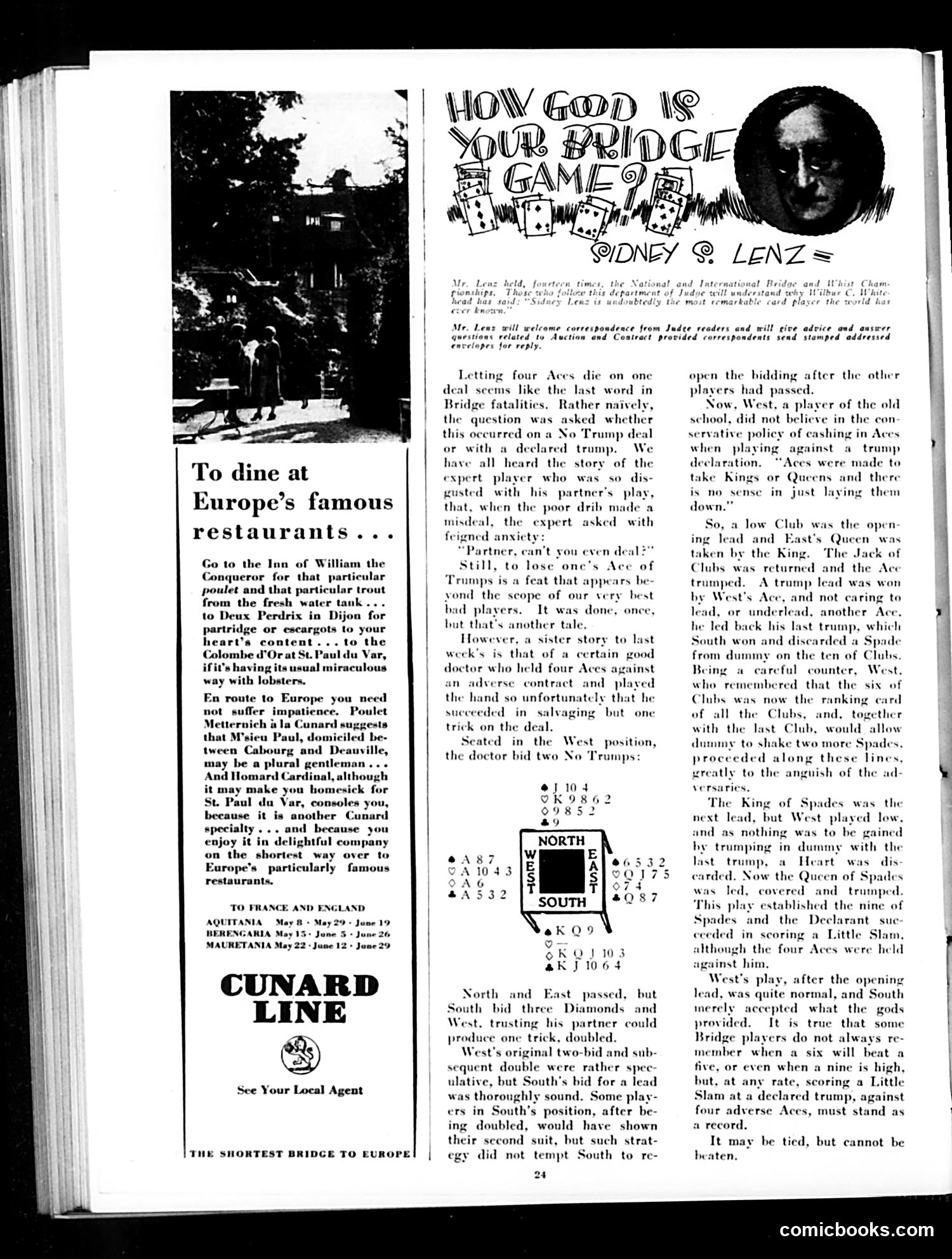
This page primarily contains a **bridge card game article** by Mr. Lenz, not political satire. The content analyzes a specific bridge hand where South successfully made a "Little Slam" contract despite West holding four Aces—normally a devastating holding. The key point: West, playing in "old school" style, made poor defensive decisions. Rather than cashing his Aces immediately, West led low clubs and attempted trump management, allowing South to establish dummy's tricks and succeed anyway. Lenz uses this as a teaching moment about bridge strategy. The page also includes **Cunard Line shipping advertisements** promoting passage to Europe's famous restaurants, unrelated to any political content. There are no political cartoons or caricatures visible on this page—it's primarily instructional bridge content with commercial advertising.
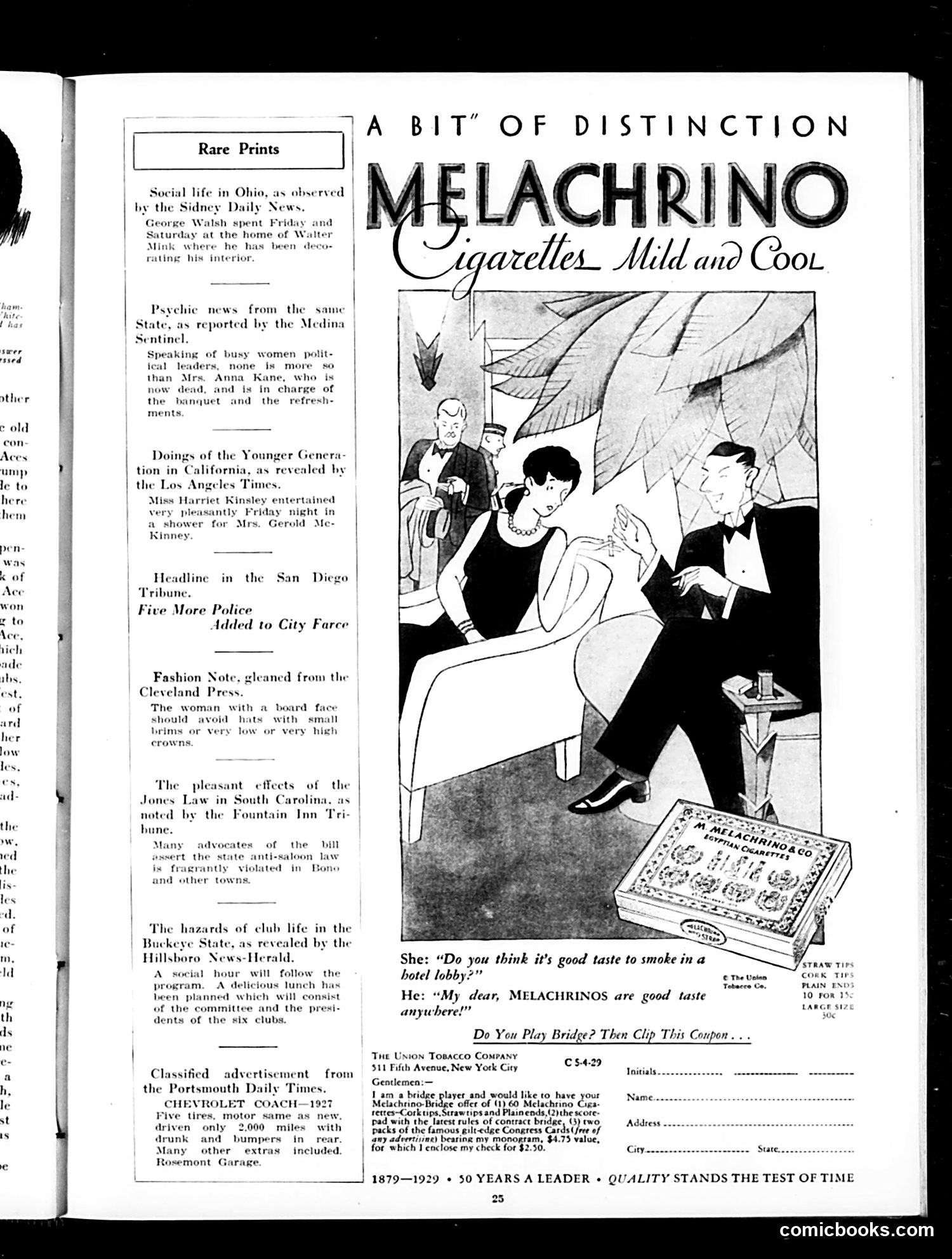
This is primarily a **cigarette advertisement**, not political satire. The main cartoon depicts a social scene where a woman questions whether smoking in a hotel lobby shows good taste, and a man reassures her that Melachrino cigarettes specifically are "good taste anywhere." The "distinction" referenced in the headline plays on cigarette marketing of the 1920s, which positioned premium brands as markers of social refinement and class status. By smoking Melachrinos (shown as cork-tipped, "mild and cool"), one supposedly demonstrated sophisticated taste. The left column contains satirical "Rare Prints"—brief, humorous local news items from various newspapers mocking small-town absurdities (a dead woman "in charge" of refreshments; police additions called a "farce"). These contrast with the advertisement's pretense of elegance, likely creating ironic juxtaposition typical of Judge's editorial approach. The bridge-playing coupon below furthers the advertisement's appeal to affluent readers.
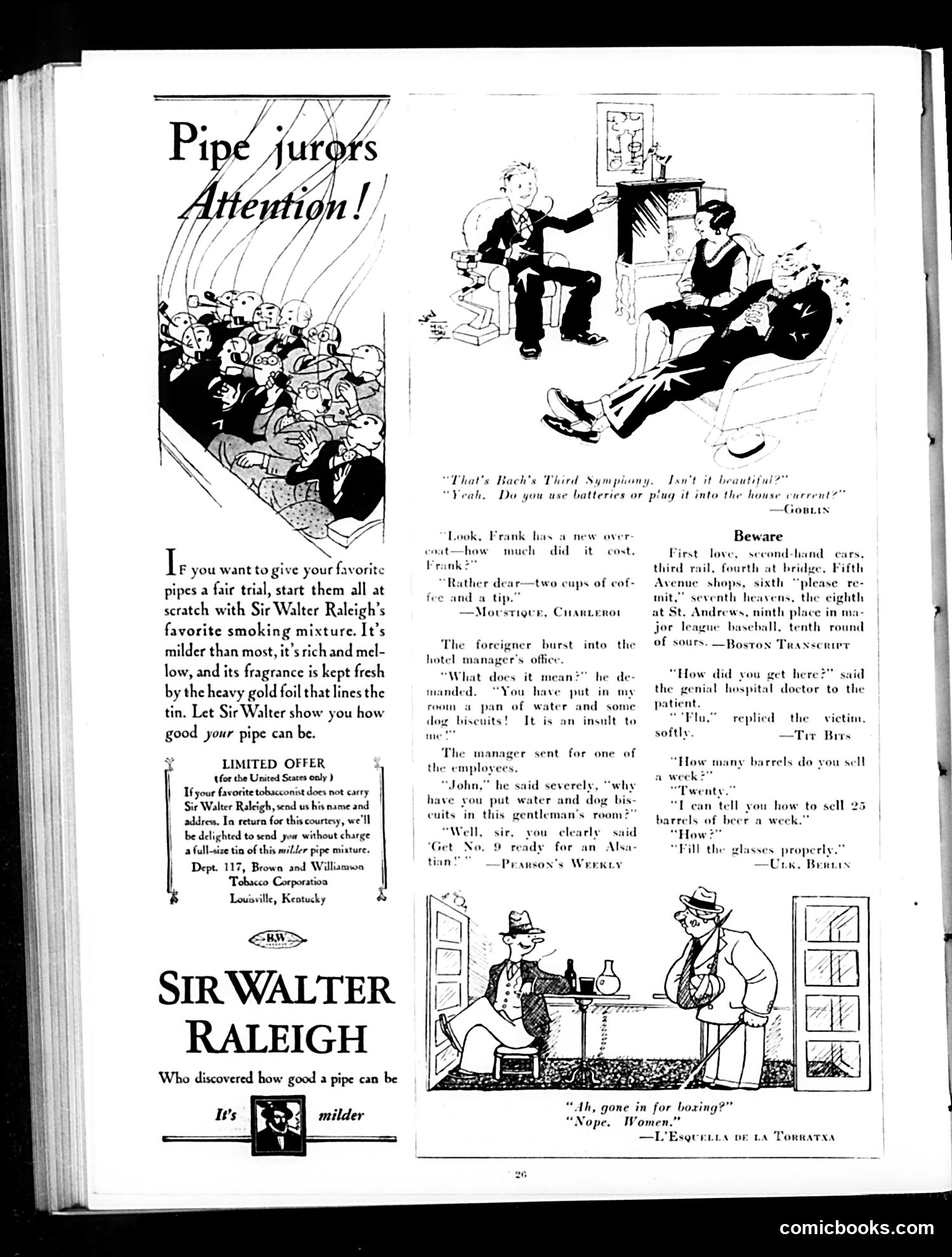
This page is primarily a **tobacco advertisement** for Sir Walter Raleigh pipe tobacco, framed around the historical figure Sir Walter Raleigh, who is credited with introducing tobacco to England. The left side features a large ad claiming the product is "milder" than competing pipe tobaccos, with a limited promotional offer. The right side contains **several unrelated humorous cartoons and jokes** typical of Judge magazine's satirical content: - A dialogue about Bach's Third Symphony, where someone absurdly asks if it uses "batteries or plug it into the house current"—mocking technological ignorance - A joke about a foreigner offended by water and dog biscuits placed in his room (confusion between "Alsatian" dog breed and hotel room preparation) - Sardonic "beware of" advice listing life's pitfalls (second-hand cars, the third rail, etc.) - A hospital patient claiming "Flu" caused their condition; the punchline reveals it was actually "Women" These jokes reflect early 20th-century satirical humor—mixing wordplay, absurdist scenarios, and cynical observations about modern life and romance.
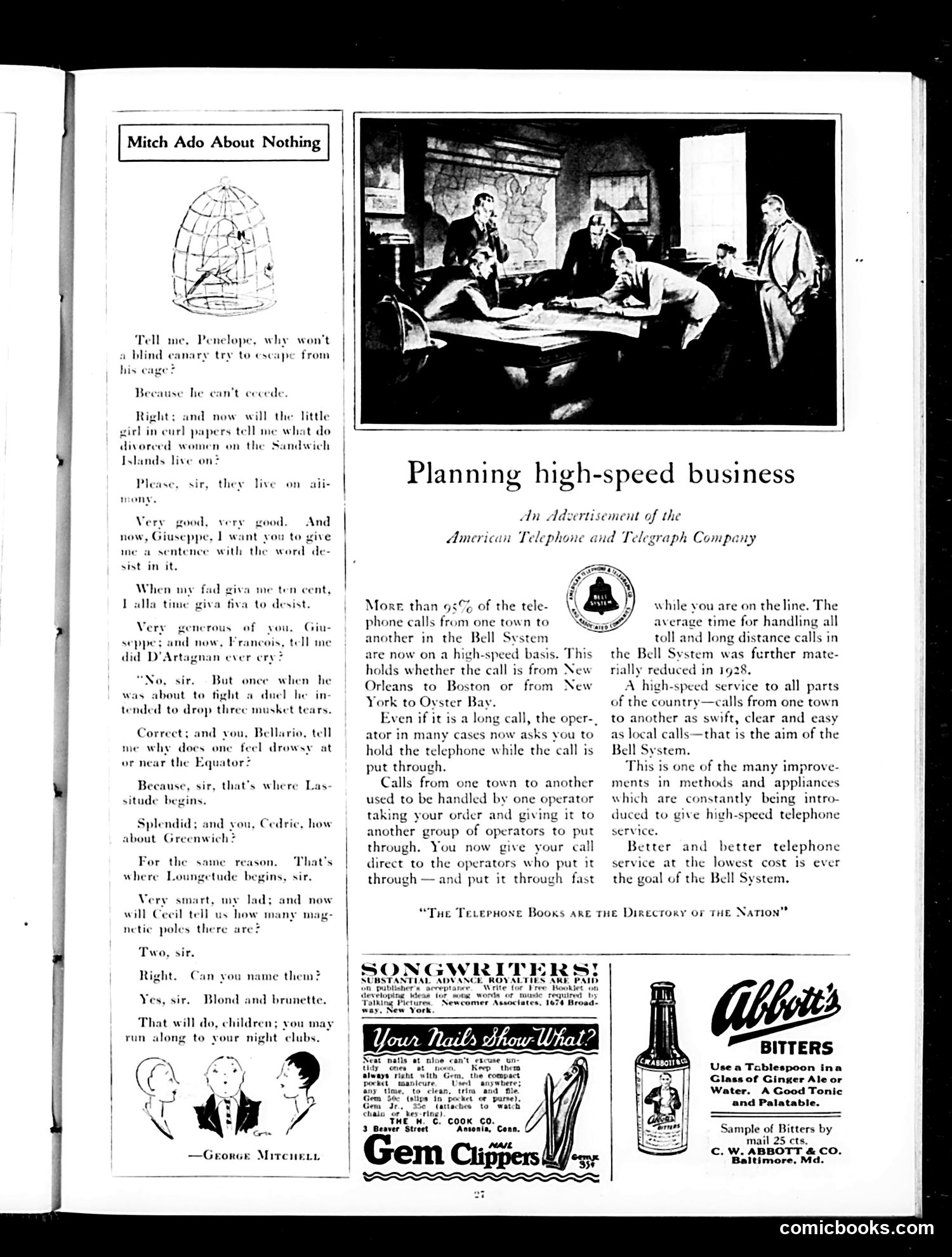
This is a schoolroom joke piece (the title puns on Shakespeare's "Much Ado About Nothing"). A stern teacher poses riddles to students with ethnic names—Giuseppe, Francois, Bellario, Cedric—extracting groan-worthy puns from their answers. The humor relies on wordplay: a blind canary can't "cede" (concede), divorced women live on "alimony" (not "anemones"), one feels drowsy at the Equator because "lassitude begins" there, and Greenwich has "longitude" beginning there. The final joke—the two "magnetic poles" are "Blond and brunette"—references contemporary flirtation culture. The piece reflects early 20th-century Judge magazine humor: ethnic caricature as comedy fodder, earnest pun-based wit, and implicit class assumptions (these appear to be lower-class or immigrant children sent to "night clubs"). It's largely innocent by today's standards but reveals period attitudes toward nationality and education.
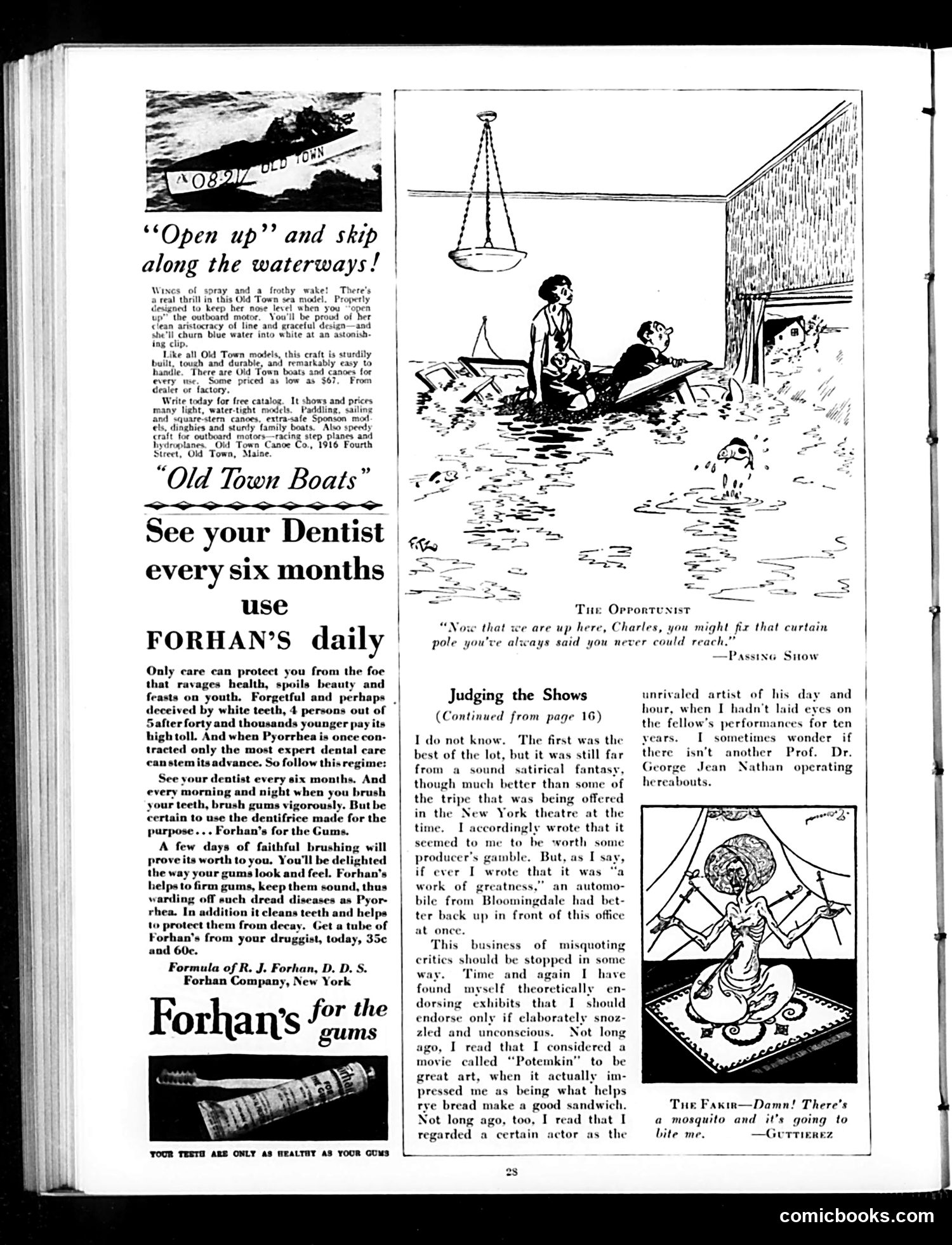
This page contains two unrelated items: an advertisement and a satirical article. **The Advertisement** promotes Old Town canoes and boats, emphasizing speed, durability, and variety of models. **The Satirical Content** features George Jean Nathan, a prominent theater critic of the era, complaining about being misquoted. Nathan describes evaluating theatrical productions—none truly great—yet discovering his words later cited as praising works he'd criticized or been indifferent toward. He cites specific examples: endorsing an avant-garde film ("Potemkin") when he merely found it ordinary, and praising an actor he actually disliked. The satire targets two problems: critics' tendency toward exaggeration, and producers' dishonest manipulation of reviews for marketing. Nathan's sardonic tone—comparing the film to "rye bread" making "a good sandwich"—underscores the gap between genuine critical assessment and how his words get weaponized commercially. The cartoon illustrations are unrelated humorous sketches accompanying separate pieces.
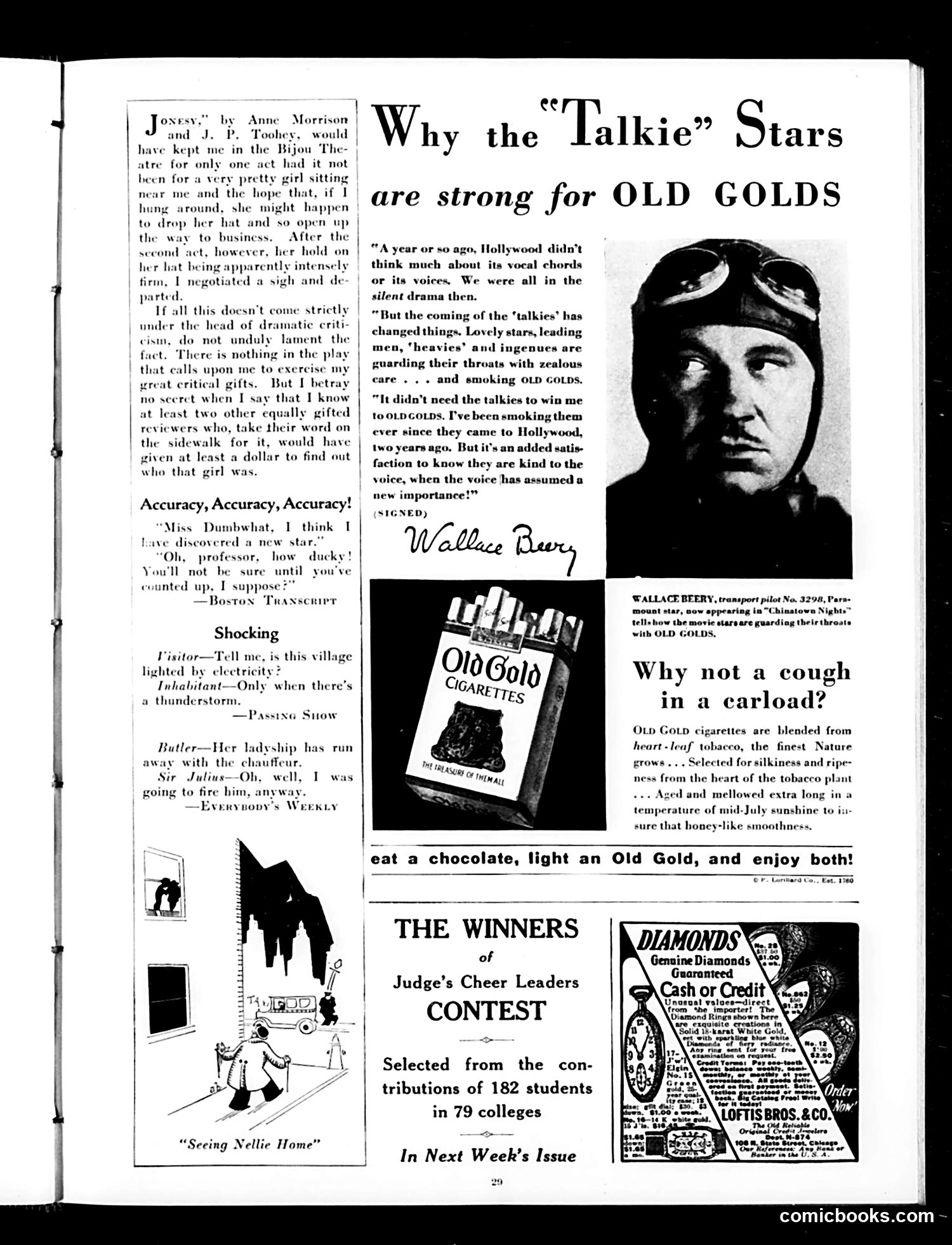
This page mixes theatrical criticism with period advertising and humor. **Main Content:** The opening reviews a play called "Joree," with the critic admitting he stayed primarily to observe an attractive woman in the audience rather than critique the performance—a self-deprecating joke about male distraction and shallow theater criticism. **The "Talkies" Advertisement:** The dominant feature is a celebrity endorsement from actor Wallace Beery for Old Gold cigarettes. This references Hollywood's transition from silent films to "talking pictures" (talkies), around 1927-1929. The ad claims actors now prioritize throat health because voices matter in talkies, so they smoke Old Golds—a humorous, ironic pitch since smoking actually harms vocal health. This represents the era's unregulated celebrity advertising before health warnings. **Small Humor Pieces:** Brief jokes about electricity, infidelity, and academic errors fill the page—typical Judge magazine filler. **Context:** This appears to be from the late 1920s, when talkies revolutionized Hollywood and advertising aggressively targeted emerging consumer anxieties.
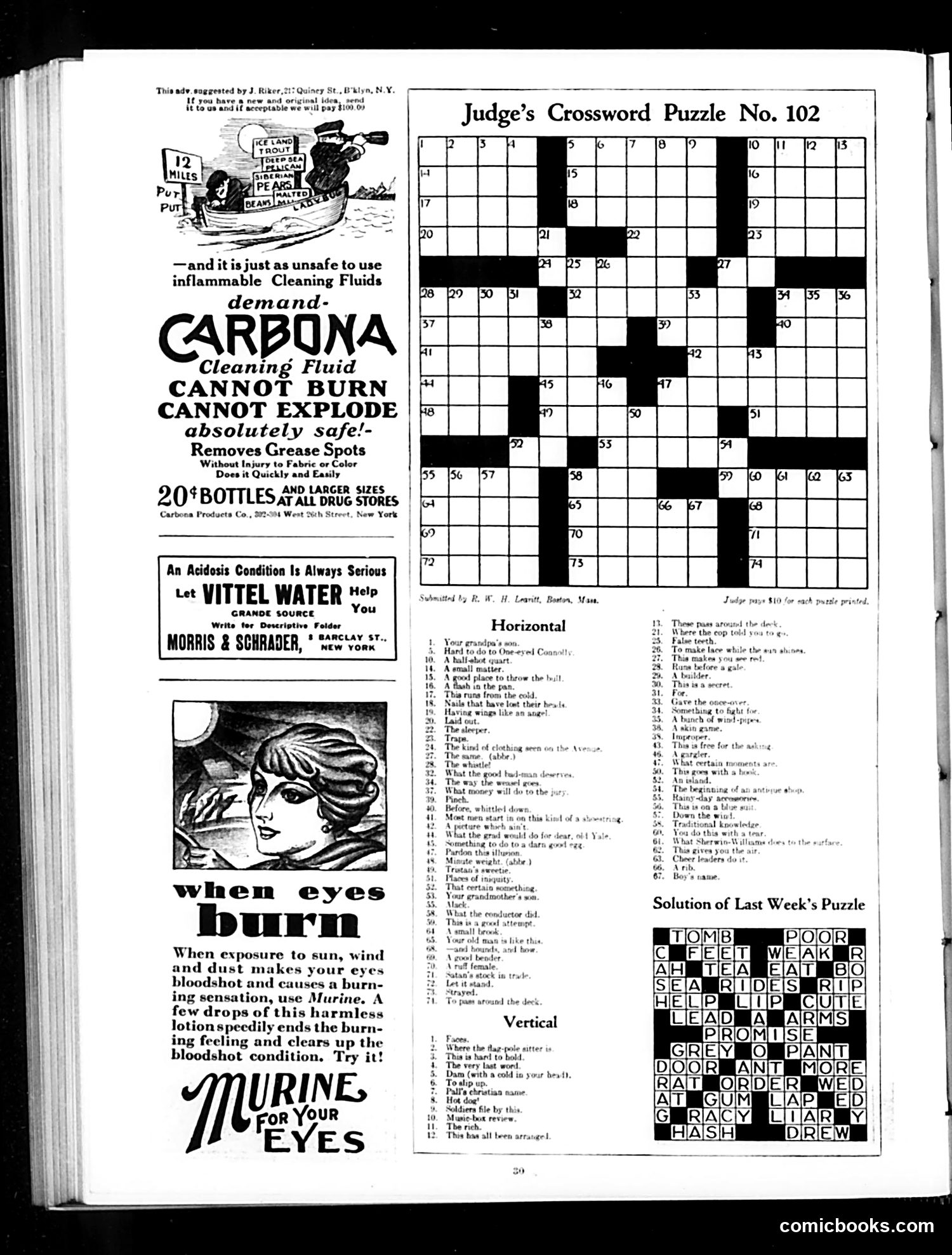
This page is primarily **advertising and puzzles**, not political satire. It contains: 1. **Carbona Cleaning Fluid ad**: Emphasizes the product is non-flammable and non-explosive—likely responding to contemporary safety concerns about volatile cleaning chemicals that could ignite or explode in homes. 2. **Vittel Water ad**: Markets mineral water for "acidosis condition," reflecting early 20th-century health fads promoting alkaline products as cures. 3. **Murine eye drops ad**: Features a woman with reddened eyes, addressing sunburn and irritation—common complaints before modern sunscreen. 4. **Crossword puzzle**: Standard entertainment feature. The advertisements reveal period anxieties: household chemical dangers, pseudo-scientific health remedies, and eye care. These reflect 1920s consumer culture and marketing that often made dubious health claims. No political figures or satire are present—this is commercial content typical of Judge magazine's revenue model.
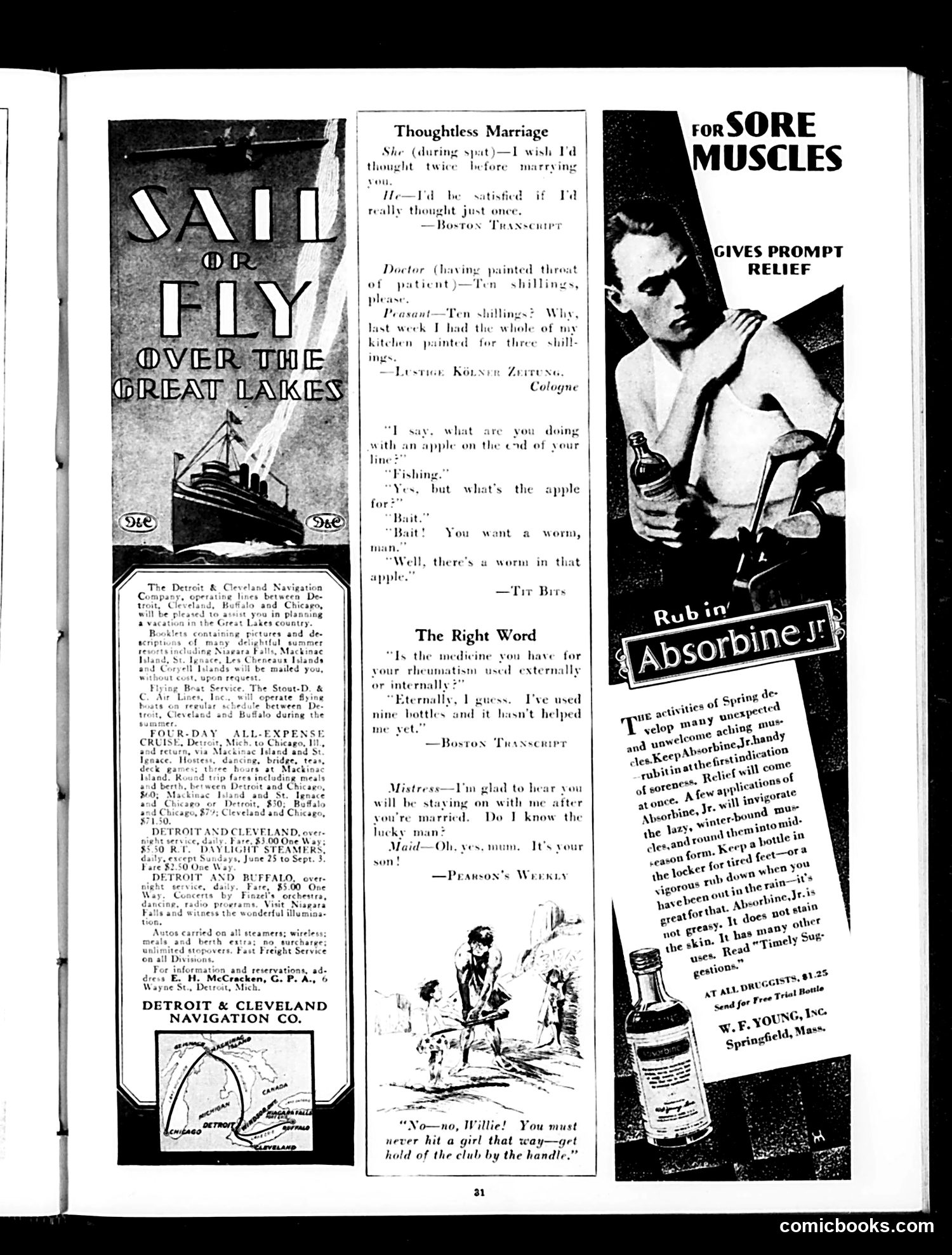
This page contains several unrelated short jokes and advertisements typical of early 20th-century satirical magazines. **The jokes** mock common human folly: a couple's thoughtless marriage decision; a doctor's price complaint compared unfavorably to house painting; someone using an apple as fishing bait; a patient taking rheumatism medicine ineffectively for nine bottles; a maid revealing she's marrying her employer's son; and a parent correcting a boy's improper club-swinging technique against a girl. **The advertisements** promote Great Lakes steamship cruises (Detroit & Cleveland Navigation Co.) and Absorbine Jr., a patent medicine for sore muscles. These are generic jokes about class differences, domestic life, and medical skepticism—common Judge fare. No specific political figures or events are referenced. The humor relies on wordplay, misunderstandings, and gentle social observation rather than topical satire. The page exemplifies how Judge mixed satirical commentary with genteel humor and commercial advertising for a middle-class audience.
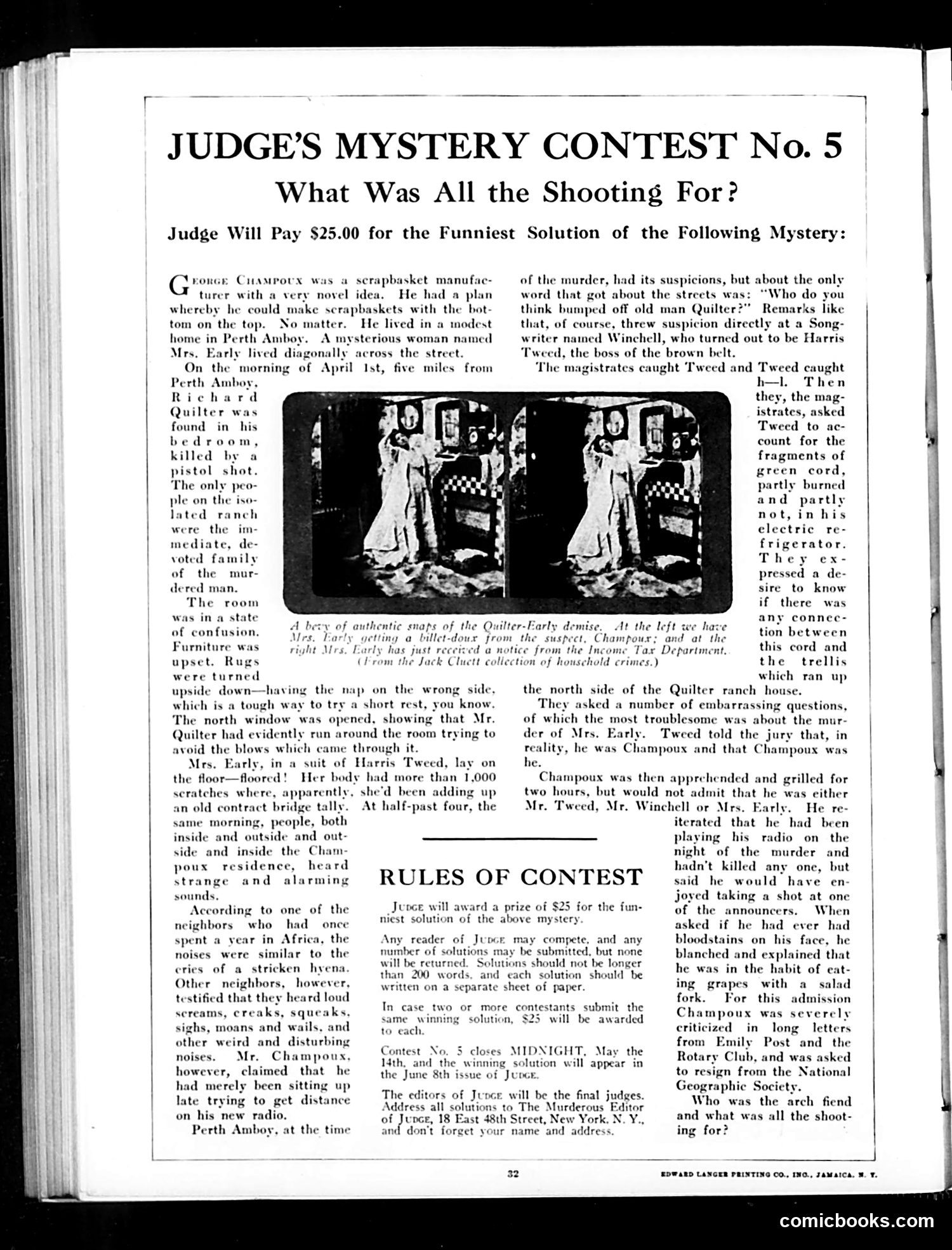
This page presents a reader-participation mystery game rather than a political cartoon. Judge magazine invited readers to solve "What Was All the Shooting For?" and paid $25 for the funniest solution. The setup involves a murder mystery set in Perth Amboy: a scrapbasket manufacturer named Richard Quilter is shot in his bedroom. A mysterious woman, Mrs. Early, lives across the street. Suspects include songwriter Winchell (actually Harris Tweed, "boss of the brown belt") and scrapbasket inventor Champoux. The accompanying stereoscopic photographs (the paired images) show the crime scene—a woman in a kitchen—typical visual aids for early-20th-century mystery puzzles. The satire appears aimed at detective fiction conventions and perhaps contemporary scandals. "Harris Tweed" (a fabric brand) and cryptic clues about green cord, upside-down furniture, and radio-playing suggest parody of overly-complicated mystery plots rather than political commentary.
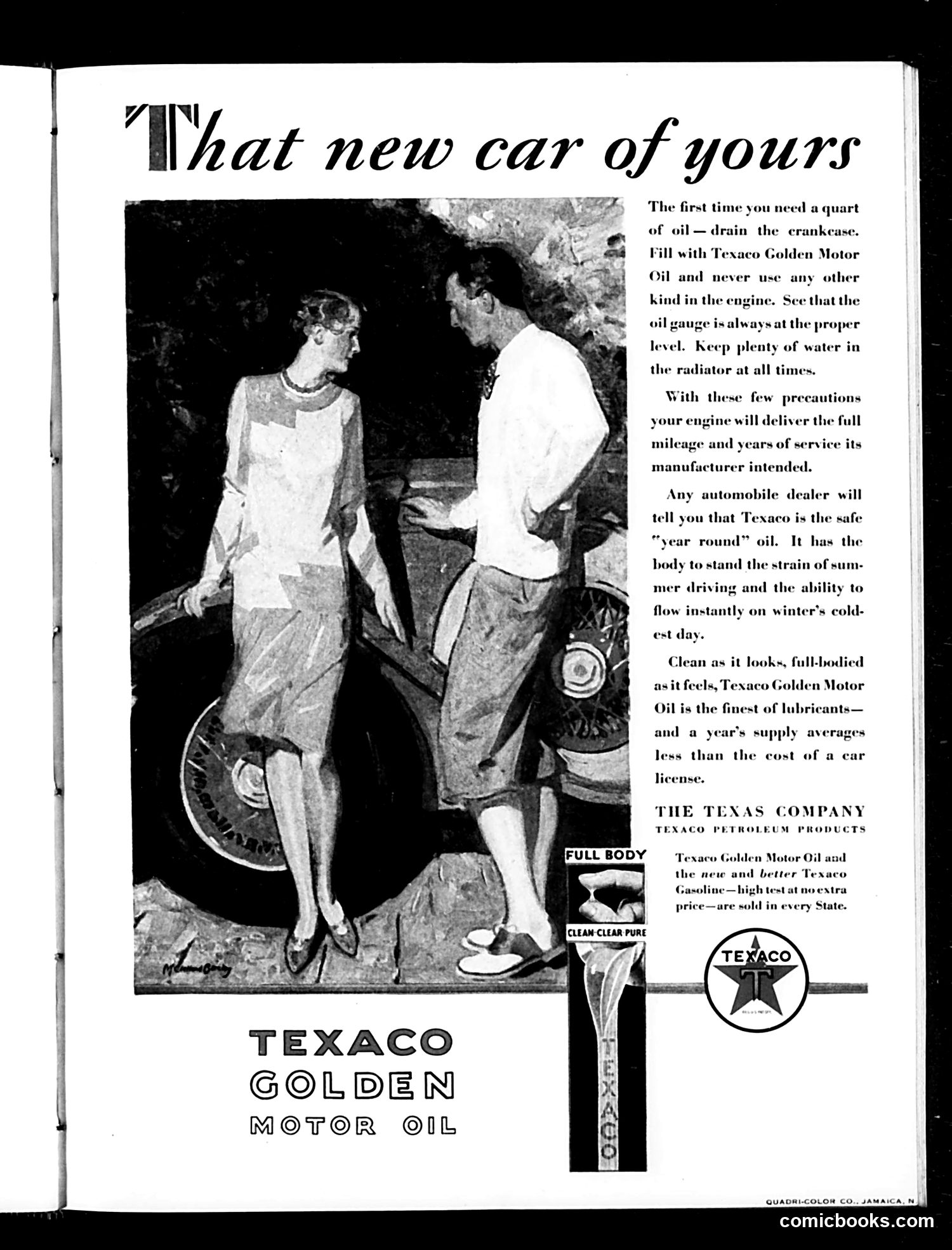
This is primarily a **product advertisement**, not a political cartoon. It appears in *Judge* magazine, which mixed satirical content with paid advertising. The page shows a couple examining a new automobile, with the man pointing to the engine. The ad uses this domestic scene to pitch Texaco Golden Motor Oil to car owners. The messaging targets new car owners, advising them on proper engine maintenance—specifically recommending they use *only* Texaco oil and keep the oil gauge at proper levels. The advertisement emphasizes Texaco's reliability across seasons ("year round" oil), affordability (cheaper than a car license), and quality ("finest of lubricants"). The Texaco star logo anchors the branding. There is **no satire or political commentary** visible here—this is straightforward commercial promotion using a relatable domestic scenario to sell automotive products to the magazine's middle-class readership.
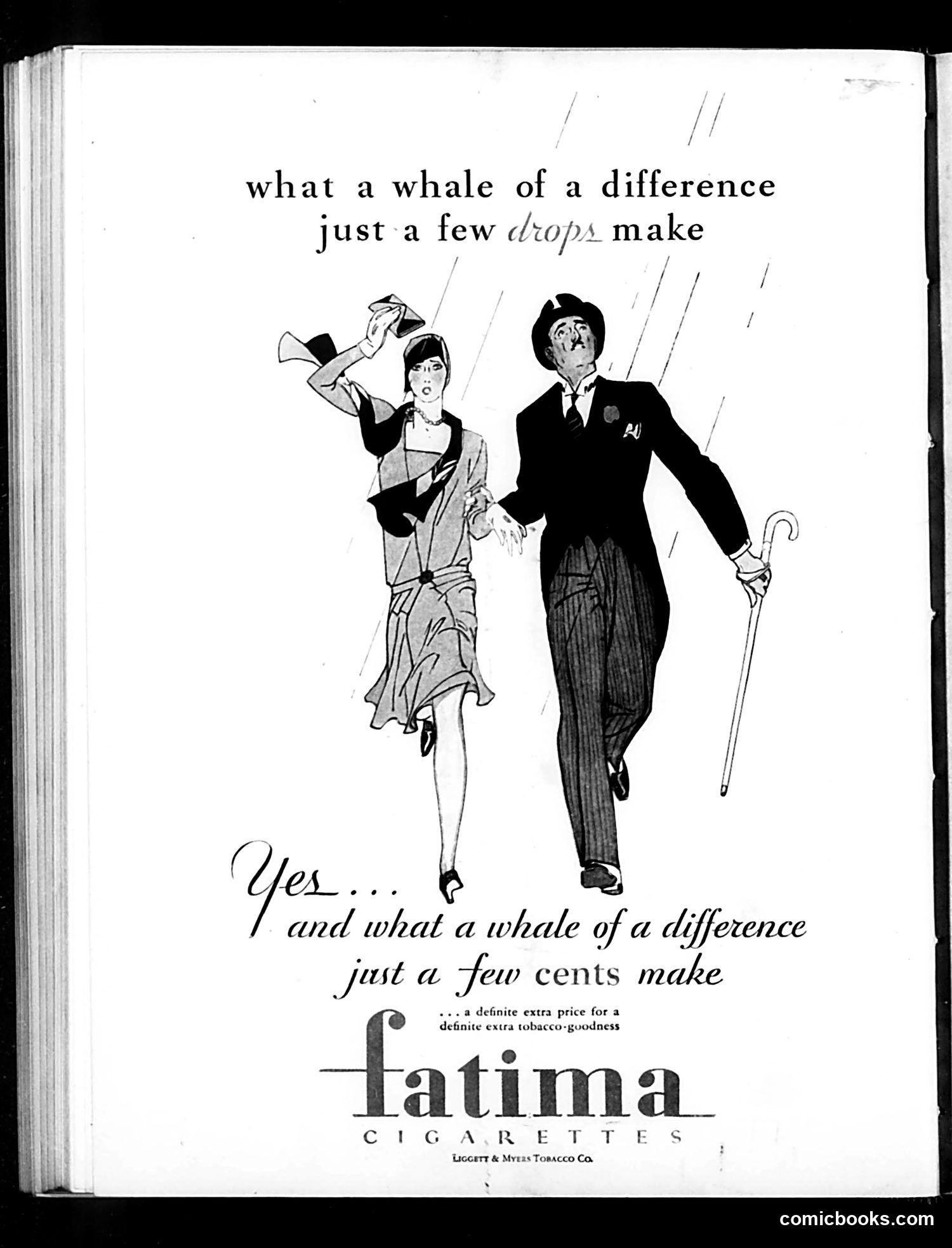
This is a **Fatima Cigarettes advertisement**, not political satire. The page shows an elegantly dressed couple in rain—a woman in a light coat and hat, a man in a dark suit with umbrella—with the tagline "what a whale of a difference just a few drops make" (referring to rain protection). The advertisement's main message: "just a few cents" difference in price yields "definite extra tobacco goodness." The humor relies on the visual pun—tiny water drops creating a noticeable difference in appearance parallels how a small price increase supposedly delivers noticeably better tobacco quality. This represents early 20th-century consumer advertising strategy: justifying premium pricing through quality claims, using witty wordplay and fashionable imagery to appeal to middle-class buyers.