
Judge, 1929-05-04 · page 15 of 36
Judge — May 4, 1929 — page 15: what you’re looking at
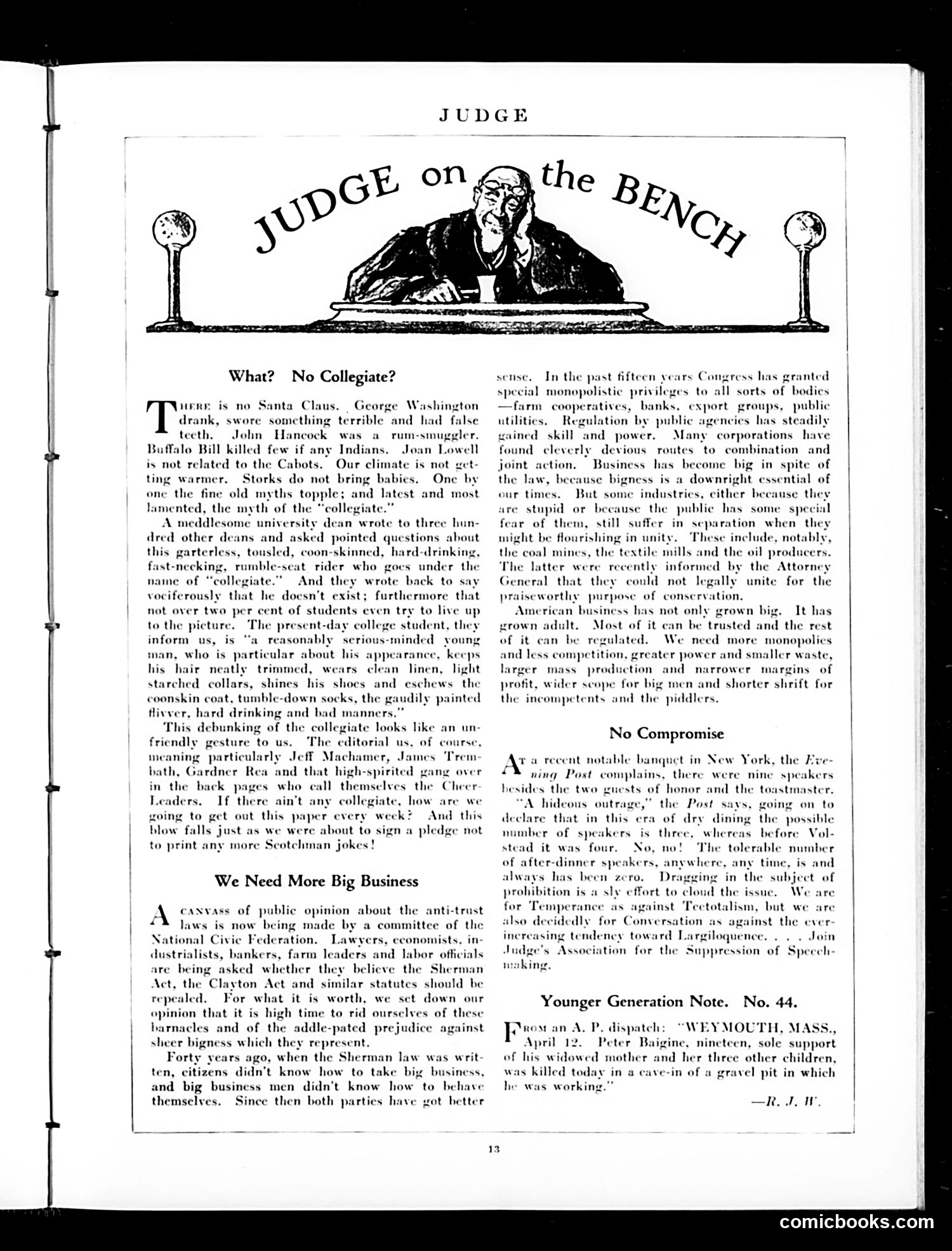
What you’re looking at
## The Cartoons and Articles **Main Illustration:** A judge sits at his bench, introducing the page's content. **"What? No Collegiate?"** satirizes a university dean's survey debunking the popular stereotype of the rowdy college student—the gin-drinking, hard-partying "collegiate" who drives fast cars and ignores etiquette. The article reveals that modern college students are actually serious and well-behaved. Judge magazine humorously laments this, since their comedic content relies on mocking these collegiate stereotypes. The piece targets figures like "Jeff Machamer" and the magazine's "Cheerleaders" (staff contributors), joking they won't survive losing this reliable subject matter. **"We Need More Big Business"** argues for repealing anti-trust laws (Sherman Act, Clayton Act). The editor contends that large corporations have matured and self-regulate better than government agencies can. He advocates for consolidated industries like coal and oil, claiming monopolies produce efficiency, lower costs, and higher quality—views opposing progressive anti-monopoly sentiment of the era. Both pieces reflect 1920s-era Judge editorial positions on youth culture and business regulation.
📄 Transcribed text from this page (OCR, searchable)
Machine-transcribed from the original scan — historical spelling and the odd misread are preserved.
What? No Collegiate? Here is no Santa Claus. George Washington drank, swore something terrible and had false teeth, John Hancos was a rum-sinugyle Buffalo Bill killed few if any Indians. . is not related to the Cabots, Our climate is not xet- ting warmer. Storks do not bring babies. One by one the fine old myths topple; and latest and most lamented, the myth of the “collegiate.” A meddlesome university dean wrote to three hun- dred other deans and asked pointed questions about this garterless, tousl on-skinned, hard-drinking, fast-necking, rumble-seat rider who goes under the name of “collegiate.” And they wrote back to say vociferously that he doesn’t exist; furthermore that not over two per cent of students even try to live up to the picture. The present-day college student, they inform us, is reasonably Serious-minded young man, who is particular about his his hair neatly trimmed, wears clean linen, light starched collars, shines his shoes and eschews the coonskin coat, tumble-down socks, the gaudily painted flivver, hard drinking and bad 1 This debunking of the colle friendly gesture to us. ‘The meaning particularly Jeff M bath, Gardner Rea and that high-spirited in the back pages who call themselves the Cheer Leaders. If there ain't any collegiate, how are we ing to get out this paper every week? And this blow falls just as we were about to sign a pledge not to print any more Scotchman jokes! ypearance, keeps anners.” ute looks like an un- 1 us, of course, ner, James ‘Trem ng over We Need More Big Business A canvass of public opinion about the anti-trust #2 laws is now being made by a committee of the National Civic Federation. Lawyers, economists, in- dustrialists, bankers, farm leaders and labor officials are being asked whether they believe the Sherman Act, the Clayton Act and similar statutes should be repealed. For what it is worth, we set down our opinion that it is high time to rid ourselves of these barnacles and of the addle-pated prejudice a sheer bigness which they represent. Forty years ago, when the Sherman law was writ ten, citizens didn’t know how to take big business, and big business men didn’t know how to behave themselves. Since then both parties have got better sense, In the past fifteen years Congress has granted special monopolistic privileges to all sorts of bodies —farm cooperatives, banks. export groups, public utilities. Regulation by public agencies has steadily gained skill and power. Many corporations have found cleverly devious routes to combination and joint action. "Business has become big in spite of the law, t our times. But some industries, either because tl ire stupid or beeause the public has some. spec fear of them, still suffer in separation when they might be flourishing in unity. ‘These include, notably, the coal mines, the textile mills and the oil producers. The latter were tly informed by the Attorney General that they could not legally unite for the praiseworthy purpose of conservation, American business has not only grown big. It has grown adult. Most of it can be trusted and the rest of it can be regulated. We need more monopolies and less competition, greater power and smaller waste, larger mass production and narrower margins of profit, wider scope for big men and shorter shrift for the incompetents and the piddlers. 1use bigness is a downright essential of No Compromise a recent notable banquet in New York, the ning Post complains, there were nine besides the two guests of honor and the toastmaster. “A hideous outrage,” the Post says, going on to declare that in this era of dry dining the possible number of speakers is three, whereas before Vol- stead it was four. No, no! The tolerable number of after-dinner speakers, anywhere, any time, is and always has been zero. Dragging in the subject of prohibition is a sly effort to cloud the issue. We are for Tempe tinst Tectotalism, but we are also decidedly for Conversatic against the ever ng tendency toward Largiloquenee. . . . Join Association for the Suppression of Speech d speakers ance as d Younger Generation Note. No. 44. Snow an A. P. dispatch: “WEYMOUTH, MASS., April 12. Peter Baigine, nineteen, sole support of his widowed mother and her three other children, was killed today in a cave-in of a gravel pit in which he was working.” RI W. comicbooks.com