
A complete issue · 36 pages · 1929
Judge — March 16, 1929
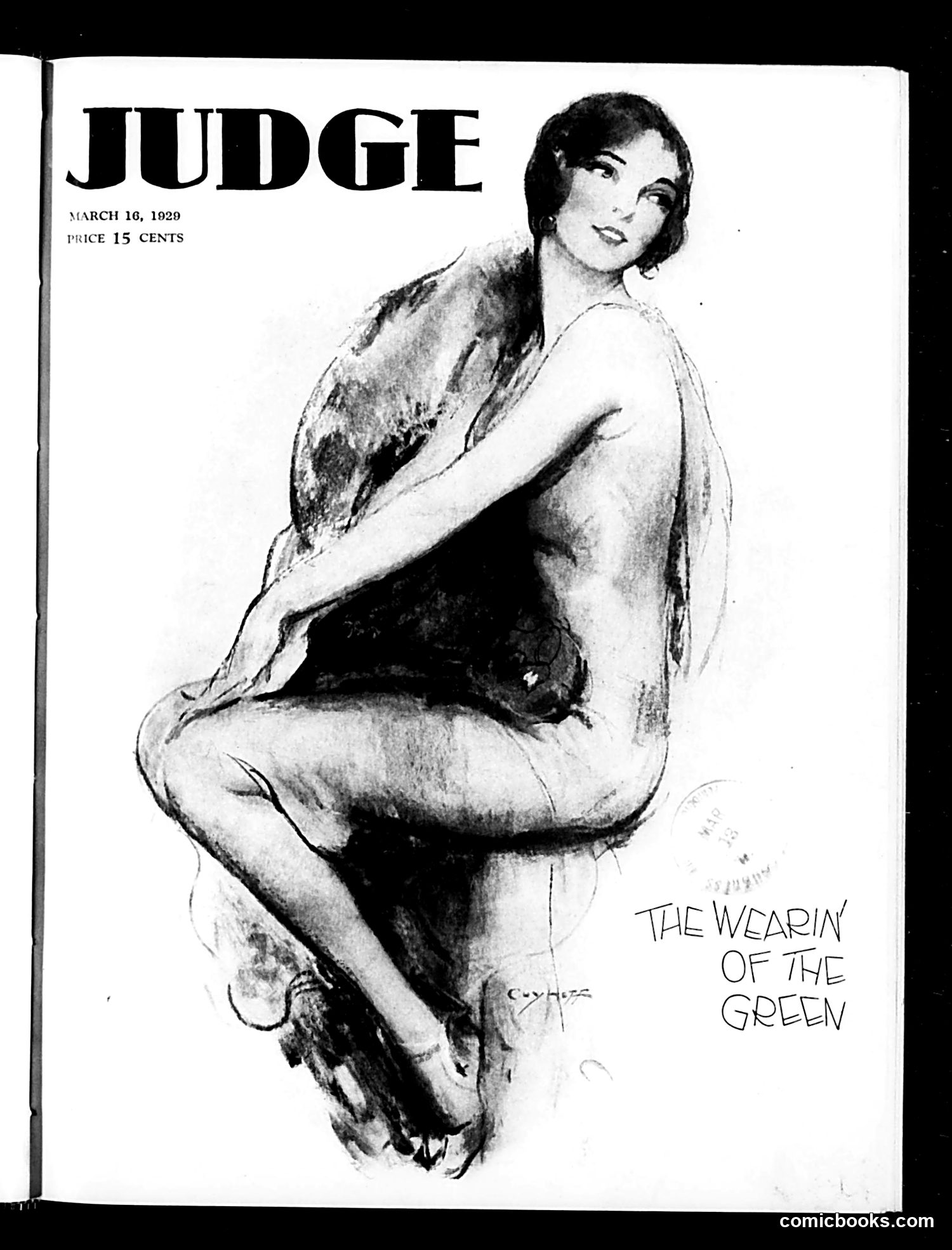
This is the March 16, 1929 cover of *Judge* magazine, priced at 15 cents. The main image is an artistic illustration of a woman in partial dress with a fur stole, posed suggestively. The caption reads "The Wearin' of the Green." The joke likely plays on the double meaning of "wearing the green"—both the Irish idiom (meaning to wear green on St. Patrick's Day, celebrated mid-March) and a sexual innuendo about partial undress. The illustration's suggestive pose and styling were typical of *Judge*'s humor during the Jazz Age, when the magazine frequently published provocative artwork with cheeky wordplay targeting adult audiences. The artwork is signed by what appears to be the illustrator, though the signature is partially unclear.
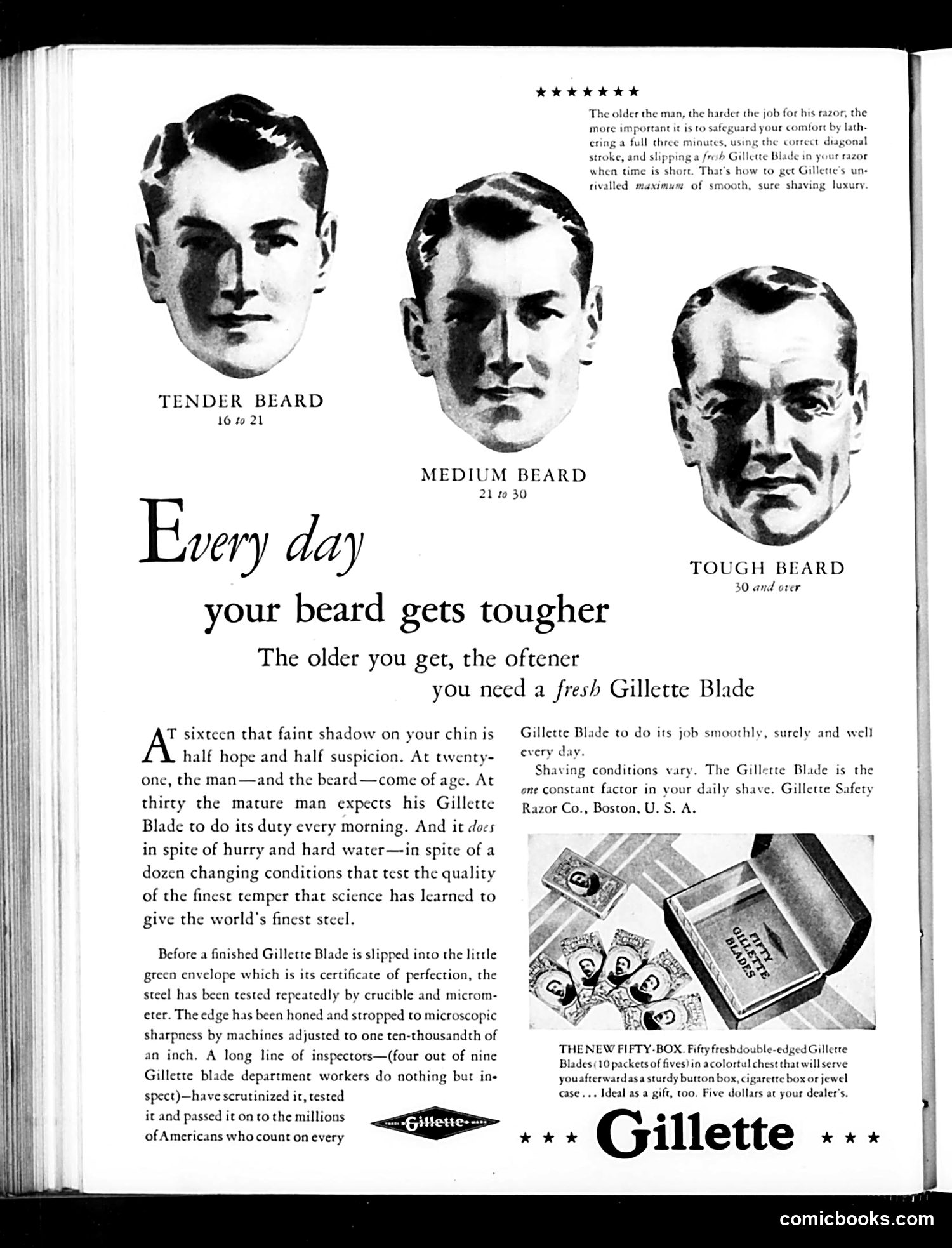
This page is **primarily an advertisement**, not a satirical cartoon. It's a Gillette razor blade advertisement from an era (likely 1920s-1930s based on styling) disguised as editorial content. The "cartoon" element consists of three illustrated male heads labeled by beard thickness: "Tender Beard" (ages 16-21), "Medium Beard" (21-30), and "Tough Beard" (30+). These are not caricatures of specific figures, but generic male types used to market the product. The satirical *angle* is the implicit joke: as men age, their beards become tougher, requiring "fresh" razor blades more frequently—thus requiring more purchases. The advertisement frames this biological fact as a selling point, cleverly turning a product limitation into marketing copy. No political figures or satire is present; this is purely consumer marketing.
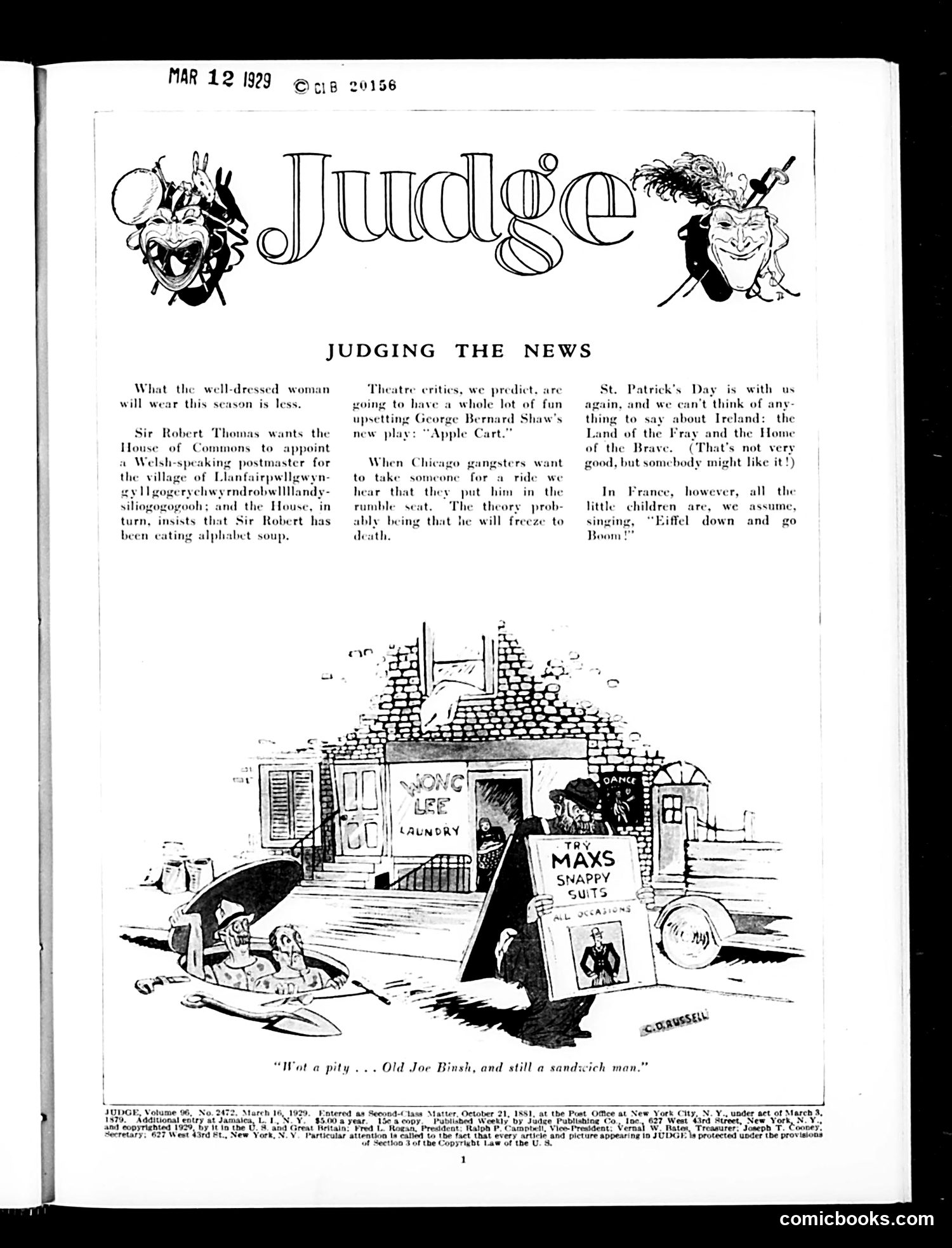
This 1929 cartoon satirizes Joe Busch, apparently a figure known for selling sandwiches from a street cart or stand. The joke references Prohibition's end—note the laundry and various commercial signs on the ramshackle building. The caption suggests Busch has remained in his humble sandwich-vending trade despite presumably having opportunity to advance during or after Prohibition. The cartoon likely mocks someone who failed to capitalize on bootlegging profits or other opportunities that may have enriched others during the 1920s dry era. The disheveled storefront and scattered goods suggest economic struggles, implying Busch is still eking out a living as a sandwich vendor—a comedown or stagnation from higher expectations. The humor relies on knowing who Joe Busch was locally or in contemporary New York circles.
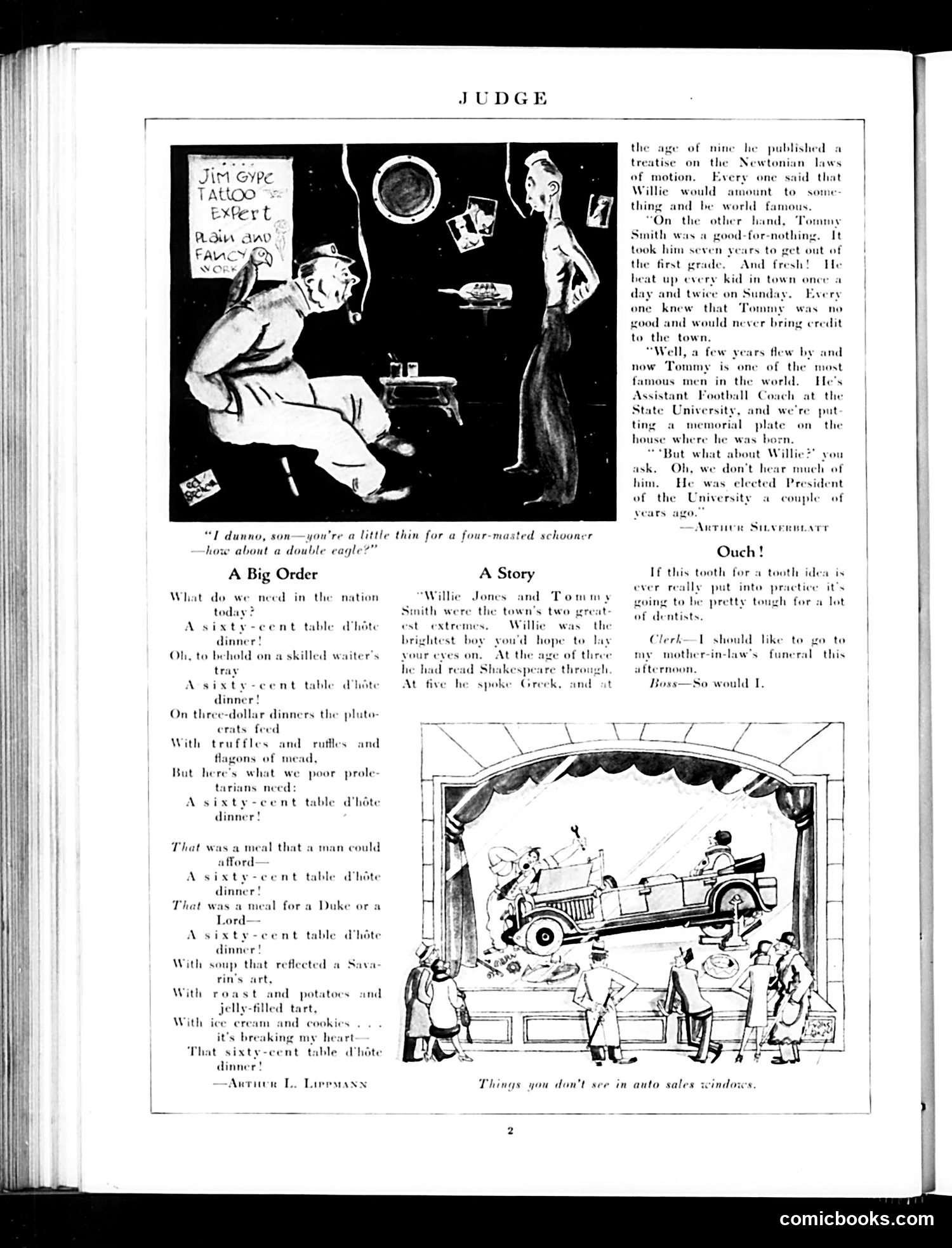
This page contains three separate pieces of humor: 1. **"A Big Order"** (left): A humorous poem by Arthur L. Lippmann satirizing the aspirational American appetite for luxury dining. It mocks the desire for expensive "sixty-cent table d'hôte dinners" with elaborate French cuisine—a satirical comment on working-class pretension and economic aspiration during what appears to be the early 20th century. 2. **"A Story"** (right text): An anecdote about two local boys, Willie Jones and Tommy Smith, where Willie becomes famous while Tommy remains obscure. The joke critiques unpredictable success and fame's arbitrary nature. 3. **"Things you don't see in auto sales windows"** (bottom): A cartoon showing a car crash in a showroom window—obvious visual satire about dealers hiding accident damage and defects from customers.
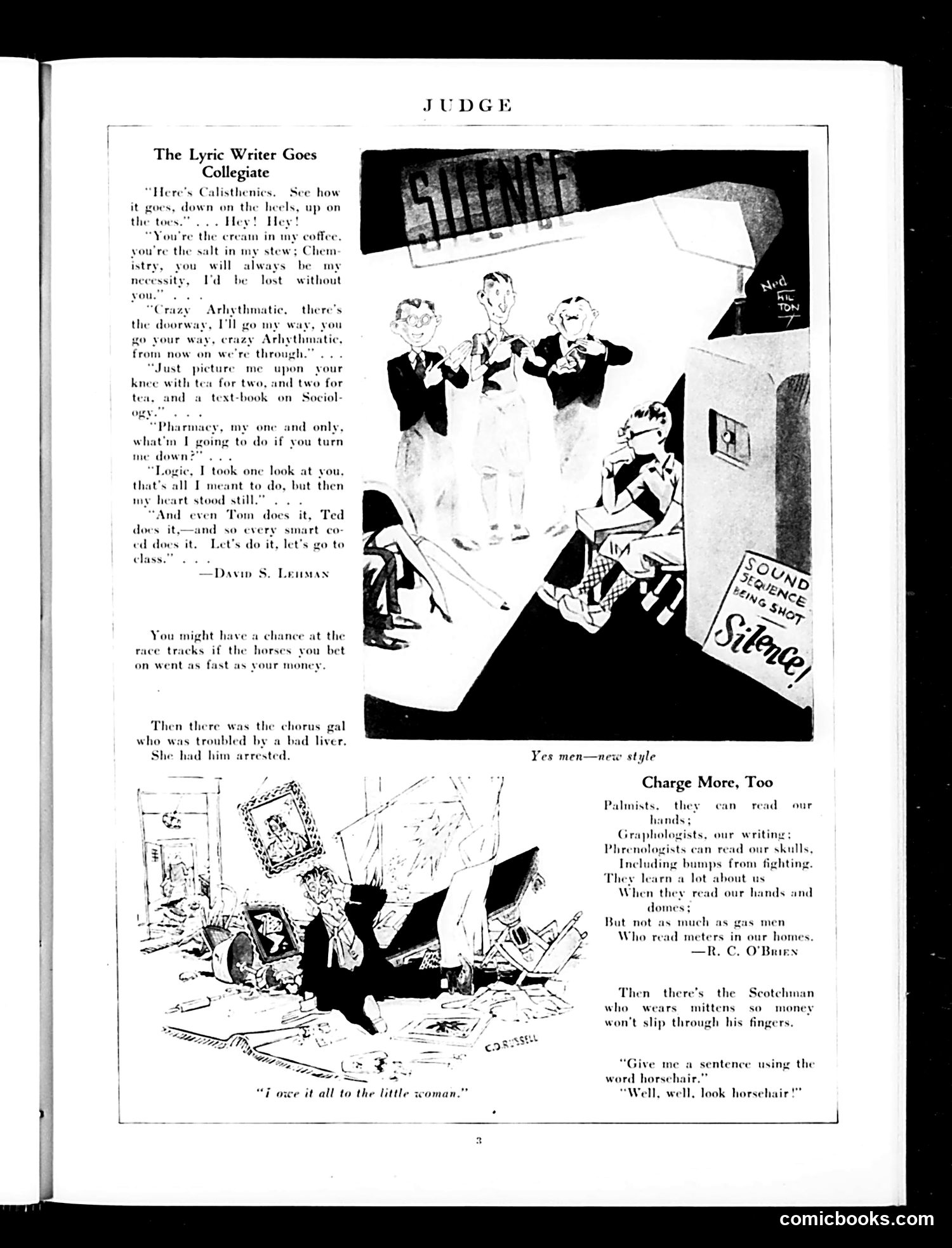
**"The Lyric Writer Goes Collegiate"** (top cartoon): This satirizes college students, likely from the 1920s-30s, depicting them as frivolous and intellectually lazy. The lyrics quoted mock how students trivialize serious subjects—treating chemistry, pharmacy, and sociology as mere pretexts for socializing. The joke targets the perceived gap between collegiate pretension and actual academic engagement. **"Yes men—new style"** (middle cartoon): Criticizes yes-men in professional settings, showing submissive employees around a desk, suggesting blind obedience in workplace hierarchies. **"Charge More, Too"** (right): A brief quip by H.C. O'Brien about professionals (palmists, graphologists, phrenologists, gas men) exploiting customers by charging higher rates. The overall theme critiques American consumer culture and workplace conformity during the interwar period.
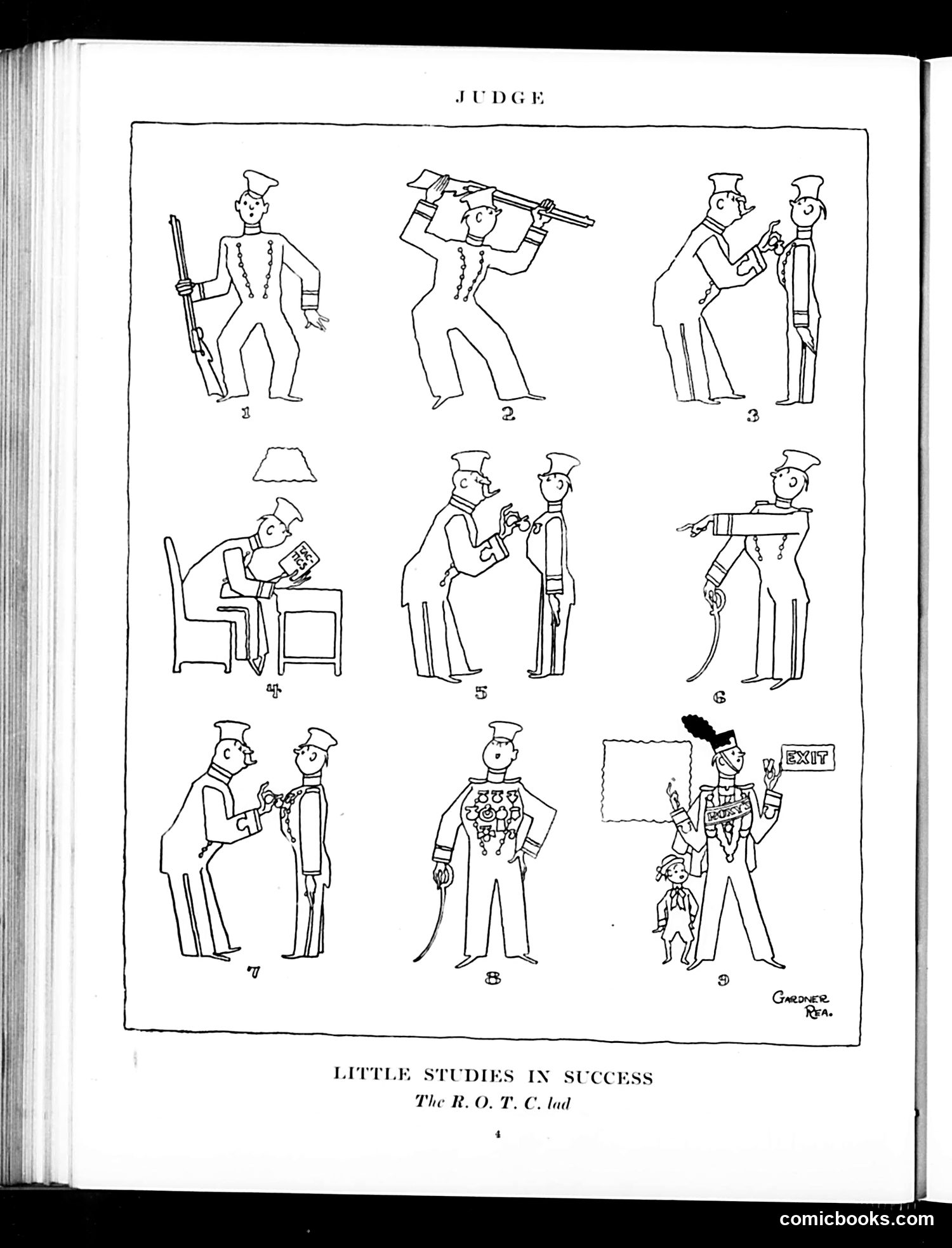
This page satirizes the Reserve Officers' Training Corps (R.O.T.C.), a military education program. The nine numbered panels show caricatured military figures in various poses—marching, saluting, instructing, and commanding—depicted in an exaggerated, comedic style typical of Judge's satirical approach. The cartoon appears to mock the R.O.T.C. program itself, possibly critiquing military pretension, rigid hierarchy, or the preparation of young officers. The title "Little Studies in Success" uses irony, suggesting these military poses represent supposed achievement. Without knowing the specific publication date, the exact historical context remains unclear, though R.O.T.C. programs were sometimes targets of satirical commentary regarding militarism and youth indoctrination.
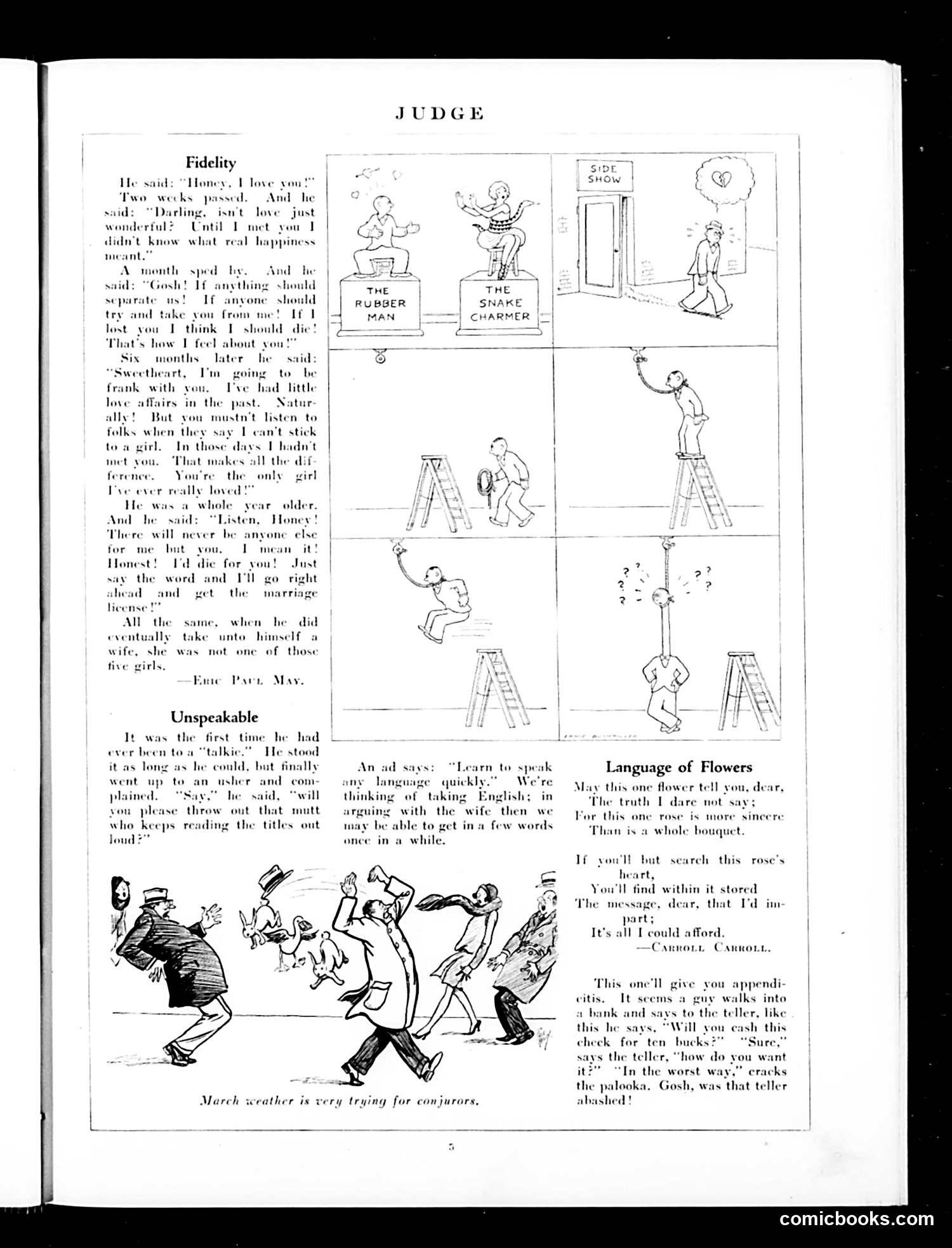
This page contains three distinct pieces of humor: **"Fidelity"** (left): A romantic story about a man's devotion to his wife, emphasizing old-fashioned marital loyalty and monogamy—contrasting with contemporary anxieties about infidelity. **"Unspeakable"** (center): A comic about a couple arguing over language instruction. The husband objects to his wife reading English instruction ads aloud repeatedly. The accompanying illustration shows people in exaggerated physical comedy, depicting the marital conflict humorously. **"Language of Flowers"** (right): A poem about flower symbolism in courtship, with accompanying caption about financial mishaps ("bank" and "check" references). The cartoons satirize domestic life, marital disputes, and social conventions of the era. The recurring theme is tension between spouses over communication, finances, and behavior—reflecting early 20th-century middle-class anxieties.
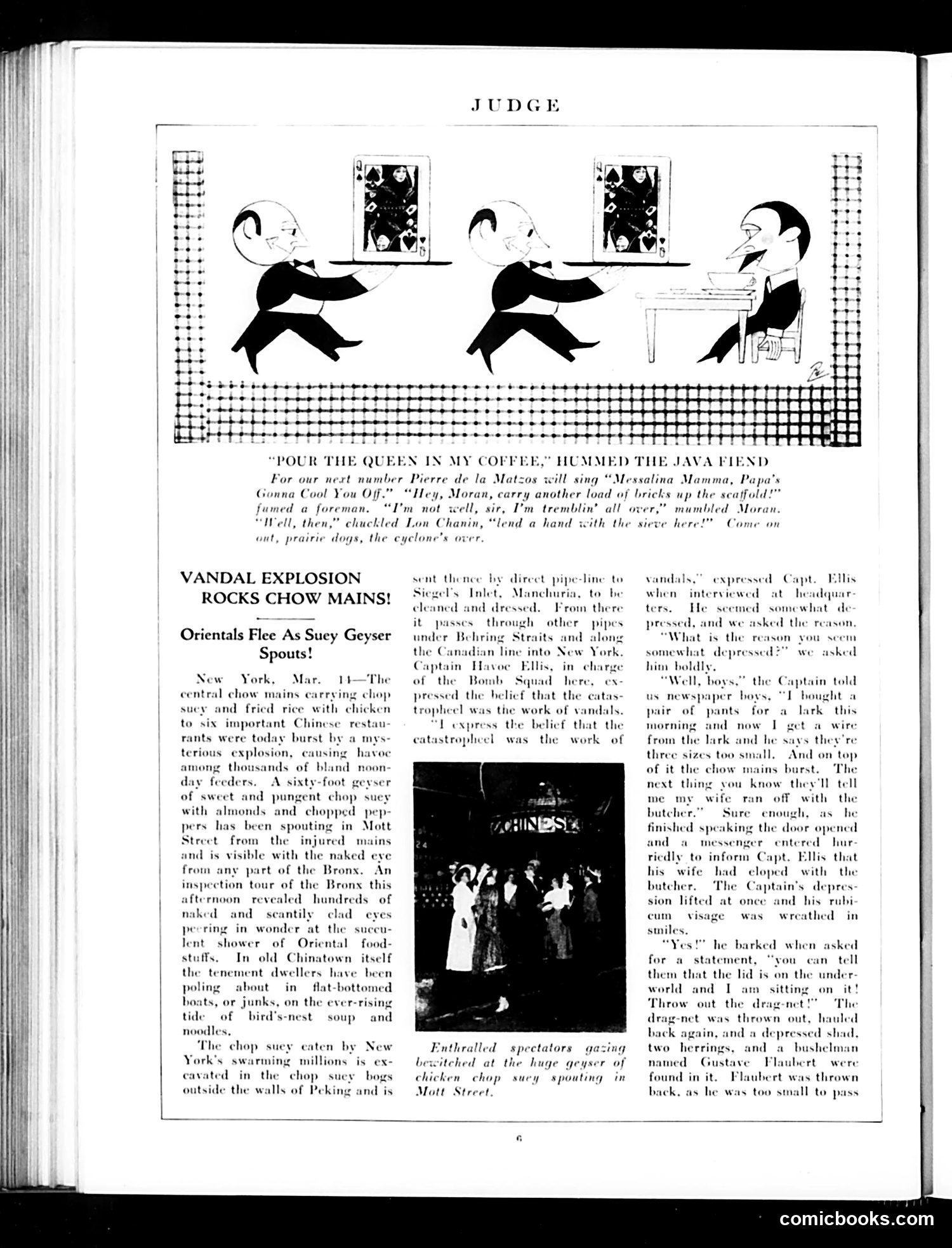
**The Top Cartoon ("Pour the Queen in My Coffee"):** This cartoon depicts two figures presenting playing cards to a judge seated at a desk. The caption references a "Java fiend" (coffee addict), making a pun on "java" (slang for coffee) and Java the island. The joke appears to satirize obsessive coffee consumption among Americans, portraying the character as so addicted he'd literally consume a queen (the playing card) in his coffee. **The News Stories:** Below are two unrelated items: one about a geyser explosion damaging Chinese restaurants in New York, and another about a woman (Suey Geyser) fleeing with a butcher. These appear to be genuine news snippets interspersed with satirical commentary, typical of Judge's format mixing humor with current events.
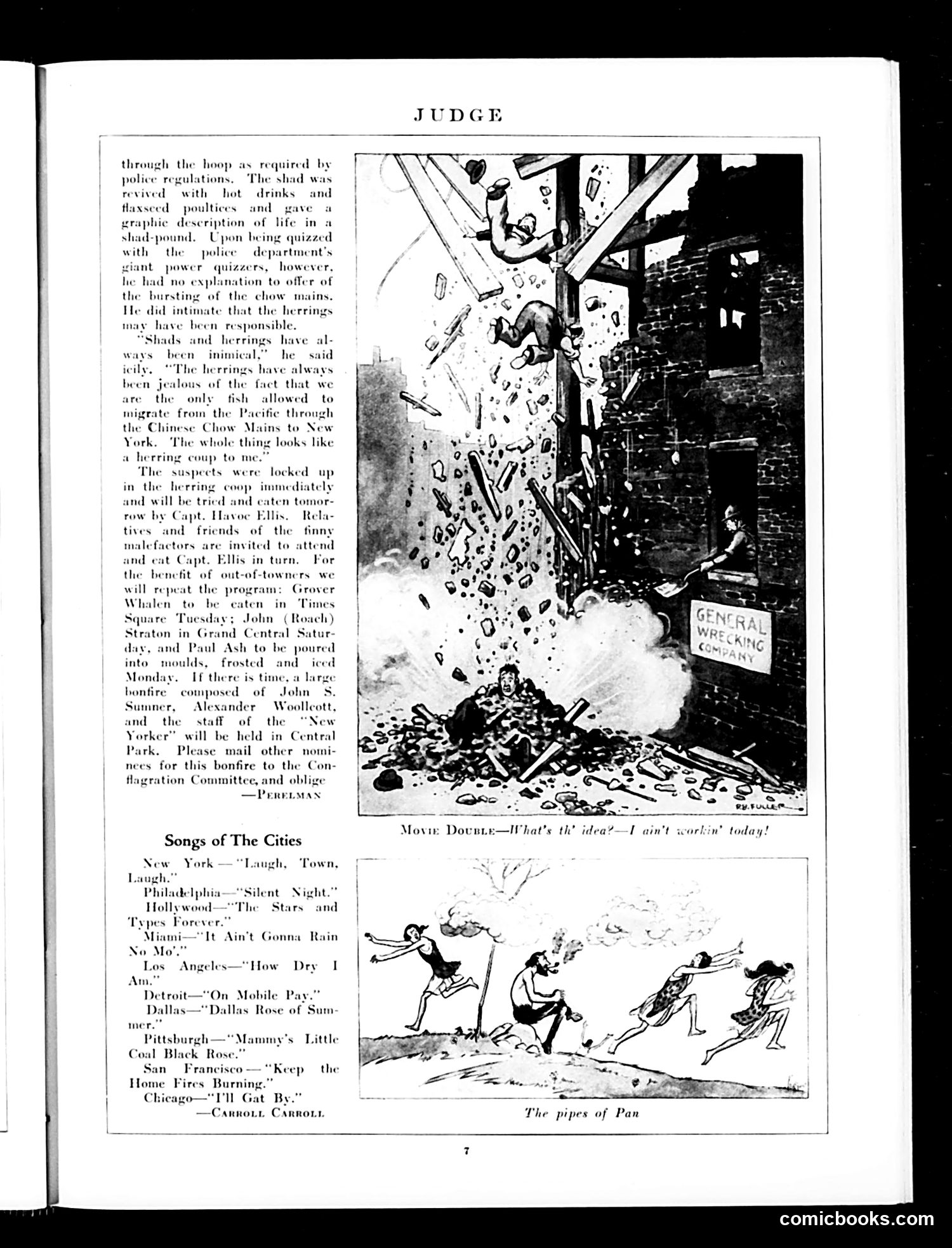
This page contains satirical commentary on New York City's recent scandals, likely from the early 1920s. The main text mocks a supposed incident involving fish in the city's water system (the "chow mains" — a pun on Chinese chow mein and water mains). The satire targets New York's police commissioner (likely referring to raids and enforcement activities) and takes jabs at public figures: Alexander Woollcott (theater critic), John S. Sumner (censorship advocate), and the staff of *The New Yorker* magazine—threatening to burn them in a bonfire at Central Park. The "Songs of the Cities" section offers humorous theme songs for American cities, playing on contemporary popular music and stereotypes (Miami's humidity, Pittsburgh's coal industry, Los Angeles's Prohibition-era "dryness"). The bottom cartoon, "The Pipes of Pan," appears unrelated—a classical reference showing Pan playing pipes, likely a visual pun or separate satirical piece.
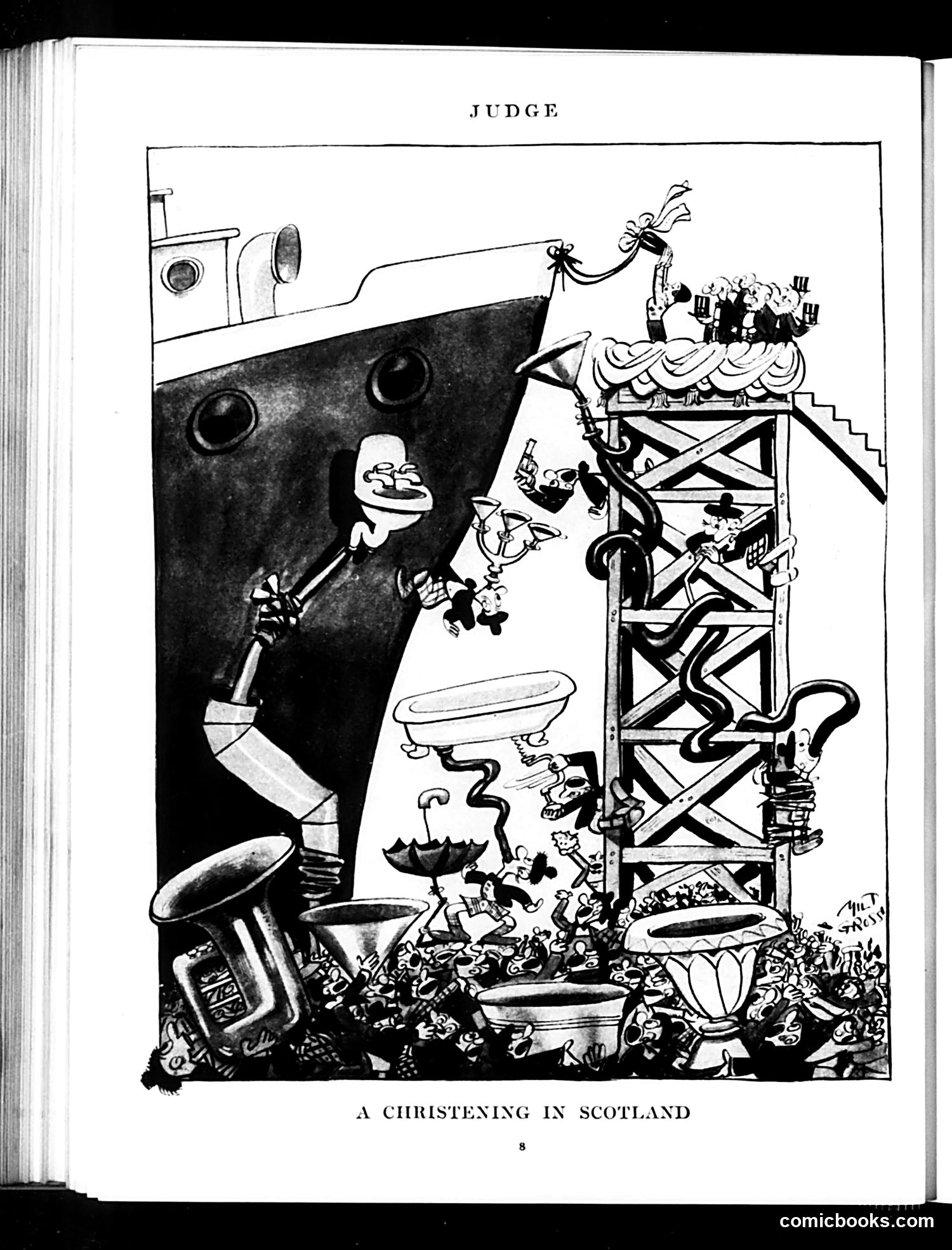
This satirical cartoon depicts a massive ship being christened (blessed at launch) in Scotland, a major shipbuilding nation. The illustration shows a formal christening ceremony with a figure smashing a bottle against the vessel's hull, while crowds gather on elaborate scaffolding to witness the event. The cartoon likely satirizes Scottish industrial pride or a specific notable ship launch, possibly mocking the grandiosity of such events or Scottish shipbuilding industry practices. The exaggerated scale of the ceremony and the crowded, chaotic scene suggest humor at the expense of public spectacle around industrial achievement. Without additional historical context about Judge magazine's publication date, the specific vessel referenced remains unclear, though Scottish shipbuilding was economically significant during the late 19th and early 20th centuries.
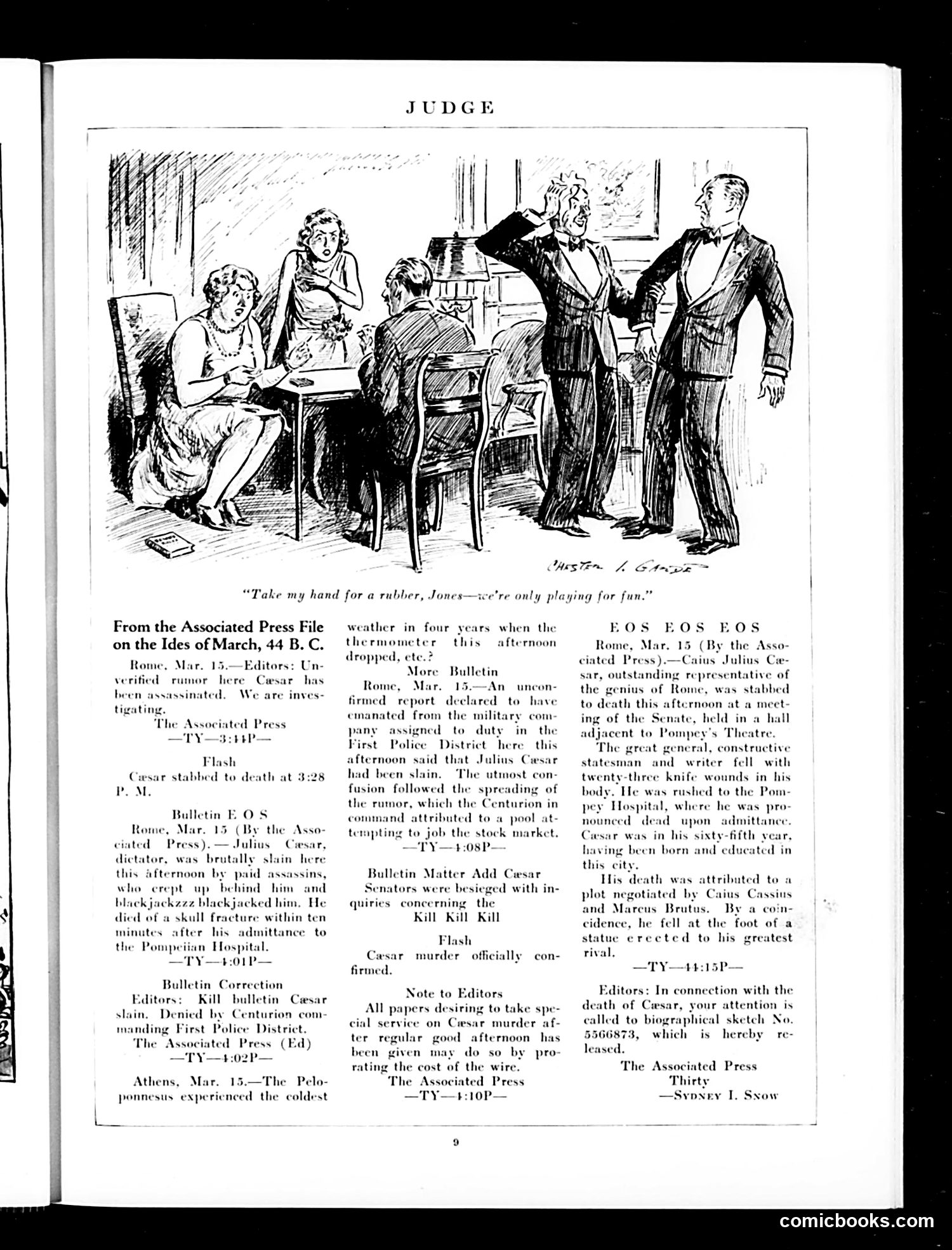
This page satirizes **modern newspaper sensationalism and unreliability** by presenting Julius Caesar's assassination (44 B.C.) as breaking news through contemporary wire service bulletins. The cartoon depicts a social gathering where someone says "Take my hand for a rubber, Jones—we're only playing for fun," likely referencing casual bridge or card games, while the news bulletins mock how real papers report evolving stories. The joke: **The Associated Press and other outlets issue contradictory, constantly-revised bulletins about Caesar's death**—from "unverified rumor" to "stabbed to death" to denials by authorities to finally confirmed assassination. Details shift wildly (blackjacking vs. knives, hospital names, casualty counts). The satire targets **journalism's rush to publish unconfirmed information, corrections, competing rumors, and sensationalism**—treating ancient history as urgent modern news. By applying 1920s newspaper chaos to a 2,000-year-old event, Judge critiques how papers prioritize speed and drama over accuracy, making them unreliable sources regardless of the story.
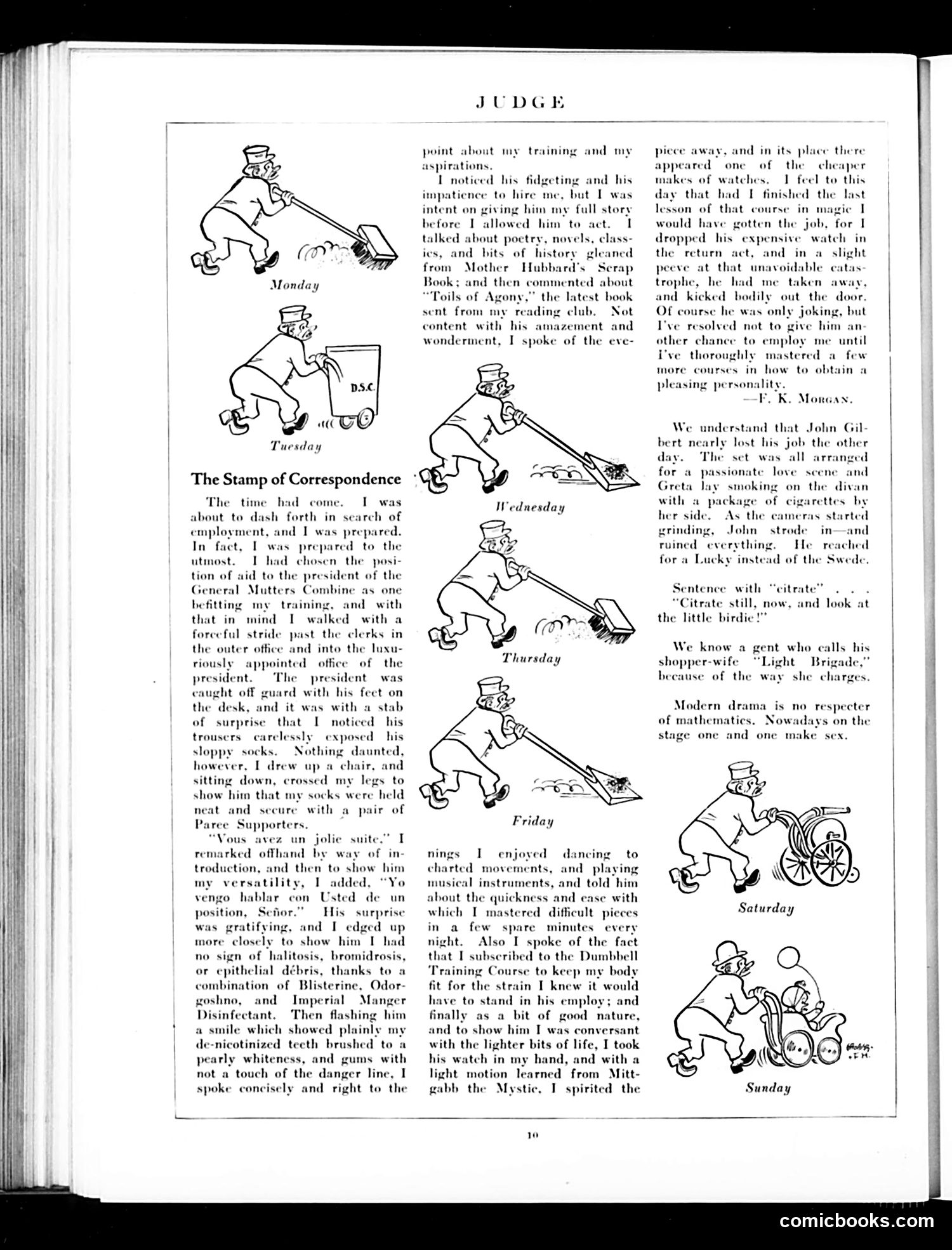
This page satirizes job-interview desperation and social climbing. The main narrative follows an ambitious applicant seeking work as an aide to a company president. The humor centers on the protagonist's absurd over-preparation: he obsessively displays his hygiene (mentioning Paree Supporters, Blisterine, and whitened teeth), flaunts half-learned knowledge from reading clubs, and demonstrates parlor tricks—culminating in performing magic he hasn't mastered, accidentally destroying the president's expensive watch while attempting to switch it with a cheap one. The accompanying week-long "Stamp of Correspondence" illustrations show a character performing increasingly ridiculous labor with correspondence stamps, depicting the mundane drudgery of clerical work. The satire targets social anxiety about making good impressions through performative self-improvement—the implicit joke being that such desperate credential-flashing and half-baked cultural knowledge backfire spectacularly. The scattered joke items (about actors on film sets, brand-name cigarettes) are period advertising asides typical of Judge magazine.
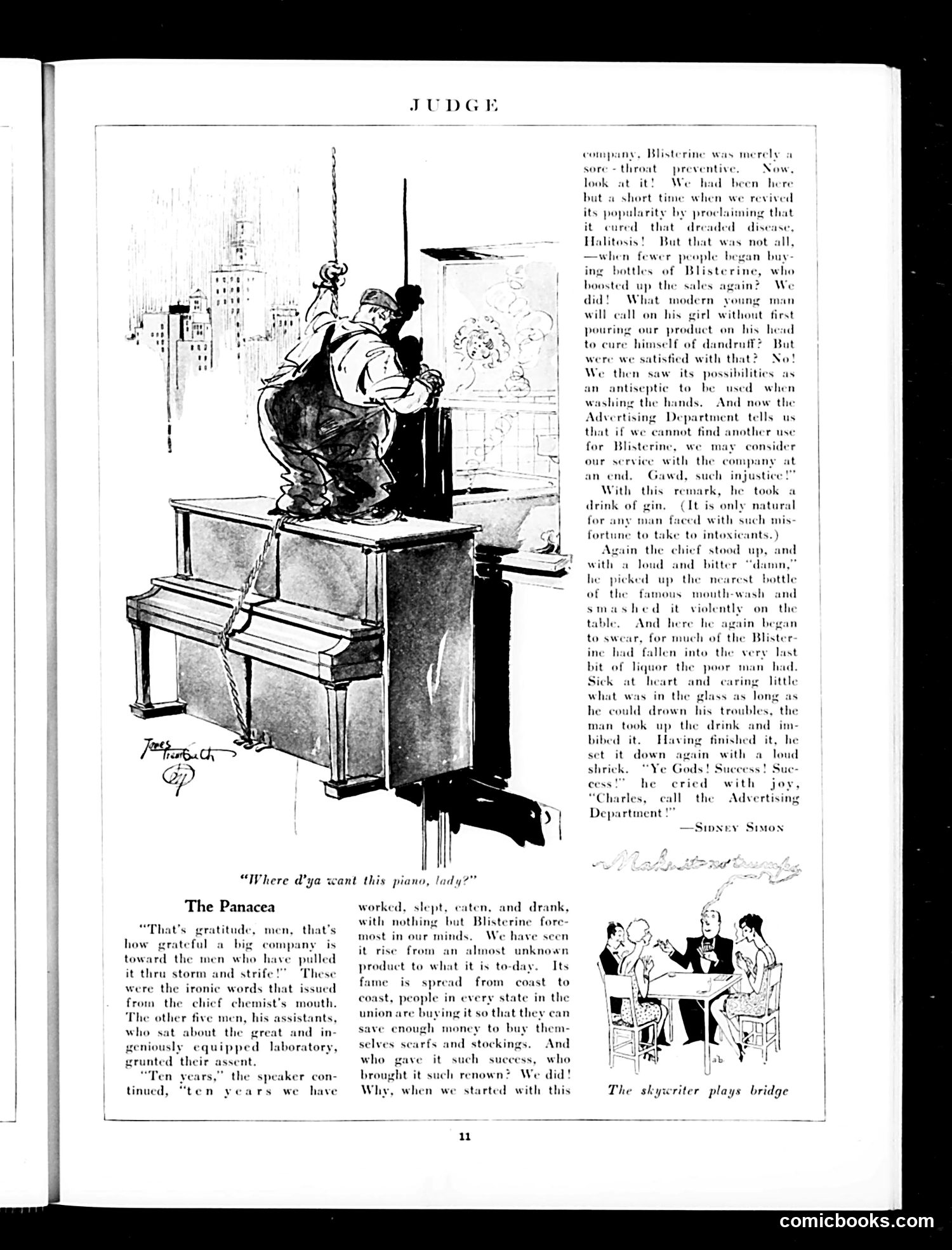
This satirical story mocks both corporate exploitation and patent medicine advertising. A chief chemist and his team have spent ten years developing "Blisterine," a fictional cure-all product (likely parodying real patent medicines like Listerine). They've repeatedly invented new uses—sore throat prevention, halitosis cure, dandruff treatment, antiseptic—to boost sales whenever demand flagged. Now the company demands *another* use or the chemists are fired. In desperation, one chemist accidentally mixes Blisterine with gin, discovers it makes an intoxicating drink, and triumphantly calls the Advertising Department to market it as a new product. The satire targets: (1) the absurd elasticity of patent medicine claims, (2) corporate ingratitude toward workers, and (3) the era's rampant false advertising. The punchline suggests these "cure-all" products are so worthless their only real value is as alcohol—a bitter commentary on the patent medicine industry's actual practices.
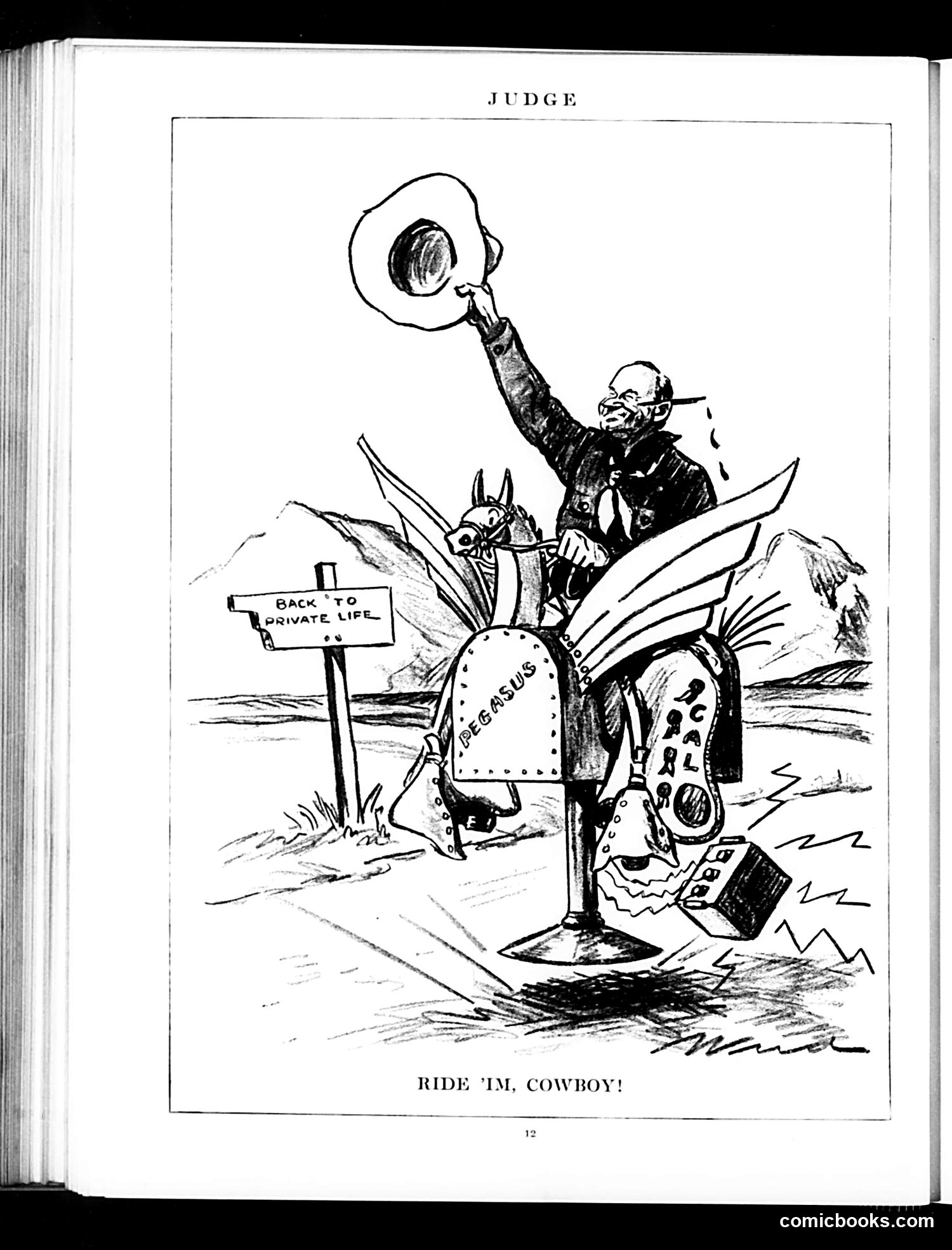
This political cartoon satirizes a public figure (caricatured with exaggerated features) trying to regain "private life" after public scandal or notoriety. The judge character rides a bucking bronco labeled "Pegasus" (the mythological winged horse, suggesting grandiose ambitions), while a signpost points "Back to Private Life." The satire mocks the impossibility of escaping public scrutiny once one has been exposed or made infamous. The "cowboy" imagery suggests wild, uncontrollable circumstances. The figure desperately waves his hat—a futile gesture against forces beyond his control. Without knowing the specific date or subject, the cartoon's general point is clear: public figures cannot simply retreat to obscurity after becoming controversial. It's a commentary on accountability and the lasting nature of public judgment.
This page from *Judge* magazine contains three separate editorial pieces: **"A Thought for Income Tax Day"** uses a Chinese famine (referenced as current news from the *New York Times*) as ironic context for American taxpayers' complaints. The piece argues that filing income taxes is trivial compared to China's catastrophe, where millions starve due to governmental incompetence and corruption. **"The Open Mind"** quotes Buddha's teaching to embrace reason over blind tradition—then sarcastically notes Americans ignore this wisdom, blindly accepting standardization, radio sermons, and neighbor-worship instead of independent thought. **"One Industry Asks No Tariff Boost"** praises book publishers for not seeking protective tariffs (unlike other industries petitioning "Mr. Grundy," likely referring to tariff-advocate Joseph Grundy). Publishers recognize that low book prices serve the poor better than protectionism. The cartoon header shows a judge contemplating—likely representing judicial wisdom or fairness as the page's organizing metaphor.
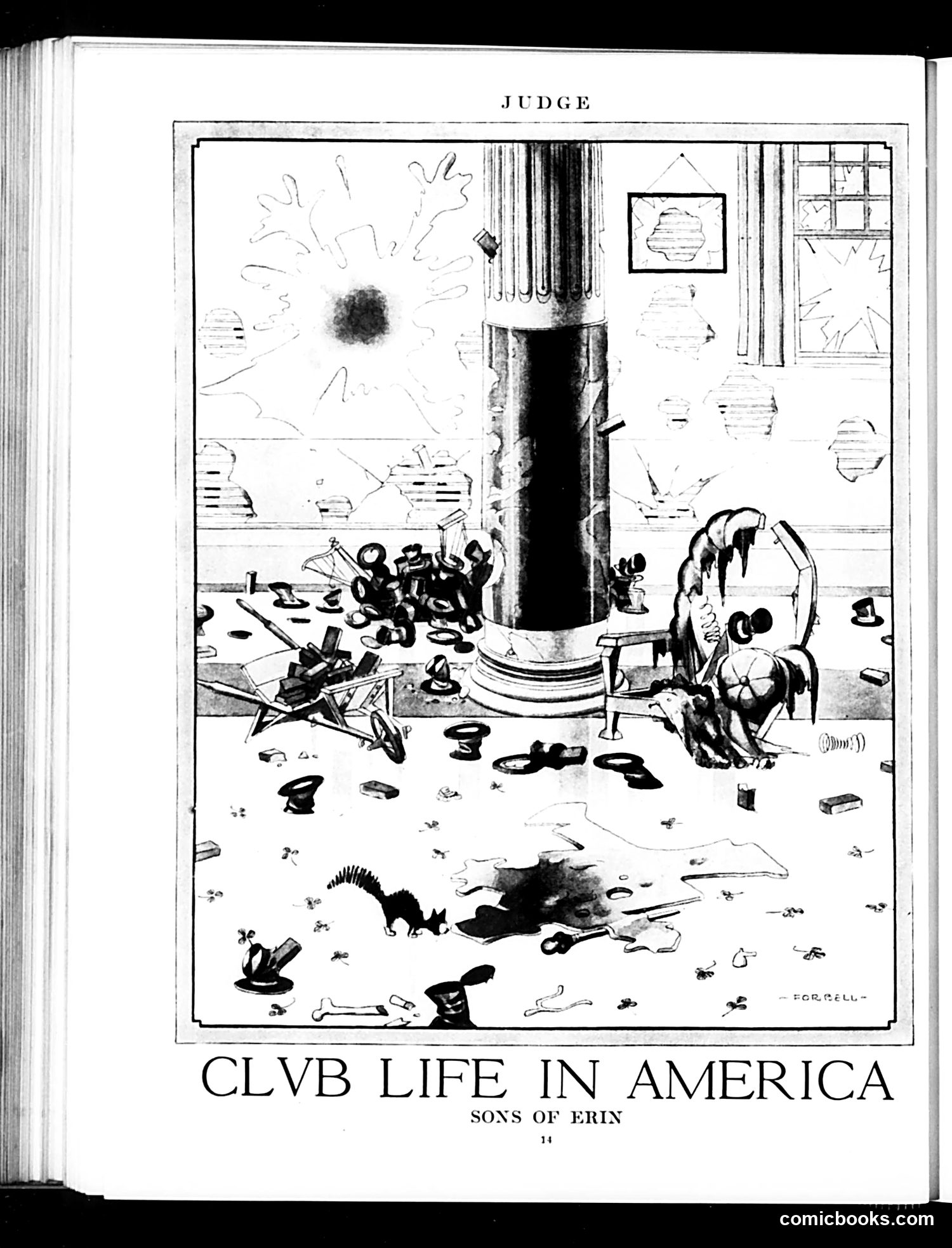
This satirical cartoon depicts an Irish-American social club in chaotic disarray. The interior shows multiple figures engaged in rowdy behavior—fighting, drinking, and creating general mayhem around a central pillar. Objects are scattered across the floor. The satire targets Irish immigrants and Irish-Americans, playing on common stereotypes of the era portraying them as drunk, violent, and disorderly. "Sons of Erin" references Ireland, suggesting these are Irish-American fraternal organizations. The "club life" caption sarcastically contrasts the genteel associations of American clubs with this portrayed bedlam. This reflects late 19th/early 20th-century anti-Irish prejudice that depicted Irish communities as inherently lawless and uncivilized—a common theme in American satirical publications of this period.
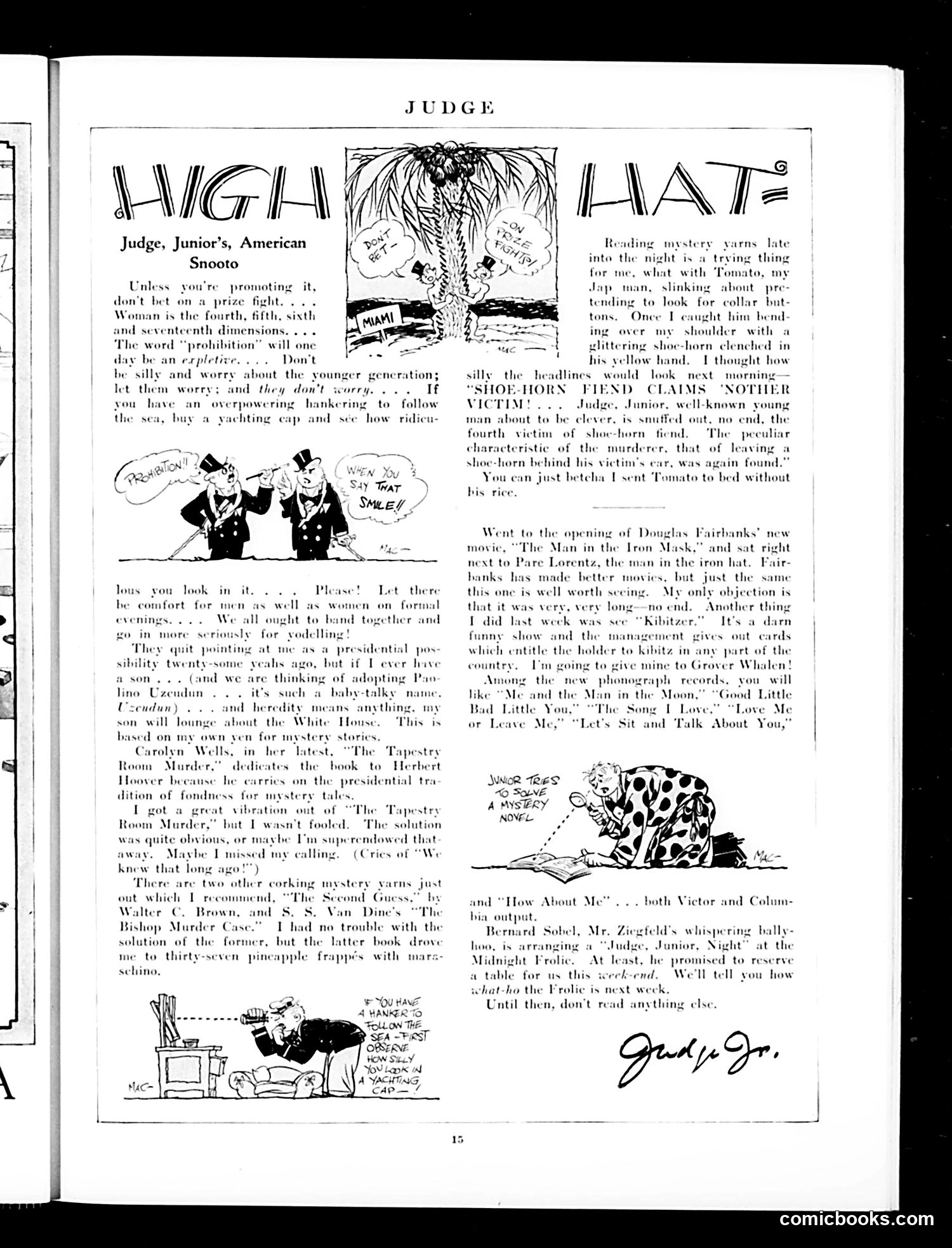
This page is a humorous column by "Judge, Junior" offering satirical observations on 1920s American culture. The cartoons and commentary mock contemporary trends and personalities. The opening section ridicules prohibition-era attitudes and younger generation concerns. The cartoons depict well-dressed men in top hats making absurd pronouncements—typical Judge satire of upper-class pretension. The main content discusses mystery novels, mentioning author Carolyn Wells and books like "The Bishop Murder Case," alongside a joke about the author's Japanese servant sneaking around with a shoe horn, which he imagines as tabloid fodder ("SHOE-HORN FIEND"). References include Douglas Fairbanks' film "The Man in the Iron Mask" and the "Kibitizer" card game promotion. The final item notes Bernard Sobel organizing a "Judge, Junior, Night" at the Midnight Frolic (a Ziegfeld theatrical venue). The satire targets literary pretension, 1920s entertainment, and upper-class affectation throughout.
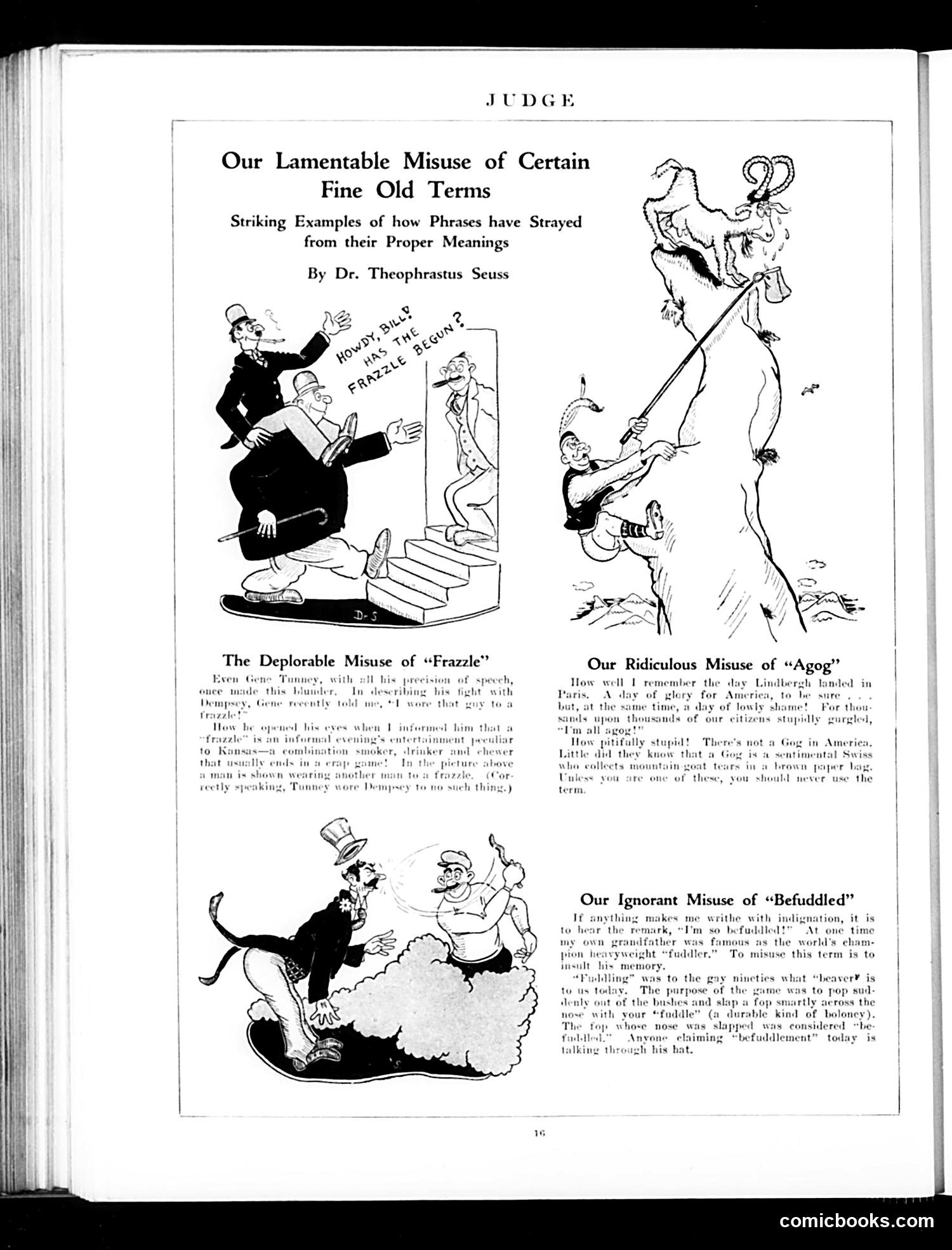
This is a linguistic humor piece by Dr. Theophrastus Seuss (Dr. Seuss) critiquing the misuse of old English words. Three cartoons illustrate outdated terms whose meanings have drifted: 1. **"Frazzle"**: Shows a man being interrogated about the term, satirizing how it's now used casually when it originally referred to something more specific. 2. **"Agog"**: Depicts someone climbing a tall figure, illustrating the word's current misapplication. The text references Lindbergh landing in Paris and uses of "agog" that strain the original meaning. 3. **"Befuddled"**: Shows physical comedy with a top hat, explaining how the term once meant being hit on the nose in a specific game, now misused to mean simple confusion. The satire targets how colloquial speech has corrupted precise Victorian-era terminology. Seuss's characteristic whimsical drawings accompany this prescriptivist language commentary.
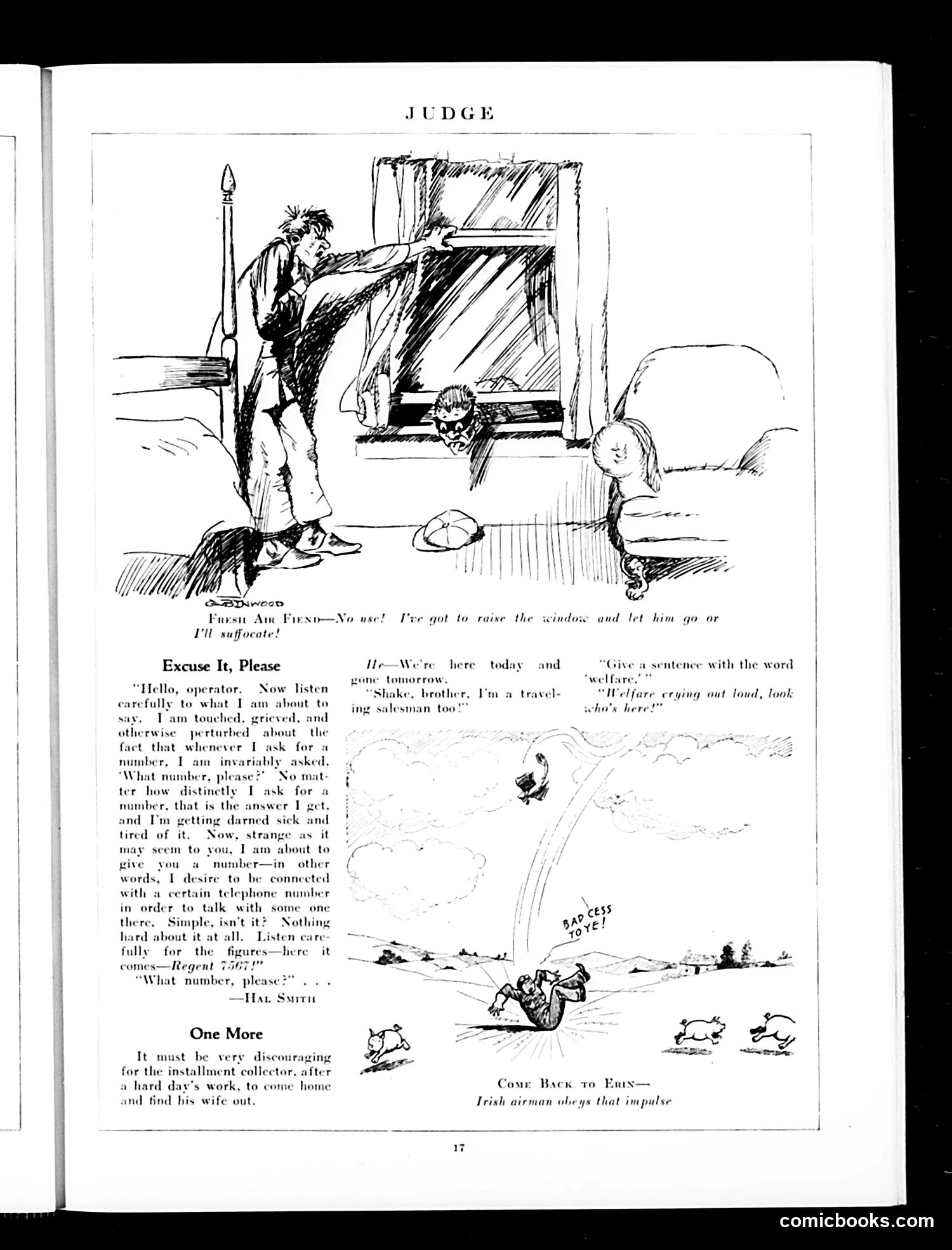
This page contains three separate satirical cartoons: 1. **"Fresh Air Fiend"** (top): Depicts a man forcing open a window despite a woman's protests about suffocation. It mocks obsessive health-fad enthusiasts of the era who believed in excessive fresh air exposure, regardless of practical concerns. 2. **"Excuse It, Please"** (left): A frustrated man complains to a telephone operator about repeatedly asking for a specific number but always receiving the same confused response ("What number, please?"). This satirizes poor telephone service and operator incompetence—a common complaint in early 20th-century America when manual switchboards required operator assistance. 3. **"One More"** (bottom): Brief joke about an installment collector (debt collector) coming home to find his wife out—ironic commentary on how those who pursue others for unpaid debts face domestic abandonment themselves. The cartoons target everyday frustrations: health obsessions, telephone service failures, and the comeuppance of debt collectors.
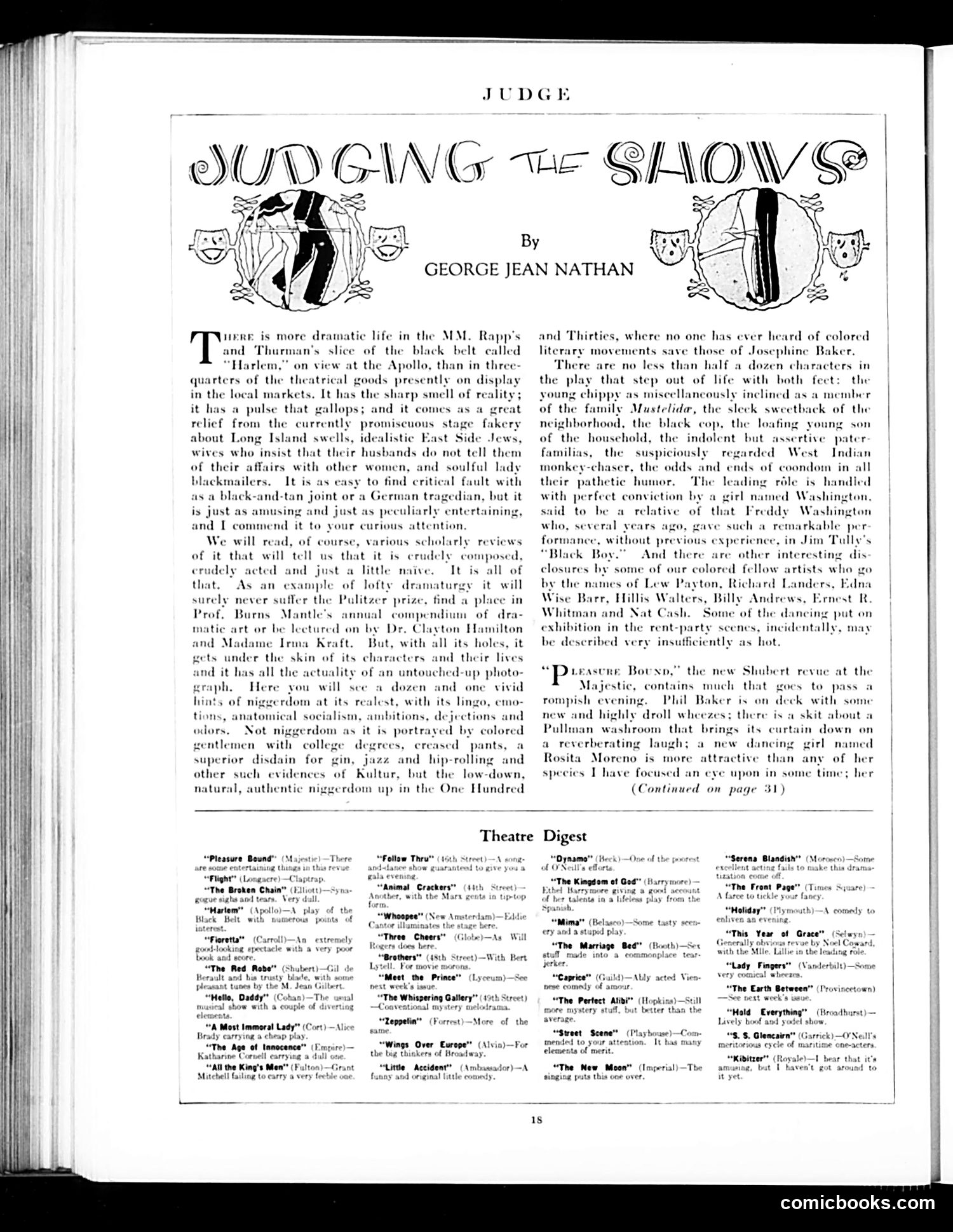
This is a theater review by George Jean Nathan, a prominent drama critic of the era. He's praising a play called "Harlem" at the Apollo Theatre for its authentic depiction of Black life in Harlem, contrasting it favorably with the artificial plots dominating Broadway (romantic comedies about wealthy characters, Jewish immigrants, and morally questionable women). Nathan's language reflects 1920s-30s racial attitudes—he uses now-offensive terminology throughout, including the slur "niggerdom," which he uses to describe authentic working-class Black culture approvingly (as "low-down, natural, authentic") versus the artificial performances by educated Black entertainers in formal attire. The review names Black performers including Josephine Baker, Lew Payton, and others, and praises the "dancing girl named Rosita Moreno." While Nathan's language is deeply problematic by modern standards, his fundamental point was that the play offered genuine realism rather than stereotypical Broadway artifice—a progressive position for theater criticism at that time, though expressed through a lens of racial condescension.
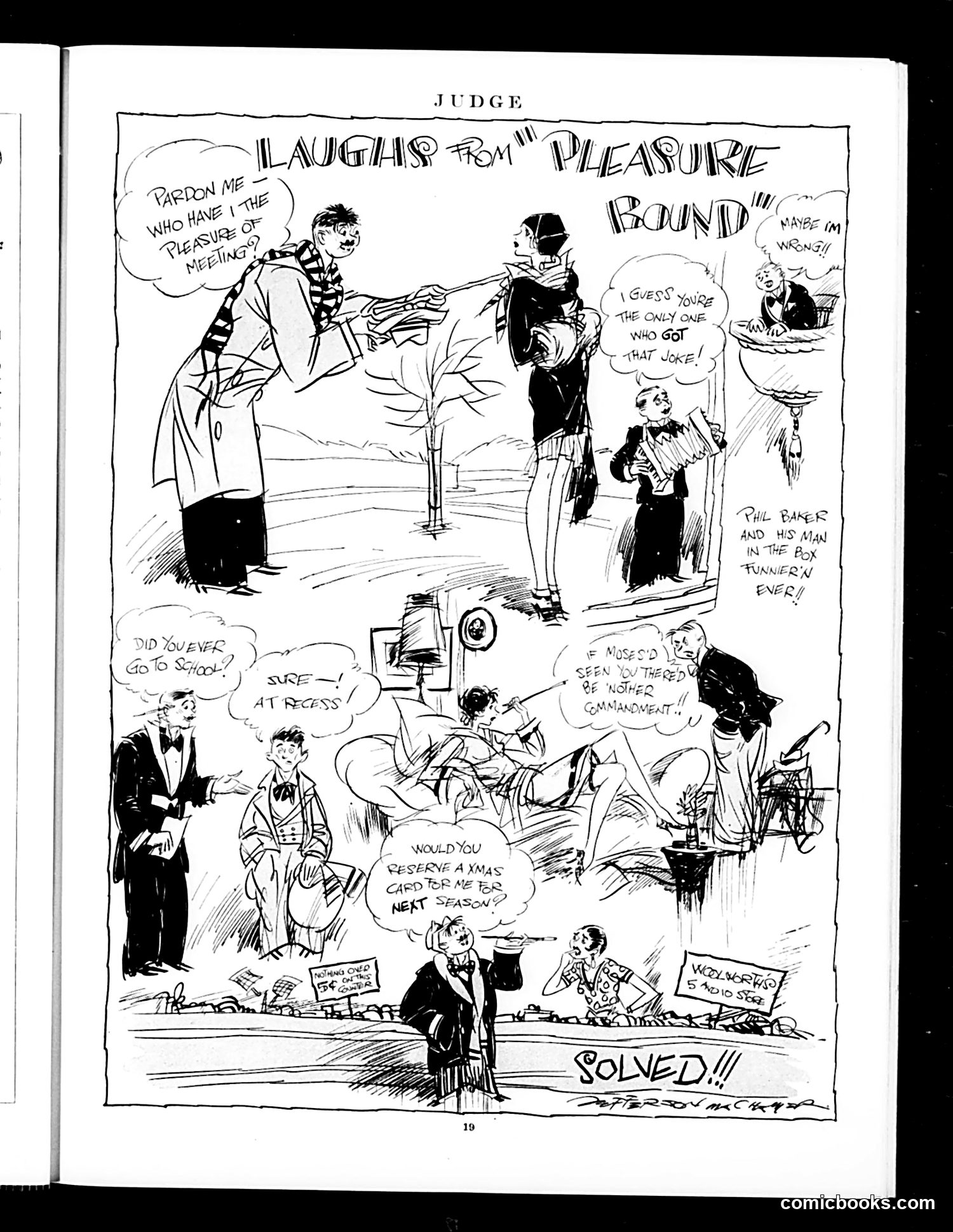
This Judge cartoon satirizes courtroom proceedings through absurdist humor. A judge presides over a chaotic scene where various characters reference popular entertainments and social situations. References include "Phil Baker and his man in the box" (likely a vaudeville or radio comedy act), mentions of school, recess, and Christmas cards, and inquiries about "pleasure bound" activities. The cartoon's humor derives from the incongruity of courtroom formality colliding with frivolous, everyday concerns and entertainment references. Characters discuss pleasure-seeking, school attendance, and seasonal greetings as if these were serious legal matters requiring judicial resolution. The final word "SOLVED!!!" suggests the judge has absurdly resolved these mundane issues through legal authority—mocking both judicial pomposity and the triviality of modern social preoccupations. The satire targets how Americans treat minor social concerns with excessive formality.
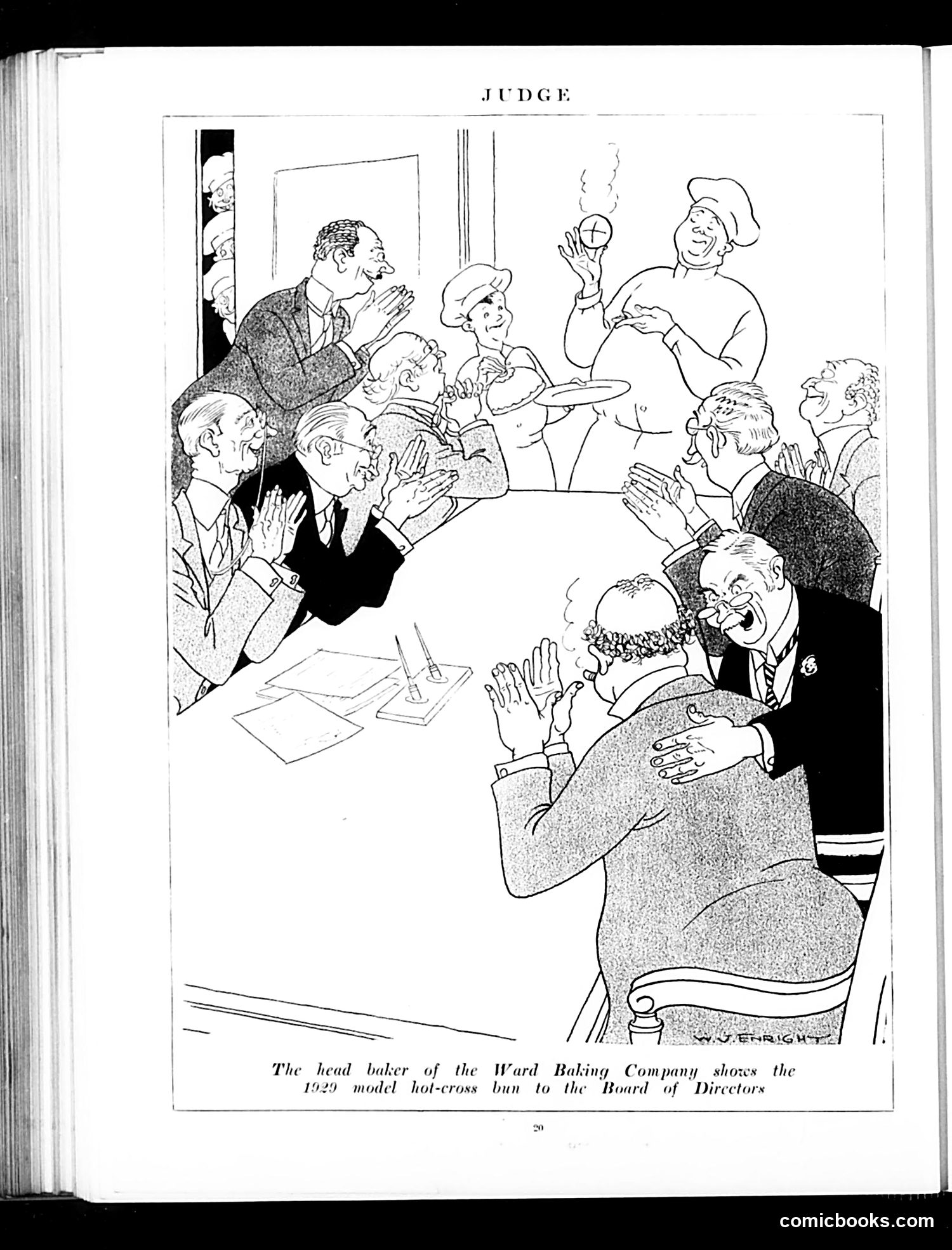
This 1929 cartoon satirizes the Ward Baking Company's board of directors by depicting them as enthusiastically examining a hot-cross bun as if it were a major innovation—a "1929 model" automobile. The joke mocks corporate pretension: the dignified businessmen in suits treat a simple baked good with the ceremonial gravity typically reserved for engineering breakthroughs or product launches. The satire likely comments on 1920s corporate culture and marketing excess, where companies aggressively promoted mundane consumer goods as revolutionary. The timing (just before the October 1929 stock market crash) may also carry ironic weight, suggesting boardroom enthusiasm detached from reality.
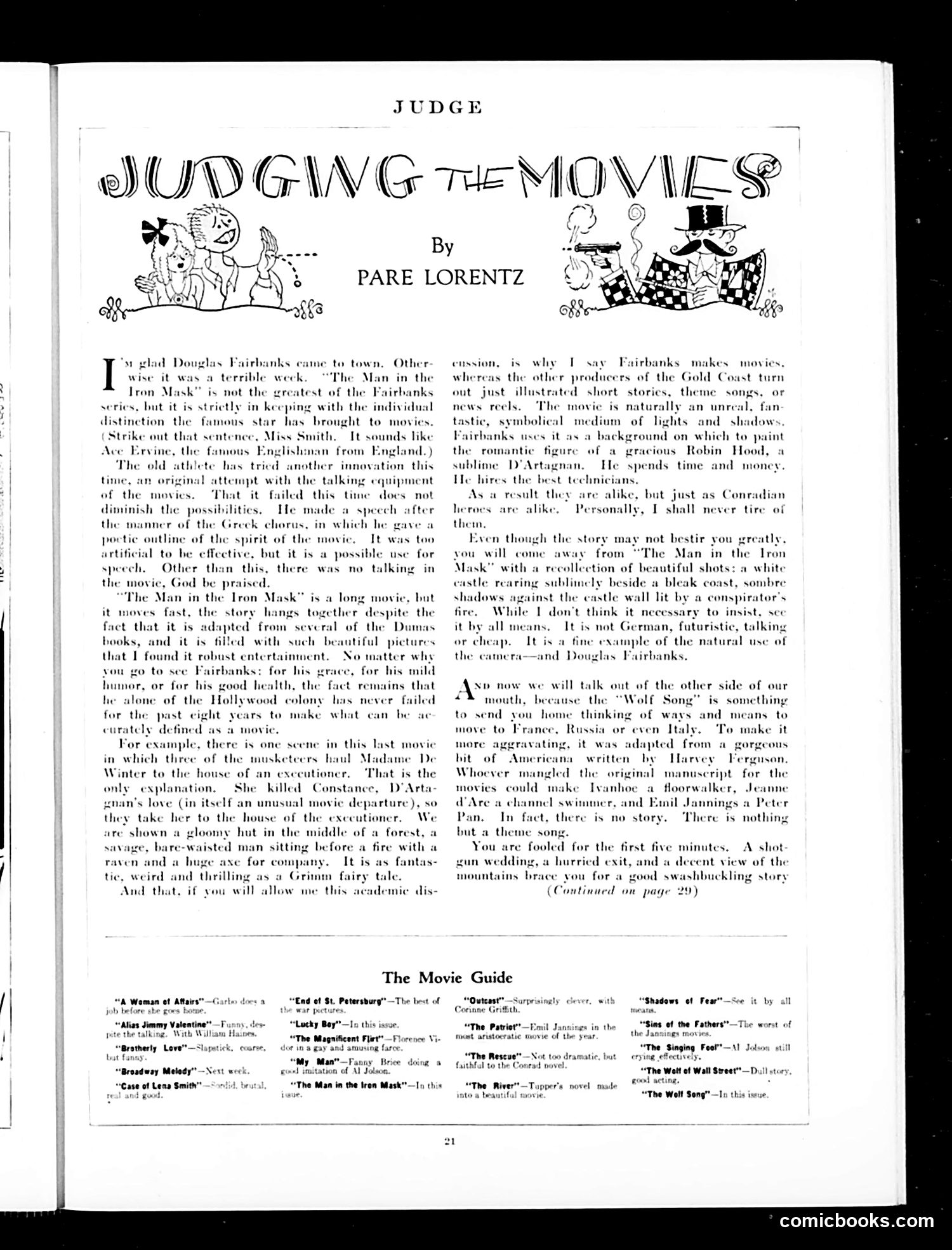
This is a film review column by critic Pare Lorentz evaluating Douglas Fairbanks' latest movies. The piece discusses *The Man in the Iron Mask*, praising Fairbanks as Hollywood's most consistently reliable star who elevates material through his romantic, athletic heroism and technical craftsmanship. Lorentz criticizes Fairbanks' experimental addition of a Greek-chorus-style speech to the talking-equipped version—calling it artificially ineffective. He then shifts to savaging *The Wolf Song*, adapted from American source material, arguing it's been mangled into something unrecognizable (comparing it to making Ivanhoe a department-store floorwalker). The satire targets how studios adapt literary works into unrecognizable vehicles for stars, and questions whether talking pictures enhance or diminish cinema's visual storytelling power—a live debate during the early sound era's transition.
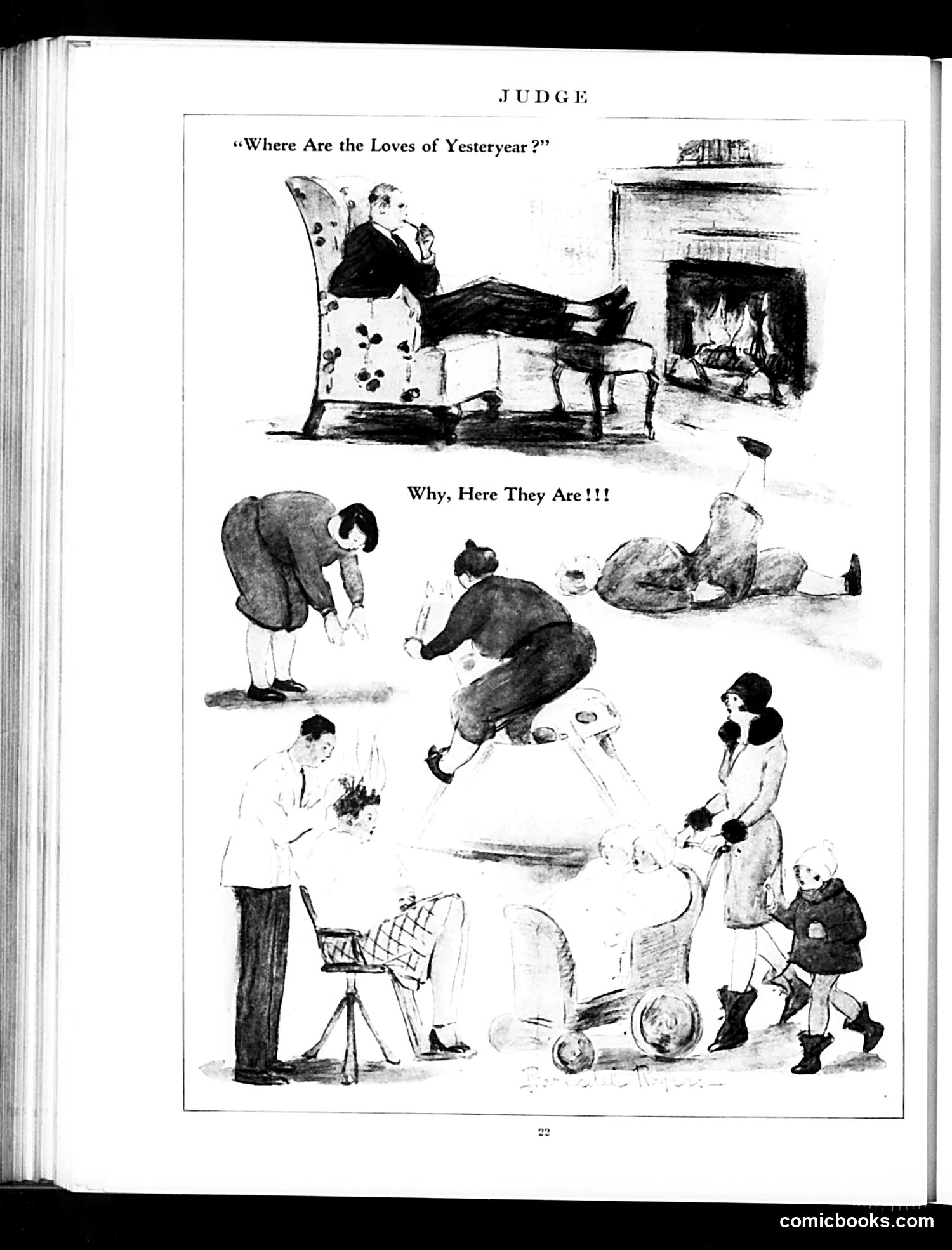
This satirical cartoon contrasts romantic nostalgia with modern reality. The top panel shows a man lounging by a fireplace, wistfully recalling past loves—a literary reference to the famous medieval poem asking "where are the snows of yesteryear?" The bottom panel reveals the answer: those romantic loves of the past are now depicted as the mundane realities of middle-aged and older life—women occupied with domestic chores, childcare, shopping, and household management. One woman bends over household tasks; another chases children; others handle laundry and errands. The satire mocks both male romantic idealization of youth and the gap between youthful romance and adult domestic responsibility. It suggests that yesterday's romantic interests have become today's wives preoccupied with unglamorous household duties.
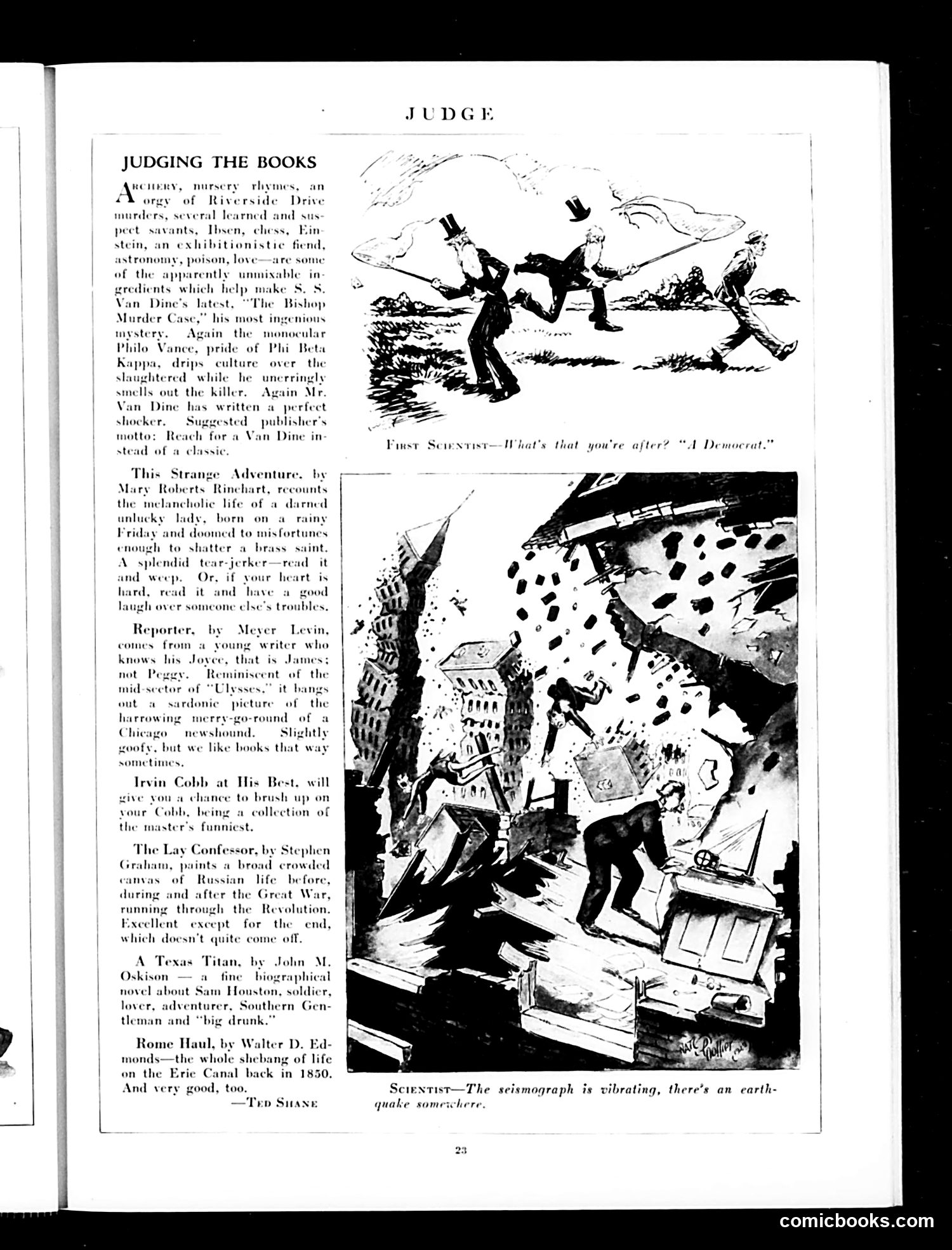
This page reviews several 1920s-30s novels while featuring two cartoons satirizing science and politics. **Top cartoon**: Two men in formal dress conduct an absurd experiment outdoors. One asks the other, "What's that you're after? 'A Democrat.'" The joke equates Democrats with something unstable or volatile—likely a Depression-era jab at Democratic political instability or unpopularity. **Bottom cartoon**: Scientists observe a seismograph wildly vibrating, with one saying "The seismograph is vibrating, there's an earthquake somewhere." The humor suggests the scientists are incompetent or oblivious—they're detecting obvious seismic activity but stating it redundantly, mocking academic pedantry. The book reviews themselves discuss mysteries by S.S. Van Dine, novels by Mary Roberts Rinehart and Meyer Levin, and historical fiction, with the Judge critic offering snide commentary on literary quality and popular taste of the era.
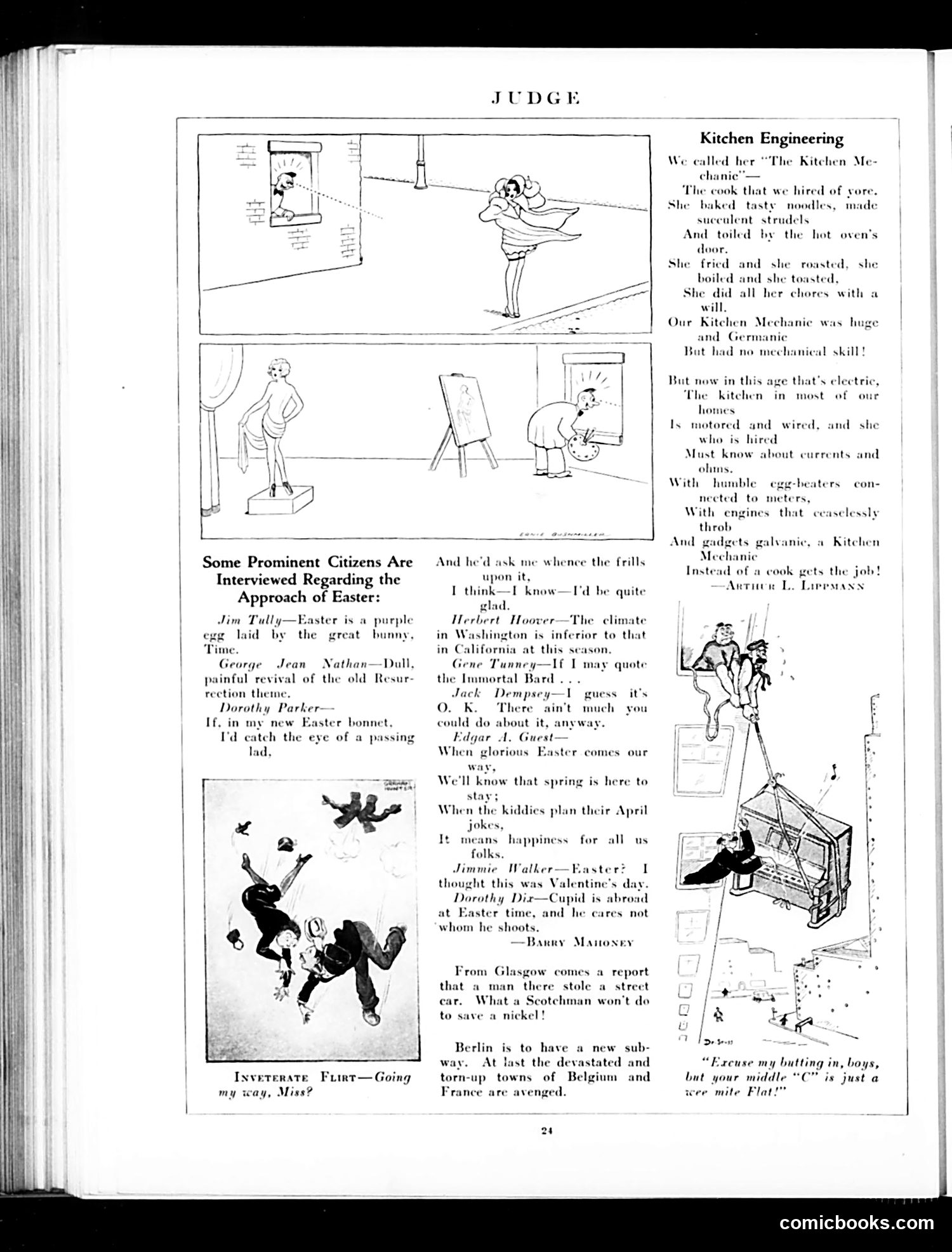
This page contains two main satirical pieces: **"Kitchen Engineering"** (top/right) contrasts old and new domestic labor. It mocks the transition from traditional "Kitchen Mechanic" cooks (depicted as large, hardworking German women with no formal training) to modern electric kitchens requiring technical knowledge of "currents and ohms." The satire suggests that mechanization paradoxically makes cooking more complicated, transforming a simple domestic job into something requiring engineering expertise. **"Prominent Citizens Interviewed Regarding Easter"** (left/bottom) is a humorous survey of famous 1920s figures—including boxer Jack Dempsey, boxer Gene Tunney, playwright George Jean Nathan, and advice columnist Dorothy Dix—offering absurd or cynical takes on Easter. The jokes range from dismissive to crude, satirizing both the holiday's commercialization and these public figures' celebrity personas. The cartoons mock technological progress and celebrity culture through exaggeration and irony typical of Judge's satirical approach.
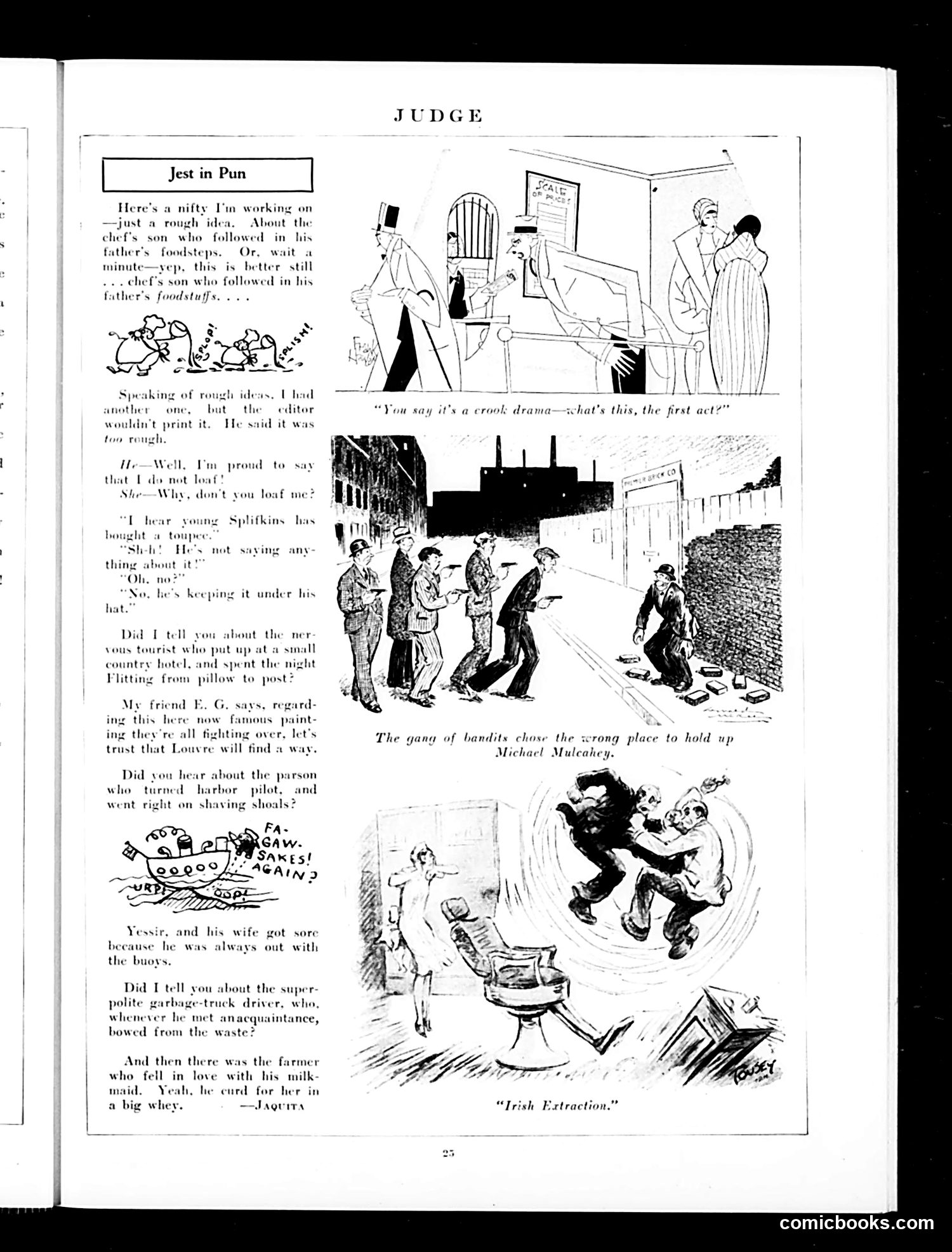
This page from the satirical magazine **Judge** contains primarily **puns and joke anecdotes** rather than political cartoons. The "Jest in Pun" column offers wordplay humor typical of early 20th-century magazines. The three illustrated cartoons are: 1. **Top**: A domestic scene mocking theatrical drama—a wife accuses her husband of creating "a crook drama" with his behavior. 2. **Middle**: "The gang of bandits chose the wrong place to hold up Michael Mulcahey"—likely satirizing Irish-American toughness or a specific news incident, though the specific reference is unclear. 3. **Bottom**: "Irish Extraction"—depicts figures being forcibly removed from a large pot or vessel, playing on the phrase "extraction" and ethnic stereotyping common to the era. The jokes throughout rely on puns ("foodstuffs," "loaf," "waste") and mild social observations about tourists, parsons, and farmers. The Irish-themed cartoons reflect the magazine's use of ethnic humor characteristic of early-1900s American satire.
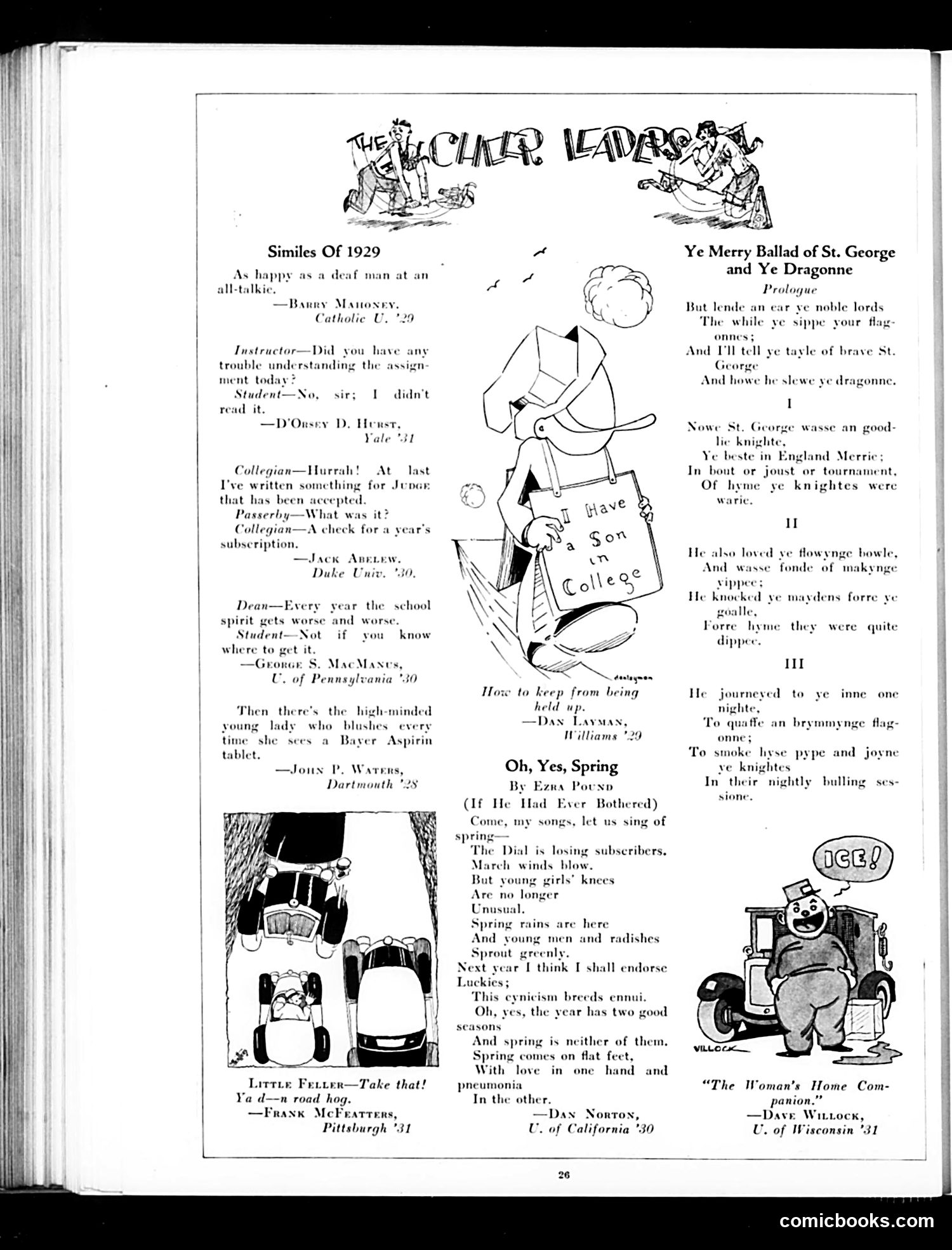
This page contains **college humor** rather than political satire. The "Similes of 1929" section presents jokes about contemporary student life, playing on 1920s references: the "all-talkie" (newly popular sound films), road hogs (reckless drivers), and young women's hemlines ("knees are no longer Unusual"—mocking the ongoing shock over shortened skirts). The collegiate jokes target recognizable campus types: the student who admits not reading assignments, the collegian who only gets published by paying for subscriptions. The car illustration ("Little Feller") satirizes dangerous driving. The poetry sections parody literary affectation—a mock-medieval ballad about St. George and a poem by "Ezra Pound" (likely mimicking modernist obscurity). The humor relies on college readers recognizing literary pretension and generational attitudes. Overall, this is **student-oriented satire** about academic life, not political commentary—typical fare for Judge's college audience in the Jazz Age.
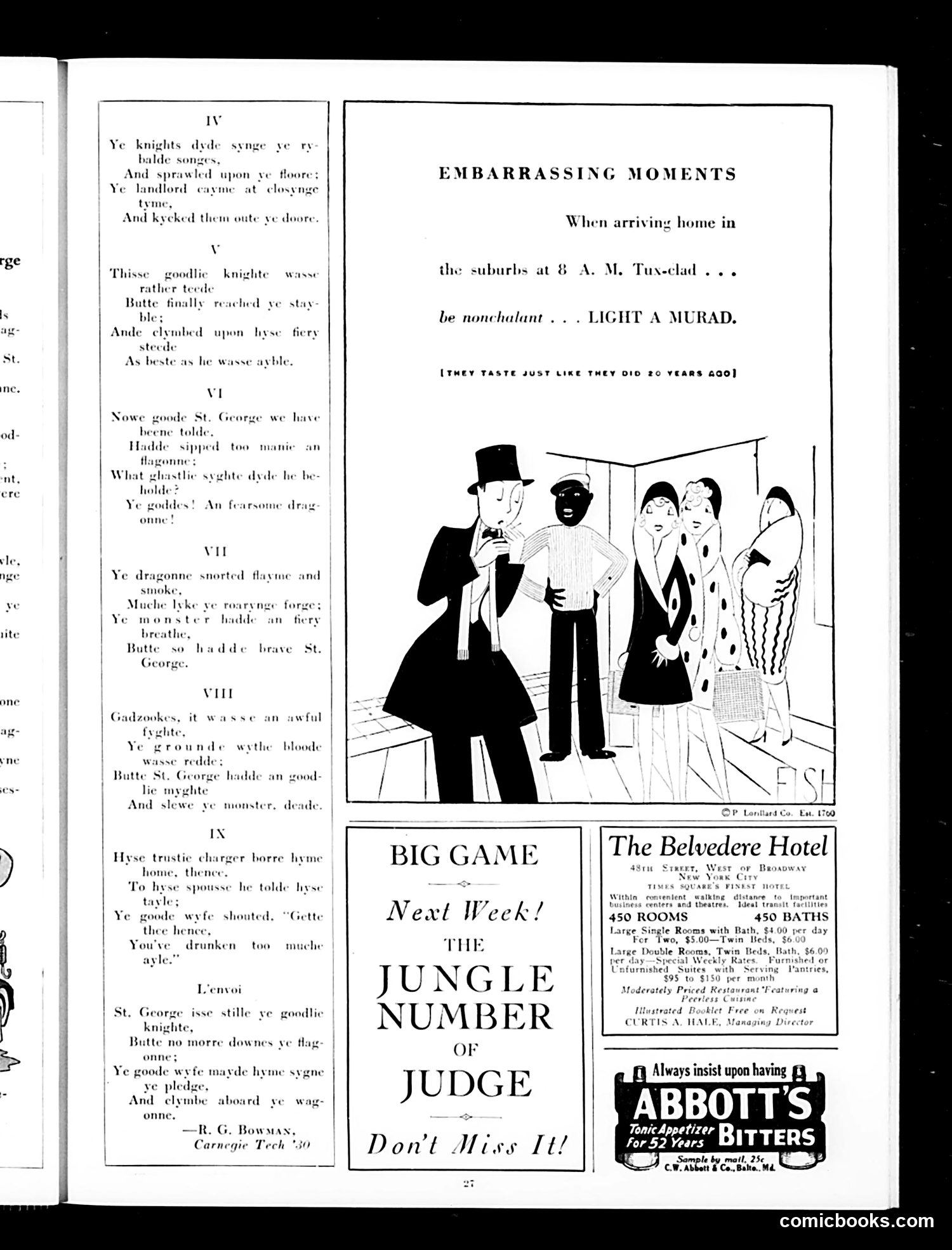
This page contains primarily **advertising and promotional content** rather than political satire. The main feature is "**Embarrassing Moments**"—a humor cartoon depicting a man arriving home at 8 A.M. in a tuxedo (suggesting he's been out all night) encountering his wife and neighbors. The joke's premise: he should "light a Murad" (a cigarette brand) to appear nonchalant, with a note that these cigarettes "taste just like they did 20 years ago"—advertising copy masquerading as humor. The left column shows archaic verse about St. George and a dragon, likely a literary parody or historical piece unrelated to contemporary politics. The page also advertises **The Belvedere Hotel** (midtown Manhattan), **Abbott's Bitters** (a tonic/medicinal product), and promotes next week's "Jungle Number of Judge" featuring a judge character. There is **no clear political commentary** visible. This appears to be a typical Judge magazine page from the early 20th century, mixing light domestic humor with commercial advertising.
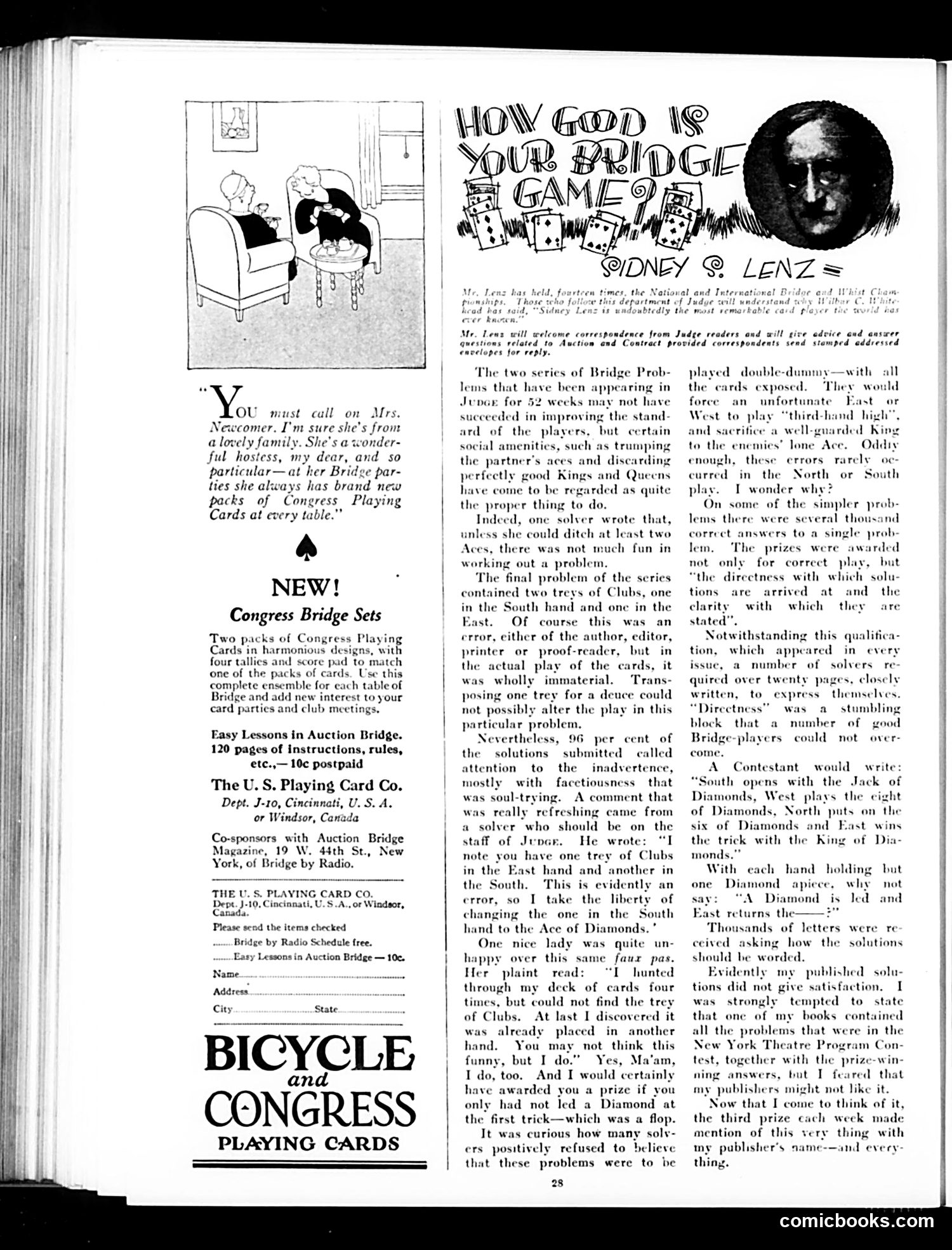
This page combines **advertising with bridge-game content and editorial commentary**. The cartoon (top left) depicts a social scene where a woman recommends calling on "Mrs. Newcomer," praising her as a hostess who always provides **brand-new packs of Congress Playing Cards** at bridge parties—an endorsement thinly disguising product placement. The bulk of the page features an article by **Sidney Lenz**, a prominent bridge expert (his photograph appears top right), discussing a 52-week bridge problem series in *Judge* magazine. Lenz humorously recounts readers' complaints about a printing error—a duplicate card in one problem—noting that 96% of solvers obsessed over this mistake despite it being irrelevant to gameplay. The satire targets **American social pretension**: the cartoon jokes that wealthy hostesses signal status through *brand-new* playing cards, while Lenz's article gently mocks bridge enthusiasts' pedantic attention to minor errors while missing actual strategic mistakes. The advertisements for **Congress Bridge Sets** and **Bicycle Playing Cards** directly below reinforce the commercial angle.
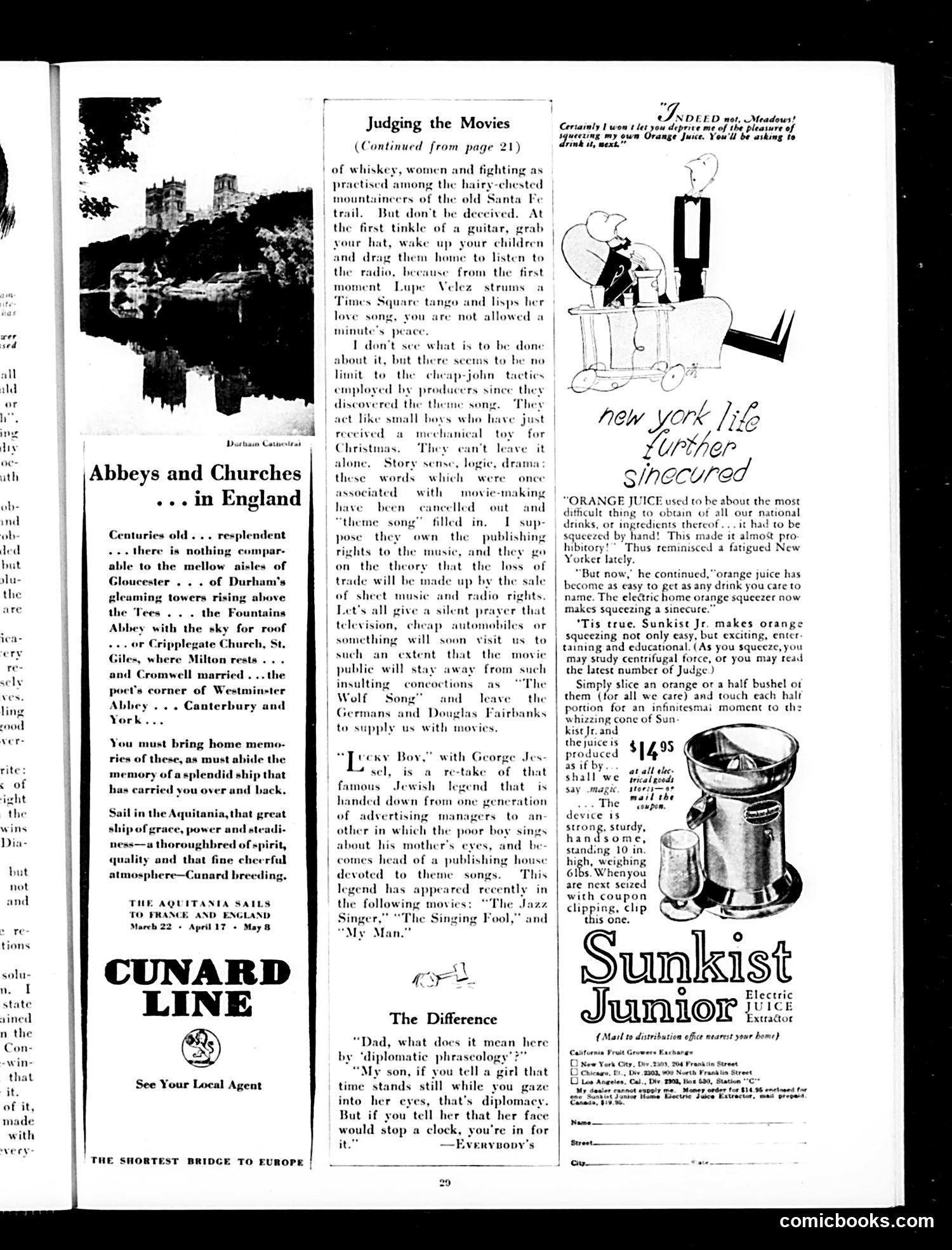
This page contains two main cartoons: **"New York Life Further Sinecured"** (top right): A satirical commentary on modern convenience. The cartoon jokes that orange juice—once laboriously hand-squeezed—has become effortless via the electric "Sunkist Jr." squeezer. The humor plays on the term "sinecure" (an easy job with minimal effort), suggesting that technology is eliminating all human effort from daily tasks. The cartoon mocks both the advertising industry's hyperbolic claims about convenience and Americans' apparent obsession with labor-saving devices. **"The Difference"** (bottom): A brief comic dialogue about diplomacy and tactlessness. A father explains to his son that "diplomatic phraseology" means saying flattering things (like "time stands still" when gazing into someone's eyes), whereas bluntly insulting someone (saying their face could stop a clock) crosses into rudeness. It's a gentle satire on pretense and social hypocrisy. The page also includes movie reviews and travel advertisements, typical of Judge magazine's mixed editorial/advertising format from this era (1920s-30s).
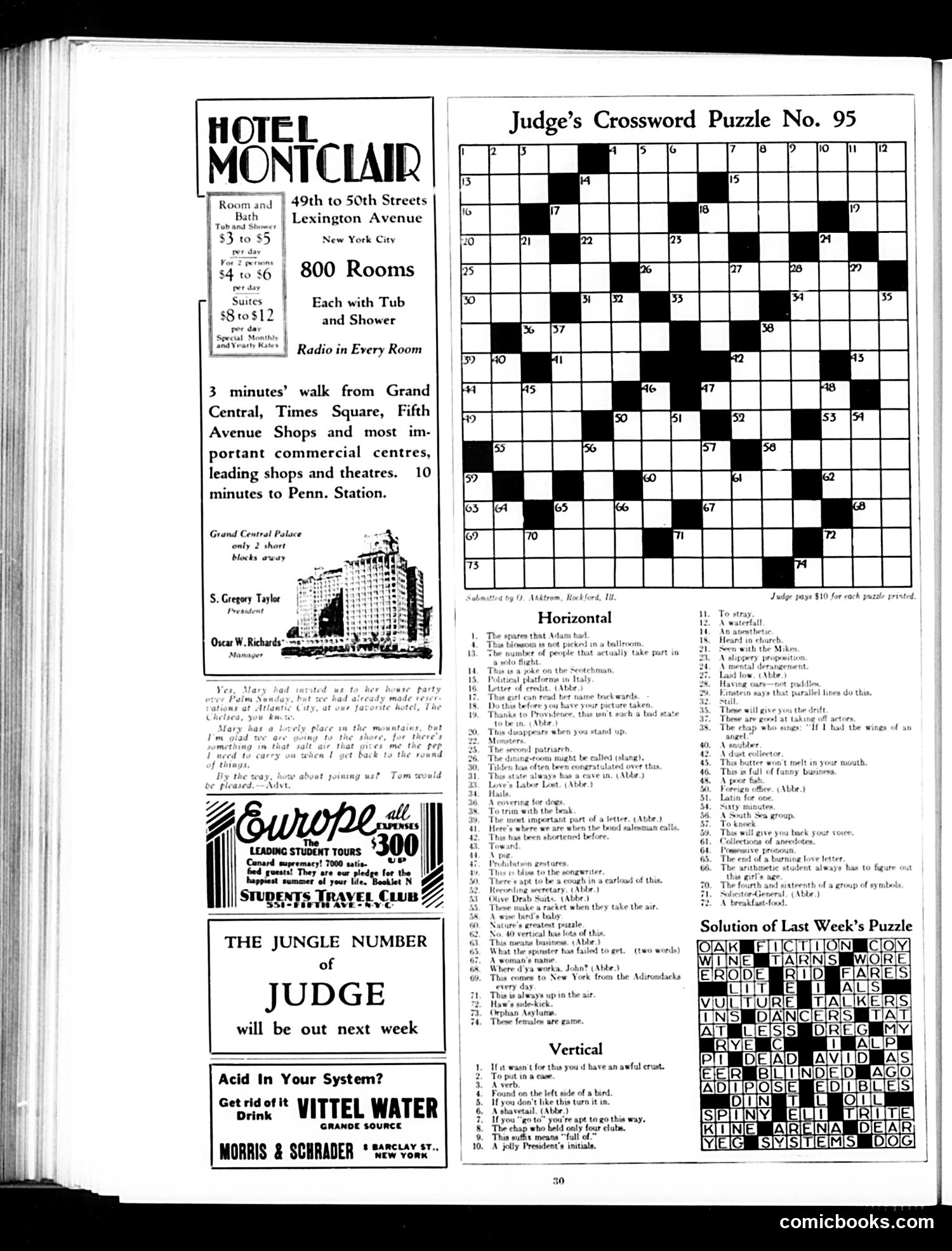
This page is primarily **advertising and crossword puzzle content**, not political satire. The main elements are: **Hotel Montclair Advertisement**: A mid-size NYC hotel (800 rooms) promoting moderate pricing ($8-$12/day) and convenient Midtown location near Grand Central and major shopping districts. The S. Gregory Taylor signature indicates ownership/management. **Crossword Puzzle No. 95**: Judge's standard puzzle feature with horizontal and vertical clues—entertainment content typical of 1920s-30s magazines. **Minor Advertisements**: Including Vittel Water (a digestive/health product) and a Student Tours travel promotion advertising European trips for $300—targeting the youth/student market. **Teaser**: "The Jungle Number of Judge will be out next week" promotes an upcoming themed issue, likely referencing Upton Sinclair's *The Jungle* or general "jungle" adventure content. **Context for Modern Readers**: This represents typical magazine mixed content—advertising revenue funded editorial material. The hotel ad's emphasis on "radio in every room" highlights how novel that amenity was then.
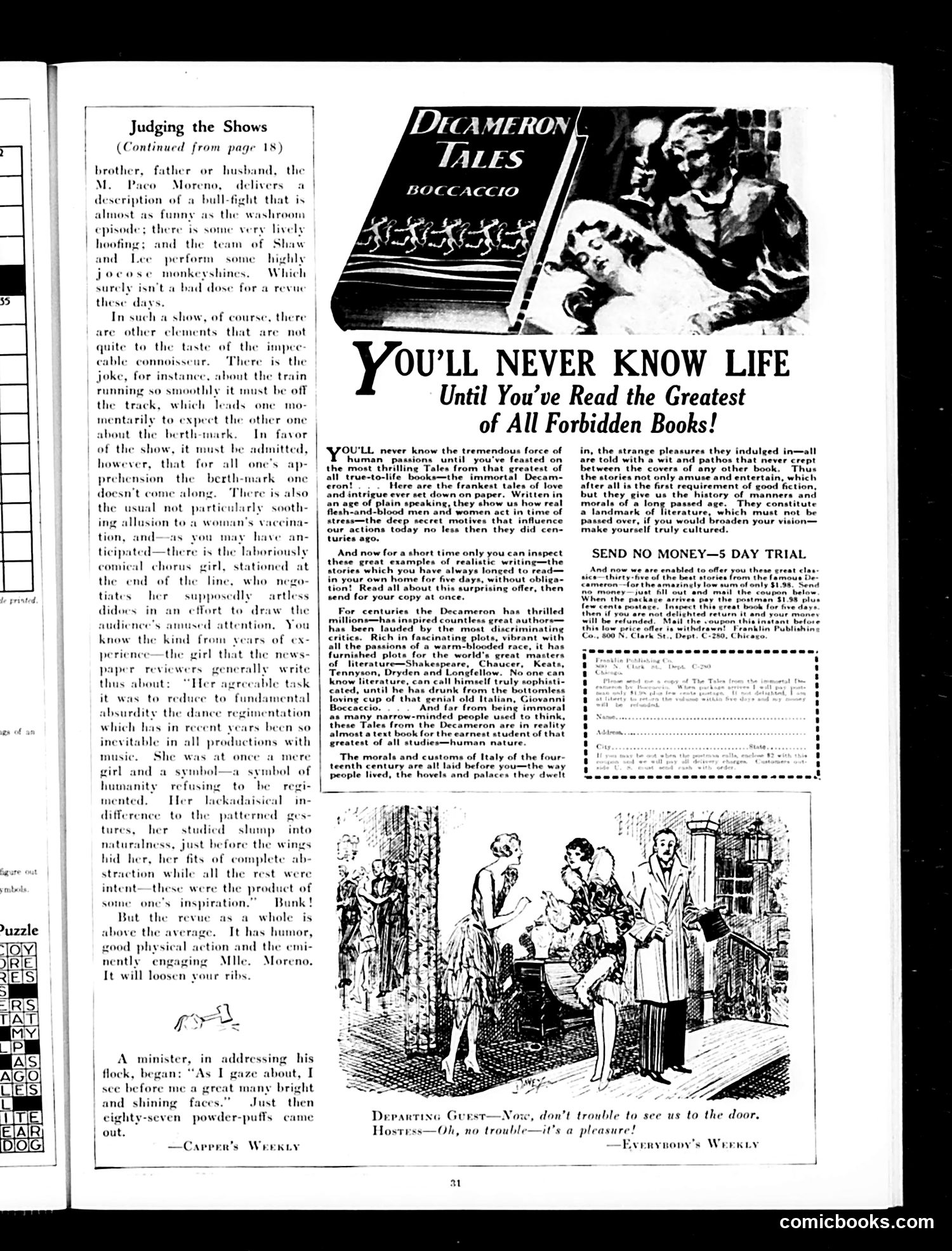
This page mixes theater criticism with advertising. The left column reviews a theatrical revue featuring performer M. Paco Moreno and a dance team (Shaw and Lee), praising its humor and physical comedy while critiquing the obligatory "comical chorus girl" as a tired theatrical convention. The dominant content is a full-page advertisement for *Decameron Tales* by Boccaccio, marketed as "forbidden books" that reveal life's true passions. The ad employs sensationalist language—promising readers will "never know life" without reading such works—and uses euphemistic appeals to sophistication ("cultured," "discriminating critics") to market what appears to be an unexpurgated literary edition to early 20th-century readers. The bottom illustration shows a drawing-room scene, likely from the advertised book, with the caption playing on social propriety and hospitality conventions. This reflects period debates over literary censorship and moral standards regarding explicit content in classic literature.
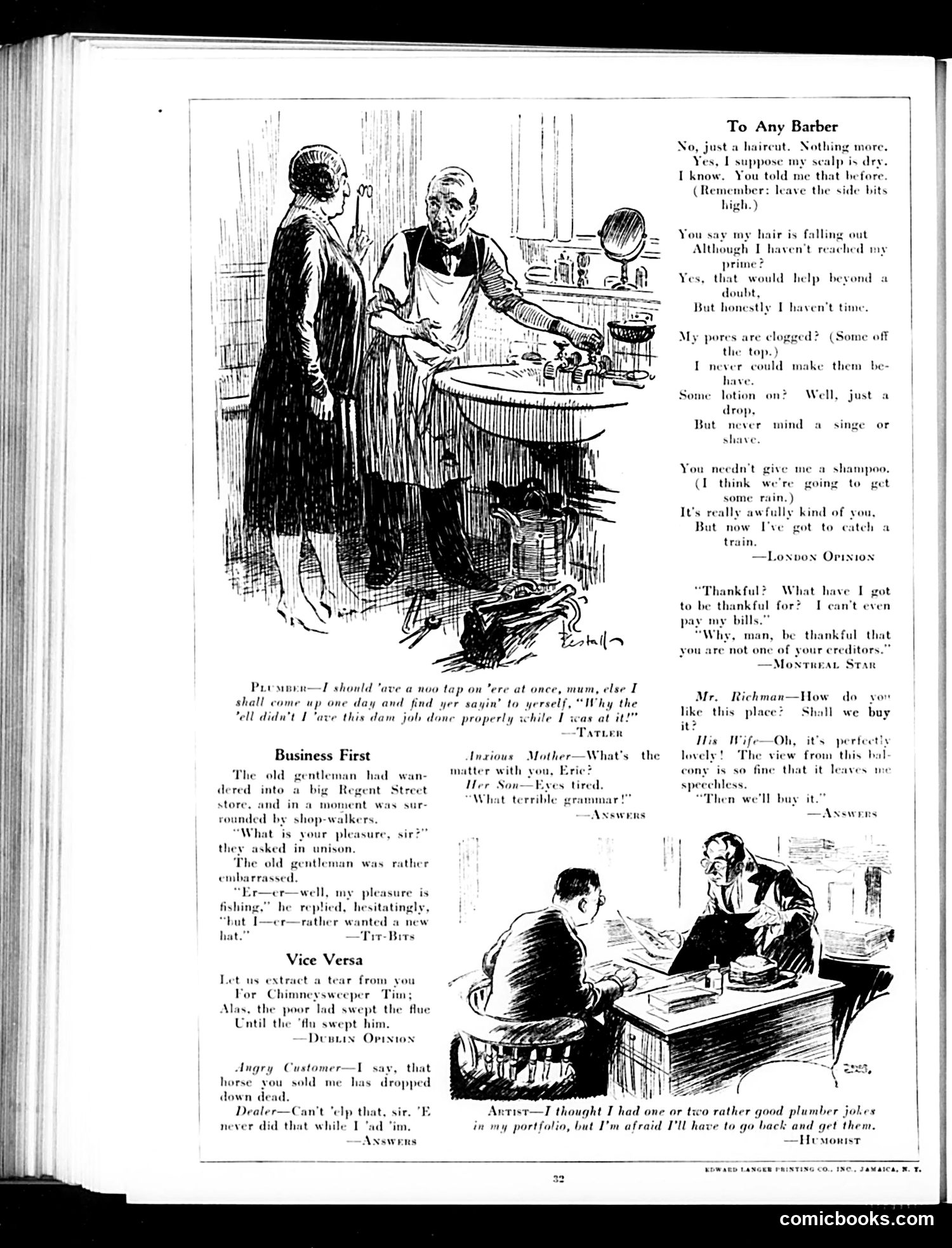
This page from the satirical magazine *Judge* contains multiple brief humorous sketches satirizing everyday British and American life, circa early 20th century. **"To Any Barber"** mocks the barber's tendency to upsell unnecessary services (shampoos, lotions, scalp treatments) to a reluctant customer who just wants a quick haircut before catching his train. **"Business First"** satirizes department store politeness: an elderly gentleman, surrounded by overeager shop-walkers, admits his real pleasure is fishing—but he came for a hat. The joke targets the absurd formality of retail service. **"Vice Versa"** darkly jokes about a chimney sweep who was literally swept up the flue by the draft he created. **Other sketches** include complaints about defective goods, grammar lectures, and affluent couples buying expensive property based solely on aesthetics rather than value. The page's humor relies on class observations, commercial absurdity, and British working-class dialect, reflecting *Judge*'s satirical approach to modern urban consumer culture.
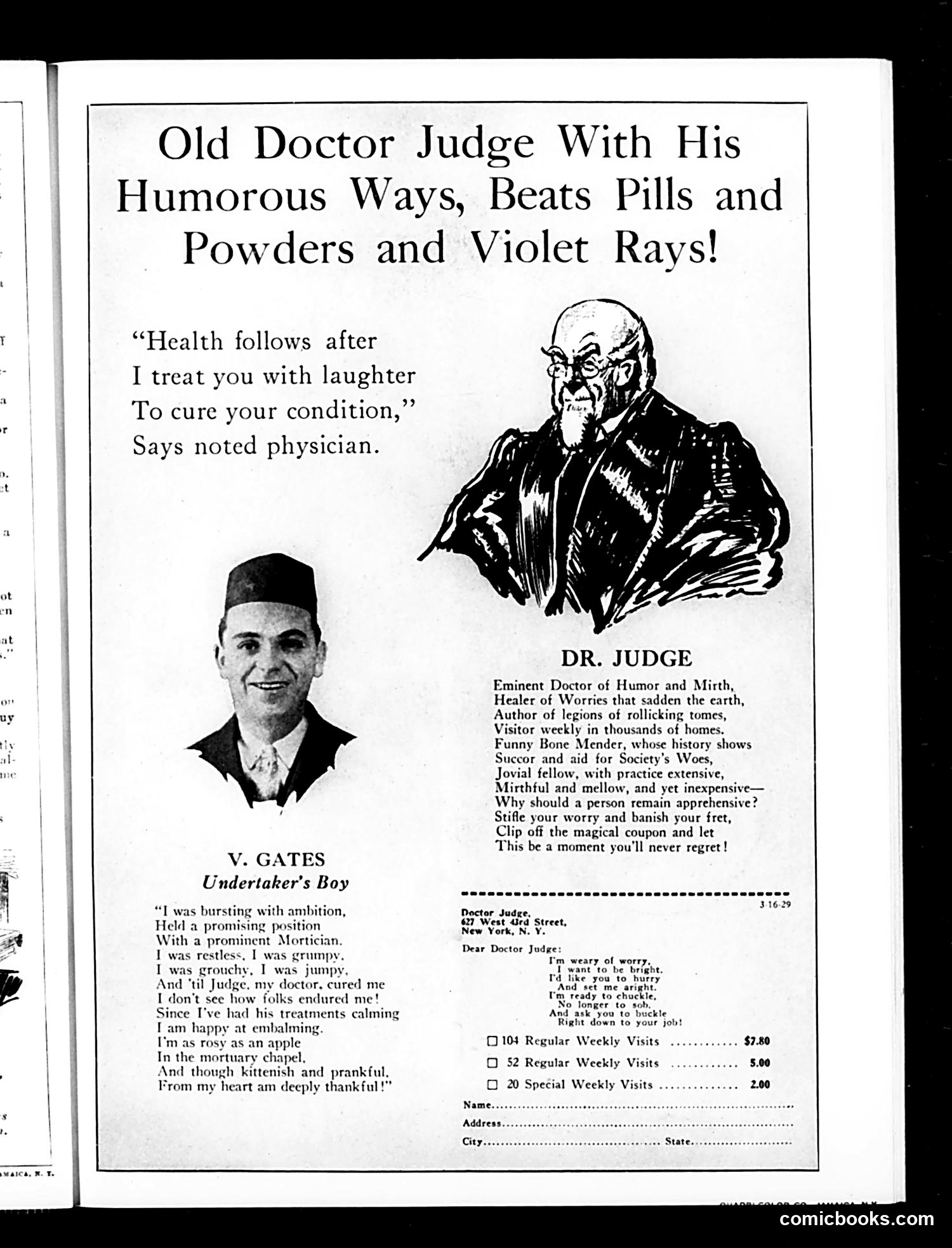
This is a satirical advertisement for "Doctor Judge"—a personification of *Judge* magazine itself—presented as a humorous physician offering laughter as medicine. The satire mocks both contemporary medical fads (violet rays, pills, powders) and the magazine's own self-promotion. **The figures:** "Dr. Judge" is the magazine anthropomorphized; "V. Gates, Undertaker's Boy" is a fictional testimonial from someone whose depression was cured by the magazine's humor. **The joke:** An undertaker's assistant—someone surrounded by death—becomes cheerful through reading *Judge*. This darkly comic pairing suggests the magazine's humor is so powerful it can uplift even those in the grimmest profession. **The satire:** By advertising "laughter as cure" while mimicking medical advertising (with pricing tiers for "visits"), the page gently mocks both dubious medical treatments of the era and magazine advertising itself. The coupon reinforces this—readers can literally "purchase" happiness through subscription.
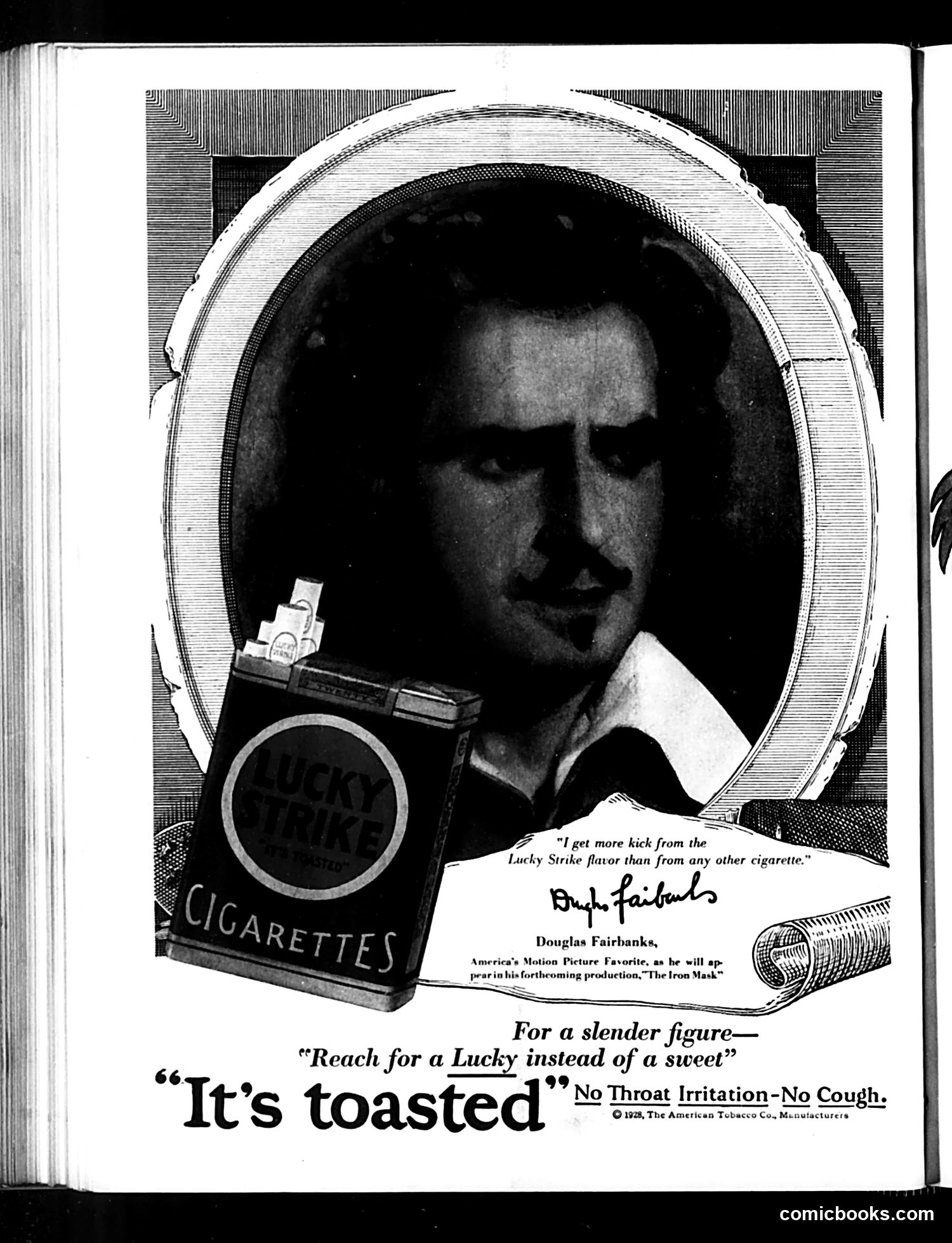
This is a **Lucky Strike cigarette advertisement**, not political satire. It features Douglas Fairbanks, a major silent-film star of the 1920s, endorsing the brand. The ad includes his signature and promotes his upcoming film "The Iron Mask." The marketing strategy targets weight-conscious consumers (particularly women) with the slogan "Reach for a Lucky instead of a sweet"—positioning cigarettes as an appetite suppressant and figure-control aid. It claims "No Throat Irritation—No Cough," a common health claim in tobacco advertising before such claims were banned. This reflects 1920s advertising conventions: celebrity endorsements, health claims, and targeting concerns about body image. The copyright date (1928) appears in the bottom text.