
A complete issue · 36 pages · 1929
Judge — February 2, 1929
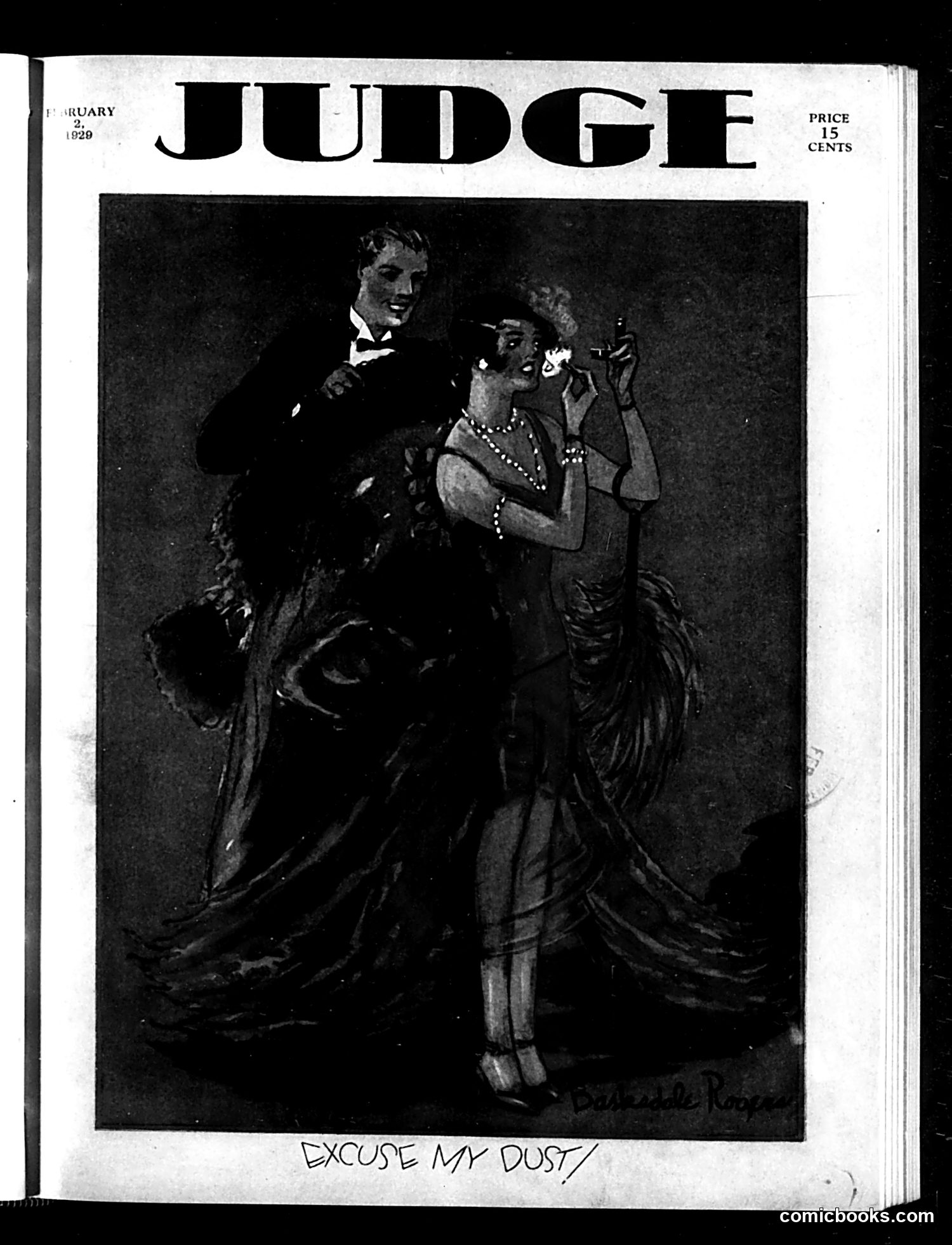
This appears to be a satirical illustration from Judge's February 1920 issue depicting a social scene with the caption "Excuse My Dust!" The image shows a well-dressed man in formal attire alongside a woman wearing pearl necklaces and fashionable 1920s dress, with what appears to be a third figure in the background. The "dust" reference likely alludes to either: 1. The rapid, chaotic social changes of the Jazz Age/early 1920s 2. Automobile culture (dust from cars was common then) 3. General social disruption or scandals Without additional context, the specific satirical target remains unclear—it could reference evolving gender roles, fashion scandals, or social upheaval characteristic of post-WWI American society. The formal juxtaposition with casual dismissal ("excuse my dust") suggests mockery of social pretension amid rapid cultural change.
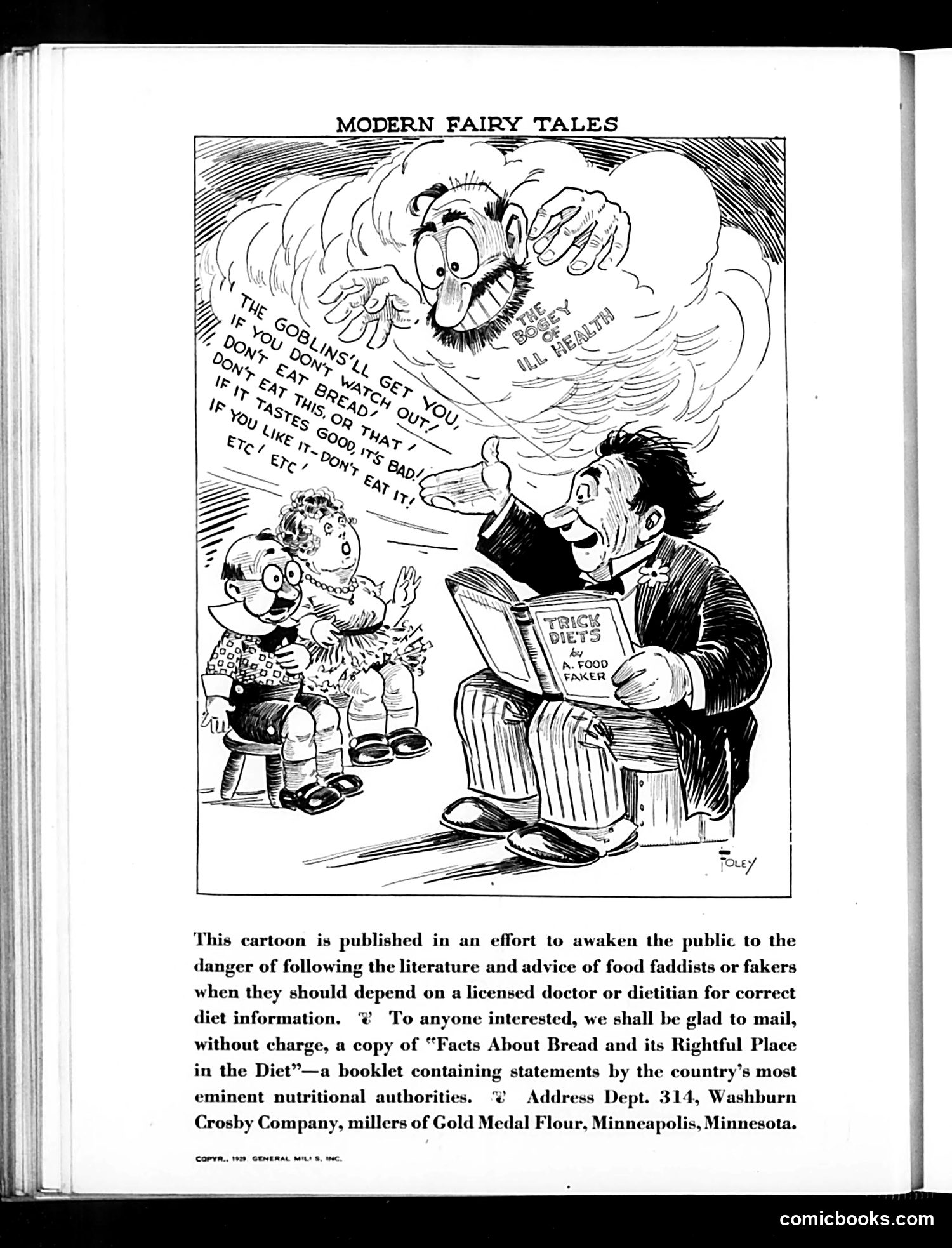
This 1920s-era Judge cartoon satirizes diet fads and nutritional misinformation. A goblin-like figure (representing a "food faker") spouts contradictory diet advice to a credulous parent and child—telling them to both eat and avoid bread depending on trends ("if you don't eat it, it's bad! If you like it—it's banned!"). The man on the right holds a book titled "Trick Diets by A. Food Faker," explicitly identifying the source of such nonsense. The accompanying text warns against following unqualified dietary advice, urging readers to consult licensed doctors instead. This was a public-health message by Washburn Crosby Company (later General Mills), promoting their flour as part of proper nutrition. The cartoon ridicules the proliferation of pseudoscientific diet claims that contradicted each other—a consumer protection message.
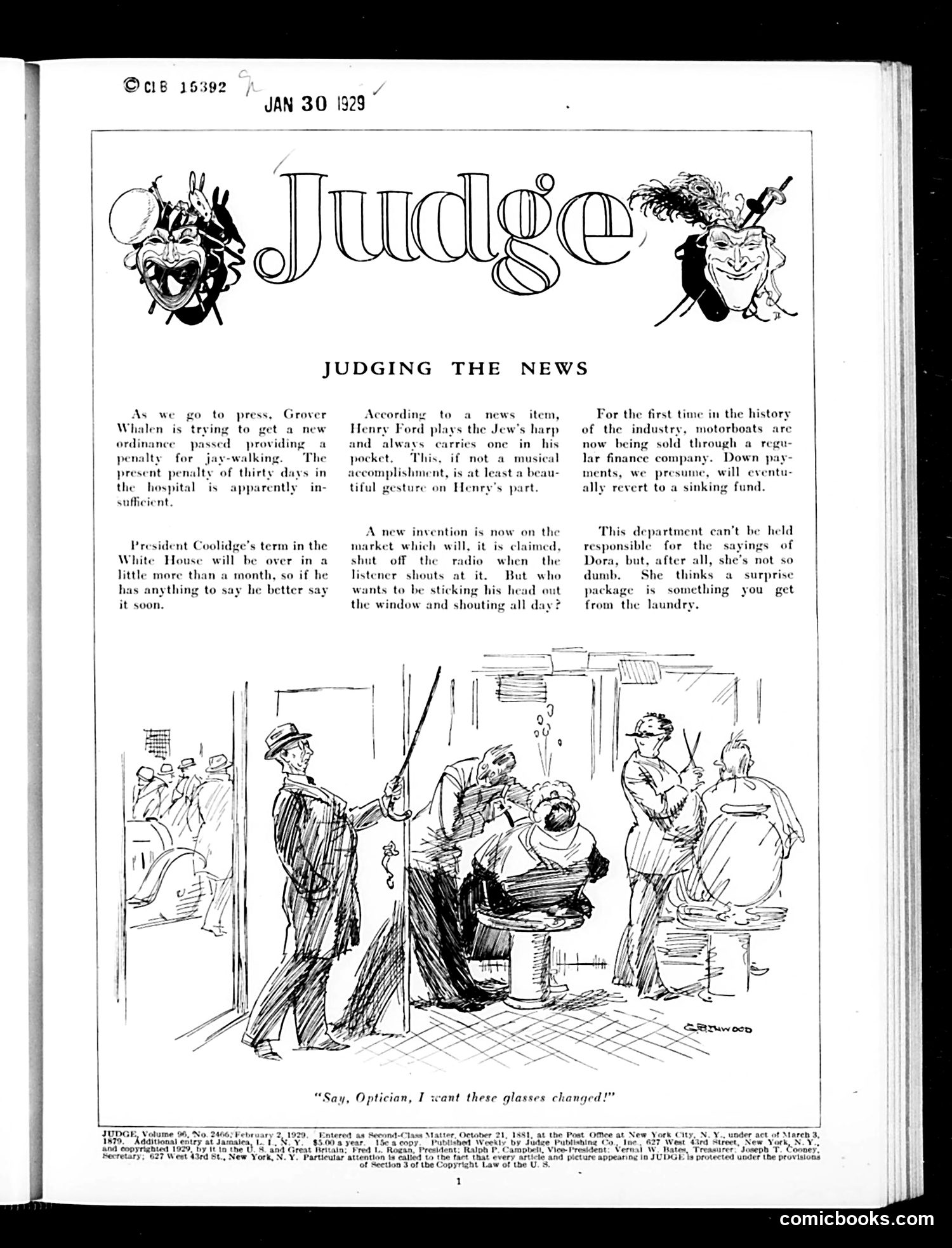
**Main Cartoon Caption:** "Say, Optician, I want these glasses changed!" **Context & Satire:** The cartoon depicts an optician's shop where a man demands his glasses be changed while wearing thick spectacles. The humor plays on the phrase "judging the news"—the page's title—suggesting people need corrective lenses to properly understand current events. The accompanying text satirizes contemporary news stories: Henry Ford's supposed habit of carrying a harp, a radio-shutoff invention, motorboats financed through regular companies, and a laundry mishap involving a woman named Dora. The cartoon's joke is that readers cannot properly "see" or understand the absurdity of these news items—they need their vision corrected, just as they need critical judgment corrected to evaluate the ridiculous stories being reported.
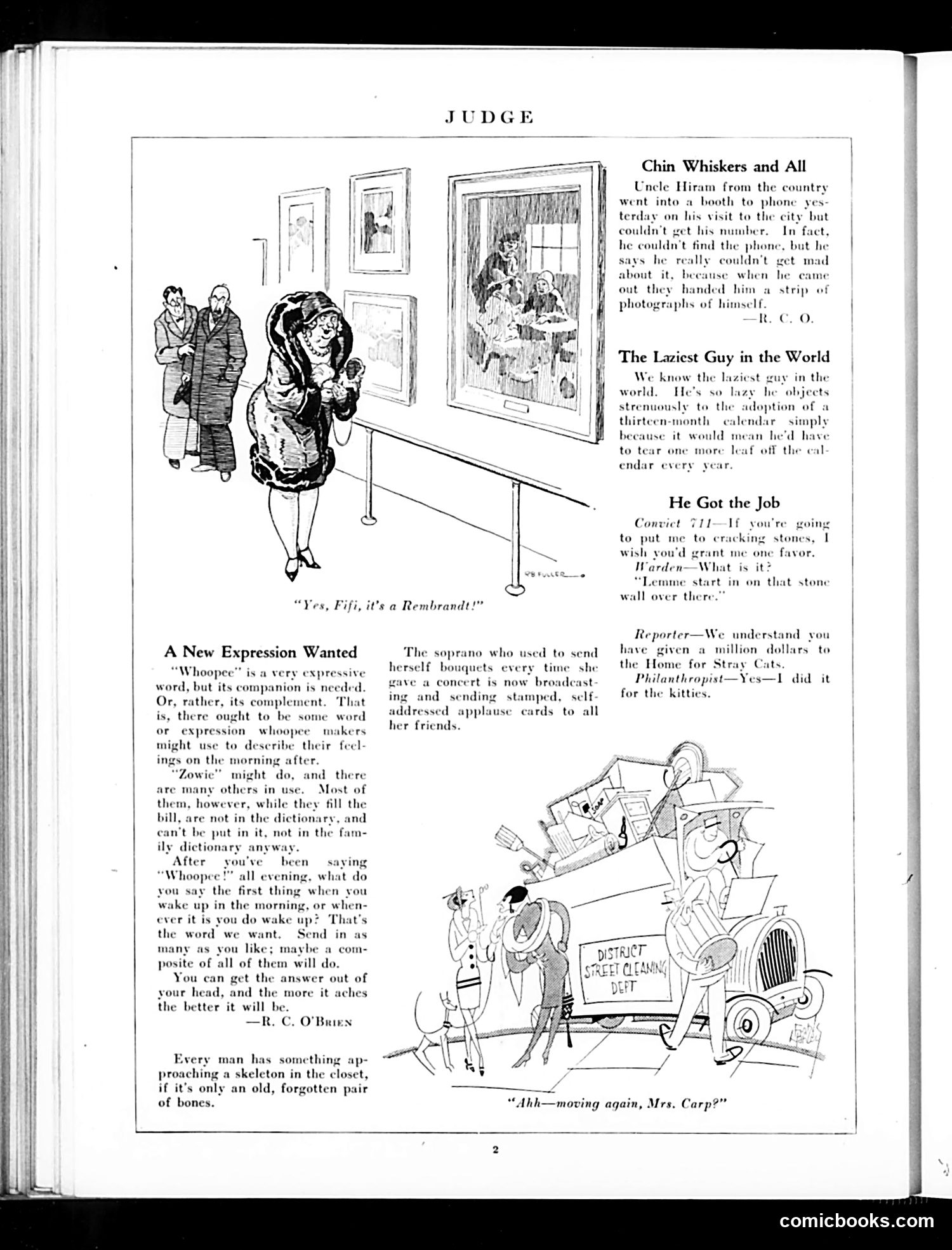
This page contains humor pieces rather than political cartoons. The main items are: 1. **"A New Expression Wanted"** - A linguistic humor piece proposing "Whoopee" as a new dictionary word to describe morning-after feelings. The author (R. C. O'Brien) argues existing words like "zowie" are insufficient and invites readers to submit alternatives. 2. **Three brief jokes**: About Uncle Hiram's difficulty using a telephone booth, "the laziest guy in the world" rejecting a calendar, and a convict asking a warden for a favor. 3. **"Ahh—moving again, Mrs. Carp?"** - A cartoon showing a District Street Cleaning Department truck arriving at a residence, humorously suggesting the woman and her belongings are being removed as "street cleaning." The humor is mostly observational and wordplay-based rather than political satire.
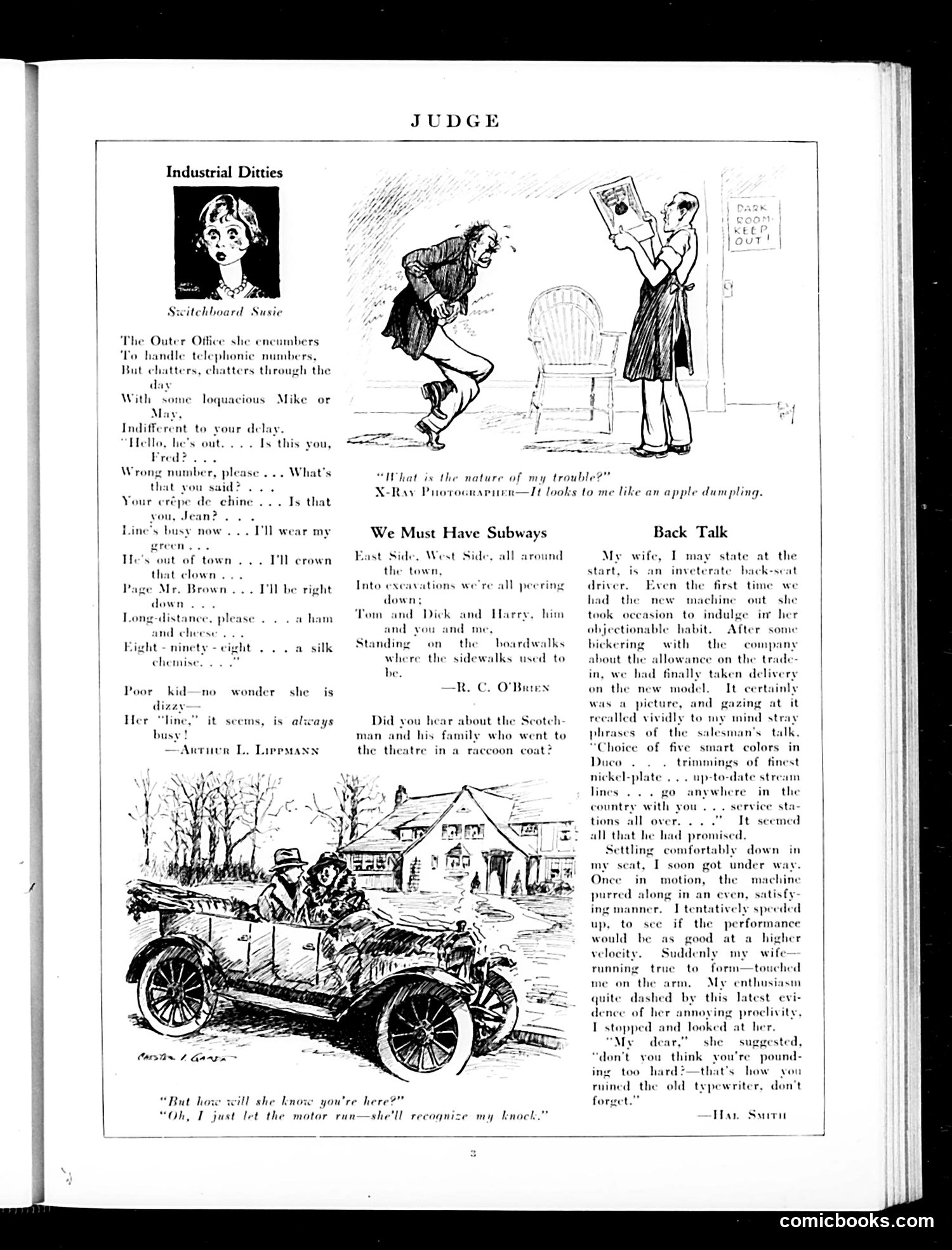
This page contains three distinct pieces of humor reflecting early 20th-century American life: **"Industrial Ditties"** satirizes office work through "Switchboard Susie," a telephone operator overwhelmed by constant calls and workplace chitchat—reflecting anxiety about new technology and women's expanding roles in business. **"We Must Have Subways"** appears to be light social commentary about urban infrastructure and excavation projects, likely referencing contemporary subway construction debates in major American cities. **"Back Talk"** humorously depicts marital tension, with a wife criticizing her husband's driving of their new automobile. The piece satirizes both automotive enthusiasm and domestic friction over this exciting but still novel technology. The vintage automobile illustration and dialogue capture early motorcar-era anxieties about speed, mechanical reliability, and changing gender dynamics in marriage.
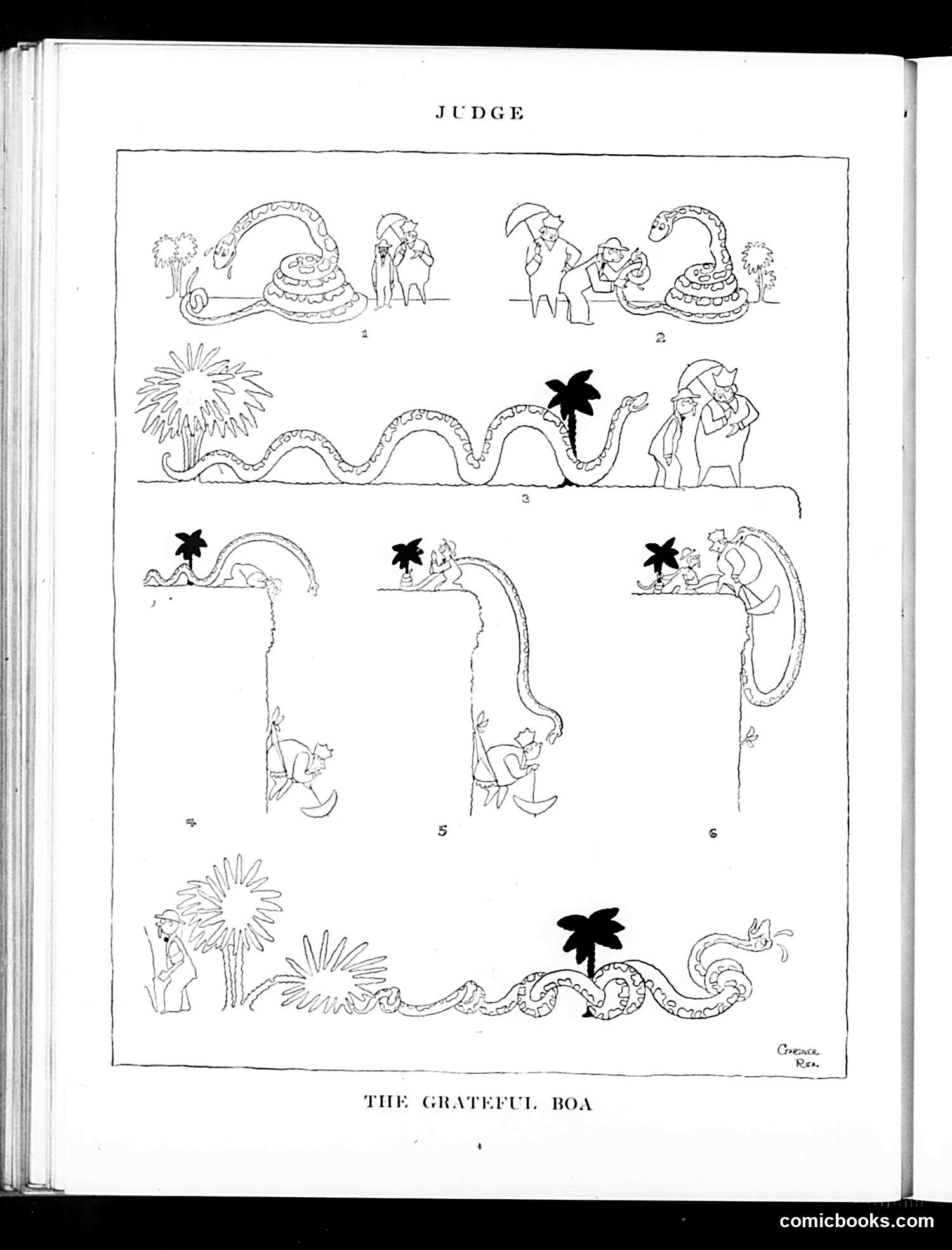
This six-panel satirical strip depicts a giant boa constrictor interacting with human figures and tropical elements (palm trees, sun). The title "The Grateful Boa" suggests ironic commentary—the snake is likely *not* grateful, and humans are presumably its victims or associates. The repeated scenarios show people positioned precariously around or above the serpent, some appearing to feed or tend it. Without additional context about the publication date or specific political figures, the exact target is unclear. However, the cartoon likely satirizes either: - A political figure or group depicted as dangerously deceptive ("grateful" only superficially) - Colonial or imperial exploitation presented as benevolent - A wealthy patron or institution whose apparent gratitude masks predatory behavior The black X marks may indicate deleted or highlighted elements, suggesting editorial revision or emphasis of key satirical points.
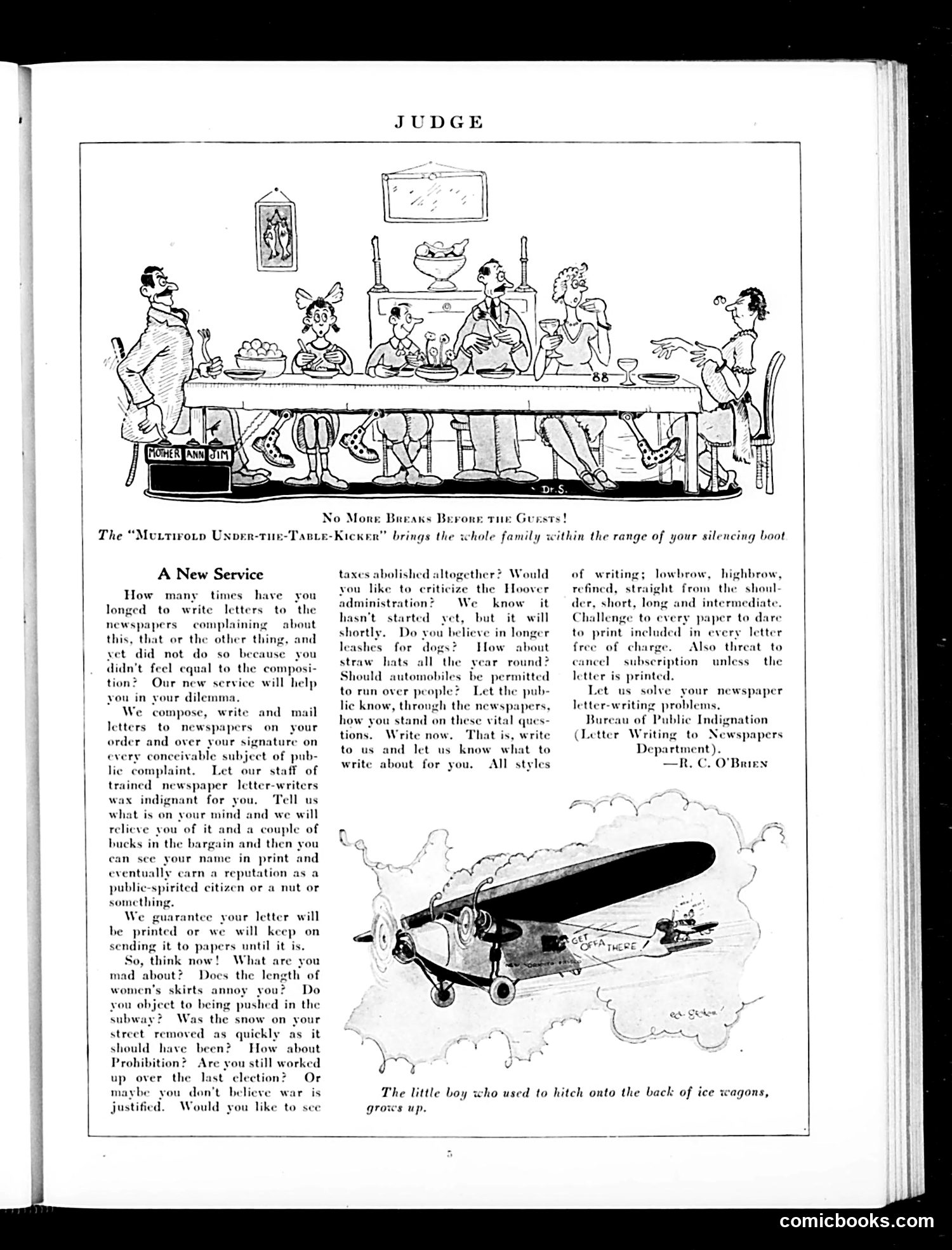
**Main Cartoon:** "No More Breaks Before the Guests!" depicts the "Multifold Under-the-Table-Kicker"—a device that silences children misbehaving during formal dinners. Adults sit at a dining table while the contraption under it activates when children kick or cause disruption. This satirizes early 20th-century anxieties about child behavior and etiquette during social gatherings. **Adjacent Content:** "A New Service" advertises a newspaper letter-writing bureau offering to compose complaint letters for readers on any topic—from taxes and Prohibition to automobile regulation. This mocks both Americans' complaints and the emerging consumer service industry. **Bottom Image:** An airplane illustration captioned "The little boy who used to hitch onto the back of ice wagons, grows up"—satirizing how children's street activities evolve with modern transportation technology.
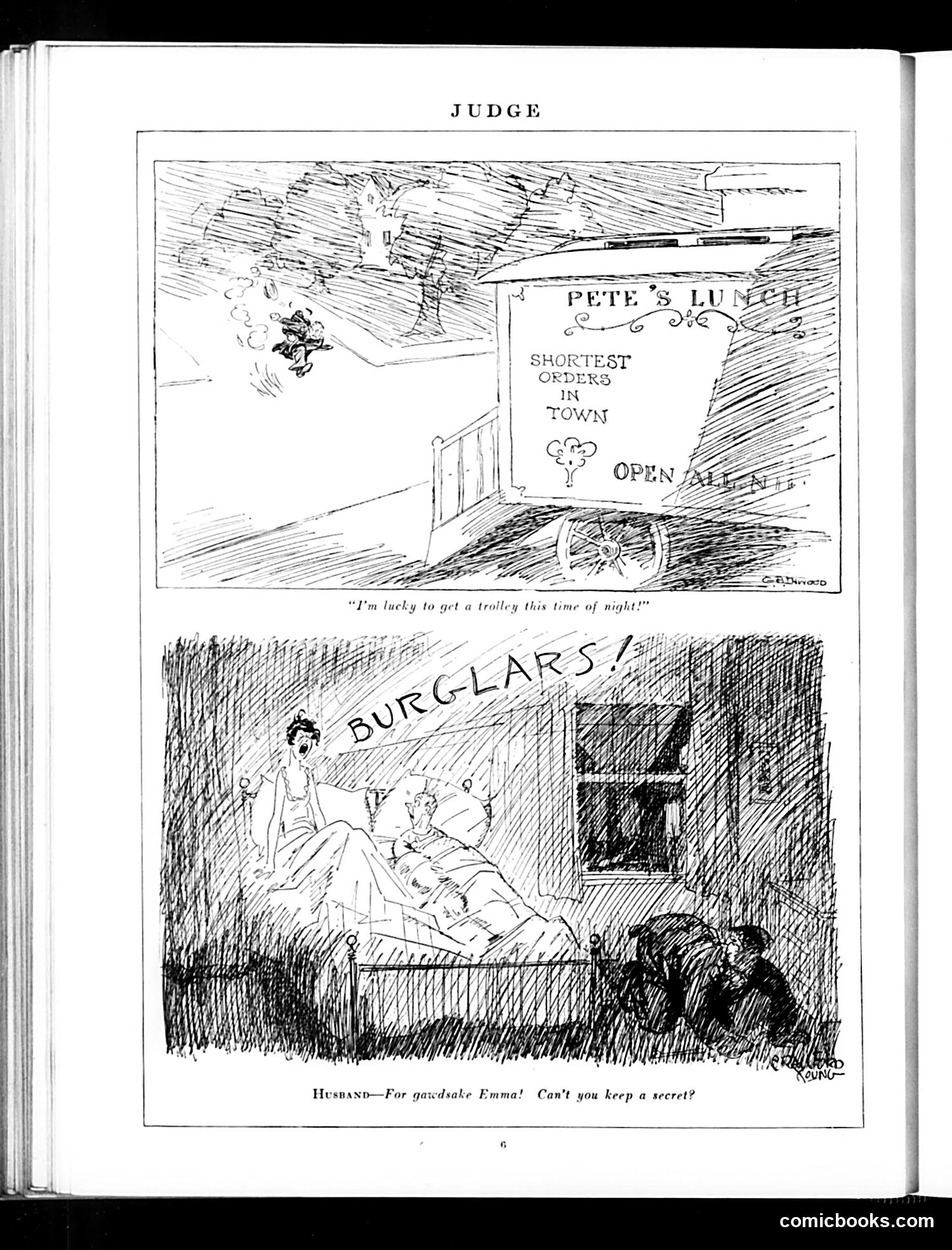
**Top Cartoon:** Shows a figure being chased from "Pete's Lunch" restaurant at night with a sign advertising "Shortest Orders in Town." The caption reads "I'm lucky to get a trolley this time of night!" — satirizing either poor restaurant service or the luck required to escape quickly. **Bottom Cartoon:** Titled "Burglars," depicts burglars breaking into a home while a couple sleeps in bed. The husband asks his wife: "For goodsake Emma! Can't you keep a secret?" — the joke being that the burglars heard about the burglary beforehand, suggesting the wife couldn't keep quiet about the planned theft or the couple's valuable possessions. Both cartoons employ domestic/everyday scenarios for comedic effect typical of Judge's satirical approach.
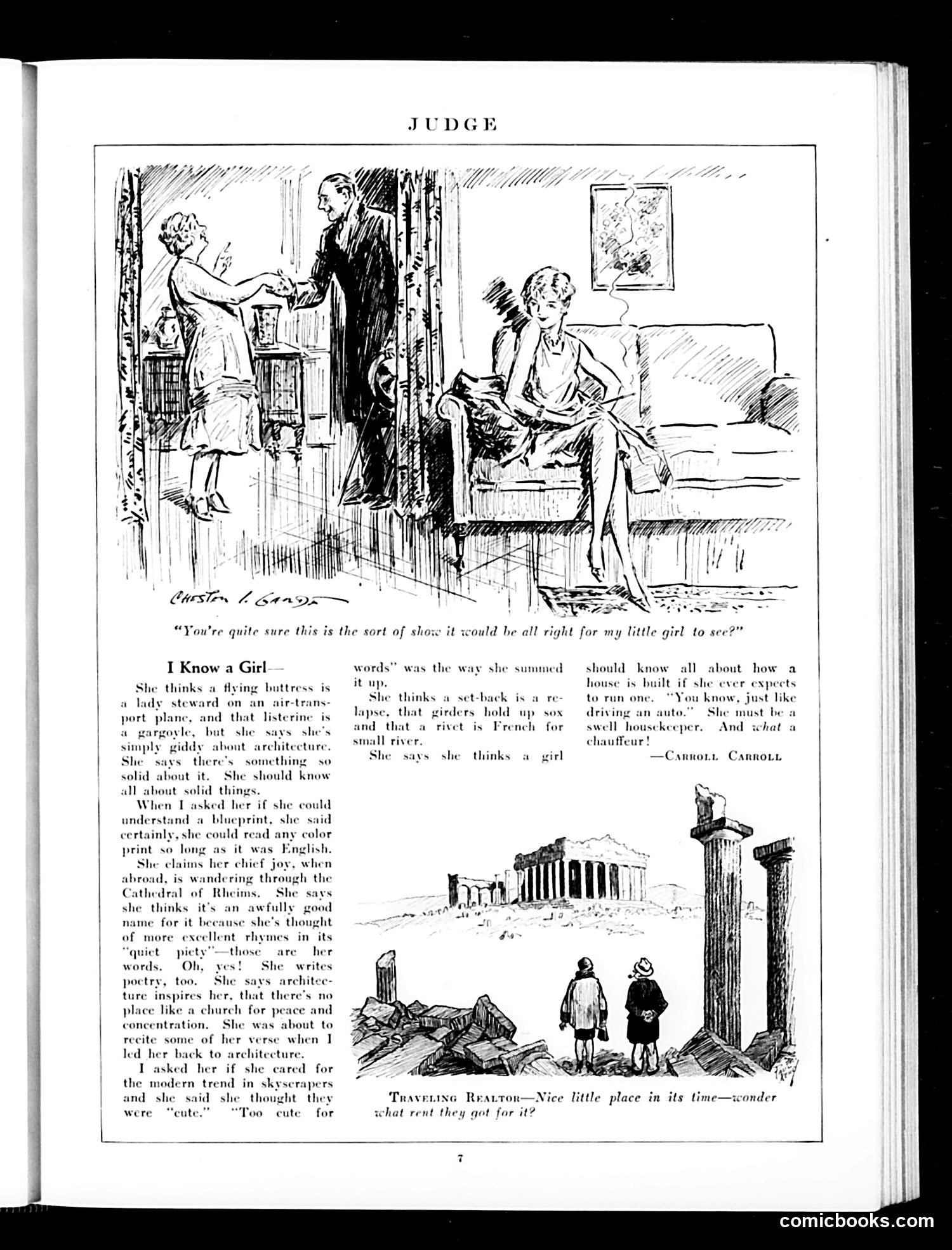
This page contains two satirical pieces mocking women's superficial understanding of architecture and culture. The main cartoon depicts a man asking another about taking his daughter to a show, with a woman lounging on a sofa in the background—likely referencing concerns about theatrical propriety. The accompanying essay "I Know a Girl" ridicules a woman who claims to appreciate architecture but misunderstands basic terms: she confuses "flying buttress" with an airline steward, thinks "set-backs" are relapses, and believes "girders hold up sox." She romanticizes European cathedrals and writes poetry but lacks genuine comprehension. The lower illustration shows ancient Greek ruins with tourists, captioned "Traveling Realtor—Nice little place in its time—wonder what rent they got for it?" The satire targets early-20th-century women who adopted cultured affectations—architectural and artistic appreciation—without genuine knowledge, treating serious subjects as fashionable accessories rather than serious study.
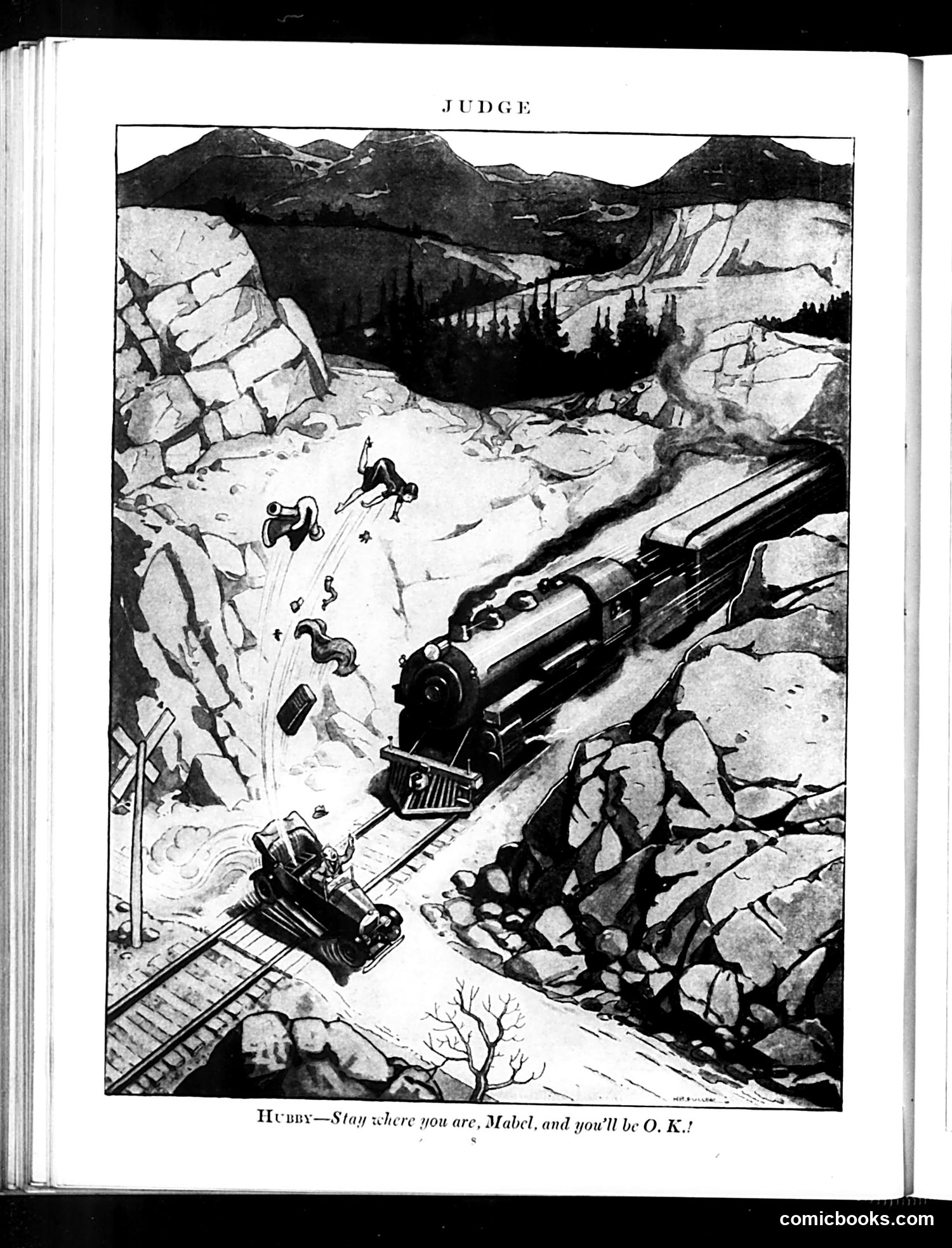
This illustration depicts a dramatic scene of a train traveling through a mountainous canyon, with several figures appearing to be in peril on the tracks below. The caption reads: "Hubby—Stay where you are, Mabel, and you'll be O.K.!" The satire appears to comment on domestic dynamics and marital trust. A husband reassures his wife (Mabel) to remain stationary despite apparent danger from an oncoming locomotive, suggesting either misplaced confidence or deliberate callousness. The cartoon likely satirizes either naive optimism about risk, or darker marital tensions—possibly mocking husbands who give questionable advice to wives, or commenting on marital anxiety and trust. Without additional context about Judge's publication date or contemporary events, the specific target of this satire remains unclear, though the domestic humor and potential danger suggest commentary on marriage and gender relations typical of early-to-mid 20th-century American satire.
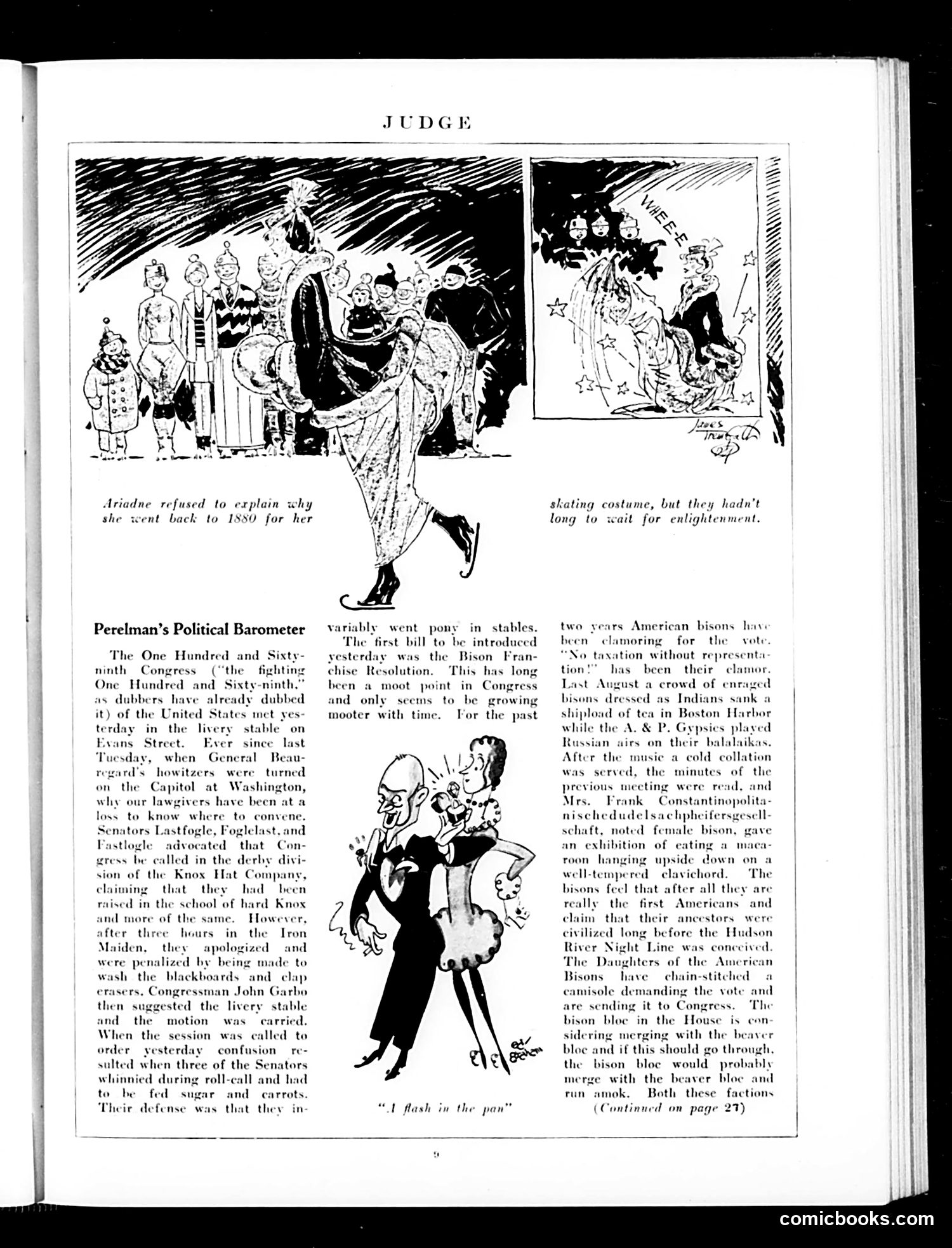
This column by S.J. Perelman mocks the 169th Congress through absurdist humor. The satire compares congressmen to animals—senators literally whinnying during roll-call and needing to be fed sugar and carrots—to suggest lawmakers are incompetent and bestial. The main target is the ongoing "Bison Franchise Resolution," a pointless debate that has dragged on for years. The joke escalates ridiculously: American bisons dress as Indians, dump tea in Boston Harbor (referencing the 1773 Tea Party), demand voting representation, and now threaten to merge their "bloc" with the beaver lobby to cause chaos. The cartoons above show theatrical absurdity—ice skaters and performers—reinforcing that Congress itself is merely entertainment, not serious governance. Perelman ridicules both Congress's ineffectiveness and the era's political squabbles as fundamentally ridiculous theater.
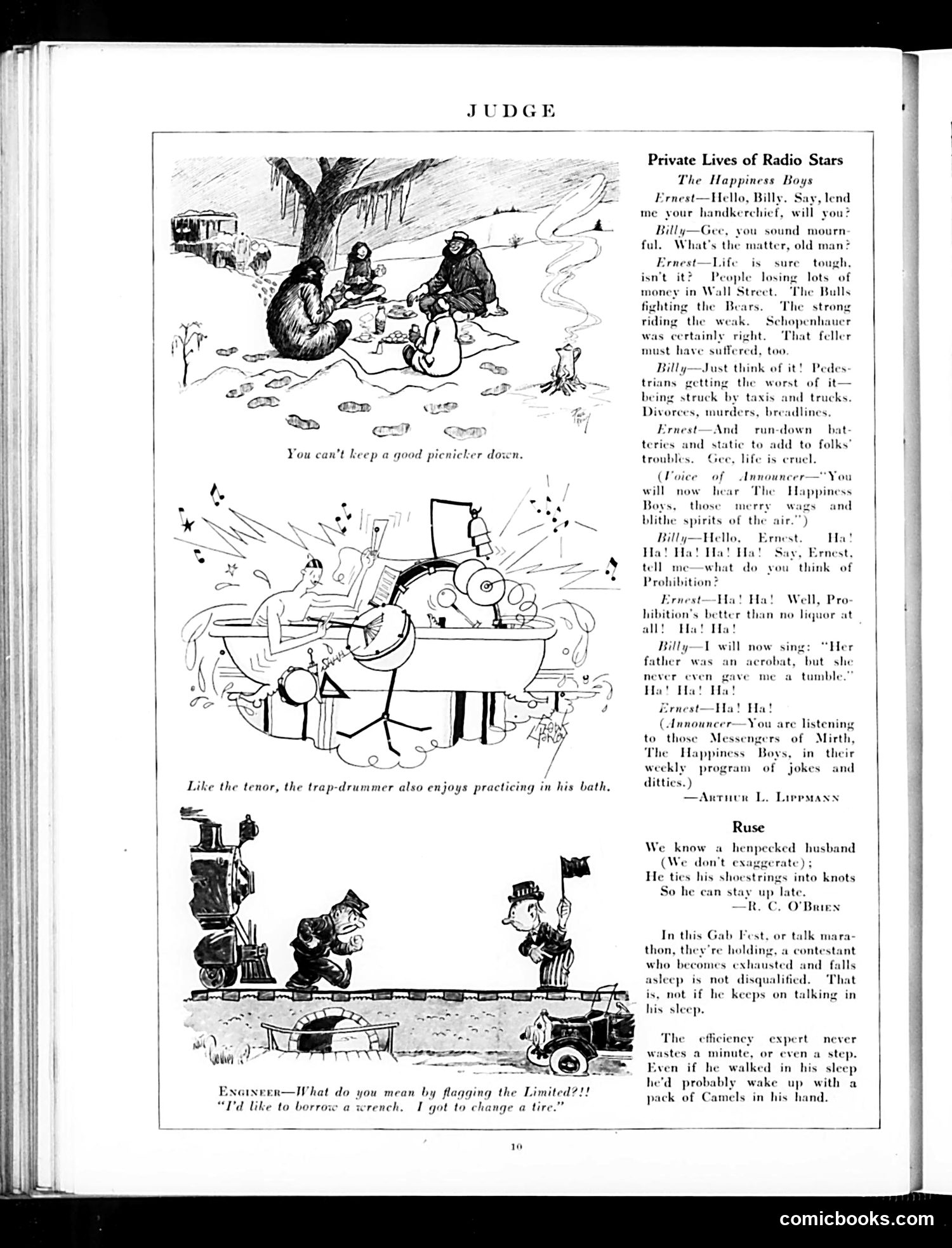
This page contains three satirical pieces about 1920s American life: **"Private Lives of Radio Stars: The Happiness Boys"** mocks a popular radio comedy duo by showing their supposedly cheerful banter contrasts sharply with their cynical, depressing monologues about life's troubles—divorces, accidents, poverty, and Prohibition. The satire exposes the gap between performers' public personas and private attitudes. **"Ruse"** is a brief joke about a henpecked husband deliberately tying his shoelaces in knots to stay awake—implying he wants to avoid going to bed with his domineering wife. **The cartoon at bottom** depicts an engineer flagged down by someone wanting to borrow a wrench to change a tire, humorously illustrating working-class ingenuity and the casual borrowing culture of the era. All pieces reflect Jazz Age concerns: commercialized entertainment, marital discord, and working-class life. The Happiness Boys piece particularly critiques radio's manufactured cheerfulness during economically uncertain times.
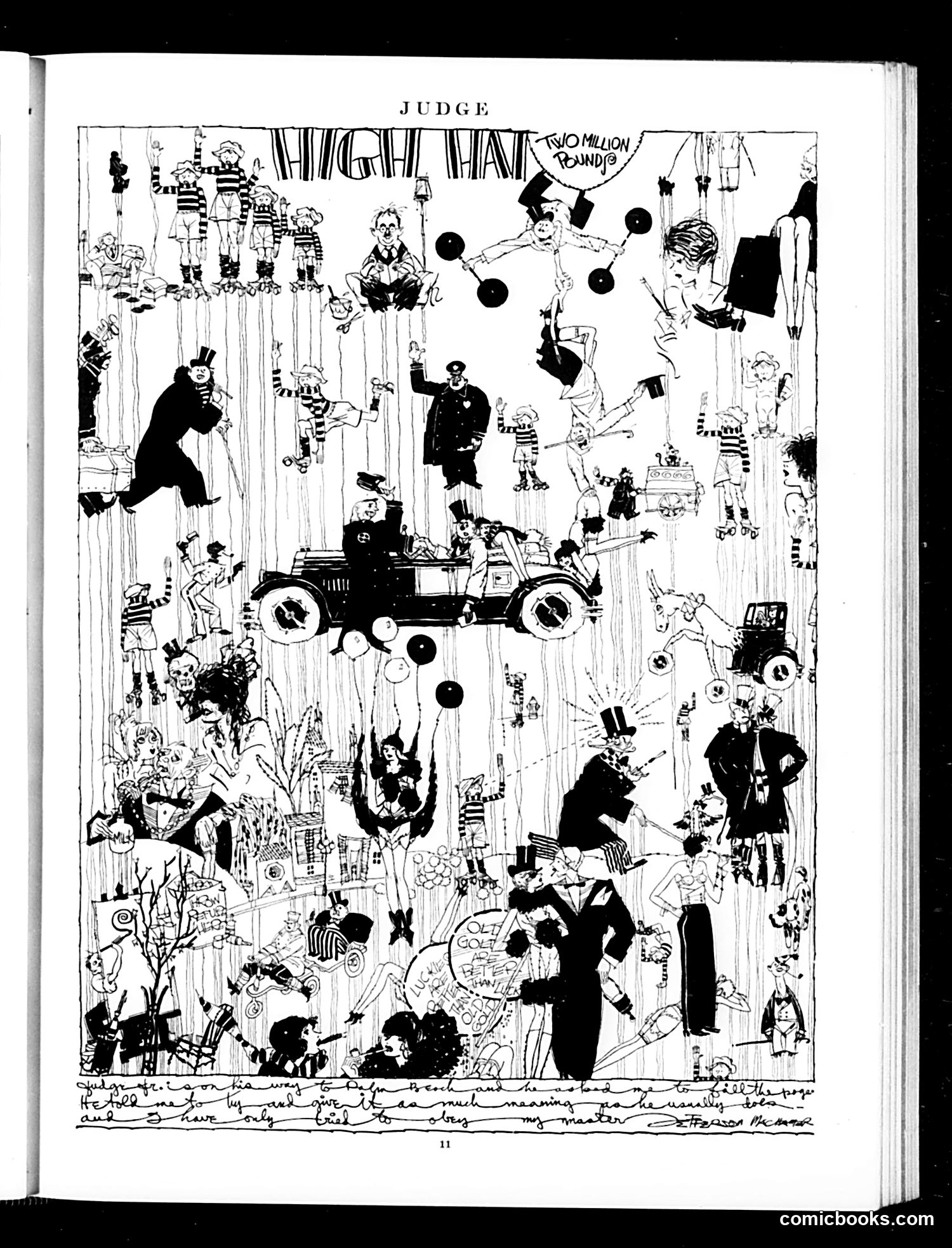
This is a complex satirical illustration titled "High Hand," depicting what appears to be a chaotic financial or political scene. The central image shows an automobile surrounded by numerous figures in various states of activity—some juggling, others operating machinery or conducting transactions. The cartoon likely satirizes either stock market speculation, corporate corruption, or financial manipulation during the early 20th century (Judge's peak era). The "two million" reference visible in a speech bubble suggests enormous sums of money at stake. The dense, frantic composition—with figures stacked vertically and performing acrobatic feats—emphasizes the chaotic, precarious nature of whatever scheme is being mocked. The handwritten text at the bottom appears to be artist's notes, though largely illegible in reproduction.
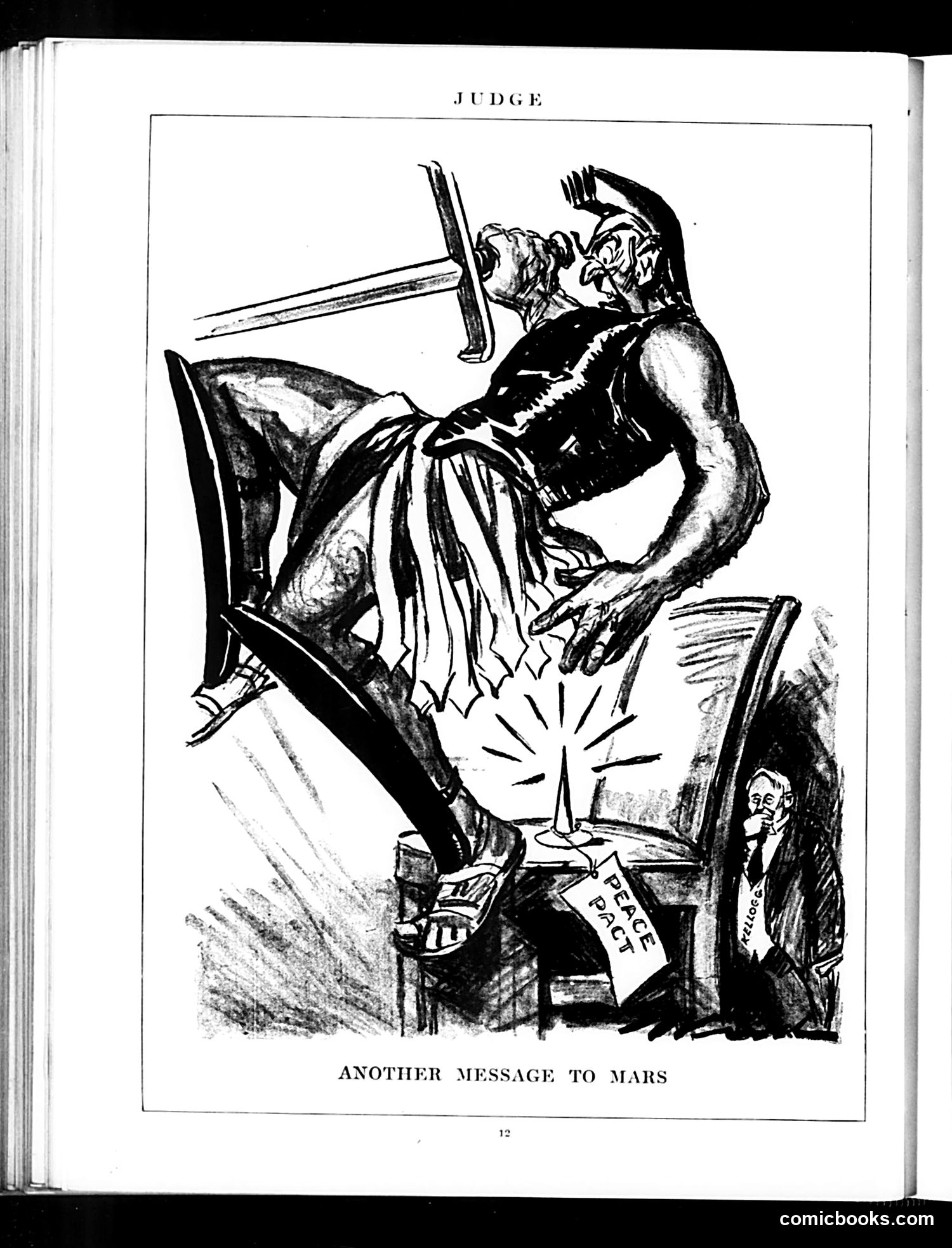
This Judge cartoon satirizes American militarism and imperial ambitions. A demonic or war-like figure sits in a judge's chair, wielding a sword and appearing to send a message outward. The figure labeled "PEACE" sits small and subordinate below, suggesting that peace takes a backseat to military aggression. The title "Another Message to Mars" likely references contemporary fascination with Mars and extraterrestrial contact, but uses it as metaphor: America is sending messages of warfare and violence to the world (or to hostile nations). The satire critiques how judges or authority figures—represented by the main figure—prioritize militarism over peaceful resolution. The exact historical moment is unclear without a date, but this reflects early-20th-century American debates about interventionism and military power.
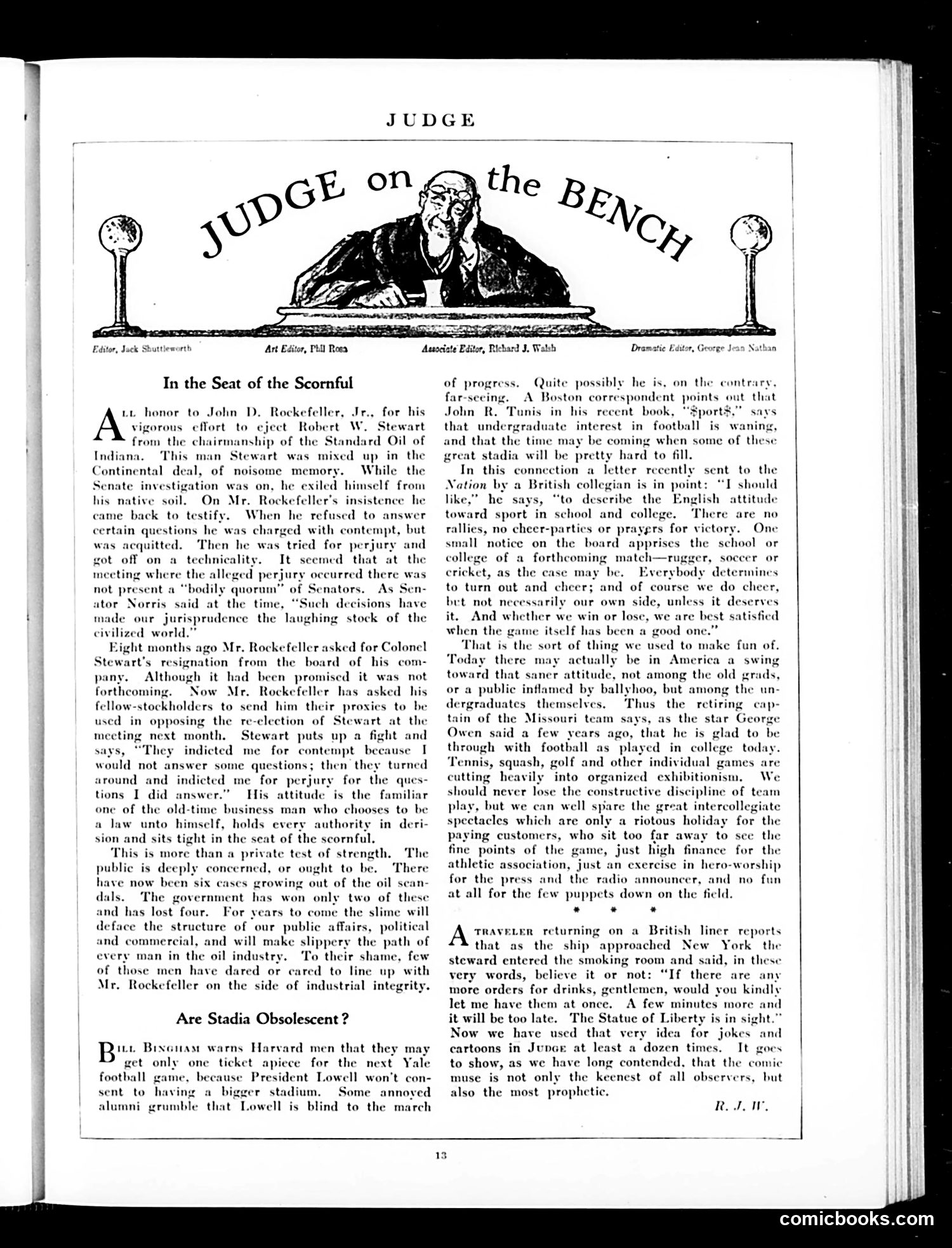
## Main Content: "In the Seat of the Scornful" This editorial attacks **Robert W. Stewart**, chairman of Standard Oil of Indiana, whom **John D. Rockefeller Jr.** is trying to remove. Stewart was implicated in the "Continental deal" oil scandal and evaded accountability through legal technicalities—contempt charges were dismissed on a procedural basis (lack of "bodily quorum"), and perjury charges failed similarly. The satire targets Stewart's defiant attitude: when indicted for contempt (refusing to answer questions), he then faced perjury charges (for answering other questions), creating an absurdist defense. The piece criticizes Stewart as an "old-time business man" who treats authority with contempt and sits "in the seat of the scornful." The broader point: while Rockefeller shows industrial integrity by opposing Stewart, few oil industry figures support him. The ongoing scandal continues damaging public confidence in both business and government. ## Secondary Item: "Are Stadia Obsolescent?" A brief note on Harvard/Yale football stadium capacity debates, suggesting declining undergraduate interest in organized sports may make massive stadiums unnecessary—a prescient observation on changing college culture.
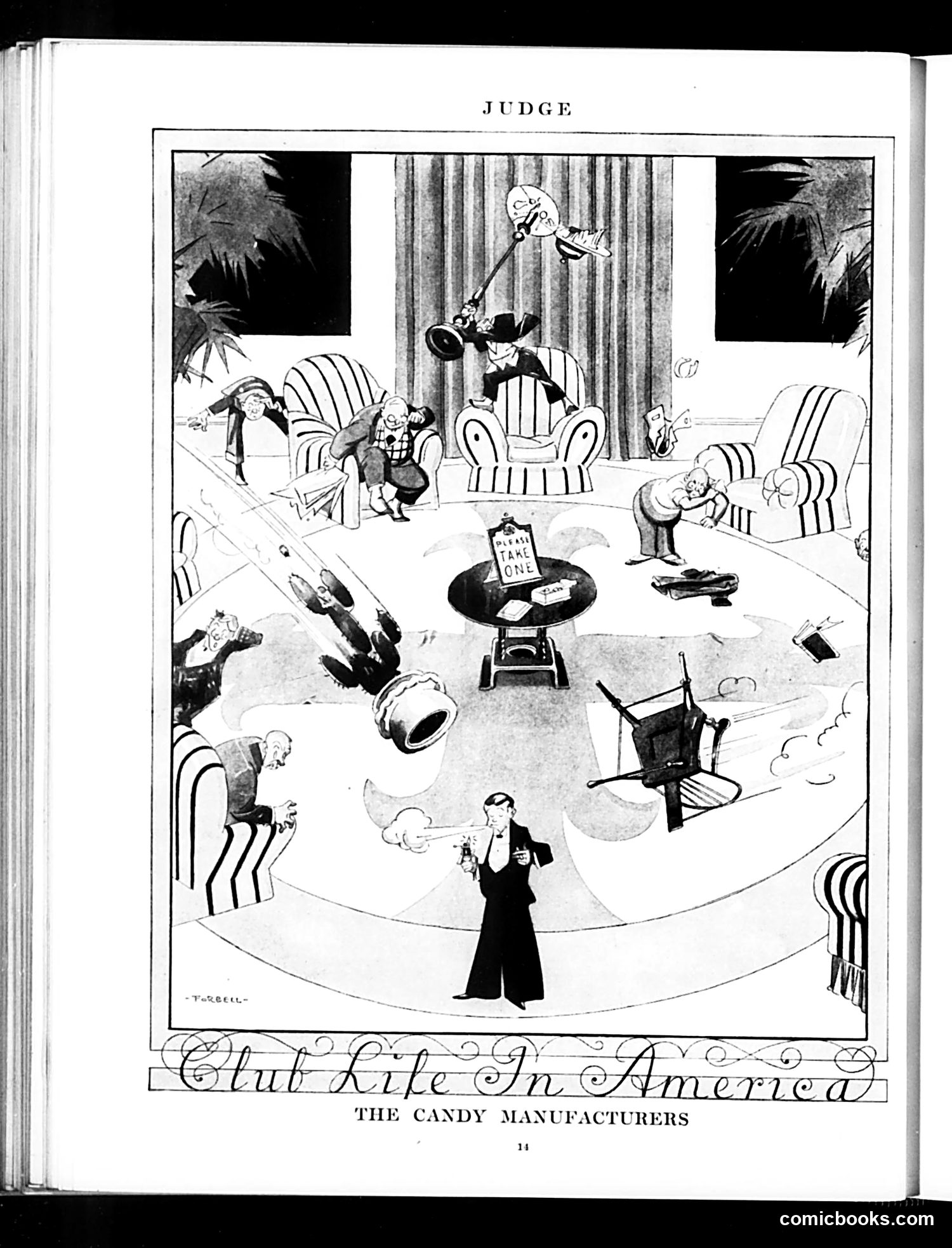
This satirical cartoon depicts a chaotic indoor scene labeled as a club for candy manufacturers. The central figure—a woman in dark formal attire standing prominently—appears to be presiding over or judging the scene. Around her, various figures engage in absurd activities: some operate mechanical devices, others interact with oversized candy or manufacturing equipment, and chaos generally prevails with scattered objects and exaggerated poses. The satire likely critiques either the candy manufacturing industry itself or a specific manufacturers' association/club of the era. The "Judge" framing suggests moral or social judgment of their practices or conduct. Without additional historical context, the specific critique—whether targeting labor practices, product quality, business ethics, or industry excess—remains unclear from the image alone.
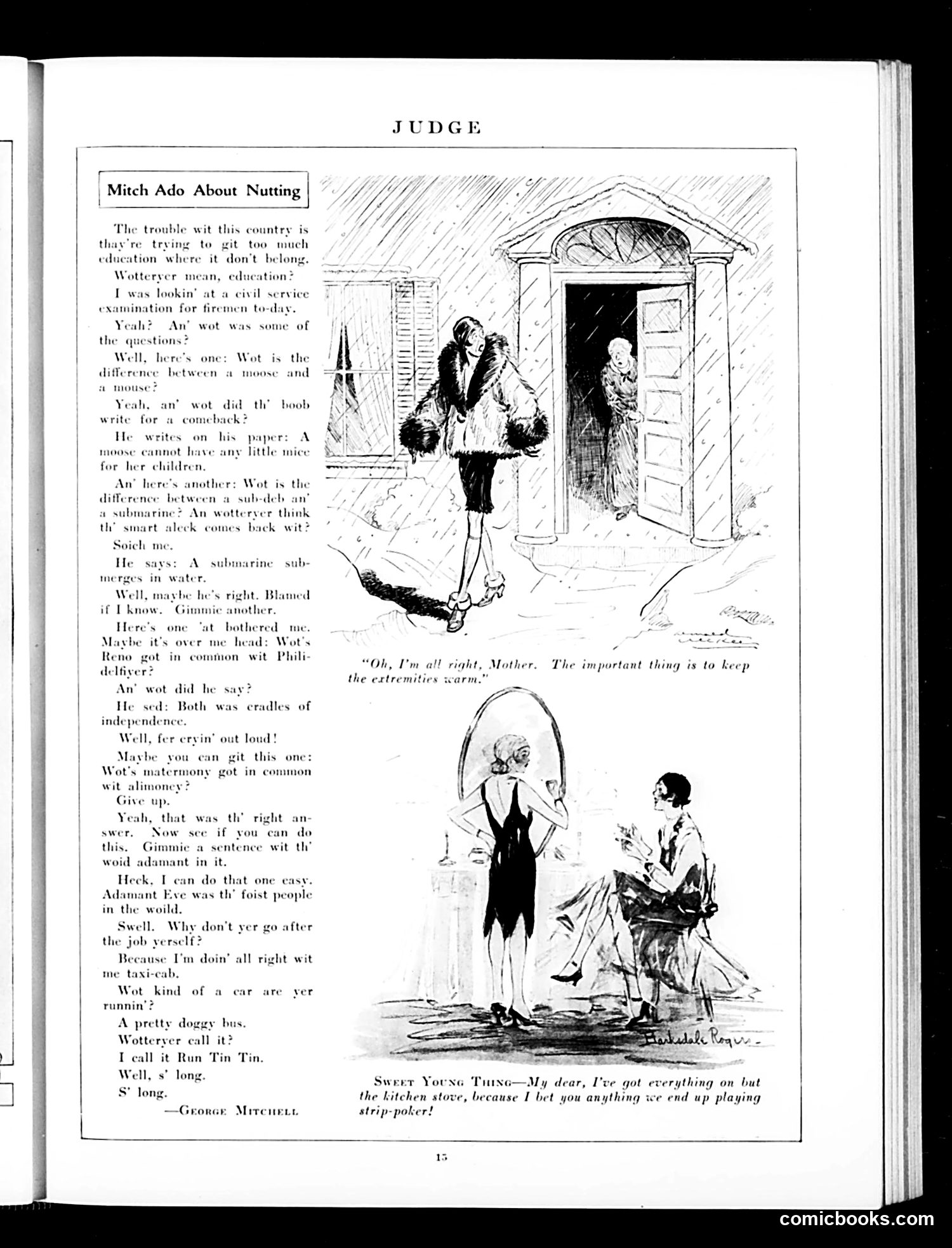
This page from *Judge* contains two satirical pieces: **"Mitch Ado About Nutting"** (left) mocks overqualification and civil service exams. A working-class character complains that education is being applied inappropriately—using a fireman's civil service exam as his example. The exam questions are absurdly difficult or poorly-answered by test-takers (e.g., "What's the difference between a moose and a mouse?" answered with "A moose cannot have little mice for her children"). The joke satirizes the gap between impractical academic testing and actual job competence. The speaker, happy driving a "Run Tin Tin" taxi-cab, questions why anyone would pursue such complicated exams. **Two cartoon panels** (right) show domestic scenes: a woman telling her mother she's keeping warm by the stove, and another warning about strip-poker at the kitchen stove. These appear to be separate humorous vignettes about domestic life and marital behavior. The overall satire critiques bureaucratic over-education and the gap between formal knowledge and practical reality.
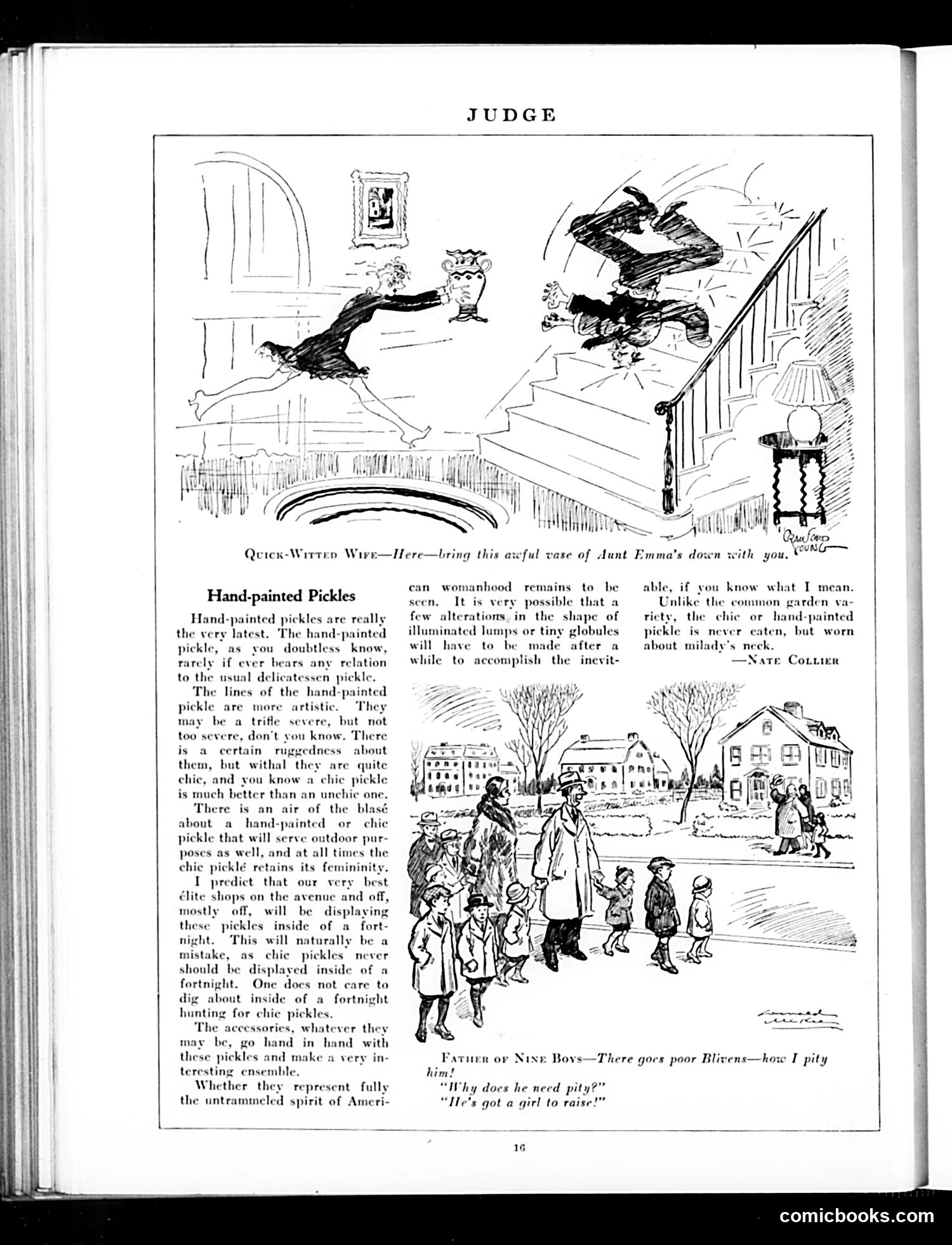
This page contains three separate satirical pieces: **"Hand-painted Pickles"** mocks high-fashion trends, sarcastically celebrating "hand-painted pickles" as the latest artistic accessory. The humor lies in treating an ordinary food item as if it were haute couture—describing pickles with aesthetic language ("chic," "artistic," "femininity") and suggesting they'll be displayed in elite shops and worn as jewelry around the neck. It satirizes how the wealthy adopt absurd fashion trends and how arbitrarily trendy items become status symbols. **"Quick-Witted Wife"** cartoon shows a woman tossing a vase downstairs, captioning it as her efficiently dealing with an unwanted gift from Aunt Emma—humor based on domestic comedy and the marital dynamic of managing difficult relatives through comedic destruction. **"Father of Nine Boys"** depicts a man pitying another ("poor Blivens") because "he's got a girl to raise"—inverting expectations by suggesting raising a daughter is worse than raising nine sons, reflecting period attitudes about gender and parenting challenges. All pieces use light satire typical of Judge's social comedy approach.
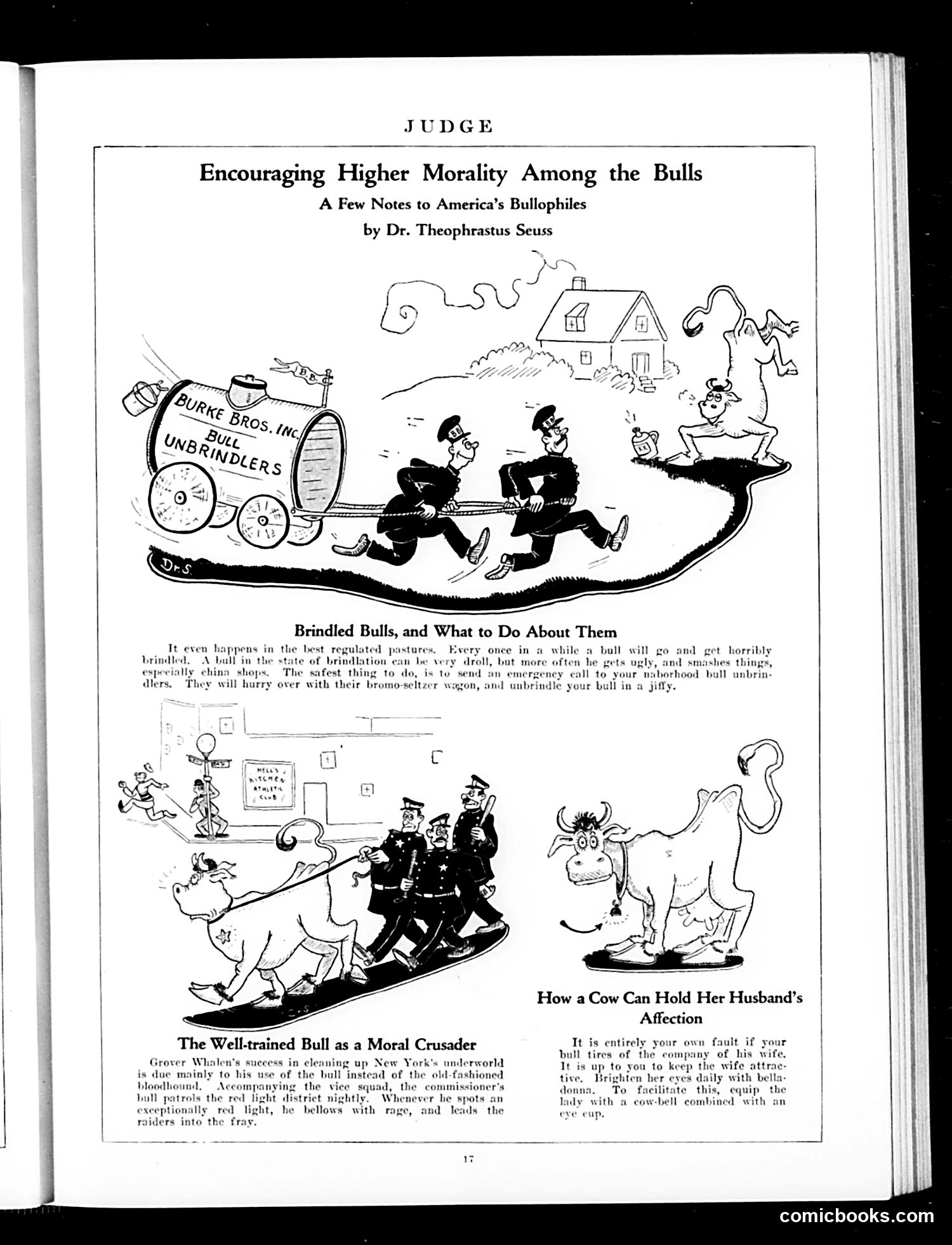
This page satirizes New York City's anti-crime efforts under Police Commissioner Grover Whalen (referenced in the text). The cartoons mock the use of bulls as crime-fighting tools—a ridiculous premise presented as serious civic policy. The top cartoon shows two men pulling a "Burke Bros. Inc. Unbrindlers" wagon, satirizing the absurdity of needing emergency services to manage unruly bulls. The bottom left, "The Well-trained Bull as a Moral Crusader," mocks Whalen's actual crime-fighting initiatives by suggesting bulls patrolling neighborhoods to apprehend criminals—an obvious joke. The right panel, "How a Cow Can Hold Her Husband's Affection," extends the joke into domestic advice, treating bovine relationships like human marriage problems. The author, "Dr. Theophrastus Seuss" (likely referencing the later-famous Dr. Seuss), uses animal humor to ridicule what the magazine considered Whalen's overly theatrical or ineffective crime-prevention methods.
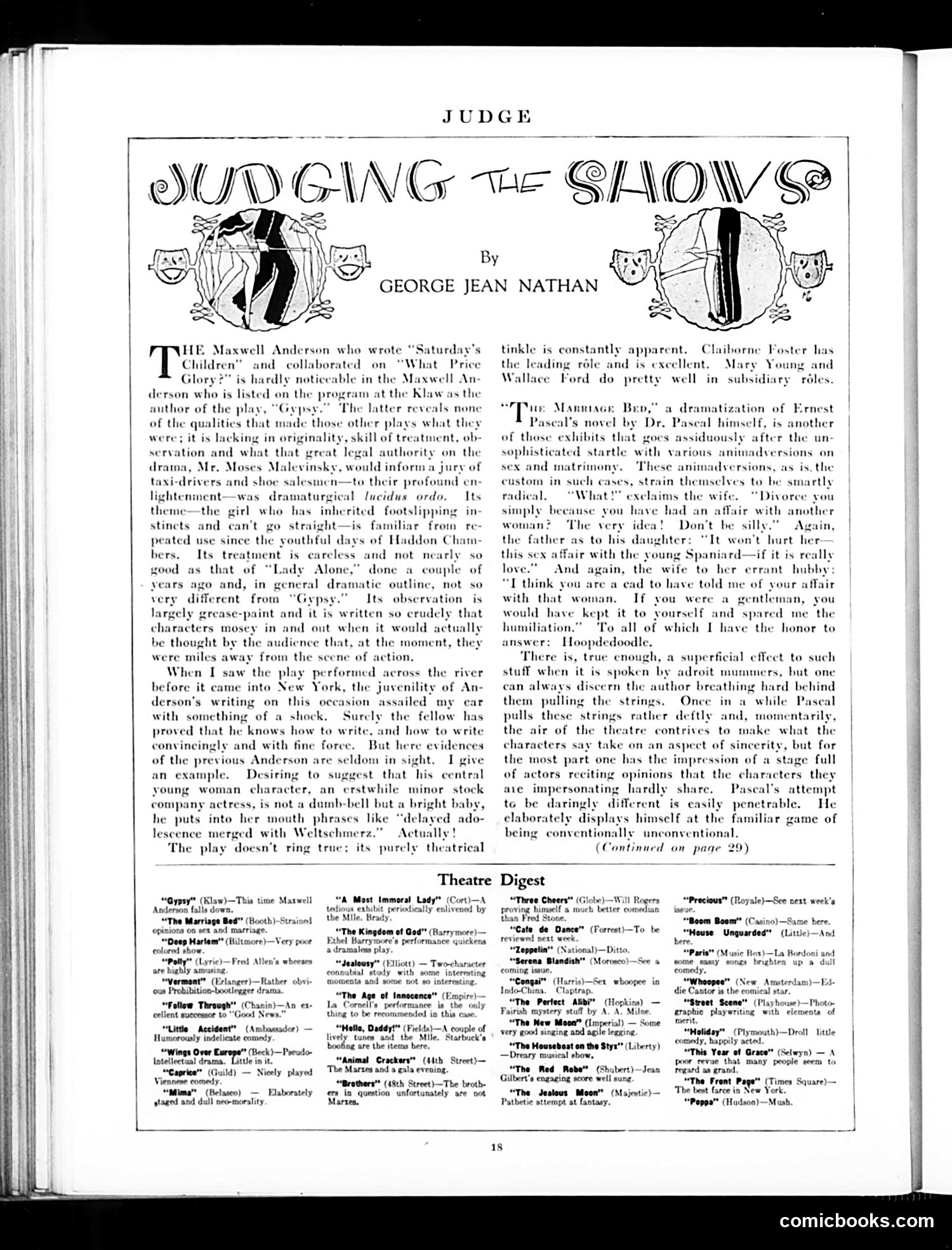
This is a theater criticism column by George Jean Nathan reviewing Broadway plays. The main target is Maxwell Anderson's play "Gypsy" at the Klaw Theatre. Nathan criticizes Anderson sharply, arguing that while Anderson wrote successful earlier plays ("Saturday's Children," "What Price Glory?"), "Gypsy" lacks originality and skill. The play's central premise—a girl with inherited "footslipping instincts" (promiscuity) who "can't go straight"—is familiar and treated carelessly. Nathan particularly mocks the dialogue as artificial and juvenile. He provides examples of the heroine's affected speech ("delayed adolescence merged with Weltschmerz") as evidence that Anderson is forcing sophistication rather than writing authentically. The review includes a sidebar "Theatre Digest" listing other Broadway productions with brief assessments. Nathan's critique emphasizes that even talented writers can produce inferior work when lacking genuine observation and care.
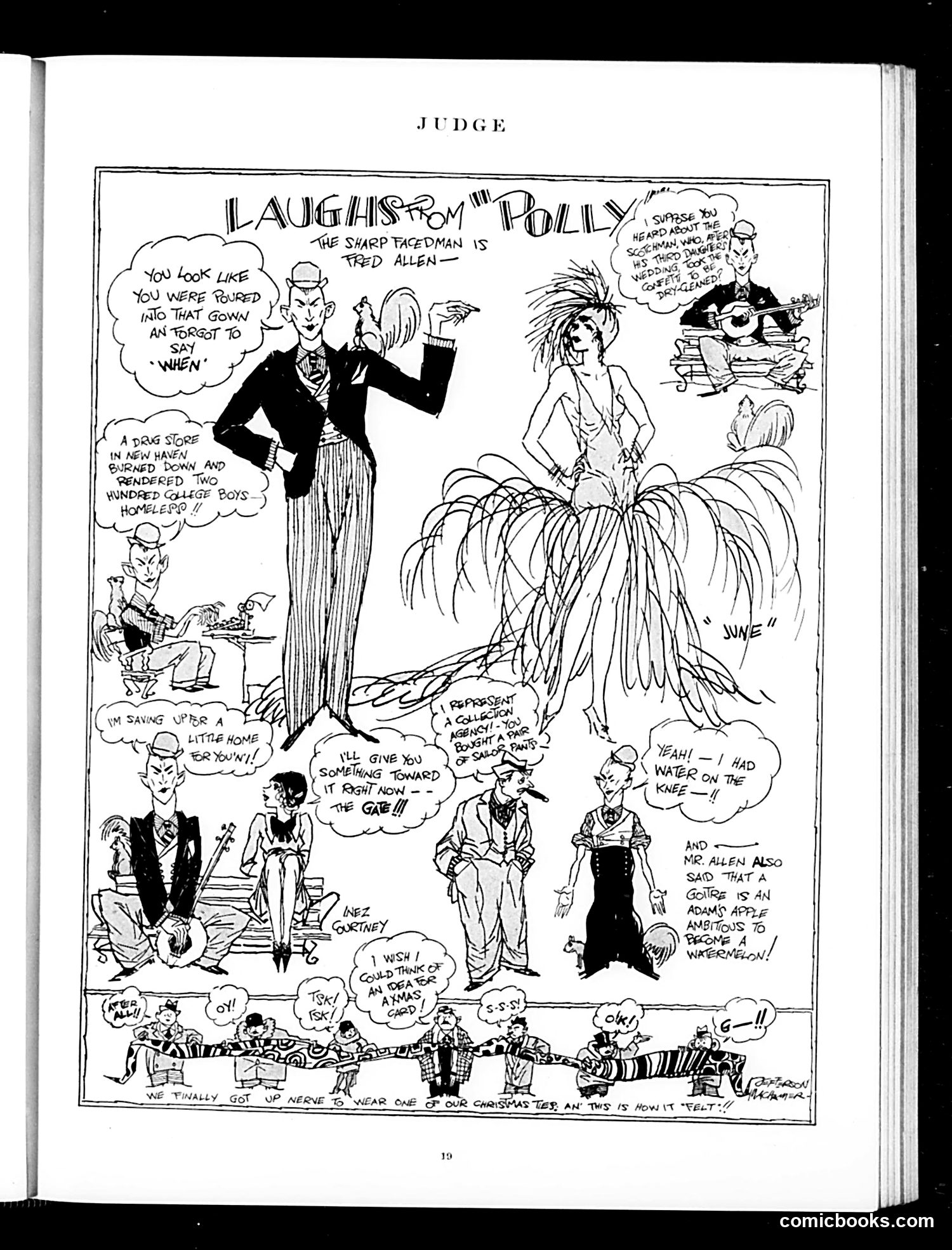
This is a single-panel comic featuring "Polly," a character who appears to be a satirical figure (likely representing a woman or persona of the era). The central figure is **"Fred Allen,"** identified as "the sharp-faced man." The cartoon mocks Allen through exaggerated physical humor and absurdist jokes. Various characters surrounding him recount ridiculous anecdotes—a drug store fire in New Haven, saving for a home, and references to a "gorge" (possibly a pun on his appearance or name). The dialogue is deliberately nonsensical and self-contradictory, typical of Judge's satirical style. The bottom panel shows small figures in what appears to be a theatrical or performance context, suggesting this may reference Allen's entertainment career. **Without more context about Fred Allen's prominence in 1920s-30s popular culture, the specific satirical target—beyond mocking his appearance and personality—remains unclear.**
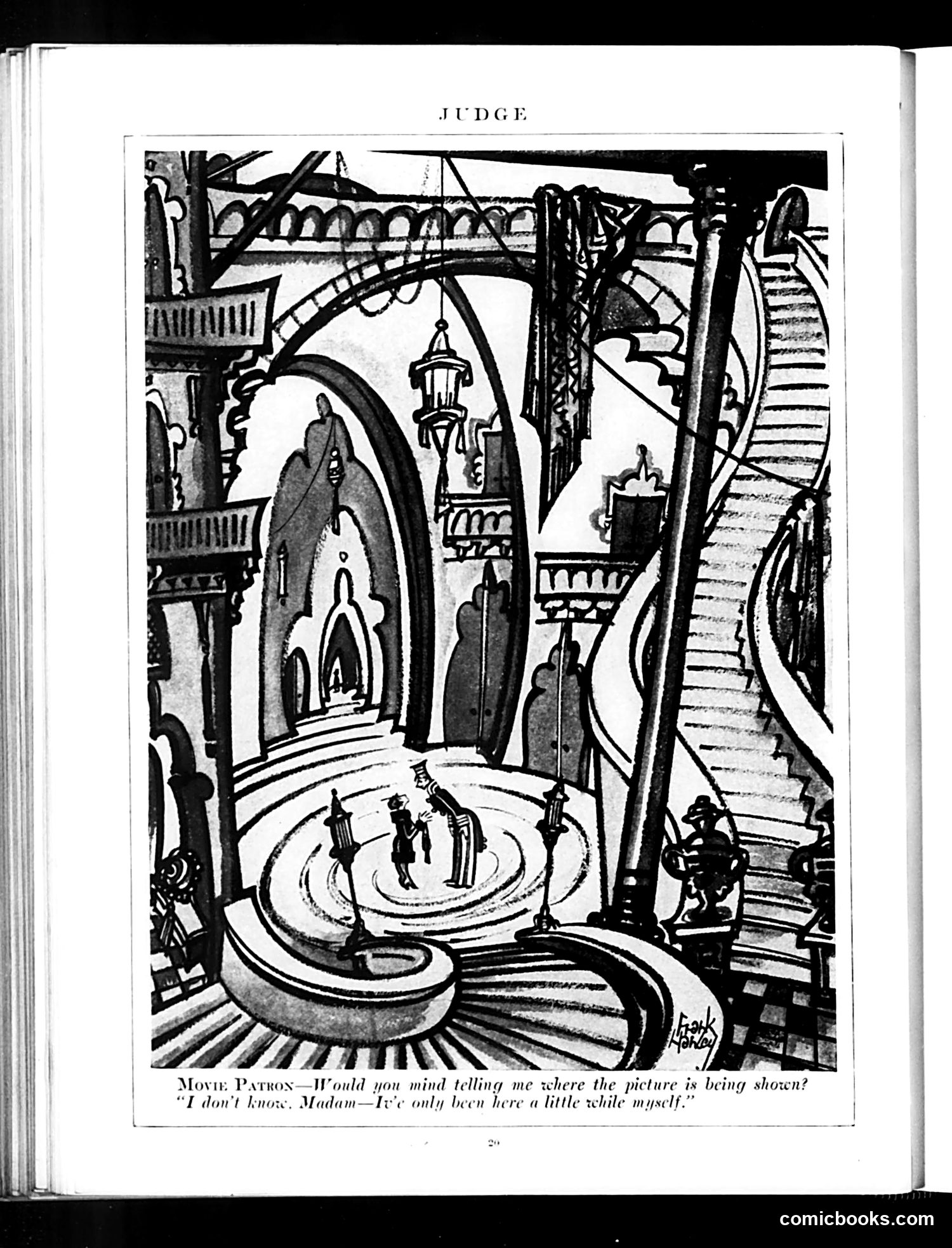
This is a single cartoon captioned "Movie Patron" showing two figures in an ornate, elaborate movie theater interior. One patron asks another where the film is being shown, and the other replies they've only been there briefly themselves and don't know. The joke appears to be about the overwhelming architectural grandeur of 1920s-30s movie palaces—the theaters were so spectacularly decorated with arches, towers, and ornamental details that patrons could easily become disoriented and lose track of which auditorium actually contains the film. The satire mocks both the excessive opulence of these "movie palace" theaters and the bewilderment such extravagance could cause viewers. The humor relies on the contrast between the theater's magnificent design and its basic function: simply showing movies.
This is a film criticism column reviewing three 1928 movies: "The Rescue" (adapted from Joseph Conrad), "The Case of Lena Smith" (directed by Josef von Sternberg), and "A Lady of Chance." Lorentz praises "The Rescue" for its faithfulness to Conrad's novel and for avoiding a happy ending—unusual for Hollywood. He notes Ronald Colman's casting limitations but credits careful overall casting. "The Case of Lena Smith" receives qualified praise for director von Sternberg's artistic restraint: he doesn't over-explain scenes to audiences or artificially punish his female protagonist, instead portraying the villain as a product of society rather than wickedness. "A Lady of Chance" is dismissed as frivolous—featuring a morally flexible heroine who suffers no real consequences, unlike Lena Smith. Lorentz recommends skipping it for the more artistically serious films. The column reflects 1920s debates about cinema's artistic legitimacy and moral messaging.
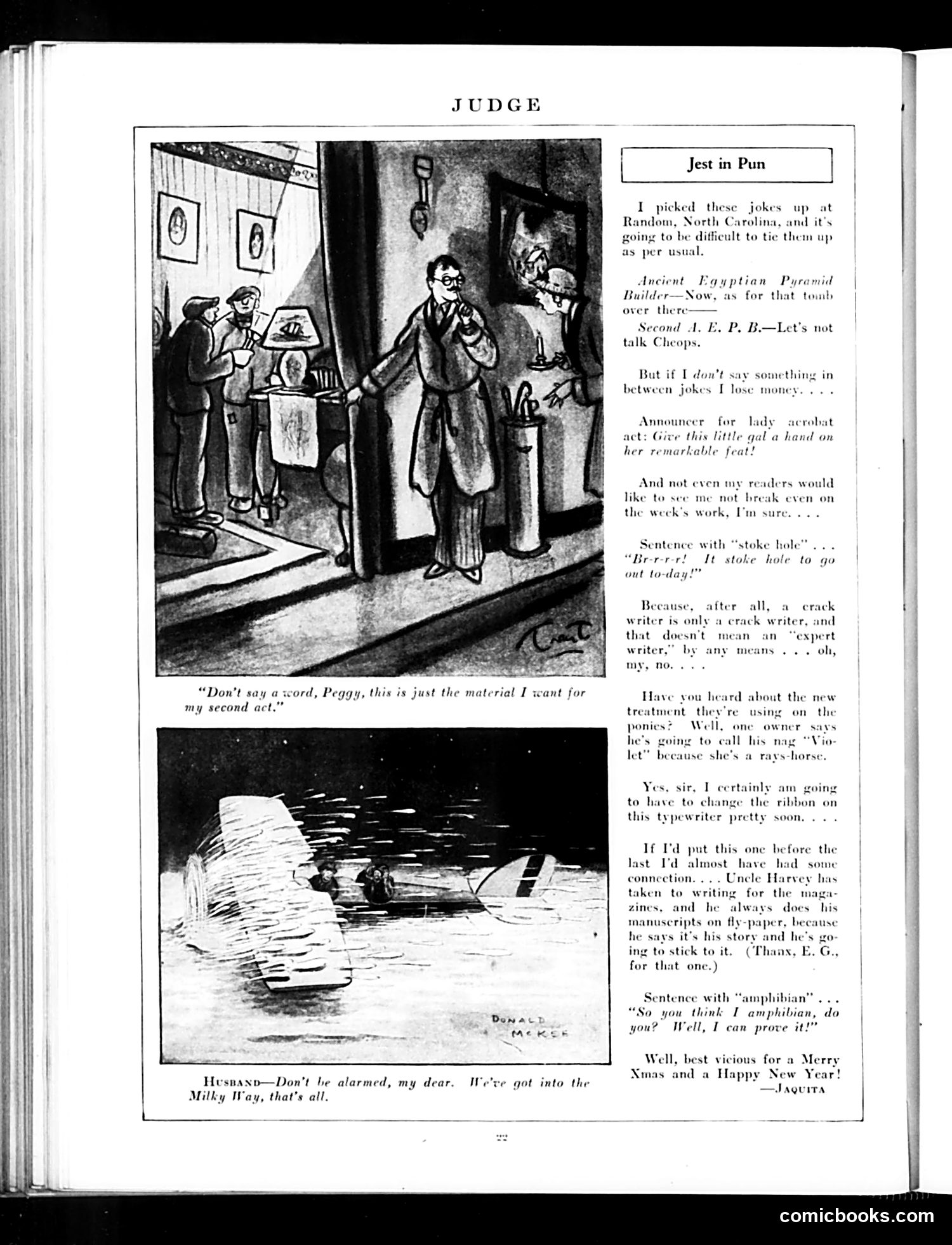
This page features two cartoons and a column of puns and one-liners by "Jaquita." **Top cartoon**: A playwright tells his companion not to worry about their predicament—they've "got into the Milky Way." The joke plays on a theatrical writer seeing real-life drama as potential "material for my second act," suggesting artists exploit life's misfortunes for entertainment. **Bottom cartoon** (by Donald McKee): A husband reassures his alarmed wife they're merely in the "Milky Way"—a euphemism for being lost or confused, likely referencing the Milky Way candy bar or the cosmic term as slang. The "Jest in Pun" column consists of groan-worthy wordplay jokes: puns on "Cheops" (cheap), "stoke hole" (stoke/joke), "amphibian" (am-a-liar), and "rays-horse" (race-horse). The author self-mockingly admits these jokes are weak material gathered randomly, used to fill space between more substantial content to justify payment.
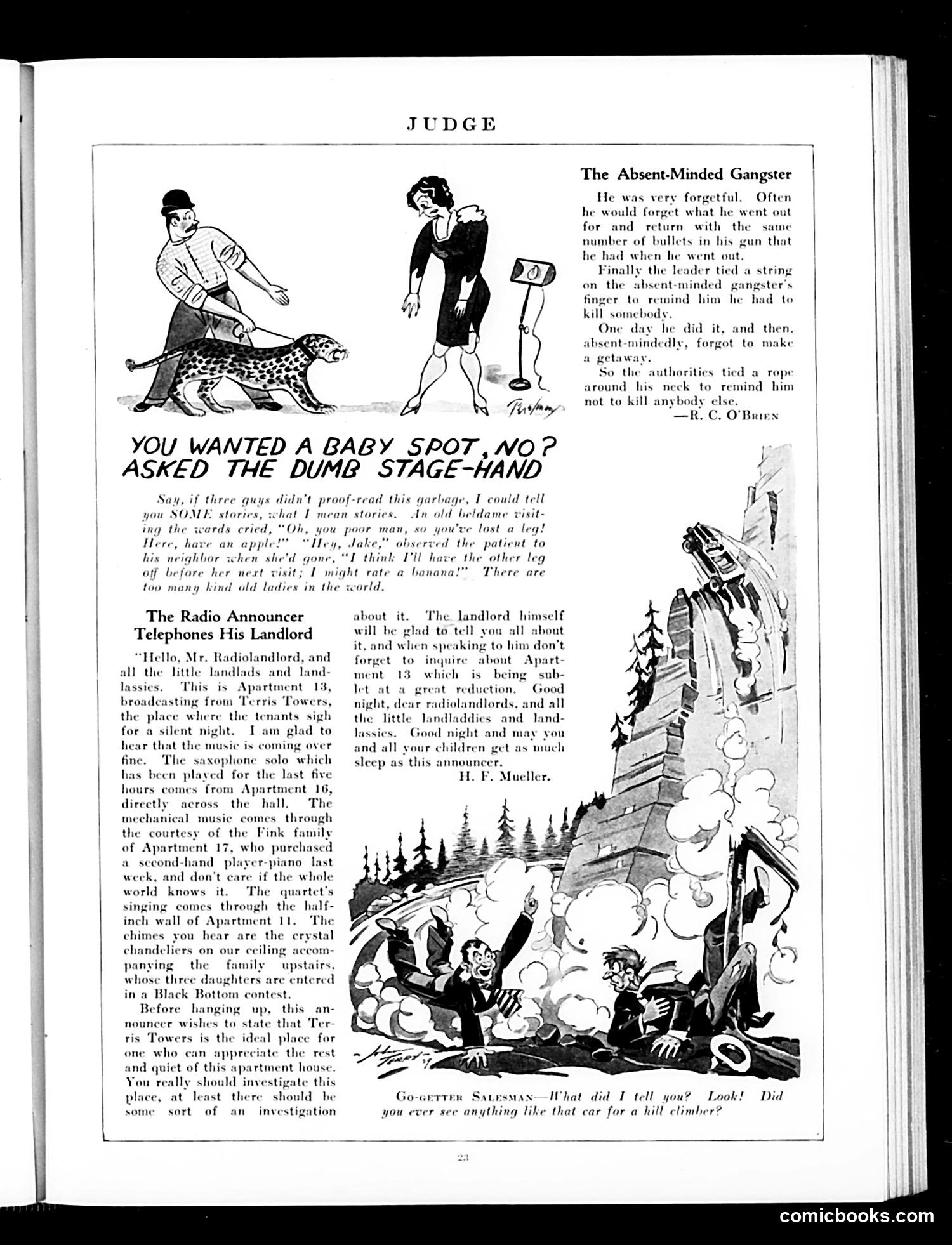
This page contains three humorous pieces satirizing early 20th-century urban life: **"The Absent-Minded Gangster"** mocks both criminal incompetence and justice system irony. A forgetful mobster keeps forgetting his murderous assignments and getaways until authorities ironically use the same reminder method (a rope around his neck via execution) to prevent future crimes. **"Baby Spot" and "Dumb Stage-Hand"** reference theatrical production, joking about a stage crew member's error in providing inadequate lighting for a performer. **"The Radio Announcer Telephones His Landlord"** satirizes apartment living in the 1920s-30s through a radio personality's mock-formal announcement. He sarcastically praises "Terris Towers" while cataloging relentless noise from neighboring apartments—saxophones, player-pianos, singing, and dancing—making the building's "rest and quiet" a laughable contradiction. The humor targets both thin-walled tenement conditions and the radio medium itself.
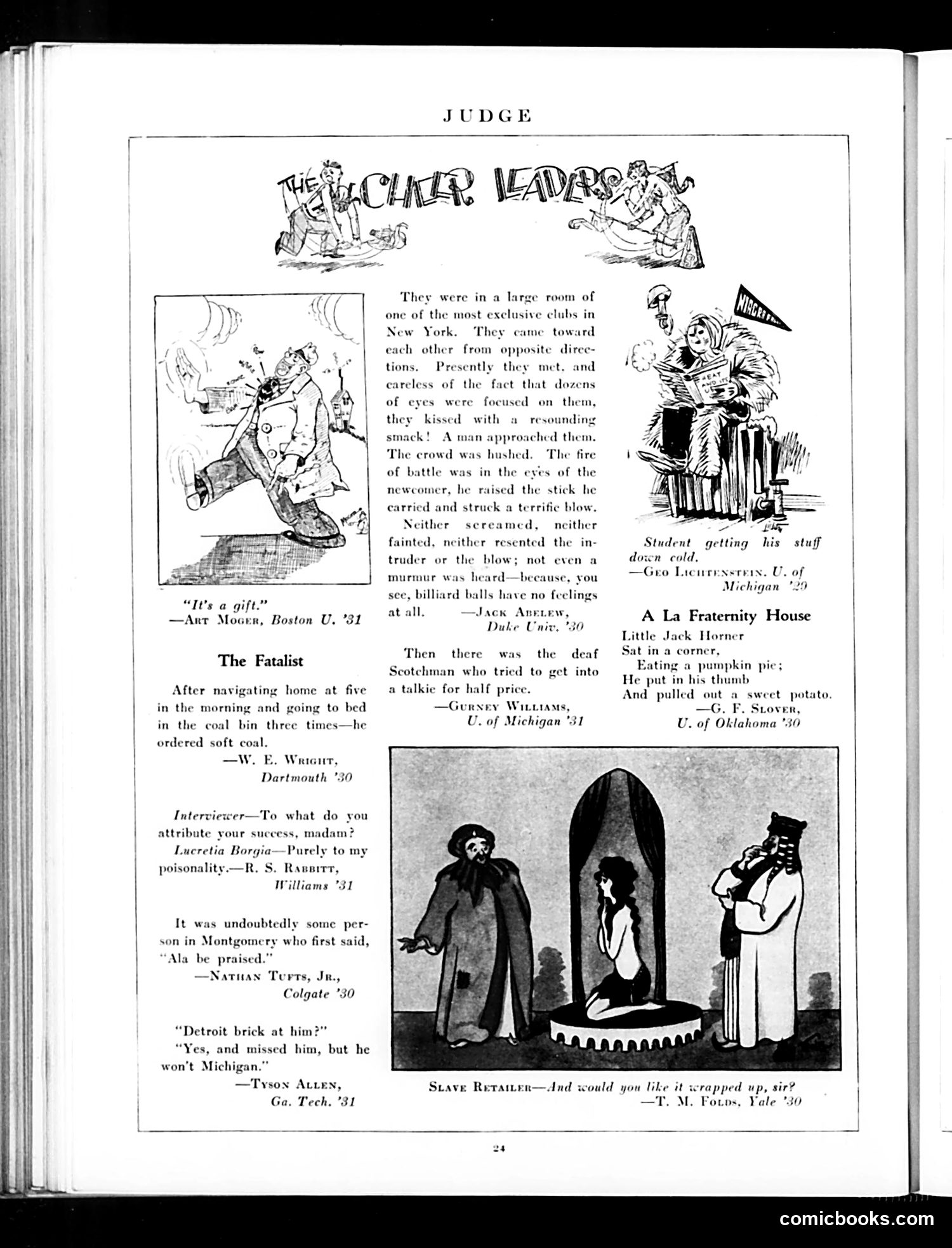
This page collects college humor submissions—jokes and witty observations attributed to students from various universities (Yale, Michigan, Georgia Tech, etc.), typical of Judge's format in the 1920s-30s. The cartoons mock collegiate life and social situations: **"The Fatalist"** ridicules a bumbling student who navigates home drunk at 5 AM, goes to bed in a coal bin repeatedly, then orders soft coal—suggesting confused, self-destructive behavior presented as fatalistic acceptance. **"The Chair Leaders"** and other illustrations depict college pranks and social mishaps (kissing in clubs, hazing with billiard cues). **"A La Fraternity House"** parodies the nursery rhyme "Jack Horner," applying it to fraternity life. The humor relies on: - Wordplay ("won't Michigan" as a pun) - Dark jokes (Lucretia Borgia's "poisonality") - Absurdist observations (billiard balls having no feelings) This reflects Judge's audience: educated readers appreciating college-oriented satire and clever undergraduate wit. The format—brief jokes with student attributions—suggests these were reader submissions celebrated as witty campus humor.
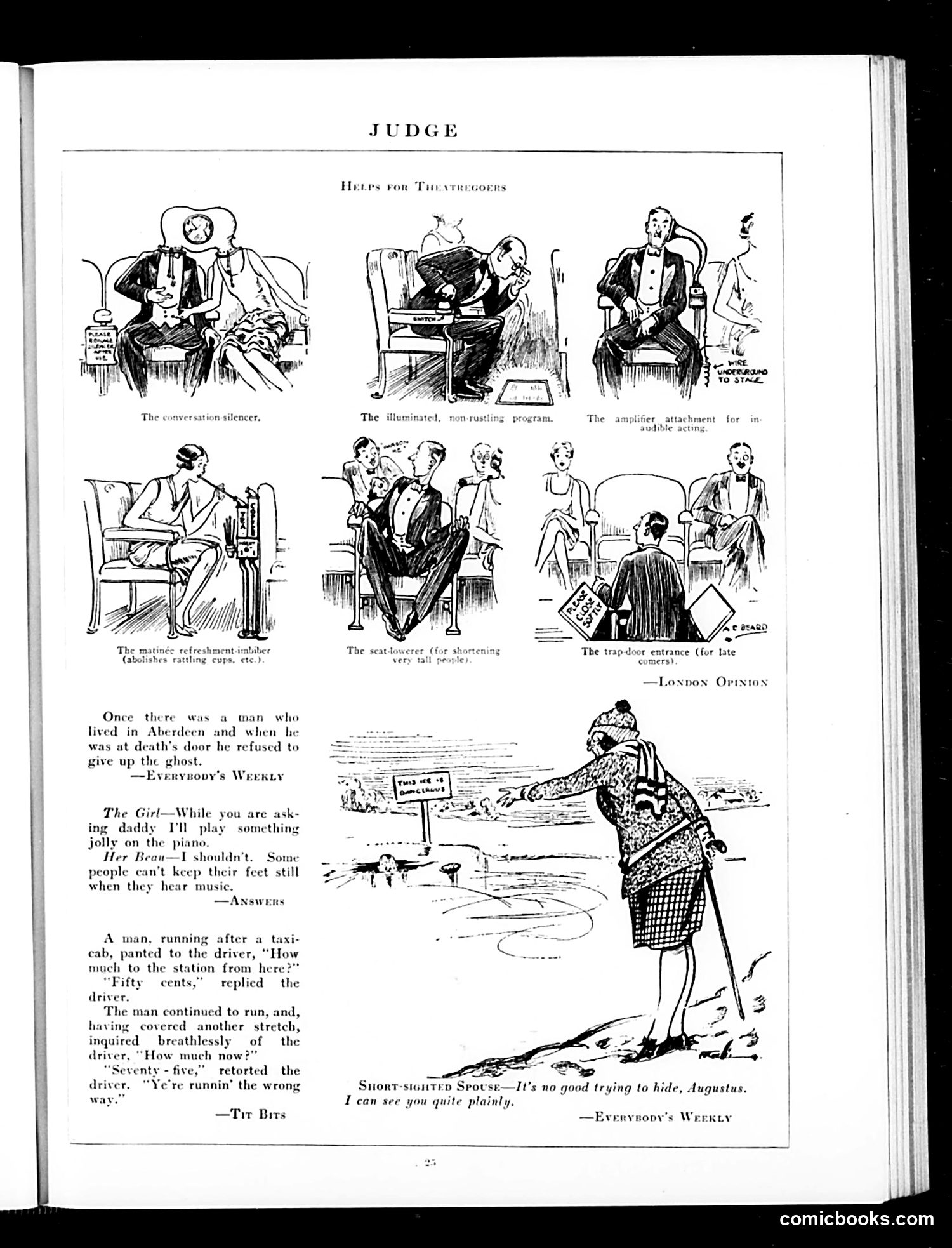
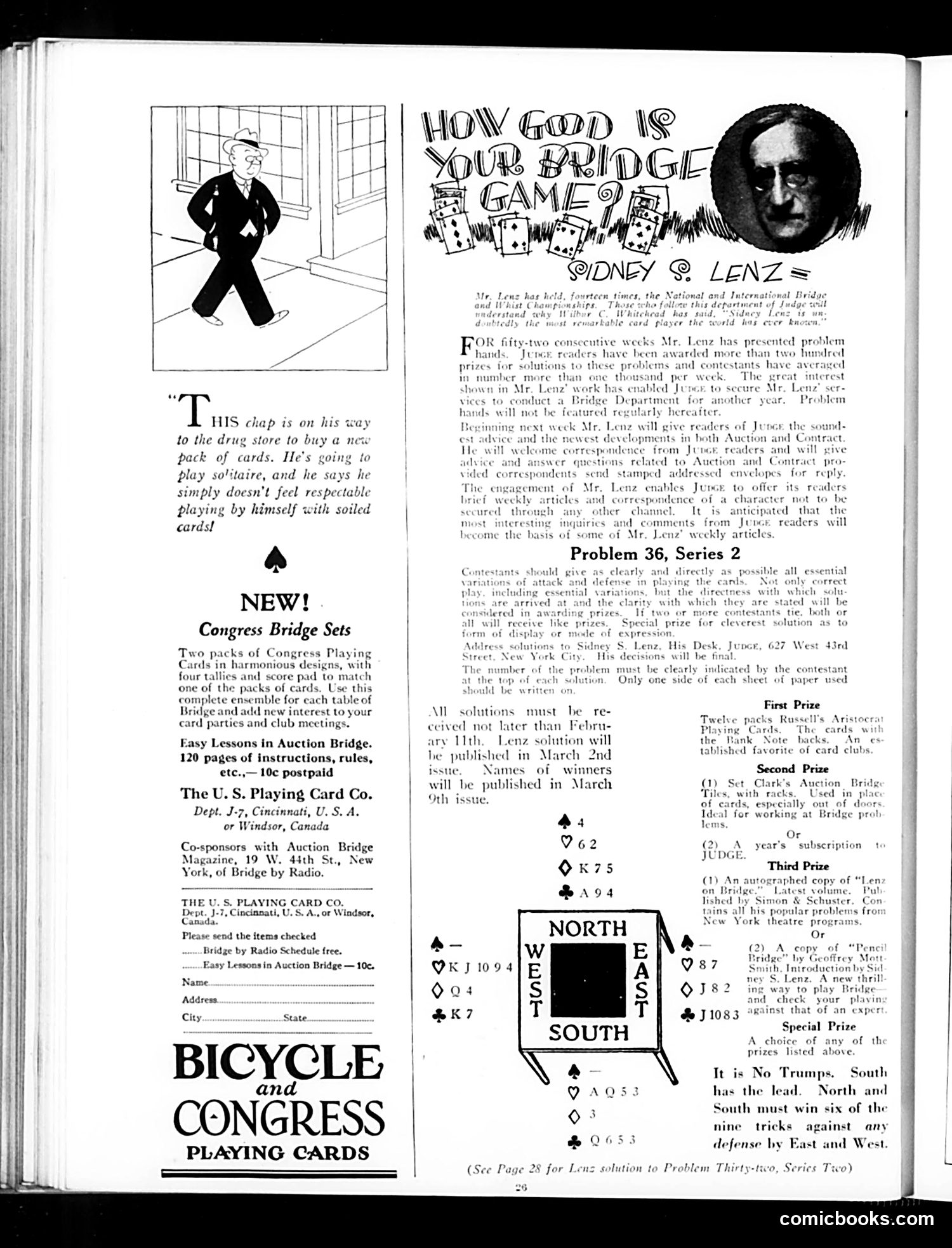
This page is primarily **advertising and instructional content** rather than satirical editorial material. The small cartoon at top-left is a humorous advertisement: a man in business attire hurries to buy new playing cards because he feels socially embarrassed playing solitaire with worn, soiled cards—a joke about genteel respectability and consumerism in the era. The bulk of the page promotes **Congress and Bicycle brand playing cards** and advertises **bridge instruction materials and competitions**. Sidney S. Lenz, whose photograph appears, was apparently a prominent bridge expert running a weekly problem-solving column in Judge magazine. Readers submitted solutions to bridge hands for cash prizes. The bridge problem shown (Problem 36) is presented for readers to solve, with detailed rules about submission deadlines and prize categories listed. This reflects early 20th-century American leisure culture where bridge was a popular card game, particularly among middle and upper-class players.
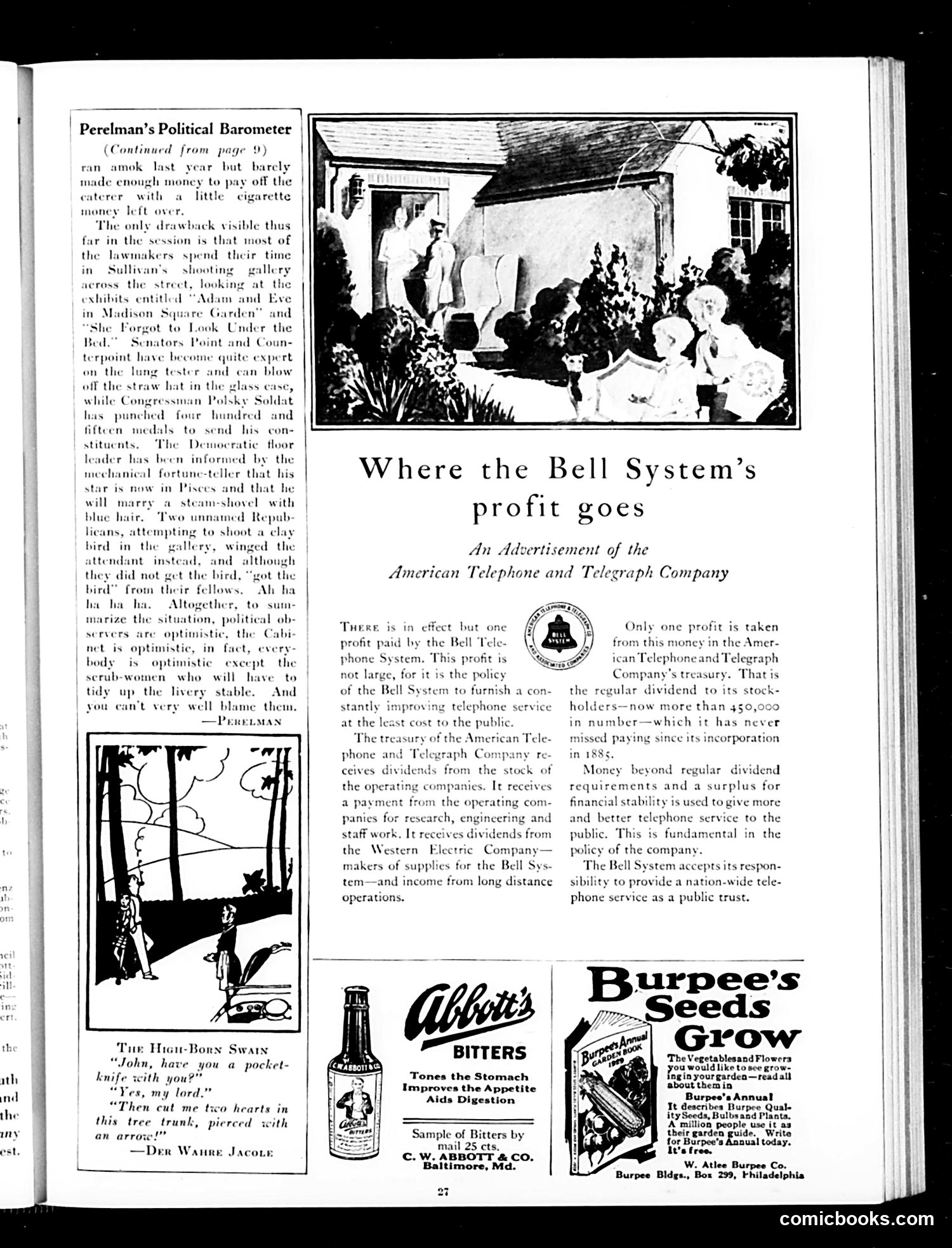
This page from *Judge* contains two distinct elements: **Main Content - "Perelman's Political Barometer":** A satirical column by S.J. Perelman mocking the current legislative session. The humor targets lawmakers as frivolous and distracted—spending time viewing art exhibitions rather than conducting business, consulting fortune-tellers, and even accidentally shooting a congressional attendant instead of clay pigeons. The piece suggests governmental incompetence through absurdist anecdotes. **Advertisement - Bell System:** A corporate advertisement asserting that the Bell Telephone Company reinvests profits into service improvements rather than excess shareholder dividends. This appears to be public relations defending the company's practices, likely responding to contemporary criticisms of monopolistic pricing or profiteering. The page also includes two smaller vintage cartoons and advertisements for Abbott's Bitters and Burpee Seeds—typical period magazine filler. The contrast between satirizing politicians while featuring corporate PR is characteristic of *Judge's* middle-class, pro-business editorial stance.
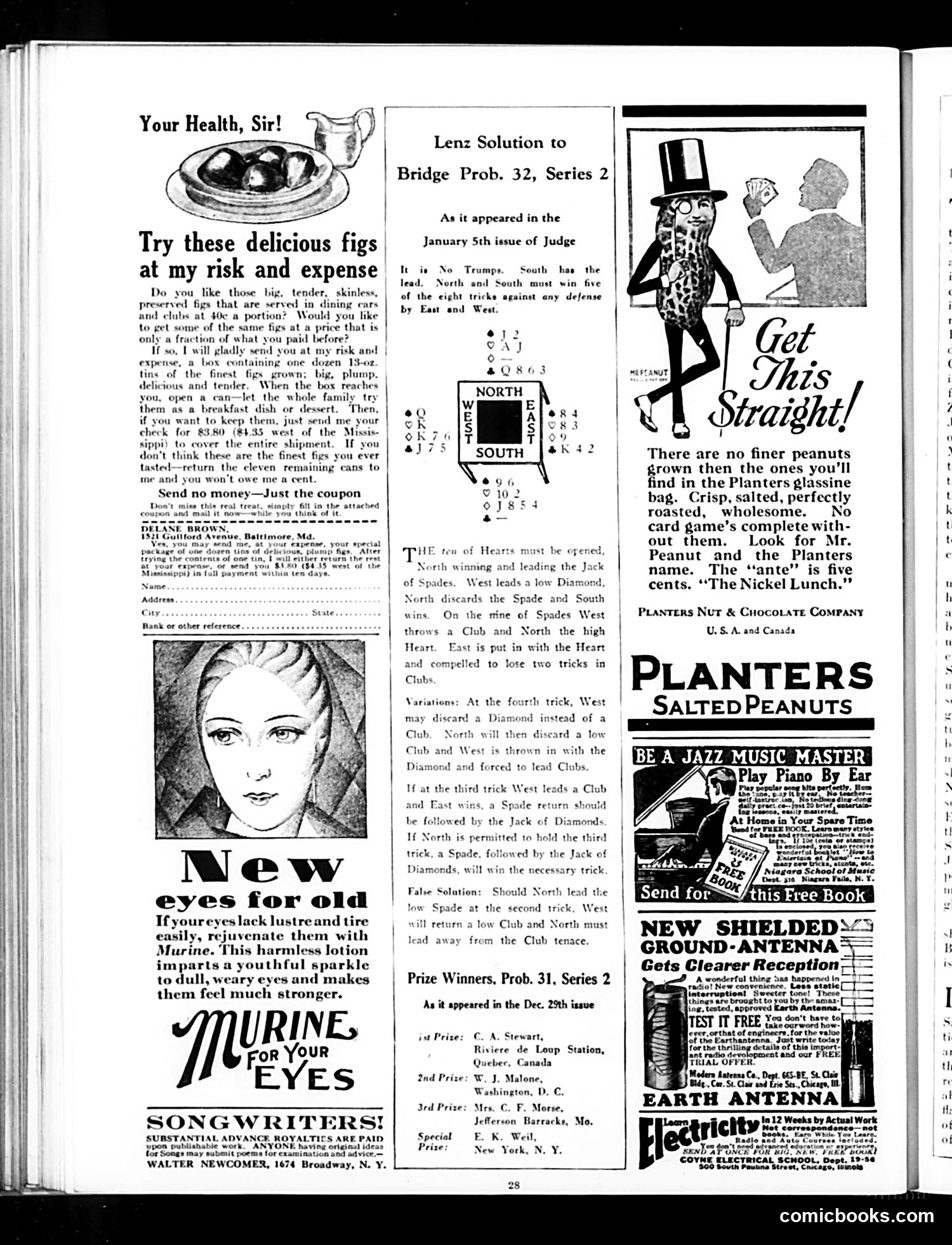
This page is primarily **advertising and puzzle solutions**, not political satire. The main content includes: **Bridge Problem Solution**: A technical card-game solution for readers, demonstrating Judge's intellectual audience. **Advertisements**: The page features multiple commercial pitches—fig delivery, eye drops (Murine), songwriting opportunities, peanuts (Planters), music lessons, radio antennas, and electrical schools. These reveal 1920s consumer culture and mail-order marketing. **The Only Cartoon**: "Get This Straight!" shows a caricatured man in top hat and checkered suit (unclear who specifically), seemingly promoting Planters peanuts. The figure's exaggerated features and pose suggest vaudeville or minstrel-show style humor typical of the era. **Historical Context**: The advertisements—particularly mail-order self-improvement courses and radio equipment—reflect post-WWI American optimism and emerging consumer technology. The page demonstrates Judge's dual role as satirical publication and advertising vehicle for middle-class readers.
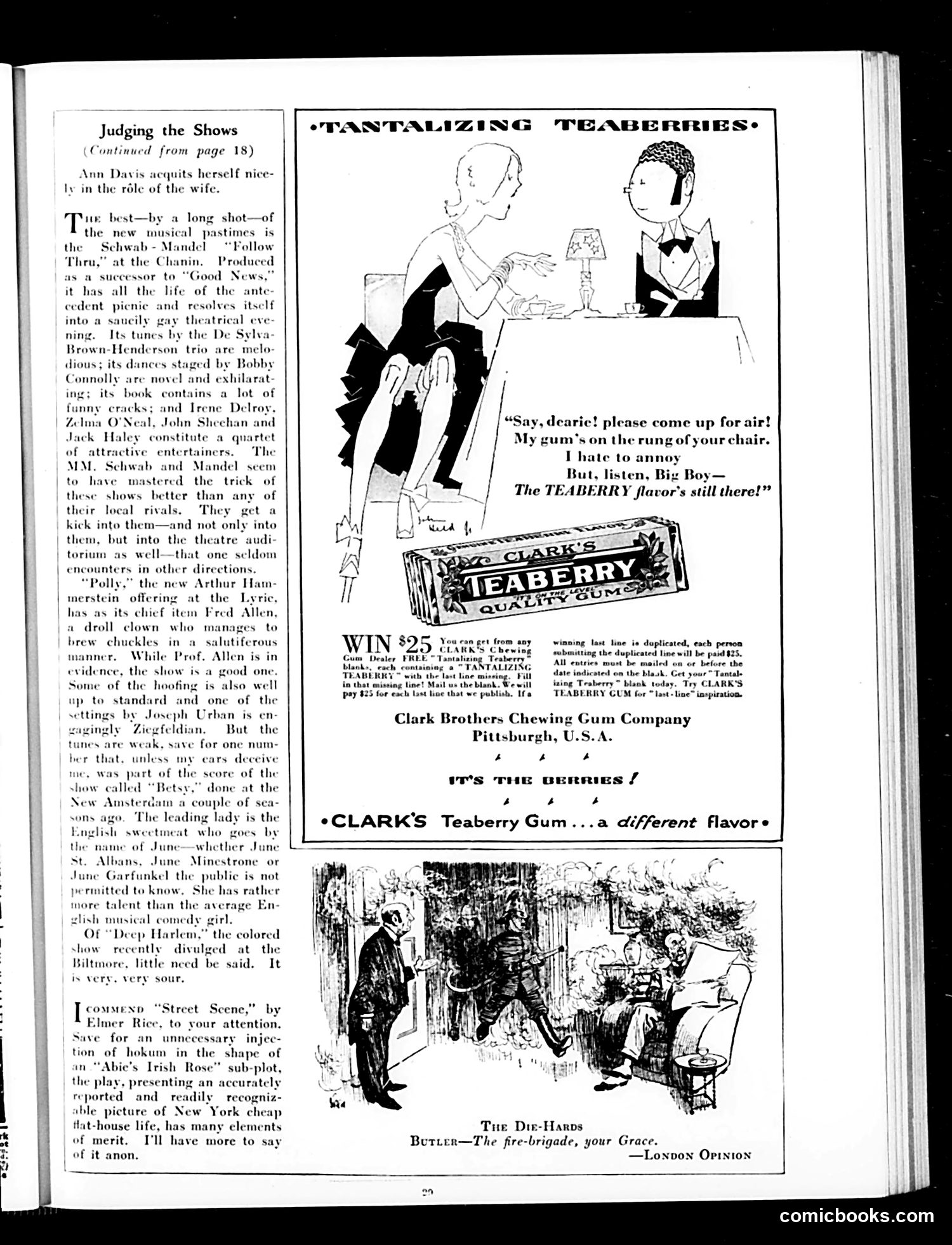
This page combines theater reviews with advertising. The main content is a drama critic's assessment of current Broadway shows, including "Follow Thru" (praised as the best new musical), "Polly" (featuring comedian Fred Allen), and "Street Scene" (Elmer Rice's play about New York tenement life). The **large cartoon advertisement** for Clark's Teaberry Gum depicts a domestic scene where a woman complains to a man about his chewing gum stuck to her chair—a lighthearted jab at messy gum habits. The humor relies on the exaggerated "dearie" and "Big Boy" dialect typical of 1920s advertising. Below is a small cartoon titled "The Die-Hards" captioned with a London Opinion quote about a butler and fire-brigade, likely satirizing British class distinctions. The page reflects 1920s consumer culture: entertainment criticism mixed with product pitches using humor and relatable domestic scenarios to sell candy and gum.
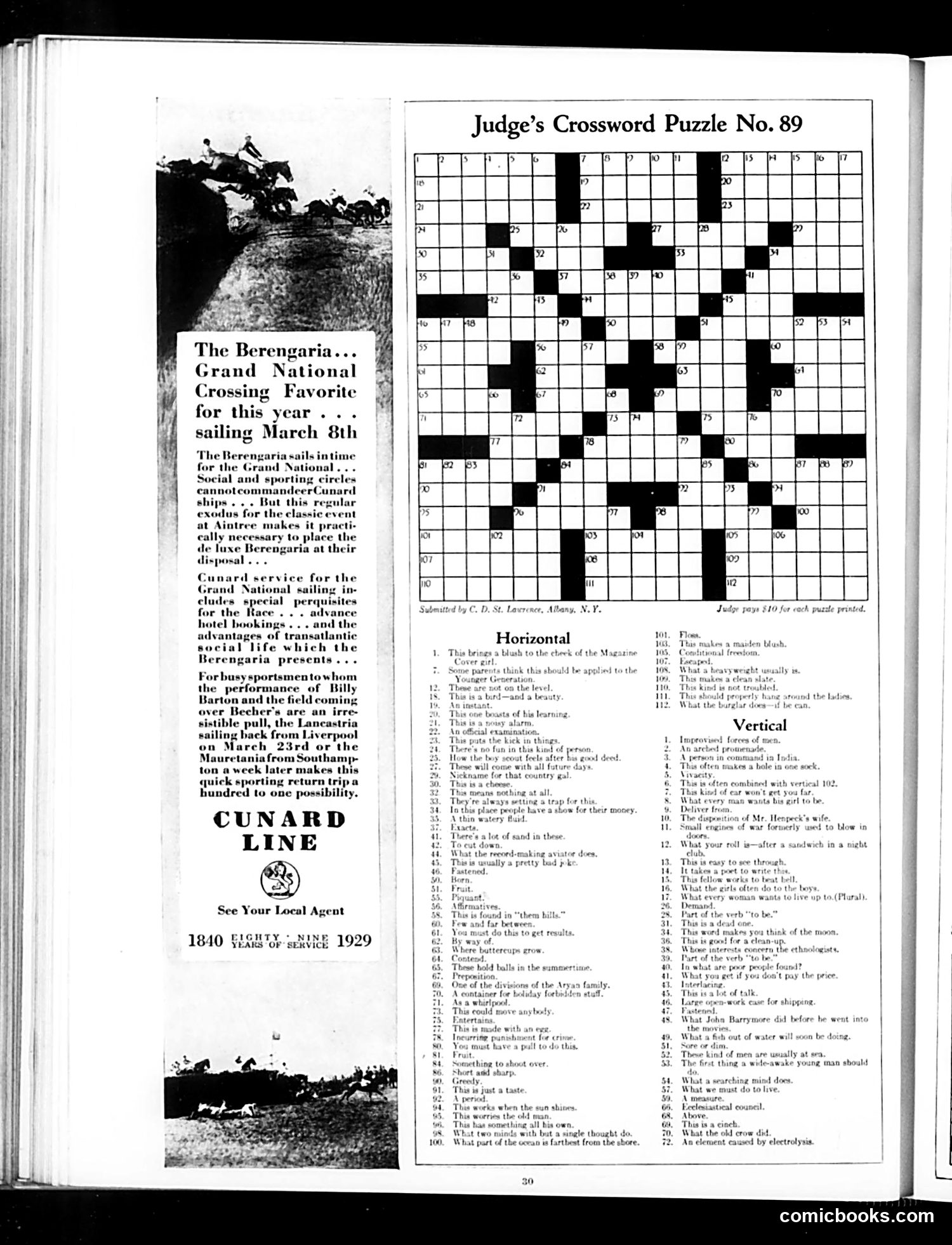
This page is primarily **advertising for Cunard Line steamships**, not political satire. The main content promotes the *Berengaria*, *Lancastria*, and *Mauretania* ocean liners to American sportsmen interested in attending the Grand National horse race at Aintree (in England) in March 1929. The pitch is that wealthy businessmen can sail to Liverpool or Southampton on these luxury vessels, attend the prestigious race, and quickly return—offering "advance hotel bookings" and "transatlantic social life" as selling points. The text emphasizes convenience for busy professionals who want to experience this sporting event without missing too much time back home. The page also includes a crossword puzzle (#89) typical of Judge magazine's content. There is **no political cartoon or satire visible**—this is essentially a travel advertisement dressed in the magazine's editorial format, targeting the affluent readership of this era.
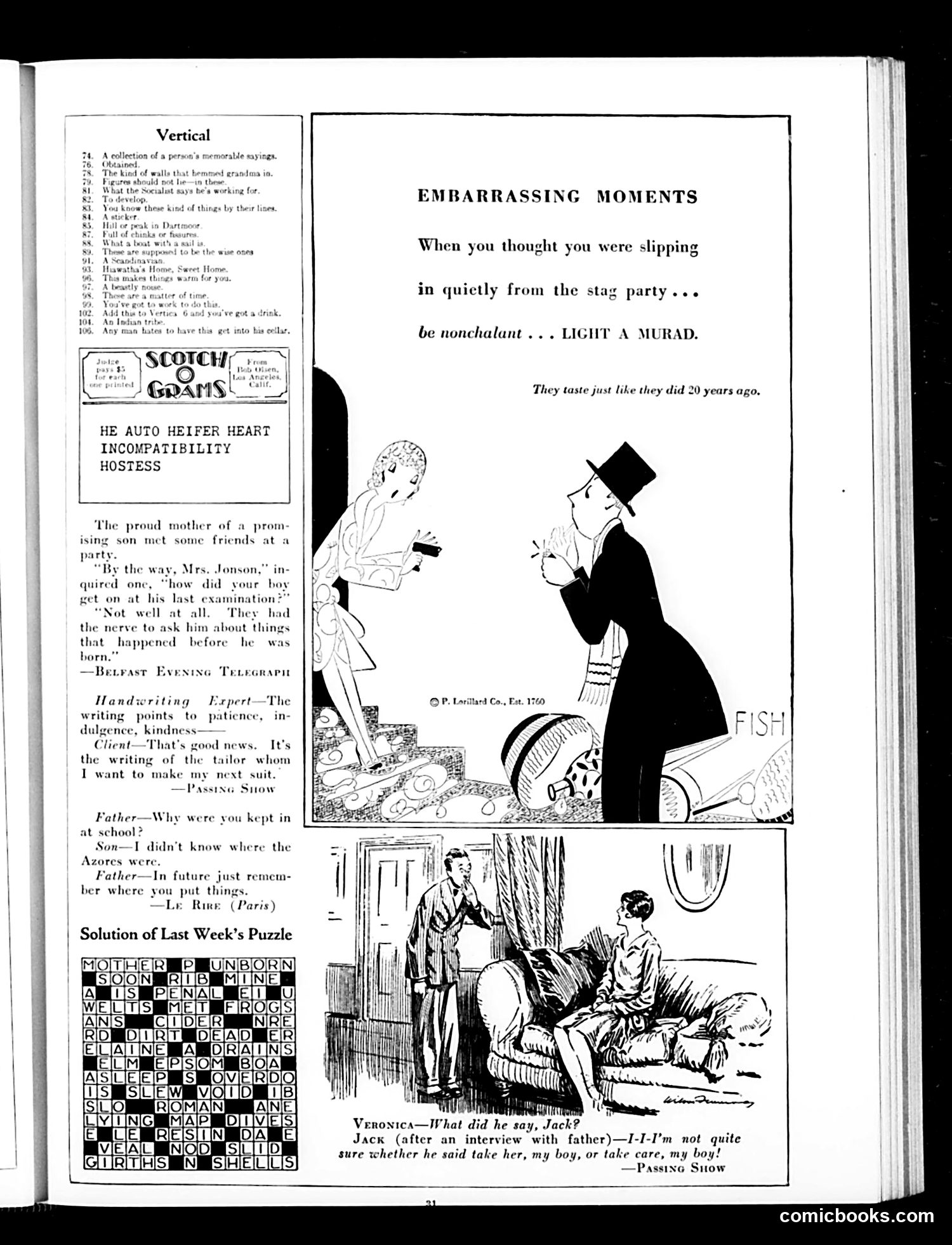
This page contains humor pieces and advertisements typical of early 20th-century American satirical magazines. **Main Content:** The "Embarrassing Moments" cartoon depicts a man caught returning from a "stag party" (men-only social gathering) and attempting to appear casual by lighting a Murad cigarette—an advertisement disguised as humor. The joke plays on the awkwardness of being discovered sneaking in. Below is a domestic scene where a young man, "Jack," has just interviewed with his girlfriend's father about courtship intentions. The humor stems from Jack's uncertainty whether the father told him to "take her" (marry her) or "take care, my boy" (a dismissal)—a misunderstanding with opposite meanings. **Supporting Content:** The page includes anecdotes mocking exam systems, handwriting analysis, and parental logic—gentle satire of social pretension and generational misunderstanding common to the era. The Scotch Grains whisky advertisement and crossword puzzle round out typical magazine filler content of the period.
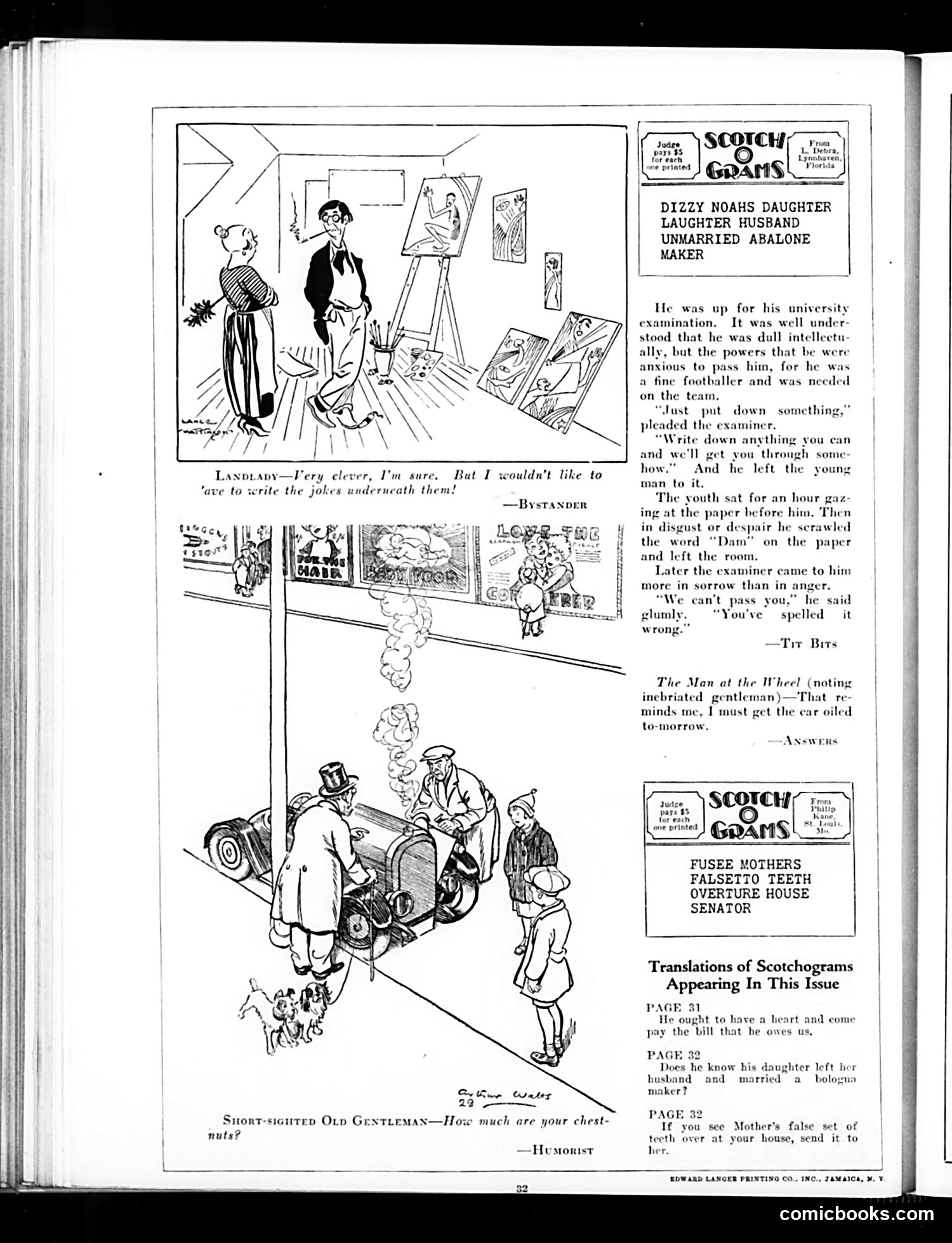
This page contains three humorous anecdotes typical of early 20th-century satirical magazines: **Top cartoon:** A landlady observes an artist struggling to sketch jokes. The satire mocks the difficulty of creating humor—the artist finds it easier to draw than to write witty captions. **Middle cartoon:** A university exam scenario satirizes institutional corruption. Despite being intellectually dull, a student is pressured to pass because he's a valuable athlete. His one-word answer ("Dam") either represents genuine stupidity or—more likely—cynical despair at the absurd arrangement. The examiner's dismay suggests the student's response exposed the system's hypocrisy. **Bottom cartoon:** An inebriated driver's non-sequitur about car maintenance is straightforward drunk-logic humor. The "Scotch Grams" section advertises word-puzzle translations, while the sidebar jokes follow similar themes of institutional absurdity and class humor typical of Judge's satirical voice.
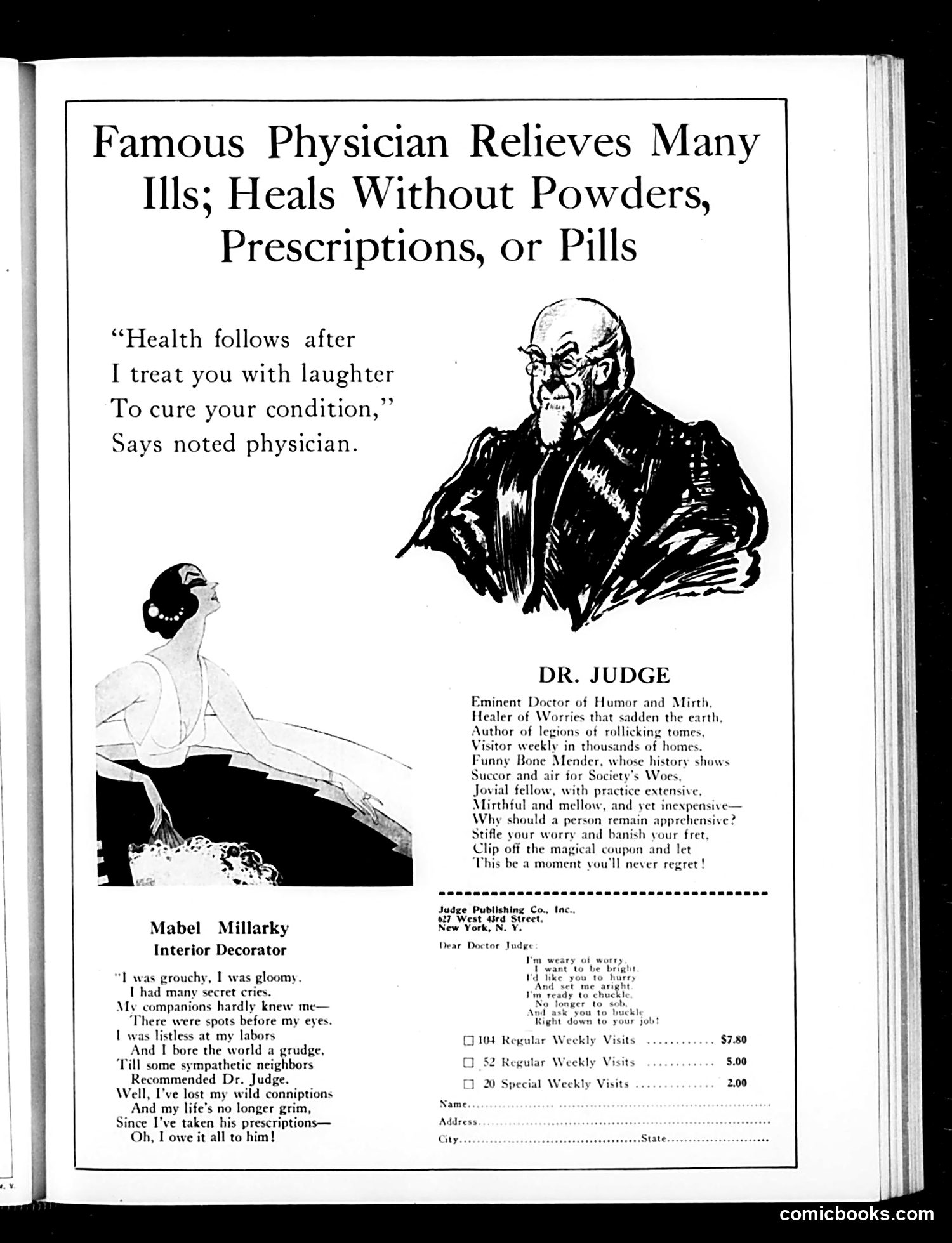
This is primarily a **self-promotional advertisement** for *Judge* magazine itself, disguised as a humorous testimonial. The "Dr. Judge" character is a personified version of the magazine—a doctor of humor and mirth who heals psychological ailments through laughter rather than medicine. The satire targets **early 20th-century anxieties** about modern life: worry, gloominess, listlessness. The testimonial from "Mabel Millarky" (an interior decorator) uses comedic exaggeration to suggest that reading *Judge's* humorous content cured her depression and nervousness. The offering of tiered subscription plans (104, 52, or 20 "weekly visits") frames regular magazine readership as medical treatment. This plays on period self-help culture and the era's growing recognition of mental health issues, while promoting *Judge* as affordable medicine for urban malaise. The cartoonish doctor figure suggests both legitimacy and gentle mockery of health trends.
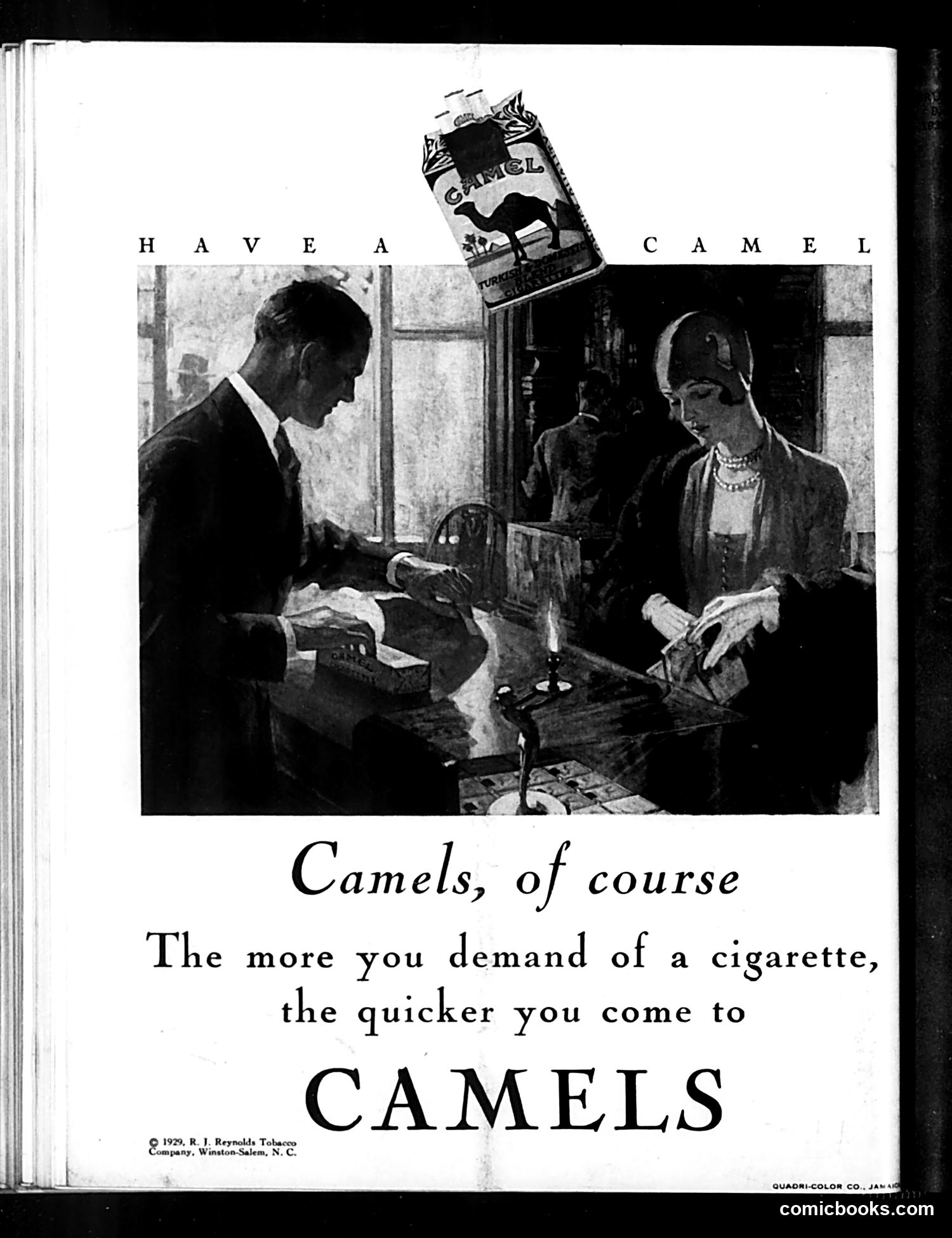
This is a Camel cigarette advertisement from 1929, not a political cartoon. The image shows a well-dressed man and woman at what appears to be a retail counter or shop, examining Camel cigarettes. A large Camel pack is displayed above them. The advertisement's slogan—"The more you demand of a cigarette, the quicker you come to CAMELS"—uses aspirational messaging common to 1920s advertising. It suggests that discerning consumers naturally gravitate toward Camel brand cigarettes as a premium product. The page exemplifies how Judge magazine supplemented its satirical content with advertising revenue. This particular ad targets affluent consumers through imagery of sophisticated shoppers and refined product positioning.