
Judge, 1929-02-02 · page 20 of 36
Judge — February 2, 1929 — page 20: what you’re looking at
What you’re looking at
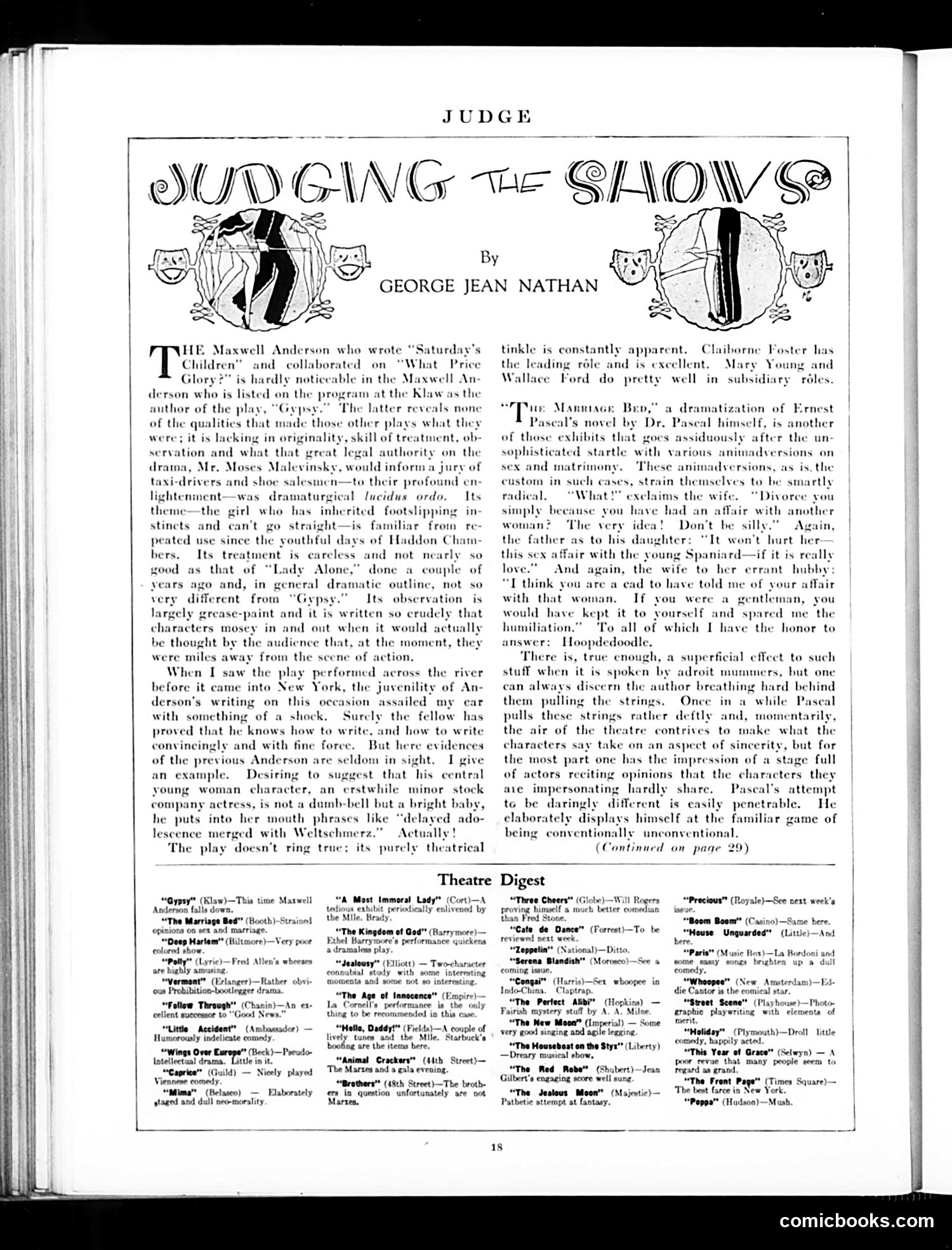
This is a theater criticism column by George Jean Nathan reviewing Broadway plays. The main target is Maxwell Anderson's play "Gypsy" at the Klaw Theatre. Nathan criticizes Anderson sharply, arguing that while Anderson wrote successful earlier plays ("Saturday's Children," "What Price Glory?"), "Gypsy" lacks originality and skill. The play's central premise—a girl with inherited "footslipping instincts" (promiscuity) who "can't go straight"—is familiar and treated carelessly. Nathan particularly mocks the dialogue as artificial and juvenile. He provides examples of the heroine's affected speech ("delayed adolescence merged with Weltschmerz") as evidence that Anderson is forcing sophistication rather than writing authentically. The review includes a sidebar "Theatre Digest" listing other Broadway productions with brief assessments. Nathan's critique emphasizes that even talented writers can produce inferior work when lacking genuine observation and care.
📄 Transcribed text from this page (OCR, searchable)
Machine-transcribed from the original scan — historical spelling and the odd misread are preserved.
JUDGE Ta Maxwell Anderson who wrote aturday’s Children” and collaborated on “What ) Price Glory?” is hardly noticeable in the Maxwell An- derson who is listed on the program at the Klaw as the author of the play, “Gypsy.” The latter reveals none of the qualities that m: those other plays what they were; it is lacking in originality, skill of treatment, ob: servation and what that great legal authority on the drama, Mr, Moses Malevinsky, would inform a jury of taxi-drivers and shoe salesmen—to their profound en- lightenment—was dramaturgical lucidus ordo. Its theme—the girl who has inherited footslipping in stincts and can’t go straight—is familiar from re- peated use since the youthful days of Haddon Cham bers. Its treatment is carcless and not nearly so good as that of “Lady Alone,” done a couple of years » and, in general dramatic outline, not so different. from “Gypsy.” Its. observation is y grease-paint and it is written so crudely that racters mosey in and out when it would actually it by the audience that, at the moment, they were miles away from the scene of action, When I saw the play performed across the river before it came into New York, the juvenility of An- derson’s writing on this occasion ‘assailed’ my ear with something of a shock. Surely the fellow has proved that he knows how to write, and how to write convincingly and with fine force. But here evidences of the previous Anderson are seldom in sight. I give an example. Desiring to suggest that his central young woman character, an erstwhile minor stock comy stress, iy not a dumb-bell but a bright t he puts into her mouth phrases like “delayed ed with Weltschmerz.” Act y doesn’t ring true; its purely t lescence me: The “Gypsy” (Klaw)—This time Marwell Anderson falls down. tetious exh The Marriage Bed" (Hooth)-Strainni the Mile. B Cpinios on sex and marriage. “The Kingdom of Ged (Barrymore) — re)—Very poor Ethel Barrymore's performance quickens a dramales play “Jealousy” (£1 Polly” (Lyric)—Frel Allen's wbeeaes “Vermont” (Erlanger)—Rather obvi ous Probibition-bootlegger drama. “Follow Through" (Chanin)—An ex- cellent successor to “Good News.” “Little Accident’ Humorously indelicate com Over (Beck)—Psevdo- Heetual drama. Little in it, “The Age et lnnecence”* (Expire) — La Cornell's performance is, the oaly thing to be recommended in this eas “Helle, Daddy!” (Fielts)—A co lively tunes and the Mlle, Sta boofing are the items here, “Animal Crackers (44th Street)— of By GEORGE JEAN NATHAN tinkle is constantly apparent. the leading réle and is excellent. Mary Young Wallace VF “TH Marnace Bep Pascal's novel b. of those exhibits that sophisticated sts a dr: Dr. tle with vz sex and matrimony. These Claiborne Foster has and d do pretty well in. subsidiary roles. natization of Ernest Paseal himself, is another ssiduously after the un- bus animadversions on animadversions, as is. the custom in such cases, strain themselves to be smartly radical, “What! exclaims the wife. simply beeause you have had an affair with ; woman? ‘The very idea! the father as to his daughter: “Divorce you Don't be silly.” this sex affair with the young Spaniard—if it is re love.” And in, the wife to her errant hubby: “L think you are a cad to have told me of your affair with that woman. If you were a ntleman, you would have kept it to yourself and spared me the humiliation.” ‘To all of which I have the honor to nswer: Hoopdedoodle. There is, true enough, a superficial ef stuff when it is spoken by can alwa ret to such adroit mummers, but one s discern the author breathing hard behind them pulling the strings. Once in a while Paseal pulls these strings rather deftly and, momentarily, the characters say take on an the most part one has the of « aie impersona to be daringly elaborately ¢ nt isc splays himself at the familiar r of the theatre contrives to make what the aspect of sincerity, but for e full ypression of as tors reciting opinions that the characters they wrdly share. Pascal's attempt ily penetrable. He me of being conventionally unconventional, (Continued on page Digest “Three Cheers” (( proving himself a than Fr “Cate de Dance” (Forrest) —To be reviewed next week ppetin”® (National) —L “Serena Blandish” (Morosco)—See a coming issue. “Congai” (Harris)—Sex whoopee in Indo-China. Claptrap. “The Pertect Alibi” (Hopk Fairish mystery stu by A. A. “The New Moon” (I:operis!) — Some very good singing and agile legxing “The Houseboat on the Styx" (Literty) —Dreary musical show, r)—Will Rogers b better cormedian “Precious” (Royale)—Sce next week's “Boom Boom’ (Cas bere. pMewne Unguarded™ (Litle)—And ere. “Paris (Music Bot)—La Bordoni and some sassy songs brighten up a dull comedy. “whoopee” (New Amster die Castor is the comical “Street Scene” (Playhouse)—P" graphic playwriting with eleme merit. “Holiday” (Plymouth)—Droll little comedy, happily acted. “This Year of Grace” (Selwyn) — A poor revue that many people seem to “Caprice” (Guild) — Nicely played The Mares and a gala evening. The Red Rebe™ (Shubert)—Jean regard aa grand Vikaness eomady “prethers’* (48th Street) —The beoth- _ Dilbert’s engaging score well tung “The Front Page” (Times Square) — “tima” (Belasco) — Elaborately ers in question unfortunately are not “The Jealous Moon” (Majestic) ‘The best farce in New York staged and dull neo-morality Marzes. Pathetic attempt at fantasy. “Poppa” (Hudson) —M usb. 18 comicbooks.com