
Judge, 1929-02-02 · page 15 of 36
Judge — February 2, 1929 — page 15: what you’re looking at
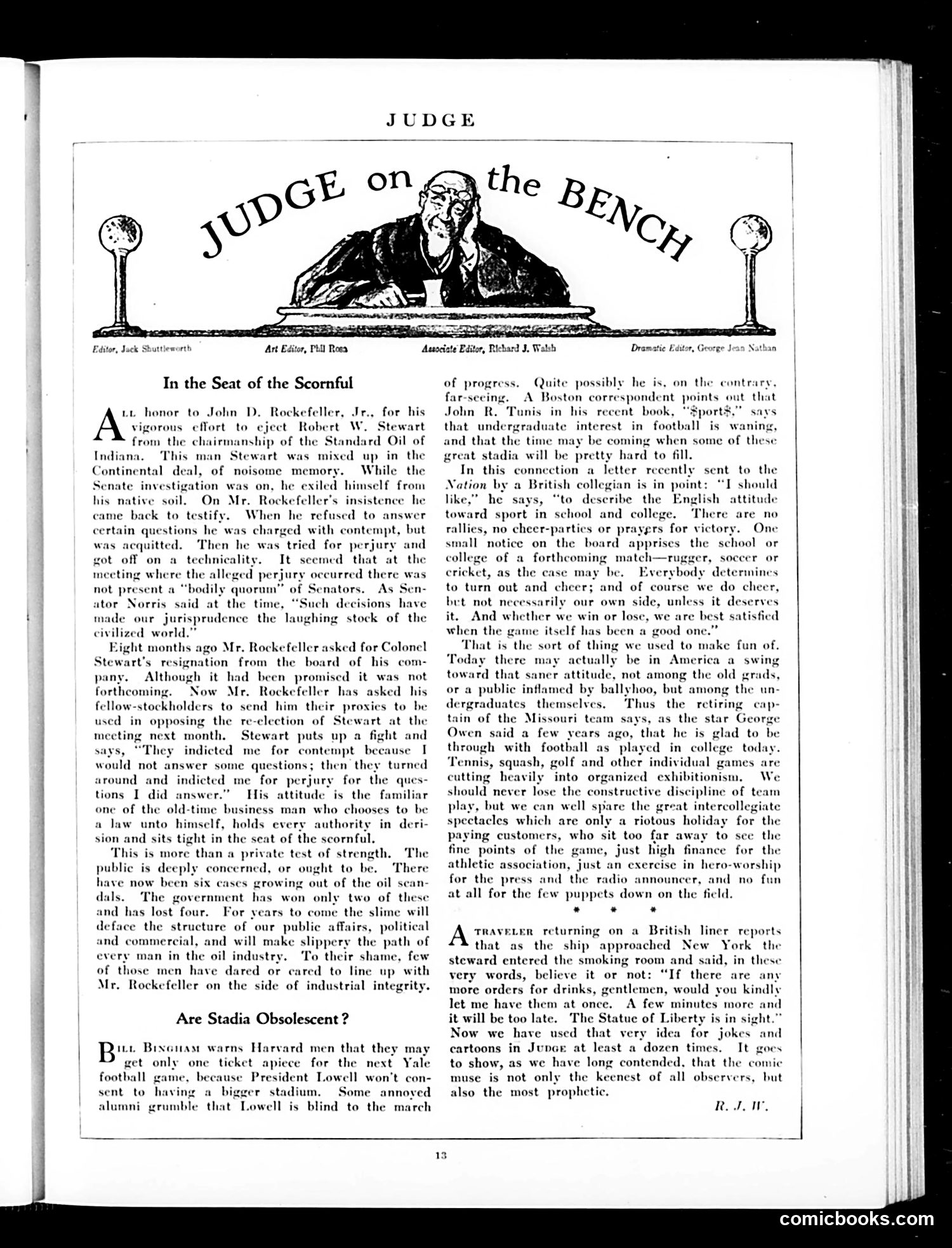
What you’re looking at
## Main Content: "In the Seat of the Scornful" This editorial attacks **Robert W. Stewart**, chairman of Standard Oil of Indiana, whom **John D. Rockefeller Jr.** is trying to remove. Stewart was implicated in the "Continental deal" oil scandal and evaded accountability through legal technicalities—contempt charges were dismissed on a procedural basis (lack of "bodily quorum"), and perjury charges failed similarly. The satire targets Stewart's defiant attitude: when indicted for contempt (refusing to answer questions), he then faced perjury charges (for answering other questions), creating an absurdist defense. The piece criticizes Stewart as an "old-time business man" who treats authority with contempt and sits "in the seat of the scornful." The broader point: while Rockefeller shows industrial integrity by opposing Stewart, few oil industry figures support him. The ongoing scandal continues damaging public confidence in both business and government. ## Secondary Item: "Are Stadia Obsolescent?" A brief note on Harvard/Yale football stadium capacity debates, suggesting declining undergraduate interest in organized sports may make massive stadiums unnecessary—a prescient observation on changing college culture.
📄 Transcribed text from this page (OCR, searchable)
Machine-transcribed from the original scan — historical spelling and the odd misread are preserved.
Editor, Jack Shuttleworth Art Editor, Pull Resa In the Seat of the Scornful ler, Jr., for his tt honor to John D. Rocke AV weerces effort to eject Robert W. Stewart from the chairmanship of the Standard Oil of Indiana. This man Stewart was mixed up in the Continental deal, of noisome memory. While the Senate investigation was on, he exiled himself from his native soil. On Mr. Rockefeller’s insistence he came back to testify. When he refused to answer certain questions he was charged with contempt, but was acquitted. Then he was tried for perjury and got off on a technicality. It seemed that at the mecting where the alleged perjury occurred there not present a “bodily quorum” of Senators. As S ator Norris said at the time, “Such decisions have ur jurisprudence the laughing stock of the 1 world.” ht months ago Mr. Rockefeller asked for Colonel Stewart's resignation from the board of his com- pany. Although it had been promised it was not forthcoming. Now Mr. Rockefeller has asked his fellow-stockholders to send him their proxies to be used in opposing the re-election of Stewart meeting next month. Stewart puts up a fi says, “They indicted me for contempt bee: would not answer some questions; then they turned around and indicted me for perjury for the ques- tions I did answer.” His attitude is the familiar one of the old-time business man who chooses to be a Jaw unto himself, holds every authority in deri- sion and sits tight in the seat of the scornful, This is more than a private test of strength. The public is deeply concerned, or ought to be. have now been six cases growing out of the oil sc dals. The government has won only two of tl and has lost four. For years to come the slime will deface the structure of our public affairs, political and commercial, and will make slippery the path of every man in the oil industry. To their shame, few of those men have dared or cared to line up with Mr. Rockefeller on the side of industrial integrity. 1s, There Are Stadia Obsolescent ? Bit Bexousse warns Harvard men that they may get only one ticket apiece for the next Yale football ne, because President Lowell won't con- sent to ing a bigger stadium. Some annoyed alumni grumble that Lowell is blind to the march Associate Editor, Richard J, Walsh i rm Dramatic Editor, George Jean Nathan | of progress. Quite possibly he is, on the contrary, — | far-seeing. A Boston correspondent points out that John R. Tunis in his recent book, “Sports,” says that unde luate interest in football is waning, and that the time may be coming when some of these great stadia will be pretty hard to fill. In this connection a letter recently sent to the Nation by a British collegian is in nt: “I should like,” he says, “to describe the English attitude toward sport in school and college. There are no rallies, no cheer-partics or praygrs for victory. One small notice on the board apprises the school or college of a forthcoming match—rugger, soccer or cricket, as the case may be, Everybody determines to turn out and cheer; and of course we do cheer, bet not nee vy our own side, unless it deserves it. And whether we win or lose, we are best satisfied when the game itself has been ood one.” That is the sort of thing we used to make fun of. there 1 lly be in America a swing td that saner attitude, not among the old grads, or a public inflamed by ballyhoo, but among the un- dergraduates themselves. Thus the retiring tain of the Missouri t ays, as the star George Owen said a few that he is glad to be through with football as played in college ‘Tennis, squash, golf and other individ cutting heavily into organized exhibit should never lose the constructive discipline of te play, but we can well spare the great intercollegi spectacles which are only a riotous holiday for the paying customers, who sit too far aw fine points of the game, just high fi athletic association, just 4 ssari sm. W to see the ance for the n exercise in hero-worship for the press and the radio announc id-no fun at all for the few puppets down on the field. «© A TRavezer returning on a British liner reports that as the ship approached New York the steward entered the smoking room and said, in these very words, believe it or not: “If there are any more orders for drinks, gentlemen, would you kindly let me have them at once, A few minutes more and it will be too late. The Statue of Liberty is in sight.” Now we have used that very idea for jokes and cartoons in Jupce at least a dozen times. It go to show, as we h: long contended, that the co muse is not only the keenest of all observers, but also the most prophetic. RW, comicbooks.com | | | | A EE