
A complete issue · 36 pages · 1928
Judge — December 22, 1928
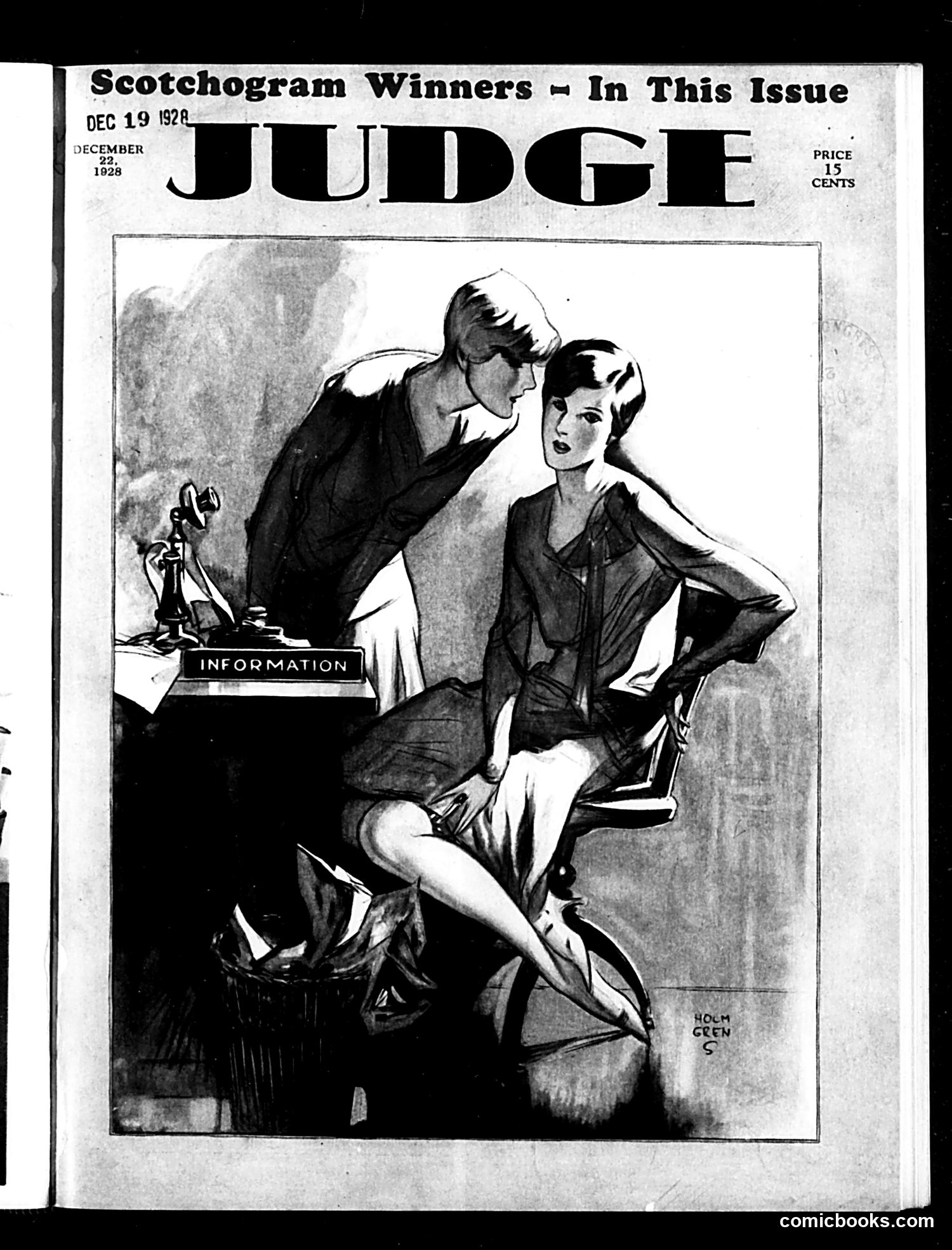
This cover depicts a office scene labeled "INFORMATION," featuring a man leaning toward a seated woman in what appears to be a flirtatious or inappropriately familiar manner. The woman maintains a reserved posture while the man gestures toward her. The satire likely comments on workplace dynamics and sexual harassment, a recurring theme in 1920s humor. The "Information" desk suggests this occurs in a public or commercial setting where such behavior would be improper. The woman's body language—turned away, formal dress—contrasts with the man's forward approach, emphasizing the discomfort of unwanted attention. This reflects Jazz Age anxieties about changing gender roles and workplace conduct during the post-suffrage era, when women were increasingly entering professional environments.
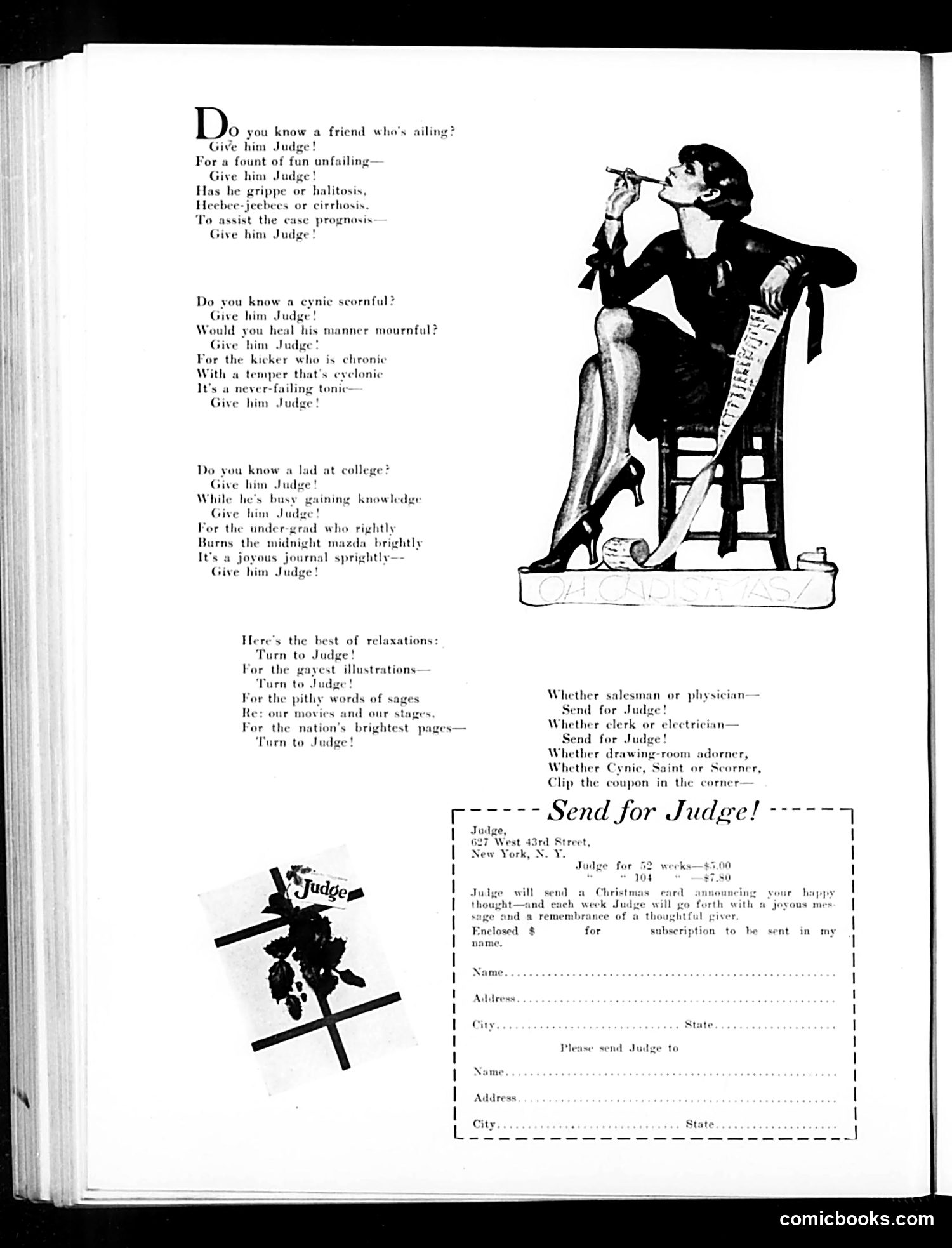
This is primarily a **subscription advertisement for Judge magazine itself**, disguised as humorous verse. The text uses repetitive rhyming couplets to promote Judge as entertainment for various people: the sick, cynics, college students, and others seeking "relaxation." The illustration shows a **fashionable woman in 1920s style** (short hair, heeled shoes, seated casually) reading Judge, emphasizing the magazine's appeal to modern audiences. The repeated refrain "Give him Judge!" or "Send for Judge!" is a sales pitch—the ad argues Judge magazine is the perfect gift or subscription for anyone needing humor and social commentary. The coupon at bottom allows readers to subscribe. This represents Judge's self-promotion strategy: positioning itself as essential entertainment and social satire for contemporary American readers.
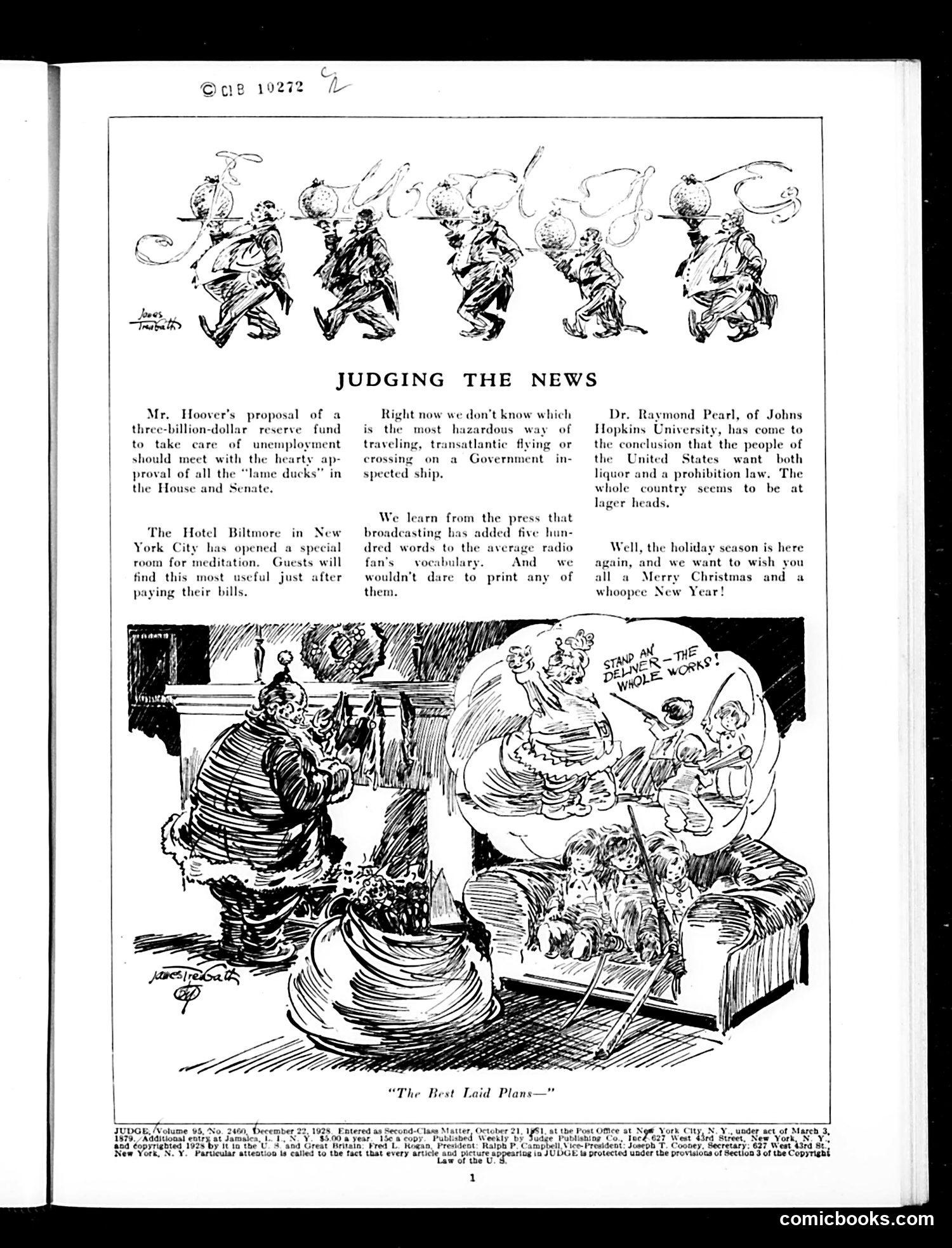
**The Main Cartoon ("The Best Laid Plans")** This cartoon satirizes ineffective holiday planning. A portly figure (likely representing a parent or authority figure) stands with a large sack, while children peek at what appears to be a thought bubble showing idealized holiday imagery labeled "STAND AT THE DECENT END WHOLE YEAR!" The satire suggests a gap between adults' well-intentioned plans for children's behavior during holidays and reality—children will misbehave regardless. The "best laid plans" of the title ironically references the notion that careful preparation often fails when children are involved. **The Text Section** The page includes brief commentary on current events: Hoover's reserve fund proposal, the Hotel Biltmore's meditation room, radio vocabulary expansion, and holiday wishes. These represent typical contemporary news items being humorously "judged."
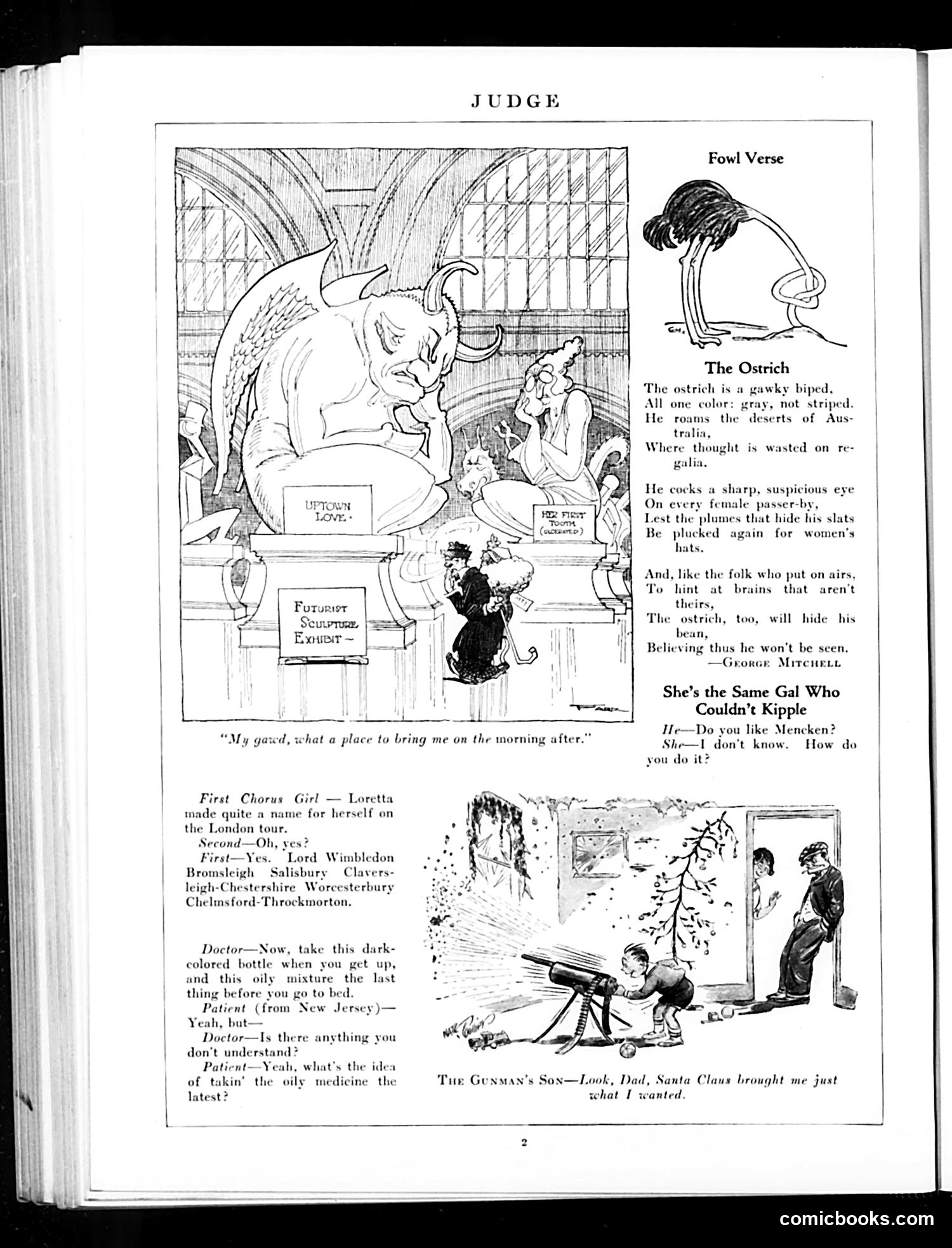
This page contains three separate humorous pieces typical of Judge's satirical content: 1. **Main cartoon**: Shows a large, grotesque figure labeled "UNICORN LOVE" with signs reading "MY FIRST LOVE" and "FUTURIST SCULPTURE." The satire appears to target avant-garde art movements (Futurism), mocking their abstract, incomprehensible aesthetic as pretentious nonsense. 2. **"The Ostrich" verse**: A poem satirizing ostriches' supposed habit of hiding their heads when threatened, using this as metaphor for willful ignorance—likely social commentary on people who avoid uncomfortable truths. 3. **"She's the Same Gal Who Couldn't Kipple"** and **"The Gunman's Son"**: Brief humor pieces playing on mundane domestic situations and comic misunderstandings. The page exemplifies Judge's characteristic blend of visual and textual satire targeting artistic pretension and social folly.
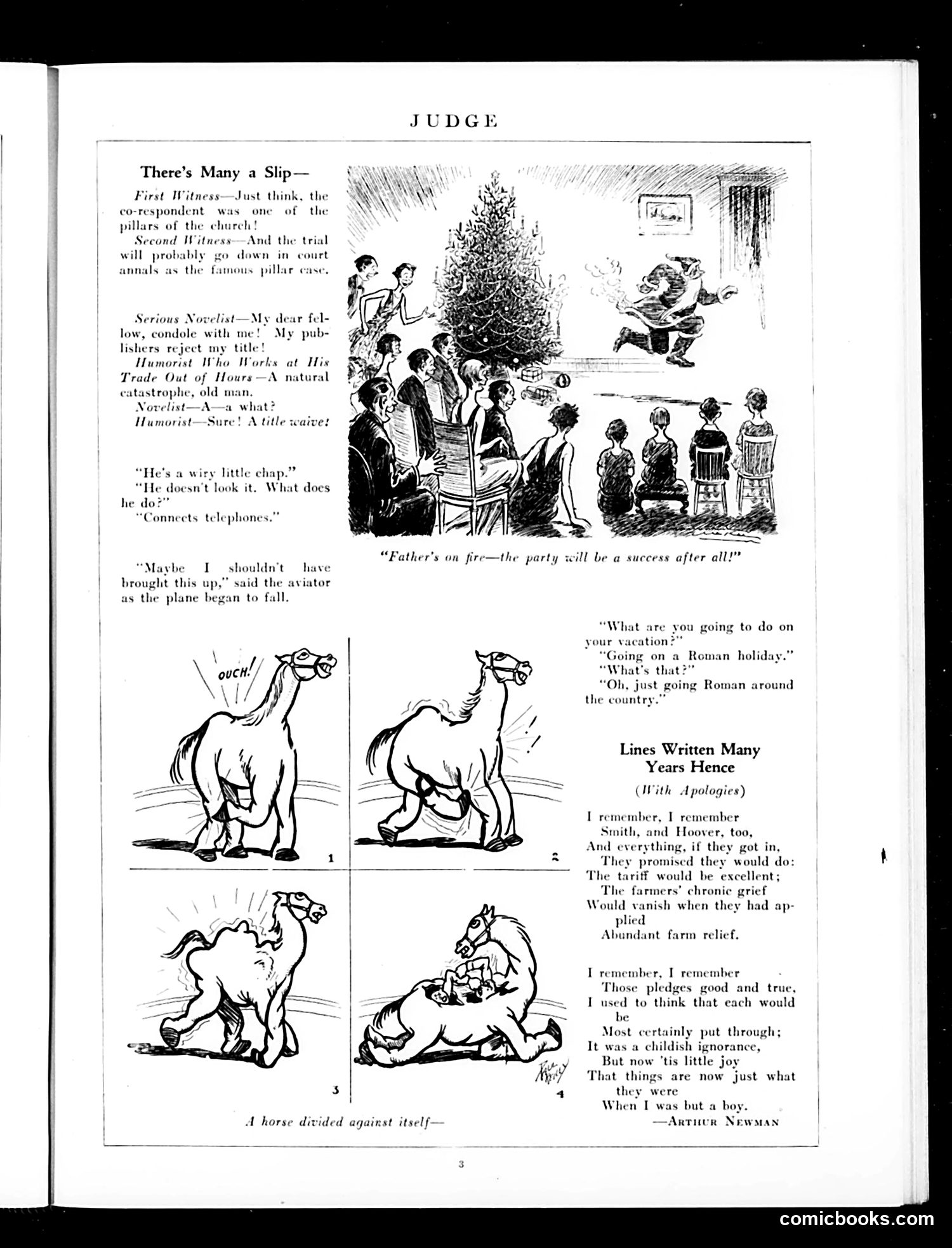
This page contains several distinct satirical pieces from Judge magazine: **"There's Many a Slip"** mocks a church trial, likely referencing a famous ecclesiastical scandal where a prominent pillar of the church faced legal proceedings. **The Christmas tree cartoon** depicts a family gathering where someone worries the party will fail—visual humor about domestic anxiety. **"A Horse Divided Against Itself"** shows a camel progressively falling apart through four panels, illustrating the phrase "a house divided against itself cannot stand"—possibly political commentary on internal conflict or party divisions. **"Lines Written Many Years Hence"** is a nostalgic poem by Arthur Newman lamenting broken political promises about tariffs and farm relief, suggesting disappointment with unfulfilled campaign pledges—likely from the 1920s era. The page blends topical politics with domestic humor typical of Judge's satirical approach.
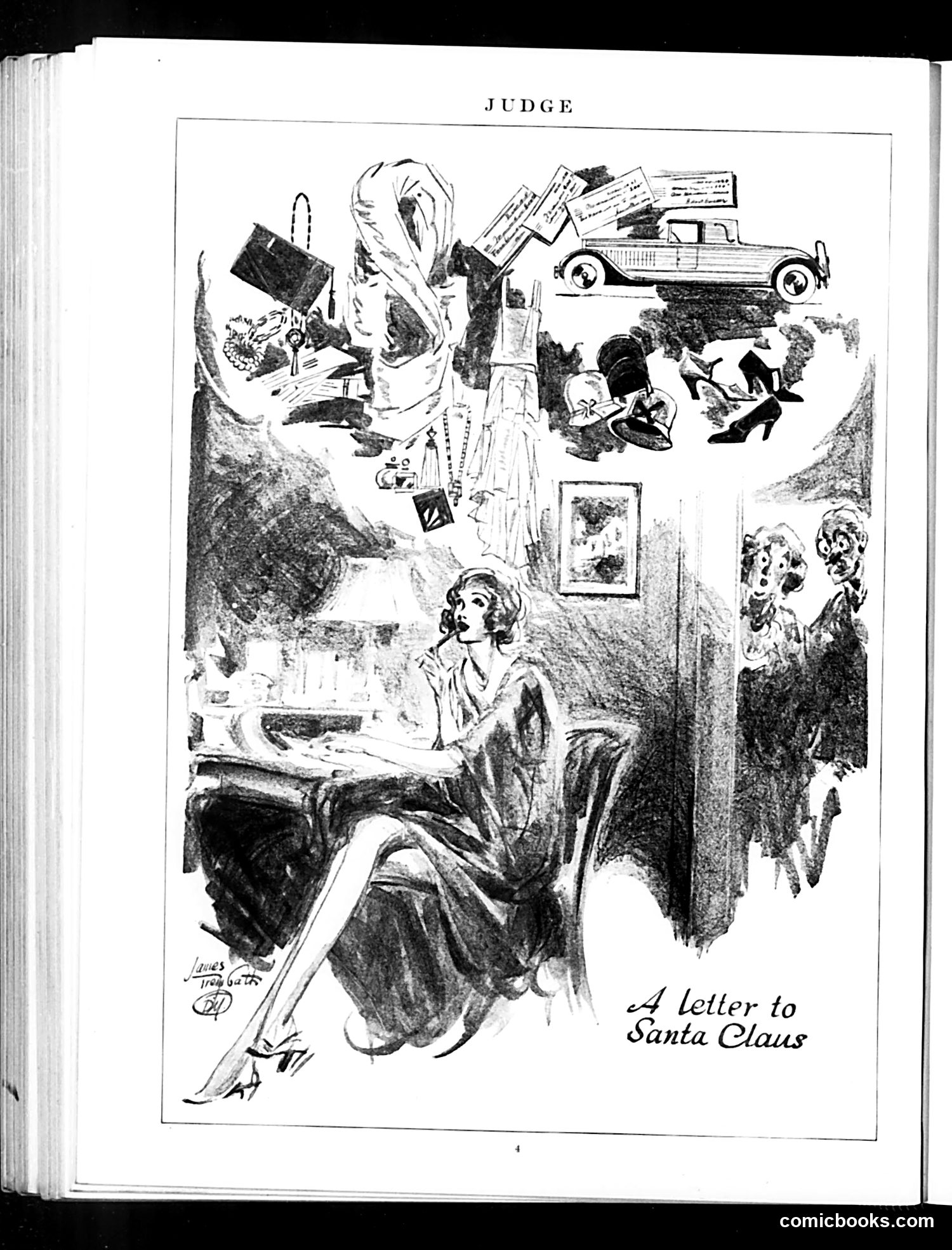
This satirical illustration depicts a woman writing to Santa Claus while surrounded by chaos representing modern consumer desires and anxieties. The surreal imagery floating above her—a giant woman's face, automobiles, stacks of papers/bills, scattered figures—suggests the overwhelming material expectations and financial pressures of contemporary life. The satire critiques how Christmas gift-giving has become entangled with consumer culture and financial burden. The woman's earnest letter to Santa contrasts with the adult reality of expenses, debts, and impossible wishes depicted around her. Judge magazine uses this to mock the gap between childhood innocence and adult economic struggle, particularly relevant during the early-to-mid 20th century when consumer culture was rapidly expanding and holiday spending created genuine financial stress for many families.
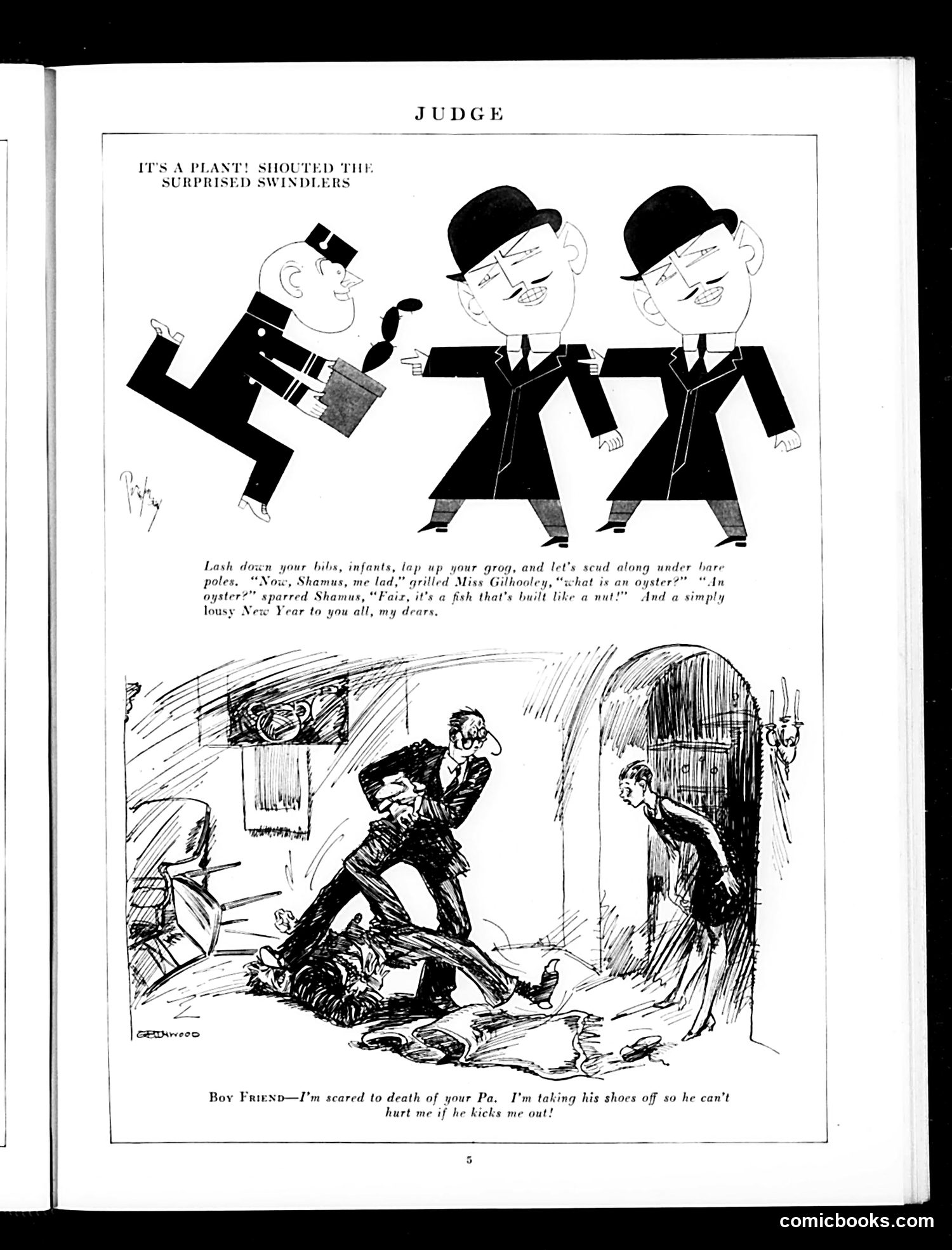
**Top Cartoon:** Three men in top hats catch a fourth man mid-fall, exclaiming "It's a plant! Shouted the surprised swindlers." The dialogue references New Year's resolutions about self-improvement ("lash down your bills, infants, top up your grog"). The joke appears to satirize con artists or fraudsters being caught off-guard—the irony being that *they* are duped, not their marks. **Bottom Cartoon:** A boy stands over a prone man (presumably his father), removing the man's shoes. The caption reads: "Boy Friend—I'm scared to death of your Pa. I'm taking his shoes off so he can't hurt me if he kicks me out!" This depicts a visiting suitor intimidated by a stern father-figure, using comedic cowardice—literally disarming the threat by stealing footwear to prevent being physically expelled. It satirizes paternal authority and courting anxieties common in early 20th-century humor.
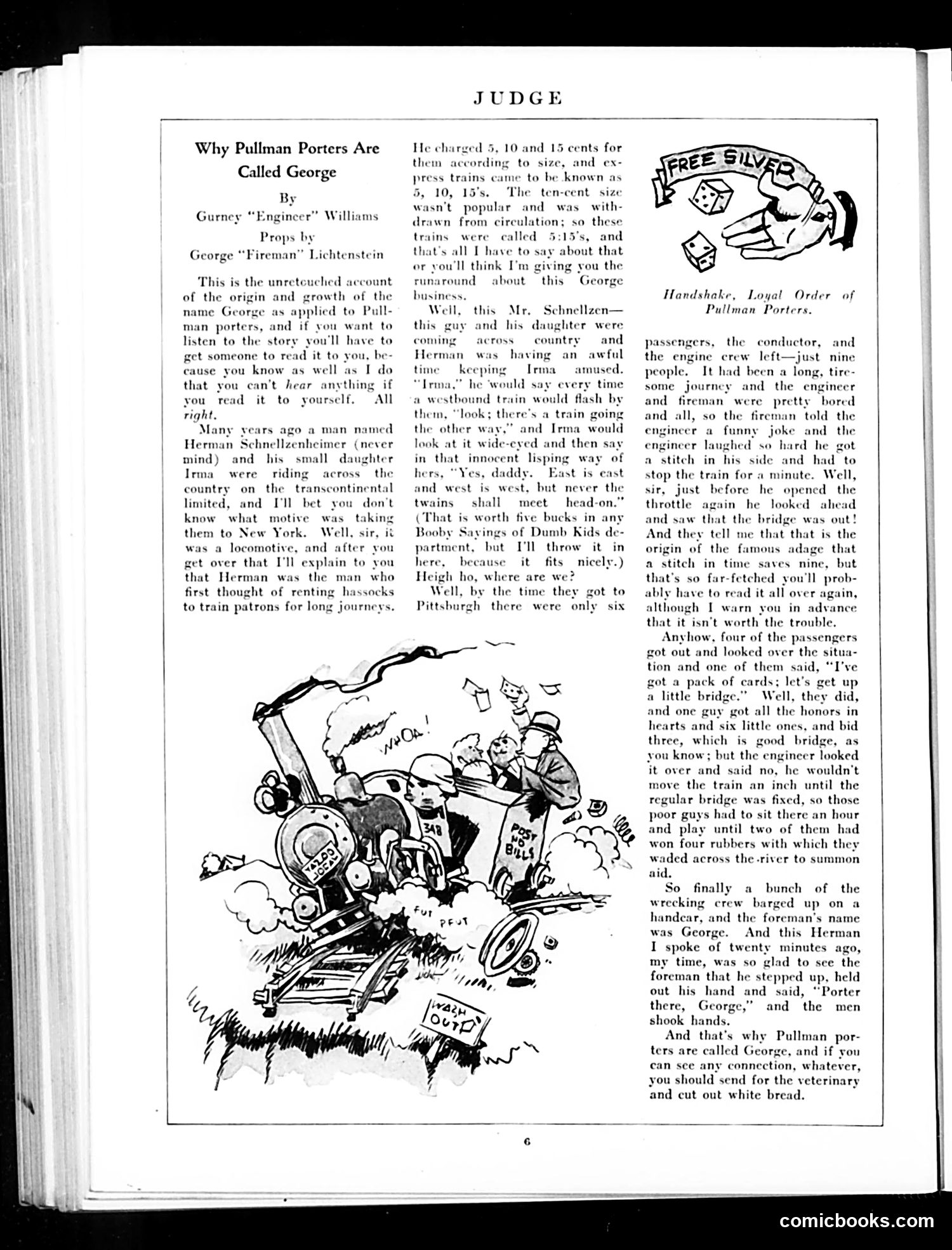
This humorous tall tale explains the origin of calling all Pullman porters "George." The story, ostensibly narrated by "Engineer" Williams with props by "Fireman" Lichtenstein, follows Herman Schnellzenheimer and his daughter Irma on a transcontinental train journey. The narrative meanders through absurd digressions—including how express trains earned numbered designations from hassock rentals—before reaching the punchline: a train bridge fails near Pittsburgh. Stranded passengers play bridge (the card game) while a wrecker's foreman named George fixes it. When Herman gratefully shakes the foreman's hand, calling him "Porter there, George," this supposedly established the custom of addressing all Pullman porters as "George." The cartoon illustrates a train disaster with chaotic imagery. The entire piece is deliberately nonsensical—filled with non-sequiturs and absurd logic—reflecting Judge magazine's satirical style. The real historical context remains unclear from the text alone.
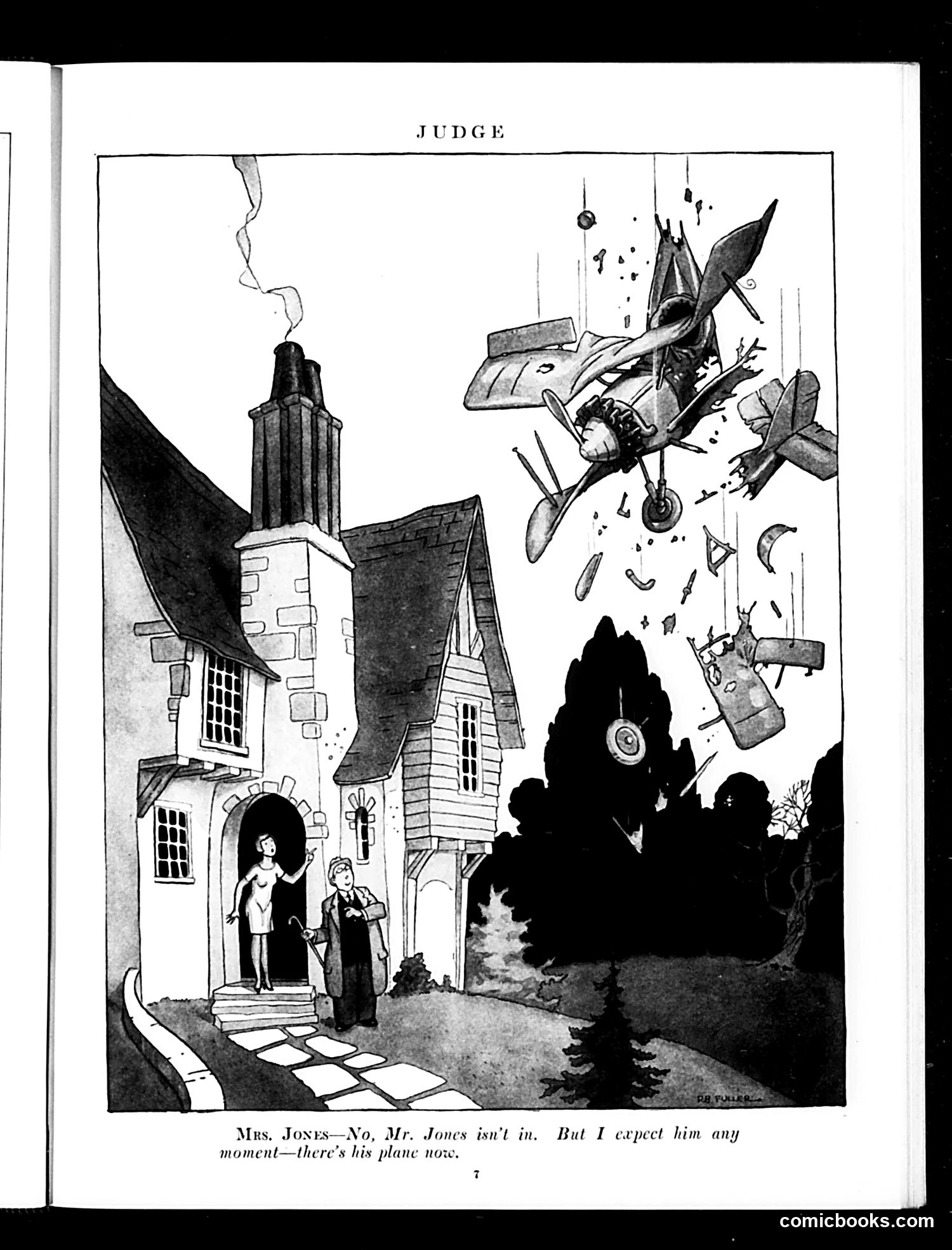
This is a single-panel cartoon titled "Judge" depicting a domestic scene with dark satire. A woman (Mrs. Jones) stands at the doorway of a cottage speaking to visitors, while above, a military aircraft is crashing in flames and debris near the house. The joke's bitter humor relies on the contrast between her casual, matter-of-fact statement that her husband will arrive "any moment" and the obvious catastrophe occurring overhead—his plane is actively falling from the sky in pieces. The cartoon appears to satirize either wartime anxieties or the dangerous nature of early aviation, treating a fatal plane crash with grim comedic understatement. The woman's composed demeanor in the face of disaster amplifies the dark humor. Without a visible date, the specific historical context—whether WWI, WWII, or interwar aviation—remains unclear.
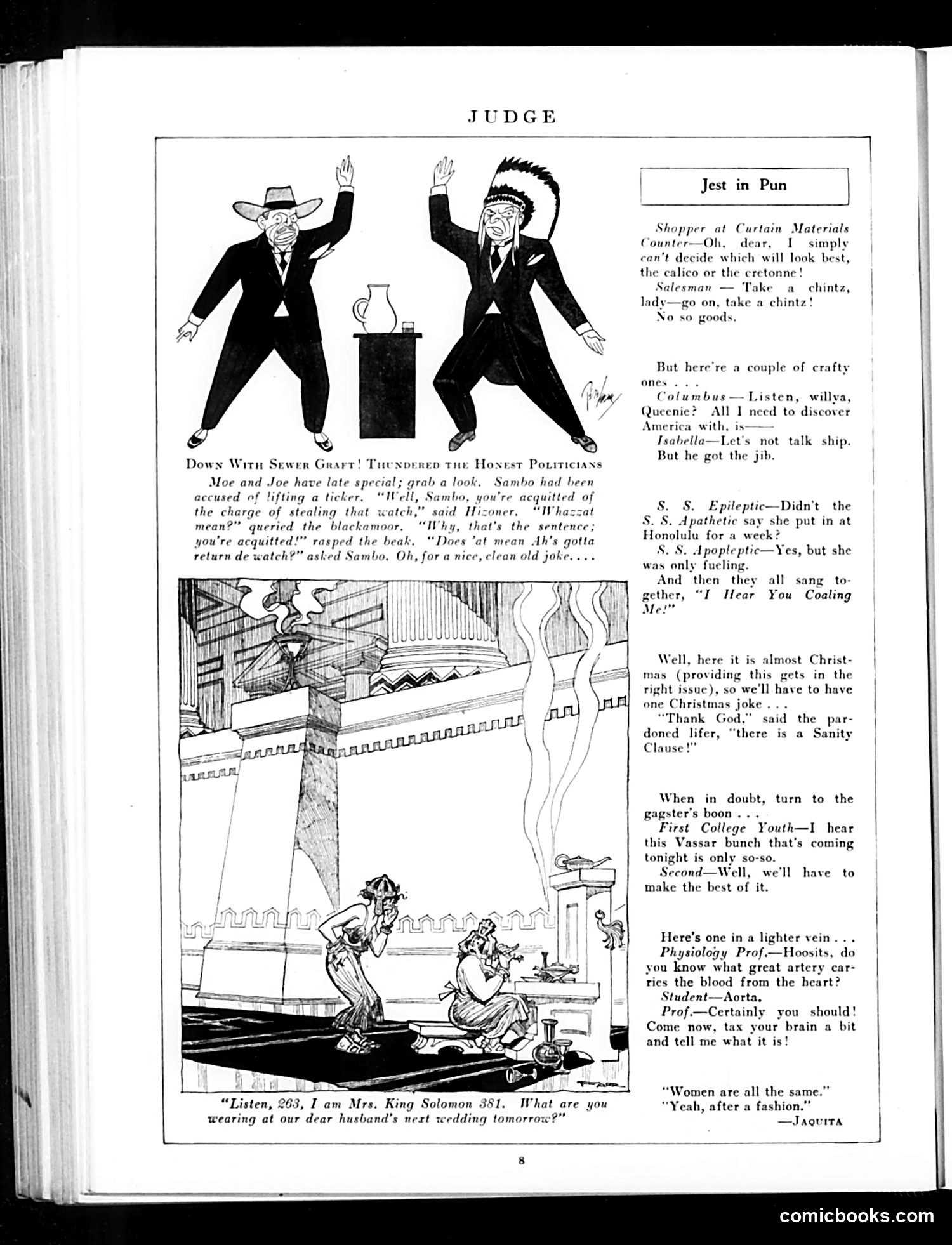
This page from *Judge* presents early 20th-century American humor through multiple short jokes and cartoons. The top cartoon mocks political corruption with two caricatured figures labeled as "honest politicians" engaging in obvious graft—the ironic title undercuts their pretense of integrity. Below that, a racist joke depicts "Sambo," a Black man, misunderstanding legal acquittal as permission to return a stolen watch. This reflects the deeply offensive racial stereotyping common in period comedy. The right column collects brief puns and one-liners playing on words: "chintz/hints," ship/jib wordplay, ship names (SS Epileptic, Apathetic, Apopleptic) as double-entendres, and anatomical humor. A "Sanity Clause" Christmas joke puns on "Santa Claus." The bottom cartoon appears to show a woman asking another about wedding attire in a polygamous situation, playing on the "King Solomon" reference to multiple wives. The humor relies on wordplay, racial caricature, and sexual innuendo typical of *Judge's* satirical approach—much of which would be considered offensive today.
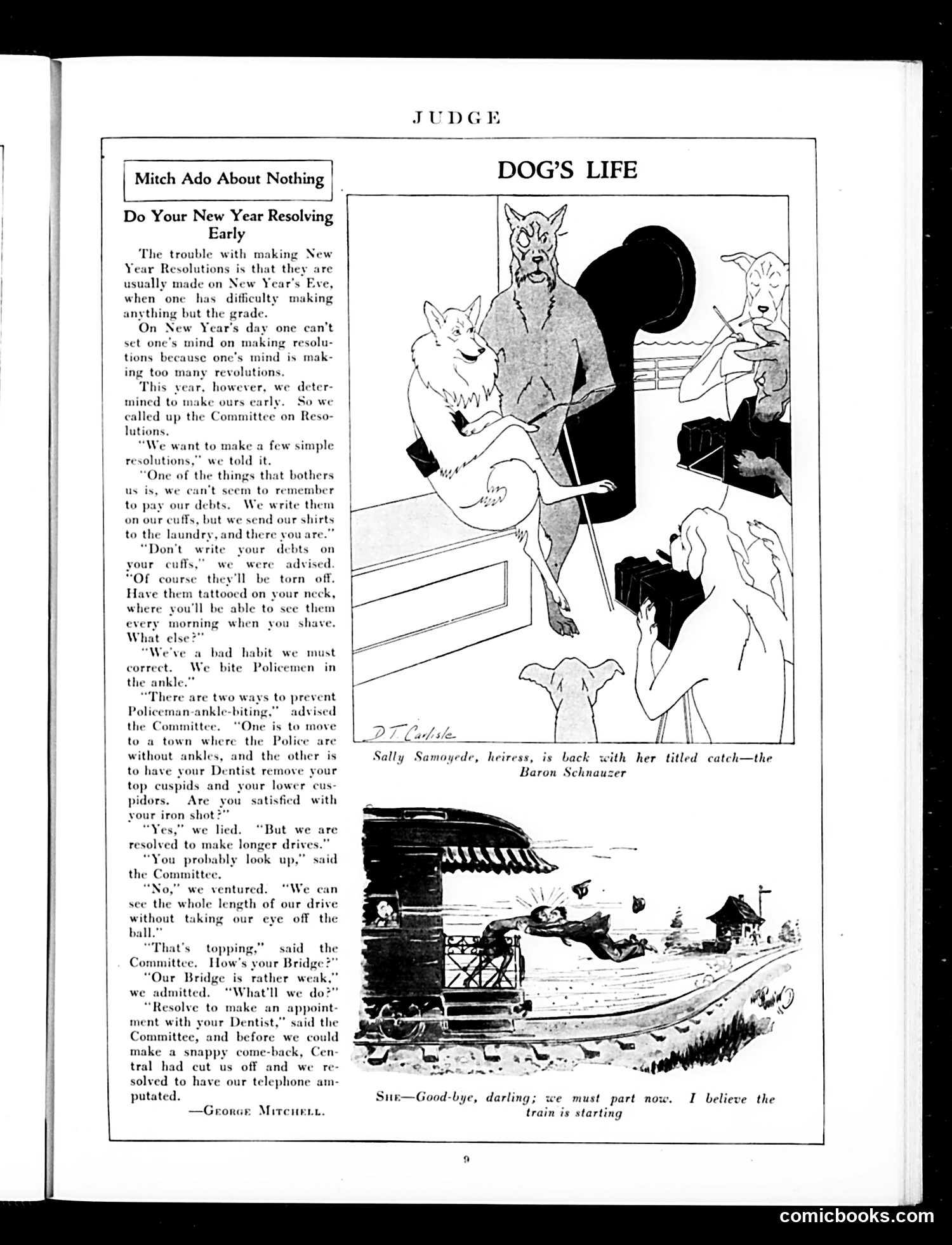
This page contains two satirical pieces from *Judge* magazine: **"Do Your New Year Resolving Early"** (left): A humorous article mocking New Year's resolutions and absurd self-help advice. The author consults a "Committee on Resolutions" that offers deliberately ridiculous solutions—tattooing debts on one's neck, moving to towns without police, removing teeth to stop biting officers, and amputating the telephone. The satire targets the futility of resolutions and the absurdity of contemporary advice-giving culture. **"Dog's Life"** (right): Two cartoon panels illustrating the phrase "dog's life"—meaning a miserable existence. The top panel shows a dog managing a household of bickering people and animals. The bottom panel depicts a dog being abandoned at a train station by its titled, wealthy owner (a "baroness" with a "baron" husband). The satire mocks the wealthy's casual cruelty to animals and suggests that even prestigious ownership doesn't spare dogs mistreatment. Both pieces use humor to critique contemporary American society, manners, and class behavior.
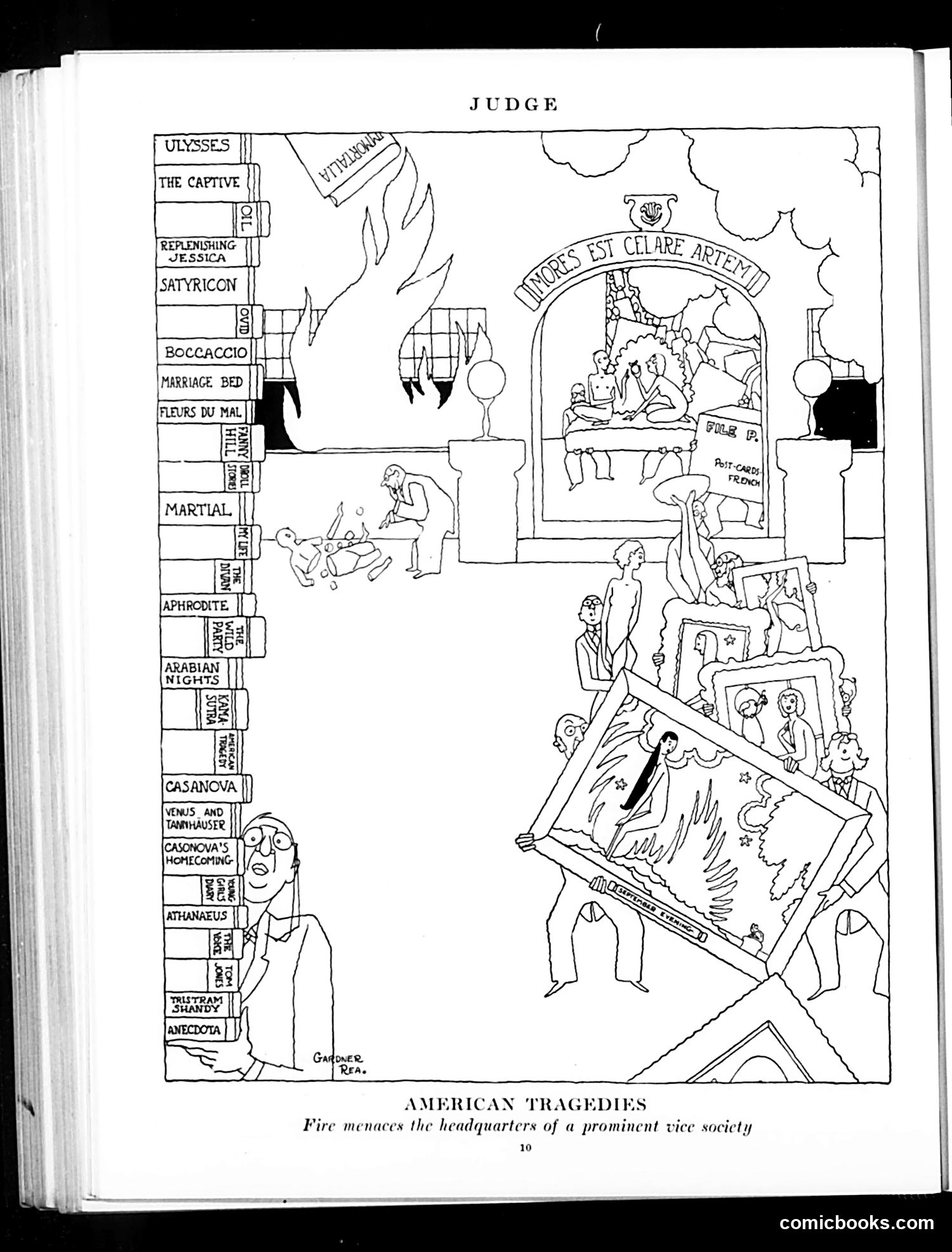
This cartoon satirizes American "vice societies"—moral reform organizations that campaigned against perceived social evils like gambling, prostitution, and obscenity. The joke is darkly ironic: fire is destroying the headquarters of such an organization, shown as a multi-story building labeled with various classical literary works (Ulysses, Satyricon, Casanova, etc.)—texts these groups typically sought to censor or ban. The cartoon mocks the contradiction between these societies' stated moral missions and the reality that they must extensively study the "immoral" materials they condemn. The burning building filled with banned literature suggests the futility or absurdity of censorship efforts. The figure on the left appears to be a distraught reformer witnessing the destruction of confiscated materials, making this a critique of puritanical activism popular during Judge's era.
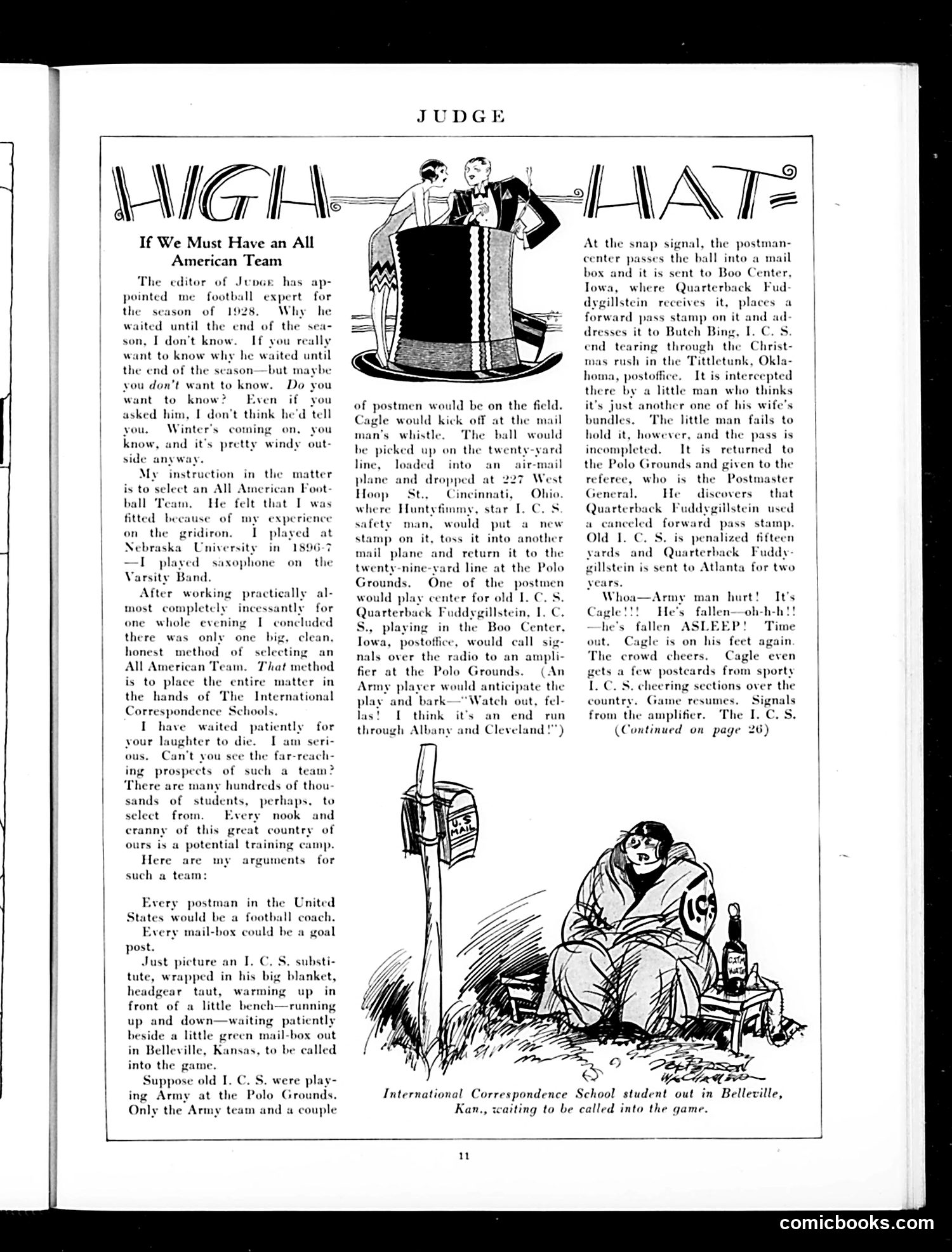
This 1928 Judge satire mocks the International Correspondence Schools (I.C.S.), a popular mail-order education company, by proposing an absurd all-American football team composed entirely of I.C.S. students and postal workers. The joke imagines football plays executed through the mail system: footballs stamped and posted between cities, postmen serving as coaches and referees, mailboxes as goal posts, and a quarterback broadcasting plays via radio from Iowa. The author ridicules both I.C.S.'s grandiose claims about training talent nationwide and the impracticality of distant education. References include the 1928 Army football team and player Cagle. The cartoon illustrates an I.C.S. student in Belleville, Kansas waiting to be "called into the game"—a visual pun on mail-order participation. The satire targets corporate overreach and the dubious promise that correspondence schools could develop genuine athletic or professional expertise without hands-on training.
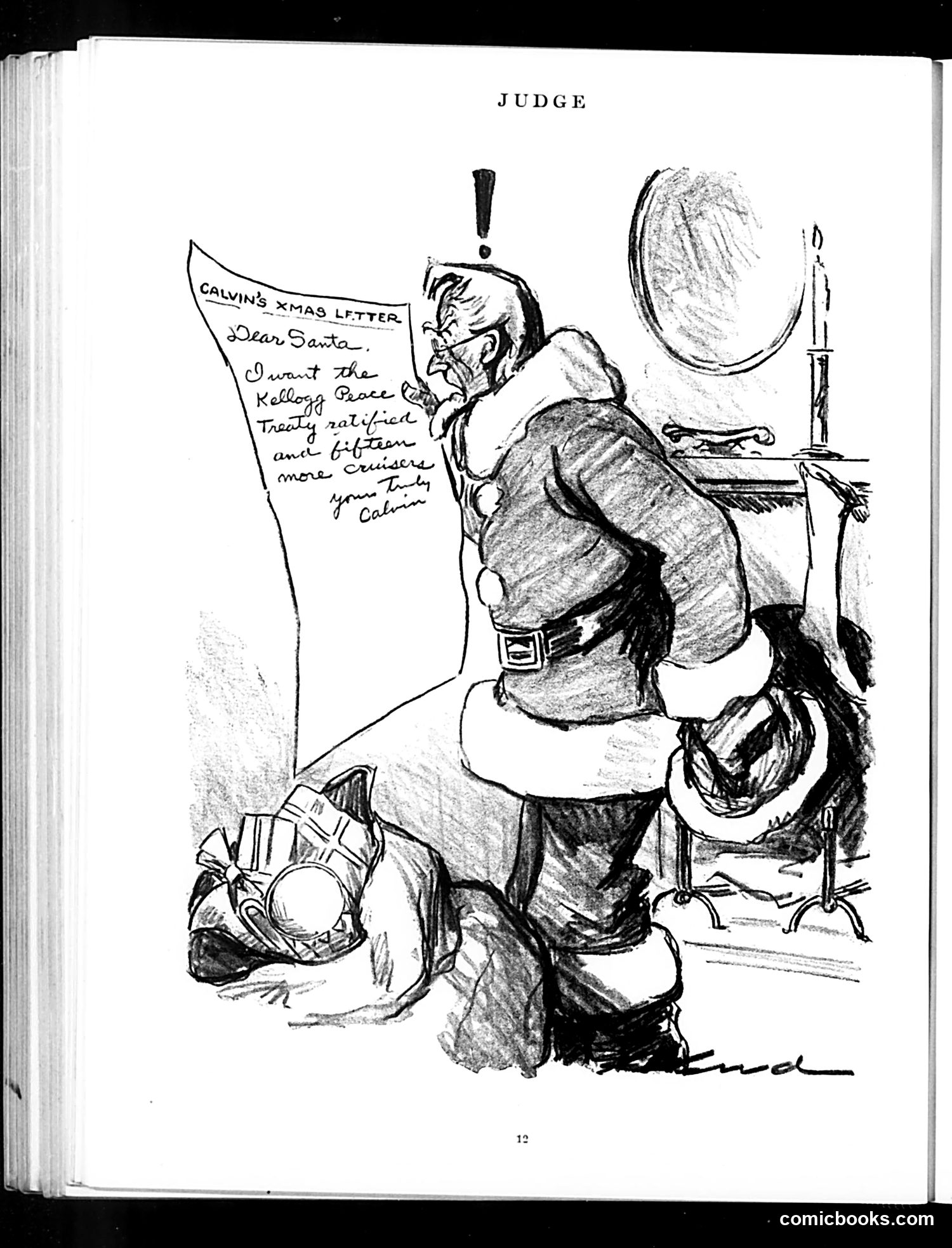
This political cartoon titled "Judge" depicts a menacing figure dressed as Santa Claus, holding Calvin's Christmas letter to Santa. The letter reads: "Dear Santa, I want the Kellogg Peace Treaty ratified and bitted into more pleasure your truly Calvin." The satire targets Calvin Coolidge (U.S. President 1923-1929), caricatured as a malevolent Santa. The joke critiques Coolidge's push for the Kellogg-Briand Pact (a treaty renouncing war as foreign policy). The artist suggests Coolidge's Christmas "wish" for this treaty's ratification is naive or sinister—depicting peace efforts with a twisted, villainous Santa implies skepticism about the treaty's effectiveness or motives. The cartoon reflects contemporary political debate over American isolationism and international peace agreements.
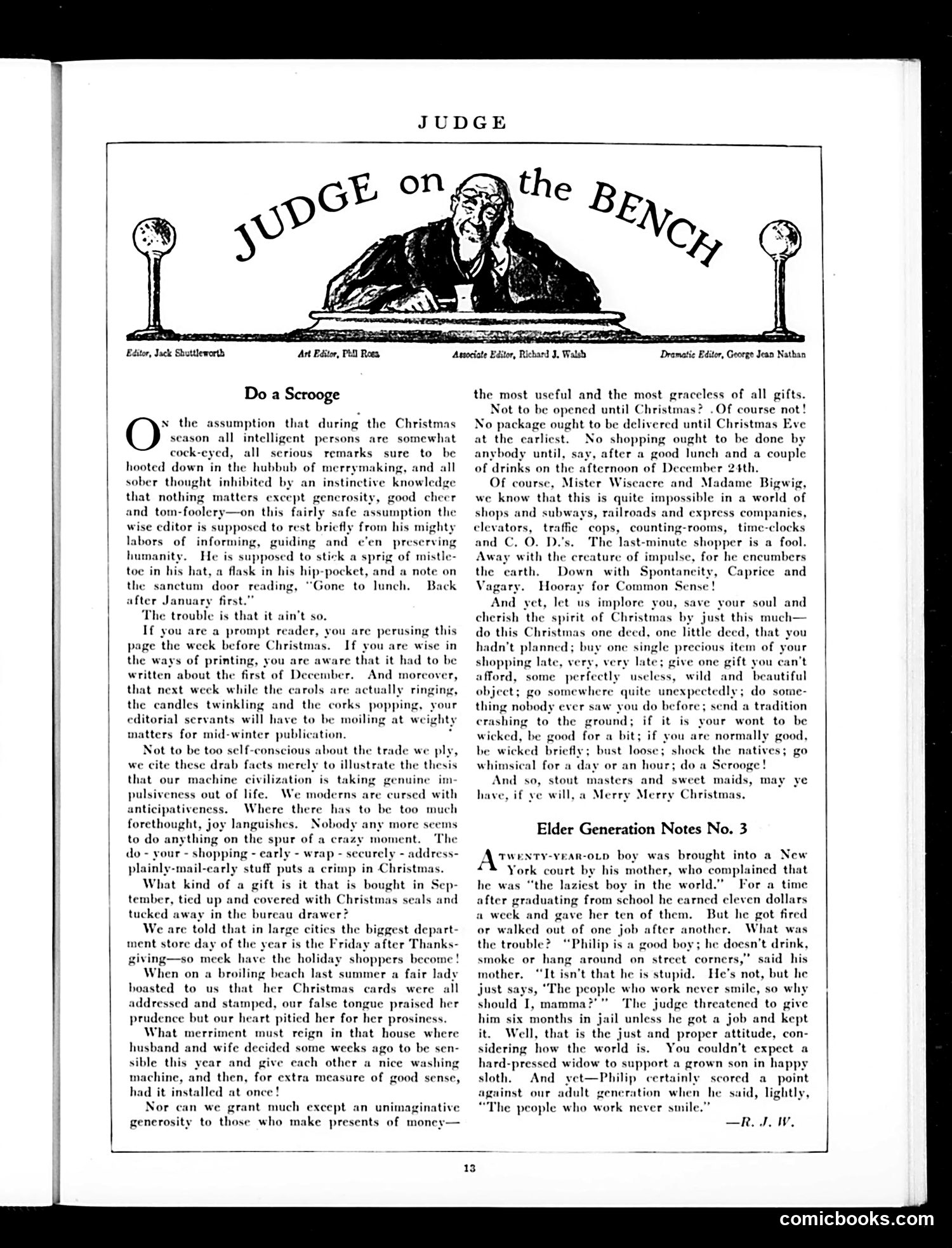
This is a satirical editorial by Judge magazine's editor attacking modern consumer culture's destruction of Christmas spontaneity. The piece criticizes how industrialized society forces people to plan holidays months in advance—buying gifts in September, mailing cards early, scheduling everything—which kills genuine Christmas spirit. The satire targets "intelligent persons" who shop rationally rather than impulsively. The editor mocks those who give practical gifts (washing machines) or money instead of surprising, frivolous purchases. He specifically ridicules the "last-minute shopper" as a fool, yet advocates for *genuine* last-minute shopping (December 24th after drinks) as the only way to preserve Christmas joy. The irony is biting: the editor acknowledges modern logistics make spontaneity impossible, yet demands it anyway. The headline figure is a stern "judge" overseeing this critique of modern life's over-planning. This reflects early 20th-century anxieties about mechanization eroding traditional values.
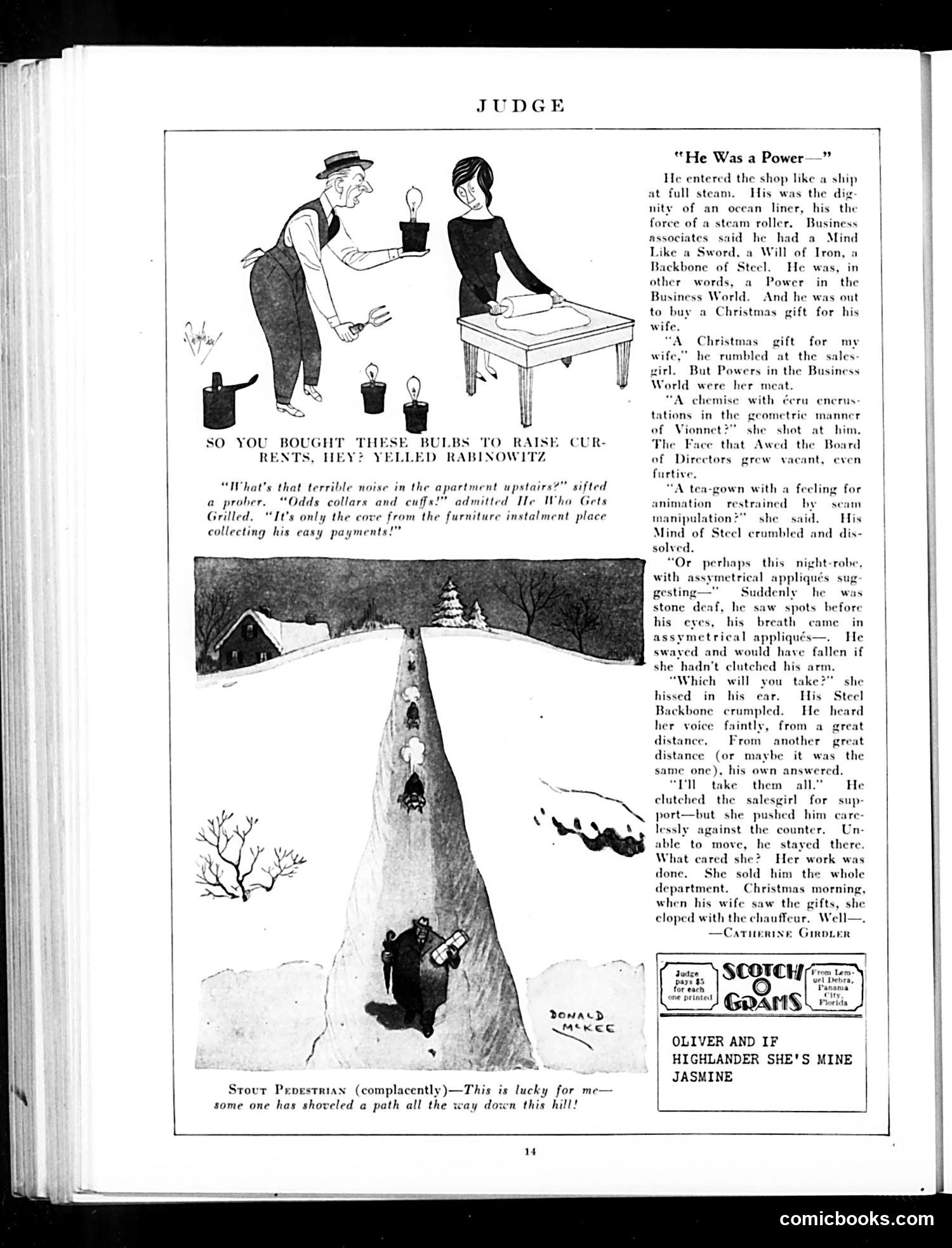
This satirical story mocks the arrogance of a powerful businessman ("a Power in the Business World") who enters a shop with domineering confidence. The salesman attempts to sell him high-fashion women's garments (chemises, tea-gowns, nightrobes by designer Vionnet), using sophisticated terminology about asymmetrical appliqués. The joke: each refined fashion description renders the tough businessman literally helpless—he goes deaf, sees spots, nearly faints. He's completely undone by aesthetic/feminine sophistication he cannot comprehend. Overwhelmed and embarrassed, he purchases the entire department just to escape. The satire targets masculine business-world posturing being exposed as hollow when confronted with intellectual or artistic domains outside male dominance. The dark twist ending—his wife elopes with the chauffeur upon receiving these gifts—suggests the fashionable garments (or his pathetic weakness) doom his marriage. The cartoon uses the businessman's collapse to mock aggressive capitalist masculinity as fragile theater.
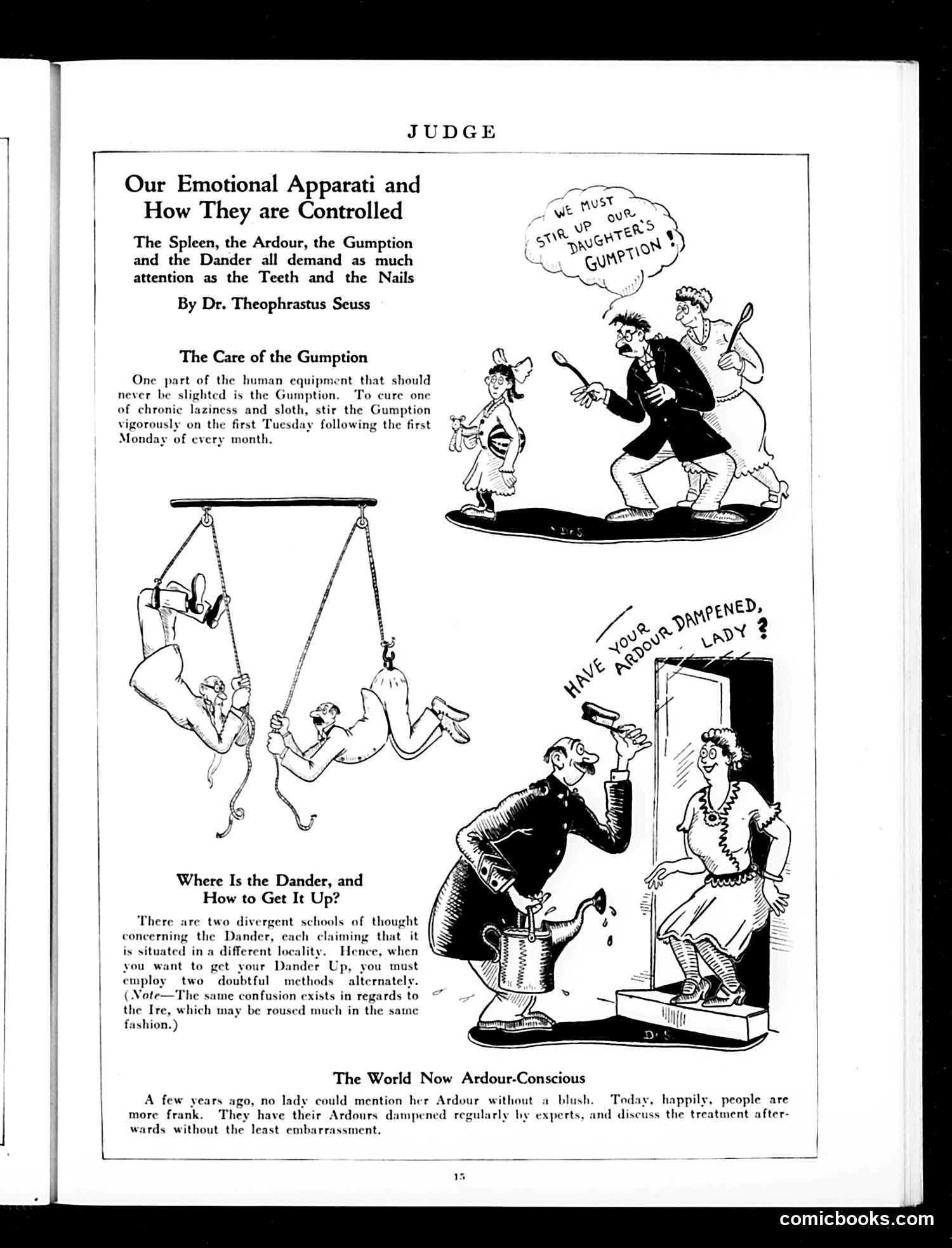
This is a humorous pseudoscientific article attributed to "Dr. Theophrastus Seuss" (likely a playful pen name) satirizing early 20th-century medical and self-help fads. The piece mocks pseudoscientific theories about emotions and body parts by inventing fake anatomical concepts—"Gumption," "Dander," and "Ardour"—and presenting ridiculous "treatments" as serious medical advice. The cartoons illustrate absurd remedies: stirring the Gumption vigorously, and dampening one's Ardour through mysterious "expert" interventions. The satire targets contemporary trends toward medicalizing everyday emotional problems and the era's frank discussion of previously taboo subjects like female desire ("Ardour"). The joke relies on treating invented medical nonsense with deadpan seriousness, poking fun at how readily people accept dubious health claims.
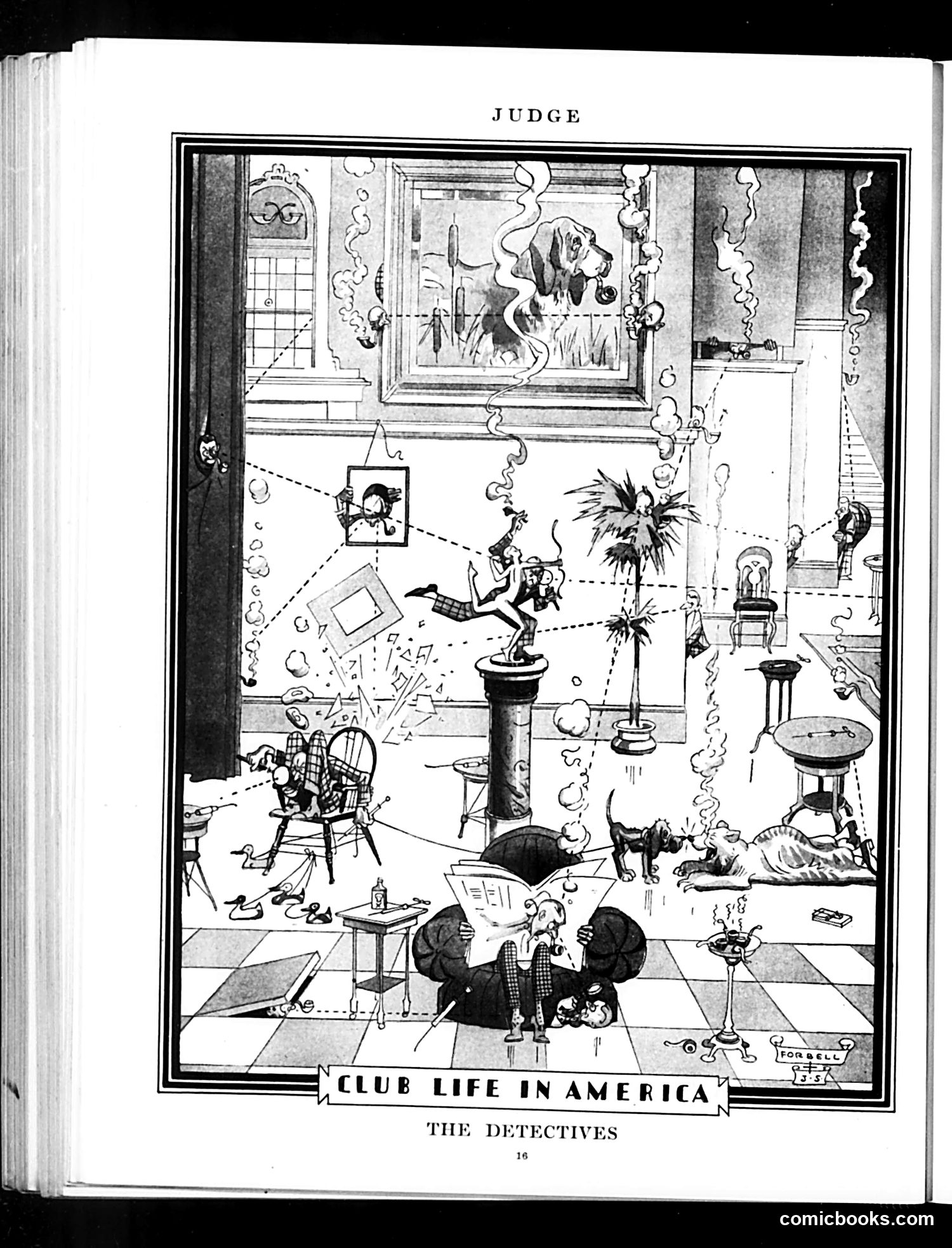
This satirical illustration depicts a chaotic courtroom or judicial chamber where detectives are supposedly investigating various social vices of American club life. The cartoon shows: - A central figure (likely a judge) at a desk surrounded by absurd chaos - Multiple figures engaging in frivolous activities: people swinging from decorations, lounging, socializing - References to excess and indulgence through scattered bottles and leisure pursuits - Decorative serpentine streamers suggesting festivity or decadence The satire appears to mock both the detective's supposed inability to control disorder within exclusive American clubs and the clubs themselves as spaces of moral laxity. The "detectives" seem ineffectual against the pervasive culture of excess. This likely reflects early-20th-century anxieties about club culture, wealth, and social propriety among the upper classes.
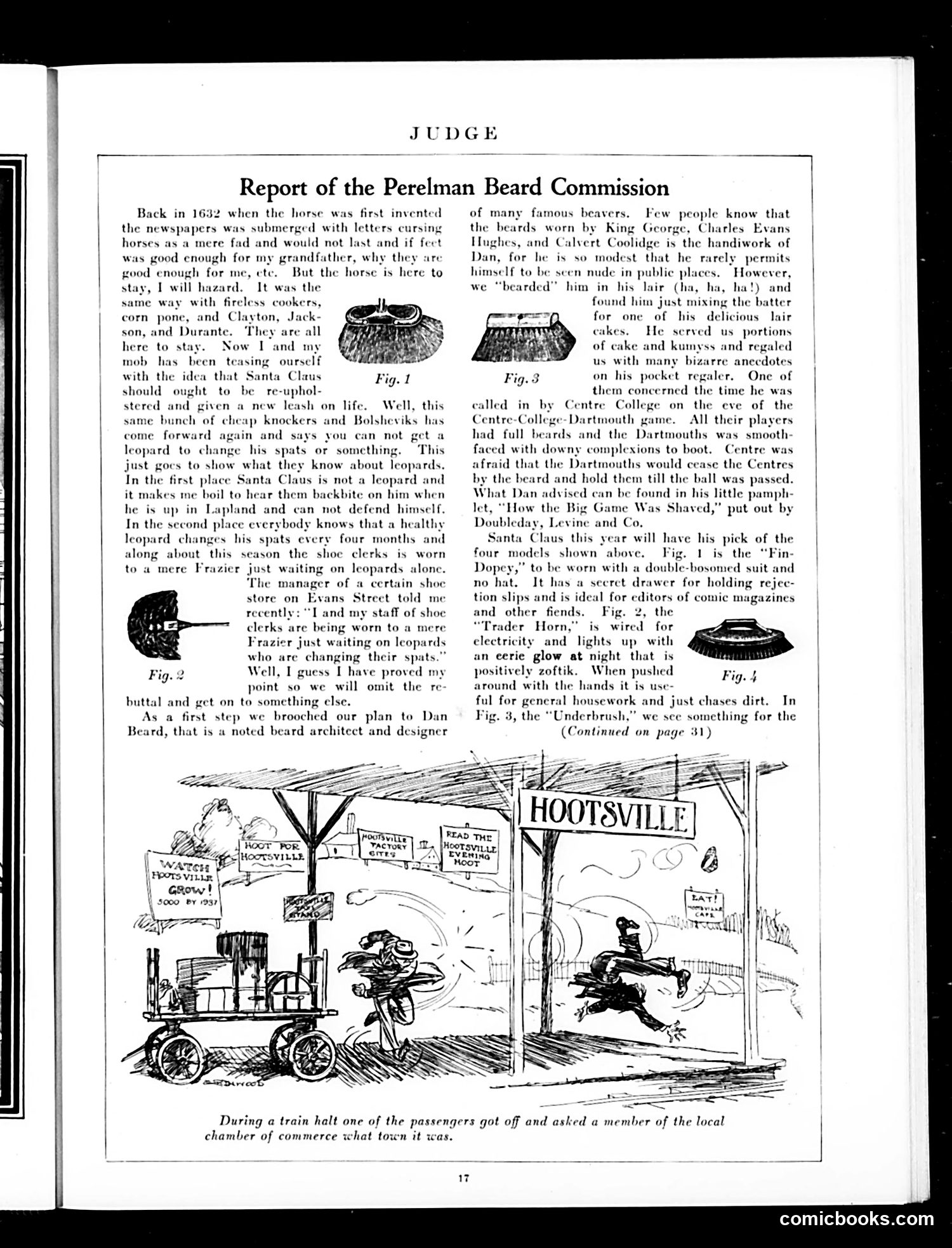
This is a humorous satirical piece mocking the absurdity of "expert commissions" and modernization debates. The author creates a fictional "Perelman Beard Commission" to propose redesigning Santa Claus's beard—treating a beloved, unchanging tradition as a problem requiring expert intervention. The satire targets two things: First, the resistance to progress (comparing beard redesign to historical objections to horses and "fireless cookers"). Second, the pretentiousness of self-proclaimed experts like "Dan Beard, beard architect and designer," who supposedly advised college football teams on shaving strategy before games. The illustrated beard models ("Dopey," "Trader Horn," "Underbrush") with absurd features (secret drawers for rejection slips, electrical wiring) mock impractical "modern design" solutions. The Hootsville cartoon below likely continues the joke about misguided innovation. The humor relies on treating the trivial as serious and the ridiculous as expert opinion—classic satirical deflation of authority and progress-worship.
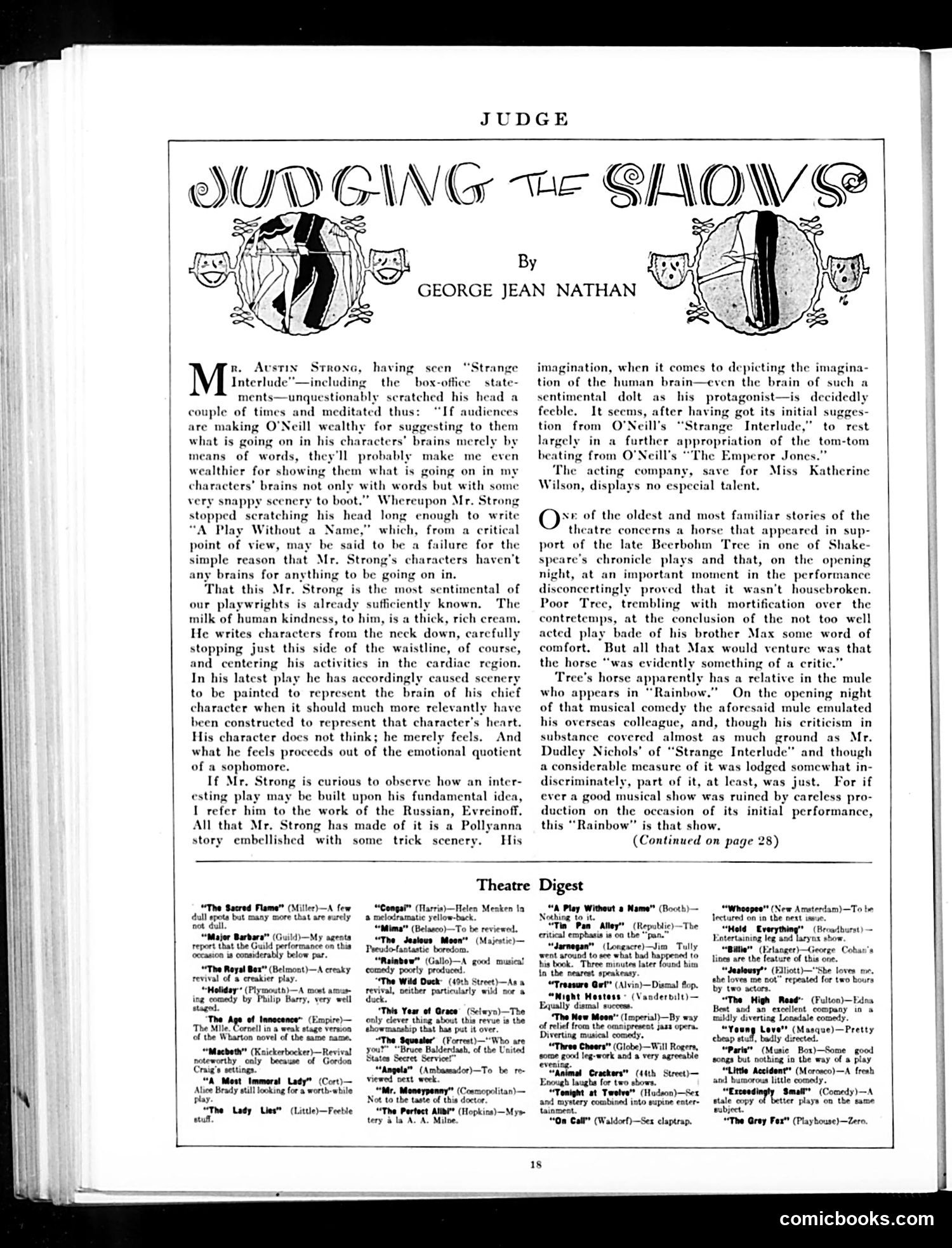
This page features George Jean Nathan's theater criticism, mocking playwright Austin Strong's new work "A Play Without a Name." Nathan's central jab: Strong copied Eugene O'Neill's successful innovation of depicting characters' internal thoughts, but lacks O'Neill's sophistication. Strong's characters, Nathan argues, don't actually *think*—they merely *feel* with sophomoric sentimentality, focusing on emotion rather than intellect. The critique references a famous anecdote about actor Beerbohm Tree and a horse that misbehaved on stage, using it to segue into criticizing the musical "Rainbow," whose opening-night performance was reportedly sabotaged by an untrained mule—suggesting even animals offered valid criticism of the production's quality. Nathan's wit lies in treating theatrical failures as almost deserving of animal commentary.
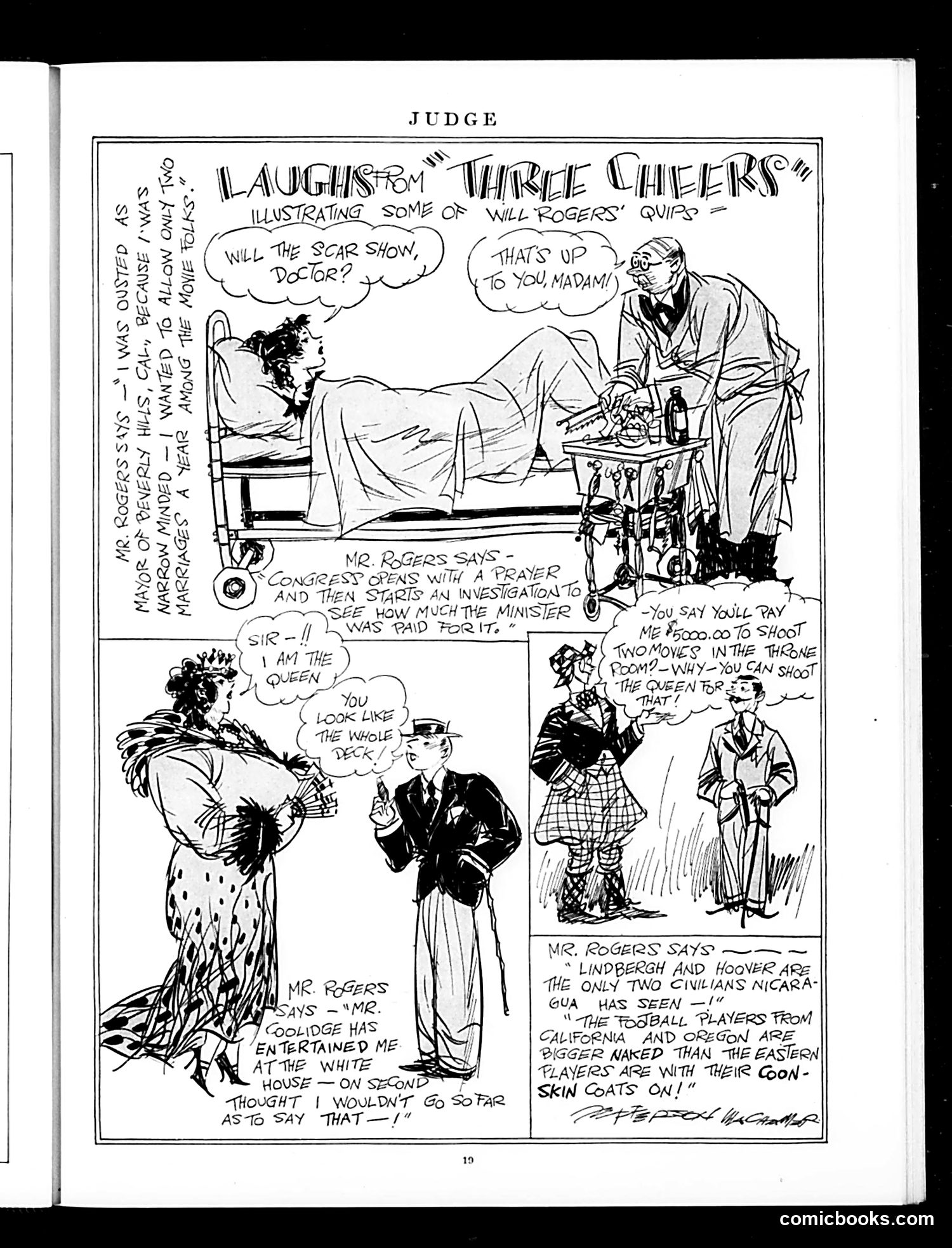
This page satirizes **Will Rogers**, the famous American humorist and political commentator of the 1920s-30s. The cartoon illustrates Rogers' characteristic quips—witty observations about politics and society delivered with folksy humor. The jokes target political figures and events: Congress's religious hypocrisy (praying before investigating ministerial corruption), comparisons between celebrities (Lindbergh and Hoover as Nicaragua's only known American civilians), and physical observations about football players from different regions. The opening anecdote references Rogers being ousted from a Beverly Hills mayoral position for being "narrow-minded"—likely satirizing small-town politics and celebrity involvement in civic affairs. The page captures Rogers' appeal: seemingly innocent observations that cleverly mock politicians, government inefficiency, and social pretension. For modern readers, this represents early 20th-century American political satire through a beloved public figure's voice.
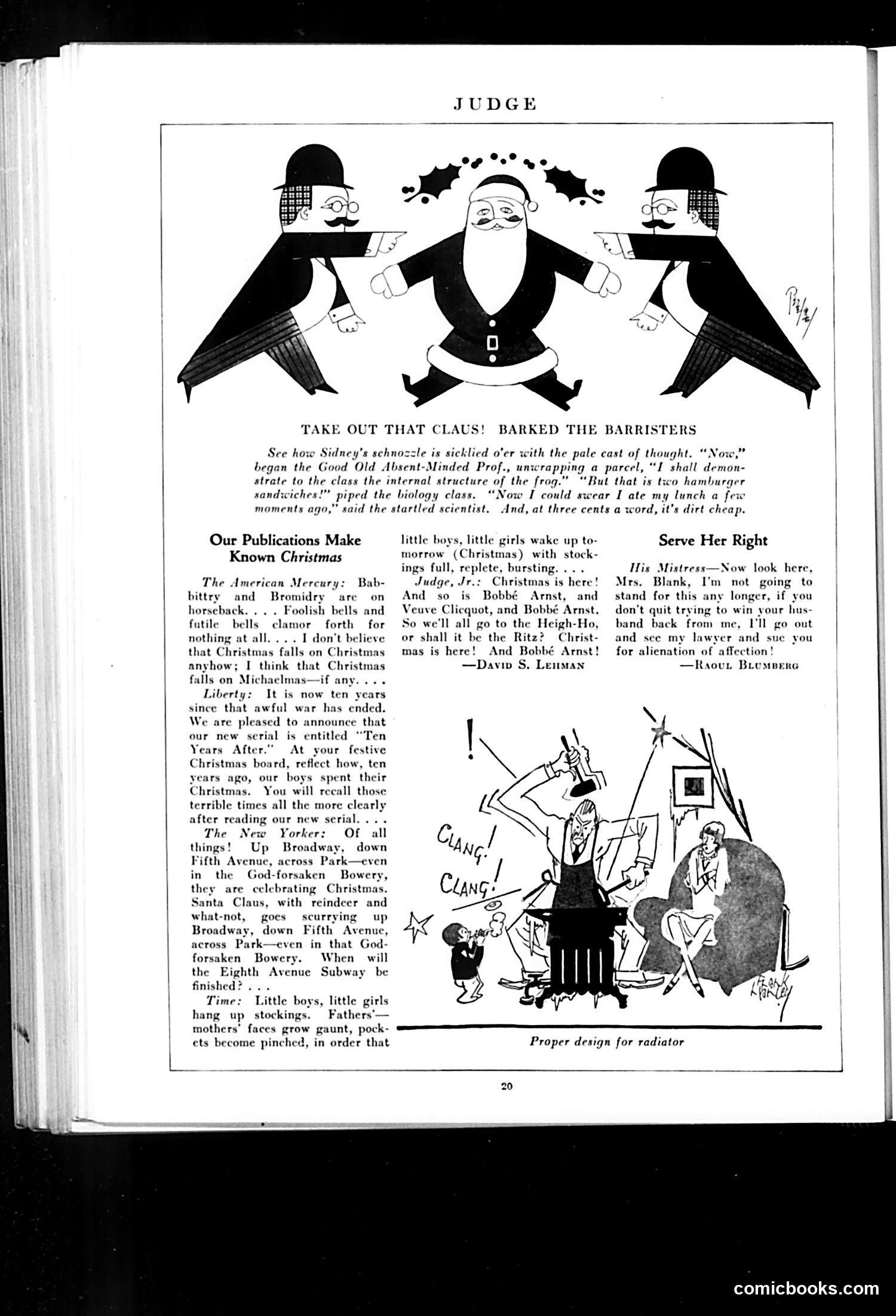
The top cartoon satirizes absent-minded academics. A professor, unwrapping what he believes is a parcel containing a frog for dissection, discovers it's actually his lunch—hamburger sandwiches. The joke plays on the stereotype of the distracted scholar so lost in thought he cannot distinguish between his meal and laboratory specimens. The page's lower sections are advertisements for Judge's sister publications (American Mercury, Liberty) promoting their Christmas-themed content and upcoming serials, emphasizing nostalgia about post-WWI America and holiday traditions. The "Serve Her Right" section appears to be a brief humorous dialogue about a mistress threatening legal action against a wife for "alienation of affection"—a common divorce-era legal claim. The satire likely mocks both the legal absurdity and the social drama of infidelity. The "Proper design for radiator" cartoon (right) remains unclear without additional context.
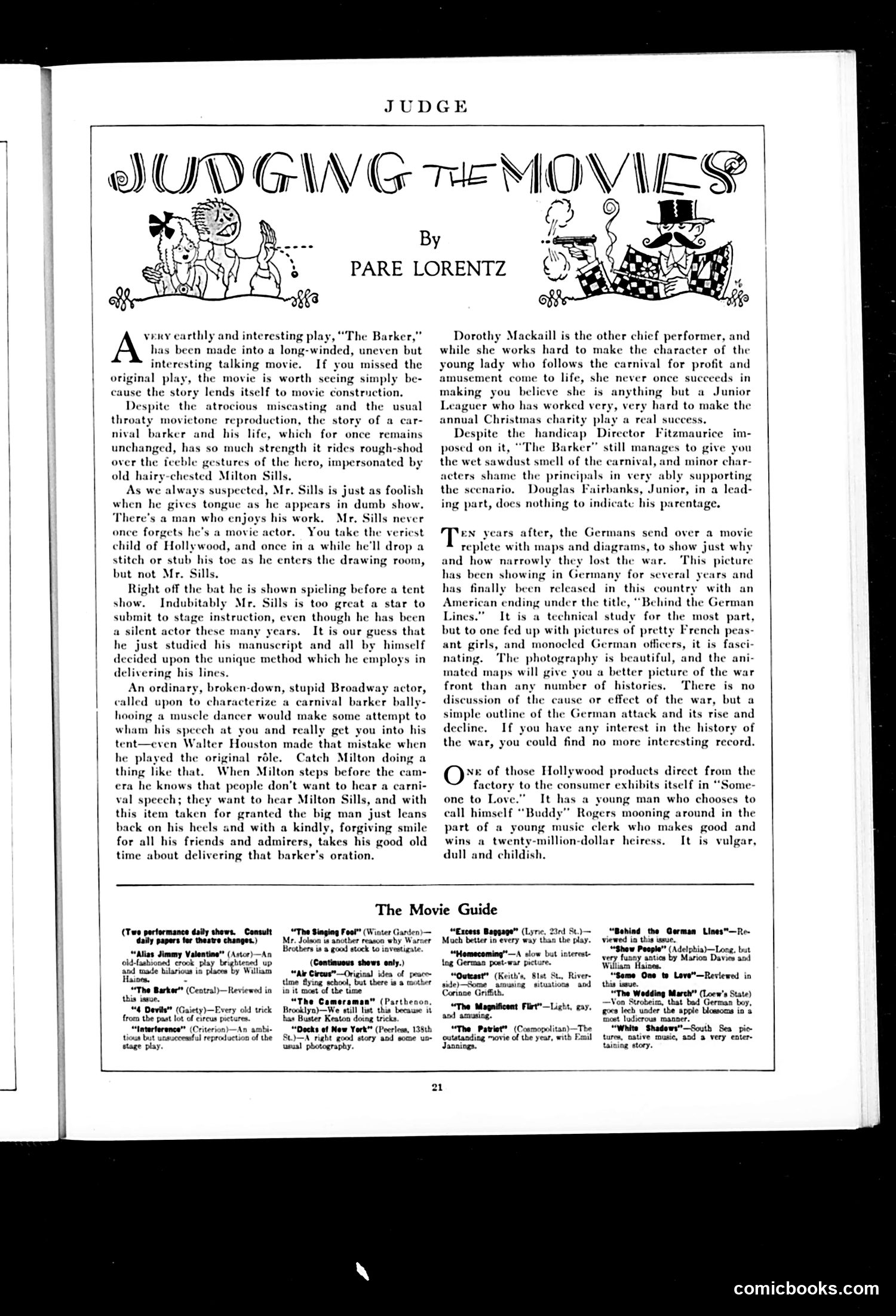
This is a film review column by Pare Lorentz critiquing three 1920s movies. The main satirical target is actor **Milton Sills** in "The Barker," whom Lorentz mocks mercilessly for being a vain, self-absorbed star incapable of authentic acting. Lorentz suggests Sills is so concerned with being recognized as "Milton Sills" that he cannot inhabit his carnival barker character—he merely recites lines with affected dignity rather than genuinely portraying a working man hawking attractions. The satire reflects period Hollywood tensions: stars' outsized egos conflicting with dramatic authenticity. Lorentz contrasts Sills unfavorably with Walter Huston, who reportedly committed to his role. The reviews also mention "Behind the German Lines," a German WWI documentary finally released in America, and "Someone to Love," dismissed as vapid entertainment featuring actor "Buddy" Rogers winning a heiress. The tone throughout is caustic toward both pretentious acting and shallow commercial filmmaking.
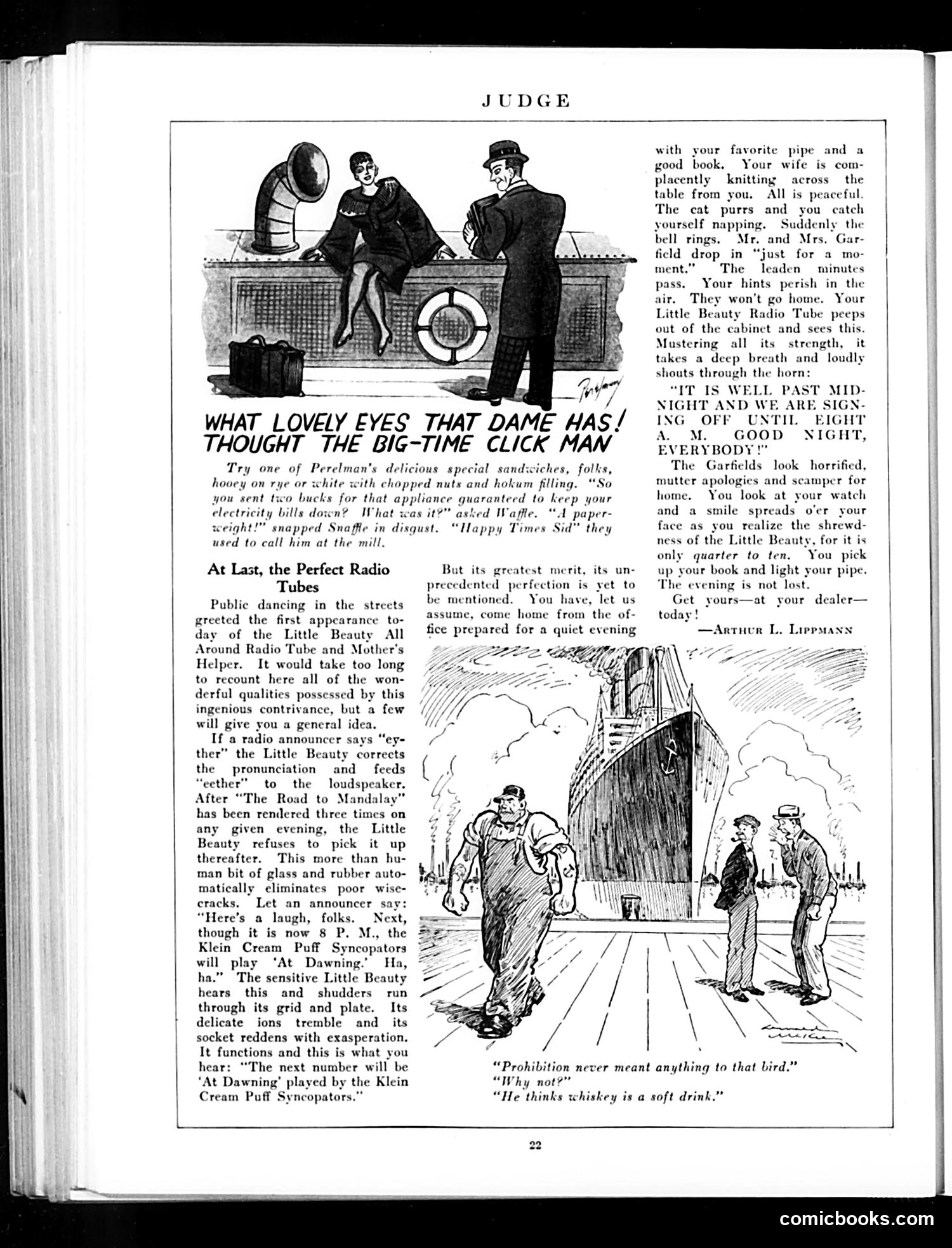
This page contains **two distinct satirical pieces**: ## Top Cartoon A single-panel joke about radio culture, captioned "What Lovely Eyes That Dame Has / Thought the Big-Time Click Man." The cartoon shows a woman at a radio microphone being observed by two men. The humor appears to target radio announcers' superficiality or the absurdity of radio personalities being judged by appearance despite working in an audio-only medium. ## "At Last, the Perfect Radio Tubes" Article This is a **mock advertisement/satire** of the emerging radio industry. It humorously describes an imaginary "Little Beauty All Around Radio Tube" with absurd features: - Corrects announcers' mispronunciations - Refuses to replay overused songs like "The Road to Mandalay" - Most amusingly: **ejects unwanted houseguests by loudly announcing the station is signing off at night**, even when it's actually only 9:45 PM The satire targets both **radio technology hype** and the universal social problem of guests overstaying their welcome. The bottom cartoon references **Prohibition**, mocking someone's claim that an alcohol-avoiding teetotaler drinks "whiskey like a soft drink"—dark humor about Prohibition-era hypocrisy.
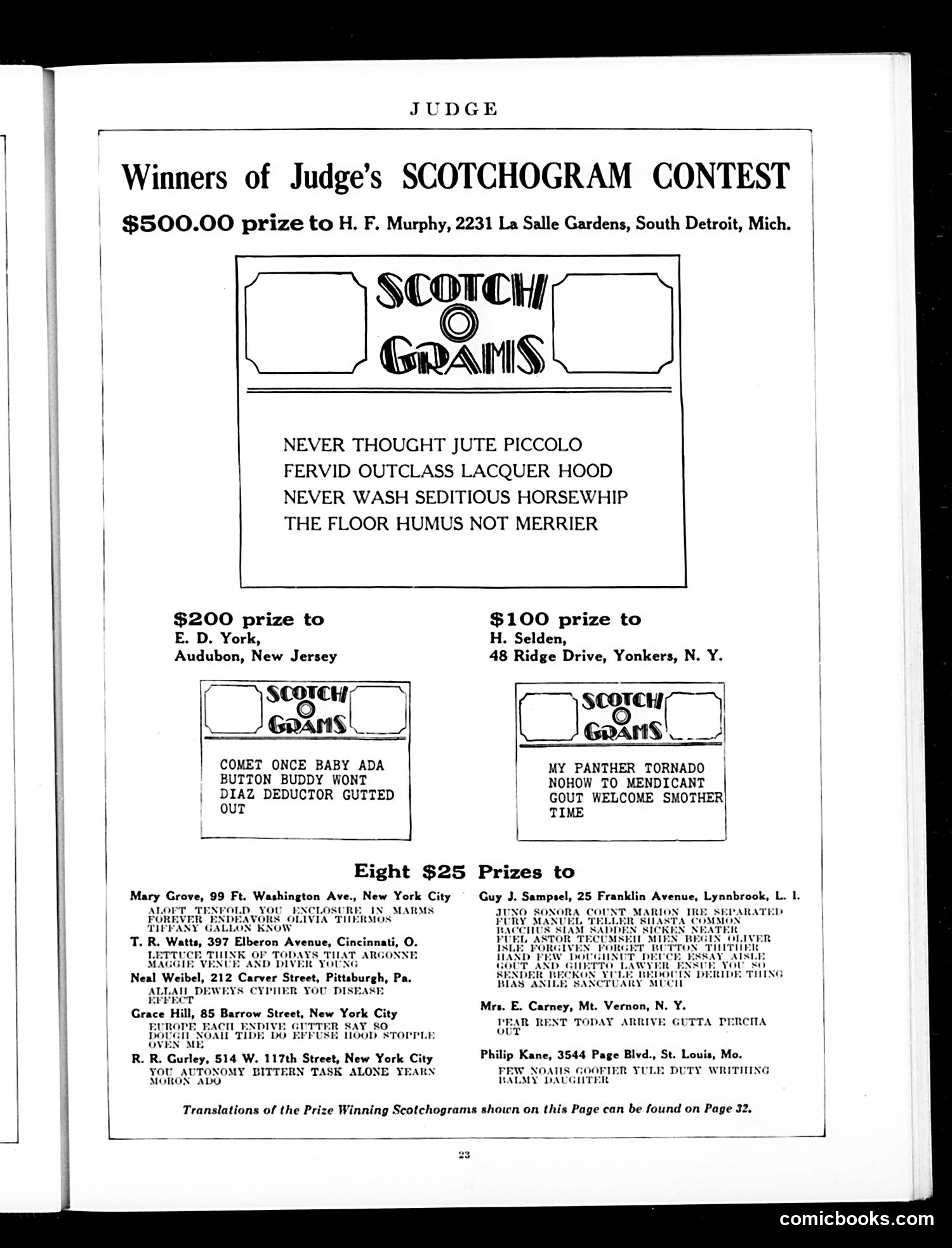
This page announces winners of Judge magazine's "Scotchogram" contest—a word game where contestants create nonsensical phrases that *sound* like coherent sentences when read aloud quickly or with a Scottish accent. The humor relies on homophonic confusion: meaningless word combinations that mimic real phrases. For example, the $500 winner's entry "Never thought jute piccolo / Fervid outclass lacquer hood" presumably sounds like an actual sentence when spoken aloud, though the written version is gibberish. Contestants submitted these tongue-twisting phrases for prizes. This represents early 20th-century parlor game humor—playful linguistic wordplay popular in satirical magazines. The contest showcases how Judge engaged readers through participatory humor challenges rather than solely editorial cartooning. The promised translation key on page 32 would reveal what these scrambled phrases actually sound like when spoken.
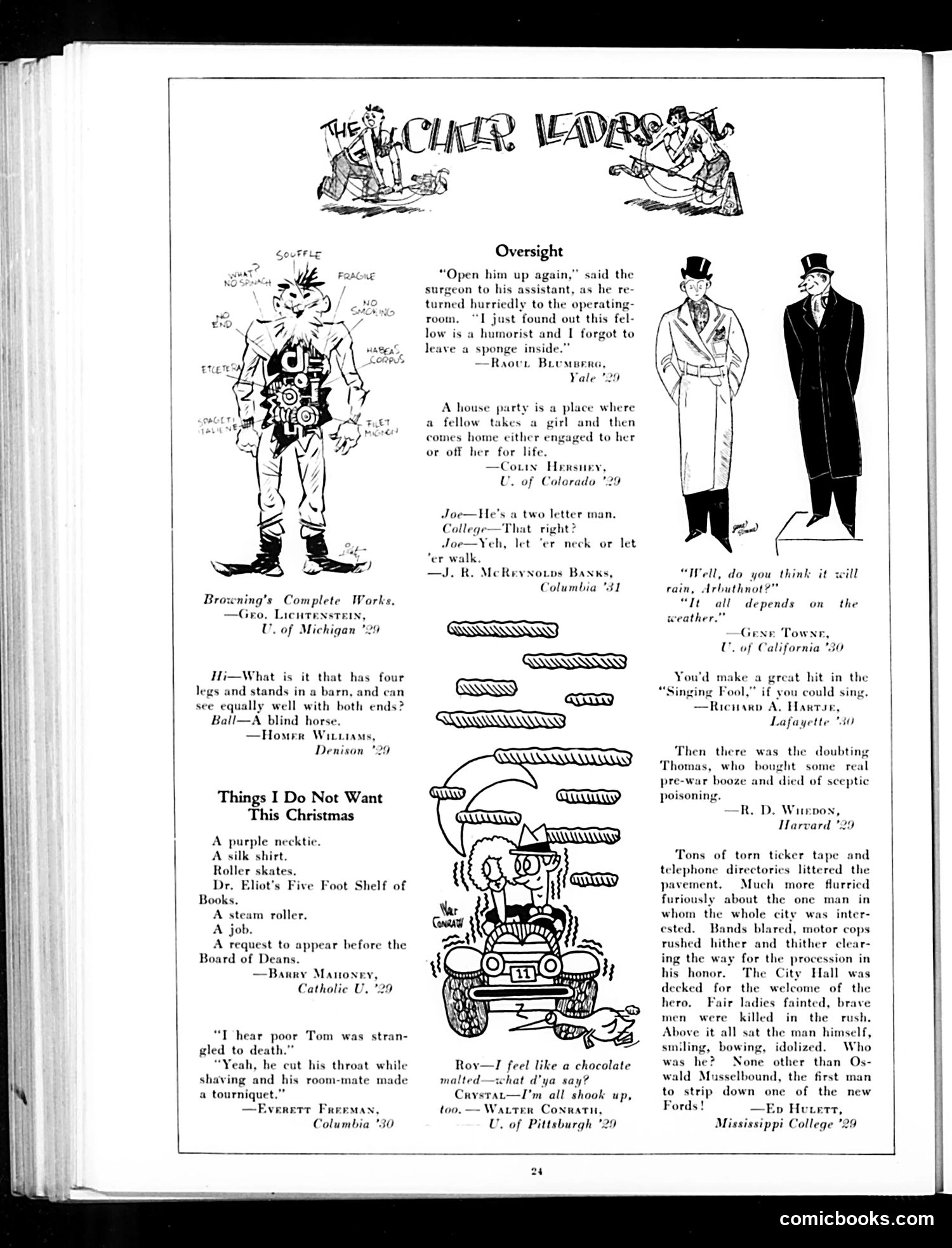
This page collects student humor and jokes from American universities circa 1929-1930. The content reflects college-era comedy of the era: **Main Elements:** - A detailed anatomical diagram labeled "Browning's Complete Works" showing a student figure annotated with slang terms and college references - Numerous brief jokes and witticisms submitted by undergraduates from Yale, Columbia, Michigan, and other schools - A satirical narrative about "Oswald Musselbound" being celebrated as "the first man to strip down one of the new Fords"—mocking both celebrity worship and fascination with automobiles **Key Satire:** The humor targets college life (avoiding the Dean, unwanted gifts like neckties), medical absurdism (the surgeon forgetting a sponge in a humorist), and contemporary social trends (pre-Prohibition bootleg liquor, ticker-tape parades). The "Ford" reference reflects 1920s automotive culture and mass production enthusiasm. The page represents typical collegiate humor publication content—irreverent, punny, and focused on student life rather than political commentary.
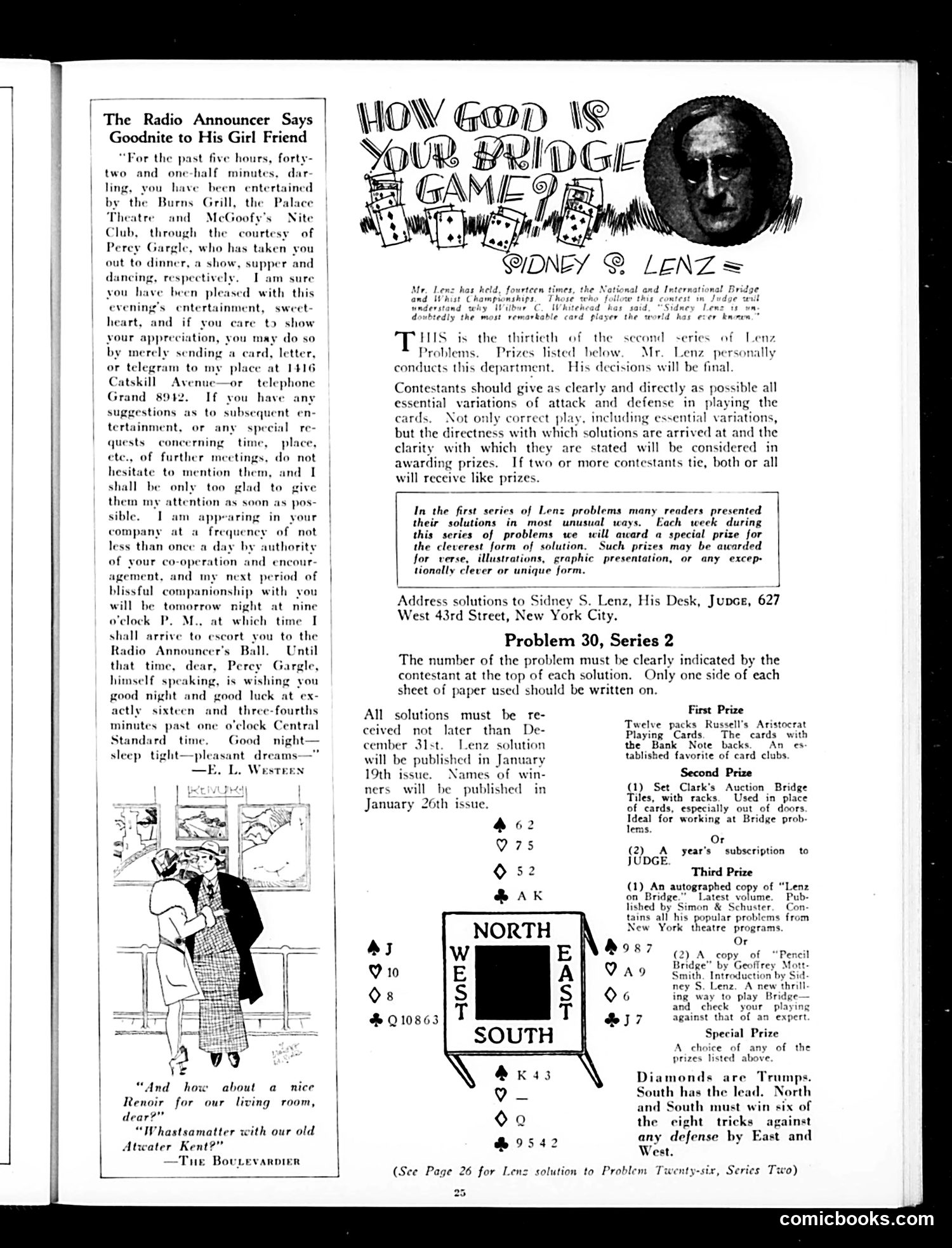
This page contains two main elements: **Left side**: A cartoon satirizing radio advertising culture. A radio announcer (likely representing the era's self-promotional broadcasters) addresses his date, essentially pitching himself and his sponsors with shameless commercialism. The joke mocks how 1920s-30s radio personalities would constantly plug sponsors and solicit listener feedback, treating romantic outings as opportunities for on-air promotion. The "Atwater Kent" caption below references a major radio manufacturer, suggesting even domestic life couldn't escape commercial messaging. **Right side**: A bridge card game problem by Sidney S. Lenz, a famous bridge expert. This is editorial content offering prizes (playing cards, subscriptions to Judge, bridge books) for solving the card problem. It appears this was a recurring puzzle series in the magazine. The page satirizes the era's advertising saturation while simultaneously running advertisements itself—a meta-joke about the commercial nature of magazines themselves.
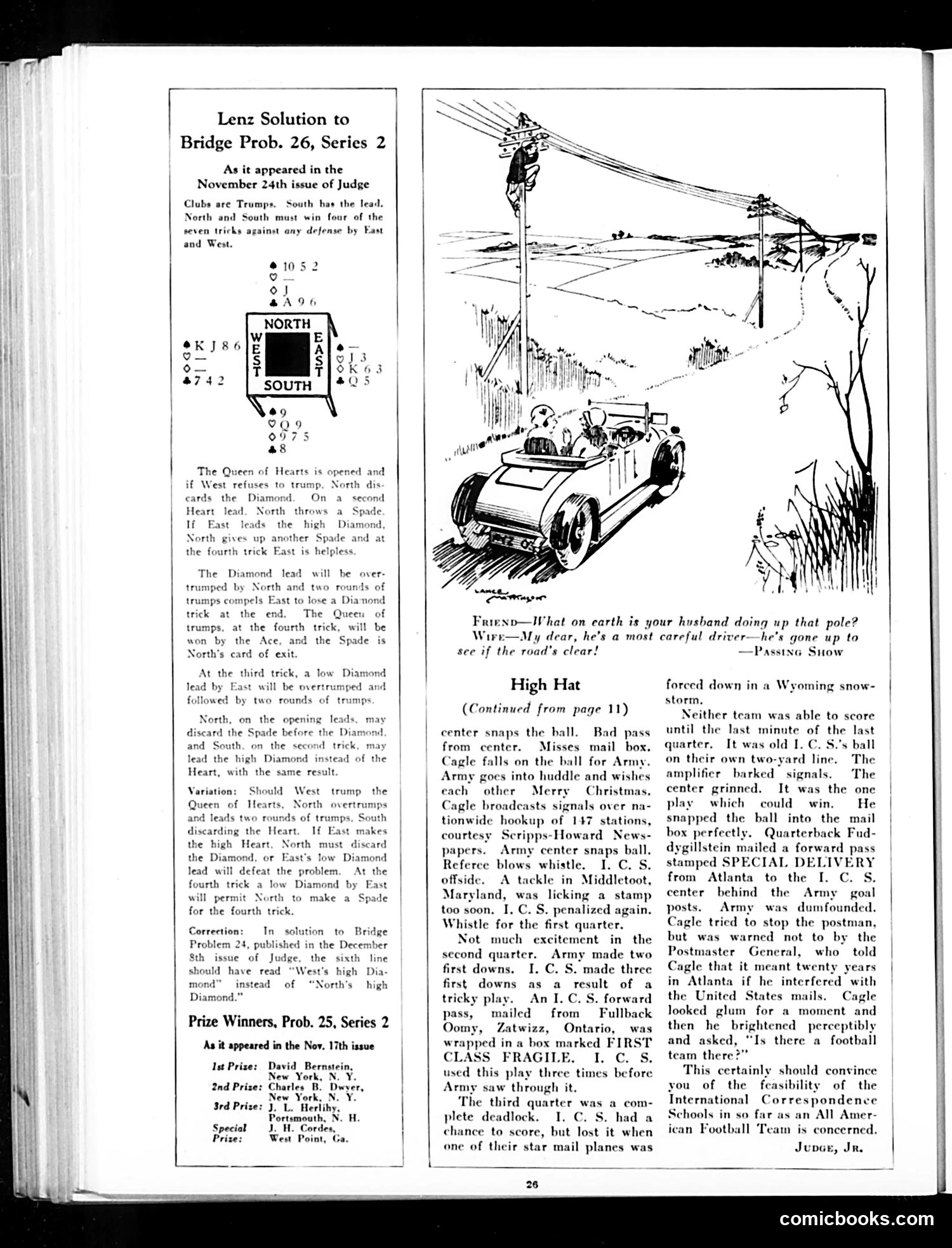
This page contains bridge card game solutions and a satirical sports story called "High Hat." **Bridge Problem Section:** Technical solutions to a bridge card puzzle from Judge's November 24th issue, with prize winners listed for problem 25. **"High Hat" Satire:** A humorous parody of a football game between Army and the International Correspondence Schools (I.C.S.). The joke conflates mail delivery with football plays—the I.C.S. team literally "mails" their plays, with passes "stamped SPECIAL DELIVERY" and a quarterback named "Fuddygillstein" mailing forward passes from Atlanta. A tackle in Maryland licks a stamp "too soon," earning a penalty. **The Point:** This mocks I.C.S., a real mail-order correspondence school of the era, by treating their distance-learning model as laughably literal. The satire suggests that I.C.S. students are so geographically scattered and dependent on mail that their "team" operates entirely through postal delivery—a cutting joke about correspondence education's limitations and the absurdity of coordinating activities entirely by mail. The cartoon above shows an unrelated domestic humor caption about a careful driver.
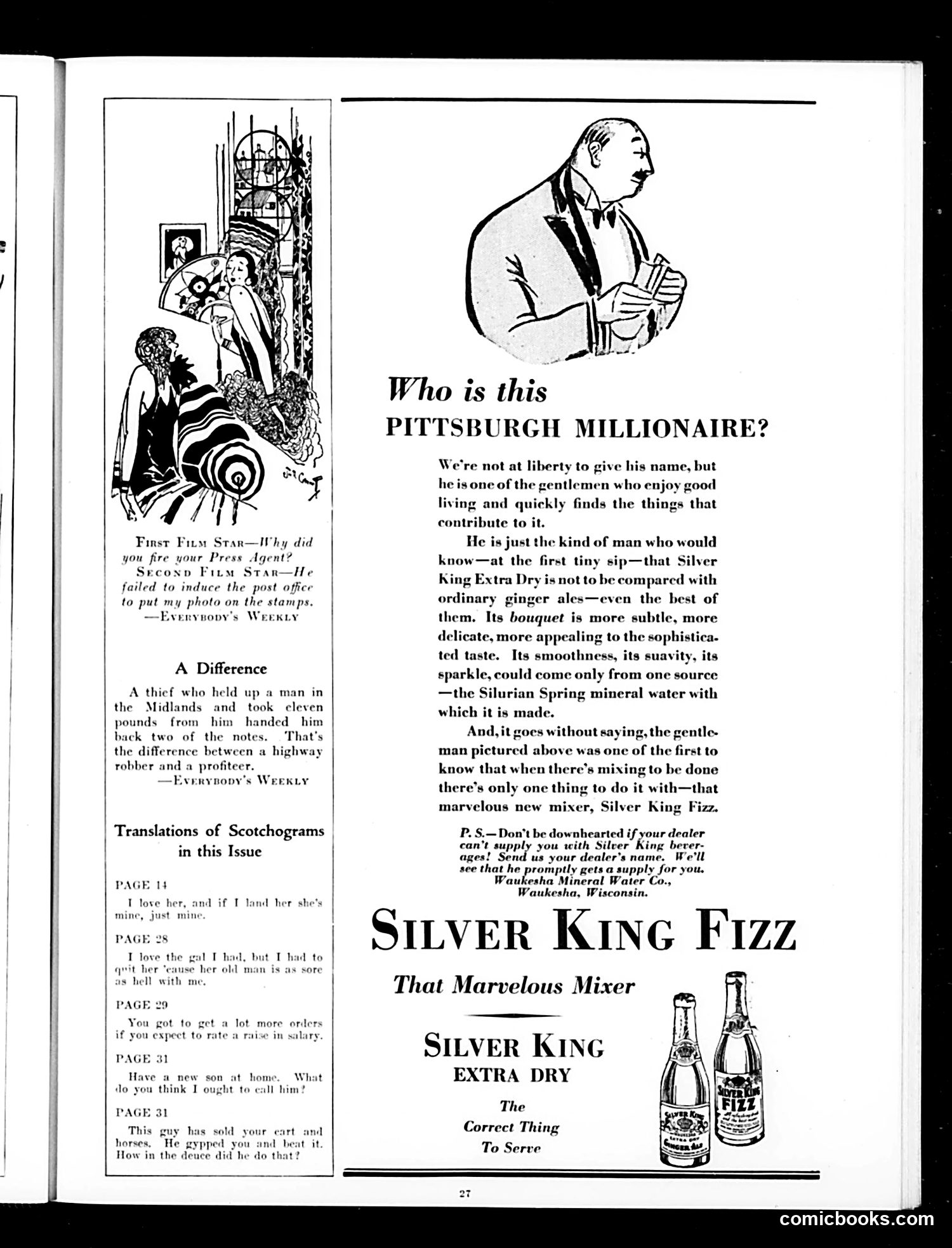
This page mixes satirical editorial cartoons with advertising. The top cartoons mock celebrity culture and profiteering: 1. **"First Film Star" joke**: Ridicules an actor's ego—he fired his press agent for failing to get his photo on postage stamps, suggesting absurd narcissism. 2. **"A Difference" cartoon**: Uses dark humor about a 1920s British thief who returned change to his victim. The joke: this makes him more ethical than a "profiteer"—a jab at wartime/postwar price-gouging by businessmen, contrasting criminality with perceived corporate greed. The rest is a **Silver King Fizz advertisement** disguised as editorial content. It teases an unnamed "Pittsburgh millionaire" who allegedly prefers this ginger ale mixer, positioning the product as sophisticated and exclusive. The ad includes a P.S. addressing supply shortages, suggesting wartime/postwar distribution issues. The page demonstrates how Judge blended satire with advertising, while the "Scotchograms" translations (Scottish dialect humor) filled space.
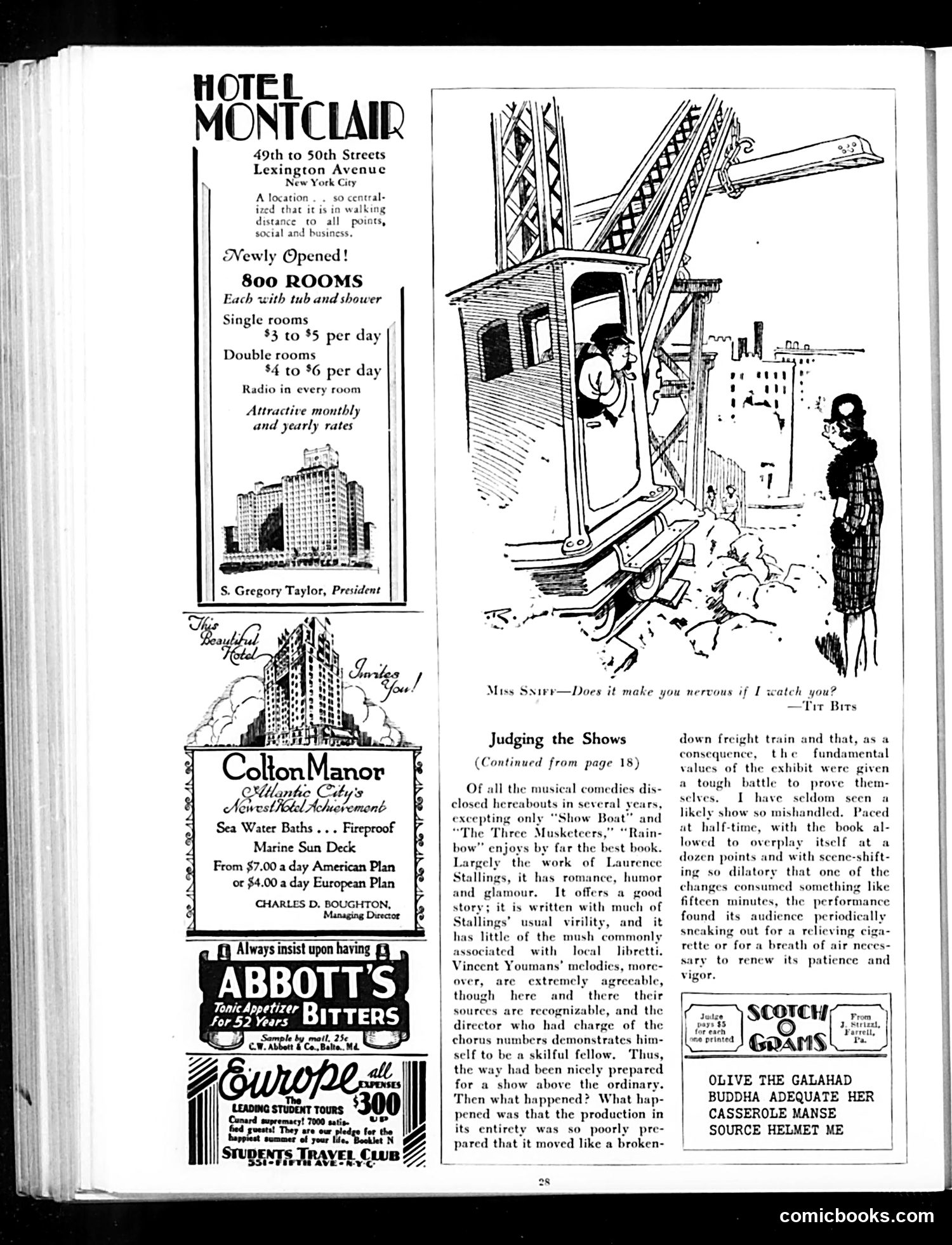
This page is primarily **advertising**, featuring hotel and product promotions typical of 1920s publications. The main content includes ads for Hotel Montclair (newly opened, 800 rooms), Colton Manor, Abbott's Bitters, and travel services. The only cartoon is a small sketch captioned "Miss Shirt—Does it make you nervous if I watch you?" by "Tit Bits," showing a man watching a woman operate machinery (possibly an elevator or industrial equipment). It's a flirtatious workplace joke playing on gender anxiety—the implication being that women feel self-conscious under male scrutiny while working. The substantial text column "Judging the Shows" reviews a Broadway musical, criticizing its poor staging and pacing despite excellent songs and script. The review suggests the production's mishandled execution undermined the quality material. The page reflects 1920s advertising culture and light comedy typical of Judge's satirical-but-commercial approach.
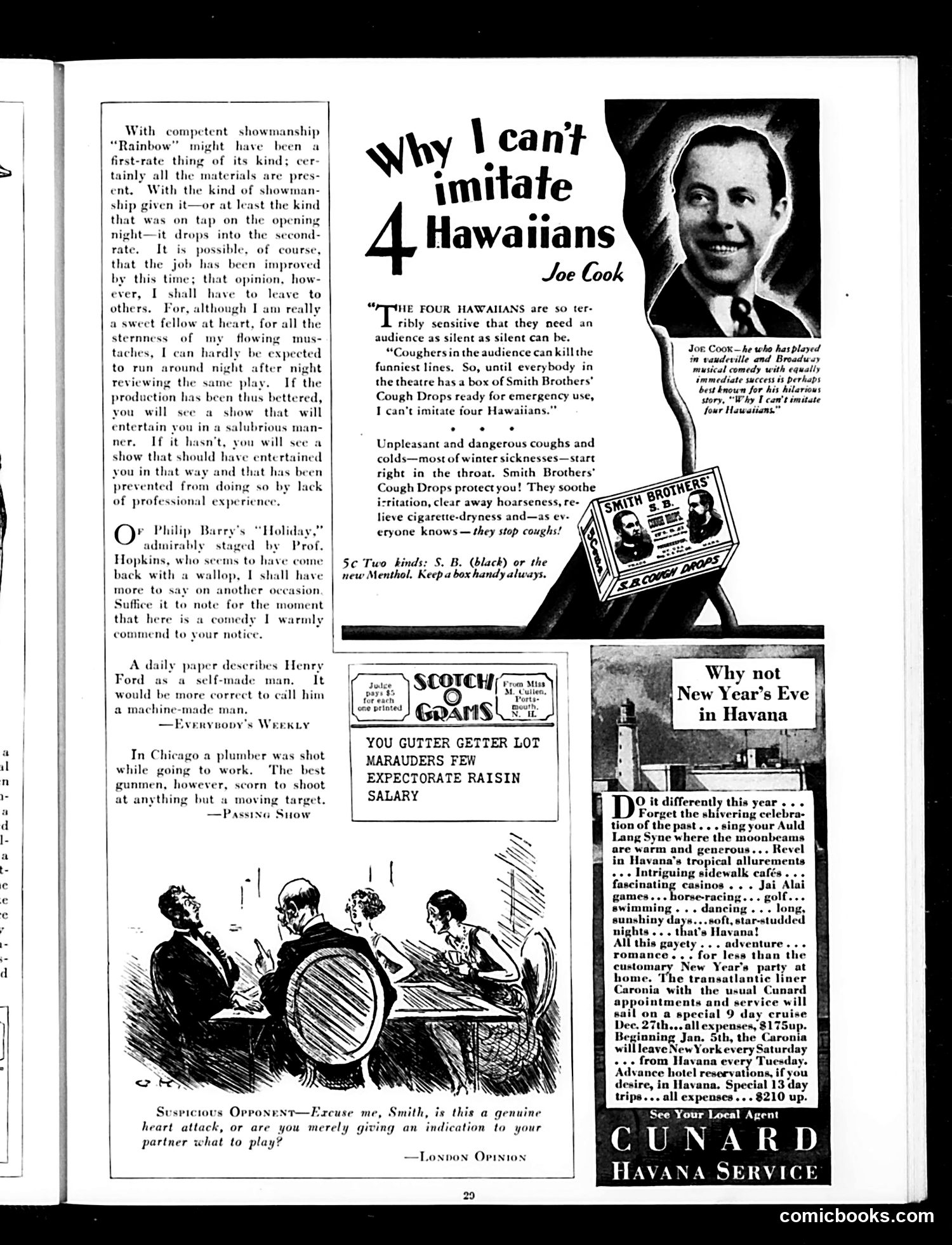
This page combines theatrical criticism with period advertising. The main feature is an advertisement for Smith Brothers' Cough Drops, featuring vaudeville performer **Joe Cook**. Cook explains he cannot imitate "four Hawaiians" because audience coughing disrupts his act—the ad uses this as a humorous pitch for the cough drops as a solution. The surrounding text includes theater reviews (mentioning plays "Rainbow" and Philip Barry's work) and several brief comedic observations typical of Judge's satirical format, including jokes about Henry Ford being "machine-made" and Chicago gun violence. The lower portion advertises **Cunard's Havana cruises**, promoting tropical vacation getaways for New Year's celebrations as an alternative to cold northern winters. The cartoon at bottom shows a card game scene with the caption about a "genuine heart attack," a London Opinion reprint making light of medical emergencies during gambling. The page reflects 1920s consumer culture and entertainment preferences.
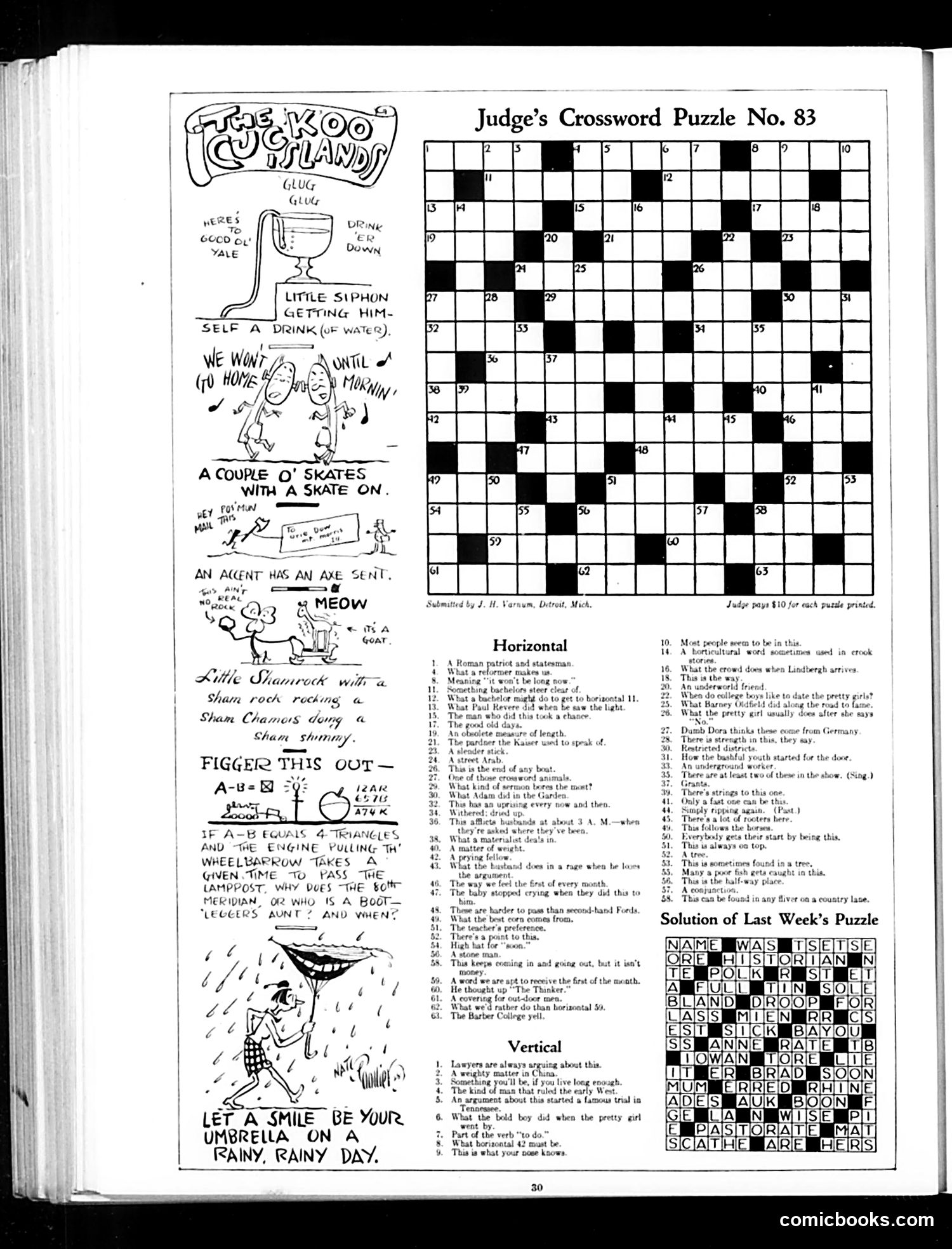
This page from *Judge* magazine presents humor through wordplay, puns, and visual gags typical of early 20th-century American satire. The main content includes: **Verbal Puns**: "An Accent Has an Axe Sent" plays on homophones (accent/a sent, axe/ax). Similar pun-based jokes appear throughout ("Little Siphon," "Sham Shamrock," "Meow"). **Math Riddle Satire**: The "Figure This Out" section mocks the absurdity of word problems—combining irrelevant mathematical equations with nonsensical scenarios (wheelbarrows, meridians, ledgers' aunts), satirizing convoluted classroom logic. **Crossword Puzzle**: Standard entertainment feature of the era. **Illustrated Vignettes**: Small cartoon drawings accompany each joke, depicting situations literally (a character with an umbrella, a figure being drenched). The overall tone is lighthearted wordplay and visual humor aimed at general audiences. The satire targets not politics or social issues, but rather the absurdity of language itself and pedantic educational exercises—gentle, family-friendly comedy rather than pointed social criticism.
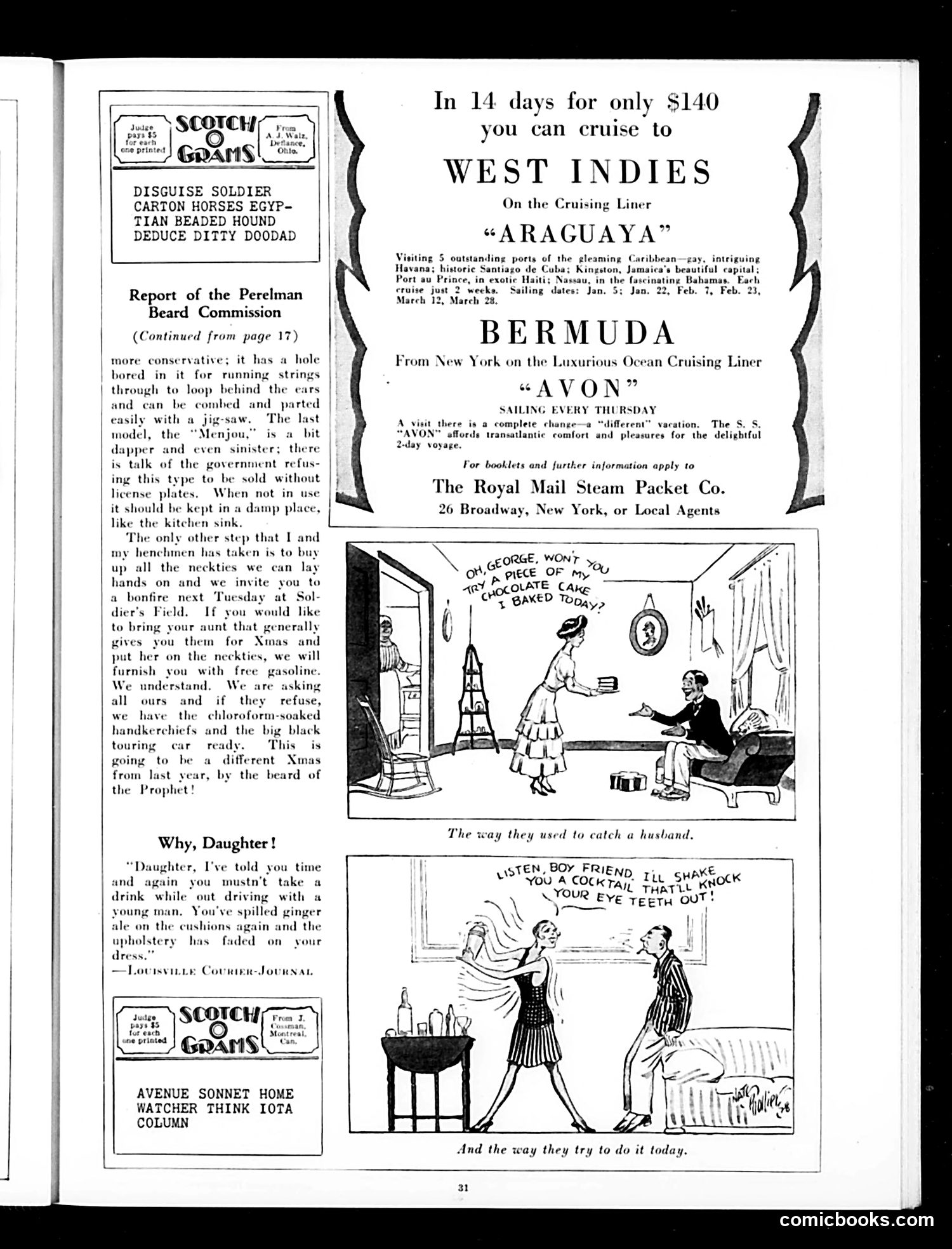
This page mixes advertising with satirical humor typical of early 20th-century Judge magazine. The **upper cartoons** appear to be absurdist humor—"Scotch Grams" features nonsensical items (disguised soldier, Egyptian beaded hound). The "Perelman Beard Commission" continues a running joke about absurd bureaucratic recommendations, including burning neckties at Soldier's Field and soaking handkerchiefs—pure nonsense satire on governmental overreach. The **"Why, Daughter!"** section satirizes changing social morals: a father warns his daughter against drinking while driving with young men, reflecting 1920s anxieties about women's newfound independence and modern dating practices. The **bottom cartoon pair** contrasts courtship methods: the first shows a woman offering homemade cake to "catch a husband" (traditional domesticity); the second depicts a woman offering cocktails to a man (modern, Prohibition-era approach). The joke critiques how rapidly dating customs had shifted—from domestic virtue to boldly sharing illegal alcohol. **Cruises to Bermuda and West Indies ads** fill the remaining space.
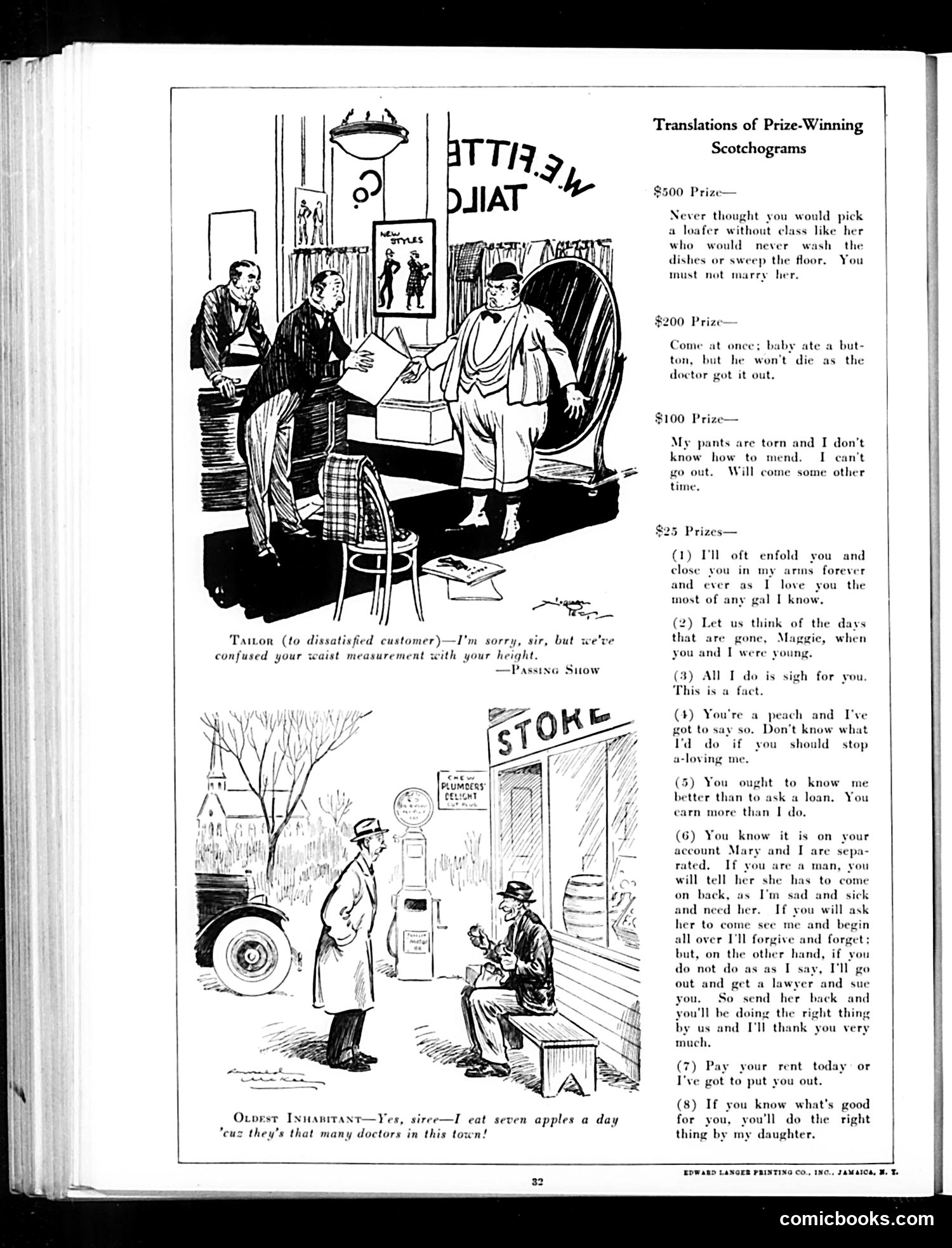
This page satirizes Scottish immigrant communications, likely "Scotchograms"—humorous fake telegrams supposedly sent by Scottish people. The top cartoon jokes about a tailor confusing waist and height measurements, a classic mix-up gag. The main satire presents "translations" of prize-winning messages, mocking Scottish (or working-class immigrant) speech patterns and domestic concerns: nagging about housekeeping standards, medical emergencies, torn clothing, and romantic sentiments rendered in awkward phrasing. The bottom cartoon shows an old tenant claiming he eats seven apples daily because "there's that many doctors in this town"—implying he's avoiding medical bills through folk remedies. The humor targets immigrant communities' grammar, class anxieties, and financial struggles during an era when such stereotyping was considered mainstream entertainment. These appear to be actual contest entries Judge received and was mocking for readers' amusement.
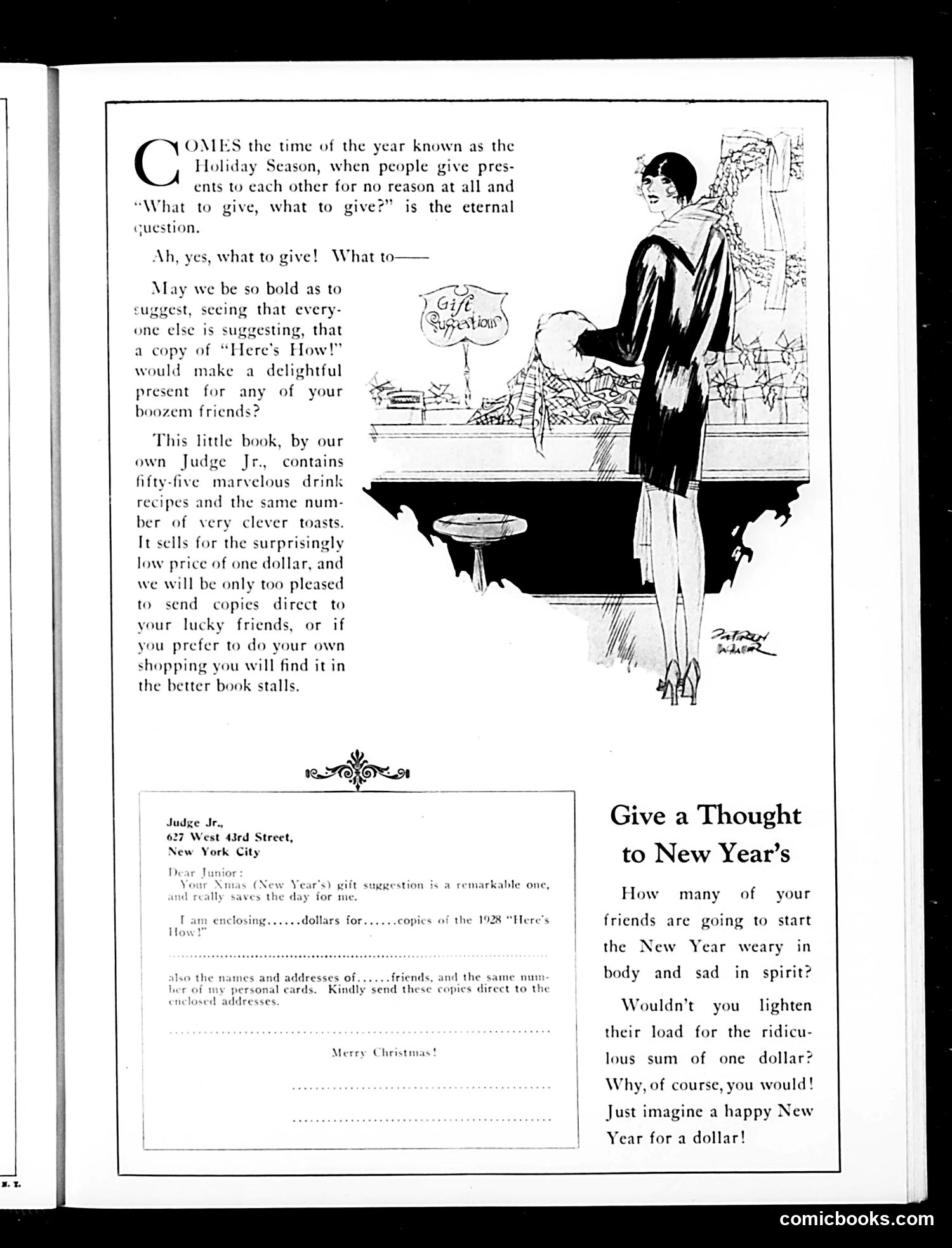
This is primarily **advertising content** disguised as editorial advice in Judge magazine (circa 1928, based on the "1928 'Here's How!'" reference). The page satirizes holiday gift-giving anxiety while promoting "Here's How!"—a cocktail recipe book containing 55 drink recipes and toasts. The elegant illustration shows a woman presenting the book as an ideal gift. The humor relies on **Prohibition-era subtext**: openly promoting a cocktail book during the 1920s (when alcohol was illegal) is audacious. The ad presents giving this book as generously helping "weary" friends—a winking acknowledgment that recipients could use liquor advice. The order form and tongue-in-cheek tone ("boozem friends," "the ridiculously low sum of one dollar") make the satire clear: Judge is mocking both gift-giving conventions AND the absurdity of Prohibition by openly hawking booze instruction manuals. Modern readers would need to know Prohibition (1920-1933) was in effect, making this simultaneously illegal promotion and clever magazine self-promotion through satirical framing.
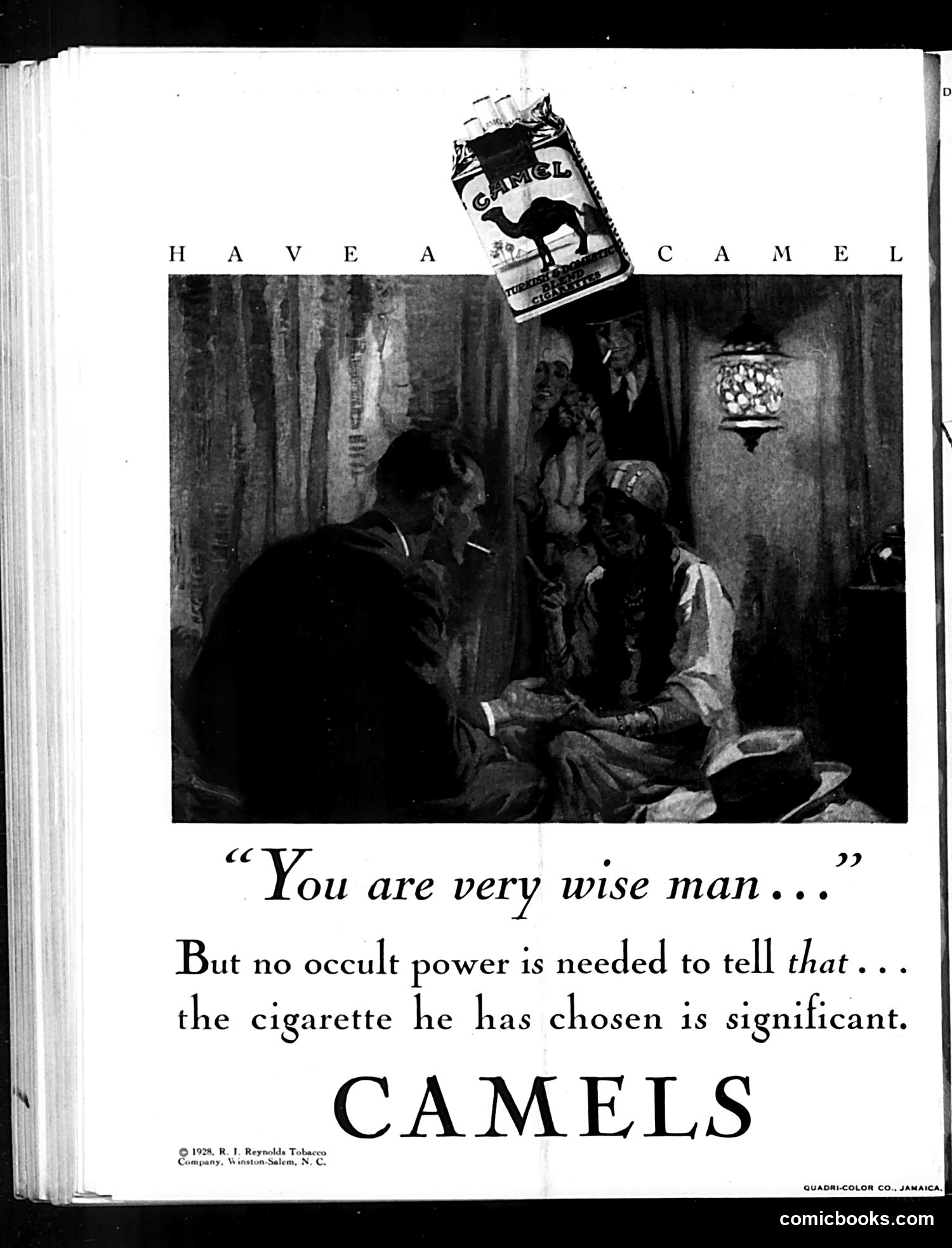
This is a Camel cigarettes advertisement rather than political satire. The image shows men in what appears to be an exotic or Oriental setting, with one man presenting a large Camel cigarette package. The advertisement uses pseudo-mystical language ("occult power," "wise man") to suggest that choosing Camel cigarettes reveals something significant about a person's character or taste—implying that Camels are the sophisticated, discerning choice. This reflects 1928 advertising tactics that associated cigarette brands with worldliness, wisdom, and social status. The exotic setting and mysterious framing were common marketing strategies to make smoking seem glamorous and aspirational to consumers.