
Judge, 1928-12-22 · page 23 of 36
Judge — December 22, 1928 — page 23: what you’re looking at
What you’re looking at
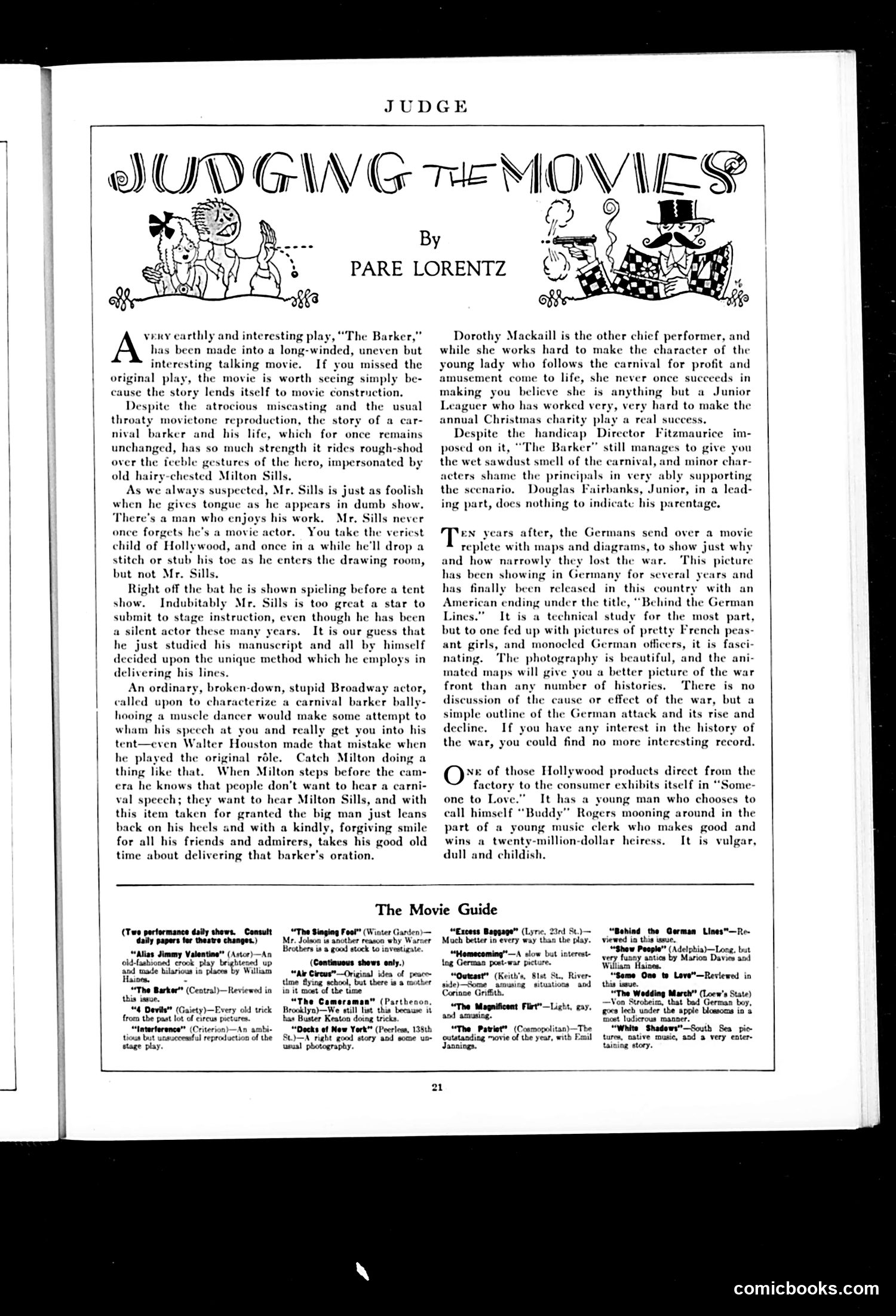
This is a film review column by Pare Lorentz critiquing three 1920s movies. The main satirical target is actor **Milton Sills** in "The Barker," whom Lorentz mocks mercilessly for being a vain, self-absorbed star incapable of authentic acting. Lorentz suggests Sills is so concerned with being recognized as "Milton Sills" that he cannot inhabit his carnival barker character—he merely recites lines with affected dignity rather than genuinely portraying a working man hawking attractions. The satire reflects period Hollywood tensions: stars' outsized egos conflicting with dramatic authenticity. Lorentz contrasts Sills unfavorably with Walter Huston, who reportedly committed to his role. The reviews also mention "Behind the German Lines," a German WWI documentary finally released in America, and "Someone to Love," dismissed as vapid entertainment featuring actor "Buddy" Rogers winning a heiress. The tone throughout is caustic toward both pretentious acting and shallow commercial filmmaking.
📄 Transcribed text from this page (OCR, searchable)
Machine-transcribed from the original scan — historical spelling and the odd misread are preserved.
JUDGE veny earthly and interesting play, “The Barker,” A has been made into a long-winded, uneven but interesting talking movie. If you missed the original play, the movie is worth secing simply be- cause the story lends itself to movie construction. Despite the atrocious miscasting and the usual throaty movietone reproduction, the story of a car- nival barker and his life, which for once remains unchanged, has so much strength it rides rough-shod over the iceble gestures of the hero, impersonated by old hairy-chested Milton Sills, As we always suspected, Mr. Sills is just as foolish when he gives tongue as he appears in dumb show. There's a man who enjoys his work. Mr, Sills never once forgets he’s a movie actor. You take the vericst child of Hollywood, and once in a while he'll drop a stitch or stub his toe as he enters the drawing room, but not Mr. Sills. Right off the bat he is shown spieling before a tent show. Indubitably Mr. Sills is too great a star to submit to stage instruction, even though he has been a silent actor these many years. It is our guess that he just studied his manuscript and all by himself decided upon the unique method which he employs in delivering his lines. An ordinary, broken-down, stupid Broadway actor, called upon to characterize a carnival barker bally- hooing a muscle dancer would make some attempt to wham his specch at you and really get you into his tent—even Walter Houston made that mistake when he played the original réle. Catch Milton doing thing like that. When Milton steps before the cam- era he knows that people don't want to hear a carni- val speech; they want to hear Milton Sills, and with this item taken for granted the big man just leans back on his heels and with a kindly, forgiving smile for all his friends and admirers, takes his good old time about delivering that barker’s oration. JUVGING TEM By PARE LORENTZ : ( 6) VIS Dorothy Mackaill is the other chief performer, and while she works hard to make the character of the young lady who follows the carnival for profit and amusement come to life, she never once succeeds in ing you believe she is anything but a Junior guer who has worked ver, try hard to make the annual Christmas charity play a res Despite the handicap Director posed on it, “The Barker” still w the wet sawdust smell of the carni acters shame the principals in ver. the scenario, Dougla ing part, does nothi Tes sears after, the Germans send over a movie replete with maps and diagrams, to show just why and how narrowly they lost the war. This picture has been showing in Germany for several years and has finally been released in this country with an American ending under the title, “Behind the German Lines.” It is a technical study for the most part, but to one fed up with pictures of pretty French peas- ant girls, and monocled German officers, it is fase nating. The photography is beautiful, and the inated maps will give you a better picture of the front than any number of histories. There is no discussion of the cause or effect of the war, but a simple outline of the German attack and its rise and decline. If you have any interest in the history of the war, you could find no more interesting record. O of those Holl od products direct from the actory to the consumer exhibits itself in “Some- one to Lov It has a young man who chooses to call himself “Buddy” Rogers mooning around in the part of a young music clerk who makes good and wins a twenty-million-dollar heiress. It is vulgar, dull and childish. im- ages to give you al, and minor char- ably supportin, thanks, Junior, in a lead- ig to indicate his parentage. The Movie Guide (Two performance daily thews. Contult “The Singing Feel” (Winter Ganten| Gaily papers fer theatre changes.) “Alias Jimmy Valentine” (Astor)—An old-fashioned crook play brightened up and made hilarious ia places by William Haines. - “The Barker’ (Central)—Reviewed in this issue. “4 Devils” (Gaiety)—Every old trick from the past lot of eircus pictures. “n (Criterion)—An ambi- tious but unsuccessful reproduction of the stage play. Mr. Jolsoa is another reason why Brothers ia a good stock to investigate. (Continuous shows enly.) “Ale Circus” —Original idea of peace time fying school, but there is 3 mother in it most of the ume “The Com (Parthenon. Brooklyn) ist thin because it Buster Keaton doing tricks Decks of New York™ (Peerles, 138th SU)—A right good story and some uo turual photography. “Excess (Lyne, 23rd St.)— Baggage” “Behind the German Lines"—Re- Mach better in every way than the play. viewed in this issue. “Show People” (Adelphis)—Long. but Sunay aati by Marion Devies and iam Haines. “Same One to Love”—Reviewed in this issue. “The Wedding March” (Loew's State) —Von Strobeis, that bad German boy, gots lech under the apple blowoms in & most ludicrous manner. “white Shadews"—Soutb Sea pic- tures, native music, and a very enter taining story. “Homecoming”—A slow but interest- ing German post-war picture. “Outcast” (Keith's, Sist St., Rivers side)—Some amusing situations and Corinne Grifith. “The Magnificent Flirt”—Light, gay, and amusing. “The Patiet” (Cosmopolitan)—The outstanding movie of the year, with Ezil Jannings. comicbooks.com