
A complete issue · 36 pages · 1928
Judge — December 1, 1928
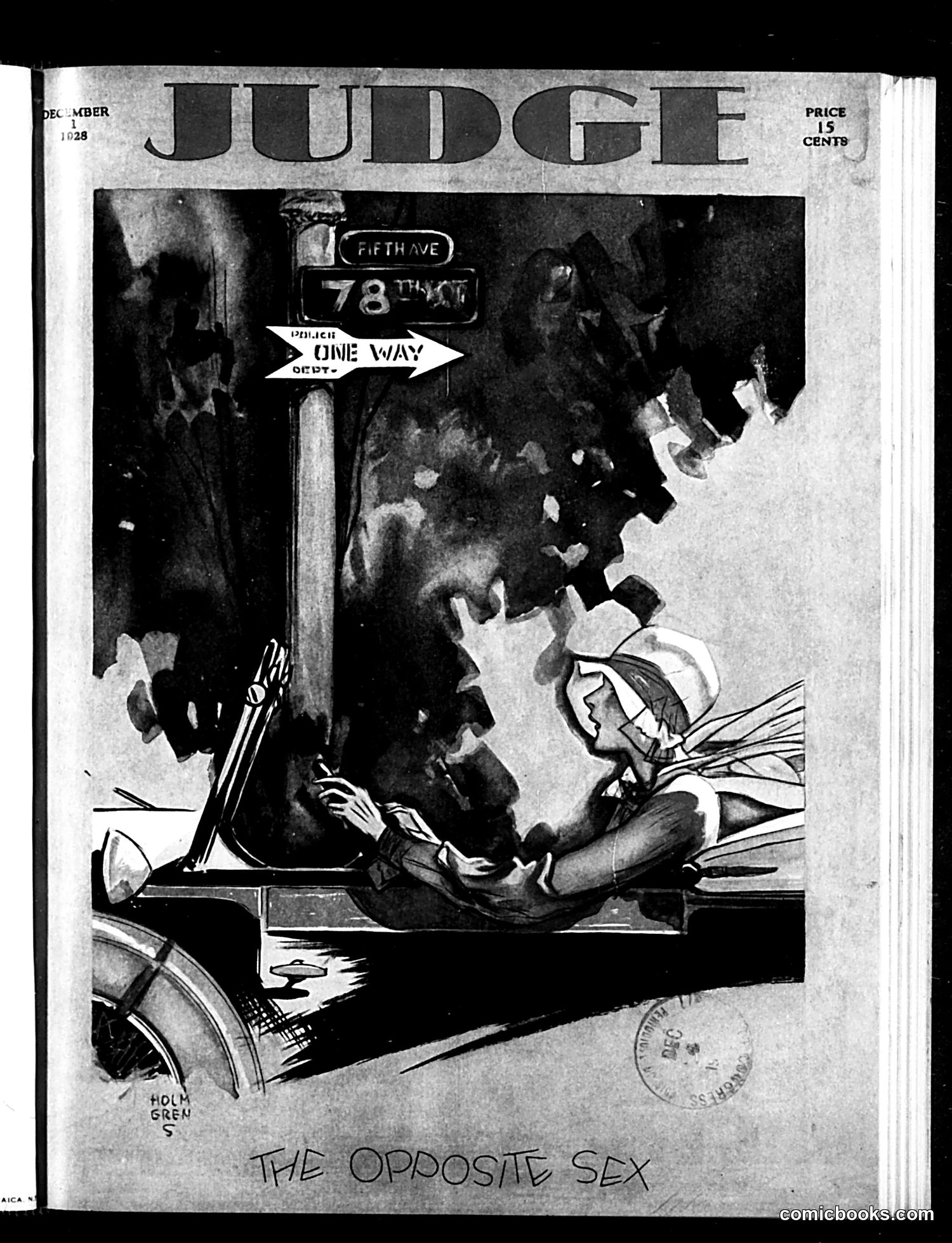
This cover illustrates a flapper woman (recognizable by her short hair, 1920s dress, and wings) sitting on a street corner at Fifth Avenue and 78th Street in New York City. She appears to be soliciting or engaging in street behavior, with a "One Way" traffic sign behind her suggesting ironic commentary on her "direction" or morality. The title "The Opposite Sex" satirizes changing gender dynamics during the Jazz Age. The cartoon critiques the new independence and visible public presence of 1920s women—their shorter skirts, bobbed hair, and social freedom—by depicting this flapper in a compromising urban scenario. It reflects conservative anxiety about women's liberation and sexual freedom during the Roaring Twenties.
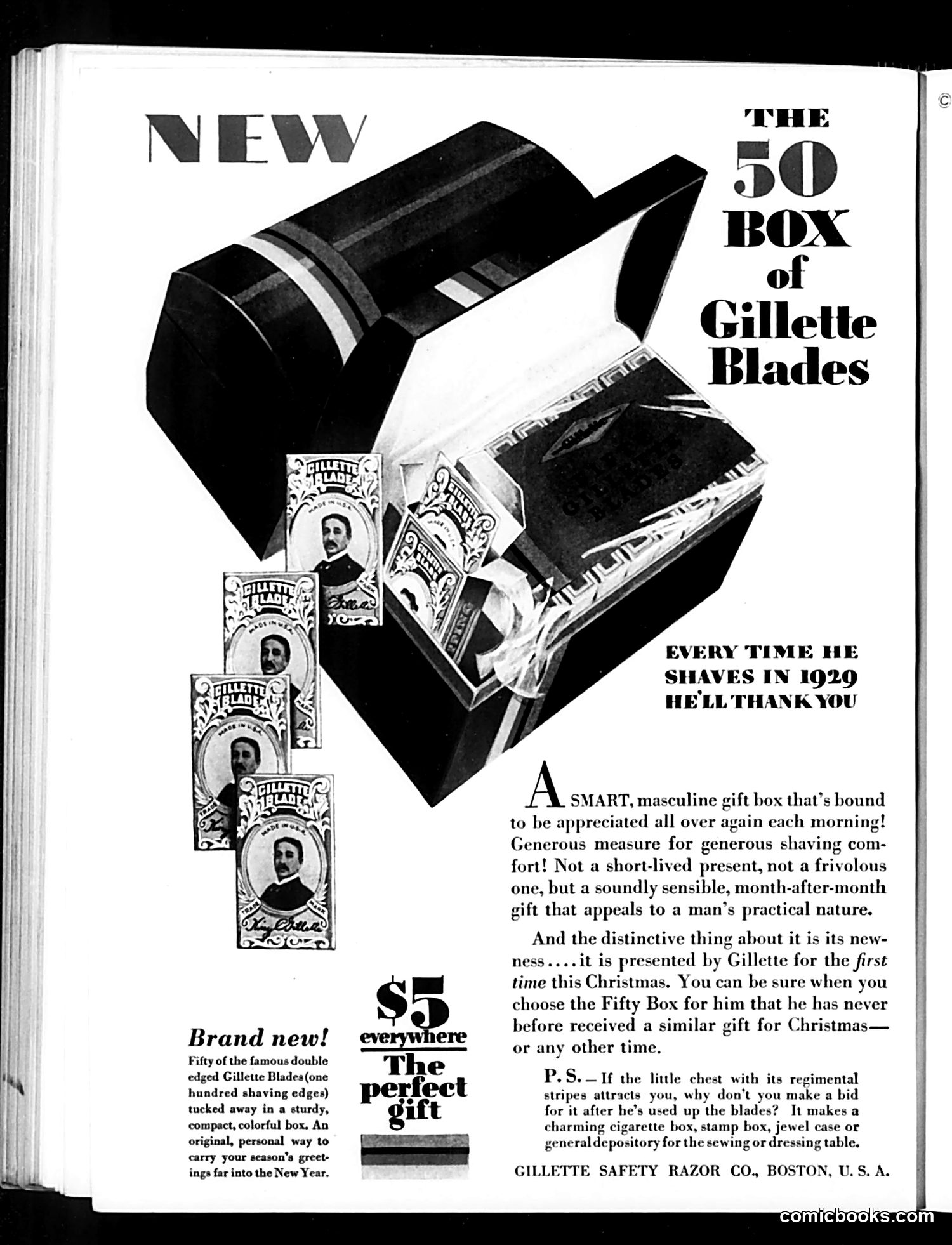
This is a **Gillette Safety Razor advertisement**, not political satire. The page promotes Gillette's new "50 Box" of razor blades as a Christmas gift for men, priced at $5. The advertisement uses early 20th-century masculine marketing language, calling it "a smart, masculine gift box" and "soundly sensible" rather than "frivolous." The copy emphasizes practicality—that a man will appreciate it "each morning" when shaving. The only figure is a mustachioed man's portrait on the blade packages themselves, likely the Gillette brand mascot or founder (common in era advertising). There is no political cartoon or satire on this page—it's straightforward product advertising from 1929, appealing to gift-givers with practical masculine sensibilities.
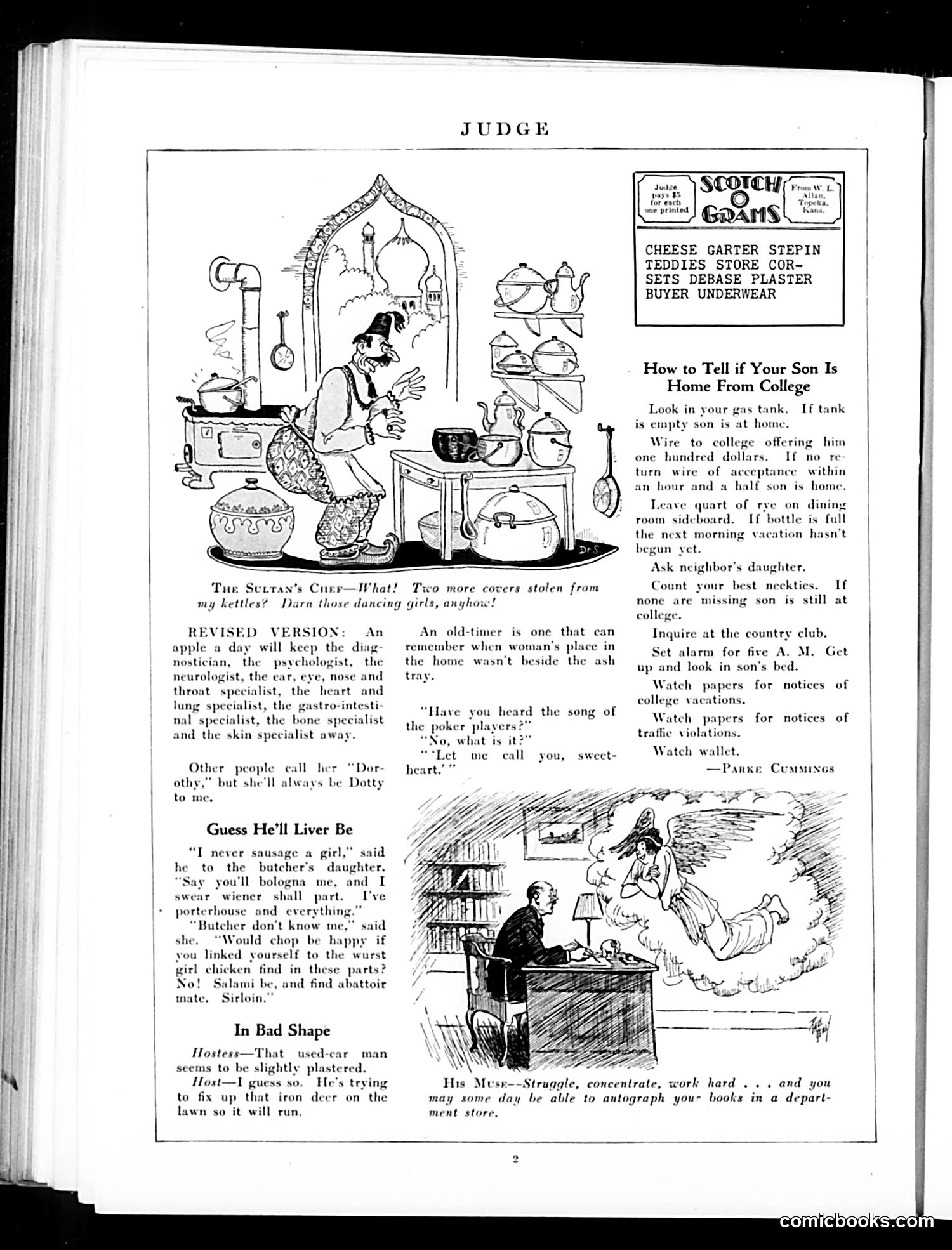
This page from *Judge* magazine contains humor and satire typical of the early 20th century. **Main cartoon**: "The Sultan's Chef" depicts a chaotic kitchen scene, likely satirizing exotic or foreign domestic arrangements. The humor appears to play on stereotypes about non-Western households and their unfamiliar cooking practices. **"How to Tell if Your Son Is Home From College"**: A humorous guide offering absurd diagnostic methods—checking the gas tank, monitoring rye whiskey, counting missing neckties. This satirizes parental anxieties about college students' wastefulness and poor behavior while away. **Other brief humor pieces** ("Guess He'll Liver Be," "In Bad Shape") feature typical period jokes about butchers, used-car salesmen, and domestic situations. The ads reference period products (Scotch Grains, undergarments). Overall, this reflects early 1900s middle-class anxieties and consumer humor.
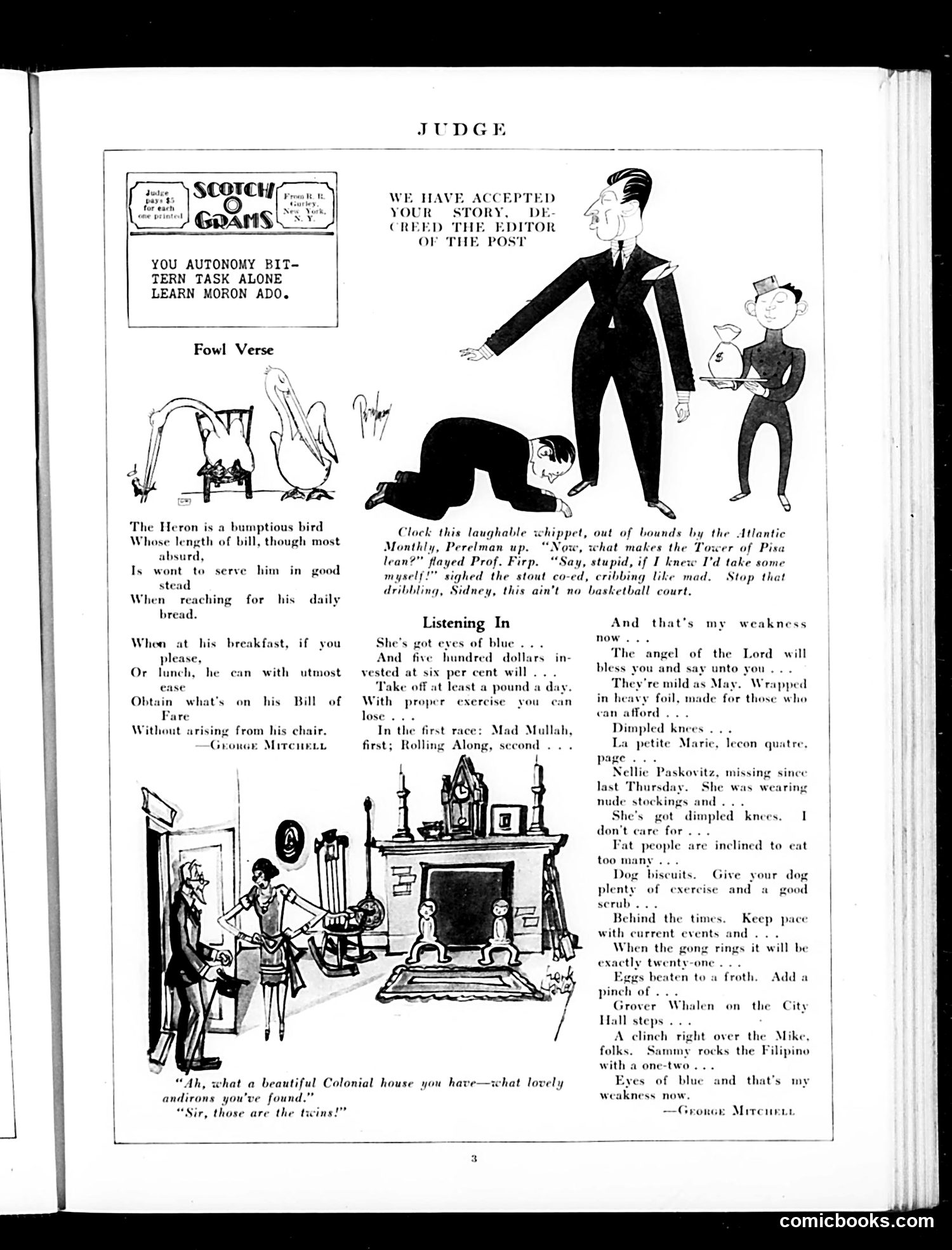
This page contains three distinct sections: **"Scotch Grans"** (top left): A brief humorous item about autonomy and learning Gaelic—likely satirizing Scottish cultural nationalism or language revival movements. **"Fowl Verse"** (center-left): George Mitchell's poem about herons' feeding habits, presented as lighthearted natural history verse. **Main cartoon** (top right): Shows a tall man in a suit with three smaller figures. The caption references "Atlantic Monthly" and "Preeman," suggesting this satirizes a magazine editor's encounter with a submitted story. The humor appears to center on the editor's condescending rejection or critique of the writer's work. **"Listening In"** (right): A gossip column by George Mitchell featuring social tidbits—missing persons, fashion commentary, local events—typical of period satirical magazine filler content. The page reflects early 20th-century magazine humor and social commentary.
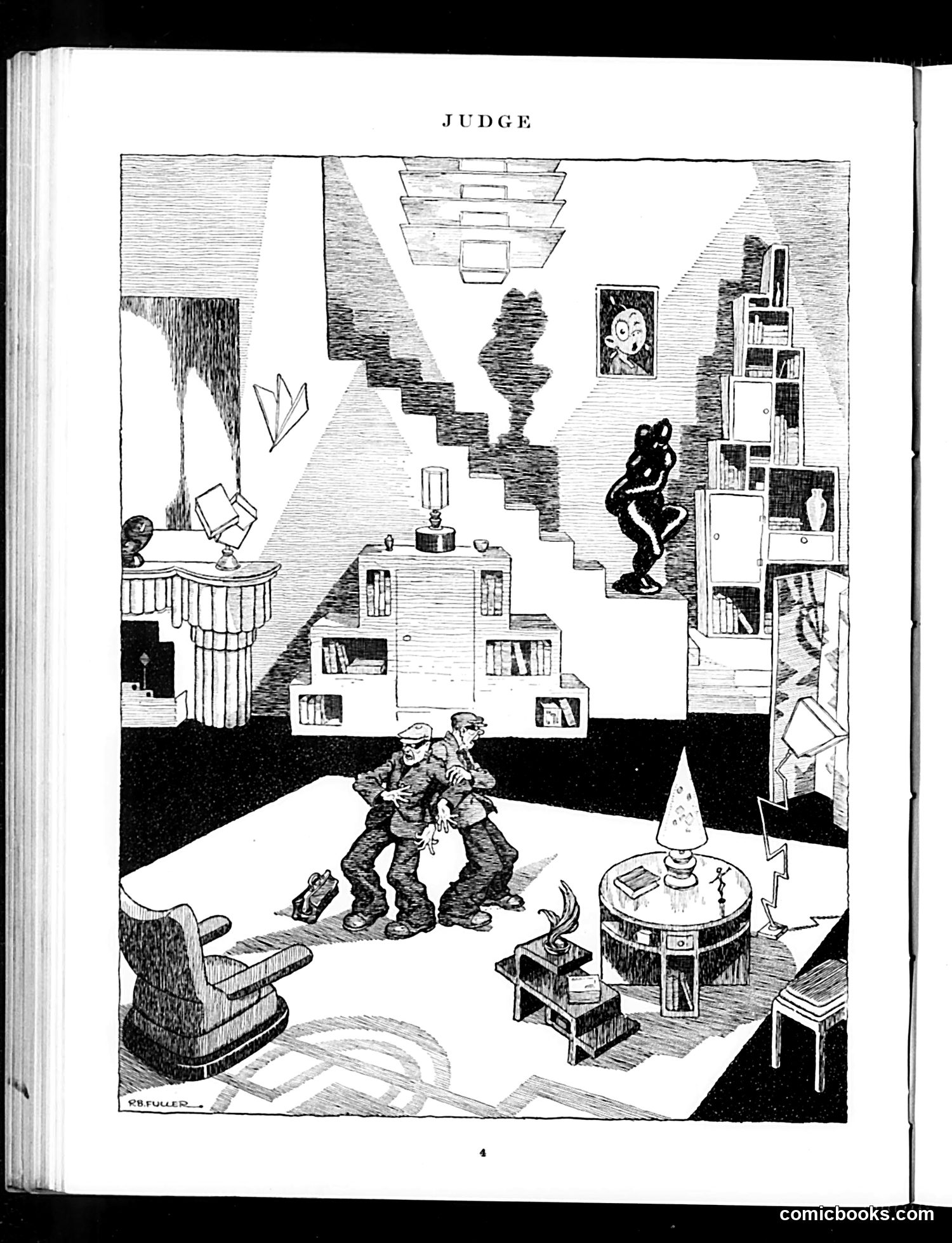
This satirical cartoon depicts a surreal domestic interior with absurdist, modernist design elements—jagged walls, fragmented shelving, distorted furniture, and bizarre architectural features. Two men in what appear to be work clothes or uniforms stand confused in the center of this chaotic space. The title "JUDGE" and the disorienting, exaggerated interior likely satirize **modern/avant-garde interior design trends** popular in the early 20th century, possibly mocking Art Deco or Cubist-influenced home design as impractical and ridiculous. The workers' bewilderment suggests satire on the gap between fashionable design ideals and actual usable living spaces. Without visible text content beyond the title, the specific social or political target remains unclear, though the overall intent appears to mock contemporary design pretension.
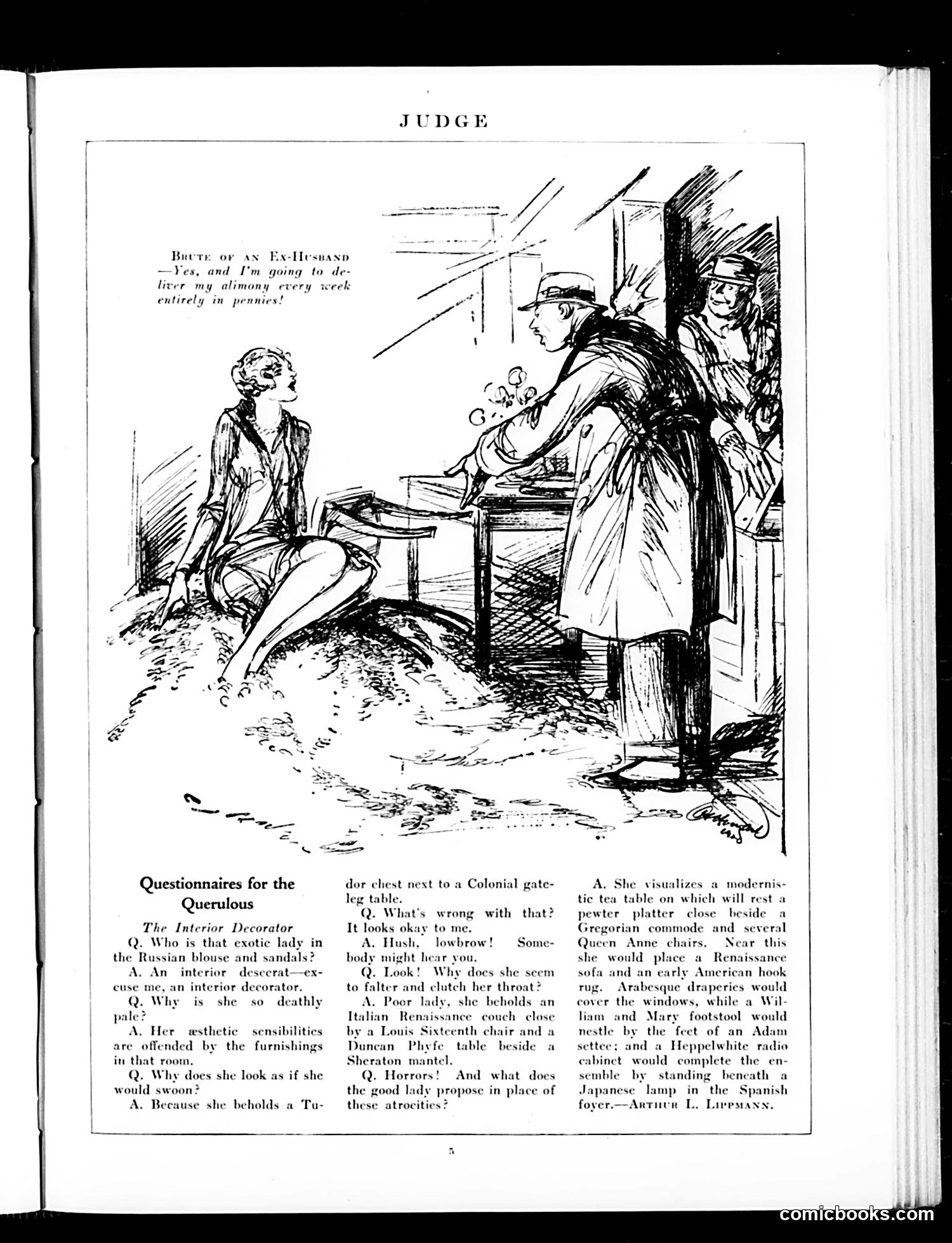
This cartoon satirizes interior decorating trends of its era. The main illustration shows a woman sitting on a dirt pile while a decorator gestures dismissively—the humor stems from absurdist "aesthetic sensibility." The "Questionnaires for the Querulous" section mocks fashionable interior design through Q&A. A woman asks why holding a Tudor pole makes sense; another questions placing Italian Renaissance furniture next to Duncan Phyfe tables. The responses defend these eclectically mismatched styles as "modernistic" aspirations. The satire targets wealthy people chasing trendy but contradictory decorating advice—combining Colonial gatelegs with Gregorian commodes, Japanese lamps in Spanish foyers. Judge ridicules both the pretentious homeowners and the decorators encouraging expensive, aesthetically incoherent choices. The dirt floor emphasizes how divorced these fashionable ideas are from practical reality.
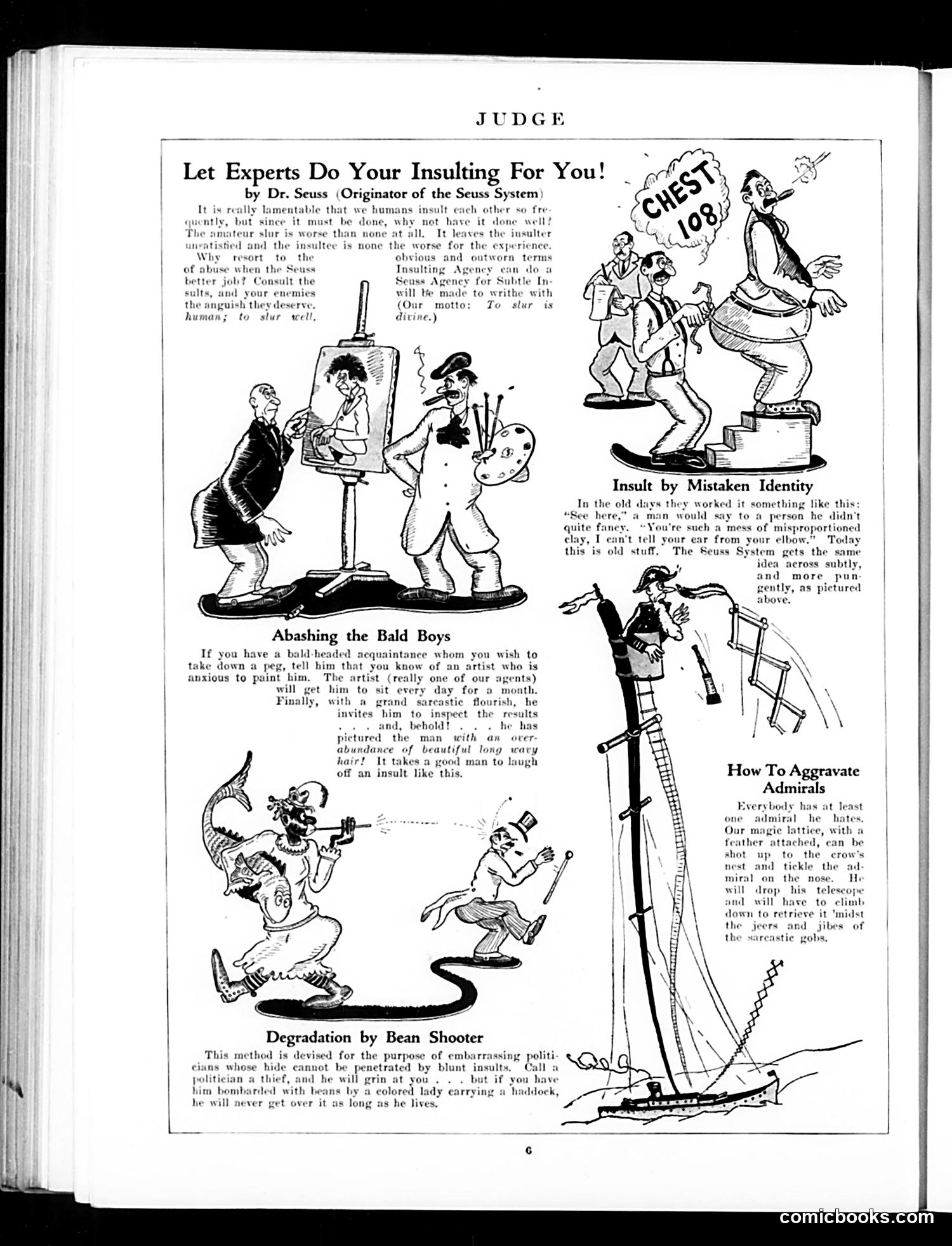
This is a humorous Dr. Seuss piece from *Judge* magazine satirizing the art of insults. Seuss proposes a fictional "Seuss Insulting Agency" offering creative ways to embarrass people—presented as superior to crude name-calling. The four methods shown are: 1. **Mistaken Identity**: Complimenting someone by comparing them unfavorably to someone else (confusing their body parts) 2. **Abashing Bald Men**: Hiring an artist to paint their portrait with exaggerated hair, embarrassing them upon reveal 3. **Aggravating Admirals**: Using a mechanical lattice device to shoot feathers up a naval officer's nose, forcing undignified retrieval 4. **Degradation by Bean Shooter**: Embarrassing politicians (whose thick skin resists direct insults) by bombarding them with beans thrown by "a colored lady"—the public humiliation making it impossible to ignore The satire mocks both elaborate revenge schemes and social hierarchies of the era. The humor relies on absurdity and the notion that "clever" insults are somehow more civilized than direct ones—a concept Seuss treats with obvious irony.
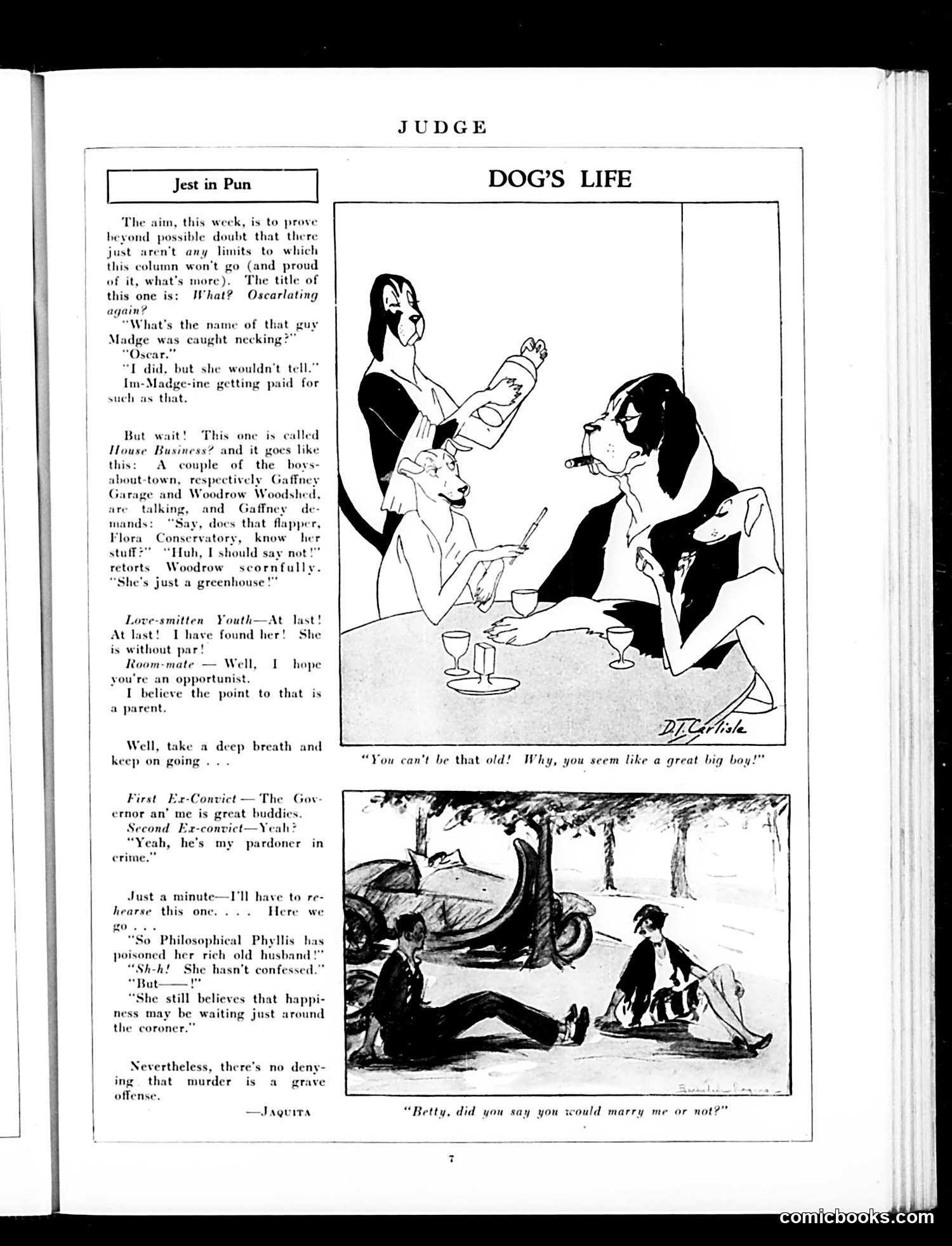
This is a humor column from *Judge* magazine featuring puns and short jokes. The page contains two cartoons illustrating comedic scenarios: **Top cartoon**: A woman and man at drinks. The caption reads "You can't be that old! Why, you seem like a great big boy!"—the joke plays on the man's vanity being flattered while being called a "boy" (implying youth). **Bottom cartoon**: Two men outdoors, one lying down. Caption: "Betty, did you say you would marry me or not?"—the humor derives from the prone man's desperation or awkward proposal situation. The left column contains brief puns and jokes, including wordplay like "Im-Madge-ine" (imagine) and "greenhous" (implying a young woman is naïve, from "hothouse flower"). References to flappers and "boys-about-town" indicate 1920s-era social commentary on modern youth culture. The page satirizes human foibles—vanity, romance, criminal connections—through light, genteel humor typical of early-20th-century satire magazines.
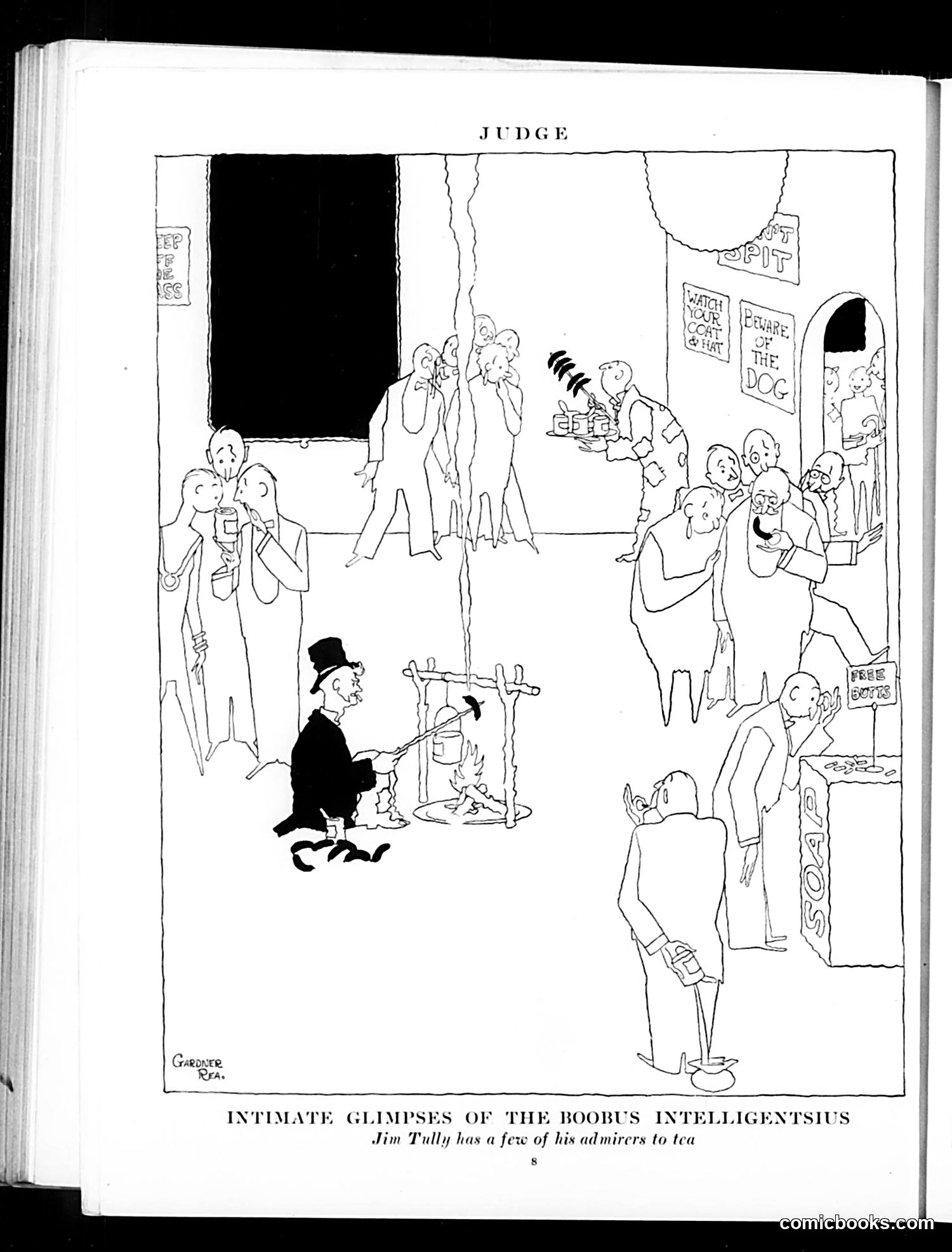
This cartoon satirizes **Jim Tully**, a writer/celebrity of the 1920s-30s, as "Boobus Intelligentsius"—mocking his pretensions to intellectual sophistication. The scene shows Tully (the figure in the top hat, center) hosting a tea gathering for his admirers. The satire targets the affectations of both Tully and his social circle: various well-dressed guests cluster around the room, some examining drinks, others making theatrical gestures. The cartoon suggests these gatherings are pompous performances where mediocre intellectuals pose as cultured sophisticates. The Latin-derived title "Boobus Intelligentsius" is itself satirical wordplay—"boobus" implying foolishness or "boobism." Judge magazine regularly ridiculed celebrities and intellectual pretenders, and this piece mocks what it presents as hollow, performative intellectualism among Tully's circle. The humor depends on readers recognizing Tully as a recognizable (if now obscure) public figure worthy of such mockery.
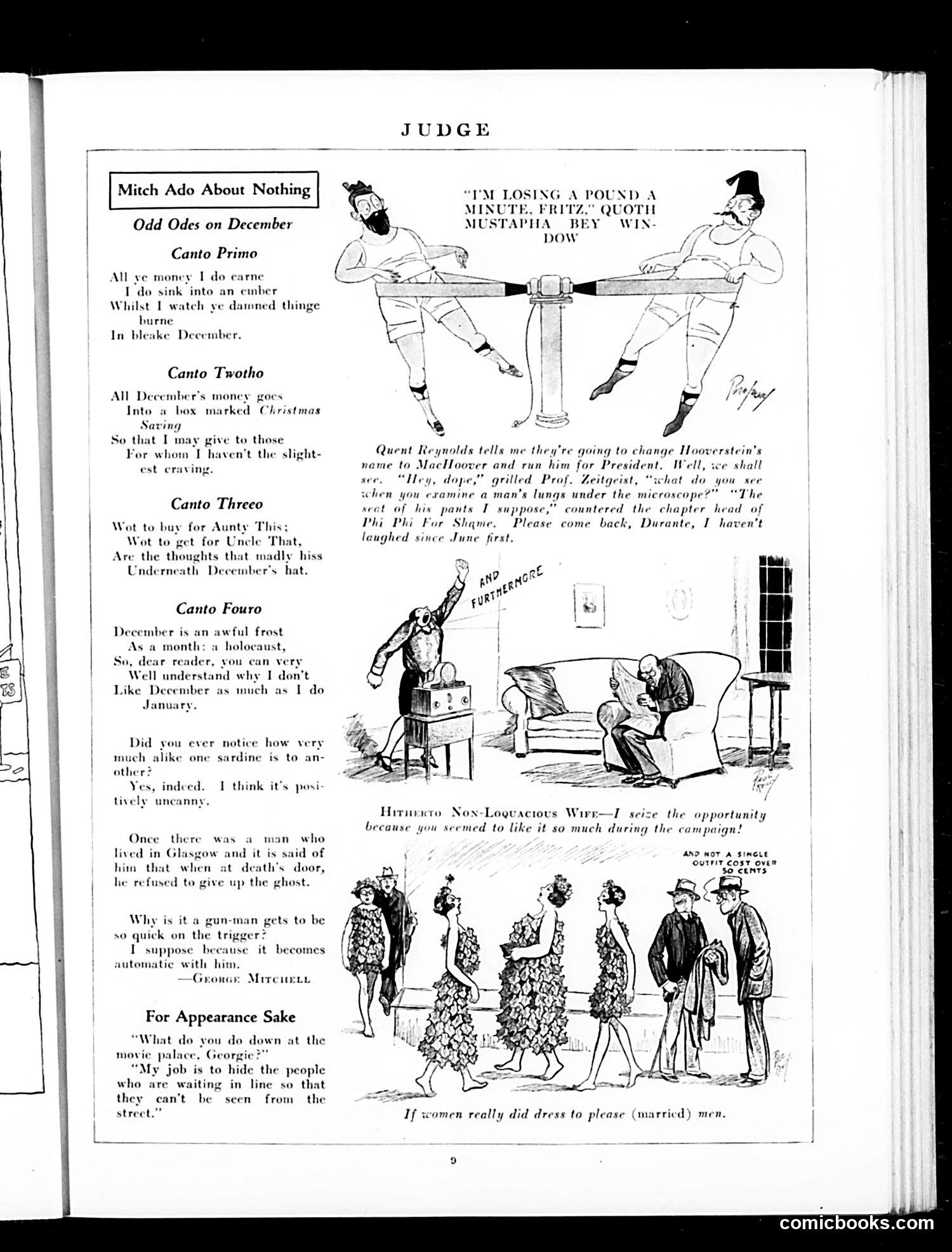
This page contains several loosely connected satirical pieces about December and holiday expenses: **"Mitch Ado About Nothing"** offers humorous verses lamenting December's financial drain—money spent on Christmas gifts for people one doesn't care about, shopping anxiety, and the month's general bleakness compared to January. **The cartoon panels** include social satire: one depicts a seesaw labeled "End Futherance," another shows a wife complaining about weight loss to her husband ("Fritz"), and a final panel mocks women's fashion, captioning that if women dressed to please married men, they'd wear far less expensive clothing. **Scattered jokes** reference contemporary figures—"Hooverstein" (likely Herbert Hoover) being renamed "MacHoo" for a presidential run, and Jimmy Durante (the performer, referenced humorously). **The "For Appearance Sake" dialogue** satirizes movie theater ushers who hide waiting customers from street view to maintain an illusion of popularity. Overall, the page reflects 1920s-30s Judge magazine humor: domestic complaints, consumerism criticism, and gender-based comedy typical of the era.
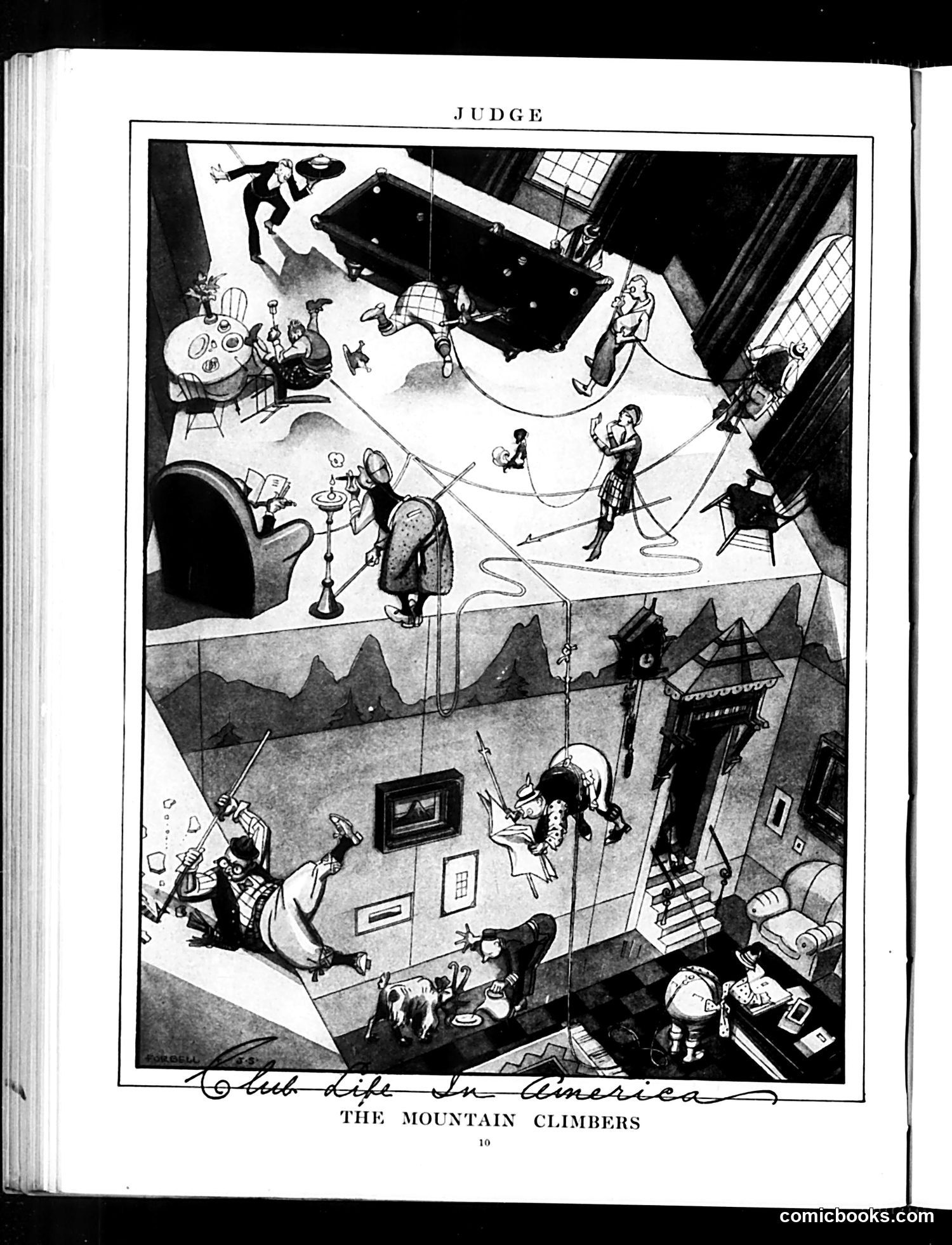
This cartoon depicts a cross-section view of American society as a mountain, with people climbing toward the summit. The upper level shows affluent individuals in formal dress enjoying leisure activities—a film camera crew, performers on ropes, and well-dressed spectators. The middle shows working-class people laboring. The lower level reveals the foundation: struggling workers in harsh conditions, mining or doing manual labor underground. The satire critiques class hierarchy and social mobility in America. The title "Club Life in America" (visible in handwriting) suggests this mocks the exclusive nature of high society. The image suggests that wealth and leisure rest literally upon the exploitation and hard labor of those below—a commentary on economic inequality and the structural inequities of American capitalism.
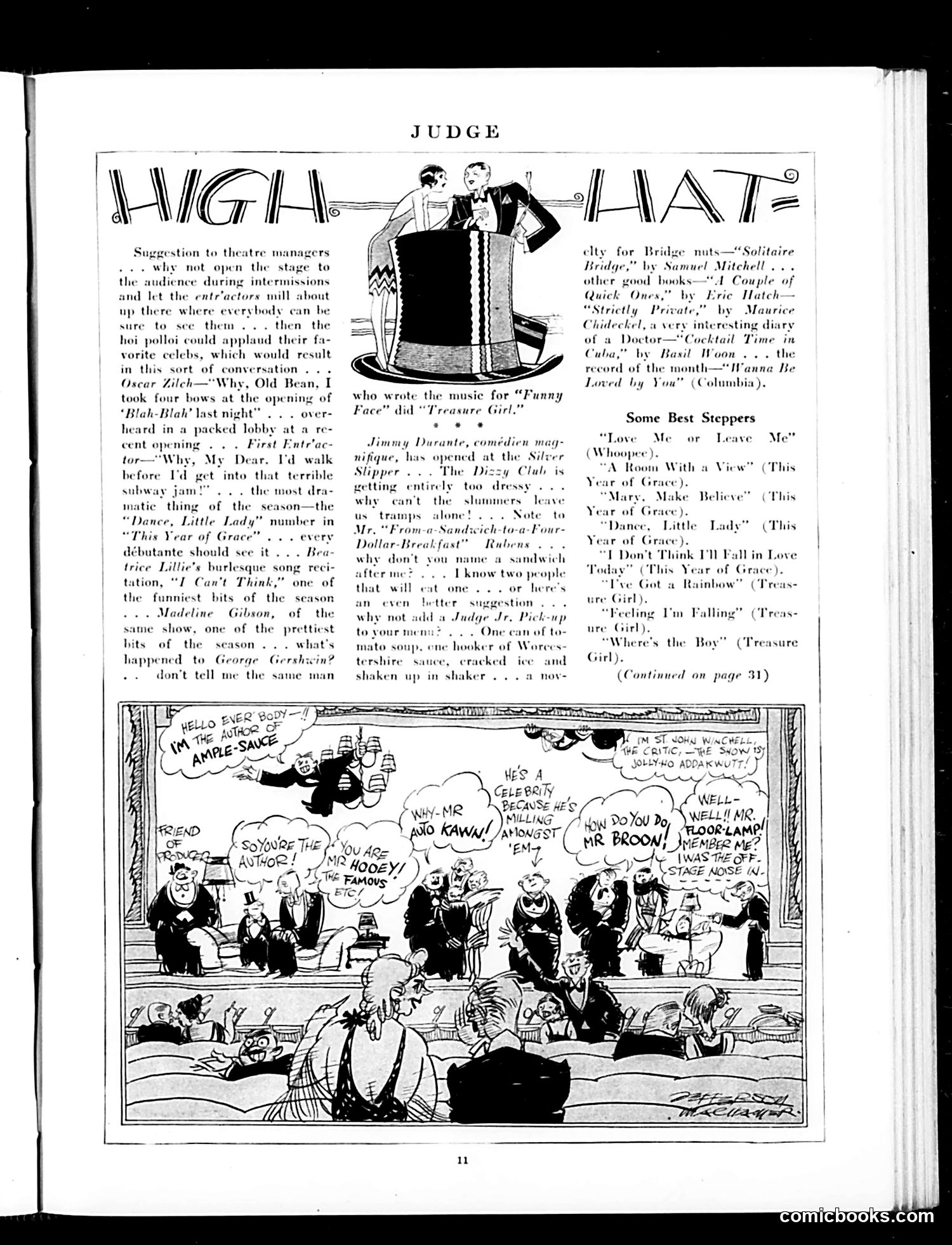
This page satirizes **1920s Broadway theater culture and celebrity vanity**. The cartoon depicts famous performers crowding a theater box during intermission, all competing for applause and attention from "hoi polloi" (common people). The figures appear to be **well-known entertainers of the era** (though specific identities aren't labeled). Characters boast about their performances and complain about accommodations—one mentions being "the off-stage noise in-"—suggesting theatrical divas behaving badly. The upper text discusses **real Broadway shows and performers**: "This Year of Grace," Beatrice Lillie, Jimmy Durante at the Silver Slipper, and songs from "Funny Face" and "Treasure Girl." The "Best Steppers" section lists popular dance numbers. **The satire's point**: Broadway celebrities are absurdly self-absorbed, demanding public adoration even during breaks, and creating ridiculous social hierarchies. It mocks both performer pretension and audience willingness to celebrate them—a timeless Hollywood/entertainment industry critique.
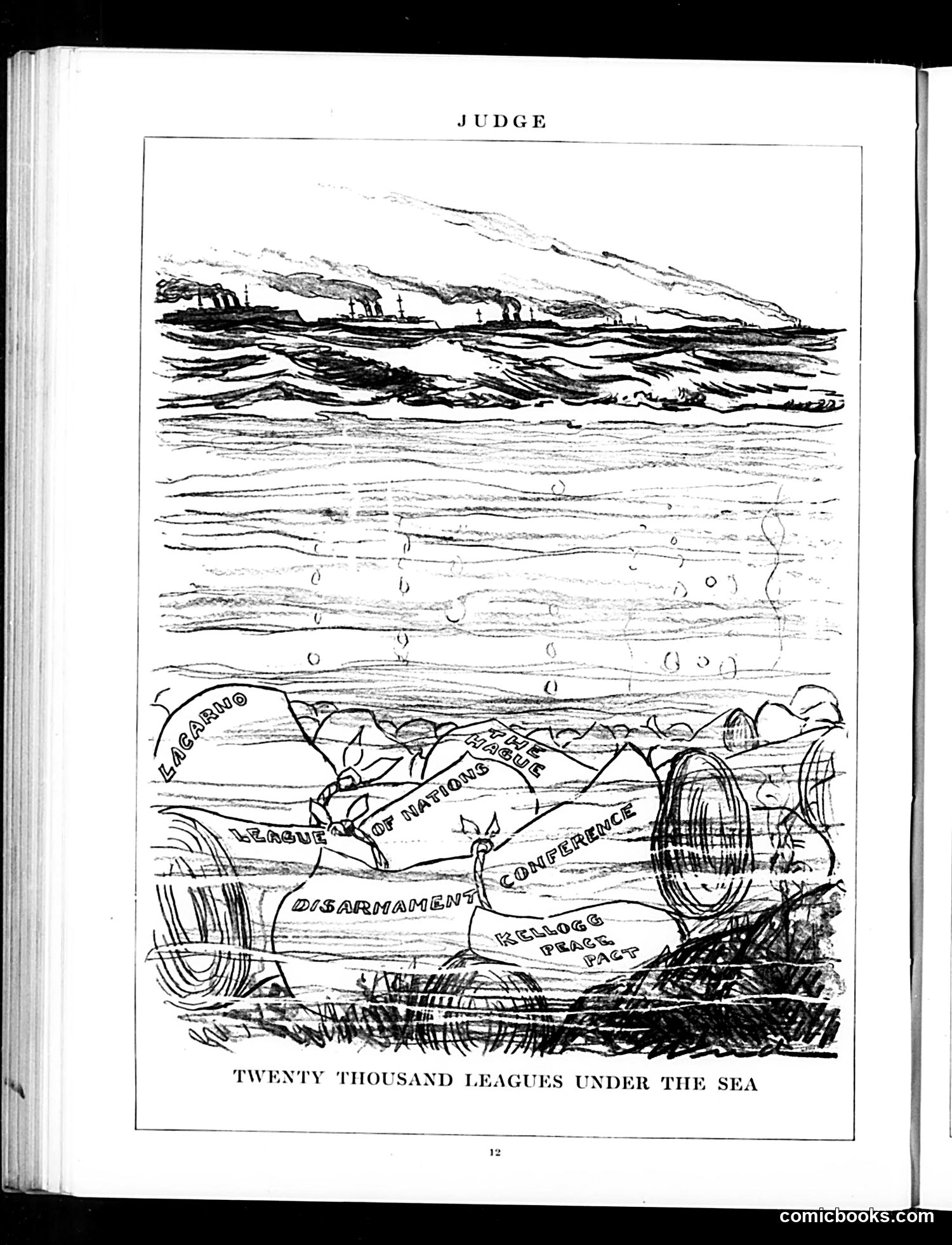
This Judge magazine cartoon titled "Twenty Thousand Leagues Under the Sea" is a political satire about disarmament. The underwater scene shows a submarine carrying large naval weapons and military equipment labeled with phrases like "Disarmament," "Conference," "Kellogg Pact," and "League of Nations." The satire's point appears to be **ironic critique of disarmament efforts**: while governments publicly advocated for peace treaties and weapons reduction (referenced by the Kellogg-Briand Pact and League of Nations), they were simultaneously developing and deploying advanced military technology, particularly submarines armed with weapons. The image suggests that actual disarmament was fictional—nations were merely paying lip service to peace while secretly building more sophisticated instruments of war.
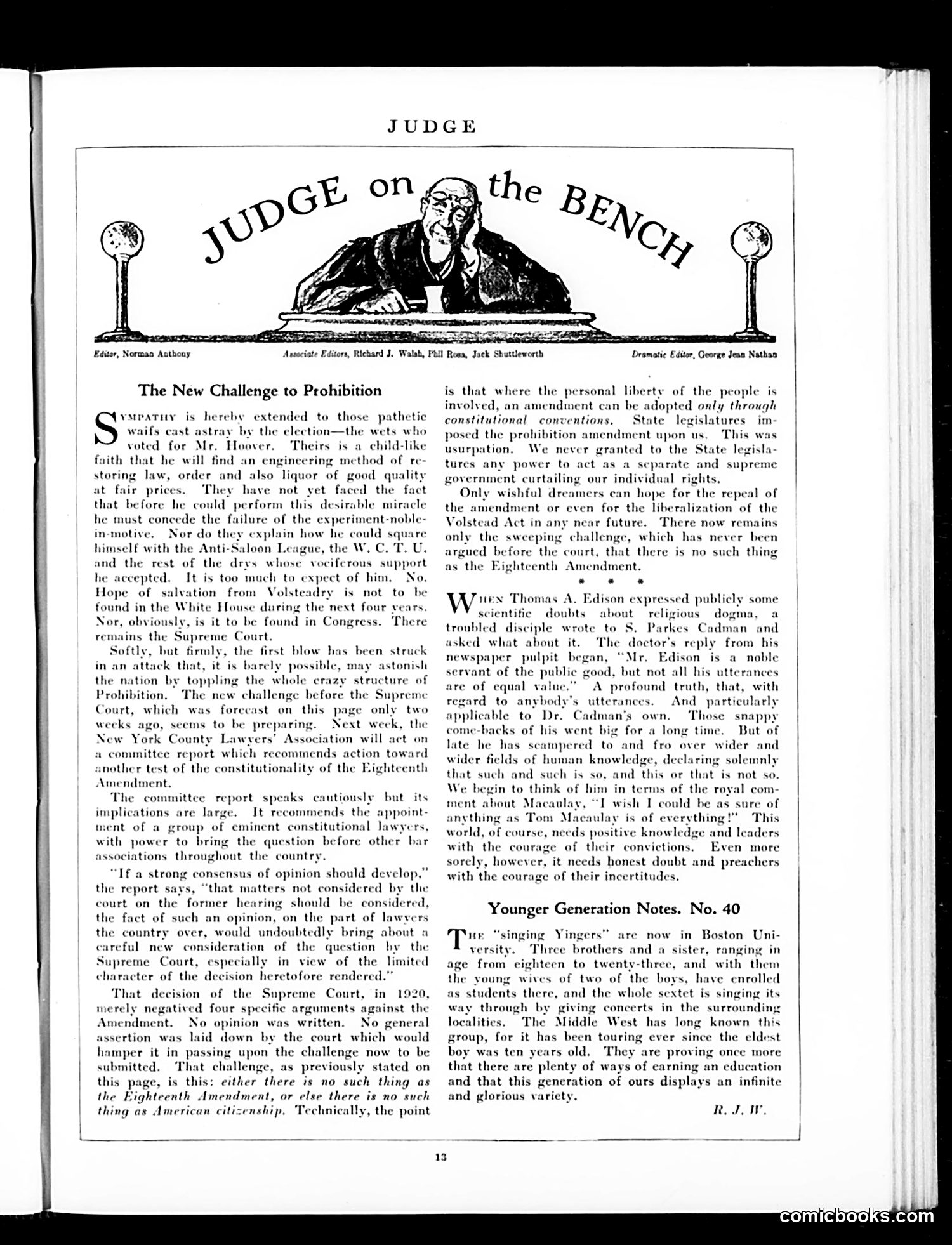
This page discusses a legal challenge to Prohibition's constitutionality. The New York County Lawyers' Association planned to argue before the Supreme Court that the Eighteenth Amendment was invalid because state legislatures—not constitutional conventions—ratified it, allegedly violating citizens' rights. The article expresses sympathy for "wets" (alcohol advocates) who voted for Hoover hoping he'd restore legal liquor, while acknowledging this was naive given his support from dry organizations like the Anti-Saloon League and W.C.T.U. A secondary item mocks Thomas Edison's public skepticism about religious dogma. S. Parkes Cadman (a prominent minister) replied dismissively in his newspaper column, sparking a jab at Cadman's tendency toward "snappy come-backs." The overall tone is critical of Prohibition's enforceability and skeptical of political solutions.
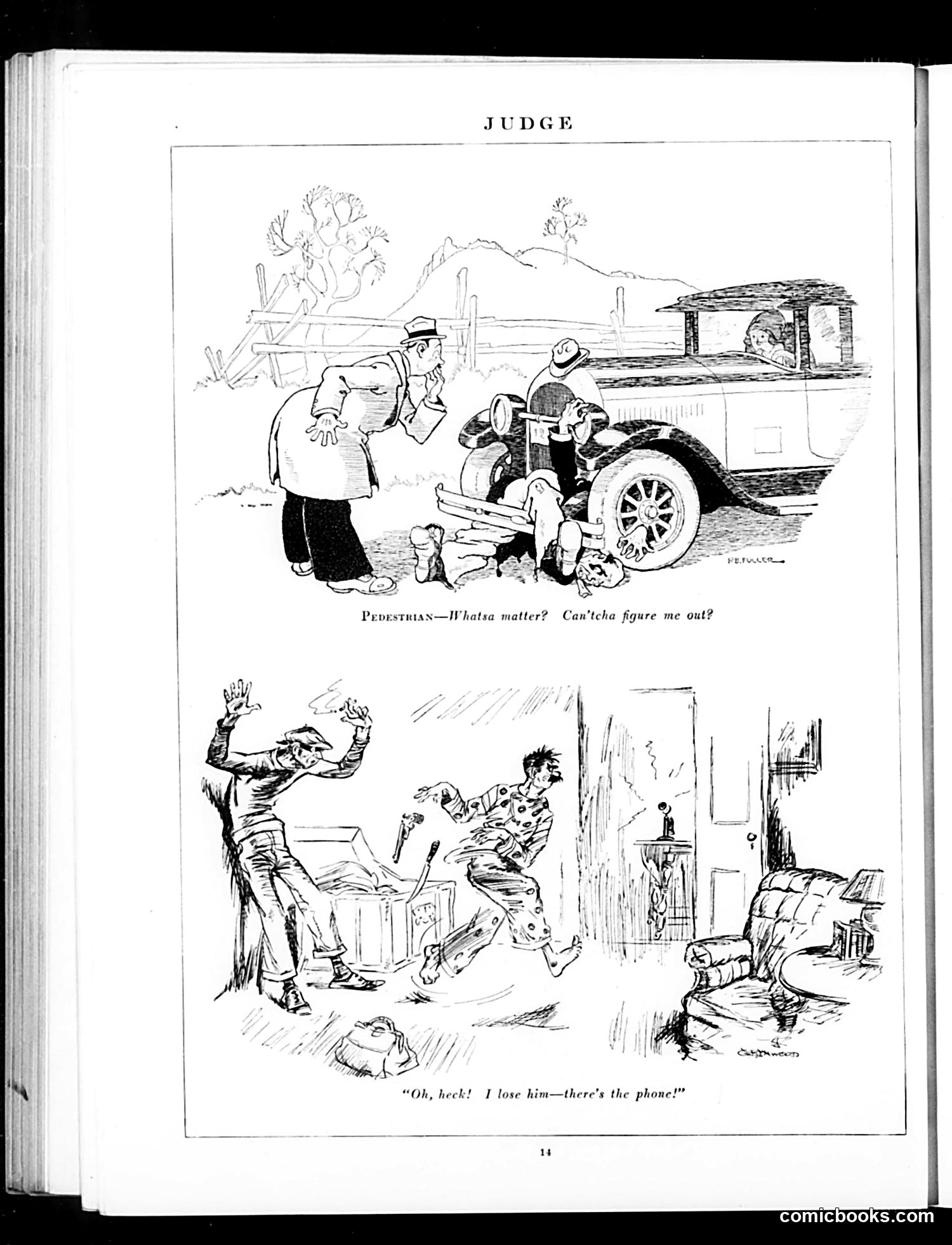
This page contains two satirical cartoons about early automobile culture: **Top cartoon**: A pedestrian confronts a motorist after a collision, demanding "Whatsa matter? Can'tcha figure me out?" The satire targets both reckless drivers and the confusion caused by automobiles entering streets previously shared only with pedestrians and horse-drawn vehicles. **Bottom cartoon**: Titled "Oh, heck! I love him—there's the phone!" depicts a woman apparently discovering her suitor kissing another woman. The satire likely mocks the chaos caused by early telephone communication, suggesting the technology enables awkward romantic confrontations or complications. Both cartoons reflect early 20th-century anxieties about modern technology disrupting traditional social order and domestic life.
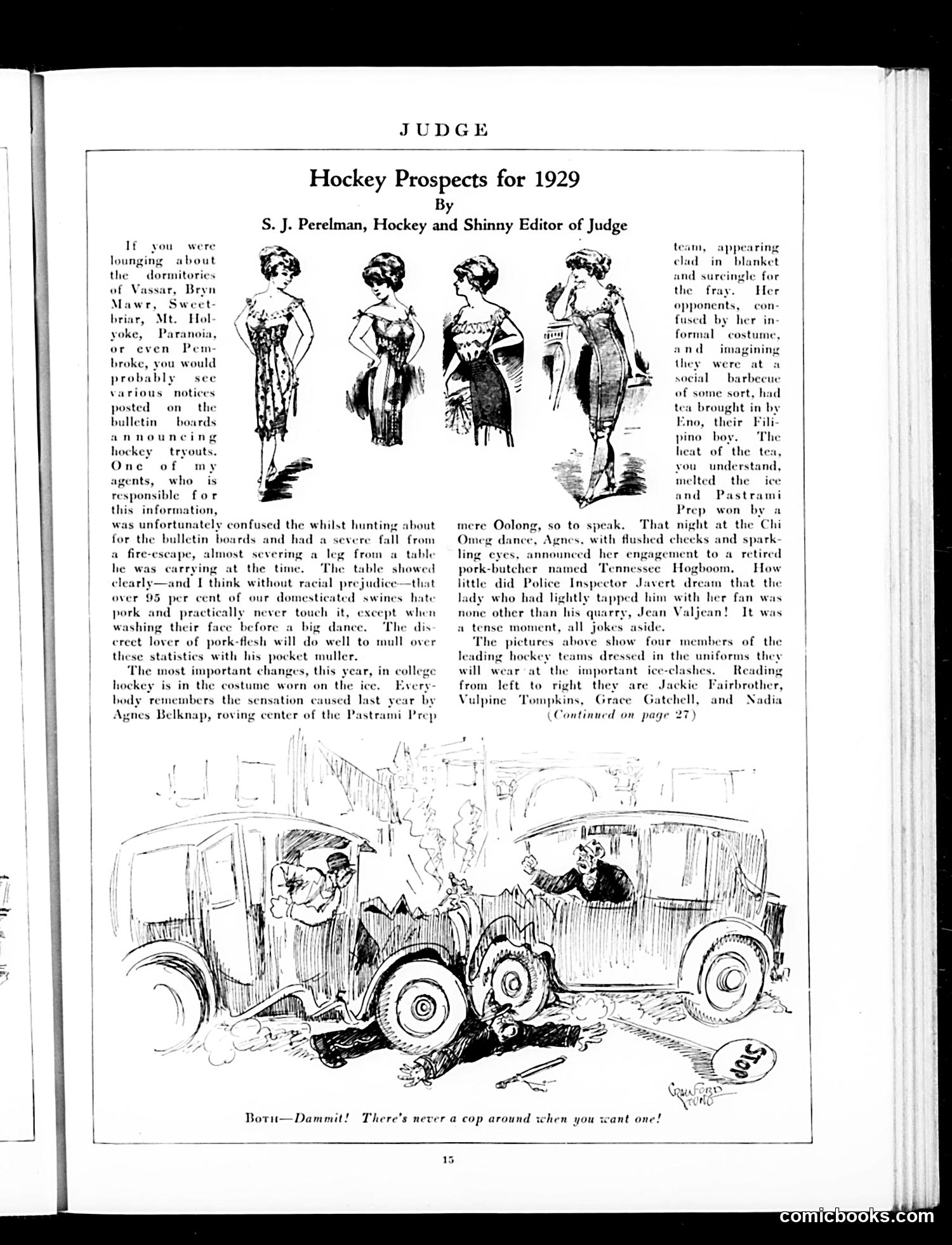
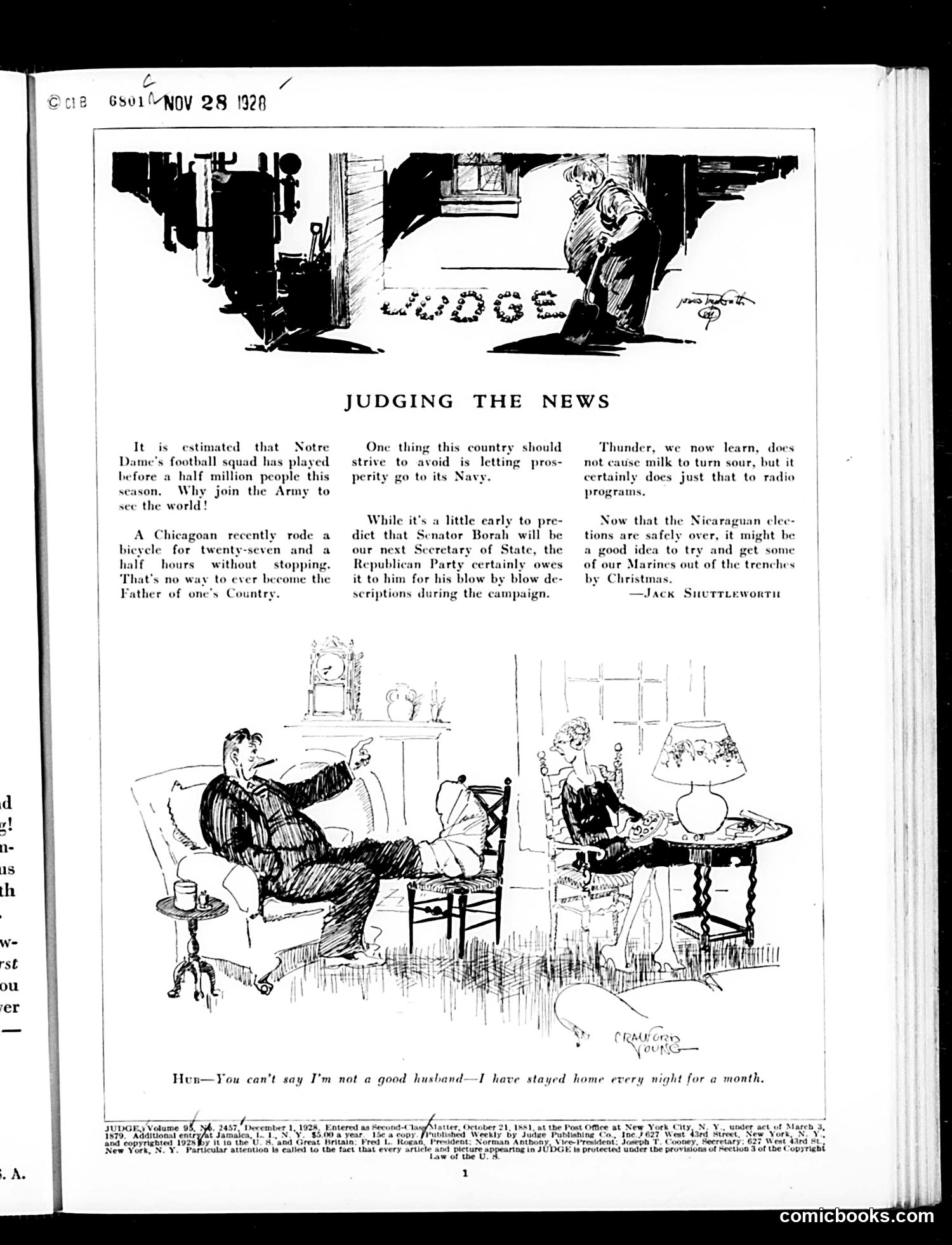
This is a humorous article by S.J. Perelman (a prominent satirist) about women's college hockey, published in *Judge* magazine. The main cartoon depicts a car accident between two vehicles with the caption "Both—Dammit! There's never a cop around when you want one!"—a joke about ironic timing. The article itself is largely absurdist comedy rather than political satire. Perelman rambles through non-sequiturs: a confused agent falling from a fire escape, statistics about pigs disliking pork, tangential references to *Les Misérables* characters (Jean Valjean, Inspector Javert), and a woman announcing engagement to "Tennessee Hogboom." The piece concludes with photos of four female hockey players in their uniforms for upcoming matches. The humor relies on 1920s collegiate culture, non-sequitur digression, and the novelty of women's athletics at elite colleges like Vassar and Bryn Mawr.
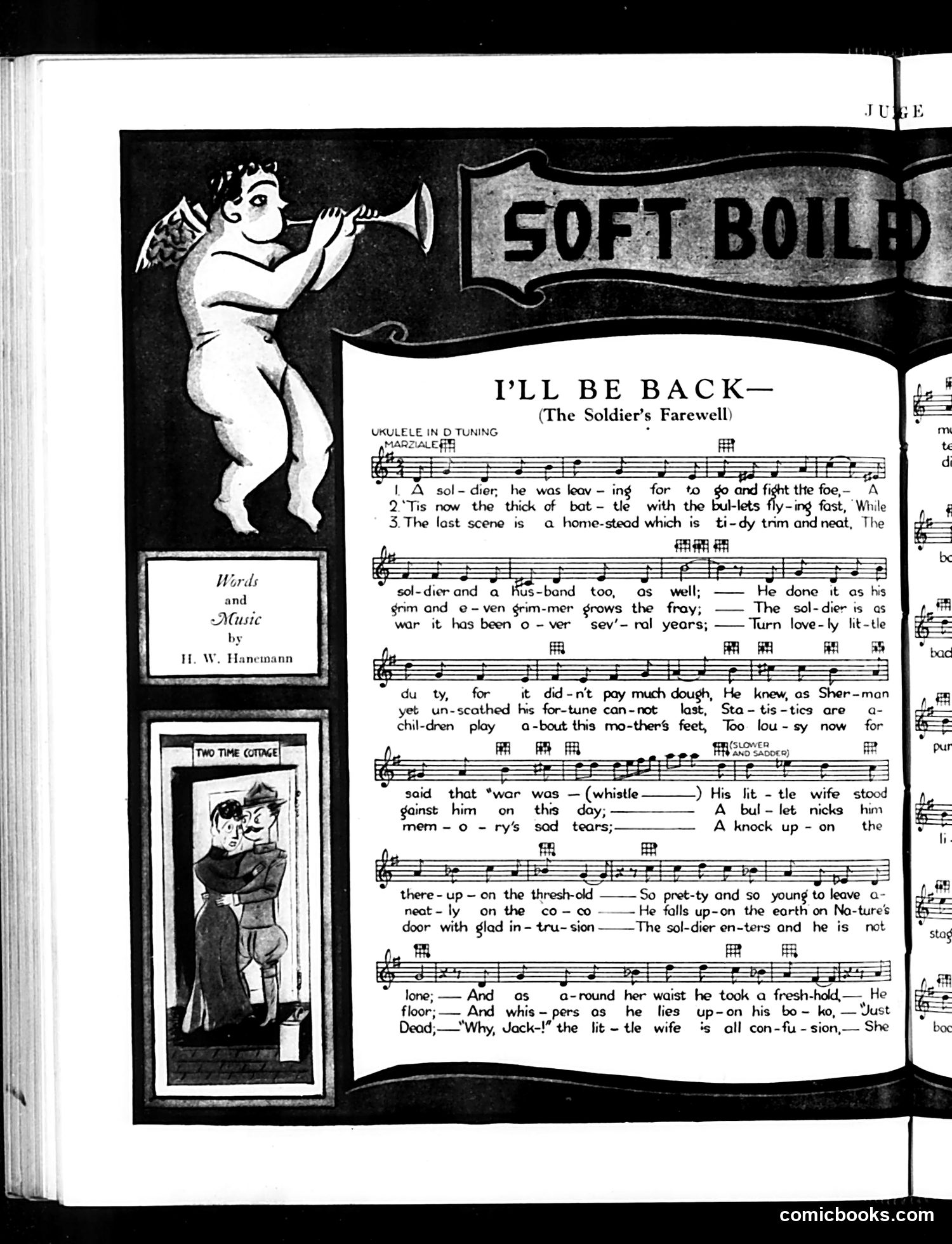
This page contains a sentimental WWI-era song with ukulele sheet music, reflecting the popular culture of the 1910s-20s. The composition by H.W. Hanemann presents a narrative song about a soldier departing for war, told across three verses depicting: his leaving, battle, and his return home. The decorative elements—a cherub trumpeter and a "Two Time Cottage" illustration showing an embracing couple—reinforce the romantic, patriotic tone typical of wartime popular entertainment. The song's structure juxtaposes battlefield horrors ("statistics," casualties) with domestic sentimentality (wife, children waiting at home). This represents how American popular magazines like *Judge* used music and illustration to process the emotional experience of WWI for civilian audiences, mixing patriotic duty with emotional reassurance about soldiers' safe returns.
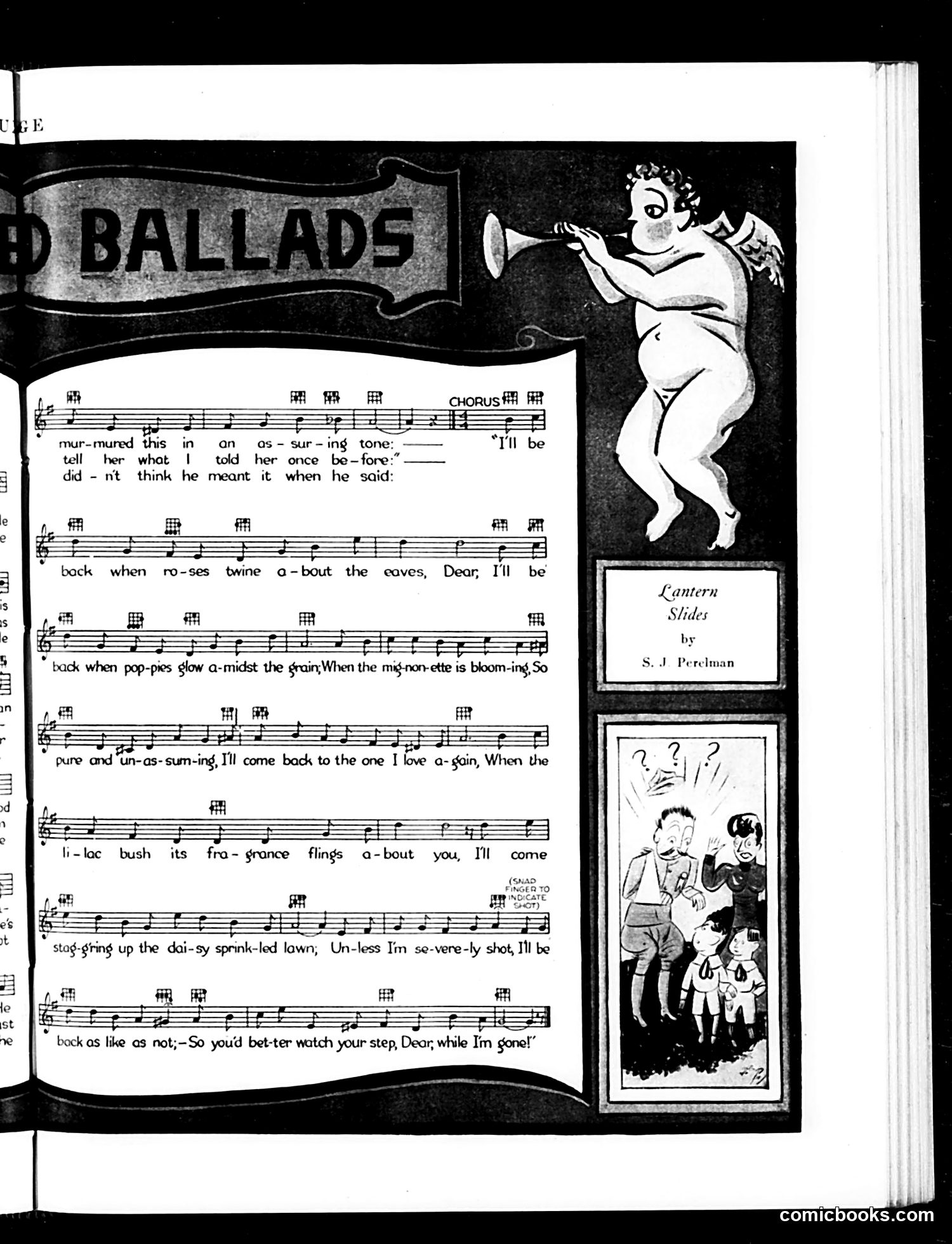
This page presents sheet music for a romantic ballad with humorous lyrics. The song depicts a man making elaborate promises to return to his sweetheart—"back when poppies glow," "when the mignonette is blooming," and "when the lilac bush" spreads its fragrance. The joke lies in the final lines' deflation of romance: he'll return "unless I'm severely shot" and warns her to "watch your step" while he's gone—implying either infidelity or that she should be cautious in his absence. The cherub illustration at top right and the "Lantern Slides by S.J. Perelman" credit (visible at bottom) suggest this satirizes sentimental Victorian ballads popular in that era. The contrast between flowery romantic language and the cynical threat/warning at the end is the satire—mocking melodramatic love songs and insincere male declarations of devotion.
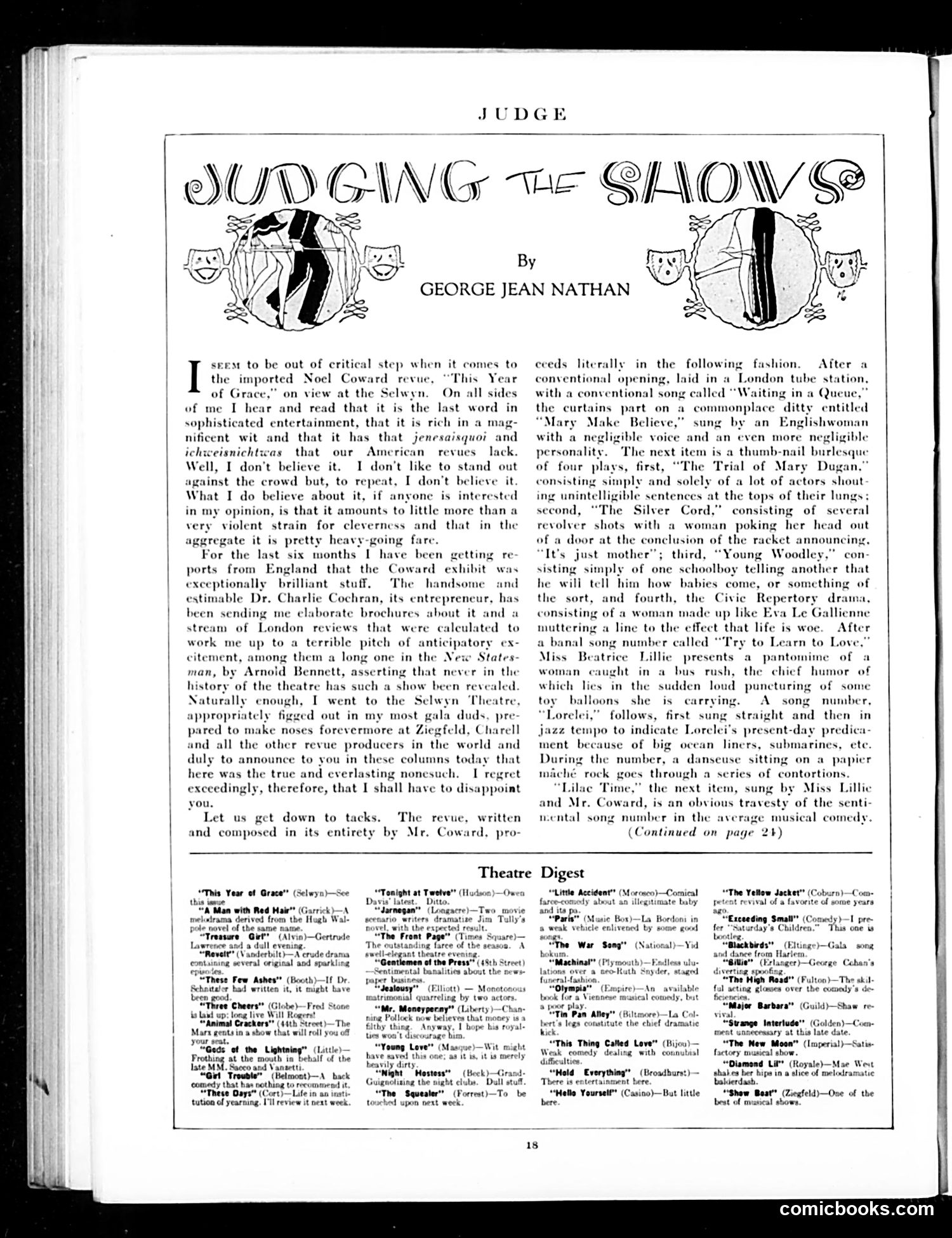
This is George Jean Nathan's theater column reviewing Noël Coward's imported British revue *This Year of Grace* at the Selwyn Theatre. Nathan satirizes both the revue itself and the critical hype surrounding it. **The satire:** Nathan mocks American critics' reflexive admiration of British entertainment, describing *This Year of Grace* as pretentious but ultimately mediocre—"heavy-going fare" masquerading as sophisticated wit. He catalogs the show's sketches (a song about waiting in a queue, a door-slamming farce, a schoolboy monologue) to expose them as trivial despite being composed by the celebrated Coward. **The target:** The piece ridicules the "je ne sais quoi" worship of imported British culture and the London critical establishment (Arnold Bennett is mentioned by name) that manufactured anticipatory excitement through elaborate promotional materials. The accompanying "Theatre Digest" lists other current Broadway productions, providing context for period entertainment.
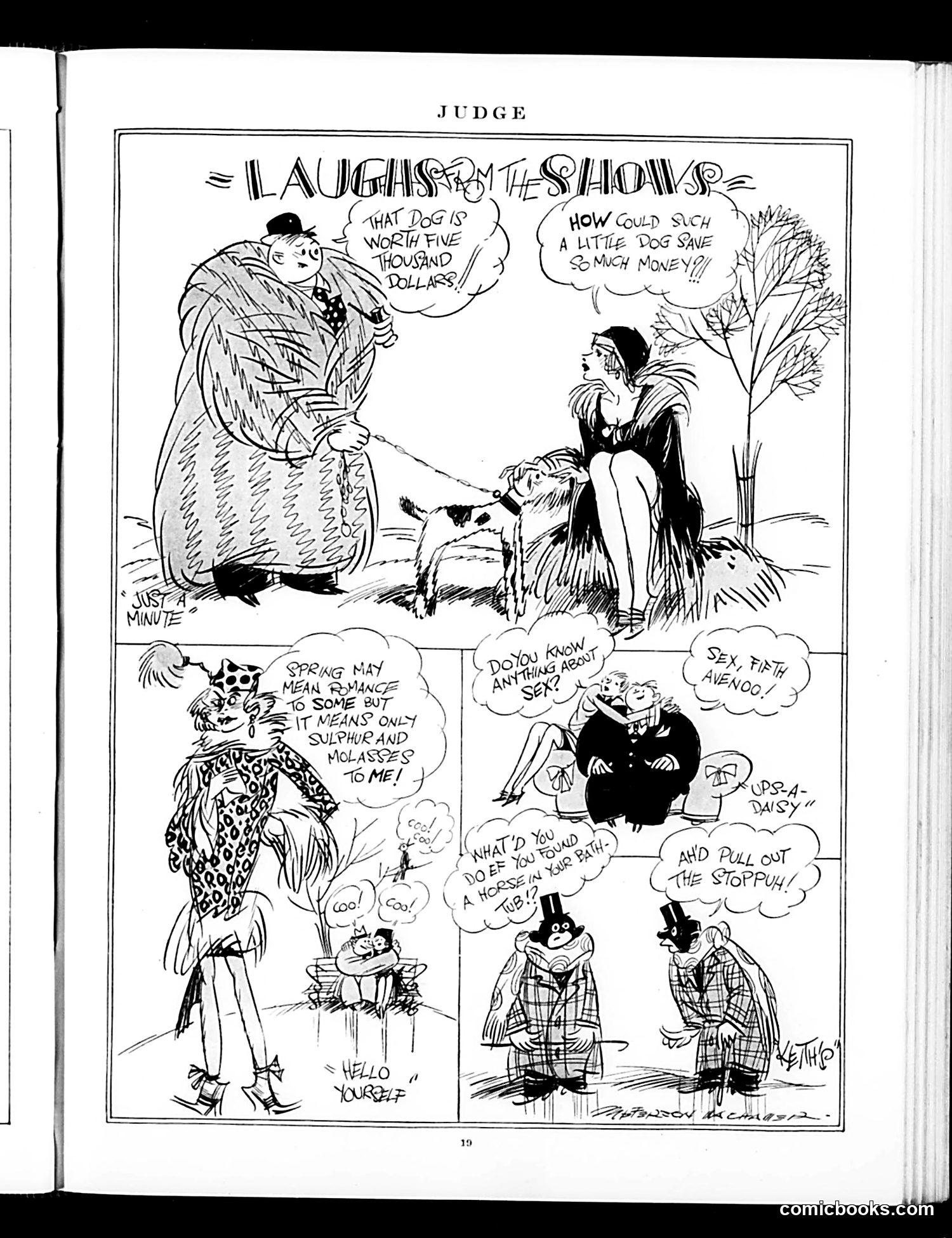
This comic strip satirizes the high prices charged at dog shows. The top panel shows a wealthy man astounded that a small dog is "worth twenty-five thousand dollars," while a woman responds sarcastically about the expense. The subsequent panels mock pretentious dog-show culture through exaggerated character types: a pompous judge in ornate dress, wealthy socialites discussing dubious "breeding" methods (sulfur and molasses treatments), and working-class men in flat caps discussing crude dog-show terminology ("pull out the stoppuh"). The satire targets the absurdity of the dog-show elite—their inflated valuations, affected speech, and dubious breeding practices—contrasting them with ordinary people's bafflement at such extravagance. The humor lies in exposing the pretension and financial excess of this leisure-class pursuit during what appears to be the early 20th century, when such shows were fashionable among the wealthy.
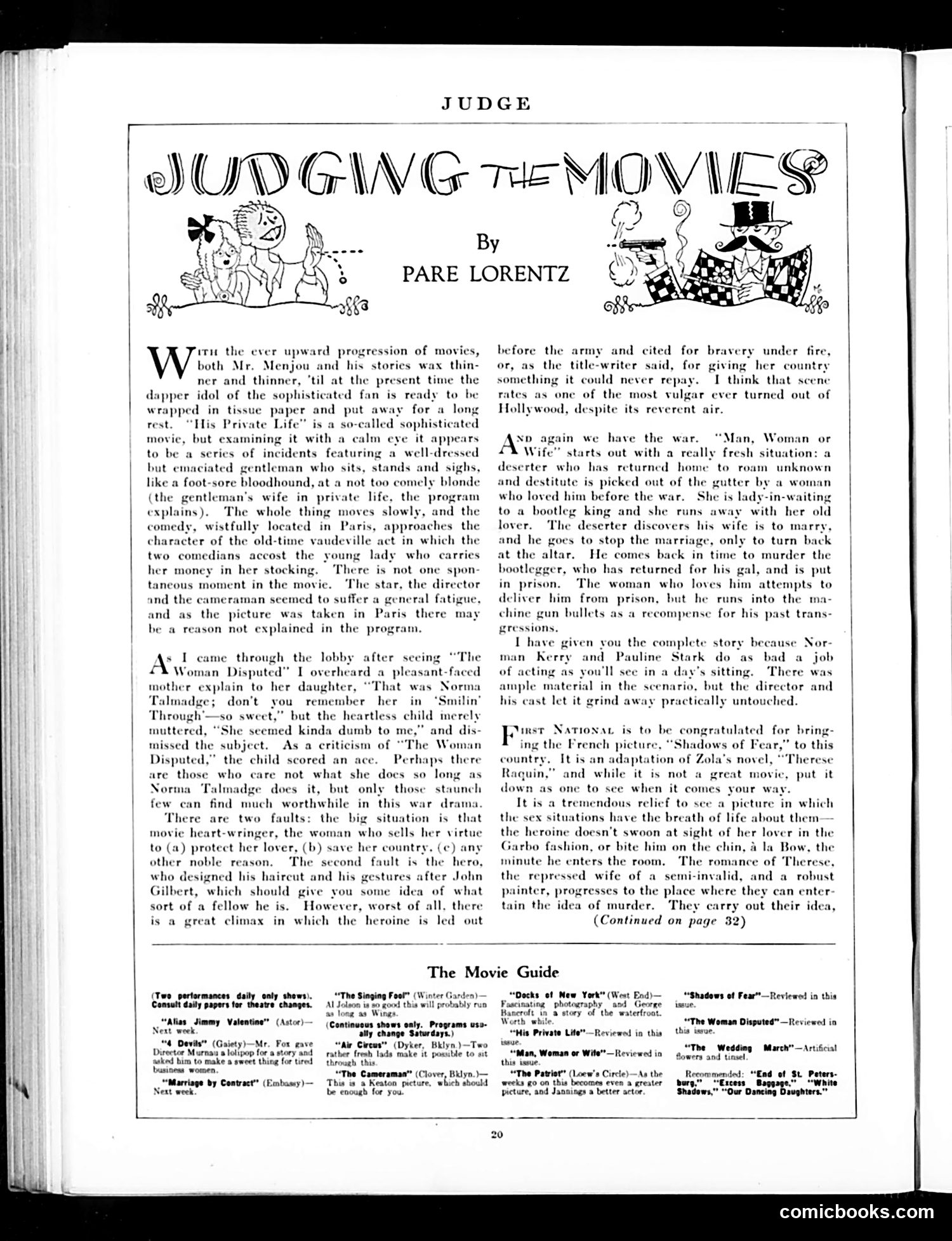
This page contains film reviews by critic Pare Lorentz, examining contemporary movies with satirical commentary. The reviews critique several films: **"His Private Life"** (starring Adolphe Menjou): Lorentz dismisses it as tedious vaudeville dressed up as sophistication—a series of static scenes featuring a well-dressed gentleman sighing at a blonde woman, moving slowly with no spontaneous moments. **"Man, Woman or Wife"**: A war-returning-deserter melodrama with contrived plot mechanics (murder, prison escape, machine-gun death) that the cast executes mechanically. **"The Woman Disputed"** (Norma Talmadge): Criticized as a manipulative "heart-wringer" where the heroine sacrifices virtue for noble reasons, with a hero who imitates actor John Gilbert's mannerisms. **"Shadows of Fear"**: Praised as a worthy adaptation of Zola's novel, offering genuine dramatic substance about repressed desire and murder. The satire targets both Hollywood's formulaic melodrama and audiences' acceptance of it.
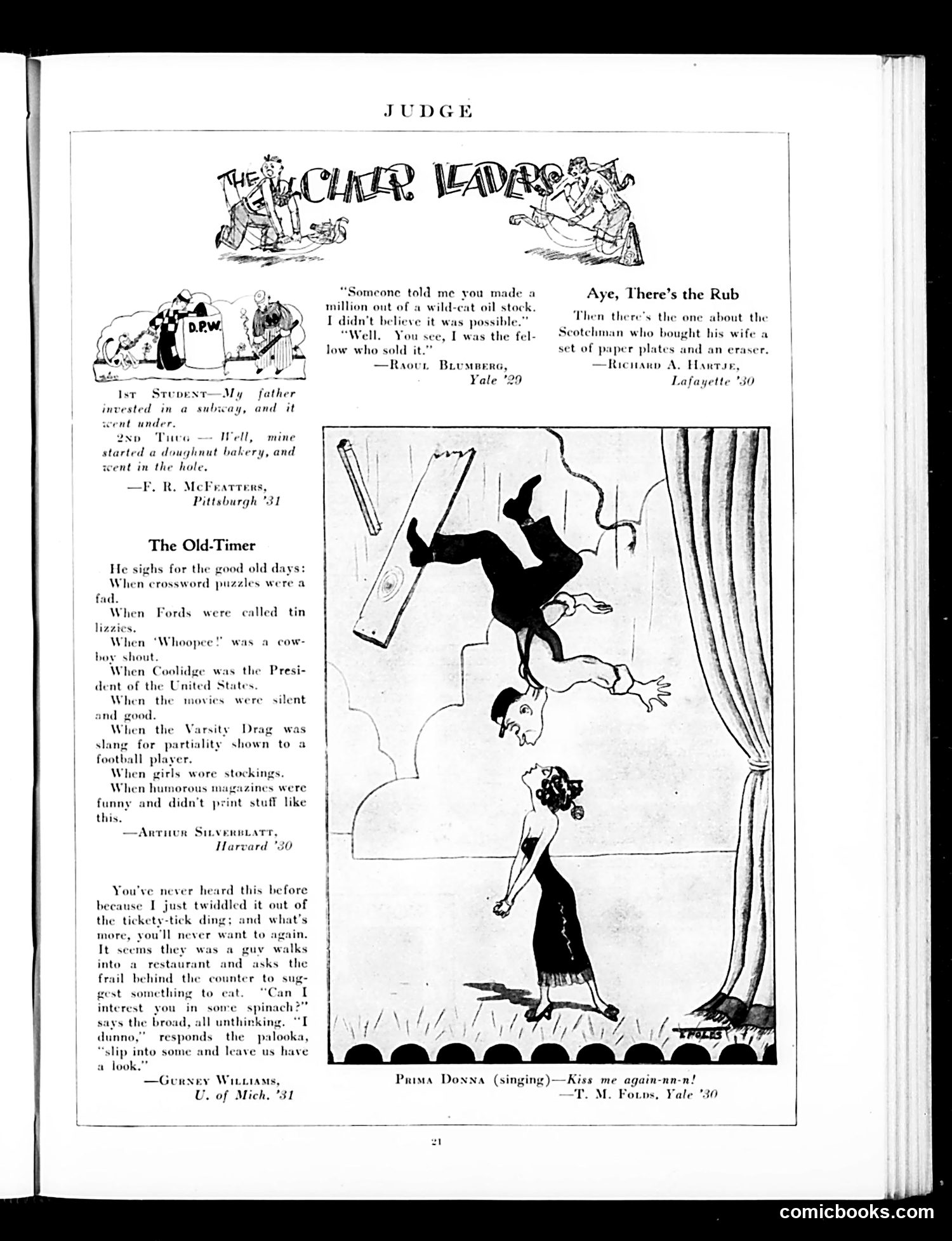
This page collects brief humorous anecdotes and jokes from college students (Yale, Harvard, Lafayette, Pittsburgh, Michigan), typical of Judge's humor section. The content reflects 1930s collegiate wit: **The jokes mock:** - Get-rich-quick schemes (wild-cat oil stocks, subway investments) - Marital dynamics (the Scottish husband buying his wife erasable paper plates) - Failed business ventures (doughnut bakery "went in the hole") **"The Old-Timer" section** is nostalgic satire about recent past trends now deemed outdated: Calvin Coolidge's presidency, silent films, the "Varsity Drag" dance craze, and rolled stockings. The final quip—that humorous magazines "didn't print stuff like this"—is self-aware mockery of Judge's own declining humor quality. **The main cartoon** shows slapstick physical comedy of figures tumbling, captioned with a restaurant joke about a customer asking to "look" at spinach—crude wordplay typical of 1930s vaudeville-influenced humor. The page is primarily entertainment for college-educated readers, reflecting mid-Depression-era campus humor.
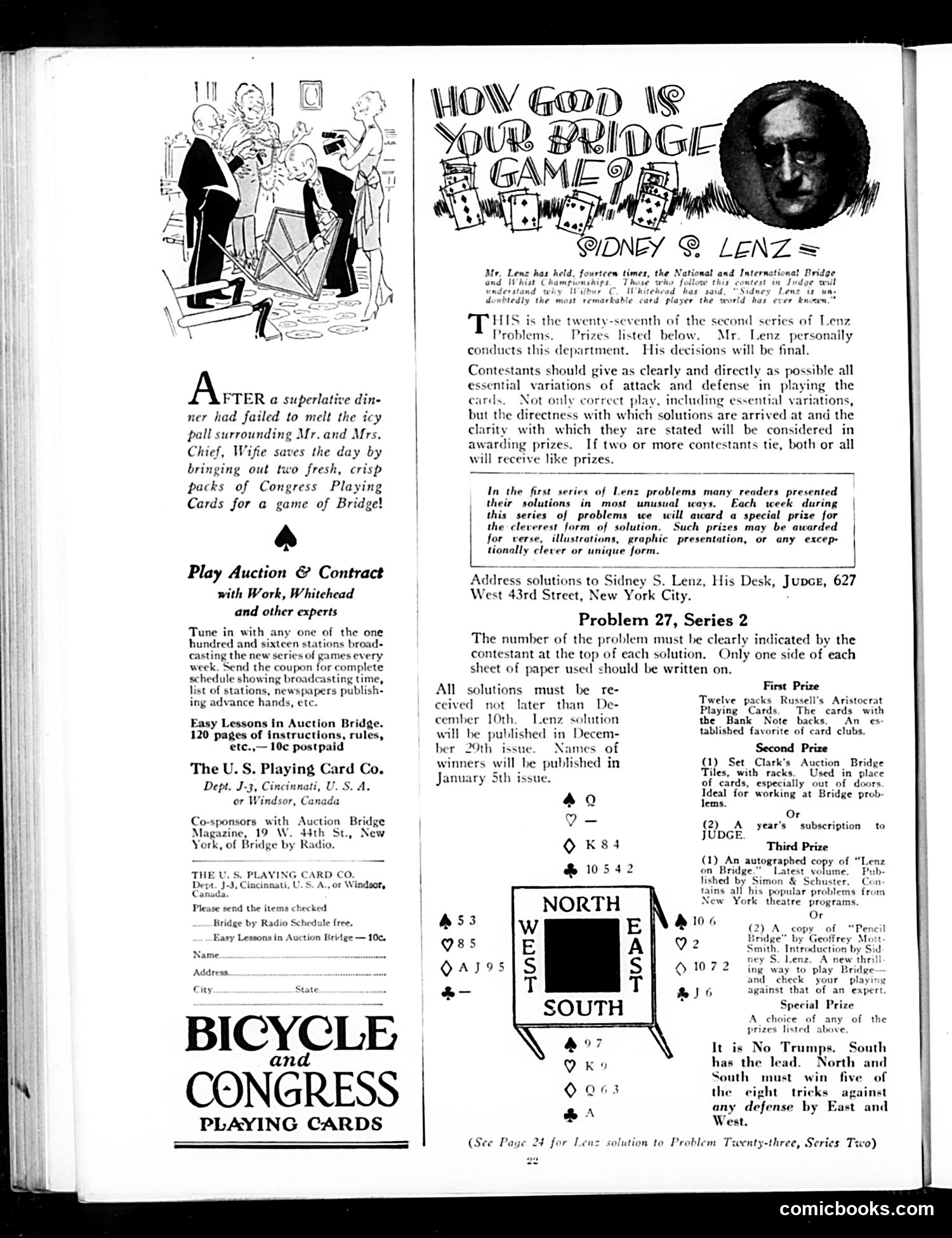
This page is primarily **advertising and a bridge card game puzzle contest**, not political satire. The cartoon at top left depicts a domestic scene: a formal dinner party where an icy atmosphere between "Mr. and Mrs. Chief" is rescued when the wife produces playing cards for bridge—suggesting card games as a social remedy for marital tension. This is a lighthearted domestic humor piece, not political commentary. The bulk of the page advertises **U.S. Playing Card Company's bridge products** (Bicycle and Congress brands) and promotes radio broadcasts teaching auction bridge. The central feature is "Problem 27" from Sidney S. Lenz's bridge instruction series, with prizes including card decks, subscriptions to Judge magazine, and Lenz's instructional book. This reflects bridge's enormous popularity as a parlor game in the 1920s-30s. The content serves primarily as promotional material for card games and radio entertainment, with minimal satirical content.
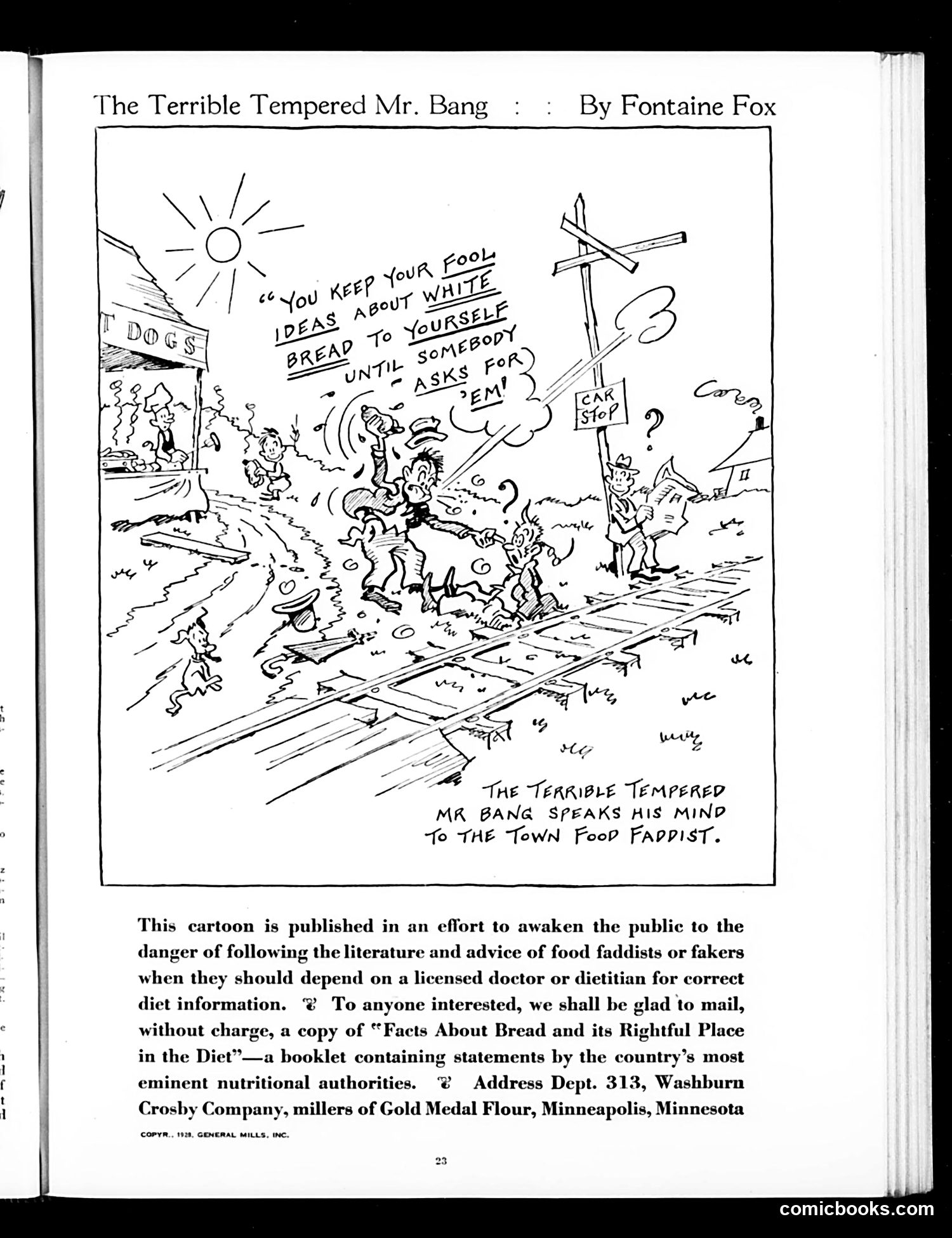
This is a **paid advertisement disguised as editorial content** by Washburn Crosby Company (General Mills). The cartoon features "Mr. Bang," an angry character confronting townspeople about nutritional misinformation. **The satire targets**: Food faddists—people promoting unorthodox, trendy diet advice outside medical authority. Mr. Bang's outburst ridicules their influence over the public. **The irony**: The ad claims to fight dangerous dietary misinformation, but it's actually promoting bread consumption (Gold Medal Flour) as nutritionally essential, presenting commercial interests as public health education. **Historical context**: This 1928 cartoon reflects early-20th-century tensions between emerging nutrition science, medical authority, and commercial food promotion. "Food faddists" refers to people following alternative diet trends—likely vegetarian, "natural food," or other non-mainstream approaches. **For modern readers**: This reveals how corporations have long used seemingly independent editorial content to market products by positioning themselves as defenders of "proper" expert-approved nutrition against fringe alternatives.
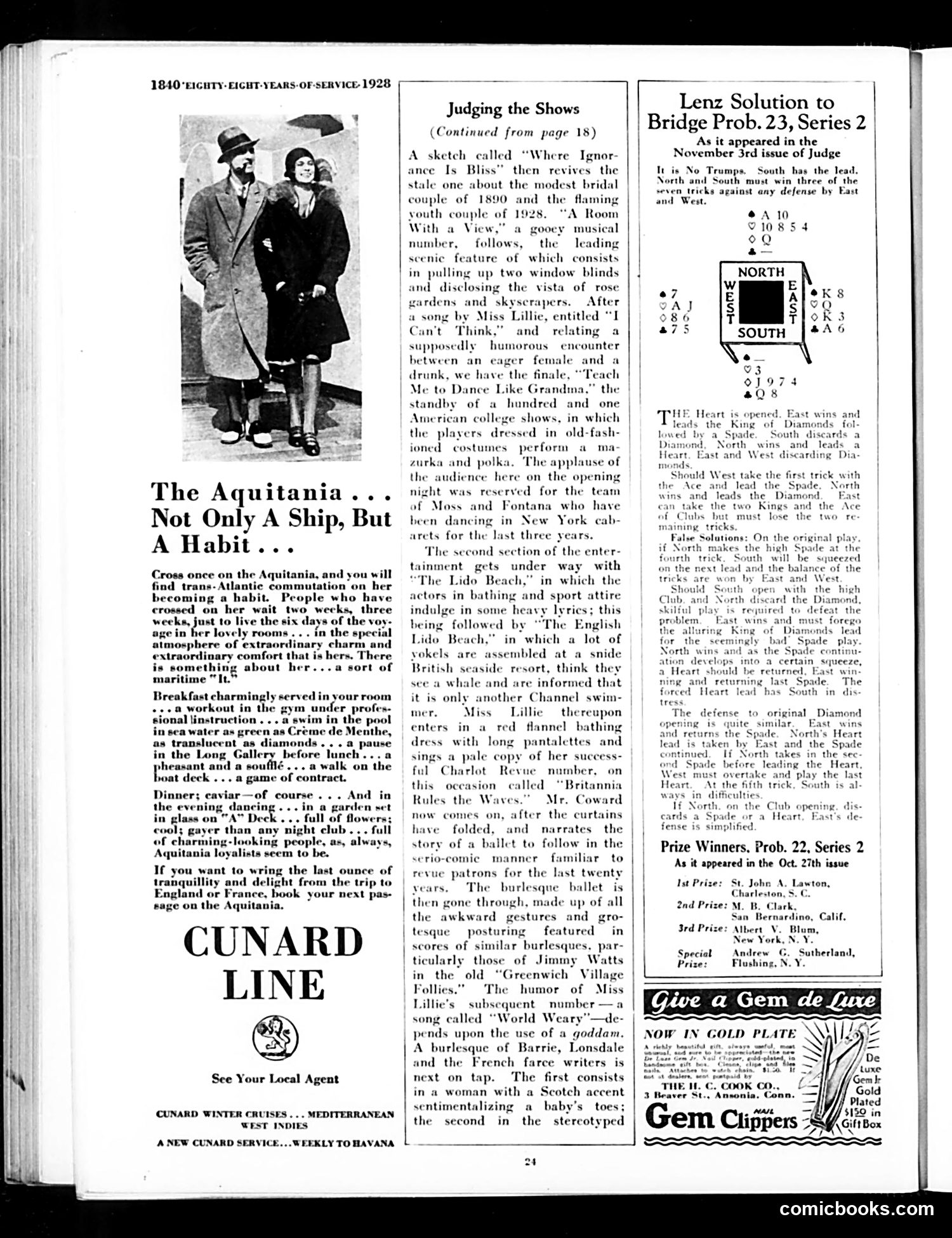
This page is primarily **advertising and bridge puzzle content**, not political satire. The main cartoon shows a well-dressed couple and promotes the Cunard Line's RMS Aquitania, a luxury ocean liner. The ad emphasizes the ship as a destination itself—not merely transportation but a desirable lifestyle experience, highlighting amenities like fine dining, dancing, swimming pools, and elegant décor. The "Judging the Shows" column reviews theatrical entertainment, critiquing a revue featuring performers Beatrice Lillie and Noël Coward. It mocks dated comedy tropes (like comparisons between modest 1890s couples and "flaming" 1928 youth) and pans the production's heavy-handed humor and derivative numbers. The page reflects 1928 upper-class leisure culture: transatlantic travel as fashionable habit, theatrical entertainment as social commentary, and bridge games as intellectual recreation. There is no clear political satire visible here.
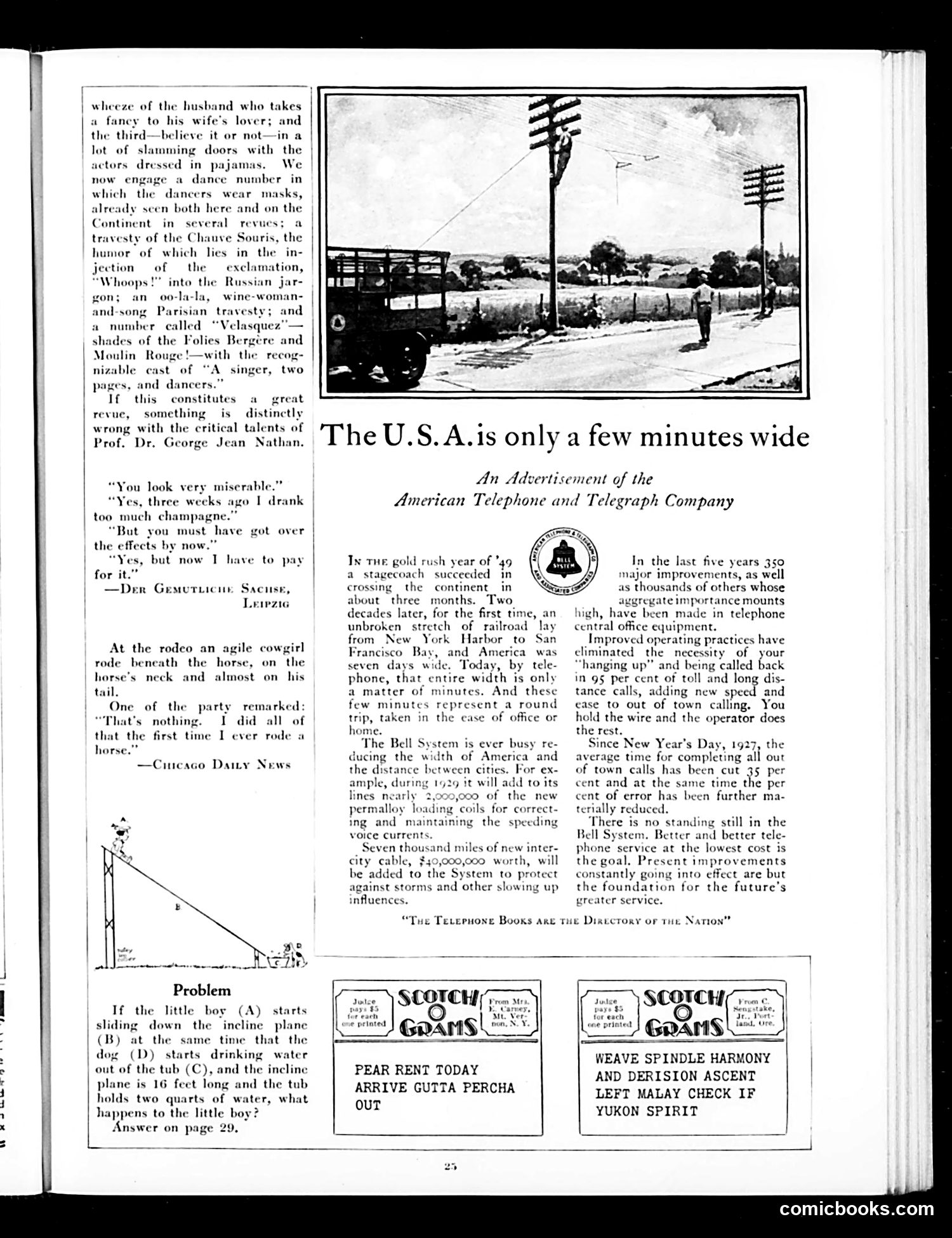
This page mixes humor pieces with corporate advertising. The top contains several joke items: a theatrical review criticizing critic George Jean Nathan's taste, a German joke about champagne hangovers, and a rodeo anecdote. A math "problem" about a boy sliding down an incline appears unsolvable—clearly meant as a joke itself. The dominant content is a full-page **AT&T advertisement** celebrating telephone technology's ability to metaphorically shrink America. It contrasts the 1849 stagecoach (3-month crossing) with railroad (7 days) to modern telephone service (minutes). The ad emphasizes Bell System's 1929 infrastructure improvements—new cables, loading coils, and reduced long-distance delays—positioning the telephone as progress enabling national connection. The "Scotch Grams" boxes at bottom appear to be advertising whisky with cryptic product names. This reflects 1920s-era corporate boosterism: technology companies using popular magazines to promote infrastructure investments as national achievement.
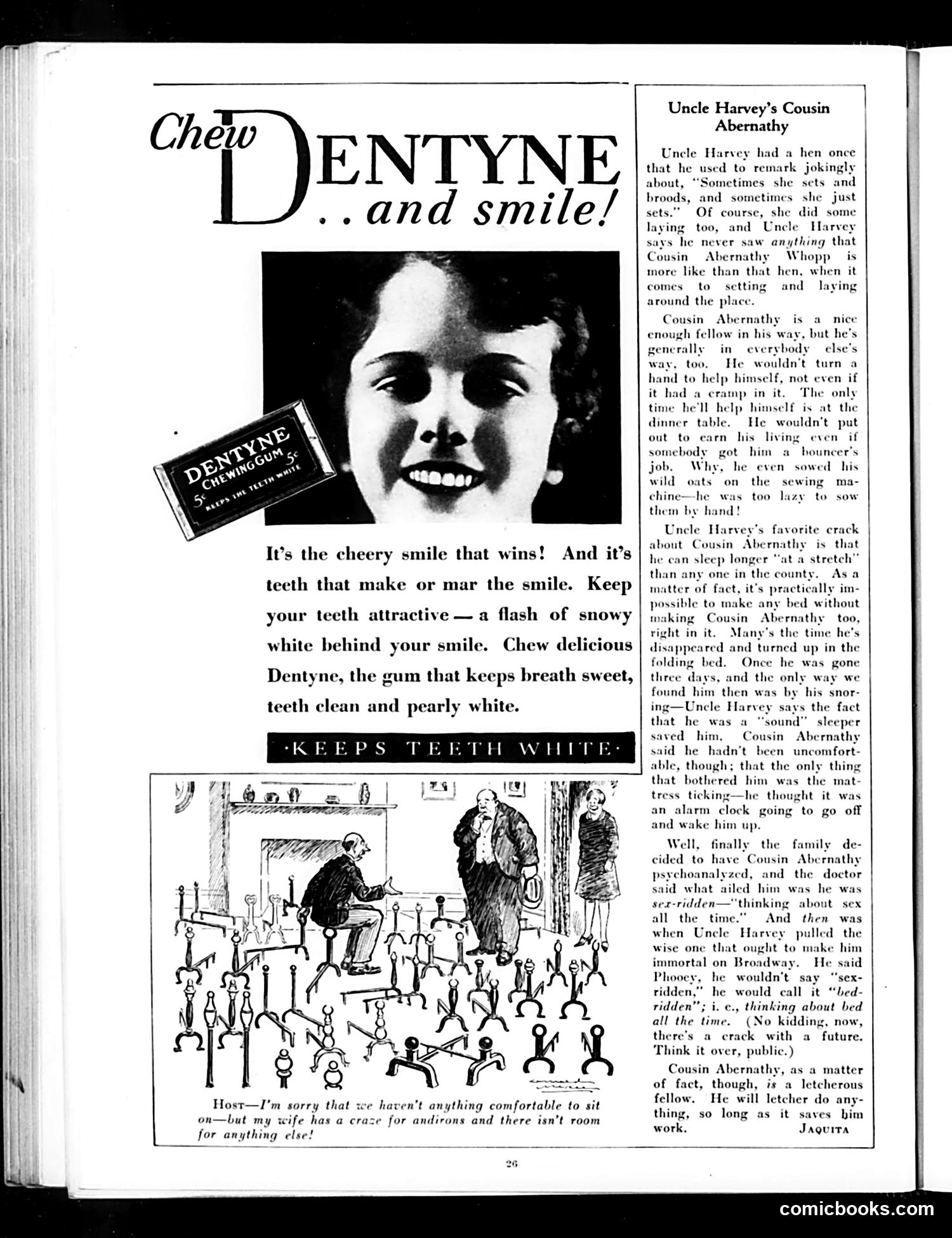
This page contains a **Dentyne chewing gum advertisement** featuring a woman's portrait and messaging about keeping teeth white and attractive through chewing gum. The main content is a **humorous character sketch** titled "Uncle Harvey's Cousin Abernathy"—a satirical portrait of an archetypal lazy American male. Cousin Abernathy is depicted as thoroughly indolent: he won't help himself, avoids work, sleeps excessively, and avoids earning a living even when offered employment. The sketch's humor relies on exaggerated descriptions of his laziness (sowing "wild oats on the sewing machine" because hand-sowing required effort) and Uncle Harvey's witty one-liners. The punchline involves a doctor declaring Abernathy "sex-ridden," prompting Uncle Harvey to quip he's actually "bed-ridden"—a wordplay joke about his constant sleeping. The satire mocks a recognizable social type: the unemployable, unmotivated layabout who drains family resources through sheer inertia.
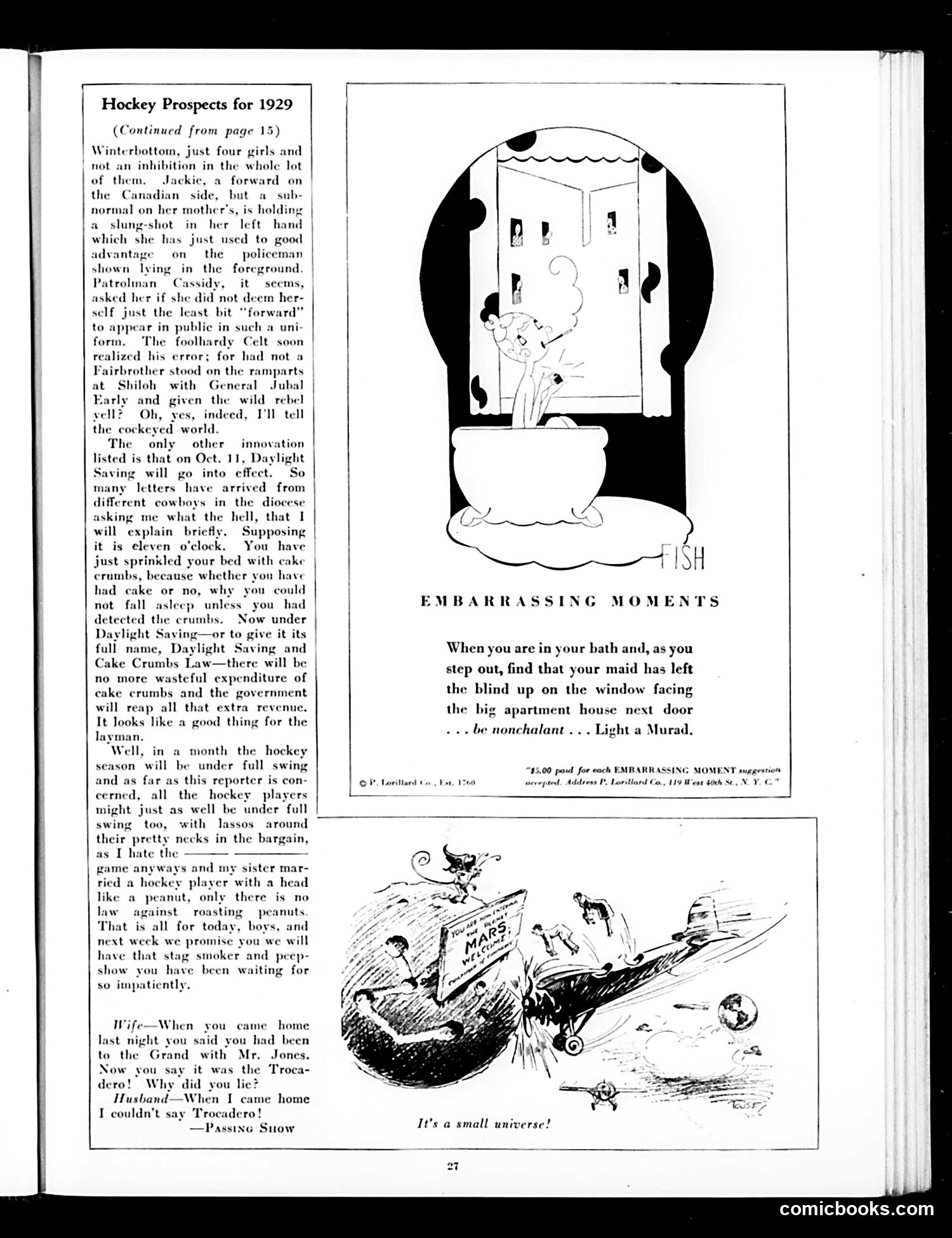
This 1929 Judge page contains two distinct satirical pieces: **"Hockey Prospects for 1929"** is a rambling column mocking women's hockey, describing female players with exaggerated stereotypes—one supposedly beat a policeman with a slung-shot after he questioned her "forward" appearance. The piece satirizes both women's athletic participation and the author's pretended disapproval. A sidebar joke references "Daylight Saving and Cake Crumbs Law," mocking government efficiency schemes by absurdly suggesting cake-crumb waste justifies time shifts. **"Embarrassing Moments"** is an advertisement (paying $5 per accepted submission) inviting readers to submit comic scenarios about social awkwardness—here illustrated by a woman in a bathtub discovering her blind is open to neighboring apartments. The solution? Light a Murad cigarette to appear nonchalant. This is pure product advertising disguised as reader participation content. Both pieces reflect 1920s attitudes: skepticism toward women's independence, absurdist political satire, and advertising-as-entertainment.
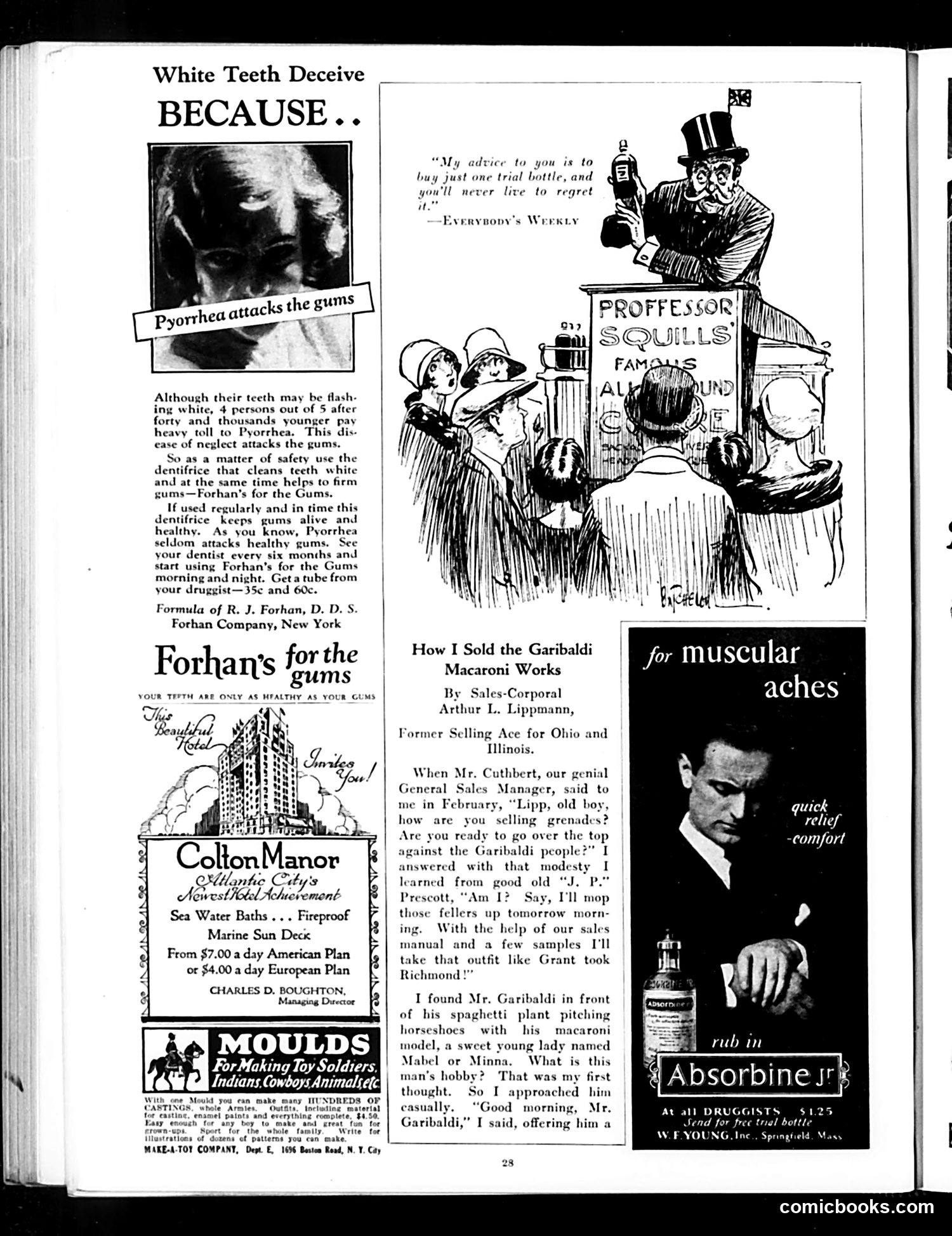
This page is primarily **advertising**, not political satire. It contains four distinct advertisements from the early 20th century: 1. **Forhan's for the Gums** (top left): A dental product warning about pyorrhea (gum disease), using a disturbing close-up photograph of diseased gums to scare readers into buying the dentifrice. 2. **Colton Manor** (middle left): A hotel advertisement for Atlantic City's "newest" establishment. 3. **Moulds for Making Toy Soldiers** (bottom left): A children's craft product ad. 4. **Absorbine Jr.** (right side): A liniment for muscle aches, featuring a grimacing man rubbing his leg. The only satirical content is the brief article **"How I Sold the Garibaldi Macaroni Works,"** which appears to mock aggressive sales tactics using military terminology ("grenades," "go over the top," "like Grant took Richmond"). The narrator uses bombastic war-inspired language to describe selling pasta products—gentle satire of American sales culture.
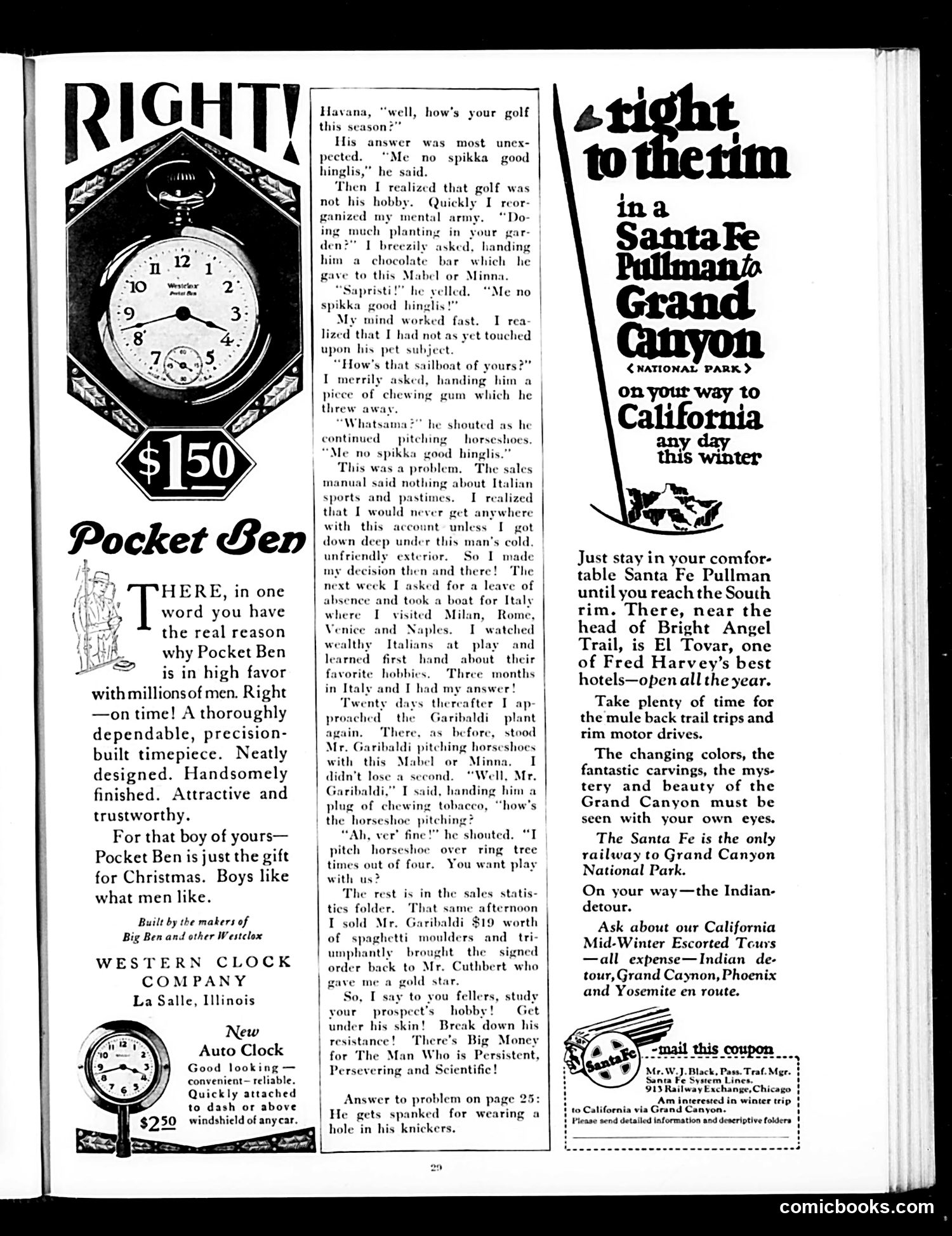
This page is primarily **advertising and narrative**, not political satire. The central story is a sales-training anecdote about a salesman named Mr. Cuthbert who struggles to connect with an Italian prospect, Mr. Garibaldi, who speaks broken English and rebuffs attempts to discuss golf, gardening, and sailing. The salesman's solution: **spend three months in Italy learning about horseshoe pitching**—Garibaldi's actual hobby. Upon returning and engaging him on this subject, Cuthbert successfully closes a large sale ($19 worth of spaghetti moulders). **The joke/lesson**: Modern sales technique emphasizes understanding a prospect's personal interests rather than generic small talk. The exaggerated premise—traveling to Italy just to learn one man's hobby—satirizes overzealous sales methodology while praising persistence. The page also features **product advertisements** (Pocket Ben watches, Auto Clocks) and a **Santa Fe Railway promotion** for Grand Canyon tourism. No identifiable political figures or events appear. This reflects 1920s-era business culture and selling philosophy.
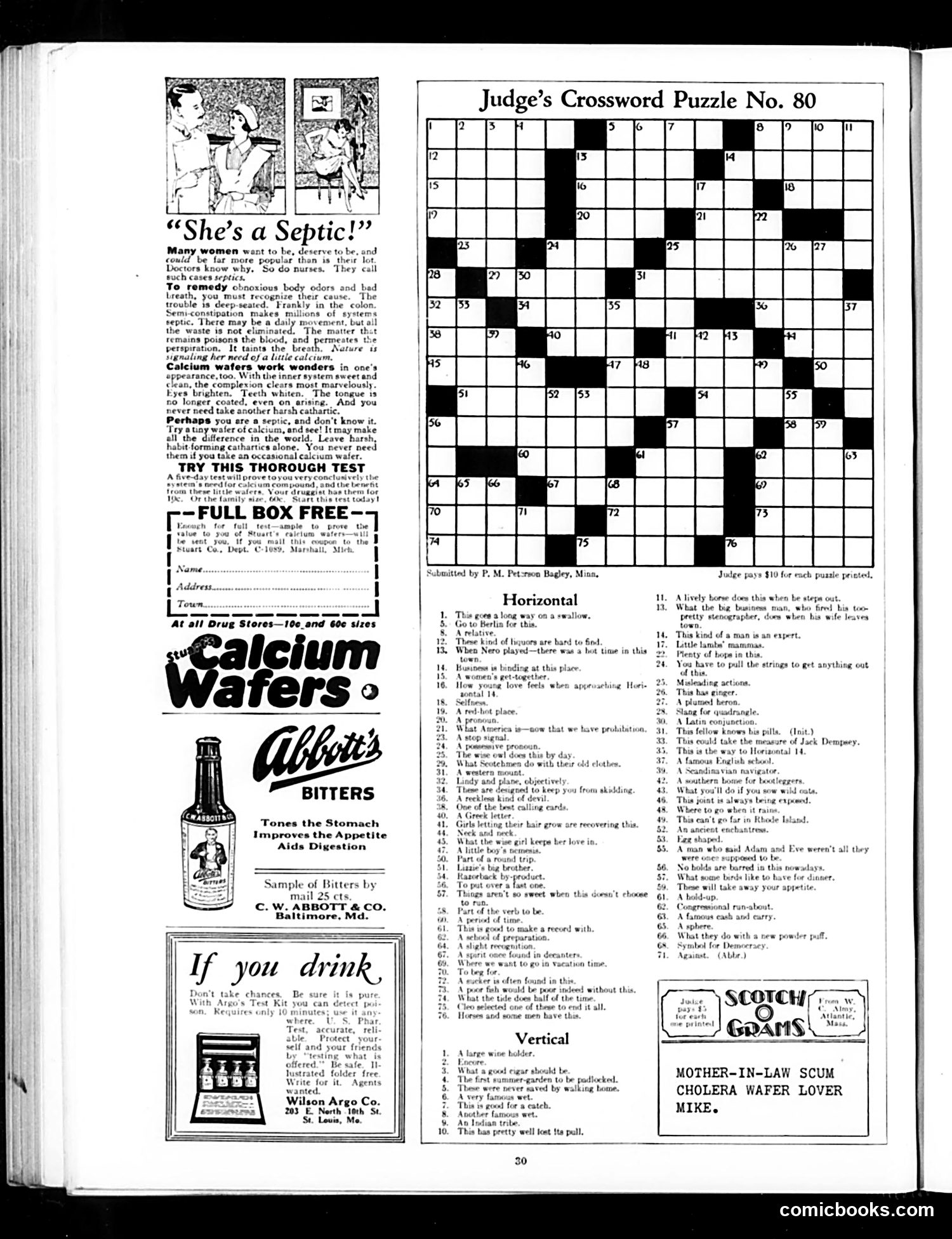
This page is **primarily advertising**, not satirical content. The dominant feature is a lengthy advertisement for Calcium Wafers, a patent medicine marketed to women as a cure for "septic" conditions—a term referring to autointoxication, a now-discredited medical theory popular in the early 20th century. The ad's headline "She's a Septic!" uses feminine insecurity as a marketing hook, claiming the product cures constipation, bad breath, and poor complexion by eliminating intestinal "poisons." The copy promises teeth whitening, improved appearance, and elimination of the need for laxatives. The page also includes a crossword puzzle and smaller advertisements for Abbott's Calcium Wafers Bitters and Wilson Argo Co. products—typical magazine filler of the era. The satire is implicit rather than explicit: the page reflects how patent medicine companies exploited women's anxieties about appearance and health through pseudoscientific claims that modern readers would recognize as entirely fraudulent.
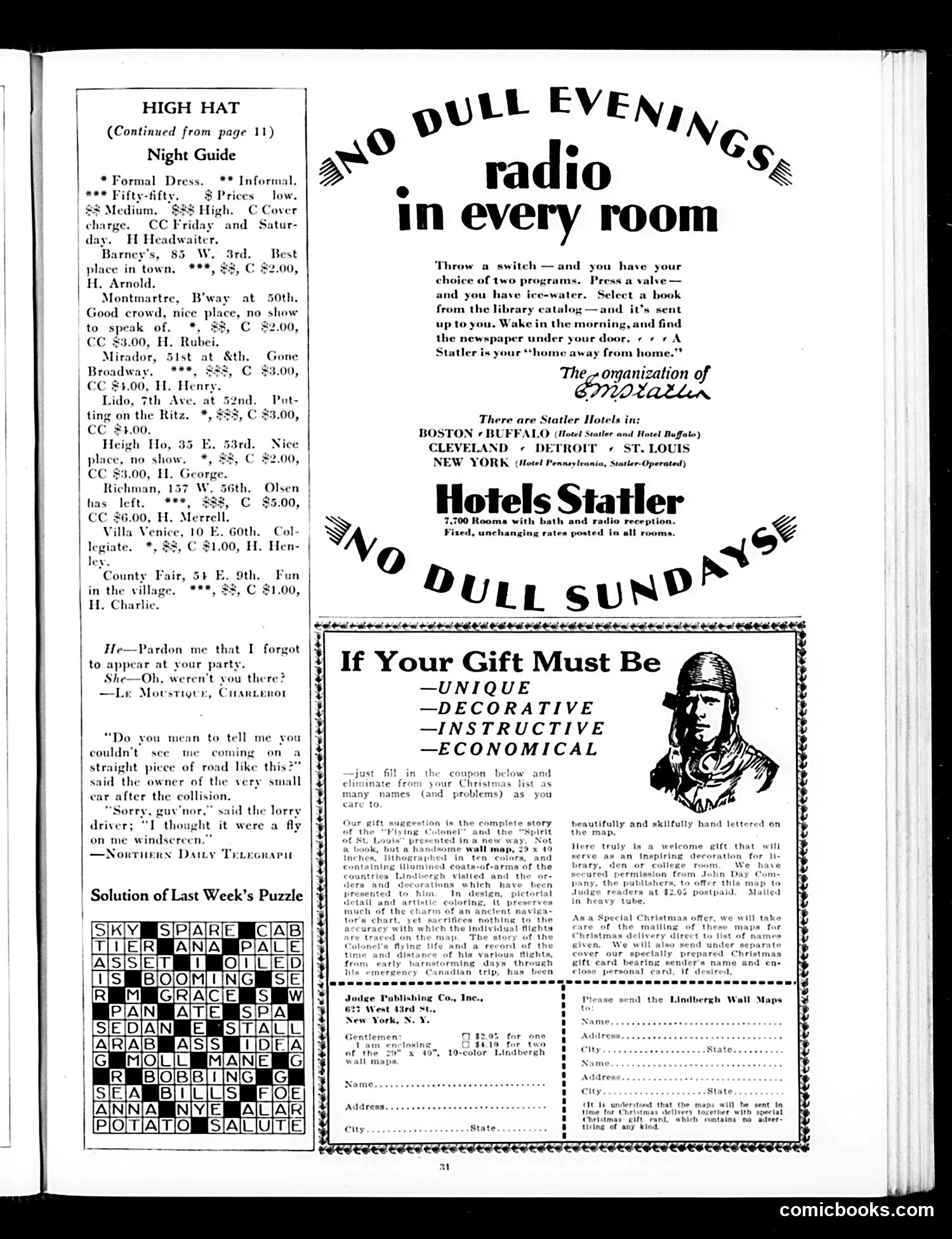
This page is primarily **advertising and entertainment listings**, not political satire. The main content includes: **"High Hat" Night Guide**: A restaurant and nightclub listing for what appears to be 1920s-30s New York, rating venues by formality, price, and quality. Notable establishments like the Lido, Montmartre, and others are reviewed. **Hotels Statler Advertisement**: The dominant ad promotes a hotel chain offering radios in every room—a modern luxury at the time, emphasizing convenience ("Wake in the morning, and find the newspaper under your door"). **Small Humor Pieces**: Two brief jokes appear—one about a man forgetting a party, another about a lorry driver claiming not to see a small car. **"Flying Colonel" Gift Map Advertisement**: An offer for an instructive, decorative hand-lettered map—likely a novelty gift item. **Crossword Puzzle**: Standard puzzle page content. There is **no significant political cartoon or satire** on this page—it's primarily a service/advertising page typical of Judge magazine's mixed editorial-commercial format.
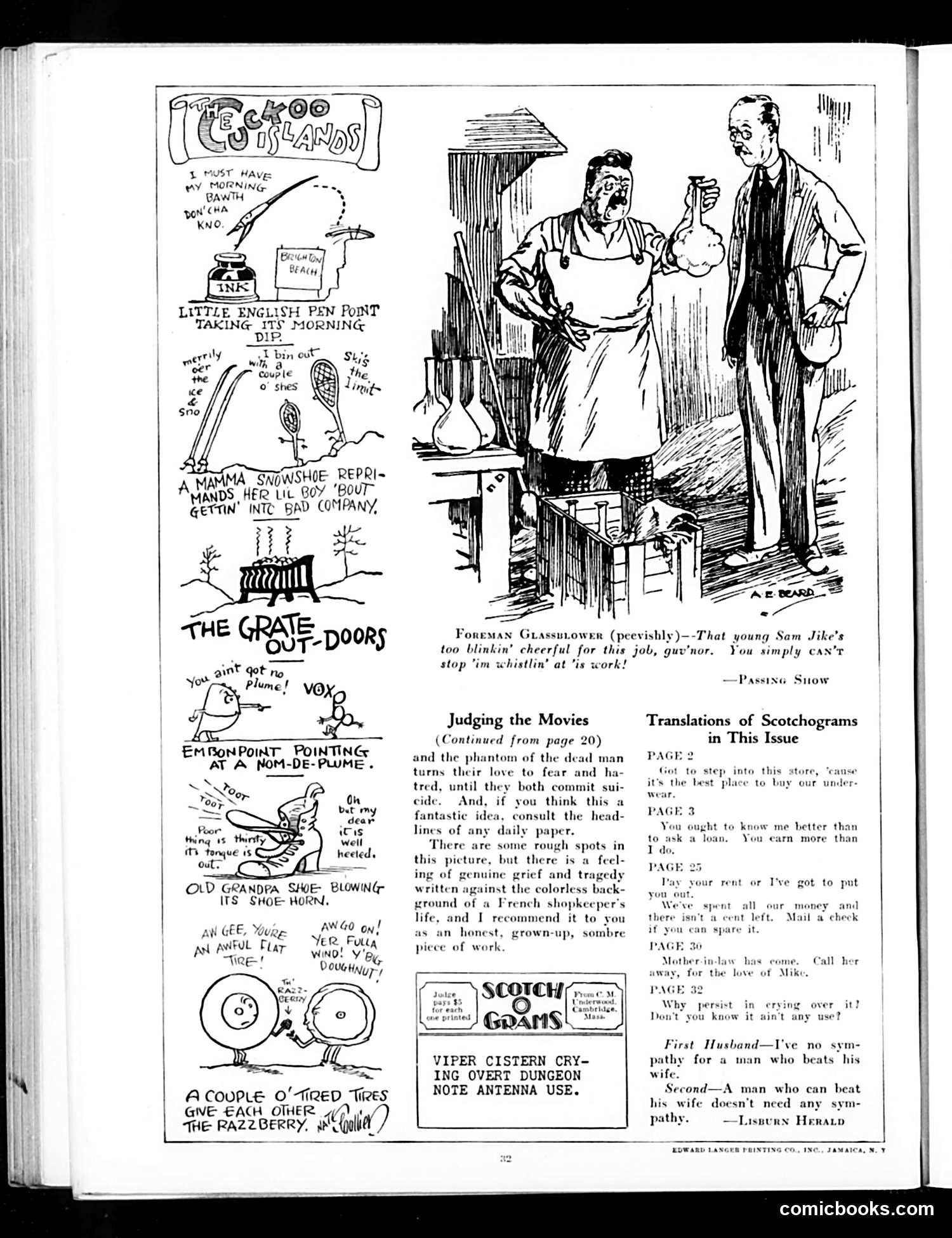
This page contains multiple unrelated humor pieces typical of Judge magazine's satirical format: **Left side:** A series of comic sketches with visual gags about everyday frustrations—a pen that won't work properly, a child's misbehavior, household annoyances like drafty doors and shoe horns, and tired tires. These are observational humor with no specific political reference. **Right side:** A cartoon by A.E. Beard showing a British factory foreman complaining that a young worker (Sam Jike) is *too cheerful*—too much whistling while working. The satire targets workplace culture where excessive cheerfulness is seen as inappropriate or irritating. The caption quotes "Passing Show," suggesting this social critique was shared across publications. **Bottom:** The "Translations of Scotchograms" section and marriage jokes are domestic humor, poking fun at marital discord and financial stress (money worries, in-laws visiting). The page reflects 1920s-era concerns: economic anxiety, class-conscious workplace dynamics, and domestic tensions—with no specific political commentary visible.
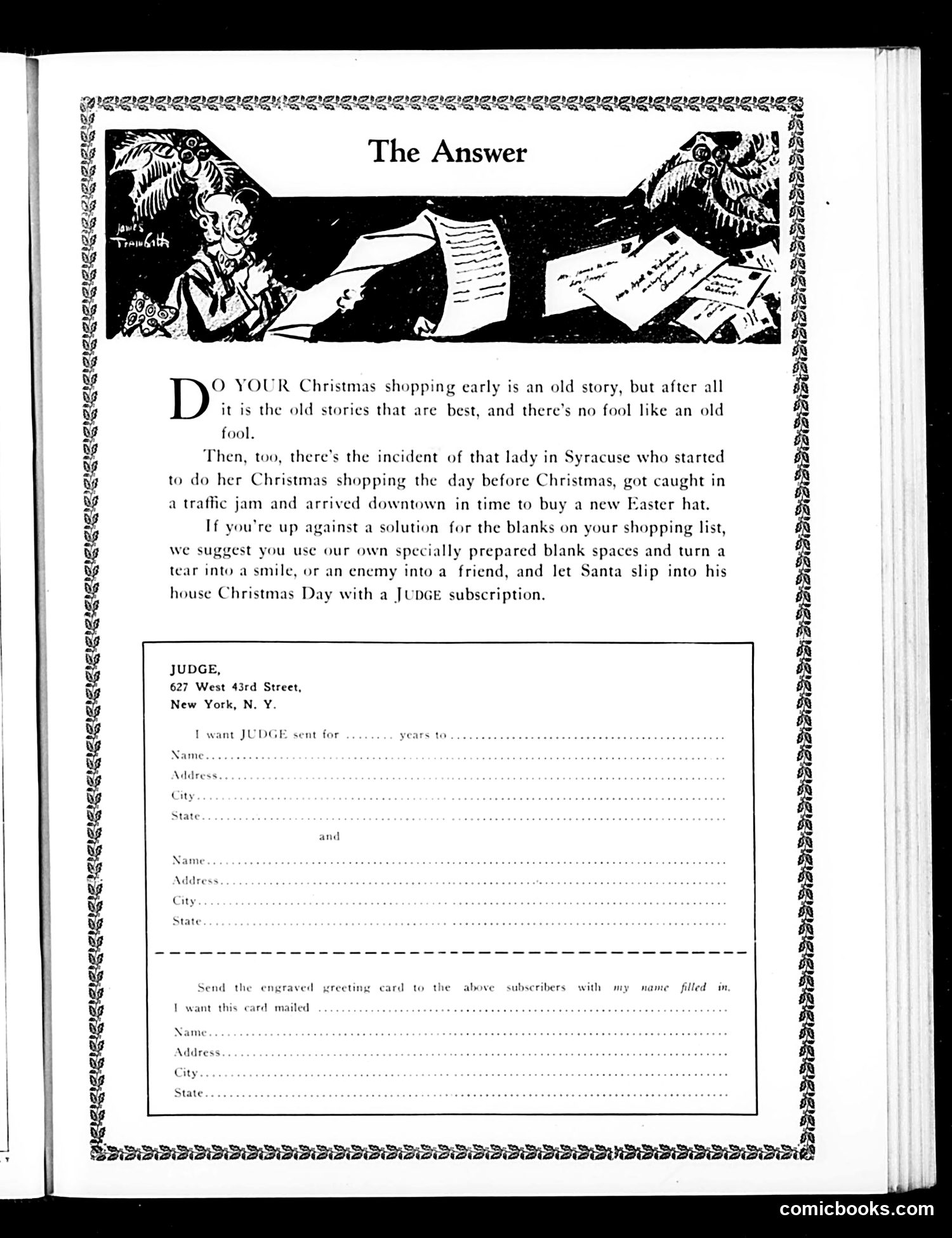
This page is primarily a **subscription advertisement** for *Judge* magazine disguised as humorous editorial content. The opening essay mocks procrastinating Christmas shoppers, using a comedic anecdote about a Syracuse woman who waited until Christmas Eve to shop, got stuck in traffic, and ended up buying an Easter hat instead—a joke about poor planning. The "answer" to last-minute shopping chaos, the ad suggests, is a **Judge subscription as a gift**. The copy cleverly positions the magazine as a solution: it will "turn a tear into a smile, or an enemy into a friend"—meaning it works as a thoughtful (or humorous) fallback gift when you're unprepared. The form allows readers to order subscriptions sent to others' names with an engraved greeting card. This is essentially a **mail-order gift service**, marketed to busy or indecisive holiday shoppers. The satirical framing—mocking procrastination while selling procrastination relief—is the magazine's self-aware sales pitch.
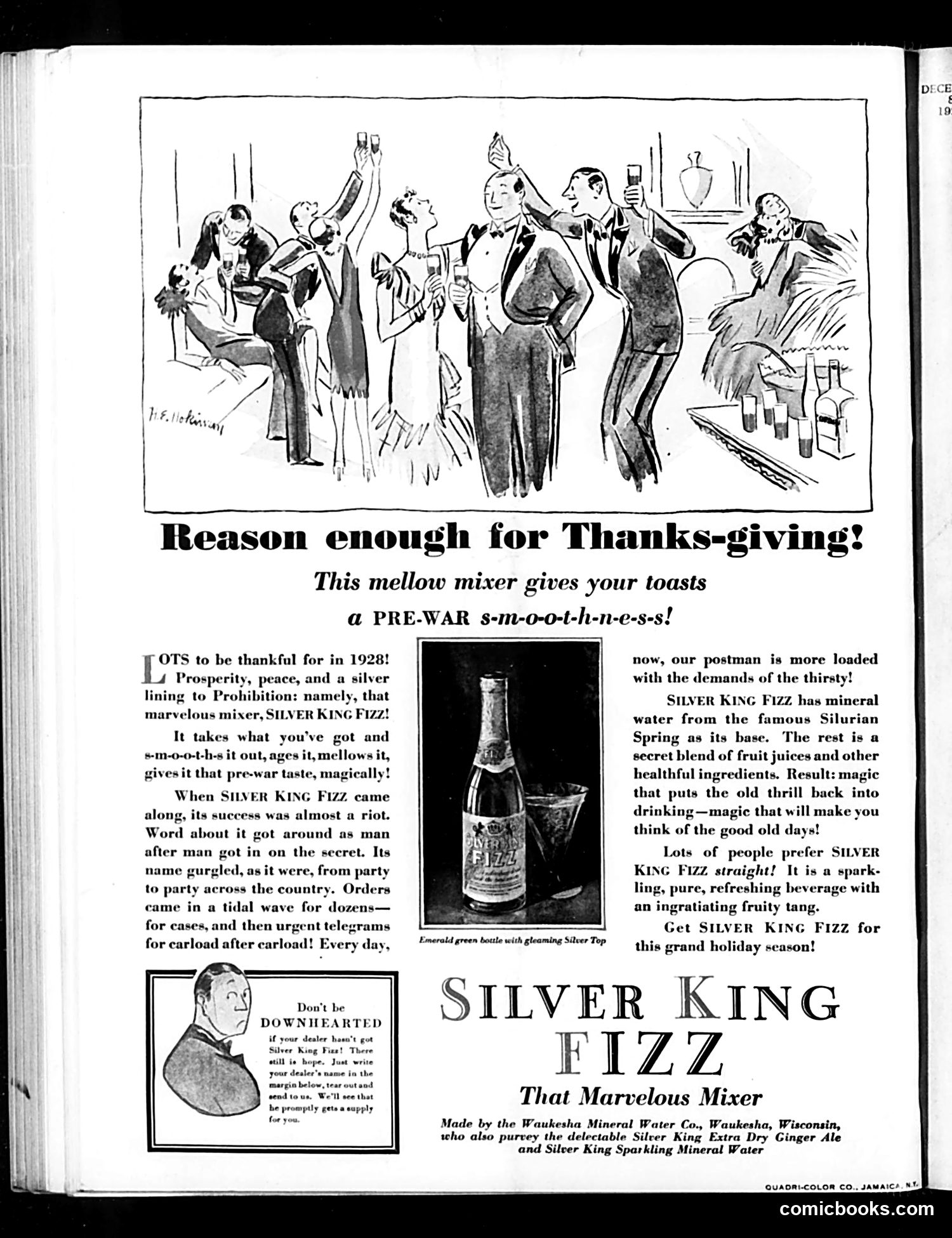
This is primarily a **1928 advertisement** for Silver King Fizz, a mineral water mixer, but with thinly veiled satirical commentary on Prohibition. The cartoon depicts a lively party scene—likely meant to evoke the "speakeasy" culture of the Prohibition era (1920-1933). The text repeatedly emphasizes the product gives drinks a "**pre-war smoothness**" and restores "the good old days"—nostalgia for alcohol consumption before Prohibition's 1920 enactment. The humor is in the obvious subtext: this "marvelous mixer" is being marketed as a way to improve illegally-obtained or home-made alcohol during Prohibition. References to "s-m-o-o-t-h-n-e-s-s," secret distribution networks ("word got around"), and urgent telegrams for "carloads" mock the bootlegging black market. The ad exploits the widespread public resentment of Prohibition, presenting this mixer as solving a real problem for ordinary drinkers circumventing federal law—with winking, coded language rather than explicit acknowledgment.