
A complete issue · 36 pages · 1928
Judge — September 15, 1928
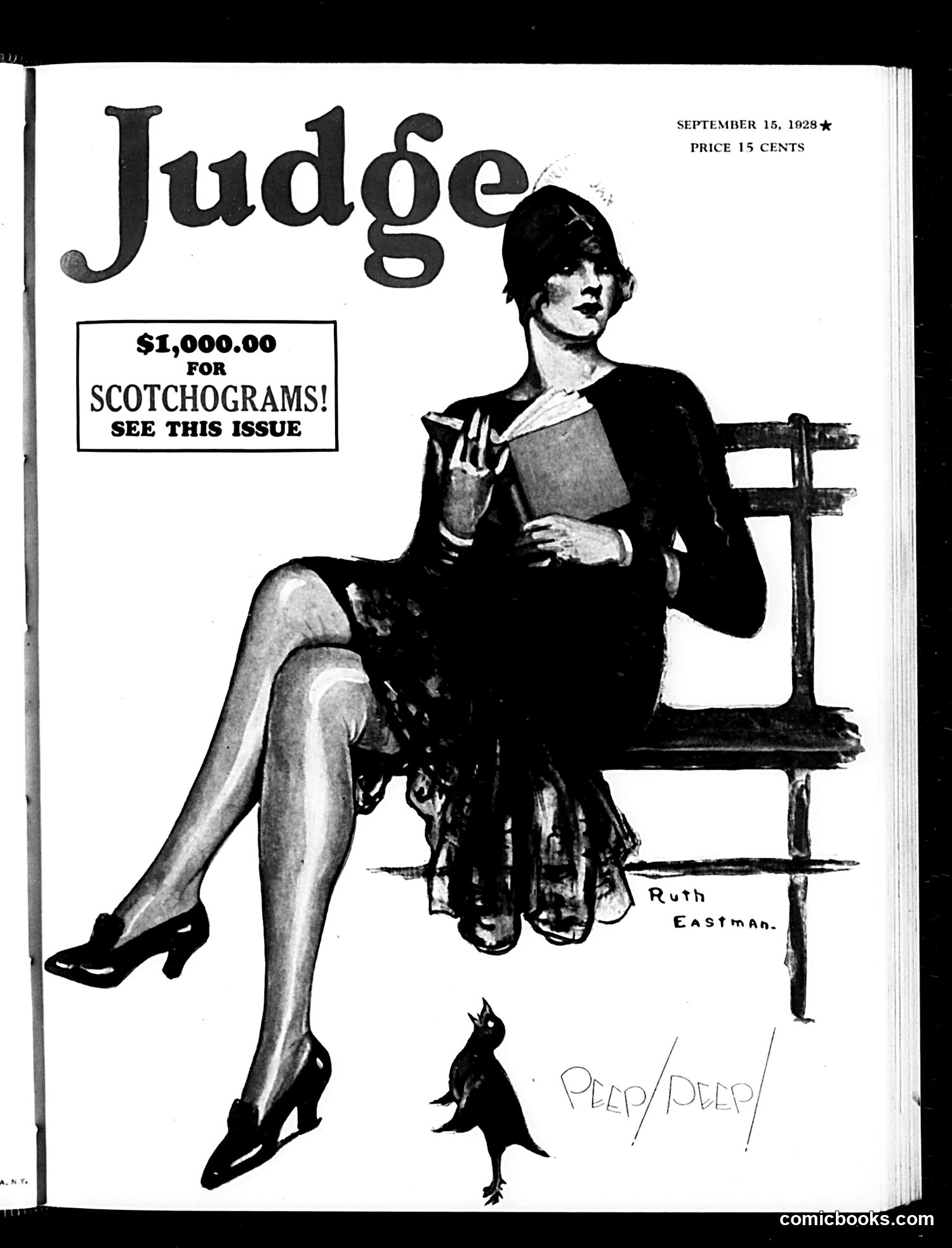
This is primarily a **magazine cover advertisement** rather than political satire. The cover features Ruth Eastman (credited at bottom), a woman in 1920s attire sitting on a chair, holding a book, with a small black dog at her feet. The main text advertises "$1,000.00 FOR SCOTCHOGRAMS" — referring to photographic prints or reproductions. The dog's barking ("PEEP/PEEP") appears to be a visual gag related to this promotion. This cover reflects 1920s consumer culture and photography trends. Ruth Eastman was likely an actress or public figure used to sell the magazine and promote the scotchogram contest. The satire here is minimal; it's primarily commercial content with mild humor.
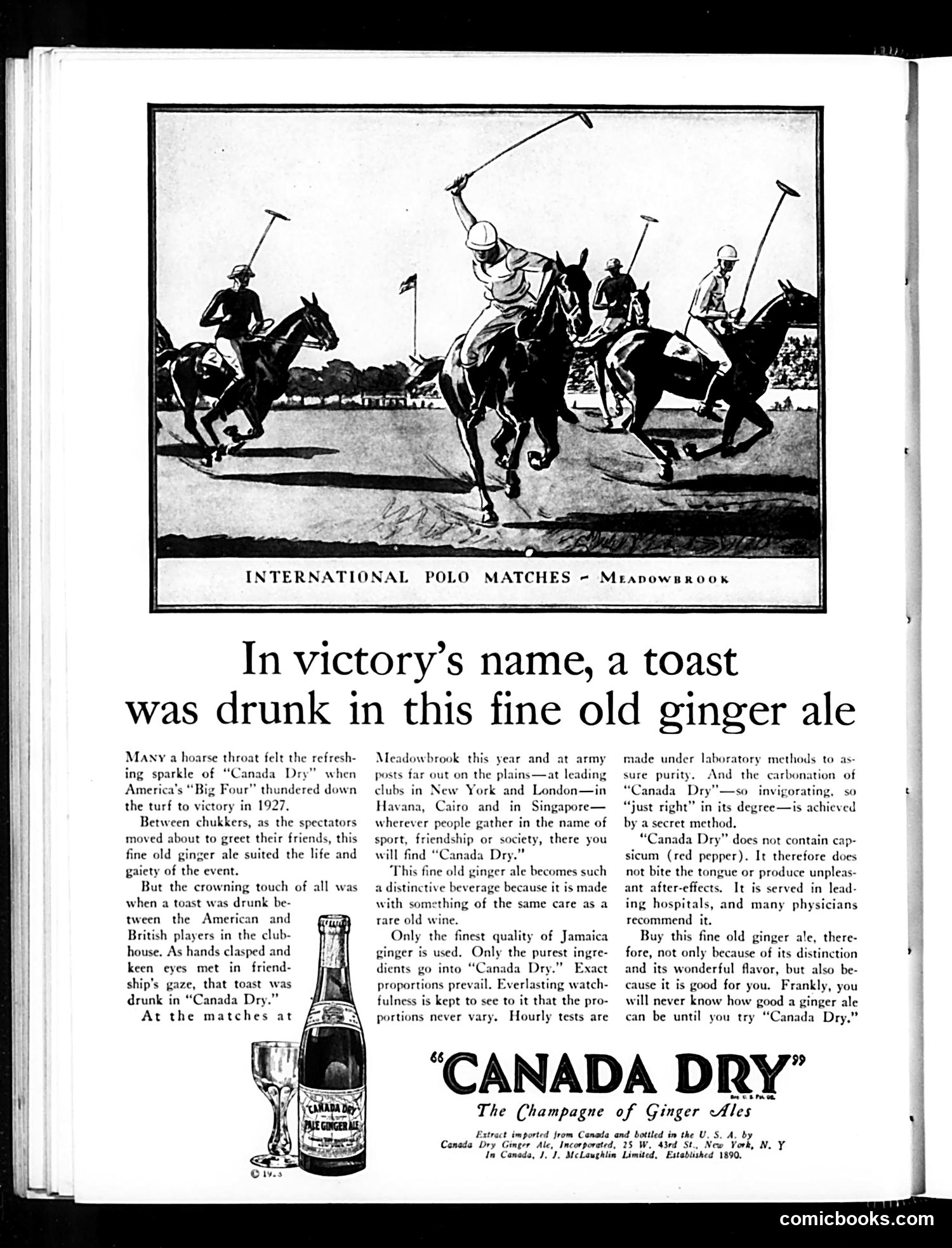
This page is primarily an **advertisement for Canada Dry ginger ale**, not satirical content. The top image shows polo players at Meadowbrook, illustrating the sport's association with wealth and leisure. The ad's narrative exploits post-WWI patriotism: it describes a 1927 polo victory celebration where "Canada Dry" was toasted among "British players" at exclusive clubs in New York, London, Havana, Cairo, and Singapore. This geographic scope emphasizes the product's prestige and international reach. The copy emphasizes Canada Dry's purity, using language about "laboratory methods," lack of red pepper irritation, and medical recommendation—marketing strategies common to Prohibition-era beverages claiming health benefits. This is **commercial advertising disguised as lifestyle journalism**, not satire or political commentary.
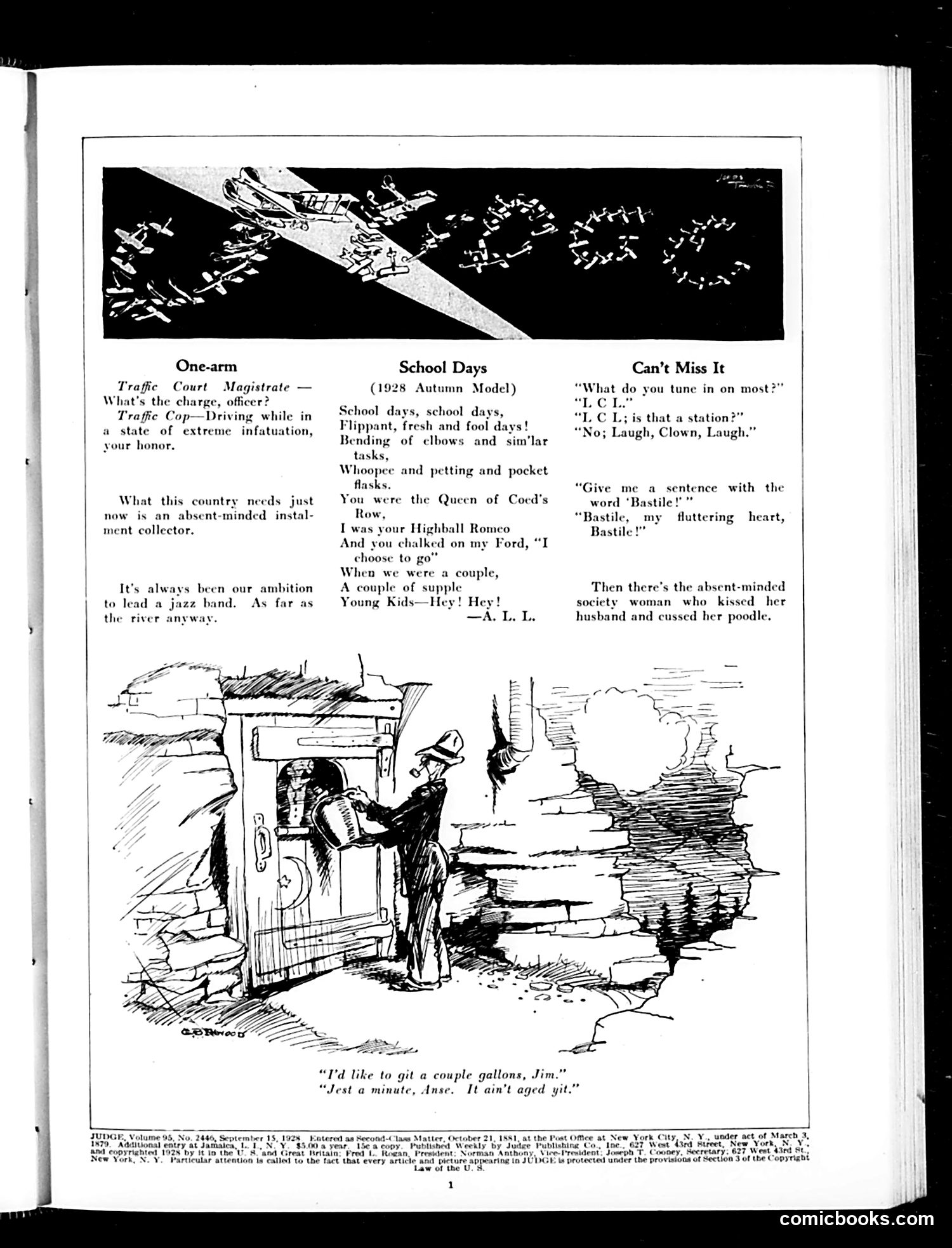
This page contains three separate humor sections typical of Judge magazine's format: **"One-arm Traffic Court"** satirizes a traffic officer citing a driver for speeding, joking that the country needs "an absent-minded installment collector" rather than traffic enforcement. **"School Days (1928 Autumn Model)"** humorously describes mischievous schoolchildren's antics—bending elbows, pocket flasks, and automotive references ("I choose to go")—suggesting Prohibition-era youth behavior and the famous Henry Ford quote about Model Ts. **"Can't Miss It"** presents a dialogue joke about tuning radio stations. The bottom cartoon depicts an old-time filling station attendant refusing to serve a customer's car, with the caption playing on gasoline terminology. The illustrations are typical ink sketches from this 1928 Judge issue, reflecting period humor about automobiles, Prohibition, and youth culture.
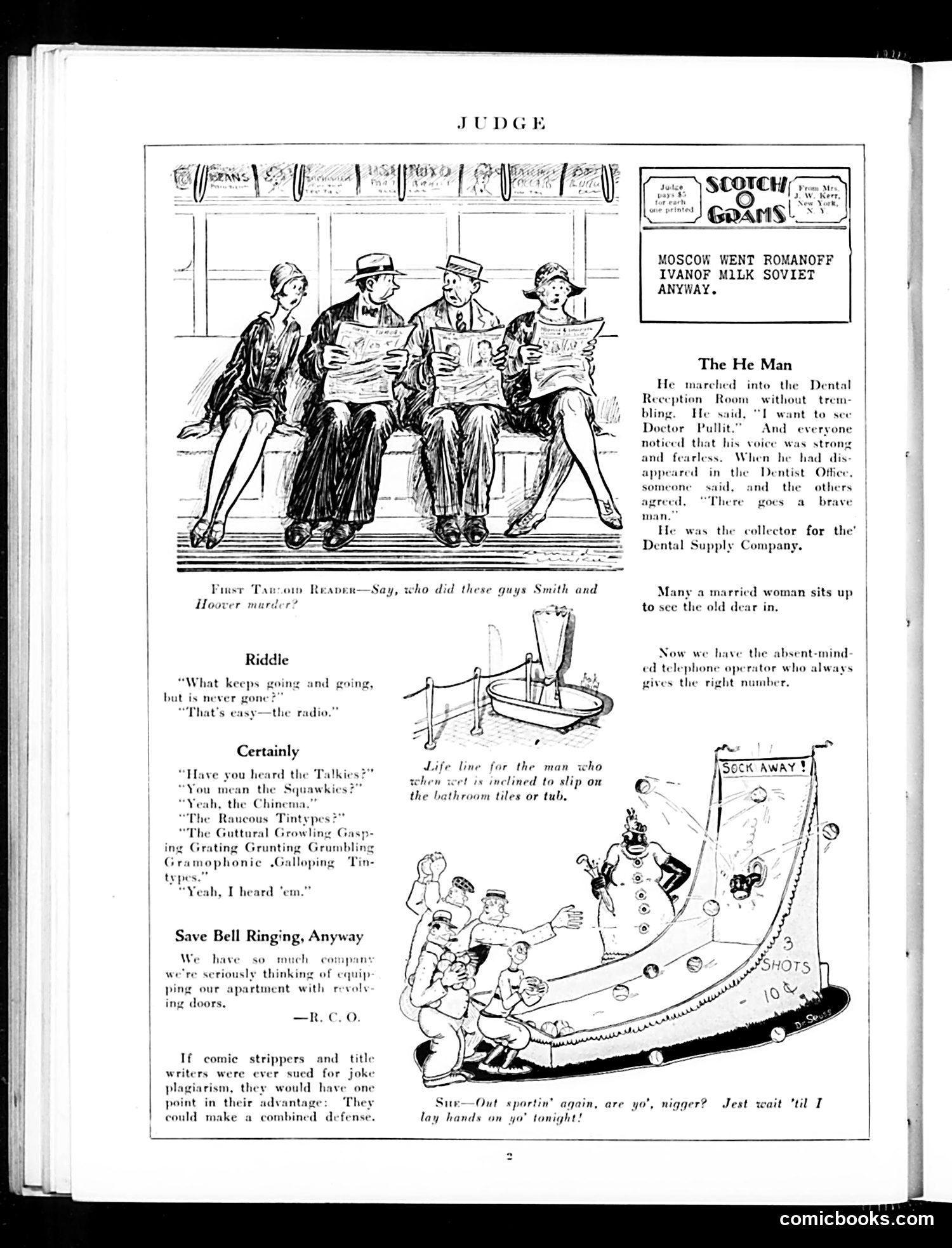
This page contains various humor sections typical of Judge magazine's format. The main cartoon depicts four people reading newspapers in what appears to be a waiting room, with a caption about "Smith and Hoover murder." The accompanying text "The He Man" describes a brave man entering a dental office fearlessly—satirizing masculine bravado in everyday situations. The page also includes light humor sections like "Riddle" and "Certainly," along with a cartoon about bathroom etiquette ("Safe line for the man who..."). Another cartoon depicts children playing on what appears to be a ship or dock, with dialogue about "sportin' again." The overall tone is genteel, domestic humor typical of 1920s-30s American satire, mixing social commentary with wordplay and visual gags rather than pointed political critique.
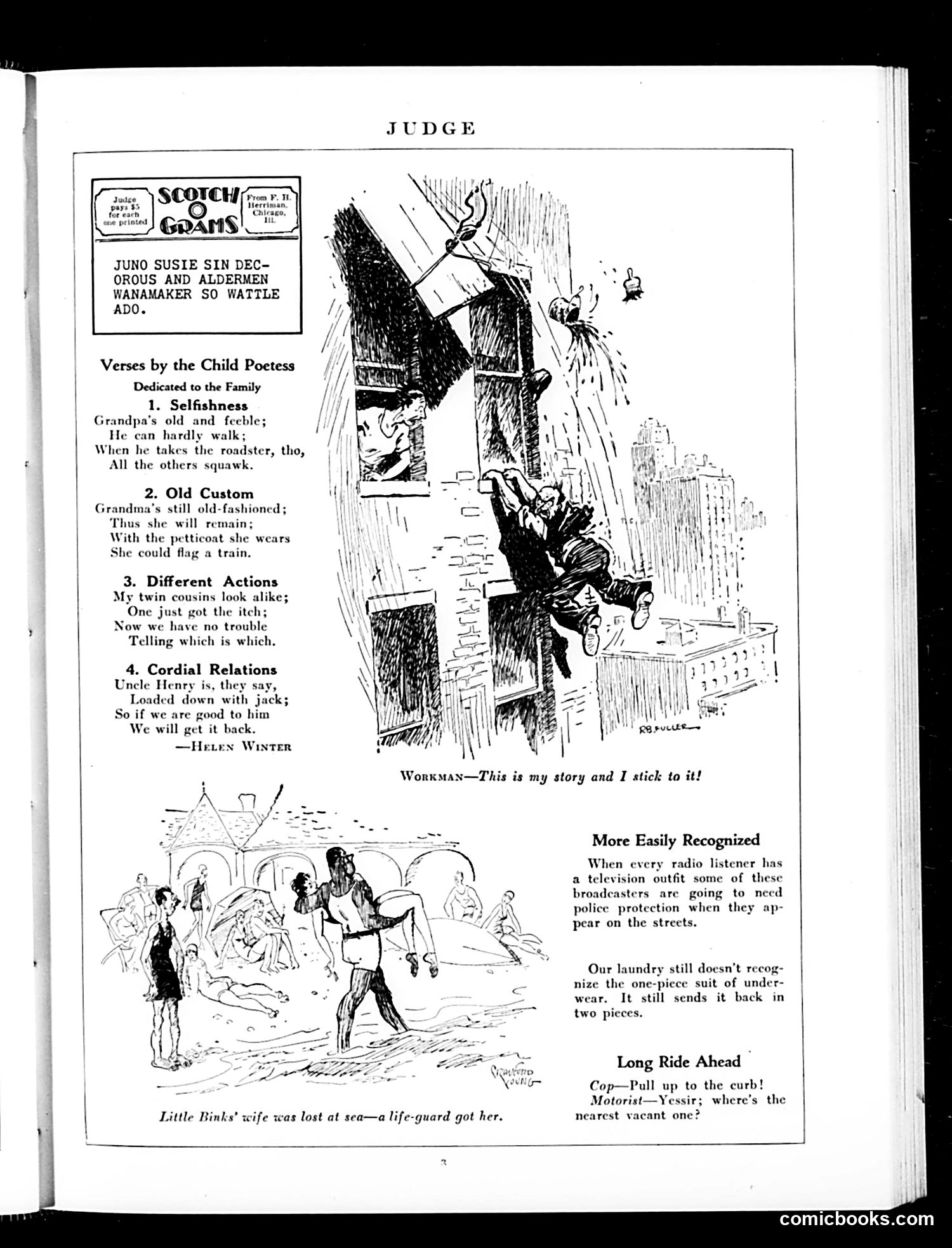
This page contains several unrelated satirical pieces typical of Judge magazine's format. The **top cartoon** depicts someone being struck by a falling object (appears to be construction or debris), illustrating slapstick humor common to the era. The **"Verses by the Child Poetess"** section presents humorous family observations about selfishness, old-fashioned grandmothers, twin cousins, and Uncle Henry—gentle domestic satire. The **"Workman" caption** uses self-deprecating humor about manual labor. The **lower cartoon** shows a beach/seaside scene with figures, captioned "Little Binks' wife was lost at sea—a life-guard got her," which is a mild joke about rescue operations. The remaining sections ("More Easily Recognized," "Our laundry," "Long Ride Ahead") contain brief topical quips about television broadcasters needing police protection, laundry mishaps, and taxi/motorist interactions—typical period humor without specific political content.
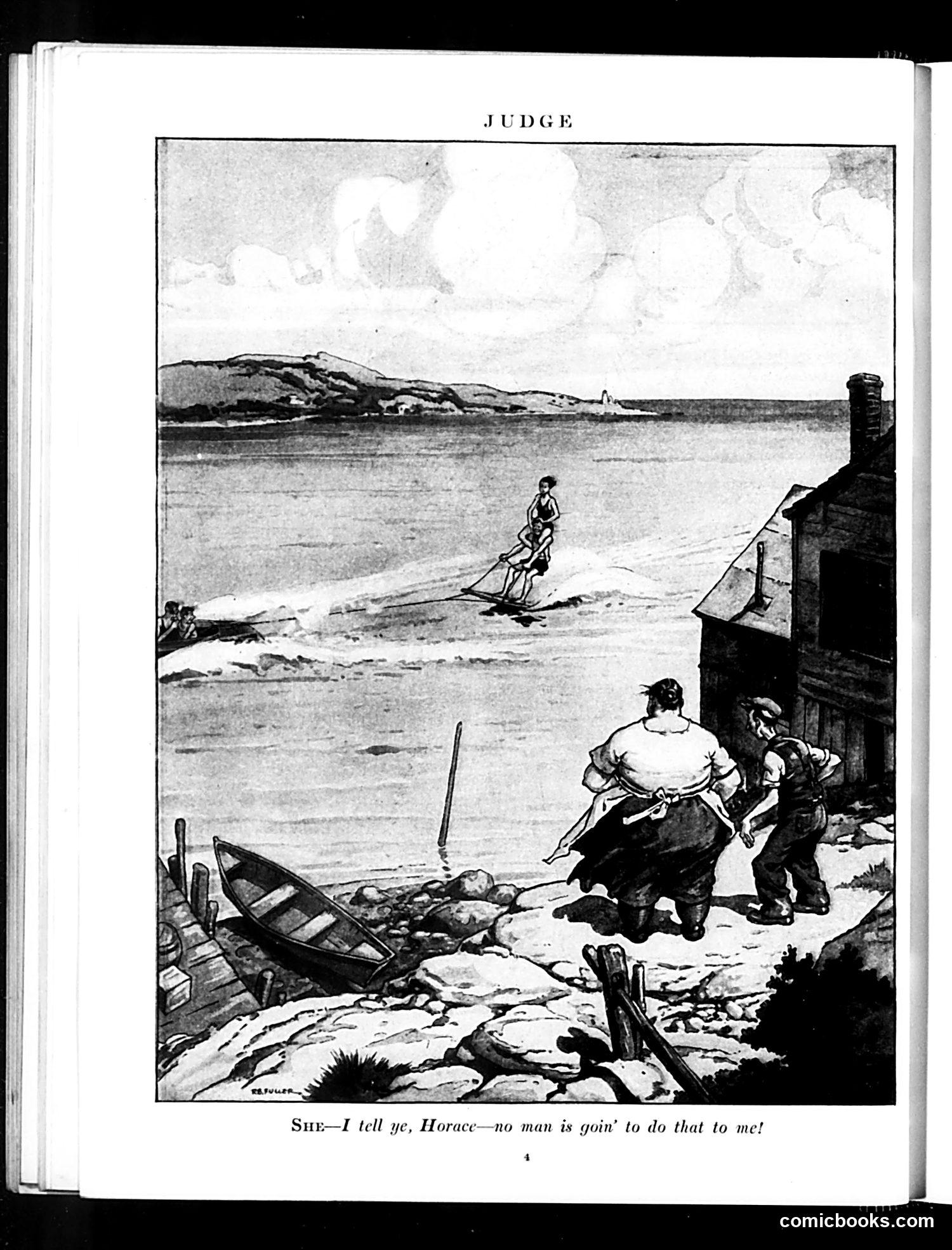
This illustration depicts a beach scene with a woman and two children confronting a man in the water. The woman declares, "She—I tell me, Horace—no man is goin' to do that to me!" The cartoon appears to satirize attitudes about bathing and propriety in early 20th-century America. The scene likely comments on evolving social norms regarding public swimming and gender relations—possibly mocking either overly protective Victorian sensibilities or new boldness in mixed-gender beach activities. The woman's defiant stance suggests she's rejecting some expected behavior or constraint. Without clearer identification of specific public figures or dated events, the precise satirical target remains unclear, though the subject touches on contemporary debates about morality, gender roles, and public decorum.
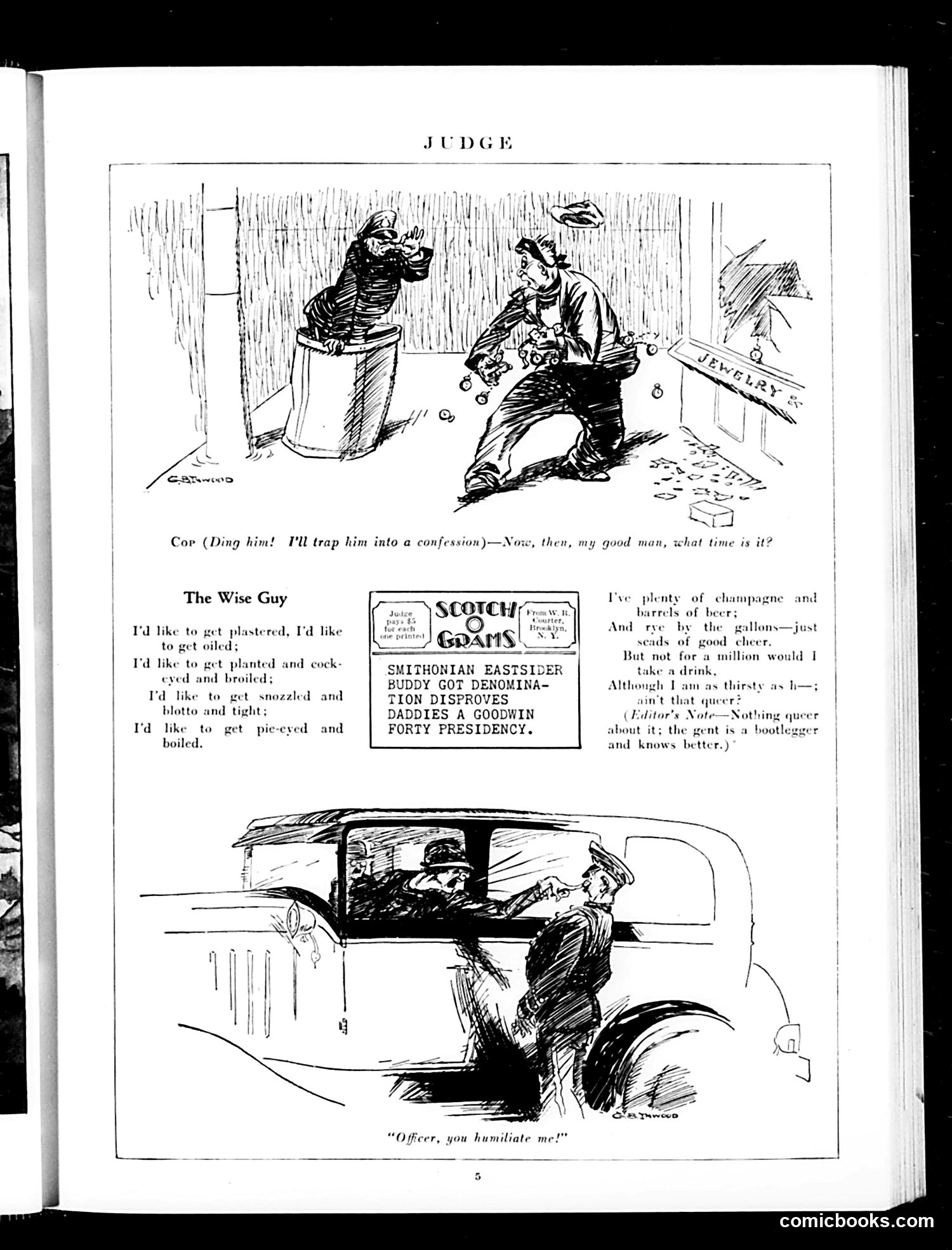
**Top Cartoon - "Judge":** Shows a man being trapped into a confession by what appears to be law enforcement or a judge. The dialogue "Ding him! I'll trap him into a confession" suggests satirizing coercive interrogation tactics or judicial manipulation during an unspecified legal proceeding. **Middle Section - "The Wise Guy":** A humorous poem listing various alcoholic states (plastered, oiled, pie-eyed, boiled, etc.). The accompanying "Scotch Grams" box references a Smithsonian scandal involving Buddy Got Denomination Disproves Daddies (unclear reference, possibly garbled OCR). **Bottom Cartoon:** Shows a traffic stop where an officer appears to be harassing or confronting a driver, with the caption "Officer, you humiliate me!" — likely satirizing aggressive police conduct toward motorists. The page broadly mocks alcohol consumption and law enforcement overreach, common Judge magazine targets.
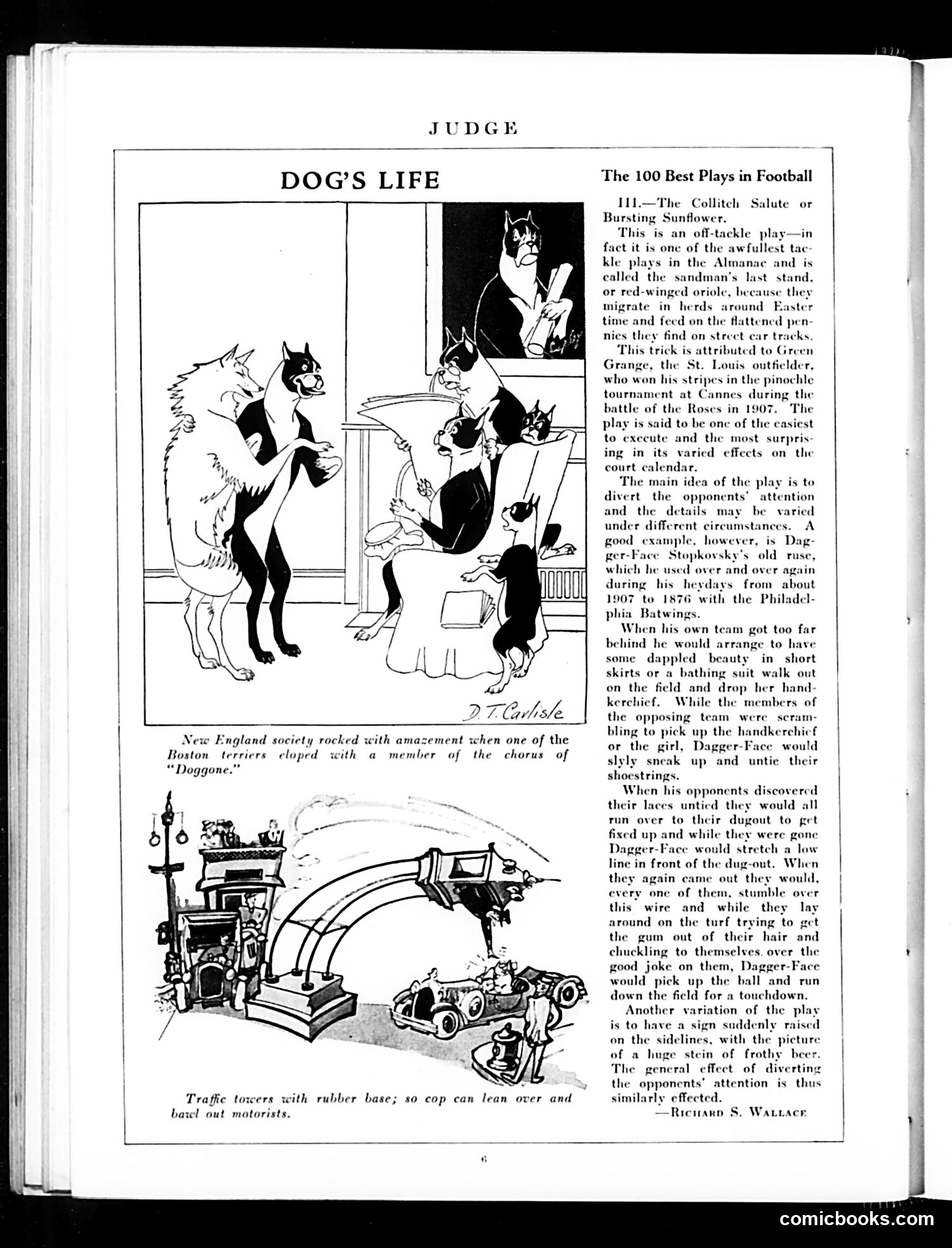
This page satirizes college football through absurdist humor. The main cartoon shows Boston terriers in human situations—one eloping with a chorus girl—mocking the breathless scandal coverage of early 1900s society pages. The accompanying text parodies overwrought sports journalism by describing a fake football play ("The Collitch Salute or Bursting Sunflower") with deliberately nonsensical details: attributing tactics to a St. Louis *outfielder* (baseball term), referencing an impossible 1876-1907 timespan, and describing ridiculous trick plays involving women in bathing suits dropping handkerchiefs and untying opponents' shoelaces. The lower cartoon about "traffic towers with rubber base" appears unrelated satirical content about traffic control. The joke targets both the inflated language of sports writing and society's obsession with trivial scandals—suggesting that in this world of absurdity, dogs eloping makes as much sense as anything else.
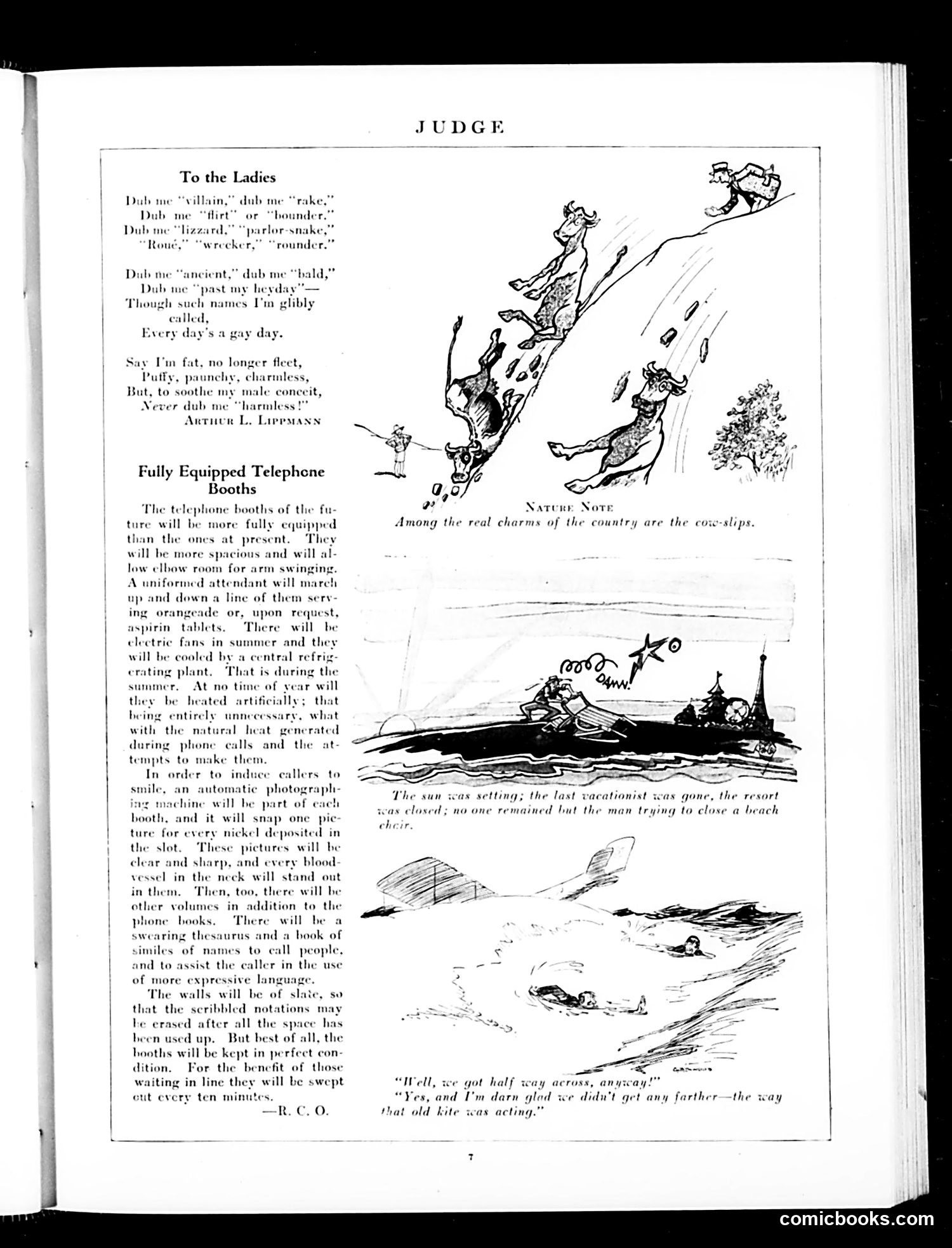
This page contains two main satirical pieces: **"To the Ladies"** (poem by Arthur L. Livesayx): A humorous male perspective claiming men don't mind being called insulting names—villain, rake, bald, fat, paunchy—so long as they're never called "harmless." The satire mocks male vanity and the masculine need to maintain an image of vitality and danger, even at the cost of negative reputations. **"Fully Equipped Telephone Booths"** (article by R.C.O.): Satirizes the futuristic modernization of public phone booths with amenities like attendants, aspirin tablets, electric fans, refrigeration, and automatic photograph machines. The joke mocks both technological excess and the American obsession with comfort and convenience. The accompanying cartoons illustrate humorous vacation/beach scenes, including people struggling with a kite. The satire reflects early-20th-century middle-class anxieties about technology, gender relations, and leisure.
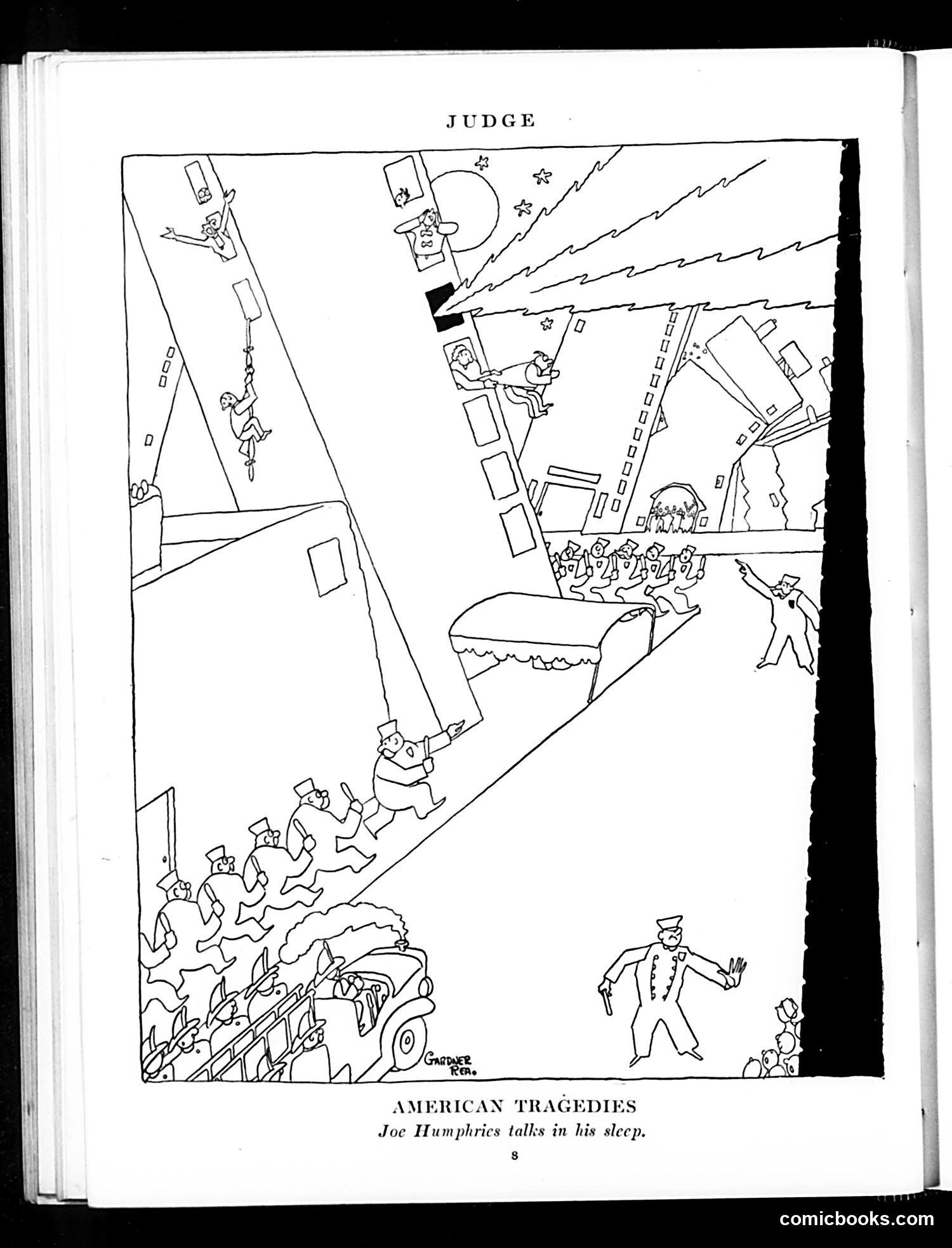
This Judge magazine cartoon satirizes **Joe Humphries**, likely a public figure of the publication's era. The title "American Tragedies" frames the cartoon as dark social commentary. The illustration shows an elaborate, surreal courthouse or governmental building with multiple levels, judges in tall hats presiding from elevated positions, crowds of small figures, and what appears to be sleeping Joe Humphries at bottom right. The joke hinges on "talks in his sleep"—suggesting Humphries reveals damaging truths or secrets unconsciously. The chaotic architectural scene with judicial authority figures implies courtroom scandal or legal misconduct being exposed through his sleep-talk. Without additional context, the specific incident or Humphries's exact identity remains unclear, but the cartoon uses surreal, Kafkaesque imagery to mock both Humphries and institutional authority.
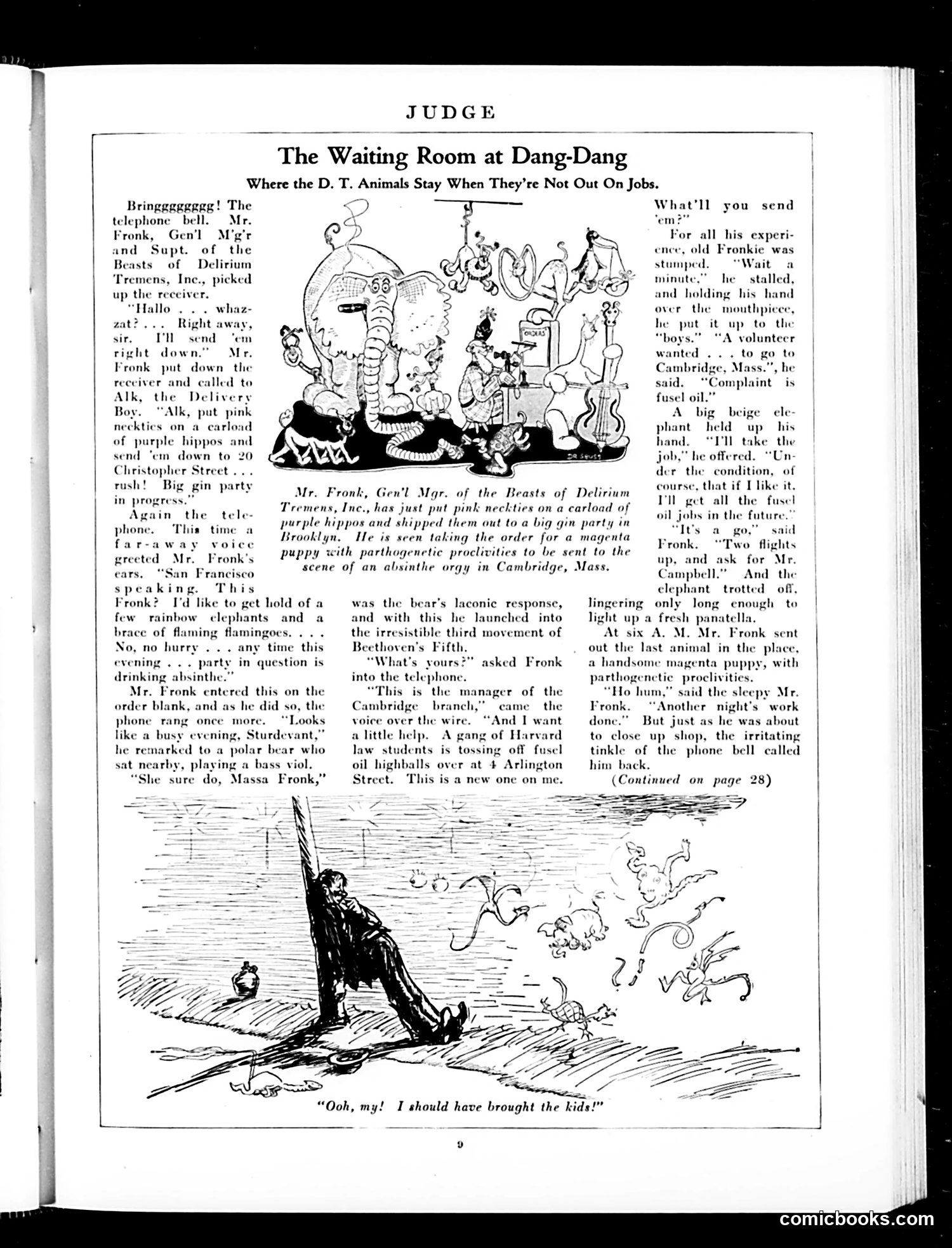
This is a satirical piece mocking Prohibition-era excess and the absurdity of alcohol enforcement. "Dang-Dang" appears to be a fictional agency supplying hallucinatory creatures (products of "delirium tremens"—alcohol withdrawal symptoms) to deliver alcohol and facilitate drinking parties. The joke: Mr. Fronk manages these surreal beasts, dispatching them on jobs like delivering pink-necklaced hippos to gin parties and coordinating absinthe orgies in Cambridge. Harvard law students and Brooklyn residents place orders for fusel oil (cheap, toxic alcohol), treating illegal drinking as a casual business service. The satire targets Prohibition's failure—organized drinking persists openly, treated as a commercial enterprise with logistics and customer service. The fantastical "D.T. animals" metaphorically represent how Prohibition created a surreal, hallucinatory economy around illegal alcohol. The page mocks both the absurdity of the law and those who flaunted it.
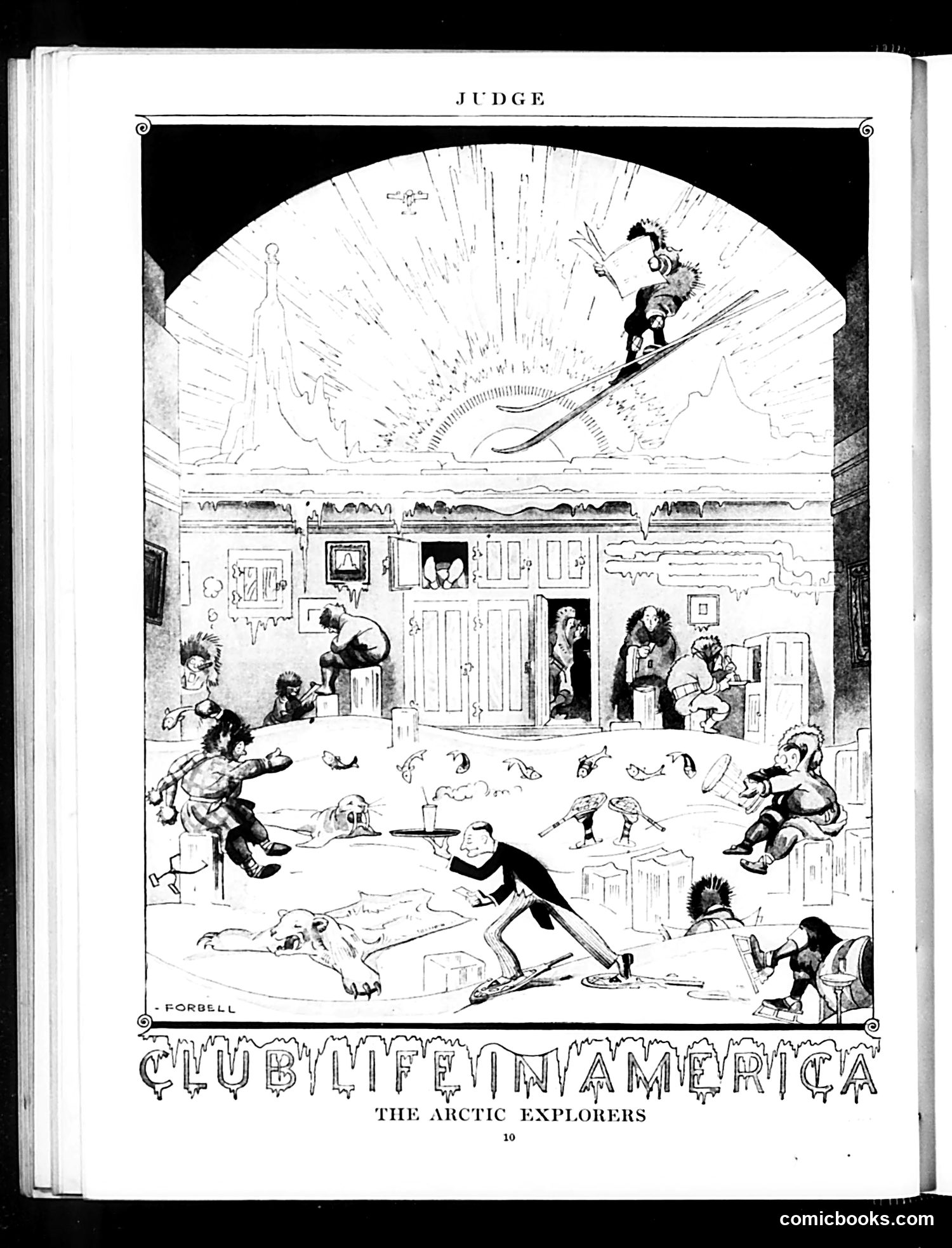
This satirical cartoon depicts a chaotic domestic scene labeled as "Arctic Explorers." The joke appears to be that the interior of a home resembles an arctic expedition—suggesting the household is in complete disarray or disorder. Children run wild, adults appear frazzled, and the space is cluttered with debris scattered across the floor. The title puns on the phrase "club it," likely meaning to behave roughly or cause chaos. The satire targets middle-class American domestic life, suggesting that maintaining a household—particularly one with children—is as challenging and hazardous as polar exploration. The Victorian-era illustration style and comedic exaggeration were typical of *Judge* magazine's social commentary on family life and domestic management during the late 19th or early 20th century.
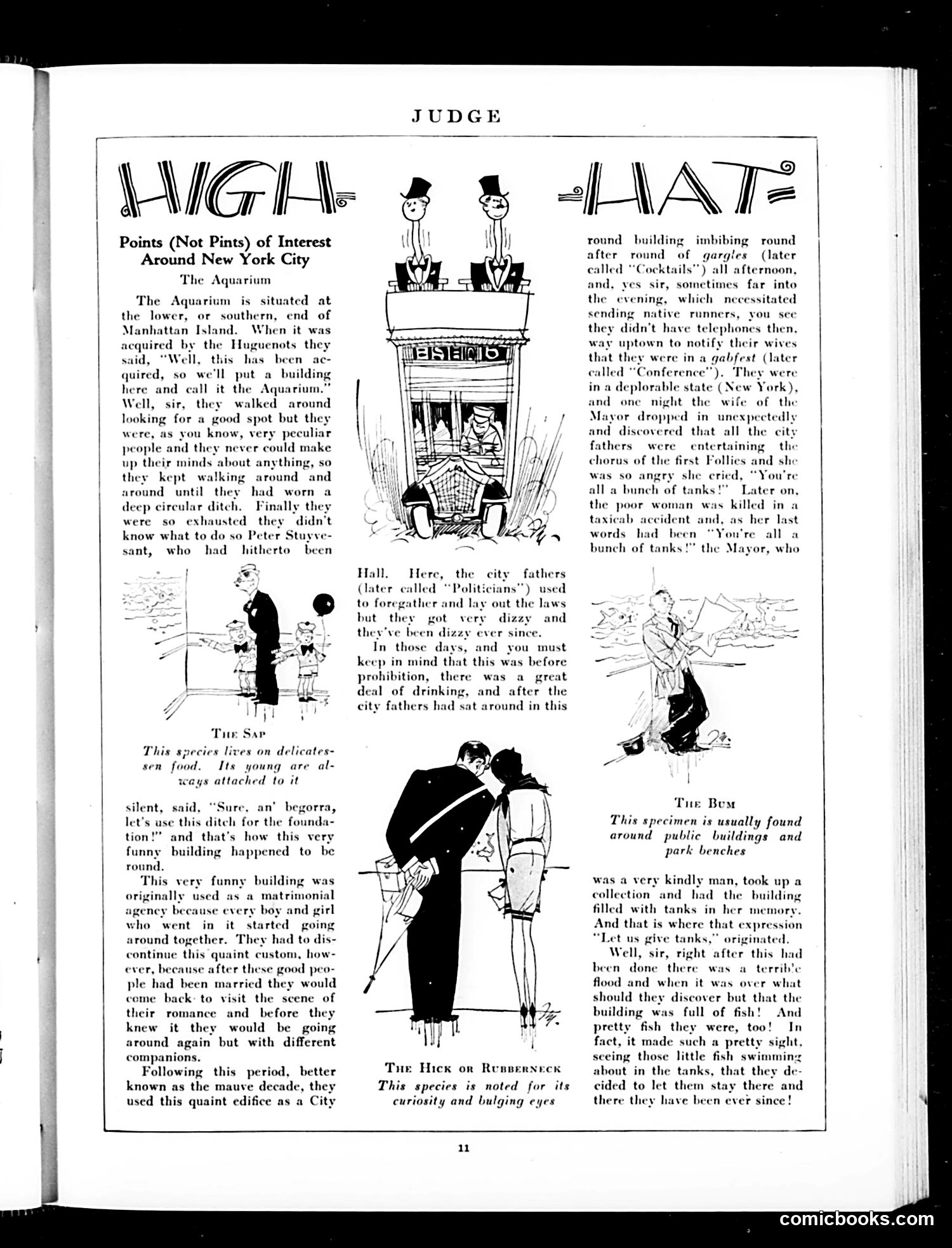
This humorous article mocks New York City landmarks and social types through tall tales about the Aquarium's origin and purpose. The satire works on multiple levels: **The Aquarium**: A farcical "history" claims Huguenots accidentally created it by wearing a circular ditch while indecisively walking, then Peter Stuyvesant repurposed it—absurdist humor deflating civic pride. **Social Commentary**: The piece satirizes: - City officials ("Fathers"/"Politicians") getting drunk on "gargles" (cocktails) during afternoon drinking sessions - The pre-Prohibition drinking culture and its consequences - Bureaucratic incompetence (dizzy lawmakers) - The Follies chorus scandal **The Fish Story**: The Mayor's angry wife dies in a taxi accident, leading to tanks installed in her memory—which accidentally become a real aquarium after a flood. This ridicules sentimental public monuments and bureaucratic irony. **Character Illustrations**: The "Sap," "Hick or Rubberneck," and "Bum" represent urban social types Judge regularly mocked. The joke assumes readers recognize 1920s New York culture: drinking culture, Follies theater scandals, and corrupt politics.
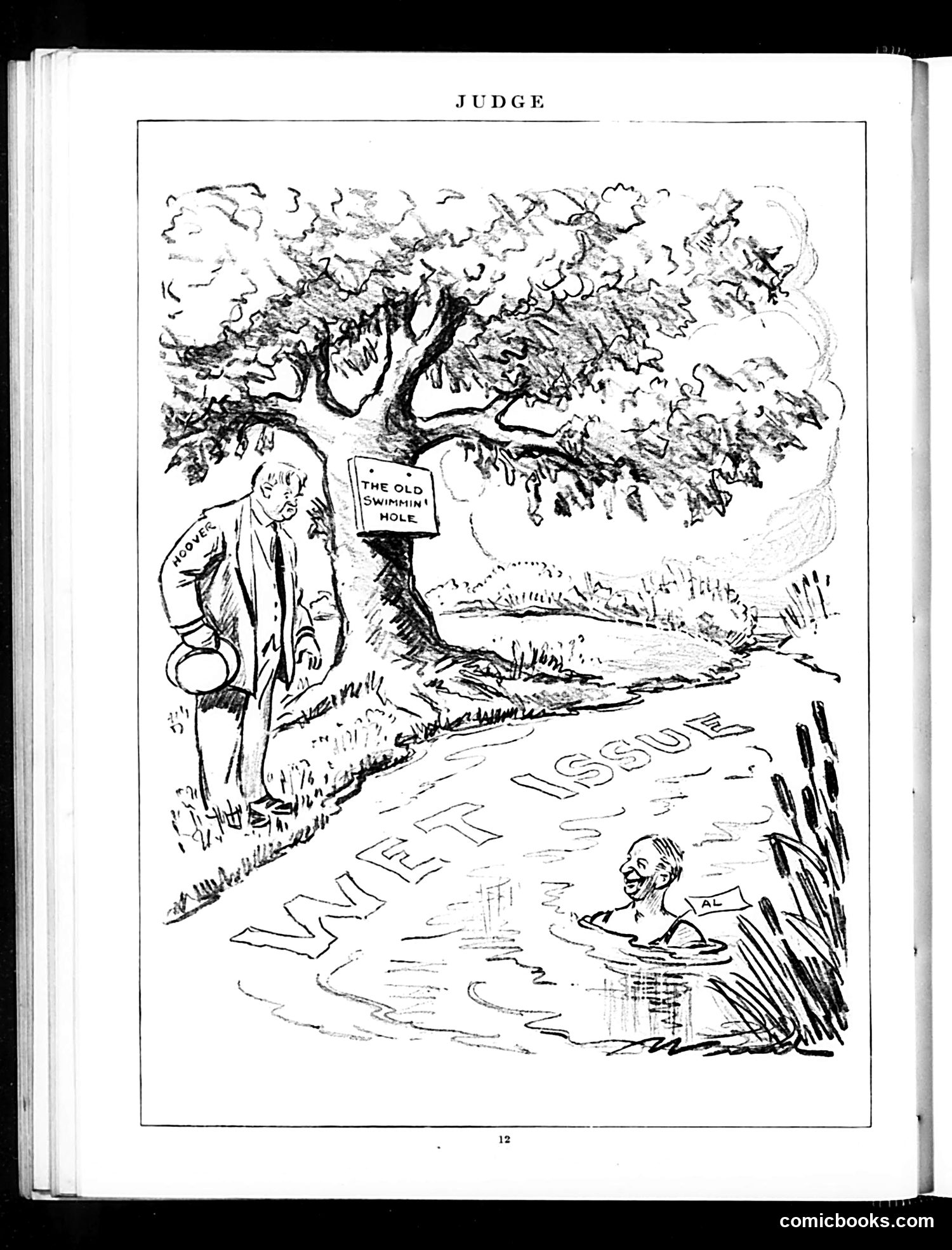
This Judge magazine cartoon depicts a man in formal dress standing beside a tree marked "The Old Swimming Hole," gazing at a body of water labeled "Wet Issue." A figure is partially submerged in the water. The satire appears to reference a political controversy or scandal ("wet issue" likely alludes to Prohibition-era politics, a major debate of early 20th-century America). The man's nostalgic pose at "The Old Swimming Hole" contrasts with the murky "wet issue" below—suggesting how political problems have made once-innocent American traditions complicated or compromised. The exact figures remain unclear without additional context, but the cartoon uses the contrast between innocent nostalgia and political turmoil to satirize how contemporary issues contaminated American life.
This page from **Judge** (a satirical magazine) contains three distinct pieces: ## "An Issue at Last" Commentary on the 1928 presidential campaign between **Herbert Hoover** (Republican) and **Al Smith** (Democrat). The writer argues prohibition has finally emerged as a genuine campaign issue, with Smith taking a clear wet (anti-Prohibition) stance. The piece expresses skepticism that this will actually change the outcome, given divided opinion within both parties and voter apathy. ## "The Age of Insects" Discussion of entomologist Dr. L.O. Howard's claim that insects, not humans, will inherit Earth. The satire notes Americans ignore pest threats through quarantine resistance and inadequate funding, treating it as mere nuisance rather than serious warfare. ## "Younger Generation Notes" Criticism of **Al Smith** for casually dismissing golf as merely "nine holes." The satirist warns that such dismissive comments about golf (and by analogy, fishing) anger influential constituencies—implying Smith's casual remark about golf damages his political standing among this voter group. All three pieces use humor to critique political and social attitudes of 1928.
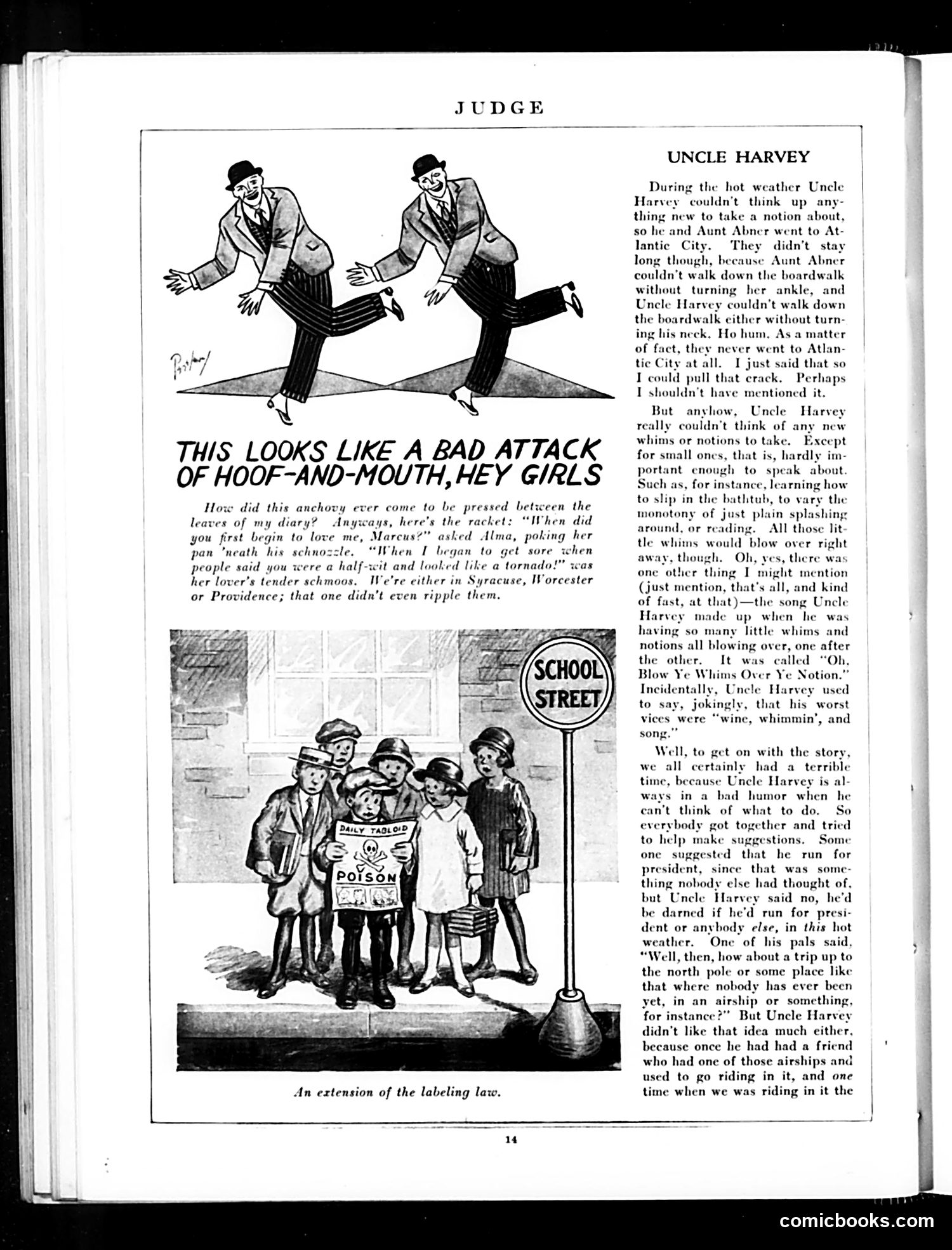
This page contains two separate humorous pieces from *Judge* magazine (likely early 20th century). **Top cartoon**: "Hoof-and-Mouth" satirizes awkward romantic declarations. Two men appear to be fleeing or demonstrating exaggerated physical discomfort. The joke references a diary entry where a woman asks when her suitor fell in love, and he responds: when he got upset hearing people call her a "half-wit" who "looked like a tornado." The humor lies in the insult disguised as romantic confession—a deliberately terrible pickup line. **"Uncle Harvey" story**: A humorous anecdote about a bored middle-aged man during summer heat. Unable to devise new entertainments, he becomes irritable. Friends suggest increasingly absurd activities (running for president, polar expeditions by airship) to occupy him. The satire gently mocks both his vapid complaints and the era's obsession with novelty and modern technology like airships. Both pieces employ understated, character-driven humor typical of early 20th-century American magazine comedy—emphasizing awkwardness and mundane frustration rather than sharp political commentary.
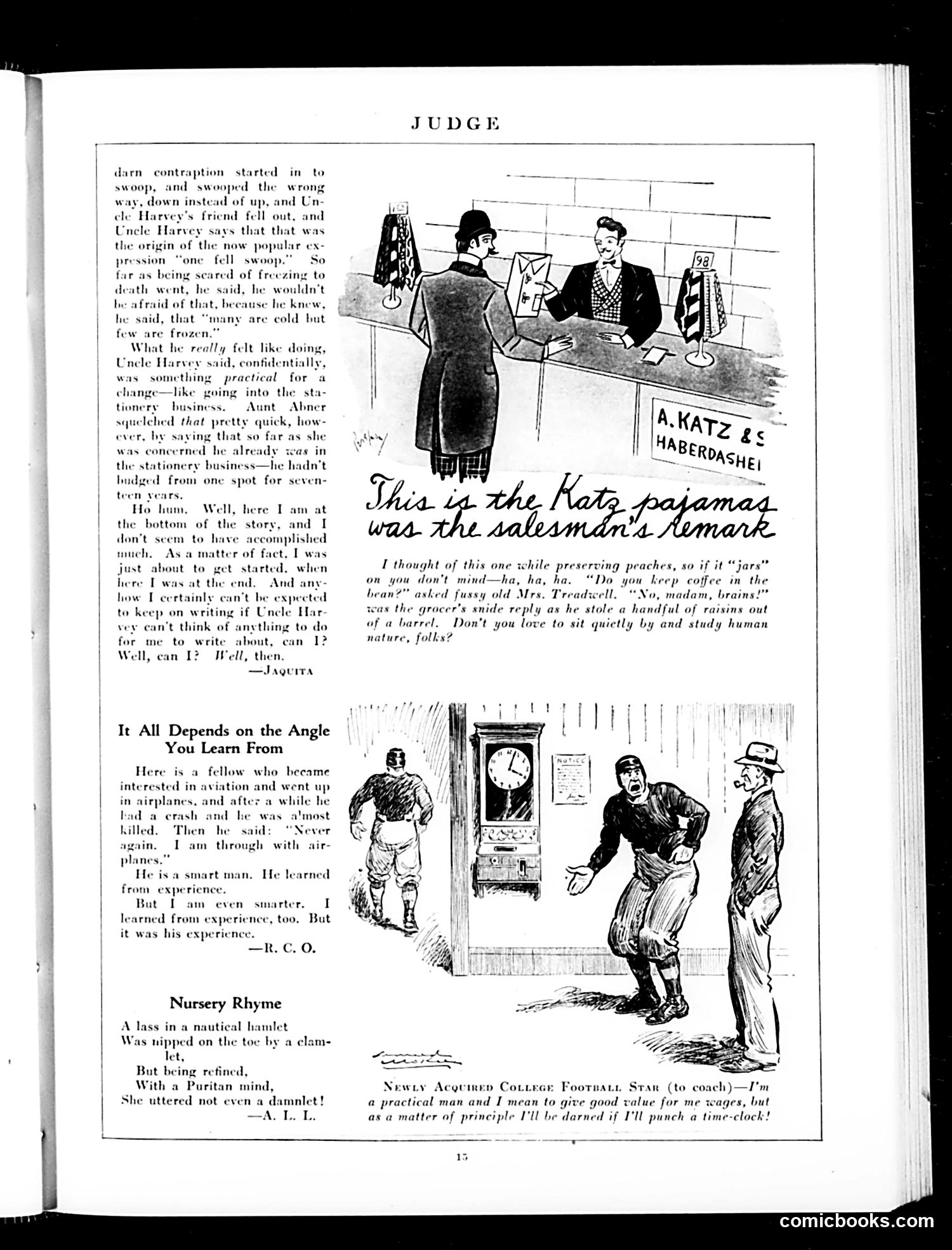
This page contains three separate humorous pieces typical of early 20th-century satirical magazines: 1. **"This is the Katz Pajamas"** (top): A retail scene where a salesman remarks on preserving peaches and discusses coffee beans with customers. The humor relies on wordplay and observational jokes about domestic life. 2. **"It All Depends on the Angle"** (middle): A brief anecdote about learning from others' mistakes—a man swears off aviation after a crash; the narrator claims superiority by learning from *his* experience instead of firsthand. 3. **"Nursery Rhyme"** (bottom) and **Football Coach cartoon** (lower right): Light verse and a joke about a newly hired college football coach refusing to punch a time-clock on principle, despite claiming to offer "good value." The page exemplifies Judge's mix of gentle domestic humor, wordplay, and mild social commentary rather than hard political satire. The cartoons mock middle-class pretension and stubborn pride humorously rather than controversially.
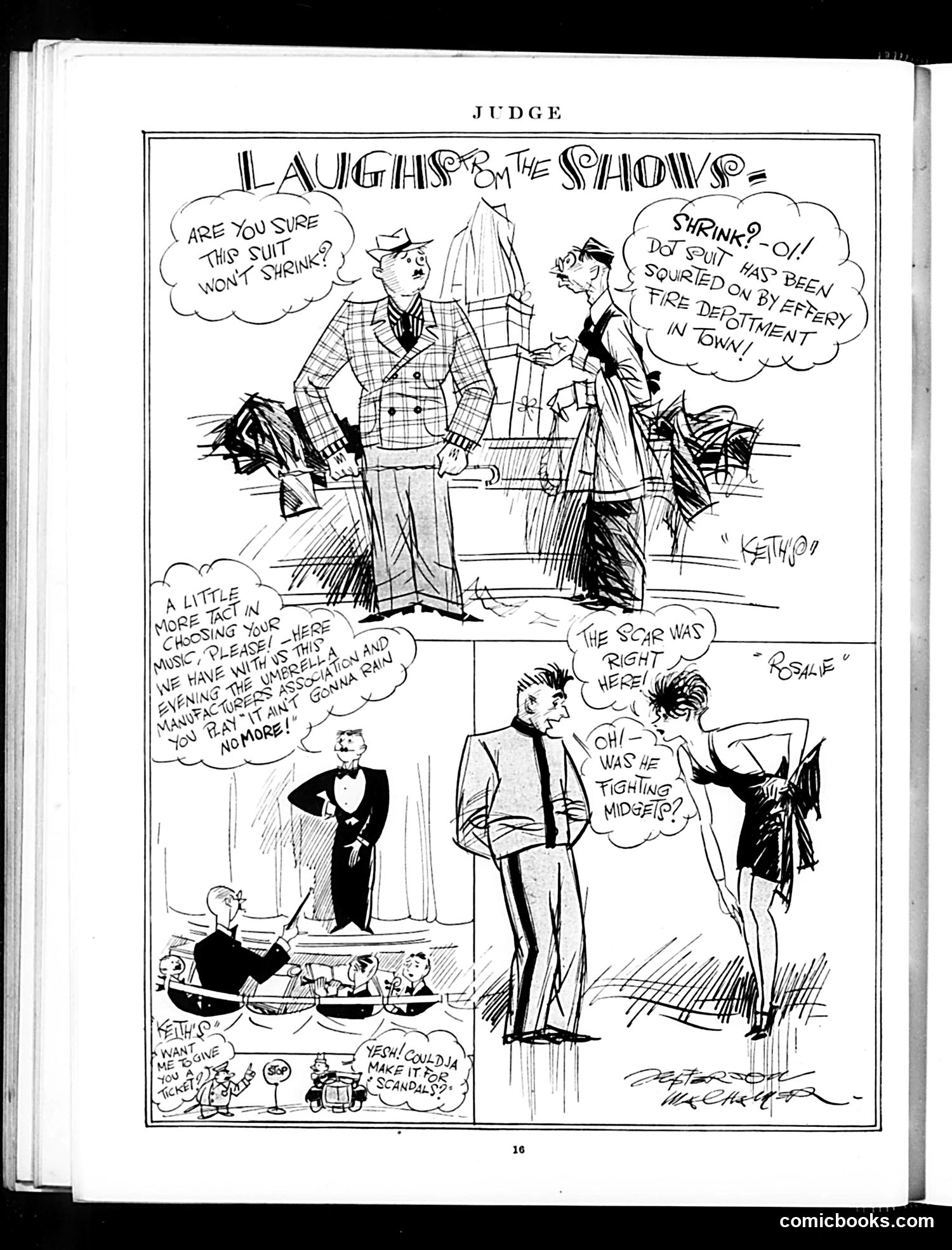
This is a multi-panel satirical comic about theatrical mishaps. The top panel shows a tailor reassuring a client that a suit won't shrink, while another man reveals his suit *has* shrunk after the fire department used it during a fire response. The lower panels depict theater-related incidents: one shows a man wanting a ticket refund due to an "immersion and dampness," while another features what appears to be a performer (possibly a midget or acrobat) who was fighting during a show. The satire targets both clothing manufacturers' false claims and the unpredictable chaos of live theatrical performances—suggesting that attending shows in this era could involve unexpected disasters from fire department involvement, water damage, or on-stage violence. The humor relies on the audience's familiarity with these common theatrical annoyances.
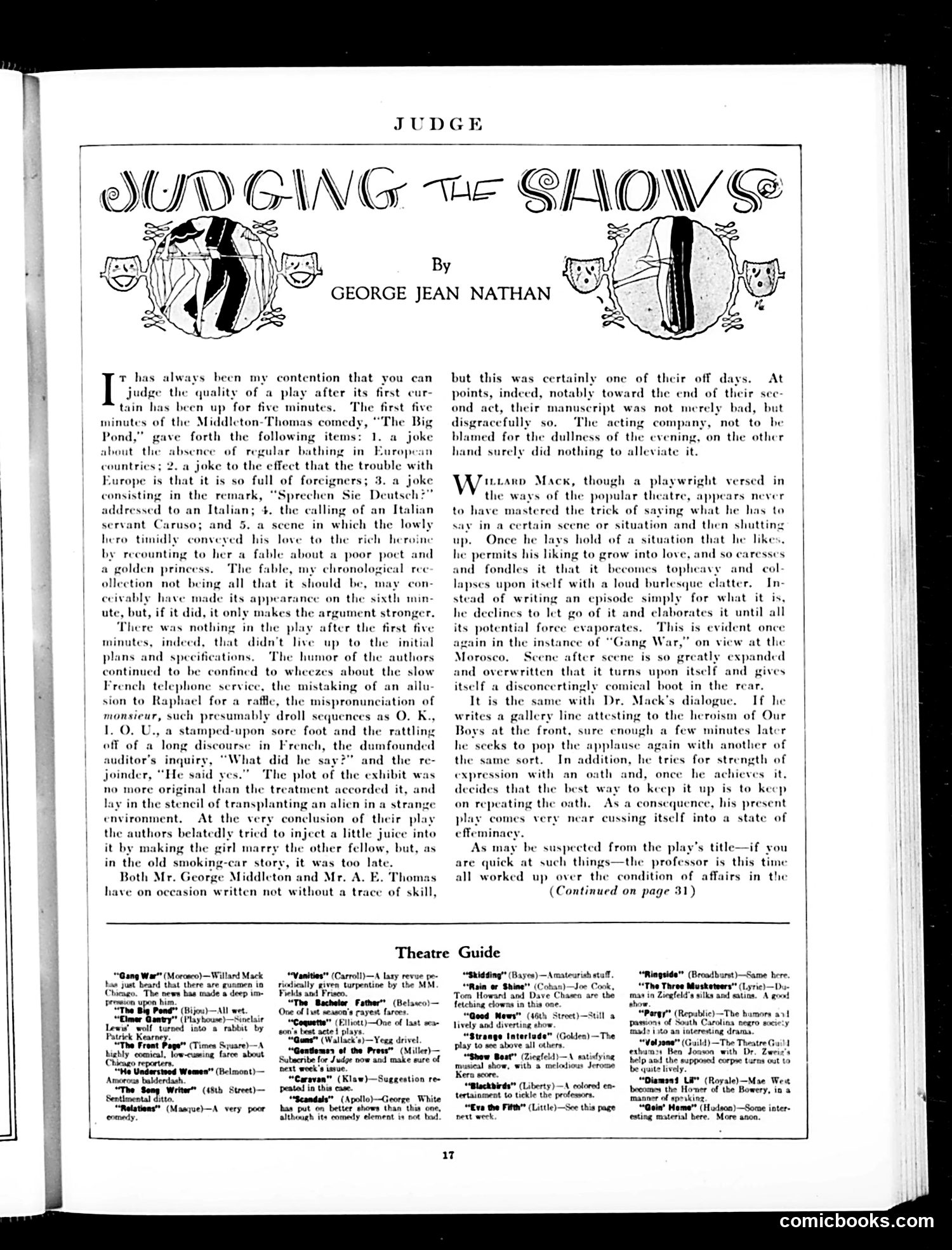
This page is primarily a **theater review**, not a political cartoon. George Jean Nathan, a prominent drama critic, reviews the play "The Big Pond" by Middleton and Thomas, starring Willard Mack. Nathan's critique is scathing: he argues you can judge a play's quality within five minutes. He catalogs "The Big Pond's" failures—tired jokes about European bathing habits, crude ethnic humor (mispronouncing Italian names), and an unoriginal plot about transplanting foreigners to an unfamiliar environment. He also critiques playwright Willard Mack's tendency to over-elaborate scenes he likes, milking them for laughs until they become tedious—a technique Nathan finds undermines the work's potential. The page concludes with a "Theatre Guide" listing current Broadway productions. This is entertainment criticism rather than political satire.
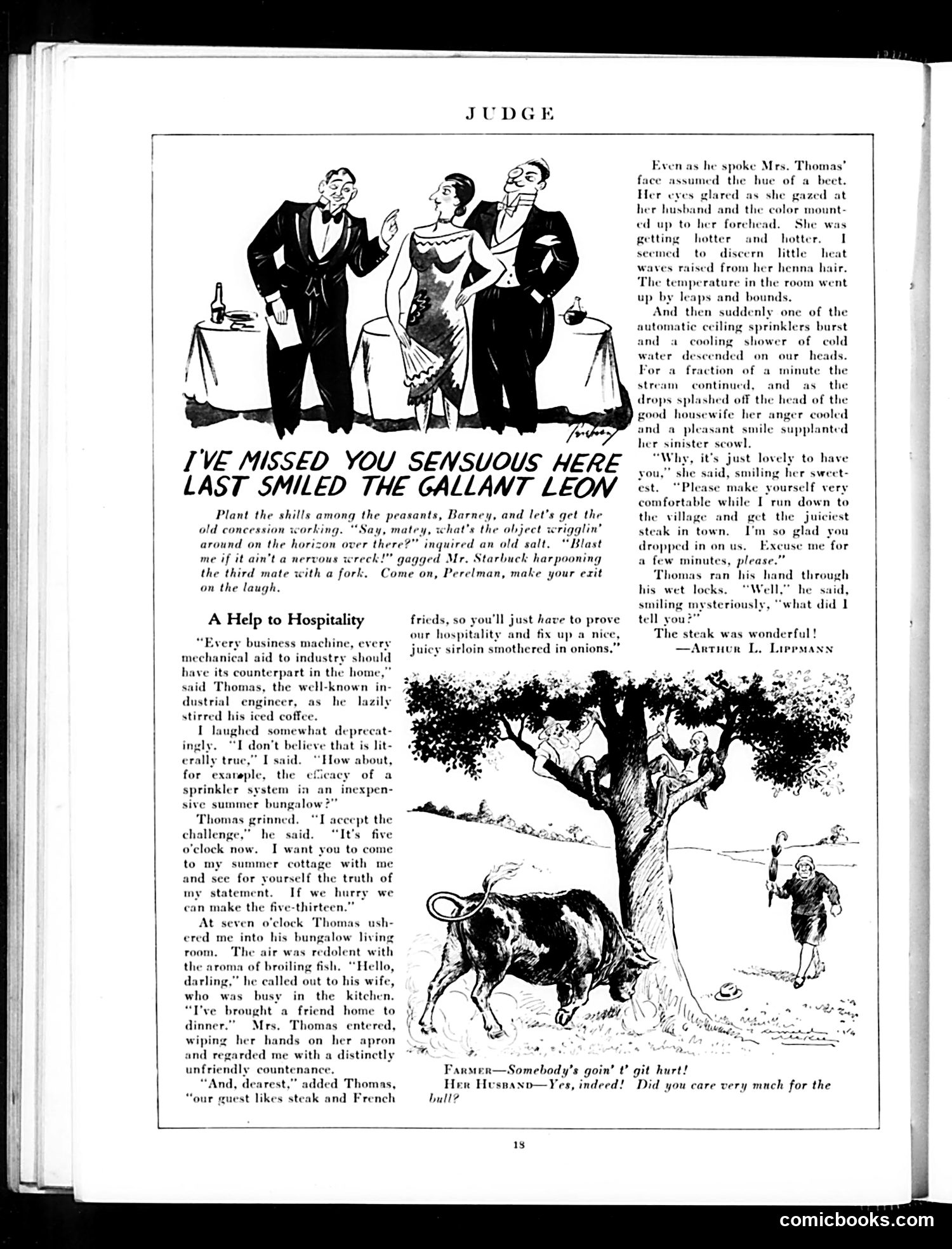
This 1920s-era short story satirizes the obsession with applying industrial efficiency to domestic life. The protagonist, Thomas (an industrial engineer), claims that every home convenience should mirror factory machinery. When his guest observes that a summer cottage couldn't possibly have an automatic sprinkler system, Thomas challenges him to visit and see. At dinner, when Thomas carelessly announces to his wife that their guest prefers steak, she becomes furious—her face turning red as a beet. The joke's punchline: Thomas has literally installed an automatic ceiling sprinkler system that activates when the room temperature rises, literally cooling Mrs. Thomas's anger with cold water. The satire mocks early-20th-century enthusiasm for mechanization and "scientific living," suggesting such obsessive efficiency is absurd when applied to human relationships and emotions. The cartoon above the story illustrates this tension between formal etiquette and genuine hospitality through a social dinner scene.
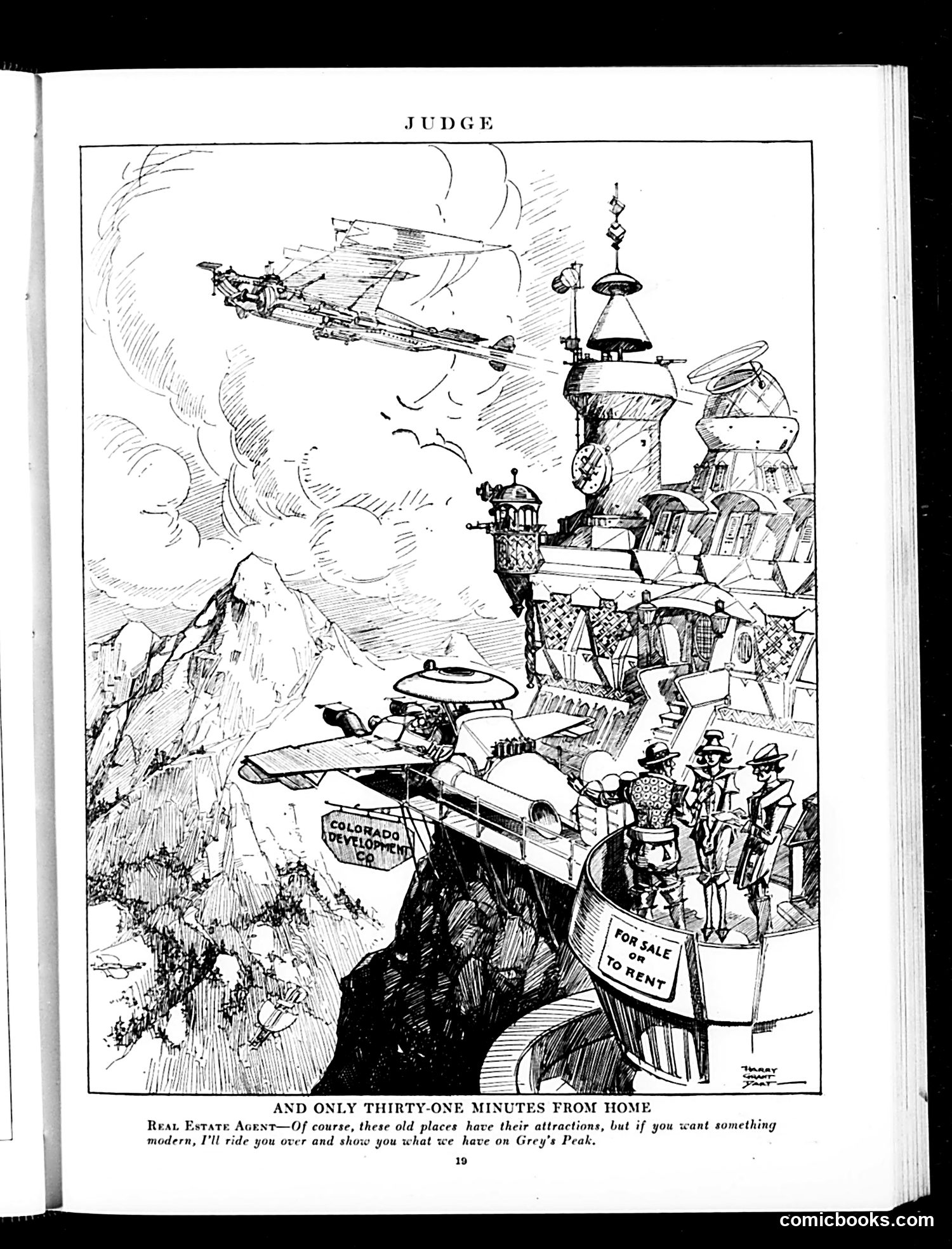
This cartoon satirizes real estate marketing in early 20th-century Colorado. A real estate agent pitches modern development on "Grey's Peak" to a prospective buyer, contrasting it with historic mountain landmarks. The futuristic cityscape depicted—complete with flying vehicles, tall buildings, and commercial development—appears absurdly overdeveloped for a remote mountain location "only thirty-one minutes from home." The satire targets the era's aggressive real estate speculation and the agent's dismissal of natural beauty in favor of commercialization. The fantastical architecture suggests the agent's unrealistic or exaggerated promises about development potential. The "For Sale or Rent" signs emphasize the commodification of the landscape. Judge mocks both the aggressive salesmanship and the modern development craze transforming American natural spaces.
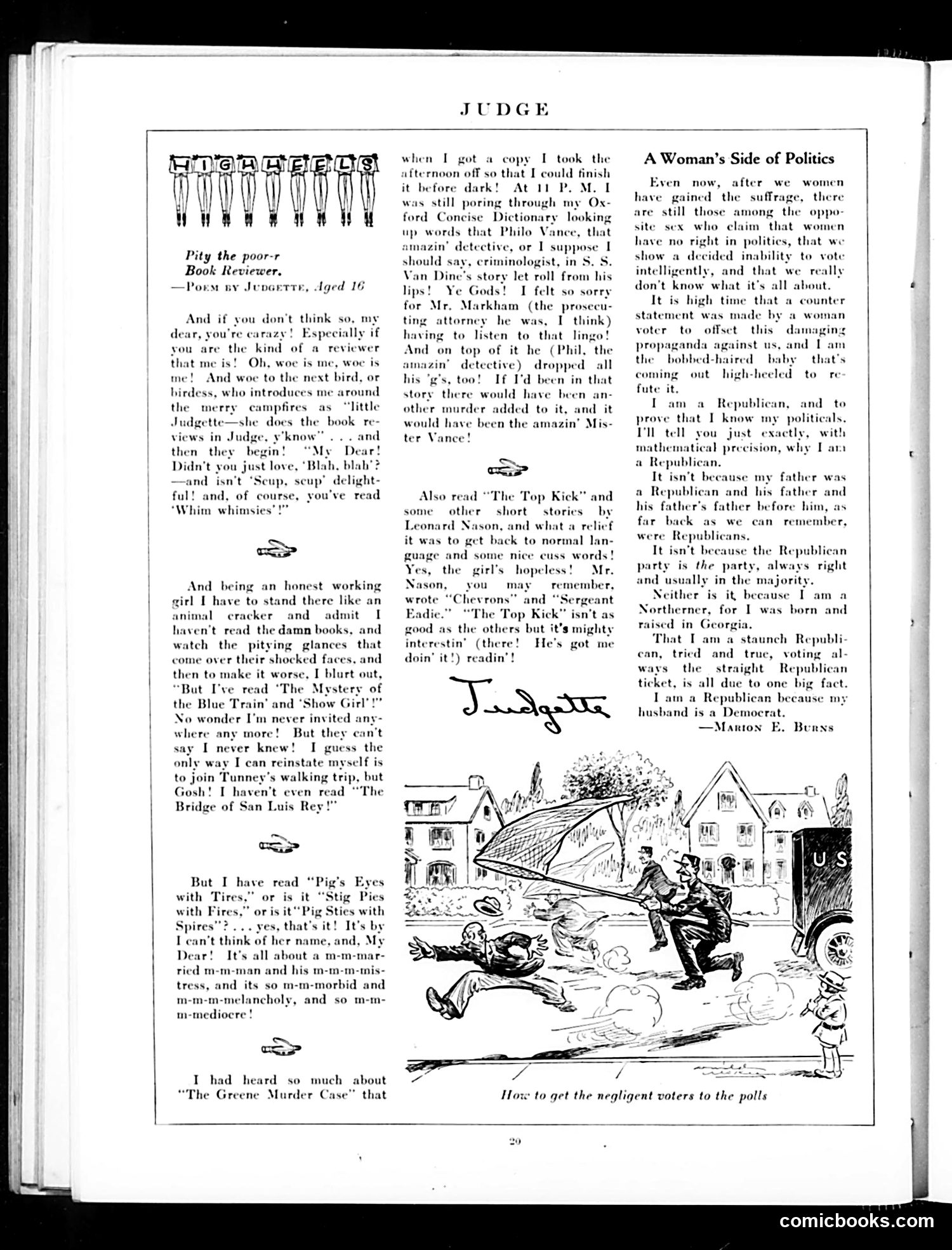
This page contains two satirical pieces typical of 1920s humor magazine content. **Left column:** A female book reviewer laments her social embarrassment at admitting she hasn't actually read the popular novels everyone discusses at gatherings. She name-drops contemporary bestsellers like "The Greene Murder Case" (S. S. Van Dine's detective novel) and "The Bridge of San Luis Rey," expressing frustration at the pretentious literary culture. The satire targets both the pressure to read fashionable books and the reviewer's own dishonesty. **Right column & cartoon:** Titled "A Woman's Side of Politics," this mocks women voters' political reasoning post-suffrage (women gained voting rights in 1920). A woman claims to be a principled Republican based on "mathematical precision," then reveals her actual reason: her husband is a Democrat—implying women voters are illogical and dependent on men's opinions rather than independent political thought. **The cartoon** depicts negligent voters being transported to polling places, satirizing voter apathy and irresponsibility. Both pieces reflect period anxieties about women's newly gained political participation and intellectual capabilities.
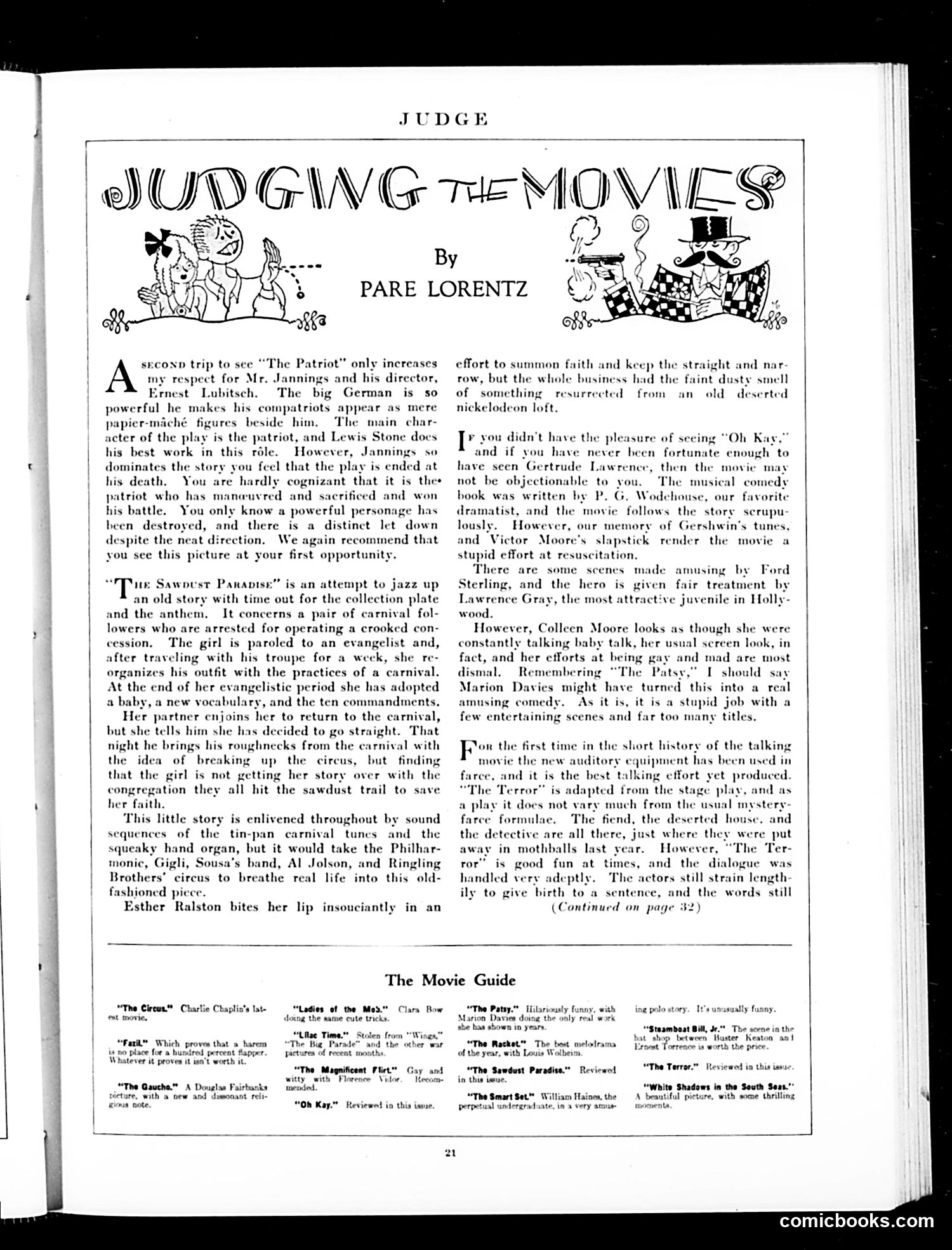
This is a film review column from Judge magazine (a satirical publication). The page contains **film criticism of contemporary 1920s movies**, not political satire in the traditional sense. The reviews critique several films: "The Patriot" (starring Emil Jannings), "The Sawdust Paradise," "Oh Kay," and "The Terror." The critic praises Jannings' powerful performance while lamenting that he overshadows the actual protagonist. He dismisses "The Sawdust Paradise" as recycled melodrama with thin religious moralizing, and criticizes "Oh Kay" as a poorly executed adaptation despite its celebrated source material and original composer (Gershwin). "The Terror" receives tepid approval as competent early talking-picture entertainment. The satire targets Hollywood's tendency to resurrect tired plots and rely on star power over substance. The tone mocks both studios' creative laziness and contemporary audiences' lowered expectations.
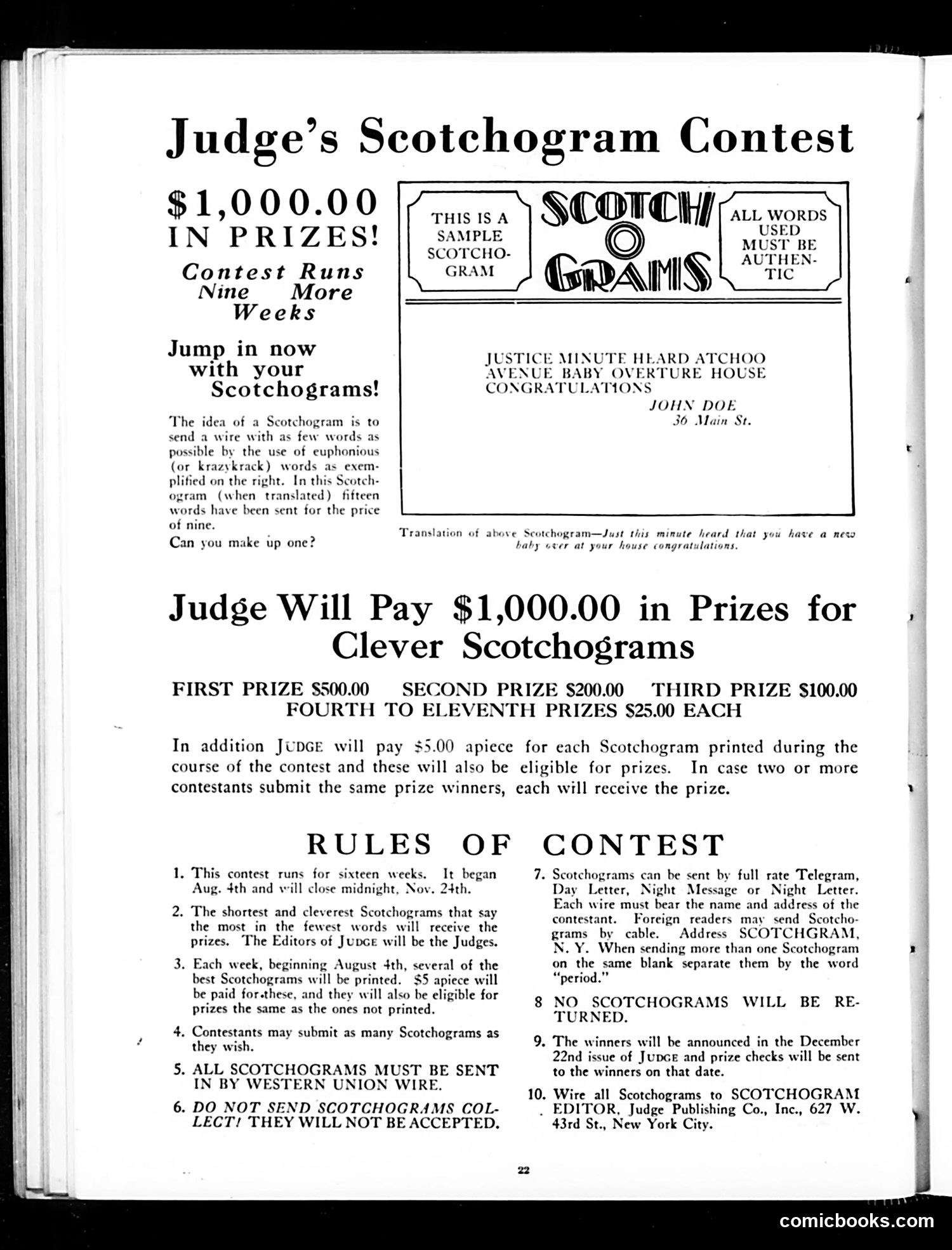
This is primarily a **contest advertisement**, not a political cartoon. Judge magazine is running a $1,000 prize competition challenging readers to create "Scotchograms"—condensed telegraph messages using clever or made-up words to convey full sentences at reduced cost. The sample shows how "JUSTICE MINUTE HEARD ATCHOO AVENUE BABY OVERTURE HOUSE CONGRATULATIONS" translates to "Just this minute heard that you have a new baby over at your house congratulations"—fifteen words compressed into nine. The contest reflects the era's fascination with **telegraph communication efficiency** and wordplay. Contestants must submit entries via Western Union wire only (emphasizing the technology), with judging by Judge's editors selecting the cleverest, most economical phrasings. This is essentially a **linguistic puzzle competition** for readers, not satire—though it showcases early-20th-century communication culture and Judge's role promoting clever wordcraft.
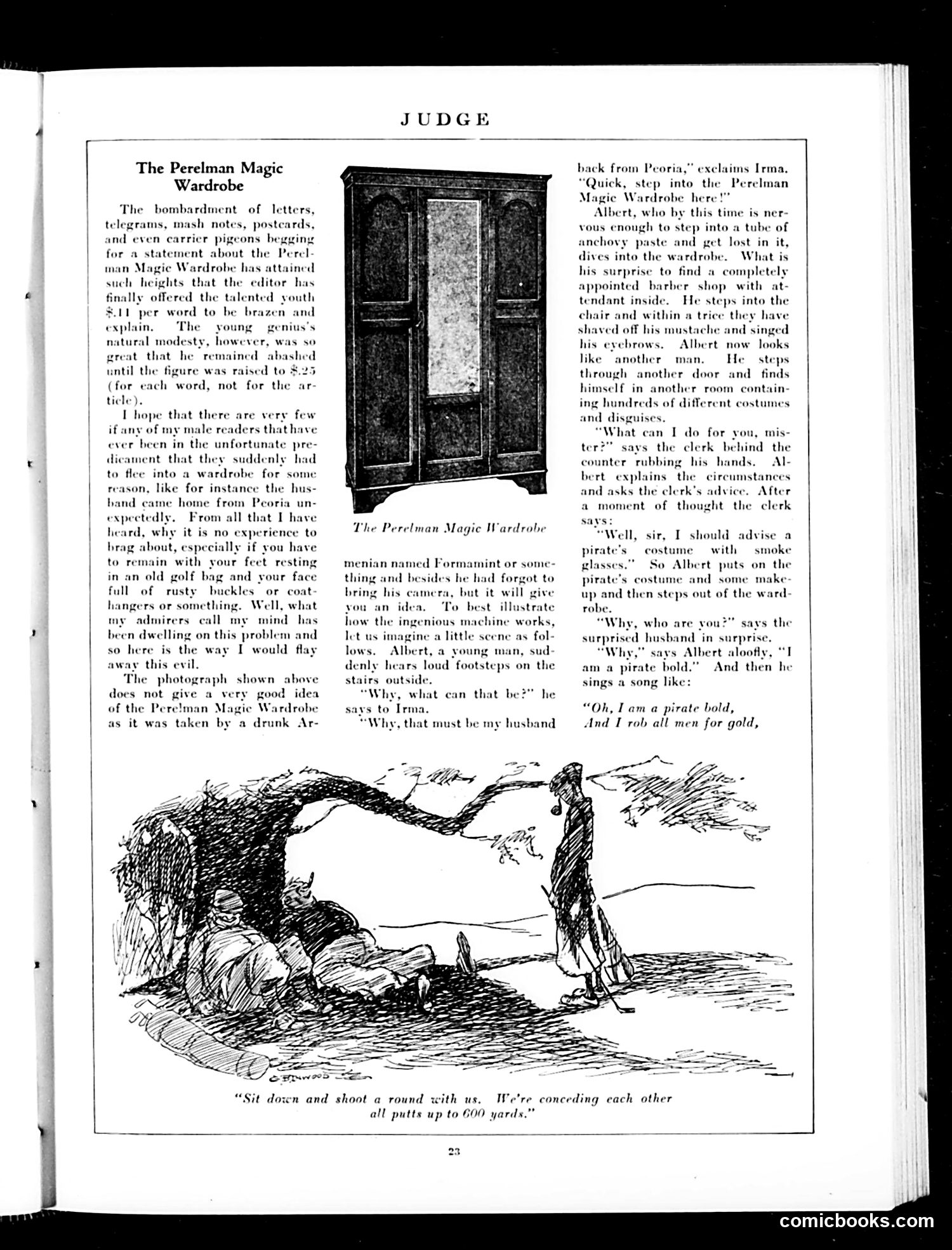
This is a humorous fiction piece—not a political cartoon—about an ingenious piece of furniture. The "Perelman Magic Wardrobe" is presented as a solution to a common domestic predicament: a man needing to hide from his wife when her husband unexpectedly returns home from Peoria. The satire targets marital infidelity and domestic anxiety through absurdist comedy. When Albert dives into the wardrobe, he discovers it contains a fully-equipped barber shop and costume room inside, complete with attendants. The wardrobe transforms him so completely (new appearance, pirate costume, theatrical makeup) that his own husband doesn't recognize him. The joke relies on 1920s-era assumptions about wayward spouses and the desire to escape detection. The illustration below shows pirates negotiating terms, which connects to Albert's adopted disguise. This is lighthearted satire of domestic infidelity rather than serious social commentary.
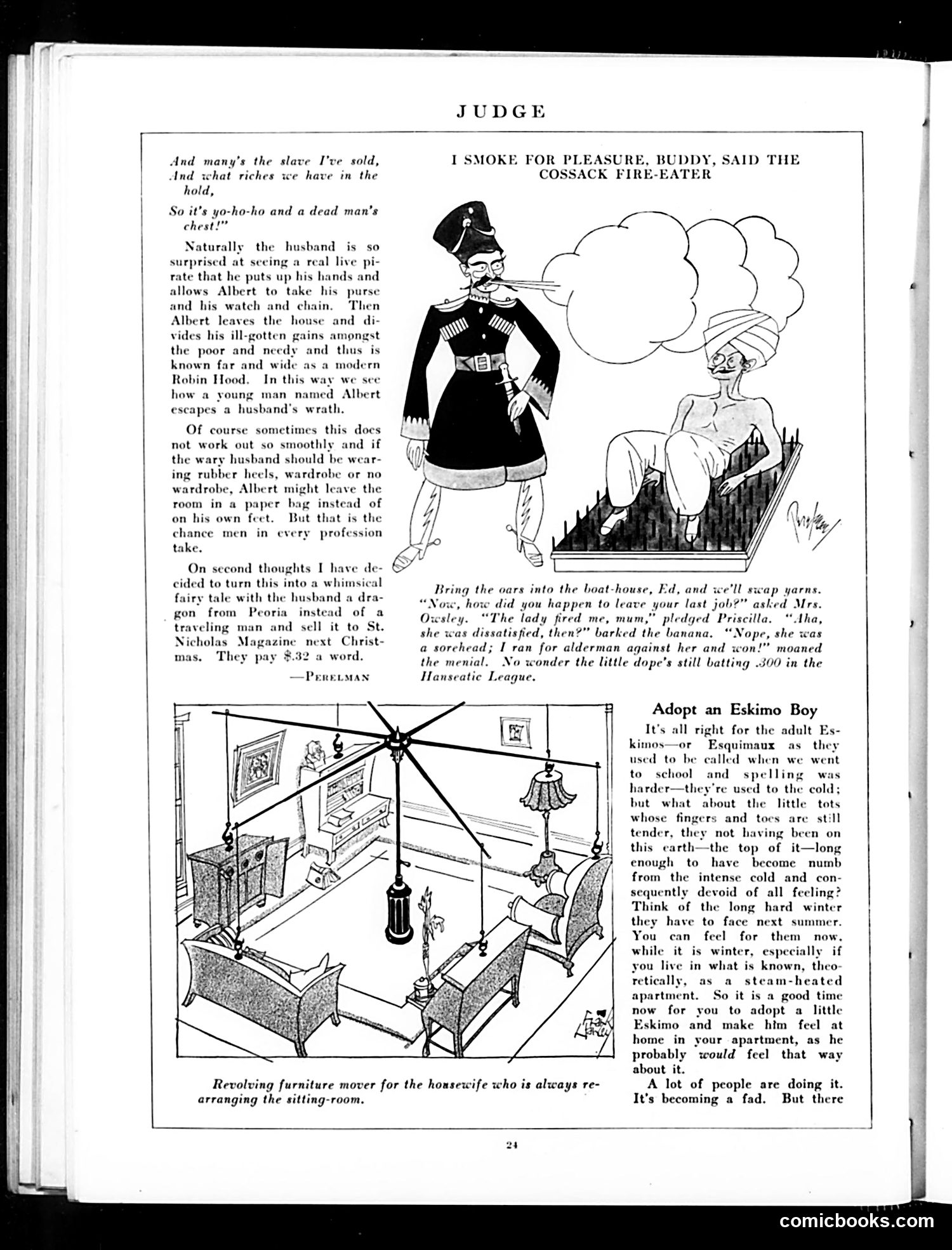
This page contains three separate humorous pieces typical of Judge's satirical style: **The "Robin Hood" Story**: A tongue-in-cheek narrative about a young man named Albert who robs husbands (disguised as a pirate) and redistributes the stolen goods to the poor. The author jokingly considers repackaging it as a fairy tale for *St. Nicholas* magazine, mocking both the sentimentality of children's literature and the low pay rates for such work ($.32 per word). **The Cossack Fire-Eater Cartoon**: A visual joke about a flamboyant character smoking extravagantly, with dialogue about swapping stories—poking fun at exaggerated masculine posturing and tall tales. **"Adopt an Eskimo Boy"**: A satirical advice column mocking the sentimental "charitable adoption" fad among wealthy Americans. The joke is absurdist—suggesting readers adopt Eskimo children to keep them warm in heated apartments, despite their natural cold-hardiness. It's social commentary on performative charity and fashionable philanthropic trends. All three pieces employ Judge's characteristic irreverent humor targeting American society's pretensions and follies.
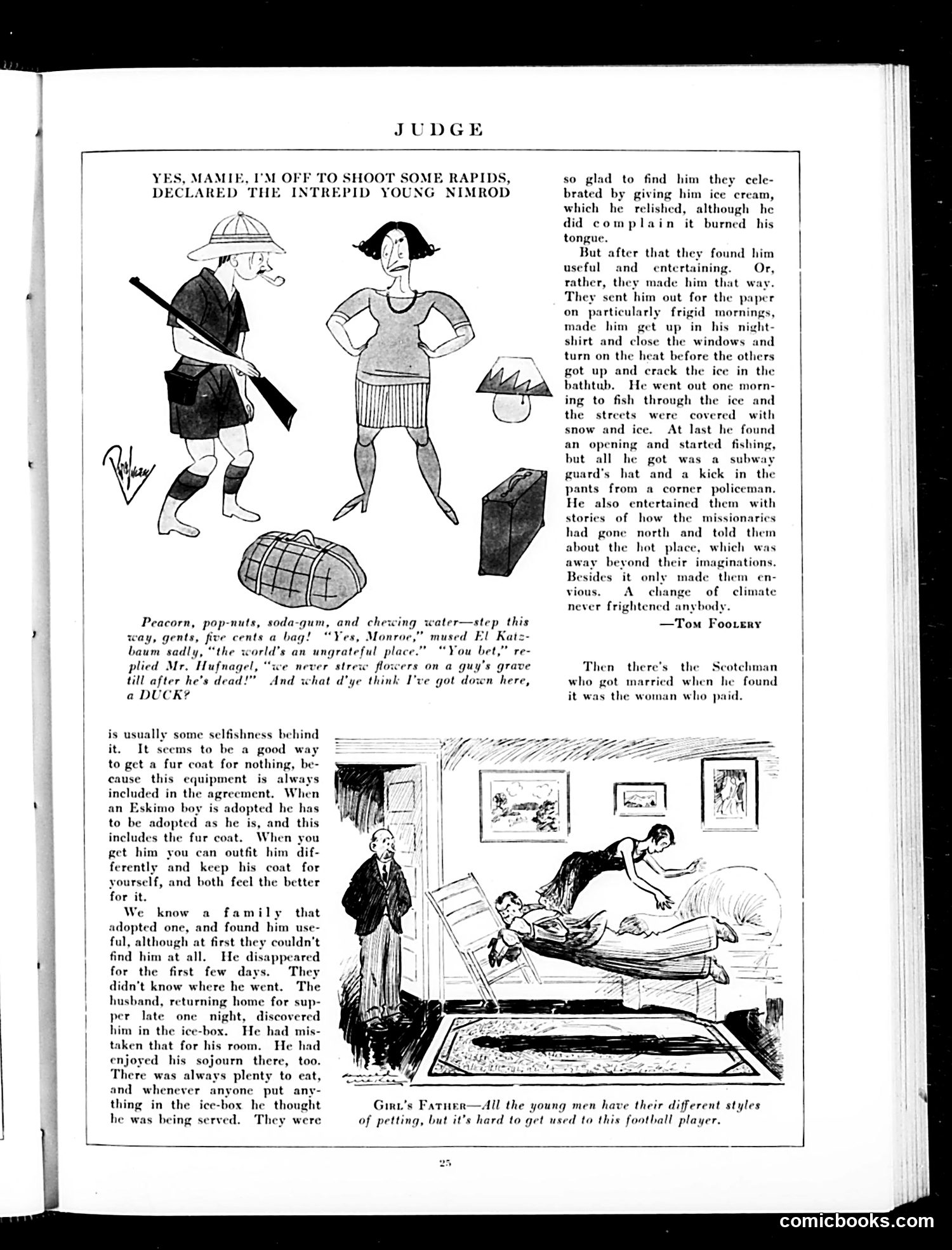
This page contains several satirical sketches about adoptions and social behavior, typical of Judge's early 20th-century humor: **Top cartoon**: A young man declares he's going hunting ("shooting some rapids"), presenting himself as an "intrepid young nimrod" (outdoorsman). The joke satirizes pretentious posturing—he's likely just going on a casual outing but inflates it dramatically. **Main story**: An adopted Eskimo boy becomes unexpectedly useful for household chores—fetching papers in cold weather, cracking ice in bathtubs. The satire critiques both the fashion of "adopting" exotic children as novelties and exploiting them as servants. His confusion mistaking an ice-box for a bedroom mocks the stereotype of Arctic peoples and cold climates. **Bottom cartoon**: Jokes about petting styles and a football player—likely satirizing the physical roughness of athletes as unsuitable romantic partners. The page reflects period attitudes toward adoption, Arctic peoples, and gender roles, presented through Judge's characteristic blend of comic drawings and sarcastic commentary.
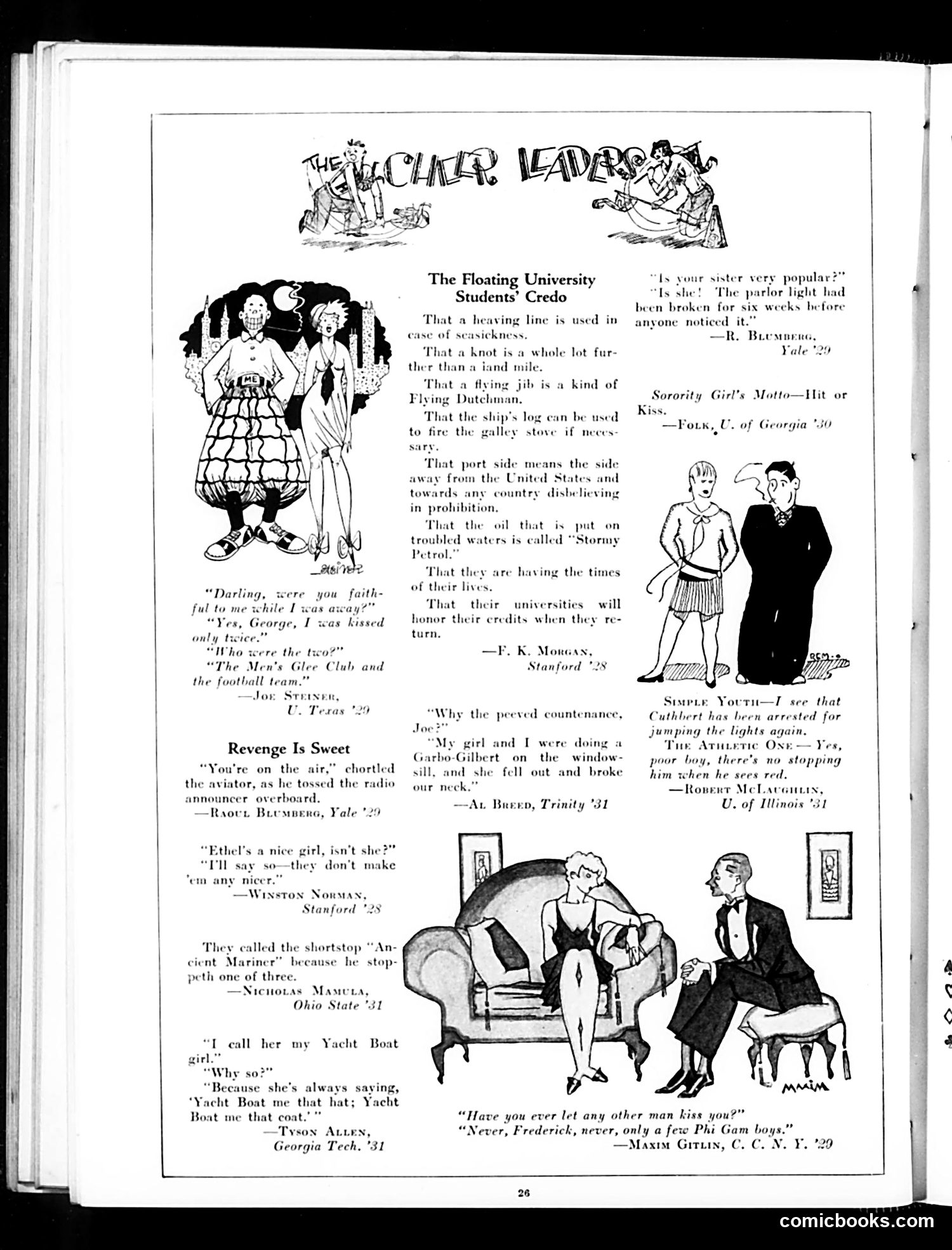
This page from Judge magazine collects humorous student submissions—jokes and quips attributed to various college students (Yale, Stanford, Georgia Tech, etc.), circa 1928-1931. The content satirizes **college life and student culture** during Prohibition era America. Key themes include: **"The Floating University Students' Credo"** mocks naive student misconceptions about maritime terms and ship operations, playing on the notion that college students are ignorant landlubbers. **Other jokes target**: - Prohibition enforcement ("port side means...towards any country disbelieving in prohibition") - Dating and romance ("Yacht Boat" wordplay, kissing customs) - Fraternity life ("Phi Gam boys") - Sorority culture (the parlor light joke about popularity) The cartoons illustrate typical college romance scenarios. Overall, the page reflects 1920s-30s undergraduate humor—relatively innocent by modern standards, focused on dating mishaps, nautical confusion, and light social commentary on student behavior and institutional life.
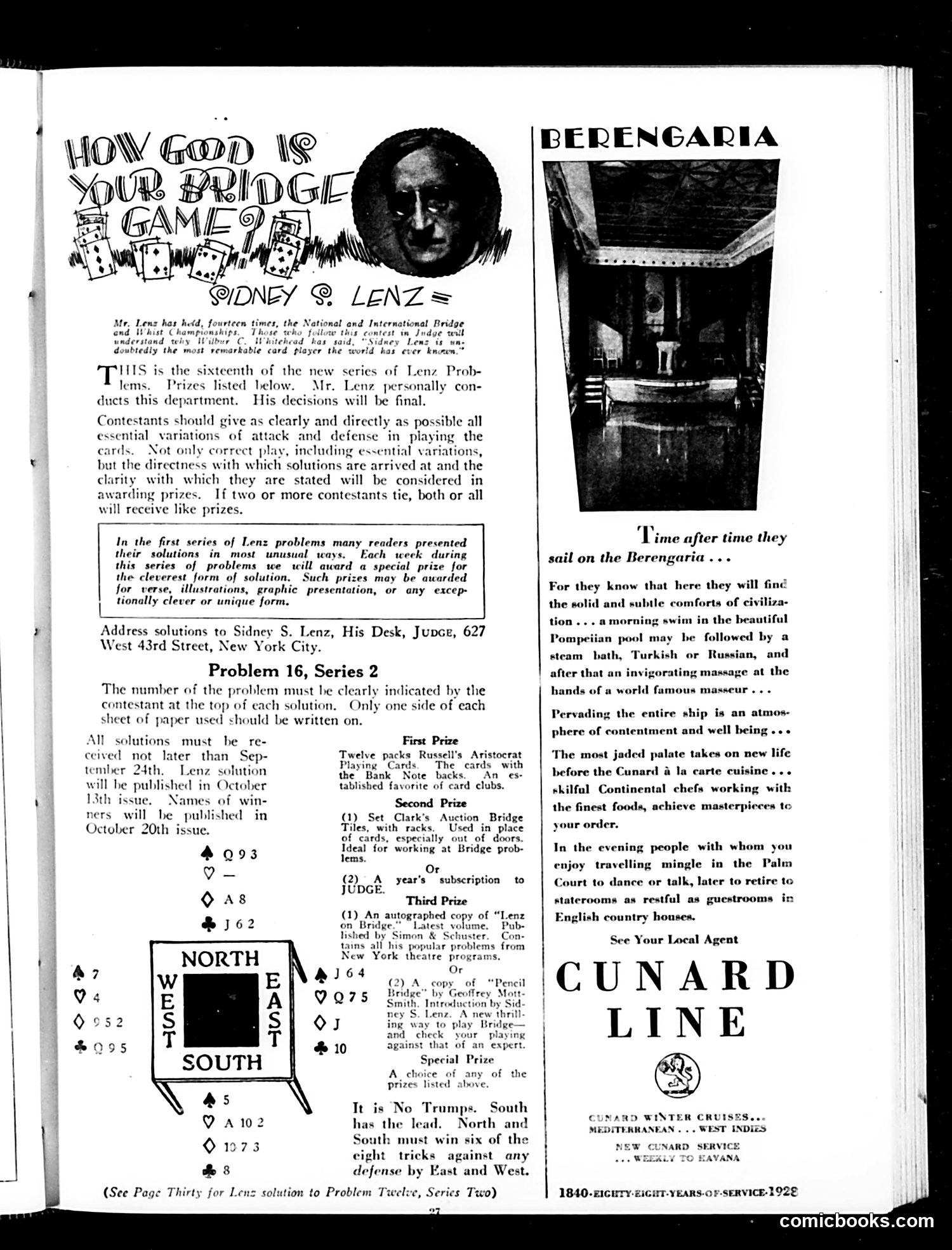
This page combines bridge instruction with advertising. The main content features a **"Lenz Problem"** — a regular bridge puzzle column conducted by Sidney S. Lenz, a famous competitive bridge player. The text emphasizes Lenz's credentials as a champion, describing him as "undoubtedly the most remarkable card player the world has ever known." The left side presents **Problem 16, Series 2**, a bridge scenario requiring readers to solve how North and South can win six tricks playing "No Trumps" against East and West defense. Judge offered prizes for the best solutions, including playing cards, a year's subscription, and autographed bridge books. The right side contains a **Cunard Line ocean liner advertisement** for the *Berengaria*, emphasizing luxury amenities: swimming pools, Turkish baths, massages, fine dining, and evening entertainment. This represents typical 1920s travel advertising targeting affluent readers. The page reflects Judge's dual function: intellectual entertainment (bridge puzzles) for educated readers, combined with upscale commercial advertising.
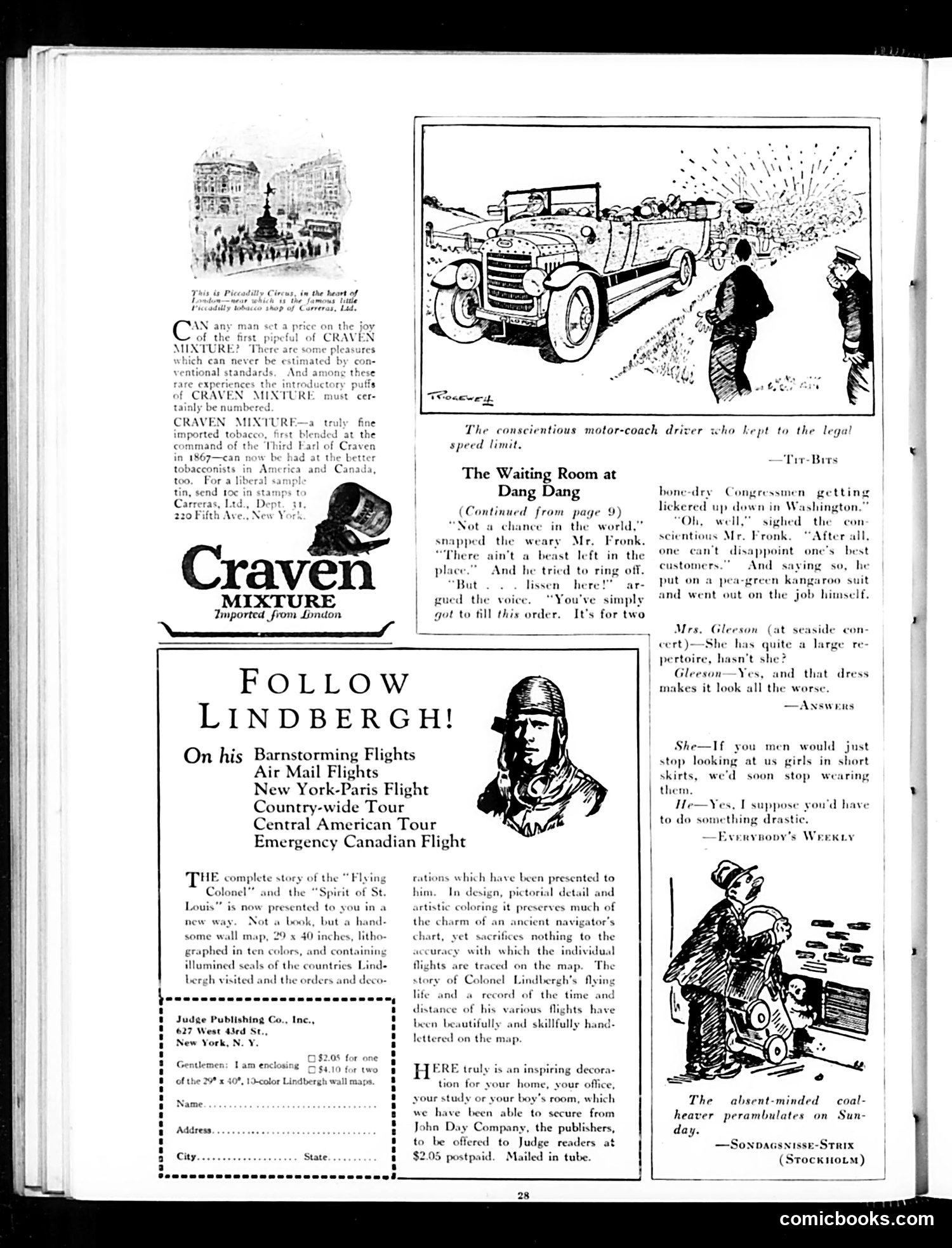
This page is primarily **advertising and filler content** rather than political satire. The main elements are: **Advertisements:** - Craven Mixture (imported tobacco from London) - Lindbergh flight maps and materials from Judge Publishing Co. **Humorous Anecdotes ("The Waiting Room at Dang Dang"):** A brief story about a frustrated man named Mr. Fronk trying to refuse an order because there are "not a beast left in the place"—likely a colonial-era tale of commercial frustration. **Small Jokes/Quips:** Various one-liners about congressmen drinking ("bone-dry Congressmen getting lickered up"), women's fashion complaints, and an absent-minded coal heaver. **Cultural Context:** The Lindbergh promotion reflects 1920s enthusiasm for aviation. The "conscientious motor-coach driver" cartoon references Prohibition-era concerns about alcohol and legal speed limits. Overall, this appears to be a typical Judge magazine interior page mixing product advertisements with light social humor rather than serious political commentary.
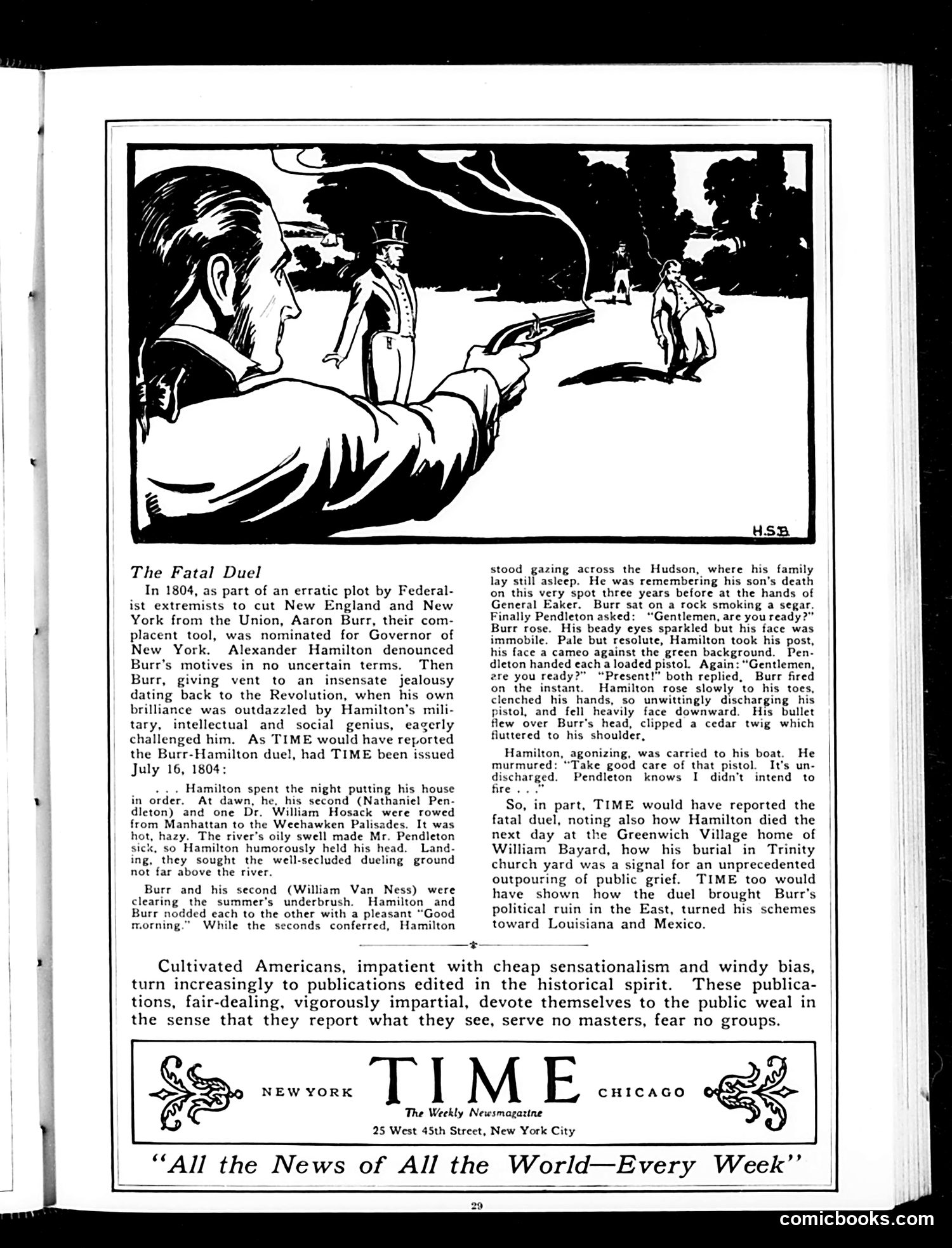
This page reconstructs the famous 1804 duel between Aaron Burr and Alexander Hamilton as if TIME magazine had covered it. The illustration depicts Hamilton (in foreground, left) preparing to face Burr across a clearing near the Hudson River. The historical context: Burr, a Federalist politician, challenged Hamilton after Hamilton publicly opposed his gubernatorial campaign. The text suggests Burr harbored jealousy from Revolutionary War days when Hamilton outshone him. The article describes the duel's tragic outcome—Hamilton was fatally shot and died the next day—and notes it destroyed Burr's political career in the East, forcing him westward. The satire is subtle: by presenting this violent historical episode through the lens of a "fair-dealing, vigorously impartial" modern newsmagazine, the piece implicitly mocks sensationalist journalism while celebrating TIME's claimed objectivity and historical rigor. The advertisement at bottom reinforces this self-promotional message.
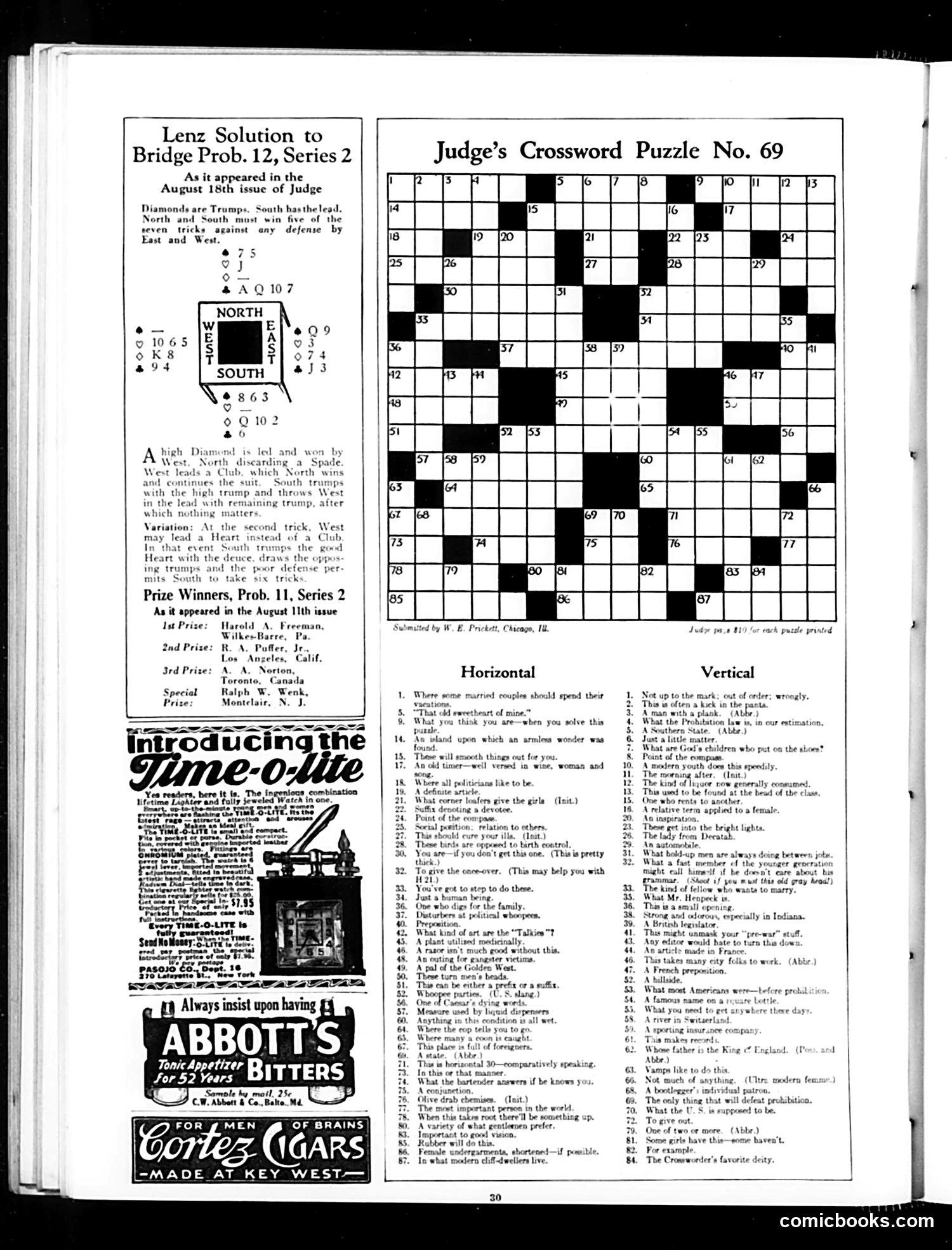
This page is primarily **advertising and puzzles**, not satirical cartoons. The main content consists of: 1. **Bridge Problem Solutions** — A card game puzzle from Judge magazine's "Lenz Solution to Bridge Prob. 12, Series 2" with prize winners listed 2. **Judge's Crossword Puzzle No. 69** — A standard crossword grid with horizontal and vertical clues 3. **Period Advertisements** including: - **Time-O-Lite** (a cigarette lighter product) - **Abbott's Bitters** (a medicinal tonic) - **Cortes Cigars** (made in Key West) The crossword clues contain mild contemporary humor typical of 1920s-30s wordplay (references to Prohibition, "gangsters," "flappers"), but there is **no significant political satire or social commentary** on this particular page. It represents the miscellaneous filler content Judge used between its main satirical articles.
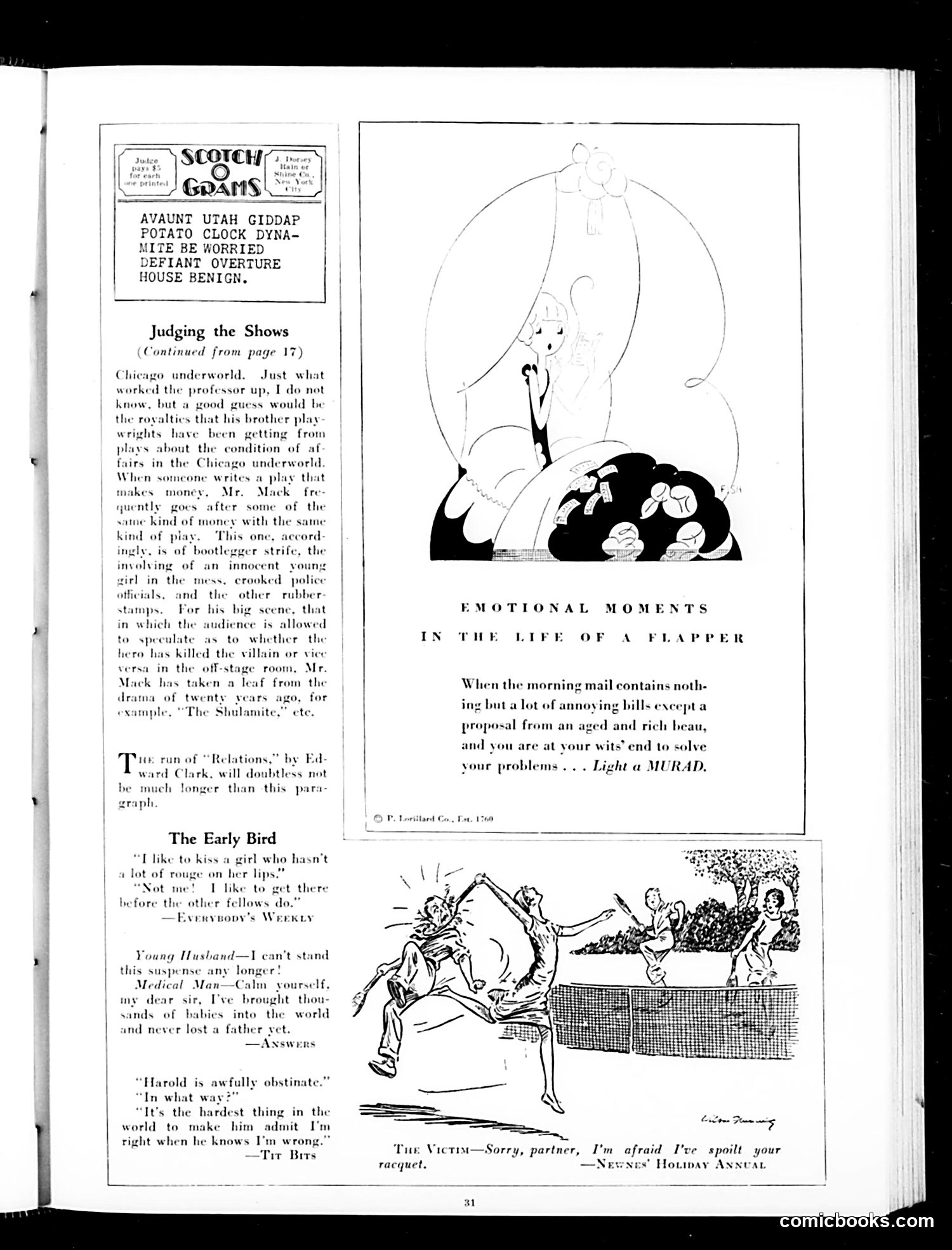
This page contains several humor pieces and advertisements typical of 1920s Judge magazine: **Main Content:** The "Judging the Shows" section discusses theater criticism, mentioning playwright Edward Clark and bootlegger-themed plays about Chicago's underworld—reflecting the Prohibition-era fascination with crime stories on stage. **Comic Bits:** Brief jokes about courtship ("The Early Bird"), marriage anxiety, and stubbornness—standard domestic humor of the era. **Central Cartoon:** "Emotional Moments in the Life of a Flapper" depicts a young woman playing tennis, with the caption joking about solving romantic/financial problems by lighting a Murad cigarette. This satirizes the modern "flapper" lifestyle—independent, cigarette-smoking women representing 1920s social liberation. **Advertisement:** Murad cigarettes use the cartoon to market to this new female consumer demographic, a significant cultural shift in the 1920s. The page reflects Judge's focus on contemporary social changes: Prohibition crimes, modern women's independence, and evolving consumer culture.
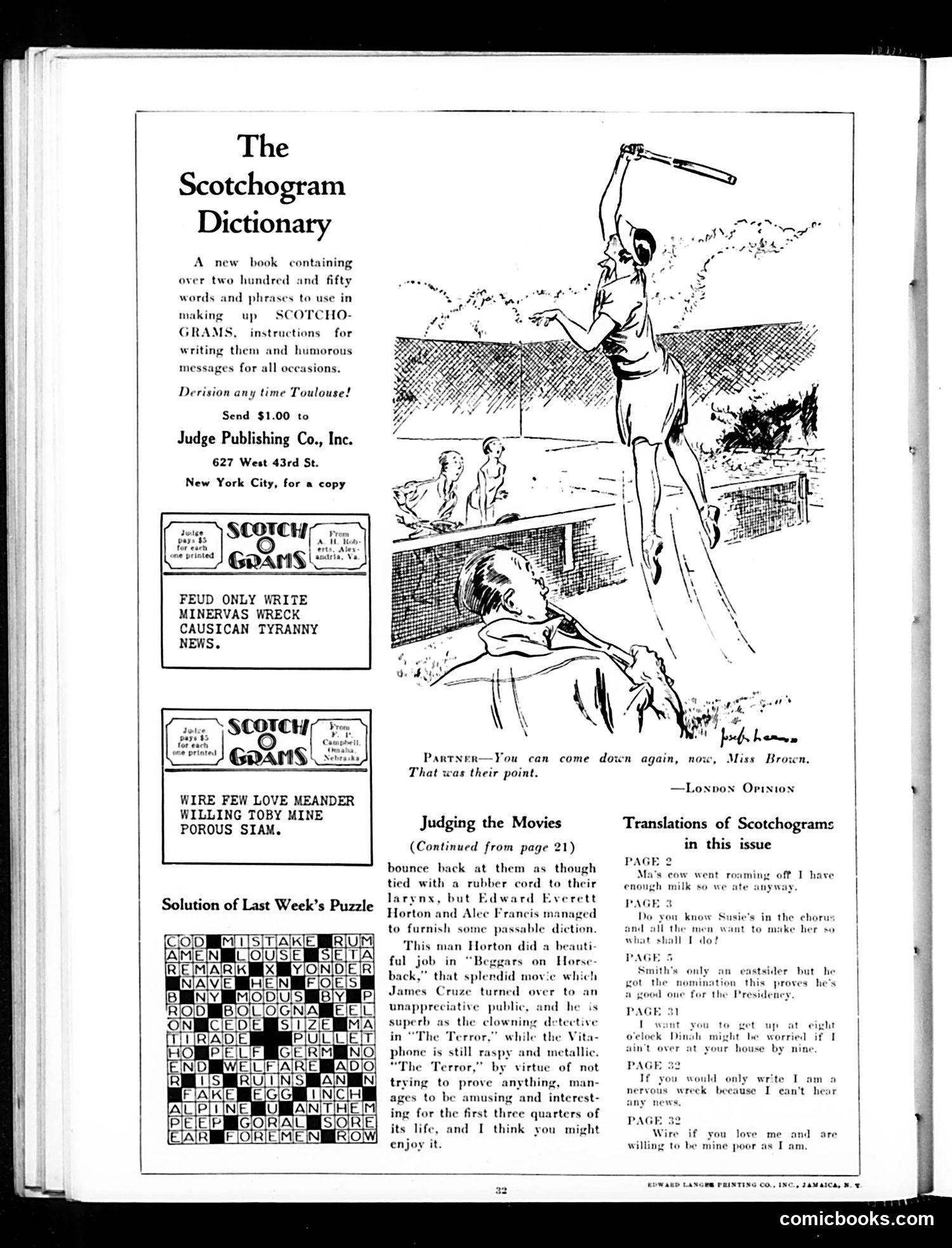
This page primarily features **advertising and puzzle content** rather than political satire. The main elements are: 1. **"The Scotchogram Dictionary"** advertisement—a book selling coded word puzzles where phrases are disguised through abbreviation or wordplay. Examples shown ("FEUD ONLY WRITE / MINERVAS WRECK") decode into longer sentences. 2. **A cartoon** at top right depicting a tennis player, with caption "Partner—You can come down again, now, Miss Brown. That was their point," a mild joke about competitive doubles play. 3. **Movie review** discussing actor Edward Everett Horton's performances in "Beggars on Horseback" and "The Terror," praising his comic timing. 4. **Translations of Scotchograms**—sample decoded phrases from readers. The page reflects 1920s entertainment culture: wordplay puzzles were popular pastimes, silent films with synchronized sound (Vitaphone) were novelties, and Judge magazine mixed humor across multiple formats for its audience.
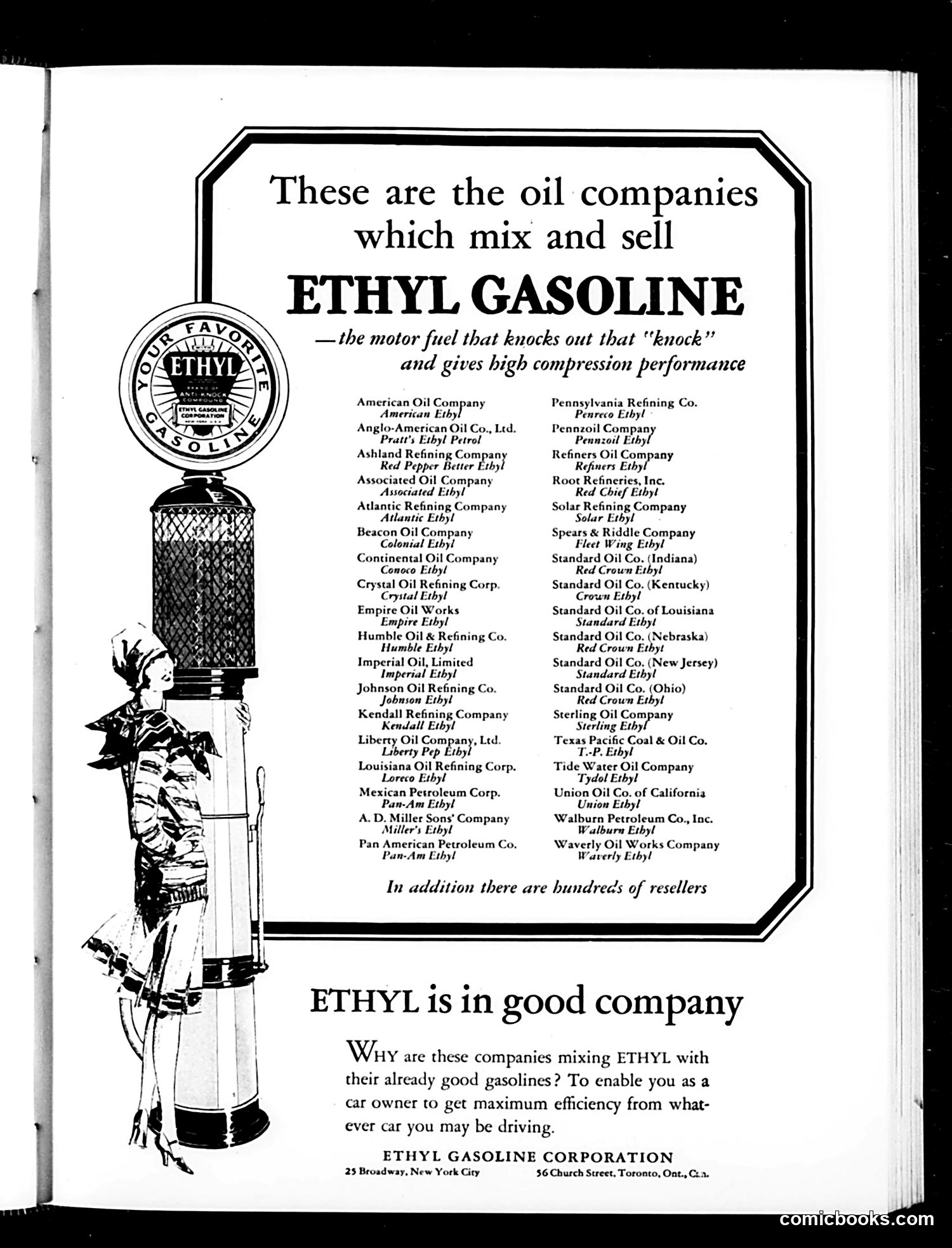
This is a **full-page advertisement**, not satire. The Ethyl Gasoline Corporation lists dozens of major oil companies selling their product with tetraethyl lead additive, which reduces engine "knock" (pre-ignition). The illustration shows a stylized gas pump attendant. The page's rhetorical strategy—"ETHYL is in good company"—attempts to reassure consumers through sheer volume of corporate endorsement. By listing prestigious oil majors (Standard Oil divisions, Gulf, Texaco, etc.), the ad implies universal industry approval validates the product's superiority. **Historical context**: This likely dates to the 1920s-1930s, when leaded gasoline was promoted as modern and efficient. The health dangers of lead were not yet widely publicized to consumers, though they were known to scientists. The "good company" framing is marketing psychology rather than satire—using peer pressure and corporate authority to drive adoption.
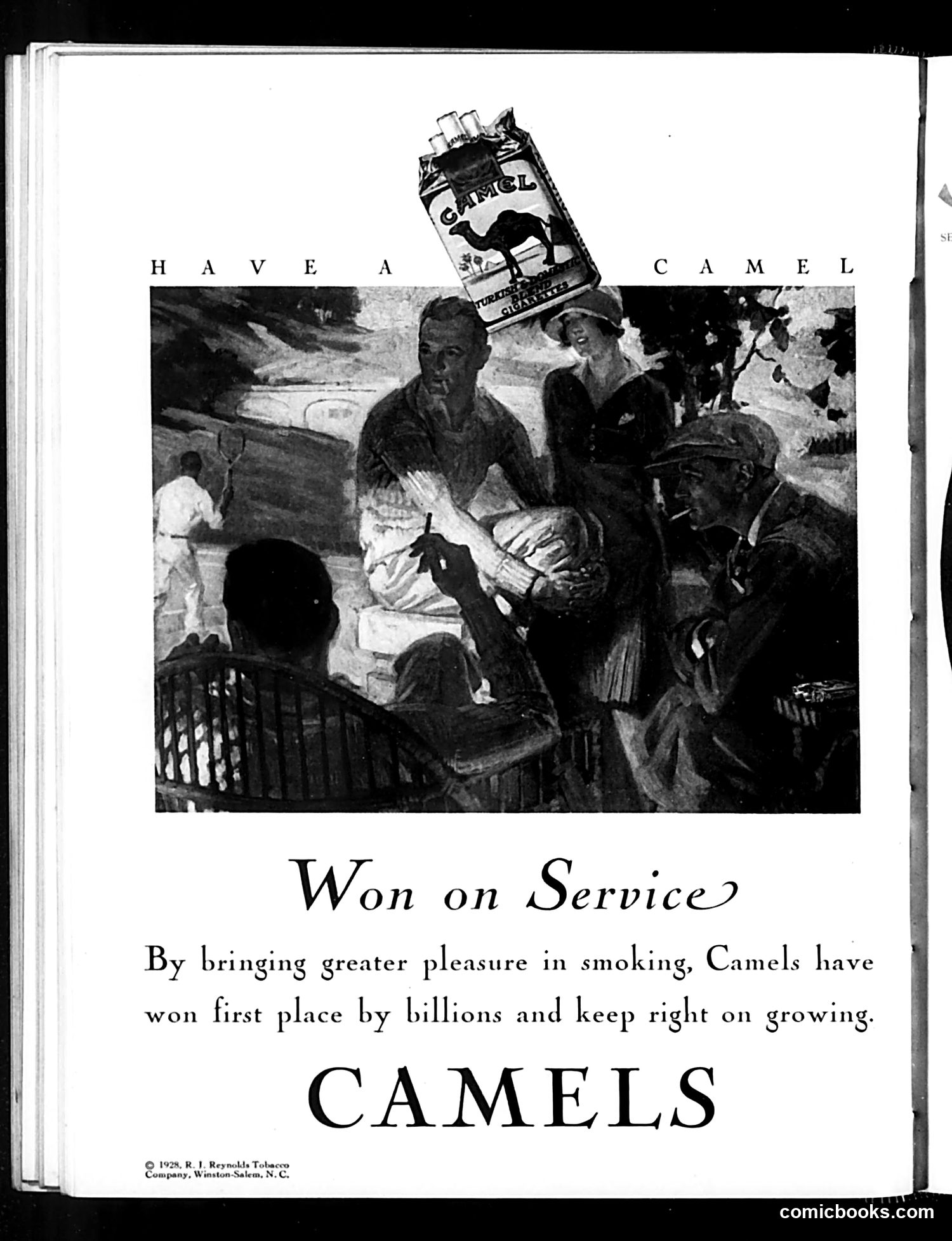
This is a **Camel cigarette advertisement**, not satire or political commentary. The page features a black-and-white photograph showing what appears to be servicemen (likely military) in a casual social setting, with a large Camel cigarette pack illustrated above them. The ad's headline "Won on Service" plays on the dual meaning of "service"—both military service and customer service. The copy claims Camels achieved market dominance through superior smoking pleasure rather than any other factor. This represents **tobacco advertising from 1928**, when such marketing directly to or featuring military personnel was standard practice and legal. The ad associates cigarette smoking with camaraderie and leisure among service members—a common advertising strategy of that era. There is no editorial cartoon or satire present; this is straightforward product advertising.