
Judge, 1928-09-15 · page 8 of 36
Judge — September 15, 1928 — page 8: what you’re looking at
What you’re looking at
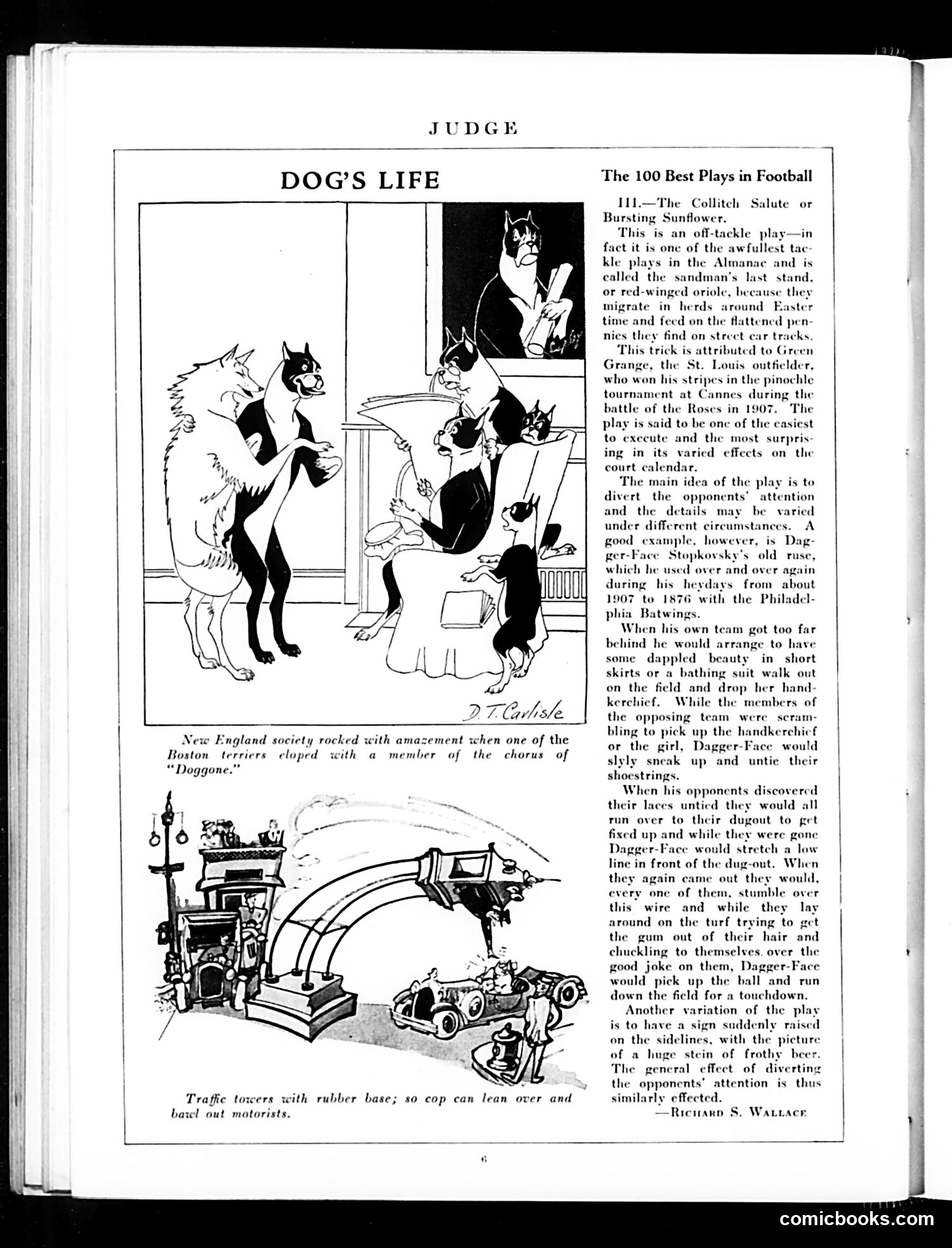
This page satirizes college football through absurdist humor. The main cartoon shows Boston terriers in human situations—one eloping with a chorus girl—mocking the breathless scandal coverage of early 1900s society pages. The accompanying text parodies overwrought sports journalism by describing a fake football play ("The Collitch Salute or Bursting Sunflower") with deliberately nonsensical details: attributing tactics to a St. Louis *outfielder* (baseball term), referencing an impossible 1876-1907 timespan, and describing ridiculous trick plays involving women in bathing suits dropping handkerchiefs and untying opponents' shoelaces. The lower cartoon about "traffic towers with rubber base" appears unrelated satirical content about traffic control. The joke targets both the inflated language of sports writing and society's obsession with trivial scandals—suggesting that in this world of absurdity, dogs eloping makes as much sense as anything else.
📄 Transcribed text from this page (OCR, searchable)
Machine-transcribed from the original scan — historical spelling and the odd misread are preserved.
JUDGE DOG’S LIFE The 100 Best Plays in Football I11.—The Collitch Salute or Bursting Sunflower. This is an off-tackle play—in fact it is one of the awfullest tac kle plays in the Alt and is | called the sandm: st stand, ' or red-winged oriole, because they migrate in herds around Easter time and feed on the flattened pen nies they find on street car tracks. This trick is attributed to Green Grange, the St. Louis outfielder, who won his stripes in the pinochle tournament at Cannes during the battle of the Roses in 1907. The play is said to be one of the casiest to execute and the most surpris. ing in its varied effects on the court calendar, The main idea of the play is to divert the opponents’ attention and the details may be varied under different circumstances. A good example, however, is Dag- ger-Face Stopkovsky's old ruse, which he used over and over again during his heydays from about 1907 to 1876 with the Philadel- phia Batwings. When his own team got too far behind he would arrange to have some dappled beauty in short skirts or a bathing suit walk out on the field and drop her hand Spe kerchief. While the members of | DT Carlisle the opposing team were seram- bling to pick up the h: v's ndkerchicf | New England society rocked with amazement when one of the or the gid, Dagger would Boston terriers eloped with a member of the chorus of slyly sneak up and untie their “Doggone. i | shoestrings. When his opponents discovered ; their laces untied they would all run over to their dugout to get fixed up and while they were gone er-Face would stretch a low in front of the dug-out. When again came out they would, | c ne of them, stumble over — | this wire and while they lay around on the turf trying to get the gum out of their hair and chuckling to themselves. over the ’ good joke on them, Dagger-Face would pick up the ball and run down the field for a touchdown, Another variation of the play is to have a sign suddenly raise on the sidelines, with the picture | of a huge stein of frothy bee The general effect of diverting the opponents’ attention is thus similarly effected. —Ricnarn S. Watrace bawl out motorists. comicbooks.com