
A complete issue · 36 pages · 1928
Judge — August 25, 1928
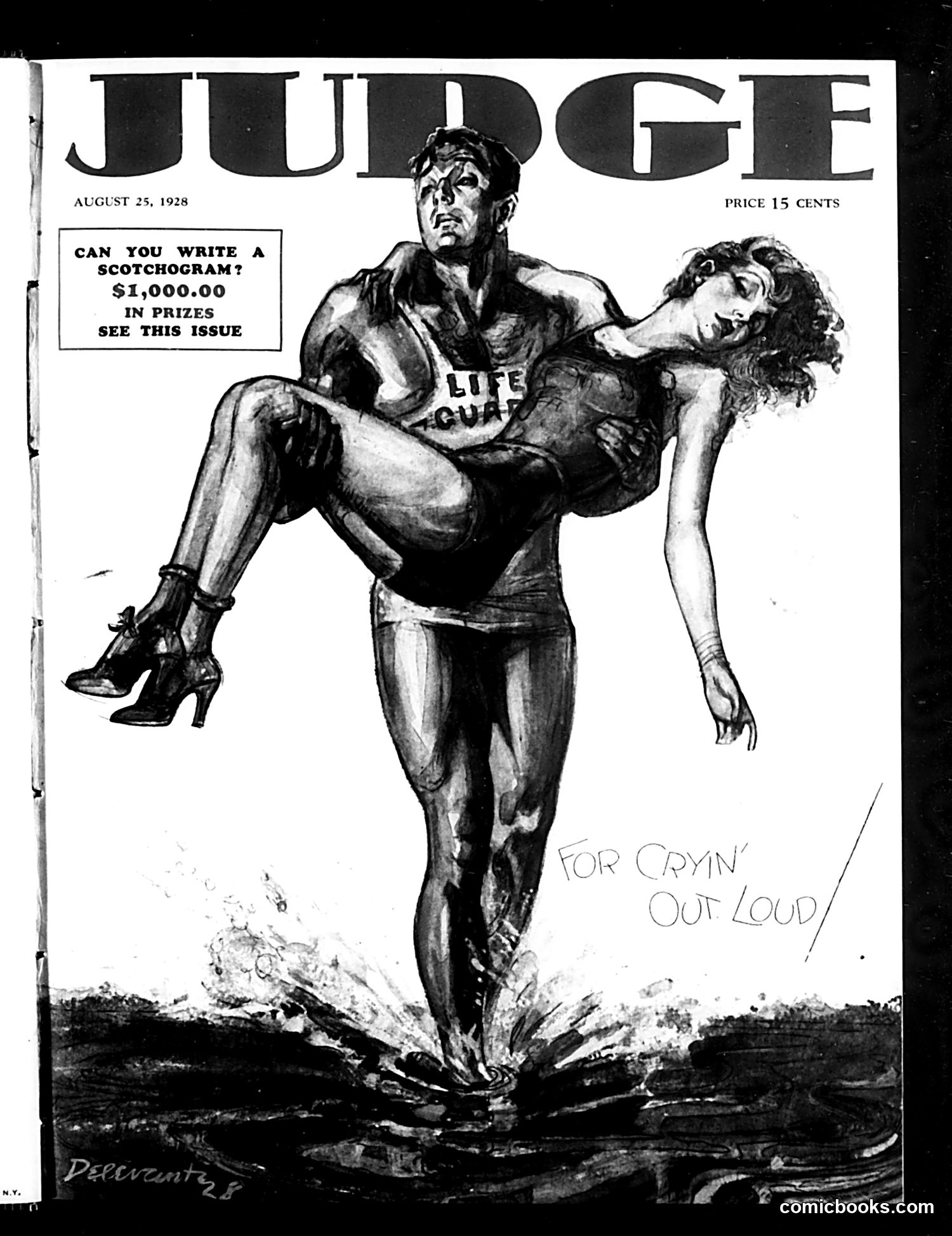
This cover depicts a muscular man in a "Life Guard" shirt carrying an unconscious woman from water, with text reading "FOR CRYIN' OUT LOUD!" The image appears to be satirizing excessive sentimentality or melodrama in popular entertainment of the era. The lifeguard scenario was a stock scenario in silent films and pulp fiction of the 1920s, often treated with overwrought emotional intensity. Judge, a satirical publication, likely mocked this trope's overuse in contemporary media. The exaggerated physique and dramatic pose parody heroic rescue narratives that audiences encountered regularly in films and literature. The accompanying contest promoting "$1,000.00 in Prizes" for scotchograms (humorous captions) suggests the magazine engaged readers in satirizing popular culture trends.
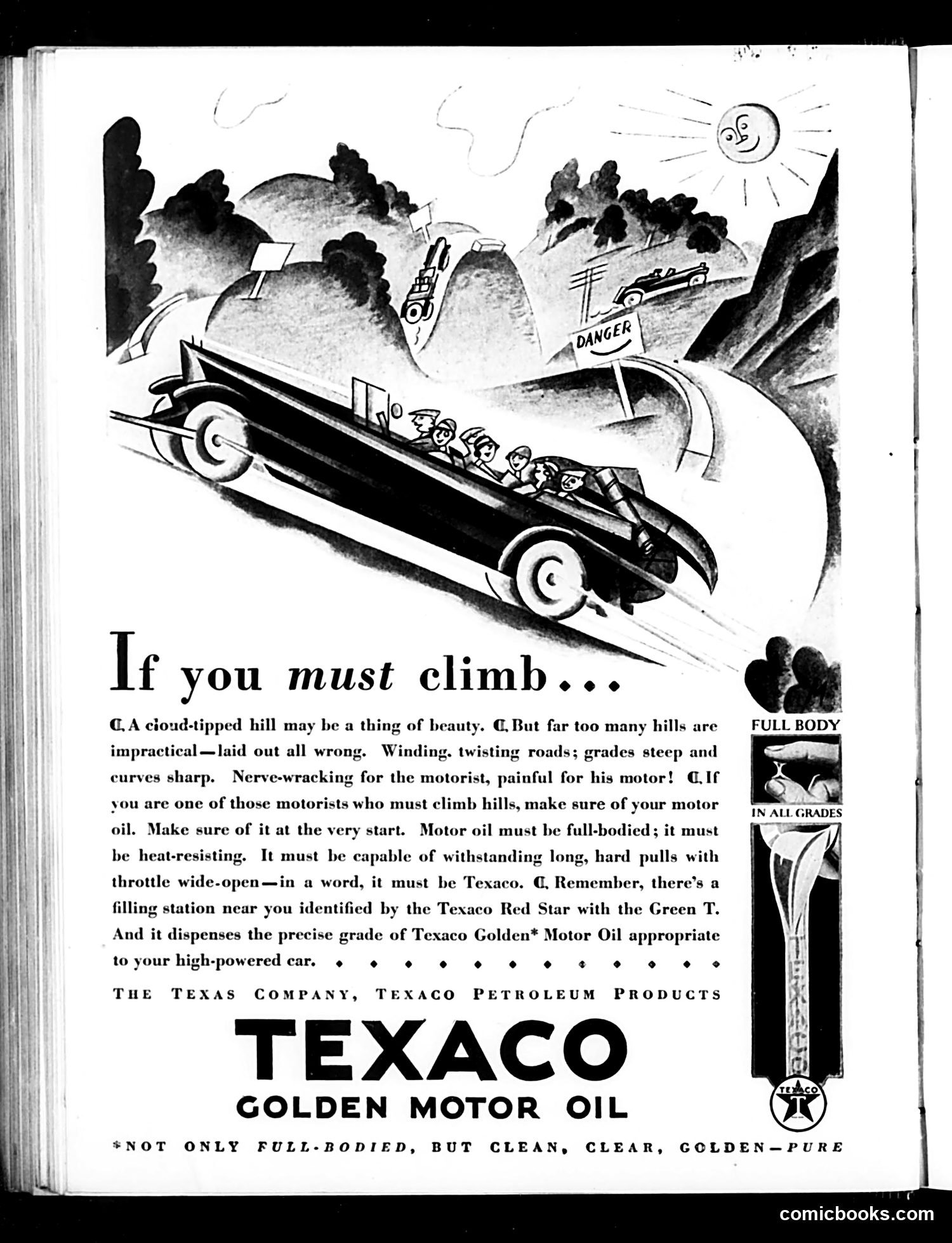
This is primarily a **commercial advertisement**, not political satire. The page promotes Texaco Golden Motor Oil using a humorous scenario about hill-climbing. The illustration depicts a car navigating treacherous, winding mountain roads with multiple vehicles and a "DANGER" sign visible. The accompanying text warns motorists about the challenges of steep hills and sharp curves, arguing that drivers need reliable, "full-bodied" motor oil to handle such demanding conditions. The joke plays on automobile anxiety common in the early automotive era—hills were genuinely challenging for period vehicles. By framing motor oil as essential to vehicle performance, Texaco advertises its product as the solution for motorists facing difficult terrain. The Texaco Red Star logo and branding dominate, clearly identifying this as brand marketing rather than editorial content.
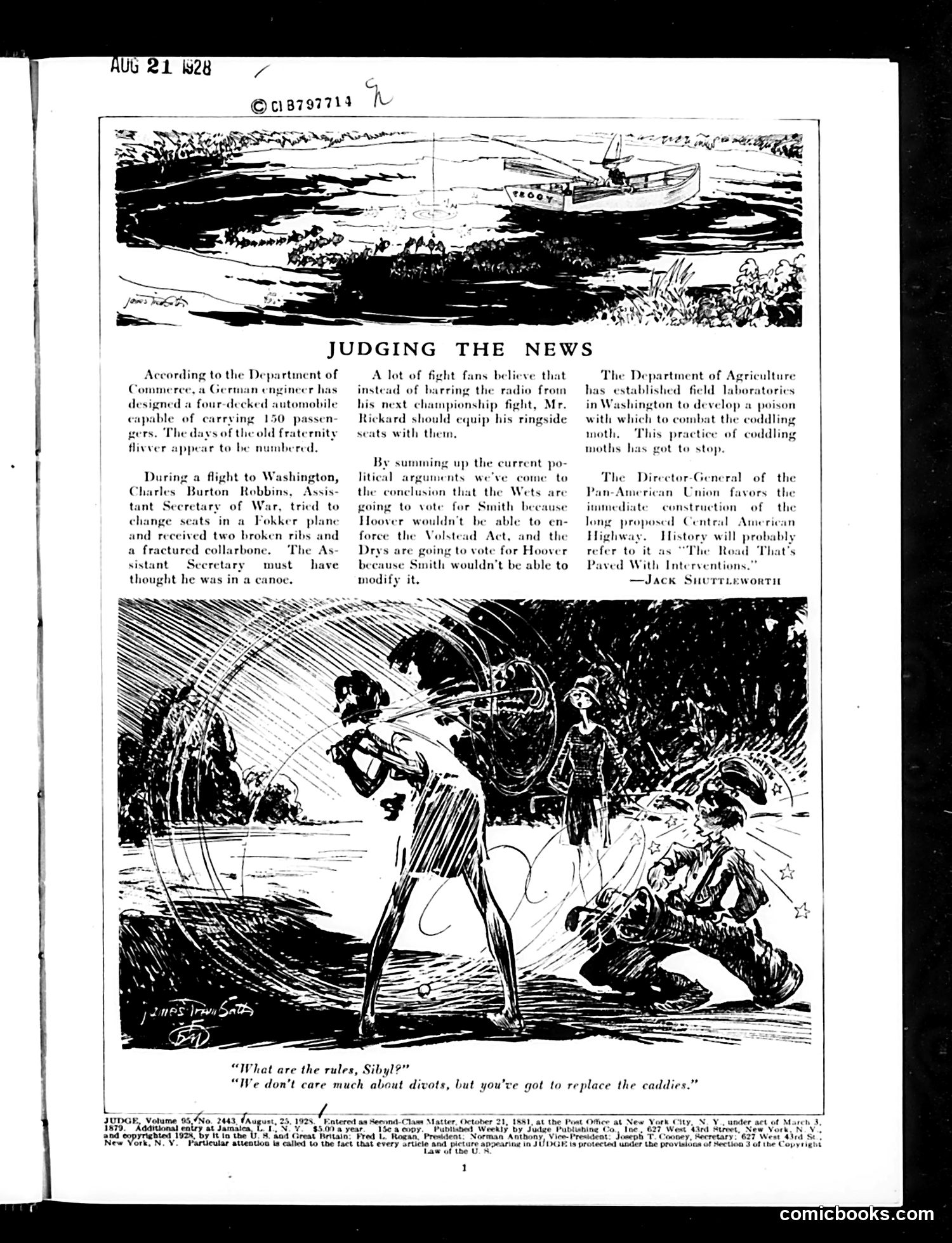
This satirical page contains three news commentaries with illustrations. The top cartoon depicts a flying mishap involving Assistant Secretary of War Charles Thacher Holmes, who apparently crash-landed in a canoe—the joke being he should have considered canoes safer than aircraft. The lower cartoon, titled "What are the rules, Siby?" shows a woman in athletic/boxing attire confronting what appears to be male fighters or athletes, with the caption about replacing "caddies." This likely satirizes women's increasing participation in sports during the 1920s "Flapper Era," mocking confusion about proper athletic gender roles. The remaining text discusses political predictions about voting patterns, the Volstead Act (Prohibition), and infrastructure development, typical of Judge's topical political humor.
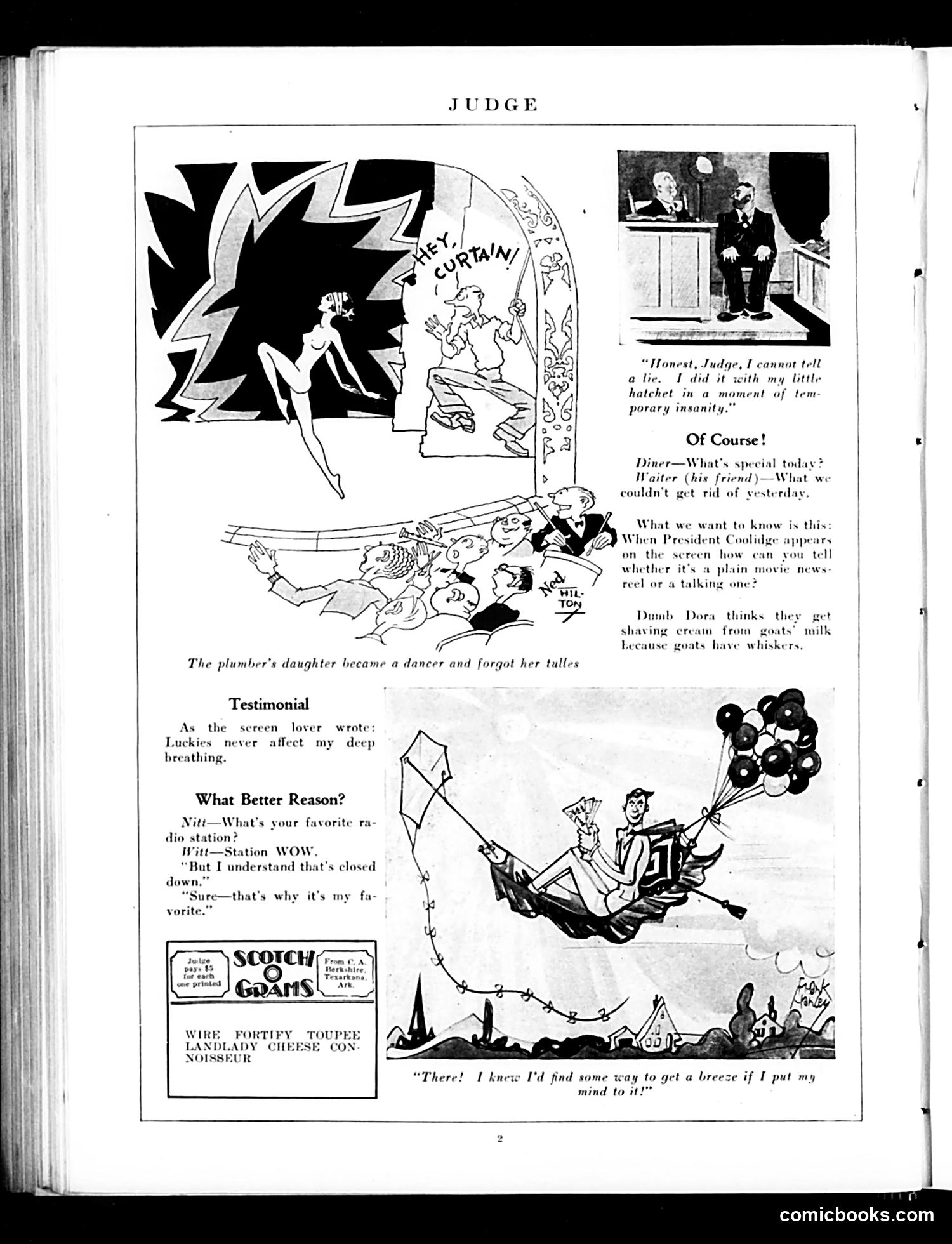
This page from the satirical magazine *Judge* contains several humor pieces: **"Judge"** (top): A courtroom scene mocking a woman's legal defense for temporary insanity after selling her jewelry for dancing lessons. The satire critiques both frivolous legal excuses and women's fashion/entertainment obsessions of the era. **"Of Course!"** section: Jokes about cinema, including whether President Coolidge's screen appearance is a "talking picture" (early sound film technology), and absurdist humor about goats' milk and shaving cream. **"Testimonial" & "What Better Reason?"**: Advertising-integrated humor about radio stations and Scotch grams (early recorded music). **Bottom cartoon**: A whimsical scene of people in a hot-air balloon seeking wind, using dated visual humor. The page blends social satire with product advertising typical of 1920s-era humor magazines.
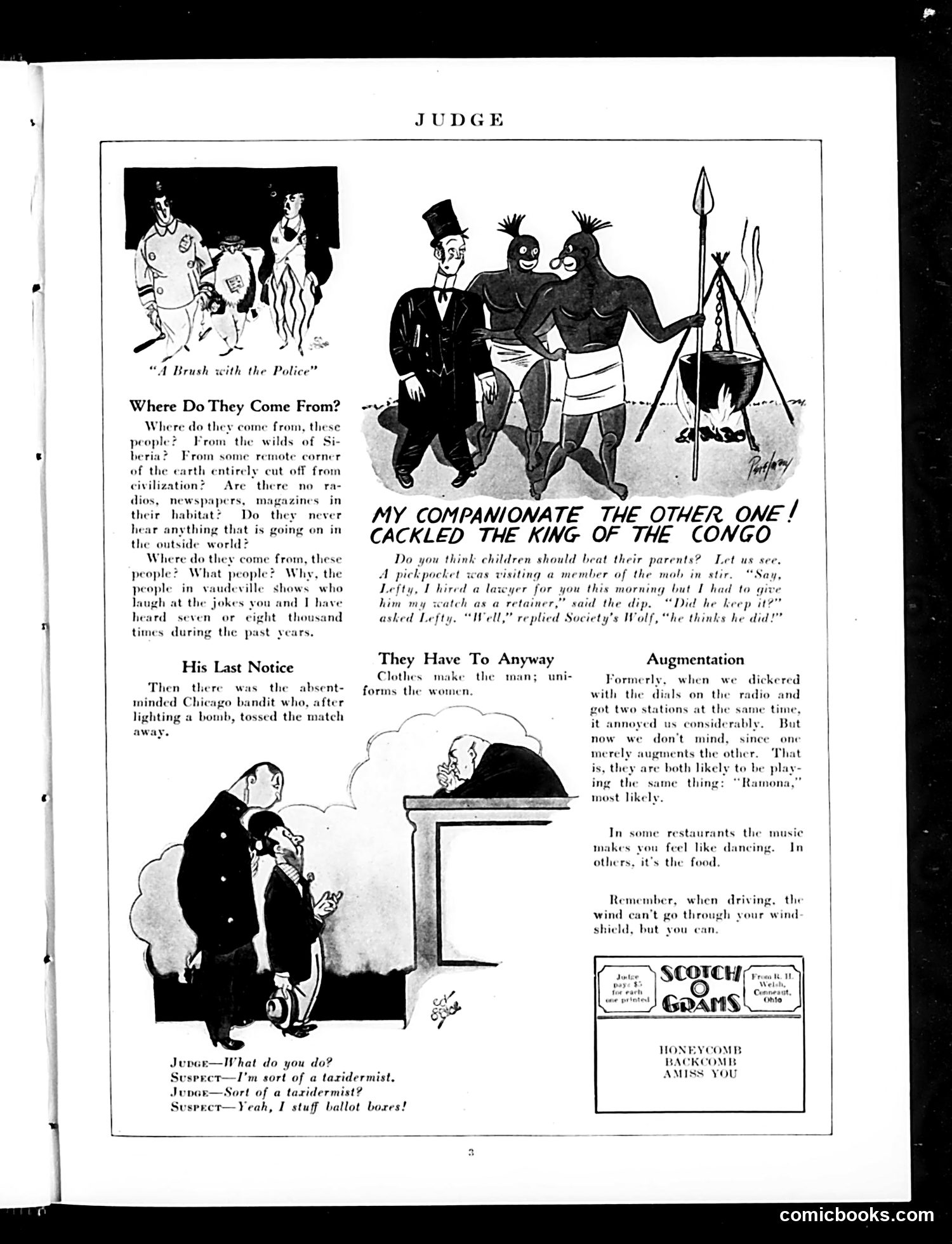
This page contains several satirical pieces reflecting early 20th-century American attitudes: **"Where Do They Come From?"** mocks immigration, questioning whether foreigners assimilate into civilization—a common nativist concern of the era. **"My Companionate the Other One! Cackled the King of the Congo"** uses racist caricature (exaggerated features, tribal imagery) to mock contemporary social issues—likely referencing "companionate marriage," a modern relationship concept being debated at the time. The crude racial stereotypes were regrettably standard in period humor. **"His Last Notice"** depicts a taxidermist/suspect arrested, with dark humor about criminal consequences. **"They Have To Anyway"** and **"Augmentation"** offer light social commentary about clothing, radio stations, and restaurant music. The page reflects Judge's satirical approach to immigration, modernity, and social change, alongside period prejudices now considered deeply offensive.
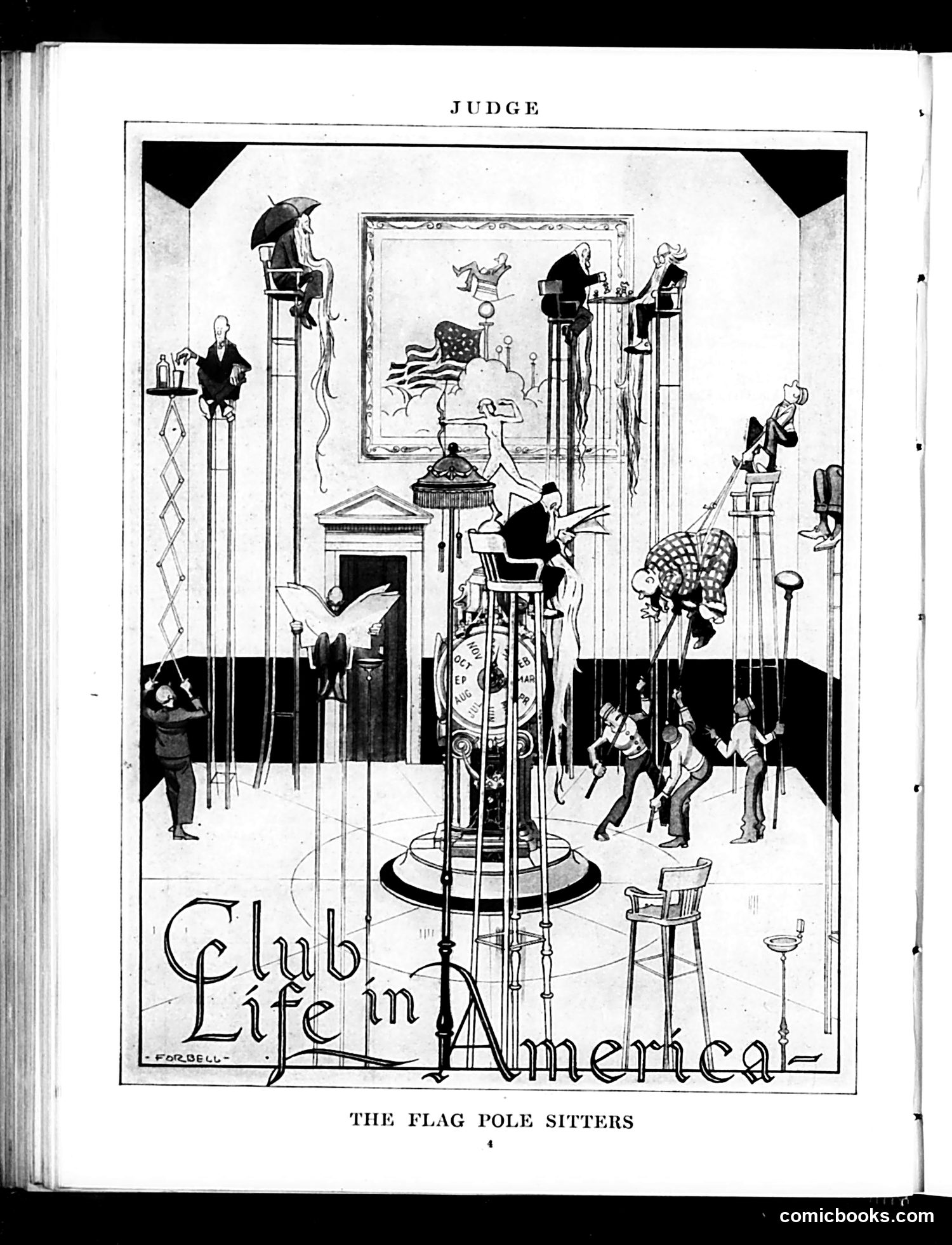
This cartoon satirizes the 1920s fad of flagpole sitting—a bizarre endurance stunt where contestants competed to sit atop tall poles for extended periods. The cartoon depicts an absurdly tall flagpole in an elegant interior space, with men in business attire perched on poles at various heights, observers below, and dining/social elements scattered throughout. The satire mocks how Americans embraced this pointless craze as entertainment and competition. The "Club Life in America" title suggests this ridiculous activity had become an aspirational pastime for the wealthy. By placing the spectacle in a formal club setting, Judge critiques both the frivolity of the fad and the society figures who participated in and celebrated such nonsensical pursuits as leisure activities.
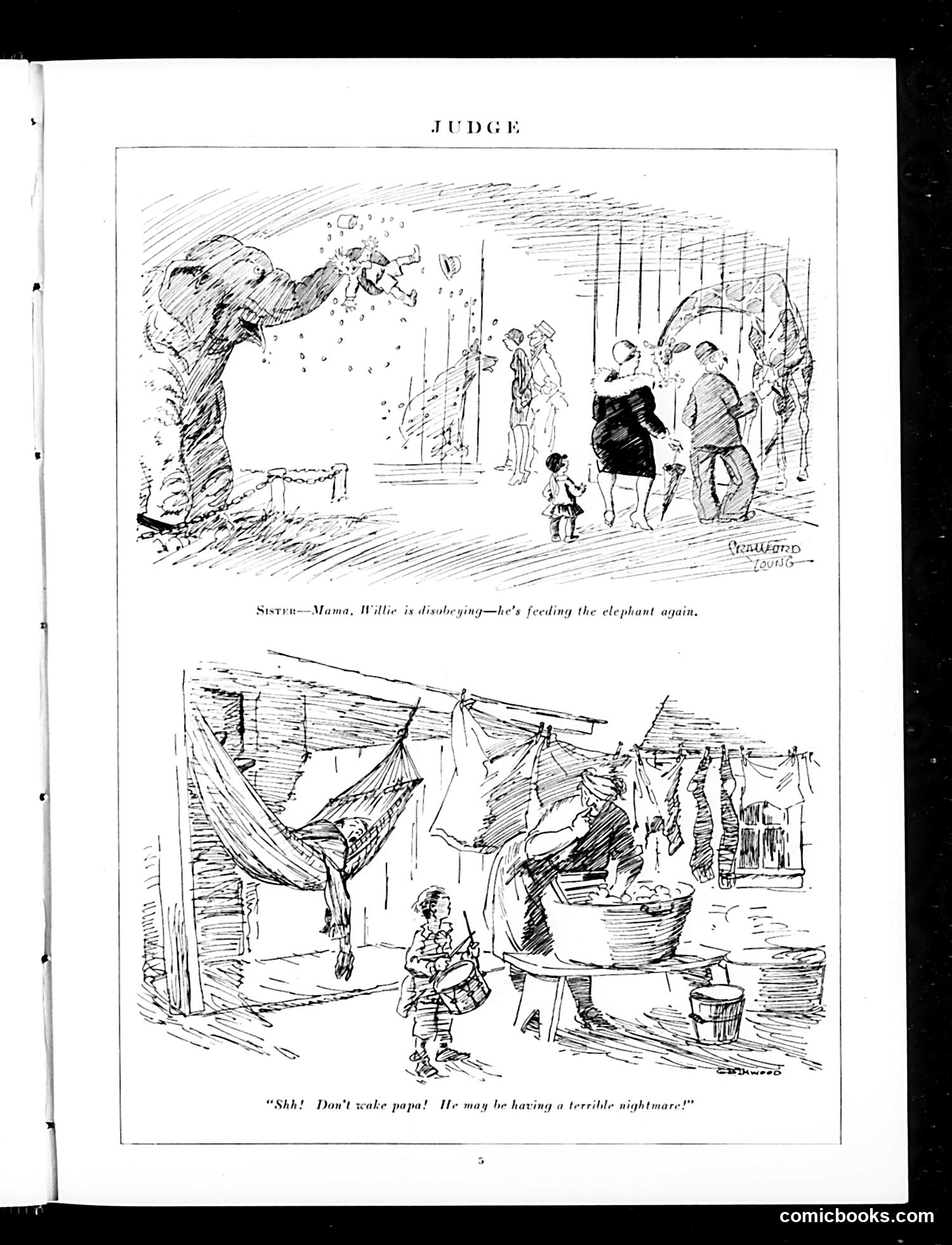
This page contains two unrelated cartoon sketches by different artists (Cesare and E. H. Bartz). **Top cartoon:** Shows a woman ("Sister") scolding a boy named Willie for disobeying her—specifically for feeding an elephant again. The humor appears to be simple domestic comedy: a child repeatedly misbehaves despite being told not to, likely sneaking food to an elephant (perhaps at a zoo or circus). **Bottom cartoon:** Depicts a domestic scene where a child warns their father not to wake papa, as "He may be having a terrible nightmare." The joke relies on the ironic suggestion that papa's sleep—however troubled—is preferable to his waking presence. Both are generic family humor rather than political satire, typical of Judge's entertainment content.
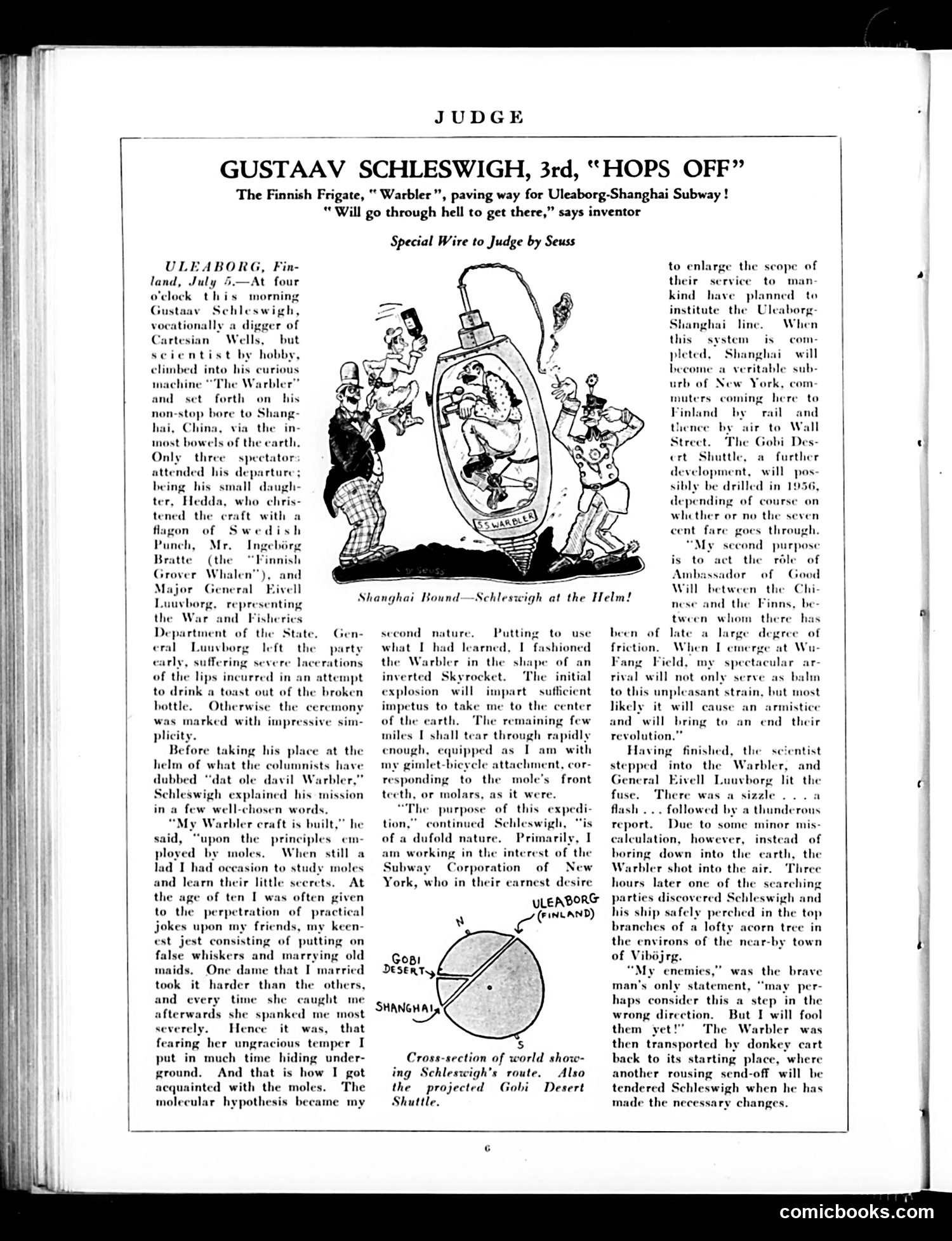
This Judge magazine article satirizes both technological utopianism and the absurdity of modern transit expansion. The "inventor" Gustaav Schleswigh proposes boring a subway tunnel from Finland to Shanghai through the Earth's center—an obviously impossible engineering feat presented with mock-serious detail. The satire targets: 1. **Subway expansion mania**: The New York Subway Corporation's grandiose plans to connect distant cities, extending Manhattan's reach globally 2. **Pseudoscientific justification**: Schleswigh's invented "molecular hypothesis" based on childhood mole-chasing, presented as legitimate engineering principle 3. **Overconfidence in technology**: The notion that any distance can be conquered through mechanical ingenuity The cartoon shows Schleswigh's "Warbler" machine (resembling an inverted rocket) with figures celebrating its launch. The humor culminates when the experimental craft inexplicably launches *upward* instead of downward—undermining the entire scheme. The piece gently mocks both utopian urban planning dreams and the eccentric inventors who propose them, typical of Judge's satirical approach to contemporary American optimism about technology and progress.
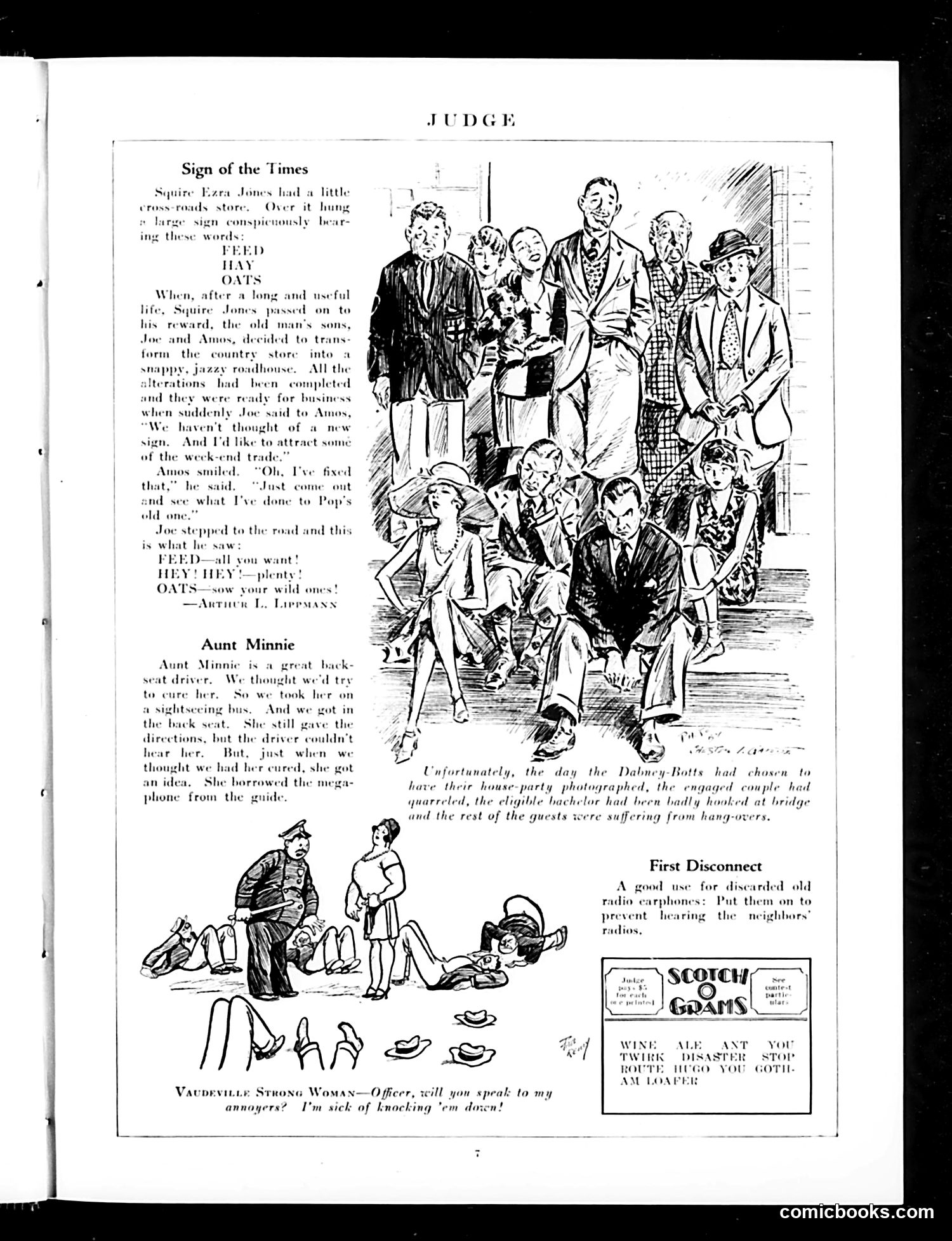
This page contains three satirical pieces reflecting 1920s American life: **"Sign of the Times"**: Rural tradition meets Jazz Age modernism. When the old general store (marked "FEED HAY OATS") passes from Squire Jones to his sons, they transform it into a "snappy, jazzy roadhouse." The joke is the new sign's irreverent wordplay—replacing practical farm supplies with hedonistic commands ("sow your wild ones"), satirizing how quickly American youth abandoned rural, conservative values for urban, leisure-focused culture. **"Aunt Minnie"**: A domestic humor piece about an overbearing backseat driver. The attempted "cure" (removing her hearing via disconnected earphones) fails when she independently discovers the solution, satirizing stubborn personality types. **"First Disconnect"**: A brief joke about repurposing discarded radio headphones to block annoying neighbors' radios—poking fun at emerging radio culture and neighborly nuisances. The "Vaudeville Strong Woman" cartoon caption is partially illegible but appears to reference a female performer. Overall, the page satirizes modernization, generational conflict, and technology's rapid social integration.
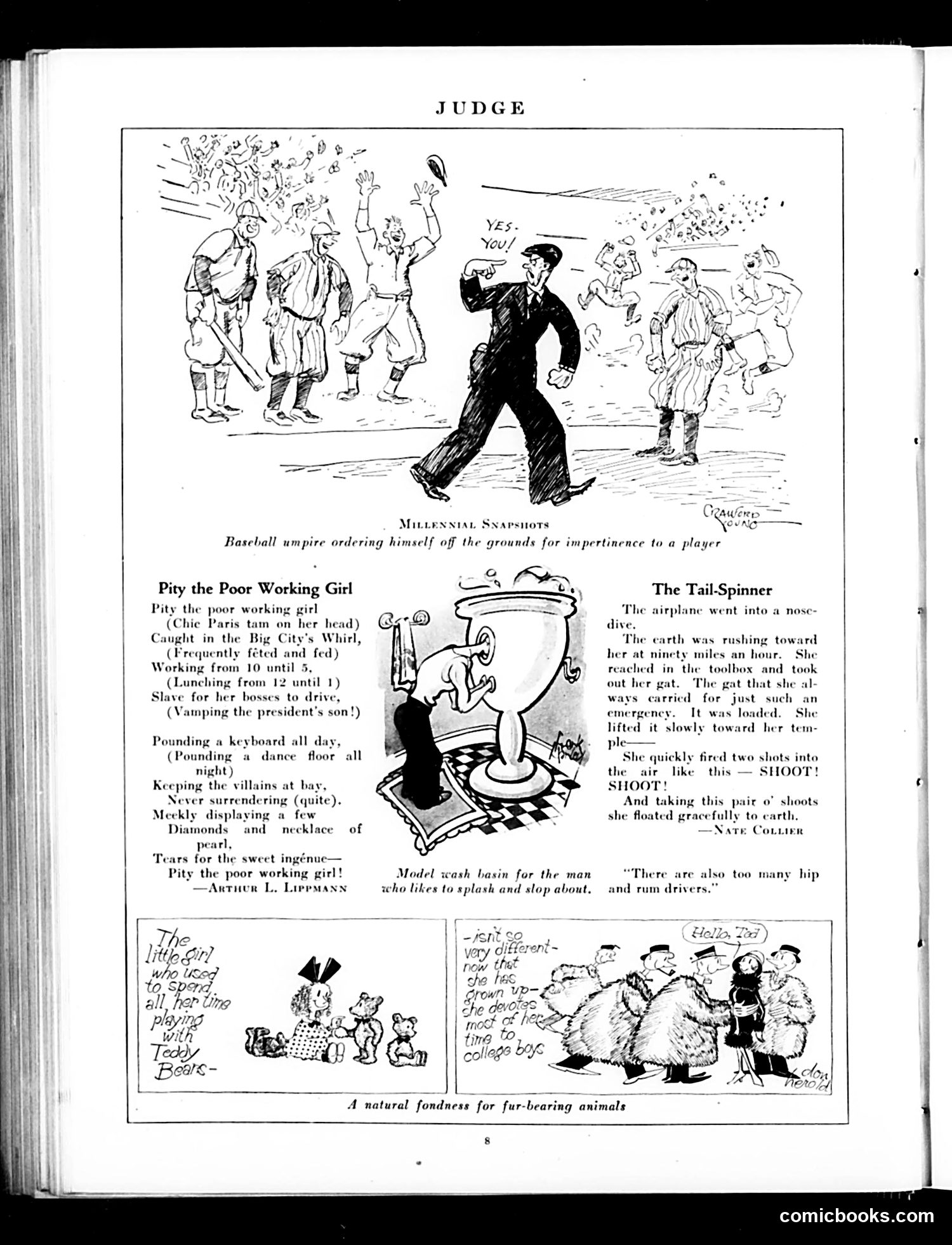
This page satirizes early 20th-century American social contradictions through verse and cartoons. **"Pity the Poor Working Girl"** mocks sympathy for female office workers (typewriter operators) by highlighting the gap between their supposed hardship and actual comfort: they work modest hours (10-5, with a lunch break), yet are "frequently féted and fed," wear Paris hats and pearl necklaces, and date important men's sons. The satire suggests working girls aren't truly suffering despite romantic portrayals as "sweet ingénues." **"The Tail-Spinner"** is a humorous aviation story-in-verse about a woman pilot in a nosedive who calmly shoots her gun twice into the air, allowing her to "float gracefully to earth"—absurdist logic mocking pulp fiction adventure tales. The bottom cartoons offer lighter domestic humor about children and animals. The overall tone suggests Judge's audience was wealthy enough to find the "plight" of well-dressed working girls amusing rather than genuinely sympathetic.
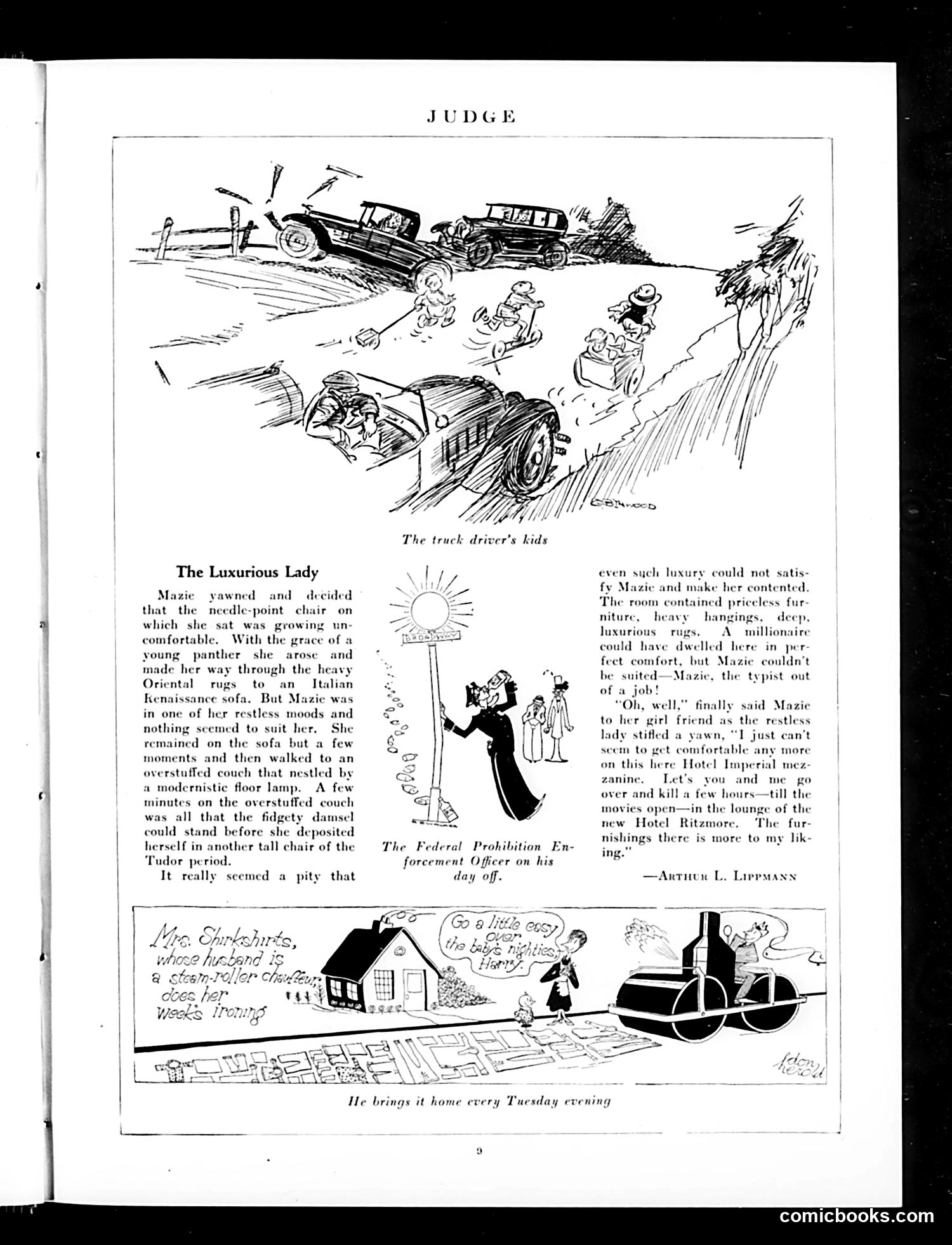
This page satirizes the pretensions of unemployed working-class women during the Depression era. "Mazie," a jobless typist, constantly complains about discomfort despite being surrounded by authentic luxury furniture (Italian Renaissance, Tudor period pieces, Oriental rugs). The joke is her absurd entitlement: she cannot be satisfied in a millionaire's setting, then suggests spending time in a *hotel* lounge because it has furnishings "more to my liking." The satire mocks both her snobbery and unrealistic expectations—she has no money, no job, yet judges expensive hotels as insufficiently luxurious. It's commentary on social pretension and the disconnect between actual means and perceived status. The separate cartoon about a "Federal Prohibition Enforcement Officer on his day off" depicts him as a bootlegger, satirizing corruption among agents tasked with enforcing Prohibition.
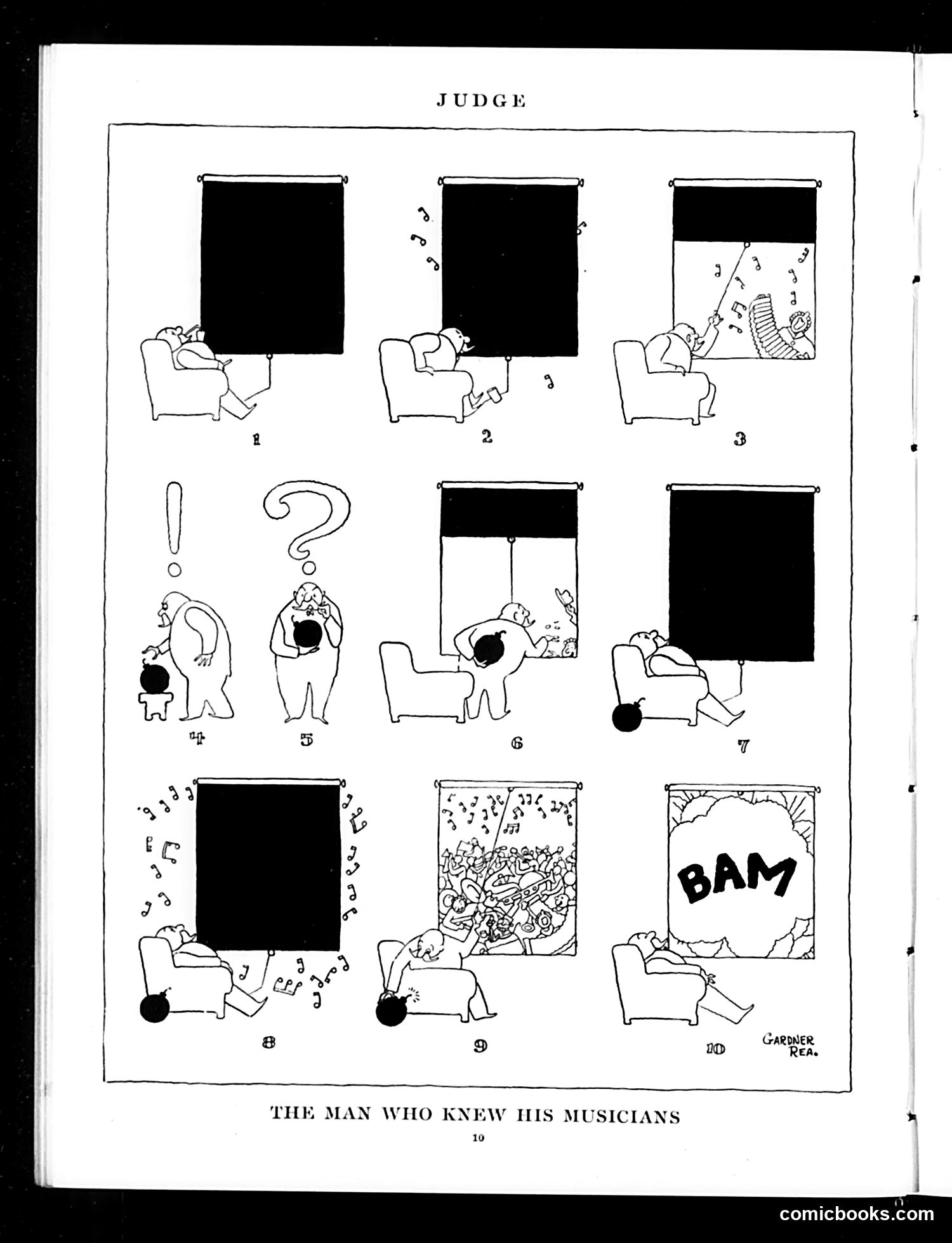
This comic strip by Gardner Rea depicts a man watching television or a window display showing various performances—from blank screens to musical acts to chaos ("BAM"). The humor relies on visual progression: panels 1-3 show increasingly obscured or confusing views, panels 4-5 show the man's confusion, panels 6-9 escalate through noise, crowded scenes, and musical chaos, ending with panel 10's explosive "BAM." The joke appears to satirize someone attempting to appreciate or manage musicians/performances but becoming progressively overwhelmed or bewildered by what he encounters. Without additional historical context, the specific reference remains unclear, though it likely mocks either a music critic, impresario, or conductor struggling with modern musical tastes or avant-garde performances popular in the era Judge was published.
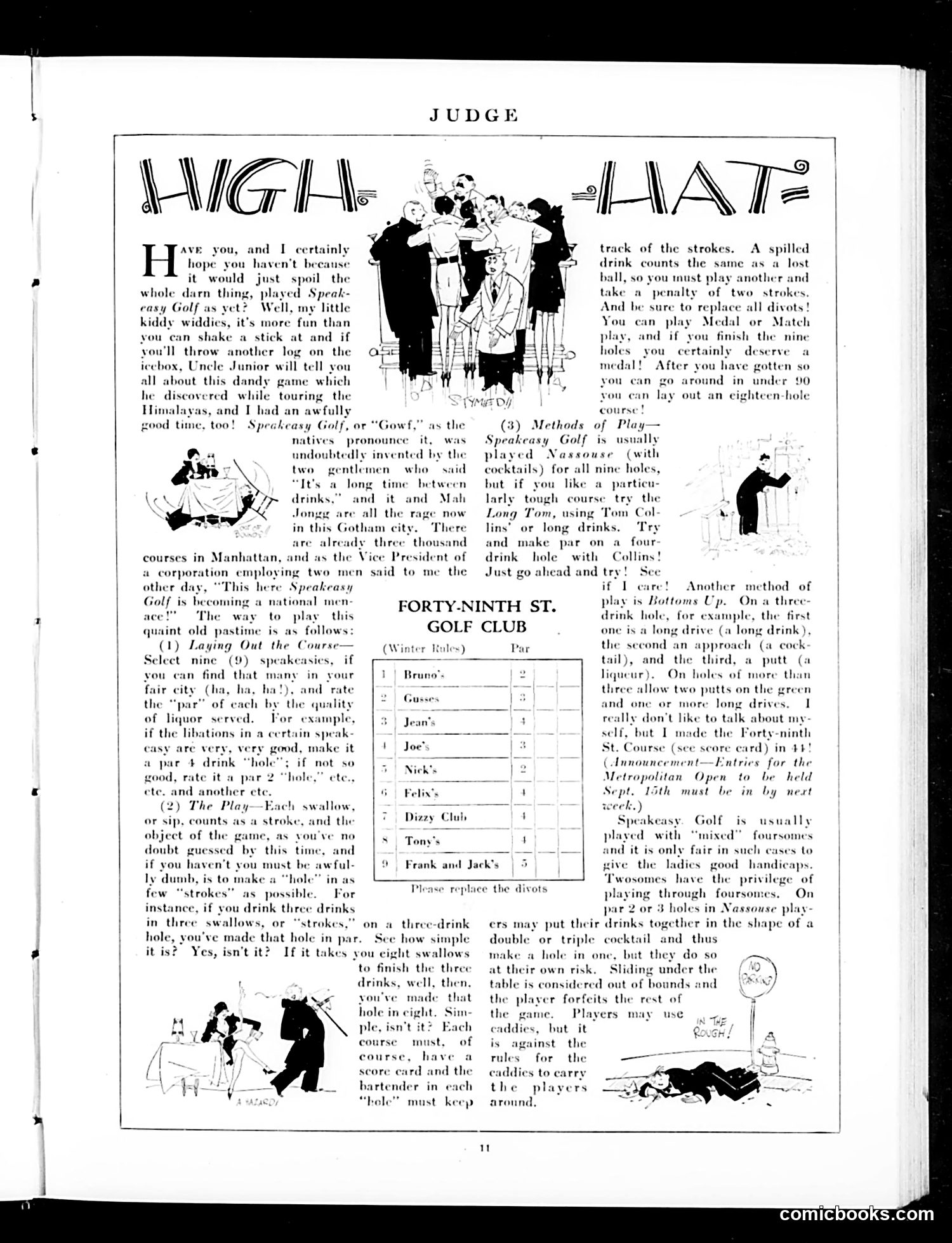
This page satirizes "Speakeasy Golf," a drinking game that emerged during Prohibition (the 1920s-early 1930s). The joke exploits the era's absurdity: with legal alcohol banned, drinking establishments operated illegally as "speakeasies," and someone invented a "game" that treats visiting multiple bars like playing golf. The satire works by applying golf terminology to bar-hopping: each speakeasy is a "hole," drinks are "strokes," the quality of liquor determines par-value, and players aim to visit nine bars and consume their cocktails efficiently. A score card lists actual establishments (Bruno's, Dizzy Club, Tony's, etc.). The humor mocks both Prohibition's failure—alcohol consumption was rampant—and the creative absurdities people devised around it. The "Forty-Ninth St. Golf Club" itself is fictional mockery of the pretense surrounding these illegal operations. For modern readers, this reflects how Prohibition paradoxically glamorized drinking culture rather than eliminating it.
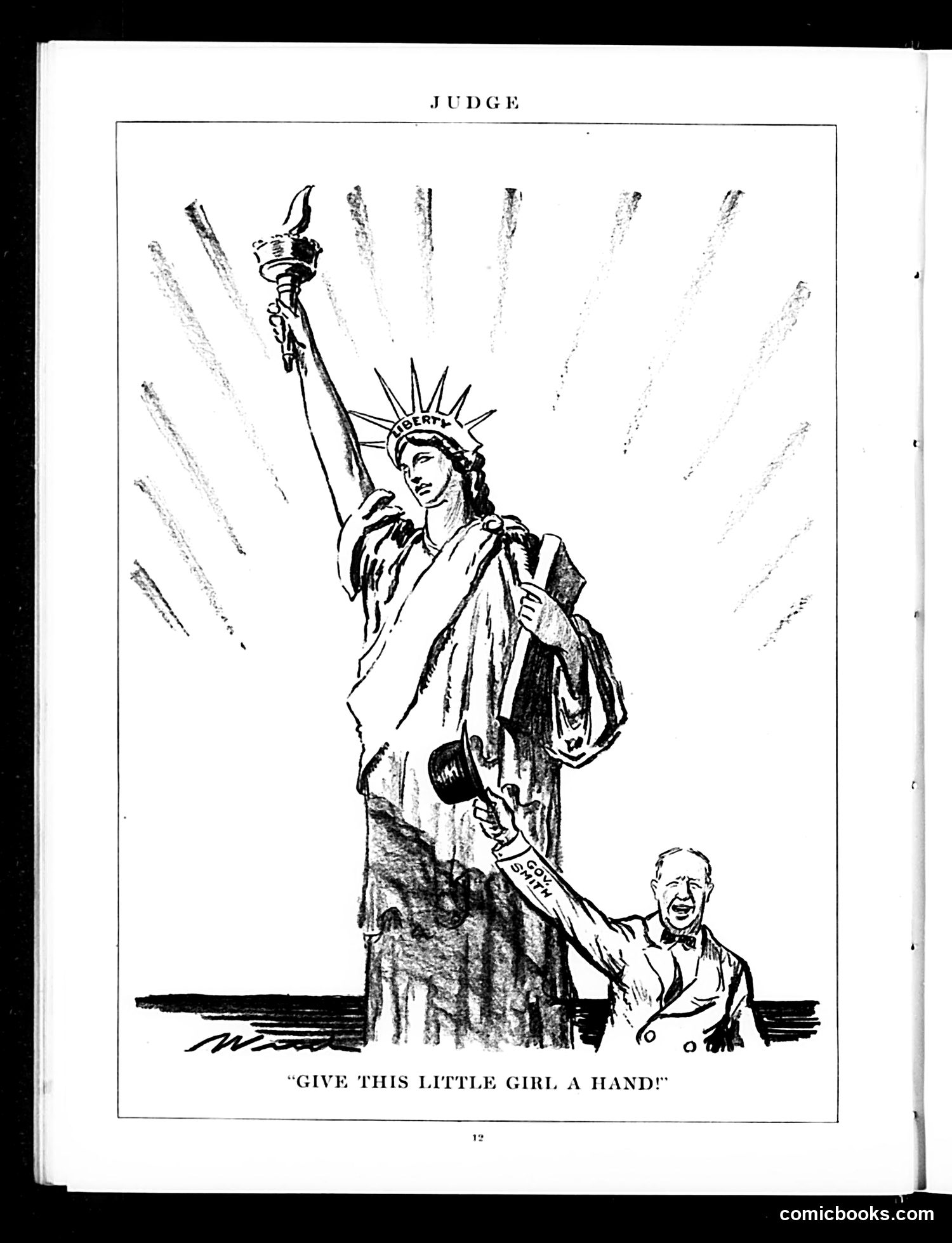
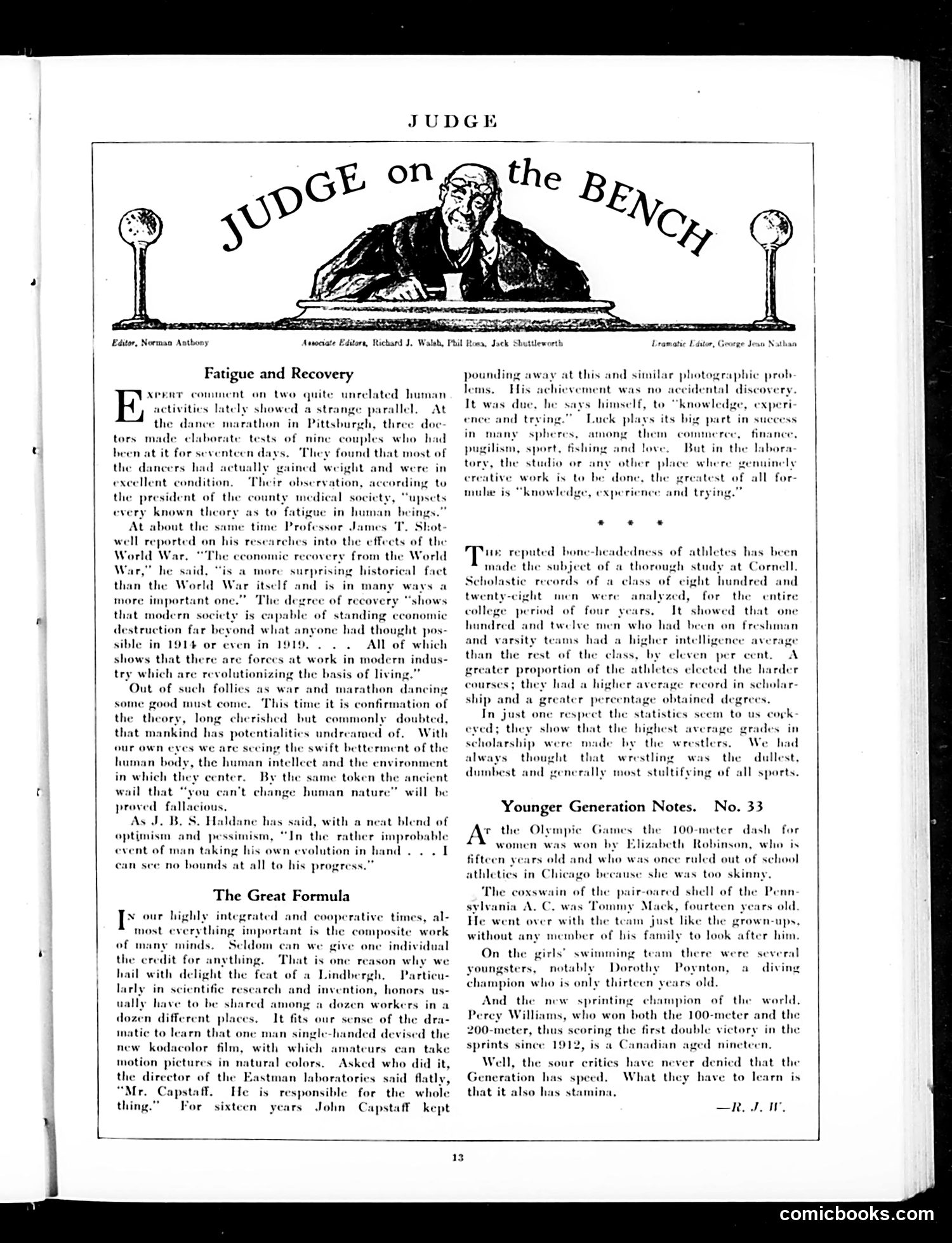
This page from Judge magazine contains three separate commentary pieces, with no prominent political cartoon at the top—just the masthead illustration of a judge at a bench. The articles discuss: 1. **"Fatigue and Recovery"**: References dance marathons (a 1920s fad) and WWI recovery, arguing these phenomena prove humans have untapped potential contrary to the old saying "you can't change human nature." 2. **"The Great Formula"**: Celebrates John Capstaff's development of Kodacolor film for amateur photography, emphasizing that great achievement requires sustained individual effort ("knowledge, experience and trying"), not just luck—a counter-narrative to the modern tendency to credit composite teams. 3. **"Younger Generation Notes"**: Reports surprising Cornell research showing college athletes (including wrestlers) had higher average grades and intelligence than non-athletes, contradicting the stereotype of athletes as intellectually inferior. The page reflects 1920s-30s optimism about progress, technology, and debunking conventional wisdom about human limitations.
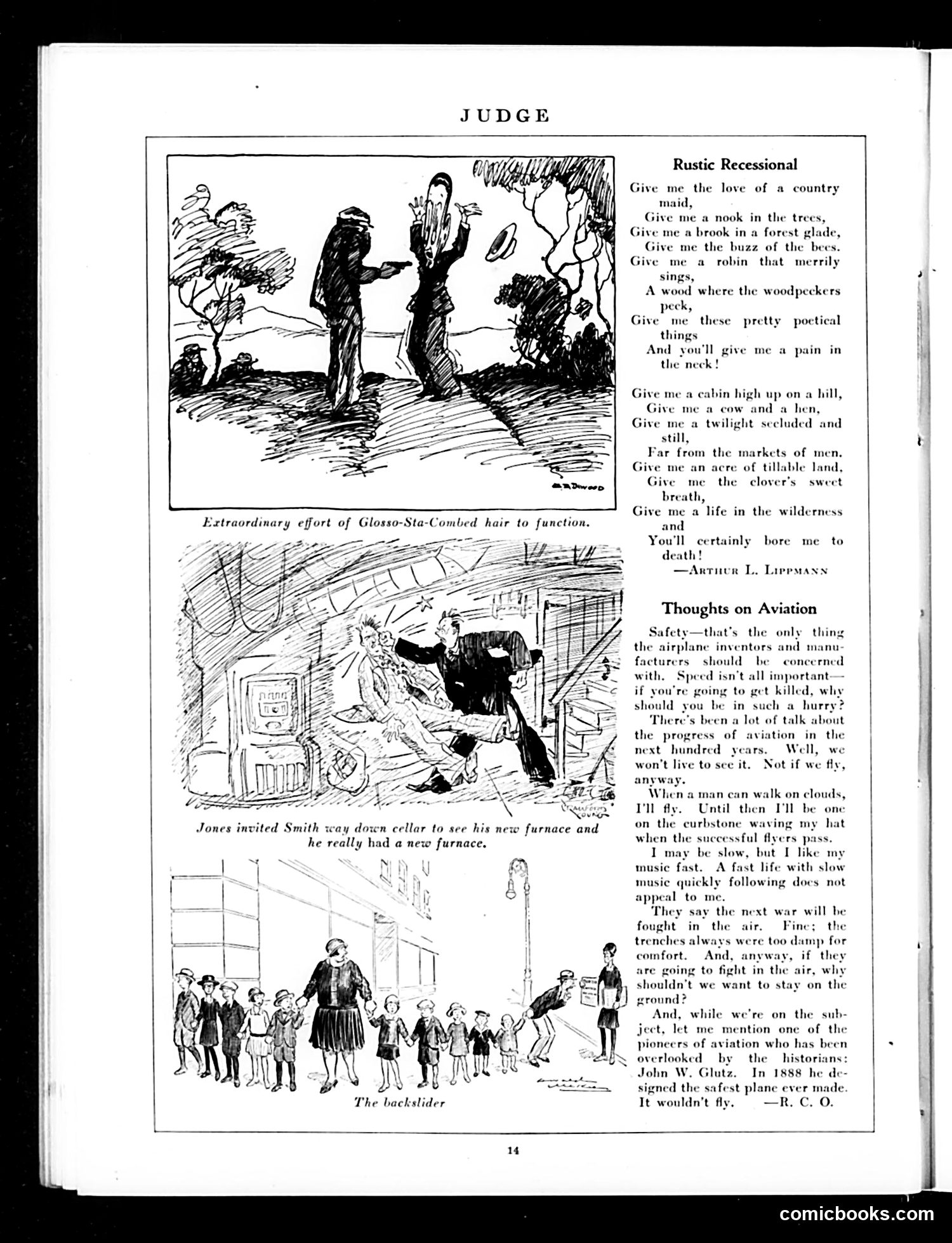
This page contains three distinct humor pieces: **"Extraordinary effort of Glosso-Sta-Combed hair to function"** (top): A cartoon about an elaborate hairstyling attempt, showing two figures outdoors—likely satirizing the impractical or exaggerated grooming trends of the era. **"Jones invited Smith way down cellar..."** (middle): A visual joke where Jones shows Smith his "new furnace," with the punchline being that the furnace works so well it's literally incinerating Smith—dark humor about domestic appliances or home improvement mishaps. **"The backslider"** (bottom): Shows a woman addressing a group of children, likely referencing religious or moral instruction, though the exact social commentary is unclear without more context. **"Rustic Recessional"** (poem, right): Satirizes romantic nostalgia for rural life by having the speaker request pastoral pleasures, then reveal the punchline: rural life would bore him to death. **"Thoughts on Aviation"** (right column): Commentary on early aviation safety concerns versus speed obsession, mentioning a fictional pioneer "John W. Glutz" whose 1888 airplane "wouldn't fly"—mocking aviation's nascent, impractical phase.
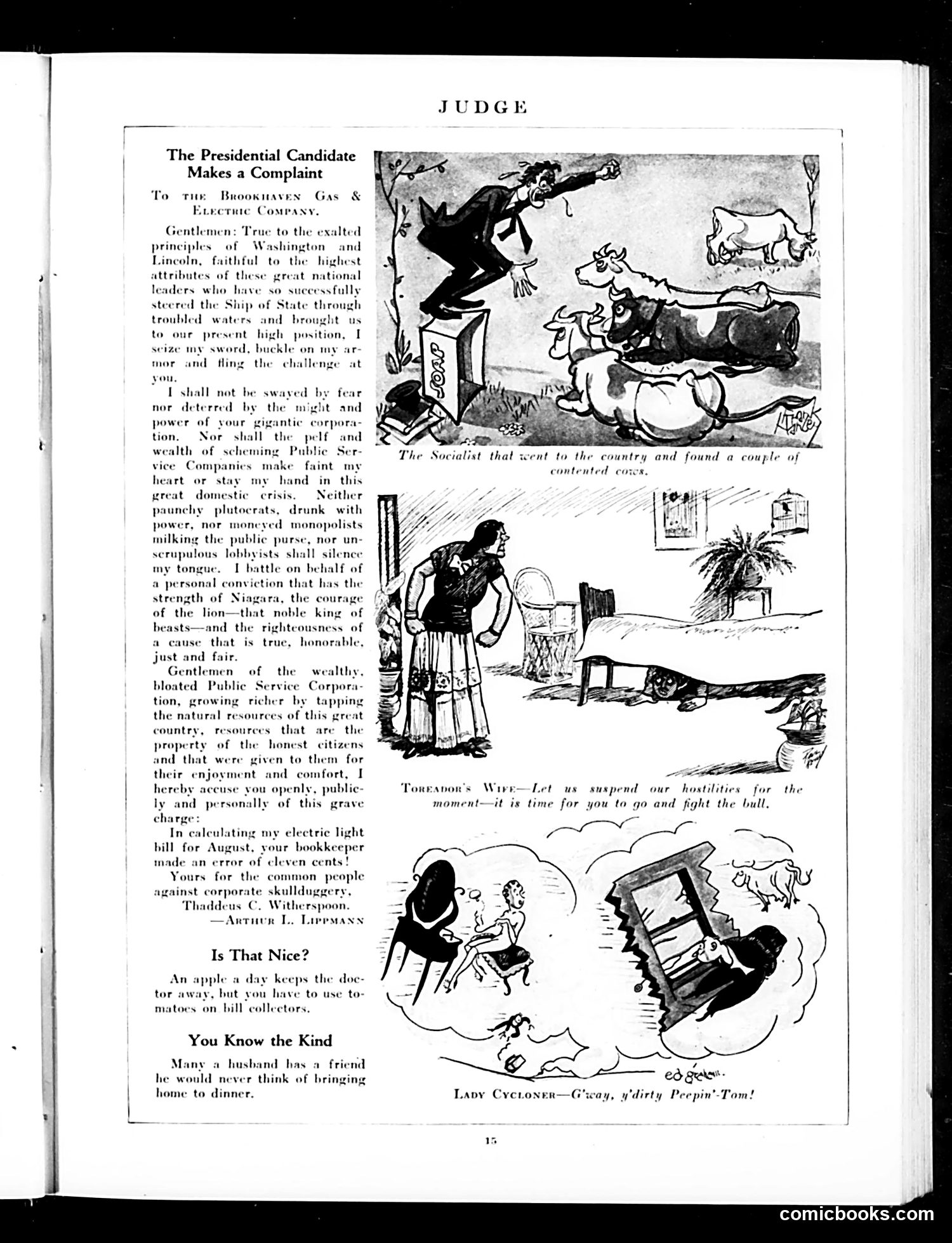
This page satirizes a **Presidential candidate's grandiose complaint** to a utility company about an eleven-cent billing error. The candidate (attributed to "Thaddeus C. Witherspoon" and "Arthur L. Lipmann") delivers an overwrought speech comparing himself to Washington and Lincoln, using martial language ("buckle on my armor," "fling the challenge") against corporate corruption—only to reveal the actual complaint is trivial. The satire mocks **populist political rhetoric**: candidates who pose as champions against "plutocrats" and "monopolists" exploiting the common people, yet reveal themselves as petty or self-serving. The accompanying cartoons extend the theme: "The Socialist that went to the country and found a couple of contented cows" ridicules Socialist ideology for missing obvious reality; other sketches mock domestic absurdities. The page collectively targets inflated political posturing and ideological blindness of the era.
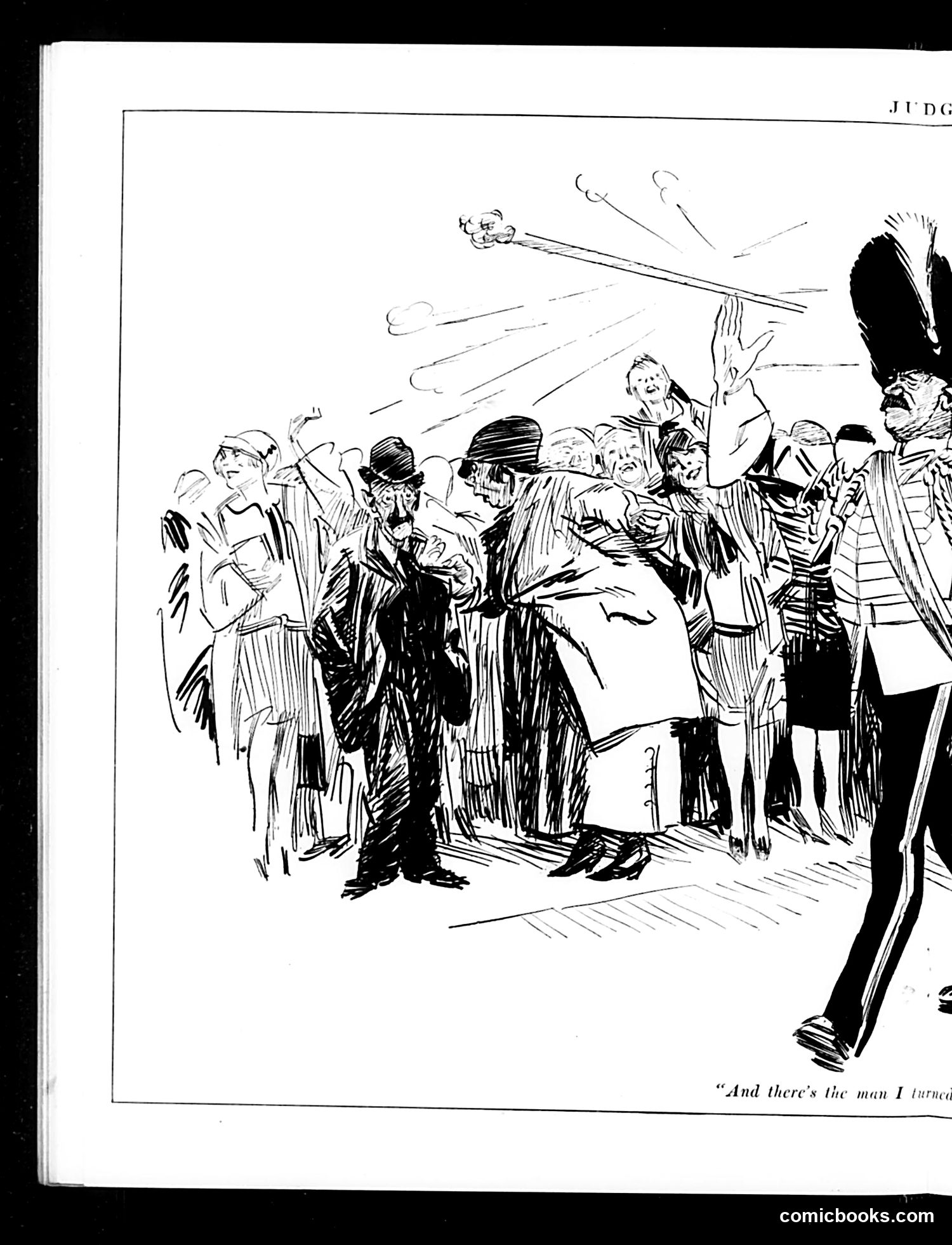
This appears to be a satirical cartoon from *Judge* magazine depicting a military or formal government scene. The incomplete caption reads "And there's the man I turned..." suggesting someone is being pointed out or identified to others. The drawing shows a crowd of formally dressed figures, including what appear to be military officers (identifiable by uniforms and tall hats) and civilians in formal attire. The style and clothing suggest this is from the early-to-mid 20th century. However, without a complete caption or clear date, I cannot confidently identify which specific political figures or events are being satirized. The OCR text is too fragmented to determine the cartoon's precise meaning or target. Additional context about the publication date would be necessary for accurate interpretation.
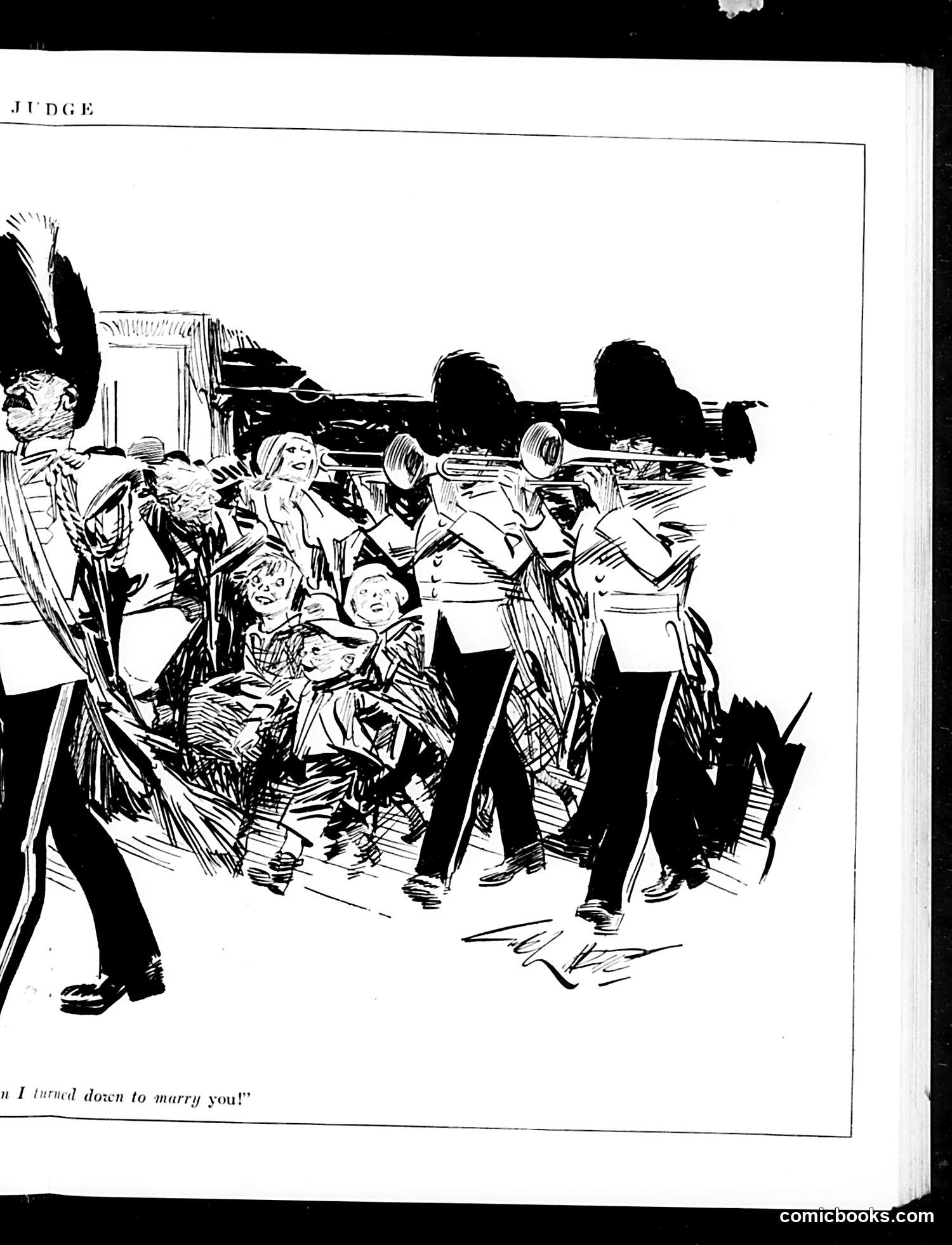
This cartoon depicts what appears to be a courtroom or judicial scene, indicated by the "JUDGE" header and the formal-dressed figure on the left (likely a judge or court official). The central scene shows a woman surrounded by uniformed military or naval officers, with two children present. The partial caption reads "...I turned down to marry you!" suggesting a romantic or matrimonial dispute, possibly involving a woman who rejected suitors—perhaps military officers—to marry someone else. The presence of children indicates domestic complications. Without the full caption and context, the exact satirical point remains unclear, but it likely comments on courtship, marriage disputes, or military romance—common Judge magazine themes from the early 20th century. The specific historical reference or political dimension cannot be determined from the visible text alone.
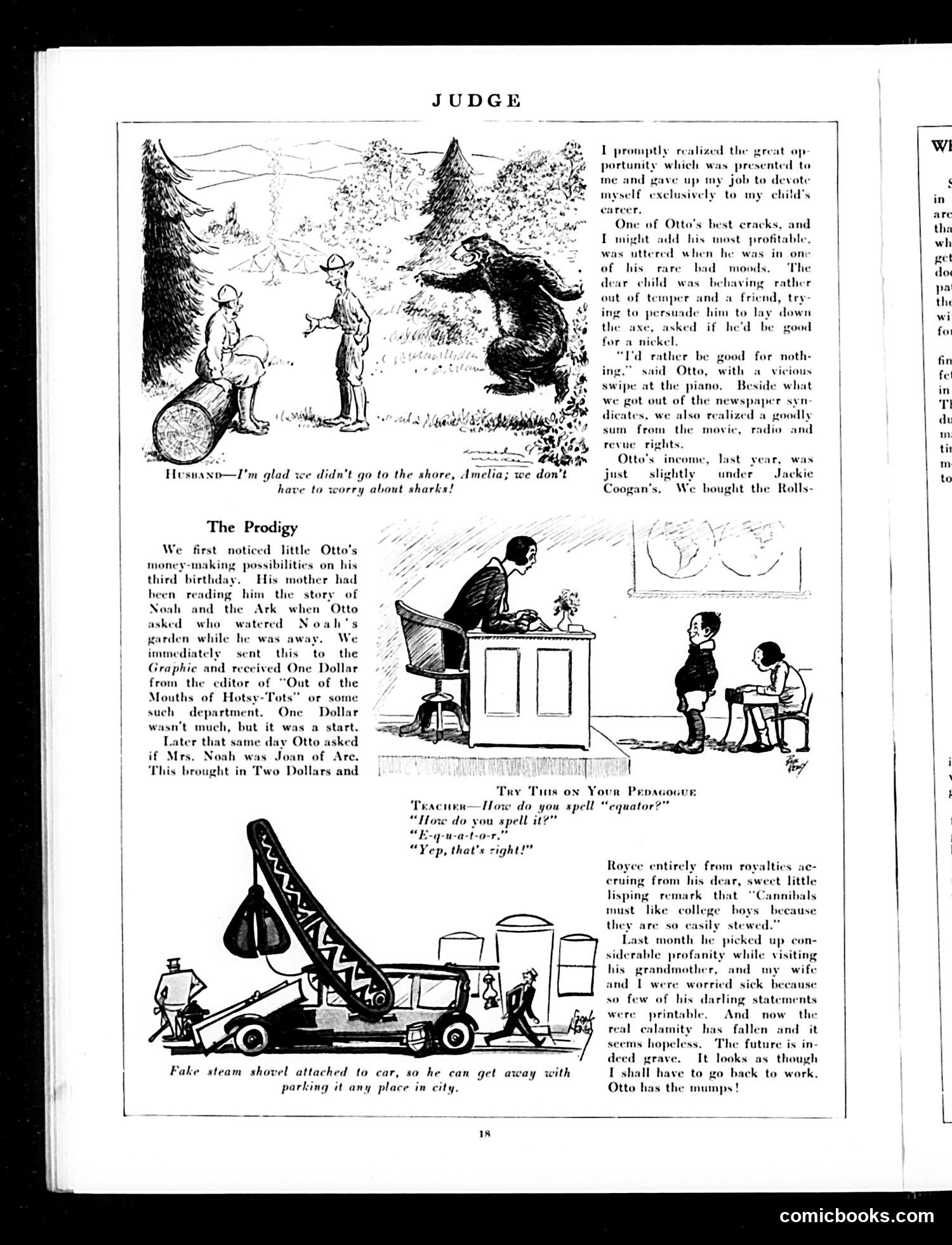
This page satirizes the American obsession with child prodigies and exploiting children for profit, likely from the 1920s-30s (referencing Jackie Coogan, the child actor whose earnings became a legal concern). **"The Prodigy"** follows Otto, a young boy whose innocent remarks and mistakes are monetized by his parents. They submit his confused questions ("who watered Noah's garden?") and malapropisms to publications for payment, then escalate to movie and radio rights. The satire peaks when Otto's "mistake" spelling "equator" as "B-q-w-a-t-o-r" is presented as clever wit. The joke: parents have become so desperate for income that they've abandoned their jobs to manage their child's "career," relying on his accidental humor and misbehavior. The punchline is darkly comic—when Otto contracts mumps (a serious childhood illness), the income stops immediately, forcing the father back to real work. The cartoon critiques both parental greed and society's hunger for child entertainment, treating childhood as a commodity rather than a protected stage of life.
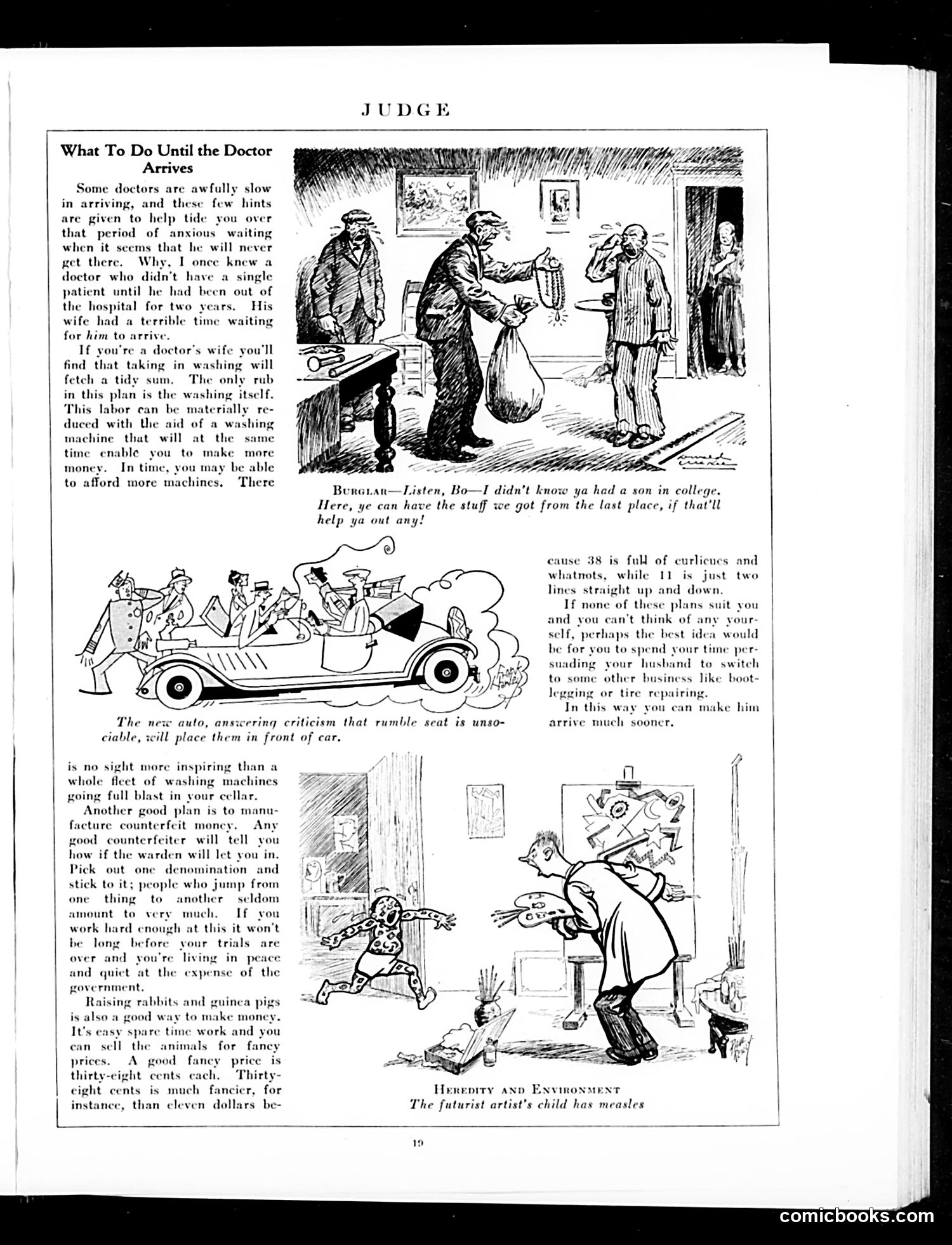
This page satirizes the economic struggles of doctors' wives waiting for their husbands to establish practices. The piece humorously suggests wives take up washing machines, counterfeiting money, or raising rabbits to supplement income while waiting for the doctor to become successful. The top cartoon shows a burglar offering stolen goods to a man, joking that having a son in college requires income—a dark joke about financial desperation. The middle cartoon ridicules the "rumble seat" automobile feature as antisocial, suggesting cramped cars create friction. The bottom cartoon labeled "Heredity and Environment" depicts a disheveled woman with a sick child surrounded by mess, satirizing bohemian "futurist" artists' living conditions and hygiene. The caption suggests the child's measles result from poor environmental conditions rather than heredity alone. All content mocks working-class economic hardship, modern inventions, criminal behavior, and artistic pretension through exaggerated scenarios typical of 1920s satirical humor.
This is George Jean Nathan's column reviewing European theater—but the joke is that he's primarily evaluating the **beer and champagne served in theaters**, not the actual performances. Nathan visits German theaters (Berlin, Munich, Dresden) and obsesses over beer quality: Pilsner from Bohemia is superior; German lagers vary wildly in temperature and freshness; some venues serve better brands than others. He dismisses French champagne as mediocre "Impressionistic school" stuff, except what London theaters receive. He dismisses Italian theater entirely because he dislikes chianti. The satire is obvious: a supposedly serious theater critic has inverted priorities, treating beverages as the main event and dramatic performances as mere "adjuncts" to drinking. It's a comic exaggeration of how European café culture dominated theater-going, and possibly mockery of critics who cared more about leisure and refreshment than actual art.
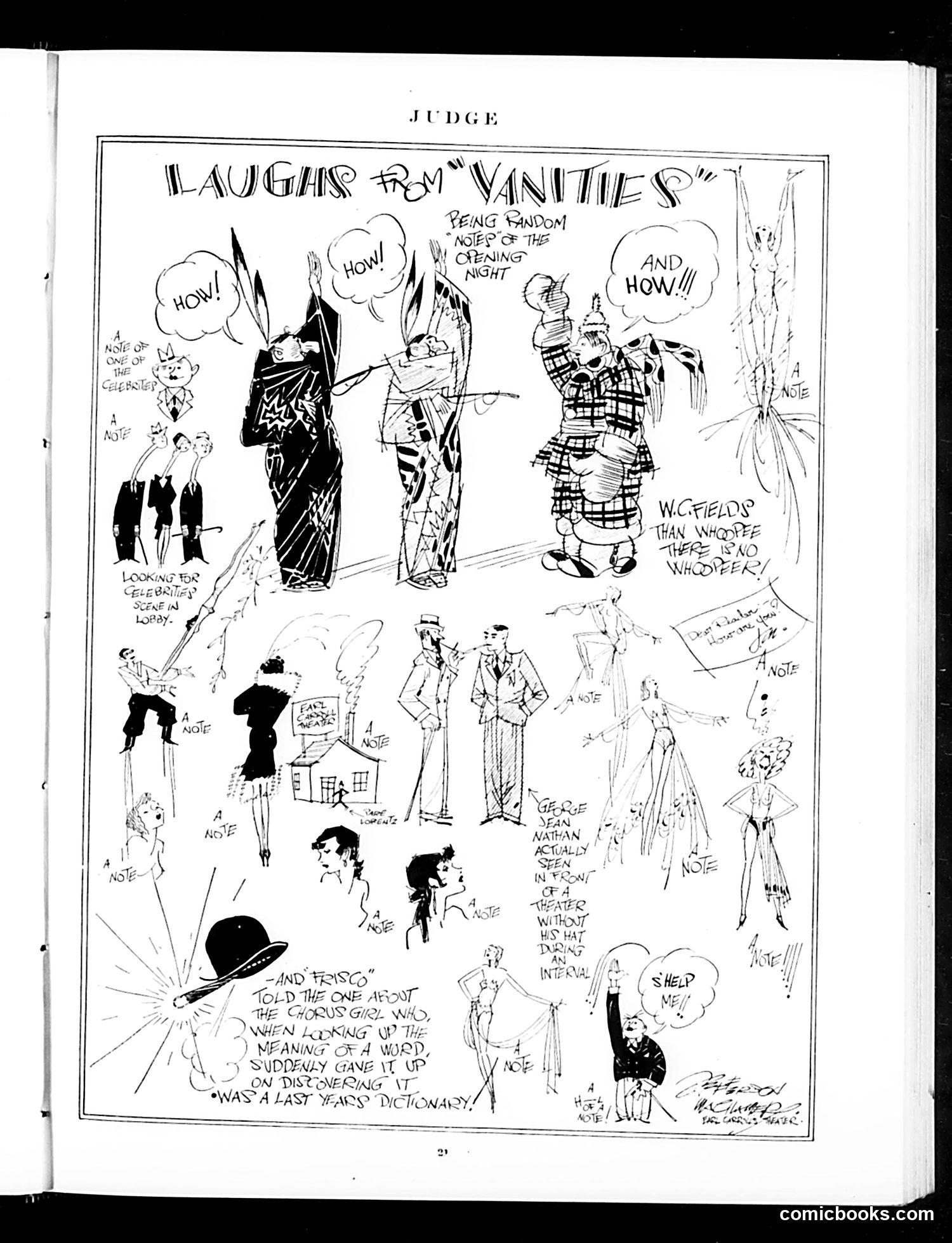
This satirical cartoon mocks the theatrical and social pretensions of opening night audiences. The title references "vanities"—likely referring to vanity productions or self-important theatrical events. The cartoon depicts various absurd figures at what appears to be a fancy premiere or society event: women in exaggerated evening wear, men in formal dress, and theatrical performers striking dramatic poses. Multiple speech bubbles show characters exclaiming "HOW!" and "AND HOW!!!" in exaggerated enthusiasm. The satire targets affectation and empty praise in theater culture. The bottom panel's lengthy caption—about someone confidently citing a word's definition from last year's dictionary, only to realize it's outdated—extends the joke: these society types pretend knowledge and sophistication while being fundamentally shallow or uninformed. The overall message ridicules both the theatrical world's pretension and the "vanity" of audiences who attend primarily to be seen.
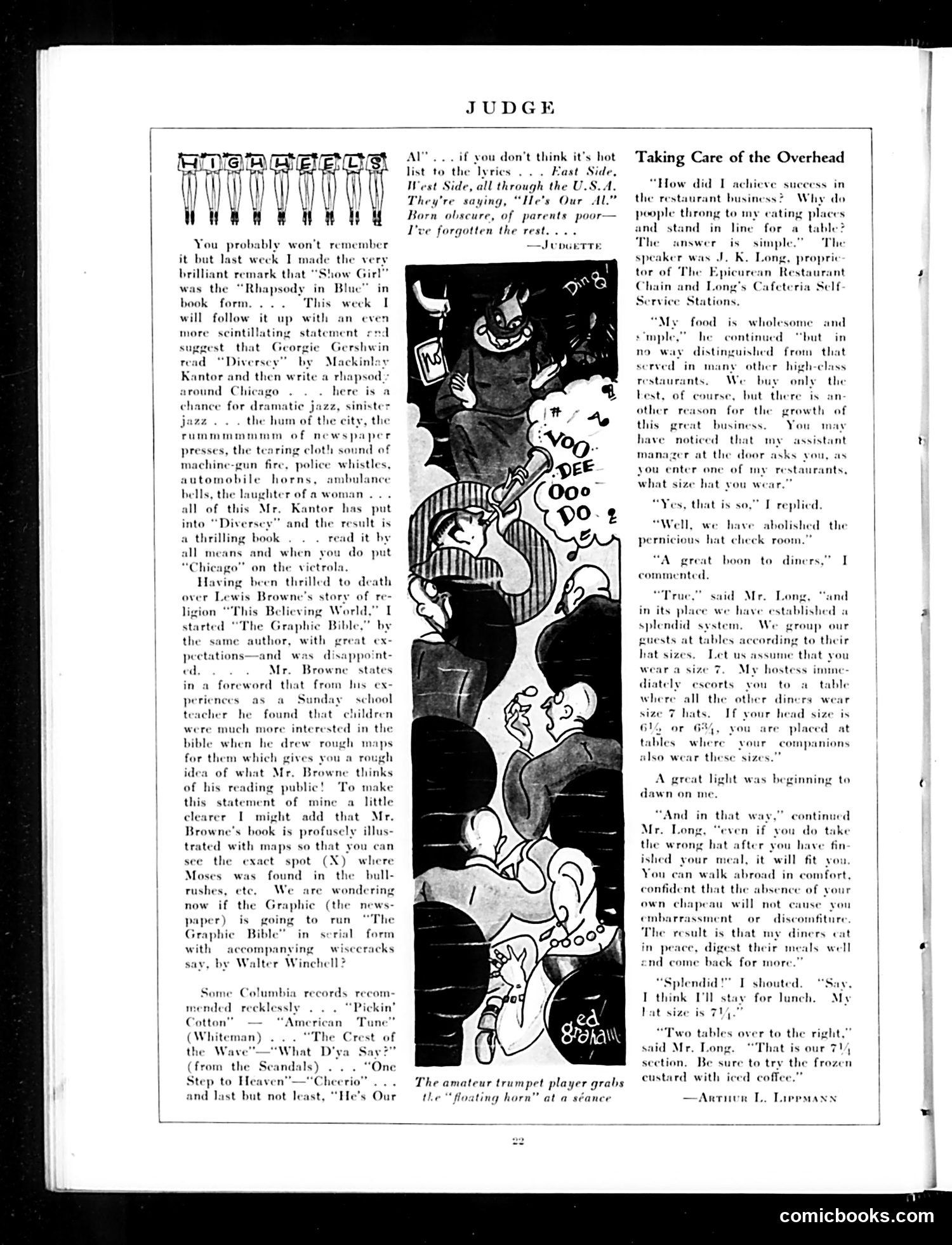
This page contains two distinct pieces: a music/book review column on the left, and a humorous interview article on the right featuring an illustration. **The Illustration & Main Article:** The cartoon depicts an amateur trumpet player performing at a séance—a satirical reference to the popular spiritualist practices of the era. The accompanying article by Arthur L. Lippmann humorously interviews J. K. Long, proprietor of the Epicurean Restaurant, about his business success. Long's comedic "secret" is an absurd hat-check system: he seats diners exclusively with others wearing the same hat size, ensuring that if someone accidentally takes the wrong hat after eating, it will fit anyway. This is gentle satire on restaurant management pretensions and the era's obsession with efficiency systems. **The Left Column:** Reviews of recent releases: George Gershwin's "Diversey" (suggesting a companion piece to "Rhapsody in Blue"), Lewis Browne's "This Believing World," and various Columbia Records recommendations. The tone is playful and conversational, typical of Judge's cultural commentary. The humor relies on absurdist logic rather than sharp political satire.
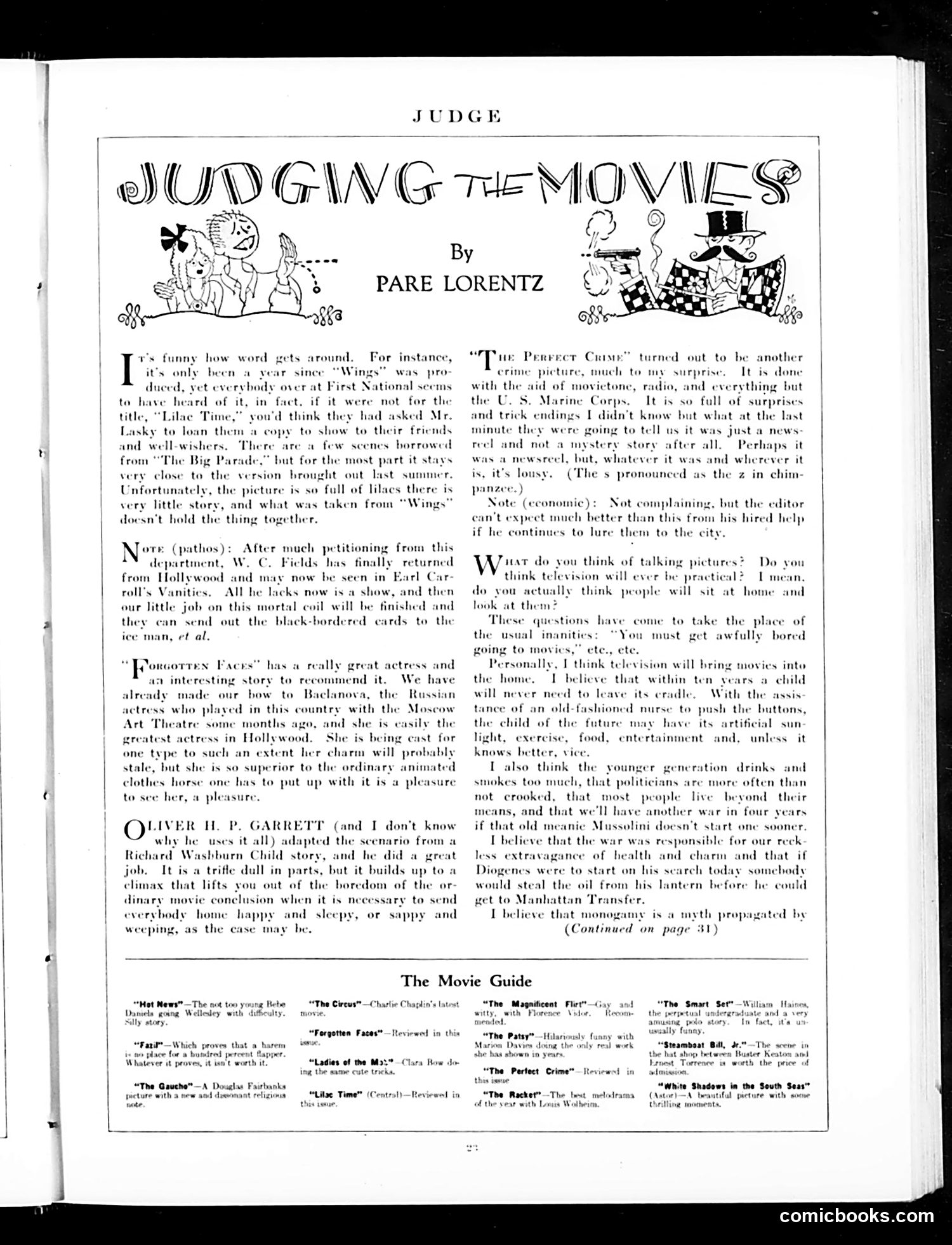
This is a film review column by Pare Lorentz examining current movies and Hollywood gossip. The main satirical targets are: **"The Perfect Crime"** — criticized as a formulaic crime picture stuffed with gimmicks (movietone newsreel footage, radio integration) that attempts surprise endings but ultimately fails ("it's lousy"). **W.C. Fields** — noted as finally returning from Hollywood; the joke is he now "lacks" only a proper show to complete his career comeback. **Russian actress Baclanova** — praised as genuinely talented, contrasting with typical Hollywood starlets who are merely "clothes horses" elevated by charm alone. The broader satire mocks Hollywood's repetitive storytelling (films copying successful plots like *Wings* and *The Big Parade*) and questions emerging technology's impact: Lorentz skeptically asks whether television will ever replace cinema—predicting children won't leave home for entertainment, a darkly ironic prediction given modern streaming culture.
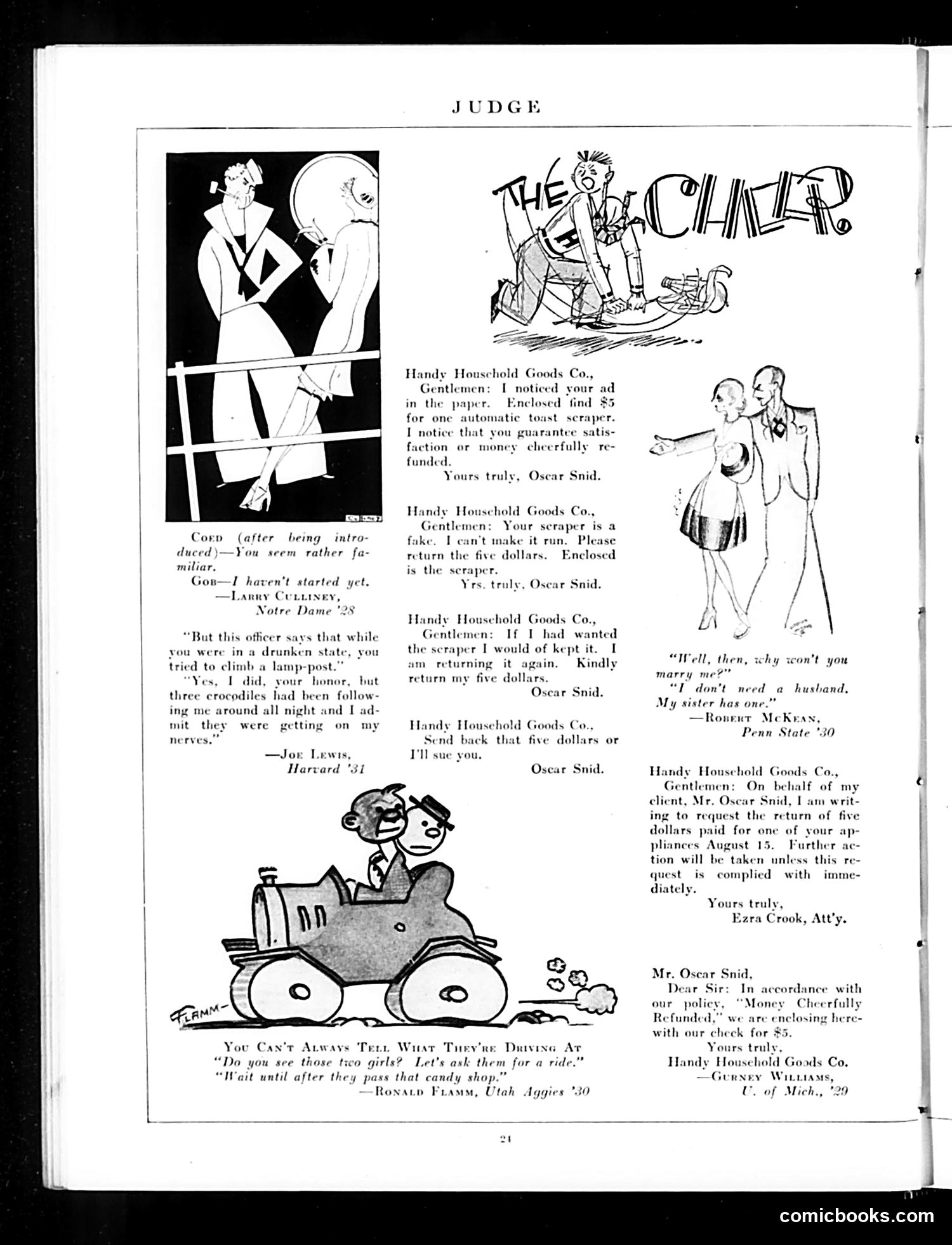
This page is primarily a humorous advertising parody rather than political satire. The central joke involves **Oscar Snid**, a consumer who repeatedly orders defective products from "Handy Household Goods Co." (a fake company) and demands refunds. The satire targets **mail-order product scams and false advertising**—a common consumer problem of the era. Snid's escalating complaints follow a comedic pattern: he buys an automatic toast scraper, it doesn't work, he demands his $5 back. The company ignores him, so he hires a lawyer (Ezra Crook). The final ironic twist: the company promptly refunds him, apparently making all the fuss unnecessary. The surrounding cartoons and reader submissions offer unrelated jokes about flirtation, drunkenness, and courtship—typical Judge magazine filler content. The humor relies on the predictable logic of consumer fraud and bureaucratic runaround, targeting both incompetent companies and gullible consumers of the period.
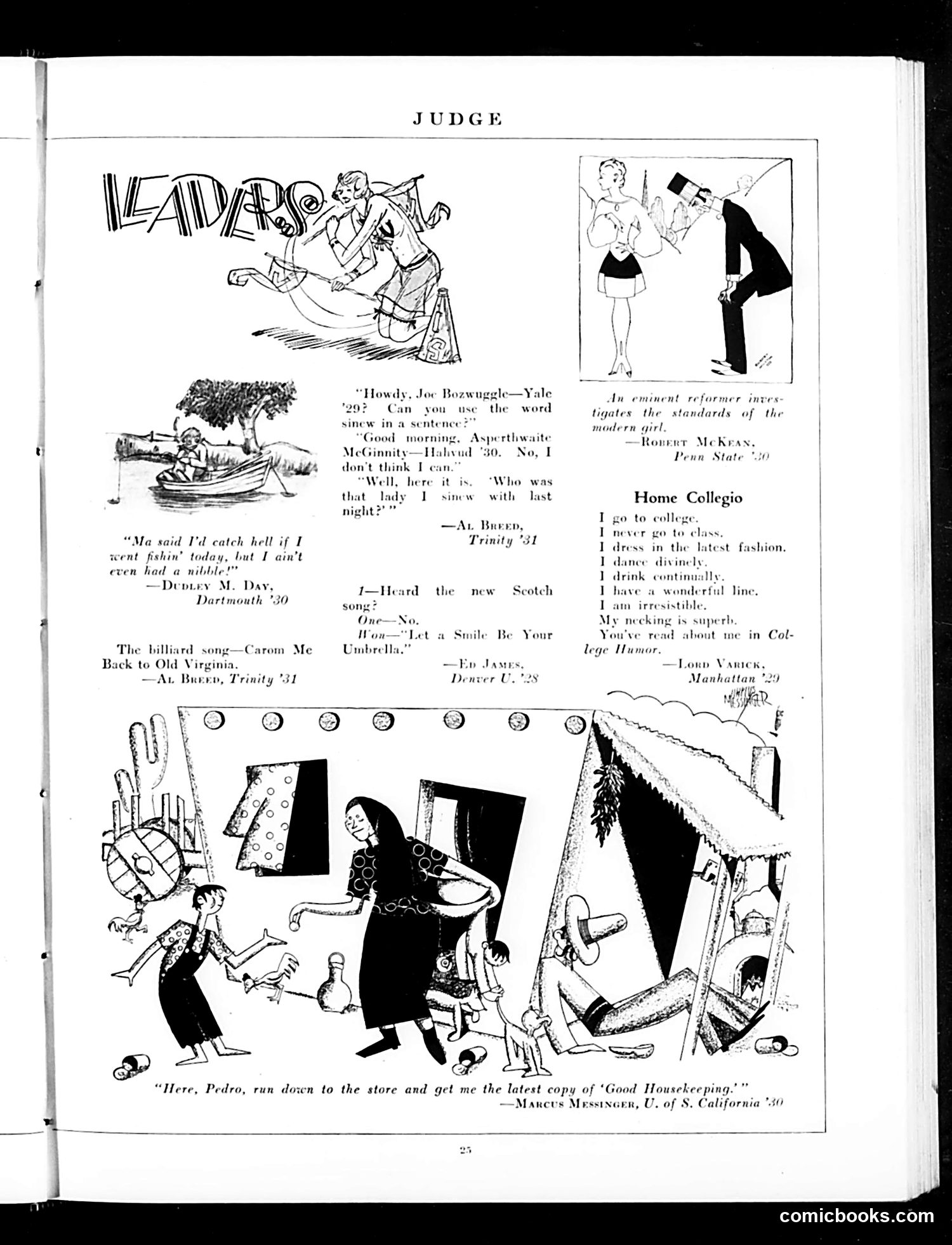
This page from Judge presents college humor from circa 1930, featuring satirical quips about student life at elite universities (Yale, Harvard, Trinity, Penn State, Denver U.). The top cartoons mock collegiate pretension: one shows a student unable to use "sinew" in a sentence despite attending Harvard; another depicts gossip about romantic encounters. These target the gap between elite education's prestige and students' actual intellect. The large bottom cartoon satirizes the "modern girl"—a 1920s-30s social anxiety. A reformer inspects what appears to be a bohemian living space, finding evidence of drinking, smoking, and casual morality (the "wonderful line" reference suggests seduction tactics). This reflects contemporary moral panic about women's increased independence and sexual freedom post-WWI. The "Home Collegio" poem parodies college life's contradictions: attending college while never attending class, dressing fashionably, and cultivating charm rather than learning. Overall, the page satirizes both student mediocrity and anxieties about women's changing social roles—typical Judge magazine fare targeting affluent, conservative readers.
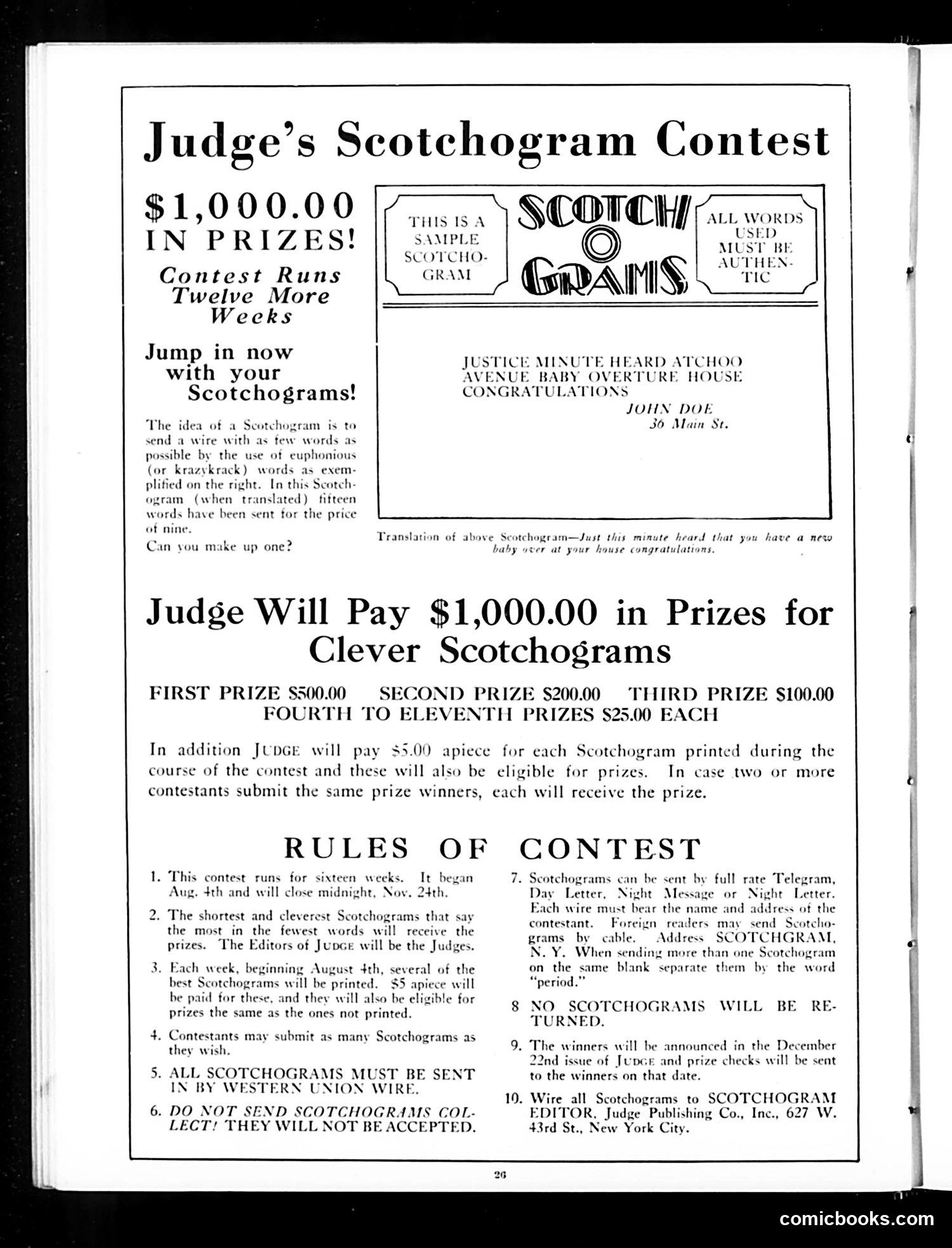
This page is primarily a **contest advertisement** rather than political satire. Judge magazine is running a sixteen-week competition (August–November) offering $1,000 in prizes for "Scotchograms"—a word-economy concept where contestants craft telegram-style messages using phonetic or unusual word choices to convey maximum meaning in minimum words, reducing telegraph costs. The sample Scotchogram shown translates standard congratulations into abbreviated form: "Justice minute heard atchoo avenue baby overture house" becomes "Just this minute heard that you have a new baby over at your house congratulations." The contest rules are straightforward: entries submitted via Western Union wire, judged on brevity and cleverness, with weekly printed selections earning $5 each plus eligibility for larger prizes ($500 first place down to $25 for fourth-eleventh places). This reflects early-twentieth-century concerns about **telegraph costs**—a significant communication expense before widespread telephone adoption—making word economy genuinely practical rather than merely humorous.
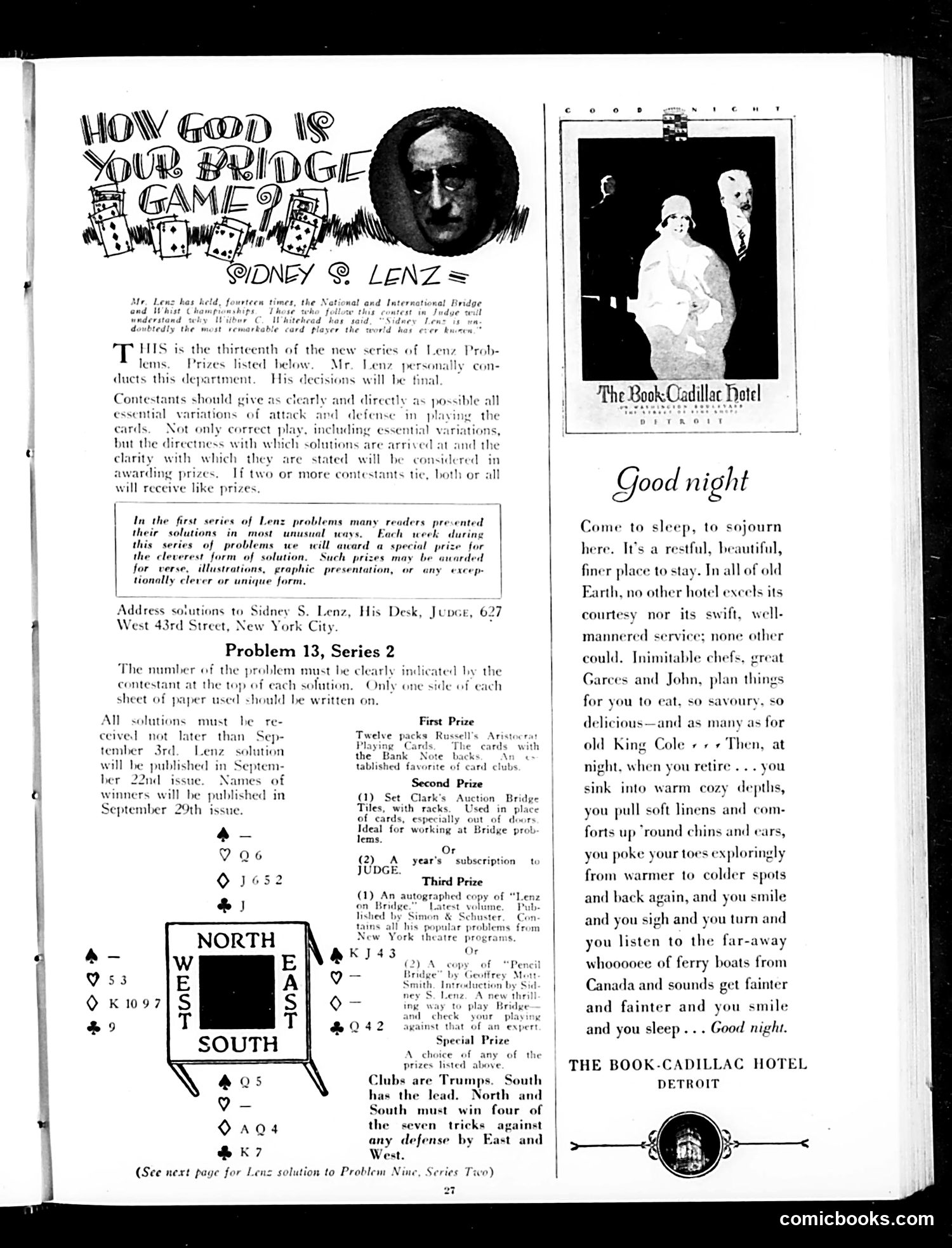
This page primarily contains **bridge puzzle content and advertising** rather than political satire. The main feature is "Problem 13, Series 2" of Sidney S. Lenz's bridge problems—a popular puzzle series for the card game. Lenz was a renowned bridge authority, and Judge ran these as reader engagement contests with prizes (playing cards, bridge tiles, subscriptions). Contestants submitted solutions judged on correctness and creative presentation. The illustration at top left shows a caricatured face amid playing cards, likely Lenz himself, asking "How Good Is Your Bridge Game?" The right side contains a **full-page advertisement for the Book-Cadillac Hotel in Detroit**—a luxury establishment promising elegant service, fine dining, and comfort ("you sink into warm cozy depths"). This reflects 1920s advertising's lyrical, aspirational tone. The page reflects Judge's dual function: sophisticated humor magazine for educated readers interested in card games and upscale leisure activities.
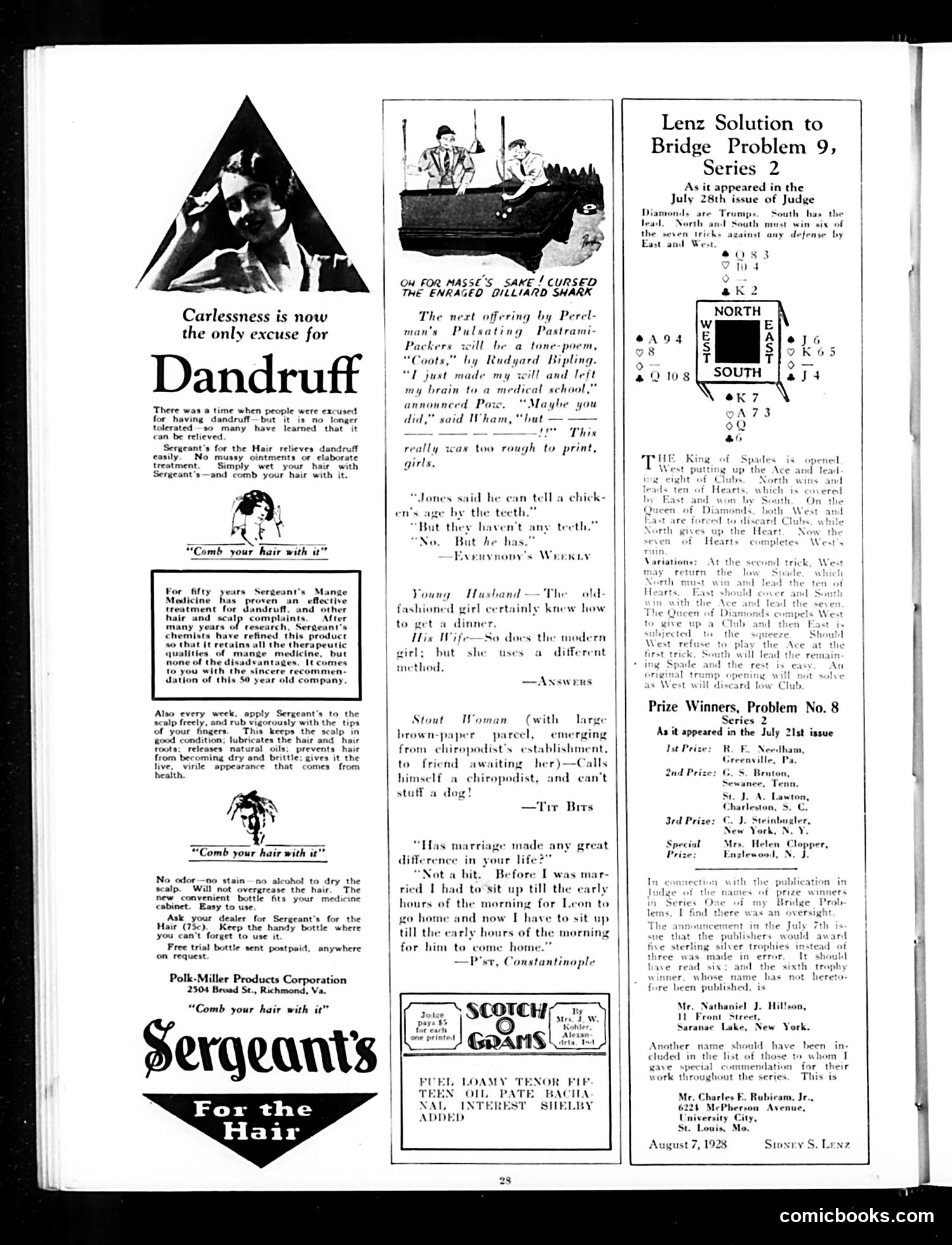
This page is primarily **advertising and puzzle solutions**, not political satire. The dominant content is a large advertisement for **Sergeant's Hair Treatment**, a dandruff remedy. The ad uses mild humor (the phrase "carelessness is now the only excuse for dandruff") to shame readers into buying the product—suggesting that dandruff relief is now so easy that having it is inexcusable. This reflects 1920s marketing tactics targeting middle-class anxieties about personal grooming. The remaining space contains: - A bridge card-game problem solution - Brief comic anecdotes about marriage and modern courtship, using standard joke formats ("Young Husband," "Stout Woman") that were typical humor filler - Prize winners' names from a previous puzzle contest There is **no political commentary or significant satire** on this page. It represents Judge's typical mixed format of humor, puzzles, and advertising rather than its better-known satirical editorial cartoons.
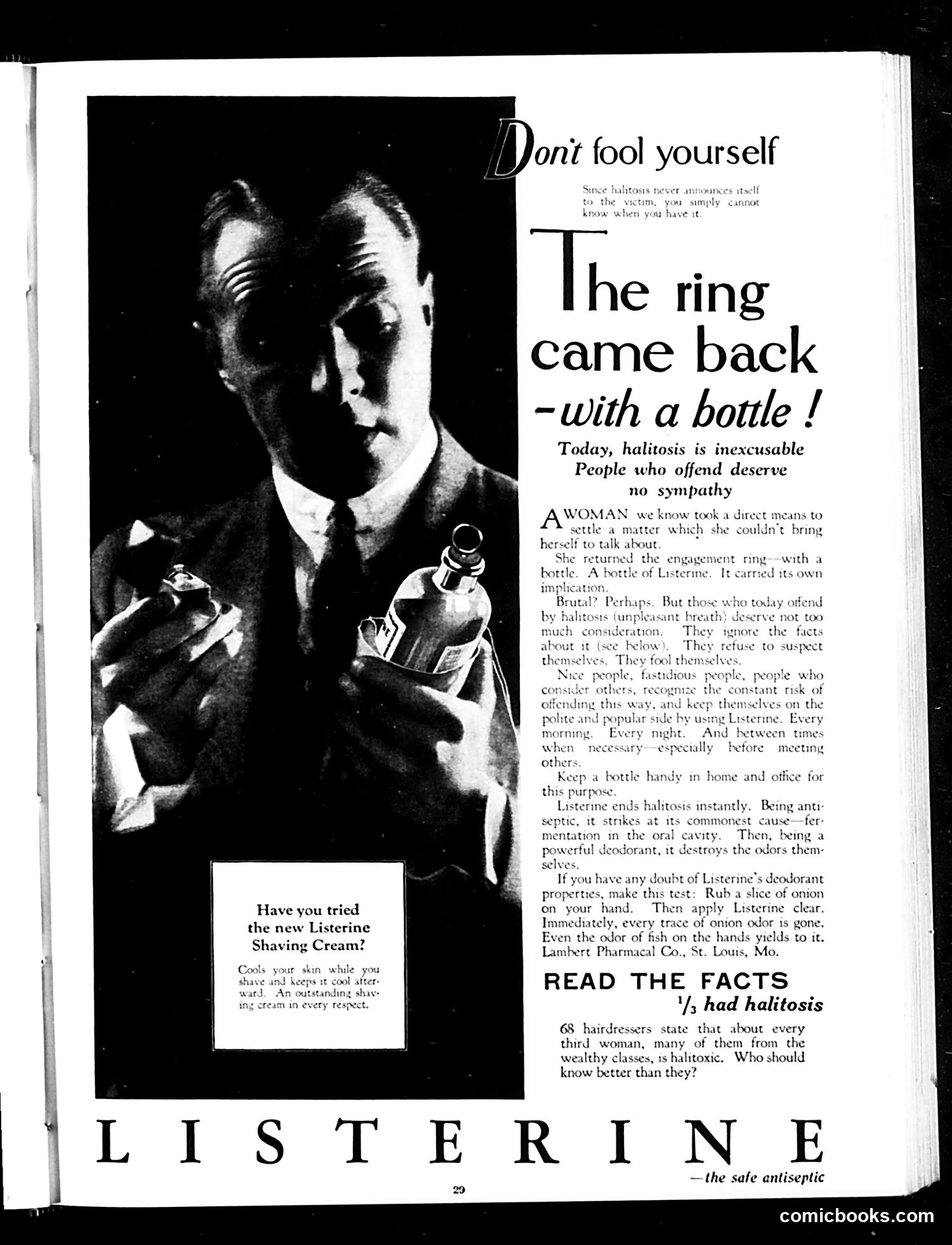
This is primarily a **Listerine mouthwash advertisement** using social shame as a sales tactic. The imagery shows a man examining a woman's returned engagement ring alongside a bottle of mouthwash—the implication being that she rejected him due to bad breath ("halitosis," a term Listerine popularized). The satire targets early 20th-century consumer advertising's weaponization of insecurity and social embarrassment. The ad shames people with halitosis as socially unacceptable, claiming "people who offend deserve no sympathy." It presents bad breath as a moral failing rather than a health issue, and suggests keeping mouthwash "handy" for constant self-monitoring. The secondary ad for Listerine Shaving Cream reinforces this messaging through normalcy marketing. The advertisement exemplifies how vintage advertising exploited social anxiety—particularly toward women—to drive product sales by equating hygiene failures with romantic and social disaster.
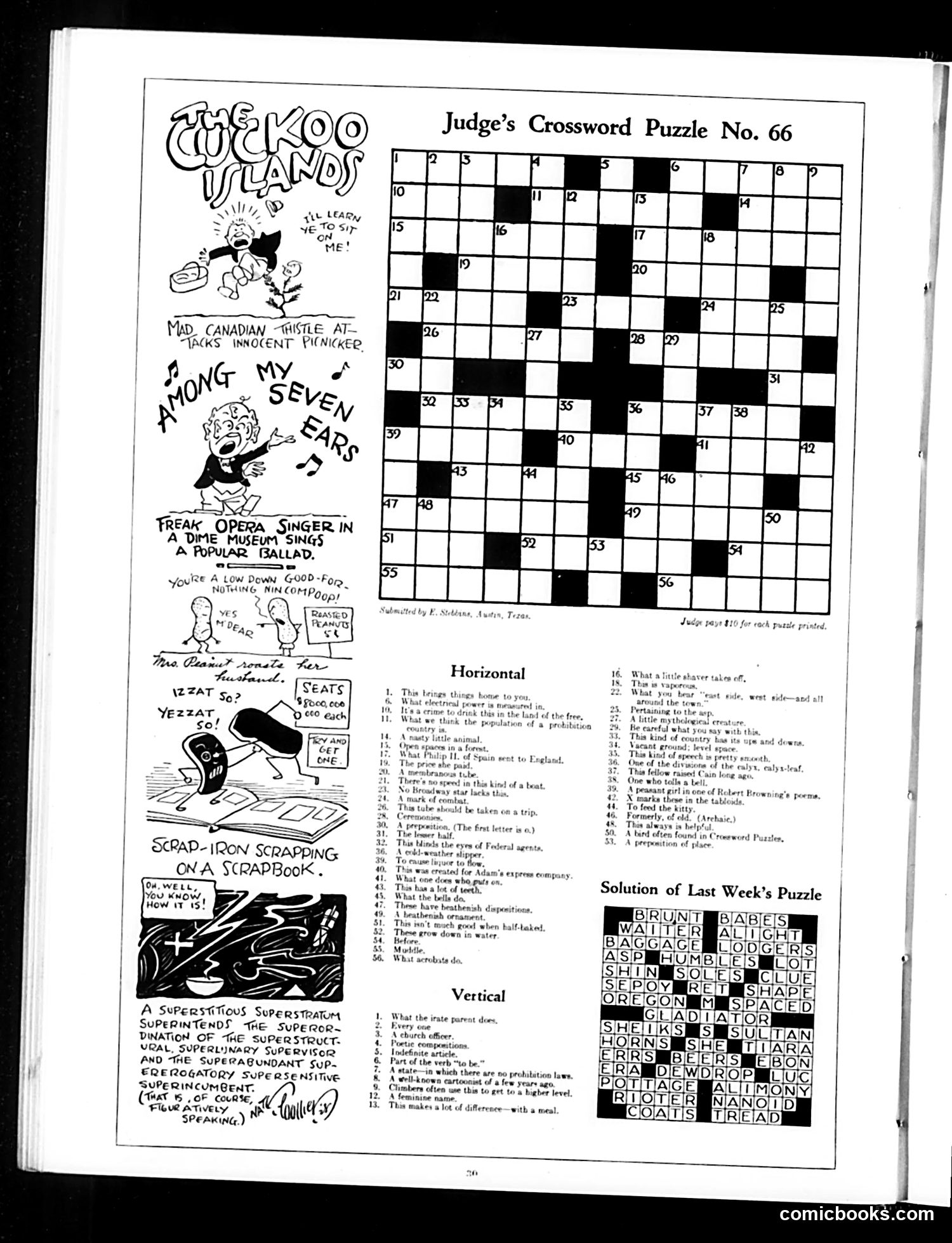
This page presents **Judge's Crossword Puzzle No. 66**, a standard puzzle feature typical of satirical magazines of this era. The left margin contains humorous cartoons and editorial commentary rather than political satire of specific figures. The cartoons mock various absurdities: - "The Cuckoo Lands" ridicules a "mad Canadian thistle" attacking an innocent picnicker - A "freak opera singer in a dime museum" singing popular ballads (mocking lowbrow entertainment) - A "superstitious superstructure" joke playing on the word "super" (appearing to be wordplay humor) - A figure "scrapping in a scrapbook" (visual pun) The clues reference Prohibition ("a state in which there are no prohibition laws"), contemporary entertainment, and general Americana. This is primarily **entertainment and wordplay** rather than pointed political commentary—typical crossword puzzle fare designed to amuse readers with puns and light cultural references of the period.
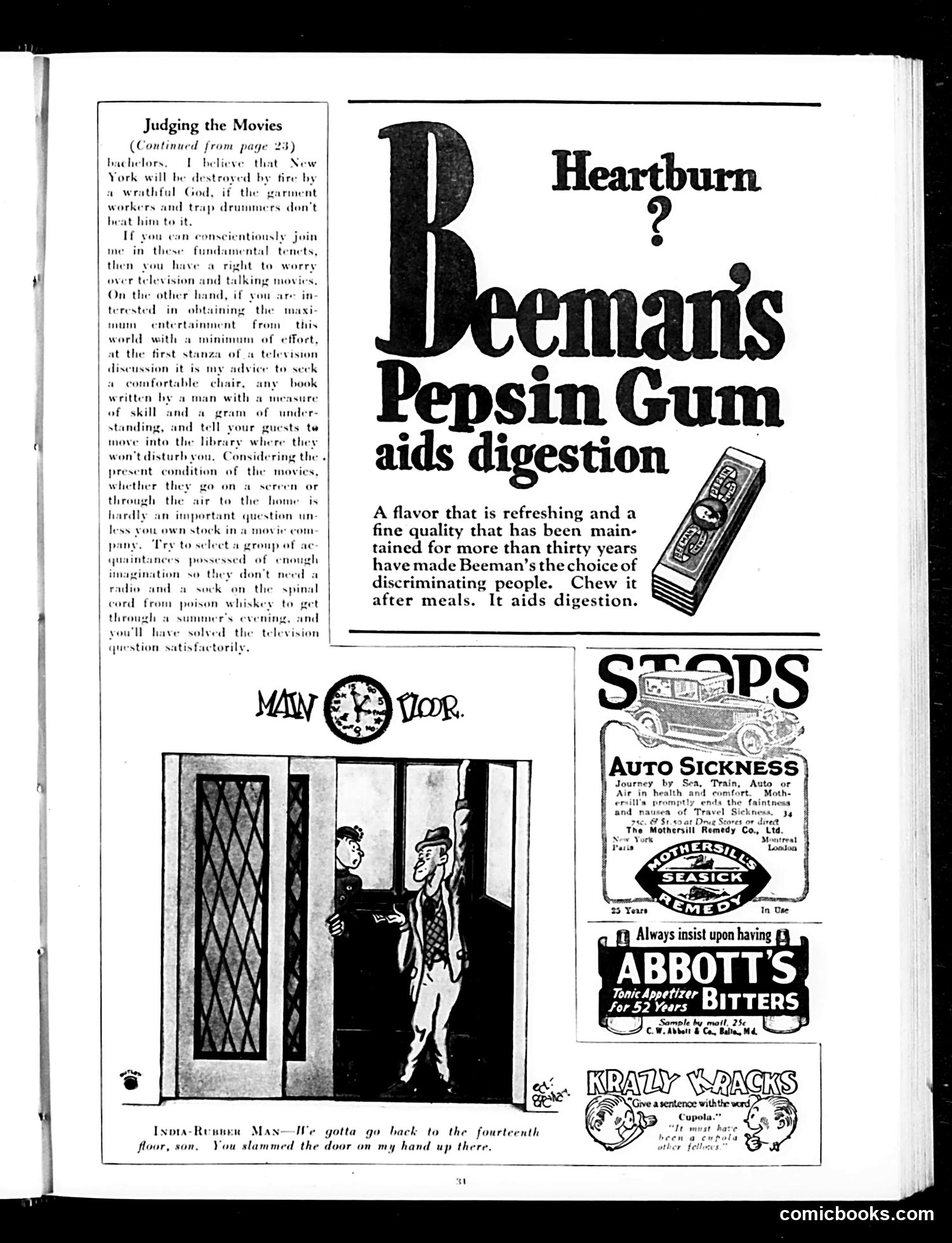
This page mixes editorial content with period advertising. The main article ("Judging the Movies," continued from page 23) discusses whether citizens should worry about television and talking movies—suggesting anxiety about new media was already present in the early sound-film era. The author argues that if you don't share certain moral/religious convictions about entertainment's dangers, you needn't fret about these technologies. The cartoon below shows "India Rubber Man" getting his hand slammed in a door by someone fleeing to the fourteenth floor—a visual gag about physical comedy and slapstick, likely referencing silent-film or vaudeville humor styles. The advertisements reveal contemporary concerns: Beeman's Pepsin Gum (aids digestion), treatments for auto sickness and seasickness, and Abbott's Bitters as a "tonic appetizer." These products suggest early 20th-century anxieties about digestive health and motion-related nausea from new transportation technologies.
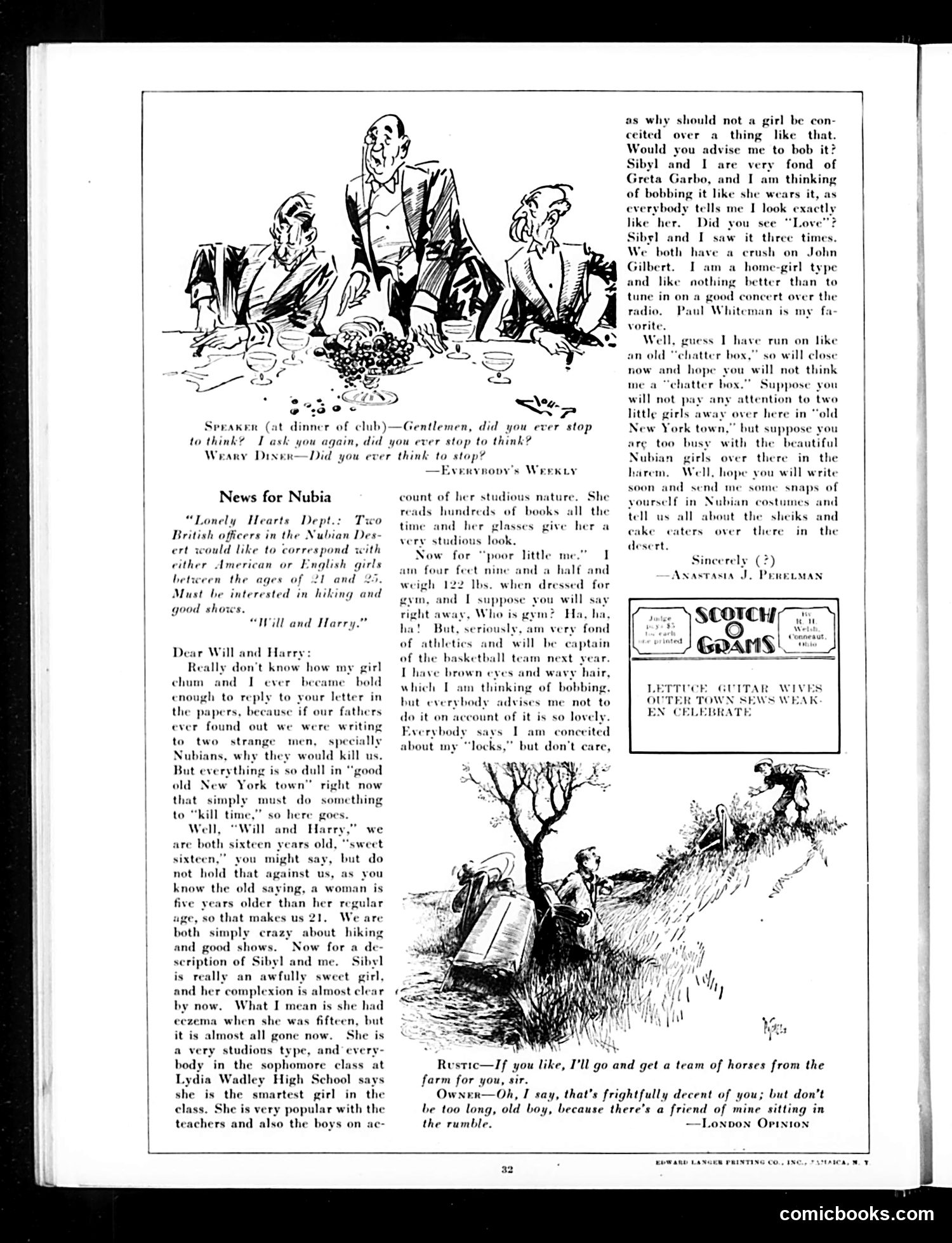
This page contains two satirical cartoons typical of Judge magazine's humor: **Top cartoon:** A club dinner scene mocking verbose speakers. A man asks "did you ever stop to think?" repeatedly while a weary listener sarcastically replies "Did you ever think to stop?"—poking fun at tedious after-dinner speakers who ramble endlessly. **"News for Nubia" section:** A humorous advice column satirizing young women's romantic naiveté. Two sixteen-year-old New York girls respond to a lonely hearts ad from "British officers in the Nubian Desert." They're excited to correspond despite parental disapproval, reveal physical insecurities (eczema, height), admire movie stars like Greta Garbo and John Gilbert, and worry the officers might ignore them for local women. The satire targets adolescent girls' desperation to escape boring hometown life and their self-conscious romanticizing of distant strangers. **Bottom cartoon:** A brief comic exchange where a rustic agrees to fetch horses for a city visitor, but warns him not to linger because his friend is "sitting in the rumble"—simple wordplay on rural hospitality.
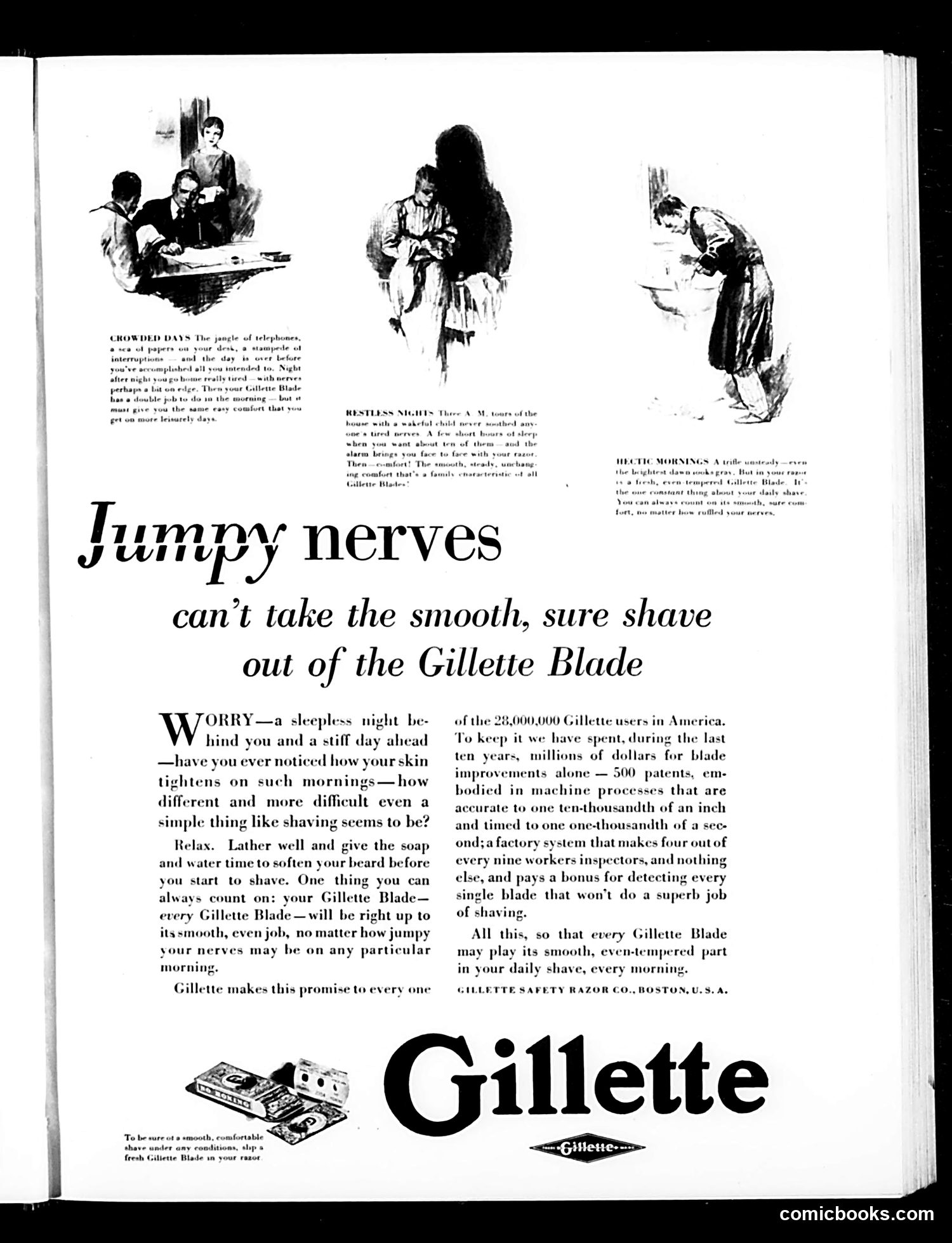
This is primarily a **product advertisement**, not political satire. The page promotes Gillette Safety Razor blades to anxious men. The illustrations depict common male anxieties: sleepless nights, restlessness with children, hectic mornings—situations where "jumpy nerves" make shaving difficult. The advertisement's pitch is that Gillette blades are so consistently reliable and smooth that even a nervous, exhausted man can achieve a quality shave. The text emphasizes manufacturing precision (500 patents, quality control inspectors, accuracy to one ten-thousandth of an inch) to assure consumers of product dependability. The reference to "28,000,000 Gillette users in America" suggests this targets the mass market. Rather than satire, this reflects **early 20th-century advertising strategy**: addressing male insecurity and positioning a commercial product as a solution to modern stress and daily pressures.
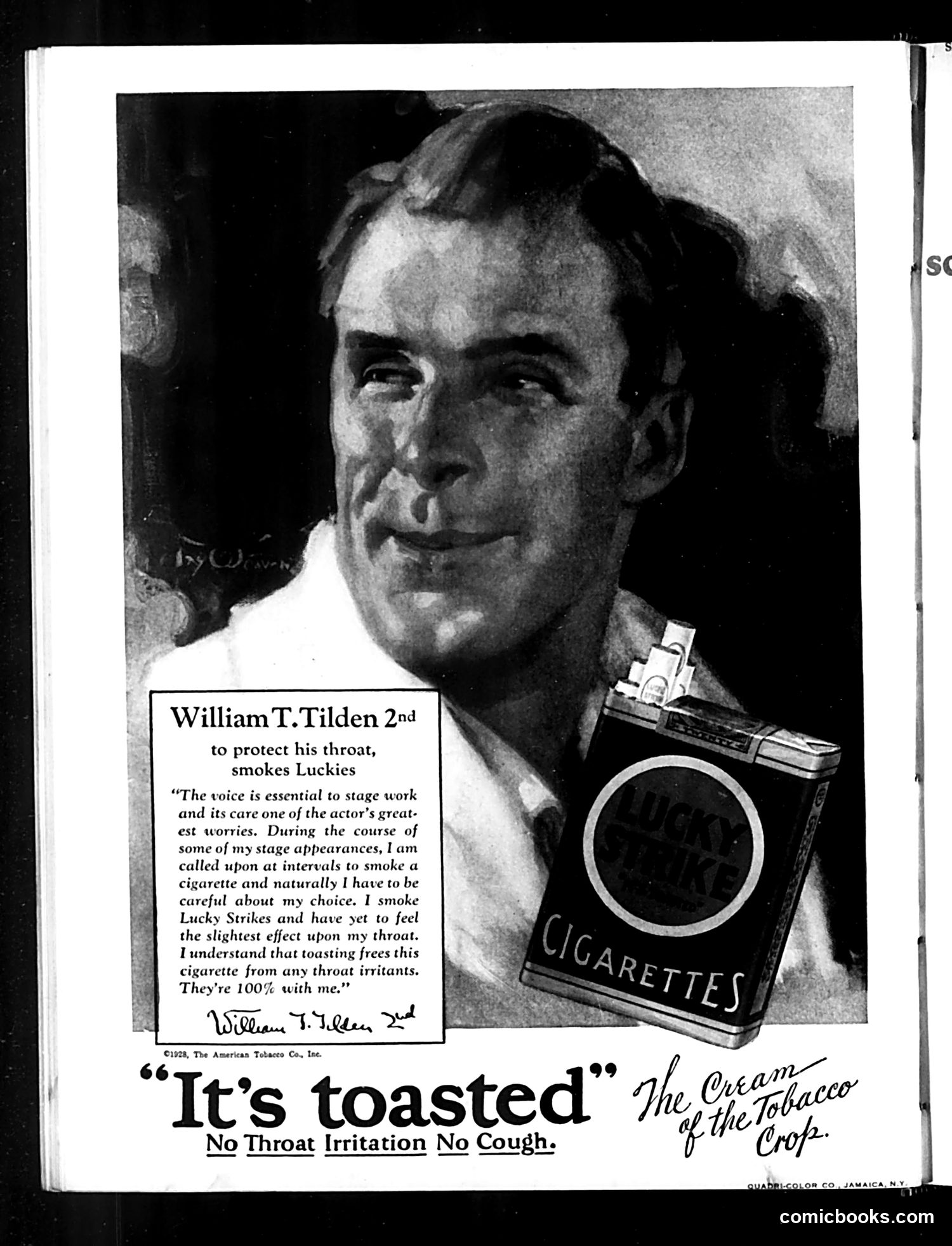
This is a **cigarette advertisement**, not editorial satire. It features William T. Tilden 2nd (a famous tennis player of the 1920s-30s), endorsing Lucky Strike cigarettes. The ad claims cigarettes are safe for performers' throats because they are "toasted," which supposedly removes irritants. Tilden testifies that smoking them during stage work causes "no throat irritation" or cough. **For modern readers:** This represents pre-regulation advertising era when: - Health claims about cigarettes were unsubstantiated and legal - Celebrity endorsements sold tobacco without disclosure - "Toasting" was marketed as a health benefit (it wasn't) - No warnings appeared on cigarette packages The ad exploits Tilden's professional credibility to suggest cigarettes are safe—a claim that would be illegal today. This page demonstrates how openly tobacco companies made false health promises before mid-20th-century regulation.