
A complete issue · 36 pages · 1928
Judge — August 11, 1928
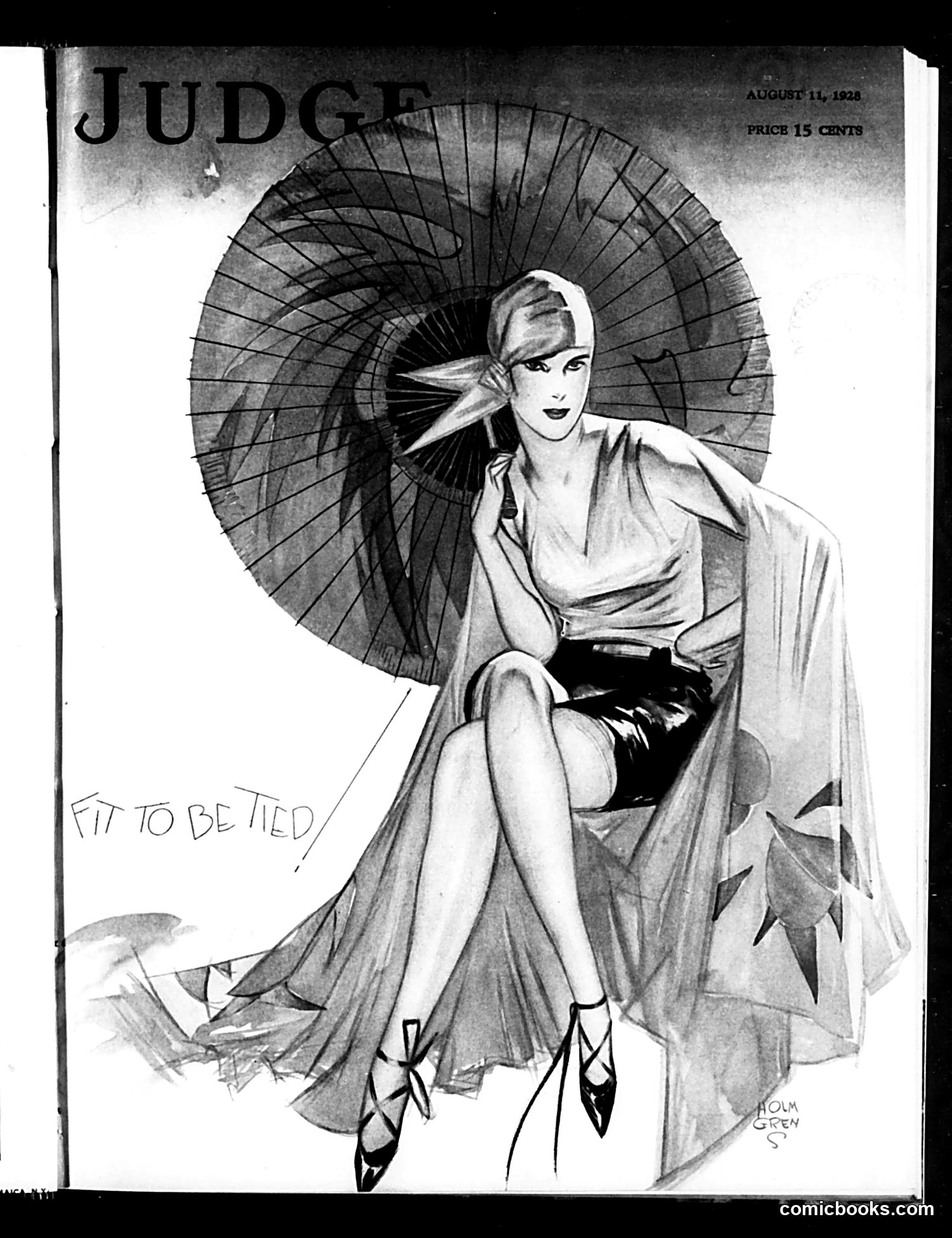
**August 11, 1928** This is primarily a fashion illustration rather than political satire. The cover features a stylishly dressed woman in 1920s attire—a cloche hat, draped coat, and heeled shoes—posing with a large decorative parasol. The caption reads "FIT TO BE TIED." The phrase "fit to be tied" was a period idiom meaning extremely angry or frustrated. The satire likely comments on women's fashion or social expectations of the era, possibly mocking the elaborate nature of 1920s women's dress or accessories. The illustration's artist signature appears to be "Holm Green." As a Judge cover, this would have appealed to contemporary readers through commentary on modern (for 1928) women's fashion trends and social behaviors, though the specific target of the satire is unclear without additional context.
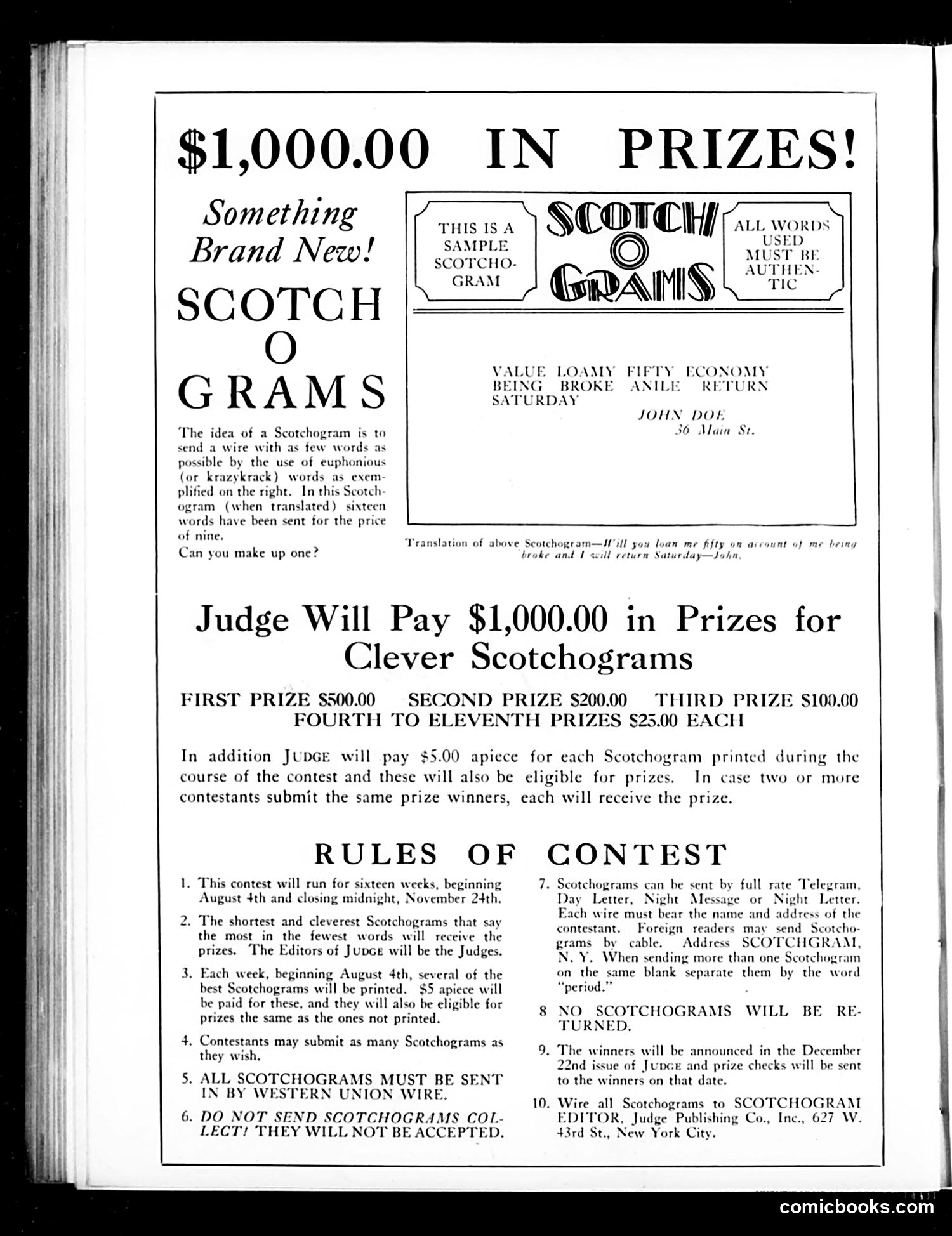
This page is primarily a **contest advertisement**, not a political cartoon. Judge magazine is announcing a word-game competition called "Scotchograms"—a play on words combining "Scotch" (economical/frugal) and "anagrams." The contest invites readers to create clever, compressed messages using euphonious (fancy-sounding) words that, when translated, convey actual messages in fewer words. The sample shown demonstrates this: a wire using 16 words becomes 9 when "scotchogrammed." **The appeal**: Readers could win $1,000 in prizes by submitting witty condensed messages via Western Union telegram. This reflects early 20th-century culture where telegraph brevity was both practical and entertaining—the humor derives from linguistic cleverness and economic efficiency, fitting Judge's satirical sensibility.
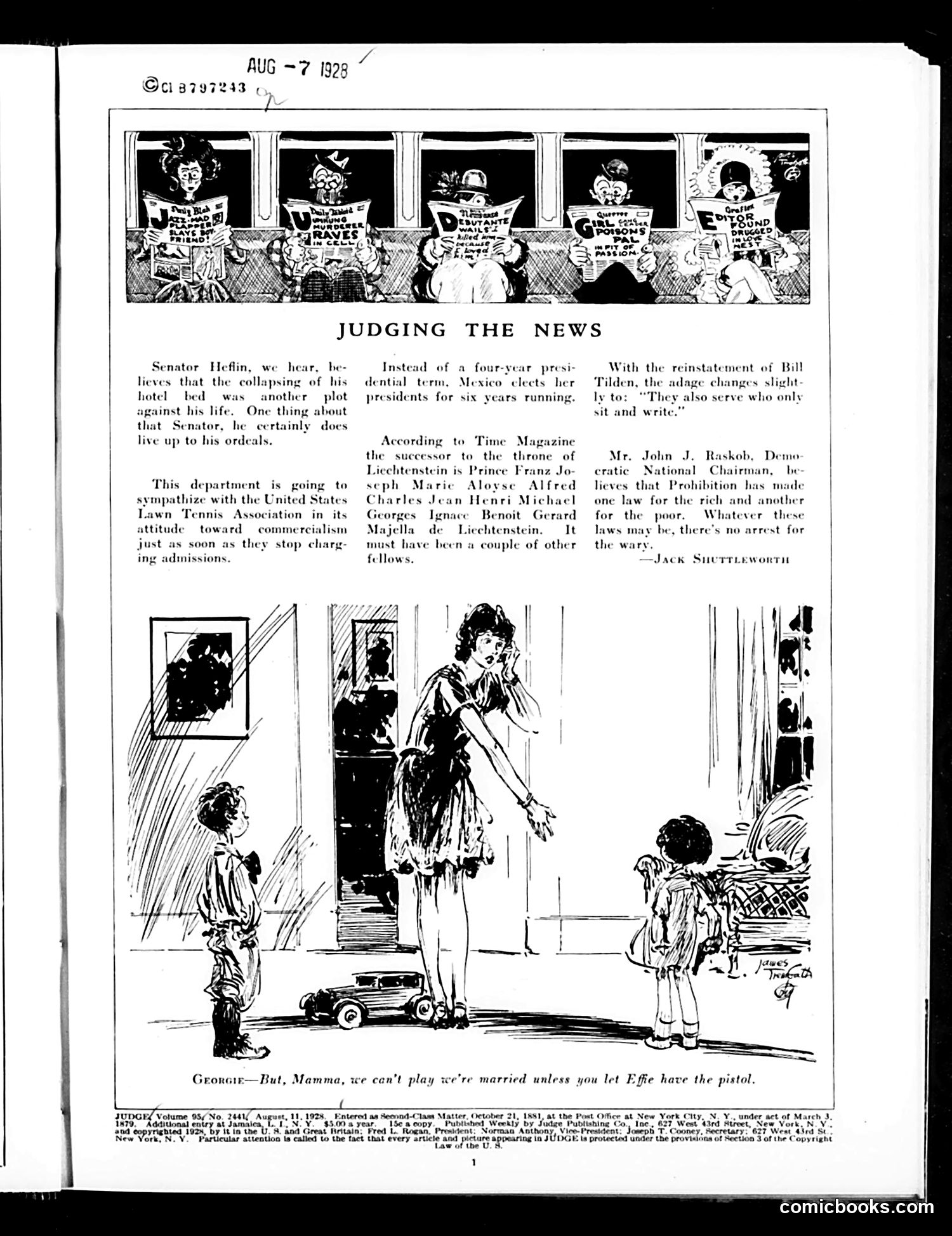
This satirical page from Judge magazine contains three main sections: **Top strip**: Five caricatured figures reading newspapers with exaggerated headlines about various scandals and political issues of 1928. **Text commentary**: Brief satirical pieces on current events, including: - Senator Heflin's political troubles - Mexico electing presidents for six-year terms - Bill Tilden's reinstatement in tennis - John J. Raskob (Democratic National Chairman) and Prohibition enforcement **Bottom cartoon**: Titled "Georgie—But, Mamma, we can't play we're married unless you let Effie have the pistol," depicts children role-playing with a toy car and gun, satirizing the prevalence of violence or weapons in contemporary society/entertainment. The overall effect critiques 1928's political scandals, inconsistent governance, and concerns about violence and crime in American culture.
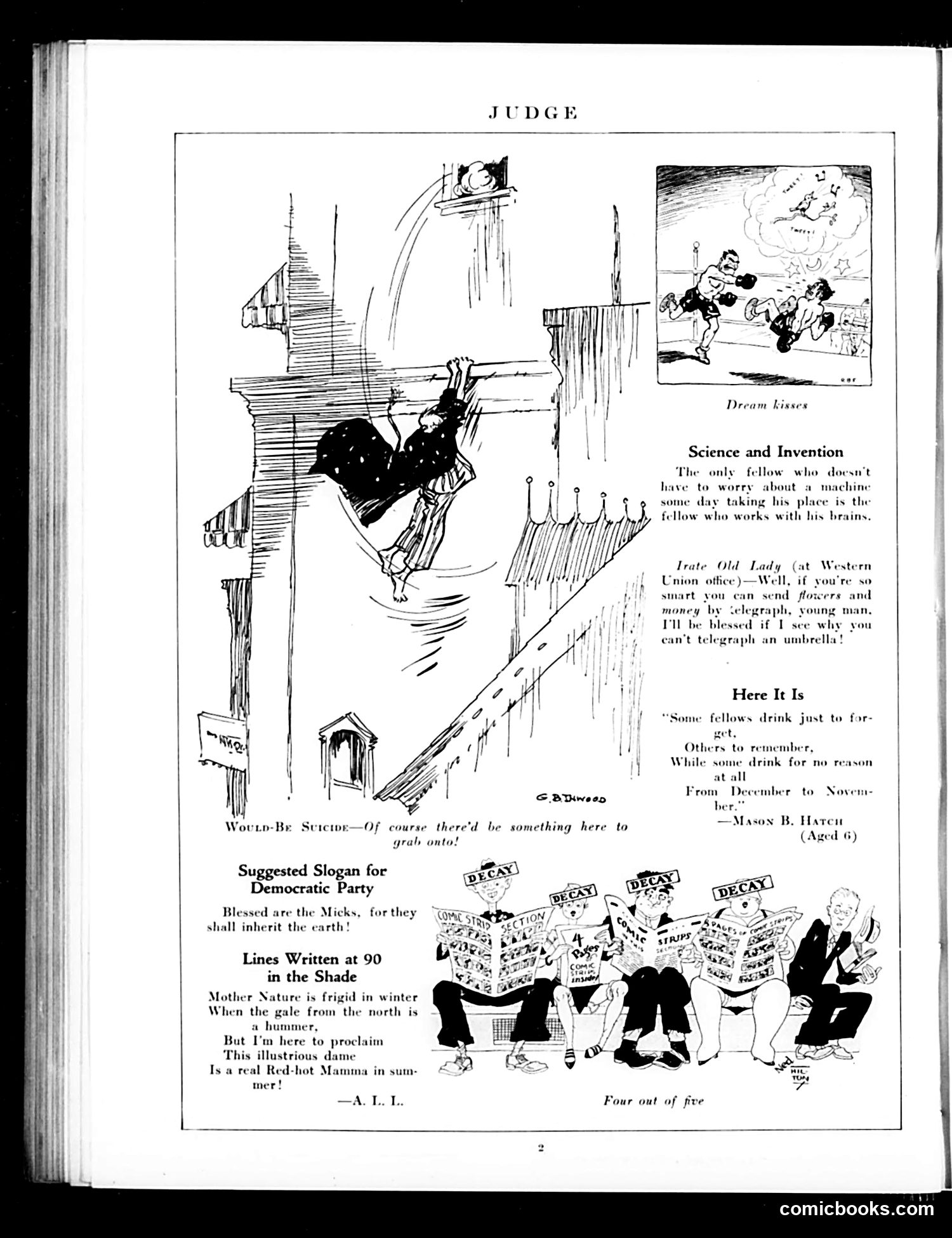
This page contains several separate satirical pieces: **"World-Be Suicide"** (main cartoon): Shows a figure attempting suicide from a building, captioned "Of course there'd be something here to grab onto!" The satire mocks suicidal impulses—suggesting even self-harm encounters life's practical obstacles. **"Science and Invention"**: A joke about machines replacing human labor, suggesting only brain-workers need fear obsolescence. **"Irate Old Lady"**: A humorous complaint about telegraph incompetence, playing on early 20th-century frustrations with technology. **"Here It Is"**: A poem about drinking habits from Mason B. Hatch, age 6—satirizing either children's precocious observations or adult drinking culture. **"Four out of five"**: Shows men reading newspapers labeled "DECAY," likely satirizing pessimistic news consumption or economic concerns of the era.
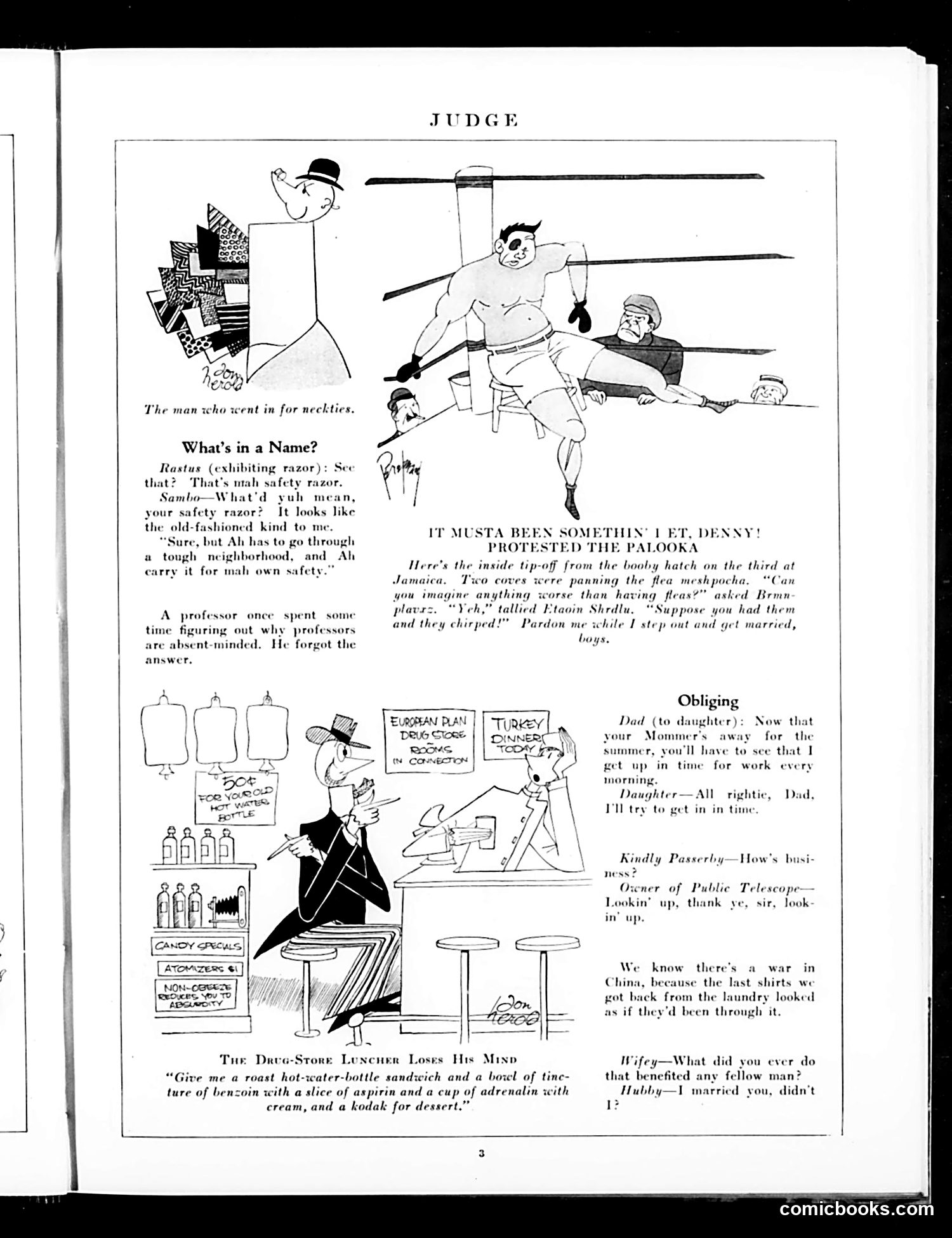
This page contains several distinct humorous pieces typical of Judge's satirical style: **"What's in a Name?"** mocks a safety razor brand called "Rostus," with characters debating whether it's appropriately named for a safety product—likely poking fun at both the product and ethnic naming conventions of the era. **"It Musta Been Somethin' I Et, Denny!"** depicts a vaudeville mishap where two performers were supposedly poisoned before their act, reflecting early-20th-century show-business culture. **"The Dutch Lunch Loses His Mind"** shows a man confusedly ordering an absurdly elaborate sandwich, satirizing both immigrant confusion and American excess. The remaining items are brief jokes about everyday life, including workplace obligations and laundry mishaps during wartime (referenced obliquely). The humor relies on period-specific social situations and domestic absurdities.
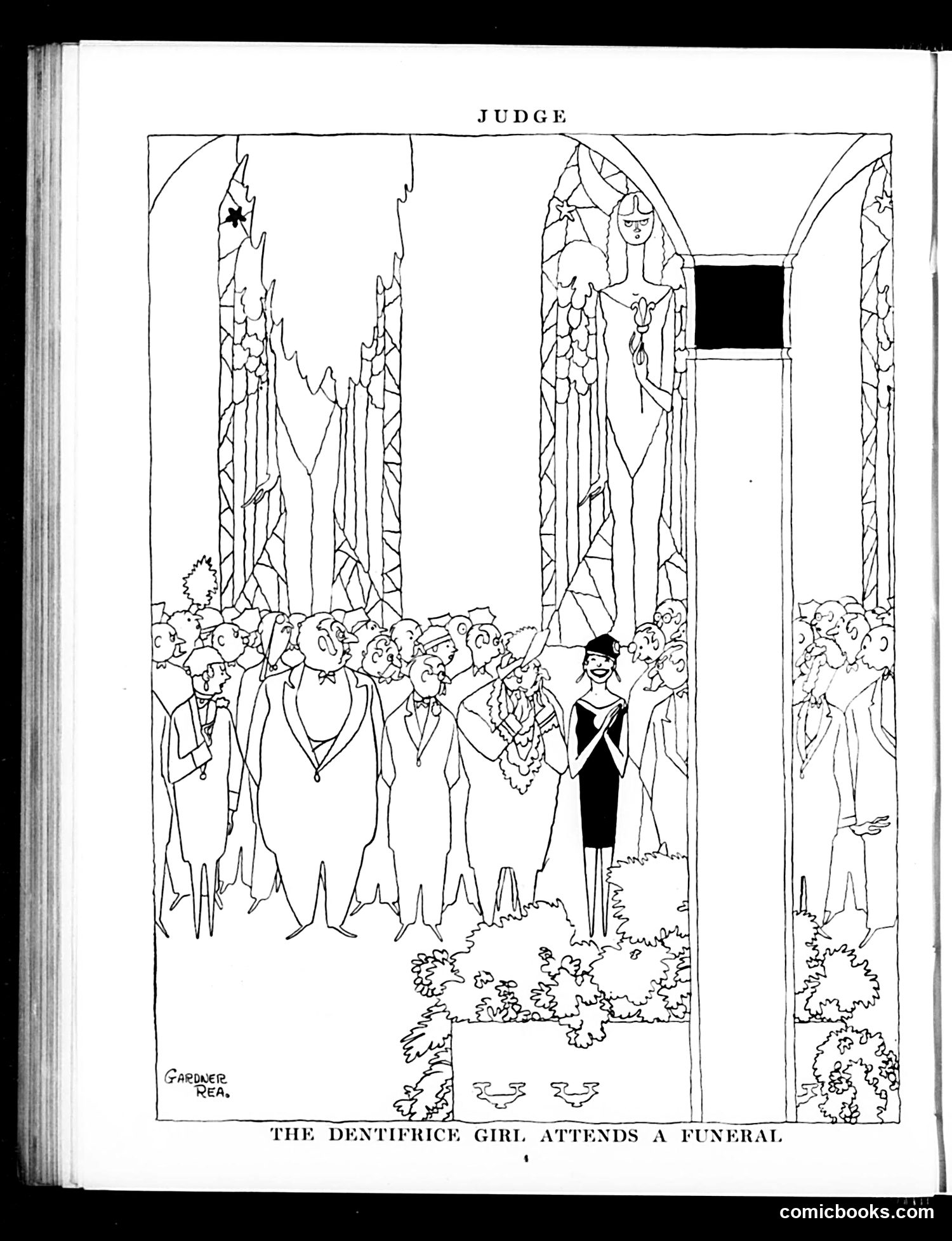
This cartoon satirizes commercial advertising's intrusion into everyday life. The woman in black (marked distinctly with solid fill) stands among funeral attendees in a grand cathedral setting, distinguished by her prominent teeth—a visual reference to toothpaste advertising imagery of the era. The satire appears to mock how dental product advertisements featured smiling women with gleaming teeth, suggesting that even at a solemn funeral, this "dentifrice girl" (advertising model type) cannot escape her commercial identity. The contrast between the sacred funeral setting and the woman's advertiser-perfect dentition ridicules both the ubiquity of product marketing and the artificiality of commercial femininity in early 20th-century culture. The artist is Gardner Rea.
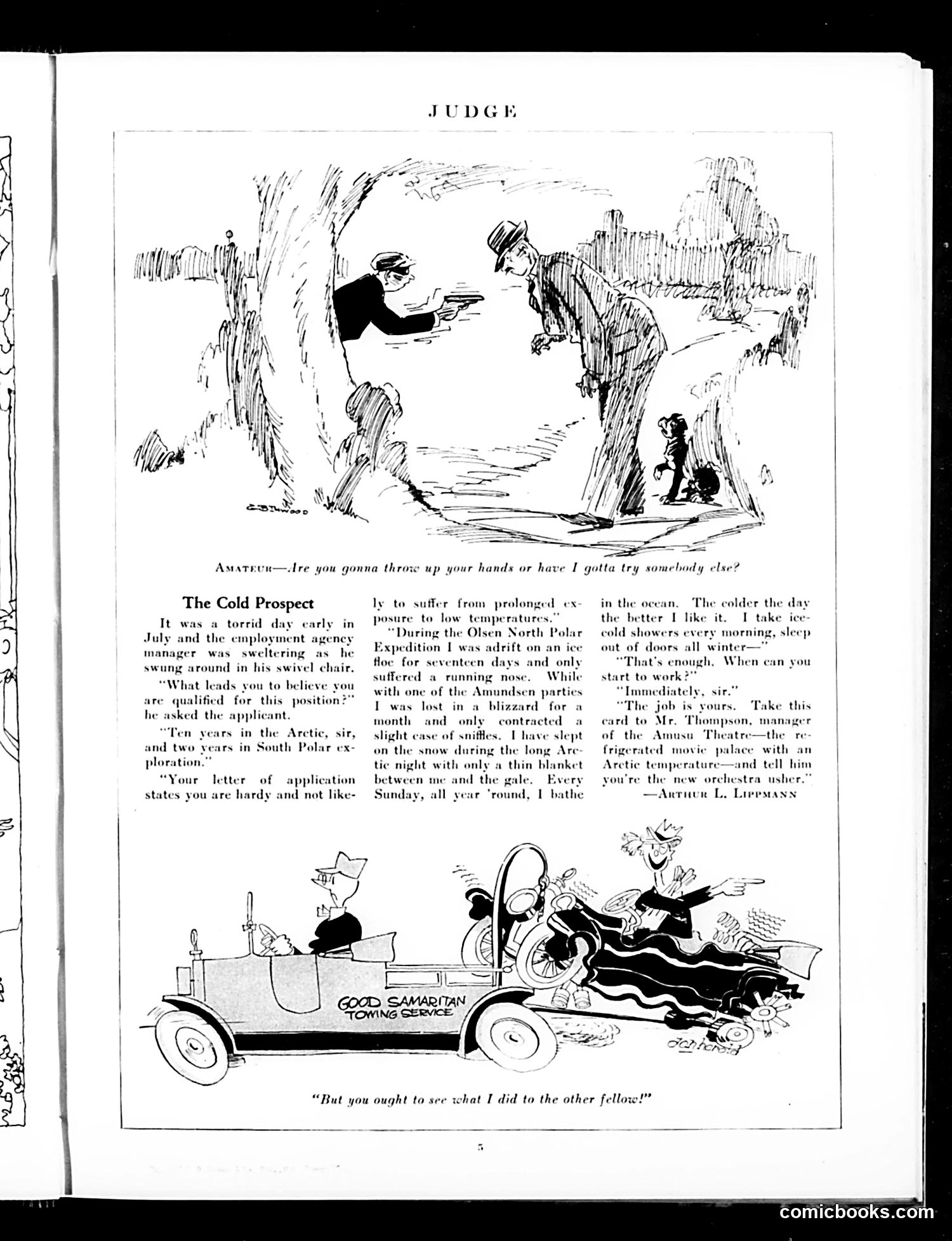
**Top Cartoon ("Judge"):** An amateur hunter threatens another man with a gun, asking "Are you gonna throw up your hands or have I gotta try somebody else?" This satirizes incompetent amateur hunters—likely a commentary on hunting season safety or the absurdity of untrained civilians with firearms. **Middle Story ("The Cold Prospect"):** A job applicant claims Arctic and polar expedition experience to qualify for a theater manager position. The employer offers him a refrigerated movie palace job. This mocks either exaggerated job applicant claims or the novelty of early air-conditioning in theaters—suggesting someone's overqualifications are mismatched to mundane modern work. **Bottom Cartoon:** A "Good Samaritan Towing Service" vehicle comically rescues tangled passengers, captioned "But you ought to see what I did to the other fellows!" This jokes about reckless towing or rescue services causing more chaos than help.
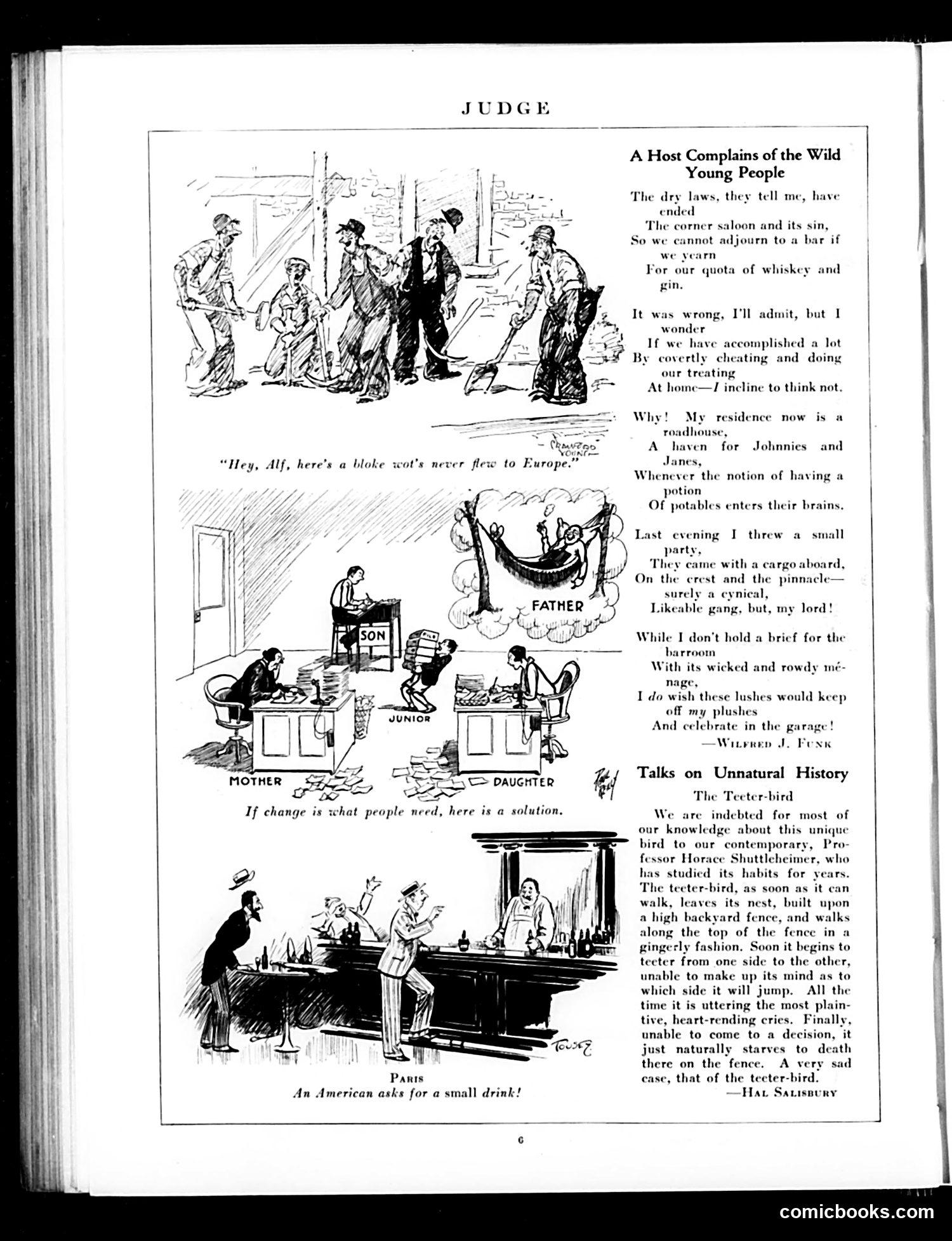
This page satirizes Prohibition's unintended consequences. The top cartoon shows a host complaining that while dry laws eliminated public saloons, young people now drink covertly at his home, turning it into an impromptu "roadhouse." The joke: Prohibition created the opposite effect—instead of eliminating drinking, it drove it underground and into private residences, making the host's home a chaotic gathering place for "Johnnies and Janes." The middle cartoon depicts a bar scene in Paris, captioning an American requesting a small drink—satirizing how Americans abroad encountered abundant alcohol while their home country was "dry." The bottom section is unrelated satirical natural history about a fictional "teeter-bird" that cannot decide which way to jump from a fence and starves—likely a metaphorical joke about indecision, possibly referencing contemporary political or social paralysis.
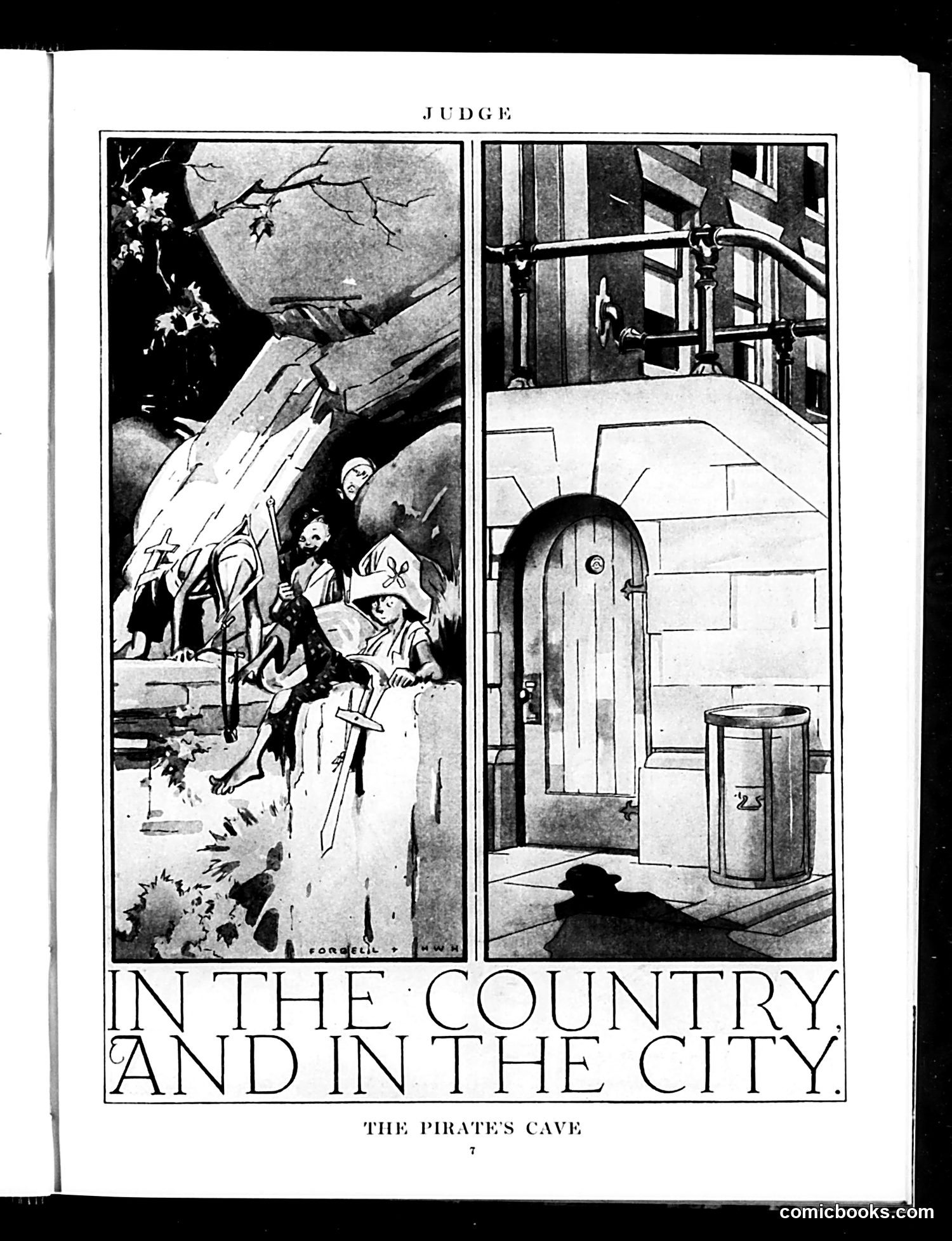
This Judge page presents a two-panel moral contrast. The left panel shows children in a rural setting gathered around a campfire, apparently playing at being pirates or bandits in a natural cave—innocent outdoor adventure. The right panel depicts an urban interior, likely a basement or cellar, where a child appears to be engaged in similar imaginative play but in a confined, industrial city environment. The satire critiques the difference between wholesome country childhood and potentially corrupting city life. Rural children's play in nature is presented as healthy; the same imaginative games in cramped, dark urban spaces appear problematic. This reflects early 20th-century anxieties about urban environments' effects on children's moral development compared to rural settings.
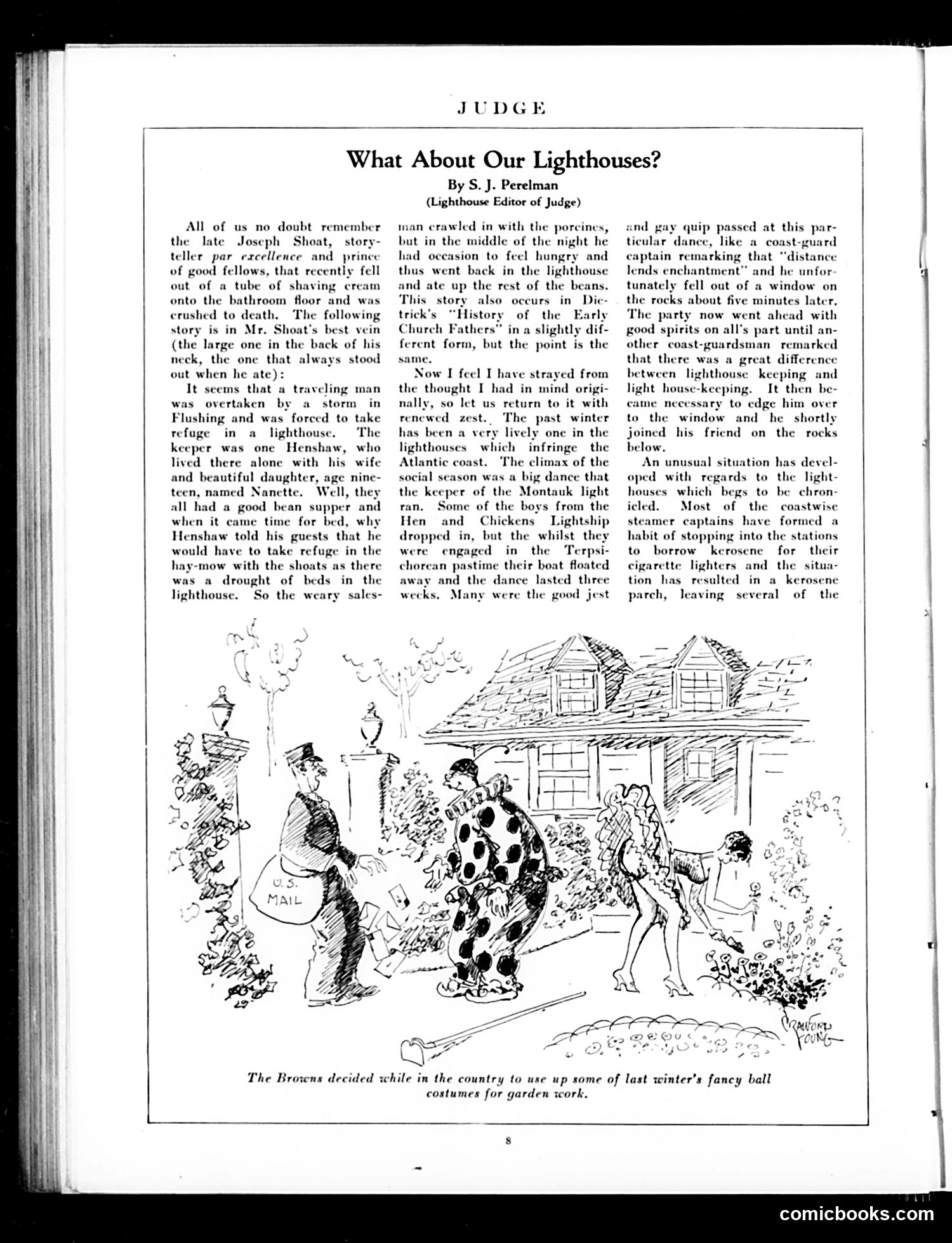
This is a humorous piece by S.J. Perelman (noted as "Lighthouse Editor") that satirizes the absurdity of rambling, pointless anecdotes. The main content is a deliberately nonsensical story about lighthouse-keepers and a traveling salesman—full of non-sequiturs, tangents, and dark jokes (people randomly falling out windows onto rocks). The accompanying cartoon illustrates the actual point: it shows the Brown family wearing fancy ball gowns and costumes from last winter's formal dances while doing ordinary garden work. The satire targets the upper-middle class tendency to repurpose fancy clothing for mundane purposes during country living, suggesting pretension masked by practicality. Together, the piece mocks both verbose storytelling traditions and genteel affectation—themes characteristic of Judge's satirical approach to American social behavior.
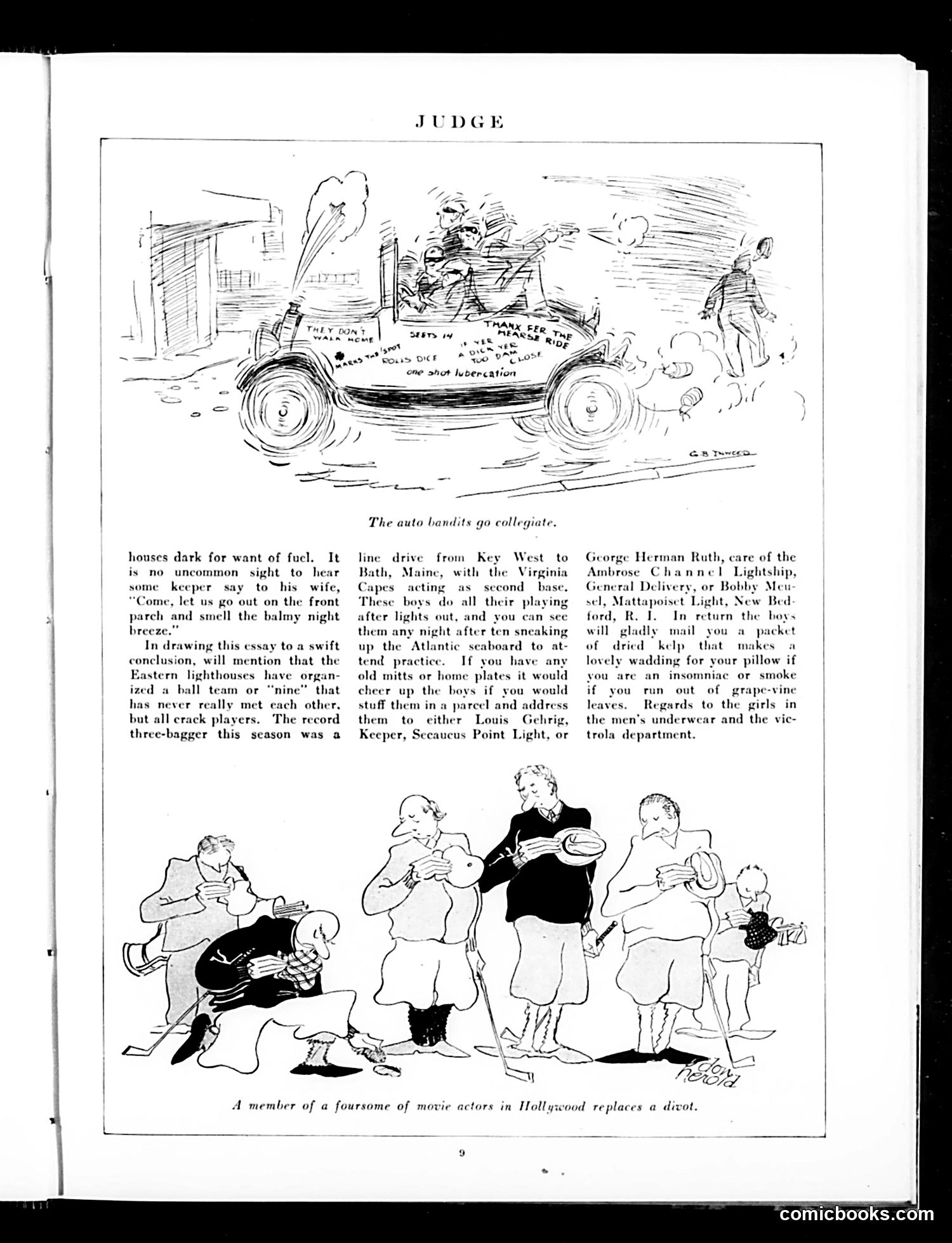
This page contains two unrelated cartoons satirizing early 20th-century American life. **Top cartoon**: "The auto bandits go collegiate" depicts criminals in a stolen car. The humor plays on the era's concern about automobile theft and reckless driving, while the "collegiate" reference mocks the criminals' pretensions or youthful arrogance. **Bottom cartoon**: "A member of a foursome of movie actors in Hollywood replaces a divot" shows what appears to be film actors playing golf. The satire likely mocks Hollywood celebrities' pretensions to gentlemanly refinement—actors, often viewed as frivolous entertainers, are humorously depicted adopting the affectations of upper-class sportsmen by properly maintaining the golf course. The text mentions specific lighthouses and baseball (referencing Ruth and Gehrig), but appears largely disconnected from the cartoons themselves, suggesting editorial filler or separate content. The overall tone reflects Judge's satirical commentary on American social pretension and emerging consumer culture.
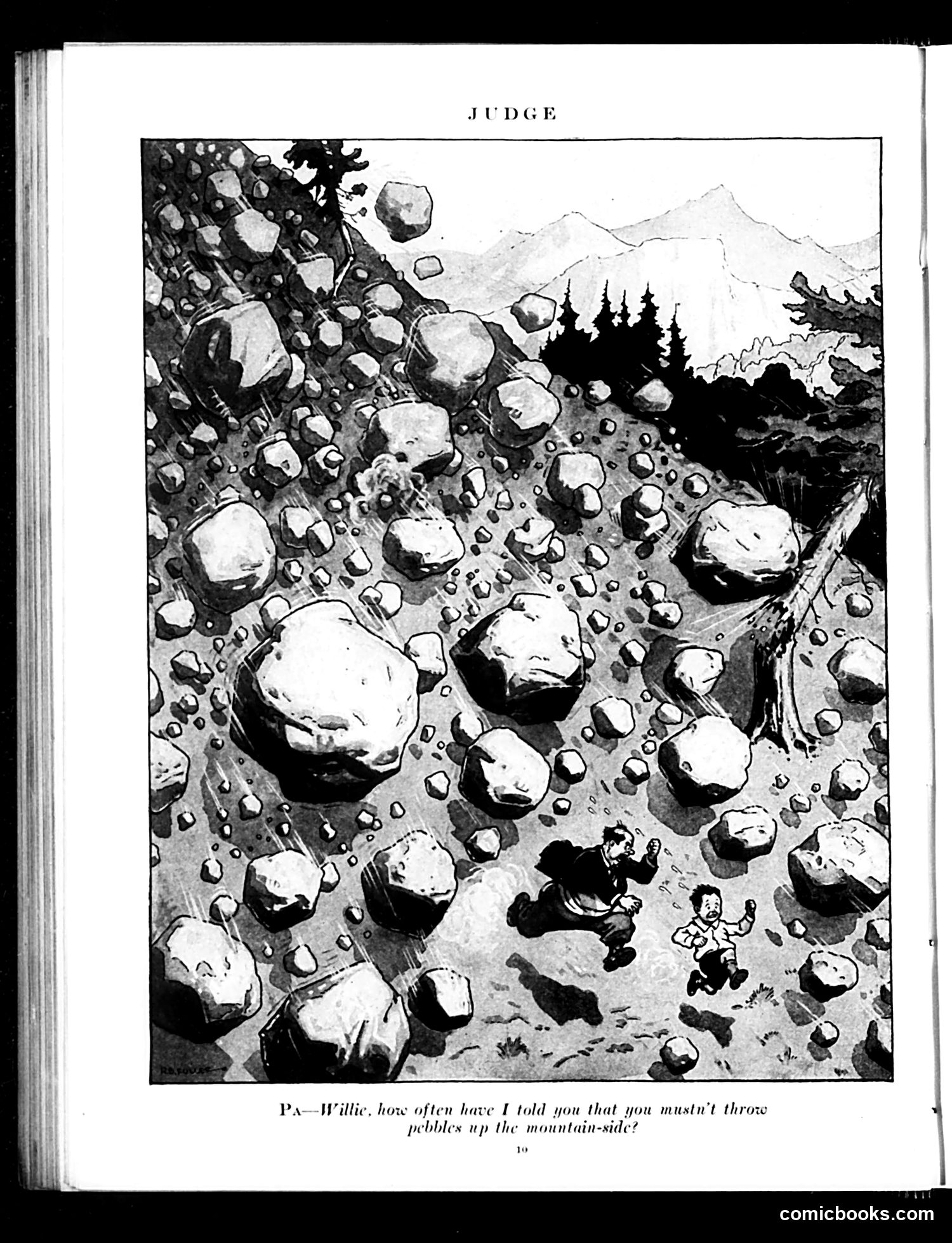
This appears to be a single-panel cartoon titled "Judge" depicting a parent (Pa) scolding a child (Willie) in a mountainous landscape scattered with large boulders and rocks. The joke plays on a literal interpretation of a common parental warning. Pa has repeatedly told Willie not to throw pebbles up the mountainside—presumably because it's dangerous or destructive. However, the cartoon shows the mountainside now covered in massive boulders, suggesting Willie's pebble-throwing has somehow caused an avalanche or rockslide of enormous proportions. The humor derives from the exaggerated consequence: Willie's minor disobedience (throwing small pebbles) has resulted in catastrophic destruction—a visual pun on the phrase "throwing pebbles" taken to absurd extremes. This reflects early 20th-century American humor's preference for slapstick exaggeration and child-centered domestic comedy.
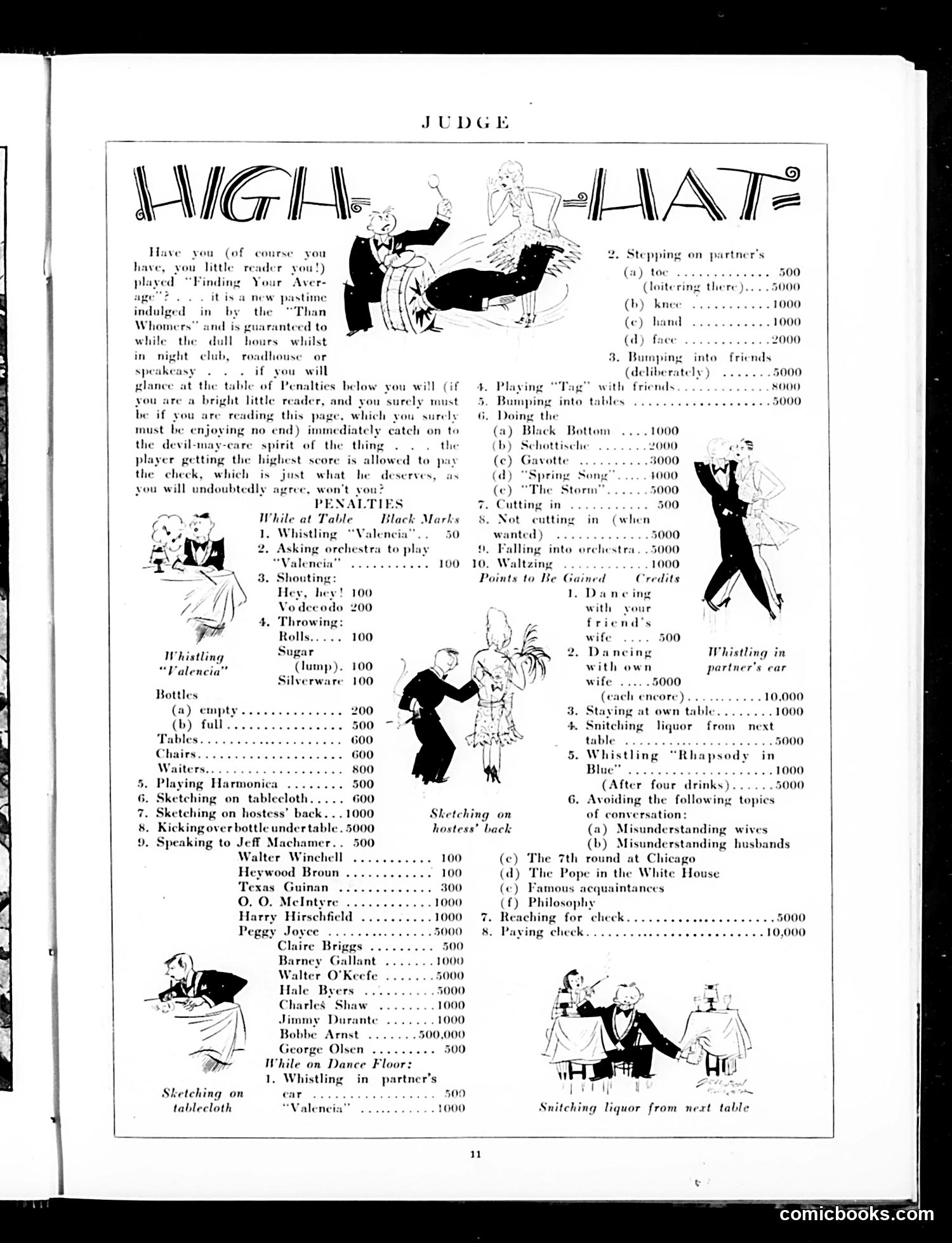
This is a satirical "penalty and credits" game mocking 1920s nightlife etiquette during Prohibition. The page lists humorous infractions and rewards for behavior in speakeasies and dance halls, with the loser paying the check. Key references: - **"Valencia"** — a popular jazz song of the era, apparently annoying when whistled repeatedly - **Texas Guinan, Walter Winchell, Heywood Broun, etc.** — famous celebrities and journalists of the 1920s; speaking to them carries penalties (mockingly suggesting they're undesirable company) - **Black Bottom, Schottische** — popular dances - **"Rhapsody in Blue"** — Gershwin's famous 1924 composition The satire targets elite speakeasy culture: rude behavior (kicking bottles, sketching on hosts), crude dancing, public drunkenness, and illicit drinking ("snitching liquor") were common despite Prohibition. The joke is that the "worst" offender—who commits the most outrageous violations—must pay, inverting normal social consequences. It's simultaneously mocking both prohibition-era excess and the pretense of "high society" nightlife.
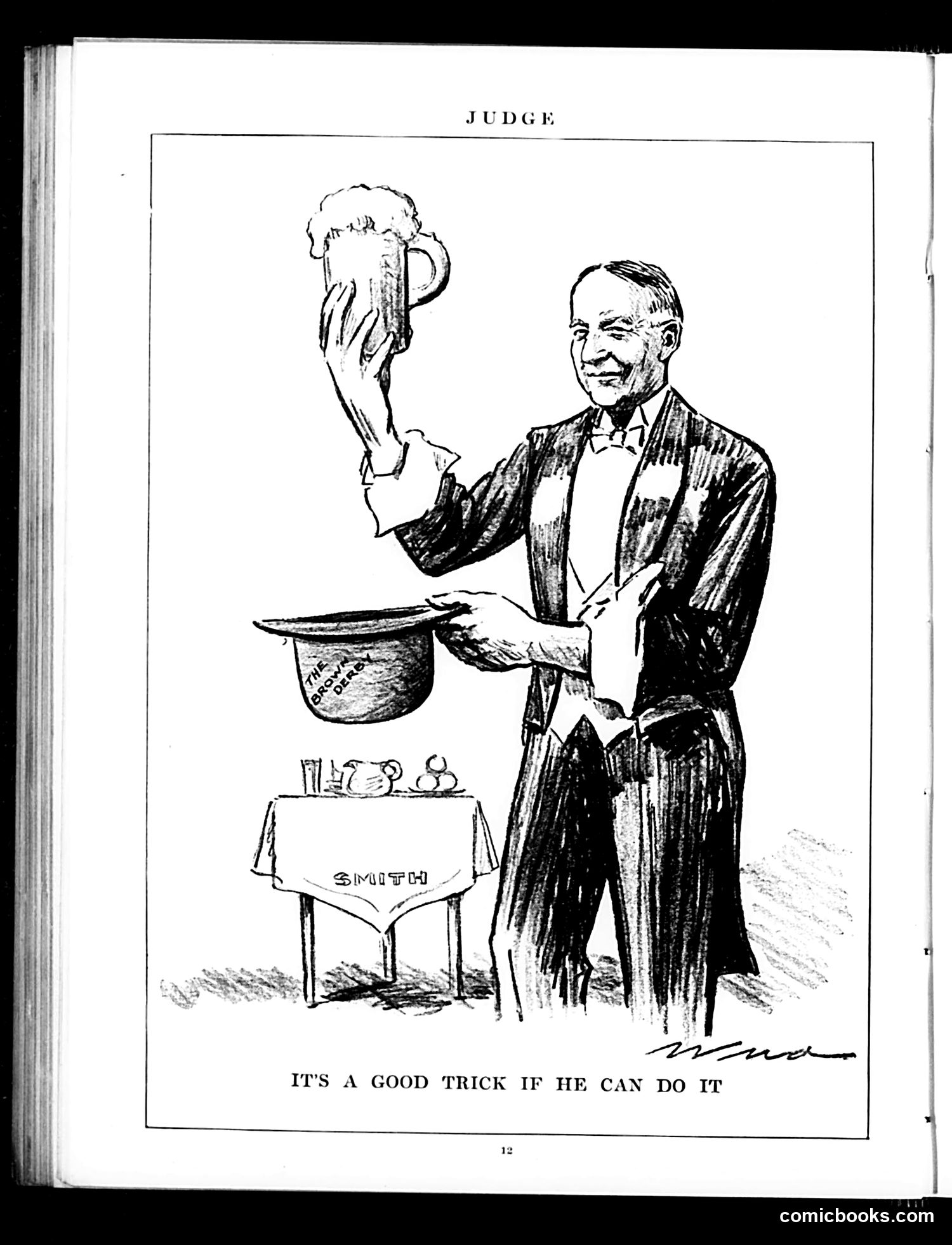
This cartoon titled "It's a Good Trick If He Can Do It" depicts a well-dressed man in formal attire performing a magic trick. He's holding up what appears to be a rabbit or similar creature pulled from a pot labeled "SMITH" (visible on the table). The satire likely references a political figure or public official named Smith attempting an impressive feat or making an unlikely promise. The "magic trick" metaphor suggests skepticism about whether the person can actually accomplish what they claim. The formal dinner setting and magician's presentation imply this is commentary on political showmanship or deception—the cartoon's point being that such "tricks" are difficult to pull off successfully. Without knowing the specific date of publication, the exact Smith referenced remains unclear.
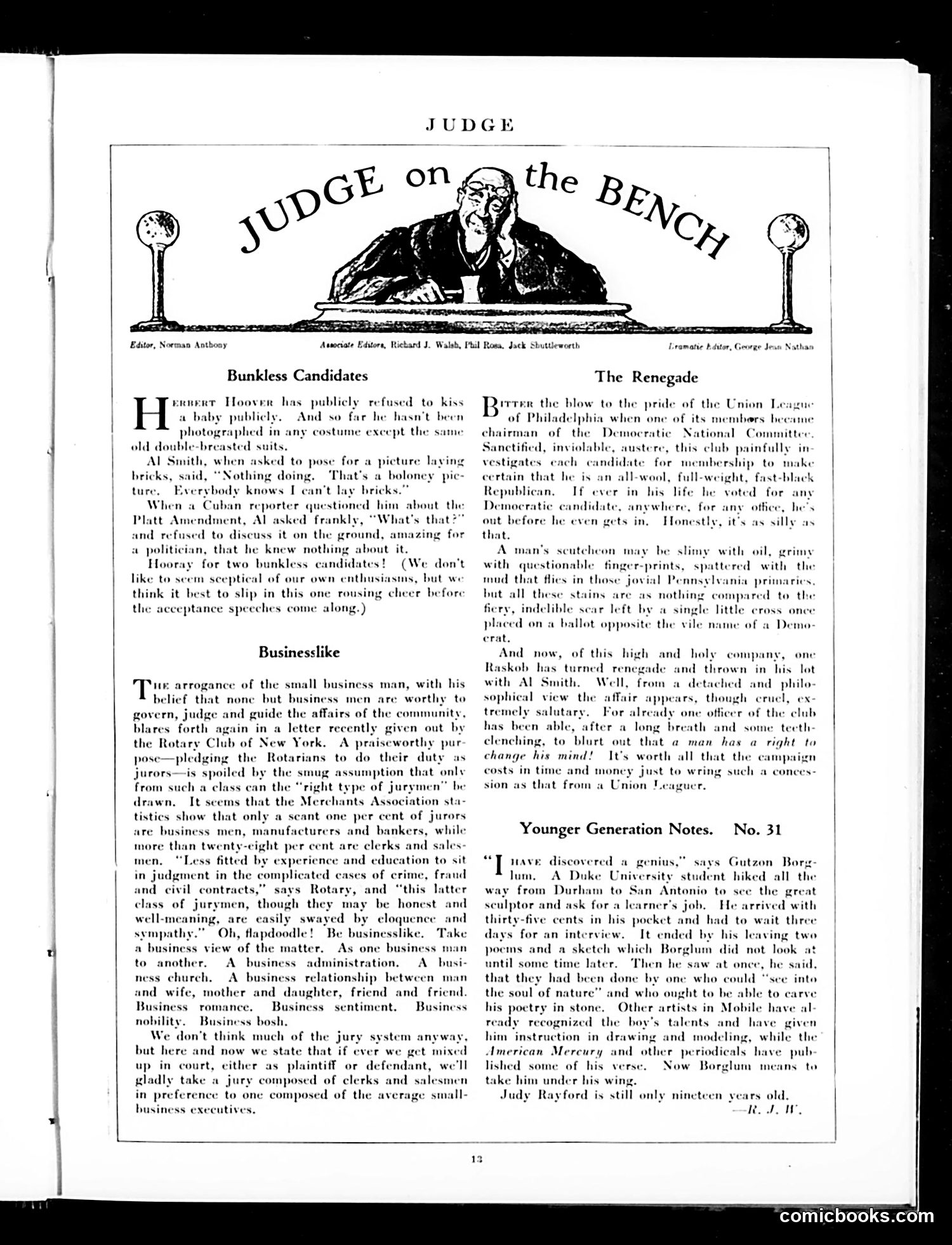
This page from *Judge* magazine contains satirical commentary on 1928 American politics, likely from the presidential election year. **"Bunkless Candidates"** mocks Herbert Hoover and Al Smith for their deliberate avoidance of typical campaign theatrics—Hoover refuses to kiss babies or wear costumes; Smith admits ignorance of the Platt Amendment rather than pretend expertise. The satire celebrates their candor as refreshingly honest. **"Businesslike"** attacks the Rotary Club and Merchants Association for arguing that only businessmen should serve on juries, claiming working-class clerks and salesmen lack judgment. *Judge* sarcastically endorses the opposite view, preferring ordinary workers to "average small-business executives." **"The Renegade"** criticizes Philadelphia's Union League club for treating Democratic voting as an unforgivable moral stain, even as member John Raskob joins Al Smith's campaign. The piece mocks such rigid partisan orthodoxy as absurd. These pieces reflect 1920s debates over class, expertise, and political loyalty.
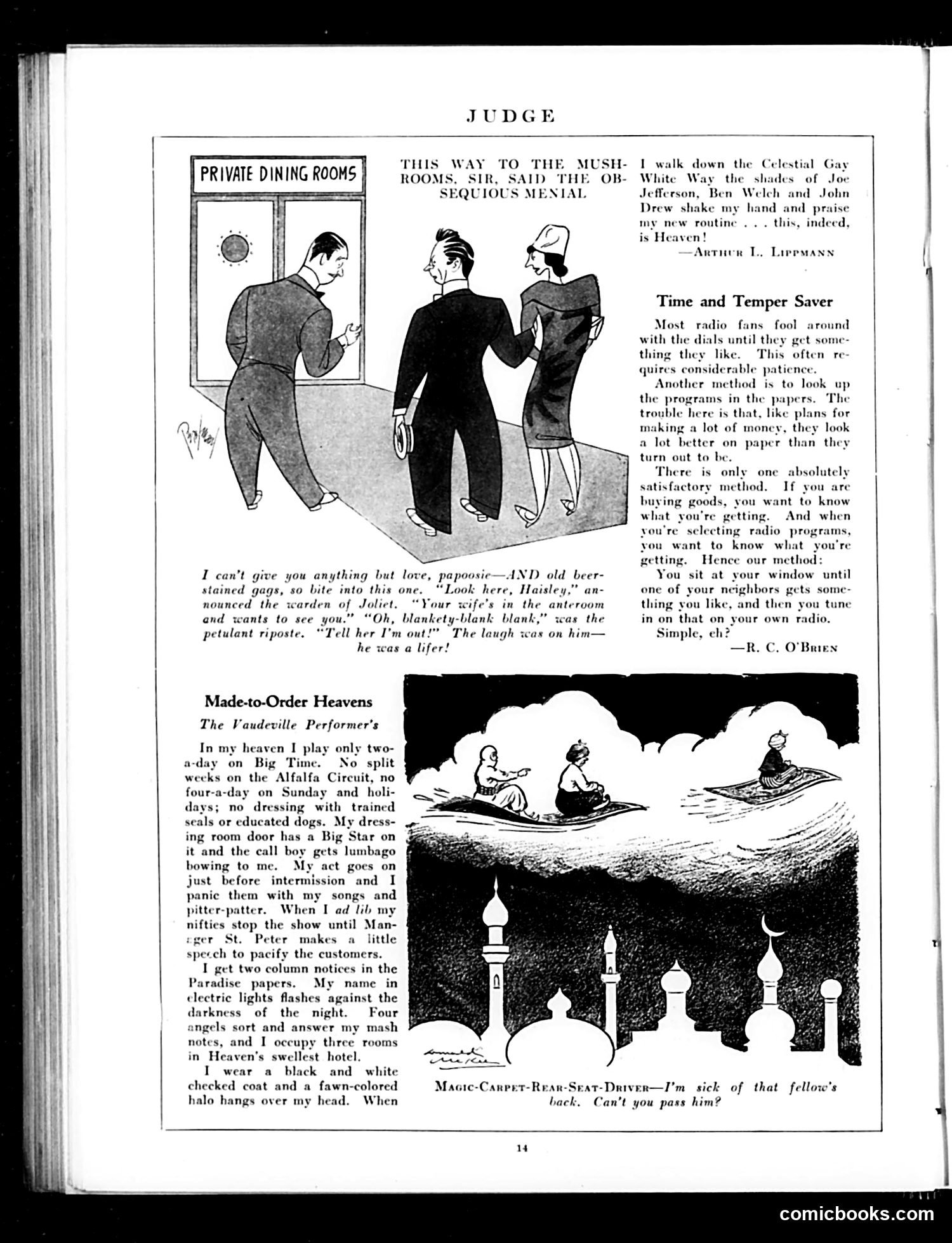
This page contains three separate humorous pieces typical of 1920s-30s Judge magazine: **"Private Dining Rooms"** (top): A cartoon joke about a man and woman entering what appear to be discrete hotel rooms. The accompanying gag—about a lifer prisoner refusing to see his wife, then being outsmarted—relies on crude wordplay and double entendre about infidelity and imprisonment. **"Made-to-Order Heavens"** (middle): A vaudeville performer fantasizes about his ideal heaven: playing prestigious two-a-day shows, receiving star treatment, getting excellent reviews in "Paradise papers," with famous theatrical figures (Jefferson, Ben Welch, John Drew) praising him. It satirizes show-business ambition and vanity by imagining heaven itself catering to ego. **"Magic-Carpet-Rear-Seat-Driver"** (bottom cartoon): Shows someone on a magic carpet irritated by a fellow passenger's presence, asking to "pass him." A joke about backseat drivers—annoying passengers—transplanted to a fantastical setting. All three pieces employ the magazine's characteristic style: mild sexual innuendo, entertainment-industry in-jokes, and everyday frustrations rendered absurd through surreal scenarios.
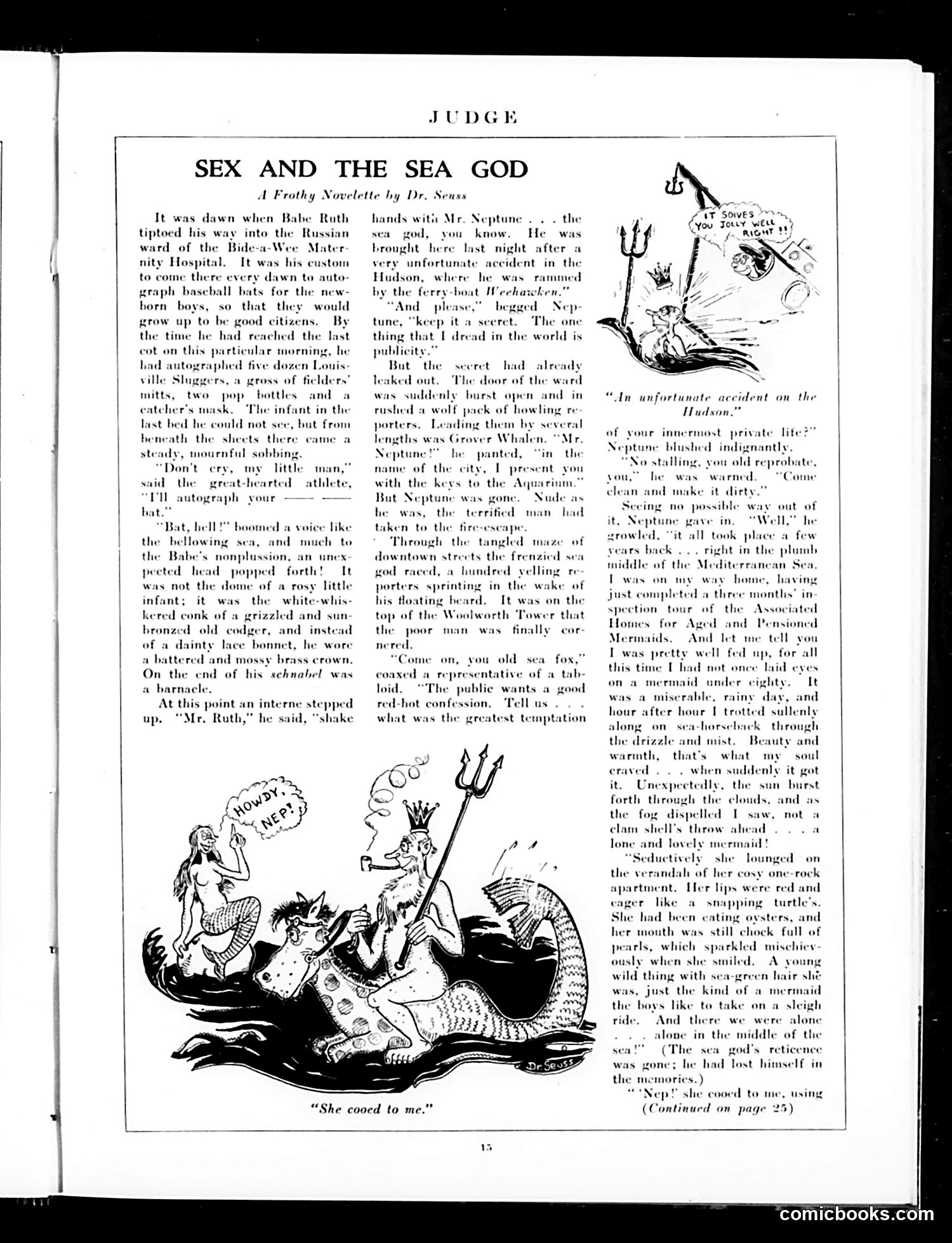
This is a humorous novelette featuring **Babe Ruth**, the famous baseball player, encountering **Neptune**, the sea god, in a hospital maternity ward. The satire targets several 1920s-30s themes: **The Setup**: Ruth visits to autograph baseball bats for newborns when he discovers Neptune recovering from hitting a ferry boat in the Hudson River. Neptune begs for secrecy about his presence. **The Satire**: The joke centers on **publicity and celebrity culture**. Despite Neptune's pleas, reporters (led by what appears to be **Grover Whalen**, a NYC official) chase him through Manhattan, culminating in a confrontation atop the Woolworth Tower demanding a "confession." **The Punchline**: The "scandal" involves Neptune encountering a seductive mermaid—treated as lurid tabloid content ("make it dirty"). The exaggeration mocks how aggressively newspapers sensationalized celebrities' private lives. The cartoons illustrate the comedic chaos, emphasizing the frenzy of pursuing tabloid stories and the invasion of privacy that characterized 1920s-30s celebrity journalism.
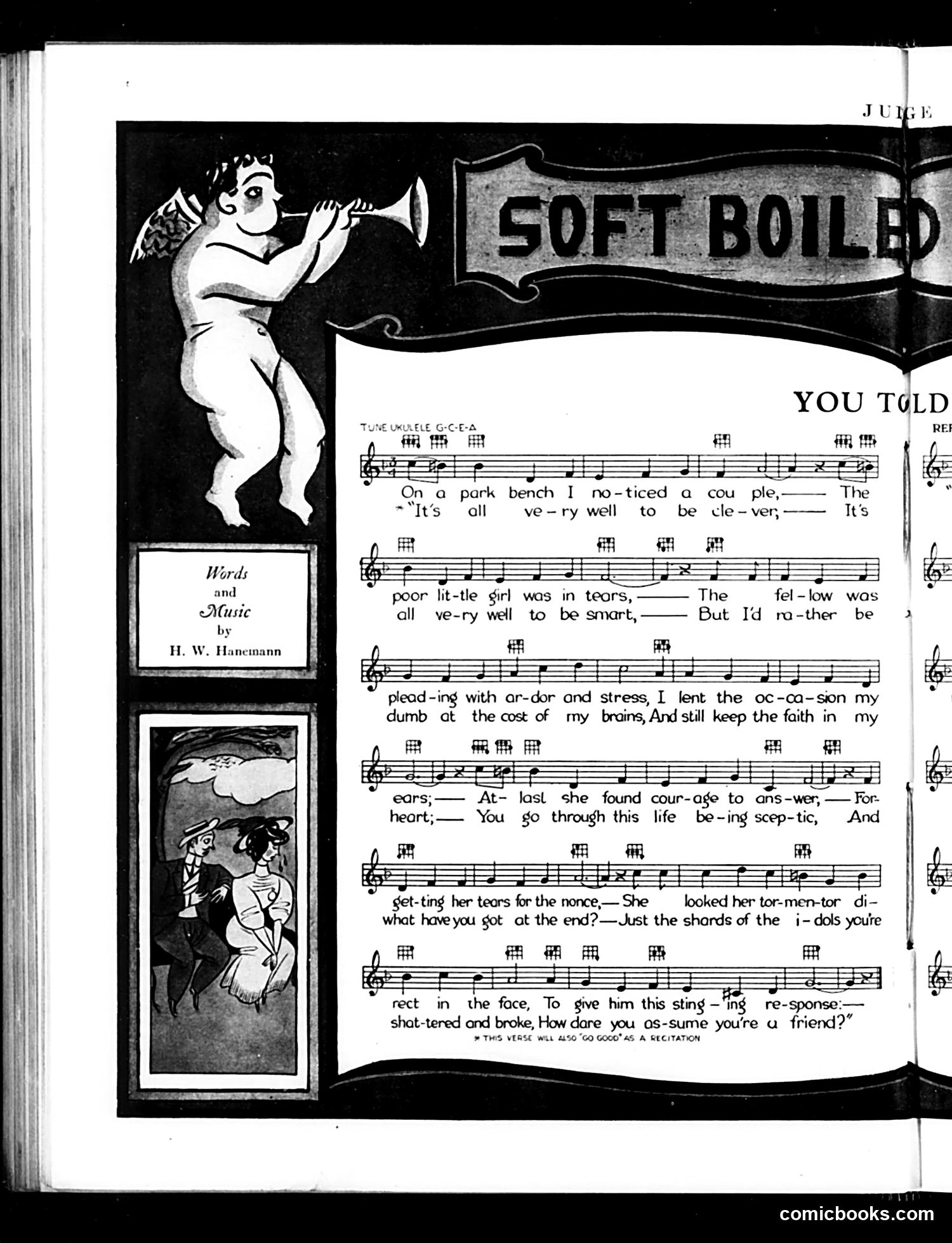
This page presents a sentimental song with lyrics by H.W. Hanemann, set to ukulele music—a popular instrument of the 1920s-30s era. The narrative depicts a scene where a man observes a couple on a park bench: a young woman in tears and a fellow "pleading with ardor and stress." The song's moral centers on a familiar early-20th-century debate about intellect versus emotional wisdom. The lyrics warn against cynicism and excessive skepticism in relationships, advocating instead for faith and emotional vulnerability. The title "Soft Boiled" appears to mock sentimental romanticism—contrasting with harder, more rational approaches to love. The cherub illustration and dated aesthetic suggest this represents period attitudes about courtship, masculinity, and the tension between intellect and sentiment. The note at bottom indicates this was intended as a recitation piece, reflecting the magazine's typical use of popular music for social commentary and humor.
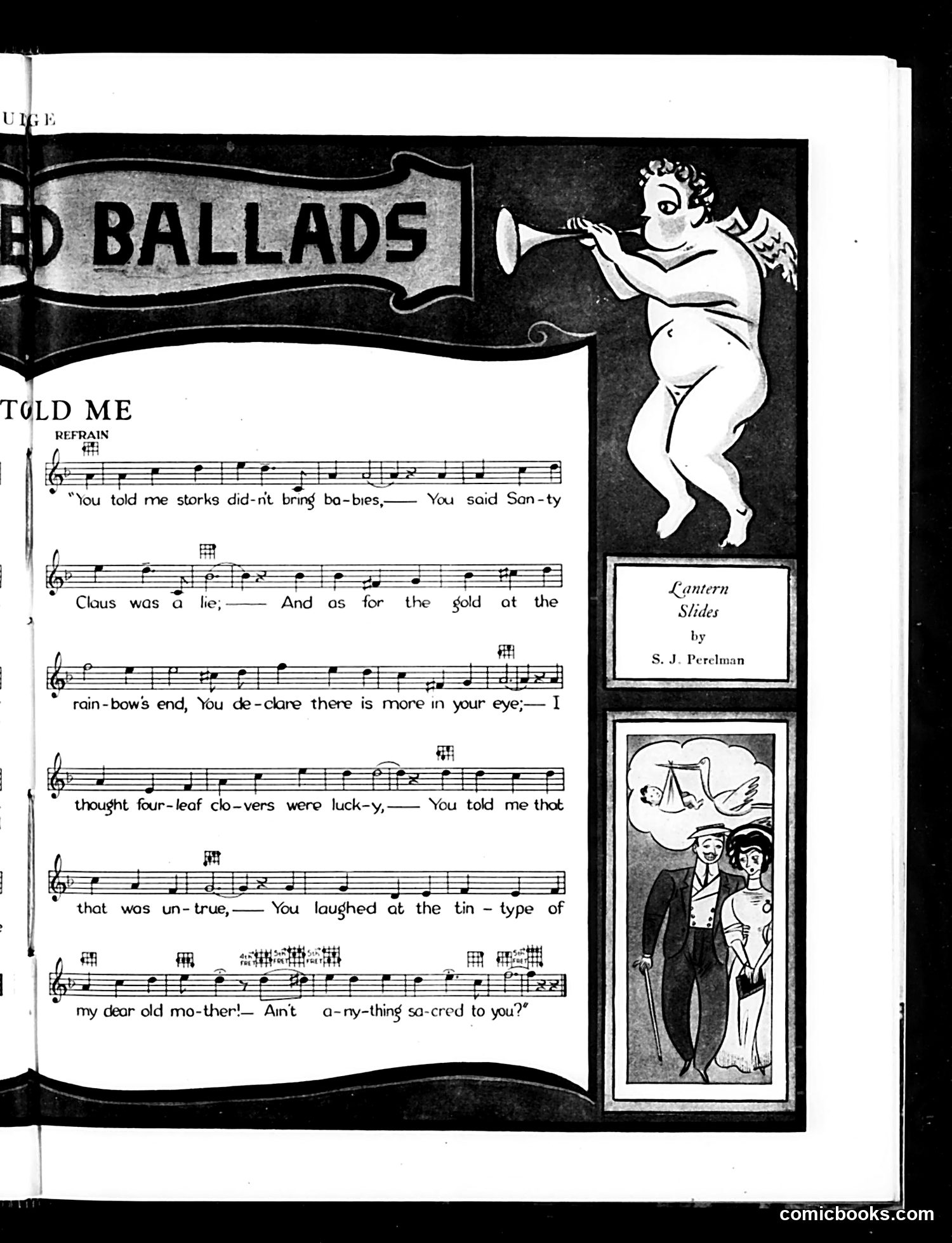
This page contains a sentimental ballad titled "You Told Me," set to music with a piano refrain. The song depicts a child (or young person) reproaching an adult—likely a parent or authority figure—who has systematically debunked childhood beliefs and myths: Santa Claus, storks delivering babies, four-leaf clovers, rainbows, and family traditions. The ballad's emotional appeal lies in its critique of excessive cynicism or harsh realism imposed on youth. The final line—"Ain't a-ny-thing sa-cred to you?"—captures the central complaint: the adult has destroyed innocent wonder without replacing it with anything meaningful. The accompanying illustration by S. J. Perelman (credited as "Lantern Slides") shows a cherub with a trumpet and a couple gazing upward at the stork delivering a baby—visual representations of the exact myths being mocked in the song. The satire targets those who aggressively strip away childhood innocence, questioning whether such disillusionment serves any constructive purpose.
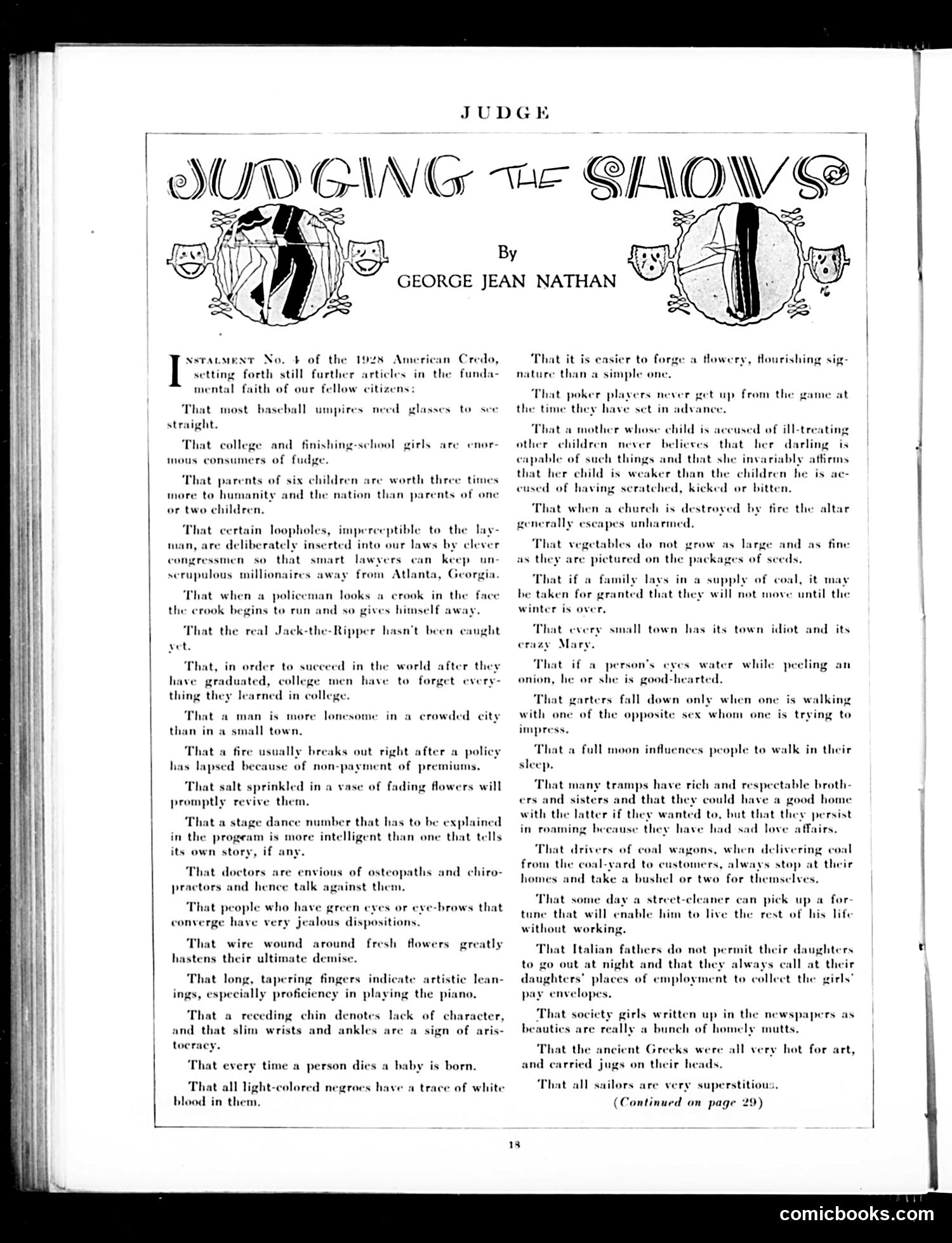
This page presents installment #4 of "The 1928 American Credo"—a satirical catalog of popular misconceptions and folk beliefs held by ordinary Americans. Rather than depicting specific political figures or events, Nathan uses humor to mock widespread superstitions and social hypocrisies of the era. The satirized beliefs range from physiognomy pseudoscience (receding chins indicate weak character; tapered fingers suggest artistic talent) to class assumptions (slim wrists indicate aristocracy) and racial pseudoscience (light-skinned Black Americans have "white blood"). The satire also targets social double standards: mothers defending misbehaving children, doctors envying alternative practitioners, and coal drivers stealing fuel. The humor relies on readers recognizing these as absurd commonplaces—Nathan's method of social criticism through exaggeration of what "everyone believes" despite lacking evidence. This was typical Judge magazine satire of the 1920s.
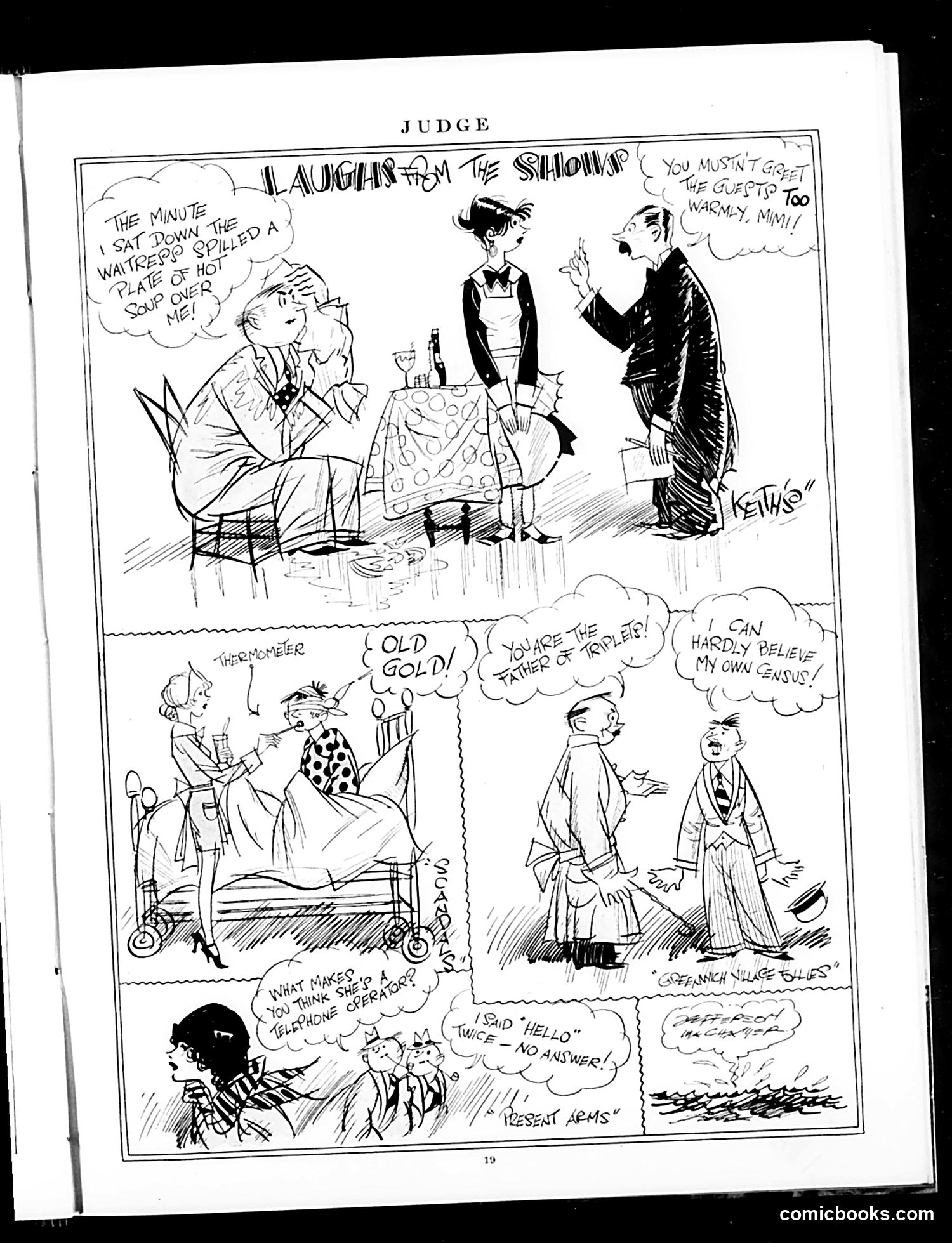
This multi-panel satirical cartoon depicts social situations involving judges and the legal system. The top panel shows a waiter serving a judge who complains about hot soup. Subsequent panels present courtroom and street scenes where characters reference judicial authority and legal proceedings. The satire appears to mock the pretentiousness and pomposity of judges—their self-importance contrasted with everyday complaints (the soup), and their sanctimonious pronouncements about morality and propriety. The repeated references to being a "judge" and comments about "old gold" and proper conduct suggest mockery of judicial authority figures' tendency toward grandiosity and moral posturing. The cartoon's humor relies on depicting judges as absurdly self-important even in trivial situations, a classic early 20th-century *Judge* magazine theme satirizing American legal and social hierarchies.
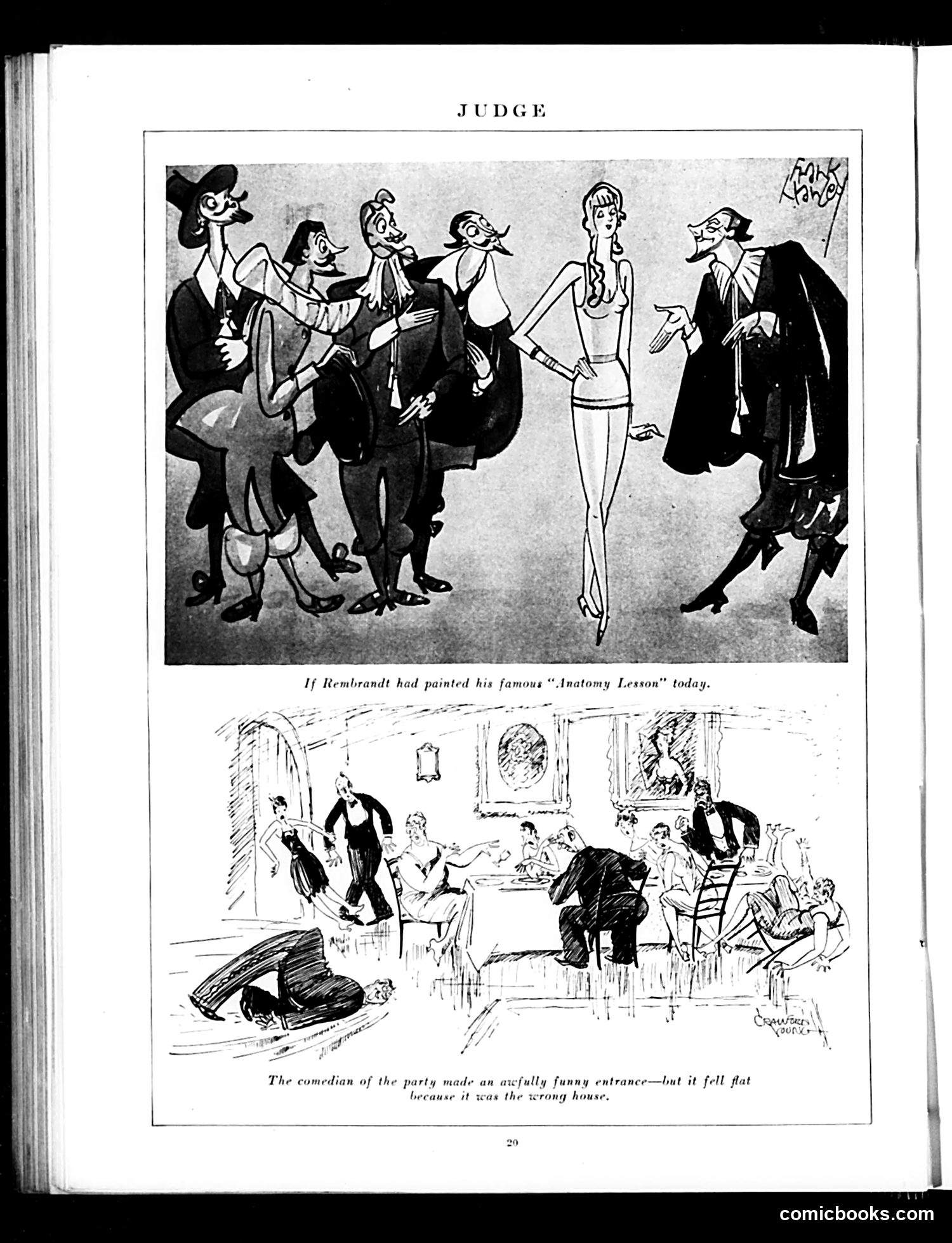
This page contains two related satirical cartoons mocking a social mishap. The top cartoon shows a woman in underwear surrounded by formally dressed men, with the caption referencing Rembrandt's "Anatomy Lesson." The bottom cartoon depicts a similar scene inside a parlor, where a man's comedic entrance has failed because he entered the wrong house. The satire targets early 20th-century party culture and male behavior. The joke relies on physical comedy and embarrassment: a would-be "comedian" attempts a scandalous entrance (likely meant to shock or amuse guests) but botches it by crashing the wrong social gathering. The contrast between expectation and reality—between a planned joke and accidental intrusion—drives the humor. The artwork mocks both the foolish would-be comedian and the pretentious formality of the social scene.
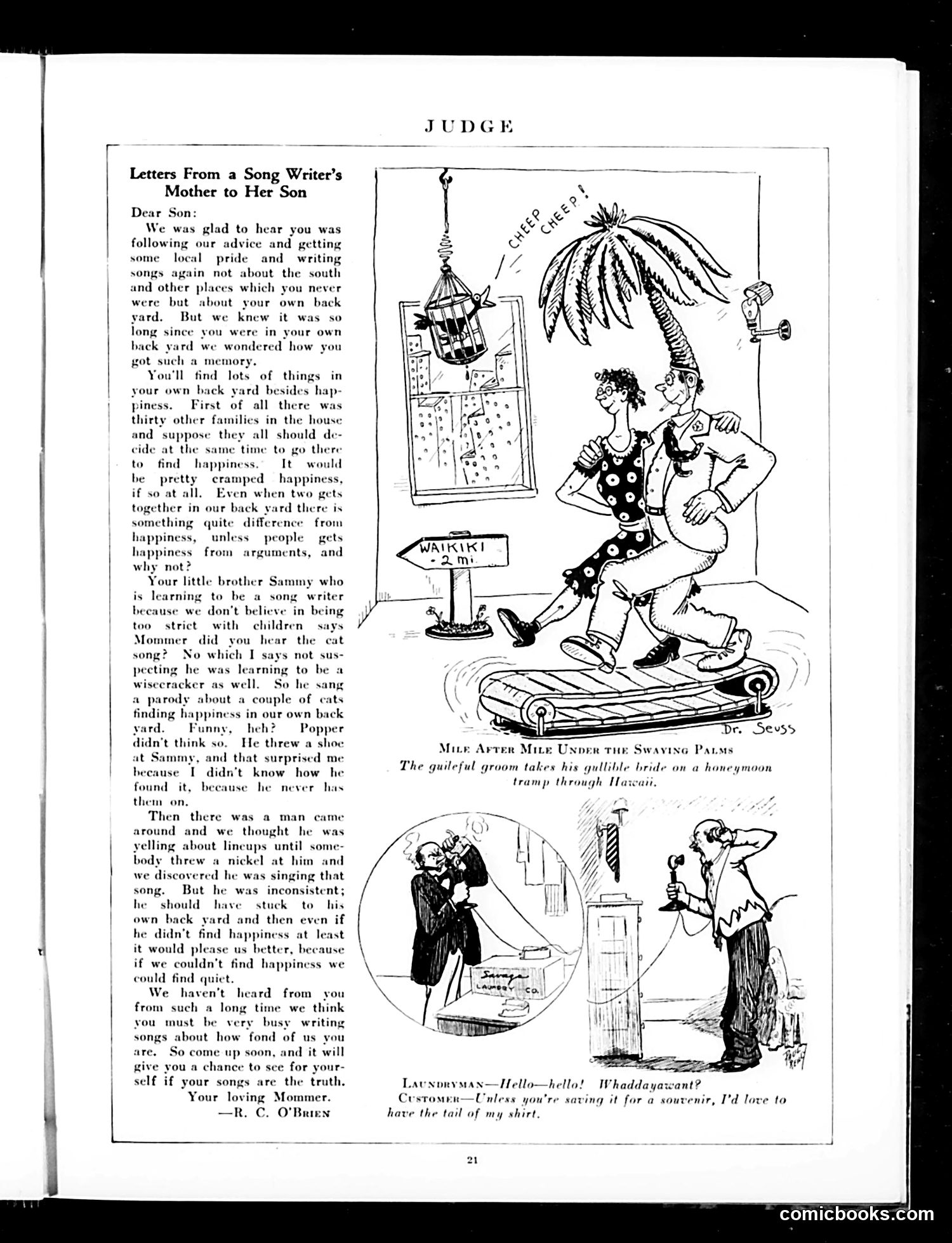
This Judge magazine page contains humorous letters and cartoons satirizing early 20th-century American life. **The Letter:** A working-class mother writes her aspiring songwriter son, mocking the trendy advice to "write about your own backyard" for authenticity. Her satire: their cramped tenement building with thirty families fighting for happiness in shared space isn't romantic material. She notes even her younger son's cat song failed, and a man singing in their building about happiness was actually yelling about hiccups—the confusion of poverty with poetry. **The Cartoons:** Two illustrated jokes accompany the letter. The top shows newlyweds on a Hawaiian honeymoon under a swaying palm, captioned about their "tramp through Hawaii." The bottom depicts a laundry worker asking a customer about saving a shirt tail as a "souvenir"—absurdist humor about poverty and class. The overall satire critiques romanticization of ordinary, humble life by those unfamiliar with actual working-class struggle.
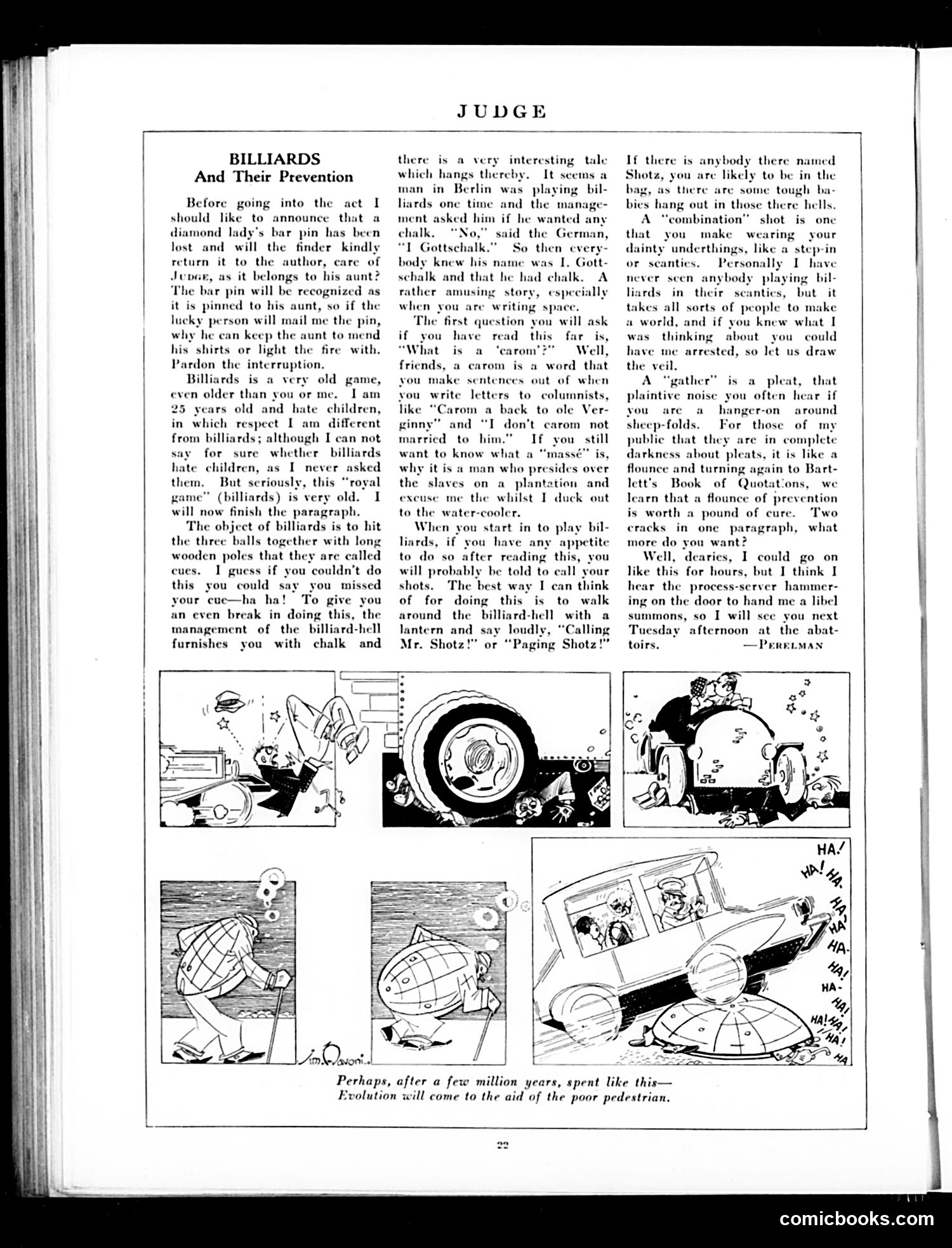
This page satirizes billiards culture and, in a concluding comic strip, traffic dangers. The main text is a humorous essay that uses billiards as a framework for absurdist jokes—puns about "cues," contrived etymologies (the "Gottschalk/chalk" anecdote), and deliberately obtuse definitions designed to frustrate rather than inform readers. The final comic strip (six panels) depicts the actual satirical target: pedestrians endangered by automobiles. Early panels show billiard balls and cues; later panels shift to vehicles with oversized wheels crushing pedestrians. The caption warns that pedestrians need evolutionary adaptation to survive modern traffic—a dark joke about automobile safety hazards of the era (likely 1920s-1930s). The "prevention" in the title refers ironically to how billiards distract from discussing real prevention: traffic safety for vulnerable pedestrians.
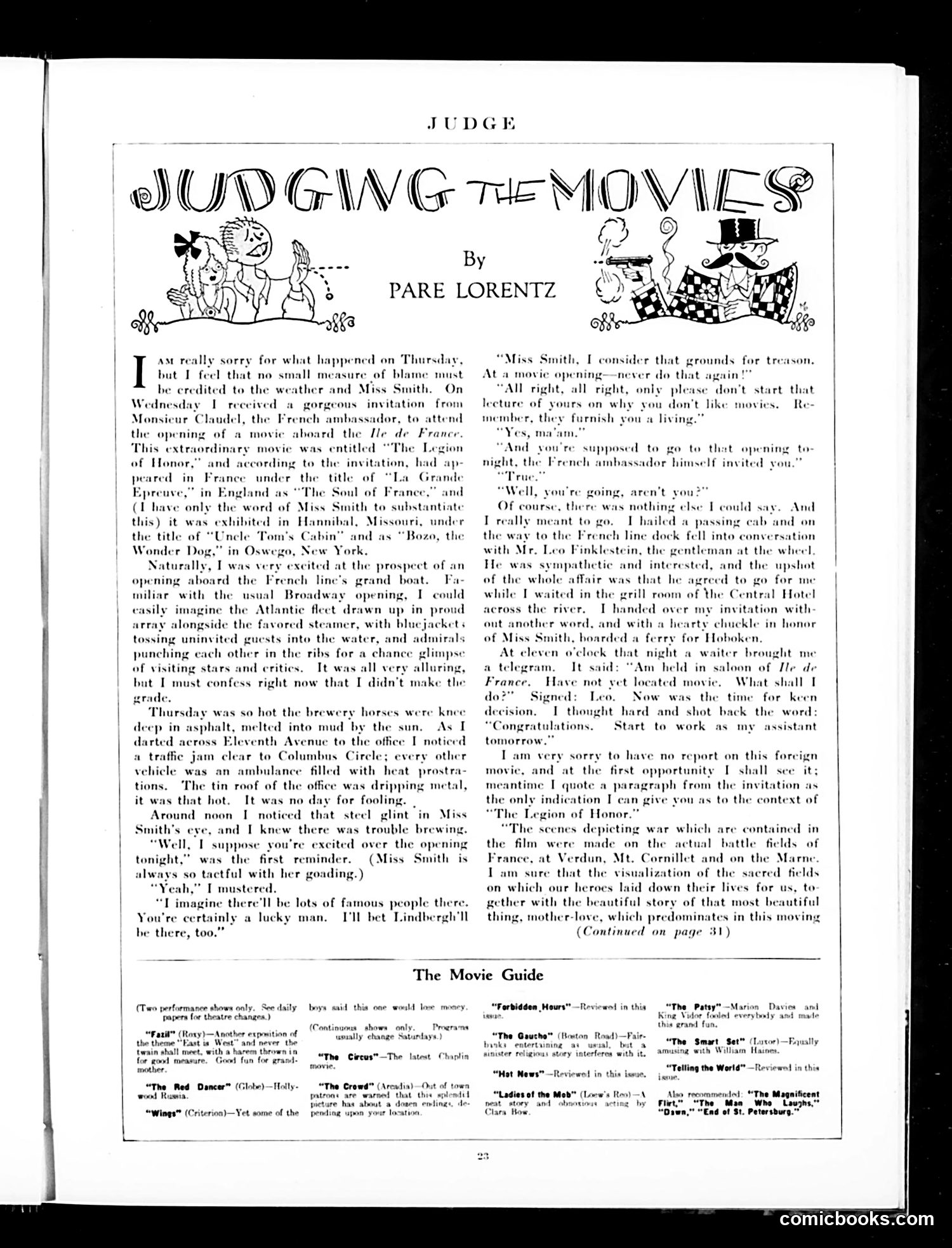
This is a humorous essay by Pare Lorentz about being invited to a movie premiere aboard a French ocean liner. The narrator, a film critic, receives an invitation from the French ambassador to attend the opening of "The Legion of Honor" (a French war film about WWI battle sites). However, his office assistant, Miss Smith, criticizes his indifference to movies, shaming him into going. The joke hinges on the narrator's elaborate excuse-making: he sends a substitute (Leo Finklestein) in his place, who gets locked in the ship's saloon and never actually watches the film. The satire mocks pretentious cultural events, movie-industry self-importance, and the narrator's cowardly avoidance of social obligation despite accepting the honor. The extreme heat and chaotic city scenes underscore the absurdity of the situation.
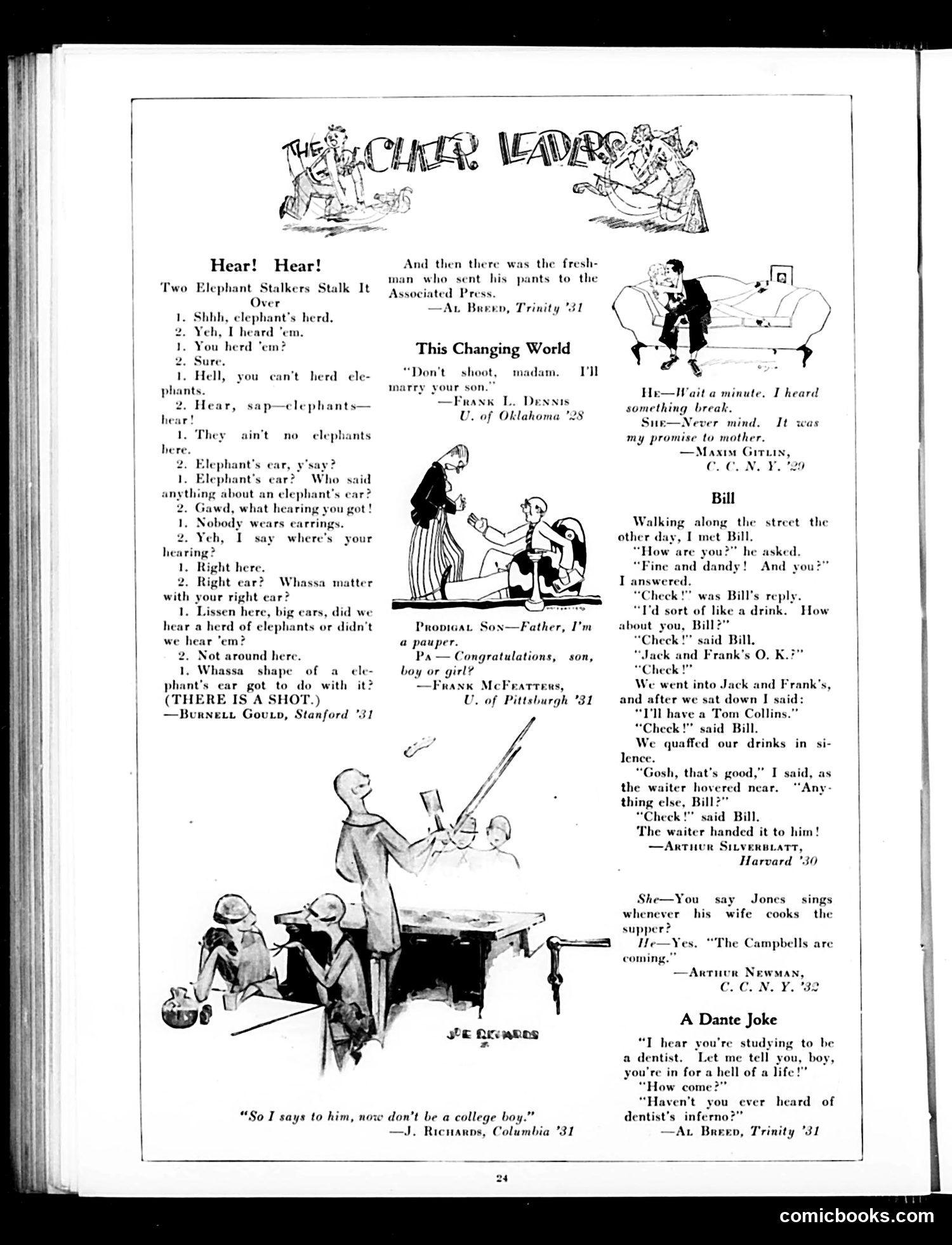
This is a humor compilation page from Judge magazine, likely from the late 1920s or early 1930s, featuring student-submitted jokes and comic dialogue. **Main content:** The page contains several unrelated comic sketches and joke submissions, primarily from college students (indicated by university attributions like "Stanford '31," "Trinity '31," "Harvard '30"). **The humor is largely wordplay and observational comedy:** - "Hear! Hear!" plays on homophone confusion (herd/heard) - "This Changing World" section includes mild domestic and social humor - The "Bill" sketch depicts casual conversation between friends discussing drinks - "A Dante Joke" uses the pun "dentist/Inferno" **Context for modern readers:** These appear to be genuine student submissions to a satirical magazine's humor section. The jokes are innocent, pun-heavy, and reflect 1930s college culture—referencing social activities like drinking and dating. There's no apparent political satire here; it's purely lighthearted collegiate humor typical of the era.
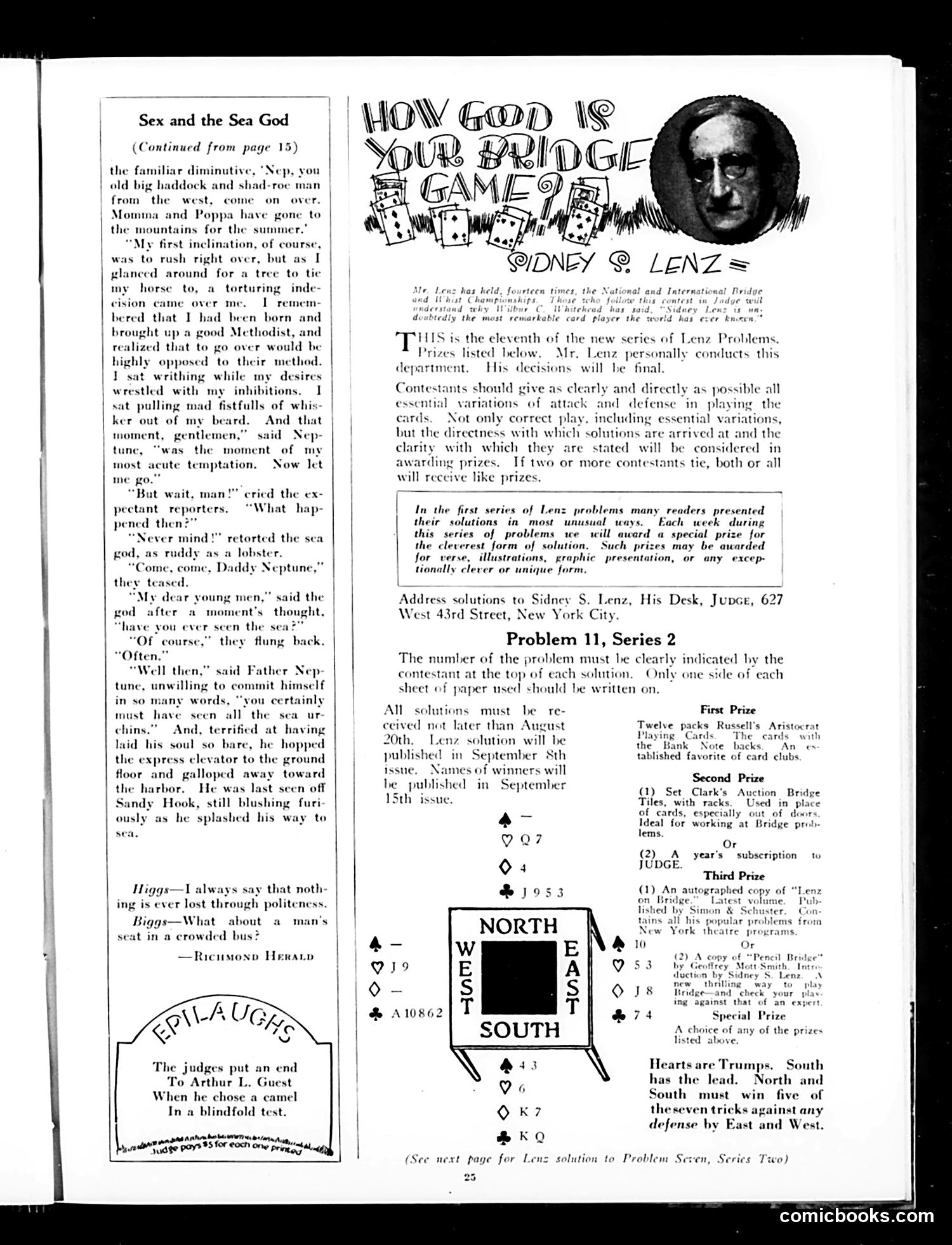
This page combines fiction, bridge puzzle content, and advertising typical of Judge magazine. **Main Content:** The top half continues "Sex and the Sea God," a humorous fictional piece about Neptune tempting a Methodist man. The joke plays on religious moral anxiety—the protagonist wrestles with desire versus Methodist propriety, ultimately resolved when Neptune himself loses nerve and retreats, "blushing furiously." The satire mocks both prudish religiosity and the pretense of authority figures (even gods) when confronted with actual temptation. **Bridge Problems:** The bulk of the page advertises "Lenz Problems," a recurring bridge puzzle series by Sidney S. Lenz. This was legitimate content for Judge's educated readership. The puzzle shows a bridge hand diagram with prizes offered for solutions, including playing cards, subscriptions, and bridge manuals—reflecting bridge's popularity among the magazine's audience. **Sidebar:** The "Epilaughs" section contains a brief joke about politeness losing nothing—thematic with the main story's moral anxiety humor.
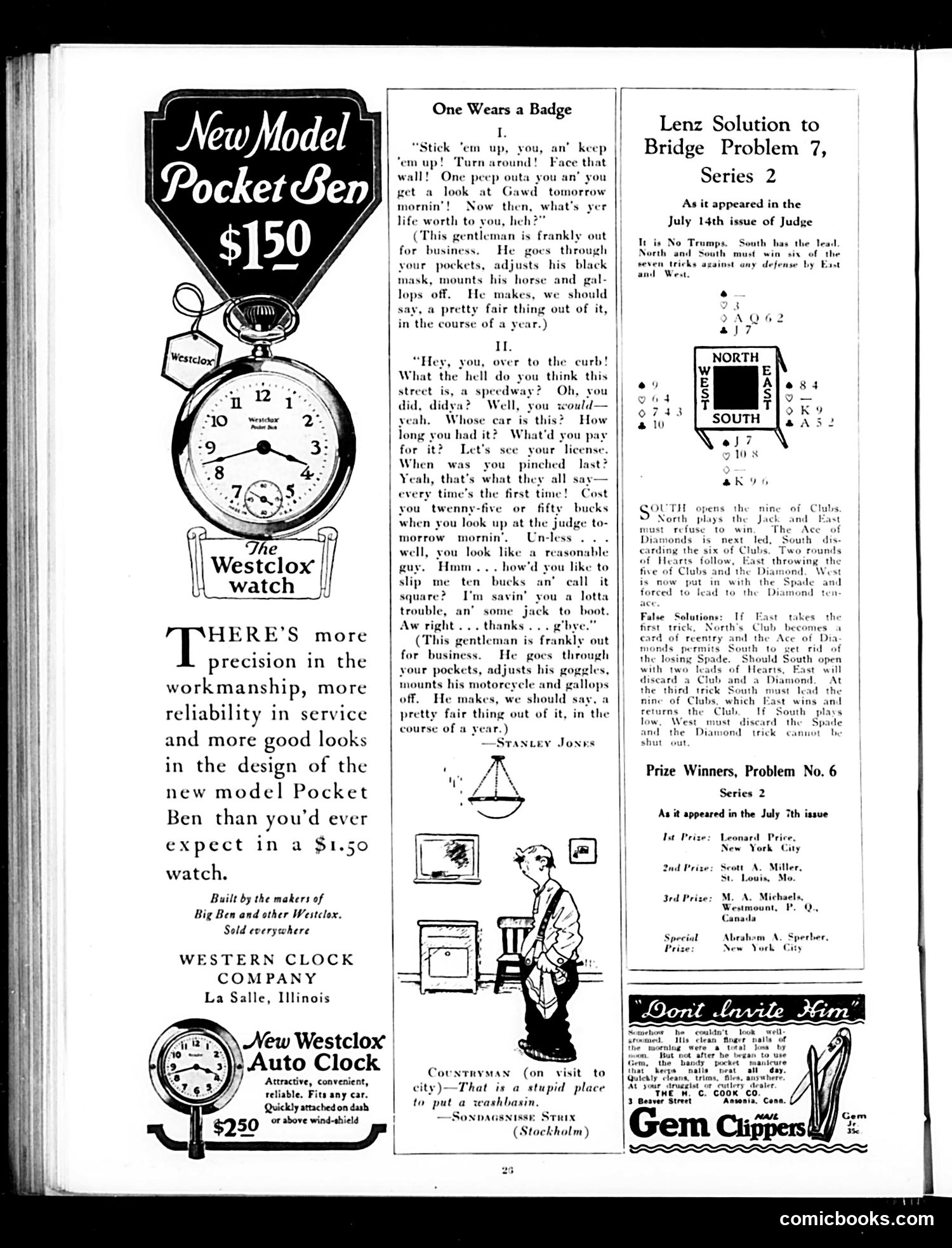
This page contains two satirical cartoons by Stanley Jones about urban crime and police corruption, likely from the 1920s-30s based on the style and references. **The cartoons depict two criminals:** 1. **First figure**: A highwayman/robber who openly steals from pedestrians, mounts his horse, and profits handsomely over a year—operating with apparent impunity. 2. **Second figure**: A corrupt police officer who pulls over motorists, extorts bribes ("slip me ten bucks an' call it square"), and profits similarly through shakedowns. **The satire's point**: Both wear badges of authority in different ways—the robber's violence, the cop's official position. The cartoon suggests that urban law enforcement was riddled with corruption: a policeman was as predatory as a common criminal, simply using his badge as legal cover for extortion. The bitter humor highlights widespread public perception that police protection was actually systematic theft justified by official status. This reflects genuine 1920s-30s concerns about police corruption in American cities.
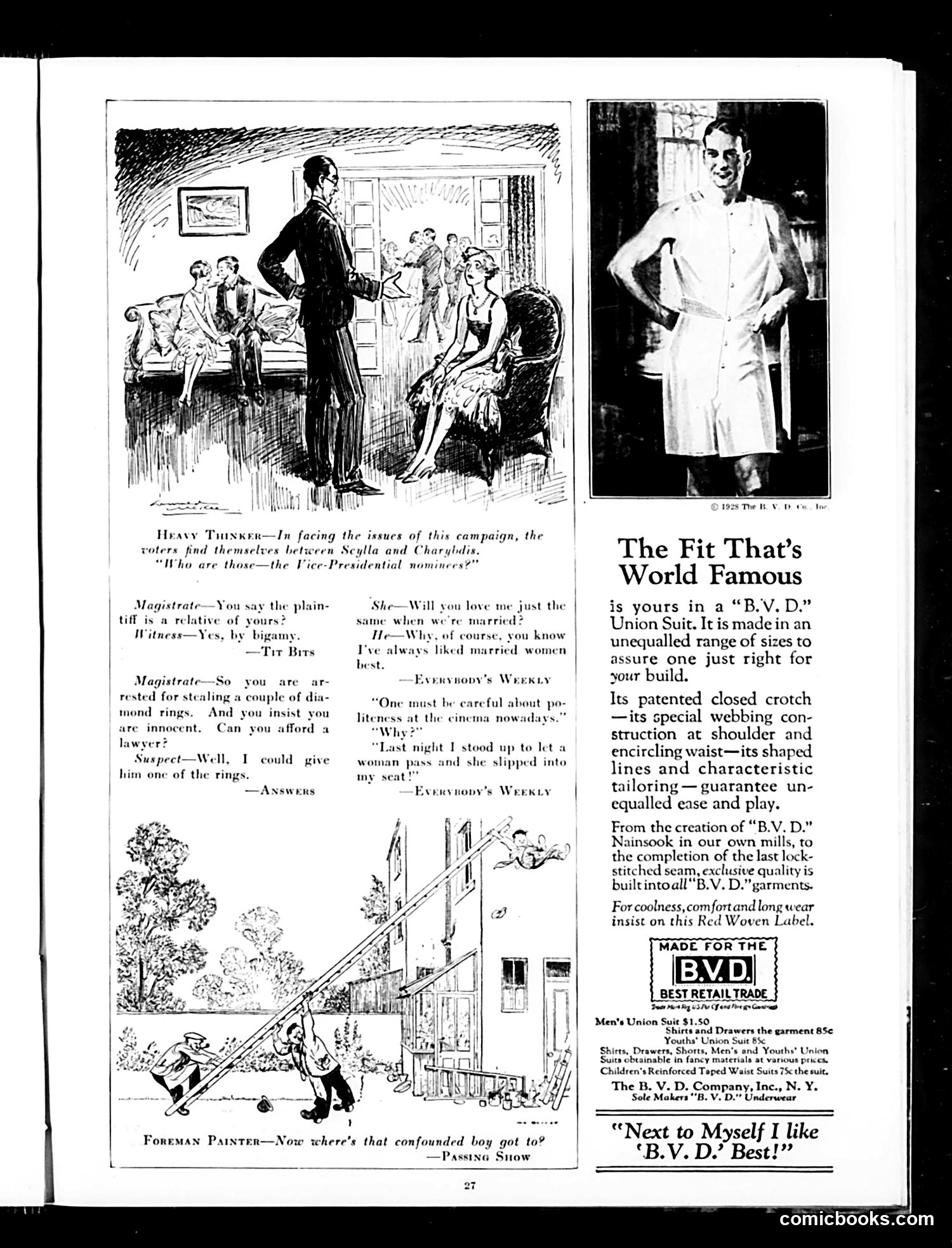
This page contains several brief jokes and a substantial advertisement for B.V.D. Union Suits underwear. The cartoons and text snippets are unrelated satirical humor typical of Judge magazine—they mock various social situations: a witness admitting to bigamy, a suspect offering stolen rings to pay for legal defense, and jokes about relationships and cinema etiquette. The "Heavy Tinker" cartoon references a political campaign involving difficult choices (Scylla and Charybdis), but the specific election is unclear from this image alone. The page is primarily dominated by the B.V.D. advertisement, featuring a photograph of a man modeling union underwear and promotional copy emphasizing the garment's fit, quality construction, and comfort. The tagline "Next to Myself I like 'B.V.D.' Best!" appears at bottom. The content reflects early 20th-century humor and consumer advertising conventions.
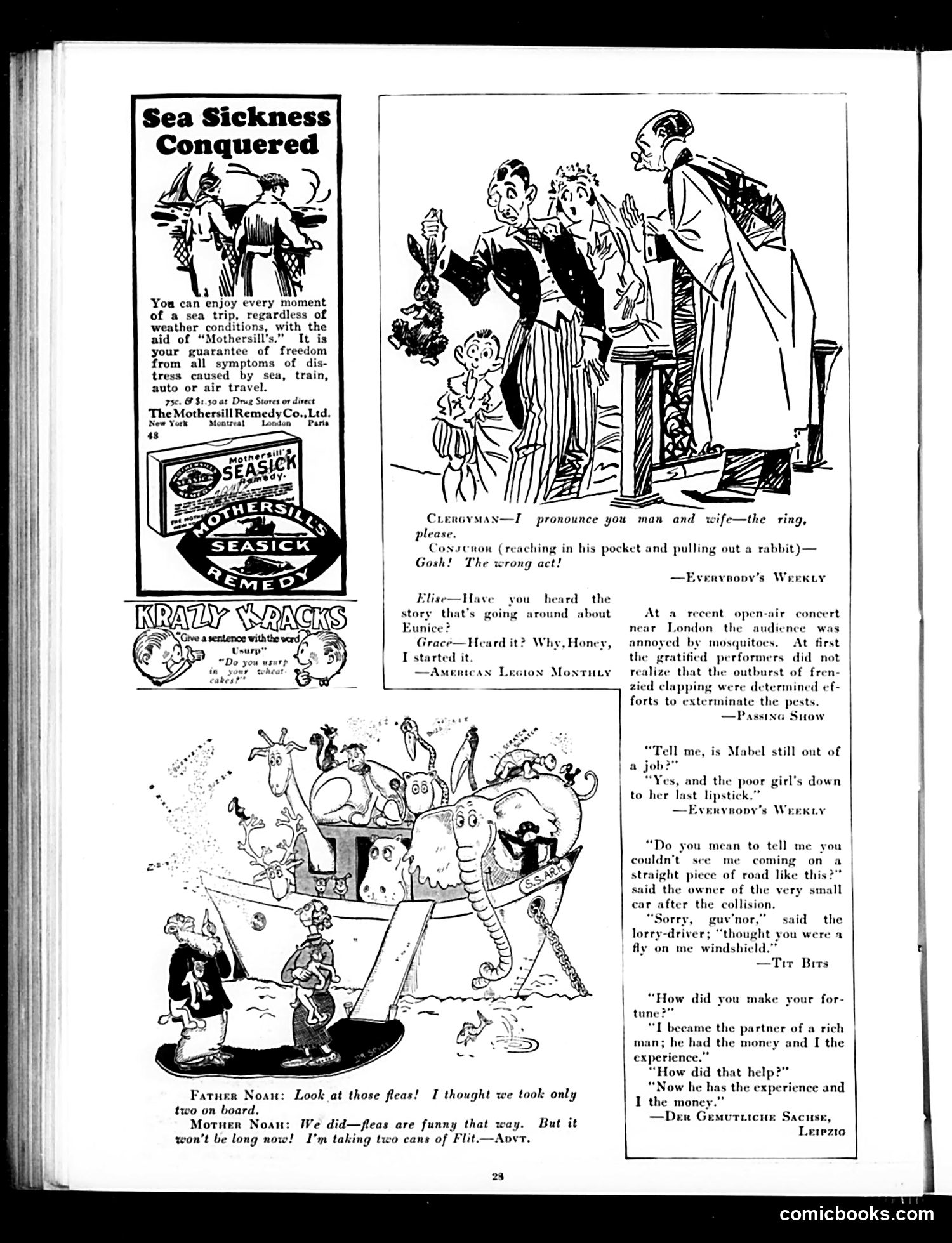
This page combines advertisements with short humor pieces typical of Judge's format. **Top Left:** An advertisement for Mothersill's seasickness remedy, promising relief from travel-related nausea. **Main Cartoon:** A clergyman pronounces a couple married but the groom produces a rabbit instead of a ring—a magic trick gone wrong. The joke mocks either stage magicians or absent-minded grooms. **Bottom Left:** A "Krazy Kracks" section features Father Noah observing fleas have multiplied aboard the ark despite boarding only two. Mother Noah explains fleas reproduce rapidly and she's using Flit (an insecticide brand) to control them—another advertisement disguised as humor. **Right Column:** Brief anecdotes from various publications covering mundane domestic and social mishaps: concert mosquitoes mistaken for audience enthusiasm, a woman's reduced circumstances, a car accident, and fortune-making through partnership. These are lighthearted observations on everyday life rather than political commentary.
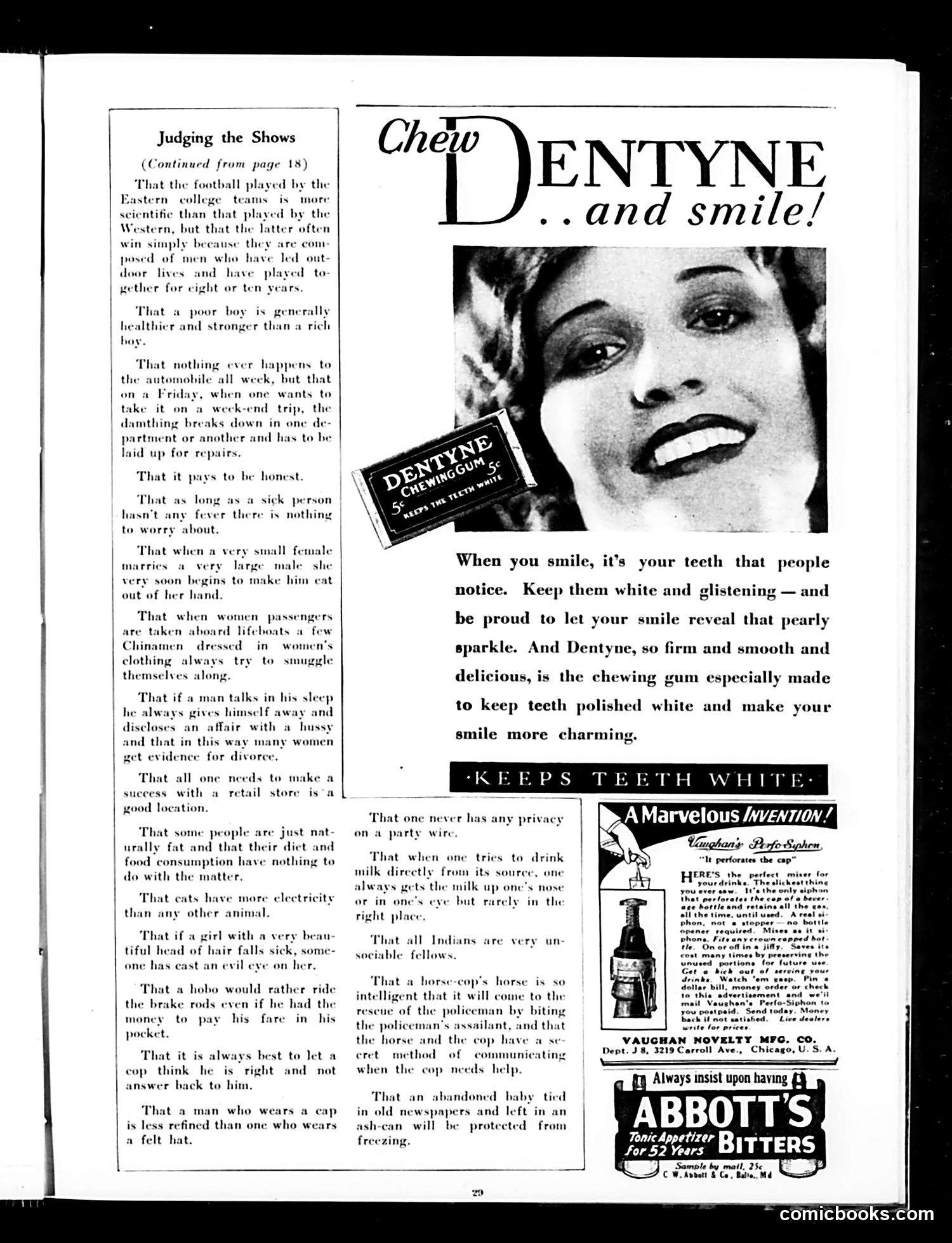
This page mixes content from Judge magazine's satirical column "Judging the Shows" with period advertising. **The Column**: "Judging the Shows" presents observational humor about everyday life—contrasting Eastern vs. Western football, poor vs. rich boys' health, automobile reliability, and social behaviors. The observations are gentle, commonsensical observations rather than pointed satire. Examples include: cops should be flattered rather than corrected, small women marry large men and dominate them, and hobo dignity outweighs financial practicality. **The Advertisements**: The page features vintage product ads (Dentyne chewing gum, Vaughan's perfume atomizer, Abbott's Bitters) using then-contemporary marketing appeals about teeth whitening, feminine beauty, and health tonics—categories that reveal period anxieties about appearance and wellness. The overall tone is nostalgic Americana humor without sharp political content, typical of Judge's lighter editorial material.
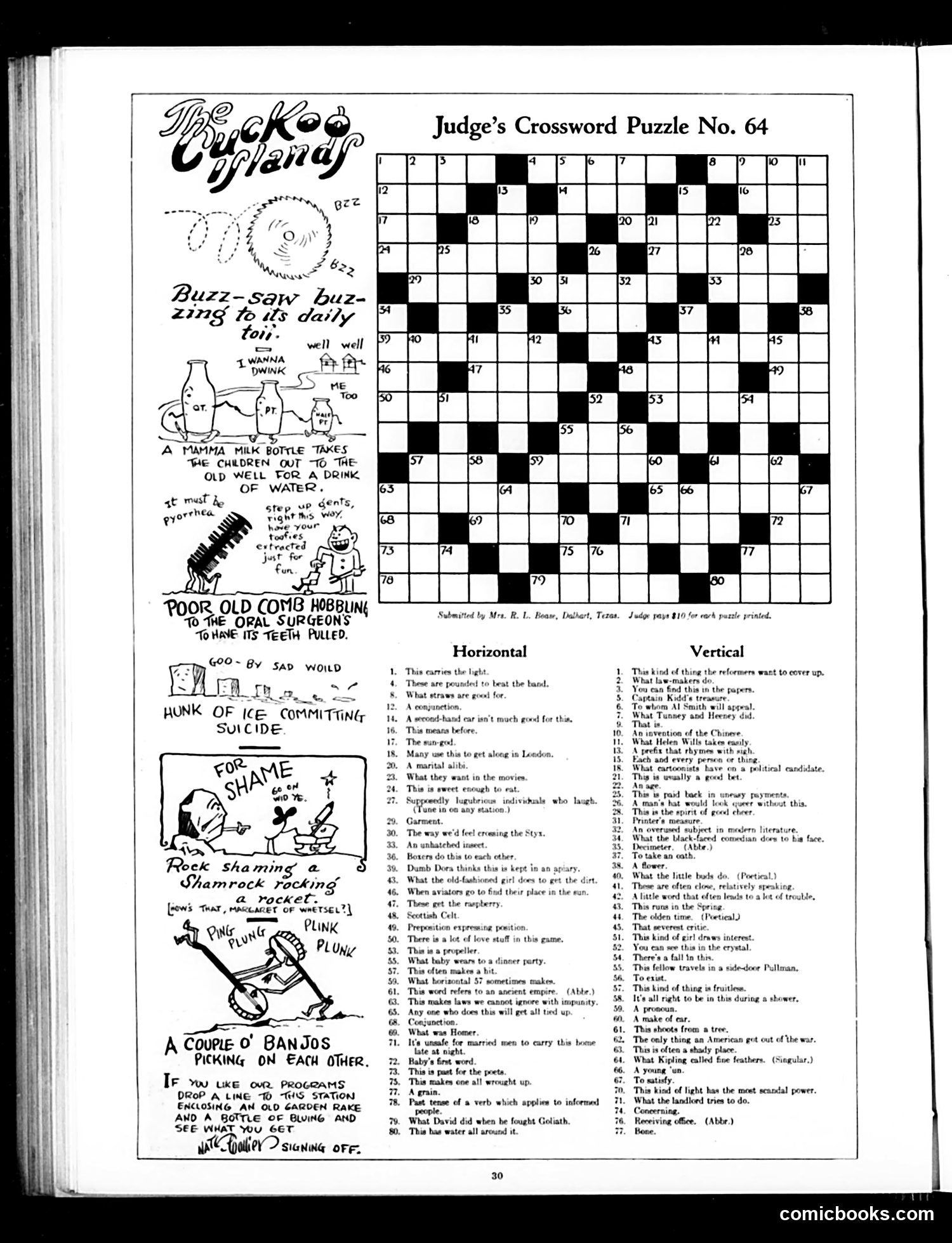
This page presents a **crossword puzzle** with accompanying humorous cartoon vignettes and the puzzle's clues. The cartoons are brief, absurdist jokes typical of Judge's satirical style: - **"Buzz-saw"**: A saw buzzing about its daily routine, with puns on "toil" - **"Mamma Milk Bottle"**: Dark humor about children visiting a dentist ("old well") where teeth are extracted - **"Hunk of Ice Committing Suicide"**: An anthropomorphized ice block melting - **"Rock Shaming a Rocket"**: Nonsensical mockery - **"Couple of Banjos"**: Musical instruments in conflict - **"Poor Old Comb Hobbling"**: A decrepit comb visiting surgeons to have teeth pulled (another dental joke) The puzzle itself contains everyday 1920s-era references (Al Smith, Tunney and Heeney boxers, Kipling, etc.). The overall tone is lighthearted absurdism—characteristic of Judge's irreverent humor aimed at middle-class readers seeking entertainment during the Jazz Age.
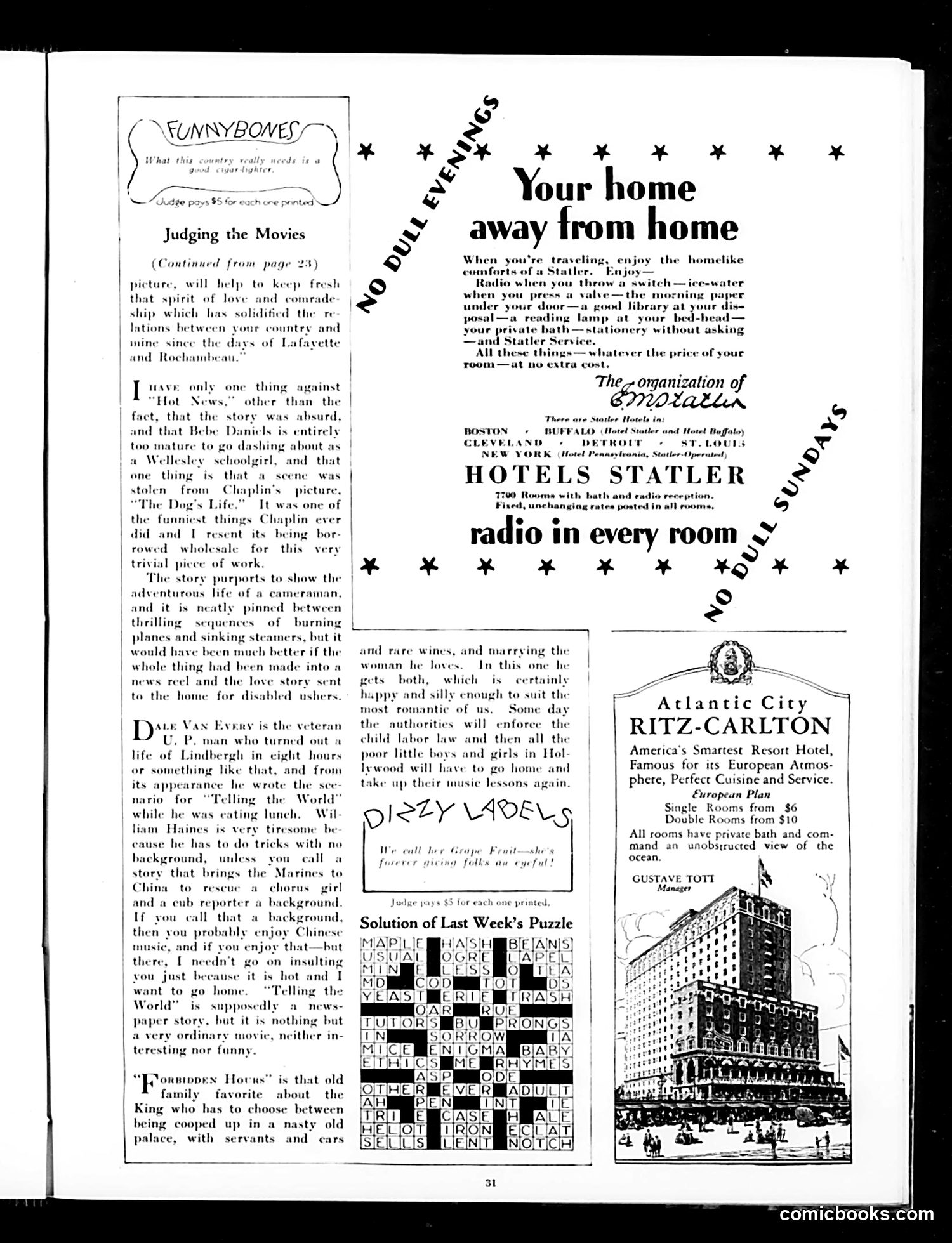
This page is primarily a **film criticism column** with accompanying hotel advertisements rather than political satire. The critic reviews several contemporary movies—"Hot News," "The Dog's Life," "Telling the World," and "Forbidden Hours"—offering mostly negative assessments of their plots and performances. Key targets include **Bebe Daniels** (criticized for her unsuitable role as a Wellesley schoolgirl) and **William Haines** (dismissed as "tiresome" and reliant on cheap tricks). The critic complains that "The Dog's Life" borrowed comedy from Chaplin, and that "Telling the World" is a poorly constructed newspaper story that conflates unrelated elements (Marines rescue, chorus girls). The column's humor relies on sarcasm and dismissive wit rather than political commentary. A sidebar puzzle and hotel advertisements (Hotels Statler, Ritz-Carlton) occupy the remaining space, making this a typical Judge layout mixing entertainment commentary with commercial promotion.
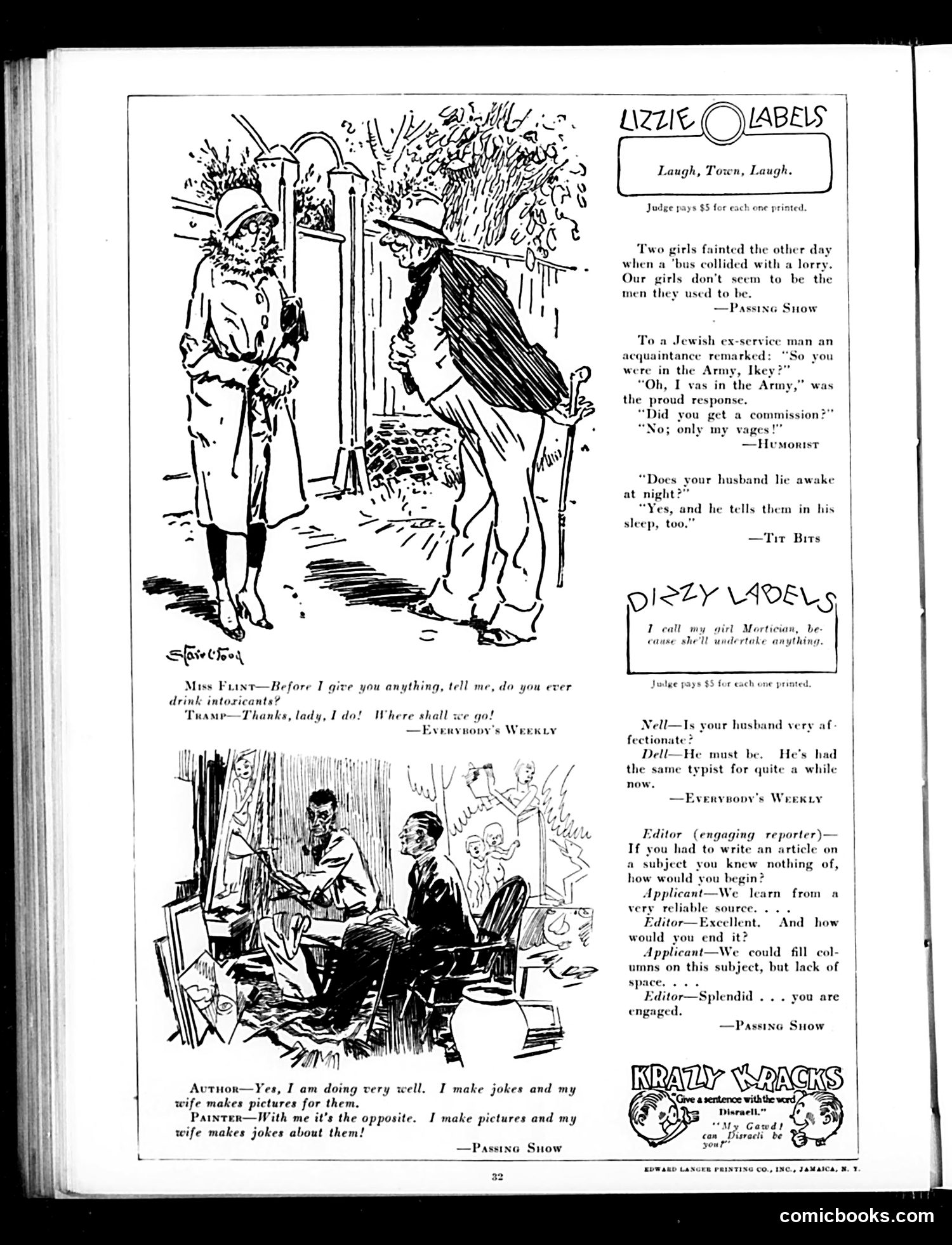
This page contains several short humorous pieces typical of early 20th-century American satirical magazines: **"Laugh, Town, Laugh"** section features brief jokes submitted by readers for a $5 prize, including wordplay about a tramp asking for directions, a Jewish soldier's pride in Army service (using Yiddish dialect for comic effect), and marital humor about a husband's nighttime storytelling. **"Dizzy Dames"** presents a joke about calling one's girlfriend a "mortician" because she'll "undertake anything"—a pun on funeral services and sexual availability. **Lower cartoons** depict two scenarios: a tramp asking a woman about drinking before she gives him money, and an office scene with an editor hiring a reporter who admits learning nothing and lacking expertise. The humor relies on period-specific conventions: ethnic dialect comedy, sexual innuendo, class-based humor (tramps, servants), and marital discord jokes. The satire targets social pretense and human weakness rather than specific political figures or events. The overall tone reflects Jazz Age cynicism about relationships and professional competence.
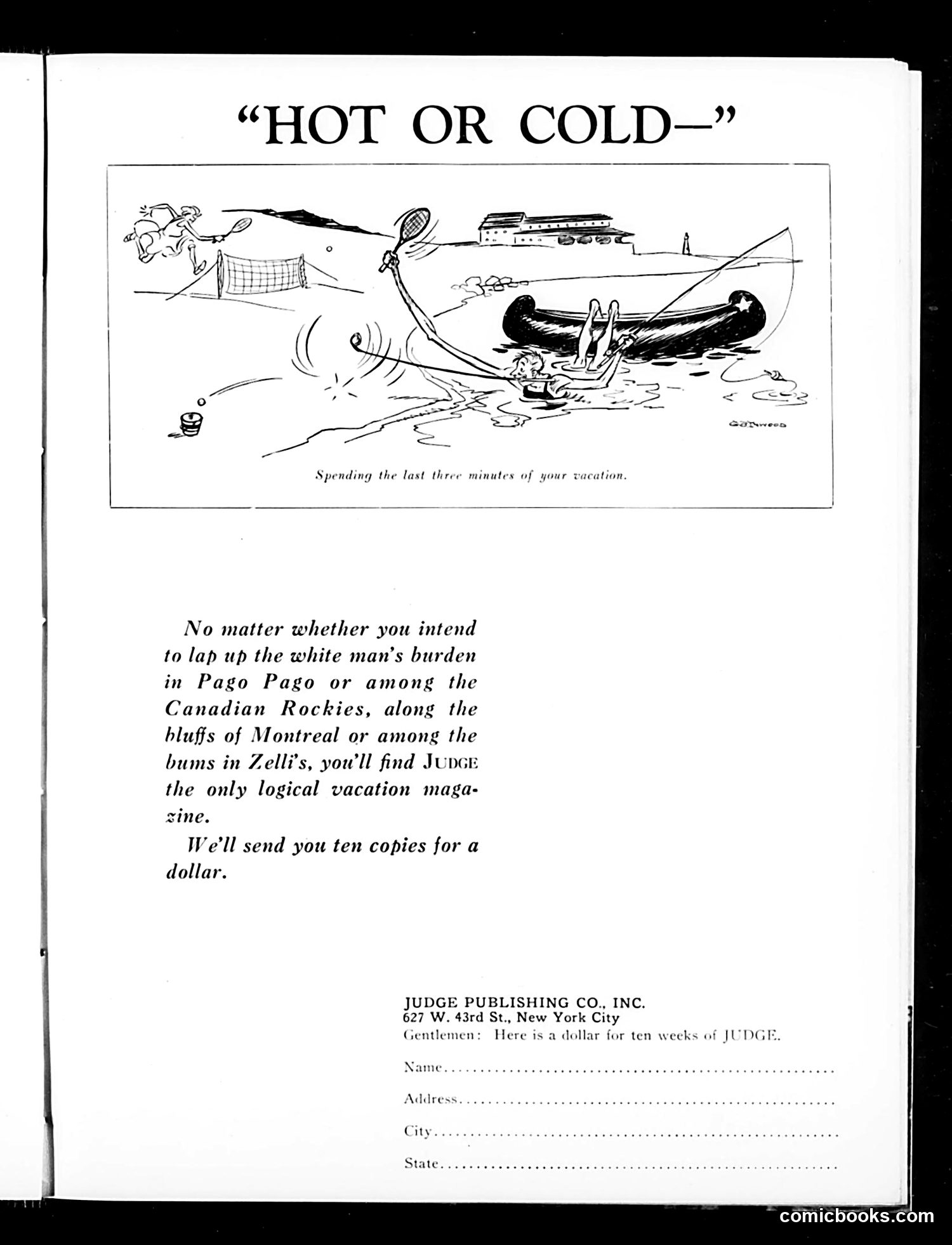
This is primarily a **subscription advertisement** for *Judge* magazine disguised as humor. The cartoon depicts a harried vacation-goer in the final moments before returning to routine—caught between extreme activities (hot and cold), seemingly unable to relax. The figure appears frazzled, embodying the anxious tourist unable to enjoy leisure time. The accompanying text uses satirical bravado, referencing exotic destinations ("Pago Pago," Canadian Rockies, Montreal) and lowbrow haunts ("Zelli's"—likely a speakeasy). The phrase "white man's burden" (referencing imperialism) is tongue-in-cheek. The joke is that regardless of vacation destination or quality, *Judge* magazine is the "only logical" choice for vacation reading—a self-promotional claim made absurdly. The ad offers ten copies for one dollar, positioning the magazine as an affordable, essential companion for any traveler's downtime.
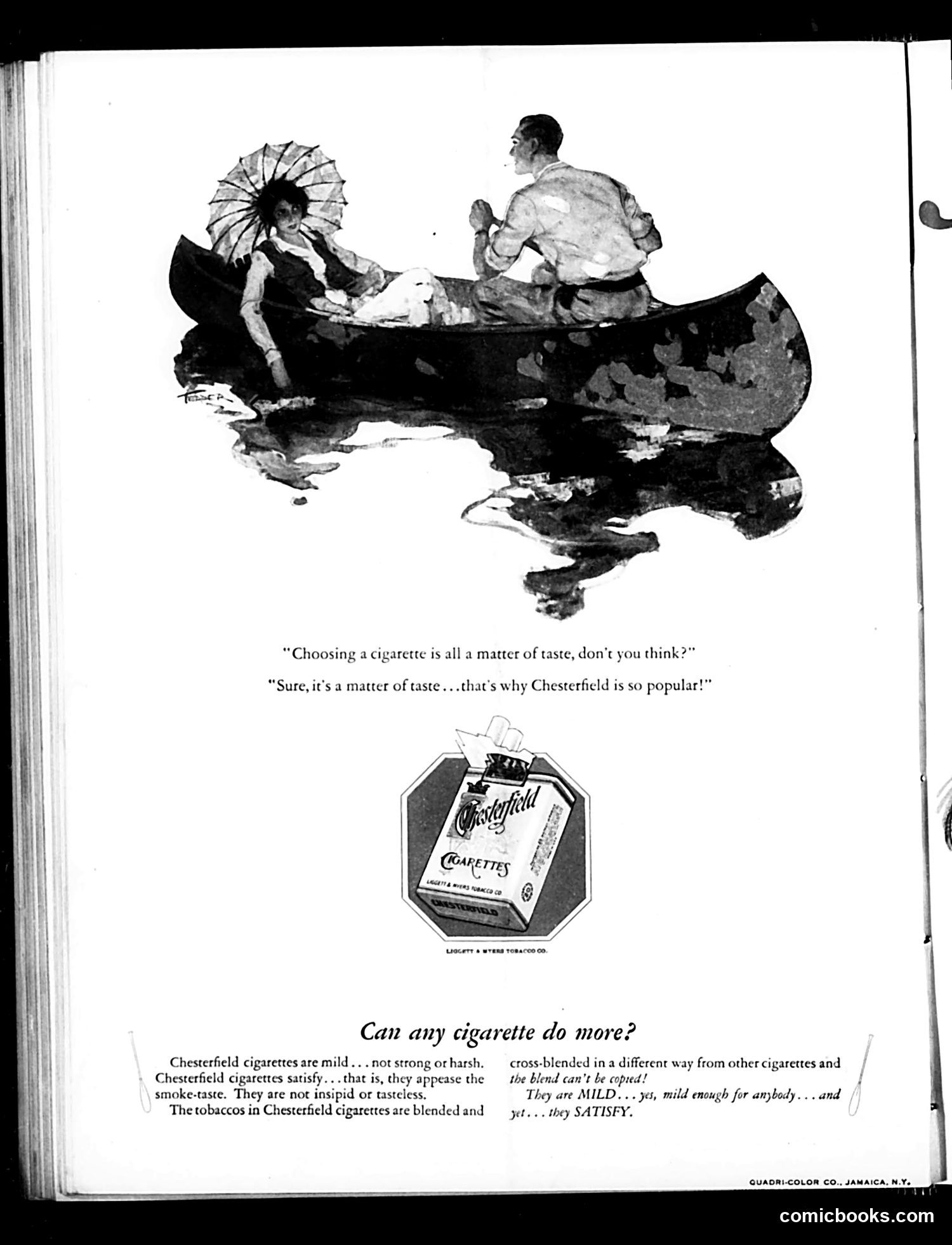
This is **not a political cartoon** but rather a **vintage cigarette advertisement** from Judge magazine. The page shows two figures in a rowboat (an elegantly illustrated scene typical of early-to-mid 20th century advertising art). Their dialogue presents a sales pitch: choosing cigarettes is "a matter of taste," and Chesterfield's popularity supposedly derives from superior taste. The advertisement emphasizes Chesterfield's "mild" blend—a key marketing claim of the era when cigarettes competed on smoothness rather than strength. The copy promises the cigarettes "satisfy" without being "insipid," attempting to position the product as balanced between strength and mildness. Modern readers should note this represents pre-warning-label cigarette marketing, when such ads appeared routinely in mainstream publications and used lifestyle imagery (leisure, romance, sophistication) to create brand appeal without health disclaimers.