
Judge, 1928-08-11 · page 10 of 36
Judge — August 11, 1928 — page 10: what you’re looking at
What you’re looking at
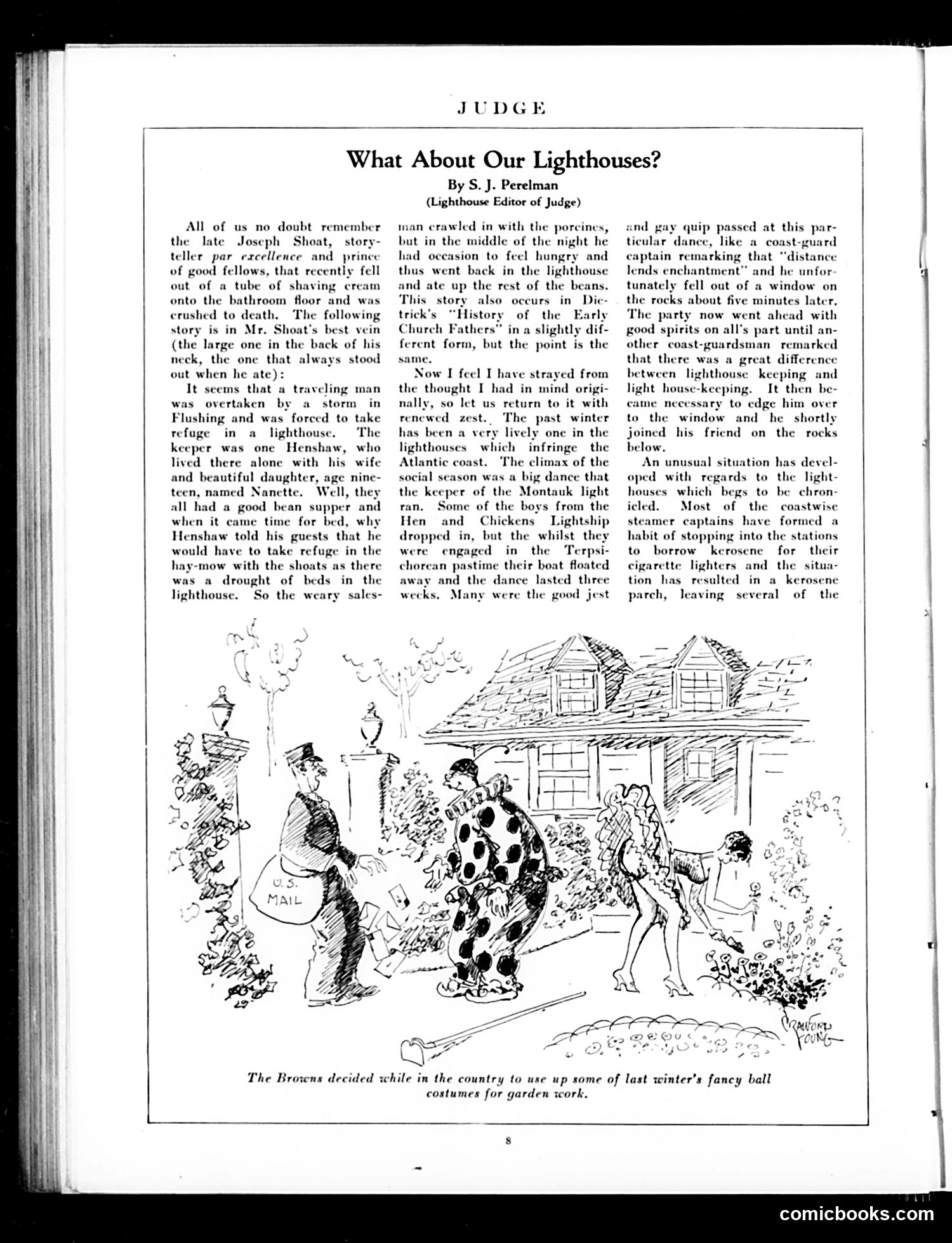
This is a humorous piece by S.J. Perelman (noted as "Lighthouse Editor") that satirizes the absurdity of rambling, pointless anecdotes. The main content is a deliberately nonsensical story about lighthouse-keepers and a traveling salesman—full of non-sequiturs, tangents, and dark jokes (people randomly falling out windows onto rocks). The accompanying cartoon illustrates the actual point: it shows the Brown family wearing fancy ball gowns and costumes from last winter's formal dances while doing ordinary garden work. The satire targets the upper-middle class tendency to repurpose fancy clothing for mundane purposes during country living, suggesting pretension masked by practicality. Together, the piece mocks both verbose storytelling traditions and genteel affectation—themes characteristic of Judge's satirical approach to American social behavior.
📄 Transcribed text from this page (OCR, searchable)
Machine-transcribed from the original scan — historical spelling and the odd misread are preserved.
JUDGE What About Our Lighthouses? All of us no doubt remember the late Joseph Shoat, story- teller par excellence and prin of good fellows, that recently fell out of a tube of shaving cream onto the bathroom floor and w crushed to death. The following story is in Mr. Shoat's best vein (the large one in the back of his neck, the one that always stood out when he ate): It seems that a traveling man was overtaken by a storm in Flushing and was forced to take refuge in a lighthouse. The keeper was one Henshaw, who lived there alone with his wife and beautiful daughter, age nine- teen, named Nanette. Well, they all had a good bean supper and when it came time for bed, why Henshaw told his guests that he would have to take refuge in the hay-mow with the shoats as there was a drought of beds in the lighthouse. So the weary sales- By S. J. Perelman (Lighthouse Editor of Judge) man crawled in with the porcines, but in the middle of the night he had occasion to feel hungry and thus went back in the lighthouse and ate up the rest of the beans. This story also occurs in Die- trick’s “History of the Early Church Fathers” in a slightly dif- ferent form, but the point is the same. Now I feel I have strayed from the thought I had in mind origi- nally, so let us return to it with renewed zest. The past winter has been a very lively one in the lighthouses which infringe the Atlantic coast. The climax of the social season was a big dance that the keeper of the Montauk light ran, Some of the boys from the Hen d= Chickens Lightship dropped in, but the whilst they were engaged in the Terp chorean pastime their boat floated away and the dance lasted three weeks. Many were the good jest and gay quip passed at this par- ticular dance, like a coast-guard captain remarking that “distance lends enchantment” and he unfor tunately fell out of a window on the rocks about five minutes later. The party now went ahead with good spirits on all’ other coast-guards that there was a great difference between lighthouse keeping and light house-keeping. It then be- ame necessary to edge him over to the window and he shortly joined his friend on the rocks below. An unusual situation has devel- oped with regards to the light- houses which begs to be chron- Most of the coastwise steamer captains have formed a habit of stopping into the stations to borrow kerosene for their cigarette lighters and the situa- tion has resulted in a kerosene parch, leaving several of the The Browns decided while in the country to use up some of last winter’s fancy ball costumes for garden work. comicbooks.com