
A complete issue · 36 pages · 1928
Judge — June 9, 1928
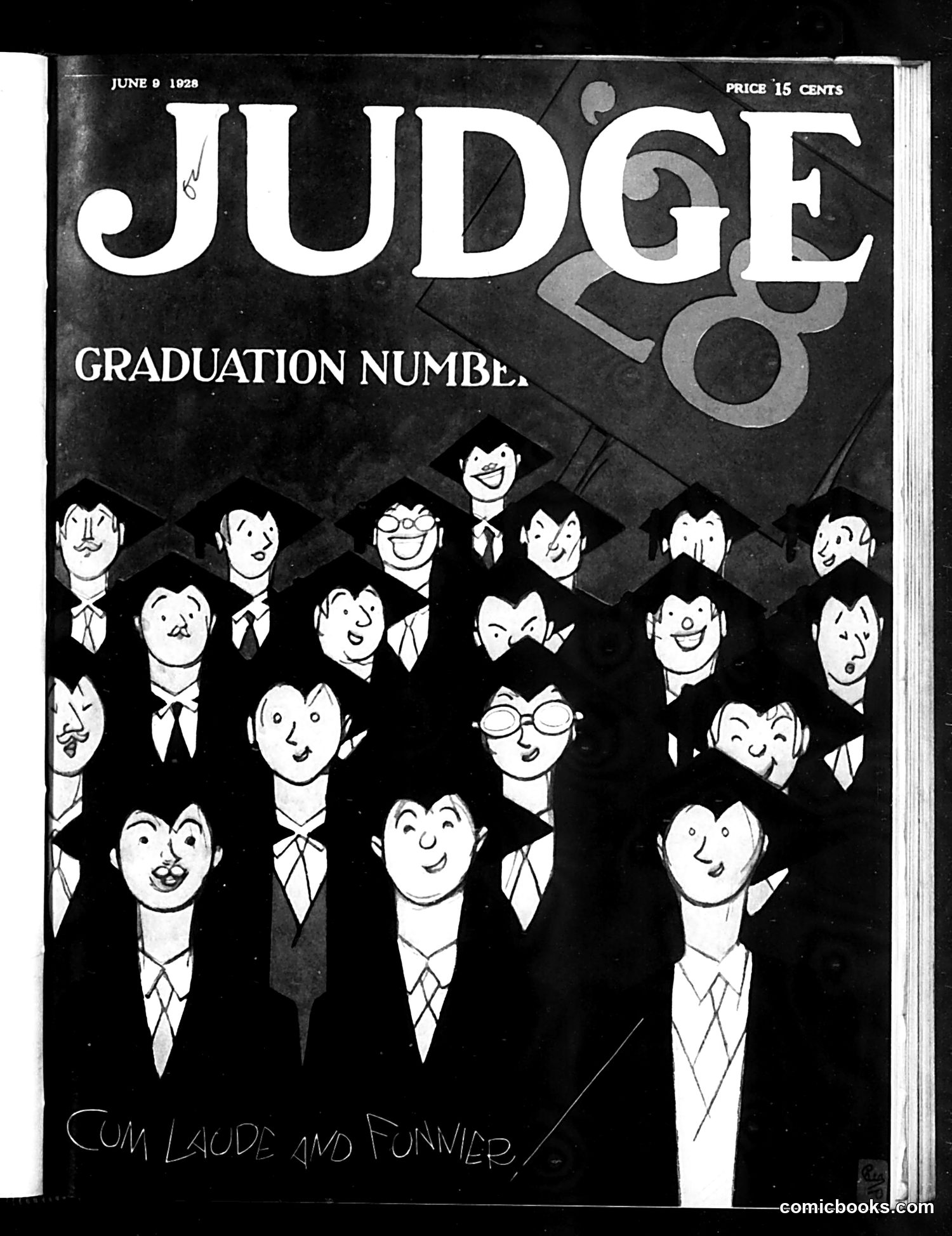
This is the "Graduation Number" of Judge magazine, featuring a satirical cover illustration. The drawing shows a group of graduates in academic robes with exaggerated, cartoonish facial features, arranged in rows. The caption reads "Cum Laude and Funnier," suggesting the cover satirizes academic achievement and student humor. The caricatured faces—with their varying expressions of smugness, bewilderment, and self-satisfaction—appear to mock the pretensions of graduating students. This was typical of Judge's satirical approach: poking fun at contemporary institutions and social classes through exaggerated portraiture. The specific identities of any individuals depicted are unclear from the image alone. The overall message seems a gentle ribbing of graduates' self-importance and the grandiosity surrounding commencement ceremonies.
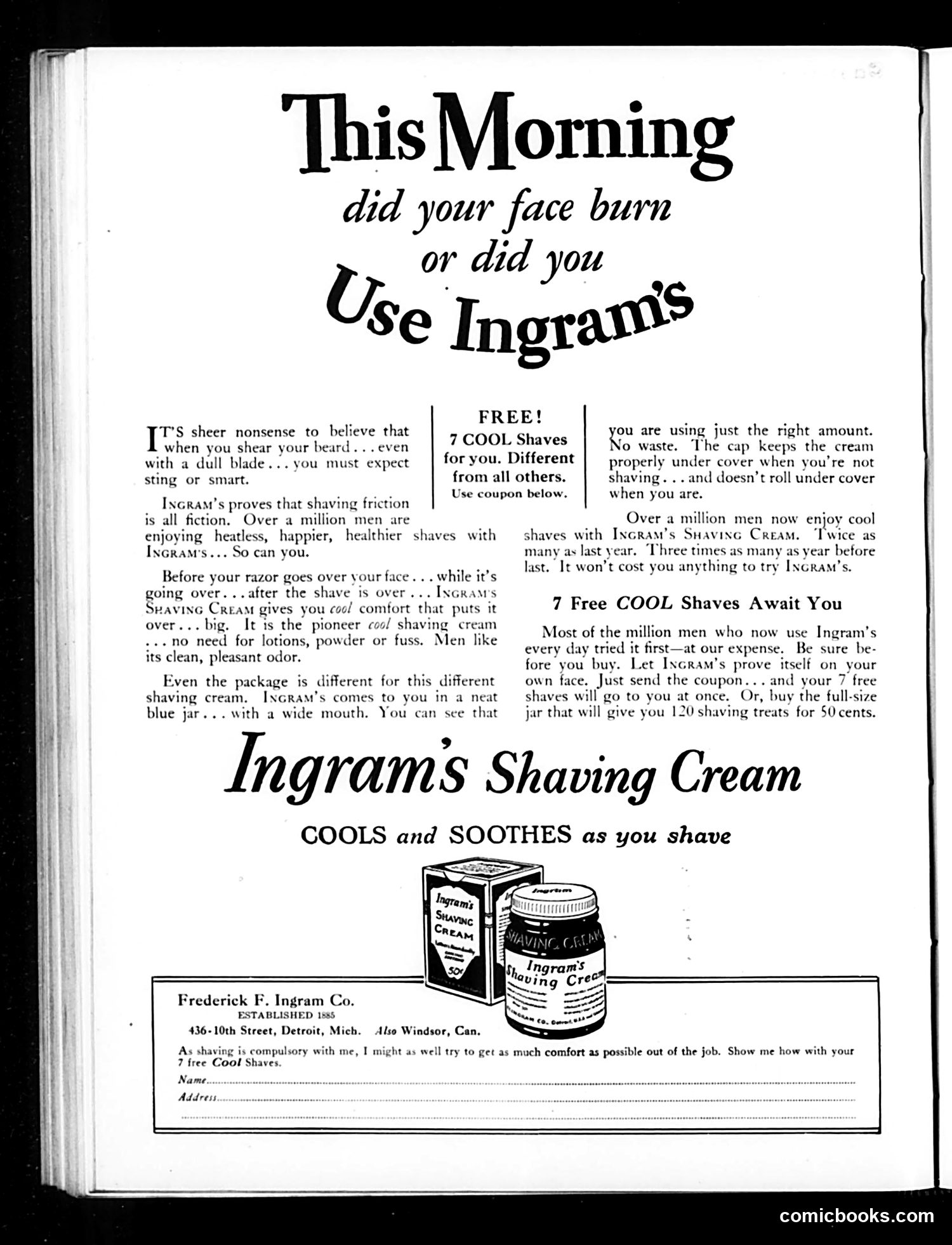
This page is **primarily an advertisement**, not satirical content. It's a full-page ad for Ingram's Shaving Cream from the Frederick F. Ingram Co. (Detroit, Michigan, established 1885). The ad uses a humorous rhetorical question as its hook: "This Morning did your face burn or did you Use Ingram's?" — implying that without this product, shaving causes discomfort. The humor is lighthearted and marketing-focused rather than satirical or political. The ad emphasizes the cream's cooling properties ("cools and soothes as you shave") and offers a promotional gimmick: free cool shaves with a coupon. The packaging illustration shows both a box and jar design. There are no political cartoons, caricatures, or social satire on this page—it's straightforward vintage advertising using gentle humor to sell a grooming product.
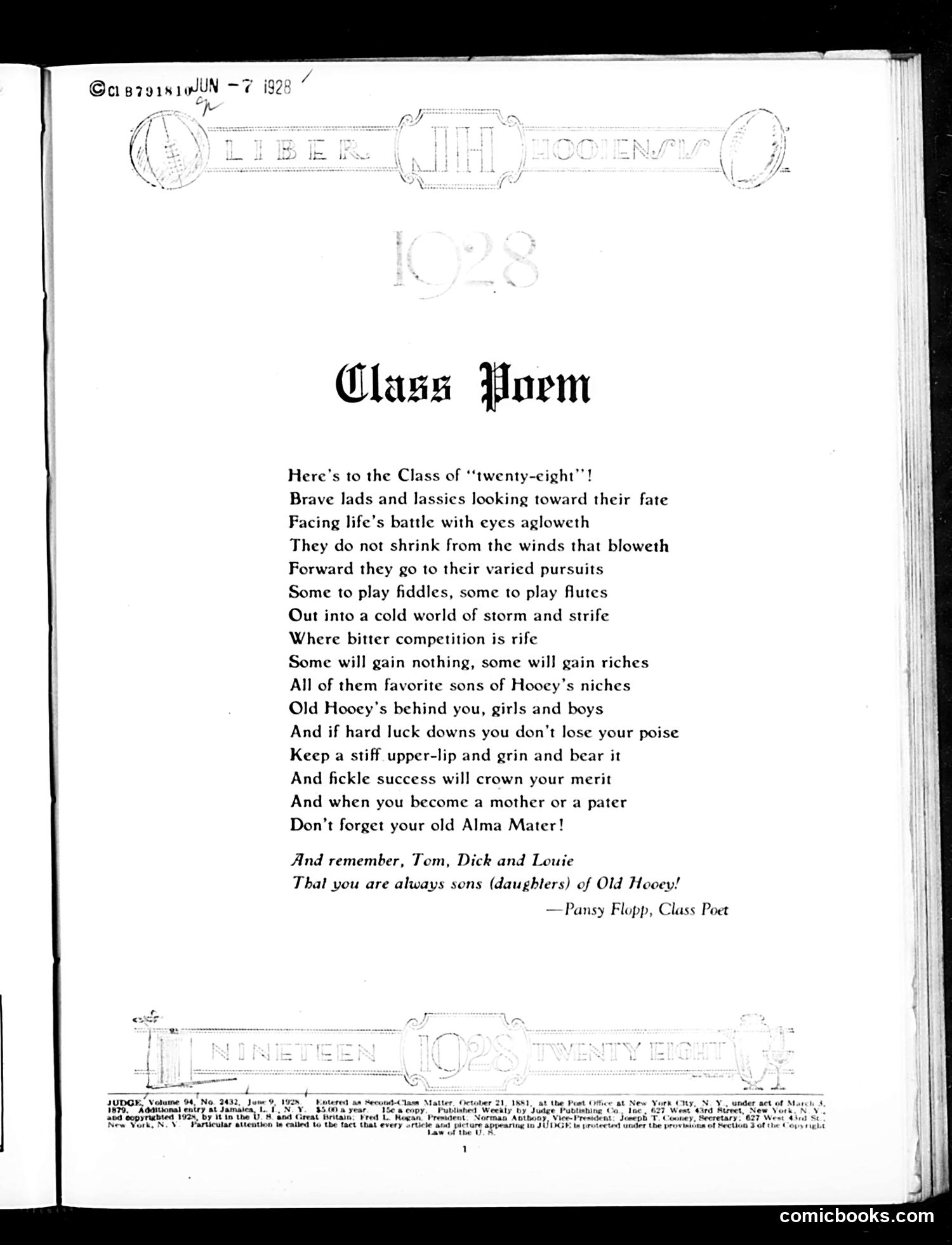
This page from Judge magazine (June 7, 1928) contains a "Class Poem" written by Pansy Flopp, identified as the class poet. The poem is a traditional congratulatory verse addressed to the graduating class of 1928 ("twenty-eight"). The poem offers conventional wisdom to graduates facing adult life: encouragement to face hardship with composure ("keep a stiff upper-lip"), maintain connection to their alma mater, and remember their school values. References to "Old Hooey" appear to be the school's mascot or personification. The poem specifically mentions "Tem, Dick and Louie" as notable class members and addresses both male and female graduates. Rather than political satire, this represents typical yearbook-style celebratory verse from the Jazz Age period, offering earnest if somewhat sentimental advice to departing students.
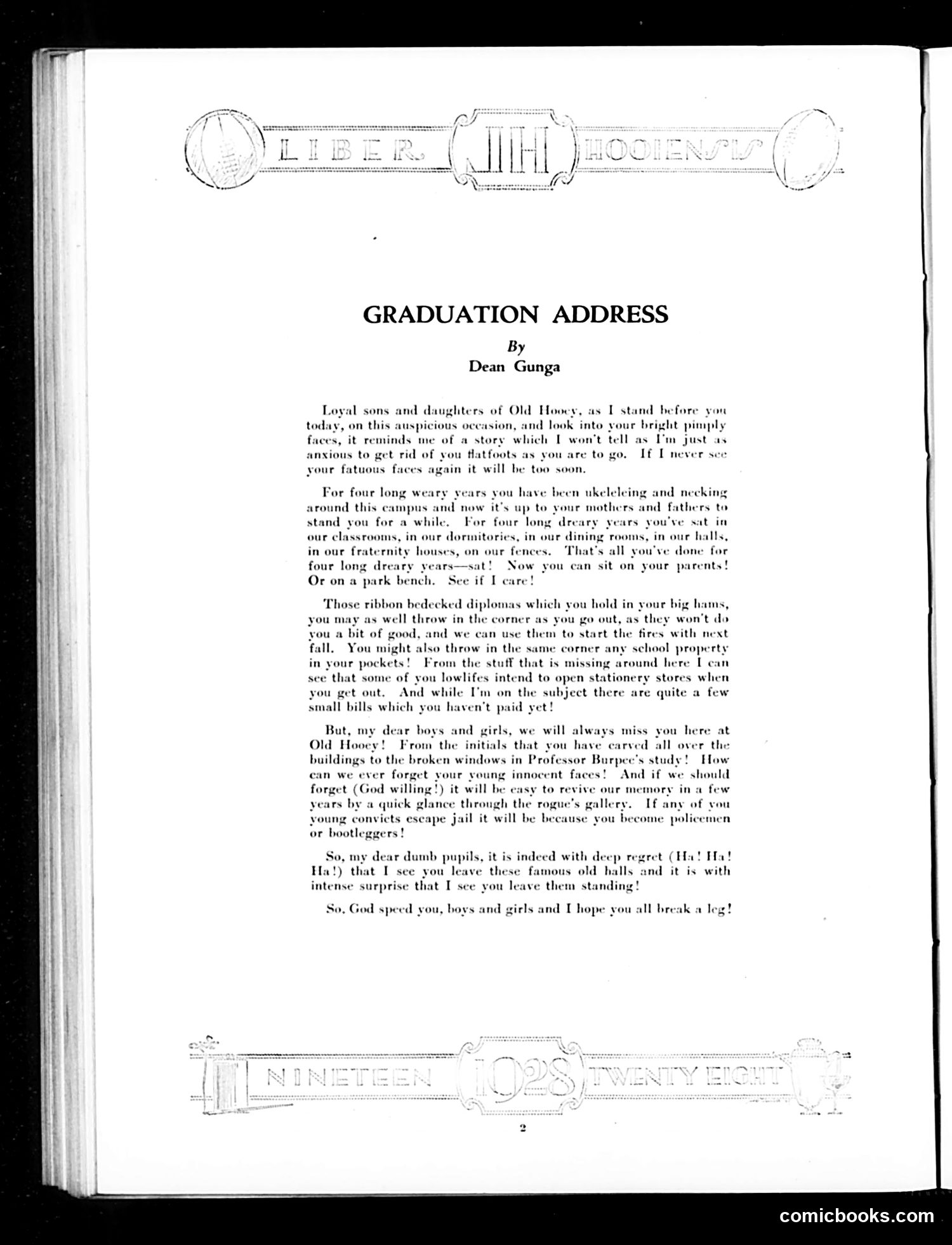
This page contains a **Graduation Address by Dean Gunga**, a humorous speech delivered to graduating students at "Old Hooey" (a fictitious college). The satire is directed at both the institution and the graduating class. The dean's humor mocks: - **Student behavior**: describing four years of "skelecing and necking," vandalism ("initials carved all over"), and property damage (broken windows in Professor Burpee's study) - **The diplomas themselves**: sarcastically suggesting graduates throw them away since they're worthless - **Student dishonesty**: references to unpaid bills and implied criminal futures ("young convicts escape jail") - **Academic pretense**: the entire address deflates the solemnity of graduation The joke assumes readers recognize this as satirizing both pretentious academia and rowdy college student culture—common Judge magazine targets. The address is intentionally cynical, suggesting higher education produces mischievous rather than upstanding citizens.
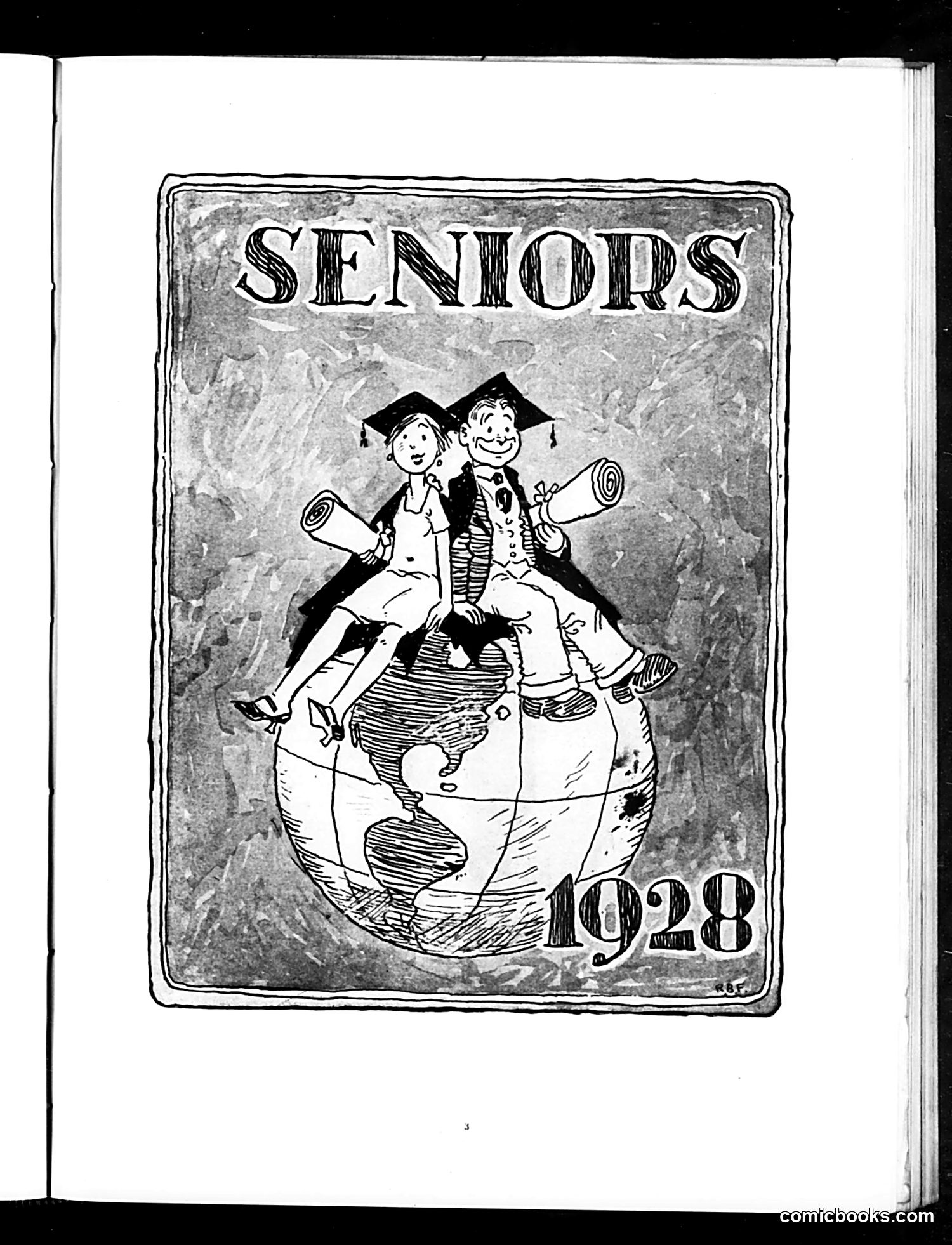
This is a yearbook cover for the class of 1928, not a political cartoon. The illustration depicts two graduates in academic regalia sitting atop a globe, each holding diplomas. The artwork is a straightforward celebratory image rather than satire. The globe symbolizes the world awaiting these graduates, while their positioning on top of it suggests optimism and ambition—a common yearbook motif. The jovial cartoon style was typical of 1920s youth publications. This appears to be from a high school or college yearbook rather than a political or satirical context, despite appearing in Judge magazine. The cover simply commemorates the graduating class of 1928.
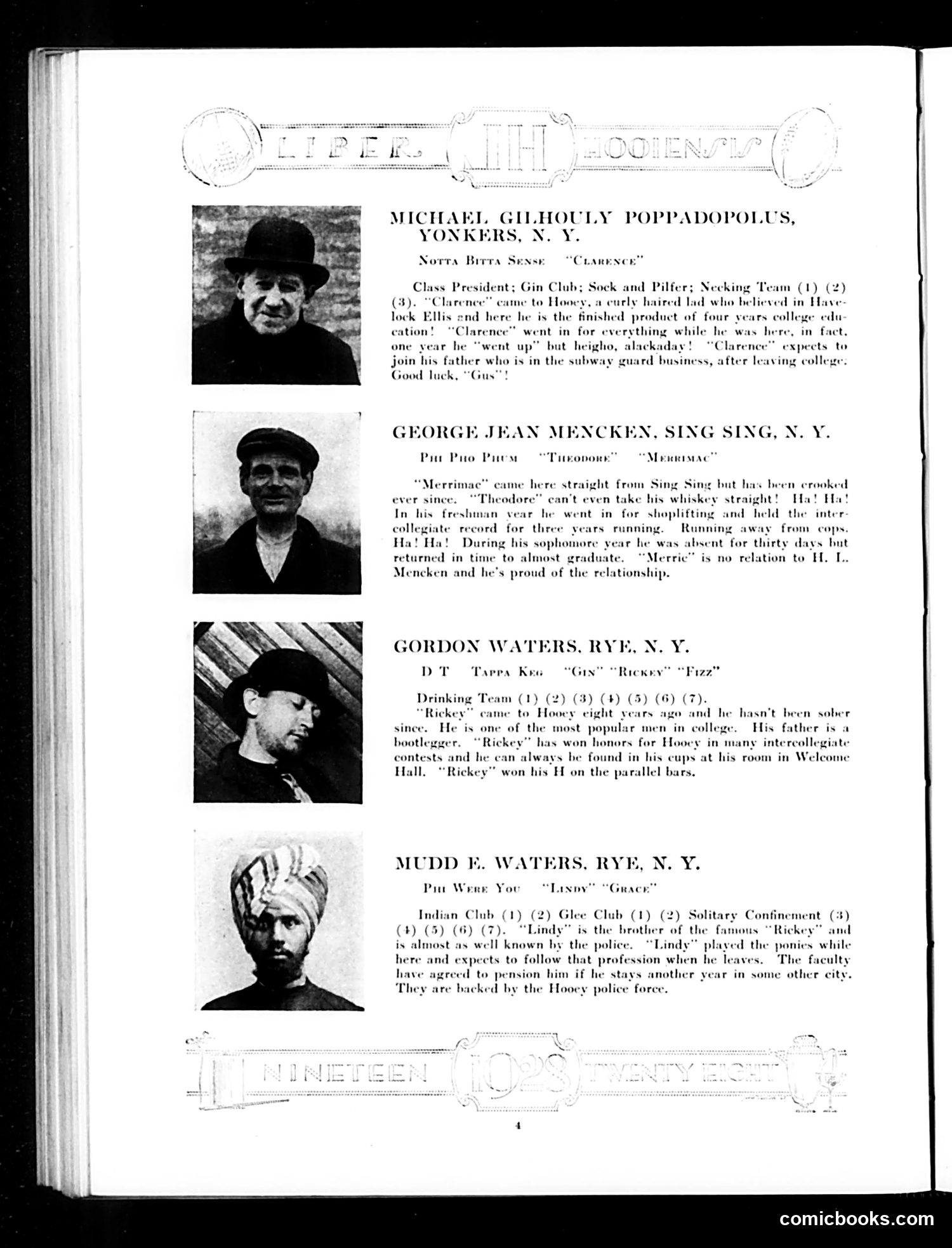
This is not a satirical cartoon page, but rather a **student yearbook section** from what appears to be an early 20th-century college (likely Hoovey or a similar institution). The page features four male students with their photographs, nicknames, and biographical entries: 1. **Michael Gilhouly** ("Clarence") - Class President 2. **George Jean Mencken** ("Theodore," "Merrimac") - from Sing Sing, N.Y. 3. **Gordon Waters** ("Ricky," "Fizz") - noted drinker 4. **Mudd E. Waters** ("Lindy," "Grace") - brother of "Ricky" The humor derives from **self-deprecating student descriptions**: references to drinking, arrests, shoplifting charges, and police involvement. The tone is deliberately irreverent, treating disciplinary issues as comedic college experiences rather than serious matters—reflecting period undergraduate culture and the satirical spirit of student publications.
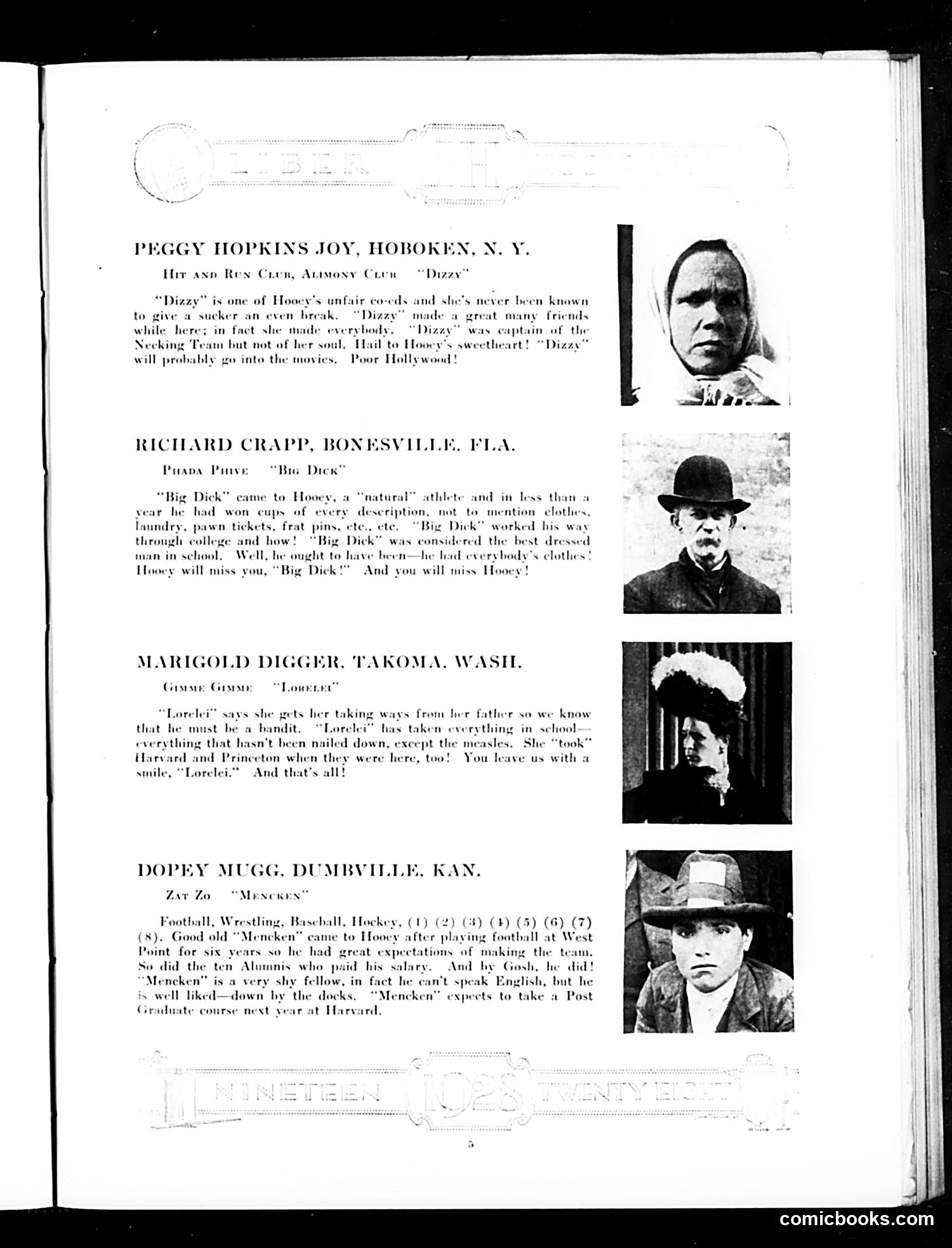
This page contains **no political cartoons or satire**—it's a section of student or social profiles, likely from a college yearbook or similar publication reprinted in Judge magazine. The entries profile four individuals with nicknames ("Dizzy," "Big Dick," "Lorelei," "Mencken"), describing their personalities and accomplishments. Each includes a portrait photograph and biographical text written in a humorous, affectionate tone typical of early 20th-century yearbooks. The jokes are gentle and personal—about academic performance, athletics, fashion sense, and romantic reputations—rather than political commentary. References to Harvard and Princeton suggest these are wealthy, educated individuals from prominent institutions. The format and content reflect Judge's practice of reprinting entertaining social material alongside its satirical cartoons.
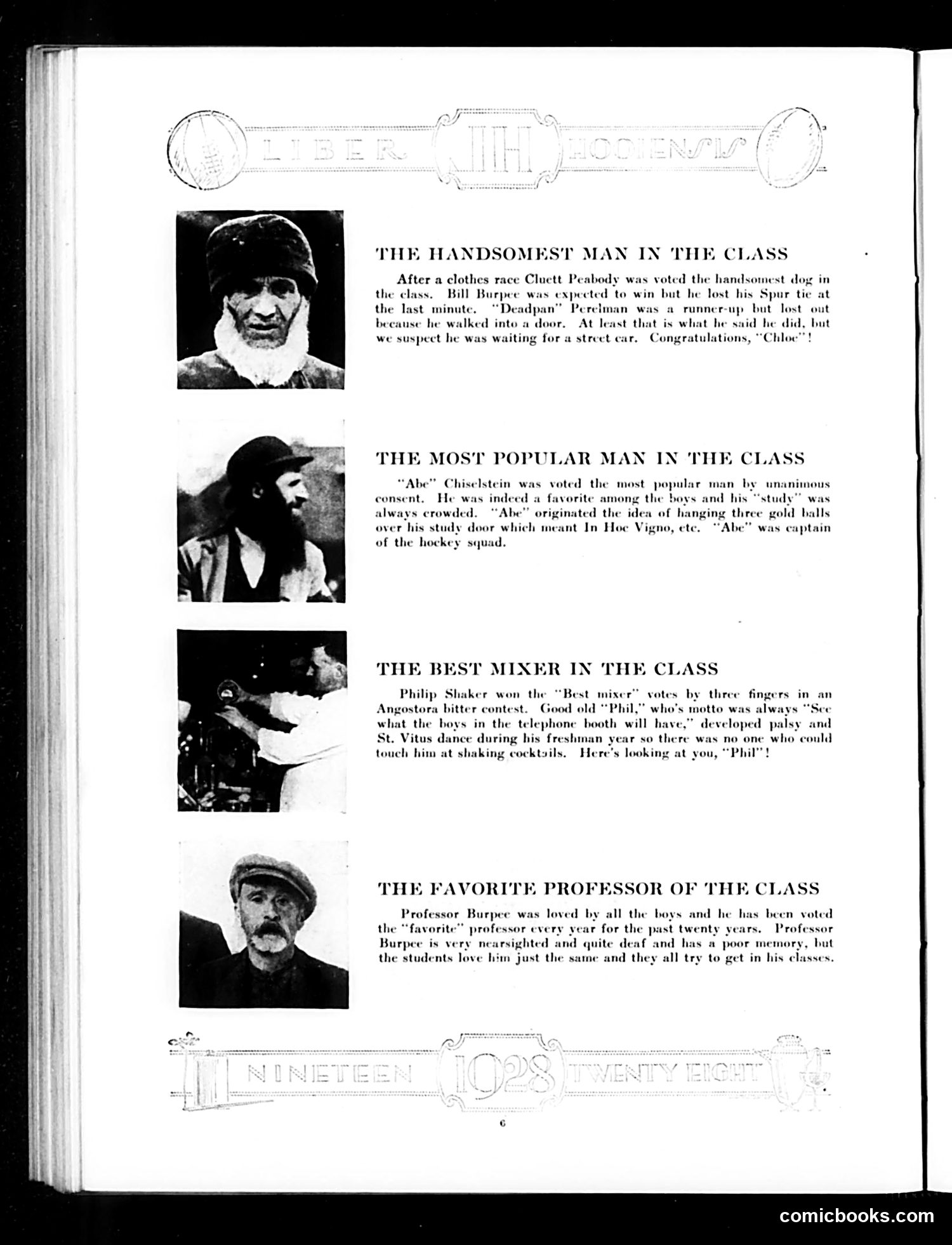
This page presents humorous "superlative" awards for a school class—a mock yearbook format. Each entry pairs a photograph with satirical commentary about student stereotypes and behaviors. The jokes rely on period stereotypes: "Cluett Peabody" (a real shirt brand) wins "handsomest" through clothing rather than looks; "Abe Chiselstein" is the "most popular" with ethnic-coded name and pawnshop reference (three gold balls); "Philip Shaker" wins "best mixer" through bartending skill at a cocktail contest; and "Professor Burpee" is beloved despite being deaf, nearsighted, and forgetful. The humor targets student vanity, ethnic caricature (common in 1920s satire), Prohibition-era drinking culture (cocktail mixing), and the gap between student and teacher perception. The page mocks both youthful pretension and institutional absurdity—familiar themes in college humor magazines of this era.
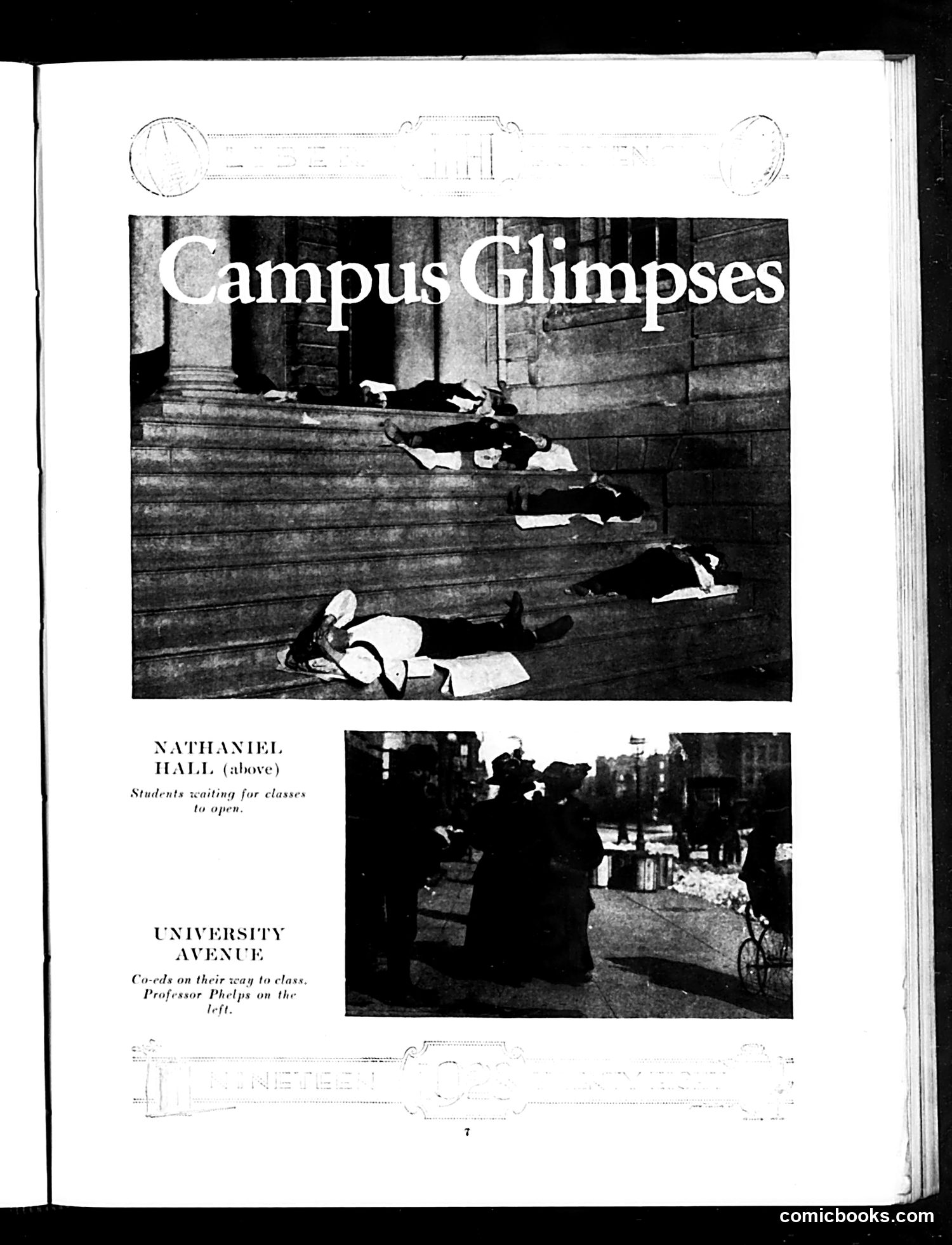
This is a "Campus Glimpses" feature showing candid scenes from university life. The top photograph depicts students lounging on the steps of Nathaniel Hall, waiting for classes to begin. The bottom image shows coeds (female students) walking to class on University Avenue, with someone identified as "Professor Phelps" visible on the left. Rather than political satire, this appears to be humorous everyday observation—the joke likely being that students are relaxed and recumbent while waiting, contrasting with the formal expectation of academic life. The feature captures casual student behavior in what was likely the early 20th century, using photography to document campus culture for satirical magazine readers.
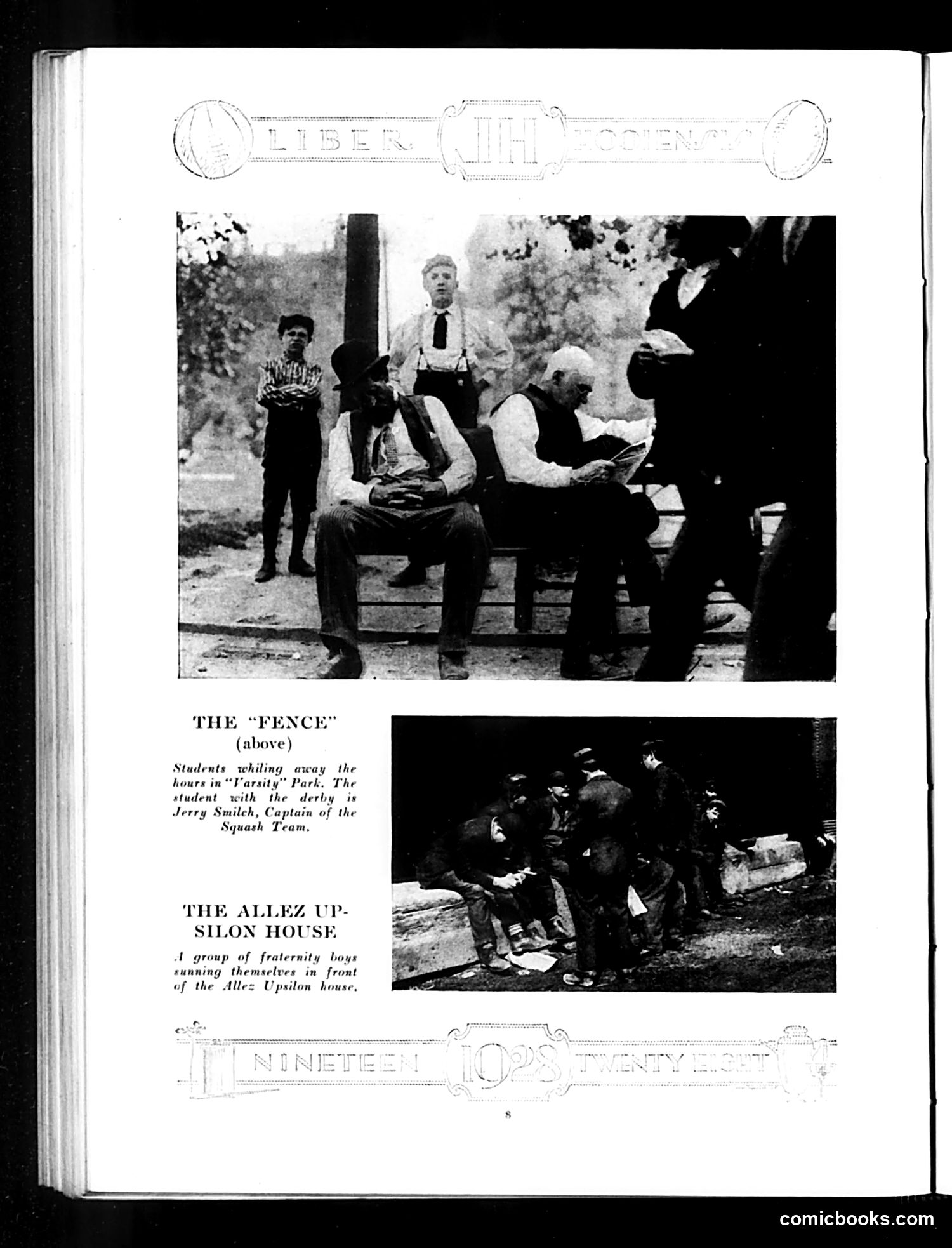
This page from *Judge* magazine shows two photographs of college students from what appears to be the early 20th century. The top image, titled "The Fence," depicts students relaxing in "Varsity Park," with one identified as Jerry Smith, Captain of the Squash Team, wearing a derby hat. The bottom image shows fraternity members ("Allez Upsilon house") lounging outdoors. These appear to be humorous documentary-style photos rather than political satire—the humor derives from capturing candid moments of college life and social hierarchies (varsity athletes, fraternity culture). The "fence" likely refers to a casual gathering spot where students congregate. Without additional context, the specific satirical point remains unclear, though the layout suggests *Judge* was documenting and gently mocking contemporary collegiate social institutions and leisured student culture.
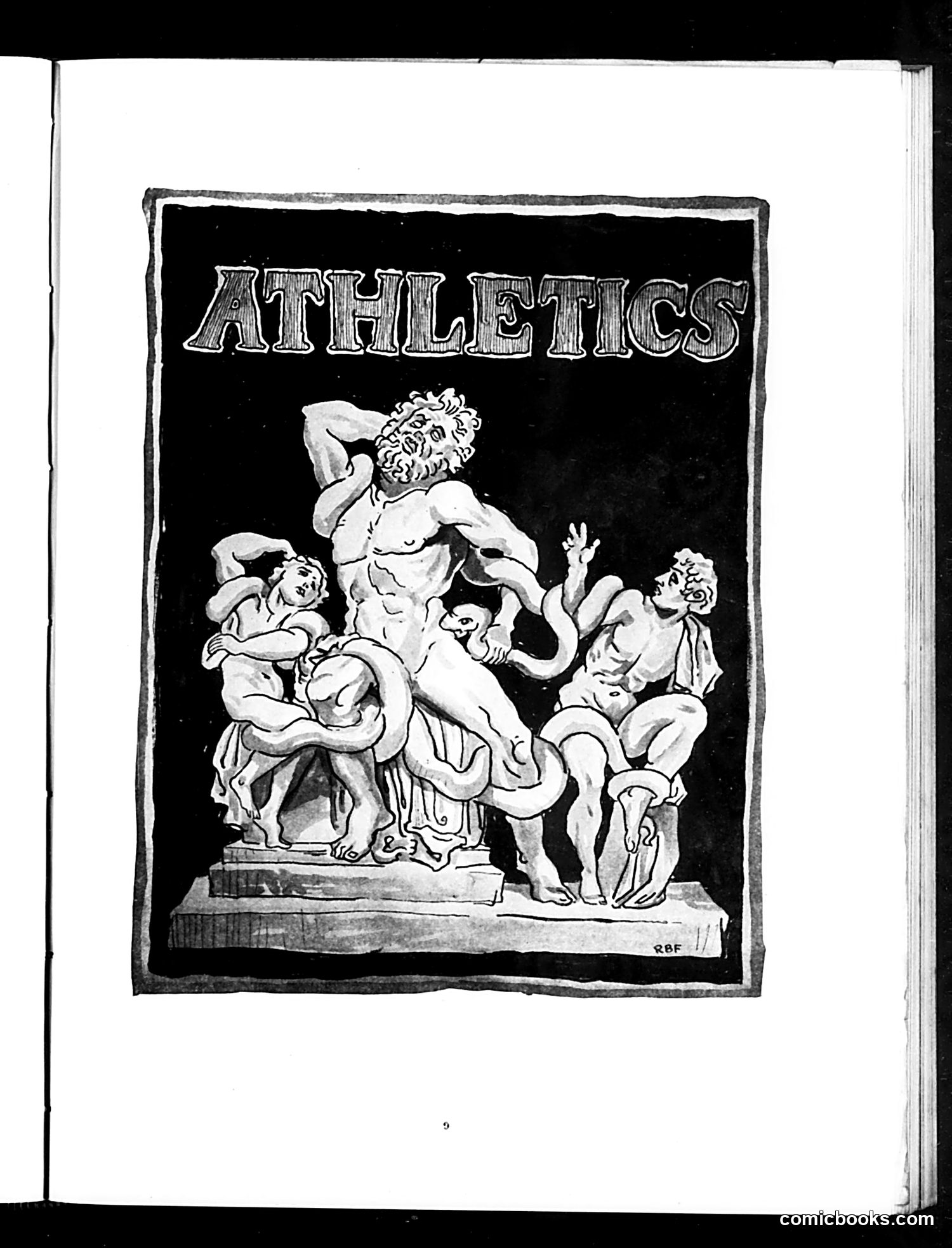
This appears to be a title page or cover illustration for a section on "Athletics" in Judge magazine. The image depicts a classical or neoclassical sculptural scene: a muscular adult male figure (likely representing an athletic ideal or Hermes/Mercury) surrounded by cherubs or putti (classical baby-like figures). The figures are posed on what appears to be a pedestal. The satire likely mocks the elevation of athletics to an almost religious or classical status in American culture. By presenting athletic ideals through classical/mythological imagery, the cartoonist may be commenting on the pretentious glorification of sports or physical competition in contemporary society. The cherubs suggest innocent reverence, potentially criticizing the somewhat absurd veneration of athletic pursuits.
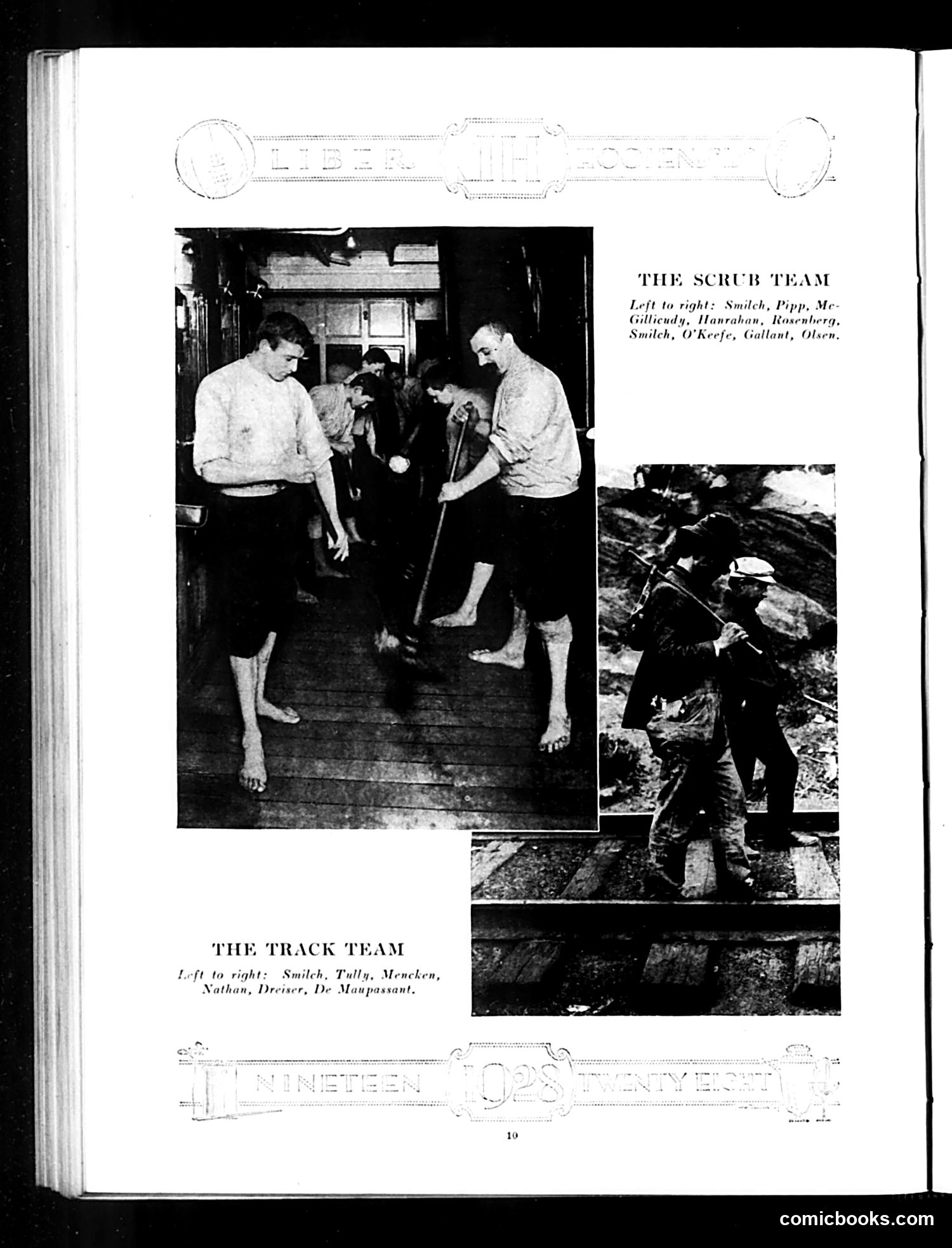
This page from *Judge* magazine features two team photographs labeled "The Scrub Team" and "The Track Team." The names listed—particularly in the Track Team (Mencken, Nathan, Dreiser, De Maupassant)—reference prominent American and European literary figures of the early 20th century. The satire appears to mock intellectual or literary circles by presenting these celebrated writers as if they were athletic teams. The humor likely derives from the incongruity of serious literary figures being treated as competitors in sports, suggesting either that literary feuds were common knowledge to contemporary readers, or that *Judge* was satirizing pretentiousness in the literary establishment. Without additional context about the specific publication date, the precise satirical target remains unclear.
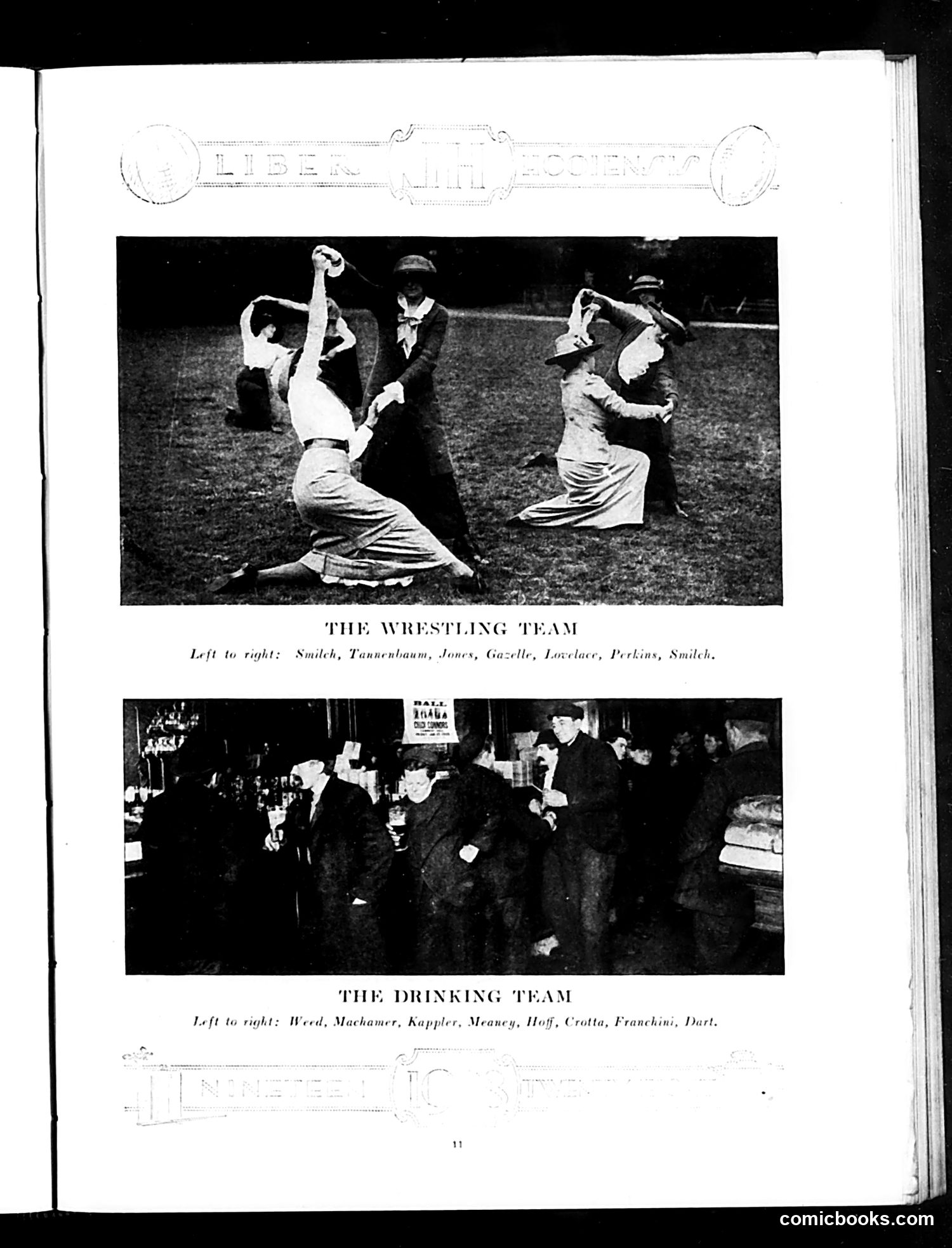
This page from *Judge* magazine presents two humorous team photos labeled "The Wrestling Team" and "The Drinking Team." The top image shows people in athletic poses on a field, while the bottom shows men in formal suits at what appears to be an indoor social gathering. The satire is straightforward: it contrasts athletic prowess with alcoholic excess by presenting them as equivalent "teams" with named members. This is a joke about college or club life, suggesting that drinking was as organized and competitive an activity as wrestling. The humor relies on the absurdity of treating recreational drinking with the same seriousness as competitive sports. The page appears to be from early-to-mid 20th century, when such satirical comparisons were common in American humor magazines. There's no clear political commentary—this is social satire targeting leisure activities and male culture.
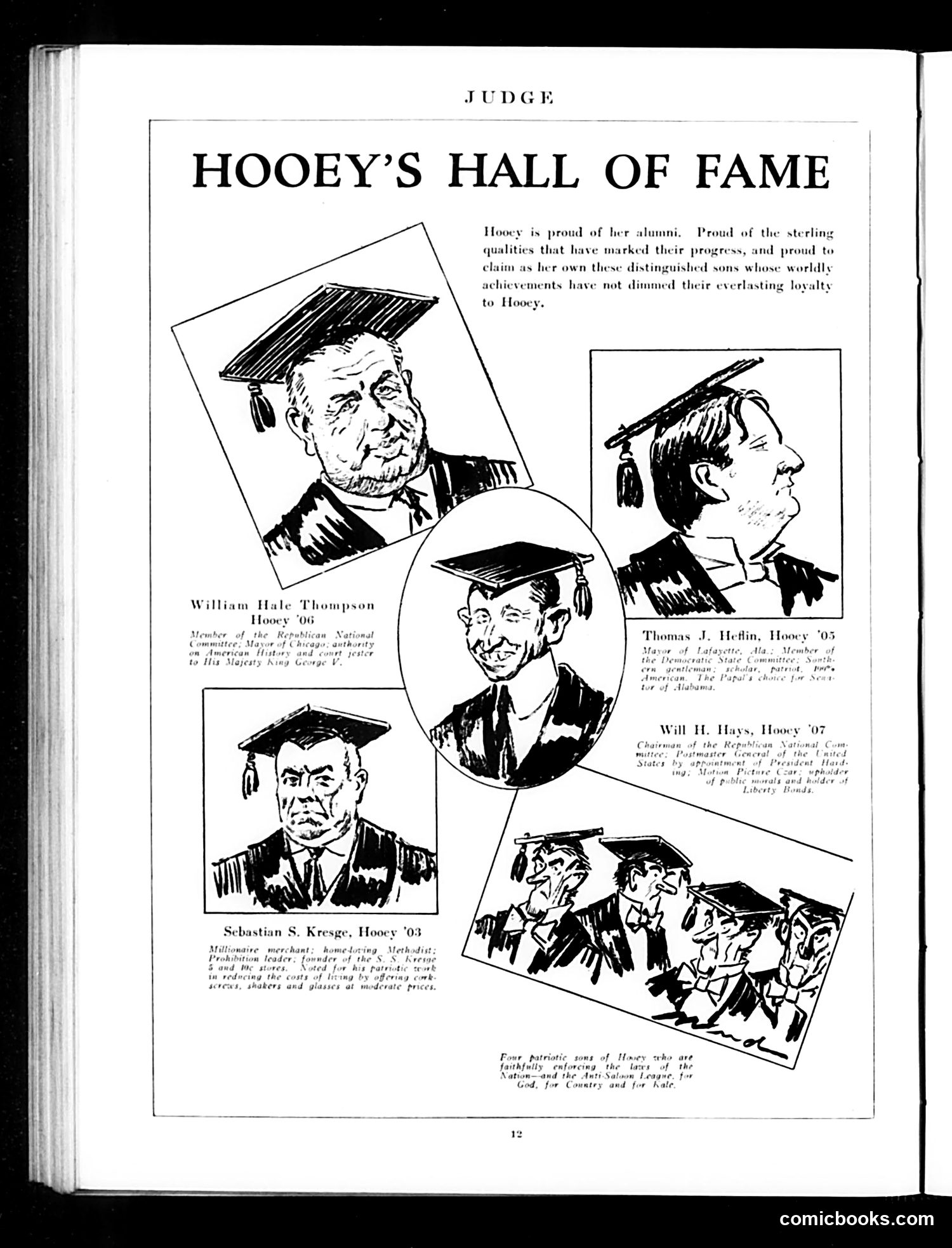
This page satirizes Hooey College's prominent alumni by presenting caricatured portraits of notable figures in academic regalia. The illustrated alumni include William Hale Thompson (Hooey '06), Sebastian S. Kresge (Hooey '04), Thomas J. Heflin (Hooey '05), and Will H. Hays (Hooey '07). The satire appears to mock the college's pride in these "distinguished sons" by suggesting they represent questionable or controversial figures whose worldly achievements contradict their supposed "everlasting loyalty" to the institution. The ironic tone—"Hooey is proud"—plays on the college's name itself, implying the alumni's accomplishments or character are dubious. Without identifying each figure's specific controversies, the cartoon ridicules the disconnect between institutional boasting and alumni reality.
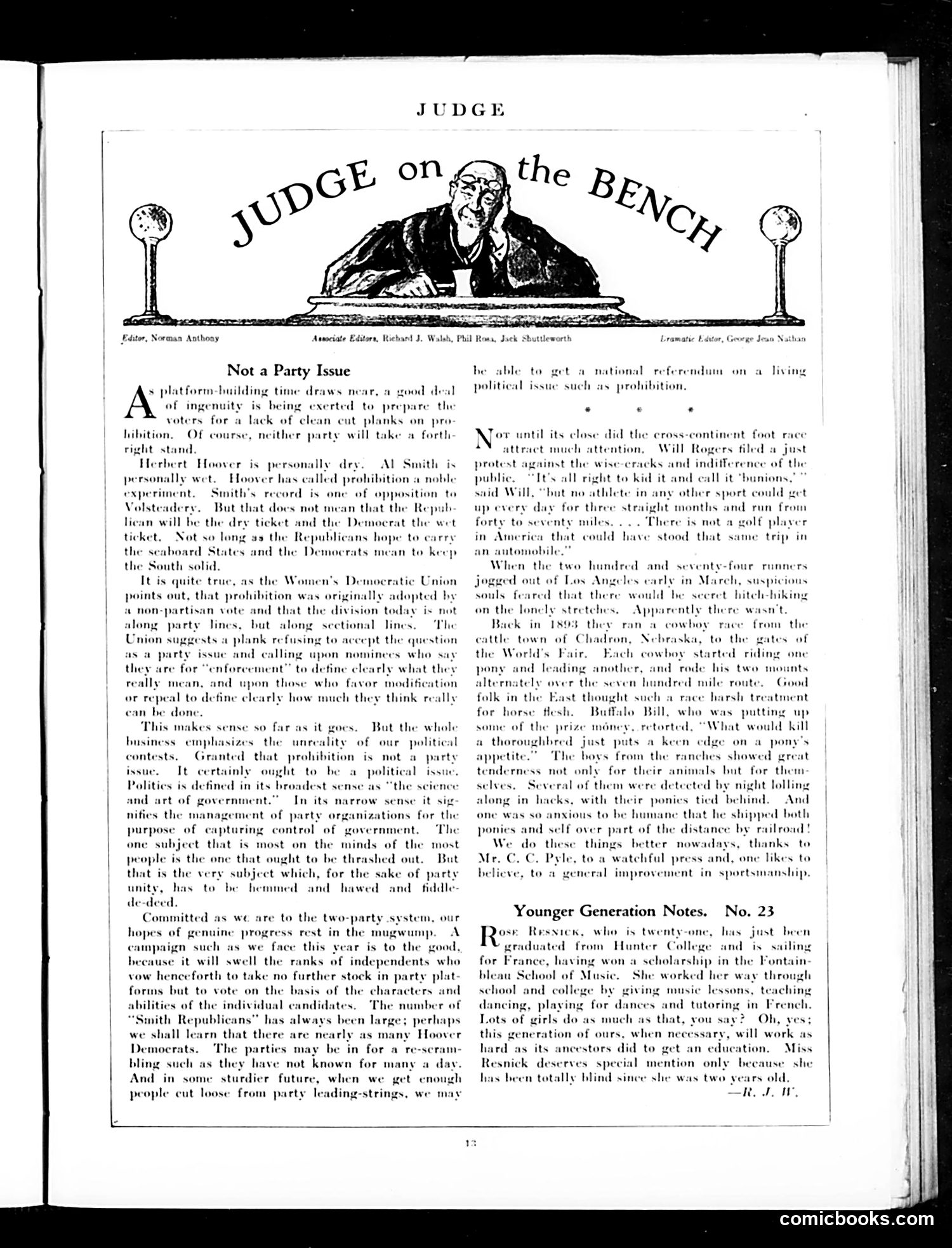
This page from Judge magazine contains two distinct pieces of political/social commentary: **"Not a Party Issue"** (main article): Discusses Herbert Hoover and Al Smith's conflicting stances on Prohibition ahead of the 1928 presidential election. The article critiques both parties for avoiding clear positions on this major policy question for political convenience—Republicans wanting seaboard states' votes, Democrats needing the "dry" South. It argues Prohibition should be debated as a substantive political issue rather than obscured by party politics, and calls for voters to judge candidates on character rather than party loyalty. **"Younger Generation Notes. No. 23"** (brief item): A lighter note about Rose Ressick, a blind woman who graduated from Hunter College and won a music scholarship to study in France, contradicting assumptions about what disabled people can accomplish. The cartoonish header shows a judge figure overseeing the bench—symbolizing judgment and evaluation of political positions.
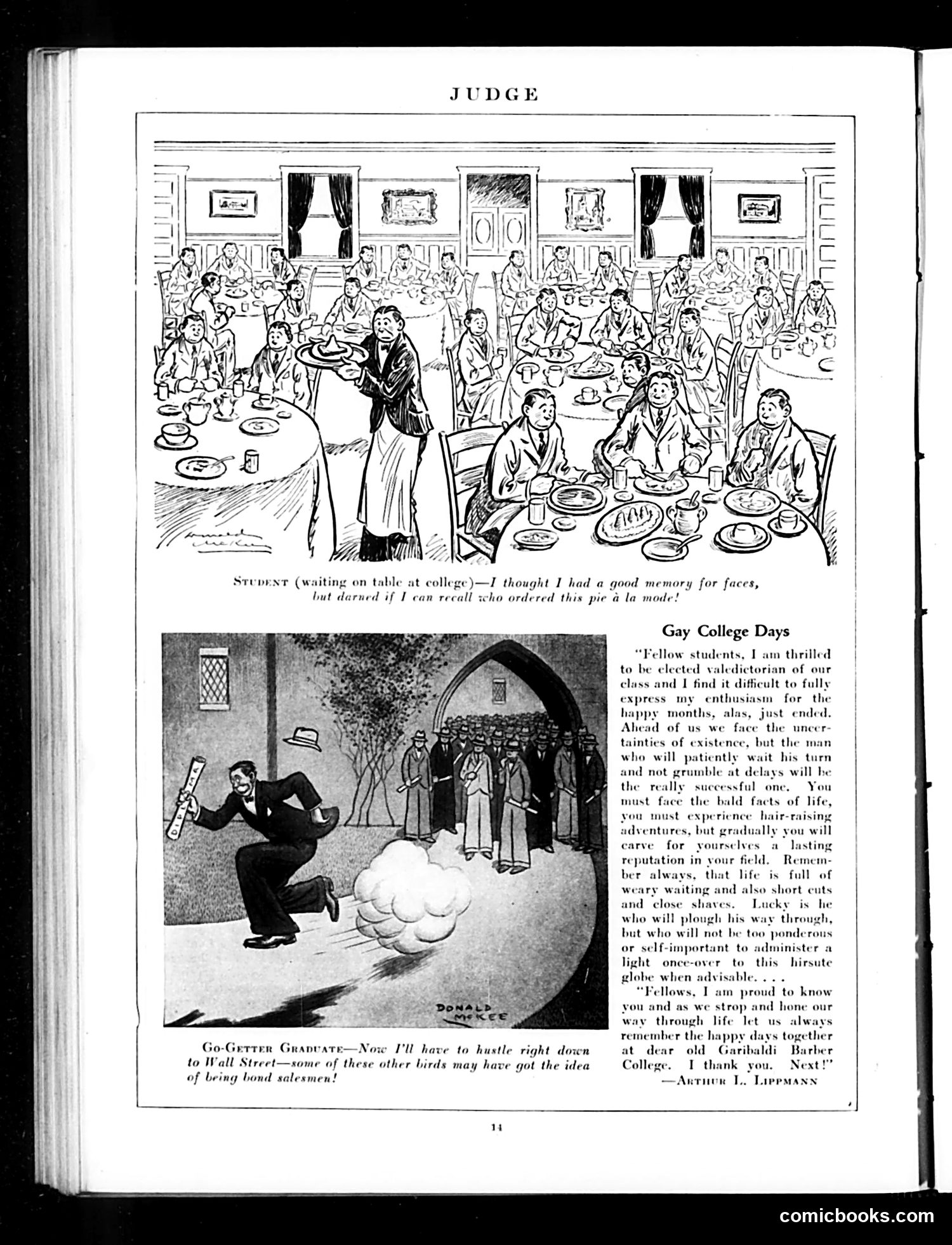
This page contains two satirical college-themed pieces: **Top cartoon**: A student waiter at a college dining hall admits he can't remember which diner ordered "pie à la mode"—a joke about the chaos of serving many identical-looking students during meals. **Bottom section**: A valedictory speech (likely satirizing typical commencement addresses) uses extended metaphors about hair and shaving ("plough his way through," "strop and hone," "hair-raising adventures," "close shaves") to dispense life advice. The humor lies in this overwrought, pretentious language applied to mundane success formulas. **Go-Getter Graduate cartoon**: A graduate realizes he must "hustle right down to Wall Street" because other classmates may have had the same idea about becoming bond salesmen—satirizing how graduates follow identical career paths and compete fiercely for the same positions. Overall, the page gently mocks college life's conformity, pretentious rhetoric, and the standardized ambitions of early 20th-century American graduates.
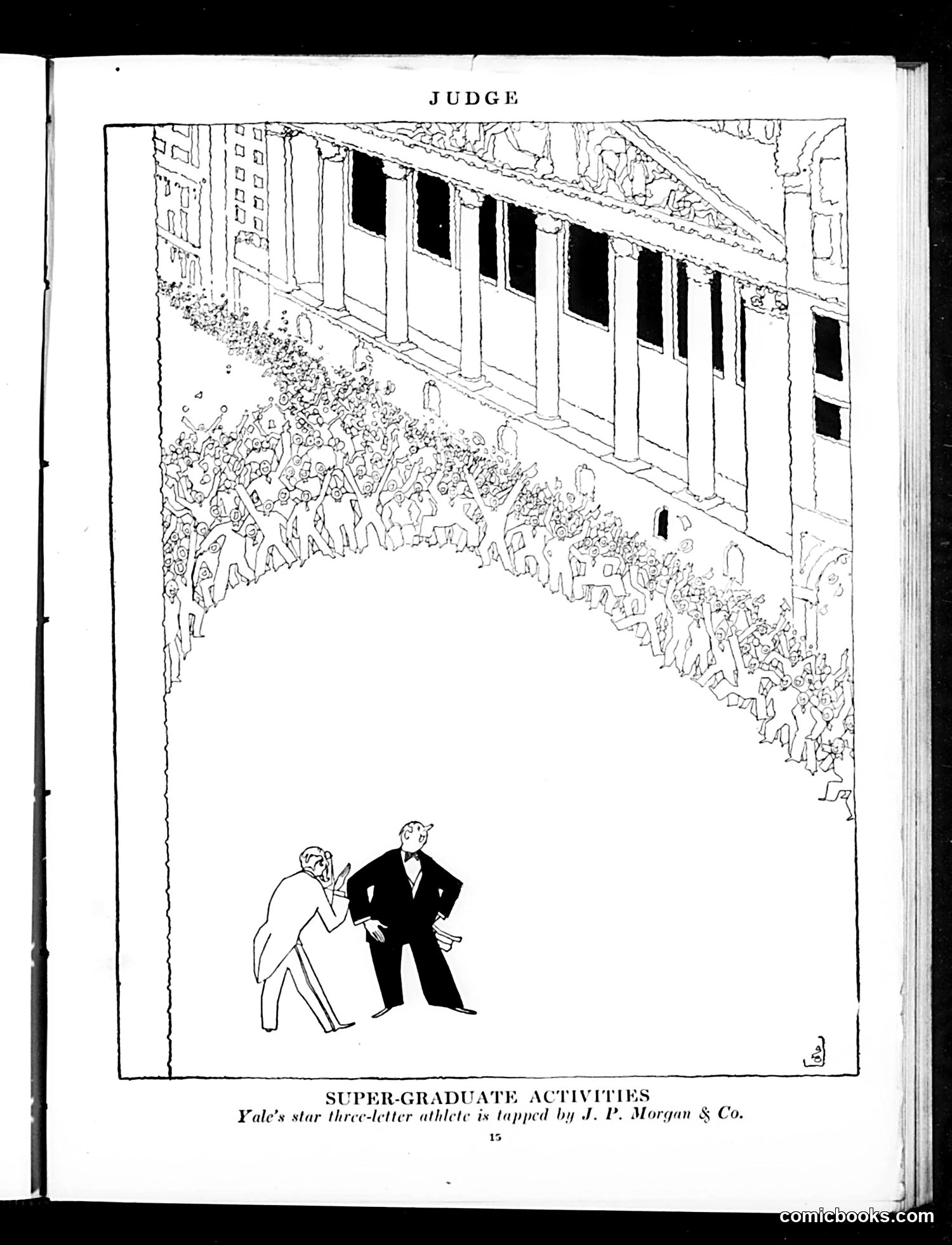
This is a satirical cartoon titled "Super-Graduate Activities" depicting Yale's star athlete being "tapped" (recruited) by J.P. Morgan & Co. The joke criticizes the practice of major corporations recruiting elite university athletes upon graduation. The cartoon shows a well-dressed man (representing J.P. Morgan & Co., the prominent banking firm) literally grabbing or "tapping" a young athlete, while a large crowd of people watches from the building above—likely representing other corporations also competing for talented graduates. The satire suggests that even celebrated athletic achievers at prestigious institutions like Yale were being commodified and recruited directly into corporate service, reducing their post-graduation prospects to corporate employment rather than individual choice or merit beyond athletics. This reflects early 20th-century concerns about corporate influence on American institutions and graduates.
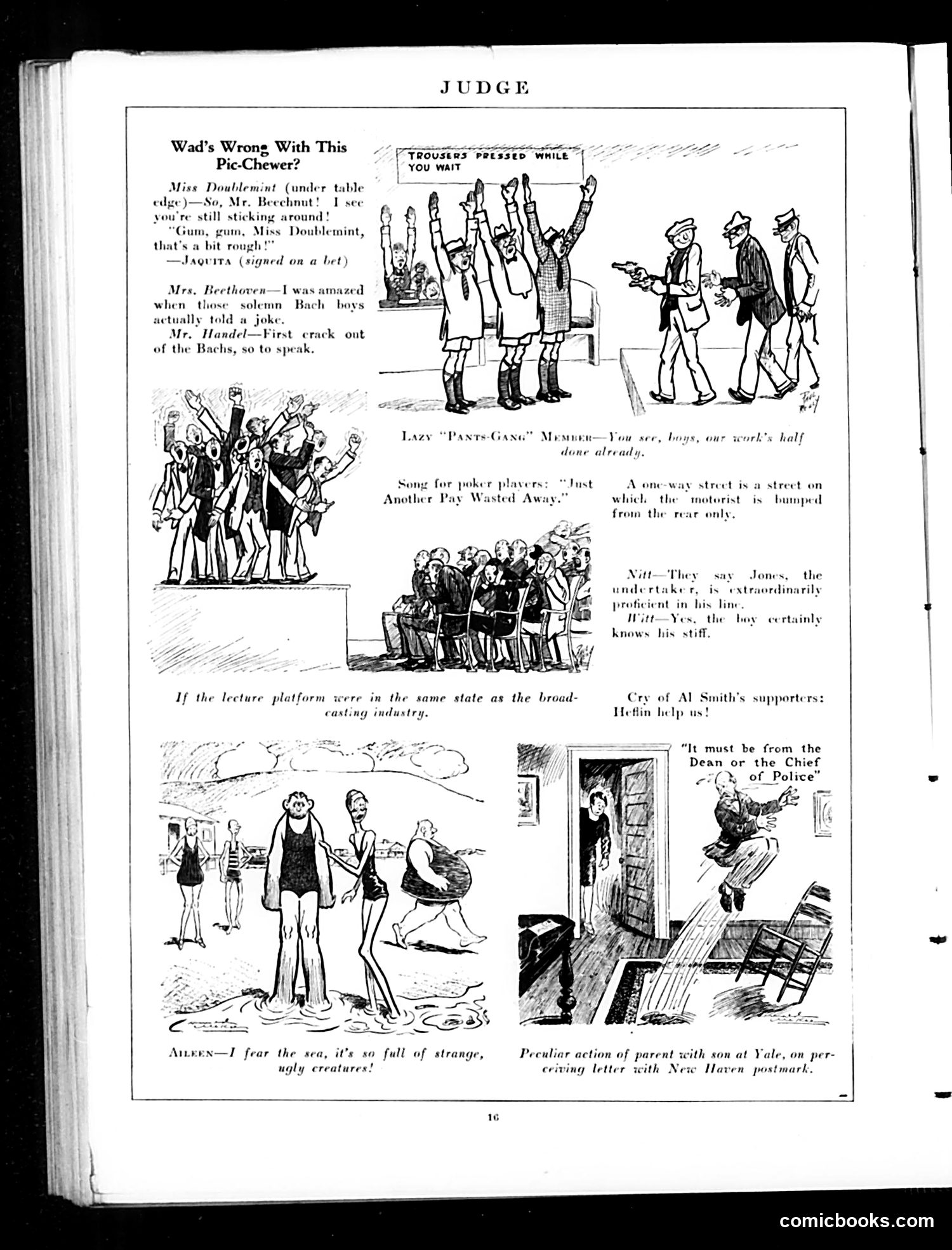
This page contains multiple short jokes typical of Judge's humor style. Key references include: **"Pic-Chewer"** mocks chewing gum brands (Doublemint, Beechnut) as interchangeable products. **Classical composer names** (Beethoven, Bach, Handel) are used for puns about musical terminology. **"Pants-Gang Member"** appears to reference a street gang or criminal group. **Al Smith's supporters** references the 1928 presidential candidate; "Heflin help us" likely puns on Senator Thomas Heflin's name while expressing desperation about Smith's prospects. **The Yale letter cartoon** depicts a parent joyfully receiving mail from their son, suggesting the parent expects bad news (expenses, discipline) from the university—satirizing Yale's reputation for wealthy excess. **The beach scene** uses Auden (likely W.H. Auden) to joke about sea creatures, playing on literary pretension. The humor relies on wordplay, brand names, political figures, and stereotypes about institutions like Yale—typical of 1920s-30s satirical magazines.
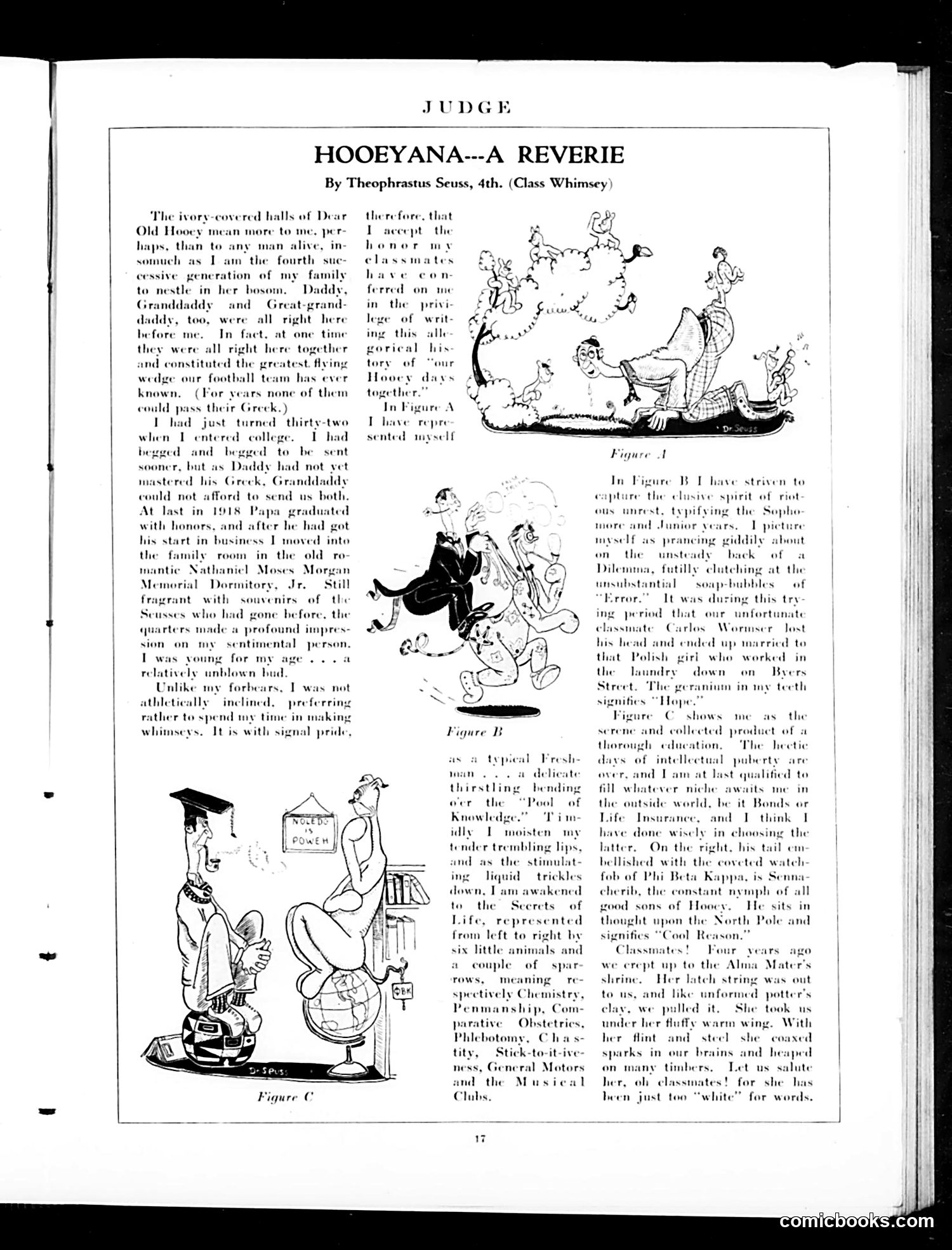
This is a humorous student essay by "Theophrastus Seuss, 4th" (a Seuss pseudonym) celebrating his college class at what appears to be a prestigious institution. The three accompanying cartoons illustrate his college experience using allegorical figures. **Figure A** depicts the author as a naive freshman being poured knowledge (represented by six subjects: Chemistry, Penmanship, Comparative Obstetrics, etc.) like liquid into his head. **Figure B** captures sophomore recklessness—the author bouncing wildly on a soap bubble labeled "Error," referencing when classmate Carlos Wormser "lost his head" and married a laundry worker named Potter. **Figure C** shows the polished graduate, now intellectually mature and wearing Phi Beta Kappa honors, finally worthy of his alma mater's investment. The satire mocks both pretentious college traditions (family legacies, Greek requirement, fraternity culture) and the stereotypical student's journey from naive freshman to pompous graduate. The elaborate wordplay throughout reflects Judge magazine's sophisticated humor aimed at educated readers.
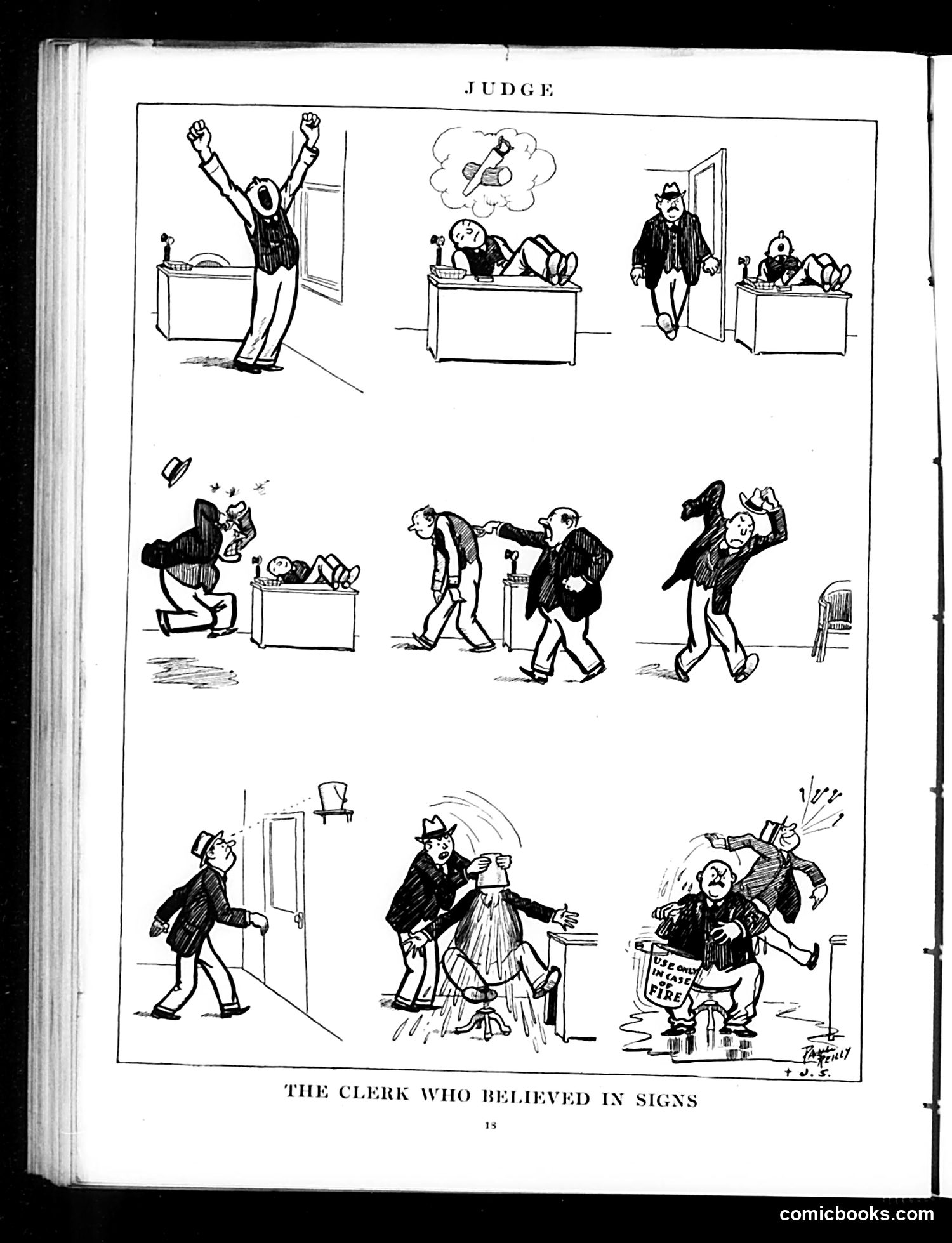
This satirical comic strip depicts a courtroom clerk whose superstitious belief in omens causes escalating chaos in a judge's chambers. The sequence shows: 1. **Top row**: The clerk celebrating what appears to be a favorable sign, while the judge reacts with growing frustration 2. **Middle panels**: The clerk's interpretation of various signs—a ladder, conflict between men, and scattered papers—leading to increasingly absurd situations 3. **Bottom panels**: The situation deteriorating, culminating in apparent disaster The satire targets superstition and magical thinking, suggesting that relying on omens and signs rather than rational judgment leads to disorder and failure. The judge's authority and courtroom decorum are undermined by one employee's irrational beliefs, reflecting broader Progressive-era concerns about superstition versus reason in professional and civic institutions.
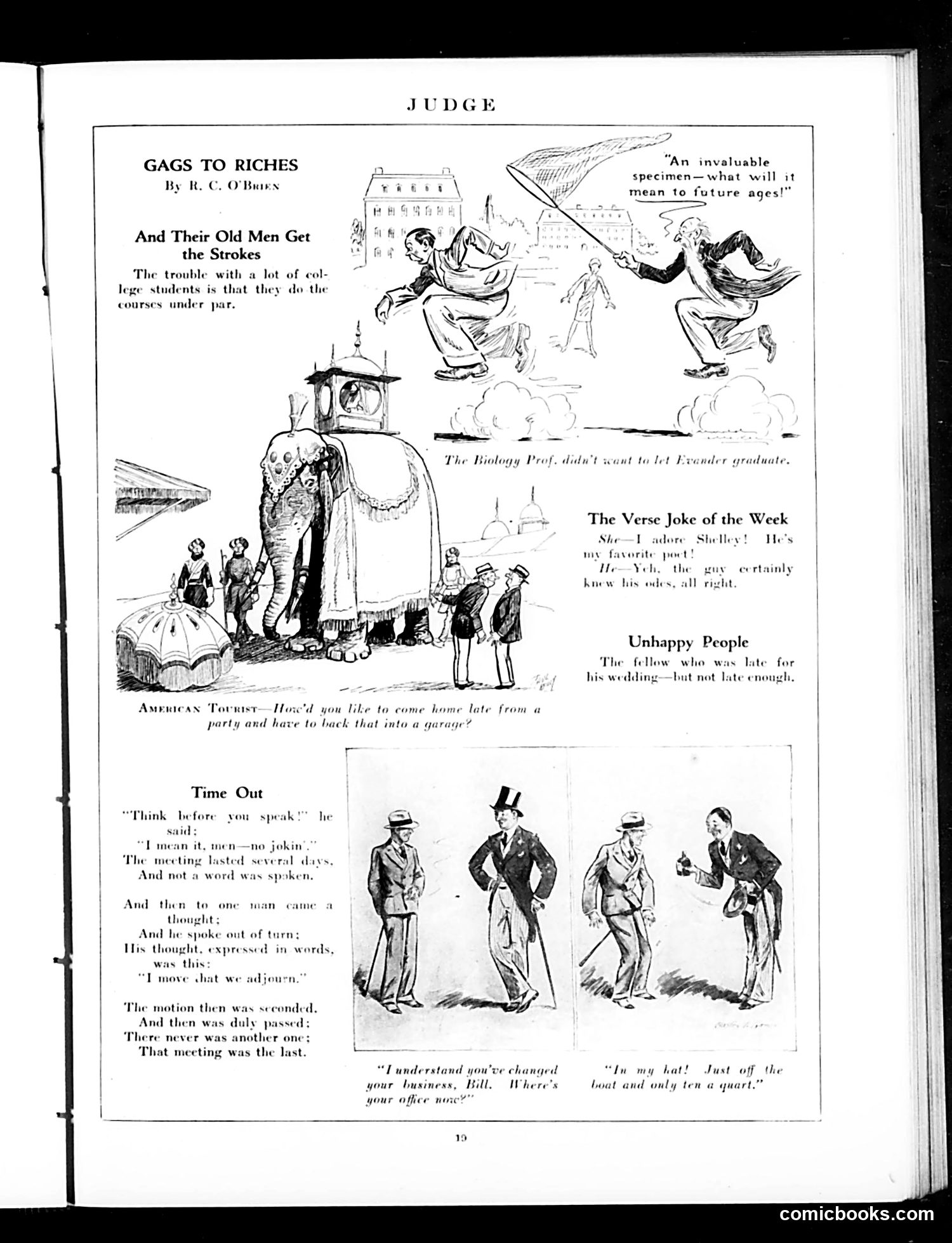
This page contains several satirical pieces typical of early 20th-century American humor: **"Gags to Riches"** mocks college students who take courses "under par"—a golf metaphor suggesting academic underperformance. The biology professor's reluctance to graduate a student (shown as a specimen) puns on educational standards. **"The Verse Joke of the Week"** jokes about someone confusing the poet Shelley with shelving/storage, and "odes" (poetry) with "odes" (sounds like "ODs"—overdoses or mistakes). **"Unhappy People"** contains a darkly comedic one-liner about a man being late to his own wedding—implying he should have avoided it altogether. **"Time Out"** is a longer humorous poem about a business meeting where enforced silence backfires: one man finally speaks to propose adjournment, the motion passes, and the meetings cease forever—satirizing pointless corporate gatherings. The cartoons use visual gags and wordplay typical of Judge's satirical approach to American social customs and institutional absurdities.
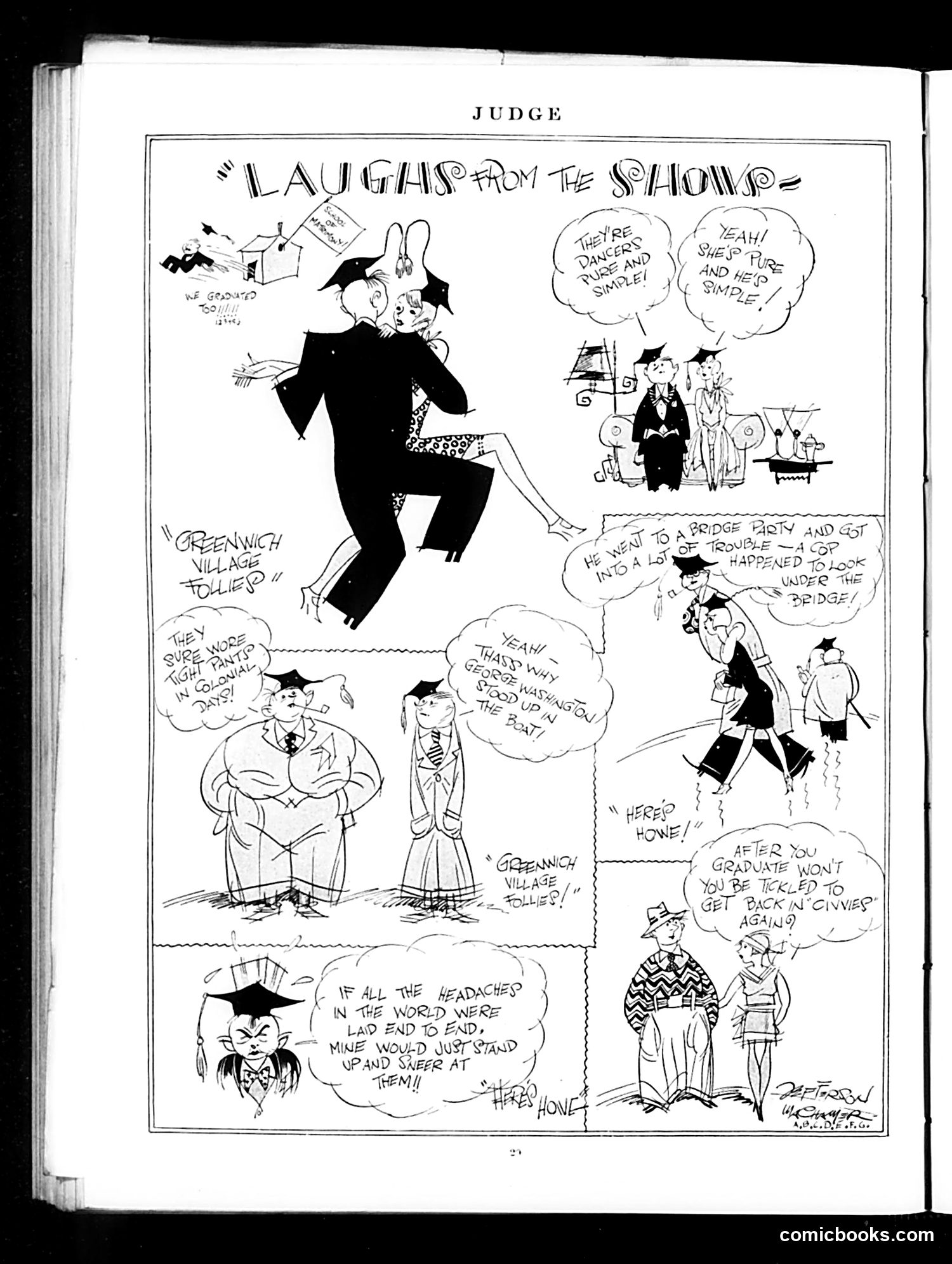
This satirical comic page mocks newly married couples and domestic life. The central figure—a man in formal dress—appears to be a groom or newly married husband dealing with various marital frustrations. Multiple vignettes depict common complaints: wives nagging about finances ("a lot of trouble"), the awkwardness of newlyweds at social gatherings ("Greenwich Village Follies"), and general domestic discord. The humor relies on stereotypes of marriage as burdensome for men. One panel features an exasperated husband saying if all headaches in the world ended at his, he'd merely "sneer at them"—implying his wife is his greatest headache. The "Judge" magazine style indicates this reflects early-to-mid 20th century American attitudes toward marriage, presenting domestic life as inherently comedic through the lens of male frustration and marital complaint. The satire targets not marriage itself but the perceived inevitable friction between spouses.
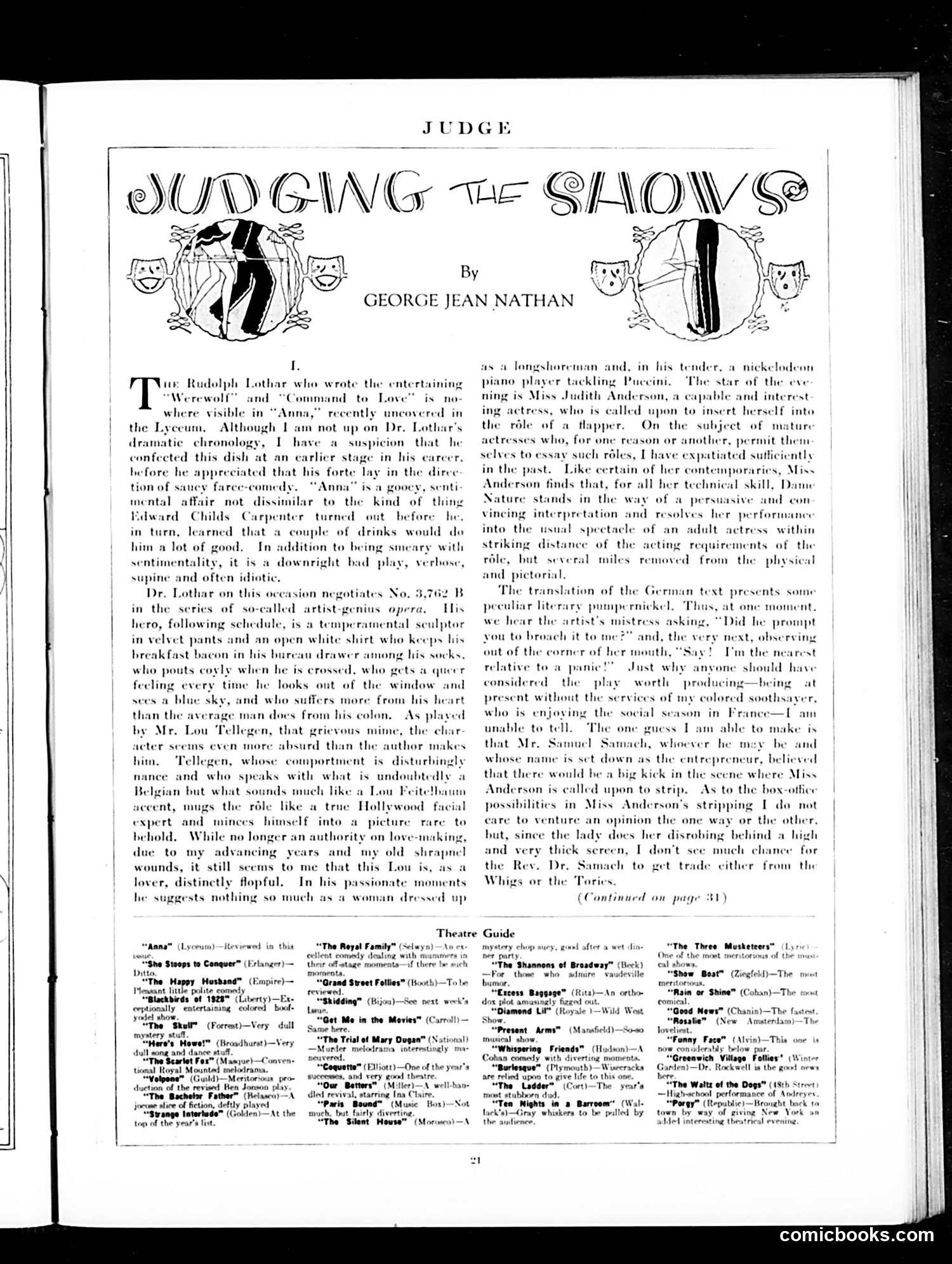
This is a theatrical review column, not a political cartoon. Nathan critiques recent Broadway productions and performances, focusing heavily on a play called "Anna" by Rudolph Lothar. The main subject is actor Lou Tellegen's performance as a temperamental sculptor. Nathan mocks Tellegen's affected acting style—his "coyly pouting" demeanor, exaggerated accent ("sounds much like a Lou Feitelbaum accent"), and theatrical mannerisms. He compares Tellegen unfavorably to actress Judith Anderson, praising her technical skill while suggesting both struggle with age-appropriate casting. The review is scathing about the play itself, calling it "downright bad," "verbose, supine and often idiotic," and "smeary with sentimentality." The "Theatre Guide" section lists contemporary Broadway shows with brief descriptions, including "The Royal Family," "Grand Street Follies," and "Orange Interlude." This represents Judge's drama criticism rather than satirical cartooning.
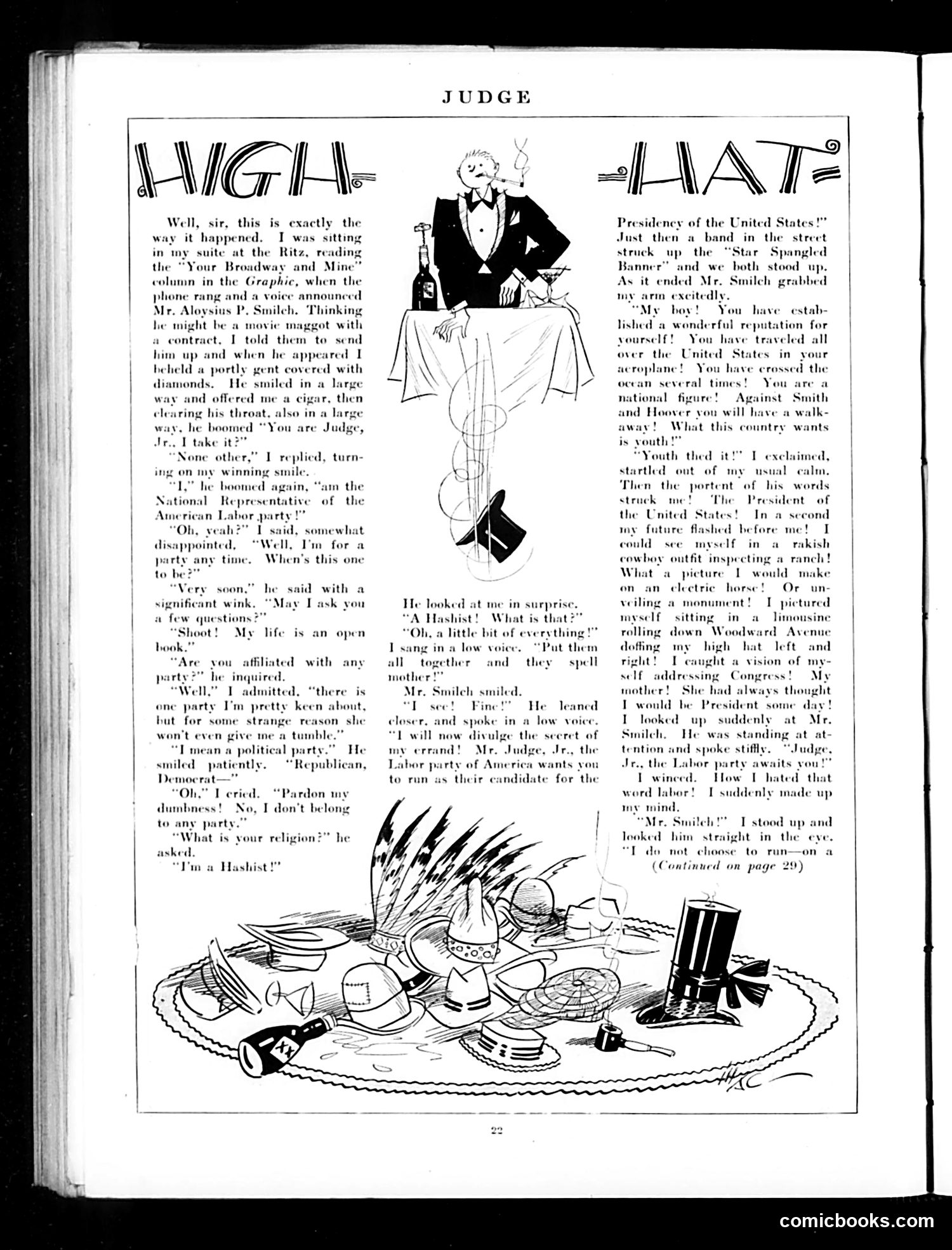
This cartoon satirizes the American Labor Party's recruitment efforts, likely from the 1920s. A portly Labor Party representative (Mr. Aloysius P. Smileh) visits the magazine's editor to recruit him as their presidential candidate. The humor turns on the editor's deliberate misunderstanding: when asked his political affiliation, he claims to be a "Hashist" (a joking non-answer meaning "a little bit of everything"), playing on the word "hash." The Labor representative takes this seriously. The satire mocks the Labor Party as desperate and foolish for courting a magazine editor with no genuine political credentials. It also satirizes the editor's vanity—he fantasizes about becoming president through increasingly absurd scenarios (cowboy outfit, monument unveiling, congressional address). The page concludes mid-story, suggesting the editor will reject their offer. The overall point: the Labor Party's political ambitions are laughably naive and their candidates equally frivolous.
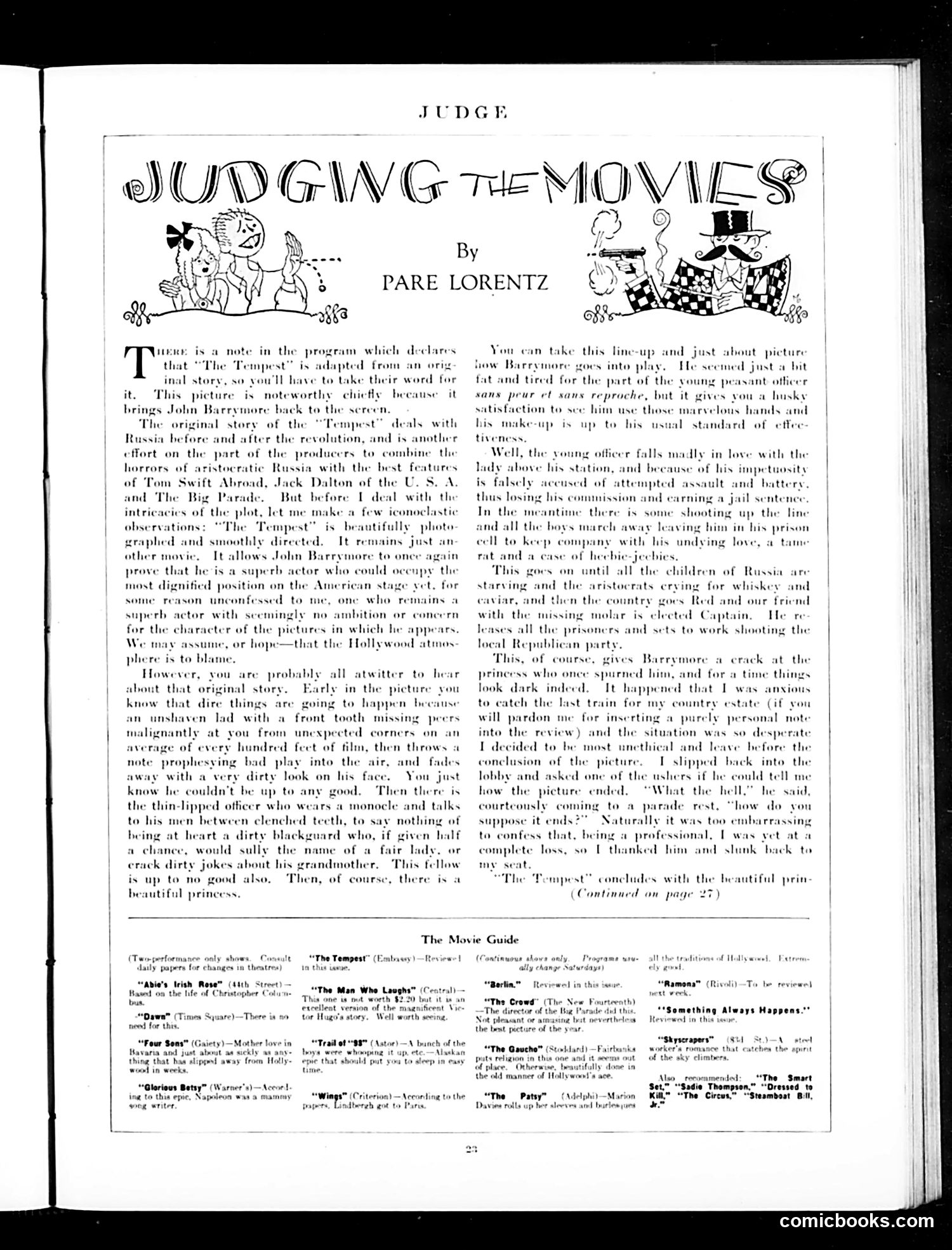
This is a humorous film review by Pare Lorentz critiquing an adaptation of Shakespeare's *The Tempest* starring John Barrymore. The satire mocks the 1920s Hollywood practice of transplanting classic stories into contemporary settings—here, the plot relocates to Revolutionary Russia. Lorentz ridicules the film's heavy-handed social commentary: the story involves a disheveled peasant officer falsely accused of assault, imprisoned while Russia descends into Bolshevik revolution. The reviewer sardonically catalogs stock villainous characters—an unshaven brute, a monocled aristocratic officer—and complains Barrymore seems "fat and tired" for the role. The real joke is Lorentz's confession that he abandoned the screening before the ending, asking an usher how it concluded. He admits being "unprofessional" but too embarrassed to confess ignorance. The satire targets both Hollywood's commodification of literature and the era's trendy incorporation of Russian revolution themes into popular entertainment.
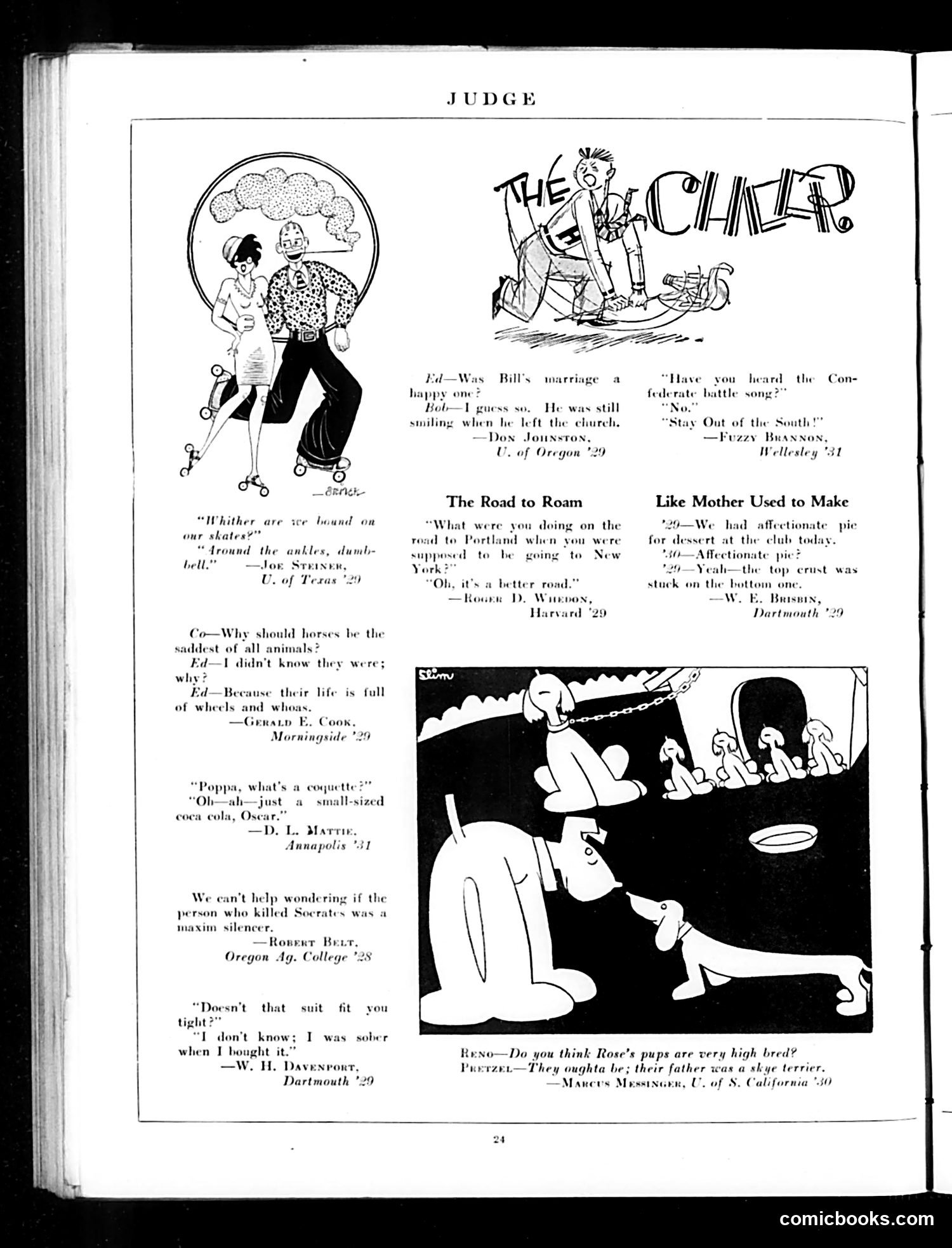
This page from Judge magazine contains humor columns typical of college-era comedy from the late 1920s-early 1930s. The content includes: **The main cartoons and jokes** are puns and wordplay submitted by college students (credited to various universities). Examples: a joke about horses being "sad" because their lives are full of "wheels and whoas" (pun on "woes"); a coquette defined as a "small-sized coca cola"; wordplay about "maxim silencer" (relating to Socrates's execution). **The illustrated cartoon** (bottom right) shows a woman with puppies and makes a joke about breeding: the puppies are "high bred" because their father was a "skye terrier" (pun on "sky," implying superiority). **The overall tone** is lighthearted, undergraduate humor relying on puns, double meanings, and gentle social observations rather than sharp political satire. This reflects Judge's evolution toward lighter collegiate comedy by this period, contrasting with its earlier reputation as serious political commentary.
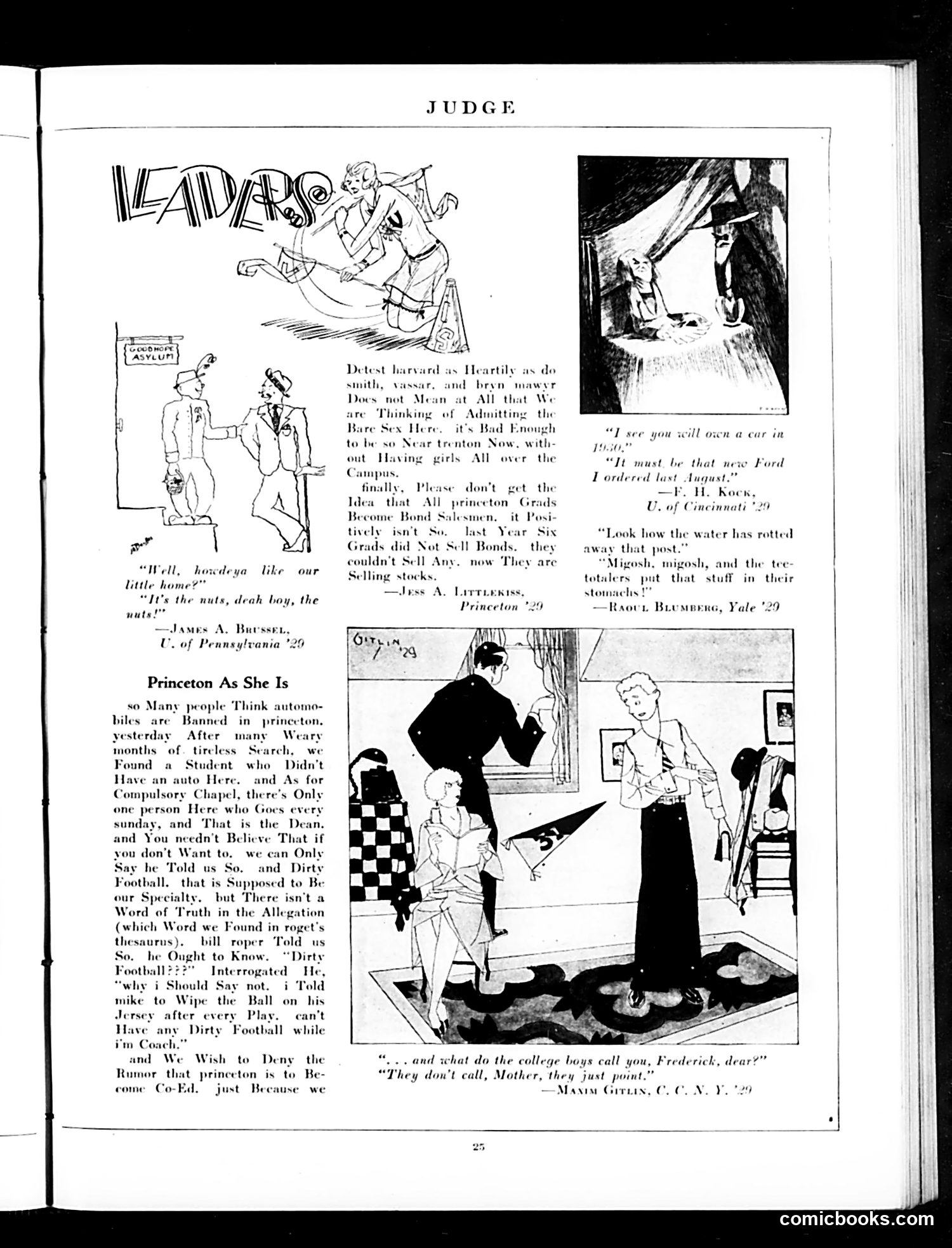
This page contains college humor from Judge magazine circa 1929. The content mocks Princeton University through exaggerated claims about student life. **Main satire:** The "Princeton As She Is" section ironically denies common stereotypes while actually confirming them. It claims automobiles aren't banned (implying they actually are common), that few students attend mandatory chapel (except the Dean), and that not all graduates become bond salesmen—though last year's class couldn't sell bonds and now peddles stocks instead. **Social context:** The jokes reference Prohibition-era concerns (water damage suggesting alcohol storage), women's education (mocking the idea Princeton might go co-ed), and the 1920s financial boom (bond and stock selling as typical graduate careers). **The cartoon caption** jokes about a Ford automobile and someone ordered in August—likely referencing Model T availability or delivery delays. The overall tone satirizes elite college pretension and the disconnect between what Princeton claims about itself versus student reality.
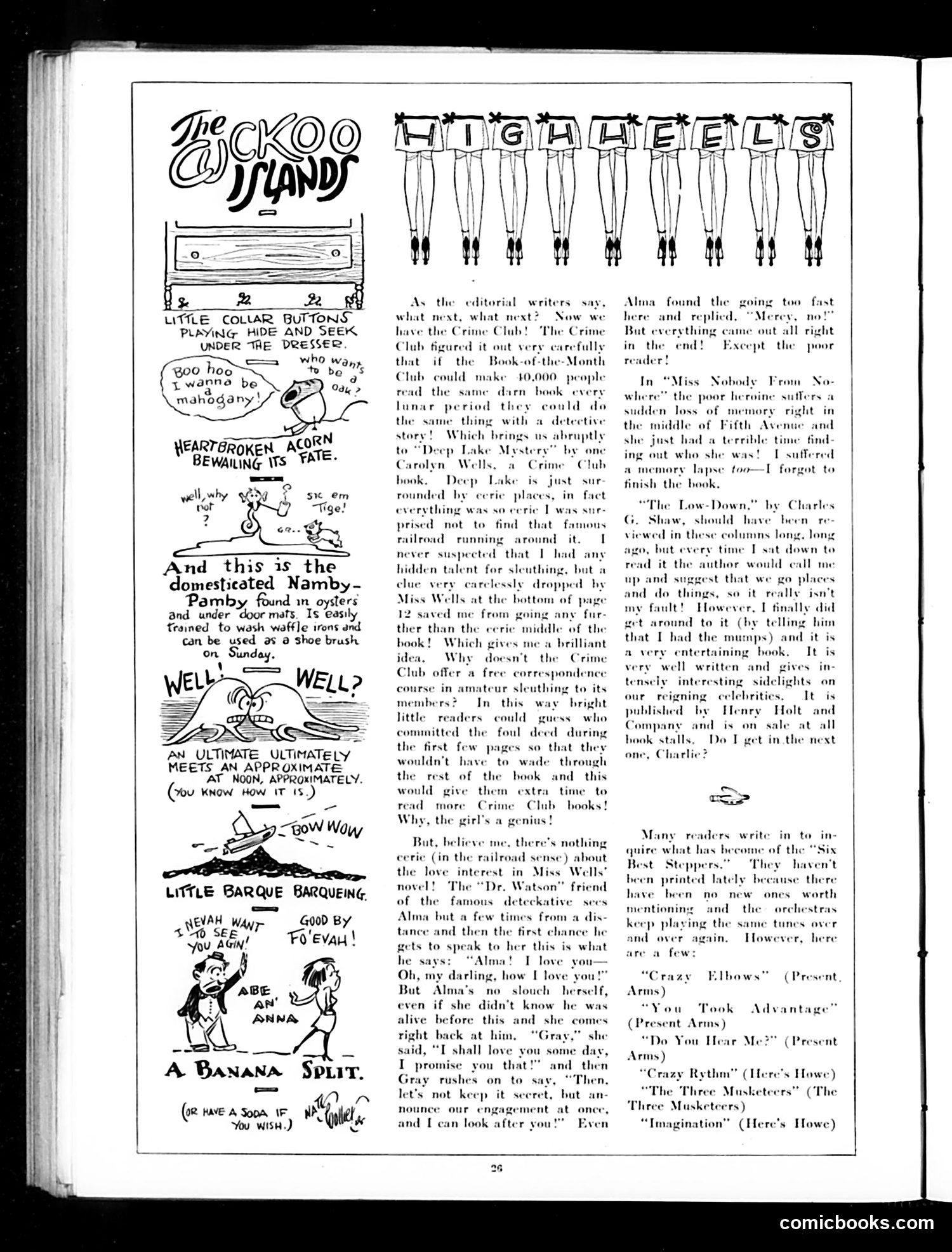
This Judge magazine page contains mostly **humorous filler cartoons** rather than political satire. The left side features absurdist, whimsical drawings with puns: - "Little Collar Buttons Playing Hide and Seek Under the Dresses" — a nonsensical visual joke - "Heartbroken Acorn Beware Its Fate" — surreal wordplay - "Domesticated Namby-Pamby" — a limp, emasculated male figure (a mild social jab at weak masculinity) - "Little Barque Barqueing" and "A Banana Split" — pun-based cartoons The **right column is book/literature review**, discussing mystery novels by Carolyn Wells and Charles G. Shaw, plus a list of popular song titles ("Crazy Elbows," "You Took Advantage," etc.). The reviewer critiques romance subplots in detective fiction. This appears to be **general entertainment filler** — humor, reviews, and ads typical of 1920s magazines — rather than satirical commentary on contemporary politics or events.
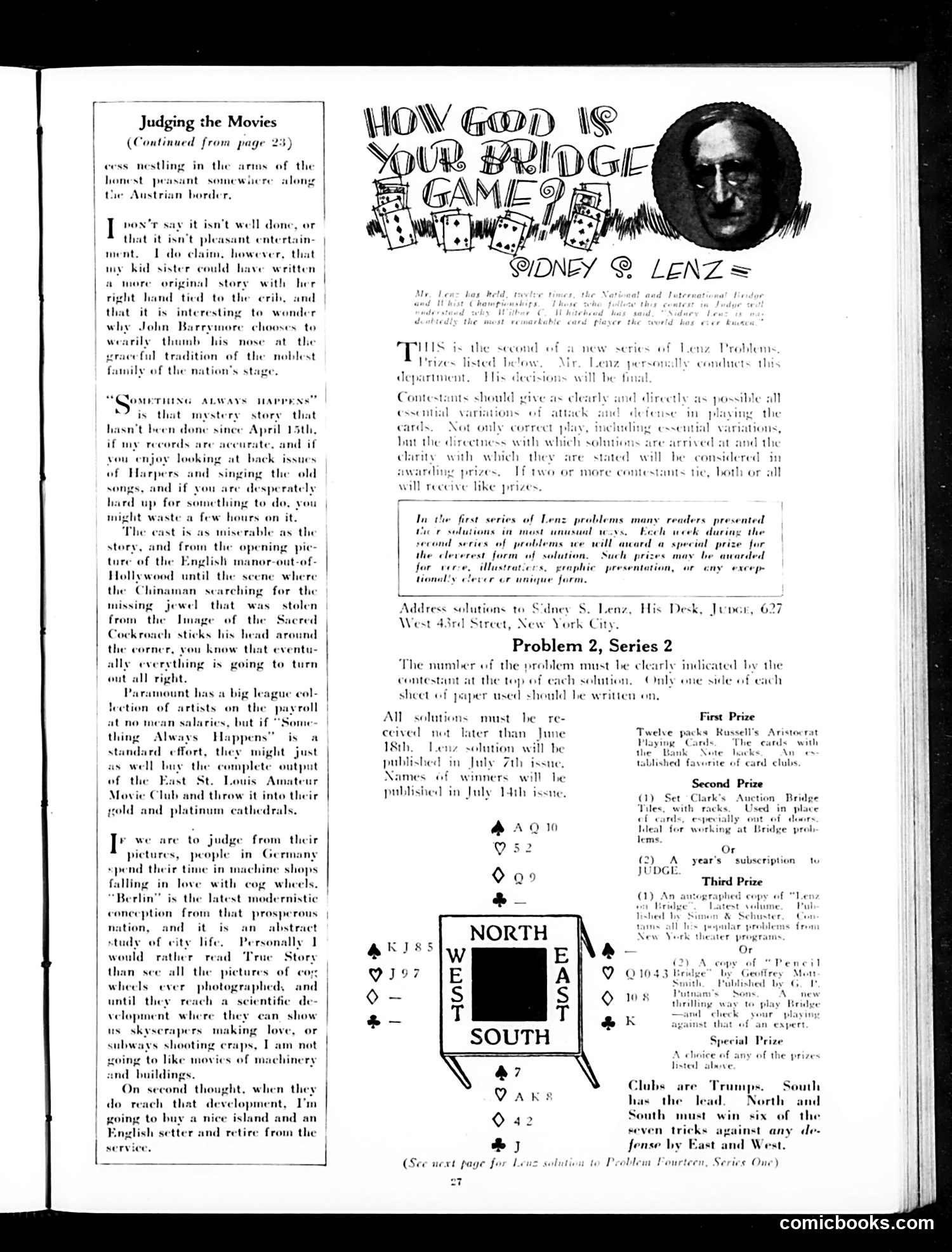
This page contains two distinct elements: a film criticism column and a bridge puzzle competition. **The Film Criticism ("Judging the Movies"):** The critic reviews recent Hollywood productions, dismissing "Something Always Happens" as unoriginal despite competent acting by John Barrymore. He attacks "Berlin," a modernistic German film about city life, as pretentious abstract nonsense—sarcastically suggesting he'd prefer reading *True Story* magazine. The satire targets both Hollywood's formulaic storytelling and the European avant-garde film movement gaining influence in 1920s cinema. **The Bridge Problem:** The page also features Sidney S. Lenz's bridge puzzle competition, offering prizes including card sets and a Judge magazine subscription. This reflects bridge's popularity as a sophisticated parlor game among Judge's educated, middle-class readership. The juxtaposition reveals Judge's dual identity: sophisticated cultural criticism paired with genteel entertainment for its audience.
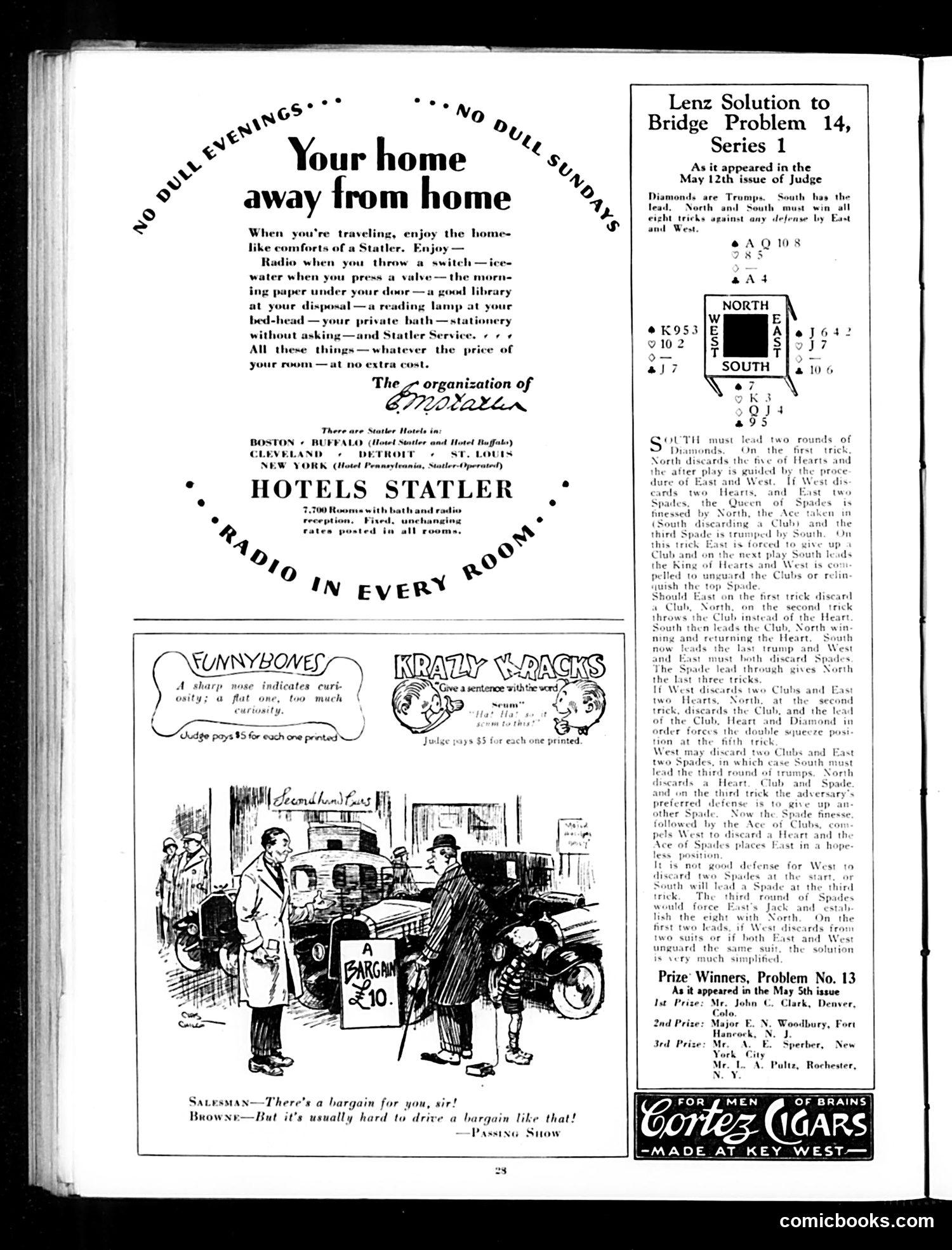
This page is primarily **advertising and puzzle content** rather than political satire. The dominant feature is a **Statler Hotels advertisement** emphasizing modern travel amenities (radio, running water, private bath, library services) available in their rooms "at no extra cost"—targeting early 20th-century travelers concerned with comfort while away from home. Below the ad are two minor **humorous anatomical jokes** ("Funnybones" and "Krazy Klancks") where readers paid 85¢ per printed joke—early user-generated content. The **main cartoon** shows a salesman pitching a vehicle (marked "BARGAIN $10") to a skeptical man named Browne, who quips that such bargains are "usually hard to drive"—a pun on both negotiating and operating a car. The right column contains a **bridge card game solution** and prize winners, plus a **Cortez Cigars advertisement**. This appears to be a typical Judge page mixing ads, light humor, and puzzle solutions rather than political commentary.
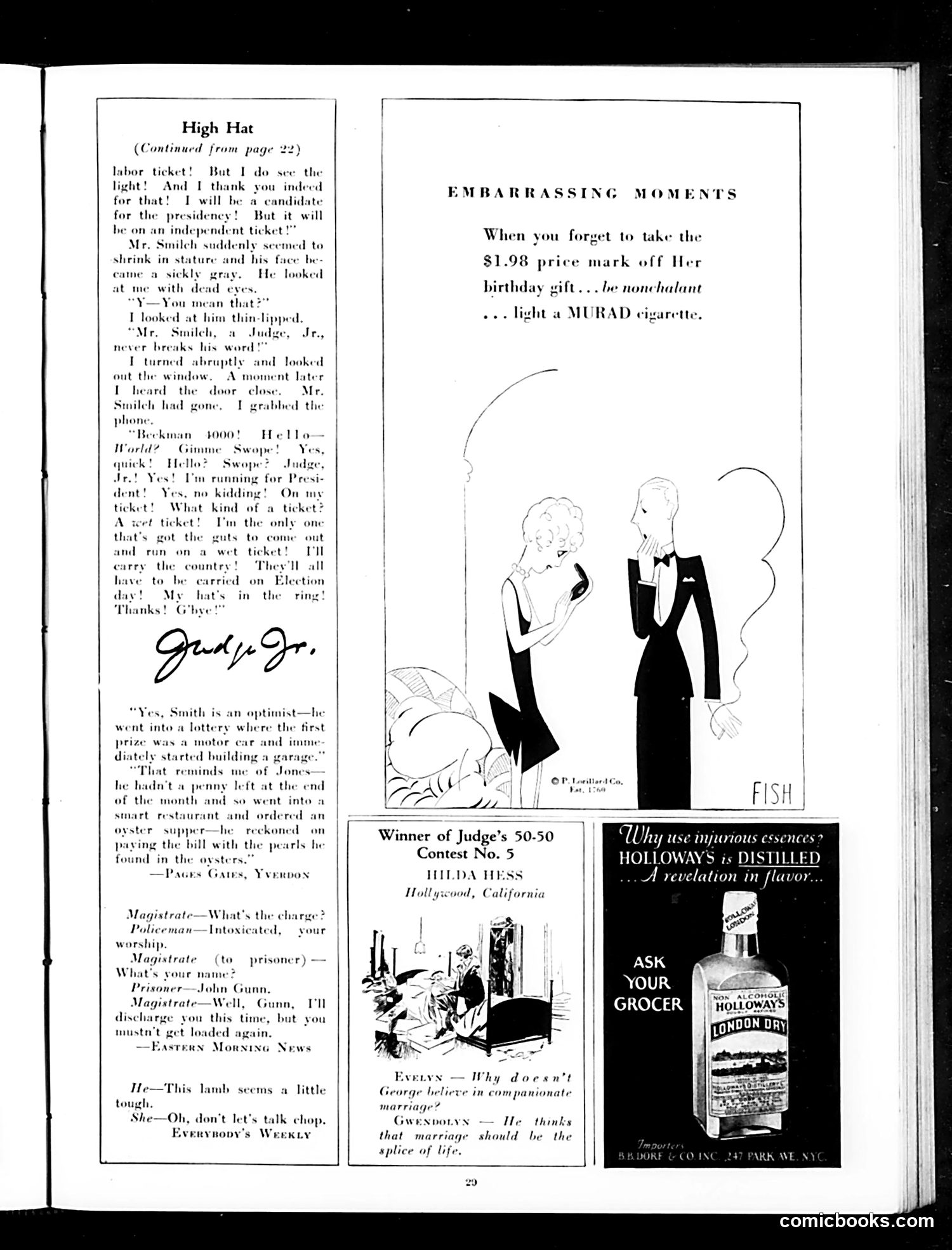
This page from *Judge* contains multiple humor sections typical of 1920s satirical magazines: **"High Hat" (continued story):** A comedic narrative about an ambitious man named Smith who, after meeting someone influential, decides to run for president on an "independent ticket"—a wet ticket, he claims, since he's "the only one that's got the guts" and will "carry the country." The humor relies on wordplay and absurdist logic about election day. **"Embarrassing Moments":** A cartoon showing social anxiety—forgetting to remove a price tag ($1.98) from a gift. The solution: light a MURAD cigarette to appear nonchalant. This reflects period advertising merging product placement with relatable social humor. **Mixed humor items** include jokes about optimists, intoxication puns, and a pun about "companionate marriage" vs. "splice of life." The page reflects 1920s concerns: political ambition, consumer embarrassment, and smoking as a social prop for confidence. Most content is lighthearted rather than hard-hitting satire.
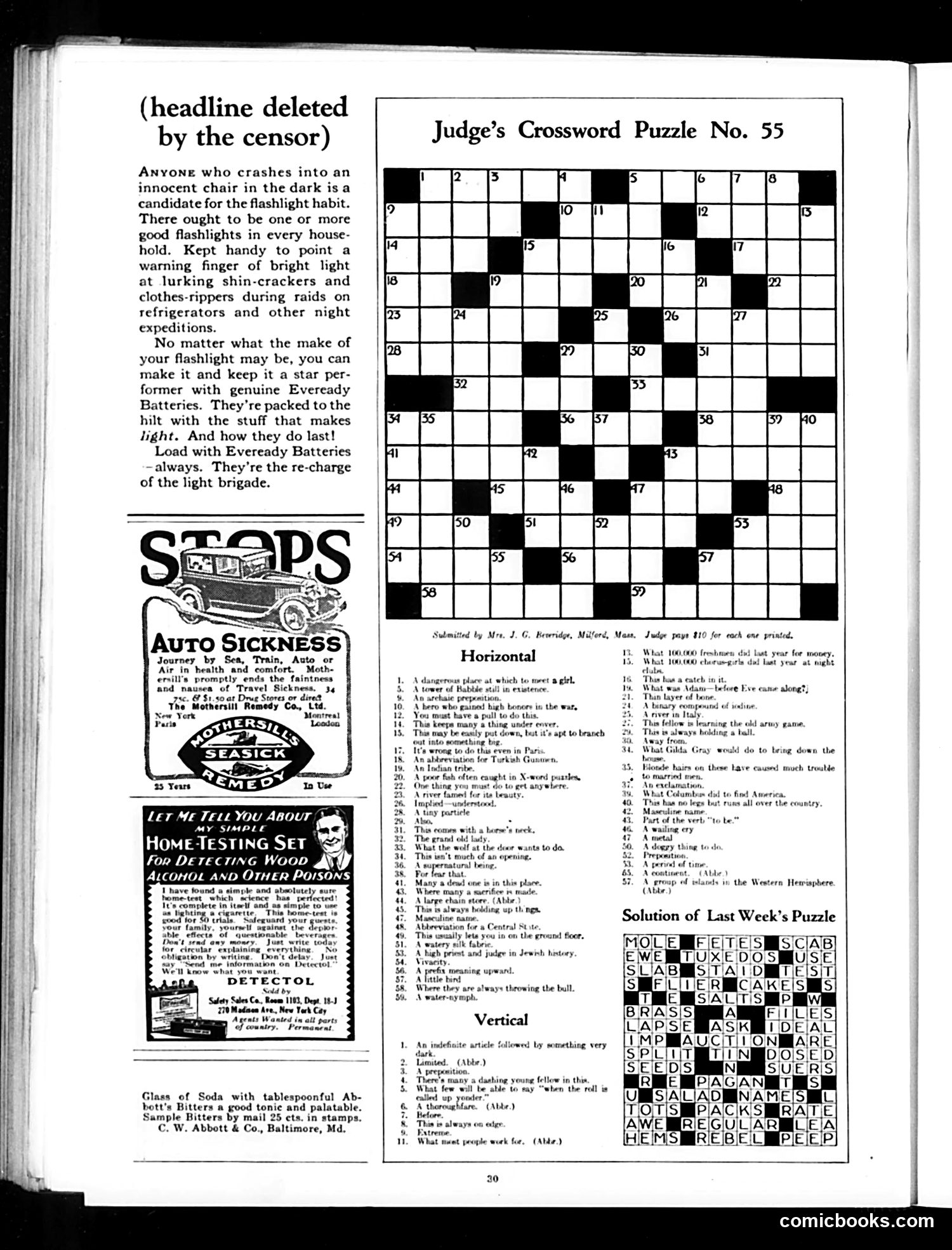
This page is primarily **advertising and entertainment content** rather than political satire. The deleted headline suggests censorship, likely related to WWI-era restrictions on criticism. The main content includes: **Advertisements:** Multiple product ads dominate—Eveready Batteries (flashlights), Mothersill's travel sickness remedy, a home testing kit for detecting alcohol and poisons, and Abbott's Bitters. These reflect early 20th-century consumer goods and concerns. **The crossword puzzle** is the page's central feature, with clues and a solution grid—standard magazine filler content. **Significant context:** The "home-testing set for detecting wood alcohol and other poisons" references Prohibition-era concerns about dangerous bootleg liquor, a major public health issue of the 1920s-30s. The deleted headline and references to "raids on refrigerators" suggest this is from a period when alcohol prohibition was active or recently ended. The page reflects Depression or Prohibition-era Judge magazine—more focused on commercial advertisements and puzzles than political commentary.
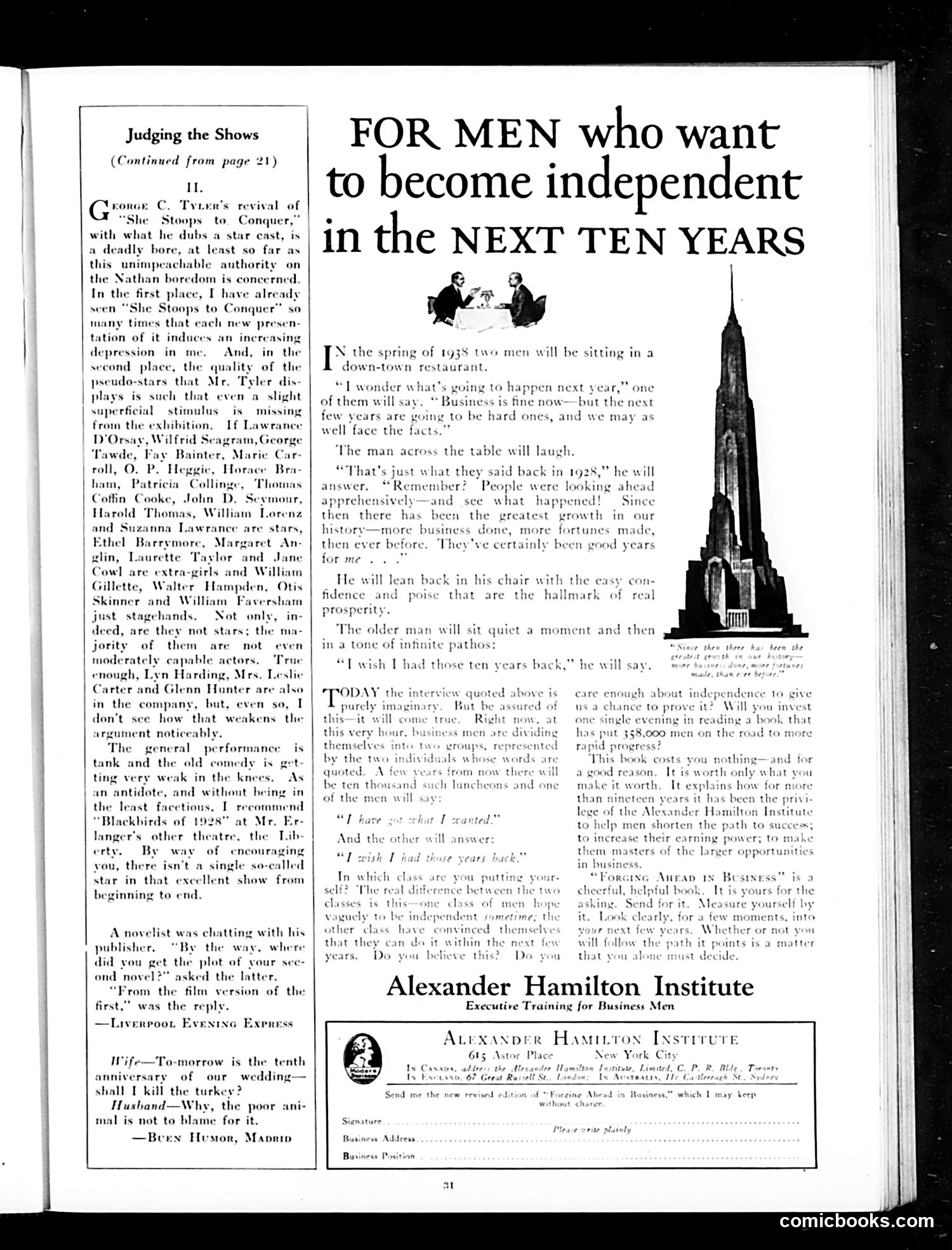
This page combines a theater review with a full-page advertisement for the Alexander Hamilton Institute, a business correspondence school. **The Theater Section** critiques George C. Tyler's revival of "She Stoops to Conquer," dismissing it as tired and the cast as mediocre despite star names like Ethel Barrymore and William Gillette. The reviewer prefers "Blackbirds of 1928," which he notes has no famous stars but is superior. **The Main Advertisement** uses an imagined 1938 conversation between two businessmen—one prosperous, one regretful—to pitch business training. The pitch: in 1928, if you invest ten evenings reading the institute's course, you could be independent within a decade. The advertisement claims 358,000 men are already "on the road to more rapid progress." This reflects 1920s optimism about self-improvement through correspondence courses—a common sales approach of the era that promised working men could achieve prosperity through evening study, without college attendance.
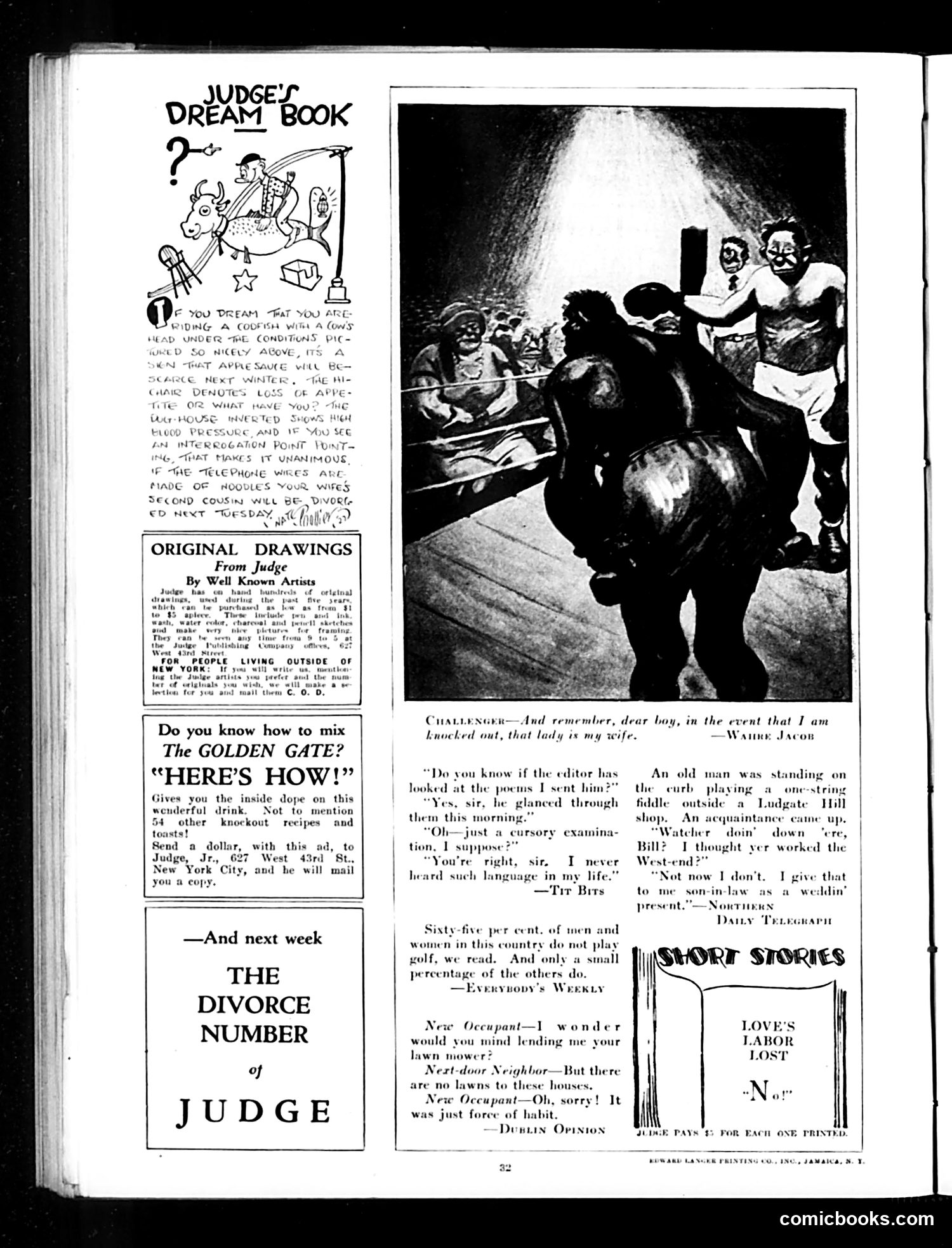
This page from *Judge* (a satirical magazine) contains mostly filler content and advertisements rather than political cartoons. The left side features a humorous "Dream Book"—a parody of fortune-telling dream interpretation guides popular at the time. It absurdly claims that dreaming of riding a cow-headed fish predicts scarce applesauce and divorces, satirizing the pseudoscientific claims of actual dream books people consulted. The right side contains brief comic anecdotes and advertisements. A notable joke features a "New Occupant" asking to borrow a lawn mower from their neighbor, unaware apartment buildings lack lawns—mocking urban newcomers unfamiliar with city living. There's also an advertisement for "The Golden Gate" cocktail recipe book, typical of Prohibition-era magazine ads promoting alcohol recipes. The page advertises that next week's issue will feature "The Divorce Number," suggesting that edition contained marriage/divorce-themed satire.
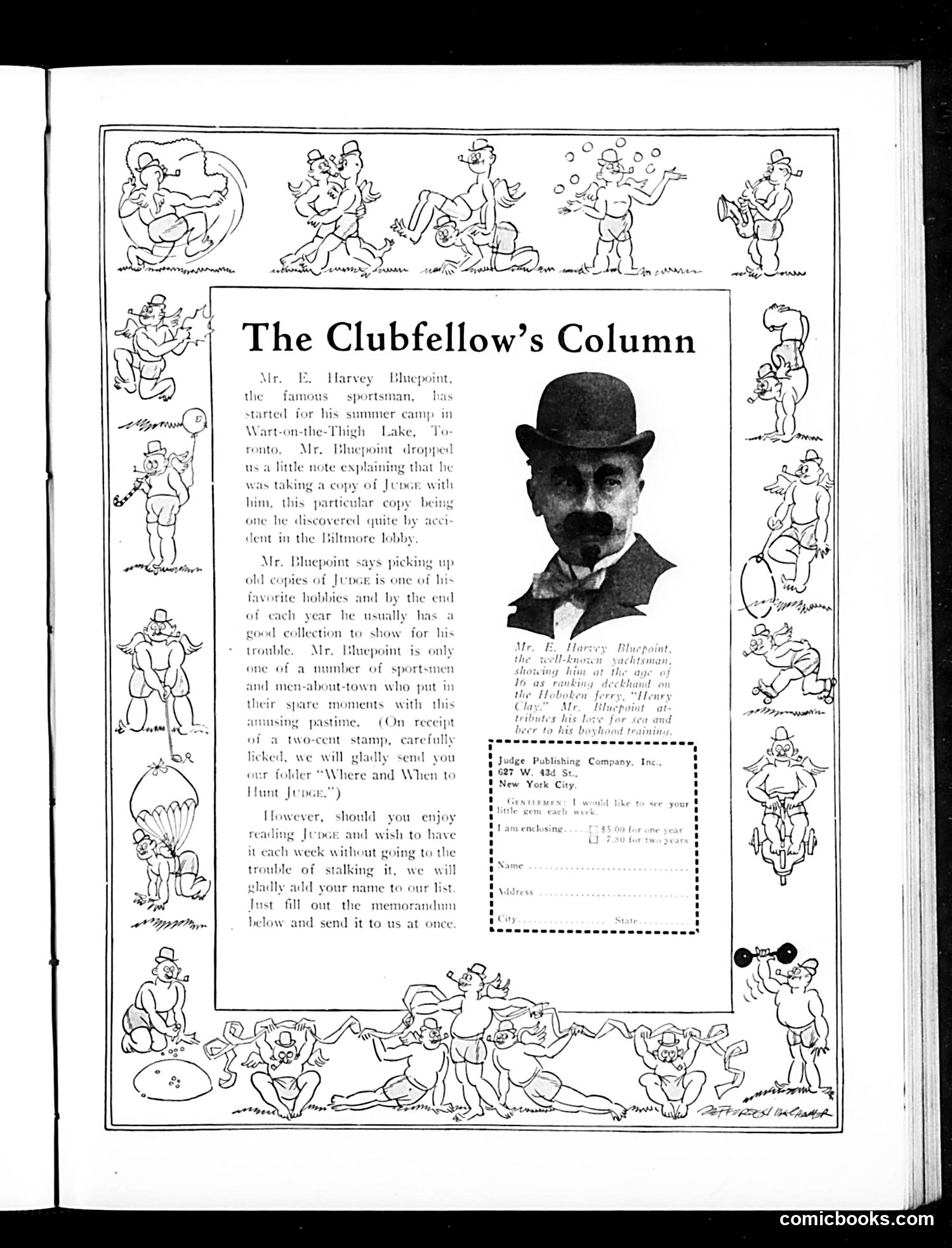
This page promotes *Judge* magazine through a tongue-in-cheek article about E. Harvey Bluepoint, a fictional wealthy sportsman and socialite. The humor works on multiple levels: **The Satire:** Bluepoint supposedly collects discarded copies of *Judge* found in upscale locations (the Biltmore hotel lobby) as a hobby—suggesting the magazine is so desirable that even accidentally-discovered copies are treasured by the elite. **The Visual Joke:** The page is bordered by whimsical cartoon vignettes of chubby men in various recreational activities (juggling, playing instruments, etc.), reinforcing the "clubfellow" lifestyle the magazine targets. **The Pitch:** Despite the playful tone, this is advertising. The subscription form (lower right) offers *Judge* by mail so readers needn't hunt for copies. The piece flatters readers by associating the magazine with wealth, leisure, and sophistication. The whole piece is self-promotional satire—mocking the pretensions of wealthy men while selling subscriptions.
This is primarily a **Life Savers candy advertisement** rather than political satire. The ad features a cigarette positioned next to a Life Savers mint, with text reading "After Smoking" and promoting Life Savers as "the candy mint with the hole." The humor is straightforward product marketing: the ad suggests Life Savers mints freshen your breath after smoking. The visual joke plays on the candy's distinctive hole-shaped design positioned alongside a cigarette. This reflects a historical era when tobacco advertising was commonplace and unregulated, and candy companies freely marketed their products as breath fresheners for smokers—a pitch unimaginable in modern public health contexts.