
Judge, 1928-06-09 · page 15 of 36
Judge — June 9, 1928 — page 15: what you’re looking at
What you’re looking at
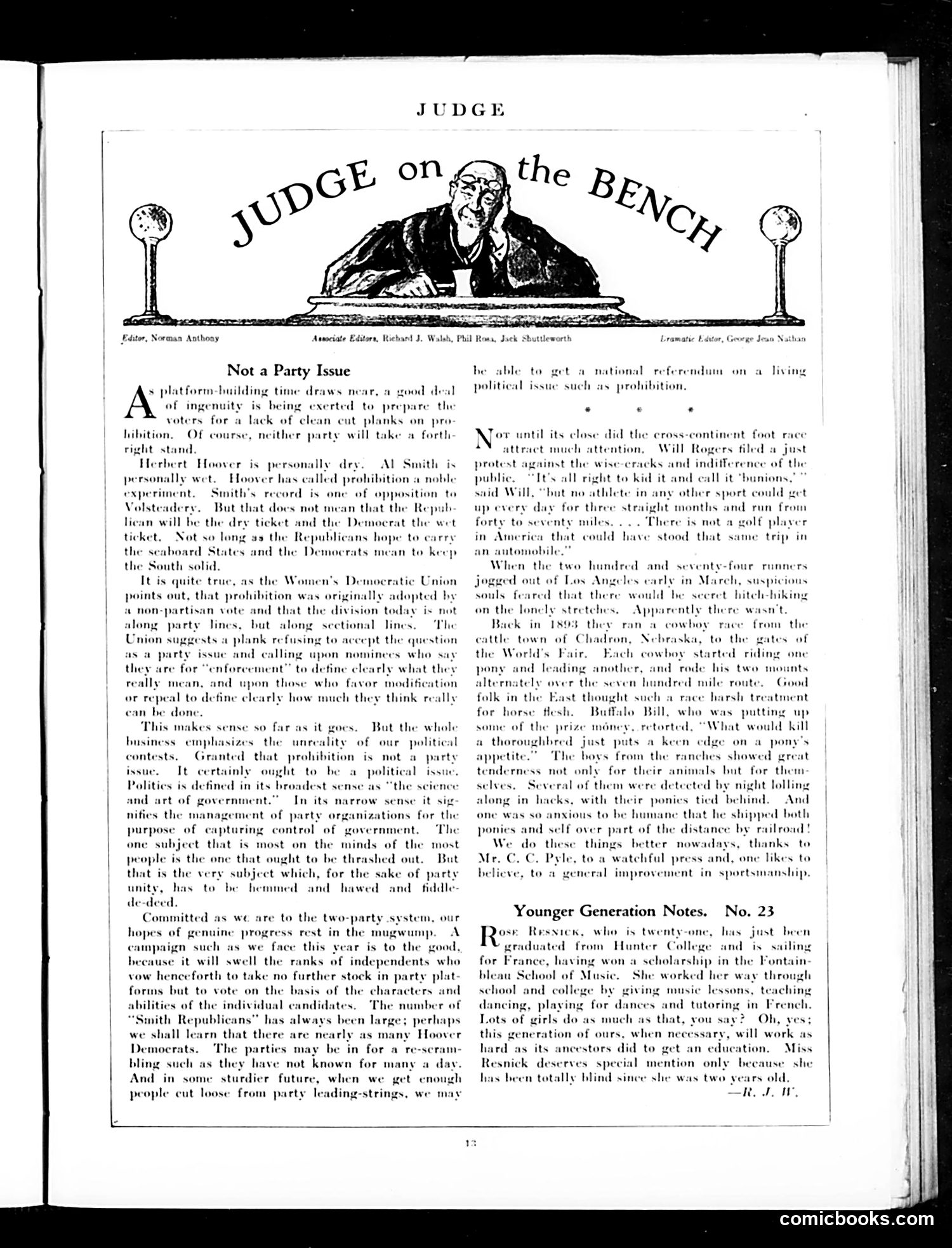
This page from Judge magazine contains two distinct pieces of political/social commentary: **"Not a Party Issue"** (main article): Discusses Herbert Hoover and Al Smith's conflicting stances on Prohibition ahead of the 1928 presidential election. The article critiques both parties for avoiding clear positions on this major policy question for political convenience—Republicans wanting seaboard states' votes, Democrats needing the "dry" South. It argues Prohibition should be debated as a substantive political issue rather than obscured by party politics, and calls for voters to judge candidates on character rather than party loyalty. **"Younger Generation Notes. No. 23"** (brief item): A lighter note about Rose Ressick, a blind woman who graduated from Hunter College and won a music scholarship to study in France, contradicting assumptions about what disabled people can accomplish. The cartoonish header shows a judge figure overseeing the bench—symbolizing judgment and evaluation of political positions.
📄 Transcribed text from this page (OCR, searchable)
Machine-transcribed from the original scan — historical spelling and the odd misread are preserved.
Norman Anthoay Not a Party Issue s platform-building time draws near, ea A of ingenuity is being exerted to prepare the voters for a lack of clean cut planks on pro hibition, Of course, neither party will take a forth right stand Herbert Hoover is personally dry. Al personally wet. Hoover has called prohibition a noble experiment. Smith's f opposition te Volsteadery. But that does not mean that the Rep lican will be the dry ticket and the Democrat the ticket. Not so long a9 the Republicans hope to carry the seaboard States and the Democrats mean to keep the South solid. It is quite true, Smith is record is onc wet as the Women’s Democratic Union points out, that prohibition was. dopted by a non-partisan vote and that the division today is not but ctional The Union suggests a plank refusing to accept the question as a party issue and calling upon nominees who say are for “enforcement” to defi and upon those who fo riginally along party lines, early what they or modifi efine clearly how much they think really can be done. This makes sense so far as it goes. But the unreslity. of our political Granted that prohibition is not a It certainly ought to be a political issue. Politics is defined in its broadest sense as “the science and art « vernment.”” nifies the m en whole business emphasizes the contests. party issue. In its narrow nt of party or sense it sig izations for the pturing control of government. The one subject that is most on the minds of the most people is the that ought to be thrashed out. But that is the very subject wh for the sake of party unit. and hawed and fiddle de 4 purpose of « has te be hemmed Committed as we : hopes of genuine progress rest in the mugwump, A npaign such as we f because it will swell the vow henceforth to take no further stock in party plat e to the two-party system, our this year is to the good, ranks of independents who forms but to vote on the basis of the characters and bilities of the individual ¢: The number of sith Republicans” has alway E rh we shall learn that th Democrats. ‘The parties may be in for bling such as they have not known for many And in sor people cut le “scram day - sturdier future, when we get enough se from party ng-strings, we may Lramatic bdvtor, George Jean Nathan he able to national referendat von political issue such as prohibitio living . ® * until its close did the cross-continent foot race Will Rogers tiled a just protest against the wise-cracks and indifference of the public, “It's all right to kid it and call it ‘bunions. ” said Will, “but no athlete in any other sport could get up every day for three straight months and run frou forty to seventy miles. 2... There is not a golf player in America that could have stood that same an automobile.” When the two hundred jogged out of Los Angeles early in March, suspicions souls feared that there would be secret: hitch-hiking on the lonely stretches. Back in 1803) they cattle town of Chad the World’s Fair. EF ay and leading N* attract much attention, trip in und seventy-four runners Apparently there wasn't. the gates of ran a cowboy race Nebraska, to the ch cowboy started riding one from nother, and rede his two mounts ternately over the seven hundred mile route. Good folk in the East thought such a race harsh treatment for horse flesh. Buffalo Bill, who was putting up of the vy. retorted, “What would kill a thoroughbred just puts a keen cdge on a pony's appetite. The boys from the ranches showed gr tenderness not only for their animals but Several of them were detected by n along in hacks, with their ponies tied behind one was so anxious to be humane that he shipped b and self over part of the distance by railroad! do these things better nowadays, thanks te Mr. C. C. Pyle, to a watehful press and, one likes believe, to a general improvement in sportsmanship, some prize mar selves. Younger Generation Notes. No. 23 R Ressicek, who iy twenty-one, has just) been graduated from Hunter Colle for France, having won a scholarship in the bleau School of Music. She worked her w school and colle iving music lessons, te: dancing, | for dances and tutoring in’ French. Lots of girls do as much as that, you say? Ob, ves; this generation of ours, when necessary, will work as hard as its ancestors did to get Miss Resnick deserves. special mi she and ix sailimg ontain y thro aying vation. ition only because has been totally blind since she was two years old. 4, of. IF, comicbooks.com