
A complete issue · 36 pages · 1928
Judge — May 26, 1928
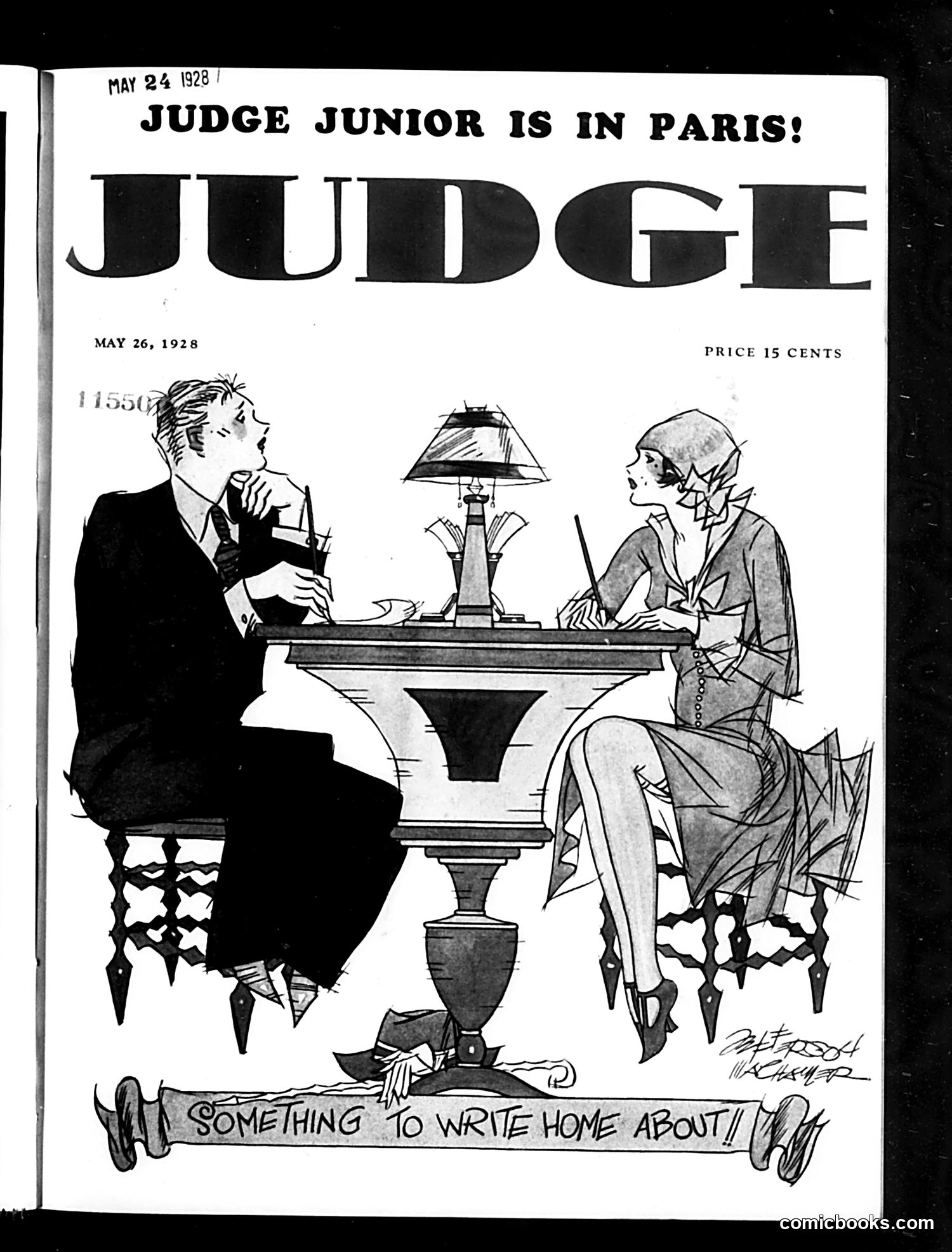
This cover depicts a flirtatious scene in Paris captioned "Judge Junior Is in Paris!" and "Something to Write Home About." The illustration shows two well-dressed figures—a man in a dark suit and a woman in 1920s fashion with a cloche hat—seated at a small table with a lamp, suggesting an intimate Parisian café encounter. The satire targets wealthy American tourists, particularly young men abroad during the Jazz Age. "Judge Junior" likely refers to the magazine's affluent readership—sons of the American upper class traveling to Paris, which was a popular destination for Americans seeking leisure, romance, and escape from Prohibition-era America. The joke implies these young tourists would engage in romantic pursuits they'd write home about, capturing contemporary attitudes toward American excess and European tourism.
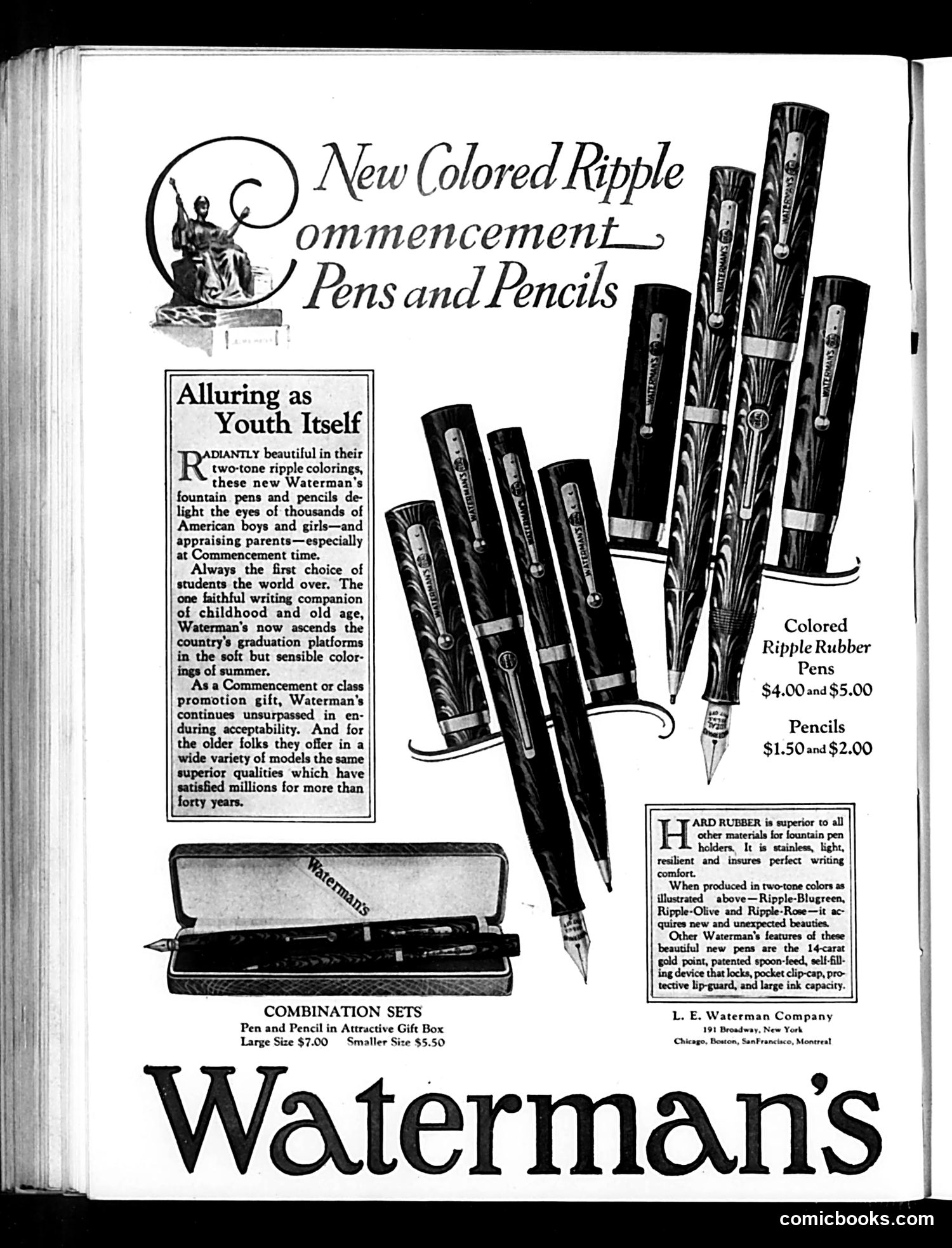
This is **not a political cartoon or satire** — it's a **straightforward advertisement** for Waterman's fountain pens and pencils from the L.E. Waterman Company. The page promotes their new "Colored Ripple Commencement Pens and Pencils" with two-tone ripple colorings (Ripple-Blugreen, Ripple-Olive, Ripple-Rose). The ad targets students and graduates, positioning these pens as ideal "Commencement or class promotion gifts." The decorative allegorical figure (left) represents "Youth" and is purely ornamental, not satirical. The product details include prices ($4-5 for pens, $1.50-2 for pencils) and a "Combination Sets" offer. This reflects early 20th-century luxury fountain pen marketing — positioning writing instruments as status symbols for educated young people entering adulthood.
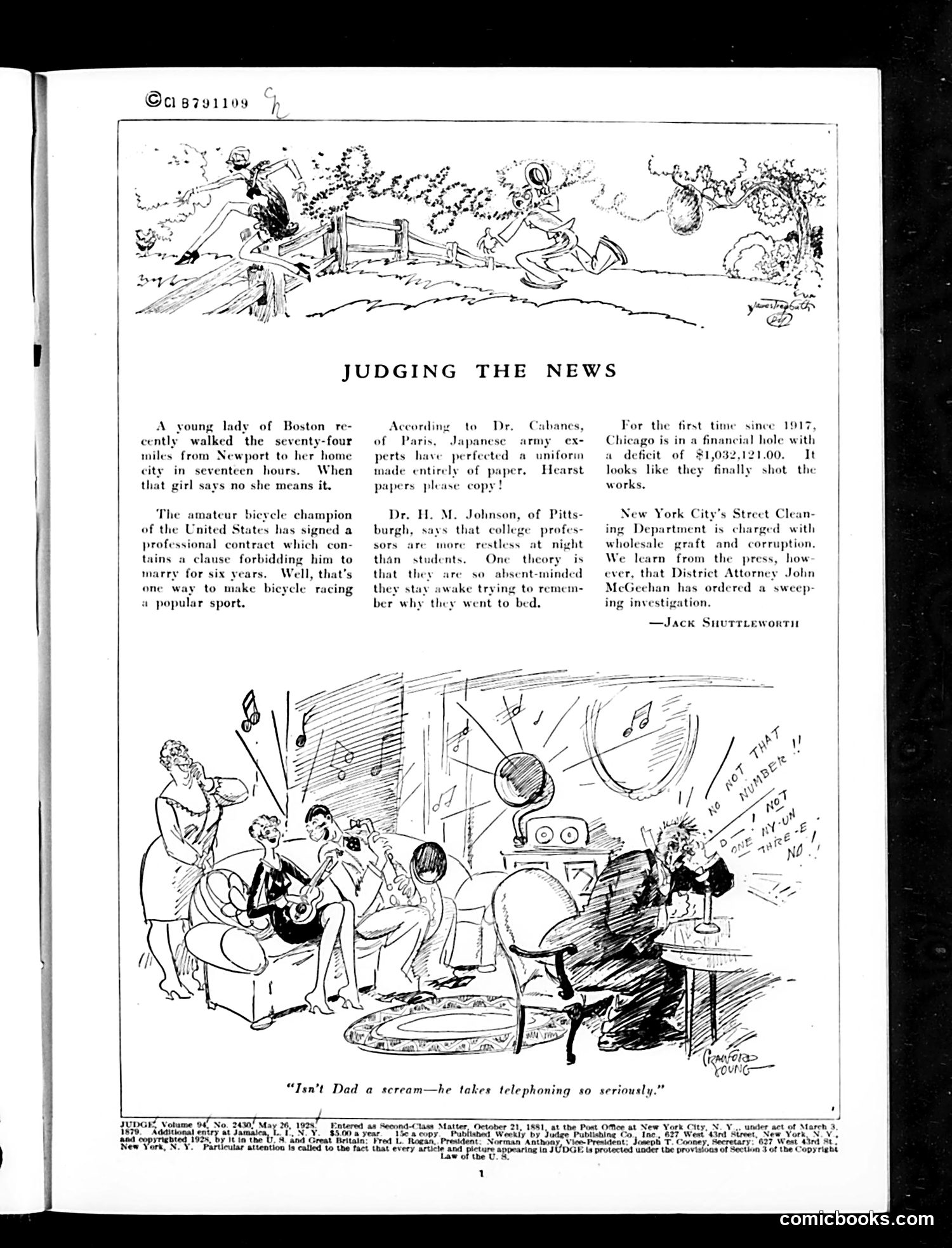
This page contains brief topical commentary and two cartoons lampooning contemporary news items (circa 1920s based on the copyright mark). **Top cartoon**: Shows two figures on a seesaw, illustrating the competitive nature of early aviation or sports achievements—likely satirizing newspaper coverage of record-breaking attempts. **Bottom cartoon**: Titled "Isn't Dad a scream—he takes telephoning so seriously," depicts a man gesticulating wildly while on a telephone, surrounded by a band of musicians playing loudly. The joke mocks both 1920s telephone anxiety and excessive domestic noise-making—people struggling with this new communication technology and its disruption to household peace. The brief news items mock a Boston woman's speed-walking, bicycle racing regulation, academic absurdities, and alleged Japanese paper manufacturing—all topical fodder for satirical commentary.
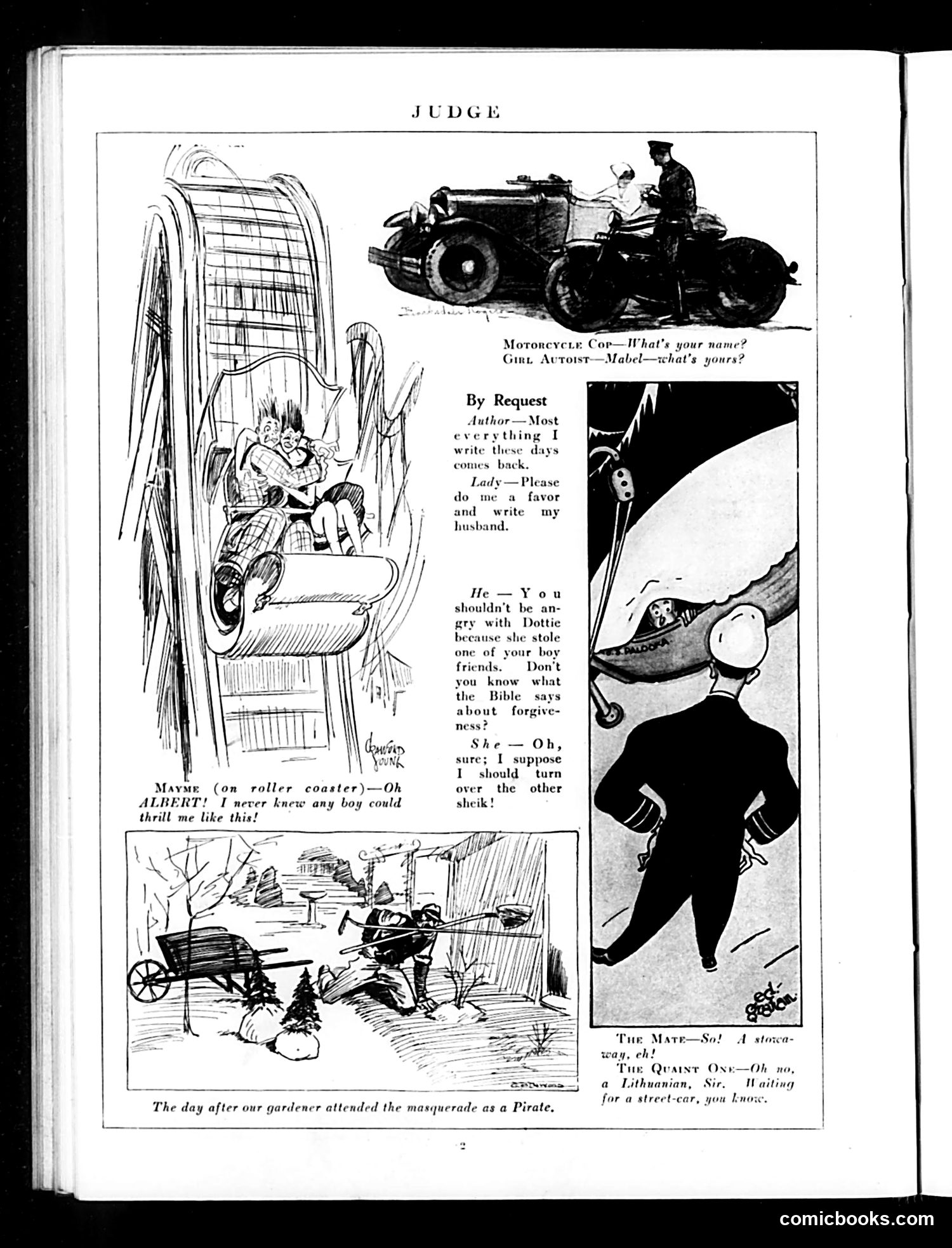
This page contains four separate humorous vignettes satirizing domestic life and gender relations: 1. **Roller coaster thrill**: A wife experiences excitement on an amusement ride, contrasting with her mundane marriage. 2. **Masquerade aftermath**: A gardener attends a costume party as a pirate, creating chaos the next day—likely satirizing servants or working-class people adopting pretentious behaviors. 3. **Motorcycle encounter**: A flirtation between a motorcycle cop and a girl, with dialogue about forgiveness and biblical references, poking fun at romantic entanglements and moral hypocrisy. 4. **The Mate and Quaint Oaf**: A figure holding a large pocket watch, with dialogue mocking foreigners (likely Lithuanian) unfamiliar with American street-cars. The humor targets marital dissatisfaction, class pretension, courtship complications, and xenophobia—typical Judge magazine fare criticizing social conventions and immigrant experiences.
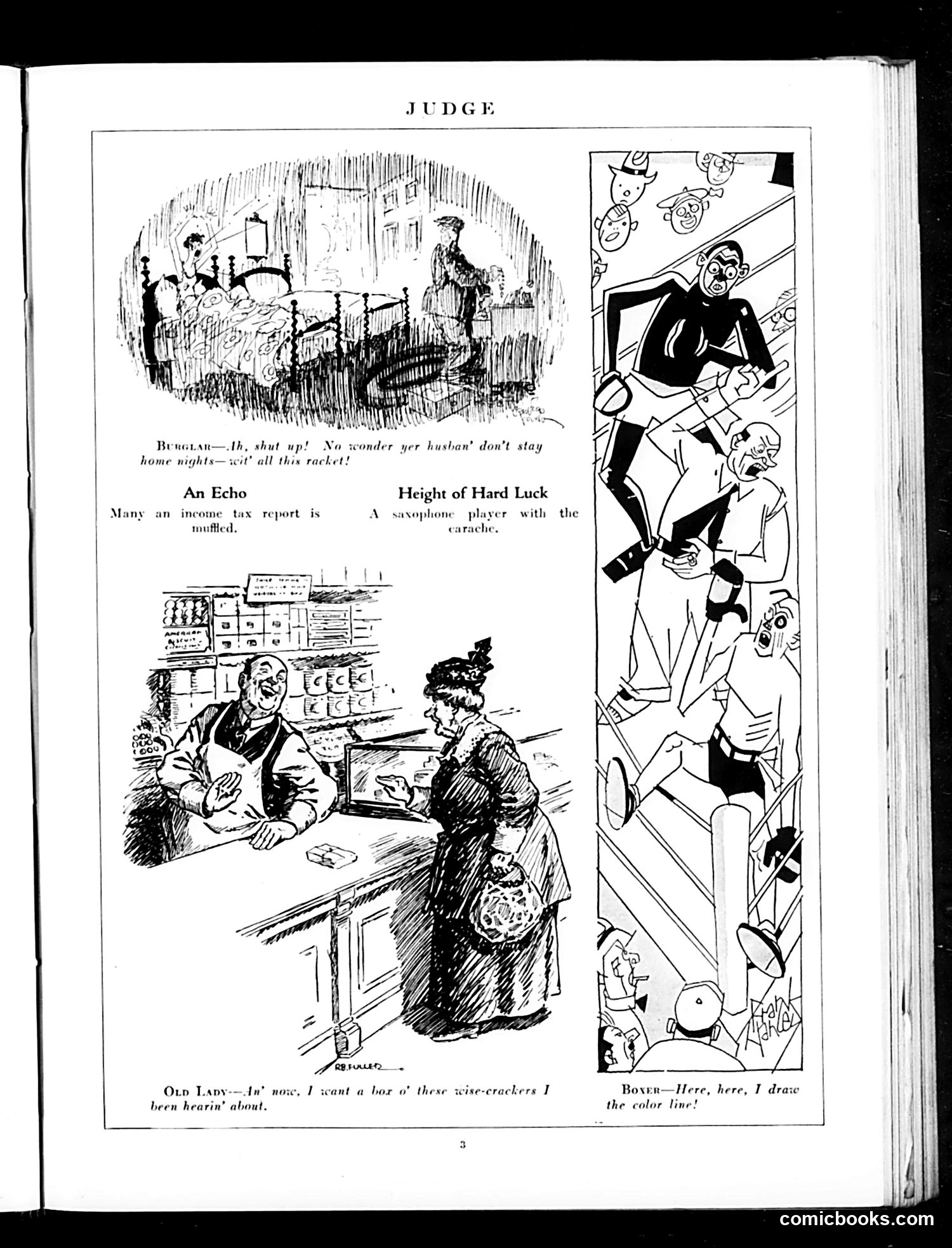
This page contains three satirical comics: **Top:** "An Echo" - A domestic scene where a husband, arriving home late, is confronted by his wife. The caption suggests he claims work kept him out, but she sarcastically echoes his excuse, implying infidelity. The joke plays on husbands' traditional excuses. **Middle:** "Height of Hard Luck" - A grocer and customer interact over groceries. The caption references a saxophone player's "hard luck" - likely a dated reference to jazz musicians of the Prohibition/Jazz Age era facing economic difficulties. **Right:** "Boxer" - A chaotic boxing match scene with multiple figures tumbling. The caption mentions "drawing the color line," referencing racial segregation in professional boxing, a significant issue in early 20th-century sports. All employ period-typical stereotypes and social commentary.
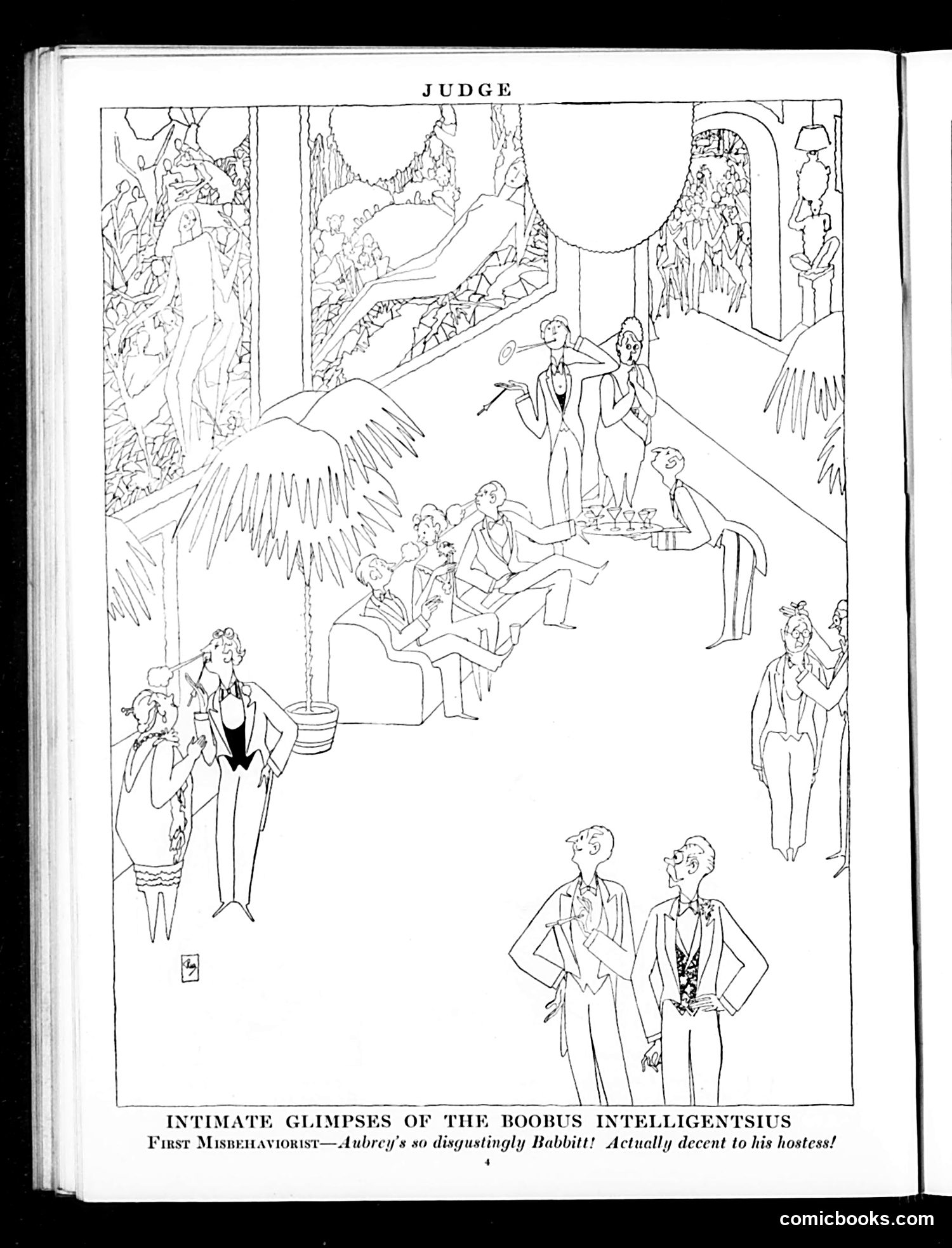
This page satirizes someone identified as "Aubrey," labeled "First Misbehaviorist," in what appears to be a heavenly or ethereal setting. The caption reads: "Aubrey's so disgustingly Rabbitt! Actually decent to his hostess!" The cartoon mocks Aubrey for being unexpectedly well-behaved and courteous—presenting this decency as absurdly out of character. The "Misbehaviorist" label suggests Aubrey was known for rude or improper conduct, making his politeness toward his hostess surprising enough to warrant satirical comment. Without additional context, I cannot definitively identify which specific public figure named Aubrey this references, though it likely targeted a contemporary personality known for notorious bad manners or antisocial behavior. The heavenly setting adds ironic contrast to his terrestrial reputation.
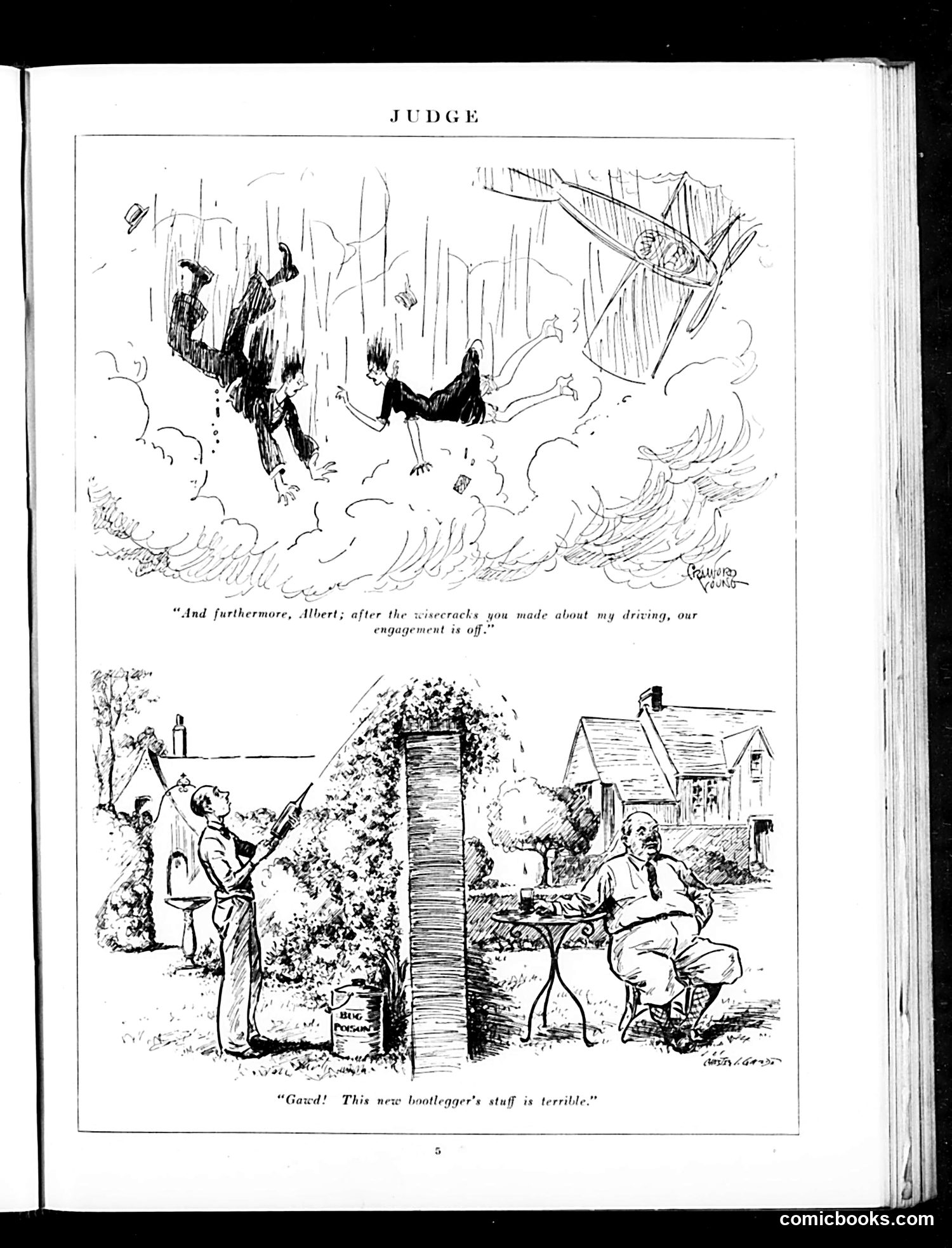
This page contains two satirical cartoons commenting on social relationships and behavior. The **top cartoon** depicts a couple in clouds during what appears to be a romantic moment, with the caption referencing complaints about driving and a broken engagement. The satire suggests a relationship ending over mundane domestic grievances. The **bottom cartoon** shows two men outdoors—one gesturing toward a tree trunk or fence while another sits nearby. The caption "Gawd! This new bootlegger's staff is terrible" references Prohibition-era illegal alcohol production. The joke mocks bootleggers' (illegal alcohol manufacturers') poor quality standards or incompetent employees during the Prohibition period (1920-1933). Both cartoons use humor to satirize contemporary American social issues: relationship conflicts and the criminal underworld created by Prohibition.
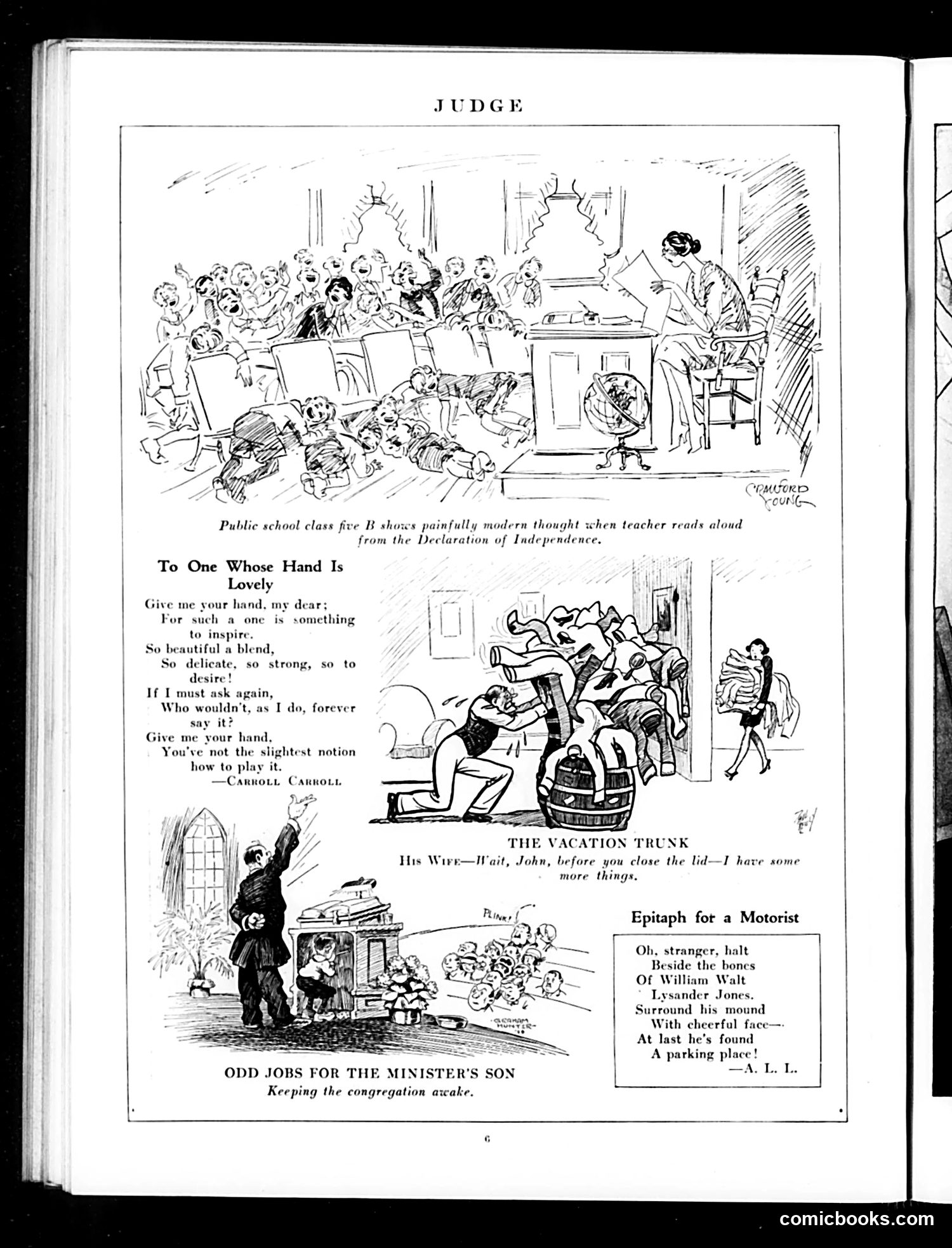
This page contains several satirical cartoons mocking early 20th-century American life: **Top cartoon**: "Public school class five B" shows children displaying irreverent skepticism when their teacher reads the Declaration of Independence—satirizing how modern youth question authority and ideals their elders revere. **"The Vacation Trunk"**: A wife delays her husband's departure by continuously adding more belongings—a domestic joke about female consumerism and marital friction. **"Epitaph for a Motorist"**: A dark humor piece mocking traffic fatalities, wishing the deceased "found a parking place"—suggesting early automobile culture's dangers while poking fun at urban congestion. **"Odd Jobs for the Minister's Son"**: Shows a minister's child disrupting church service, satirizing how even clergy families struggle with discipline. **"To One Whose Hand Is Lovely"**: A sentimental love poem (attributed to Carroll Carroll) appears almost mockingly earnest among the crude humor surrounding it. The page's overall tone reflects Judge magazine's satirical stance toward contemporary American manners, values, and social change.
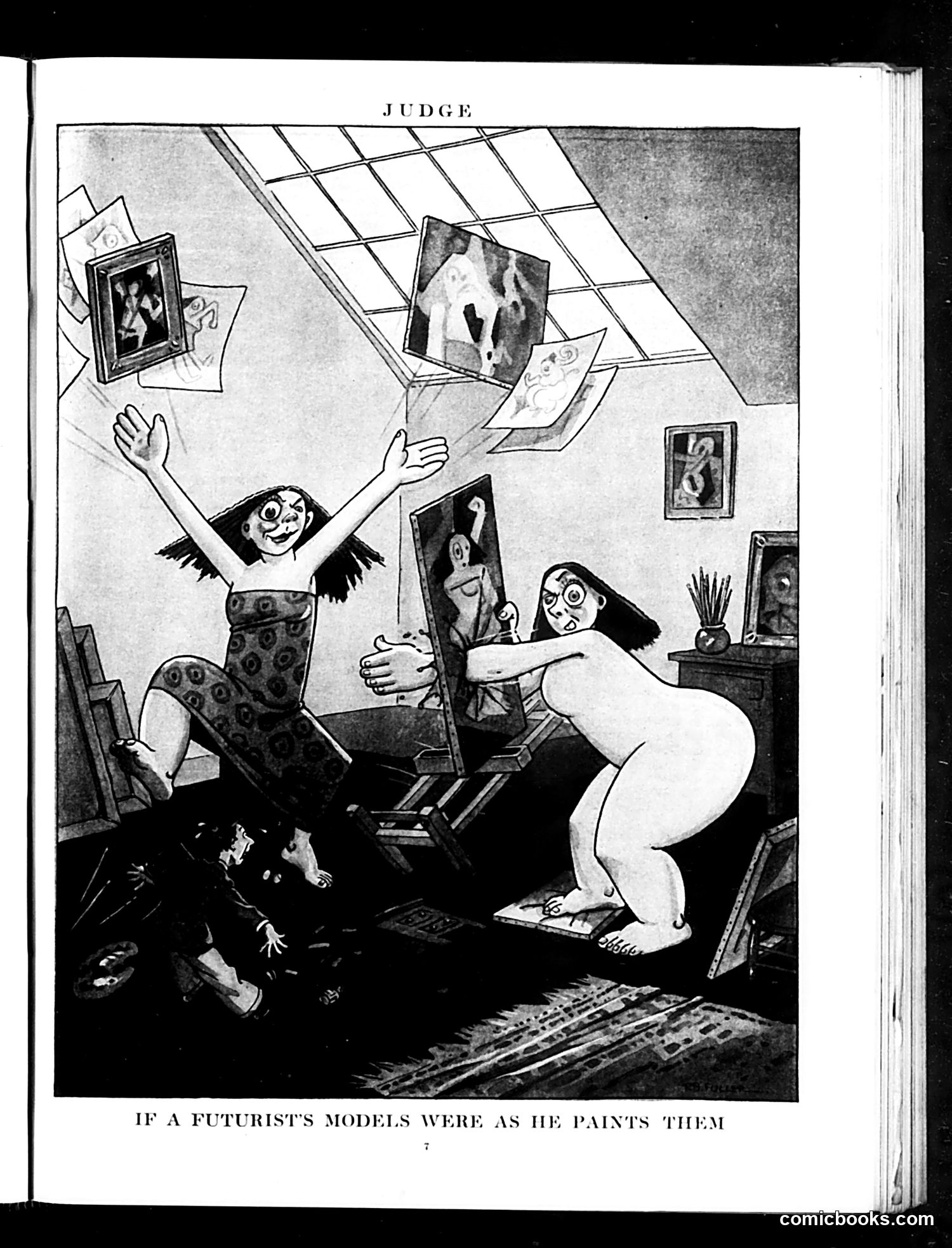
This Judge cartoon satirizes **Futurism**, an early 20th-century art movement that distorted and abstracted human figures. The caption's joke: if Futurist painters depicted their live models as grotesquely as their finished paintings appear, the models would actually look like the distorted figures shown here—with exaggerated, angular, inhuman proportions. The cartoon shows two caricatured figures in an artist's studio with paintings on the walls and ceiling. The exaggerated body shapes and expressions mock how Futurist art rendered the human form as unrecognizable and bizarre. It's a humorous critique suggesting Futurist artists were so committed to abstraction and distortion that they'd need equally distorted subjects to justify their work. The satire targets the perceived absurdity of modernist art movements.
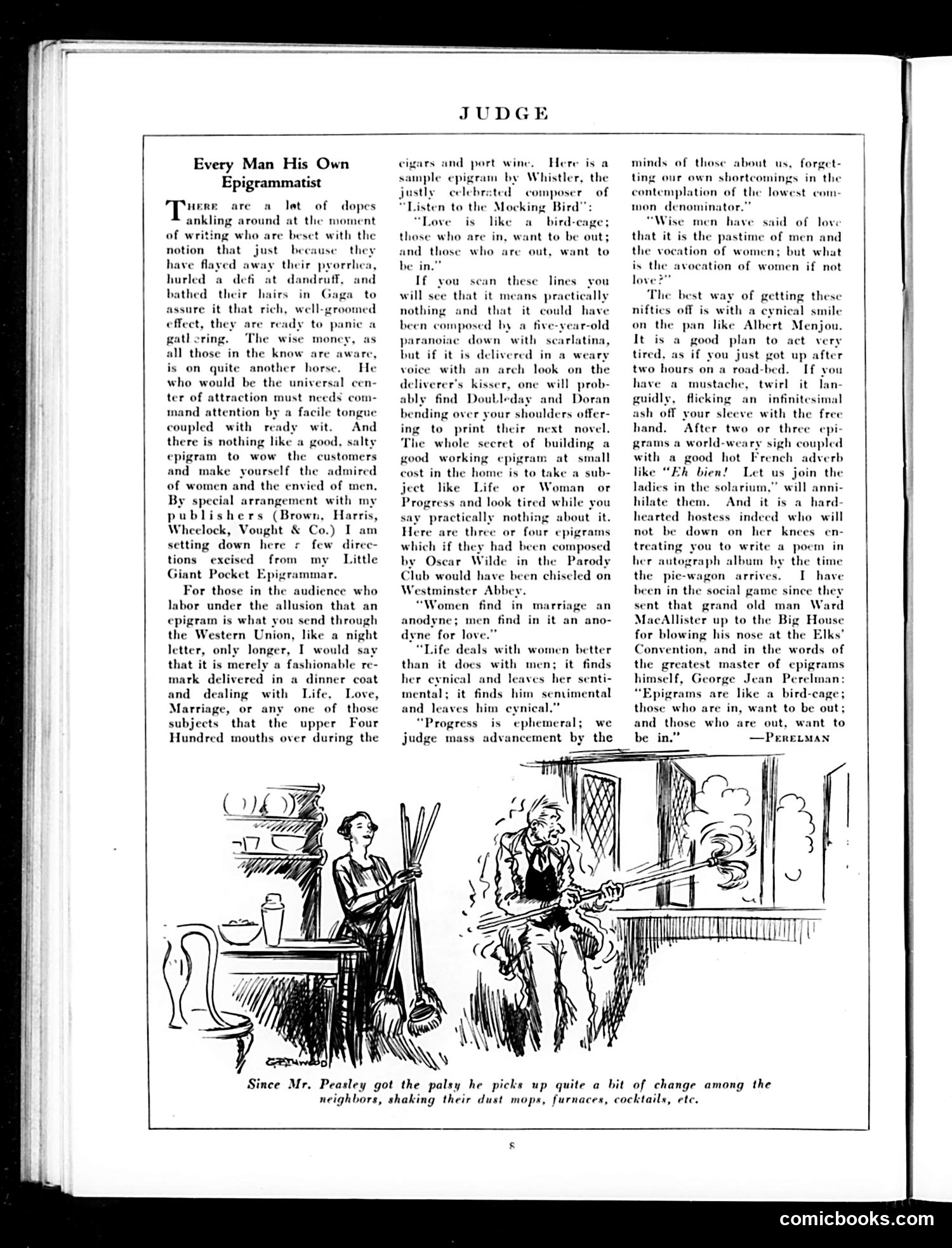
This page satirizes the pretentiousness of wealthy New York society ("the upper Four Hundred") who traffic in witty epigrams to appear sophisticated. The author mocks the emptiness of this trend: people with minor ailments (pyorrhea, dandruff) suddenly think themselves profound enough to coin clever sayings about Life, Love, and Marriage. The joke is that epigrams sound meaningless ("practically nothing") but gain acceptance through performative delivery—affected mannerisms like tired expressions, mustache-twirling, and French phrases. The cartoonist references Oscar Wilde and actor Albert Meujou as exemplars of this style. The bottom cartoon depicts "Mr. Peasley," who apparently developed palsy (a neurological condition causing tremors) and now unknowingly distributes dust as he gestures around his neighbors' homes—a visual pun on how his "palsy" literally spreads mess, mirroring how shallow epigrams metaphorically contaminate society. The satire targets upper-class affectation and the desire to appear cultured through adopted mannerisms rather than genuine wit.
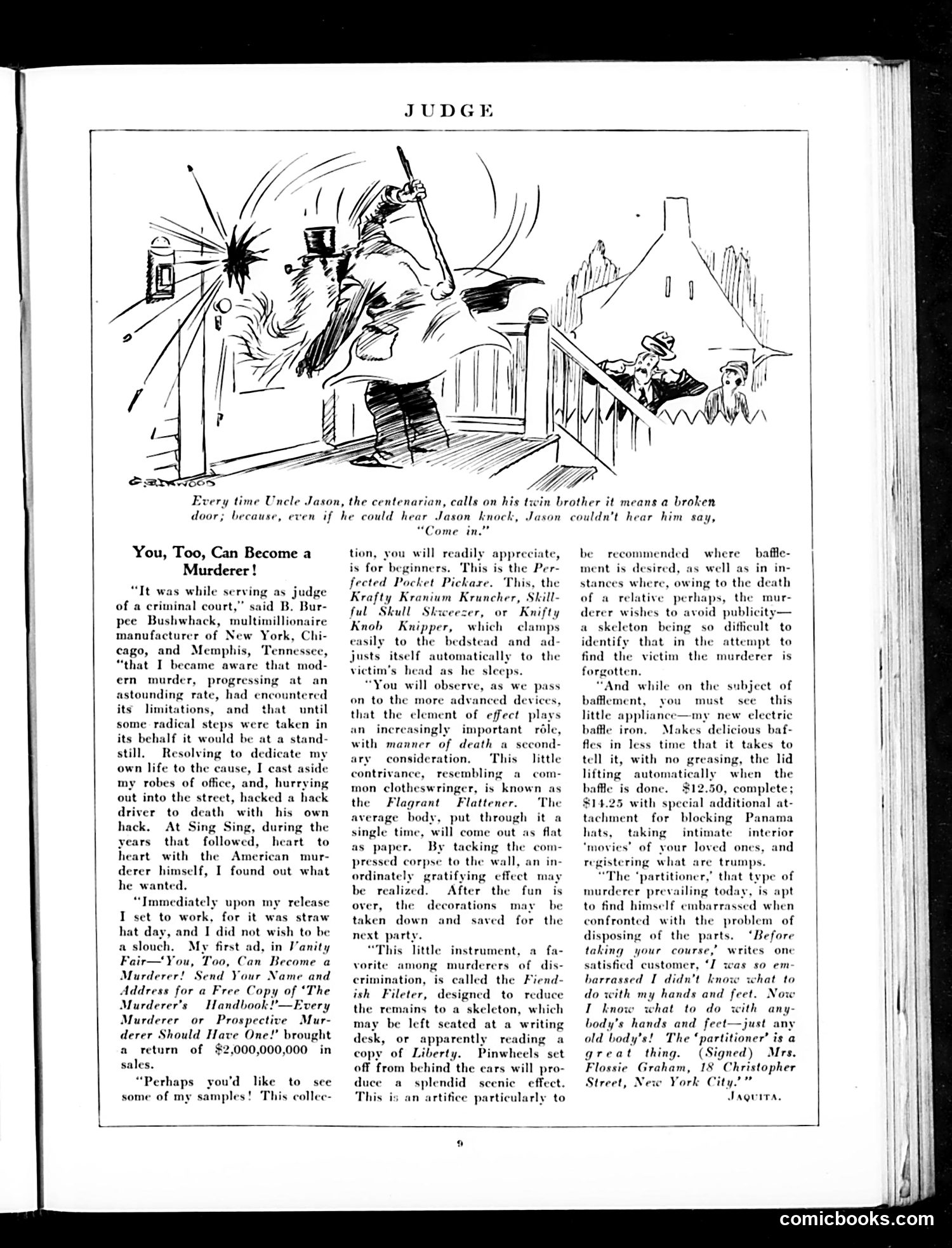
This **Judge magazine satirical piece** mocks the commercialization and instructional marketing of violence in early 20th-century America. A wealthy industrialist, B. Burpee Bushwhack, claims to have become a "murderer entrepreneur," selling instructional materials and specialized killing devices with absurdly cheerful product names ("Krafty Kranium Kruncher," "Flagrant Flattener," "Fiendish Fileter"). He describes these tools with Madison Avenue-style promotional enthusiasm—emphasizing "effect," aesthetics, and customer satisfaction. The satire targets: - **Capitalist excess**: treating murder as a marketable commodity - **Self-help culture**: positioning crime as self-improvement - **Consumer capitalism**: making violence just another consumer product with testimonials - **Desensitization**: the grotesque normalization of brutality through cheerful advertising language The top cartoon of "Uncle Jason" breaking doors (both deaf elderly men unable to hear each other) appears unrelated—likely a separate joke about old age. The piece is dark social commentary on American consumer culture's capacity to commodify anything.
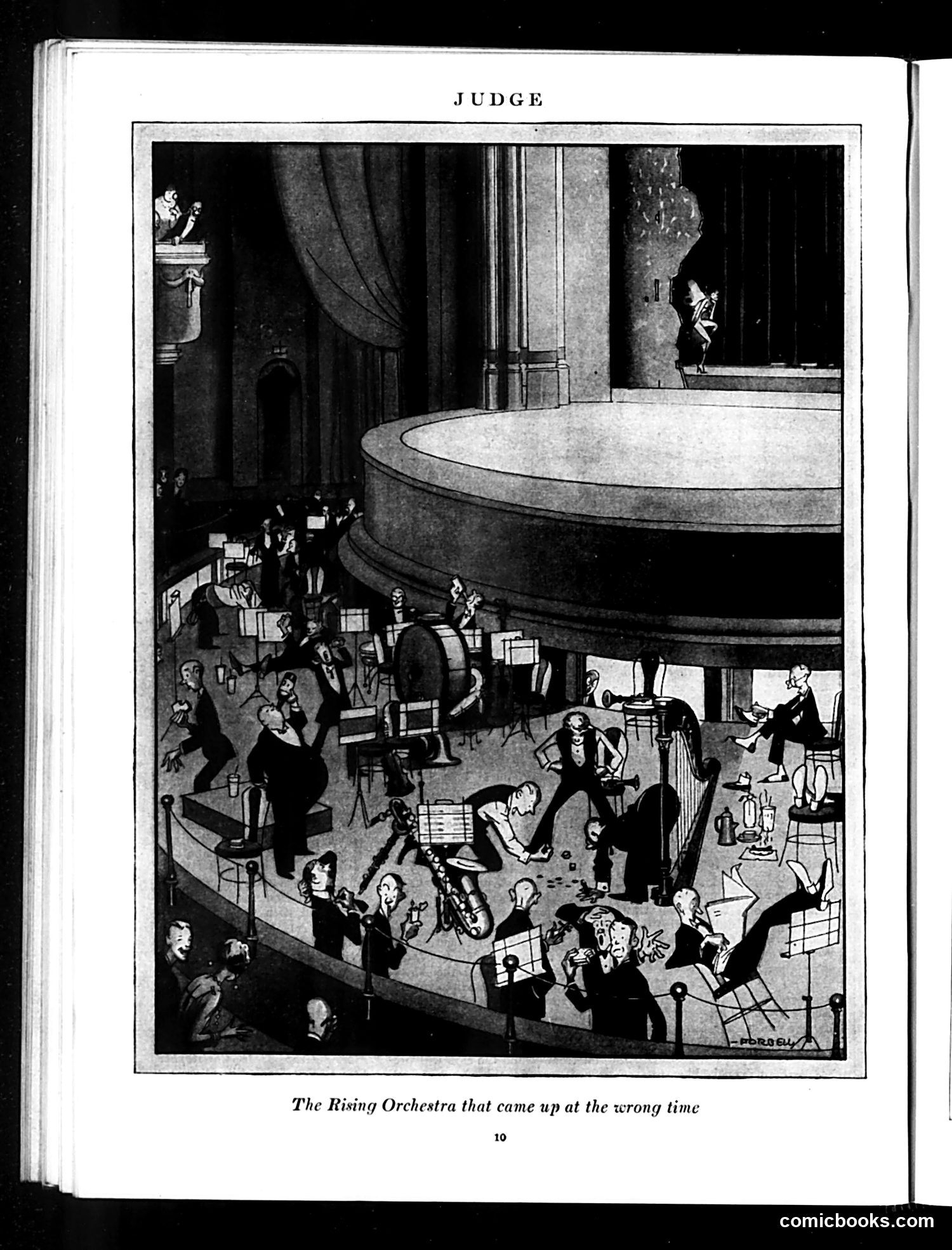
This cartoon depicts a courtroom scene in which an orchestra literally rises from below the floor during what appears to be a judicial proceeding. The judge sits elevated above, presiding over the chaos below. The satire plays on the phrase "rising orchestra"—likely referencing a musical group gaining prominence or popularity—by visualizing it as physically ascending at an inappropriate moment, disrupting the solemnity of a courtroom. The humor relies on the absurd literal interpretation: an orchestra emerging mid-trial, creating comedic disruption in a formal legal setting. This appears to be a sight-gag cartoon mocking bad timing, unexpected interruptions, or perhaps the intrusion of entertainment/frivolity into serious institutional spaces. Without additional context about the specific publication date or related articles, the exact target of satire remains unclear.
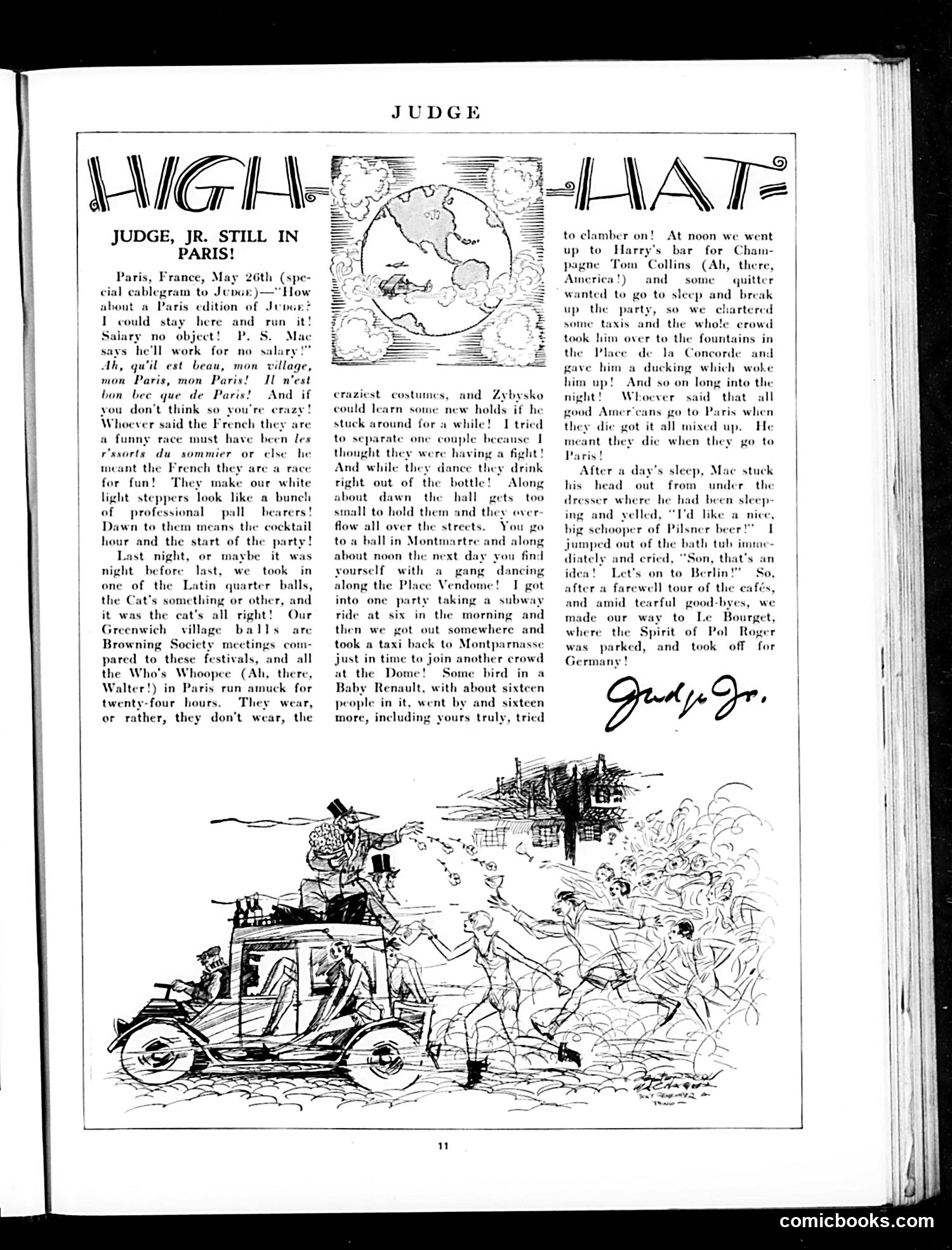
This is a humorous travel column by "Judge, Jr." (likely a junior editor or contributor to Judge magazine) describing a wild night in 1920s Paris. **The Content:** The piece satirizes American tourists' experiences in post-WWI Paris, particularly the legendary nightlife of the Latin Quarter and Montmartre. The author describes attending costume balls where revelers drink openly from bottles, dance into the streets, and spill spontaneously from one venue to another. **The Satire:** The joke targets both the excesses of Parisian nightlife AND naive American assumptions about it. The phrase "good Americans go to Paris when they die" is cleverly twisted—the author argues they actually come *alive* there, making a mess of themselves. **Key References:** - "Zybysko" (likely wrestler Stanislaus Zbyszko, a contemporary celebrity) - Harry's Bar and the Dome (real Paris establishments frequented by expatriates) - Le Bourget (Paris airfield) - "Spirit of Pol Roger" (champagne brand joke) The accompanying sketch shows a chaotic taxi overflowing with revelers, reinforcing the theme of uncontrolled merriment.
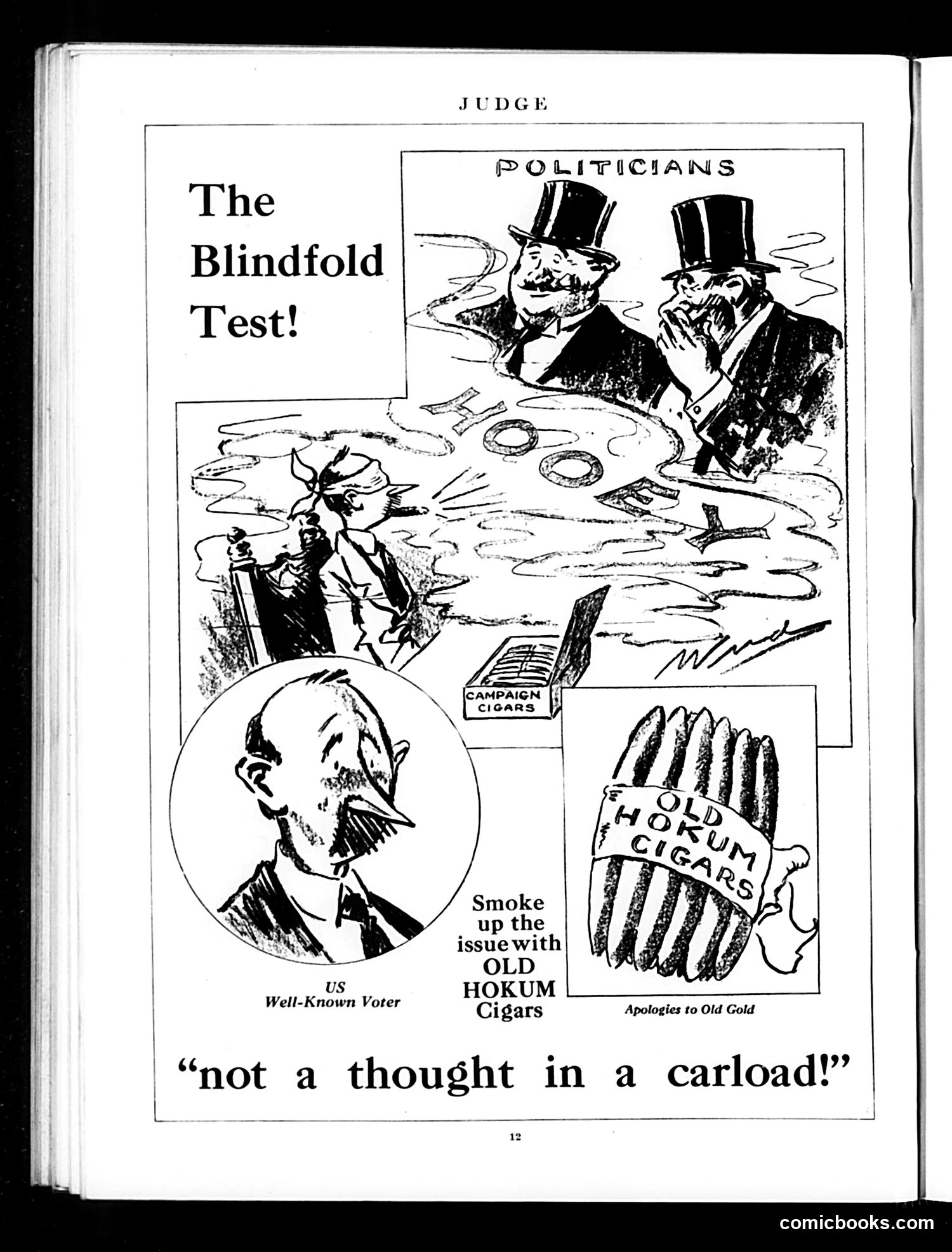
This Judge magazine satirical advertisement depicts "The Blindfold Test"—a commentary on voter gullibility during elections. Two caricatured politicians (labeled "POLITICIANS") wear top hats and appear smug while addressing a blindfolded figure representing "a Well-Known Voter." The cartoon mocks politicians for deceiving voters, suggesting they can't see through political rhetoric. References to cigar brands ("Campaign Cigars," "Old Hokum Cigars," "Old Gold") play on the phrase "not a thought in a carload"—implying voters lack discernment. The blindfold symbolizes voter ignorance or willful blindness to political deception. This is classic political satire criticizing the electorate's susceptibility to manipulation and politicians' shameless exploitation of that vulnerability during campaign season.
This editorial column addresses whether baseball is declining among American youth. The illustrated judge presiding above suggests this is a matter of serious social concern. The author argues that baseball's roots in sandlots and amateur play are withering because boys now caddy for golf instead—golf pays money while baseball doesn't. Additionally, urban development has eliminated playgrounds: billboards, gas stations, and tourist camps replace the open fields where children once played. The piece contrasts baseball (a team sport requiring sacrifice and discipline) with individual sports like golf and tennis. However, it acknowledges a counterpoint: adults need lifelong recreational options since organizing baseball games becomes impractical in modern, busy adult life. A secondary satirical item mocks an "Association for the Suppression of Speech making," joking about an aviator who disrupted a Texas rally by flying overhead with an amplifier to drown out speakers—suggesting even elaborate schemes to silence annoying orators exist.
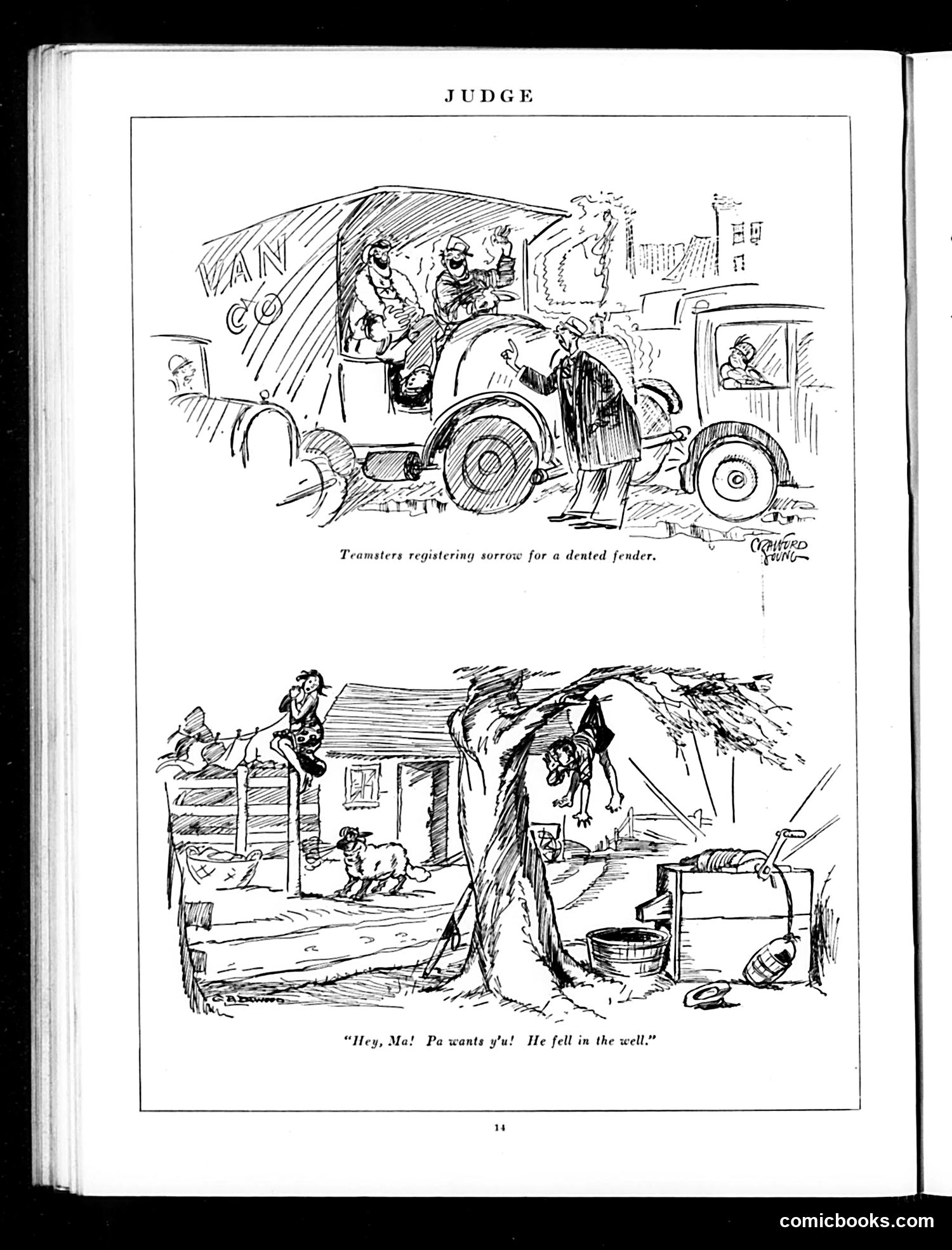
This page contains two separate gag cartoons: **Top cartoon**: Depicts tramps or vagrants "registering sorrow for a dented fender" on a delivery van. The joke satirizes the contrast between the working-class vehicle's actual damage and the exaggerated legal/formal response it receives—mocking either insurance procedures or the absurdity of vagrants making official complaints. **Bottom cartoon**: Shows a rural scene where someone has fallen into a well. A character calls out "Hey, Ma! Pa wants y'u! He fell in the well"—a darkly comedic take on country life mishaps and the casual, almost matter-of-fact response to disaster in rural settings. Both cartoons use class-based humor typical of early Judge magazine, contrasting urban formality with working-class indifference, and rural simplicity with genuine danger.
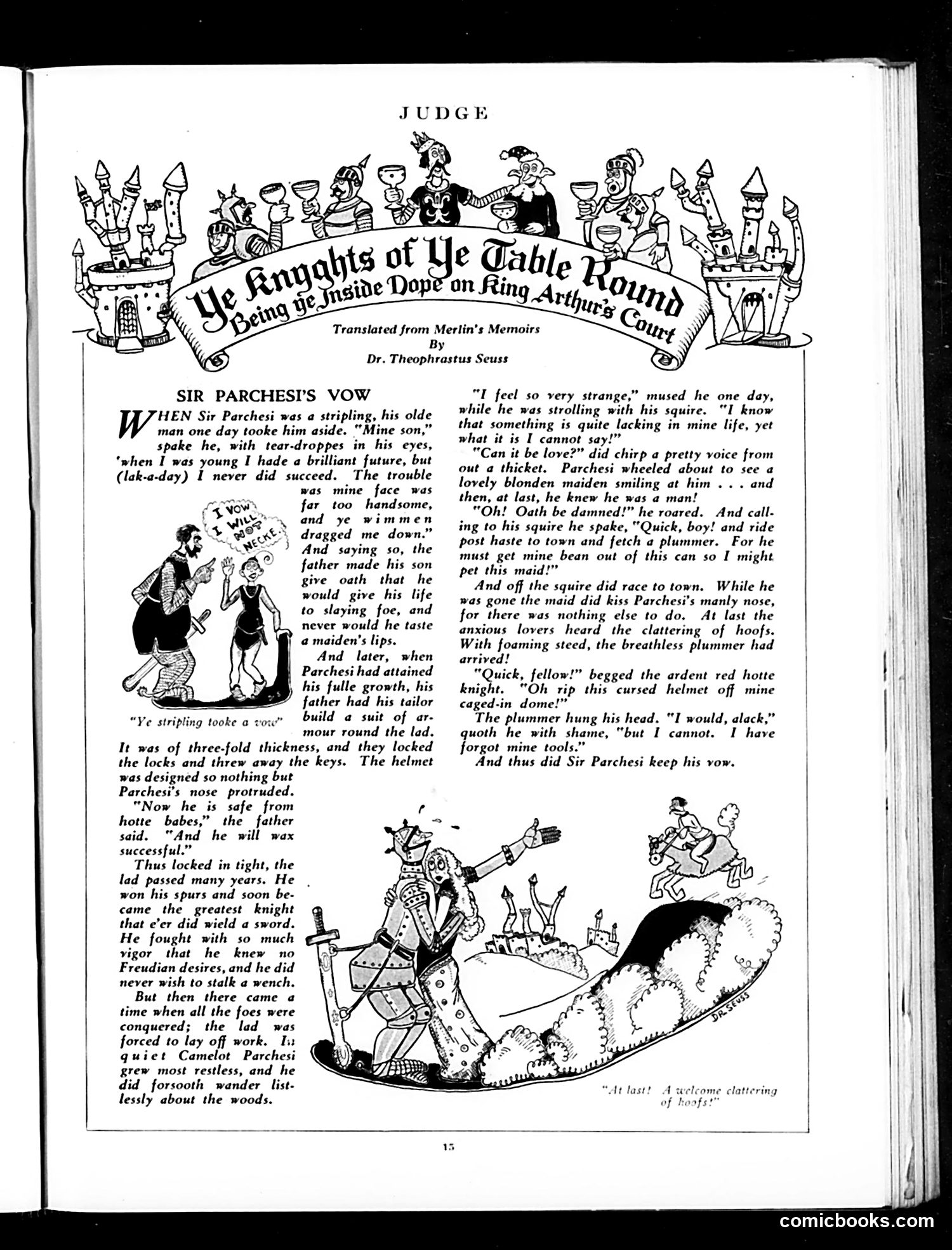
This is a humorous medieval romance parody by Dr. Seuss (credited as translator of "Merlin's Memoirs"). The satire mocks Freudian psychology and repressive Victorian attitudes toward sexuality. **The setup:** A father, traumatized by his own handsomeness attracting women, forces his son Sir Parchesi to take a vow of celibacy and locks him in three-fold armor—with only his nose exposed—to prevent "Freudian desires." **The joke:** Years later, after conquering all enemies, Parchesi discovers love and desperately wants his armor removed. A plumber arrives to cut him free but has forgotten his tools. The irony: despite abandoning his vow, Parchesi remains physically trapped and celibate anyway—his father's paranoia accidentally succeeds through circumstance rather than virtue. **The satire targets:** Overzealous Freudian thinking (which was fashionable in the 1920s-30s), paternal control, sexual repression, and the absurdity of trying to engineer human nature through force. The medieval setting lets Judge mock modern psychological anxieties through humor.
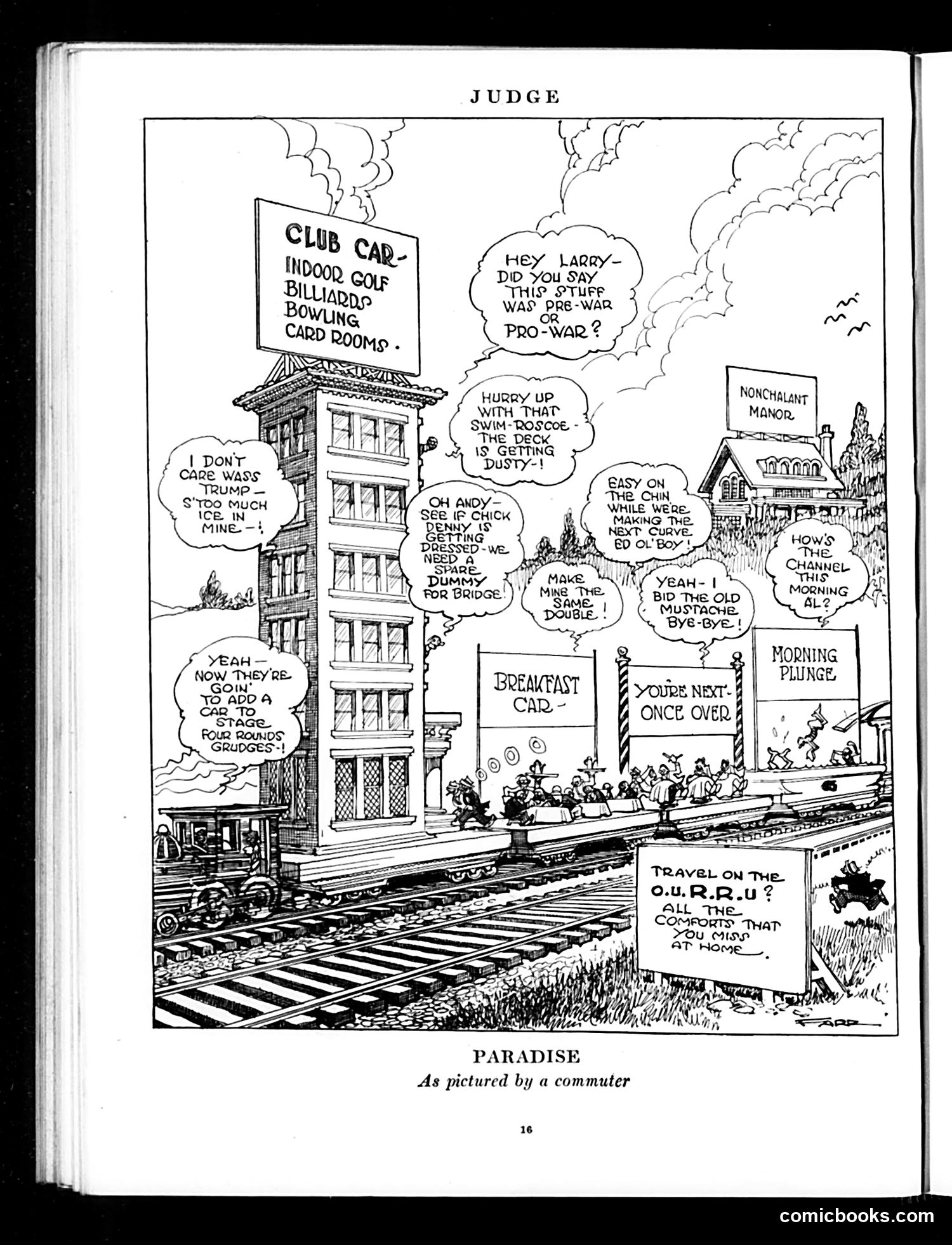
This cartoon satirizes the commuter's idealized fantasy of suburban leisure versus reality. The tall building labeled "CLUB CAP" lists desirable amenities (golf, billiards, bowling), while characters discuss various recreational activities: swimming, bridge, golf. The trains marked "BREAKFAST CAR" and "YOURE NEXT ONCE OVER" suggest crowded, regimented commuting. The reference to "pre-war" stuff appears to indicate post-WWI commentary on nostalgia. The overall joke contrasts the commuter's imagined paradise—a club offering relaxation and entertainment—with the actual exhausting routine of train commuting and crowded facilities. The subtitle "As pictured by a commuter" indicates this is the dreamer's fantasy, not reality, mocking the gap between suburban aspirations and daily commute tedium.
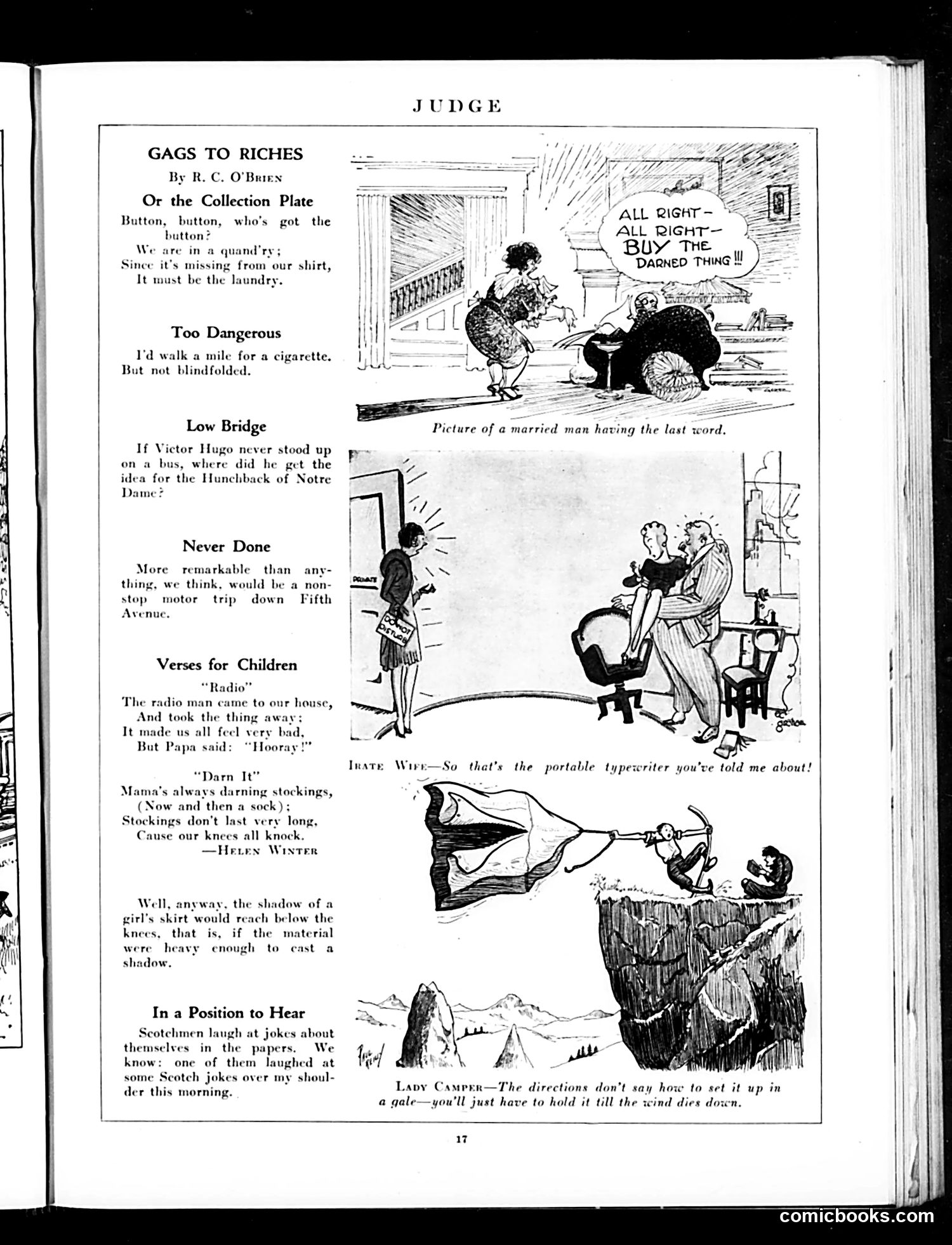
This is a humor page from *Judge* magazine featuring short comic pieces and cartoons satirizing early 20th-century American life. **The cartoons depict:** 1. **"Picture of a married man having the last word"** – A husband confidently speaks while his wife sits nearby, a visual gag about marital dynamics where husbands rarely "win" arguments. 2. **"Irate Wife"** – Shows a woman threatening a man with a portable typewriter, sarcastically calling it "portable" since it's so unwieldy. The joke mocks the impracticality of early portable typewriters. 3. **"Lady Camper"** – A woman struggles to assemble camping equipment in windy conditions, poking fun at unprepared outdoor enthusiasts. **The text humor** includes puns ("Gags to Riches"), children's verses about radios and stockings, and observations about contemporary life—radio as a novelty, Fifth Avenue traffic, fashion (short skirts as scandalous), and Scottish stereotypes. The overall tone is light domestic satire typical of 1920s-era humor magazines.
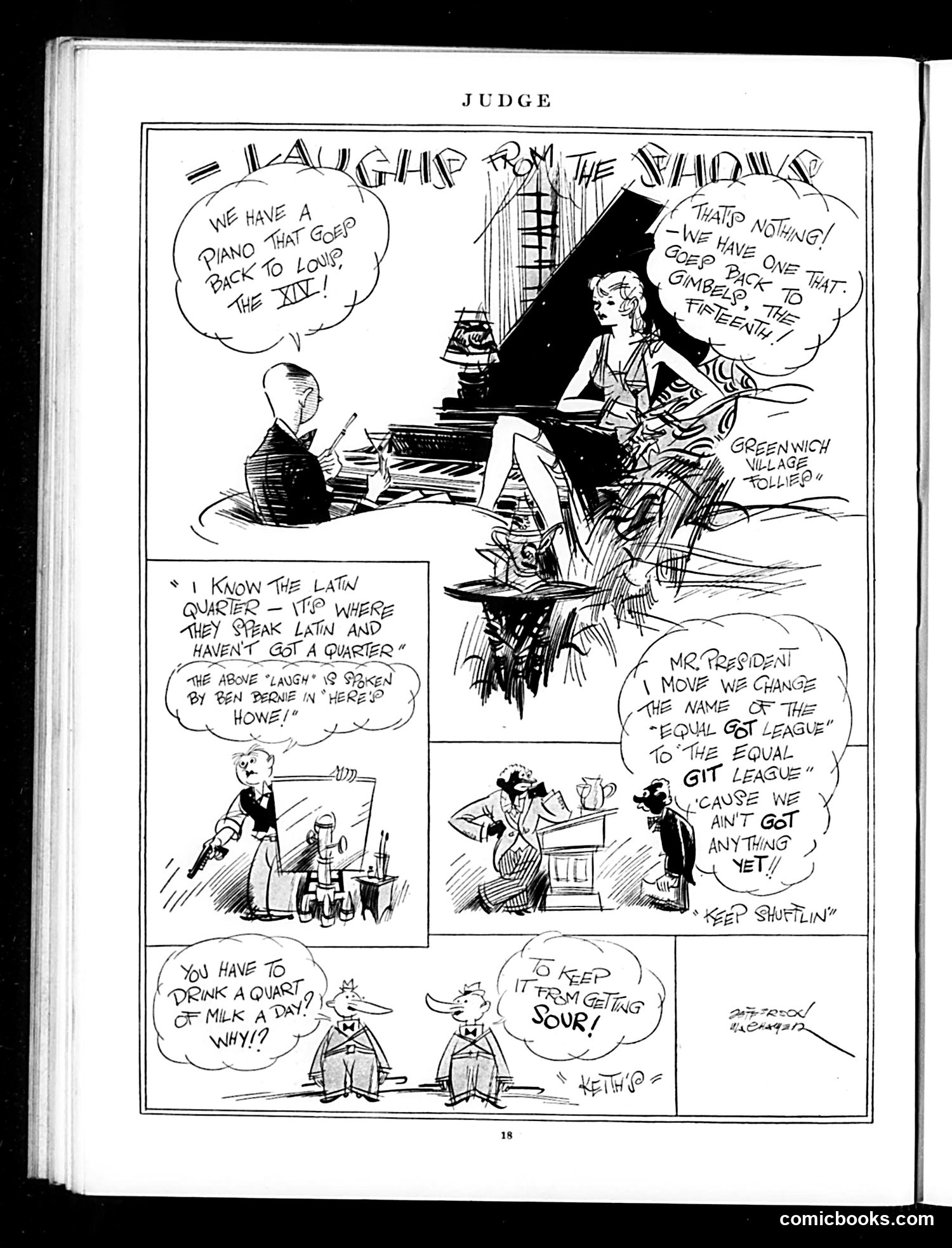
This page satirizes various social and political issues of its era through interconnected vignettes: **The Piano Scene**: A woman and man discuss an antique piano, with her boasting of its age ("XIV"—14th century). The satire appears to mock wealthy Americans' pretentious obsession with acquiring old European artifacts. **The "Equal Got League"**: A man proposes renaming the "Equal Got League" to "Equal Git League" because they haven't acquired anything yet—satirizing civic organizations or charitable groups that lack actual accomplishments. **The Latin Quarter**: A character makes a joke about a place "where they speak Latin and haven't got a quarter," punning on both the currency and the district's poverty. **The Milk Requirement**: Two figures debate drinking a quart of milk daily, with one asking "why?"—possibly satirizing health fads or government nutritional guidelines. The cartoons collectively mock American pretension, organizational ineffectiveness, and contemporary social trends through wordplay and visual humor typical of Judge's satirical style.
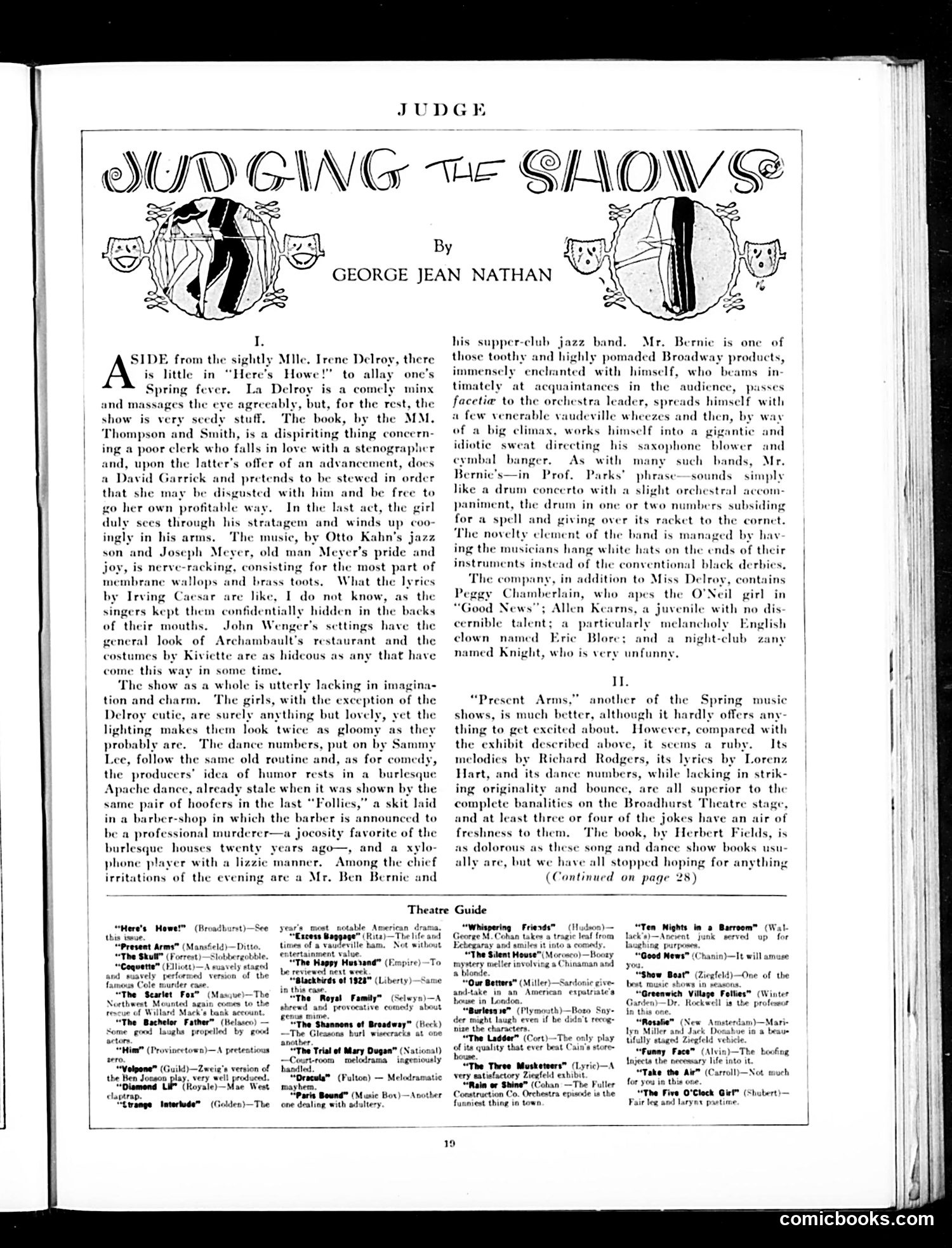
This page contains theater criticism by George Jean Nathan reviewing two Broadway musicals: "Here's Howe!" and "Present Arms." **Key figures/references:** - **Mlle. Irene Delroy**: The show's attractive lead actress - **Ben Bernie**: A self-aggrandizing bandleader whose "supper-club jazz band" is criticized as noise masquerading as music - **Otto Kahn/Joseph Meyer**: Composers whose jazzy score is called "nerve-racking" - **Richard Rodgers and Lorenz Hart**: Composers of "Present Arms," praised as superior **The satire:** Nathan mocks Broadway's mediocrity—formulaic plots (poor clerk romances stenographer), recycled comedy (stale barber-shop murders from vaudeville), and performers lacking genuine talent. He particularly skewers Ben Bernie's vanity and his band's cacophonous style, where drums overwhelm melody. The criticism reflects 1920s theatrical tastes and Jazz Age skepticism about overhyped entertainers.
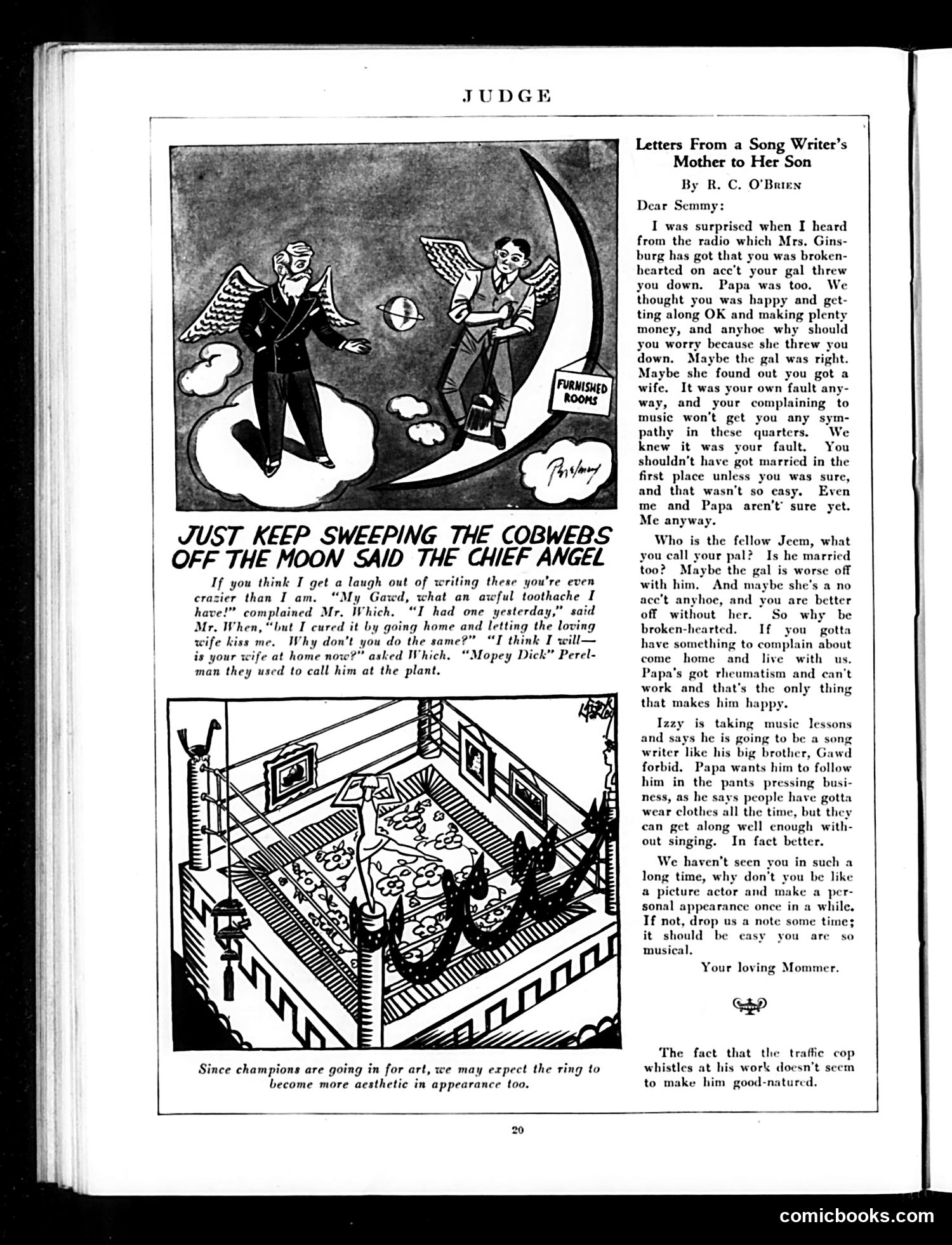
This page contains two satirical pieces mocking sentimental songwriting and artistic pretension in 1920s America. **"Letters from a Song Writer's Mother"** is a humorous column where a working-class mother writes to her successful songwriter son, sarcastically deflating his complaints about romantic heartbreak. She bluntly tells him he deserved it, notes he already has a wife, and suggests his problems don't warrant sympathy—least of all musical expression. The humor lies in her no-nonsense immigrant vernacular and her implication that professional songwriters exploit personal misery for profit and public sympathy. **The two cartoons** mock artistic vanity: one shows angels on the moon with a joke about menial labor; another depicts a furnished room full of chaos, captioning that boxers are now pursuing art, so boxing rings should become aesthetically refined. A final quip about traffic cops whistling at work suggests that ordinary people, unlike artists, don't complain about their jobs—a dig at artistic self-pity. The overall satire targets 1920s popular songwriting as exploitative emotionalism peddled by self-pitying entertainers.
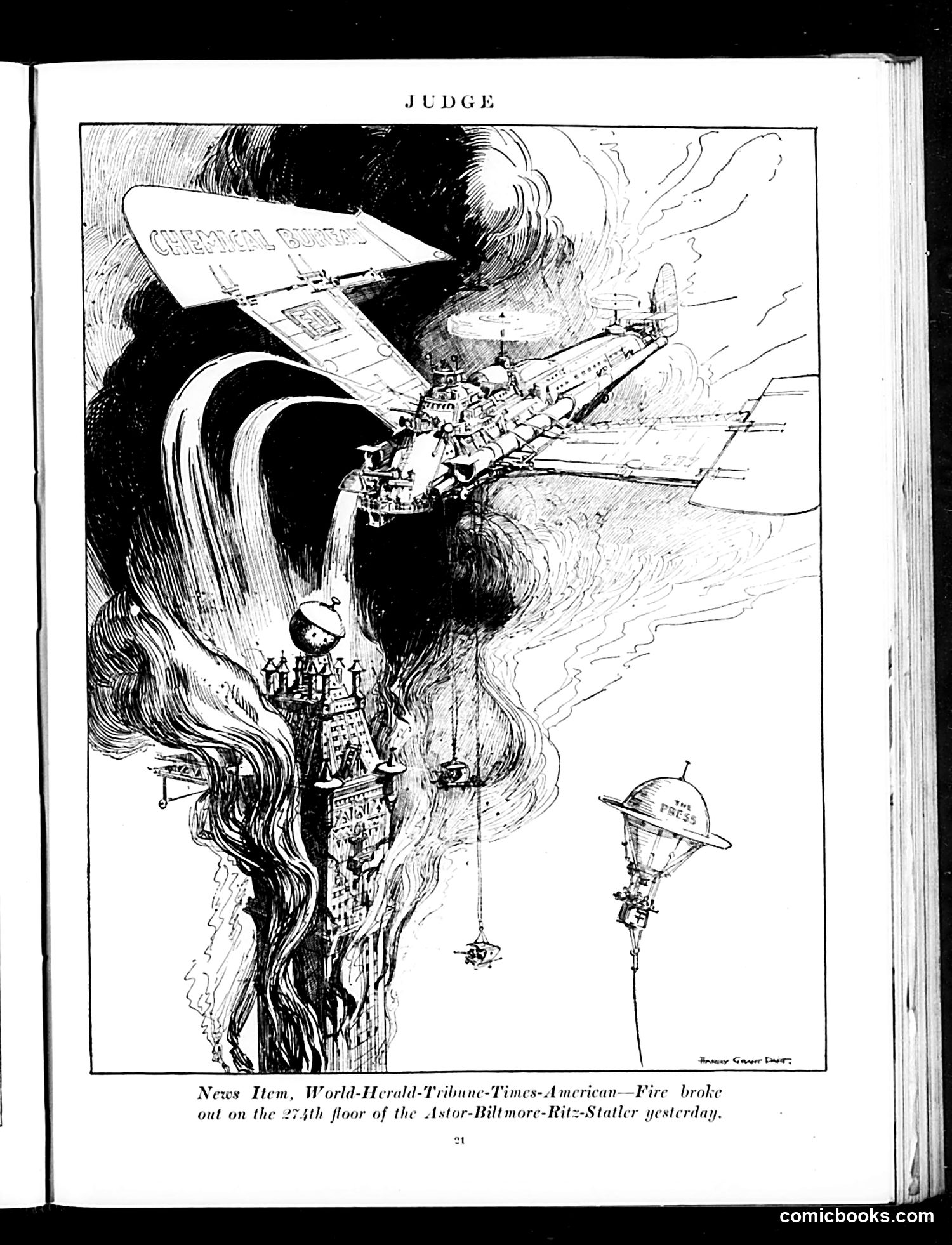
This is a futuristic satire depicting a catastrophic fire on the 274th floor of a massive, impossibly tall building combining famous luxury hotel names (Astor, Biltmore, Ritz, Statler). The cartoon mocks early 20th-century American ambitions for ever-taller skyscrapers by imagining the disaster such extreme height would create. The massive flames engulfing the building, rescue airships, and dangling figures highlight the practical dangers of unchecked architectural ambition. The satirical humor lies in the absurdity: combining multiple prestigious hotel names into one structure suggests corporate consolidation and greed, while the 274th floor represents architectural excess reaching dangerous extremes. The cartoon critiques both the competitive luxury hotel industry of the era and the era's uncritical enthusiasm for technological progress without considering safety consequences.
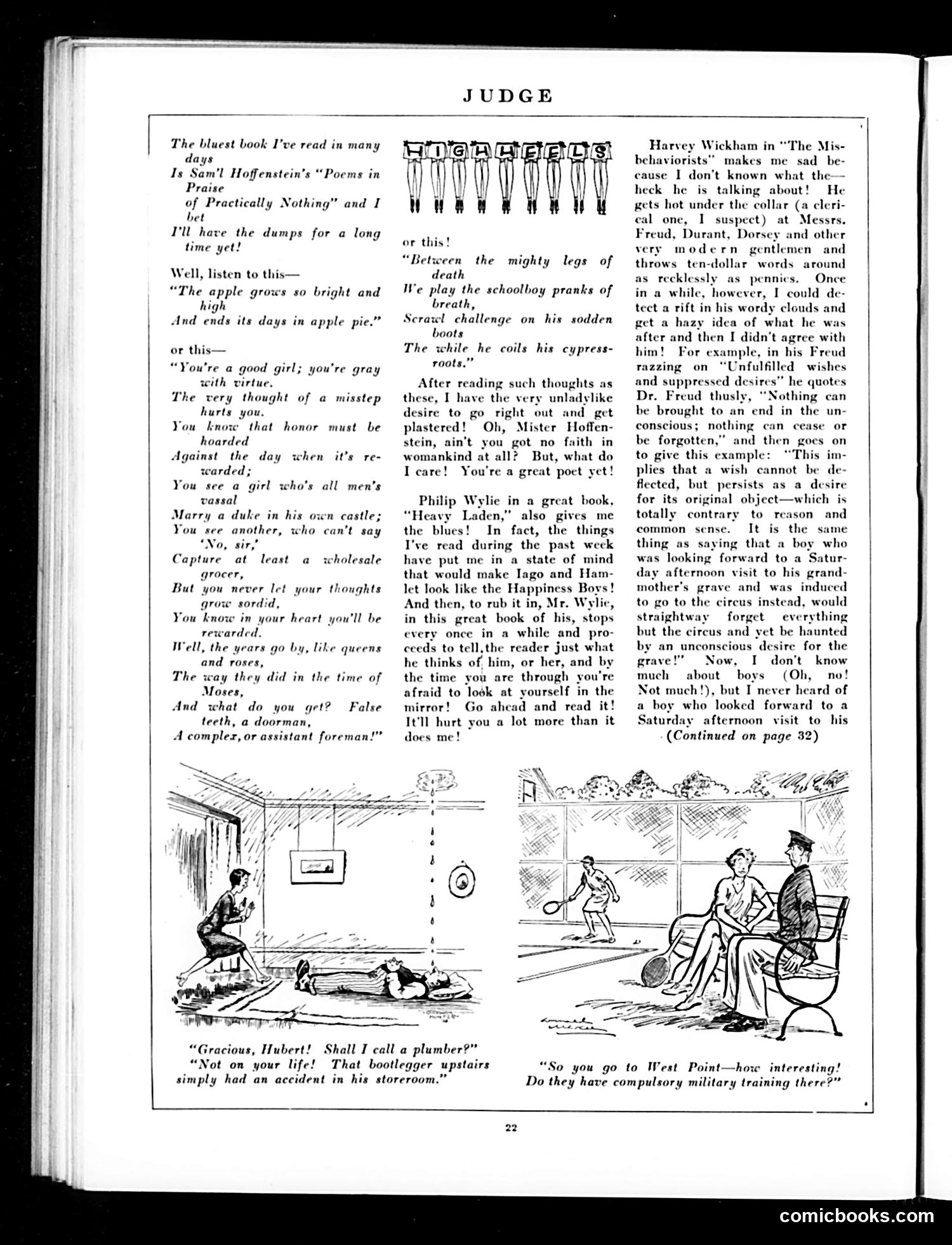
This page from *Judge* (a satirical American magazine) contains book reviews and cartoons satirizing 1920s-30s literary and social trends. **The Book Reviews:** The unnamed reviewer critiques three contemporary authors—Samuel Hoffenstein, Philip Wylie, and Harvey Wickham—whose works express pessimism and cynicism about modern life. Hoffenstein's poetry mocks virtue and morality; Wylie's novel "Heavy Laden" induces depression; Wickham's "The Misbehaviorists" attacks Freud and modern psychology with incomprehensible verbosity. The reviewer finds all three depressing but grudgingly admits they're "great." **The Cartoons:** Two separate gags appear below: 1. A plumbing disaster caused by an illegal bootlegger upstairs (referencing Prohibition-era lawbreaking) 2. A woman asking a man about West Point's military training—a straightforward social joke about military academy life The page's overall theme critiques the modern intellectual's fashionable despair and pseudo-intellectual jargon.
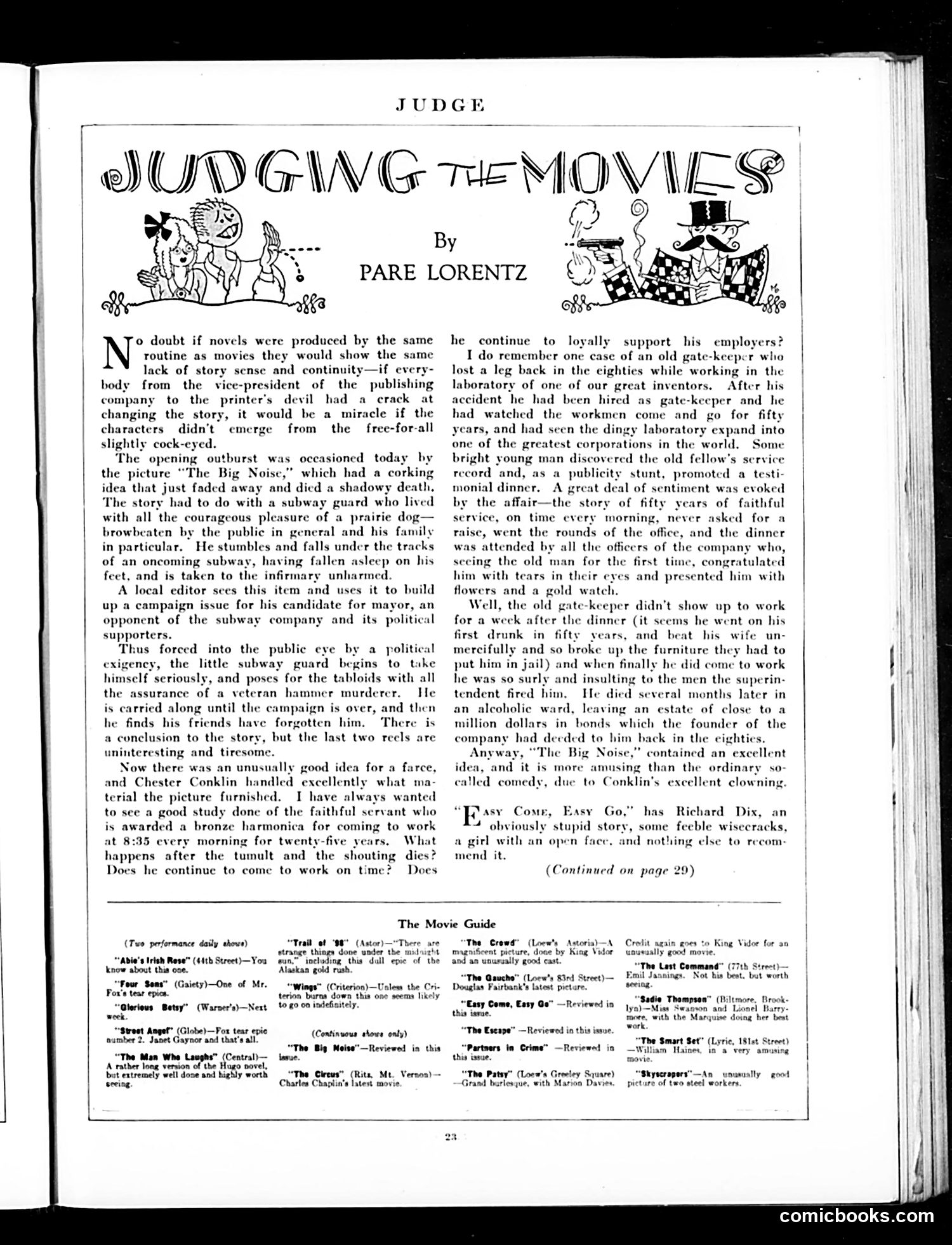
This isn't a political cartoon but rather a **film review column** by Pare Lorentz in Judge magazine's "Judging the Movies" section. Lorentz critiques "The Big Noise," a silent comedy starring Chester Conklin. The film's plot involves a subway guard whose minor accident becomes fodder for a mayoral campaign, briefly elevating his status before he's forgotten when the election ends. **The satire's point**: Lorentz uses this film as a springboard to critique how society exploits ordinary workers. He illustrates this with a real anecdote: a faithful gate-keeper receives a testimonial dinner after 50 years of service, gets drunk for the first time, beats his wife, ends up in jail and an alcoholic ward—yet dies wealthy from company bonds. **The dark joke**: Recognition and sentiment don't improve workers' lives; they may actually destabilize them. The "faithful servant" narrative is hollow corporate theater that masks genuine indifference to worker welfare. This reflects 1920s anxieties about labor, loyalty, and industrial society's empty promises to working-class employees.
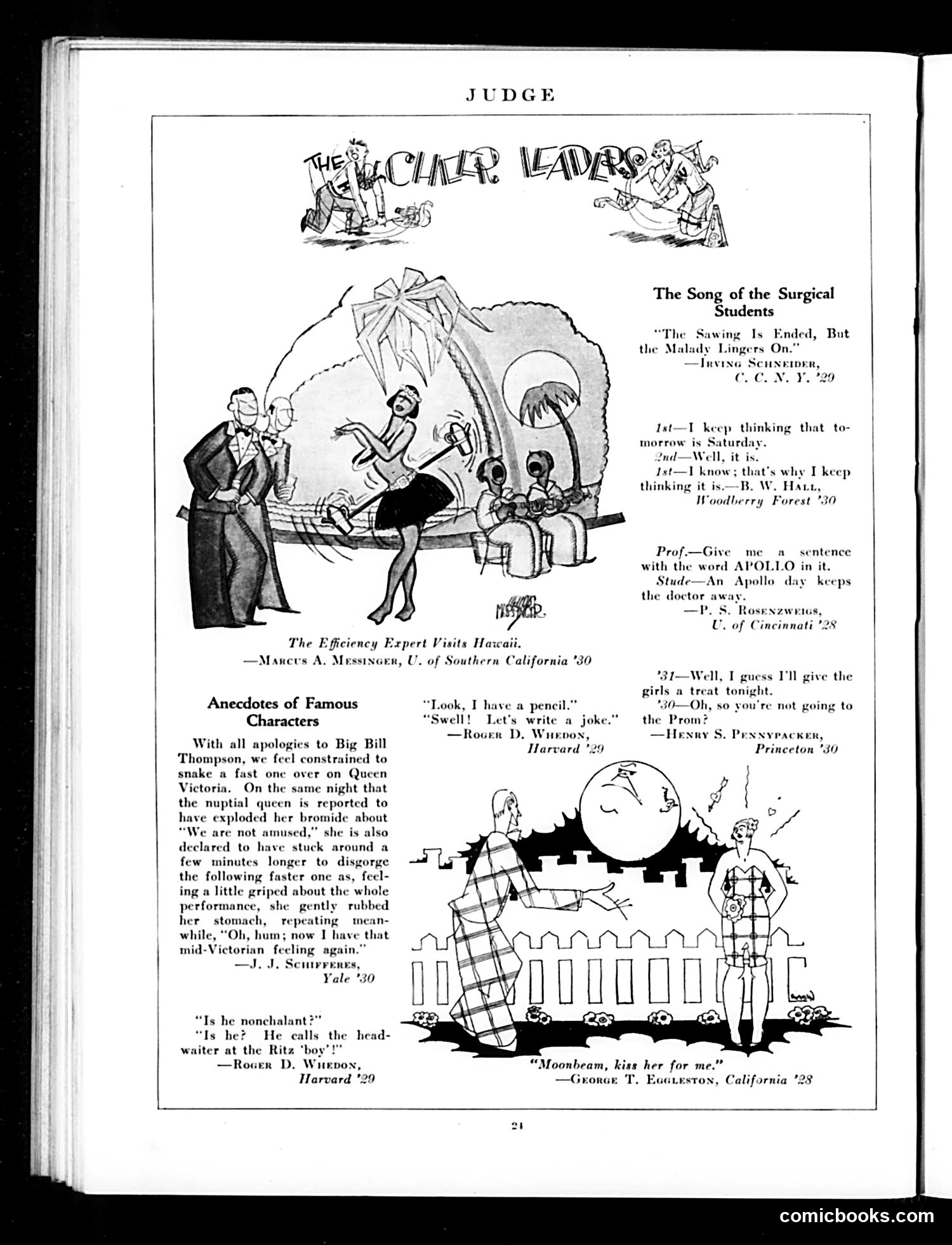
This page from Judge magazine collects student humor and anecdotes, likely from the late 1920s based on the attributed schools and years ('28, '29, '30, '31). **Top cartoon** depicts surgical students in a humorous operating theater scene, illustrating the section "The Song of the Surgical Students" — a play on the Irving Schneider quote about sawing and lingering maladies. **Middle cartoons** show college romance scenarios: one features a couple with a large moon and blanket, another shows a man with an enormous pencil trying to write a joke with a woman. **Bottom section** contains "Anecdotes of Famous Characters" — brief jokes attributed to students from Harvard, Princeton, Yale, and other universities. The Queen Victoria anecdote appears to be a humorous fictional "faster" (quicker/snappier) comeback than her famous "We are not amused" quote. The humor relies on wordplay, double meanings, and college-life situations typical of 1920s student magazines — relatively mild by modern standards but designed to amuse an educated readership.
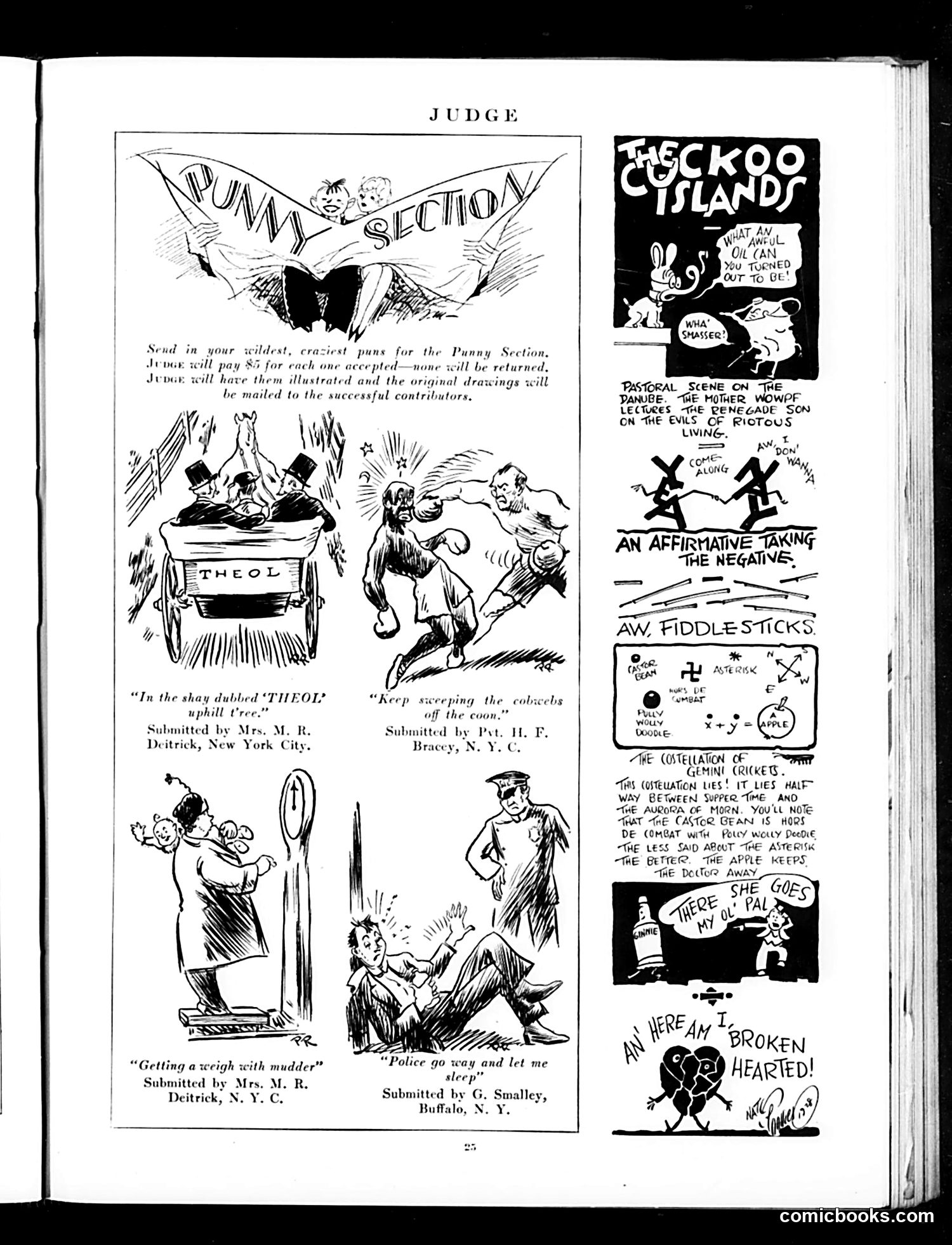
This page from *Judge* magazine features a "Punny Section" contest soliciting humorous puns from readers, offering $5 payment for accepted submissions. The left side displays four visual puns submitted by readers: - "In the shay dubbed 'THEOL' uphill t'ree" (a play on words involving a vehicle) - "Getting a weigh with mudder" (a pun on "away" and "weight") - References to sweeping and police, using period dialect humor The right side contains comic strips and humorous sketches, including "The Cuckoo Islands" (appearing to be absurdist humor with animals), pastoral scenes with moralistic commentary, and astronomical references about constellations. The overall tone reflects early 20th-century American magazine humor—reliant on wordplay, visual gags, and domestic/sentimental scenarios. The dialect and stereotypical references reflect period conventions that modern readers would find dated or offensive. The page essentially showcases amateur comic contributions and editorial humor typical of *Judge's* satirical format.
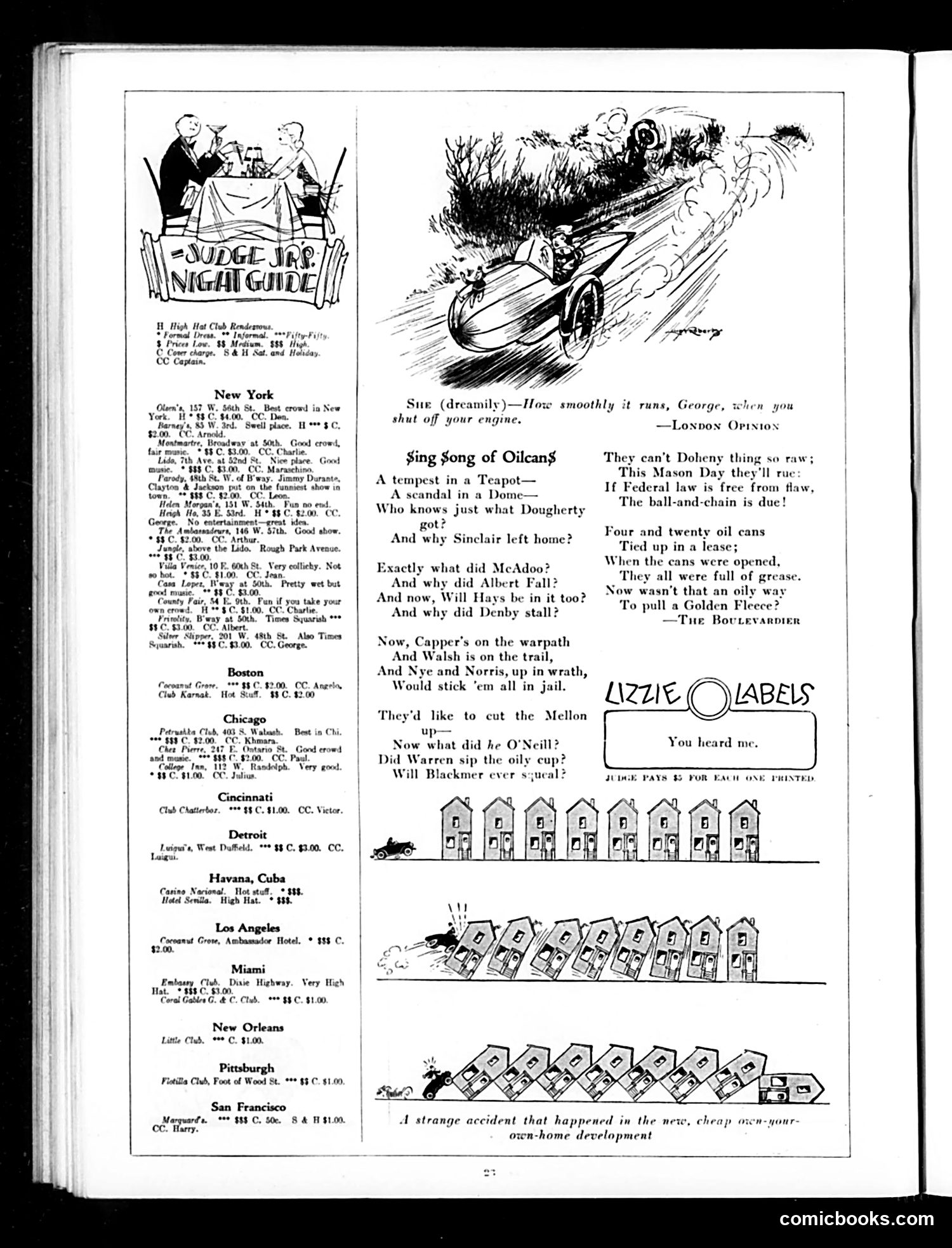
This Judge magazine page mixes nightclub listings with political satire about the **Teapot Dome scandal** (early 1920s)—a major corruption case involving oil reserves. The "Sing Song of Oilcans" poem names real figures implicated in or investigating the scandal: **Albert Fall** (Secretary of Interior who secretly leased oil fields), **Warren Harding** (president), **Harry Sinclair** (oilman), **Harry Doheny** (oil executive), and senators **Thomas Walsh**, **Gerald Nye**, and **George Norris** who investigated it. The poem mocks how many officials were caught up in bribery and corruption involving oil leases. The cartoon showing toppling houses satirizes cheap housing developments, suggesting they're as unstable and fraudulent as the scandal itself. The "Lizzie Labels" cartoon appears to be unrelated humor about automobiles. The nightclub guide reflects Prohibition-era speakeasy culture, with coded language about dress codes and prices.
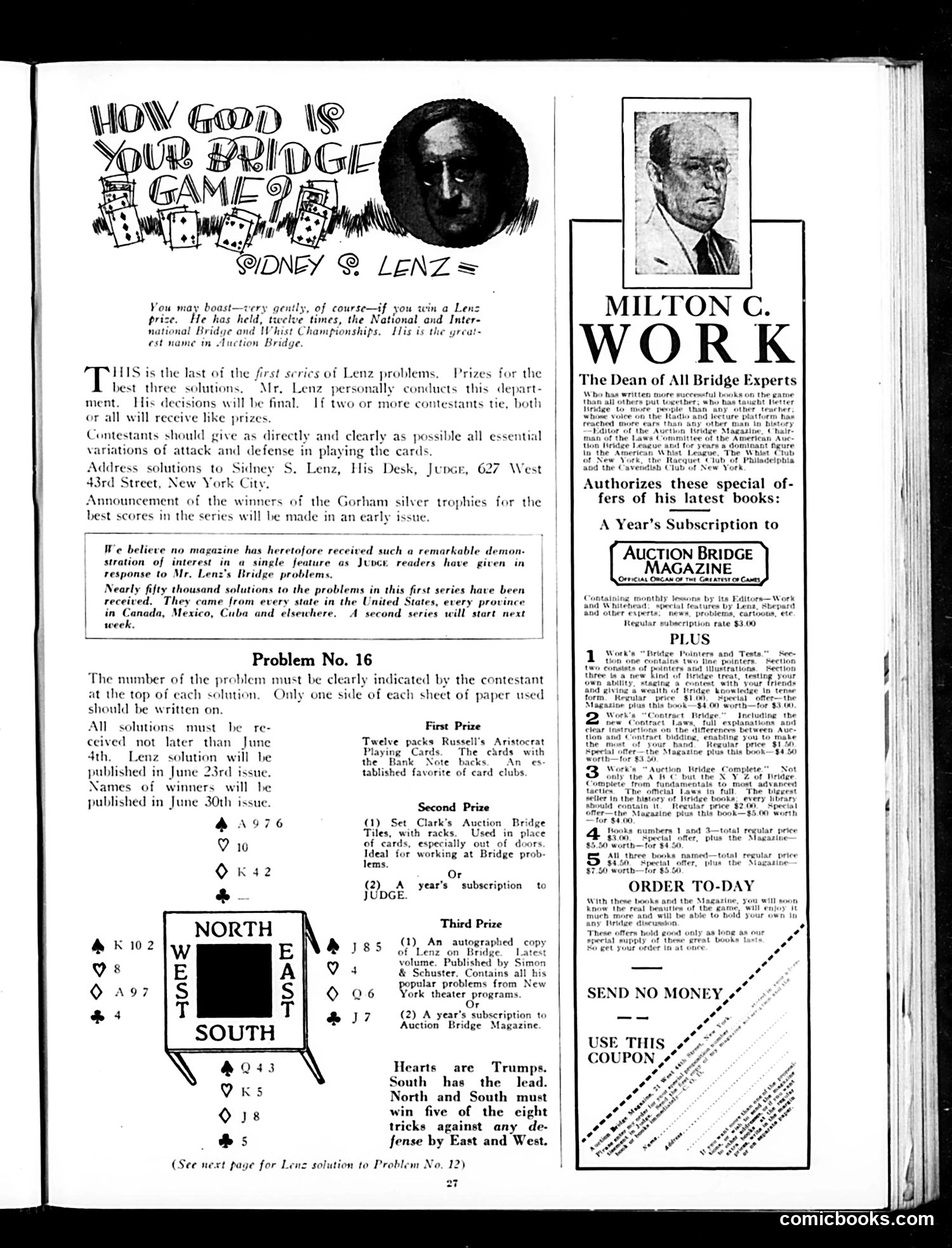
This page showcases a **bridge card game problem contest** sponsored by Judge magazine, featuring famous bridge champion **Sidney Lenz**. The content reflects early 20th-century American popular culture obsession with contract bridge—a relatively new game that captivated the nation across all social classes. The satire implicit in the headline "How Good Is Your Bridge Game?" pokes gentle fun at bridge's status as a prestigious pastime for the educated and wealthy, while the massive response (nearly 50,000 solutions from across North America) demonstrates its democratic appeal. Lenz, celebrated as bridge's greatest authority with multiple national championships, lends credibility and celebrity status to the contest. The prizes—quality playing cards, subscription offers, and Lenz's own published book—reveal how bridge had become commercialized entertainment. Judge capitalized on this craze, using it as a major circulation driver while simultaneously gently mocking the competitive seriousness with which Americans pursued the game.
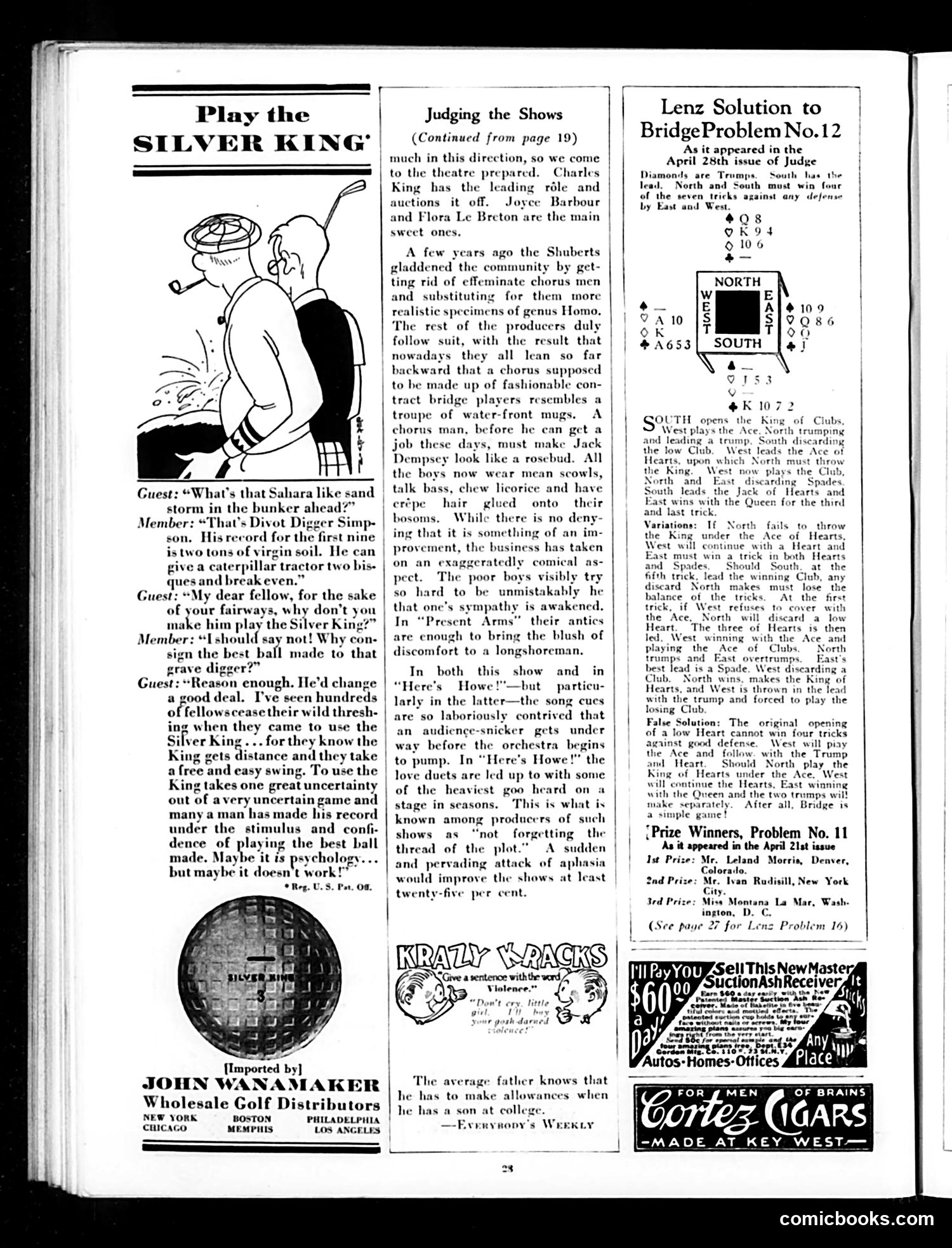
This page combines advertising with entertainment criticism. The main left section promotes "Silver King" golf balls through a humorous dialogue between golfers discussing a player nicknamed "Sahara" who digs up fairways like a caterpillar tractor. The pitch: using quality golf balls eliminates uncertainty and improves performance, allowing even bad golfers to make better records. The center column reviews theatrical productions, particularly criticizing contemporary Broadway shows for their exaggerated masculine posturing in chorus lines. The critic notes that producers, following the Shuberts' lead years earlier, replaced "effeminate chorus men" with overly masculine types who now resemble dock workers—a reaction the writer finds comedically excessive and tiresome. The right section contains a bridge card game puzzle solution. Advertisements for golf equipment, cigar brands, and other products fill remaining space, typical of *Judge* magazine's revenue model.
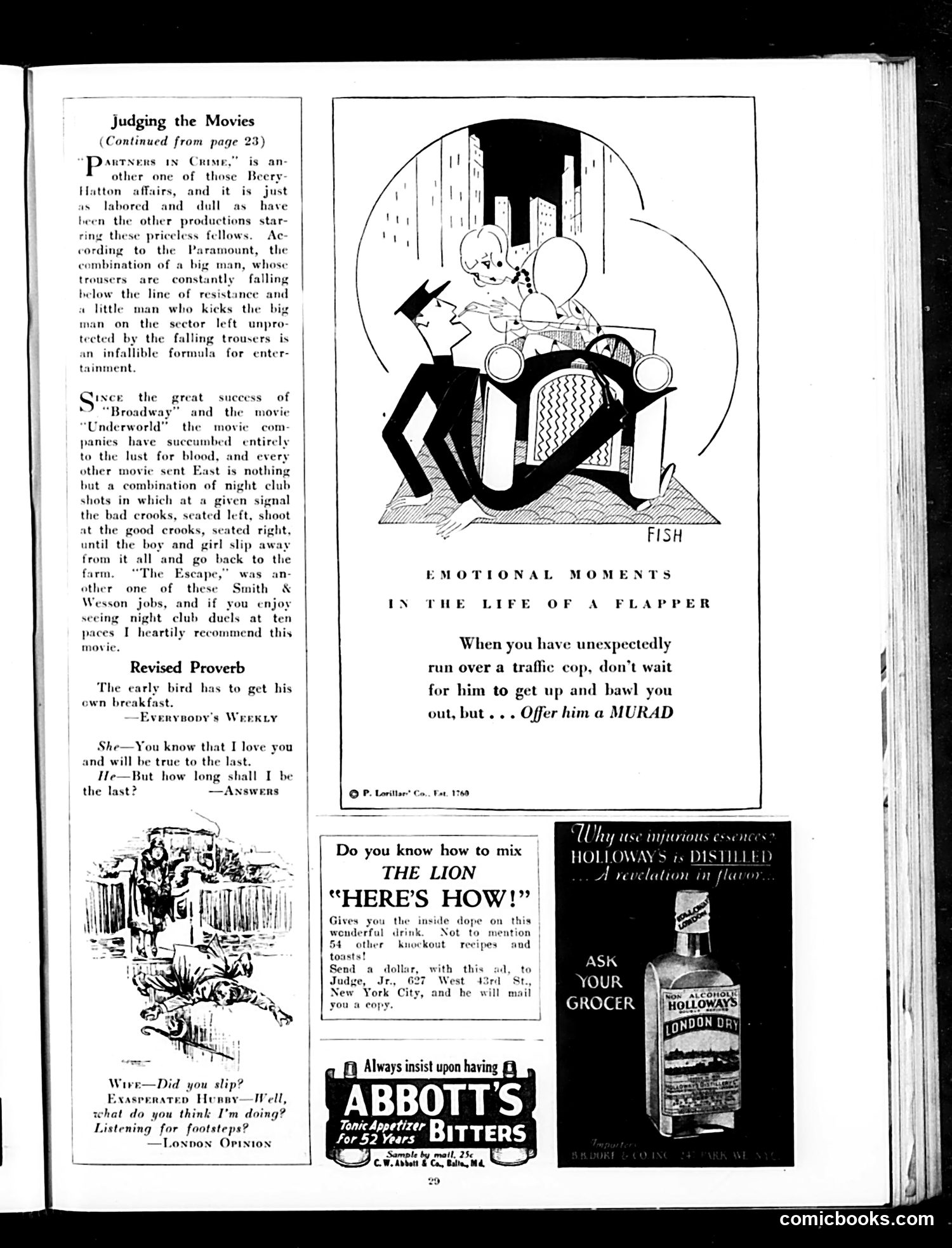
This page from Judge magazine contains film criticism and vintage advertisements rather than political cartoons. **Main Content:** The "Judging the Movies" column critiques 1920s films, particularly mocking buddy comedies starring Wallace Beery and John Baton. The critic dismisses their slapstick formula (a tall man with falling trousers kicked by a short man) as "labored and dull." He also satirizes the glut of crime/gangster films flooding theaters—standardized plots featuring night clubs, shootouts between criminals, before the protagonists escape to a farm. **Cartoons:** A small comic dialogue jokes about marital longevity ("how long shall I be the last?"), and another depicts an exasperated husband caught eavesdropping. **Advertisements:** The page is dominated by period product ads: Abbott's Bitters (52-year "tonic appetizer"), Holloway's Distilled liqueur, Murad cigarettes, and a Lion cocktail recipe offer. These reflect Prohibition-era advertising when alcohol companies marketed medicinal or "flavorful" products as workarounds. The satire targets Hollywood's repetitive formulas and commercialism.
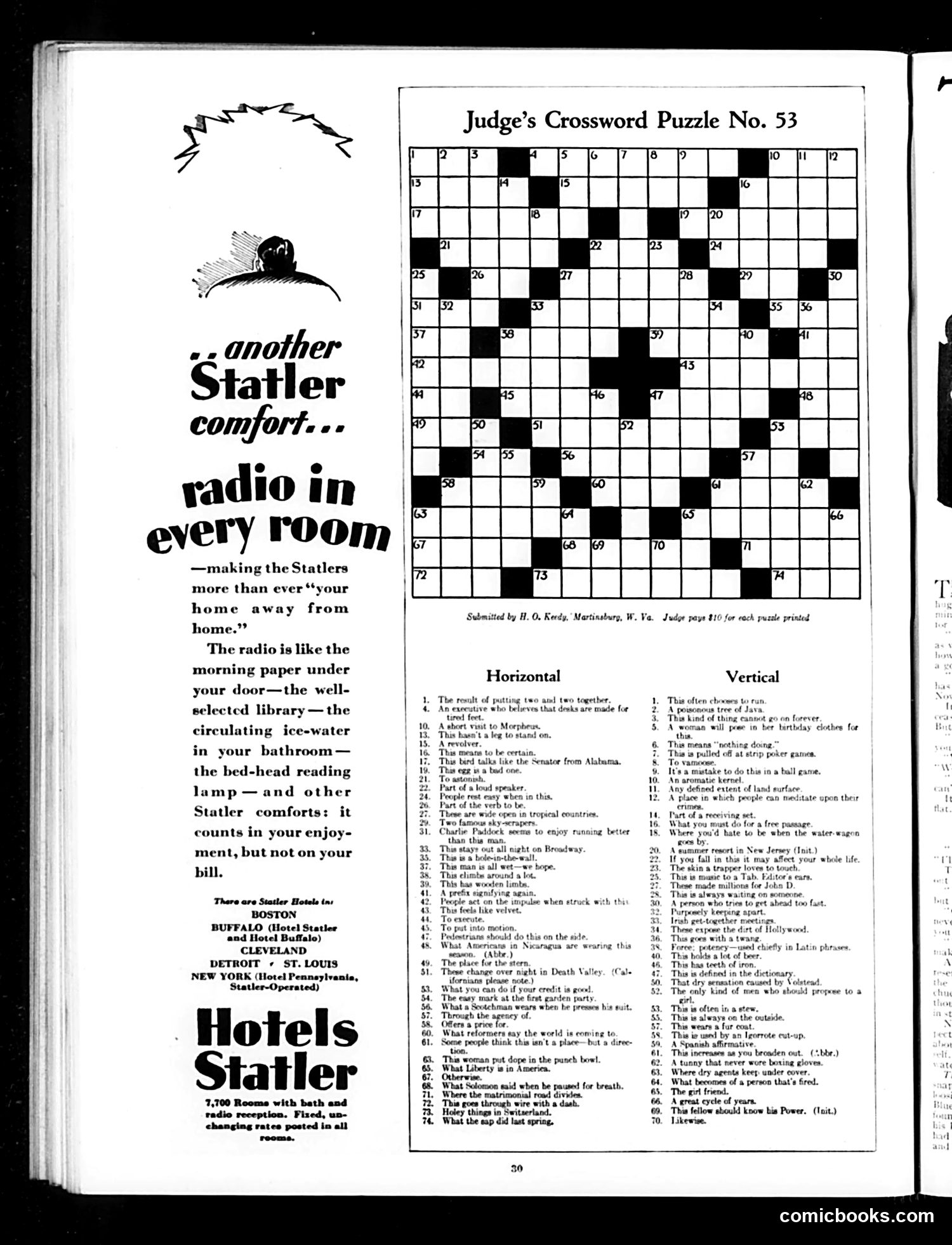
This page is primarily an advertisement for Statler Hotels paired with a crossword puzzle. The ad emphasizes that Statler Hotels provide modern comforts—including radios in every room—as amenities that "count in your enjoyment, but not on your bill," positioning the hotel chain as offering luxury without additional charges. The crossword puzzle itself contains no political satire. Instead, the clues are lighthearted wordplay and contemporary references typical of 1920s-30s puzzle entertainment: references to Broadway, Death Valley, Senator from Alabama, and contemporary figures like athlete Charlie Paddock. The puzzle was submitted by H.O. Keedy of Martinsburg, West Virginia. This is essentially a branded advertising page with entertainment value rather than satirical content.
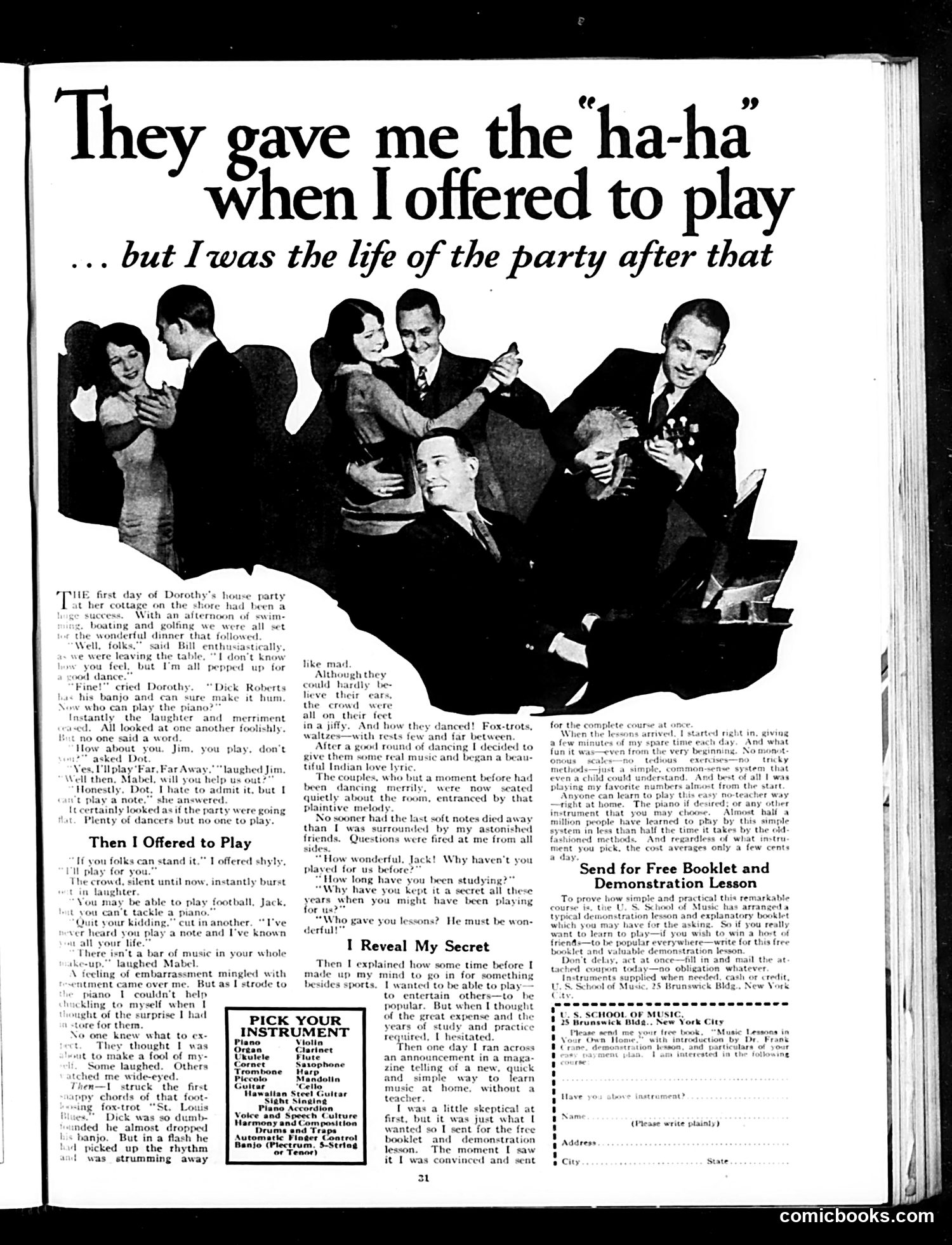
This is an advertisement disguised as a humorous narrative. The story depicts a social scenario where a young man named Jack is mocked when he offers to play piano at a party—his friends assume he's incompetent. However, he surprises everyone by playing beautifully, impressing the guests. The "joke" is the setup for the actual sales pitch: Jack reveals he learned music through a mail-order course advertised by the **U.S. School of Music** (visible in the right column). The narrative argues that this correspondence method is superior to traditional lessons—quick, simple, inexpensive, and doesn't require tedious exercises. The accompanying box labeled "PICK YOUR INSTRUMENT" lists available courses (piano, violin, banjo, etc.), making this primarily a **direct-mail advertisement** rather than satire or political commentary. The humor serves to make the pitch memorable and emotionally persuasive rather than to critique anything social or political.
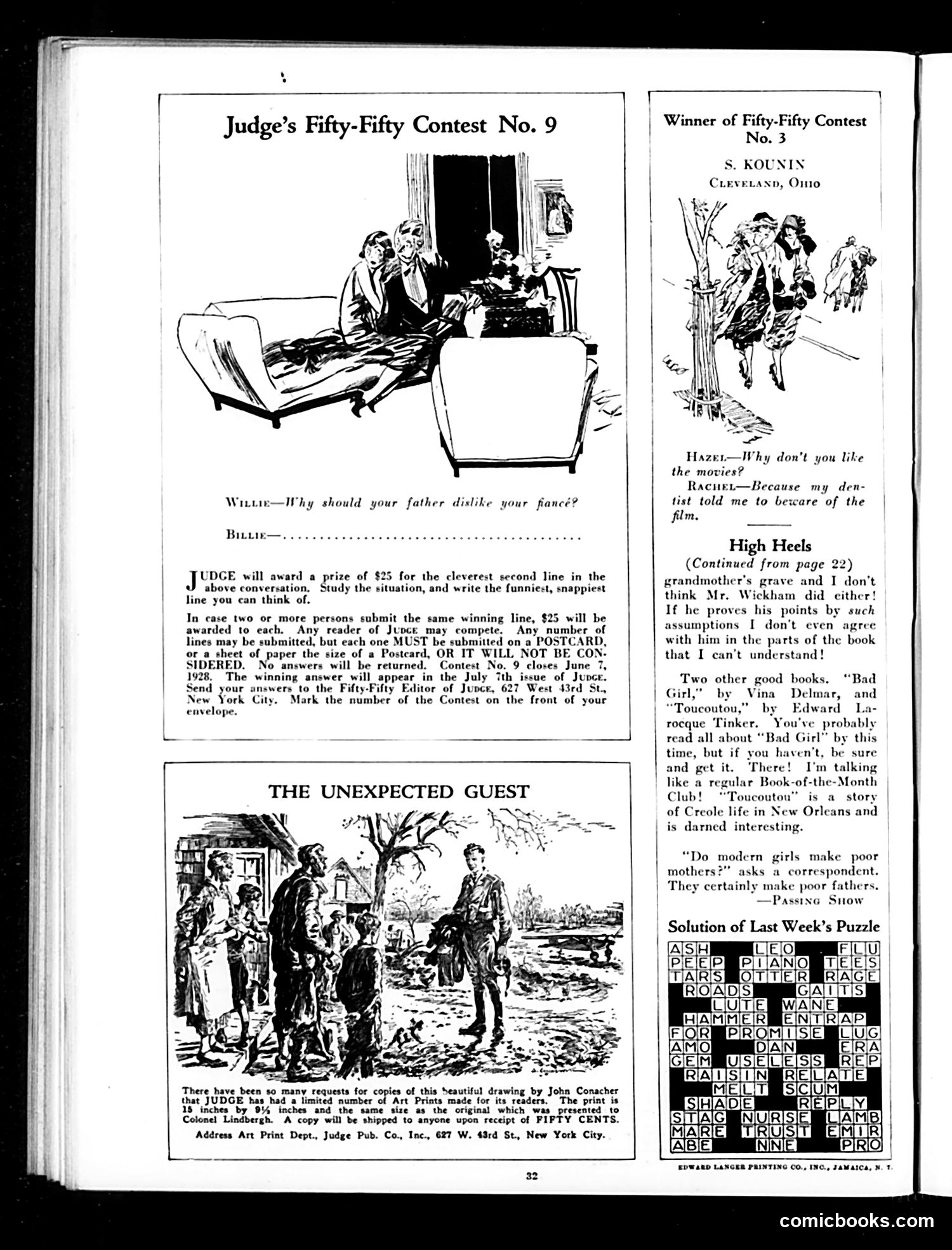
This page contains a **contest and miscellaneous content**, not a political cartoon requiring interpretation. The main feature is **"Judge's Fifty-Fifty Contest No. 9,"** a reader participation contest asking for witty punchlines. The setup shows a young woman (Willie) being asked by her fiancé's father why he dislikes the fiancé—readers must supply Billie's clever response. The $25 prize reflects Judge's interactive engagement strategy typical of 1920s magazines. The page also includes: - A winning entry from a previous contest (a mild joke about dentists and movies) - Book reviews discussing "Bad Girl" and "Toucoutou" - A crossword puzzle solution - An art print advertisement featuring a Lindbergh-related drawing There is **no political satire** on this page. It represents Judge's blend of humor contests, literary content, and reader engagement—standard magazine fare from 1928, not commentary on current events.
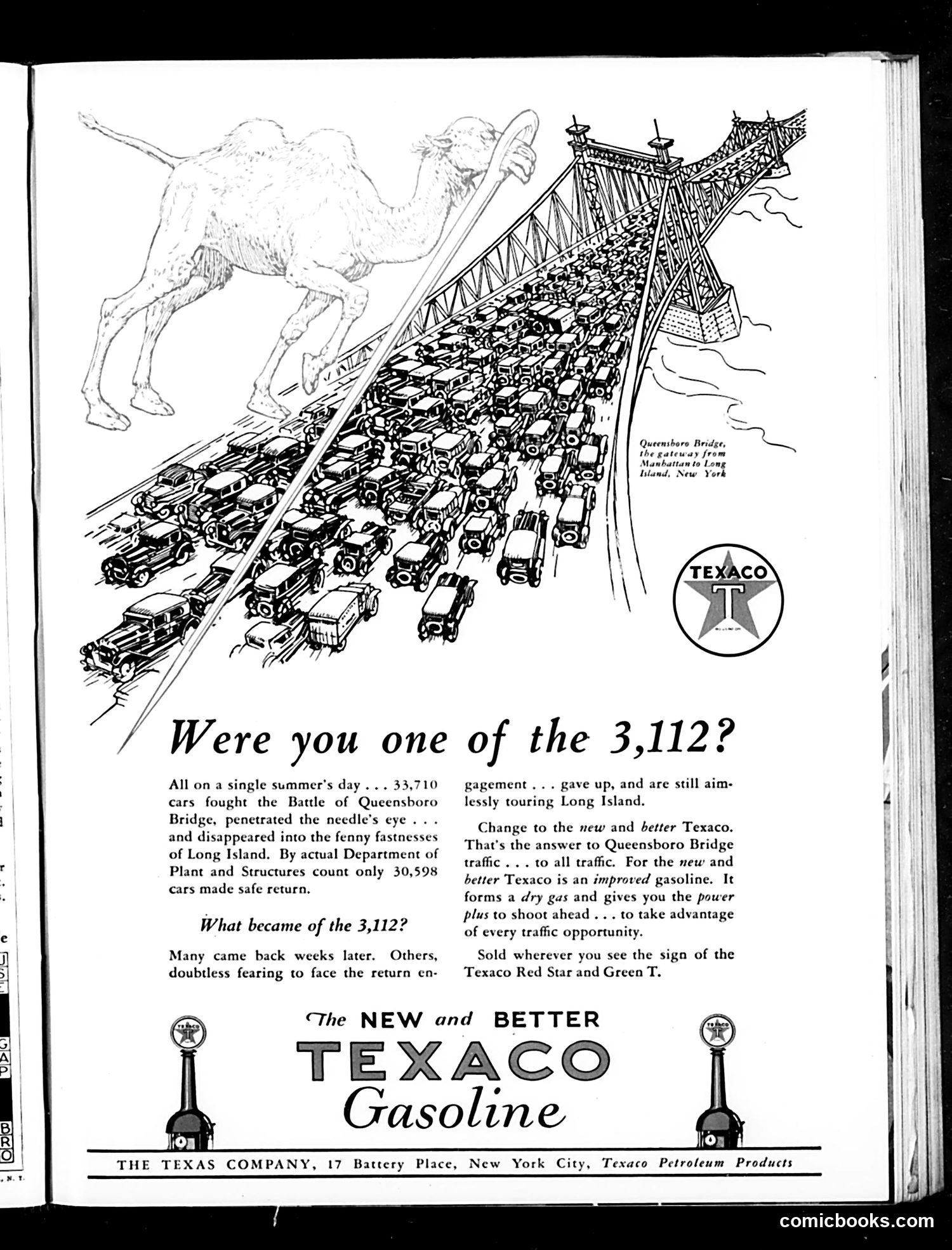
This is a **Texaco gasoline advertisement** disguised as satirical commentary, not a political cartoon. The "joke" references the Queensboro Bridge's notorious traffic congestion. The ad claims that on a single summer day, 33,710 cars crossed the bridge, but only 30,598 returned safely—implying 3,112 cars were lost or stranded in Long Island's "fenny fastnesses" (swampy areas). The camel illustration (Texaco's mascot) appears to mock this traffic chaos humorously. **The sales pitch:** Texaco's "new and better" gasoline allegedly solves this problem by providing superior power and acceleration, allowing drivers to "shoot ahead" and avoid getting trapped in traffic or lost. For modern readers, this reflects 1920s-30s automobile culture anxiety—bridges, traffic jams, and suburban travel were novel phenomena. The ad exploits humorous exaggeration about traffic problems to promote fuel quality as the solution, conflating gasoline performance with traffic management in ways that seem absurd today.
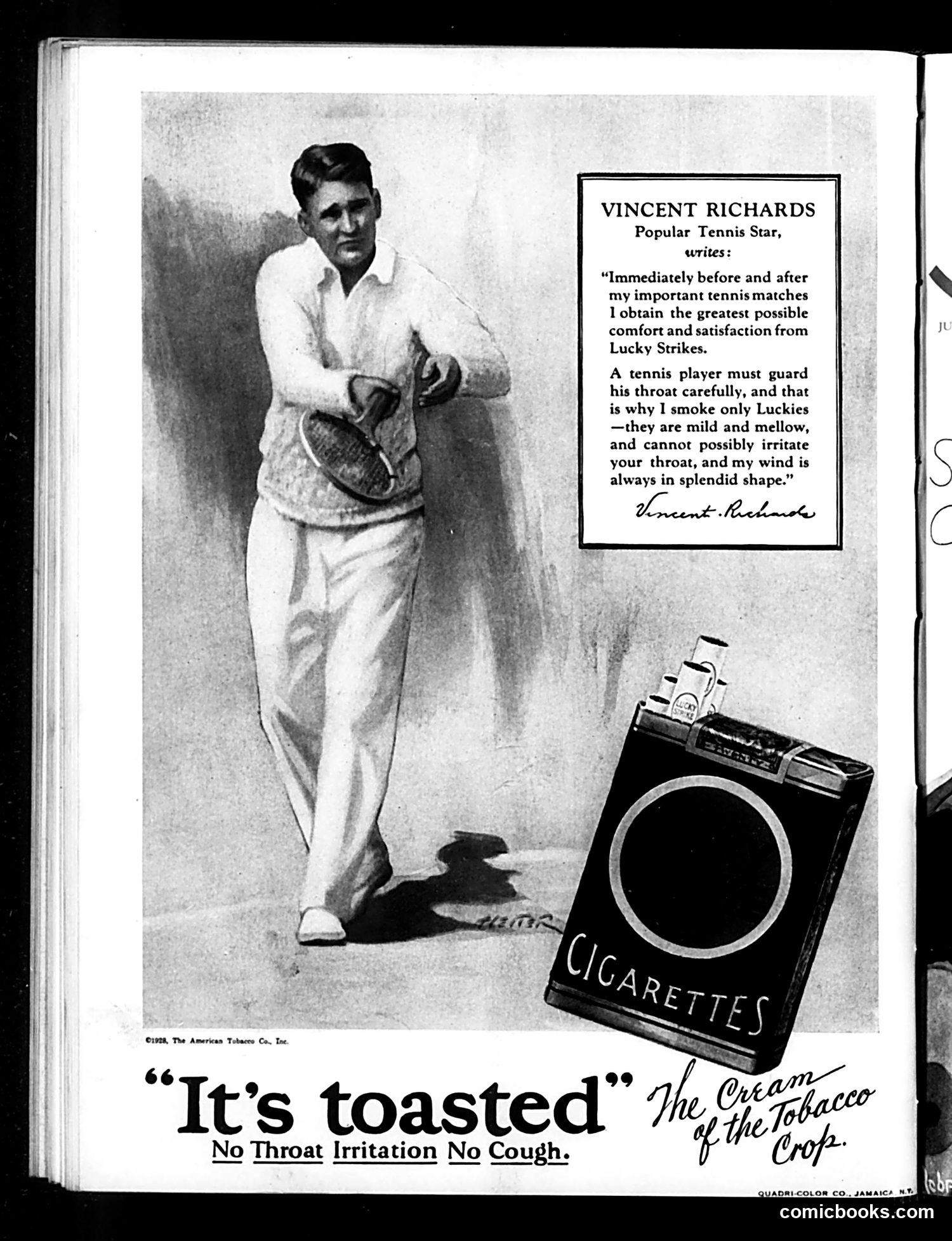
This is a **cigarette advertisement**, not satire. Vincent Richards, a prominent tennis player of the 1920s, endorses Lucky Strike cigarettes. The ad exploits Richards' athletic credibility to market cigarettes as "mild and mellow" and safe for the throat—claims designed to counter growing health concerns about smoking. The "It's toasted" slogan refers to Lucky Strike's manufacturing process, positioned as making cigarettes less irritating. The advertisement exemplifies early tobacco marketing tactics: celebrity endorsement and false health reassurances ("No Throat Irritation No Cough"). For modern readers, this reveals how aggressively cigarette companies marketed directly to consumers using trusted public figures, making unsubstantiated health claims that would be illegal today. This represents mid-1920s advertising before widespread acknowledgment of smoking's dangers.