
Judge, 1928-05-26 · page 15 of 36
Judge — May 26, 1928 — page 15: what you’re looking at
What you’re looking at
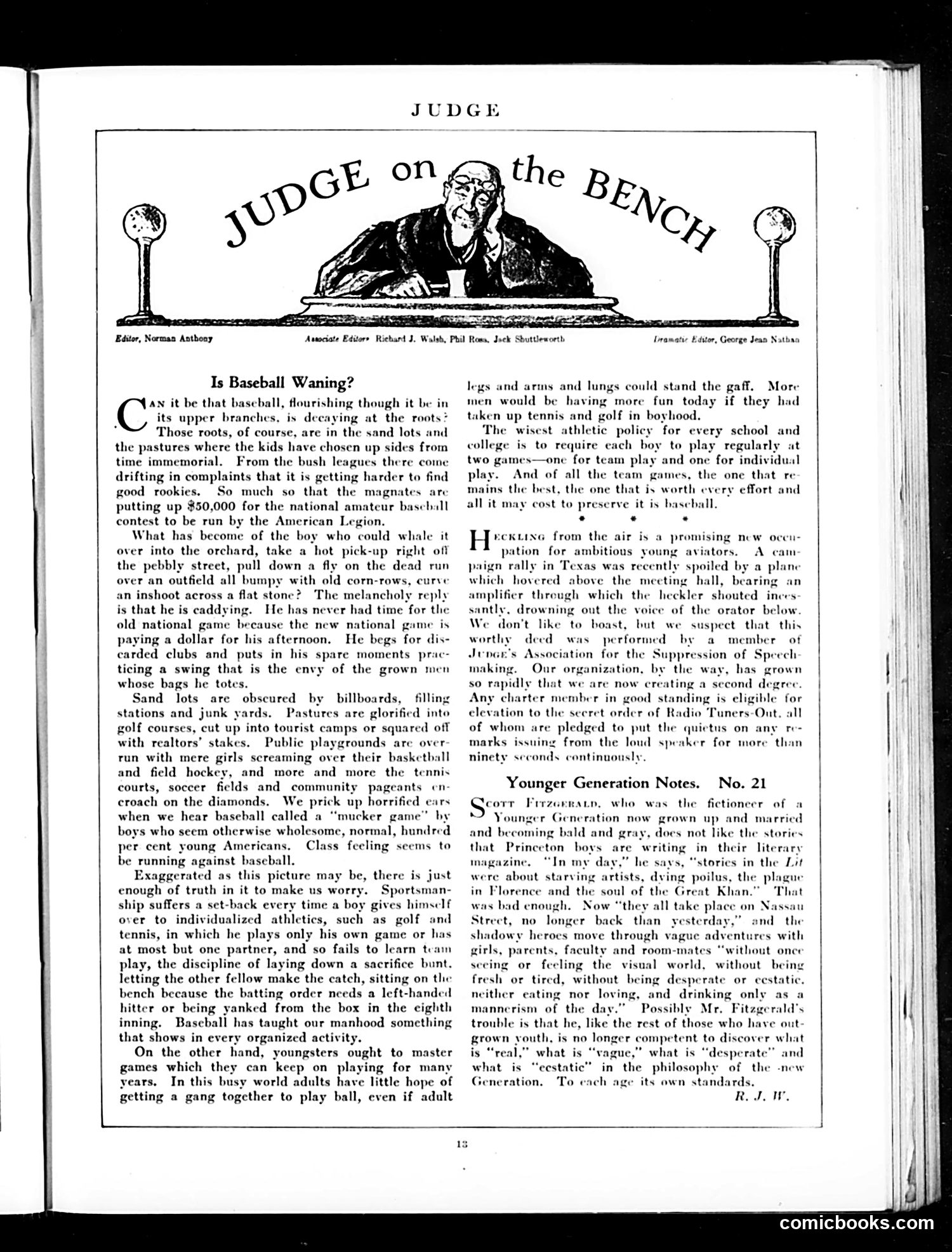
This editorial column addresses whether baseball is declining among American youth. The illustrated judge presiding above suggests this is a matter of serious social concern. The author argues that baseball's roots in sandlots and amateur play are withering because boys now caddy for golf instead—golf pays money while baseball doesn't. Additionally, urban development has eliminated playgrounds: billboards, gas stations, and tourist camps replace the open fields where children once played. The piece contrasts baseball (a team sport requiring sacrifice and discipline) with individual sports like golf and tennis. However, it acknowledges a counterpoint: adults need lifelong recreational options since organizing baseball games becomes impractical in modern, busy adult life. A secondary satirical item mocks an "Association for the Suppression of Speech making," joking about an aviator who disrupted a Texas rally by flying overhead with an amplifier to drown out speakers—suggesting even elaborate schemes to silence annoying orators exist.
📄 Transcribed text from this page (OCR, searchable)
Machine-transcribed from the original scan — historical spelling and the odd misread are preserved.
Editor, Norman Anthony Is Baseball Waning? Cc" it be that baseball, flourishing though it be in its upper branches, is decaying at the roots? Those roots, of course, are in the sand lots and the pastures where the kids have chosen up sides from time immemorial. From the bush leagues there come drifting in complaints that it is getting harder to find good rookies. So much so that the magnates arc putting up $50,000 for the national amateur baseball contest to be run by the American Legion. What has become of the boy who could whale it over into the orchard, take a hot pick-up right off the pebbly street, pull down a fly on the dead run over an outfield all bumpy with oid corn-rows, curve an inshoot across a flat stone? The melancholy reply is that he is caddying. He has never had time for the old national game because the new national game is paying a dollar for his afternoon. He begs for dis- carded clubs and puts in his spare moments p ticing a swing that is the envy of the grown men whose bags he totes. and lots are obscured by billboards, fillin; stations and junk yards. Pastures are glorified into golf courses, cut up into tourist camps or squared off with realtors’ stakes. Public playgrounds are over run with mere girls screaming over their basketball and field hockey, and more and more the tennis courts, soccer ficlds and community pageants en croach on the diamonds. We prick up horr when we hear baseball called a “mucker game” by boys who seem otherwise wholesome, normal, hundred per cent young Americans. Class feeling seems to be running against baseball. Exaggerated as this picture may be, there is just enough of truth in it to make us worry. Sportsman- ship suffers a set-back every time a boy gives himself over to individualized athletics, such as golf and tennis, in which he plays only his own game or | at most but one partner, and so fails to learn team play, the discipline of laying down a sacrifice bunt. letting the other fellow make the catch, sitting on t bench because the batting order needs a left-handed hitter or being yanked from the box in the eighth inning. Bascball has taught our manhood something that shows in every organized activity. On the other hand, youngsters ought to master games which they can keep on playing for many years, In this busy world adults have little hope of getting a gang together to play ball, even if adult JUDGE Associate Editors Richart J. Walsh, Phil Roms, Jnck Shuttleworth legs and arms and lungs could stand the gaff. More men would be having more fun today if they had tuken up tennis and golf in boyhood. The wisest athletic policy for y school and college is to require each boy to play regularly at two games—one for team play and one for individual pla. And of all the team games, the one that re mains the best, the one that is worth every effort and all it may cost to preserve it ix baseball. . * . H« tine from the air is a promising new ocen- vation for ambitious young aviators. v rally in Texas was recently spoiled b: h hovered above the meeting hall, bearing an amplifier threugh which the heckler shouted inces santly, drowning out the voice of the orator below. We don't like to boast, but we suspect that this worthy deed was performed by a member of Jepae’s Association for the Suppression of Speech making. Our organization, by the w so rapidly that we are now creating Any charter member in good standing is eligil elevation to the secret order of Radio Tuners-Out. all of whom are pledged to put th marks issuing from the loud sy ninety seconds continuously. y, has grown second ¢ Younger Generation Notes. No. 21 ort Frrzaenatn, who was the fictioneer of a Younger Generation now grown up and married and becoming bald and gray, does not like the stories on boys are writing in their literary ne. “In my day,” he says, “stories in the Lit bout starving artists, dving poilus, the p’ in Florence and the soul of the Great Khan.” That as bad enough. Now “they all take place on Nassau Street, no longer back than yesterday,” and the shadowy heroes move through vague adventures with girls, parents, faculty and room-mates “without oner ‘ing or feeling the visual world, without being fresh or tired, without being desperate or ecstatic. her eating nor loving, and drinking only as a mannerism of the day.” Possibly Mr. Fitzgerald's trouble is that he, like the rest of those who have out grown youth, is no longer competent to discover what is “real,” what is ‘ what is “despera vague "and t is “eestatic” in the philosophy of the -new eration, To cach age its own standards, R.ILW. comicbooks.com