
A complete issue · 36 pages · 1928
Judge — April 28, 1928
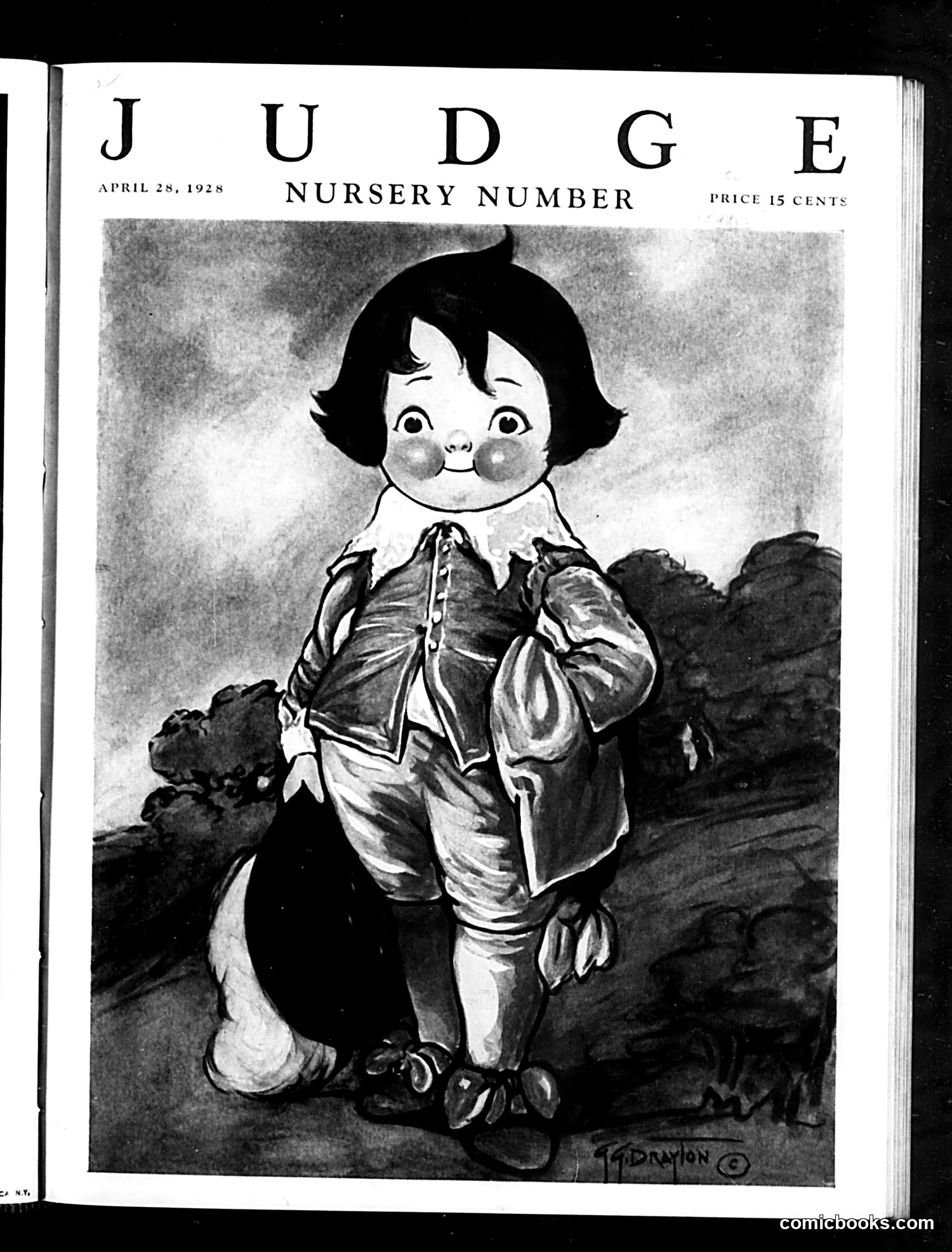
This is the cover of Judge's "Nursery Number" issue, featuring an illustration by John Drayton of a stylized child character in an oversized formal jacket, holding what appear to be vegetables or produce. The exaggerated rosy cheeks and wide-eyed expression are typical of 1920s children's illustration aesthetics. Without additional text explaining the specific satire, the cartoon's exact political or social target remains unclear. However, the "Nursery Number" designation suggests this issue focused on child-related content, education, or possibly satirized politicians/public figures through childish caricature—a common Judge magazine device. The formal attire on the infant figure may itself be the joke, mocking adult pretentiousness applied to children.
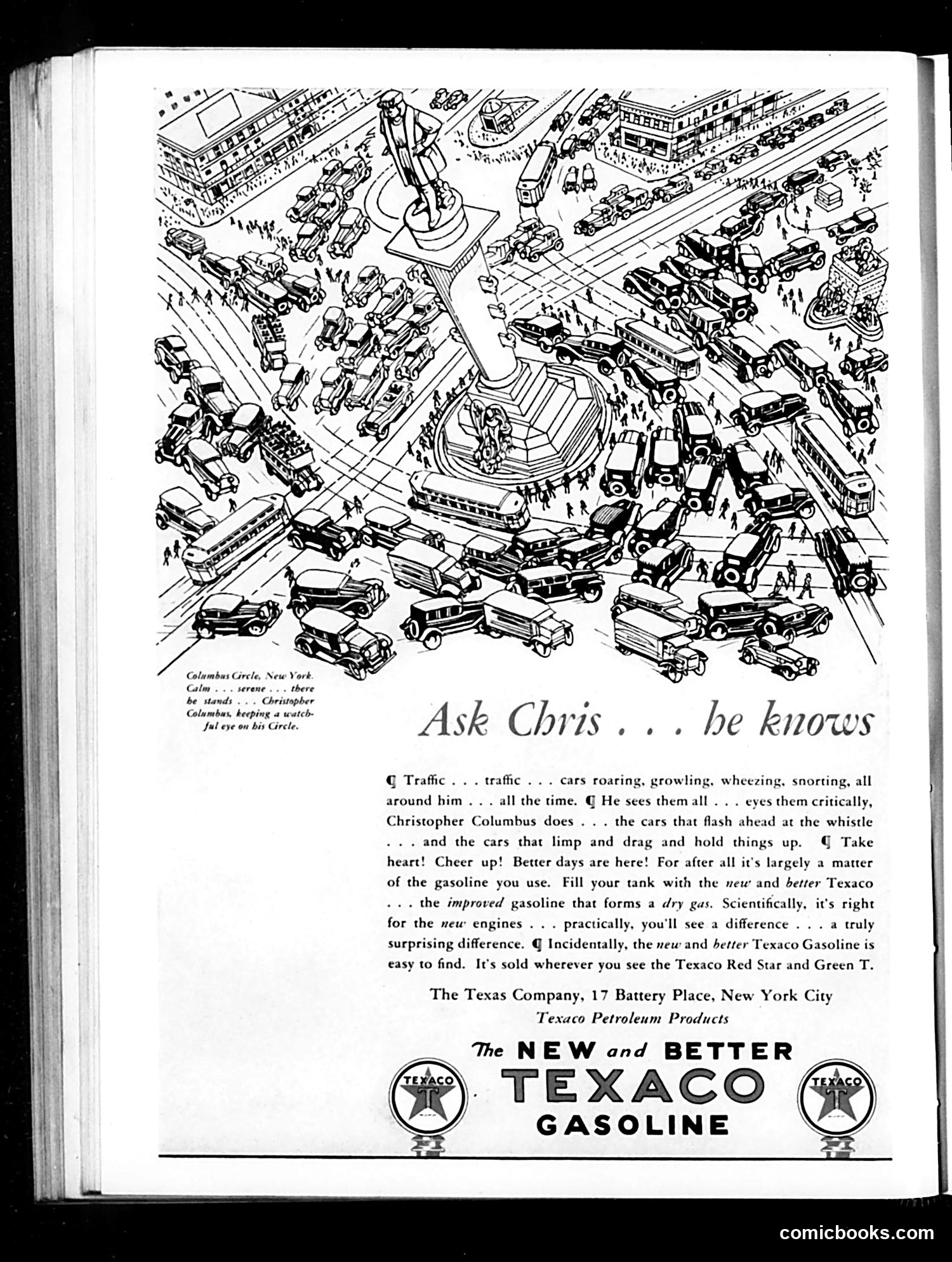
This page is primarily a **Texaco gasoline advertisement**, not political satire. The illustration depicts Columbus Circle in New York City from an isometric perspective, showing heavy traffic congestion with numerous cars, buses, and pedestrians surrounding the Columbus monument. The ad uses "Christopher Columbus" as a pun—the headline reads "Ask Chris... he knows," playing on the famous explorer's name. The advertisement's message is that Christopher Columbus observes all the traffic chaos and would recognize Texaco's "new and better" gasoline as a solution. The copy emphasizes that improved gasoline performs better in modern engines, implying smoother driving amid urban congestion. This is commercial advertising using wordplay and urban traffic imagery for marketing purposes, not satirical commentary on politics or society.
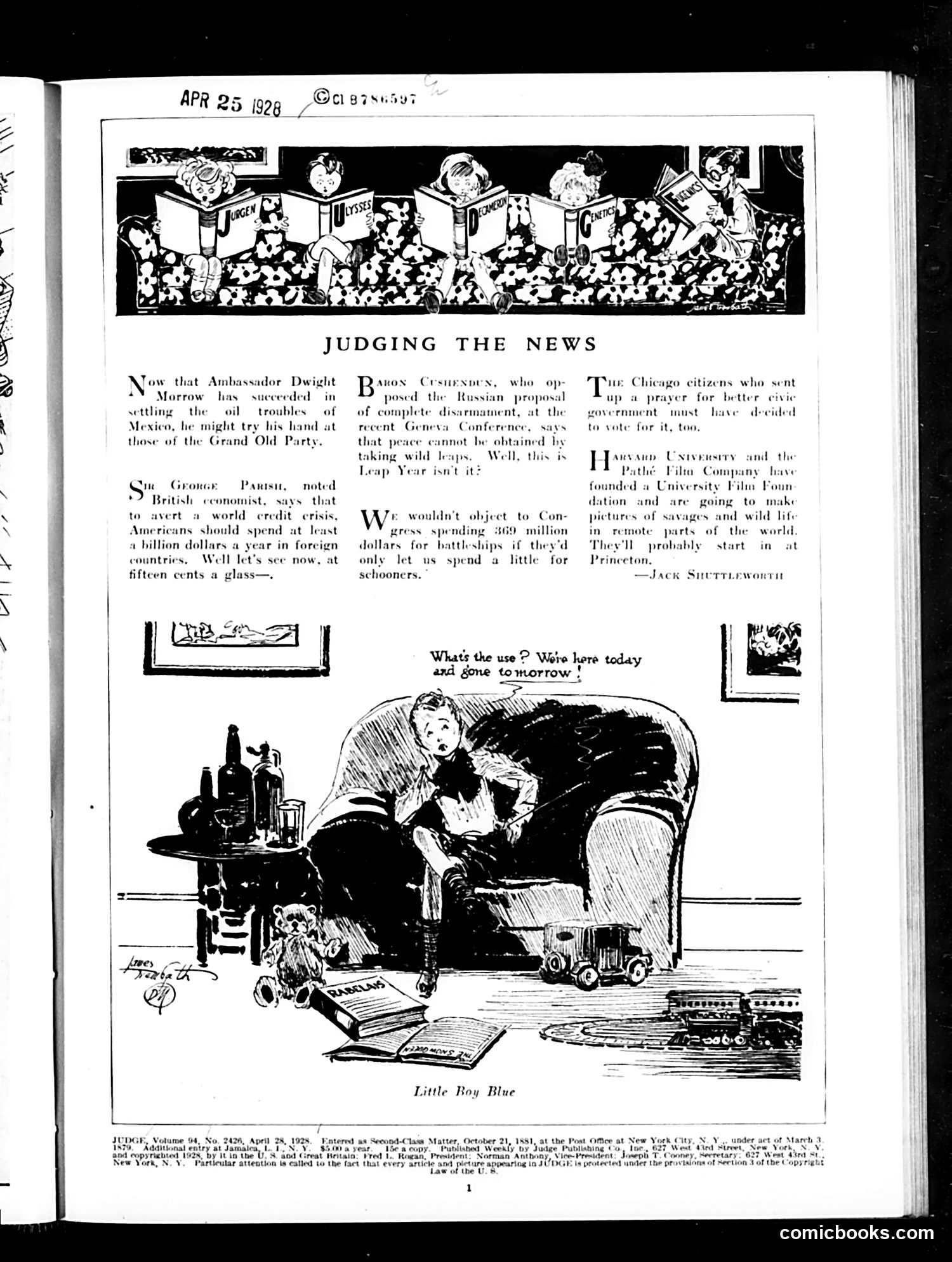
This satirical column critiques contemporary political issues: 1. **Ambassador Dwight Morrow** is praised for resolving Mexican oil disputes—a reference to U.S.-Mexico relations under the Coolidge administration. 2. **Baron Cushendun's disarmament proposal** at the Geneva Conference is mocked as naive idealism; the columnist suggests peace cannot be achieved through wishful thinking ("Leap Year isn't it?"). 3. **Congress's naval spending** is criticized as excessive—Congress wants to spend millions on battleships while the author sarcastically suggests spending "a little for schoolers" instead. 4. **Chicago voters' prayer for honest government** is noted with dry humor. The bottom illustration, "Little Boy Blue," appears unrelated to the political commentary—a nostalgic domestic scene rather than satire.
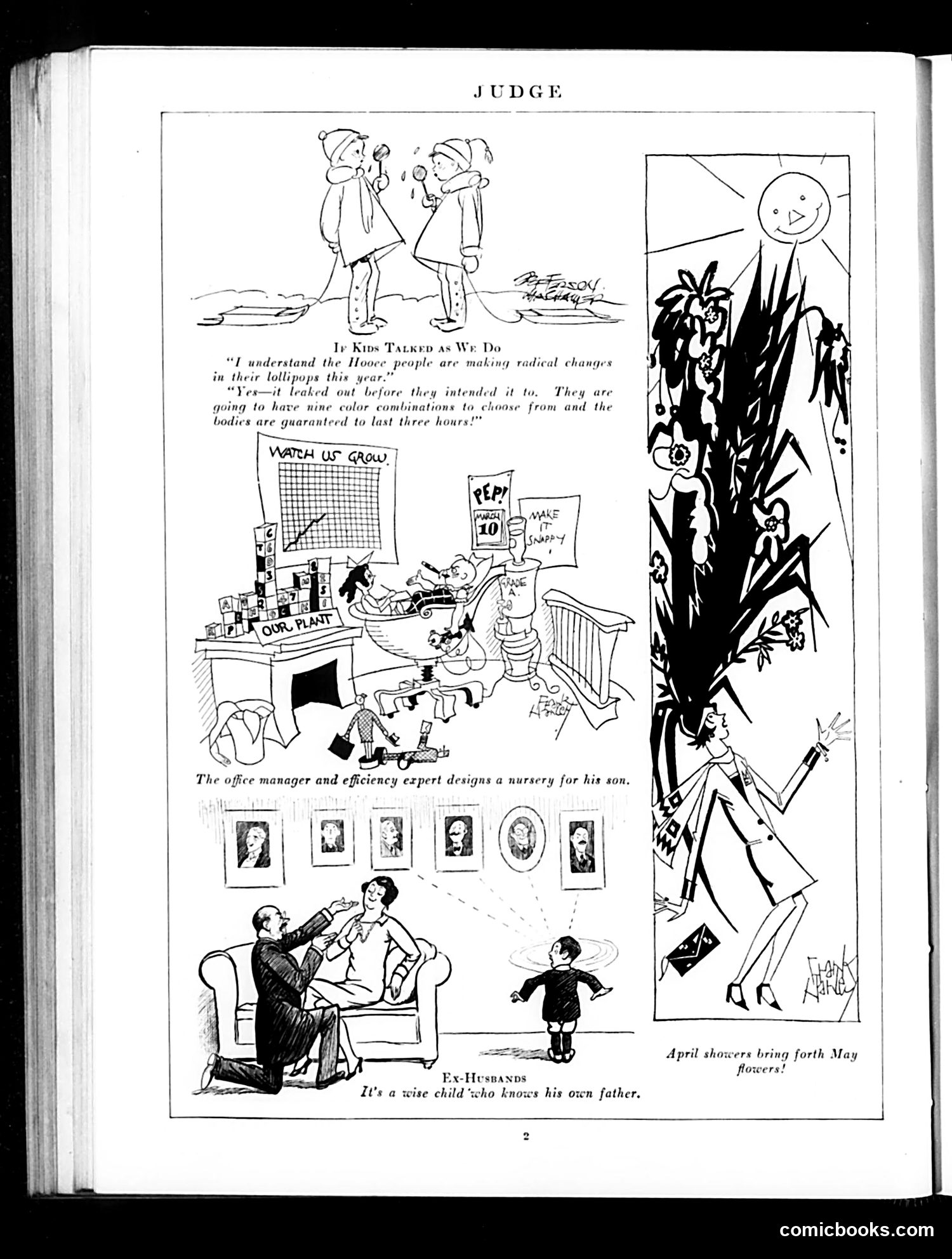
This page contains three separate satirical cartoons: 1. **"If Kids Talked as We Do"** - Two children mimicking adult political speech about "radical changes" and "color combinations," satirizing how politicians use vague, pretentious language to obscure simple ideas. 2. **"The Office Manager and Efficiency Expert"** - Shows a businessman designing an elaborate nursery with charts and signs ("Watch Us Grow," "Pep"), mocking corporate efficiency experts who apply industrial management methods to inappropriate contexts like childcare. 3. **"Ex-Husbands"** - A man selecting a child's portrait from a lineup while a small child watches, with the caption "It's a wise child who knows his own father"—satirizing infidelity and paternity uncertainty. 4. **Right panel** - Spring flowers emerging, captioning "April showers bring forth May flowers." The overall theme critiques pretentious business culture, political rhetoric, and social hypocrisy.
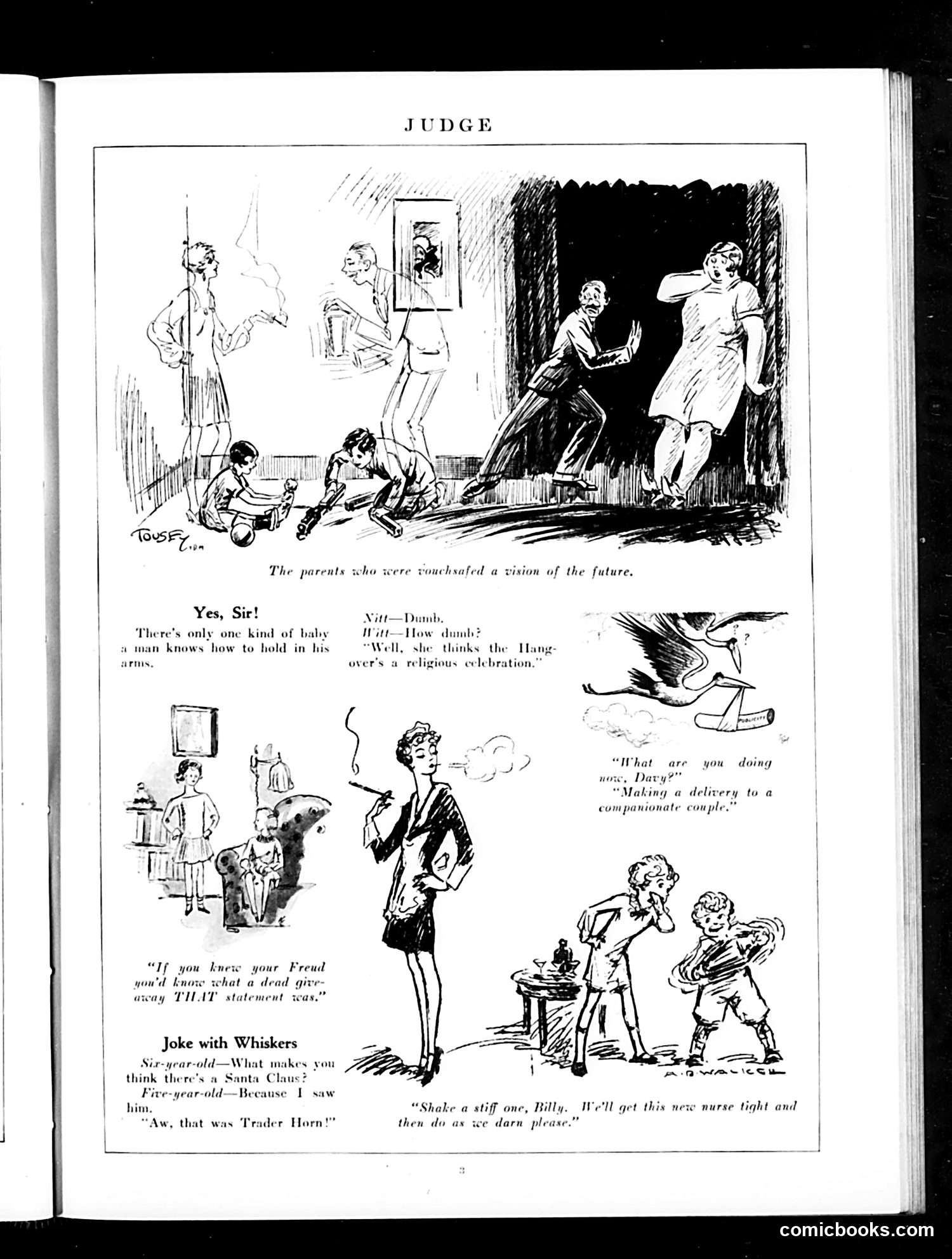
This page contains several unrelated satirical cartoons and jokes rather than a unified political commentary. The main cartoon shows parents who received "a vision of the future"—depicting children playing with a ball while adults engage in various activities. The satire appears to mock parental anxiety about what their children's futures hold. Below are separate jokes about holding babies, Freud references (suggesting psychoanalysis was a contemporary topic of ridicule), and Santa Claus. The "Joke with Whiskers" section presents tired, recycled humor presented as if novel. The remaining cartoons depict domestic scenes: a stork delivery joke and children's mischief with a nurse—typical early-20th-century family humor without clear political content. Overall, this appears to be light, general-interest satire rather than commentary on specific political events.
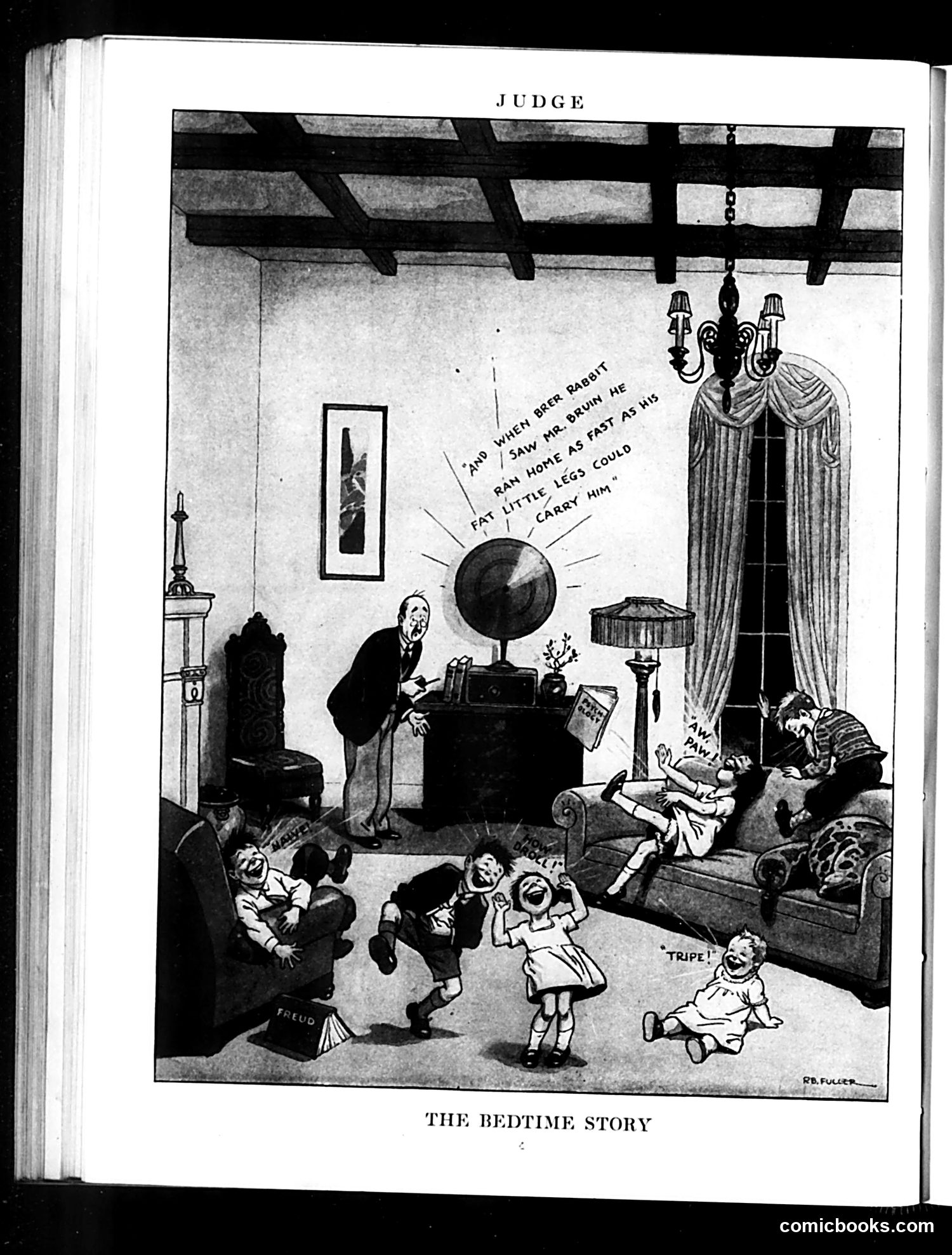
This cartoon satirizes Freudian psychoanalysis through a domestic scene. An adult (likely a parent or analyst) stands lecturing to children gathered in a living room, with a large globe behind him labeled with Freudian concepts about rabbit behavior and fat legs—appearing to mock how analysts reduced complex human behavior to crude physical observations. The children labeled "FREUD" and "TRIPE" suggest the cartoonist views such psychological theories as nonsensical bedtime stories fed to gullible audiences. The ornate, wealthy interior setting implies the satire targets how psychoanalysis had become fashionable among the upper classes. This reflects early 20th-century skepticism toward Freud's theories, which were sometimes dismissed as overly deterministic, pseudo-scientific, or absurd before achieving greater mainstream acceptance.
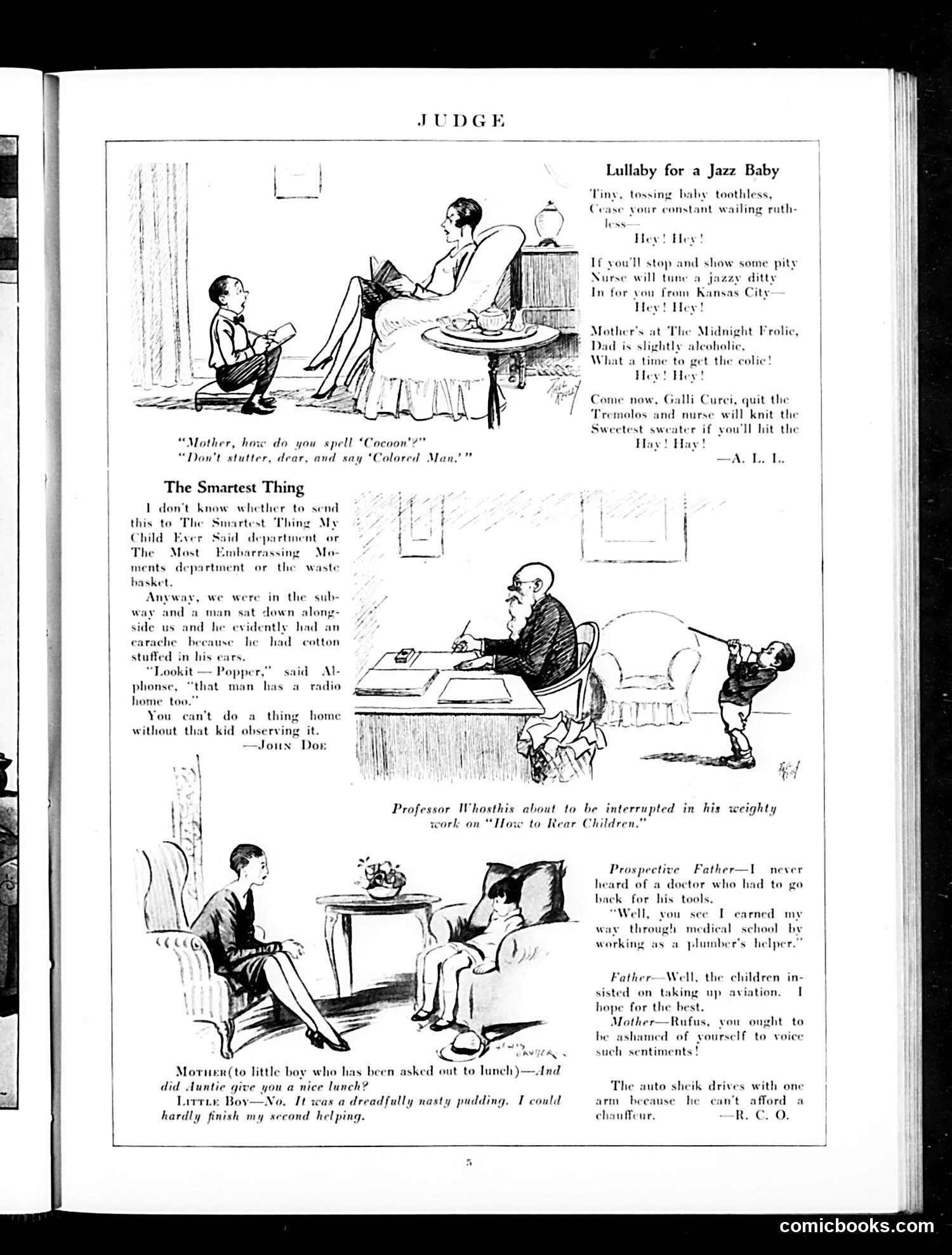
This page contains several humorous domestic sketches satirizing early 20th-century American family life and parenting attitudes: **"Lullaby for a Jazz Baby"** mocks modern parenting of infants—portraying an exhausted mother trying to soothe a fussy baby with jazz references, while the father is drunk ("slightly alcoholic"), leaving childcare to the mother. **"The Smartest Thing"** satirizes pretentious parents and overcomplicated child-rearing advice. A man observes a child with obvious ear infection ("earache because he had cotton stuffed in his ears"), highlighting how educated parents absurdly misapply expert guidance. **Remaining sketches** mock family contradictions: professors distracted from children, fathers valuing aviation over parenting, and mothers making embarrassing remarks—all reflecting period anxieties about changing social roles and modern parenting trends.
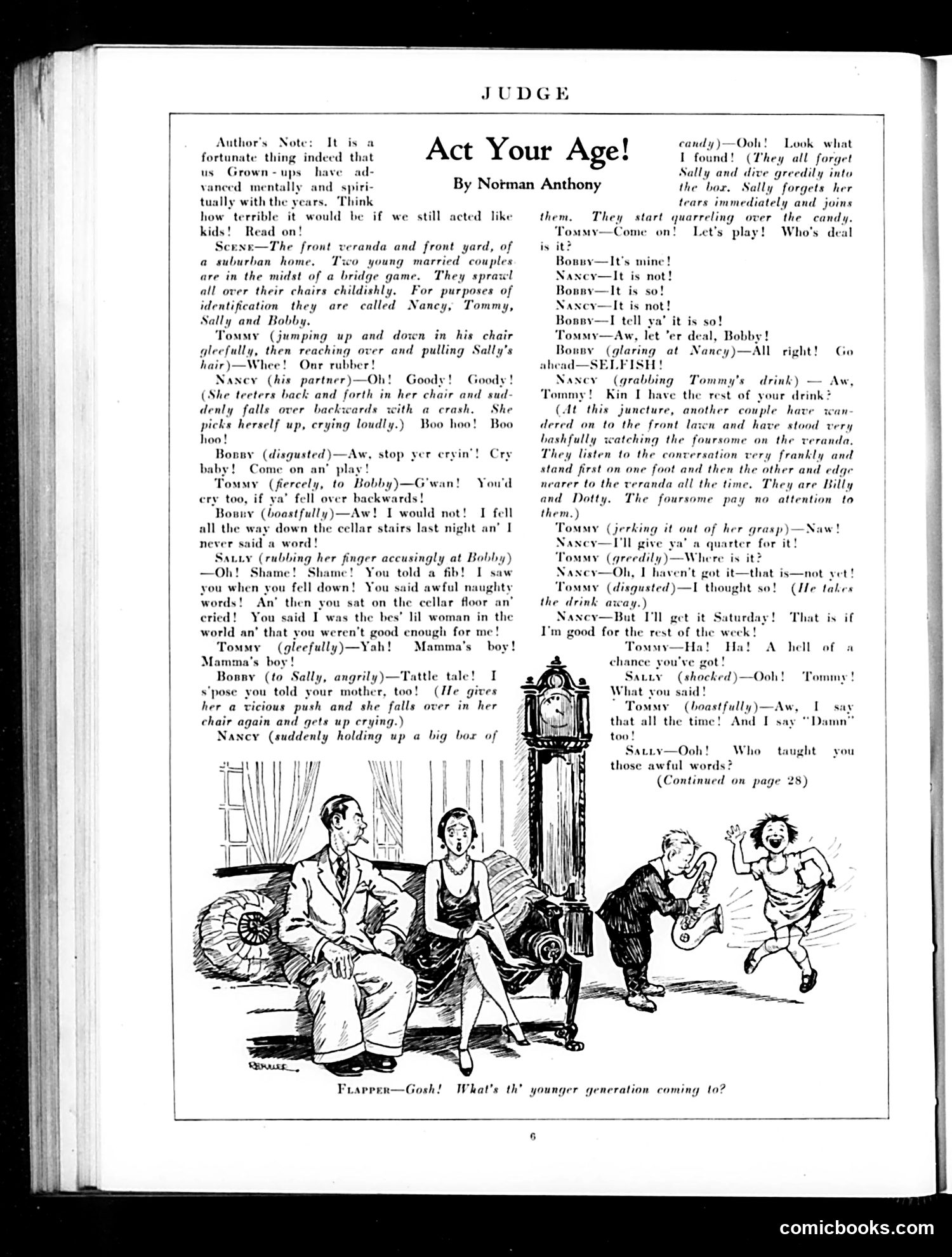
This 1920s Judge cartoon by Norman Anthony satirizes how modern adults have failed to mature emotionally alongside their intellectual growth. The setup: two married couples playing bridge on a suburban veranda, yet behaving like squabbling children—pulling hair, falling from chairs, crying, tattling, and cursing. The satire targets the "younger generation" complaint (a perennial cultural anxiety). However, the joke's real target is the *adults themselves*. By showing respectable married homeowners engaged in petty, childish behavior, Anthony critiques how grown-ups haven't truly advanced beyond childhood despite claiming superiority over kids. The final panel—visiting neighbors (Billy and Dotty) watching in dismay, asking "What's th' younger generation coming to?"—reveals the irony: these supposedly mature adults model terrible behavior. The piece mocks both generational smugness and suburban domesticity's failure to produce genuine maturity.
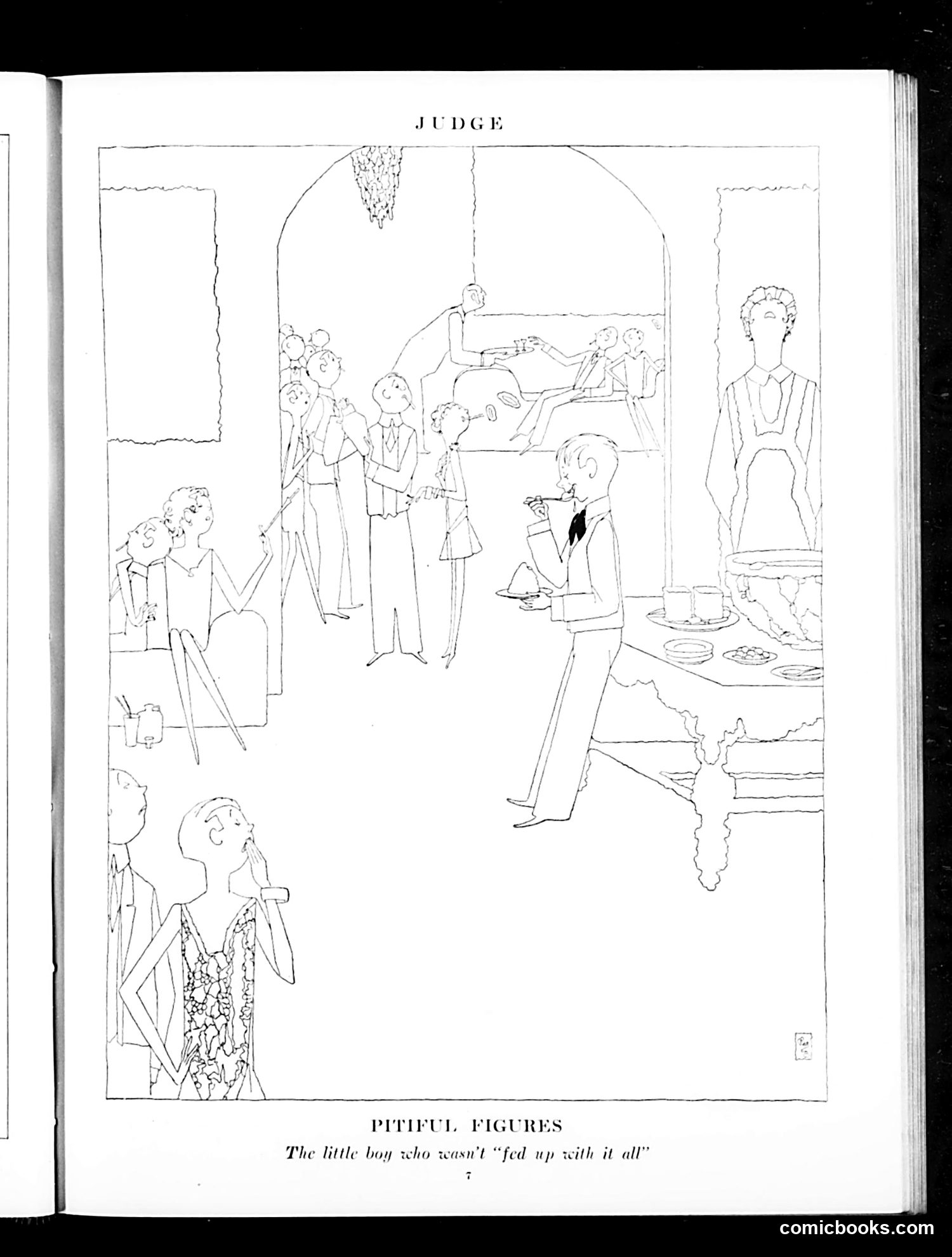
This cartoon depicts a social commentary on childhood entitlement. The title "The little boy who wasn't 'fed up with it all'" appears ironic—the scene shows a young boy at what looks like an upscale social gathering or party, surrounded by abundant food, entertainment, and well-dressed adults. The satire likely critiques children of wealthy families who, despite having every advantage and indulgence available, still display ingratitude or dissatisfaction. The "Judge" magazine frequently mocked affluent society's excesses and moral failings. The contrast between the boy's apparent discontent amid plenty and the efforts of adults to provide entertainment underscores the satire: even with "all" provided, some remain unsatisfied—a commentary on materialism and spoiled behavior among the privileged classes.
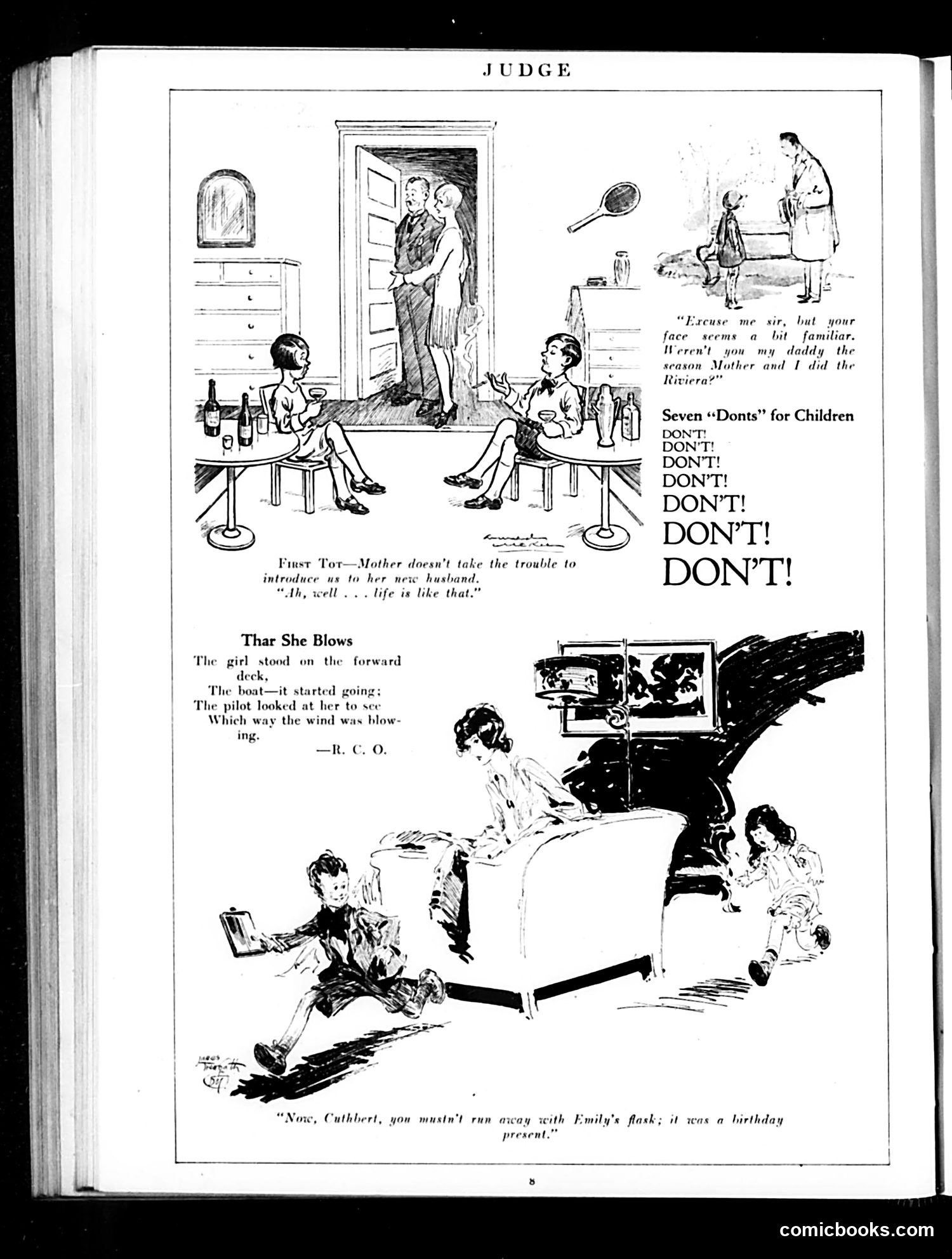
This page contains three distinct satirical pieces typical of early 20th-century Judge magazine: **Top cartoon**: Mocks infidelity and loose morality among the wealthy. A woman at a bar encounters a man whose face she recognizes—claiming he's her father from when "Mother and I did the Riviera," implying casual affairs and illegitimate children from European vacations. **"Seven 'Donts' for Children"**: Lists rules for child behavior (the repeated "DON'T!"), accompanied by a scene where adults appear to ignore these very rules—suggesting parental hypocrisy about moral instruction. **"Thar She Blows"**: A playful poem about a woman on a boat, using double entendre ("which way the wind was blowing") as innuendo about her skirts or intentions. **"Nine, Cuthbert..."**: Shows children playing with alcohol (a "flask"), satirizing parental negligence about supervising children around drinking. Overall, these pieces satirize moral contradictions between what middle-class adults preach to children versus how they actually behave.
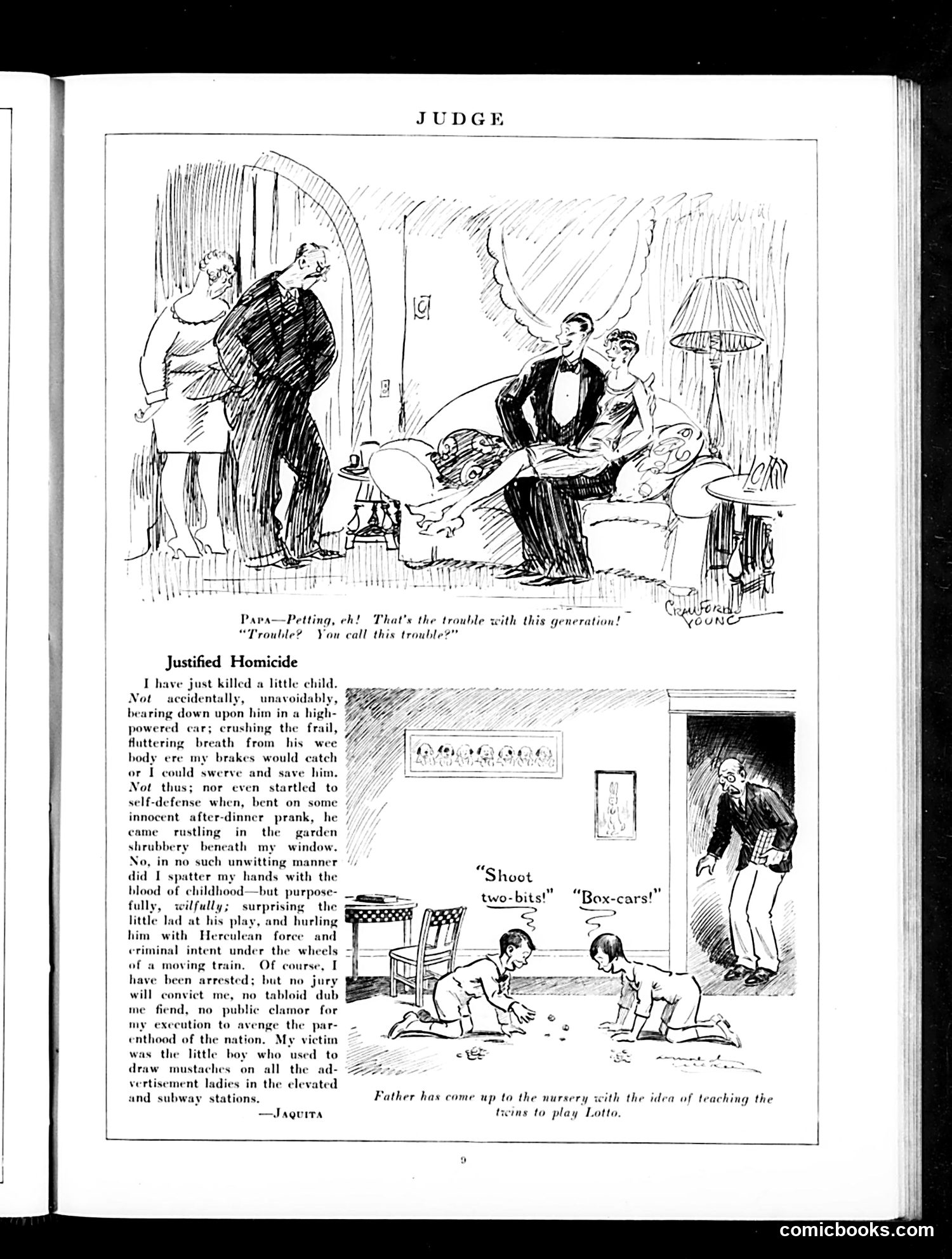
This page from *Judge* contains two satirical pieces about generational conflict and parenting. **Top cartoon**: A father complains to his wife about "this generation's" trouble—likely referring to young people's behavior or attitudes. The specifics are unclear, but the satire targets parents' tendency to blame youth for social problems. **"Justified Homicide"**: A darkly comic piece where the narrator claims to have murdered a child—not by accident, but deliberately—because the boy drew mustaches on subway advertisement images. The narrator sarcastically expects no legal consequences, arguing the victim deserved it. This appears to satirize both excessive parental frustration with minor misbehavior and the public's tendency to blame youth for petty vandalism. **Bottom cartoon**: A father attempts to teach children the lottery game "Lotto," suggesting ironic commentary on what constitutes proper parental guidance. Overall, *Judge* satirizes generational anxieties and questions about parenting, childhood discipline, and what behaviors warrant concern or punishment in early 20th-century America.
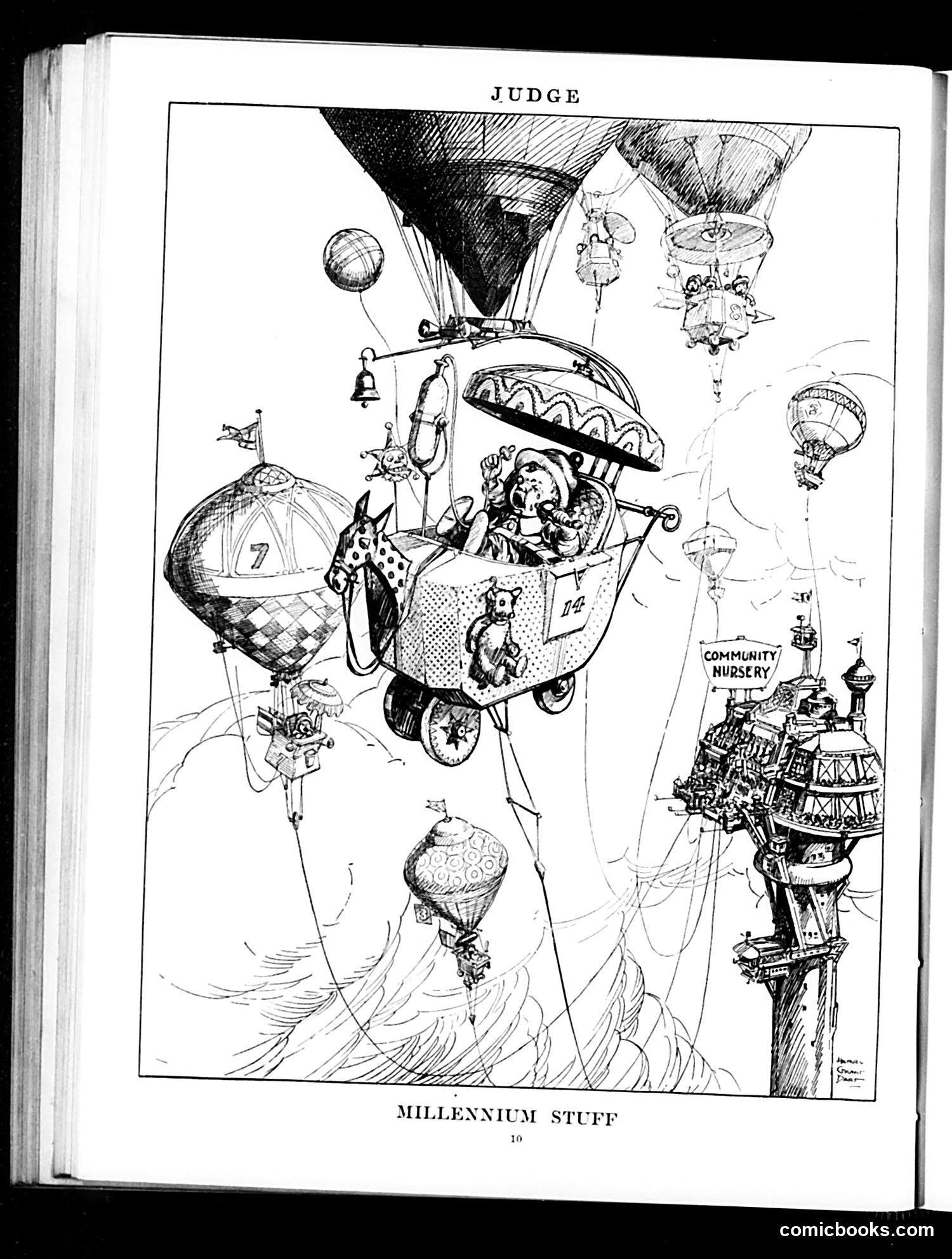
This satirical illustration depicts a fantastical aerial scene labeled "Millennium Stuff," likely referencing turn-of-the-century (1900) anxieties about the approaching new millennium. The central image shows an elaborate flying contraption—part balloon, part carriage—carrying figures through clouds. Surrounding it are various futuristic or whimsical airships, parachutes, and a tall tower labeled "Community Nursery" on the right. The cartoon appears to mock contemporary predictions about technological marvels and social changes expected in the new age. The chaotic assemblage of improbable flying devices satirizes both optimistic future-gazing and the period's fascination with aviation and mechanical innovation. The "Community Nursery" reference suggests commentary on progressive social institutions anticipated for the coming era. Without identifying specific figures, the overall message seems critical of grandiose millennial expectations.
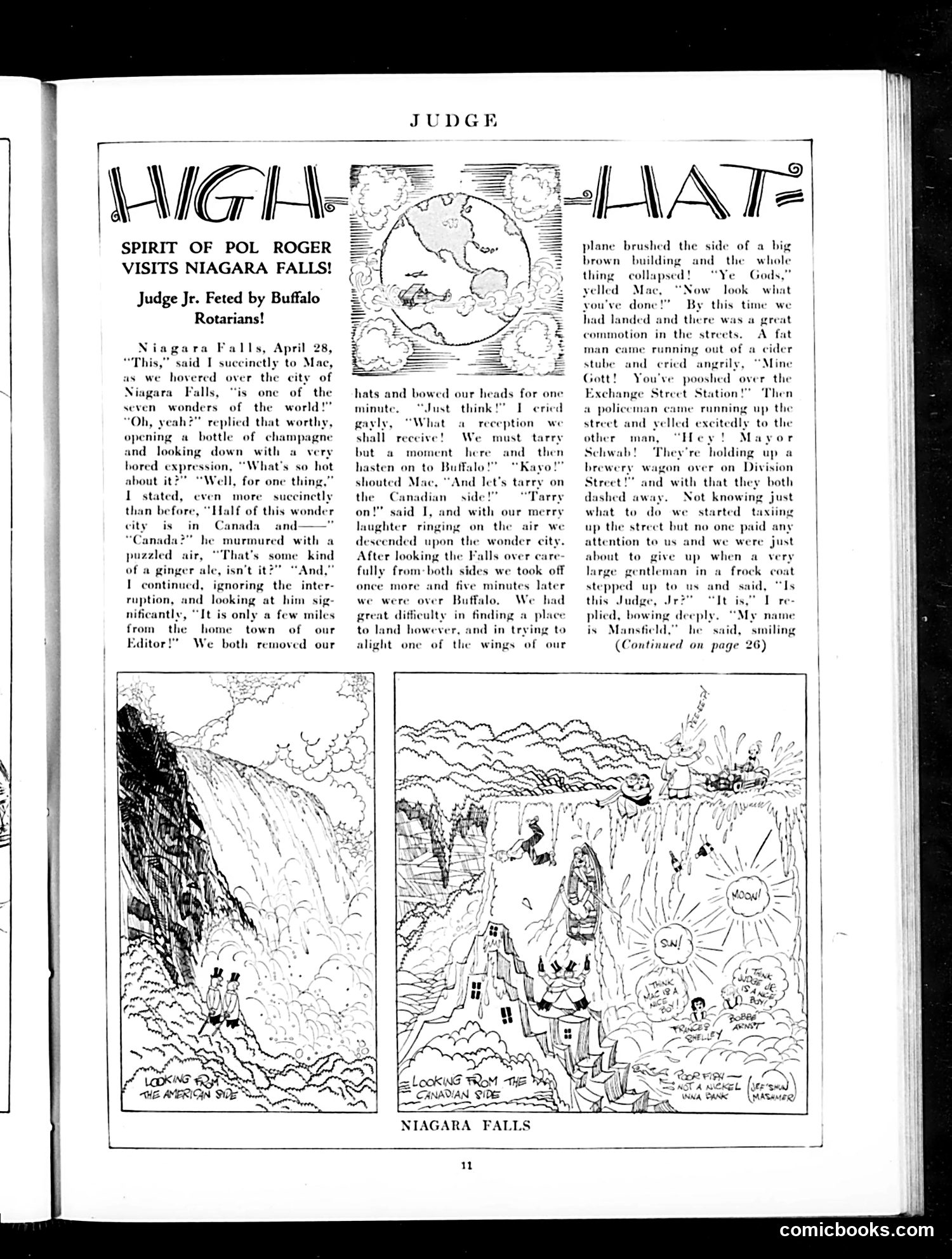
This is a humorous travel narrative in Judge magazine featuring the magazine's mascot character "Judge Jr." visiting Niagara Falls and Buffalo with a companion named Mac. The story is a light satire of tourism and local pride. The narrator and Mac arrive by plane, crash into a building (an Exchange Street Station), causing minor chaos. They encounter Buffalo locals including Mayor Schwab and a gentleman named Mansfield who greets them. The humor derives from casual mishaps, the characters' breezy attitude toward destruction, and local characters' reactions. The accompanying illustrations show Niagara Falls from both the American and Canadian sides, with the crashed plane and resulting commotion depicted on the Canadian-side view. This appears to be straightforward comedic filler content rather than political satire—essentially an entertaining travelogue with slapstick elements typical of Judge's lighter material. The "Rotarians" reference suggests this may have been connected to a Buffalo Rotary Club event.
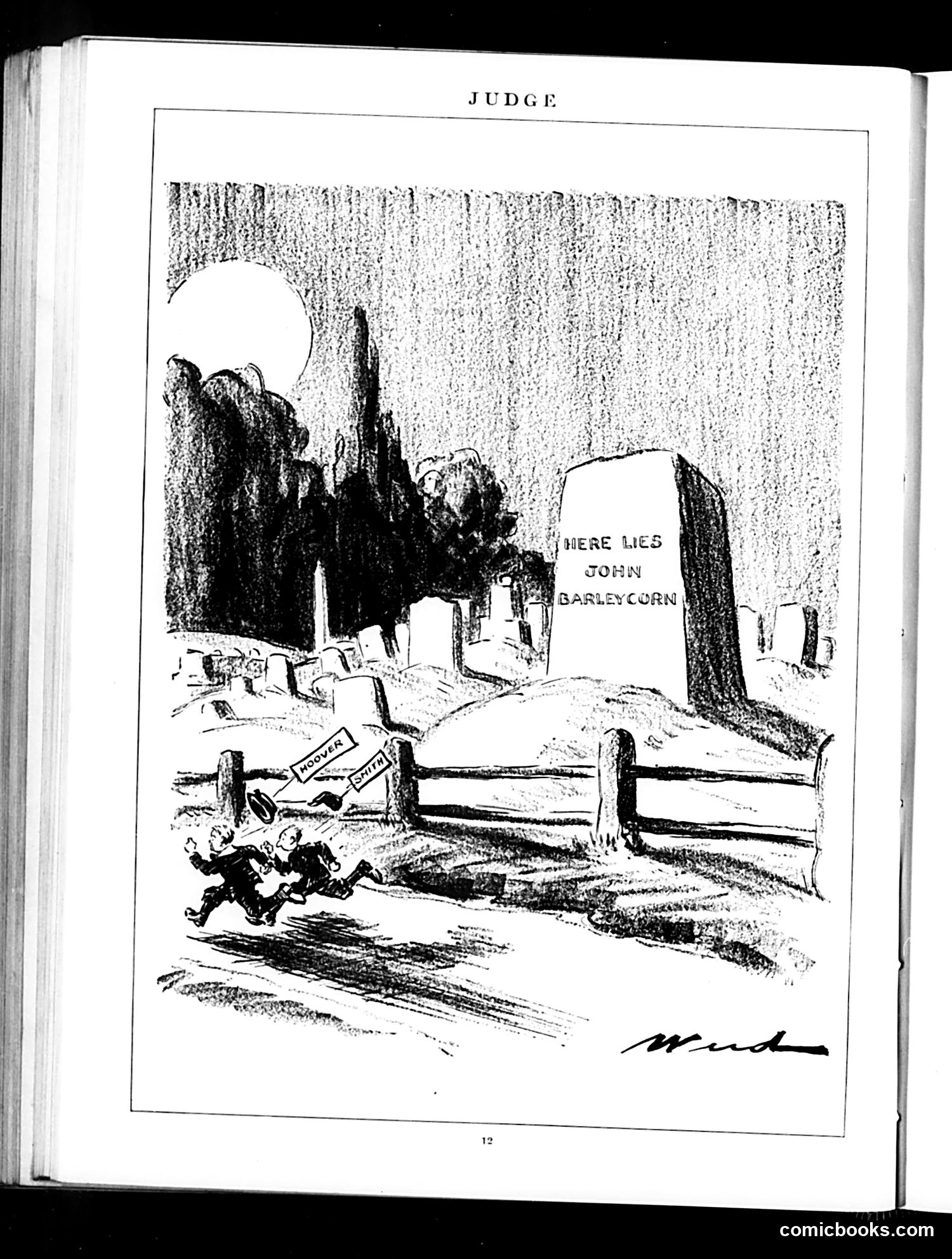
This is a political cartoon titled "Here Lies John Barleycorn." The image shows a graveyard scene with a tombstone bearing that name, bare winter trees, a full moon, and a wooden fence. A small figure appears to be running or fleeing from the grave. "John Barleycorn" is a traditional personification of alcohol/beer in British and American culture. This cartoon likely satirizes Prohibition or anti-alcohol legislation, depicting the "death" of drinking culture. The fleeing figure suggests panic or concern about this demise. Given Judge magazine's satirical nature, this probably mocks either Prohibition advocates celebrating alcohol's elimination, or alternatively, mourns its loss from an anti-Prohibition perspective. The exact date and specific political context remain unclear without additional publication information.
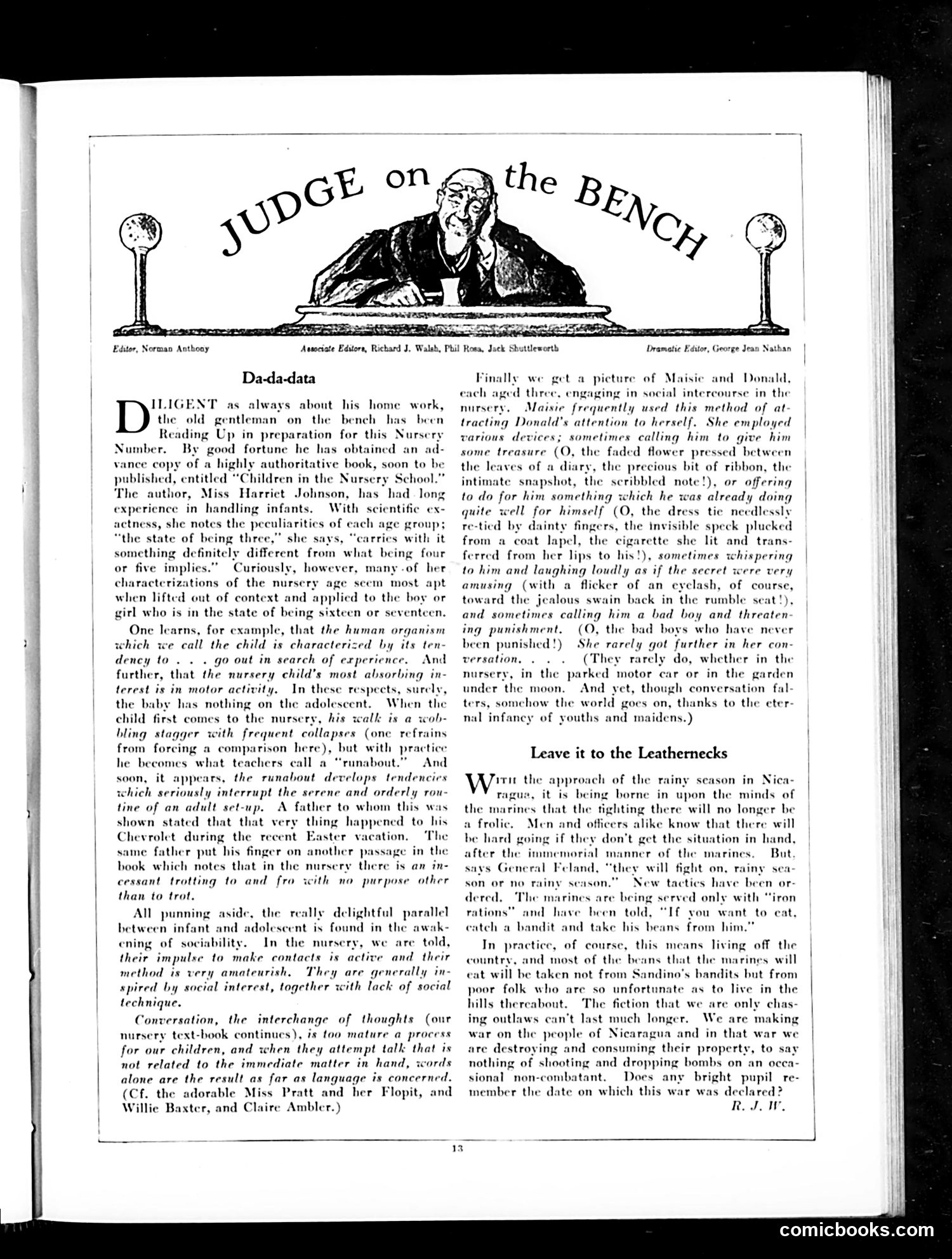
This page features a satirical column comparing nursery school children to adolescents. The "Judge on the Bench" illustration shows an elderly man (representing the magazine's editorial voice) reviewing a book titled "Children in the Nursery School" by Harriet Johnson. The satire draws parallels between toddler behavior and teenage conduct: both seek experience, engage in constant physical activity ("runabouts"), and attempt clumsy social interaction. The author humorously suggests that adolescents essentially regress to infant-like behavior—wobbling around aimlessly, lacking social technique, and making contact attempts driven by social interest but hampered by awkwardness. The specific anecdotes about "Maisie and Donald" (ages three) engaging in flirtation—using pretexts for attention, whispering and laughing, displaying jealousy—are meant to mirror teenage romance, suggesting teenagers behave like toddlers in matters of the heart. The satire mocks both child development psychology and adolescent behavior.
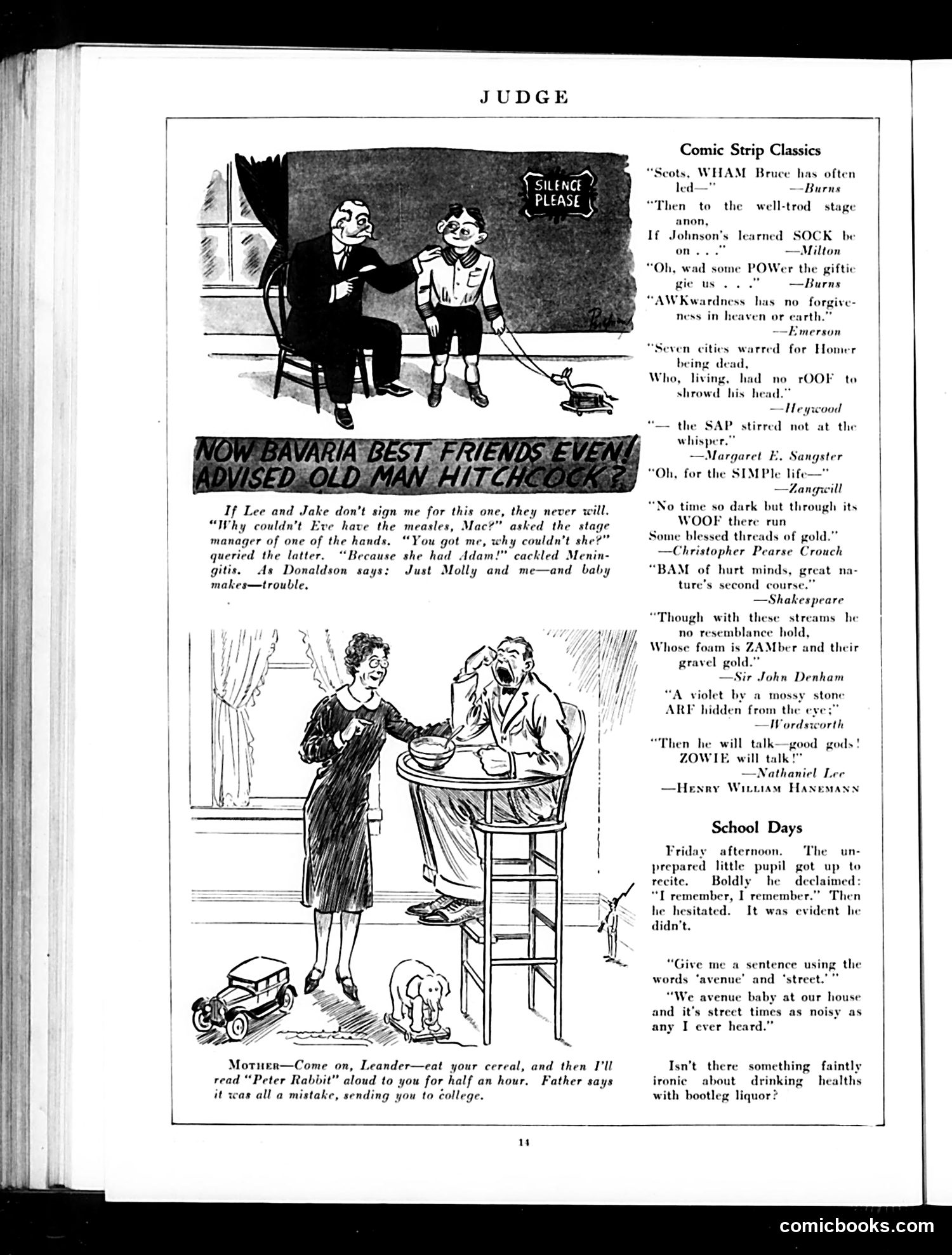
This page combines two sections: **Comic Strip Classics** (literary quotations with capitalized words rearranged to create puns) and **School Days** (humorous anecdotes). The top cartoon shows an old man with a child and toy train, captioned about "Bavaria's best friends" advising Hitchcock—likely referencing Alfred Hitchcock or a contemporary figure in entertainment. The joke references stage managers and casting disputes over a female performer named Eve. The lower cartoon depicts a mother and father discussing sending their son to college, suggesting the education was a "mistake." The **School Days** section contains period humor: a pupil failing to recite poetry, a child misusing vocabulary ("avenue" and "street" as verbs), and a final joke about drinking "bootleg liquor" during Prohibition—the irony being toasting health while consuming illegal alcohol. The literary quotations appear to be word-play exercises, capitalizing random letters to create hidden words or jokes for educated readers. The overall tone reflects early 20th-century American satirical humor targeting education, family life, and Prohibition-era contradictions.
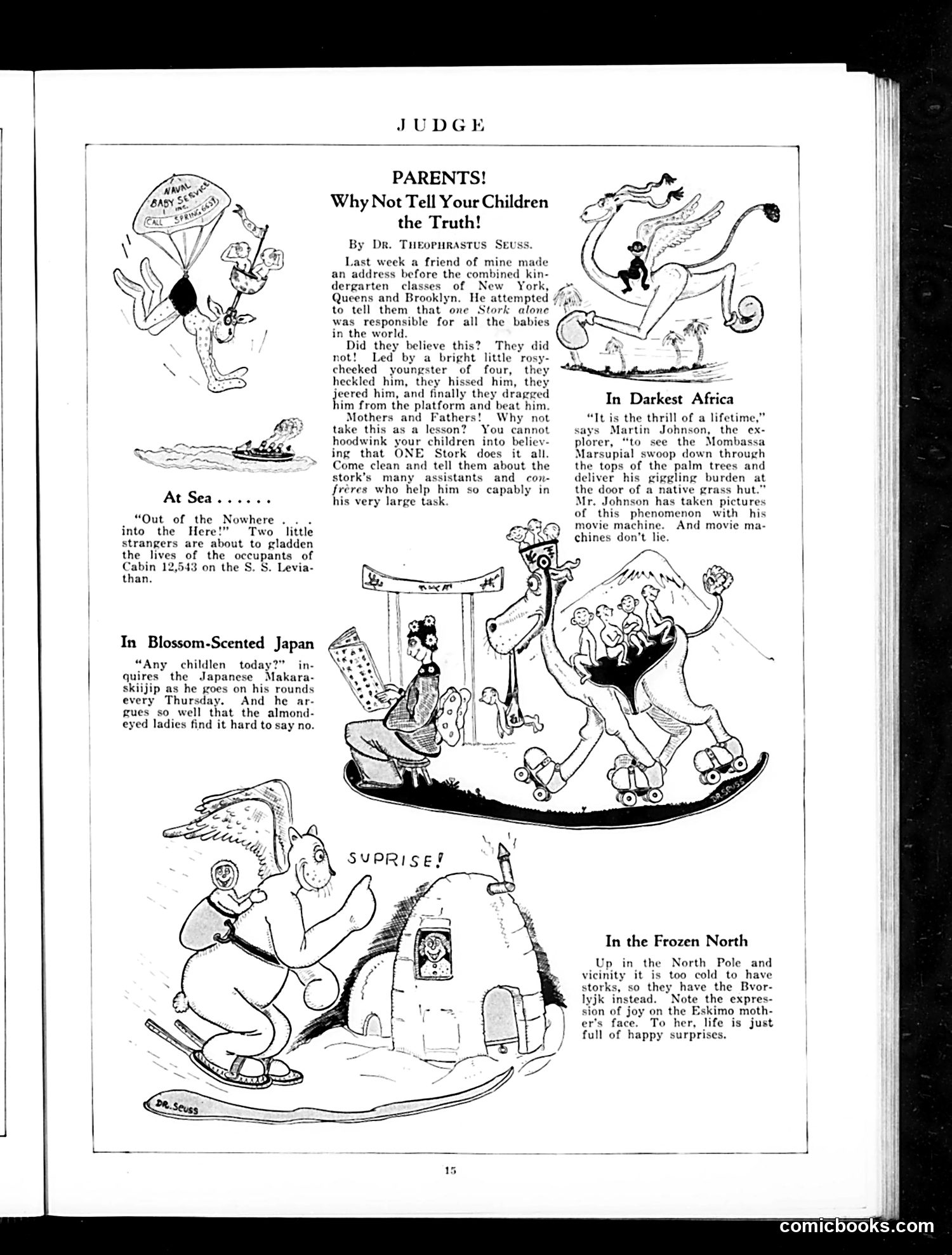
This page satirizes the "stork delivers babies" myth told to children. Dr. Theophrastus Seuss (likely a pen name) argues parents should stop pretending one stork delivers all babies, since children disbelieve it anyway. He proposes an absurd alternative: storks have numerous assistants worldwide. The cartoons illustrate "stork variants" across regions as visual punchlines: - **At Sea**: A stork delivers babies to ship cabins - **Japan**: A Japanese stork-equivalent (Makara-Miji) assists local matchmaking - **Africa**: The fictional "Mombassa Marsupial" supposedly delivers babies in the jungle - **Arctic**: An Eskimo substitute (Bvor-lyjk) replaces storks in frozen regions The satire mocks both parental dishonesty about reproduction and pseudoscientific explanations using exotic, invented creatures. Johnson's film reference adds a layer—suggesting even "movie machines don't lie" won't validate these ridiculous claims. The humor targets adults' transparent evasions about sex education.
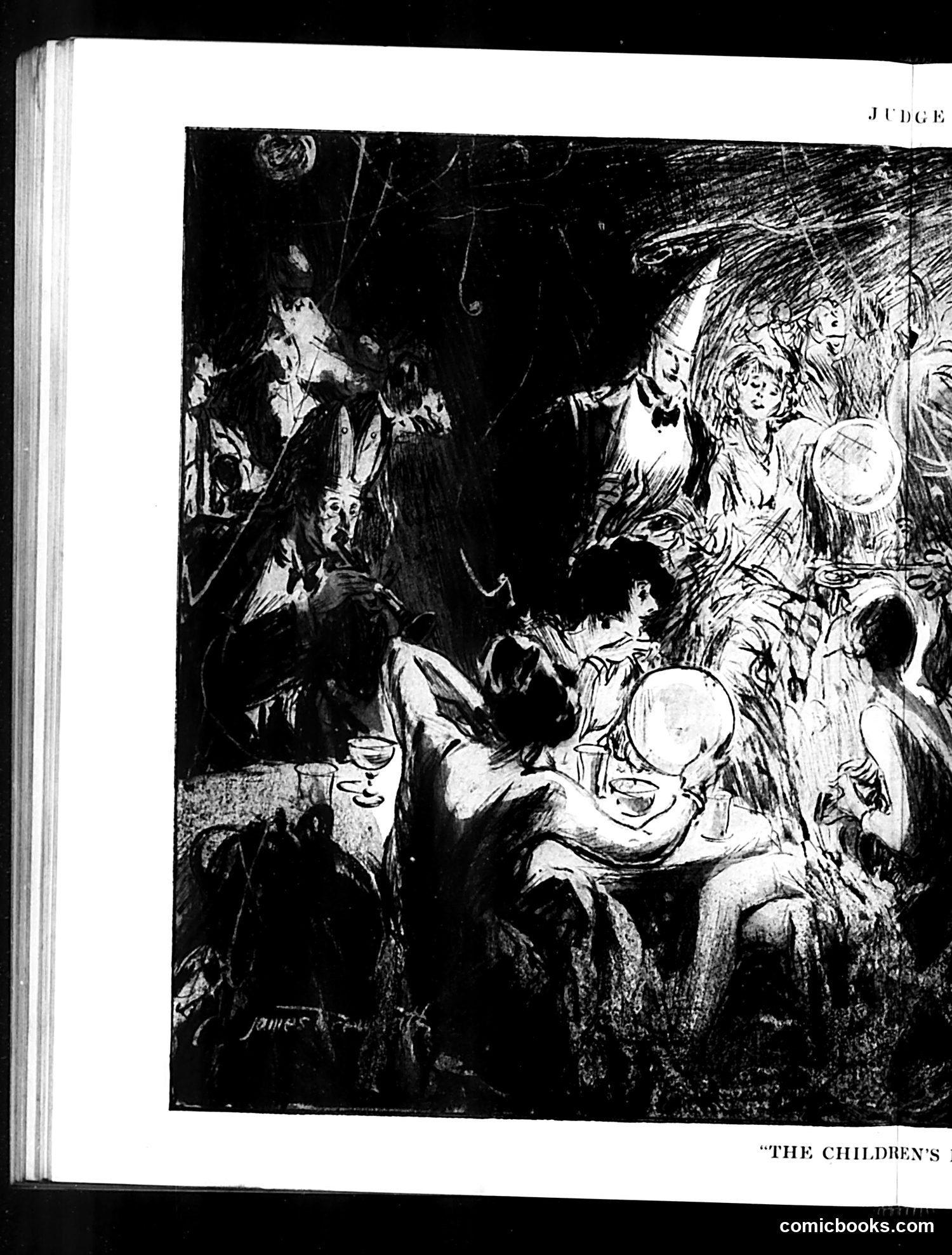
This appears to be a dramatic etching or illustration titled "The Children's" depicting a nighttime scene with multiple figures gathered indoors. The composition shows what looks like a social gathering or party, with adults and children in period dress (likely late 19th or early 20th century). The heavy use of cross-hatching and dark tones creates a somewhat chaotic, crowded atmosphere. Without clearer context or visible text identifying specific political figures or events, the exact satirical point remains unclear. It could reference contemporary social commentary about children's welfare, education, or social gatherings, but the specific target of Judge magazine's satire is not definitively apparent from this reproduction alone.
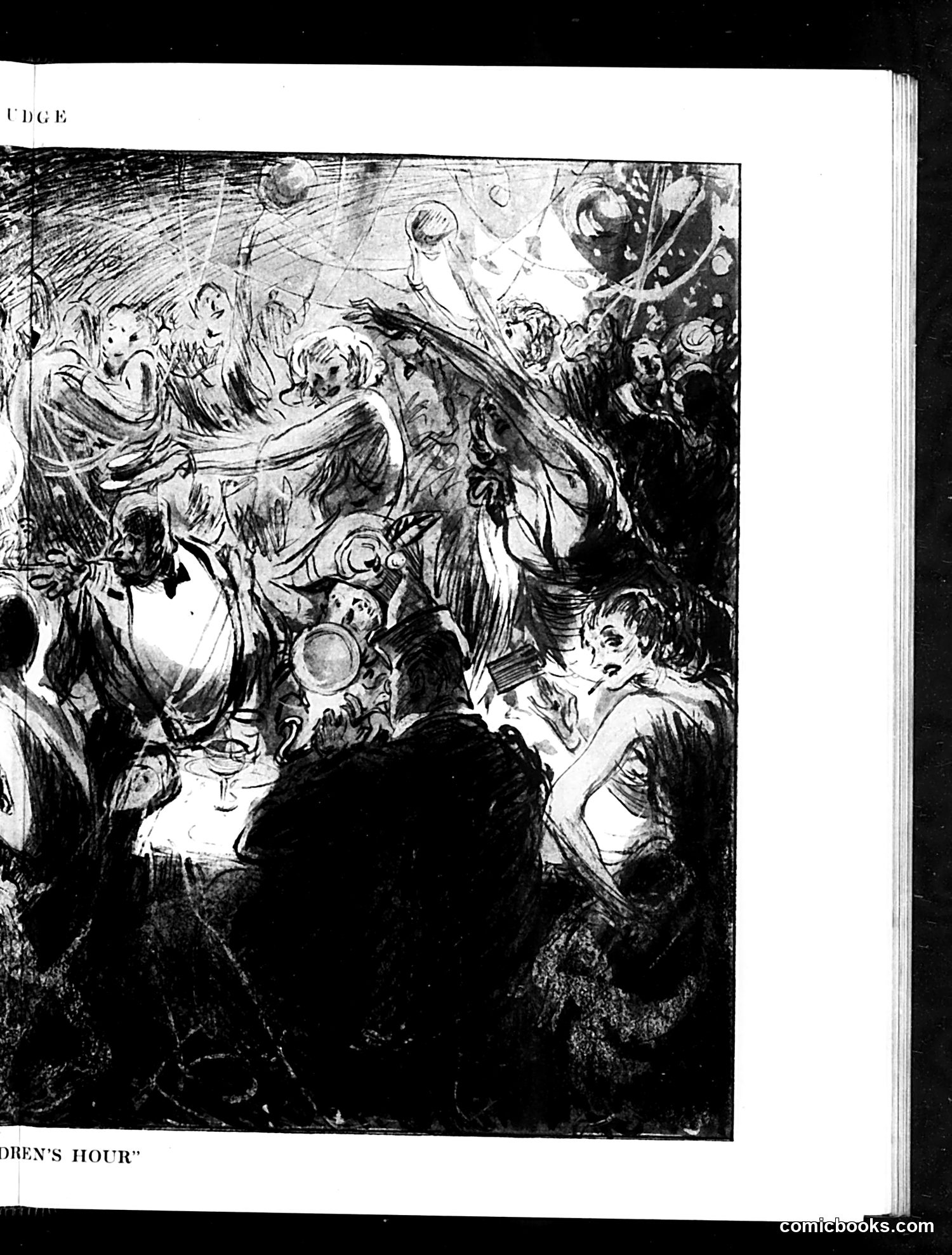
This page shows a satirical illustration titled "Children's Hour" from *Judge* magazine. The sketch depicts a chaotic indoor gathering of well-dressed adults and children in what appears to be a drawing room or parlor setting. The scene is rendered in heavy cross-hatching with dramatic, energetic linework typical of late 19th or early 20th-century satirical illustration. The "children's hour" likely refers to a fashionable social gathering or entertainment event, but the cartoon satirizes adult behavior during such occasions. The crowded, disorderly composition—with figures gesticulating, some appearing intoxicated or unruly—suggests the satire targets how adults misbehave or lose decorum at supposedly child-appropriate social events. The specific identities of caricatured figures are unclear from this image alone.
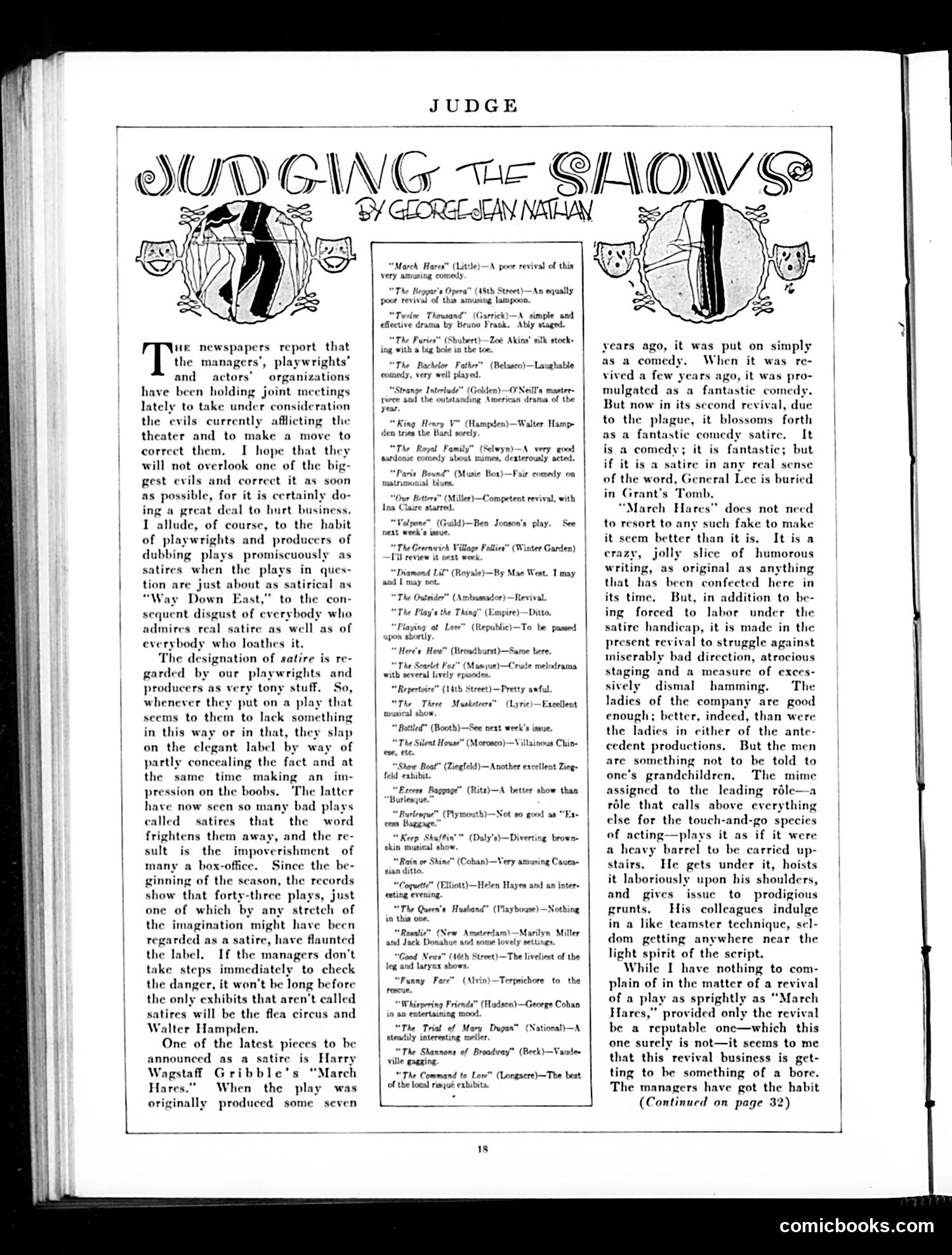
This theater column by George Jean Nathan attacks Broadway producers for mislabeling mediocre plays as "satire" to boost box office appeal. Nathan argues that out of 43 plays labeled satires that season, only one might actually qualify. Producers cynically slap the prestigious label on ordinary comedies lacking real bite or intelligence, hoping to impress audiences ("the boobs"). Nathan's complaint is that this cheapens genuine satire—which requires wit and social criticism—into a marketing gimmick. He uses Harry Wagstaff Gribble's "March Hares" as his prime example: it's simply "a crazy, funny writing" with no real satirical substance, yet it's promoted as cutting social commentary. The page includes a theater listing with Nathan's brief, often dismissive reviews of current Broadway productions, many marked as revivals or uninspired comedies. His underlying point: theaters should stop deceiving audiences and themselves about what constitutes actual satire.
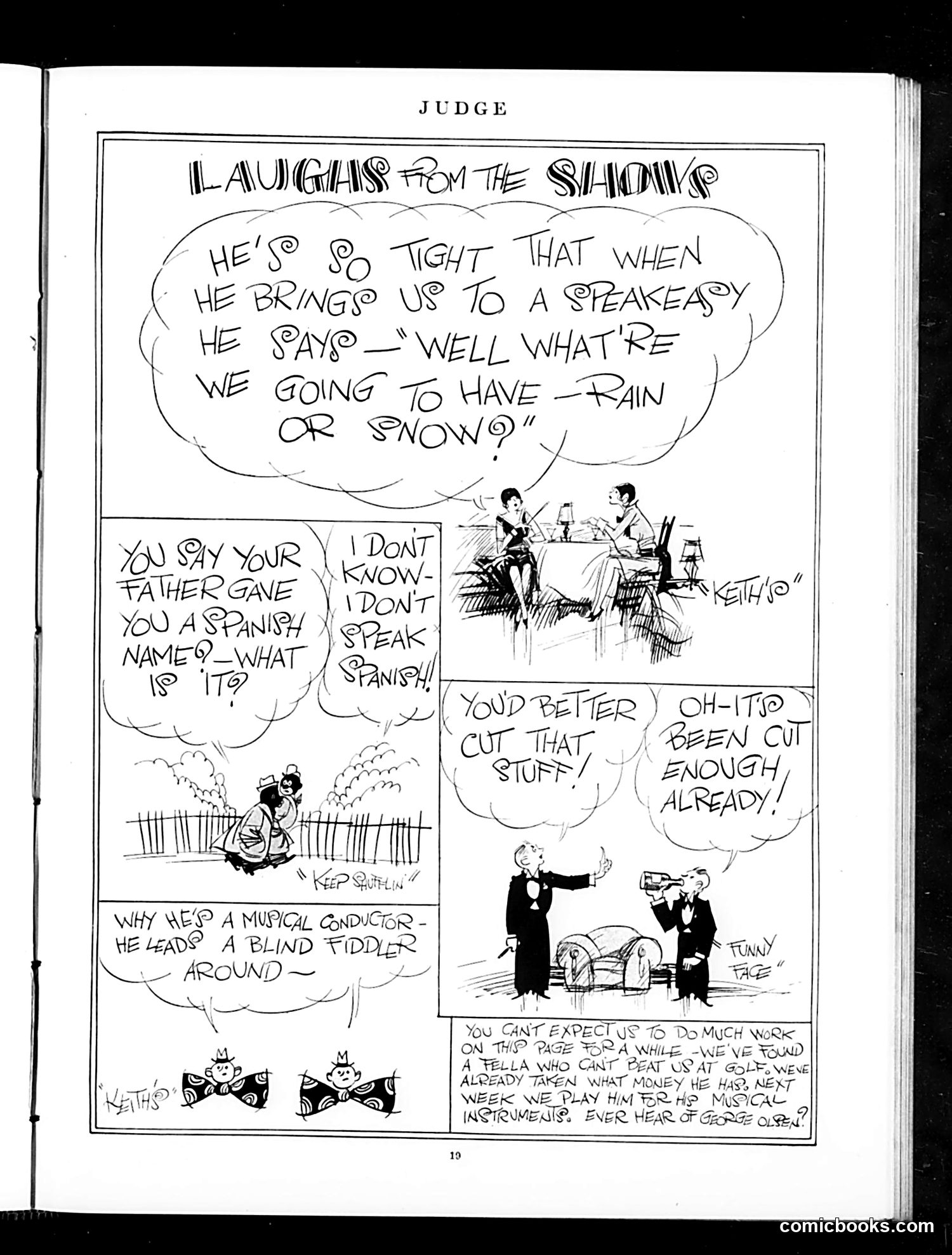
This is a theatrical satire featuring two interconnected jokes about vaudeville and musical entertainment. The top section mocks a man with a Spanish name whose father apparently gave him an ethnic identity he doesn't understand—playing on early-20th-century American stereotypes about immigrants and assimilation. The lower section satirizes wealthy leisure culture, specifically golf and classical music. It depicts affluent men exploiting an unsophisticated "fella" through repeated games of golf, having already won his money. The final panel jokes that next week they'll humiliate him further by having him attempt to play classical musical instruments despite his incompetence. The satire targets both ethnic confusion and class-based exploitation dressed up as entertainment. The "Keith's" reference likely indicates Keith's Vaudeville Circuit, a major American theater chain of that era.
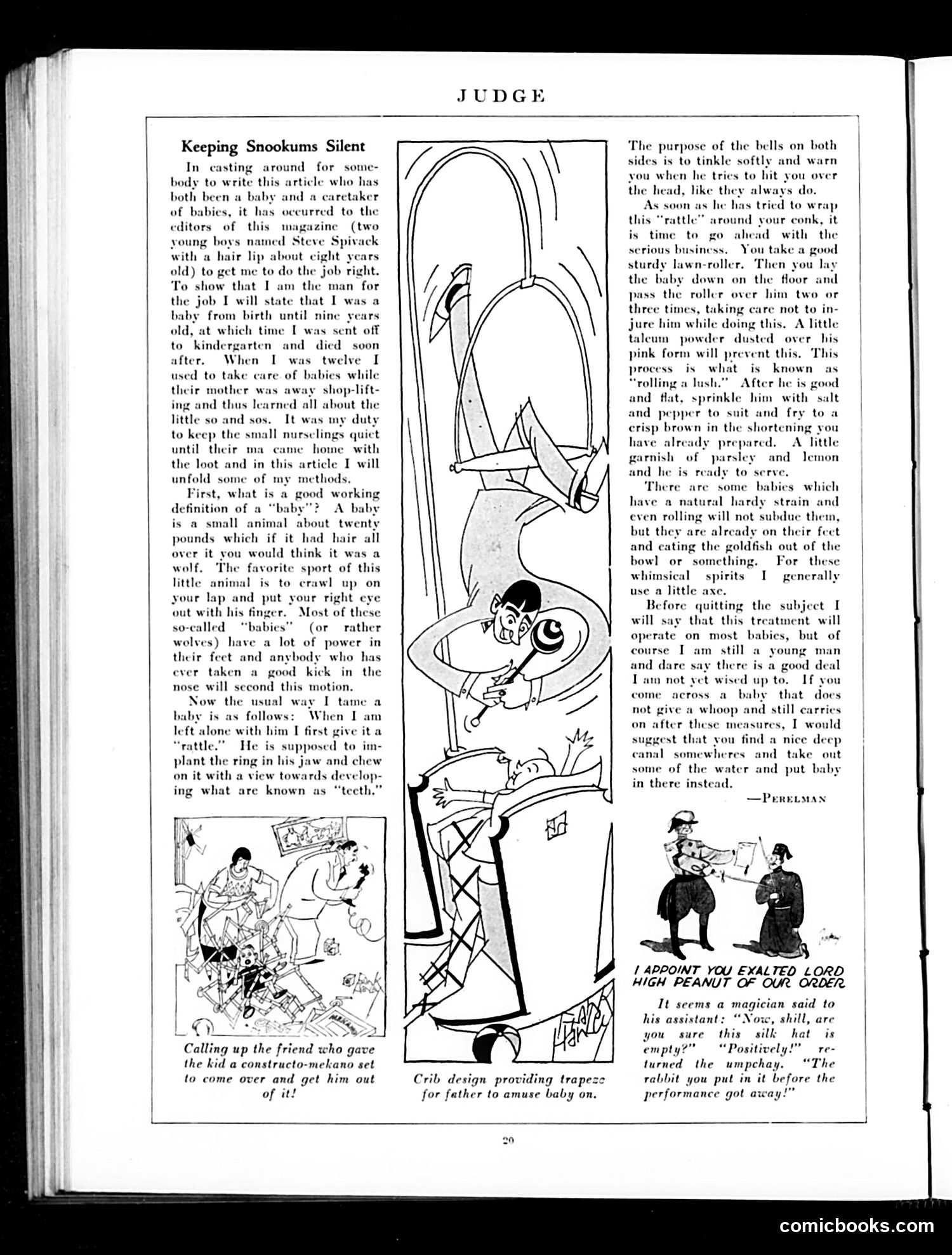
This page contains a humorous essay titled "Keeping Snookums Silent" that uses absurdist, exaggerated advice about baby care as social satire. The author—writing as "Pereleman"—employs deliberately outrageous suggestions (rolling babies with a lawn roller, frying them) as dark comedy commentary on actual parenting challenges of the era. The joke operates through *ironic inversion*: instead of genuine child-rearing advice, readers get mock-serious brutality. This satirizes both inadequate parenting methods of the time and the magazine's presumably middle-class readership's anxieties about childcare. The accompanying illustrations show farcical scenes: babies in mechanical contraptions, parents in comedic distress. A smaller cartoon about a magician's escaped rabbit provides additional light humor. The satire's target appears to be parental incompetence and the chaos of early 20th-century household management—relatable frustrations delivered through impossible, clearly tongue-in-cheek "solutions."
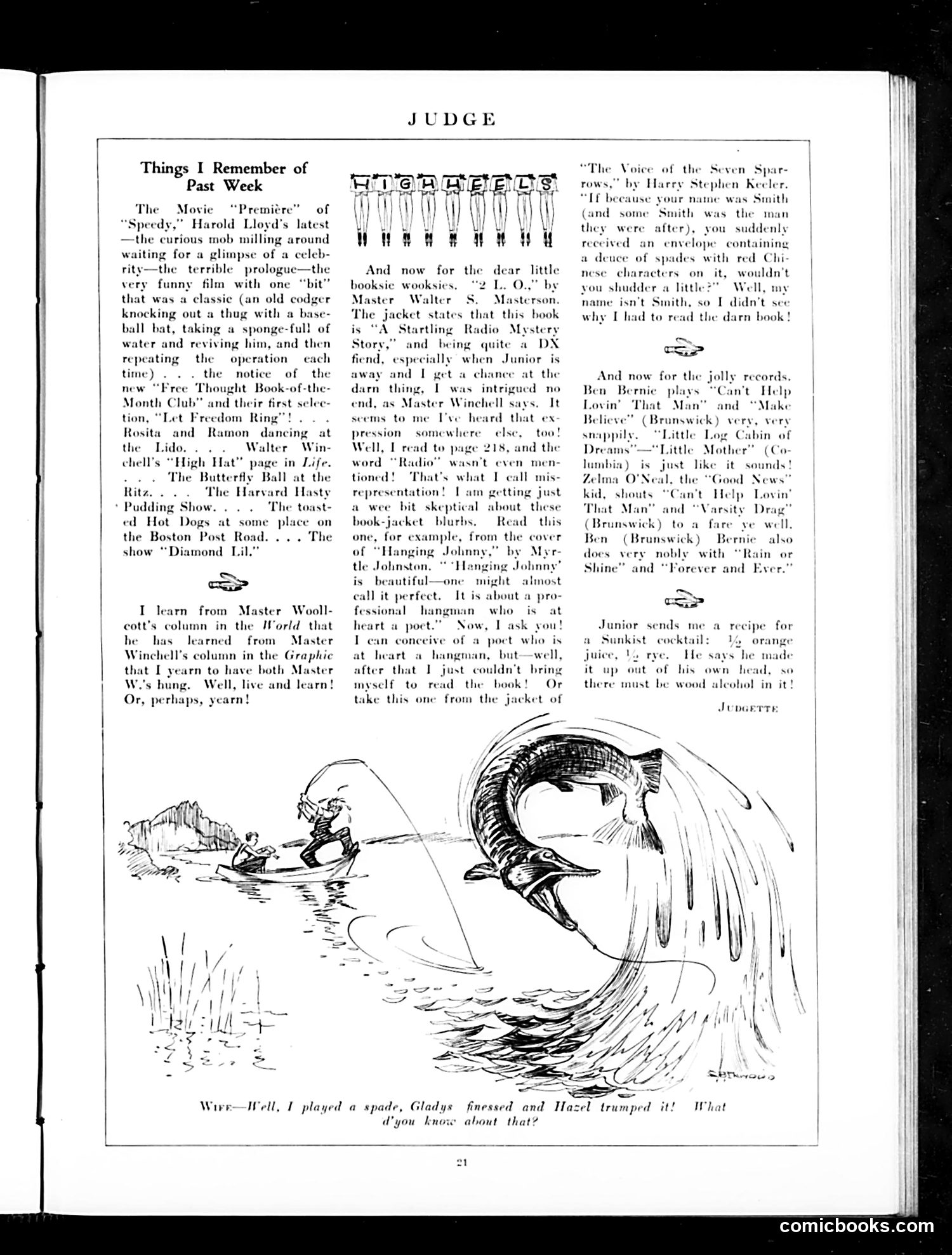
This is a humor column from Judge magazine mixing entertainment reviews and light satire. The main content includes: **"Things I Remember of Past Week"**: A gossip-style roundup of 1920s entertainment—Harold Lloyd's film "Speedy," Broadway shows like "Diamond Lil," and socialite hangouts (the Ritz, the Lido). **Book Jacket Satire**: The author mocks misleading book jacket copy, particularly for "2 L.O." (a radio mystery) and "Hanging Johnny." The joke: the jacket promises a "startling radio mystery" but the word "radio" never appears in the book—classic false advertising that makes readers skeptical of publisher claims. **The Bottom Cartoon**: Shows two people playing cards. The caption "Wire—Well, I played a spade, Gladys finessed and Hazel trumped it! What d'you know about that?" is a pun: "wire" suggests a gossipy report, but it's just bridge-game chatter—deflating expectations. **Records Section**: Brief mentions of popular singers (Ben Bernie, Zelma O'Neal) and a joke about a homemade "Sunkist cocktail" made with dangerous wood alcohol. The overall tone is light, insider entertainment gossip typical of 1920s Judge magazine.
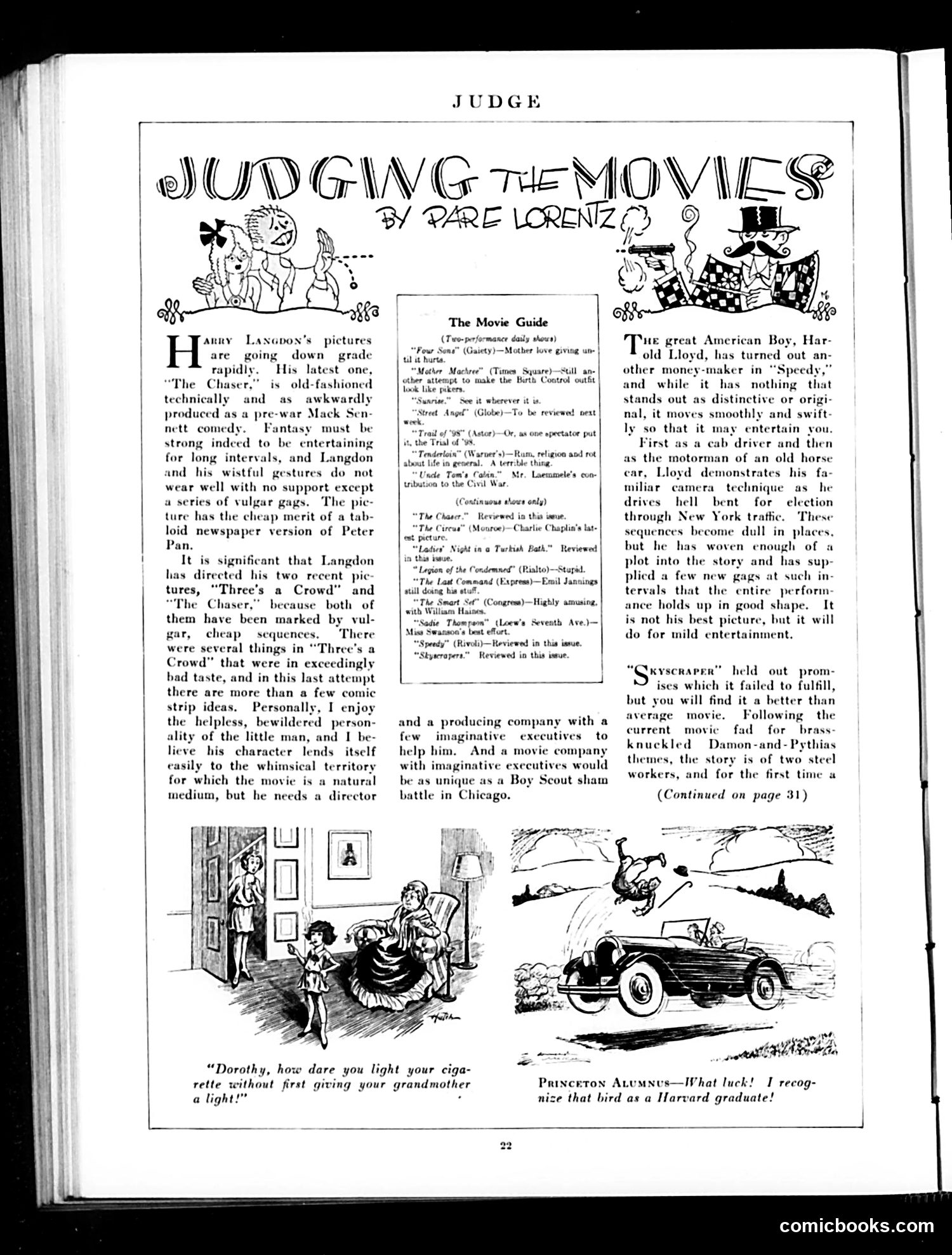
This is a film criticism column reviewing contemporary movies, circa late 1920s. Lorentz assesses silent film star Harry Langdon's declining quality, noting his latest picture "The Chaser" relies on old-fashioned slapstick and vulgar gags without sufficient wit. The column praises Harold Lloyd's "Speedy" as more inventive entertainment, featuring Lloyd as a cab driver and horse-cart operator navigating New York traffic. The cartoons below illustrate social commentary: one depicts a grandmother scolding Dorothy for lighting a cigarette without permission—mocking outdated propriety; another shows a Yale alumnus recognizing a bird as a Harvard graduate—gentle Ivy League rivalry satire. The "Movie Guide" sidebar lists current releases with brief reviews, reflecting 1920s cinema and concerns like birth control ("Mother Machree") and post-war attitudes. Overall, the page critiques both declining film quality and lingering social conventions.
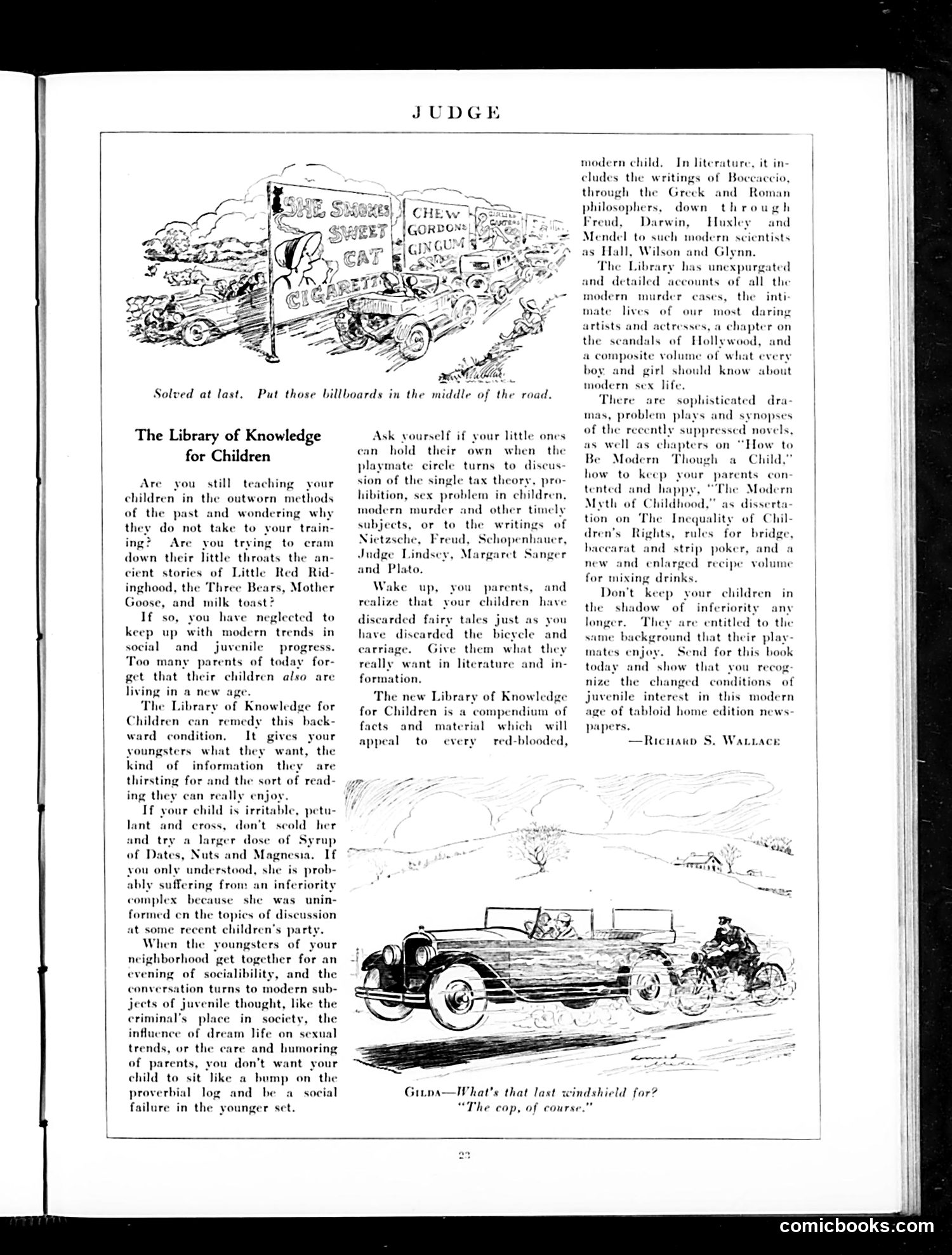
This is satirical advertising copy mocking progressive parenting trends of the 1920s-30s. Judge ridicules parents who've abandoned traditional children's literature (fairy tales, nursery rhymes) for supposedly modern, sophisticated education. The satire targets the era's popularization of Freudian psychology, sex education, and adult topics for children. It lists absurd inclusions: accounts of modern murders, Hollywood scandals, works by Freud and Darwin, chapters on "Modern Thought," strip poker rules, and "mixing drinks"—presenting modern child-rearing as inappropriately adult-focused. The cartoon (top) and illustration (bottom, captioned about a windshield) suggest chaotic modernity. The piece mocks both overeager progressive parents and the commercial exploitation of child psychology fads. Richard S. Wallace's byline anchors this as editorial satire against contemporary parenting anxieties and the selling of pseudo-intellectual child development.
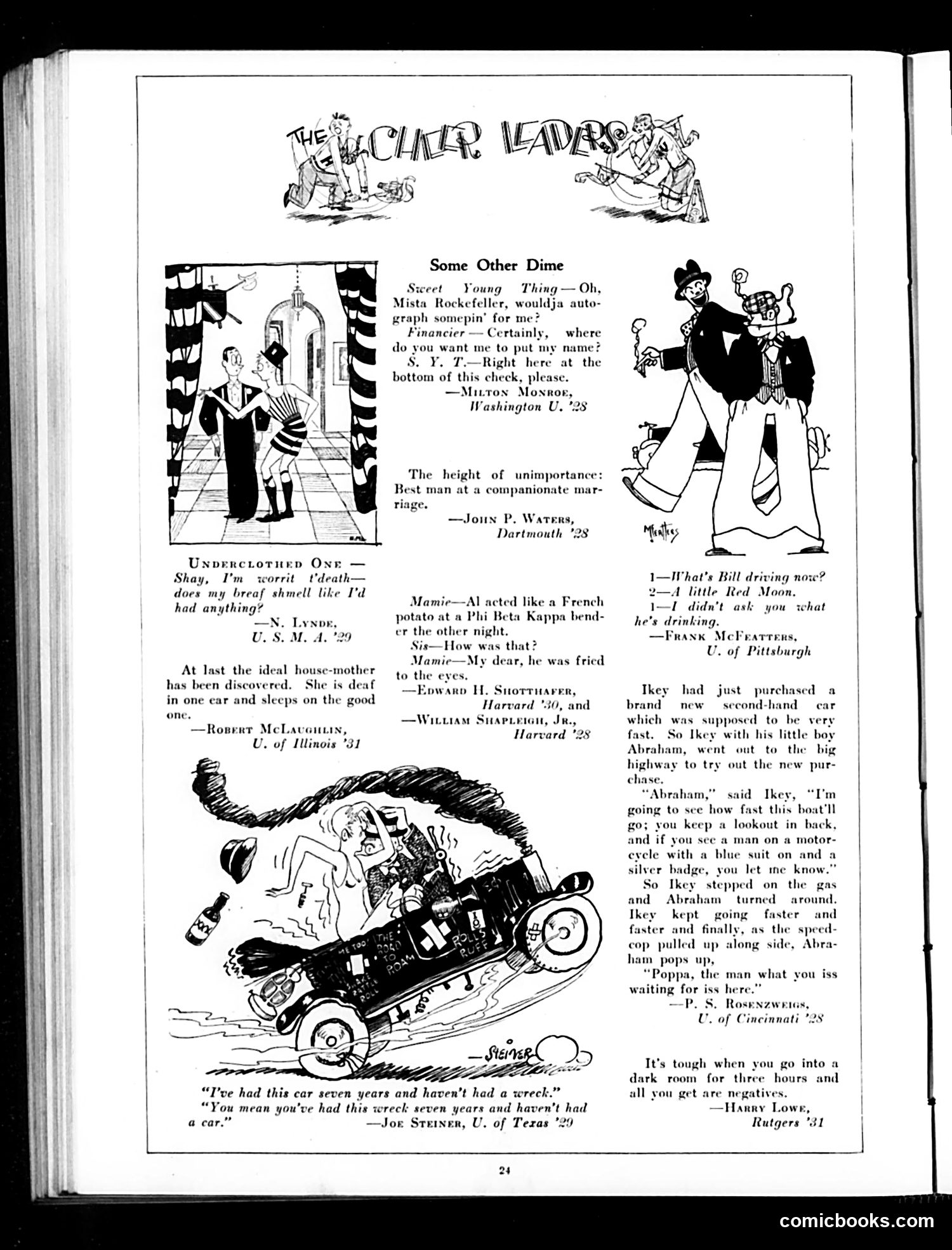
This is a college humor page featuring jokes submitted by university students (noted by their school affiliations). The content reflects 1920s-30s undergraduate wit: **Main Cartoon**: Shows a car crash victim, illustrating the joke's punchline about owning a "wreck" for seven years—a play on the difference between having a car accident versus owning a damaged vehicle long-term. **Key Jokes**: - "Underclothed One": A joke about a deaf house-mother who can't hear/smell anything - Rockefeller autograph gag: Playing on wealth, asking him to sign a check - "Companionate marriage" reference: The best man's unimportance in modern (non-traditional) marriages - "Ikey and Abraham" story: Ethnic humor involving a Jewish father and son, with the boy alerting his speeding father to an approaching police officer - Photography darkroom joke: "Negatives" as both undeveloped photos and mood The humor relies on contemporary slang, campus culture references, and period stereotypes now considered offensive.
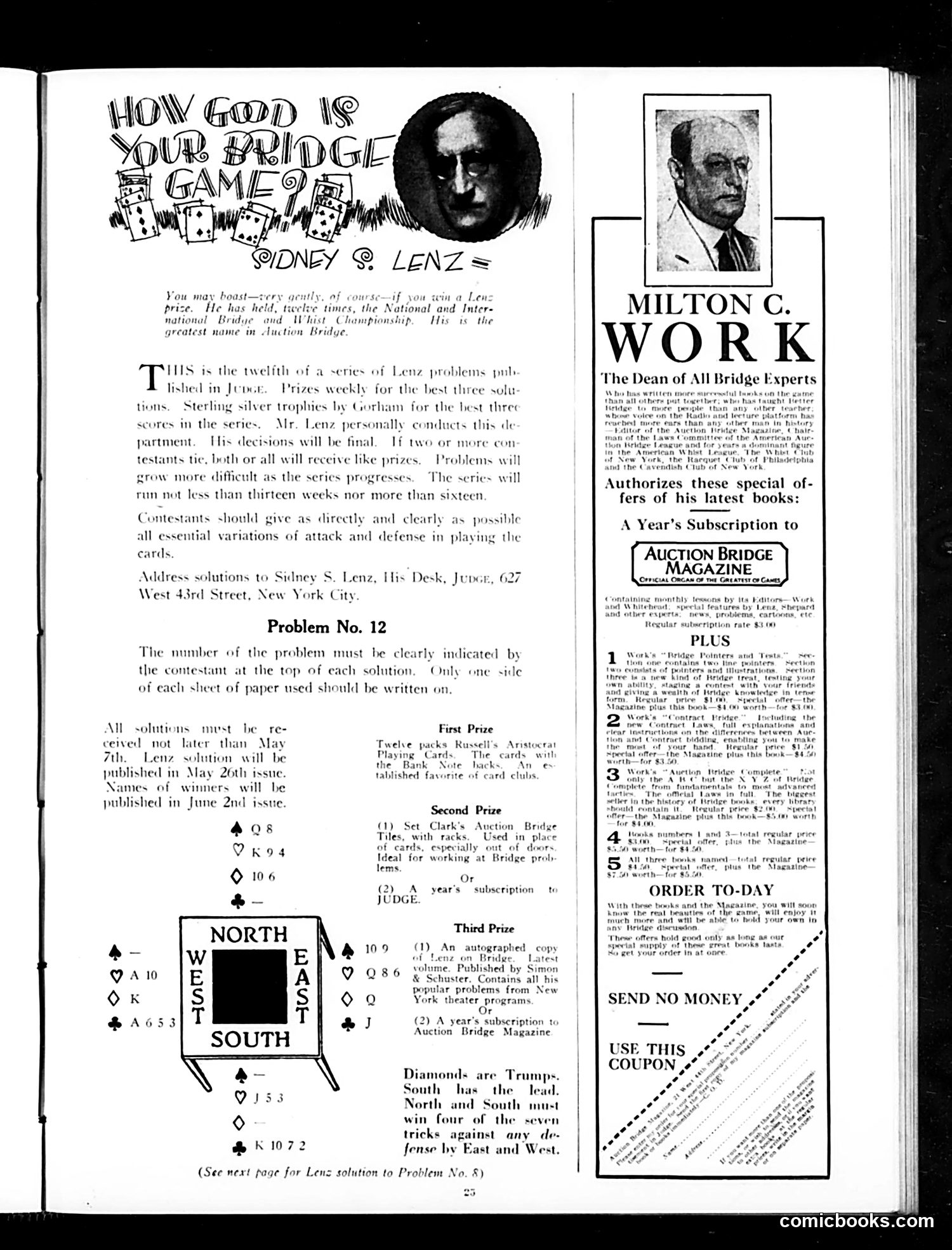
This is primarily a **bridge card game competition page**, not political satire. The page announces "Problem No. 12" in Judge's ongoing series of contract bridge puzzles, with Sidney S. Lenz—identified as "The Dean of All Bridge Experts"—personally conducting the contest. The content is a straightforward **puzzle and prize promotion**: readers submit solutions to the bridge hand shown (diamonds are trumps), with winners receiving sterling silver trophies, playing card sets, or magazine subscriptions. The small cartoon at top left simply illustrates the competitive excitement of bridge with a caricatured face among playing cards. This reflects bridge's status as a **fashionable parlor game** among early 20th-century American leisure culture. The page demonstrates Judge using its platform to promote both the game and related merchandise/subscriptions rather than deliver political commentary.
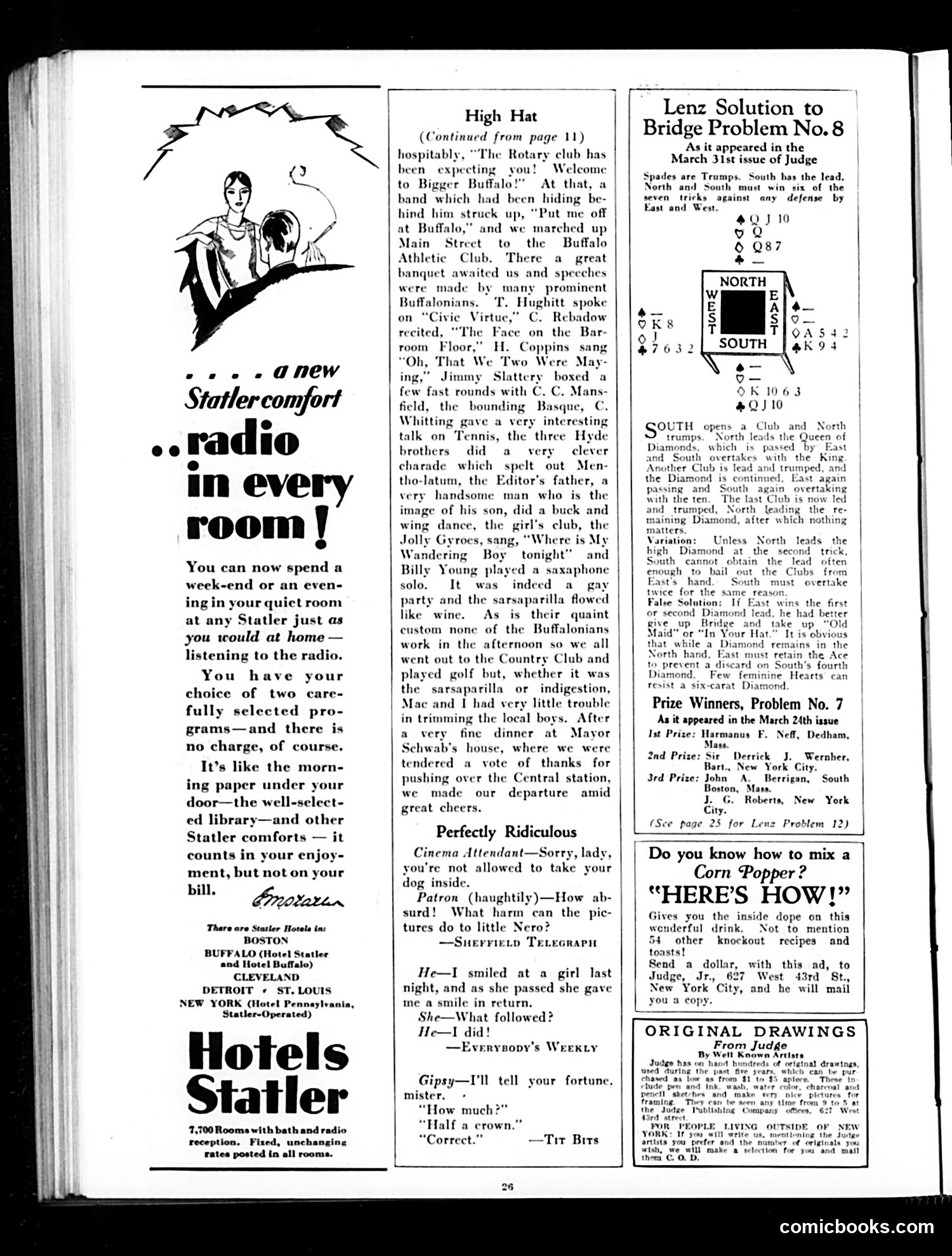
This page is primarily **advertising and puzzle content** rather than political satire. The dominant feature is a **Statler Hotels advertisement** promoting radios in guest rooms as a modern convenience—notable as an early marketing pitch for emerging radio technology in the 1920s-30s. The illustration shows a couple enjoying radio entertainment in a hotel room. The page also includes a serialized humorous story titled "High Hat" about a Buffalo visit with social club activities, several brief joke segments (labeled "Perfectly Ridiculous"), and **bridge game problem solutions**—a popular pastime among Judge's educated readership. The jokes are generic observational humor: a cinema attendant refusing a dog, a fortune teller's wordplay, romantic misadventure. They contain no political content. The bridge puzzles with detailed solutions indicate Judge catered to intellectually engaged readers beyond pure satire—reflecting the magazine's broader appeal to educated audiences in this era.
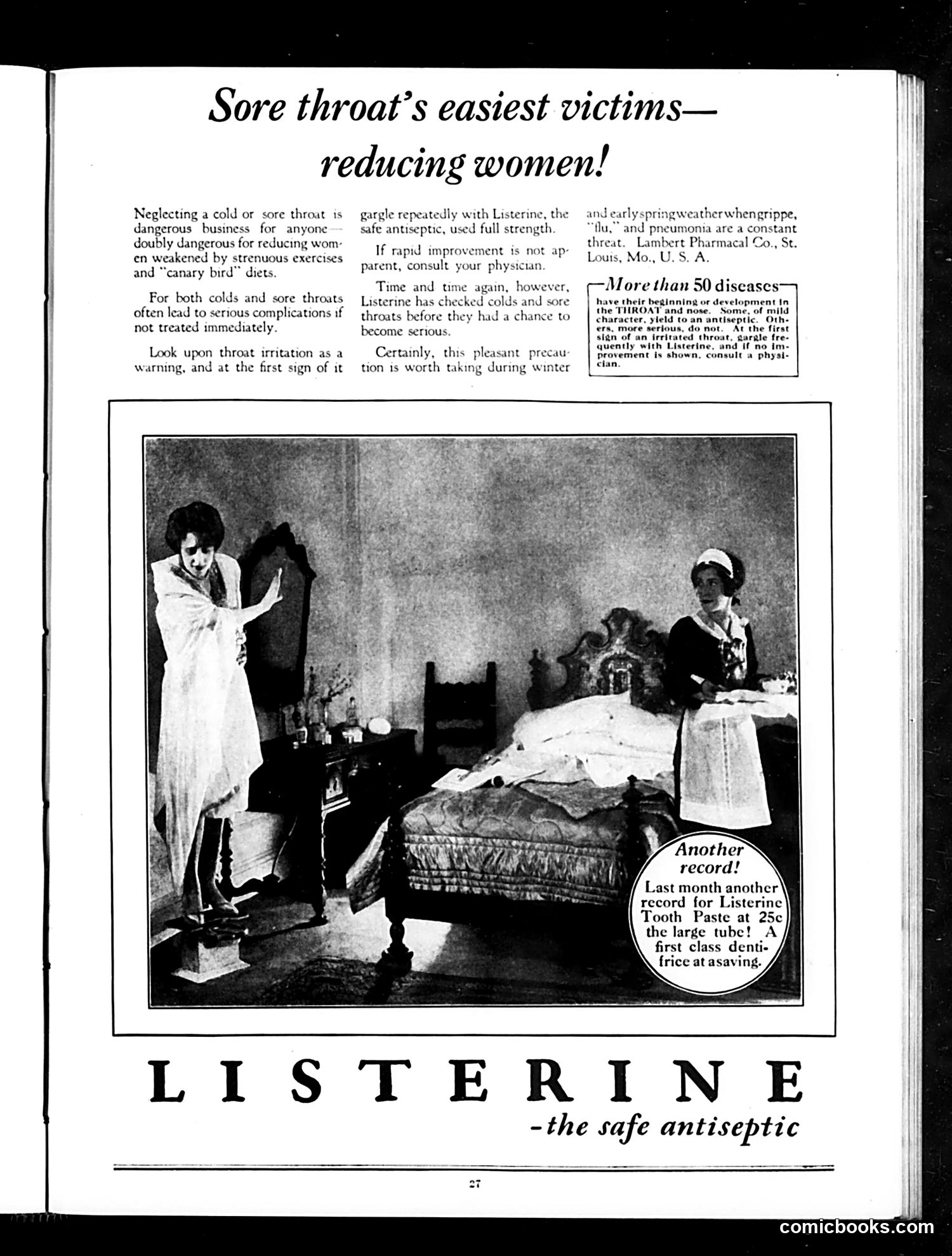
This is a **Listerine antiseptic advertisement**, not satire or political commentary. The ad targets women dieters of the era, exploiting anxieties about weight loss and health. The ad's rhetorical strategy plays on period concerns: women pursuing restrictive "canary bird" diets and strenuous exercise are portrayed as physically weakened and vulnerable to serious throat infections. The bedside scene depicts a woman ill in bed, implying that neglecting sore throats can become dangerously serious. The pitch is essentially fear-based marketing—using the vulnerability of "reducing women" (those attempting weight loss) to promote Listerine as preventative medicine. The ad claims the antiseptic can halt colds and sore throats before they develop into complications, with an appeal to consult physicians if improvement isn't rapid. The mention of Listerine Tooth Paste's sales success ("another record") suggests this was a trusted brand with multiple product lines in the interwar period.
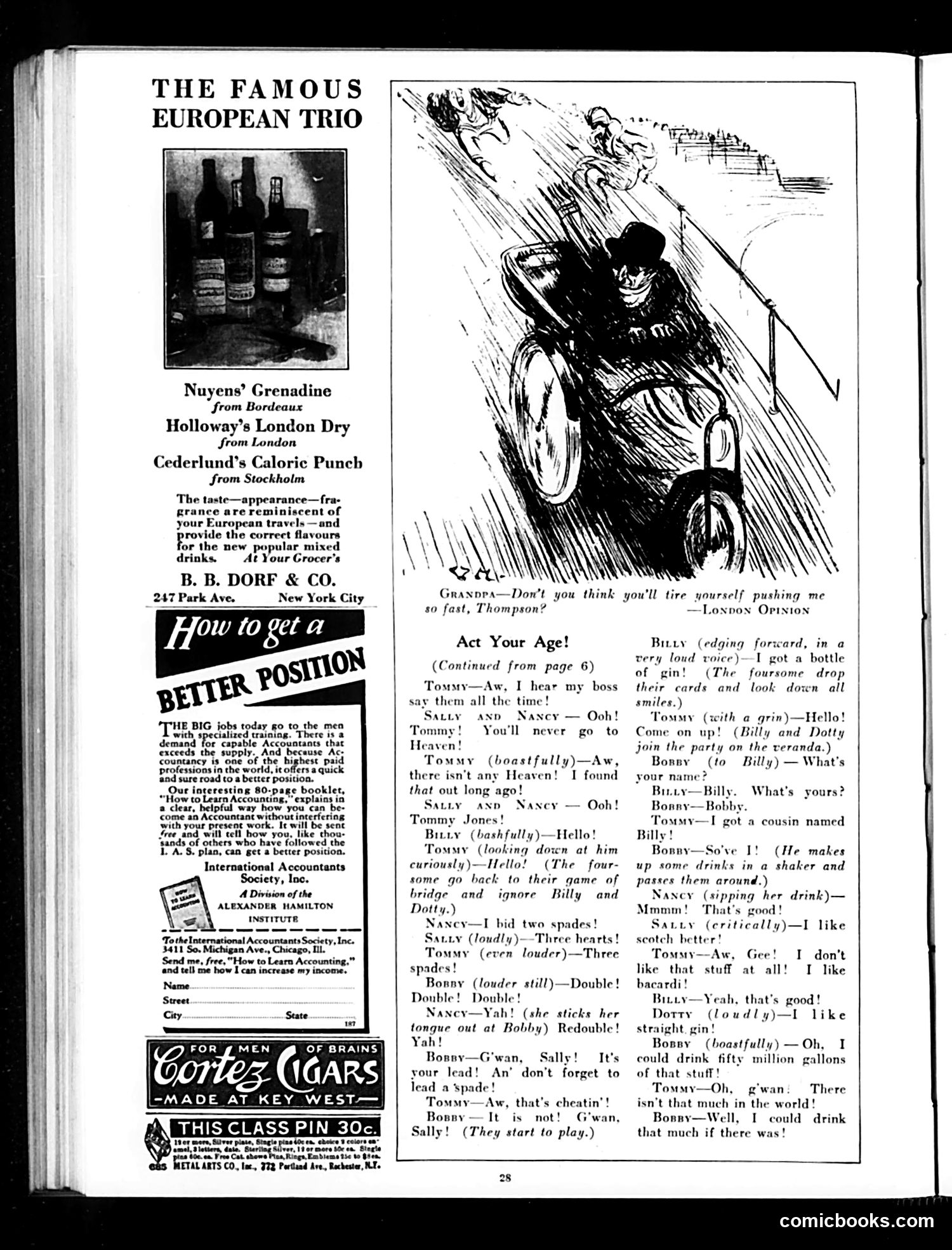
This page is primarily **advertising and entertainment content**, not political satire. The main elements are: **Left side:** Ads for European liqueurs (appealing to post-Prohibition nostalgia), accounting courses, and cigars—typical 1920s-30s magazine advertising. **Right side:** A comic strip titled "Act Your Age!" depicting children at play who discover alcohol and begin drinking. The humor relies on: - **Class/sophistication pretense**: Kids mimicking adult behavior, using cocktail terminology - **Prohibition-era context**: The casual introduction of "gin" and mixed drinks suggests post-Prohibition America (1933+), when alcohol's legality was still novel - **Period comedy trope**: Children acting grown-up was considered humorous rather than concerning The cartoon's "point" isn't satirical critique but rather entertainment through children's innocence meeting adult vices—reflecting contemporary attitudes where childhood alcohol exposure was treated as comedic rather than alarming. The page reflects 1930s values, not modern perspectives.
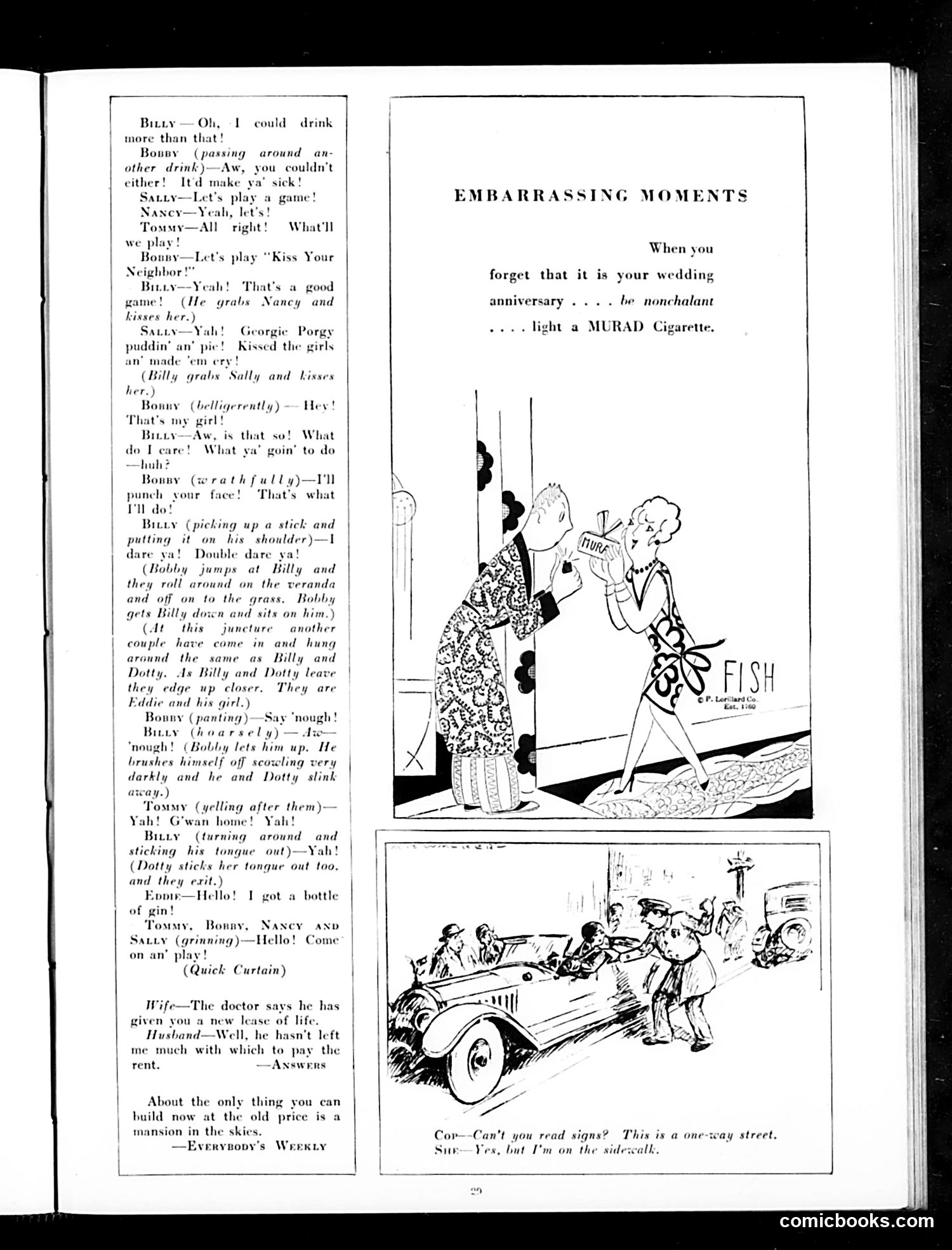
This page contains two distinct elements: **Left side:** A comedic play script depicting rowdy youth behavior at a house party—drinking, playing kissing games, and roughhousing that escalates into fighting. The humor derives from the characters' crude dialogue and physical comedy (rolling on grass, tongue-sticking). This appears to satirize post-WWI youth culture and Jazz Age "flapper era" social gatherings, mocking young people's drinking and uninhibited behavior. **Right side:** Two single-panel cartoons. The top advertises MURAD cigarettes, suggesting nonchalance during forgotten anniversaries—marketing sophistication through smoking. The bottom depicts a traffic violation: a car driver misreading a one-way street sign, with the caption implying the driver is on the sidewalk instead. This is straightforward automotive humor. The page reflects 1920s concerns about youth morality, advertising integration into editorial content, and early motoring mishaps.
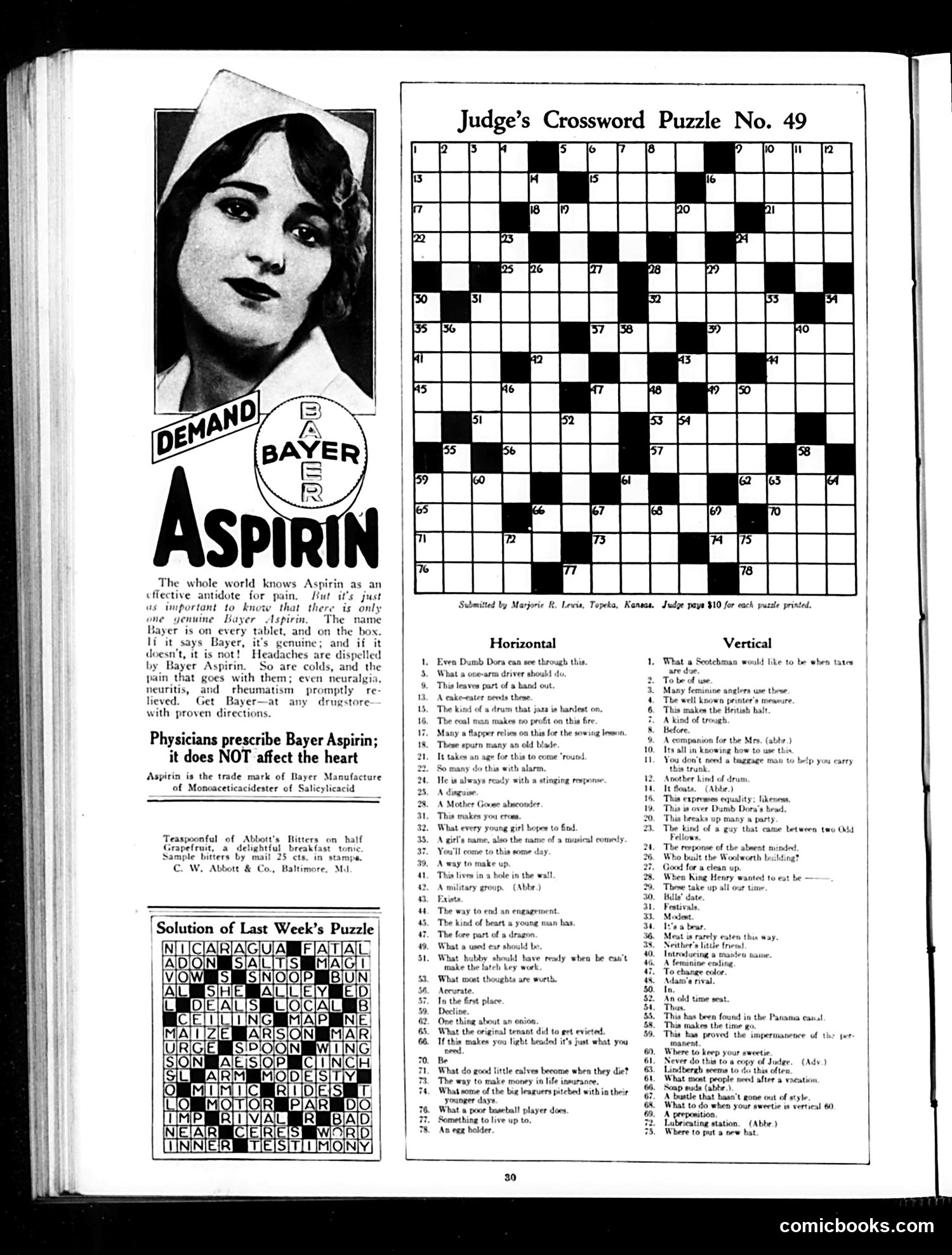
This page is primarily **advertising and a crossword puzzle**, not a political cartoon. The main content is a **Bayer Aspirin advertisement** featuring a woman's portrait. The ad emphasizes that "Bayer" is a trademarked name and warns consumers against counterfeits—a crucial message in an era before strict FDA regulations, when patent medicines and knockoffs proliferated. The reassurance that aspirin "does NOT affect the heart" addresses contemporary medical concerns. Below is "Judge's Crossword Puzzle No. 49," a typical entertainment feature. The clues reference contemporary cultural touchstones: "Dumb Dora" (a popular comic character), "flappers" (1920s women), and Lindbergh (the aviator). These clues would have been recognizable to Judge's readers but require historical context today. The page also includes the solution to the previous week's puzzle. There is no satire or political commentary visible on this particular page—it's standard magazine filler and advertising.
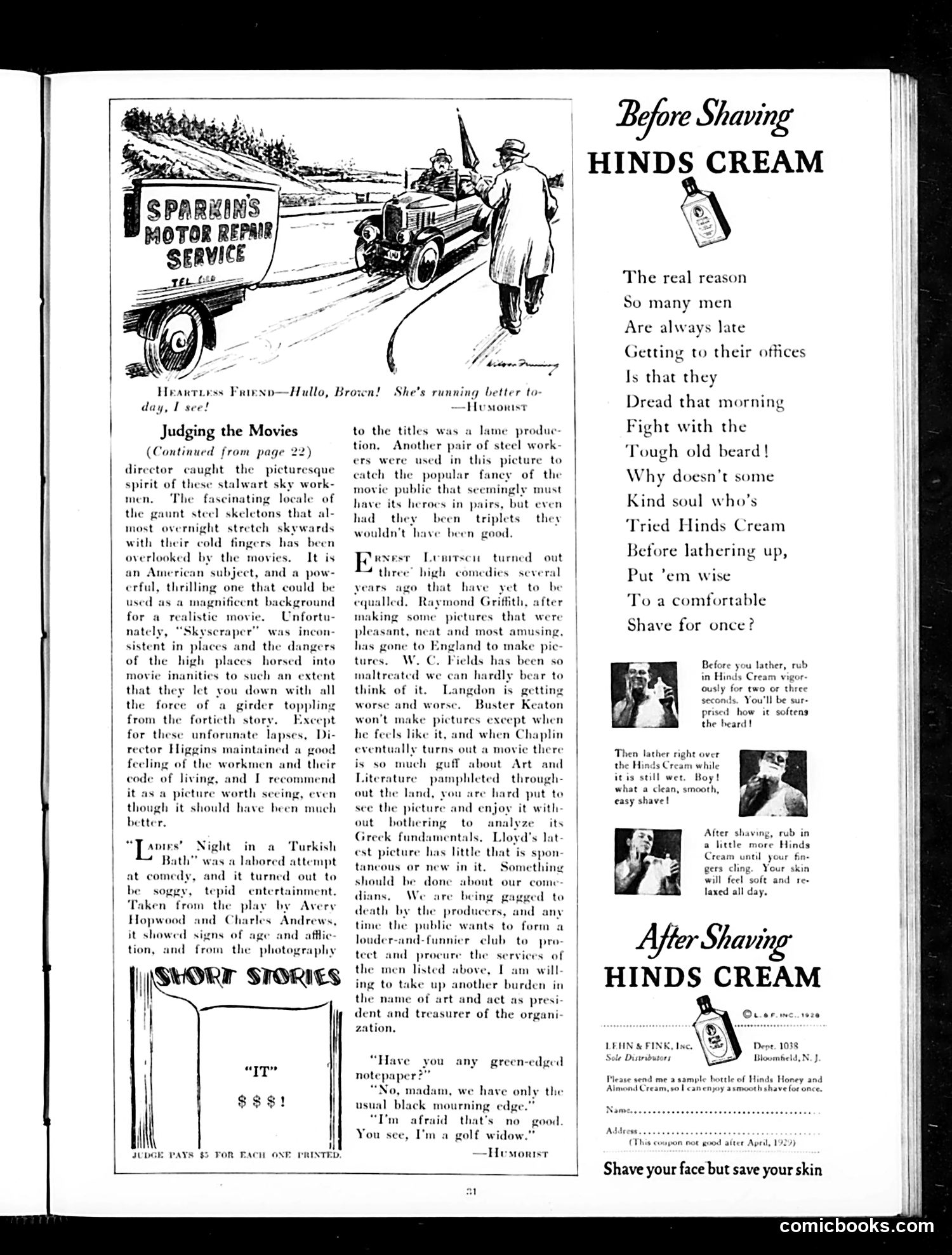
This page contains **primarily advertising** for Hinds Cream shaving product, framing the ad as solving a relatable male problem: the difficulty of shaving tough beards before work. The left side includes a **movie review column** criticizing contemporary silent film comedians—mentioning Buster Keaton, Charlie Chaplin, and Harold Lloyd by name. The critic complains these comedians are becoming repetitive or pretentious, with Chaplin allegedly surrounding his films with excessive "guff about Art and Literature." The cartoon at bottom-left is a brief **joke about widowhood**: a woman asking for green-edged notepaper is told the shop only has black (mourning paper), and she responds she's a "golf widow"—meaning her husband is always away playing golf, making her feel like a widow while still married. This is gentle domestic satire about leisure activities. The Hinds ad uses **masculine anxiety marketing**, suggesting men dread their morning shave routine. The solution: pre-lather with their cream to soften the beard.
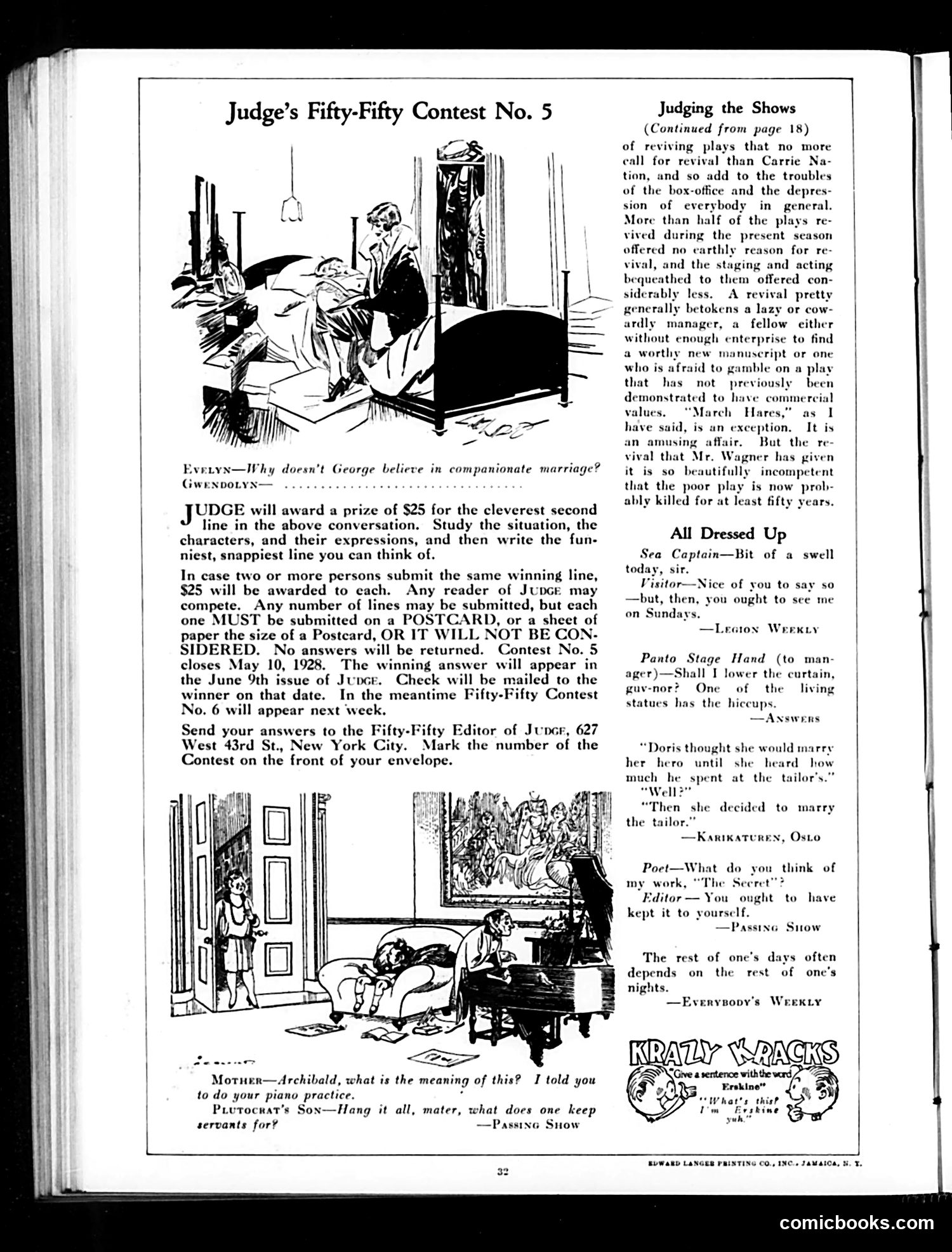
This page from Judge magazine (circa 1928) contains a reader contest and humor pieces: **The Main Contest:** A "Fifty-Fifty" competition asking readers to complete a witty dialogue. A woman (Evelyn) asks George why he doesn't believe in "companionate marriage"—a 1920s concept of marriage based on companionship and equality rather than traditional roles. Readers must supply Gwendolyn's response for a $25 prize. The joke hinges on whatever amusing reason George might have for rejecting this modern marriage ideal. **Supporting Humor Pieces:** Brief comic exchanges satirizing British class attitudes (a boy dismissing piano practice as servants' work) and vanity (a sailor dressed up only on Sundays; a woman choosing a tailor over a hero based on spending habits). The overall tone reflects Jazz Age attitudes toward marriage modernization and social pretension—typical Judge magazine fare mixing wordplay with gentle social observation.
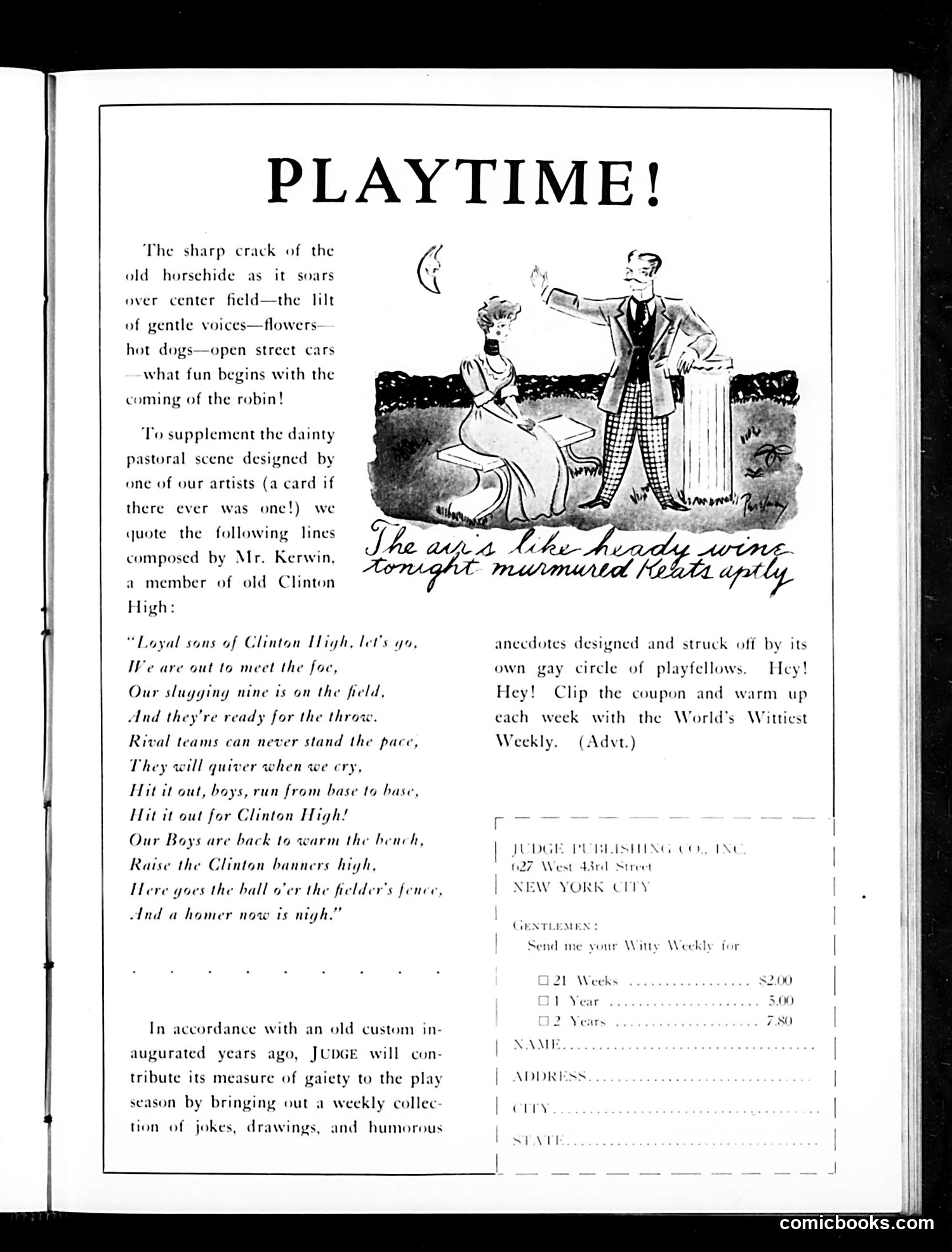
This page celebrates baseball season with a lighthearted sports theme. The cartoon shows a couple in a pastoral spring setting, with the caption "The air's like heady wine tonight murmured Polly aptly"—a gentle romantic joke about spring's arrival coinciding with baseball's return. The main content is a school fight song for Clinton High, composed by contributor Mr. Kerwin. It's a typical early 20th-century athletic anthem, rallying the baseball team with calls to "Hit it out for Clinton High!" and boasting of their superiority ("Rival teams can never stand the pace"). The page uses baseball's seasonal arrival to symbolize renewal and youthful energy. The final section is an advertisement for Judge's subscription to its "World's Wittiest Weekly," offering pricing for 21 weeks ($2.00), one year ($5.00), or two years ($7.80)—essentially promoting Judge magazine itself as entertainment reading material.
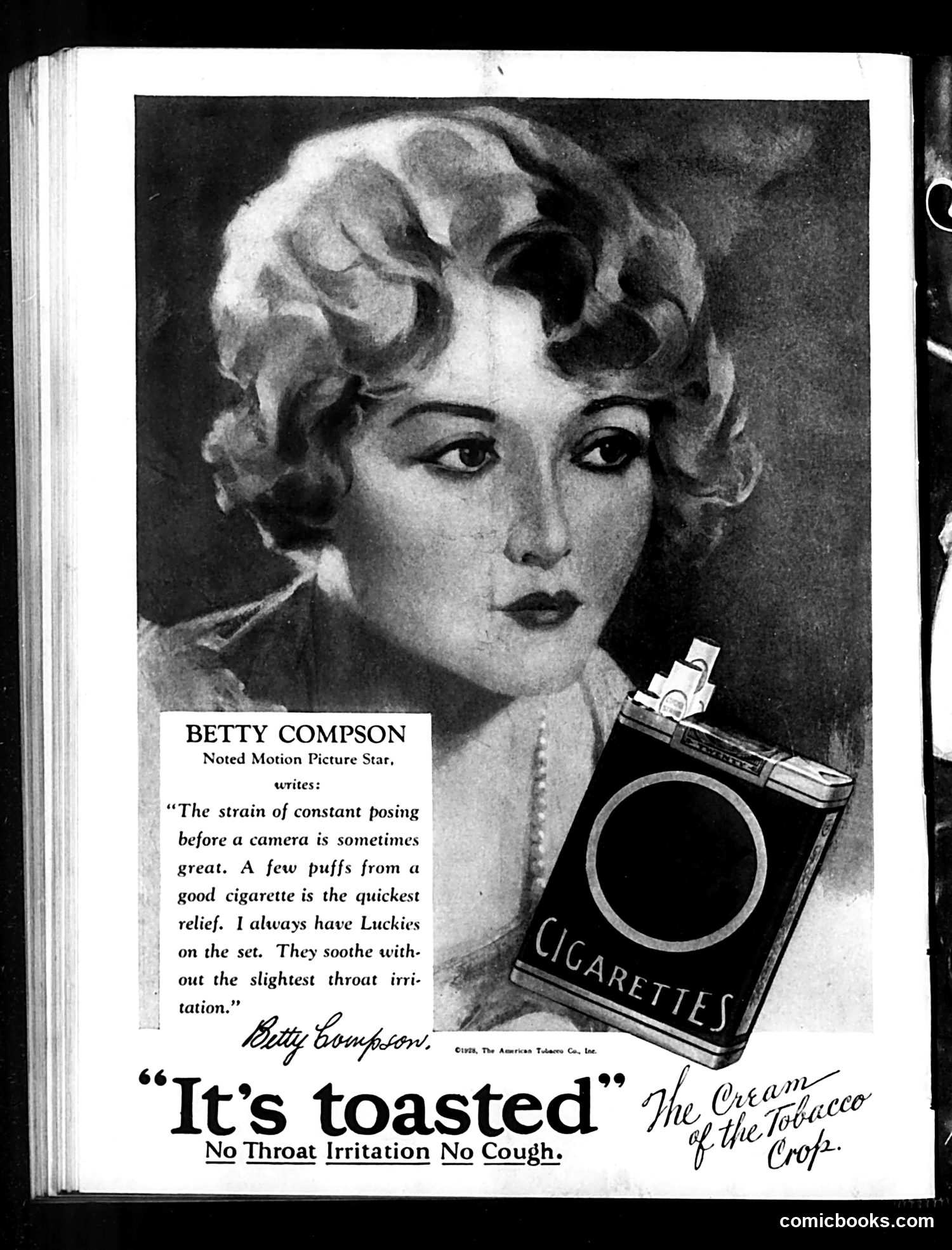
This page is a **cigarette advertisement**, not political satire. It features Betty Compson, a genuine silent-film actress popular in the 1920s-30s, endorsing Lucky Strike cigarettes. The ad claims cigarettes provide stress relief for actors during filming and promises "no throat irritation" or cough—marketing language that would later become infamous as tobacco companies made health claims now known to be false. This represents a historical artifact of pre-regulation advertising when celebrities routinely endorsed tobacco products, and health warnings were absent. The page demonstrates how cigarette manufacturers used Hollywood glamour to market their products to consumers during an era before such advertising was restricted.