
Judge, 1928-04-28 · page 20 of 36
Judge — April 28, 1928 — page 20: what you’re looking at
What you’re looking at
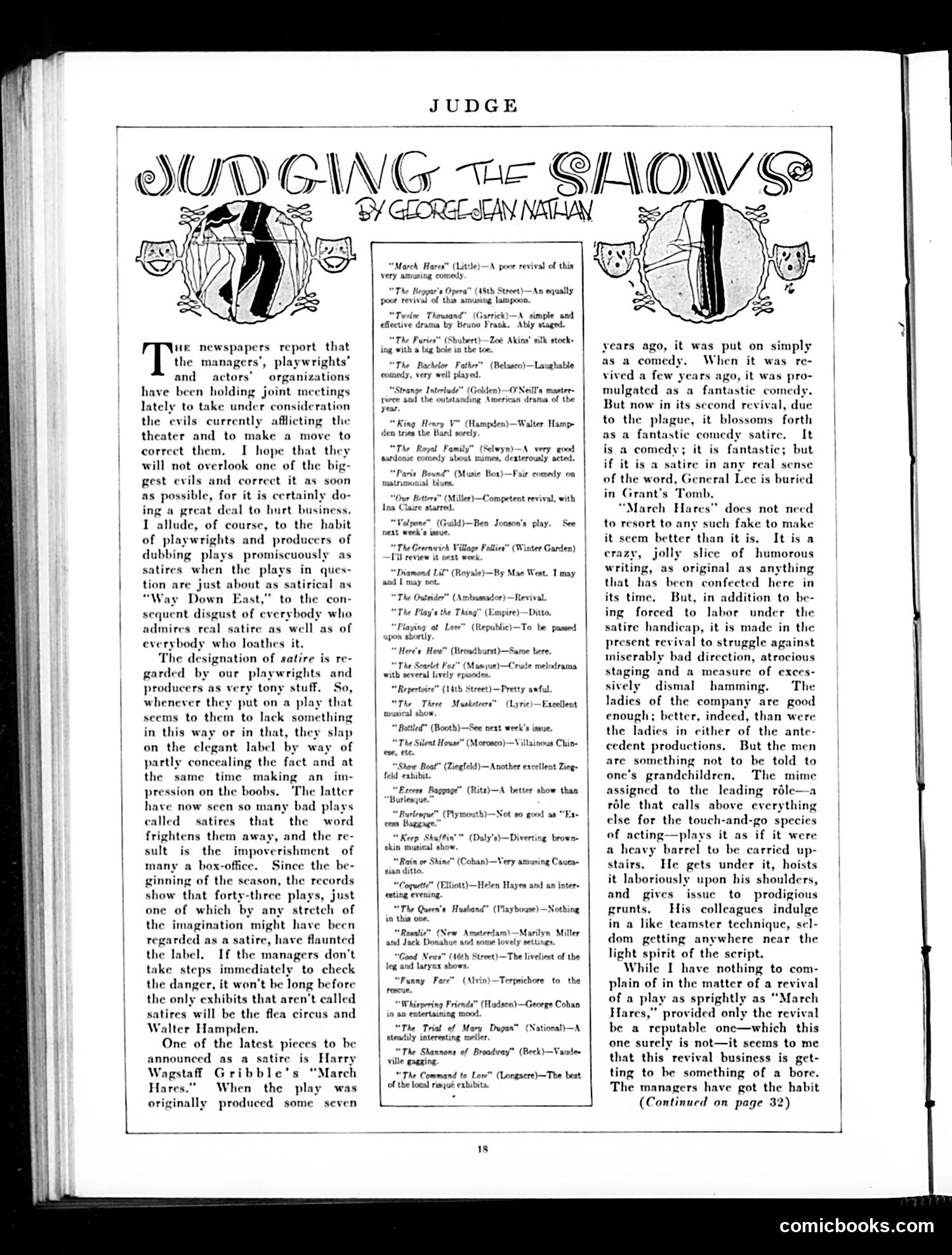
This theater column by George Jean Nathan attacks Broadway producers for mislabeling mediocre plays as "satire" to boost box office appeal. Nathan argues that out of 43 plays labeled satires that season, only one might actually qualify. Producers cynically slap the prestigious label on ordinary comedies lacking real bite or intelligence, hoping to impress audiences ("the boobs"). Nathan's complaint is that this cheapens genuine satire—which requires wit and social criticism—into a marketing gimmick. He uses Harry Wagstaff Gribble's "March Hares" as his prime example: it's simply "a crazy, funny writing" with no real satirical substance, yet it's promoted as cutting social commentary. The page includes a theater listing with Nathan's brief, often dismissive reviews of current Broadway productions, many marked as revivals or uninspired comedies. His underlying point: theaters should stop deceiving audiences and themselves about what constitutes actual satire.
📄 Transcribed text from this page (OCR, searchable)
Machine-transcribed from the original scan — historical spelling and the odd misread are preserved.
JUDGE MUM GC: WN G ae GAOW Ge BY GEORGEAEAN NATHAN We newspapers report that the managers’, playwrights’ and actors’ organizations have been holding joint meetings lately to take under consideration the evils currently afflicting the theater and to make a move to correct them. I hope that they will not overlook one of the big- gest evils and correct it as soon as possible, for it is certainly do- ing a great deal to hurt business. I allude, of course, to the habit of playwrights and producers of dubbing plays promiscuously as satires when the plays in ques- tion are just about as satirical as “Way Down st,” to the con- sequent disgust of everybody who admires real satire as well as of everybody who loathes it. The designation of satire is re- garded by our playwrights and producers as very tony stuff. So, whenever they put on a play that seems to them to lack something in this way or in that, they slap on the elegant label by way of partly conc e fact and at the same time making an im- pression on the boobs. ‘The latter have now seen so many bad plays called satires that the word frightens them away, and the re- sult is the many a box-office. Since the be- nning of the season, the records show that forty-three plays, just one of which by any stretch of the imagination might have been regarded as a satire, have flaunted the label. If the managers don’t take steps immediately to check the danger, it won't be long before the only exhibits that aren't called satires will be the flea circus and Walter Hampden. One of the latest pieces to be announced as a satire is Harry Wagstaff Gribble’s “March Hares.” When the play was originally produced some seven March Hares” (Little sing comedy A pone revival of this Beggar's Opera” (48th Street) —As equally poor revival of this amusing lampoon. ‘erise Thousand” (Garrick effective drama by Bruno Frank. “The Furies” (Shubert)—Zoe Akins’ silk stock- ing with a big bole in the toe, “The Bachelor Father” (Belsaco)—Laughable comedy, very well played. * (Golden) —O'Neill’s master- ing American drama of the "King Henry V" (Hampden)—Walter Hamp- den tries the Bard sorely “The Royal Famil sardonic comnly about m Paris Round” (Music B biues, (Selwyn)—A. very good . deaterously acted. Fair comely on (Miller)—Competent revival, with “Volpone” (Guild)—Ben Jonson's play. See next week's issue. "The Greenwich Village Follies” (Winter Garden) T'll review it next week "Diamond Lif” (Royale)—By Mae West, T may and I may not. "The Onteider” (Ambamador)—Revival. “The Pla; “Playing at Lore” (Republic)—To be parsed n sbortly he Thing” (Empire)—Ditto, “Here's How” (Broadburst)—Same here. "The Scarlet Fos” (Masjue)—Crade mele several lively epasodes. 14th Street)—Pretty awful. Musketeers (Lytie)—Exeellent f°” (Booth) —See next week's issue. “The Silent Howse” (Moroaco)—Villainows Chin- eve, ete. “Show Beat” (Ziegfeld)—Another excelleat Zieg- feld exhibit “Excess Baggage” (Ritt)—A better show than Not 20 good as “Exe (Daly’s)—Diverting browne Rain or Shine” (Coban)—Very amusing Cauea~ ian ditto. Coquette” (Elliott)—Heten Hayes and an inter- evening, “The Queen's Husband” (Vaybouse)—Nothing in this one. “Rosalie” (New Amsteriam)—Marilyn Miller and Jack Donahue and some lovely set “Good News” (48th Steeet)—The liveliest of the | teg and laryax “Panny Pace” (Alvin revue. Terpricbore to the “"Whirpering Friends” (Hodson) —George Coban in an entertaining mood. The Trial of Mary Dugan” (National)—A steadily interesting meller. “The Shannone of Broadway” (Beck)—Varr' ville gagging. "The Command to Love” (Longacre)—The best ‘of the local risqué exhibits. L . years ago, it s as a comedy. When it was re- vived a few years ago, it was pro- mulgated as a fantastic comedy. But now in its second revival, due to the plague, it blossoms forth as a fantastic comedy satire. It is a comedy; it is fantastic; but if it is a satire in any real sense of the word, General Lee is buried in Grant's Tomb. “March Hares” does not need to resort to any such fake to make it seem better than it is. It is a crazy, jolly slice of humorous writing, as original as anything that has been confected here in its time. But, in addition to be ing forced to labor under the satire handicap, it is made in the present revival to struggle against iniserably bad direction, atrocious staging and a measure of exces- sively dismal hamming. The ladies of the company are good enough; better, indeed, than we the ladies in either of the ante- cedent productions. But the men are something not to be told to one’s grandchildren. The mime assigned to the leading réle—a role that calls above everything else for the touch-and-go species of acting—plays it as if it were a heavy barrel to be carried up- stairs. He gets under it, hoists it laboriously upon his shoulders, and gives issue to prodigious grunts. His colleagues indulge in a like teamster technique, sel- dom getting anywhere near the light spirit of the script. While I have nothing to com- plain of in the matter of a revival of a play as sprightly as “March Hares,” provided only the revival be a reputable onc—which this one surely is not—it seems to me that this revival business is get- ting to he something of a bore. The managers have got the habit (Continued on page 32 comicbooks.com