
Judge, 1928-04-28 · page 15 of 36
Judge — April 28, 1928 — page 15: what you’re looking at
What you’re looking at
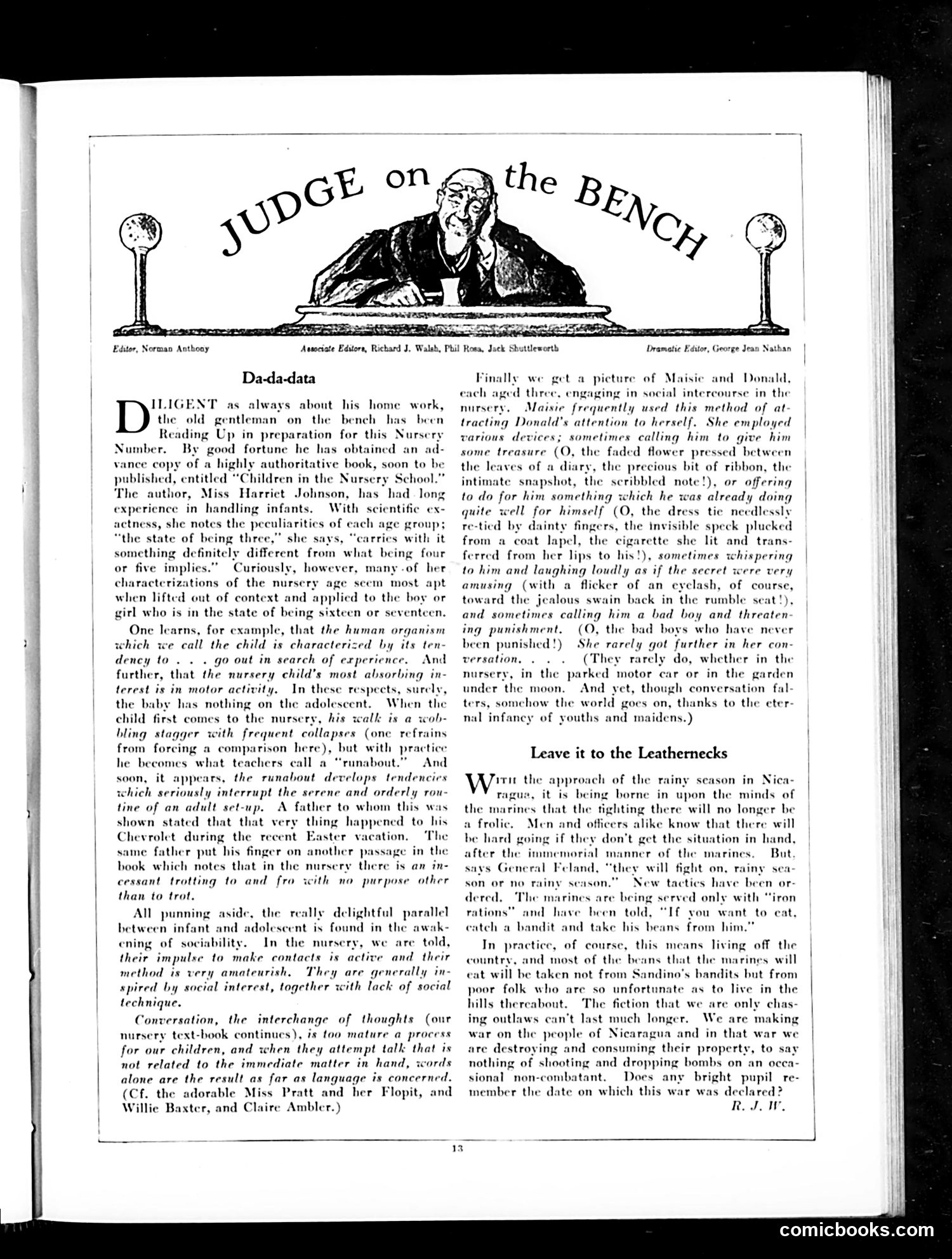
This page features a satirical column comparing nursery school children to adolescents. The "Judge on the Bench" illustration shows an elderly man (representing the magazine's editorial voice) reviewing a book titled "Children in the Nursery School" by Harriet Johnson. The satire draws parallels between toddler behavior and teenage conduct: both seek experience, engage in constant physical activity ("runabouts"), and attempt clumsy social interaction. The author humorously suggests that adolescents essentially regress to infant-like behavior—wobbling around aimlessly, lacking social technique, and making contact attempts driven by social interest but hampered by awkwardness. The specific anecdotes about "Maisie and Donald" (ages three) engaging in flirtation—using pretexts for attention, whispering and laughing, displaying jealousy—are meant to mirror teenage romance, suggesting teenagers behave like toddlers in matters of the heart. The satire mocks both child development psychology and adolescent behavior.
📄 Transcribed text from this page (OCR, searchable)
Machine-transcribed from the original scan — historical spelling and the odd misread are preserved.
Editor, Norman Anthoay Ausciate Editors, Richard J, Walsh, Phil Rona, Jack Shuttleworth Da-da-data ILIGENT as always about his home work, D the old gentleman on the bench has been Reading Up in preparation for this Nursery Number. By good fortune he | vance copy of a highly authoritative book, soon to be published, entitled “Children in the Nursery School.” The author, Miss Harriet Johnson, has had long experience in handling infants. With scientific ex- actness, she notes the peculiarities of ¢ xe group; “the state of being three,” she says, “carries with it something definitely different from what being four or five implies.” Curiously, however, many -of her characterizations of the nursery age seem most apt when lifted out of context and applied to the boy or girl who is in the state of being sixteen or seventeen. s obtained an ad- cha By One learns, for example, that the human organism which we call the child is characterized by its ten- dency to. . . go out in search of experience. And further, that the nursery child’s most absorbing in- terest is in motor activity. In these respects, surely, the baby has nothing on the adolescent. When the child first comes to the nursery, his walk is a@ wob- bling stagger with frequent collapses (one refrains from forcing a comparison here), but with practice he becomes what teachers call a “runabout.” And soon, it appears, the runabout develops tendencies which seriously interrupt the serene and orderly rou- tine of an adult set-up. A father to whom this was shown stated that that very thing happened to his Chevrolet during the recent ster vacation. The same father put his finger on another passage in the book which notes that in the nursery there is an in- cessant trotting to and fro with no purpose other than to trot. All punning aside, the really delightful: parallel between infant and adolescent is found in the awak- rning of sociability. In the nursery, we are told, their impulse to make contacts is active and their They are generally in- spired by social interest, together with lack of social technique. method is very amateurish. Conversation, the interchange of thoughts (our nursery text-book continues), is foo mature a process for our children, and when they attempt tall: that is not related to the immediate matter in hand, words alone are the result as far as language is concerned. (Cf. the adorable Miss Pratt and her Flopit, and Willie Baxter, and Claire Amble Dramatic Editor, George Jean Nathan Finally we get a picture of Maisie and Donald, each aged three, engaging in social intercourse in the nursery, Maisie frequently used this method of at tracting Donald's attention to herself. She employed various devices; sometimes calling him to give him some treasure (O, the faded flower pressed between the leaves of a diary, the precious bit of ribbon, the intimate snapshot, the scribbled note!), or offering to do for him something which he was already doing quite well for himself (O, the dress tie needlessly re-tied by dainty fingers, the invisible speck plucked from a coat lapel, the cigarette she lit and trans- ferred from her lips to his!), sometimes whispering to him and laughing loudly as if the secret were very amusing (with a flicker of an eyelash, of course, toward the jealous swain back in the rumble seat!), and sometimes calling him a bad boy and threaten ing punishment. (O, the b: been punished !) versation, 1 boys who have never She rarely got further in her con- (They rarely do, whether in the nursery, in the parked motor car or in the garden under the moon. And yet, though conversation fal ters, somchow the world goes on, thanks to the eter- nal infancy of youths and maidens.) Leave it to the Leathernecks W ithe approach of the rainy season in N rus, it is being borne in upon the minds of the marines that the tighting there will no longer be frolic. Men and officers alike know that there will » hard going if they don’t get the situ nin hand, after the immemorial manner of the marines. But. says General Feland, “the son or no rainy season will fight on, rainy sea w tactics have been or- dered. The marines are being served only with “iron ns” and have been told, “If vou want to eat, catch a bandit and take his beans from him.” In practice, of course, this means living off the country. and most of the beans that the marines will eat will be taken not from Sandino’s bandits but from poor folk who are so unfortunate as to live in the hills thereabout. The fiction that we are only chas- ing outlaws can’t last much longer. We are making war on the people of Nicaragua and in that war we are destroying and consuming their property, to nothing of shooting and dropping bombs on an oc: sional non-combatant. Does any bright pupil re- member the date on which this war was declared ? R.JLW, comicbooks.com