
A complete issue · 36 pages · 1928
Judge — March 10, 1928
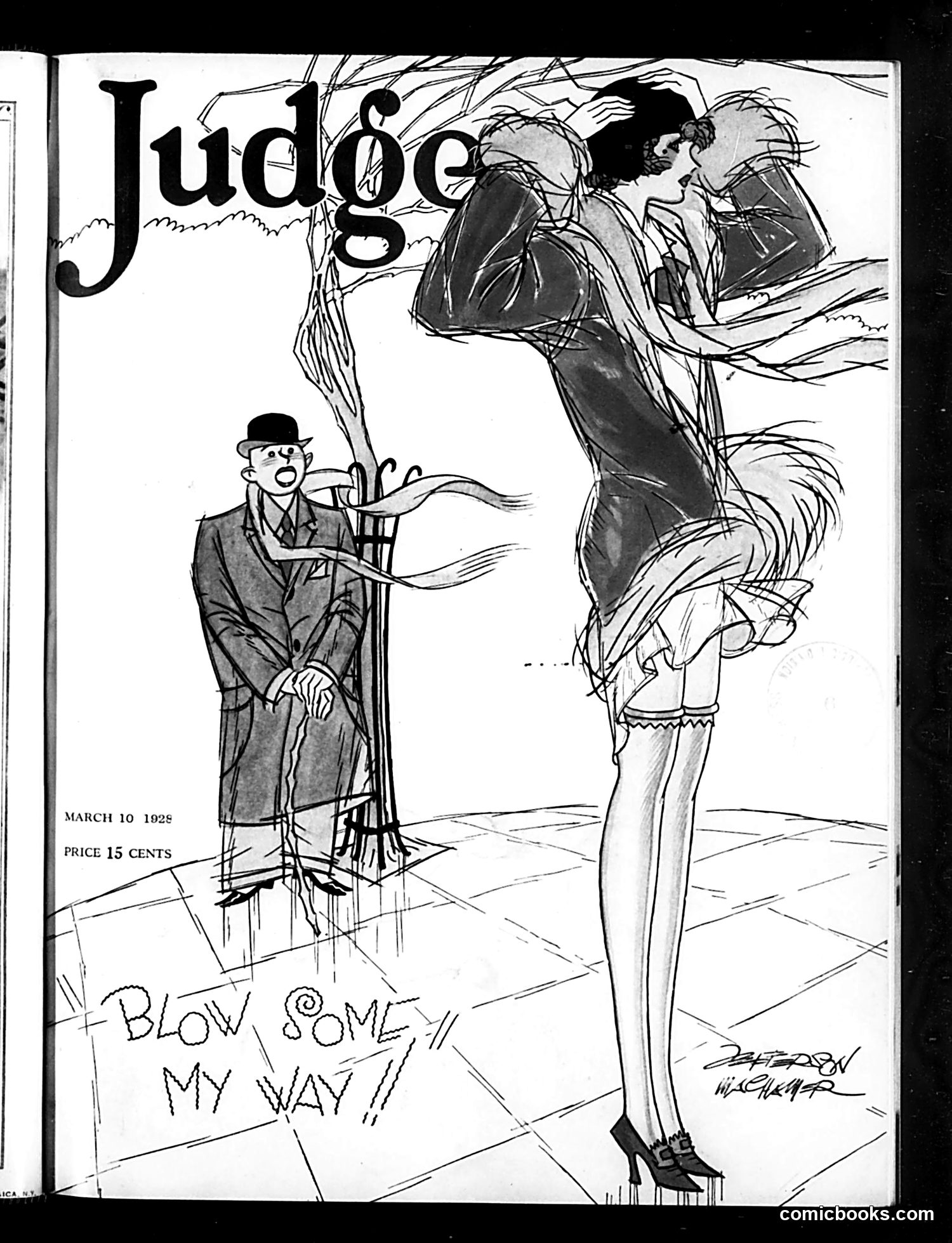
This cover satirizes the interaction between two figures: a small man in a bowler hat and overcoat (appearing to be a street-level "everyman" or working-class character) and a tall, stylishly-dressed woman in 1920s fashion with prominent legs—representative of the "flapper" archetype popular during the Jazz Age. The caption "Blow Some My Way!!" suggests the man is requesting something from the woman, likely a cigarette or smoke. The satire appears to comment on 1920s social dynamics: the contrast between the modest, conservative man and the liberated, fashionable modern woman reflects anxieties about changing gender roles and behavior during the post-WWI era. The exaggerated height difference emphasizes this cultural shift humorously.
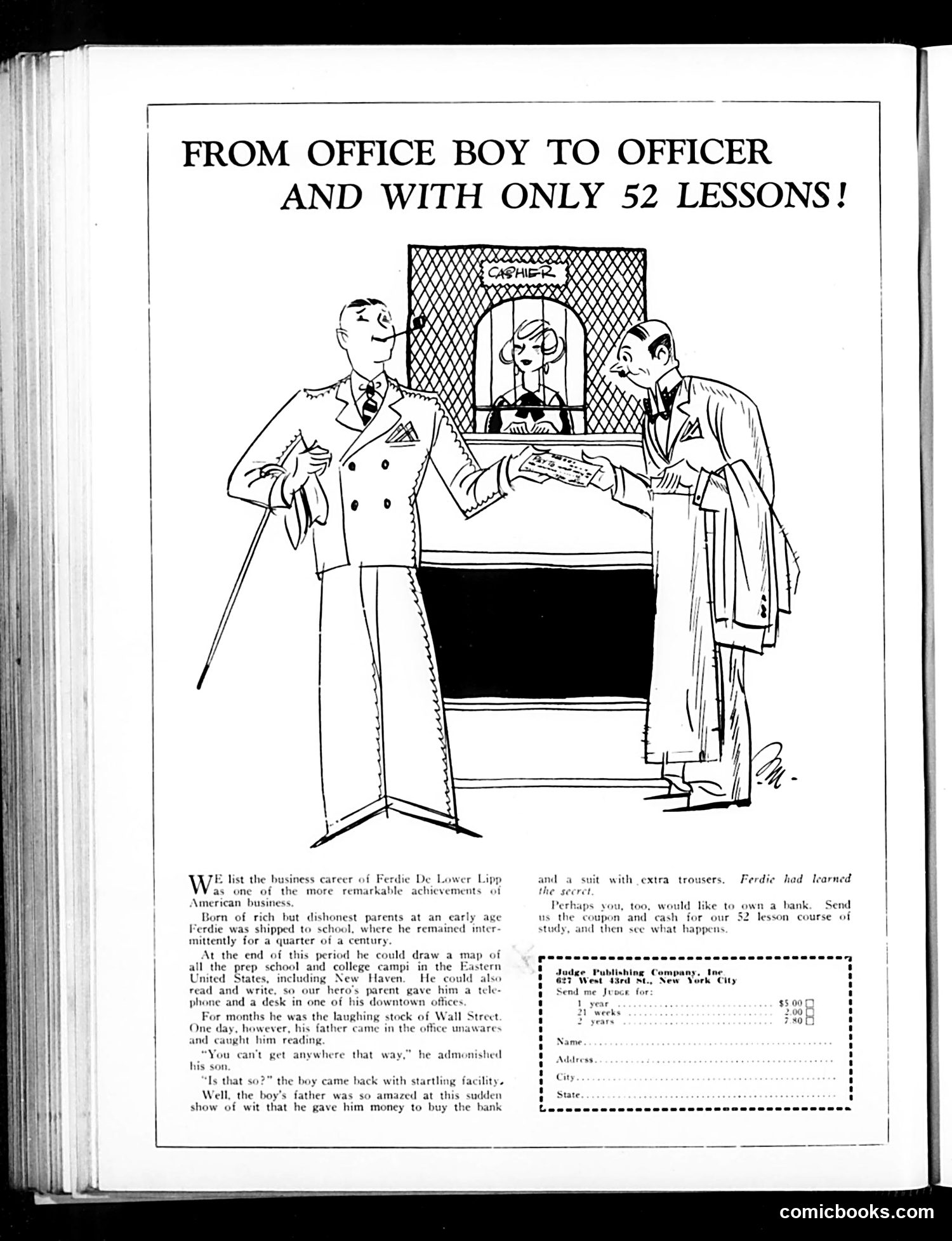
This page from *Judge* magazine advertises a 52-lesson correspondence course on business and banking. The cartoon illustrates the narrative: a young man (Ferdie De Lower Lipp) who started as an office boy has risen to become a bank officer, now conducting business with two other men in suits. The satire targets the "self-made man" mythology popular in early 20th-century American business culture. The humor lies in the exaggeration—that merely 52 lessons could transform an office boy into a bank officer commanding respect. The setup mocks both the naïveté of ambitious young men and the overselling of correspondence courses as shortcuts to success. The advertisement box offers the course for $5.00 (or installments), targeting working-class readers aspiring to white-collar advancement.
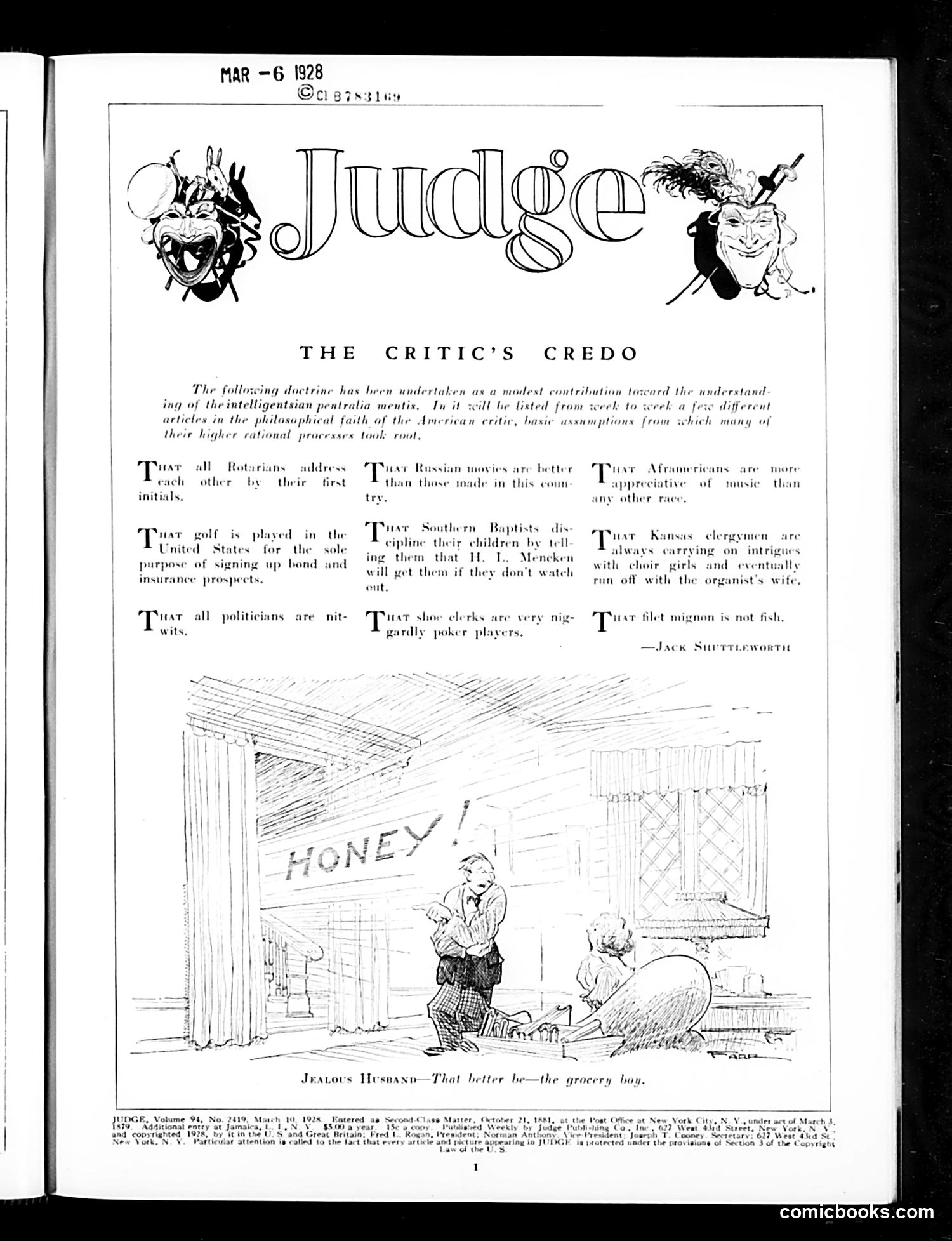
This page satirizes the pretentious assumptions critics make about cultural preferences. The header lists absurd generalizations: "all Rotarians address each other by first initials," "Russian movies are better than American ones," "Americans appreciate music more than other races," and "all politicians are nitwits." The cartoon below depicts a domestic scene captioned "Jealous Husband—That better be—the grocery bag." A man confronts his wife returning home, suggesting infidelity. This illustrates the magazine's broader satirical point: critics and observers jump to unfounded conclusions based on stereotypes and assumptions rather than evidence. The piece mocks the intellectual pretension and logical fallacies endemic to American cultural commentary in the 1920s.
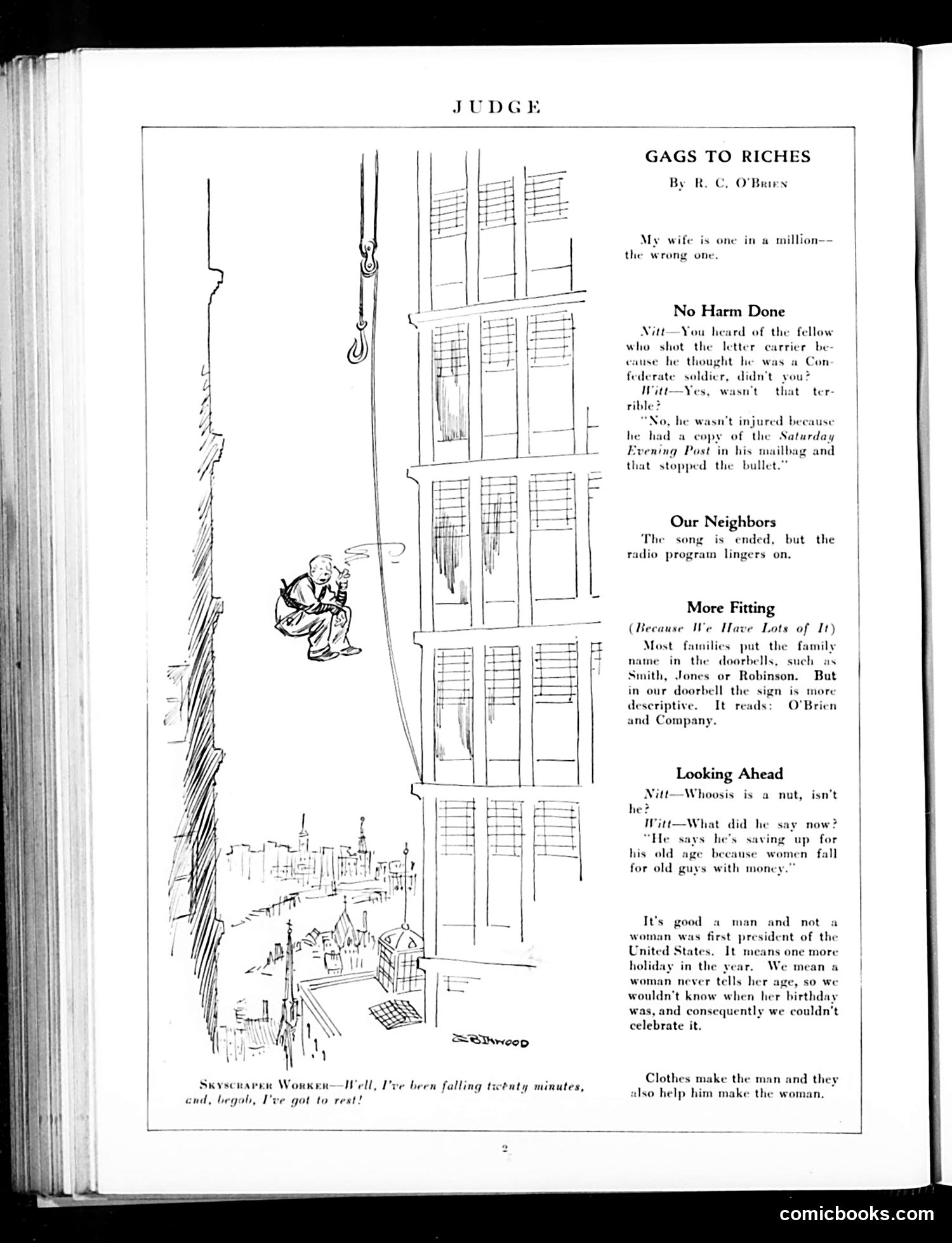
This page contains humor pieces by R.C. O'Brien rather than political cartoons. The main cartoon shows a skyscraper worker who's fallen twenty minutes and jokes about needing rest—dark humor about workplace danger. The text pieces are domestic comedies: - **"No Harm Done"**: A joke about a letter carrier shot by someone mistaking him for a Confederate soldier, stopping the bullet. - **"More Fitting"**: Humor about family nameplates on doorbells, noting "O'Brien and Company" is more descriptive than typical surnames. - **"Looking Ahead"**: A quip about an elderly bachelor saving money because "women fall for old guys with money." The final item comments that having a female U.S. president would mean one fewer holiday annually. These pieces reflect early-20th-century American domestic humor conventions.
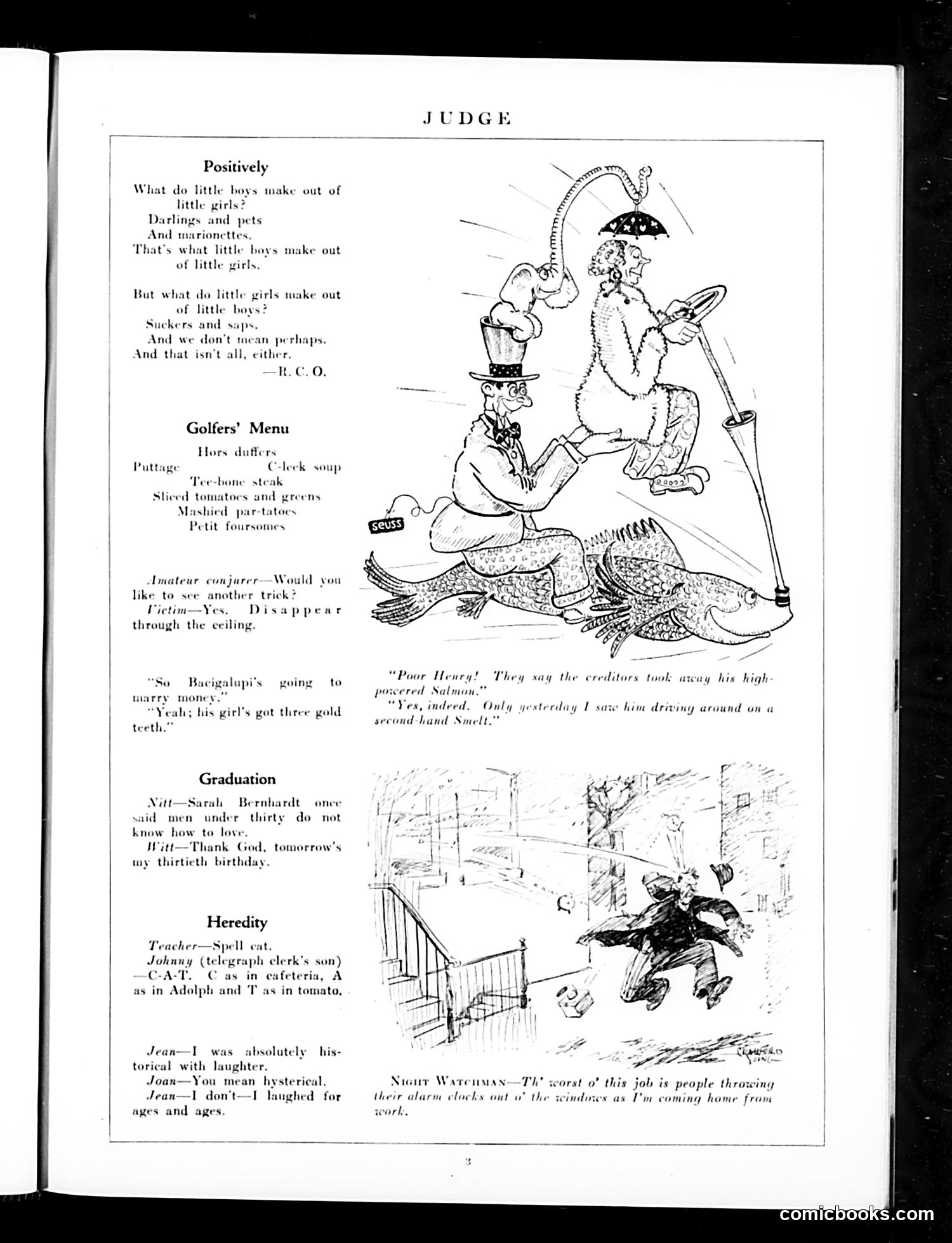
This page contains several humor pieces typical of Judge's early 20th-century satirical style: **"Positively"** presents a nursery-rhyme joke about what children make of each other—boys make "Darlings and pets" from girls, while girls make "Suckers and saps" from boys. The attribution to "R.C.O." suggests a regular contributor. **"Golfers' Menu"** satirizes pretentious restaurant culture, listing golf-themed dishes and featuring a humorous illustration of well-dressed golfers fishing instead of golfing—likely mocking either wealthy leisure culture or the absurdity of fashionable sports. **Remaining sections** ("Graduation," "Heredity") contain brief jokes about aging, birthdays, and inherited traits typical of period humor. The overall tone reflects Judge's focus on domestic social satire rather than political commentary.
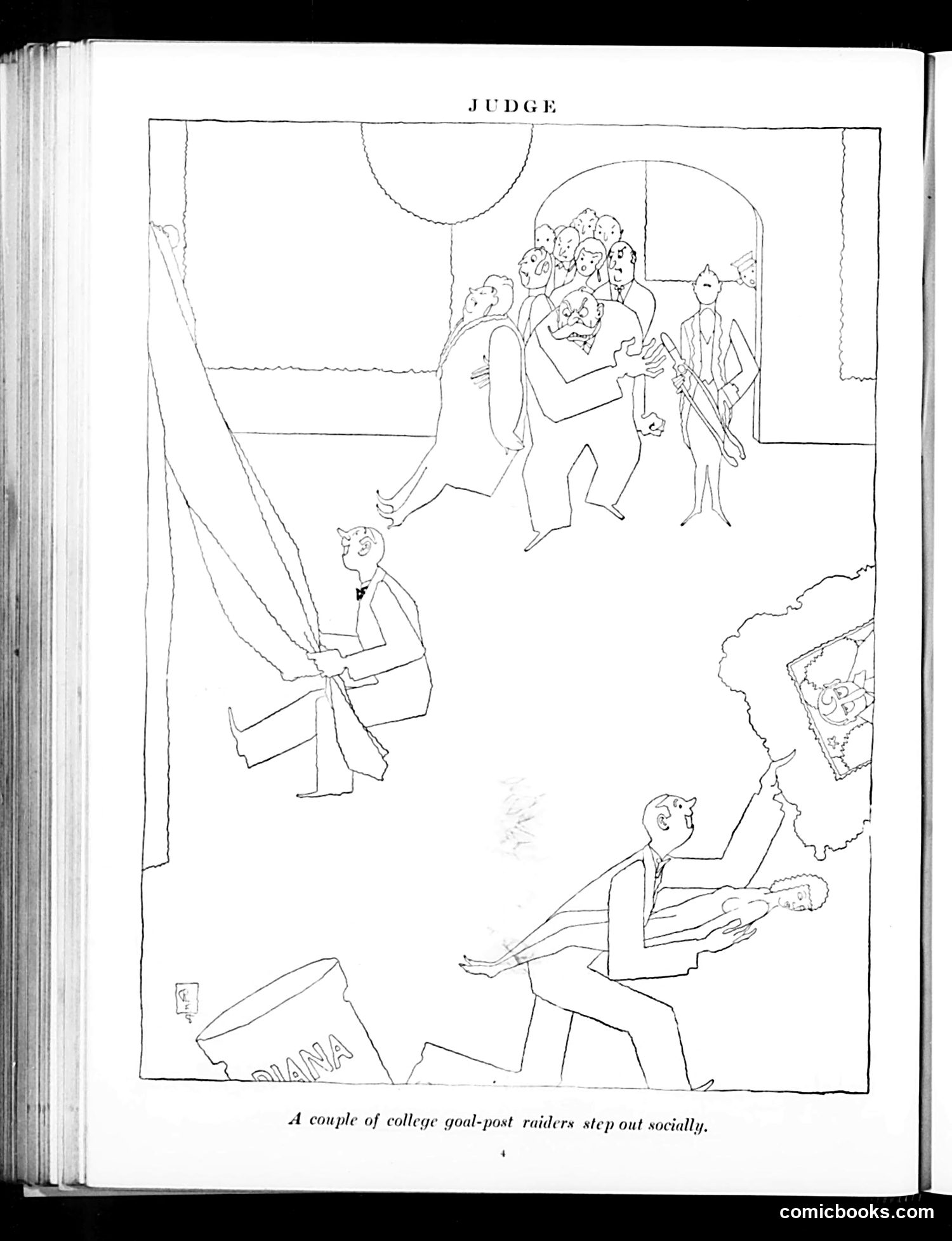
**Title:** "A couple of college goal-post raiders step out socially" **Subject:** This cartoon satirizes "goal-post raiding"—a college prank where students would steal or damage the goalposts from football fields, typically after games. The humor juxtaposes the rowdy, destructive nature of these raiders with their attempts to appear respectable in polite society. **The Scene:** The cartoon shows two young men (the "raiders") at what appears to be a formal social gathering. One hangs suspended from a rope/curtain, while the other awkwardly mingles with well-dressed attendees. The contrast between their clownish behavior and formal setting creates the joke: these pranksters cannot "step out socially" with dignity. **Satire:** The cartoon mocks college masculinity and destructive hazing culture, suggesting such behavior marks participants as socially unfit.
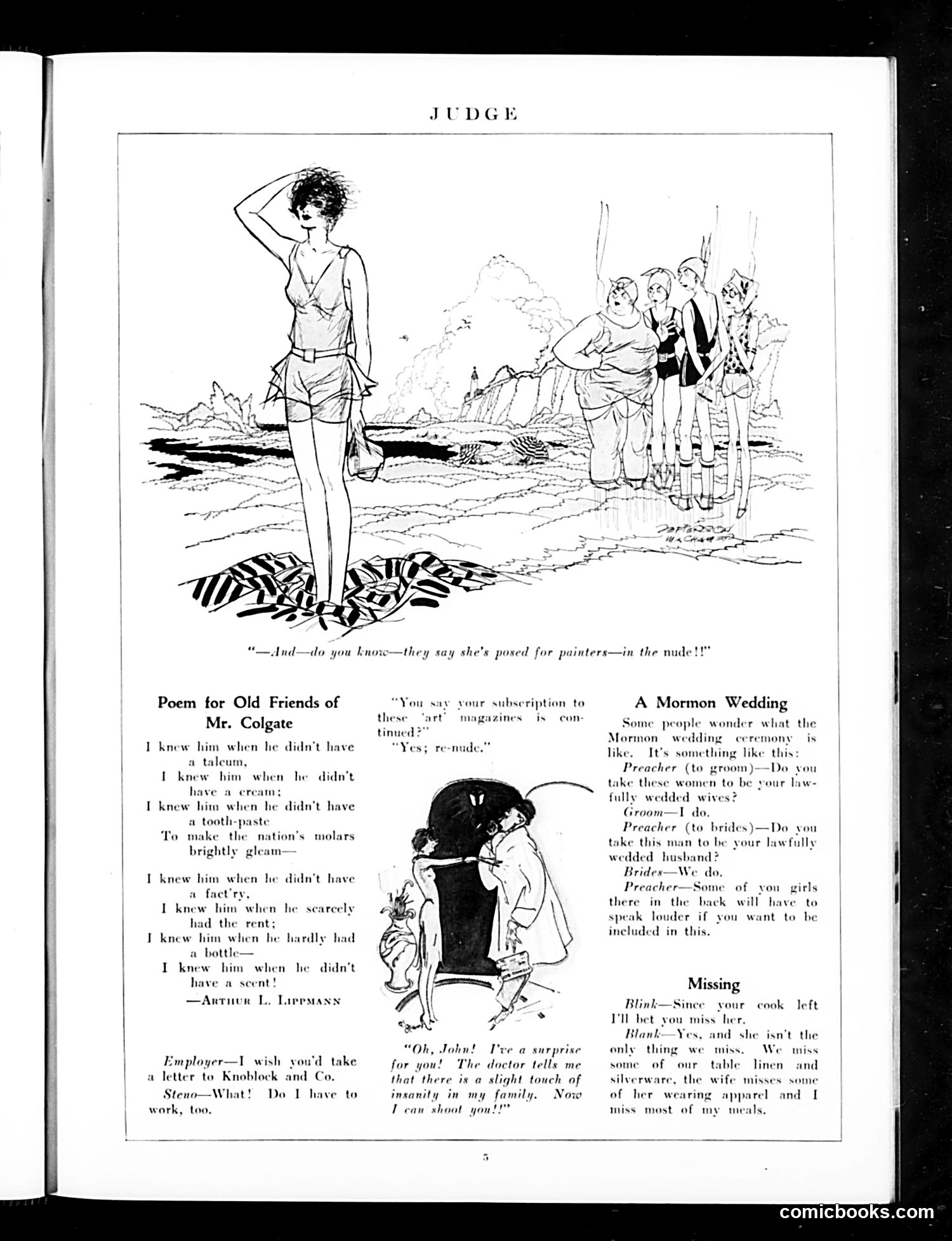
The main cartoon satirizes artistic nude modeling. A woman stands posing nude on a beach while fully-clothed observers (appearing to be painters or artists) watch from a distance. The caption suggests she's "posed for painters—in the nude," with the joke being the awkward public nature of this typically studio-based practice. The page also contains brief humorous pieces: a poem about knowing someone "when he didn't have" various things (satirizing social climbing), a dialogue about Mormon marriage practices, and a joke about a missing cook. These appear to be typical early-20th-century Judge magazine fare—light social satire targeting contemporary fashions, religions, and domestic situations rather than focused political commentary.
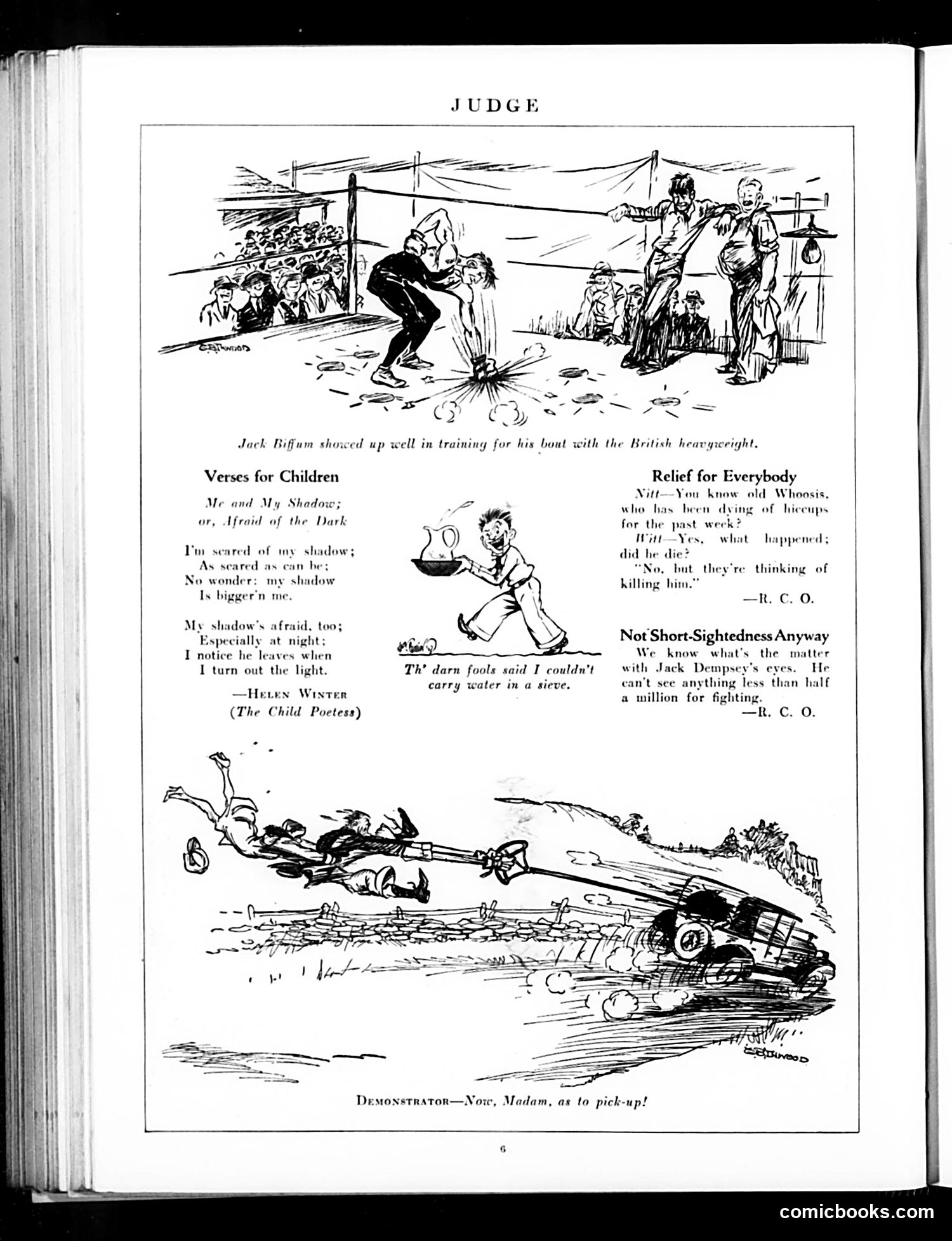
This page from *Judge* satirizes boxer **Jack Dempsey** (the heavyweight champion referenced in the top cartoon). The main joke concerns Dempsey's demanding fight purses: the quips mock his allegedly inflated financial expectations, with one suggesting he "can't see anything less than half a million for fighting." The top illustration shows Dempsey training for a bout against a British heavyweight, likely referencing actual promotional interest in international boxing matches of the 1920s. The page also includes unrelated humor: children's verse about shadows, brief jokes about hiccups and foolish water-carrying, and a chaotic illustration labeled "Demonstrator" showing a car crash. The Dempsey material reflects contemporary public fascination with professional boxing and celebrity athletes' controversial contract negotiations—a significant cultural topic in the Jazz Age.
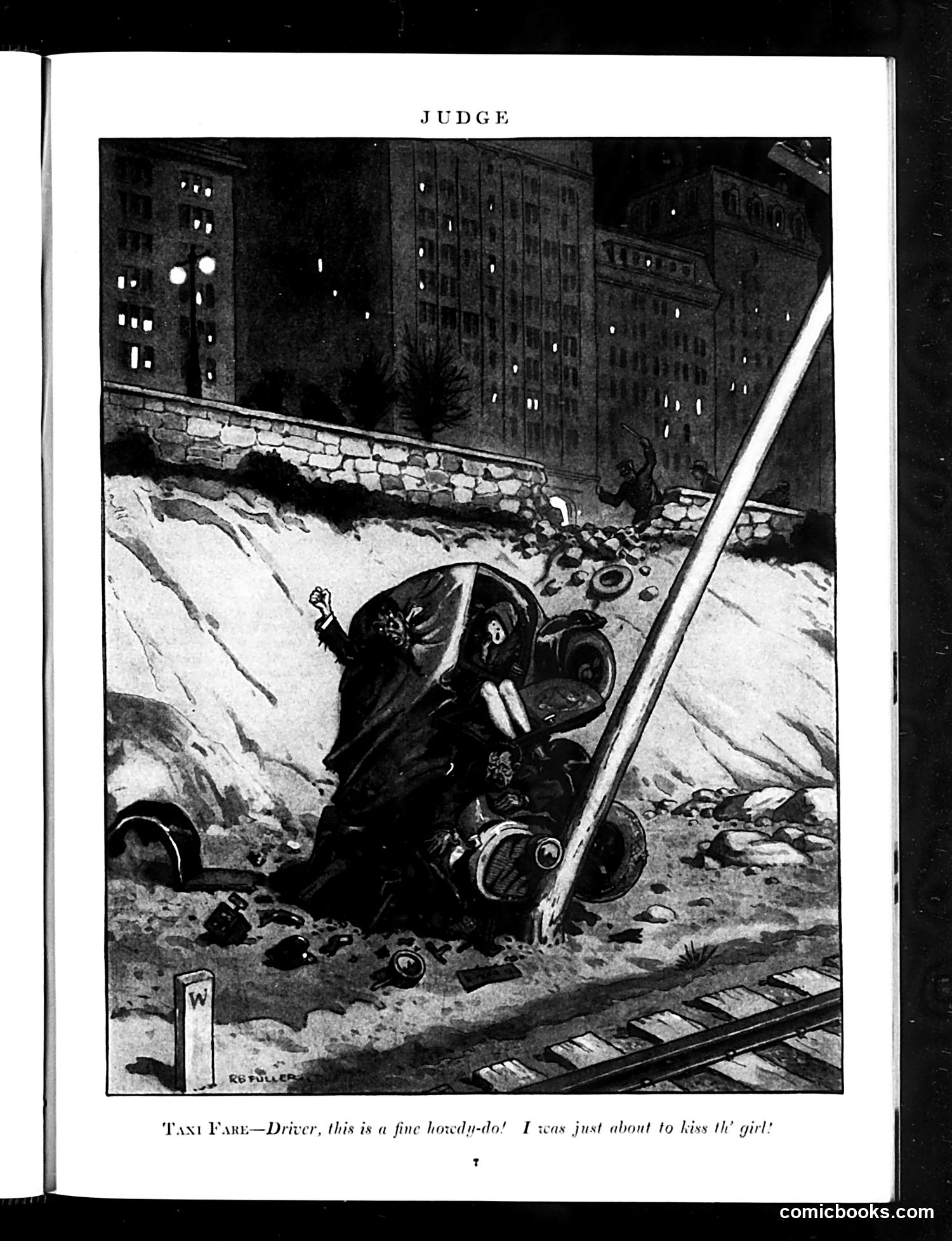
This is a single-panel cartoon from Judge magazine satirizing early automobile culture and romantic mishaps. The scene shows a taxi that has crashed into rubble near urban buildings, with the driver gesturing in complaint. The joke plays on the phrase "fine howdy-do" (meaning a mess or predicament). A passenger—apparently on a romantic date—complains that the crash interrupted a kiss with his companion. The satire targets the hazards of newfangled taxi cabs in cities, suggesting they're so unreliable they interfere with passengers' personal lives. It's also mocking the passenger's priorities: he's more concerned about his interrupted romance than the actual accident itself, reflecting period attitudes toward both automobiles and dating customs.
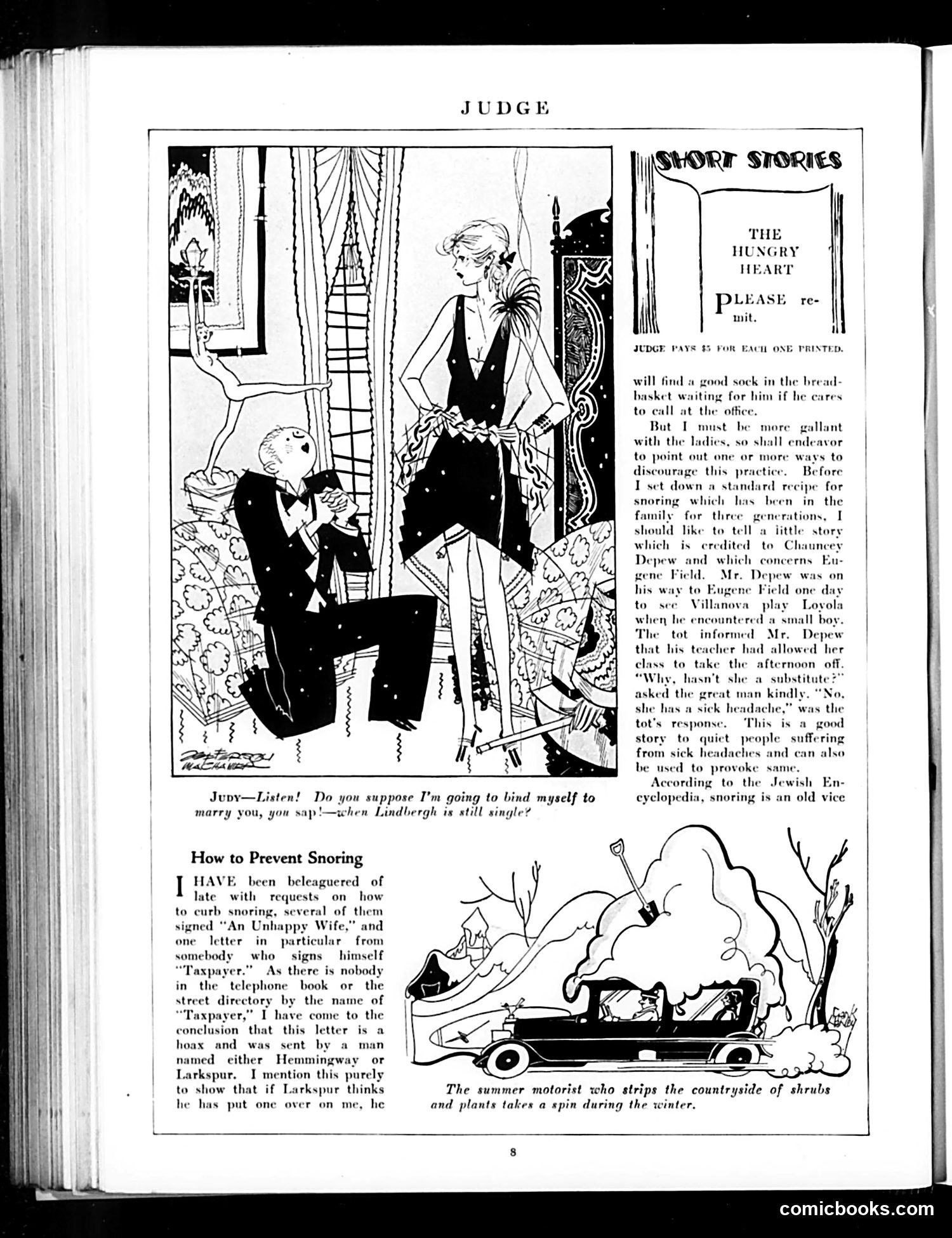
This Judge magazine page contains two satirical pieces: **Top cartoon**: A flirtation joke where a woman ("Judy") dismisses a suitor's marriage proposal, claiming she won't commit while Charles Lindbergh—the famous aviator and celebrity of the 1920s—remains single. The satire targets both Lindbergh's celebrity status and women's romantic fickleness. **"How to Prevent Snoring"**: A humorous advice column where the author claims someone named "Larkspur" (likely a pseudonym) has hoaxed him with fake letters about snoring. He threatens retaliation and promises snoring remedies. The piece includes an anecdote credited to Chauncey Depew (a prominent 19th-century politician) about a teacher with a sick headache. **Bottom cartoon**: Satirizes summer motorists who strip countryside shrubs and plants for decoration, then take joy rides in winter—depicting destructive, entitled behavior. The overall tone reflects Judge's satirical approach to contemporary American social habits and celebrity culture of the era.
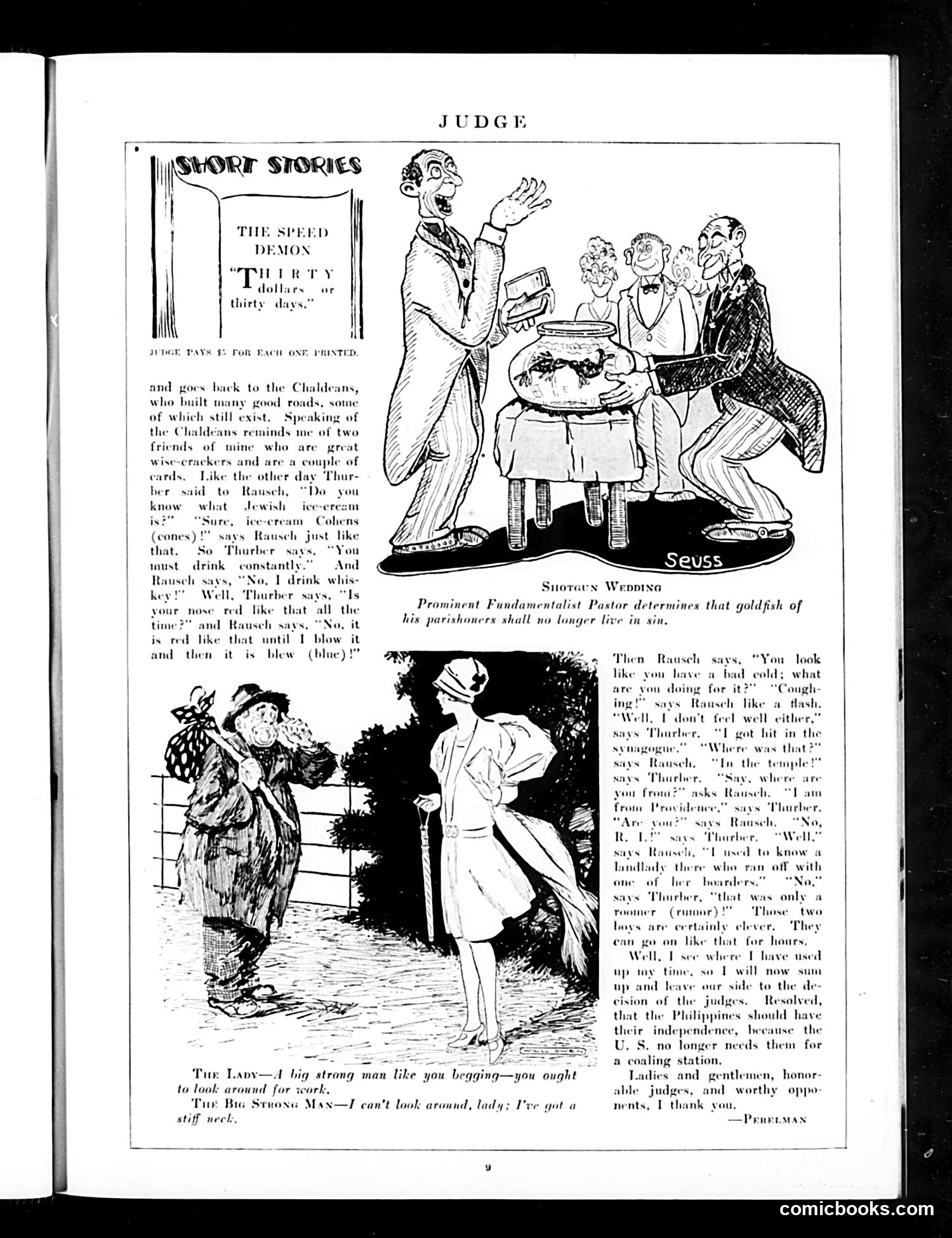
This page contains two distinct satirical pieces: **Upper cartoon ("Seuss's Wedding"):** A fundamentalist pastor preaches that his parishioners' goldfish "shall no longer live in sin"—mocking extreme religious moralizing by extending it absurdly to pets. The pastor's overwrought gesture and the parishioners' reactions satirize self-righteous religious extremism of the era. **"Shore Stories" section:** A rambling anecdote about two Jewish friends (Rausch and Thurber) trading ethnic jokes and puns. The humor relies on Jewish stereotypes and dialect comedy common in early-20th-century American humor—what modern readers would recognize as offensive ethnic humor. **Bottom cartoon:** A beggar claims he can't look for work because of a "stiff neck"—a visual gag mocking those who make excuses for unemployment or vagrancy. **The "Philippine Independence" resolution** references contemporary debate over U.S. colonial holdings, suggesting the Philippines should gain independence since America no longer needs them as a coaling station. The page reflects Judge's satirical approach through caricature, puns, and social commentary typical of the era.
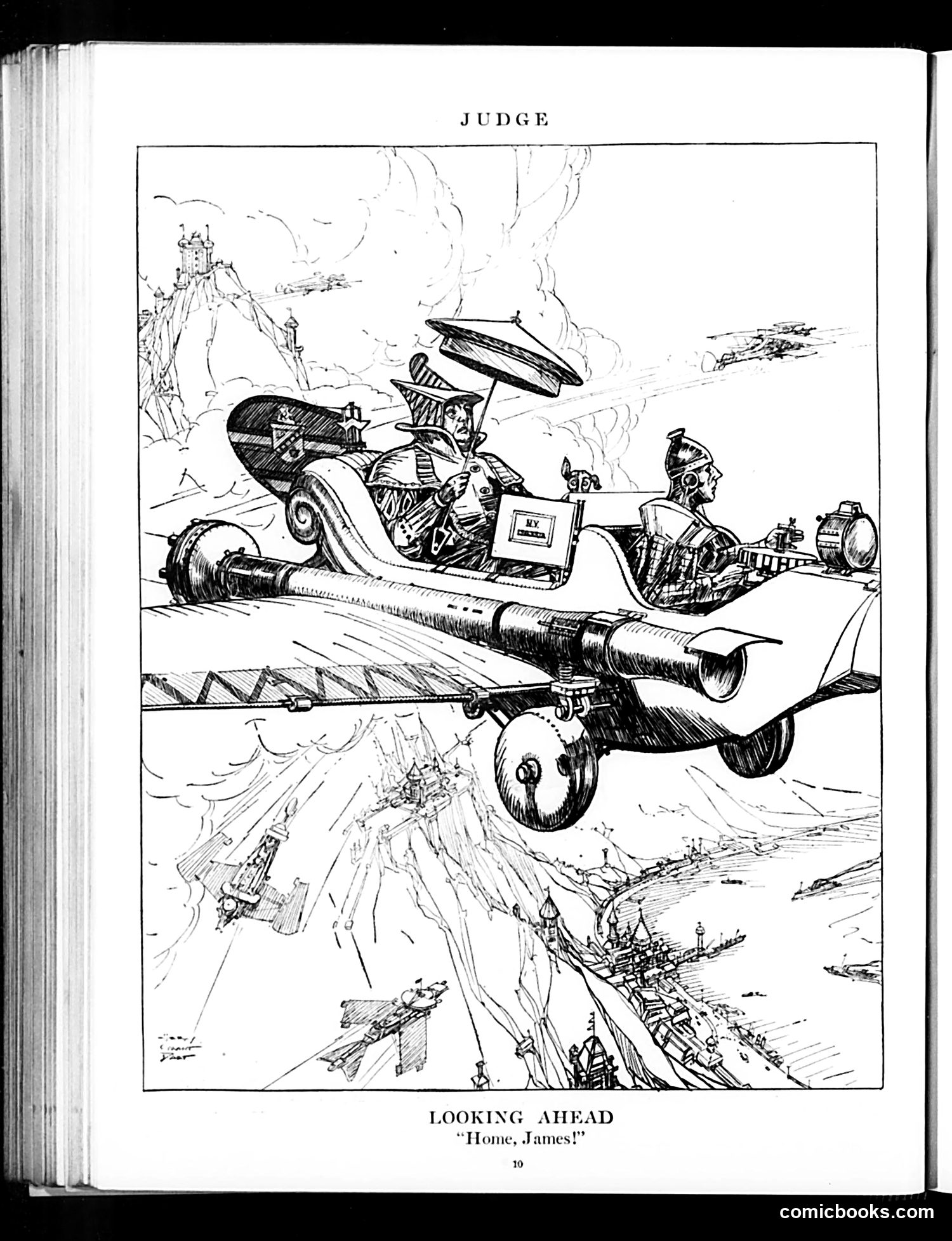
This political cartoon depicts a fantastical airship or dirigible carrying military or governmental figures through clouds, with the caption "Home, James!" suggesting a journey's end or return. The image appears to be allegorical commentary on power, leadership, or national direction—likely from the early 20th century based on the art style and airship technology depicted. The figure at the helm appears to be a judge or authority figure (matching the magazine's title), while smaller figures below suggest ordinary citizens or troops. Without additional context about the specific historical moment, the exact identities remain unclear, though the "looking ahead" theme suggests optimism or anticipation about future prospects. The satirical nature suggests commentary on either military ambitions, governance, or societal progress.
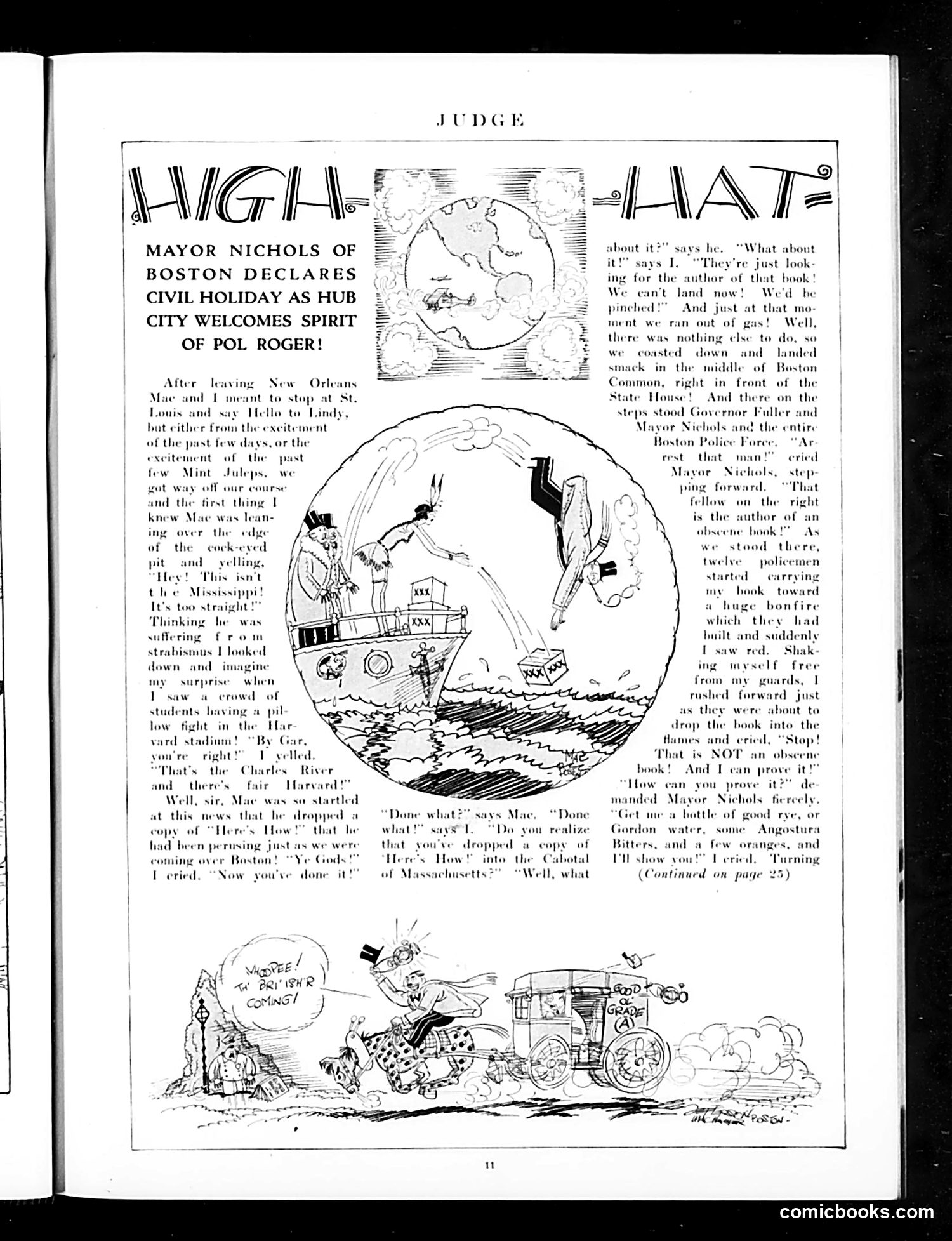
This page satirizes the famous 1927 landing of aviator Charles Lindbergh ("Lindy") in Boston. The narrator claims to have accidentally dropped a book titled "Here's How!" during a flight, which landed in Boston Common in front of Mayor Nichols and Governor Fuller. The satire works on multiple levels: it mocks the civic hysteria surrounding Lindbergh's celebrity, suggesting Boston authorities would nearly burn what they assume is an "obscene book" without question. The joke centers on the book's title—"Here's How!" appears to be a cocktail recipe book (reinforced by references to "rye," "Angostura Bitters," and "good rye")—making the near-bonfire an absurd overreaction by moralistic officials during Prohibition era. The cartoons depict the chaotic scene with exaggerated characters and slapstick elements typical of Judge's humor, mocking both celebrity worship and zealous censorship of the period.
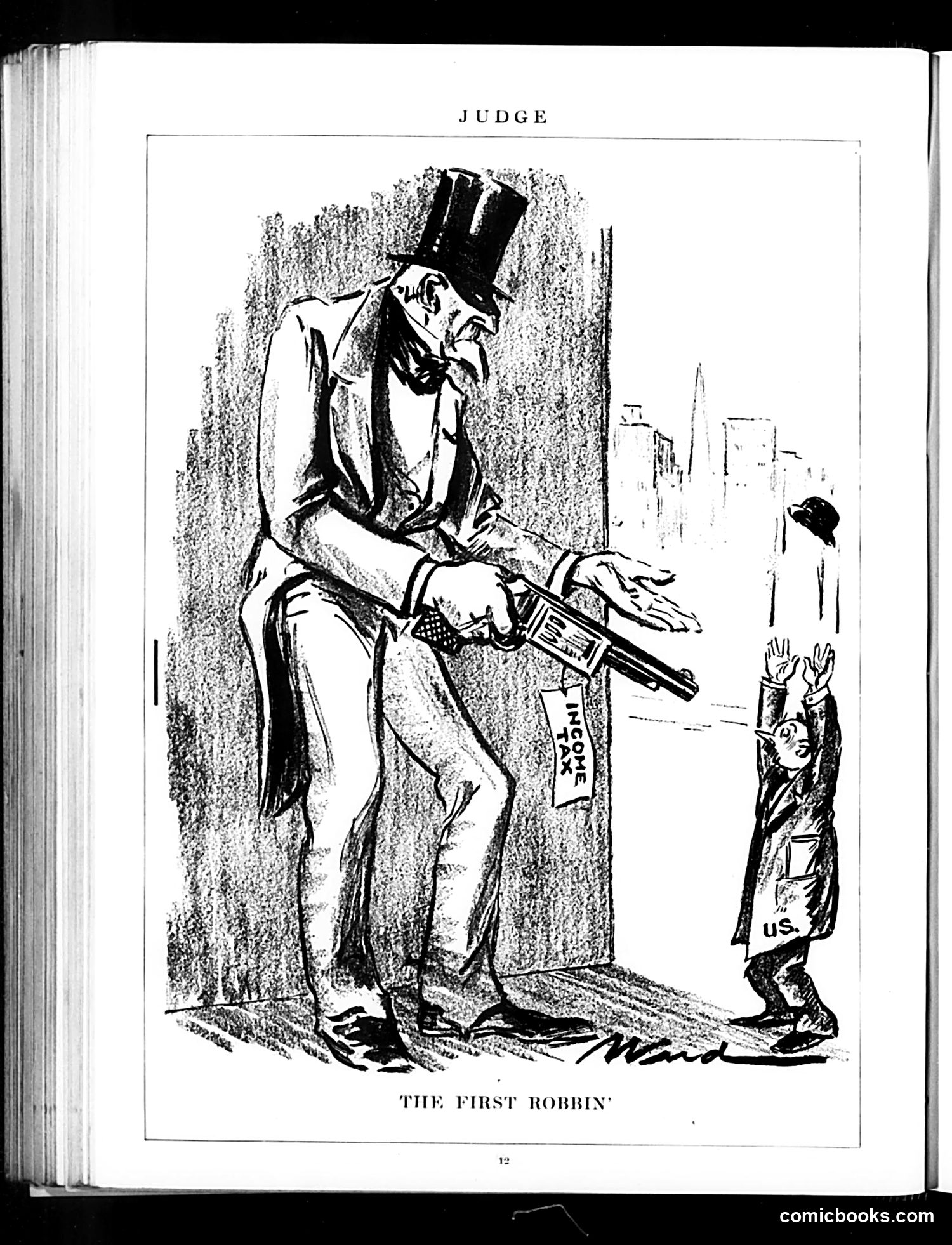
This political cartoon depicts a well-dressed figure in a top hat (representing judicial authority or "the Judge") pointing a revolver at a small figure labeled "U.S." The small figure appears to be fleeing or defending itself with raised hands. The satire critiques judicial overreach or abuse of power against American interests. The title "The First Robbin'" (a pun on "robin"—stealing) suggests the cartoon accuses the judge of robbing or violating U.S. rights or authority. The composition—with the armed authority figure threatening the much smaller, vulnerable U.S. personification—emphasizes the imbalance of power and injustice the cartoonist perceived. Without the publication date visible, the specific historical grievance remains unclear, though it likely references a controversial judicial decision from the Gilded Age or Progressive Era.
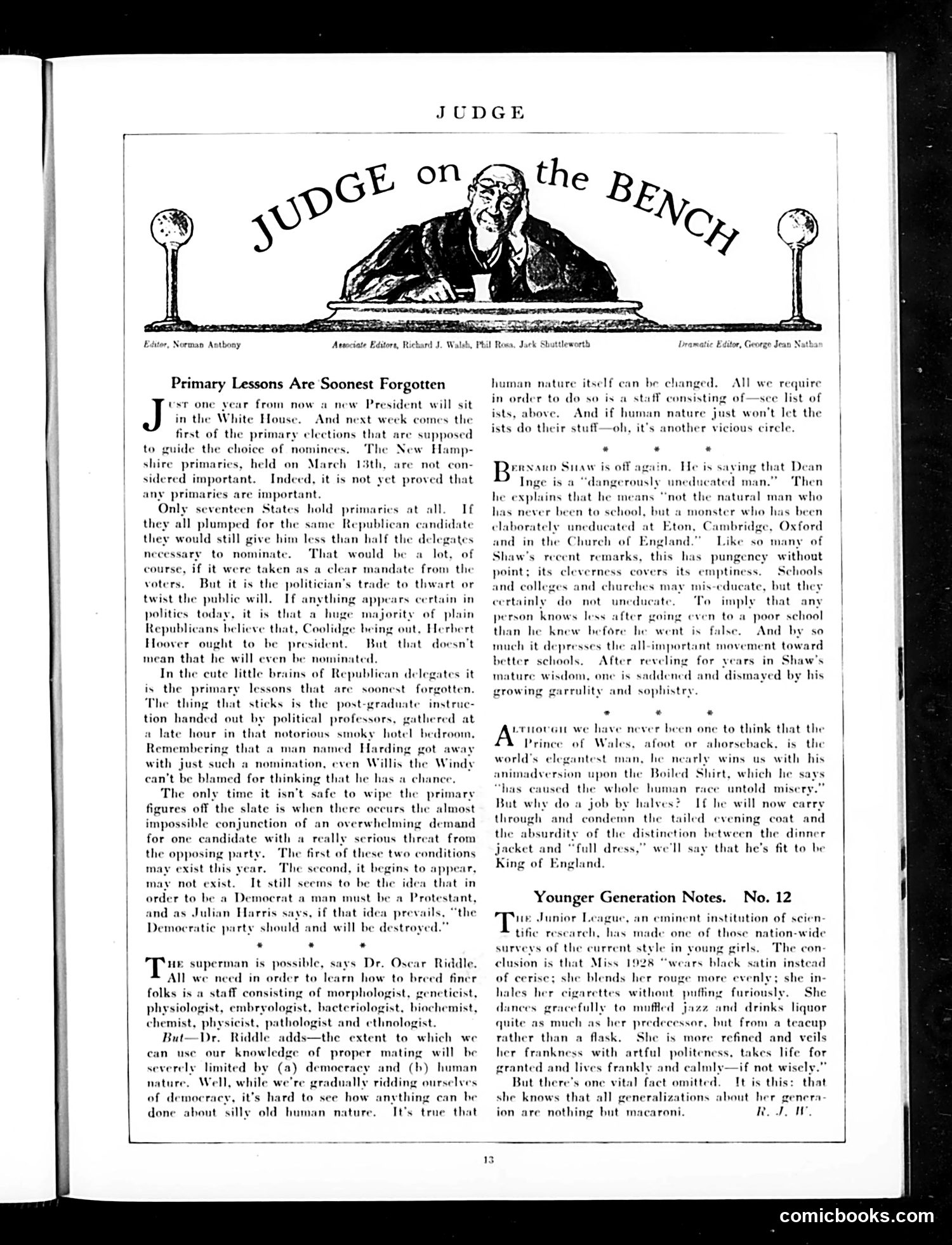
This editorial page from *Judge* magazine features several satirical commentaries on 1920s American politics and public figures. **Primary Elections Satire**: The lead article mocks the upcoming Republican primary elections (referencing New Hampshire's March 13th primary), arguing that primary results are meaningless—politicians ignore public will in smoke-filled hotel rooms anyway. It suggests Republicans favor Herbert Hoover despite the charade of primaries, and references Willis (likely William Jennings Bryan or a similar figure) as an unlikely dark horse candidate. **Religious Qualification Debate**: A brief note criticizes Julian Harris's suggestion that Democrats require Protestant membership, calling this exclusionary. **Bernard Shaw Critique**: The piece ridicules George Bernard Shaw for calling Dean Inge "dangerously uneducated," arguing Shaw's own "growing garrulity and sophistry" undermines serious educational debates. **Dr. Riddle Commentary**: A satirical jab at scientific utopianism—mocking proposals to "breed finer folks" through eugenics while noting human nature remains stubbornly unchanged. The overall tone is cynical about political processes and intellectual pretension.
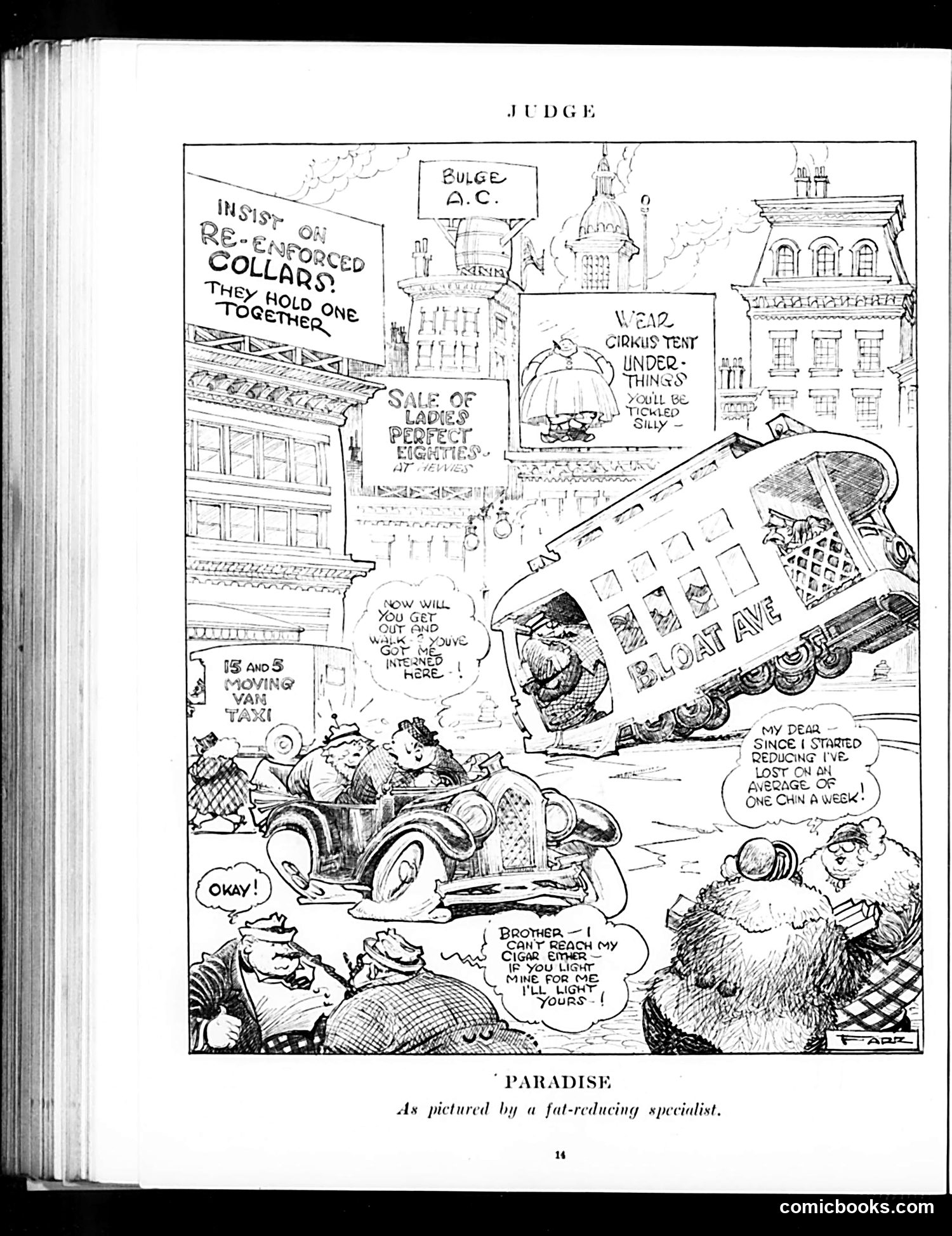
This Judge cartoon satirizes the early 20th-century fad of extreme weight-loss dieting. The central figure is a very overweight man being squeezed into or emerging from a boat labeled "Boat Ave," while various characters around him comment on their dieting struggles. The humor targets the absurdity and desperation of rapid weight loss: one character claims to have lost "one chin a week," while another struggles to reach his cigar due to his reduced physique. The carnival-like urban setting—with visible stores advertising "sale of reduced figures" and a circus tent—suggests weight-loss was commercialized as entertainment and spectacle. The satire mocks both the industry profiting from dieters' insecurities and the ridiculous extremes people pursued. The "paradise" of the title is ironic: the result shown is chaotic, uncomfortable, and absurd rather than heavenly. The drawing style emphasizes grotesque exaggeration, typical of Judge's satirical approach to social follies.
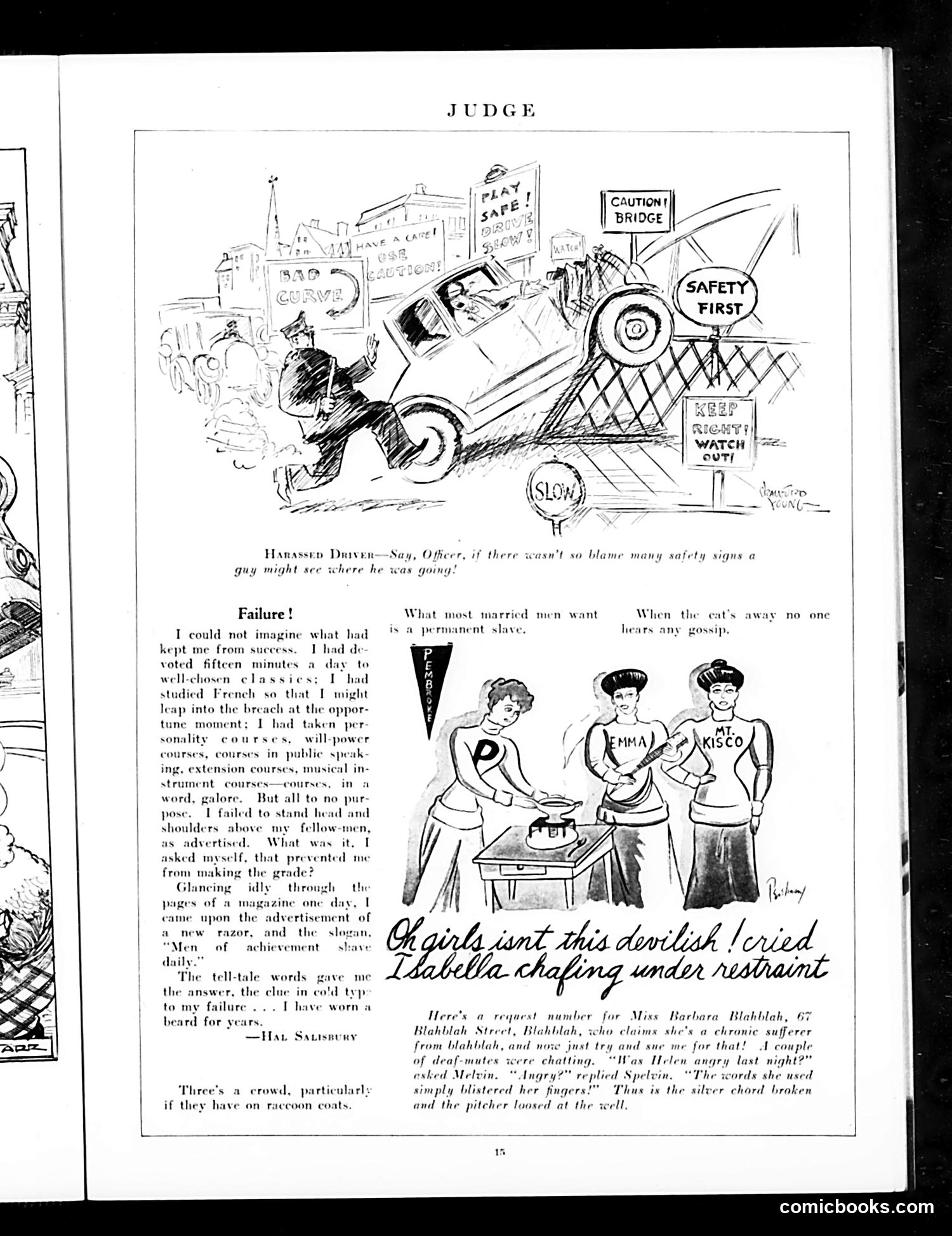
**Top Cartoon ("Harassed Driver"):** Satirizes excessive traffic safety signage. A driver, overwhelmed by "CAUTION BRIDGE," "SAFETY FIRST," "SLOW," and other warning signs, crashes while distracted trying to read them all. The joke: safety measures intended to protect actually endanger by creating visual clutter. **"Failure!" Article:** A humorous personal essay about self-improvement schemes. The author spent years on classical education, French, personality courses, and willpower training yet failed to stand out—until discovering a razor advertisement promising success. The satire mocks America's obsession with self-help products and courses marketed as shortcuts to achievement. **Bottom Cartoon:** Three women labeled with names (likely representing different types) discuss marriage. The captions humorously suggest wives want permanence/stability while husbands want freedom, and that women enjoy gossip when spouses are away. The page reflects 1920s-30s consumer culture anxieties: traffic modernization, self-improvement marketing, and gender dynamics in marriage.
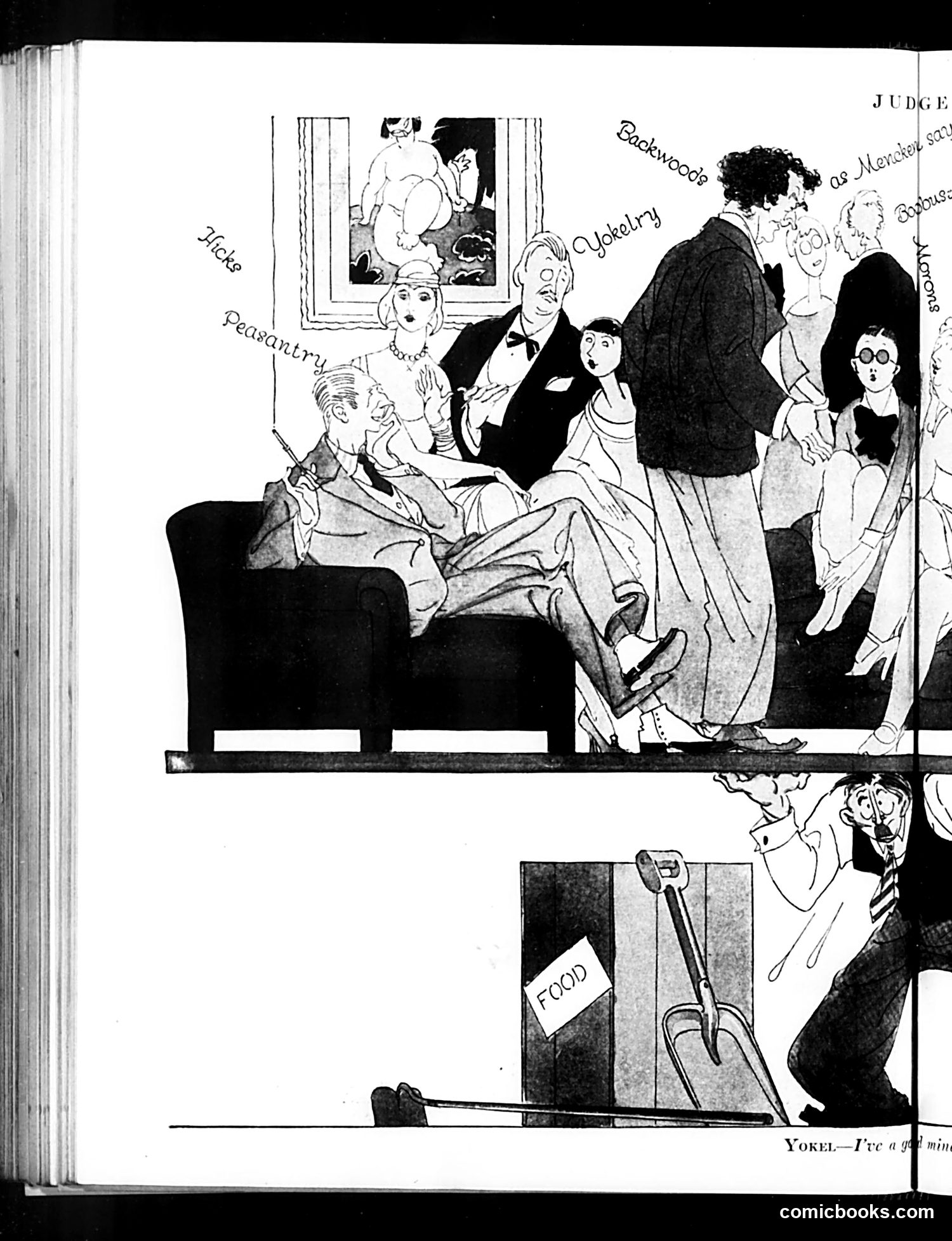
This page presents a satirical domestic scene depicting a formal gathering or party. The main cartoon shows a crowded interior with labeled character types including "Peasantry," "Hicke" [sic], "Backwoods," "Yokelry," and others, suggesting social class commentary. A man reclines on a couch while various guests mill about, indicating satire of social pretension or class mixing. The bottom panel shows a shovel labeled "FOOD," likely satirizing scarcity or economic hardship—possibly referencing Depression-era concerns about food distribution or agricultural labor. Without a visible date or clearer textual context, the precise historical reference remains uncertain. However, the overall tone suggests commentary on American class divisions and social anxieties during an economically turbulent period, mocking both upper-class affectation and rural/working-class stereotypes.
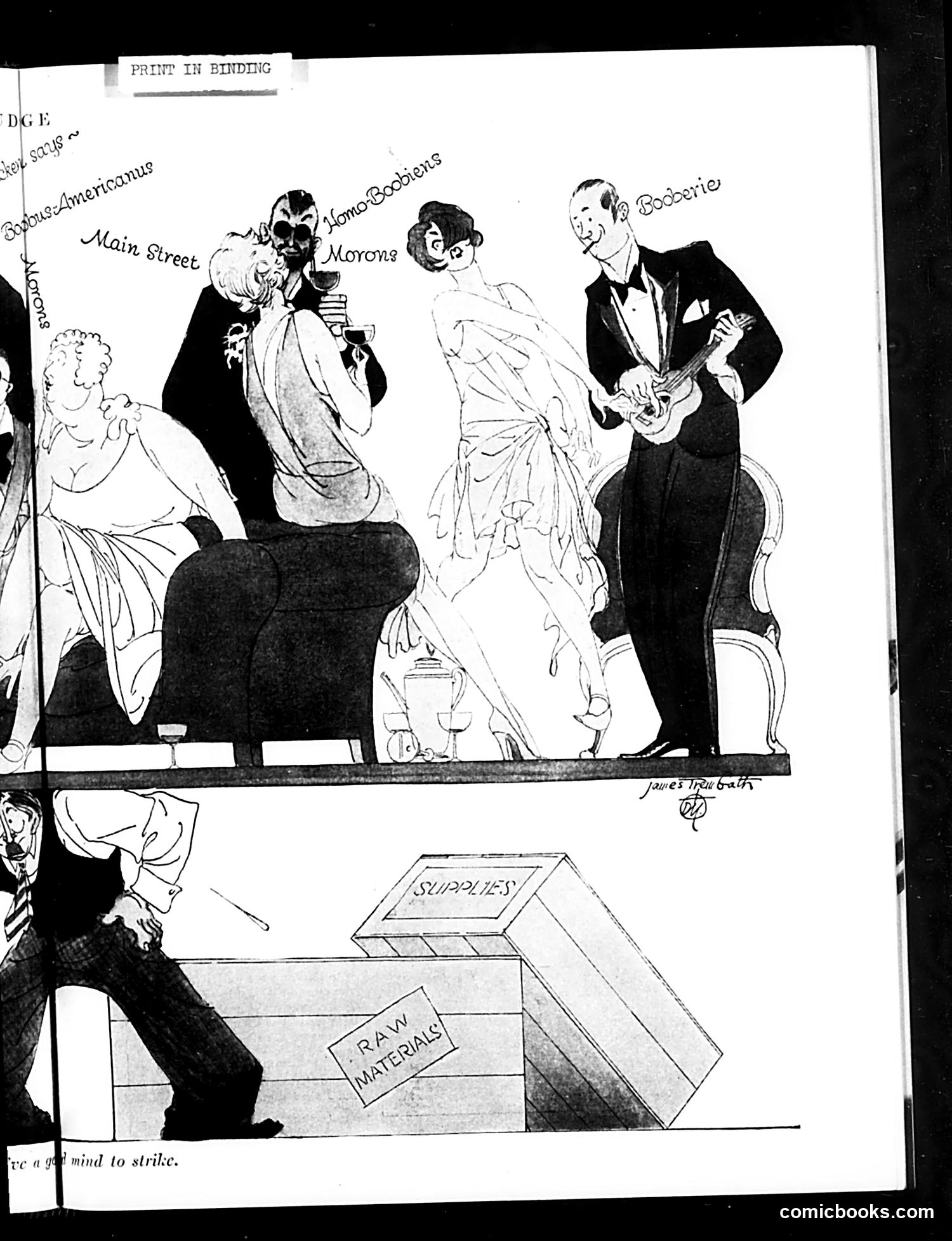
This appears to be a two-panel cartoon from *Judge* magazine. The top panel depicts a formal social gathering where elegantly dressed figures are labeled with location names: "Main Street," "Homo Boobiens," "Morons," and "Booberie," with references to "Exitus Americanus" and "Neogene." The bottom panel shows a crate labeled "RAW MATERIALS" and "SUPPLIES," with a figure nearby. **Context unclear**: The specific satirical target is difficult to determine from the image alone. The labels appear to mock American society or a particular demographic through pseudo-scientific nomenclature, suggesting social commentary on class, behavior, or civic life. The artist is credited as "James Triorooth" (or similar). Without clearer OCR text or historical context about *Judge*'s publication date, the precise political or social reference remains uncertain.
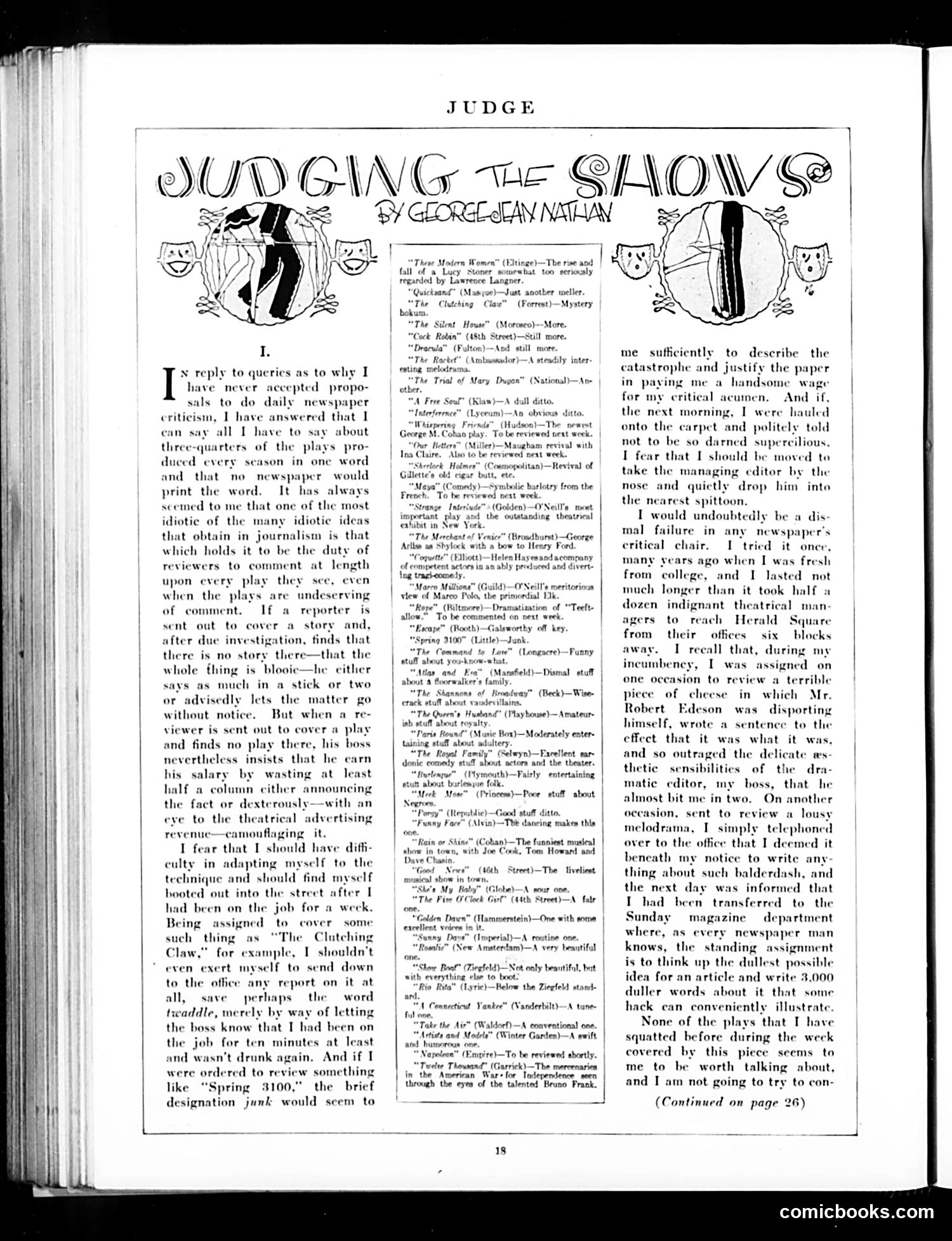
This page is a theatrical criticism column disguised as humorous commentary. Nathan, a prominent drama critic, explains why he refuses to write lengthy newspaper reviews of every play. The left column lists current Broadway productions (titles visible include "These Modern Women," "Quicksand," "The Clutching Claw," "Dracula"), mostly dismissing them with one-word judgments like "dull" or "more." Nathan's satire targets journalism's demand that critics fill column space regardless of whether a play merits discussion. He recounts being reassigned for writing a scathing review so caustic that his editor nearly attacked him physically, and another instance where he simply telephoned in a dismissal of a "lousy melodrama." The joke: Nathan argues that forcing critics to write substantively about mediocre theater is absurd—yet newspapers insist on it anyway, prioritizing filler content over honest assessment. This reflects early 20th-century tensions between serious arts criticism and commercial publishing demands.
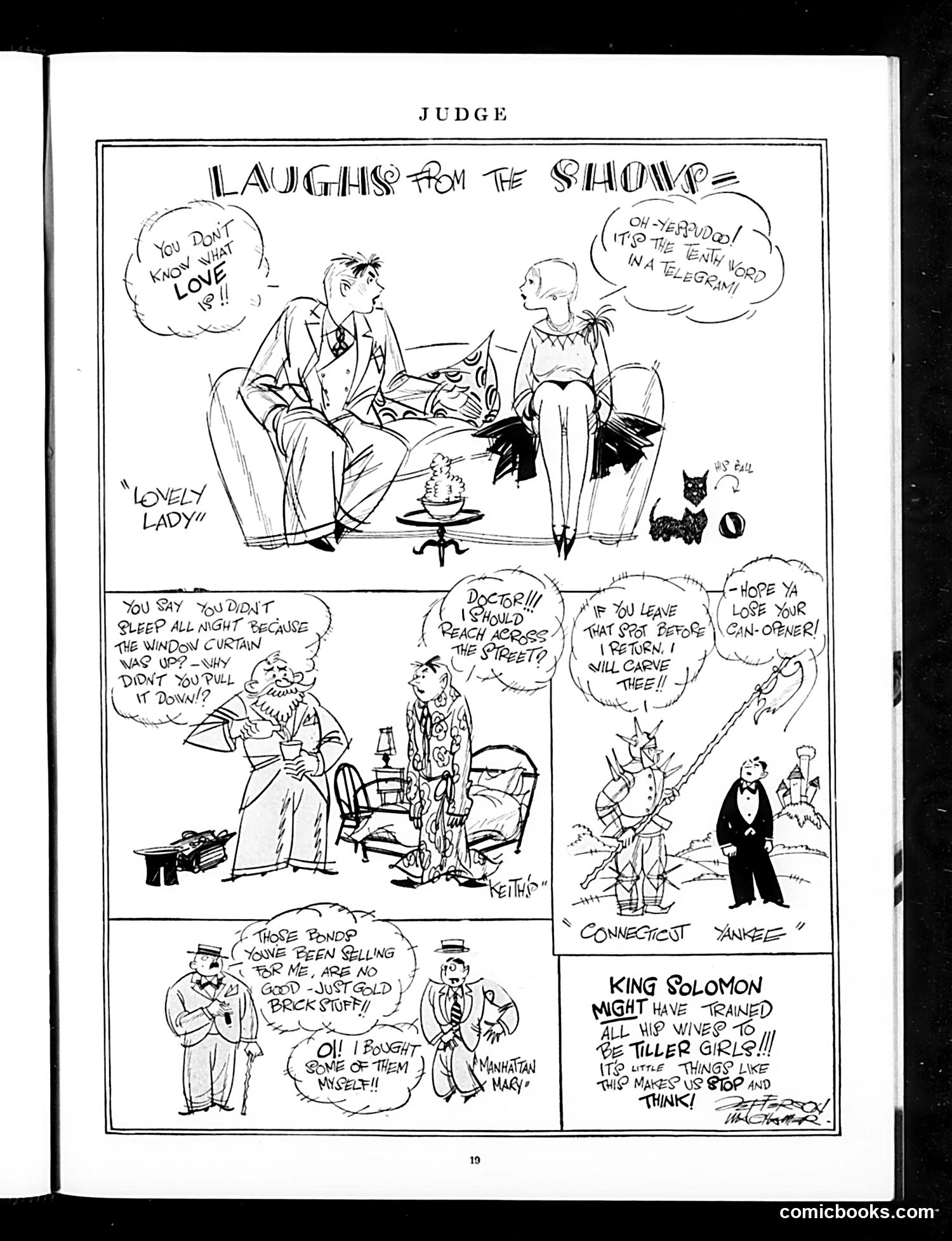
This page satirizes high society and romantic comedy theater tropes of the early 20th century. The top panel mocks theatrical clichés: a couple on a couch exchanges overwrought dialogue about love ("You don't know what love is!"), while a woman boasts about exotic travel and a man makes exaggerated claims. Lower panels depict characters discussing "ponds" and selling items, with references to "Connecticut Yankee" and "Manhattan Mary"—likely theater productions or contemporary shows. The final panel jokes about "King Solomon" training "tiller girls" (chorus dancers), sarcastically suggesting such biblical wisdom could improve theatrical performers' behavior and thinking. The humor targets both sentimental stage conventions and the perceived superficiality of show business culture. A cat observes the absurdity throughout, emphasizing Judge's mockery of the entertainment world's pretensions.
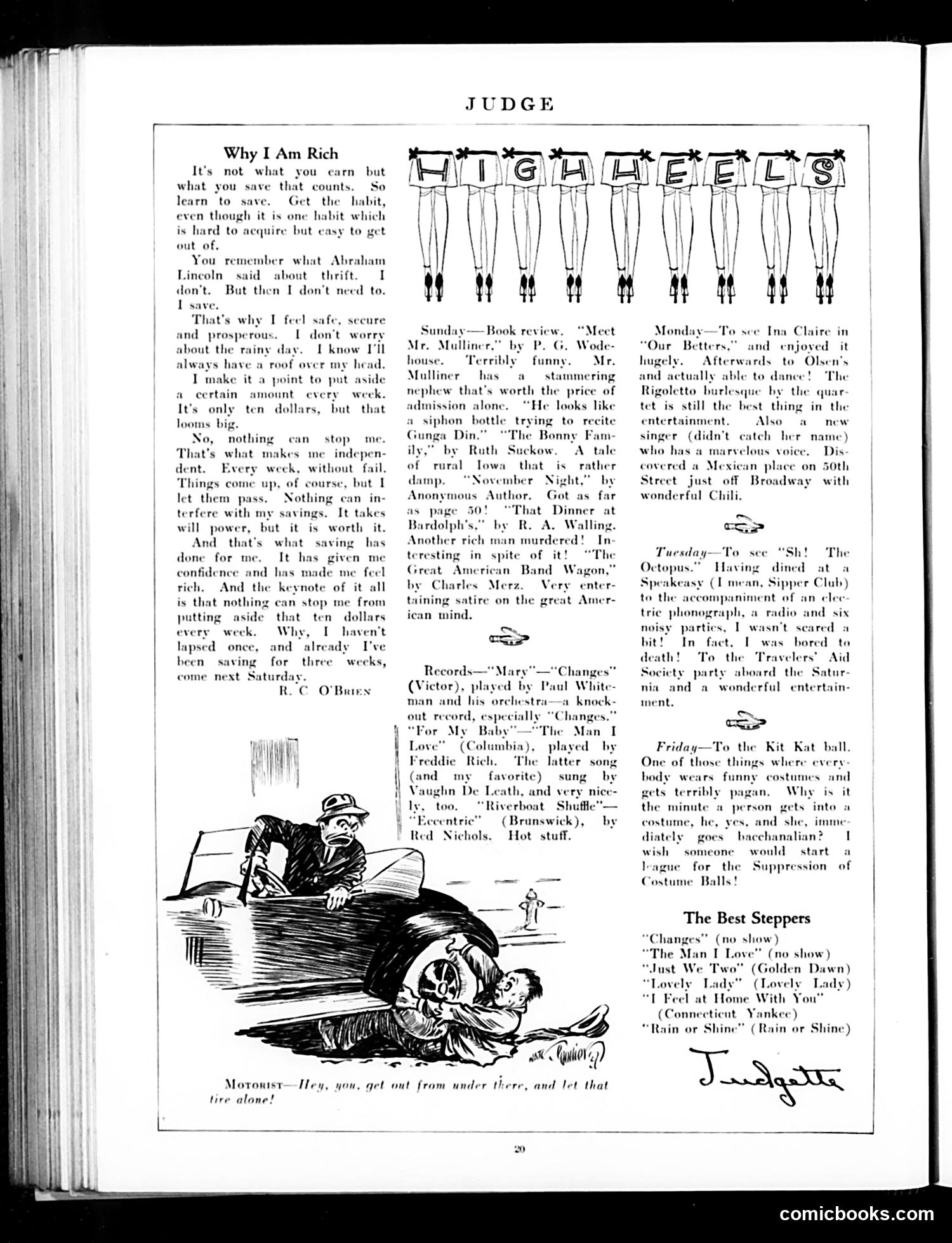
This page from the satirical magazine *Judge* contains commentary on wealth and leisure from the perspective of an affluent reader. ## Main Content **"Why I Am Rich"**: An essay praising disciplined saving—depositing ten dollars weekly—as the path to security and independence. The author credits this habit, not income, with their prosperity, invoking Abraham Lincoln's thrift philosophy. **The Cartoon**: A motorist stuck under a tire addresses a pedestrian, with the caption "Motorist—Here, you get out from under there, and let that tire alone!" This appears to mock careless behavior or entitlement. **Entertainment Diary**: The right column logs a week's leisure activities—theater reviews (*Meet Mr. Mulliner*, *Our Betters*, *Sh! The Octopus*), nightclub visits, and record recommendations. This juxtaposes working-class savings advice with upper-class entertainment consumption, likely the satire's point: preaching thrift while indulging luxuriously. **The Best Steppers**: A list of popular dance songs, suggesting current entertainment trends. The page's irony appears intentional—teaching frugality while chronicling expensive amusements.
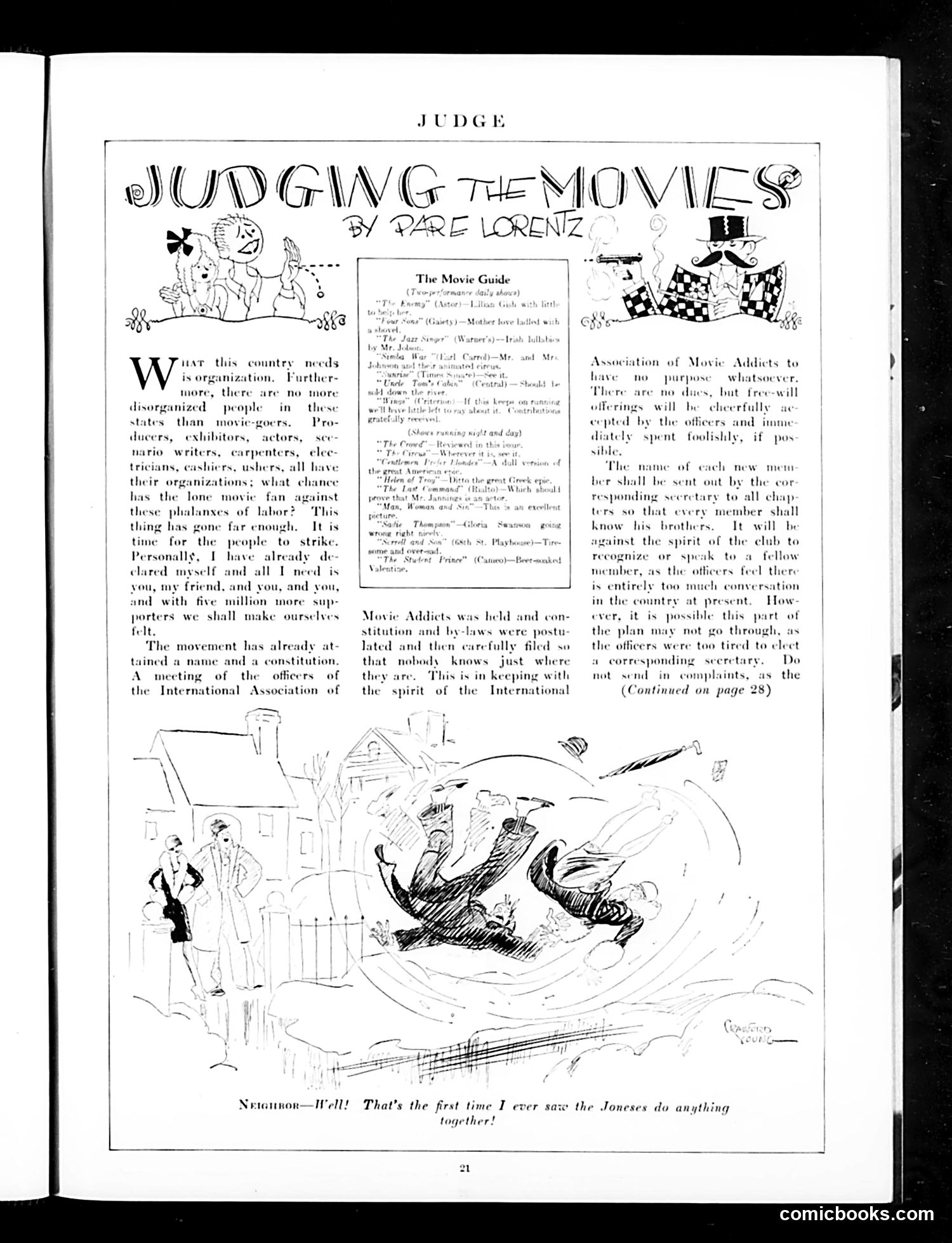
This page satirizes the formation of the "Association of Movie Addicts"—a fictional organization parodying the numerous labor unions and advocacy groups emerging in 1920s America. The main text mocks how every profession (producers, writers, carpenters, electricians, ushers) has organized, so now even movie-goers are unionizing. The satire targets organizational excess: the group has bylaws and a constitution but deliberately collects no dues and forbids members from speaking to each other—undermining the entire purpose of association. The cartoon at bottom shows a chaotic collision, illustrating the absurdity. The closing caption—"Well! That's the first time I ever saw the Joneses do anything together!"—suggests the broader joke: American society has become so fractured into competing interest groups that even doing *nothing* together (as this club does) represents unusual unity. The satire critiques both labor activism and the decade's proliferating special-interest organizations.
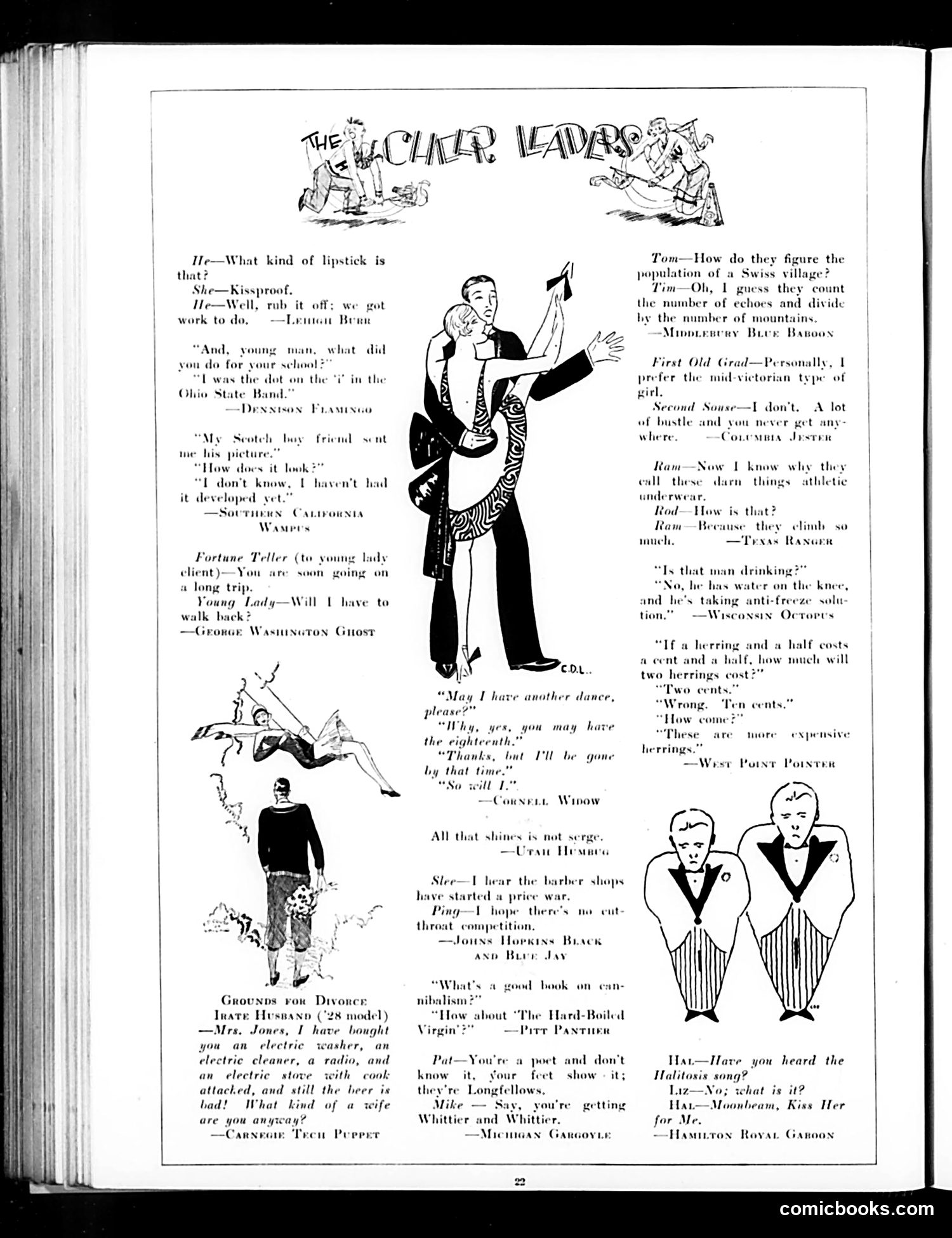
This is a humor page from *Judge* magazine featuring short jokes and one-liners attributed to various colleges and regional sources. The central cartoon shows a man in formal attire dancing with a woman, illustrating the joke about requesting the "eighteenth" dance. The jokes reflect early 20th-century concerns and social attitudes: - **Gender dynamics**: Jokes about lipstick, Scottish boyfriends, and dating expectations reveal period attitudes toward courtship and women's appearance. - **Modern conveniences**: A husband's complaint about his wife despite buying her electrical appliances (washer, cleaner, radio, stove) satirizes consumer culture and marital friction over domestic expectations. - **Wordplay and puns**: Many jokes rely on double meanings—"athletic underwear" climbs, "water on the knee" as a drinking excuse, the "Hard-Boiled Virgin" book title. - **Regional humor**: Attributions to different colleges and cities suggest this was compiled from campus and regional sources. The page presents lighthearted, often mildly risqué humor typical of 1920s-era satirical magazines aimed at educated readers.
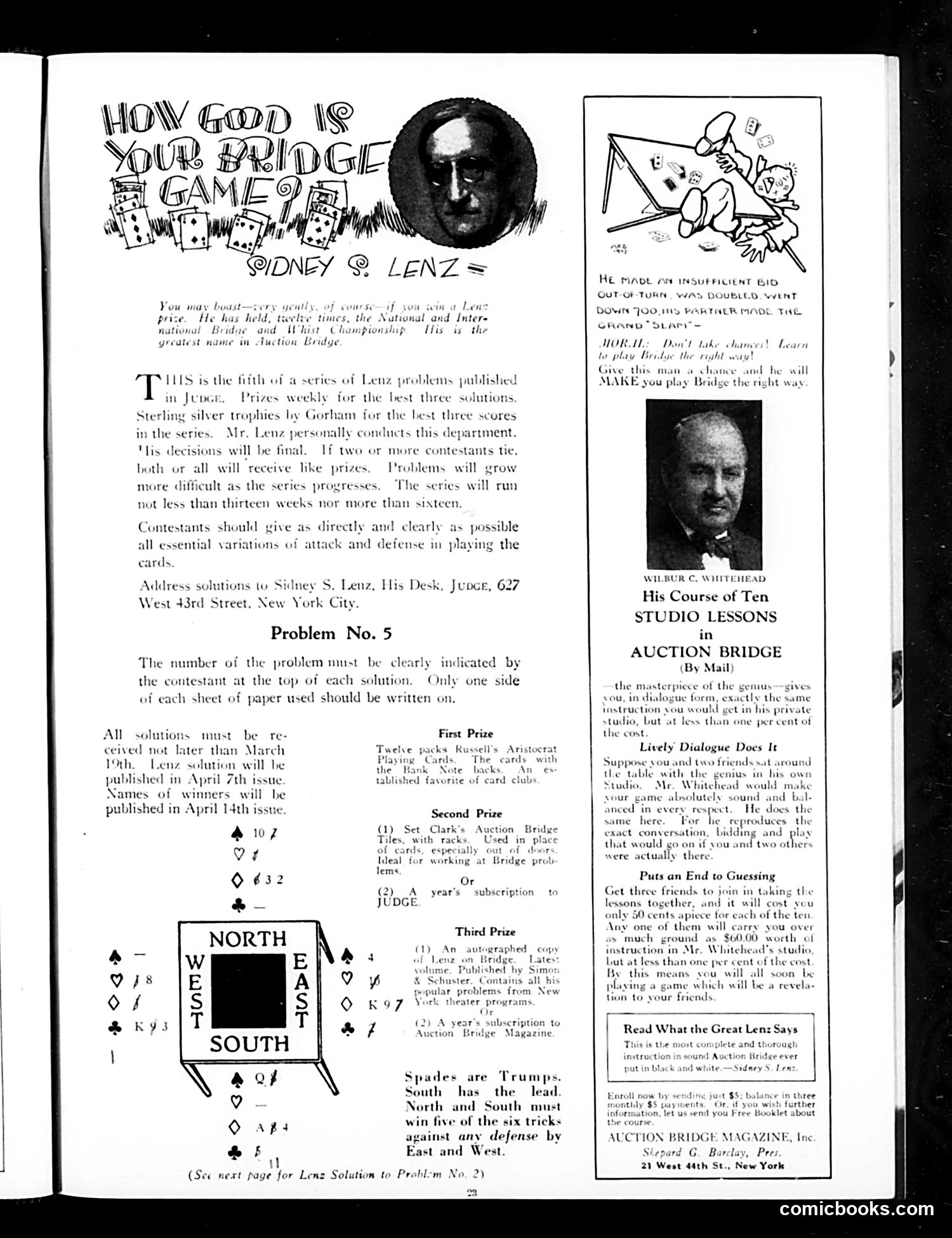
This page from Judge magazine primarily features **bridge card game content** rather than political satire. It's a problem-solving competition sponsored by the publication. The main elements are: 1. **"How Good is Your Bridge Game?"** - A weekly series by Sidney S. Lenz, a famous bridge player and instructor, offering prizes (Gorham silver trophies) for best solutions to bridge hands. 2. **Problem No. 5** - A detailed bridge scenario with North/South/East/West card positions, challenging readers to find the winning strategy. 3. **Advertisement for Wilbur C. Whitehead's bridge instruction** - "His Course of Ten Studio Lessons in Auction Bridge (By Mail)" - promoting correspondence instruction at reduced cost compared to private lessons. 4. **A small cartoon** (top right) illustrating a bridge blunder for humorous effect. This reflects the **1920s bridge craze** - auction bridge was wildly popular as both a parlor game and serious competitive pursuit. Judge positioned itself as serving educated, leisure-class readers interested in such pastimes. There is minimal political content on this page.
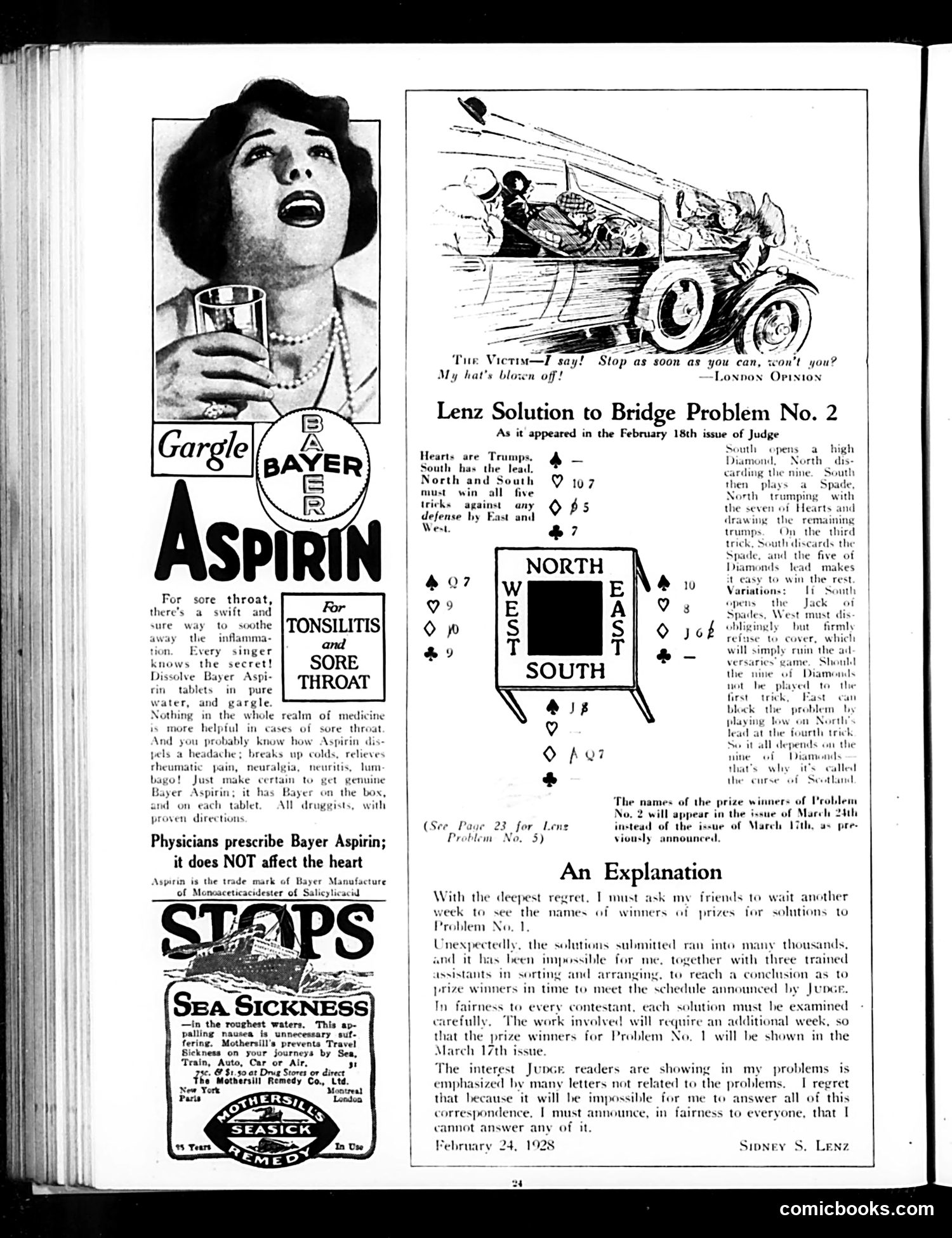
This page combines advertisements and bridge problem content rather than political satire. The main elements: **Left side**: Bayer Aspirin ads featuring a woman gargling and promoting aspirin for sore throats and various ailments. The ads claim aspirin "does NOT affect the heart"—likely responding to contemporary medical concerns about the drug's safety. **Right side**: "Lenz Solution to Bridge Problem No. 2," a contract bridge puzzle with detailed card-play instructions for readers. Sidney S. Lenz, a prominent bridge authority, explains that Problem No. 1 received thousands of solutions, making it impossible to judge winners on schedule. He apologizes for delays and notes he cannot answer reader correspondence about the problems. **Bottom ad**: Mothersill's Seasick Remedy, promoting relief for motion sickness during travel. The page reflects 1920s consumer culture and the era's fascination with bridge as a popular parlor game. No political commentary is present.
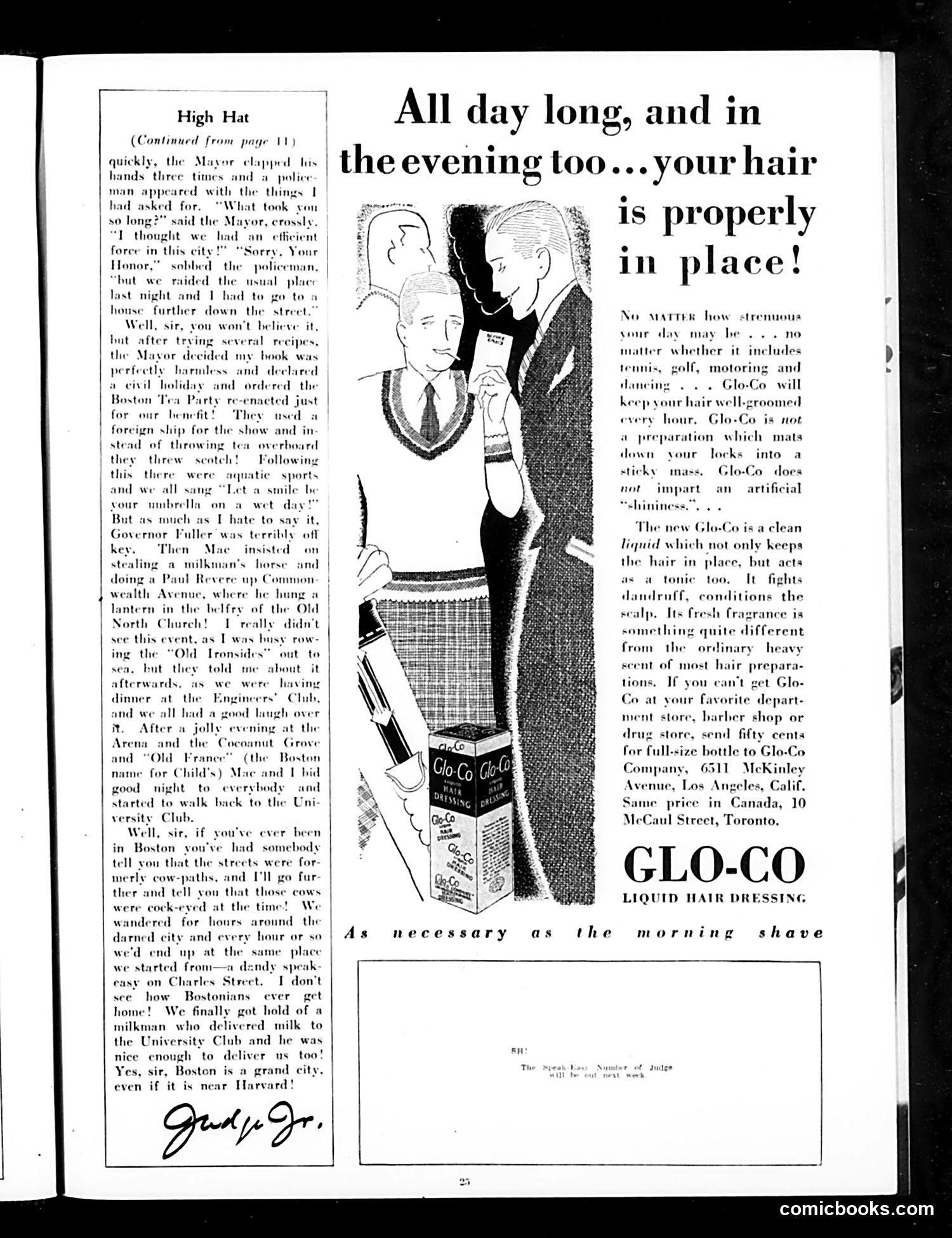
This page contains two distinct elements: a continued humorous story titled "High Hat" (left column) and a **Glo-Co hair dressing advertisement** (right side and bottom). **The Story:** A satirical narrative about Boston, where the unnamed narrator describes the Mayor's bizarre reactions to events. The "High Hat" appears to be a comedic tale mocking Boston's pretensions—featuring exaggerated historical reenactments (the Boston Tea Party, Paul Revere) performed for entertainment, and jokes about Boston's confusing streets (allegedly former cow-paths). The humor relies on absurdity and local Boston references rather than political commentary. **The Advertisement:** The Glo-Co ad is a standard period product pitch emphasizing that the hair product keeps hair "in place" throughout active days (tennis, golf, motoring, dancing) without looking artificial or greasy. It markets as both a grooming aid and scalp treatment, offering mail-order purchase options. Neither element contains overt political satire—this appears to be primarily **entertainment and advertising content** typical of 1920s-era Judge magazine.
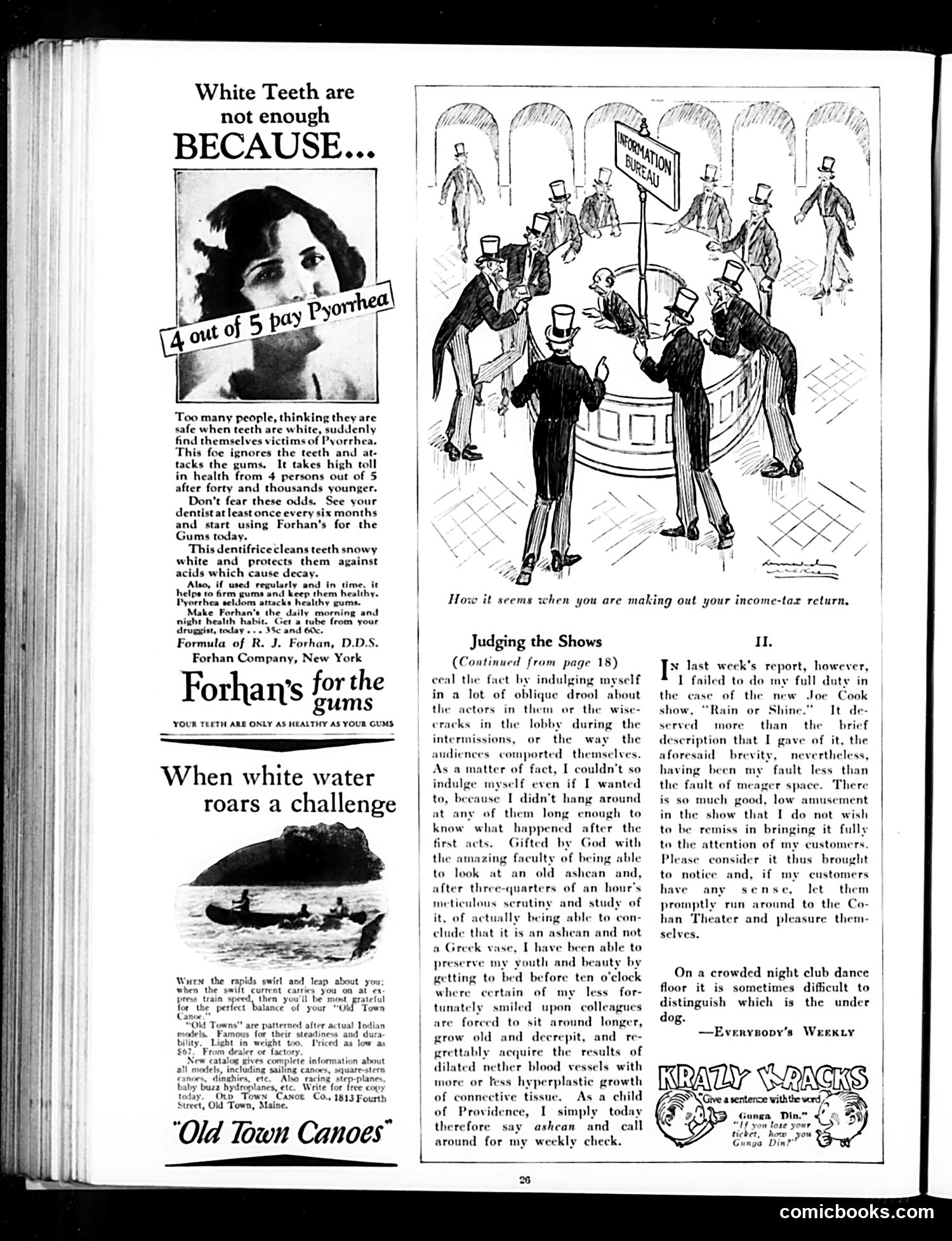
This page contains primarily **advertisements and entertainment commentary** rather than political cartoons. The main content includes: 1. **Forhan's Toothpaste ad**: Warns that white teeth alone don't prevent pyorrhea (gum disease), claiming it affects "4 out of 5" people over 40. This reflects early 20th-century dental health concerns and advertising's use of health anxiety to drive sales. 2. **Old Town Canoes ad**: Features dramatic imagery of canoes navigating rapids, emphasizing stability and quality. 3. **"Judging the Shows"**: A theater column where the critic humorously admits he leaves shows after the first act but still writes reviews. He describes an old theater seat as an "ashcan," satirizing both his own critical laziness and shabby theater conditions. 4. **"Krazy Kracks"**: A small joke section about distinguishing dance partners at crowded nightclubs. The page reflects 1920s popular culture concerns: dental health marketing, recreational activities, theater entertainment, and nightlife. There's no evident political satire here—it's standard magazine filler and advertising.
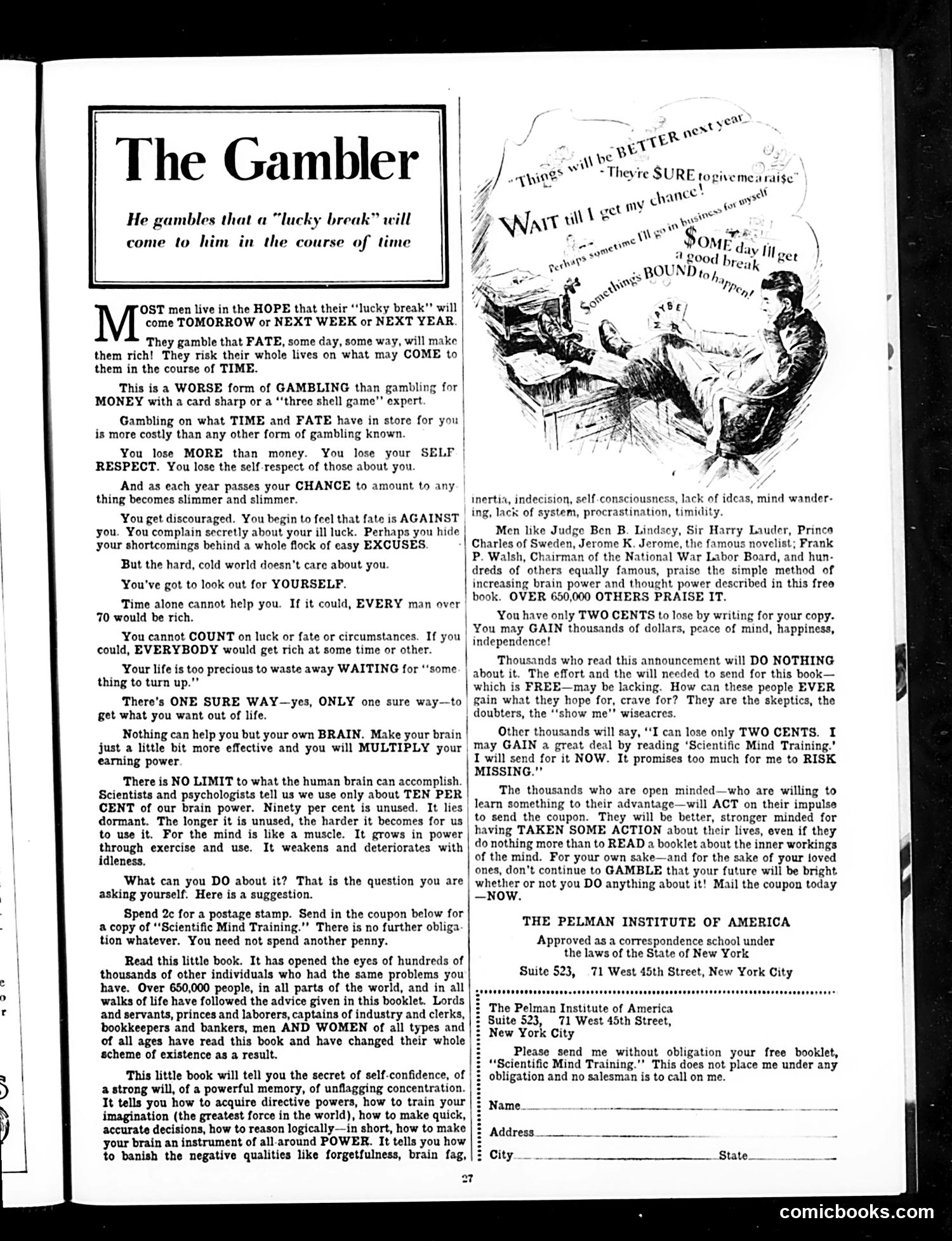
This page presents a self-improvement advertisement disguised as social commentary. The left side contains a lengthy essay criticizing men who passively wait for luck or "fate" to improve their lives, arguing this is worse than gambling because it wastes time and self-respect. The author claims 70-year-old men would be rich if luck worked. The cartoon (right) depicts a man daydreaming of future wealth—"Things will be BETTER next year!"—visualizing riches while doing nothing. The entire piece is a pitch for "Scientific Mind Training," a correspondence course promising to unlock unused brain power (the text claims humans use only 10 percent). The advertisement cites endorsements from public figures like Judge Ben Lindsey and Jerome K. Jerome. **Context**: This reflects early-20th-century American self-help culture and the popular pseudoscientific belief that mental training could dramatically increase earning potential—a precursor to modern motivational literature.
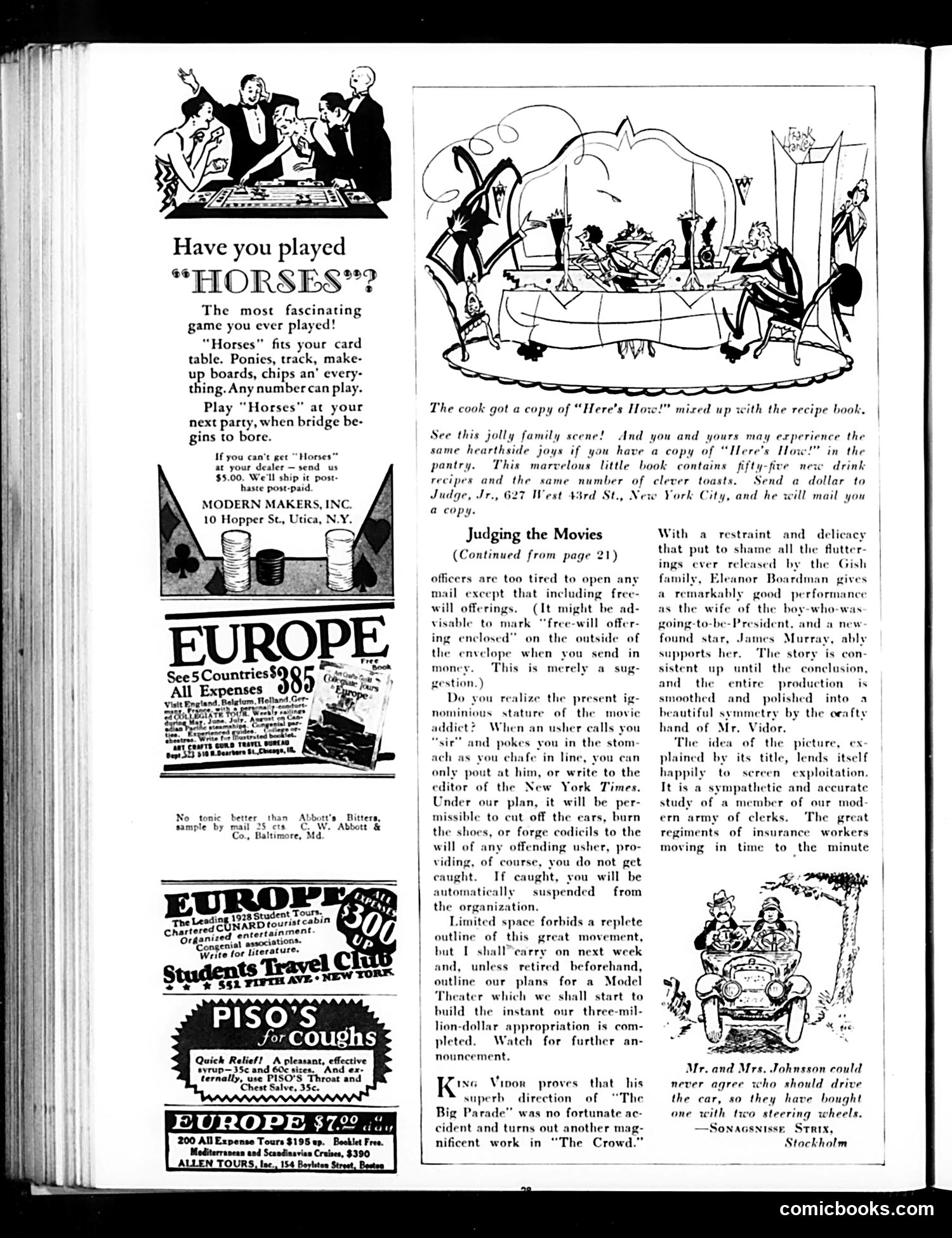
This page is primarily **advertising and entertainment content** rather than political satire. The main elements are: **Advertisements:** - "Horses" card game promotion (Modern Makers, Inc.) - "Here's How!" cocktail recipe book - Europe travel tours - Piso's cough syrup - Various other commercial products **Editorial Content:** The "Judging the Movies" column critiques contemporary films, including what appears to be King Vidor's "The Crowd" (a 1928 silent film). The reviewer discusses Eleanor Boardman's performance and James Murray's supporting role, praising the film's restraint and accuracy in depicting working-class life. **Cartoon:** A small illustration shows Mr. and Mrs. Johnson with a car featuring two steering wheels—a humorous solution to their disagreement over who should drive. Rather than political commentary, this reflects **1920s consumer culture and entertainment**—targeting readers interested in games, travel, cocktails, and cinema during the Jazz Age.
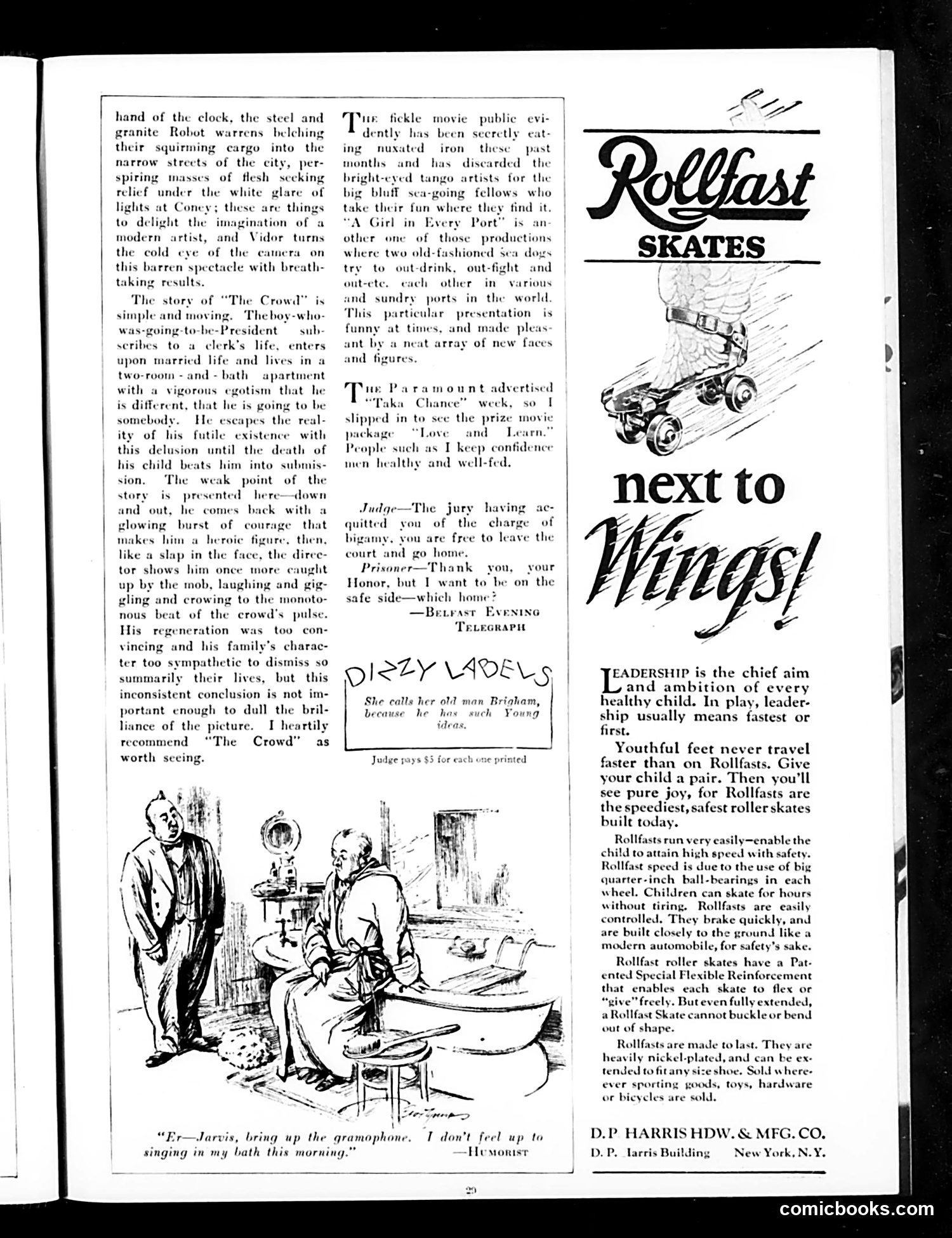
This page contains **film reviews and advertising** rather than political satire. The main review discusses **"The Crowd,"** a 1928 King Vidor film about an ambitious clerk whose dreams of distinction are crushed by urban monotony and personal tragedy. The reviewer praises the film's realism but criticizes its weak ending, where the protagonist suddenly recovers his spirits—only to be recaptured by the crowd's mindless conformity. This reflects 1920s anxieties about **mass society and individual aspiration**. A secondary review mentions **"A Girl in Every Port,"** a Paramount film about sailors, noting the movie public has abandoned "bright-eyed tango artists" for "big bluff sea-going fellows." The bottom section is a **humor joke** about a prisoner thanking the judge for acquittal but asking which home is safe—implying he has multiple households (likely a bigamy reference). The right page is **advertising for Rollfast roller skates**, emphasizing safety and speed for children—a typical 1920s product pitch.
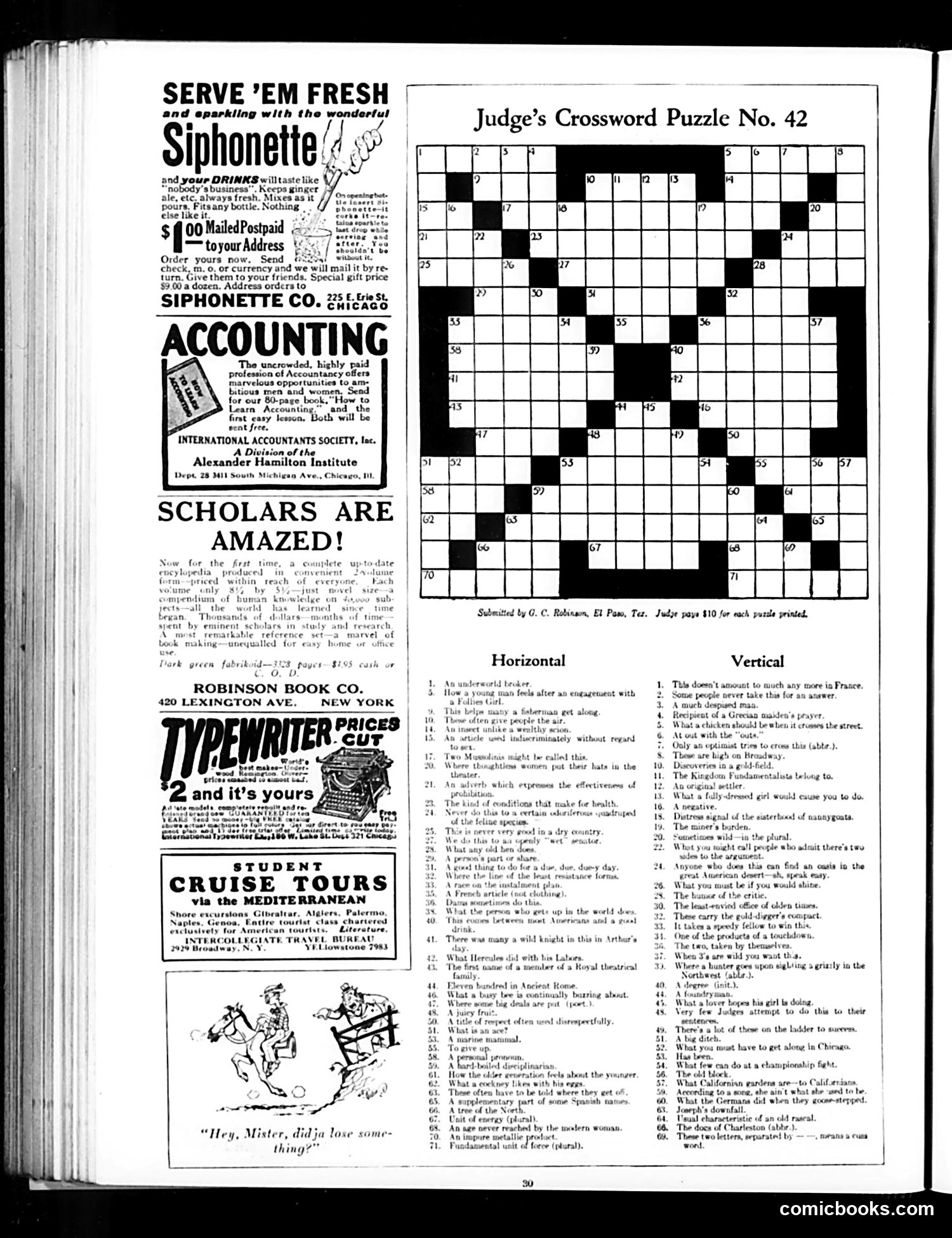
This page is primarily **advertising and a crossword puzzle**, not political satire. The content includes: **Advertisements:** - Siphonette Co. (carbonated drink dispenser) - International Accountants Society (correspondence course) - Robinson Book Co. (encyclopedia) - Typewriter ribbons - Student Cruise Tours via Mediterranean - Intercollegiate Travel Bureau **Main Content:** A crossword puzzle titled "Judge's Crossword Puzzle No. 42" with clues listed horizontally and vertically. **Cartoon:** A small illustration at bottom-left shows two figures, one asking "Hey, Mister, did ja lose something?" The caption appears to be a visual gag, though its specific meaning is unclear without additional context. This appears to be a typical magazine interior page from the 1920s-30s era, mixing advertisements with entertainment content rather than editorial satire. The crossword puzzle was a popular feature during this period.
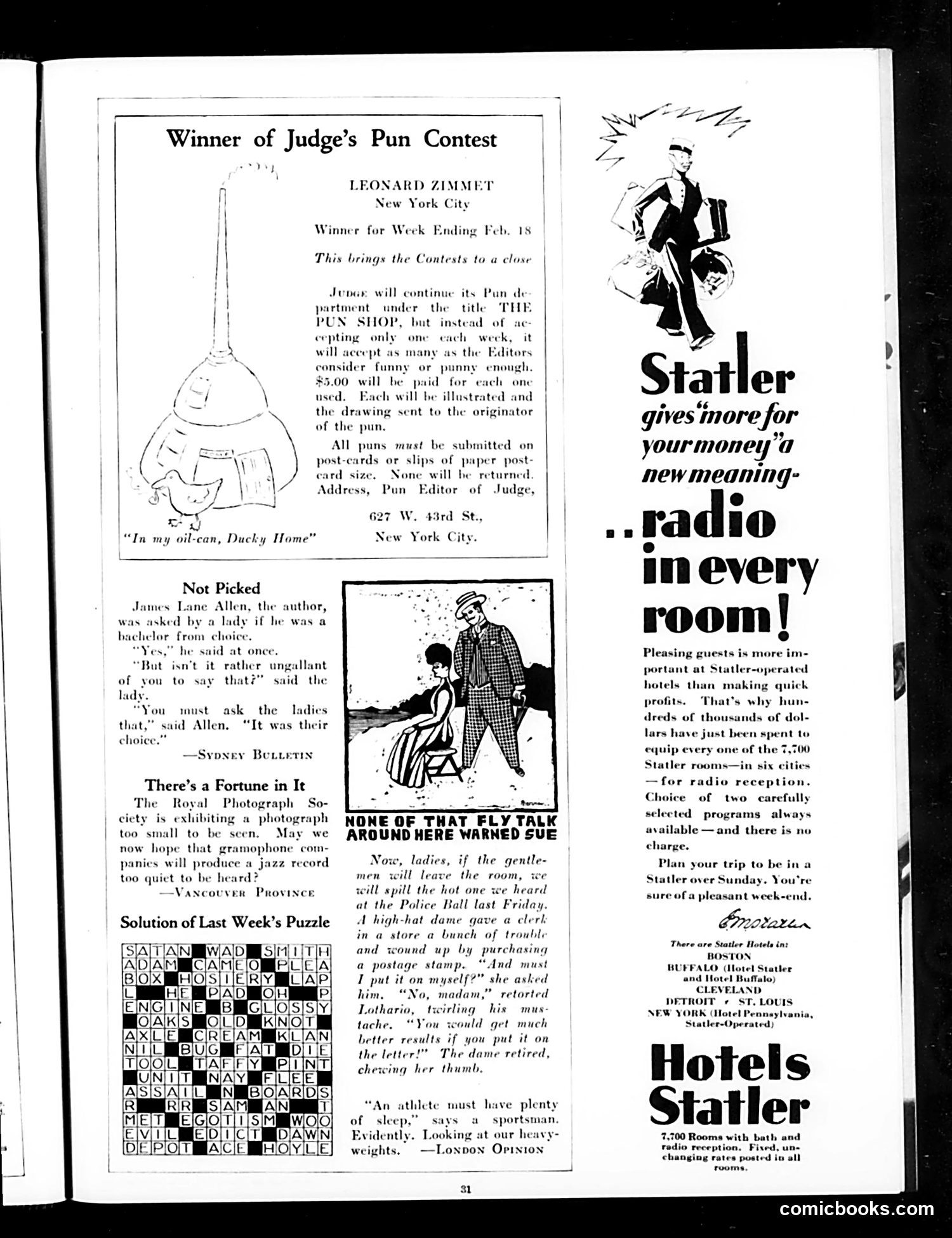
This page contains a **pun contest announcement** and humor pieces typical of Judge magazine's satirical content, alongside hotel advertising. **Main Content:** The "Winner of Judge's Pun Contest" announces Leonard Zimmet of New York City won for the week ending Feb. 18. Judge will continue accepting puns weekly at $5 per published entry, each illustrated and credited to the originator. **Humor Pieces:** - A joke about bachelor James Lane Allen deflects a woman's criticism by suggesting she ask other ladies—implying they chose to remain unmarried too - A story about a woman customer's malapropism: asking a clerk if she must apply a postage stamp "to myself" rather than to a letter - A cartoon captioned "None of That Fly Talk Around Here" shows a woman warning against off-color jokes before revealing one herself—typical period humor about women's supposed propriety **Advertising:** Hotels Statler promote radio in every room as a luxury amenity—reflecting 1920s enthusiasm for radio technology as a guest comfort feature.
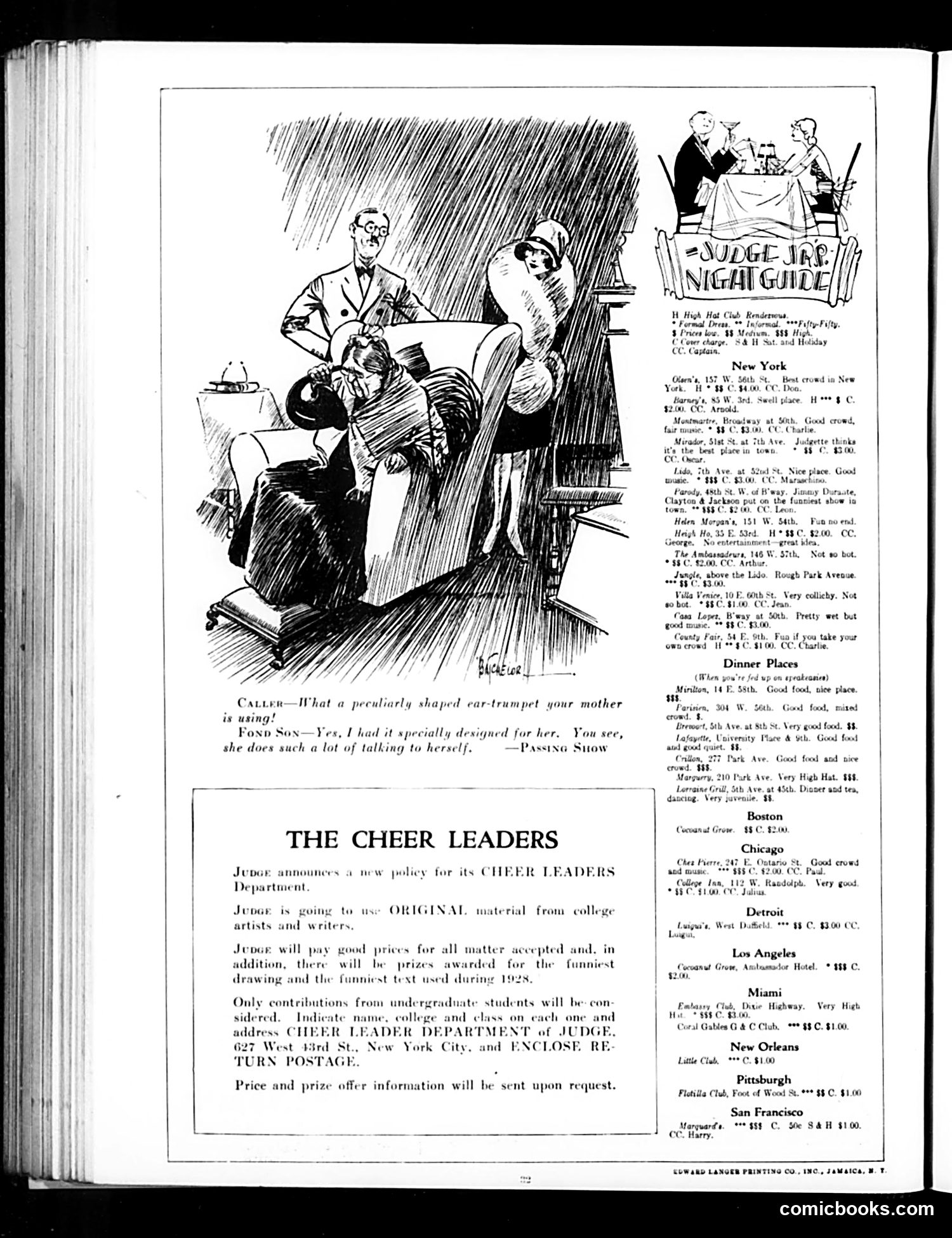
**The Main Cartoon:** A caller comments on someone's mother using a peculiarly shaped "ear-trumpet" (hearing aid). The son responds it's specially designed because "she does such a lot of talking to herself." The joke: the device isn't for *hearing* but rather a satirical comment on an elderly woman's tendency toward constant self-talk or rambling—a common stereotype about older women. **"The Cheer Leaders" Section:** This is an advertisement/announcement. Judge magazine is soliciting original material from college students and artists, offering payment and prizes for the funniest drawings and text to be published during 1928. Contributors should indicate their name, college, and class. **The Remainder:** The page is mostly restaurant and nightclub listings for major American cities, clearly catering to the 1920s speakeasy culture during Prohibition—note references to "speakeasies" and alcohol pricing (typical Judge magazine lifestyle advertising of the era).
This page is **not a cartoon or satire**—it's a straightforward **advertisement** for Canada Dry Ginger Ale from circa 1928. The ad promotes Canada Dry as superior to competitors by emphasizing: authentic Jamaica ginger content, absence of capsicum (red pepper) that causes the burning aftertaste common in other ginger ales, and health benefits ("really good for you"). The tagline "The Champagne of Ginger Ales" positions it as premium. The visual shows a bottle with an ornate coat-of-arms crest and an elegant serving glass, reinforcing luxury positioning. The ad copy uses medical/scientific language typical of 1920s advertising, when makers routinely made health claims about beverages. This appears in *Judge* magazine simply as paid advertising content, not editorial satire.
This page is primarily a **commercial advertisement** rather than political satire. It promotes Life Savers candy mints with the tagline "At the Office — refresh the mouth and aid digestion with LIFE SAVERS: The Candy Mint with the Hole." The ad features a product shot of a Life Savers roll and appears designed for office workers. The slogan "Always Good Tasting After Smoking" (visible at bottom) suggests the candy was marketed as a breath freshener for smokers—a practical selling point in an era when workplace smoking was common and unrestricted. This reflects early 20th-century advertising conventions that linked candy consumption to social acceptability and workplace etiquette. The page contains no political commentary or satirical content.