
A complete issue · 36 pages · 1928
Judge — January 14, 1928
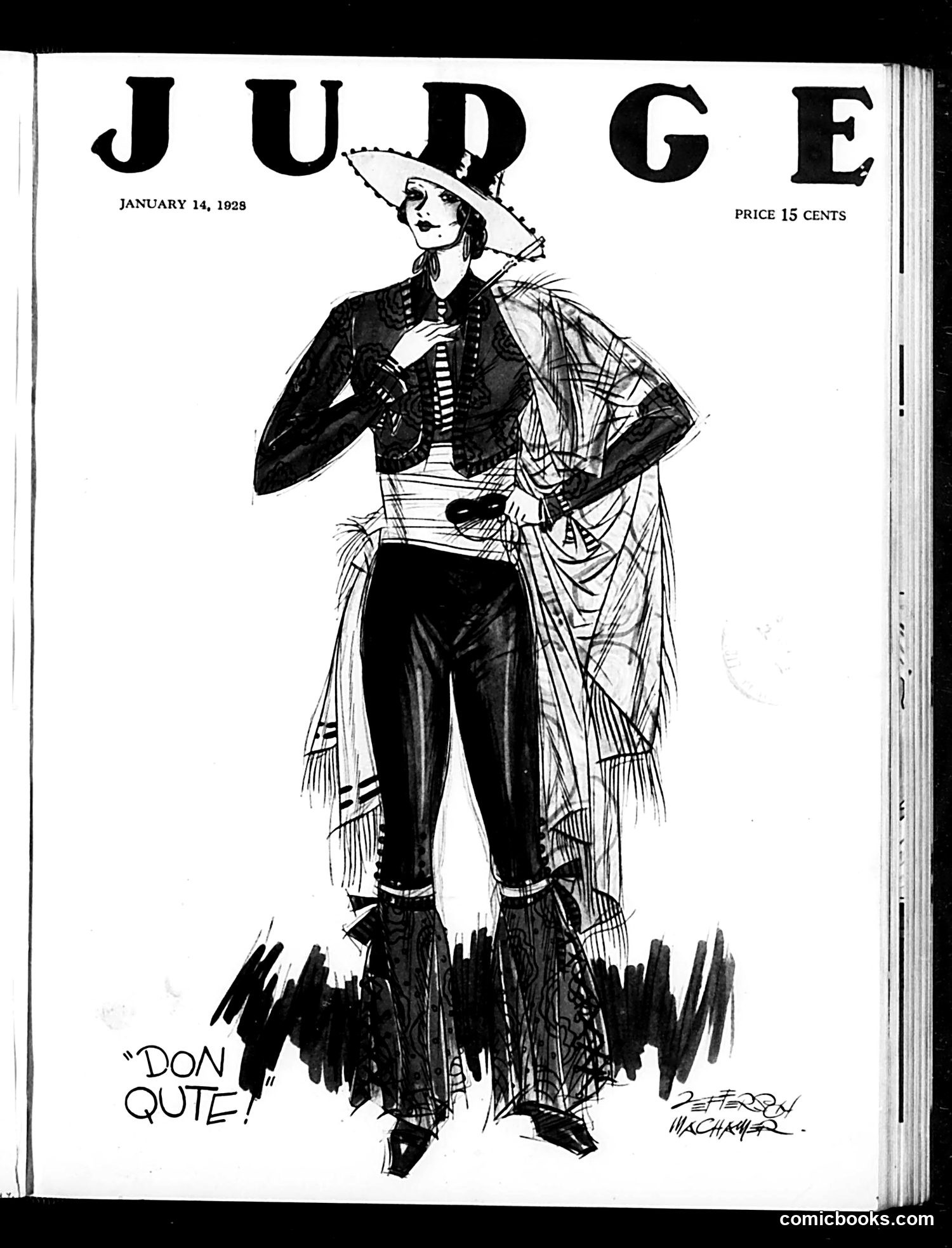
This is the January 14, 1928 cover of *Judge*, a satirical magazine. The illustration, credited to artist "Mahachek," depicts a fashionable woman in 1920s attire—a black jacket, striped shirt, riding breeches, and boots—holding an umbrella and wearing a wide-brimmed hat. The caption reads "Don Quite!" This appears to be satirizing the "modern woman" of the Jazz Age—specifically mocking the androgynous, masculine-influenced fashion and independence of 1920s feminism. The "Don Quite" caption likely plays on "Don Quixote," suggesting these liberated women are tilting at windmills with their progressive social ideas. The exaggerated, somewhat unflattering caricature reflects contemporary anxieties about changing gender roles and women's increasing social freedom during the Roaring Twenties.
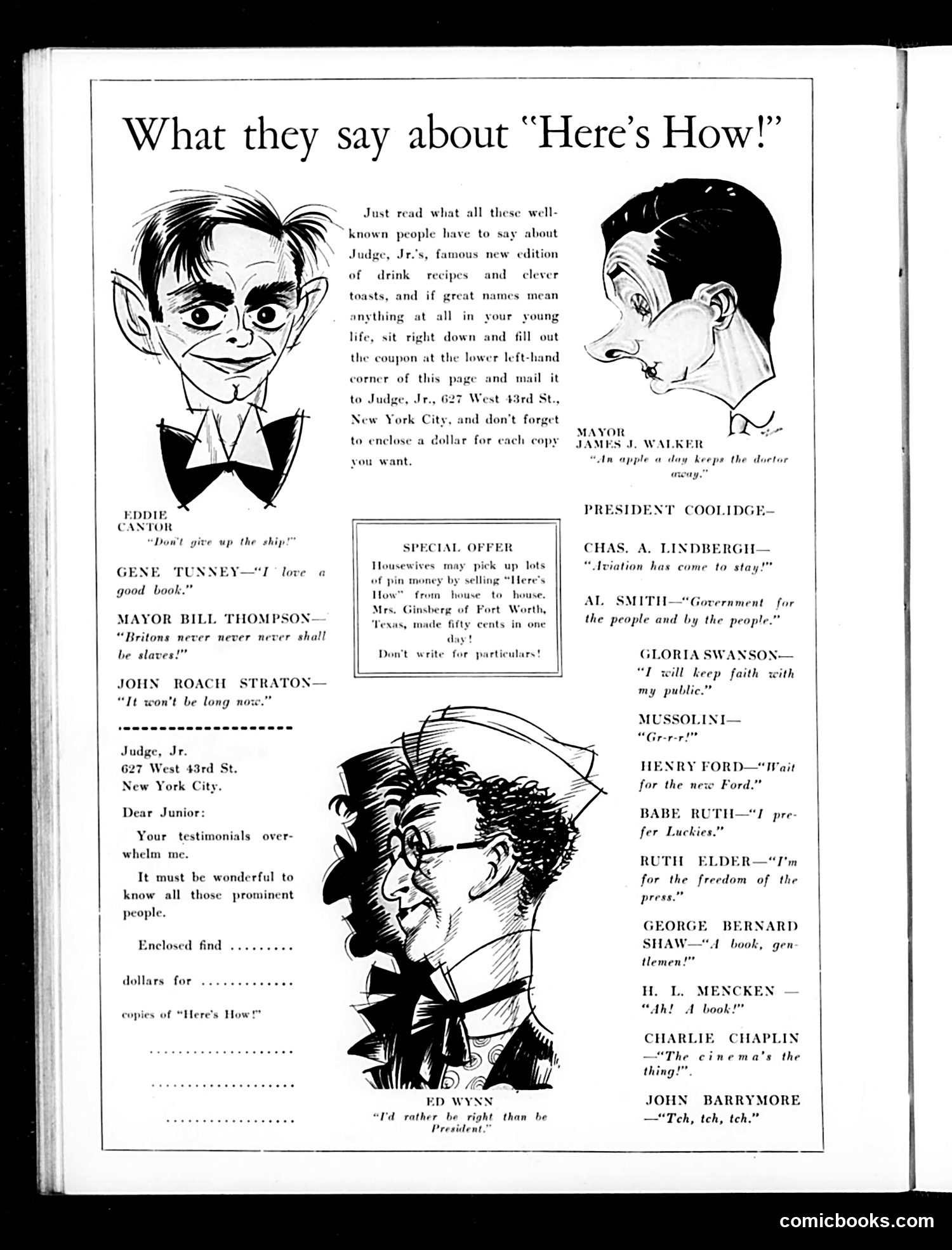
This page advertises "Here's How!" — Judge Jr.'s new book of drink recipes and toasts — by collecting endorsements from famous public figures of the era. The caricatured heads (Eddie Cantor, Gene Tunney, Mayor Bill Thompson, John Roach Straton, Mayor James J. Walker, President Coolidge, Charles Lindbergh, and others) provide humorous quotes supporting the book. The satire targets Prohibition-era hypocrisy: prominent figures, including the President and religious leaders, publicly endorse a recipe book during Prohibition when alcohol was banned. The humor lies in this contradiction — these "respectable" figures openly promoting drinking despite legal prohibition. The special offer mentions housewives could profit by selling copies door-to-door, further satirizing how Prohibition was widely flouted by all social classes.
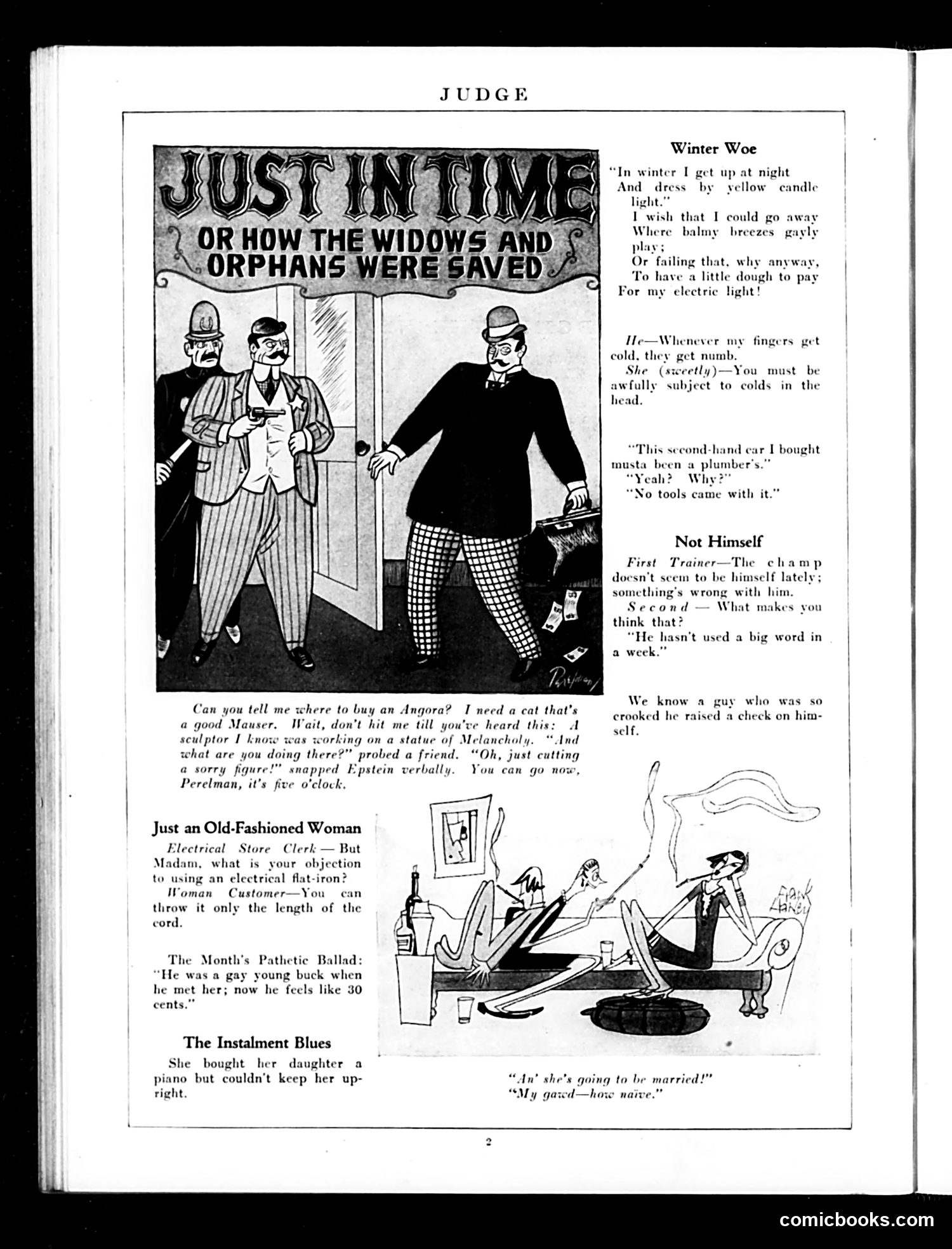
This page from *Judge* contains several short satirical pieces and jokes typical of the magazine's humor circa early 20th century. The main cartoon "Just in Time" shows a man entering a room where two other figures are present, with dialogue about buying an Angora cat and references to a statue of Melancholy. The satire appears to target absurd or pretentious behavior. The other pieces—"Winter Woe," "Not Himself," "Just an Old-Fashioned Woman," "The Month's Pathetic Ballad," and "The Instalment Blues"—are brief comedic vignettes poking fun at everyday frustrations: cold weather complaints, quirky behavior, outdated attitudes, romantic regrets, and consumer debt from installment purchasing. These reflect common anxieties of the era, particularly anxieties about modern consumer culture and changing social norms.
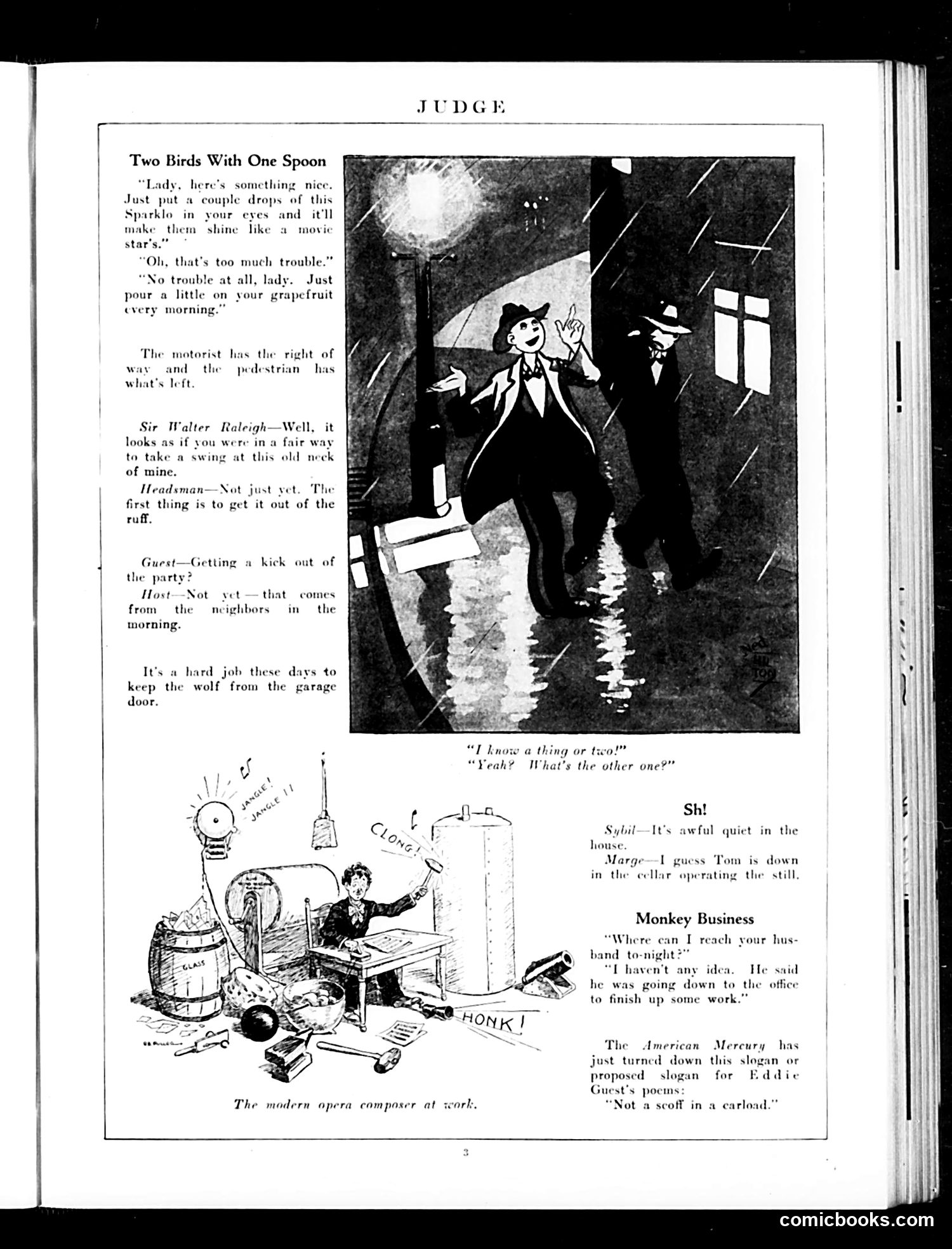
This page contains three separate humorous pieces: **"Two Birds With One Spoon"** features a dialogue about cosmetic tips and social etiquette, accompanied by a cartoon of two men in formal attire sharing a spoon outdoors at night—likely satirizing either newfangled beauty trends or awkward social situations among the wealthy. **"The modern opera composer at work"** shows a chaotic scene of a man surrounded by cacophonous objects (bells, horns, tools) labeled "CLANG!" and "HONK!"—mocking contemporary experimental opera composers who abandoned traditional melodic conventions for modernist noise and dissonance. **"Monkey Business"** is a brief domestic joke about a wife unable to reach her husband. The page satirizes modern trends (cosmetics, avant-garde music) with gentle ridicule typical of Judge's upper-class humor.
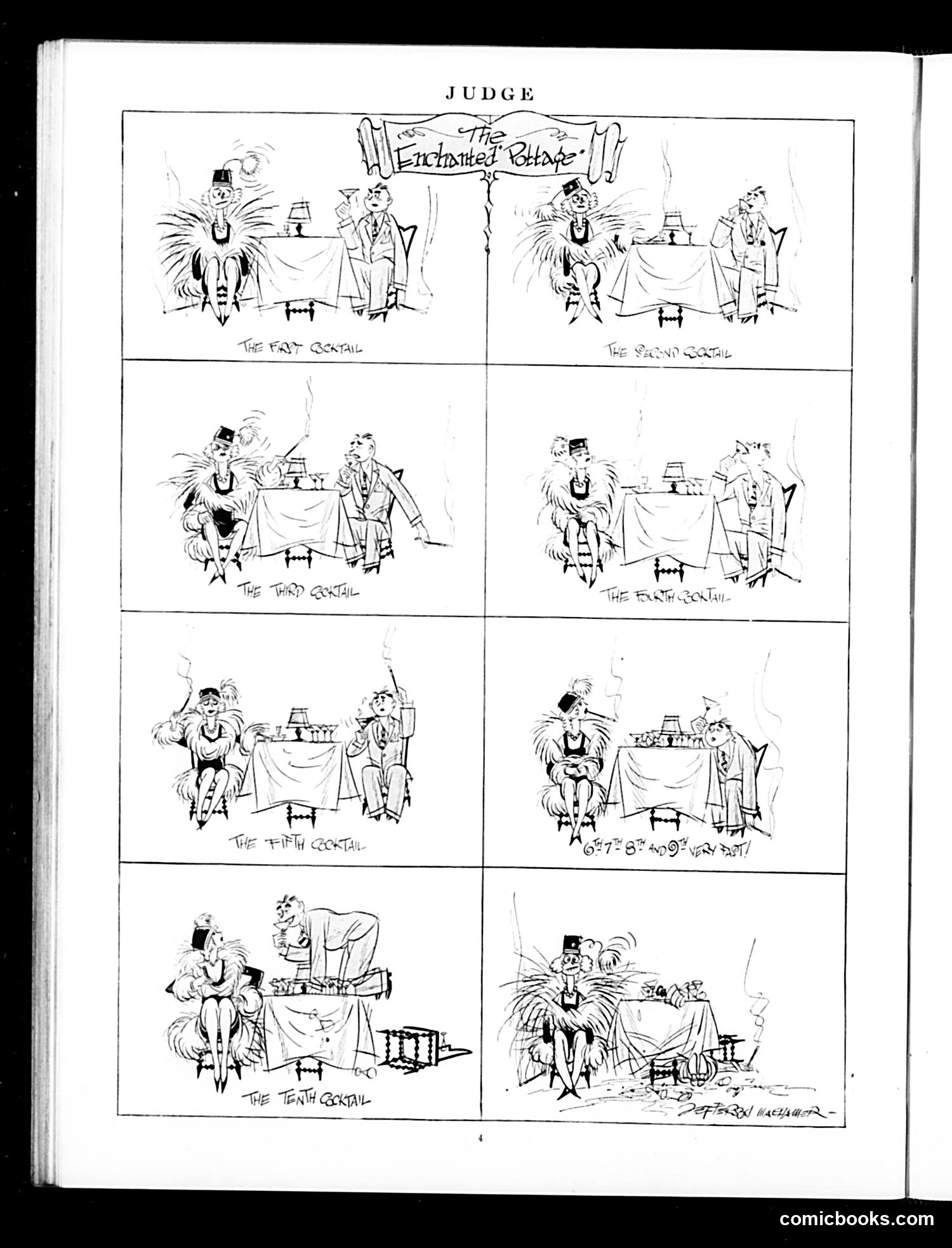
This page presents a series of sequential cartoon panels titled "The First Cocktail," "The Second Cocktail," progressing through "The Tenth Cocktail." The humor depicts a man's increasingly disheveled appearance and wild behavior as he consumes successive drinks at what appears to be a formal dinner setting. The cartoon satirizes the effects of alcohol consumption, showing the protagonist's gradual deterioration—his hair becomes progressively more unkempt, his demeanor more chaotic, and the dinner table increasingly disrupted. This reflects early 20th-century American attitudes toward drinking and intoxication, likely preceding or contemporary with Prohibition-era concerns about alcohol's social effects. The "Enchanted Blade" title may reference the magical transformation induced by alcohol.
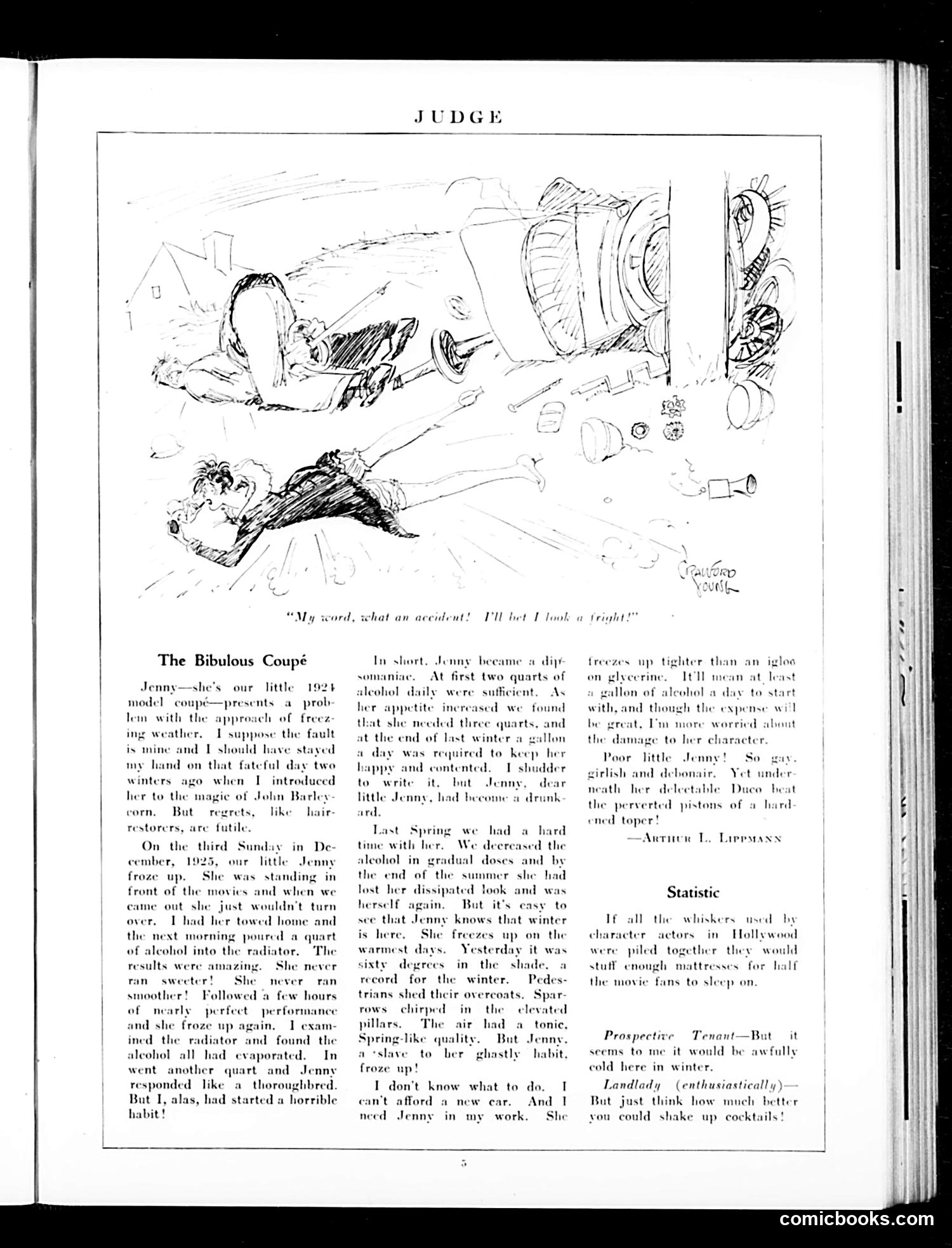
This satirical piece mocks a car owner's irresponsible drinking habit. The cartoon depicts a man examining his damaged automobile after an accident, surrounded by scattered car parts. The accompanying article, by Arthur L. Lippmann, tells how "Jenny"—a 1924 model coupe—became damaged through the owner's alcoholism. The owner repeatedly filled the radiator with alcohol instead of proper coolant, causing the car to freeze and malfunction across seasons. The satire critiques Prohibition-era drinking culture, suggesting that desperate drinkers used any available liquid—even automotive fluids—to obtain alcohol. The title's pun ("Coupé" as both car-type and drinking companion) emphasizes how the car became an unwilling participant in the owner's alcoholic excess.
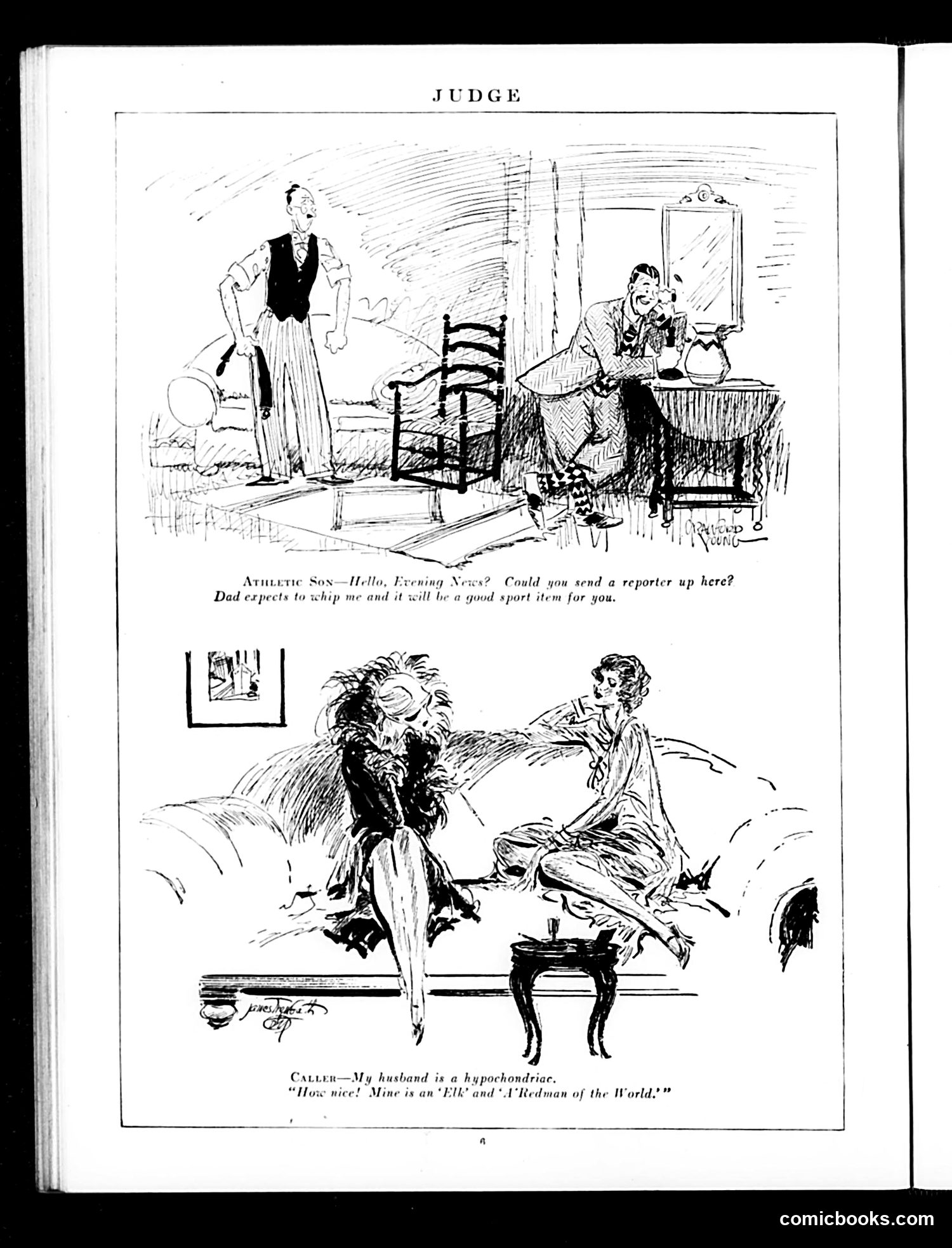
This page contains two satirical cartoons mocking contemporary social trends. The top cartoon ridicules "athletic sons"—young men who seek publicity for misbehavior, calling newspapers to report when their fathers discipline them, treating paternal punishment as a "sport item" worthy of news coverage. The bottom cartoon satirizes wives comparing their husbands' ailments. One woman boasts her husband is a hypochondriac (imaginary illnesses), while the other counters hers is an "Elk" and an "All-Redman of the World"—likely references to fraternal lodge memberships. The joke suggests wives regard their husbands' excessive club involvement as equally tedious as hypochondria. Both cartoons reflect Judge magazine's typical targets: masculine vanity, attention-seeking behavior, and the perceived absurdities of American social clubs and masculine self-importance in the early 20th century.
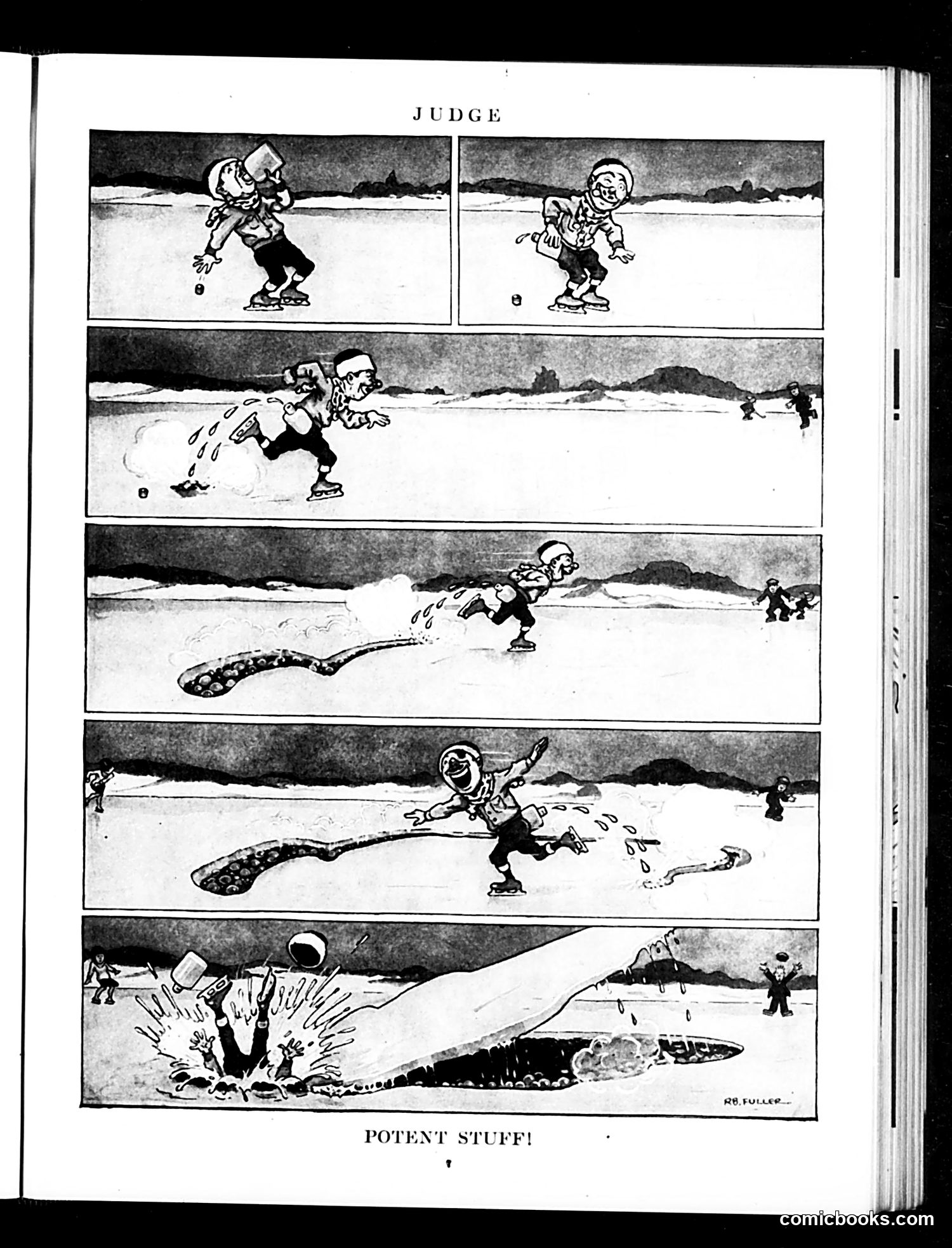
This appears to be an early 20th-century satirical comic strip showing a figure ice-skating and progressively losing control. The sequence depicts the skater becoming increasingly unbalanced, culminating in a collision or explosion in the final panel. The title "Potent Stuff!" suggests the cartoon mocks intoxication or the effects of alcohol. The skating metaphor likely represents attempts to maintain composure while under the influence—a common satirical device. The figure appears to be a caricatured public figure or representative of a social type, though their specific identity is unclear from the image alone. The cartoon satirizes how alcohol impairs judgment and physical coordination, presented through the visual deterioration across panels. Without additional context, the specific political target remains uncertain.
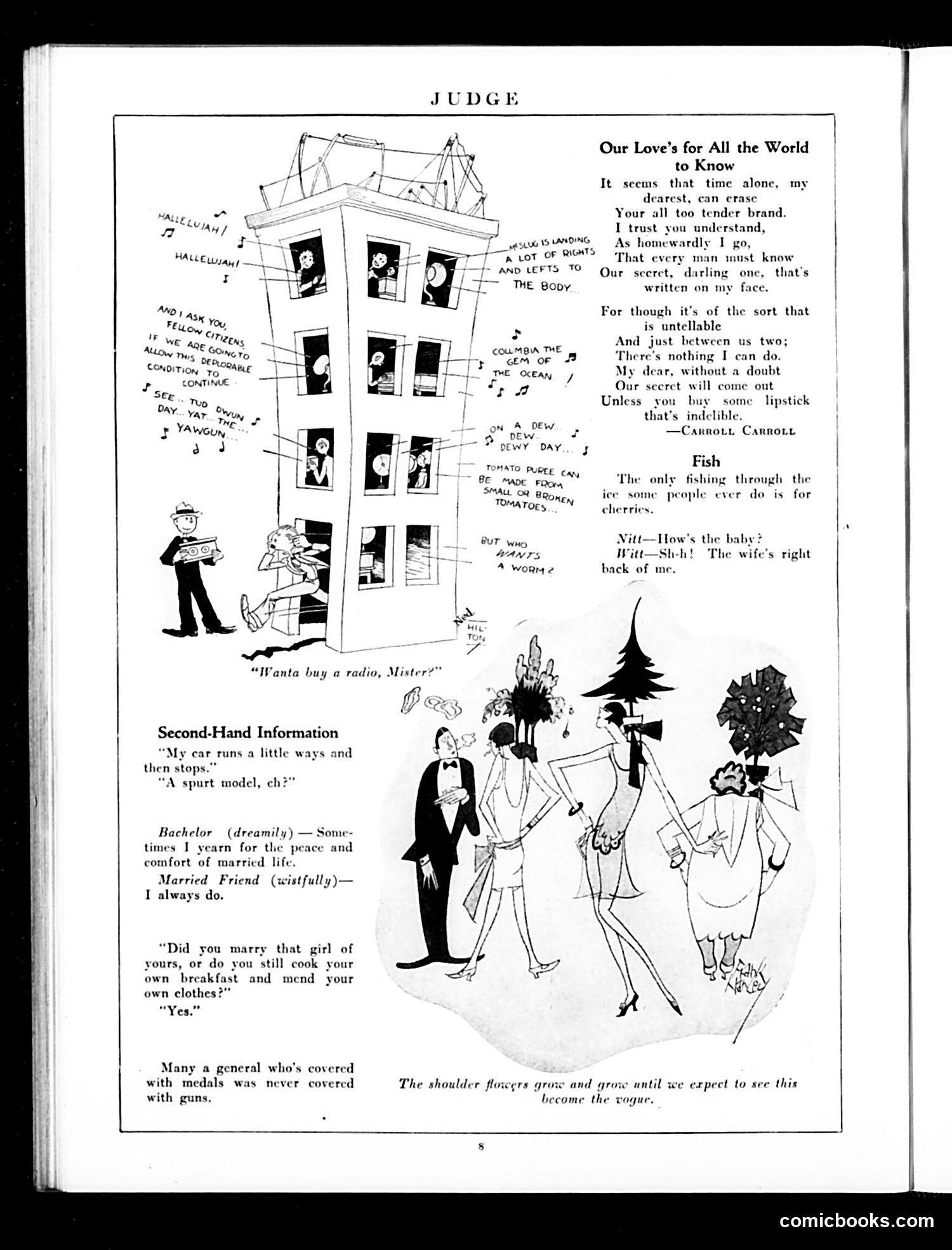
This page contains several satirical humor pieces typical of early-to-mid 20th century Judge magazine: **Main Cartoons:** - **"Wanta buy a radio, Mister?"** shows an apartment building with residents singing loudly from windows, mocking how radios were becoming household fixtures that disturbed neighbors. - **"Second-Hand Information"** jokes about cars and marriage stereotypes—a "spurt model" car that starts then stops parallels bachelor vs. married life contradictions. - **"Our Love's for All the World to Know"** satirizes romantic couples who claim their love is "secret" yet broadcast it publicly through visible signs (lipstick marks). - **"Fish"** makes a mild pun about fishing through ice for "cherries" (slang for women/romance). **Broader Context:** The page satirizes modern conveniences (radios), marital disillusionment, and romantic hypocrisy—common Judge targets. The fashion note about "shoulder flowers" (likely floral brooches or decorative elements) gently mocks evolving women's fashion. The humor relies on observational social commentary rather than political satire.
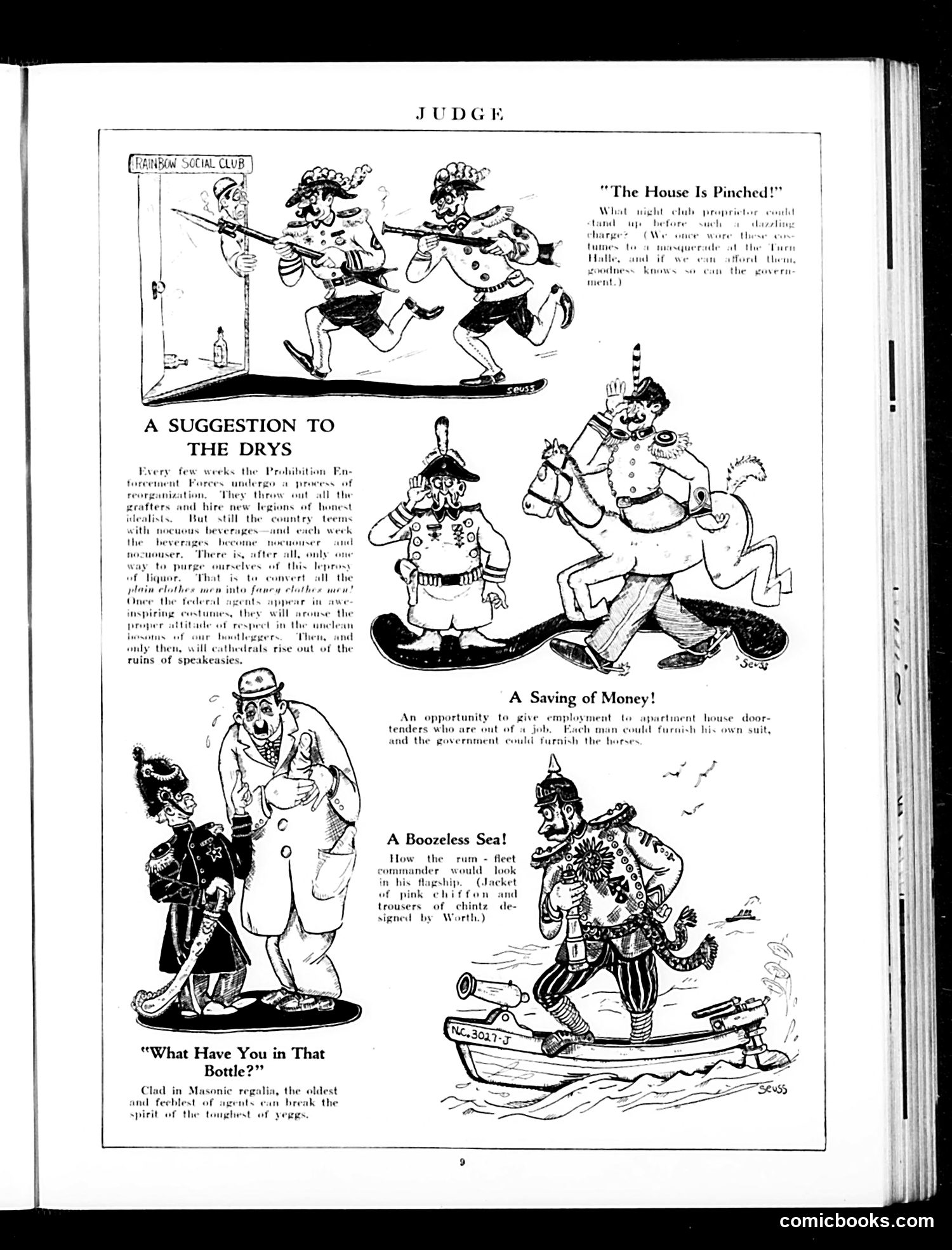
This page satirizes **Prohibition enforcement** efforts (likely 1920s America). The cartoons mock anti-alcohol advocates ("the Drys") and federal enforcement agents. **"A Suggestion to the Drys"** (top): Shows a speakeasy ("Henson Social Club") being raided. The joke proposes that instead of prosecuting bootleggers, enforcement should focus on converting illegal bars into legitimate establishments. **"What Have You in That Bottle?"** (left): Depicts a federal agent confronting a woman, sarcastically suggesting agents are actually eager to confiscate alcohol for personal use—implying Prohibition enforcement was corrupt or hypocritical. **"A Boozeless Seal"** and **"A Saving of Money"** (right): Mock naval enforcement and government spending on Prohibition, suggesting the effort is wasteful and absurd. The overall message: Prohibition enforcement is ineffective, corrupt, and ridiculous—a common satirical position among Judge's audience during this contentious period.
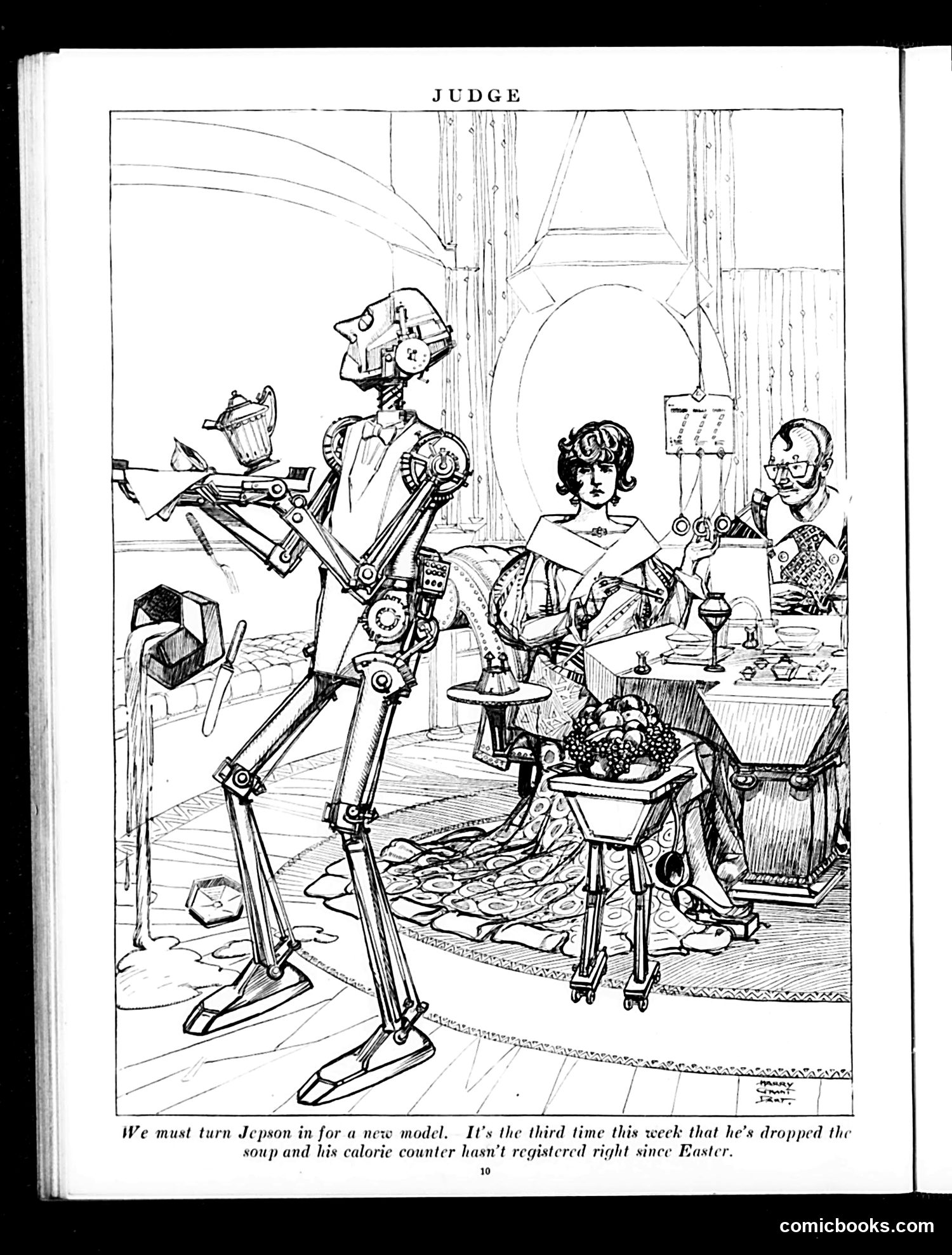
This cartoon satirizes early 20th-century obsession with mechanical efficiency and dietary science. A tall, mechanical robot named "Jepson" serves at a formal dinner, having repeatedly failed at basic tasks—dropping soup and malfunctioning calorie-counting equipment since Easter. The joke targets two concurrent fads: the craze for labor-saving robots/automation and the era's intense focus on calorie-counting as pseudo-scientific health management. The caption's matter-of-fact tone ("we must turn [him] in for a new model") mocks how disposable such mechanical solutions were treated. The cartoon suggests absurdity in expecting mechanical servants to handle delicate domestic work reliably, while also poking fun at the era's faith in precise dietary measurement and quantification as solutions to health problems. The human diners' indifference to Jepson's repeated failures emphasizes the darkly comic disconnect between technological optimism and practical reality.
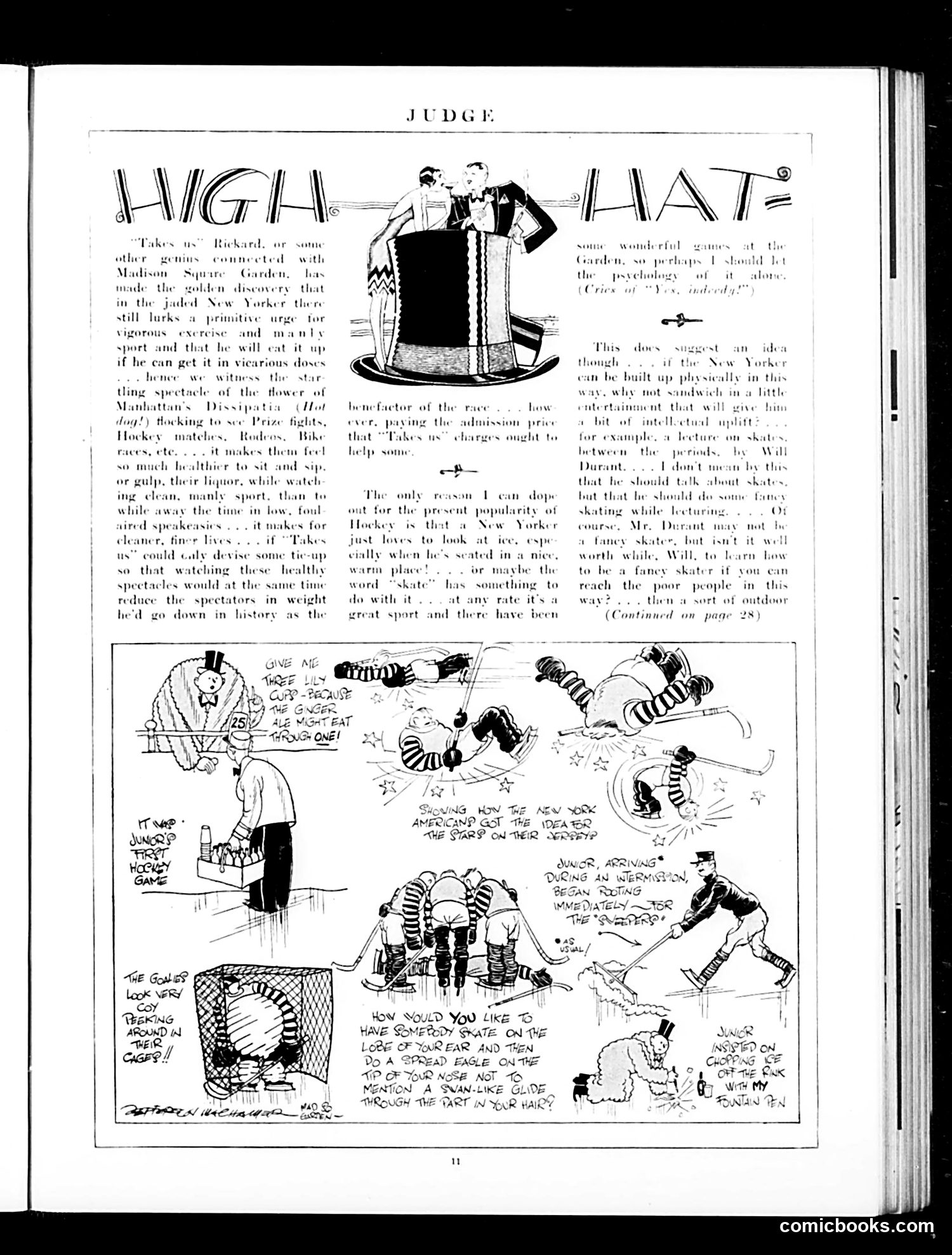
This page satirizes the popularity of indoor sports spectacles at Madison Square Garden among wealthy, sedentary New Yorkers. The main article argues that jaded Manhattan elites are attending prize fights, hockey, and rodeos—not for genuine athletic interest, but for vicarious thrills they can enjoy while sitting comfortably with drinks. The cartoon below mocks hockey specifically, depicting absurd scenarios of violence: players being launched through the air, a goalie trapped in a net, and someone's ear nearly sliced off by a skate. The text bubble sarcastically asks if someone would enjoy having another person skate on their ear while reading. The satire's point: New Yorkers pretend these are "healthy" spectacles promoting vigor, when they're actually enjoying sanitized brutality from safe seats—the opposite of genuine sport. The accompanying editorial by Will Durant suggests adding intellectual content (like lectures) during intermissions to justify attendance. The cartoon exaggerates hockey's violence to expose the contradiction between the sport's supposed health benefits and the audience's actual attraction to danger.
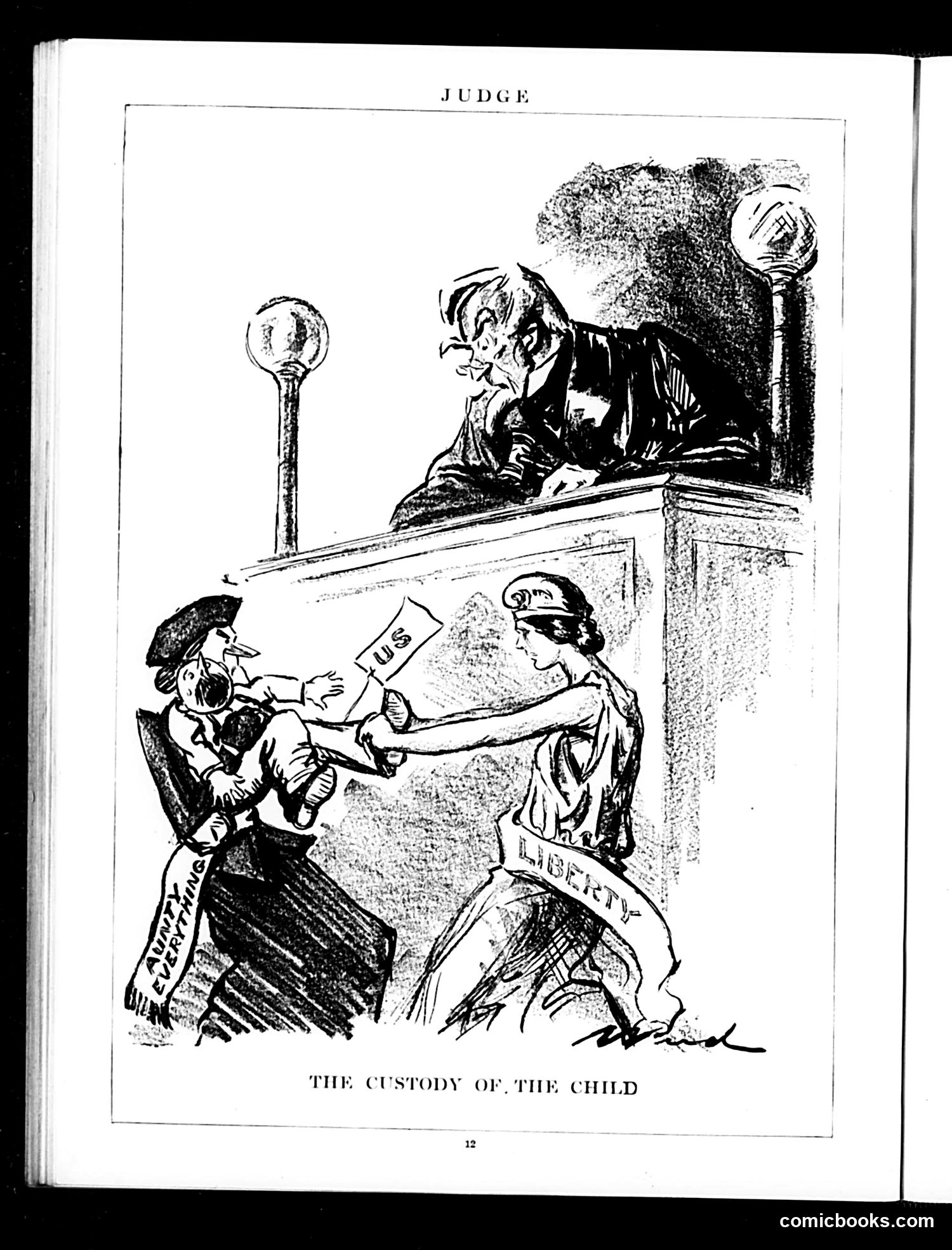
This cartoon satirizes a custody dispute over a child representing "the US." Two female allegorical figures—one labeled "LIBERTY" and the other appearing to represent a competing political faction (likely "ANARCHY" or a radical ideology, based on her disheveled appearance)—argue before a stern judge. The judge, depicted as a caricatured authority figure, oversees their quarrel from the bench. The satire comments on political conflict over America's direction and values. The cartoon suggests that different political ideologies are fighting for control of the nation itself, portrayed as a vulnerable child. The judge's stern expression implies skepticism about either side's fitness as guardian. This likely reflects late 19th-century American anxieties about political radicalism versus traditional liberty.
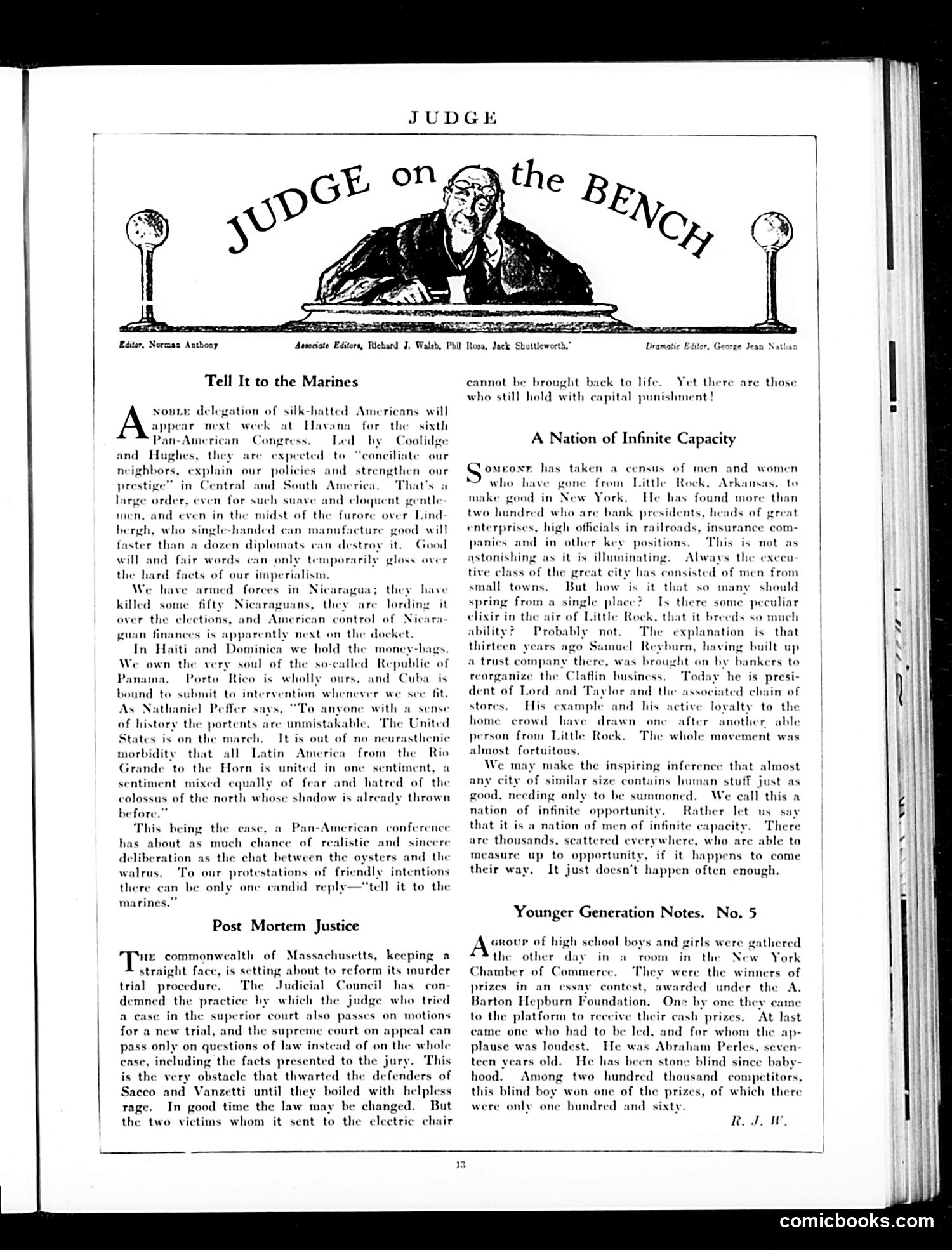
This page from Judge magazine contains three distinct opinion pieces criticizing American foreign and domestic policy: **"Tell It to the Marines"** mocks a planned Pan-American Congress delegation led by Coolidge and Hughes. The satire contends that American diplomatic pleasantries ("good will and fair words") cannot obscure the reality of U.S. imperialism: armed military occupation of Nicaragua, financial control of Haiti and Dominican Republic, and dominance over Panama, Puerto Rico, and Cuba. The title suggests the arguments are unconvincing—dismissively, "tell it to the Marines." **"Post Mortem Justice"** criticizes Massachusetts's delayed judicial reform of murder trial procedures. It references the Sacco and Vanzetti case, where flawed appellate procedures prevented justice. The bitter irony: reforms come too late for the executed victims. **"A Nation of Infinite Capacity"** celebrates American social mobility using a positive example: successful businesspeople who migrated from Little Rock, Arkansas to New York, notably Samuel Reyburn of Lord & Taylor, proving opportunity exists everywhere in America.
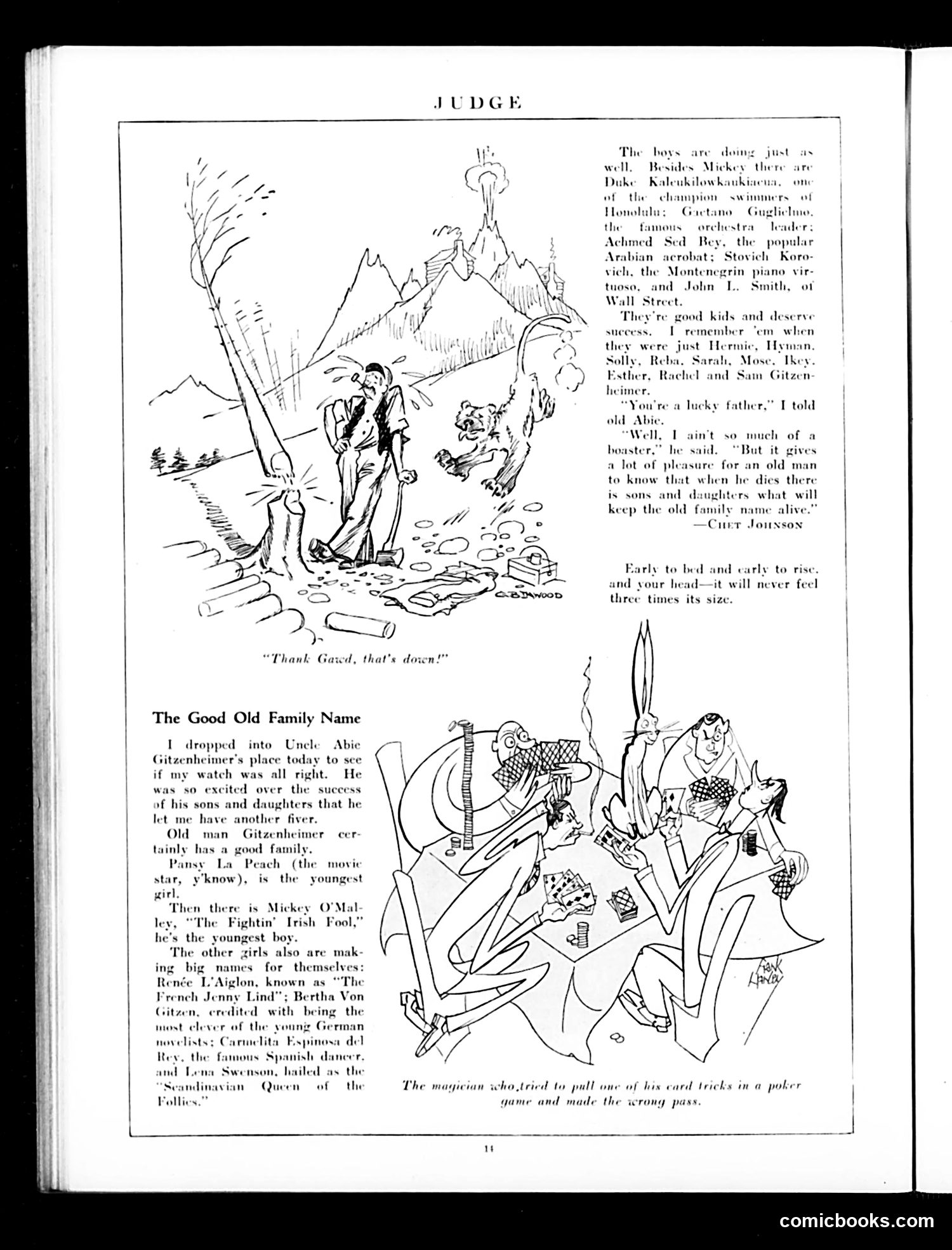
This piece satirizes Jewish immigrant assimilation and social climbing in early 20th-century America. Uncle Abie Gitzenheimer, a Jewish watchmaker, is proud that his children have adopted glamorous stage names and exotic personas—becoming a movie star, orchestra leader, Arabian acrobat, German novelist, Spanish dancer, and Scandinavian performer, among others. The satire operates on multiple levels: it mocks both the immigrants' eagerness to shed their Jewish identities (renaming children from "Hermie, Hyman, Reba, Sarah" to "Pansy La Peach" and "Renée L'Aiglon") and the American entertainment industry's willingness to market these fabricated exoticized identities. Abie's sentimental speech about keeping "the old family name alive" through his successful children becomes ironic—they've abandoned it entirely. The lower cartoon about the magician making "the wrong pass" appears to be a separate, unrelated joke.
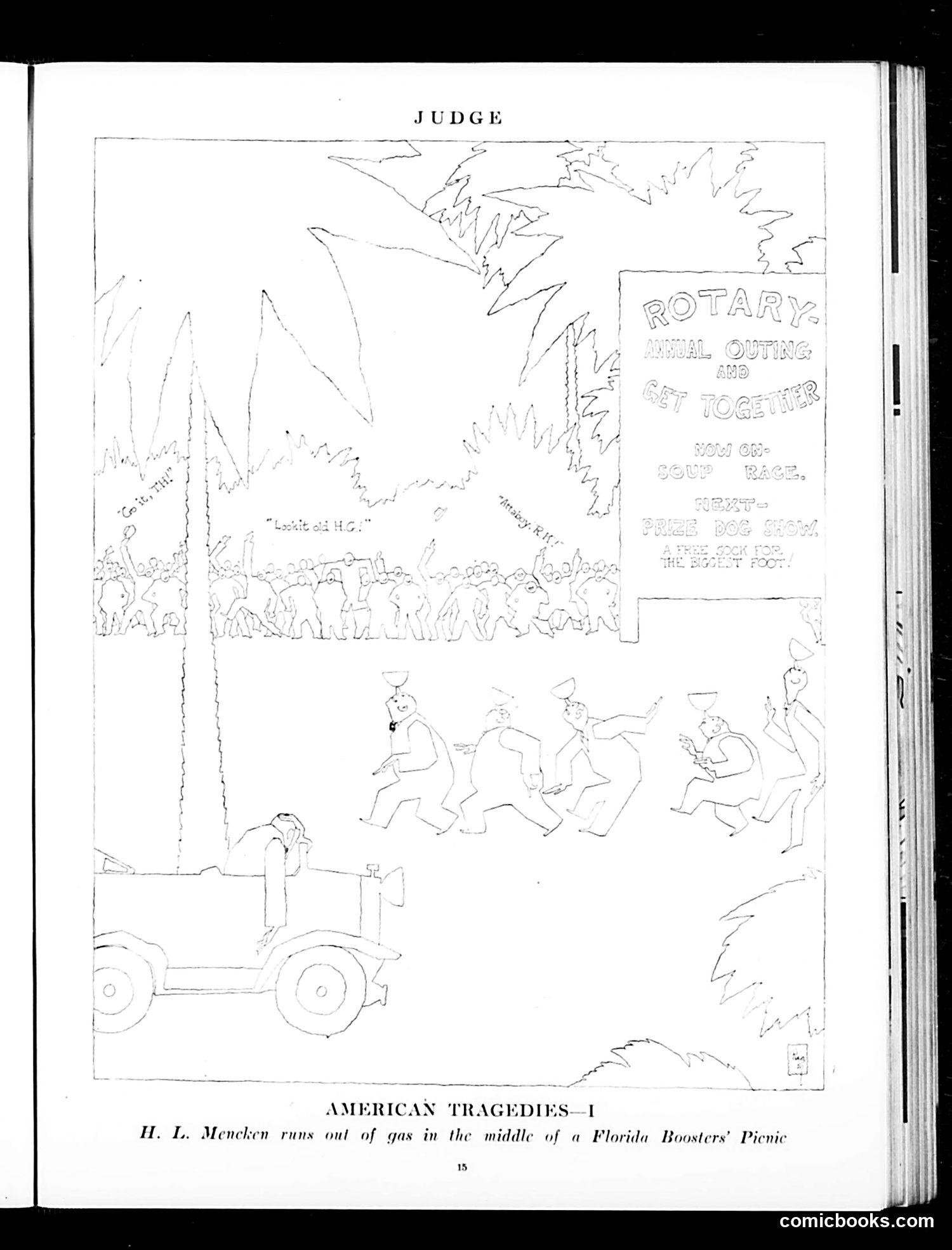
This Judge cartoon satirizes H.L. Mencken, the prominent American critic and social commentator known for his sharp critiques of American culture and institutions. The caption depicts him stranded during a Florida Boosters' Picnic—an event celebrating regional development and prosperity. The joke likely works on multiple levels: Mencken was famous for mocking American boosterism and Chamber of Commerce optimism. By literally running out of gas amid celebratory crowds, the cartoon suggests his cynical perspective has abandoned him, or conversely, that even his pessimism cannot survive the relentless American optimism he despised. The visual humor comes from his literal automotive failure amid a gathering designed to promote progress and growth.
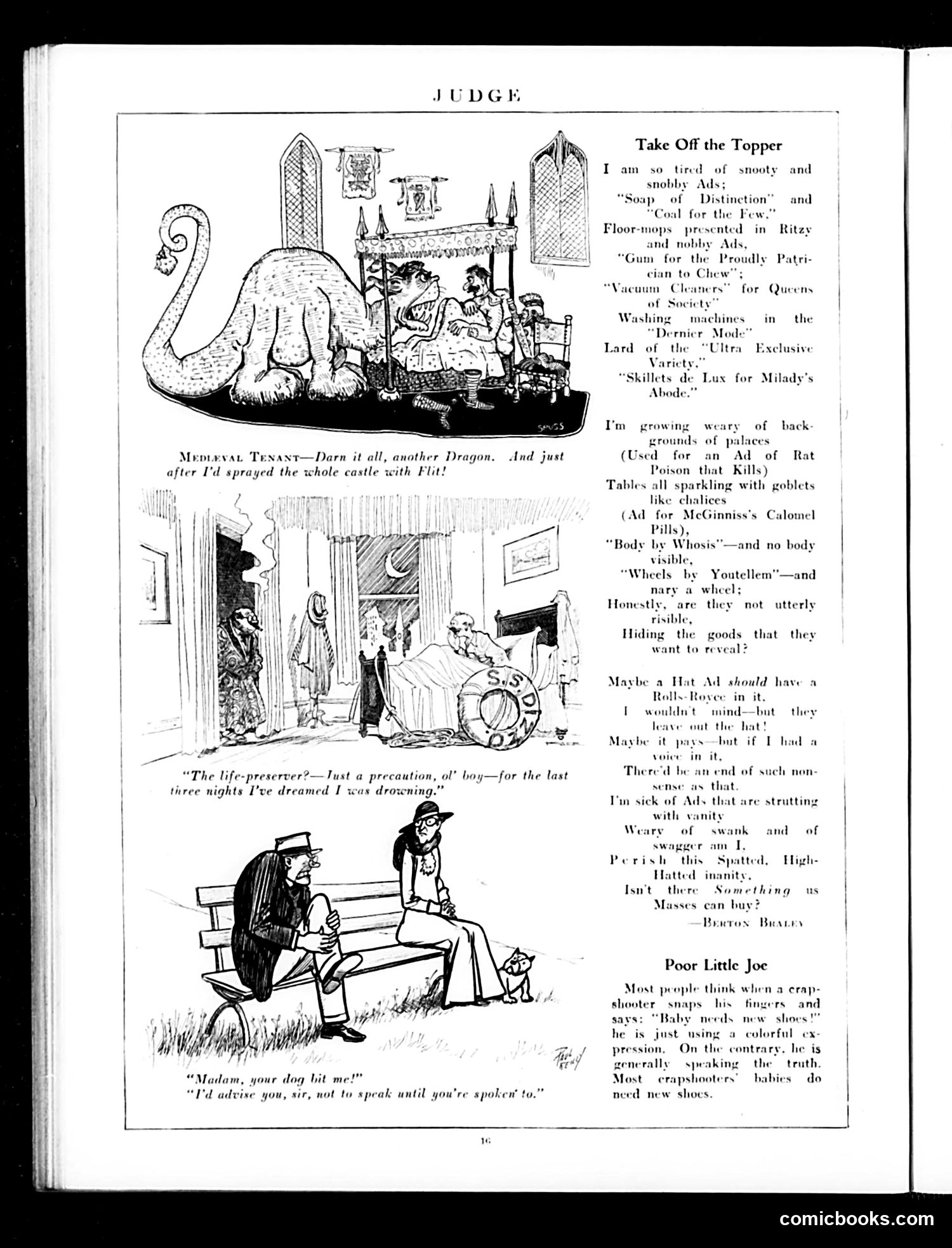
This page satirizes luxury-oriented advertising in the 1920s-30s. The column "Take Off the Topper" (attributed to Burton Raleigh) mocks ads that use exclusivity and snobbery to sell ordinary products—"Soap of Distinction," "Coal for the Few," "Vacuum Cleaners for Queens of Society." The author complains these ads feature palatial backgrounds and aspirational imagery while hiding the actual product. The cartoons below illustrate related themes: a medieval tenant curses another dragon infestation (mundane problem dressed up dramatically), and a street scene shows a man with his dog warning a woman not to speak before being spoken to (mocking class pretension). "Poor Little Joe" jokes that crapshooters genuinely need new shoes for their babies—making fun of the moral panic about gambling while suggesting even vice-associated people have legitimate domestic needs. The satire targets how advertisers sold mass-market goods by wrapping them in false aristocratic glamour, ignoring ordinary consumers' actual needs.
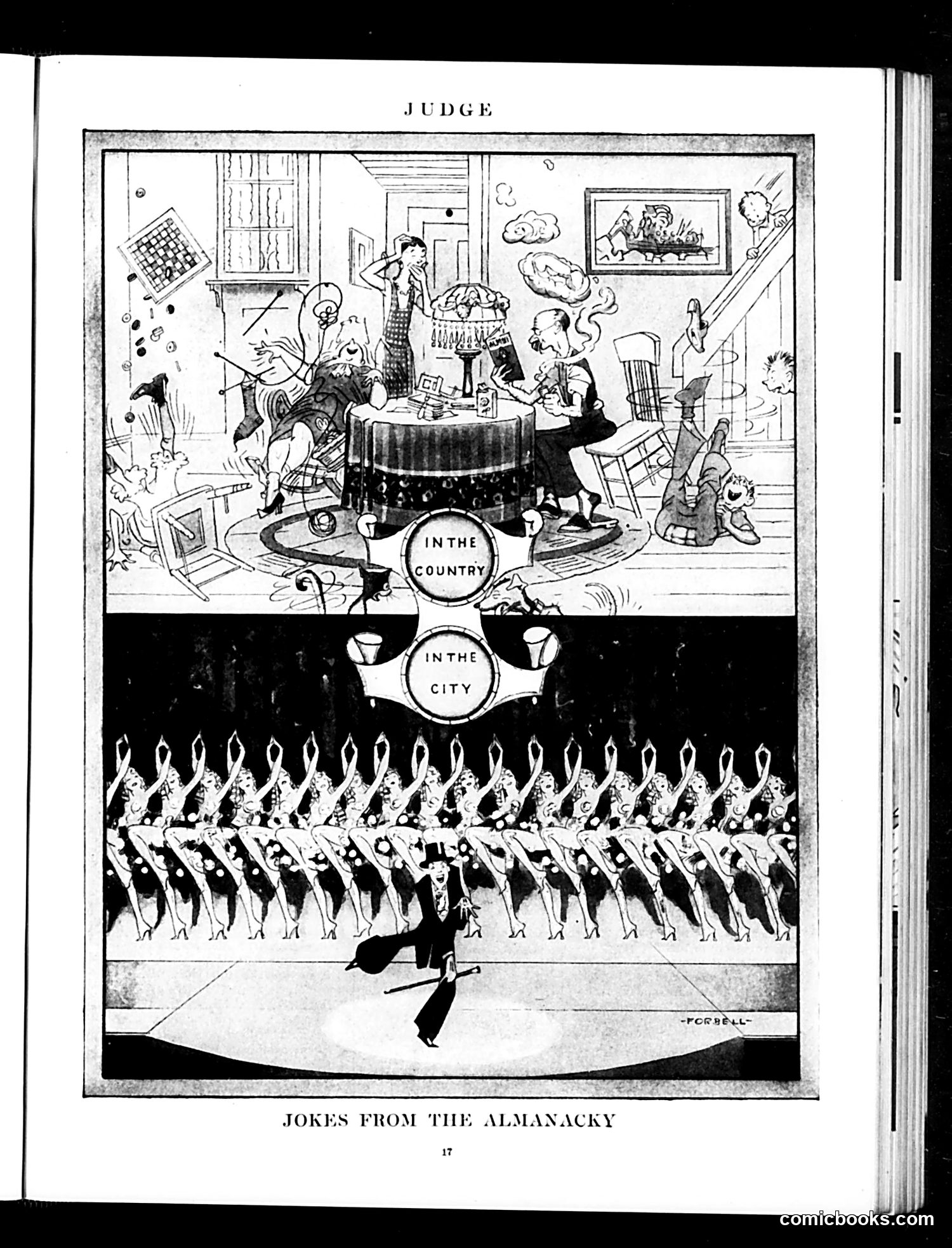
This page contains a cartoon contrasting life "In the Country" versus "In the City." The upper panel depicts a chaotic rural household scene with multiple figures engaged in various activities—domestic work, games, and socializing around a table. The lower panel shows an organized chorus line of identical women performers, suggesting the standardized entertainment and nightlife of urban centers. The satire appears to criticize the contrast between rural disorganization and urban conformity. While country life is portrayed as busy and haphazard, city life—represented by the synchronized dancers—emphasizes uniformity and artificiality. The title "Jokes from the Almanacky" suggests this was humorous commentary on contemporary lifestyle differences between rural and urban America, likely appealing to Judge magazine's urban readership.
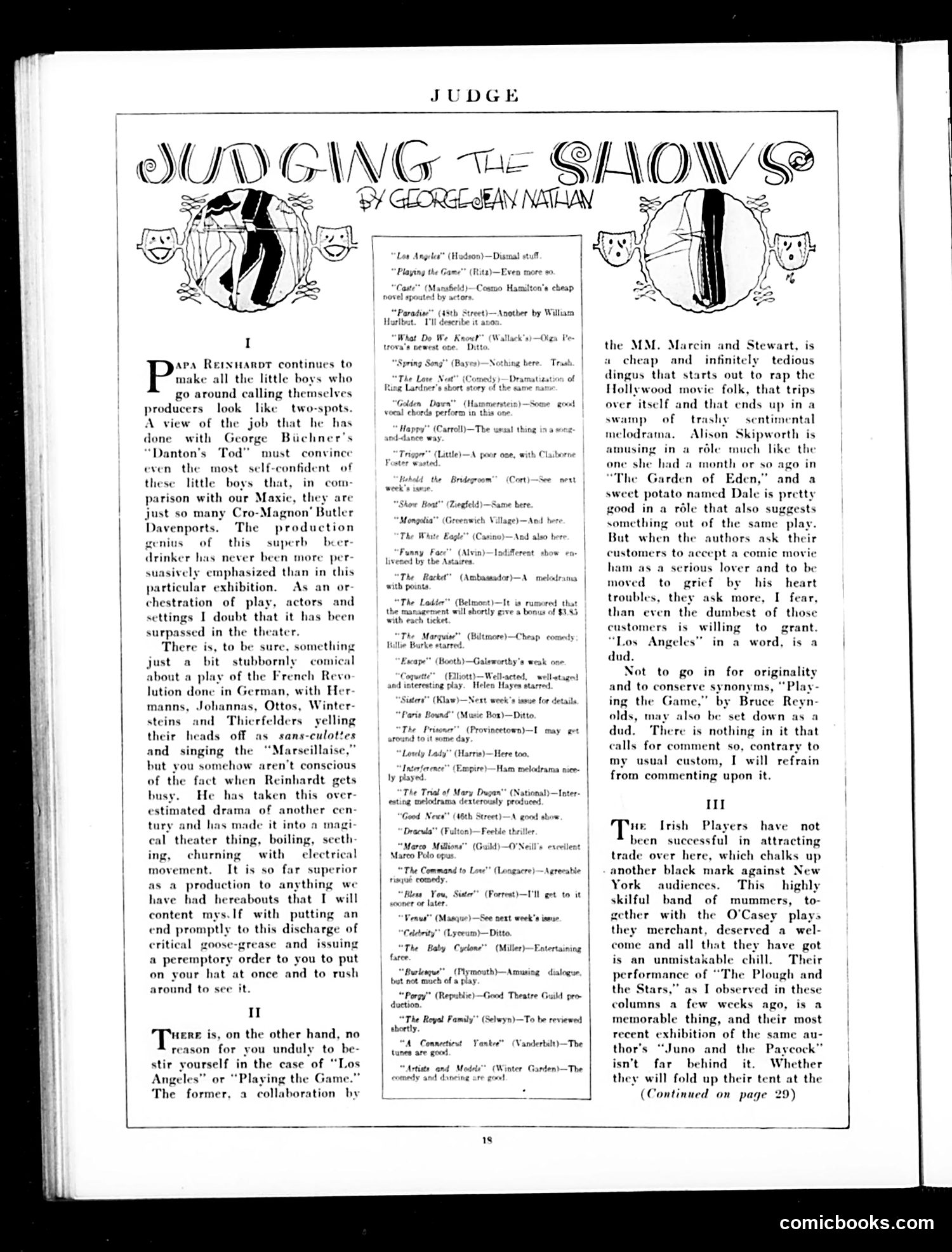
This page from *Judge* magazine contains theater reviews by George Jean Nathan, a prominent drama critic of the 1920s. The main content critiques Broadway productions. **Key Points:** Nathan praises Max Reinhardt's production of Büchner's *Danton's Tod* (a German play about the French Revolution), calling it theatrically superior despite the oddity of German actors singing "La Marseillaise." He dismisses two collaborations: *Los Angeles* and *Playing the Game*, calling them cheap, tedious melodramas exploiting Hollywood movie-folk gossip. He notes Alison Skipworth performs in a role similar to one from *The Garden of Eden*, and criticizes the sentimental plotting. The extensive list provides contemporary Broadway show titles with brief dismissive or approving commentary—typical *Judge* theater coverage mocking contemporary productions. **The Satire:** Nathan's witty, cutting reviews exemplify 1920s critical snobbishness toward commercial Broadway entertainment, contrasting "serious" artistic productions against trashy melodrama.
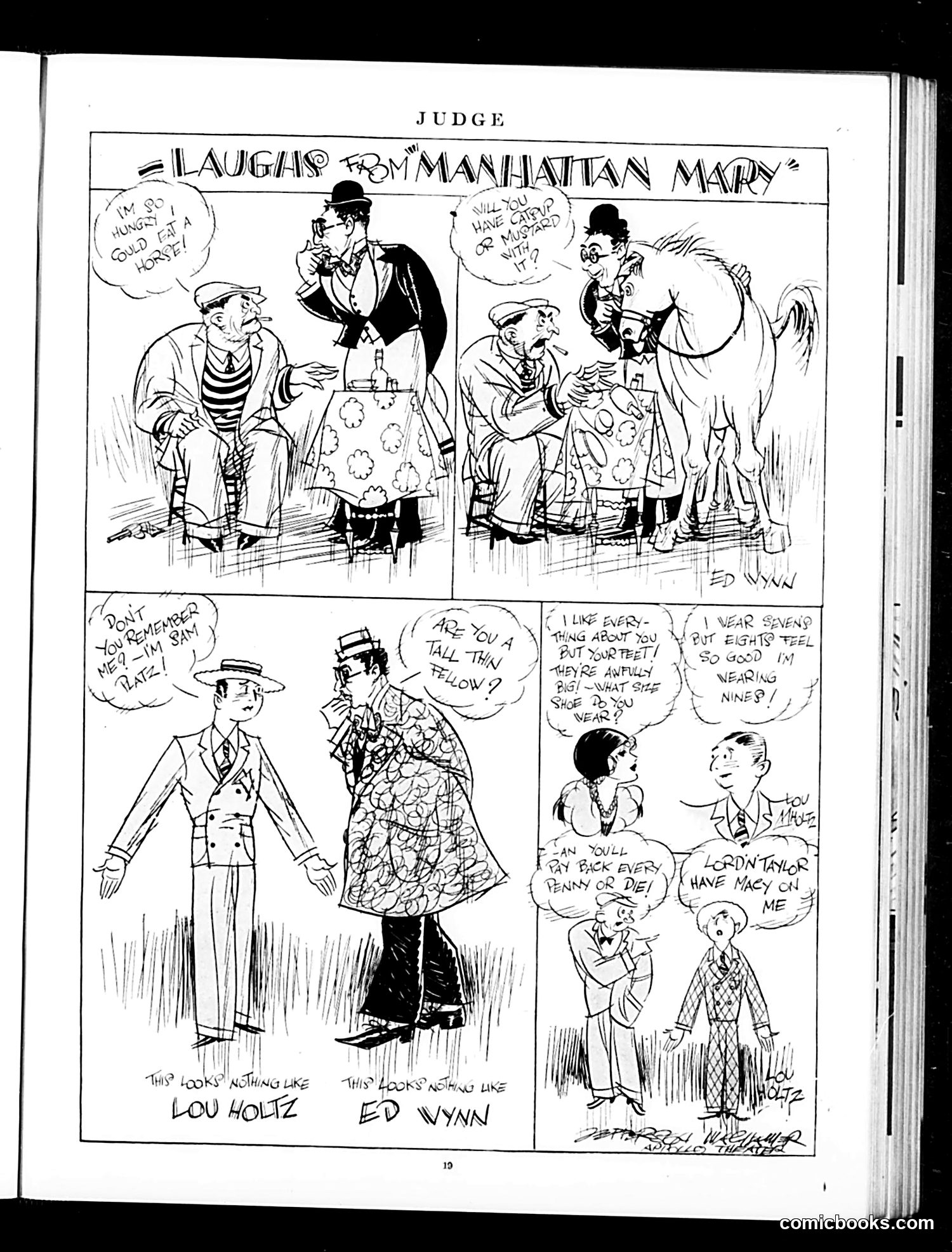
This Judge magazine comic satirizes early 1900s vaudeville performers and New York show business culture. The page features character impersonations, likely of famous entertainers of the era—the captions reference "Lou Holtz" and "Ed Wynn," both prominent vaudeville comedians known for distinctive physical comedy and quirky personas. The humor centers on physical appearance and mannerisms: characters comment on height ("Are you tall than that fellow?"), fashion choices ("I like everything about you but your feet"), and professional stereotypes. The dialogue captures vaudeville's self-referential humor, with performers discussing other performers' acts and appearance. The satire mocks both the entertainers' exaggerated styles and the vanity/superficiality of show business culture. The crude caricaturing reflects period attitudes about ethnic and physical comedy common in vaudeville humor.
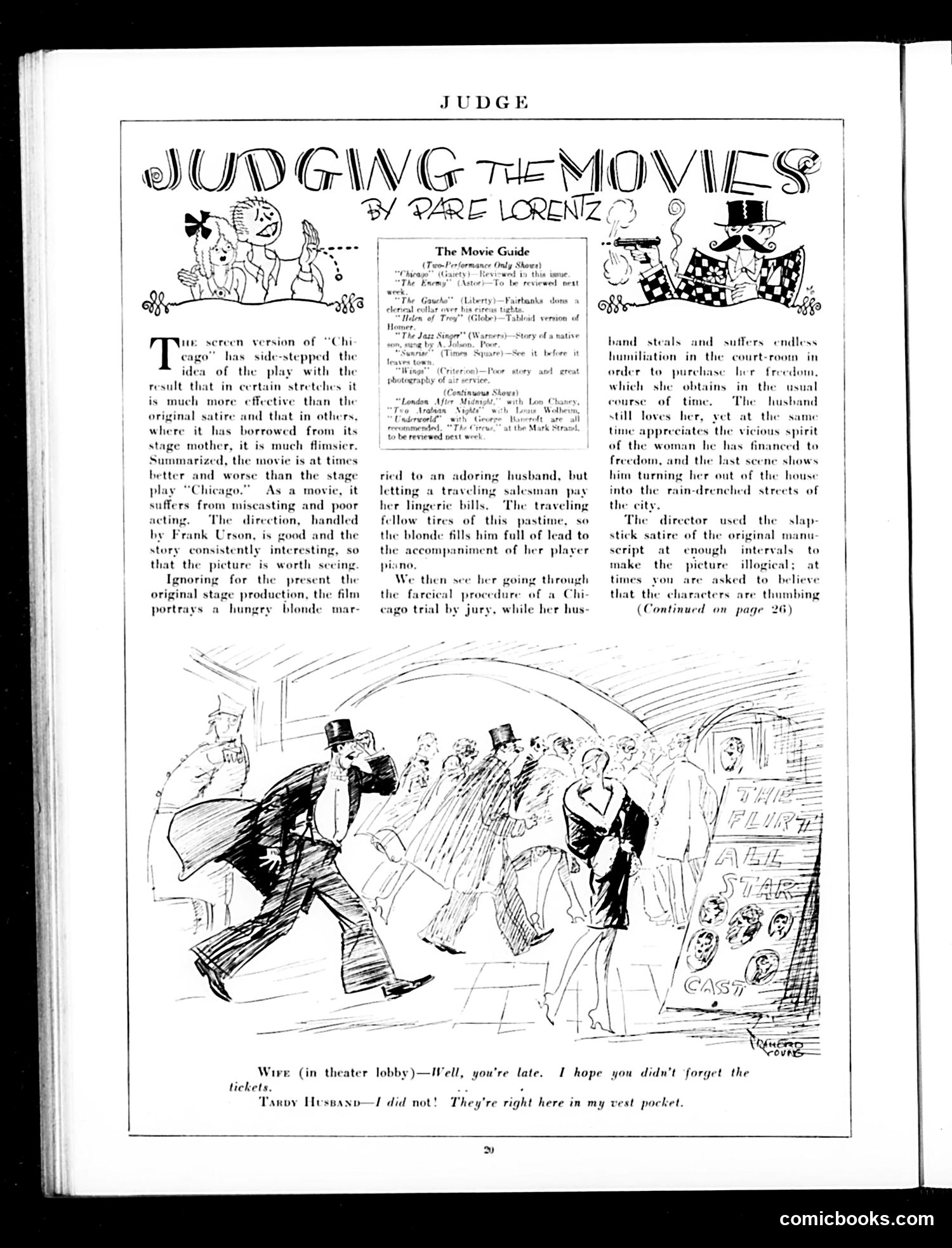
This page reviews the film adaptation of the stage play "Chicago," critiquing how the movie version differs from its theatrical source material. The review notes the film is sometimes more effective than the play but also occasionally weaker, suffering from miscasting and poor acting despite competent direction by Frank Urson. The plot involves a woman married to an adoring husband who allows a traveling salesman to pay her lingerie bills. When the salesman tires of this arrangement, she shoots him. The review criticizes the film for abandoning the original satire's bite at key moments, making character motivations illogical. The cartoon below illustrates a contemporary joke: a husband reassures his wife he didn't forget theater tickets—they're in his vest pocket. This reflects 1920s social conventions around men handling couple's outings and financial details, while satirizing absent-minded husbands.
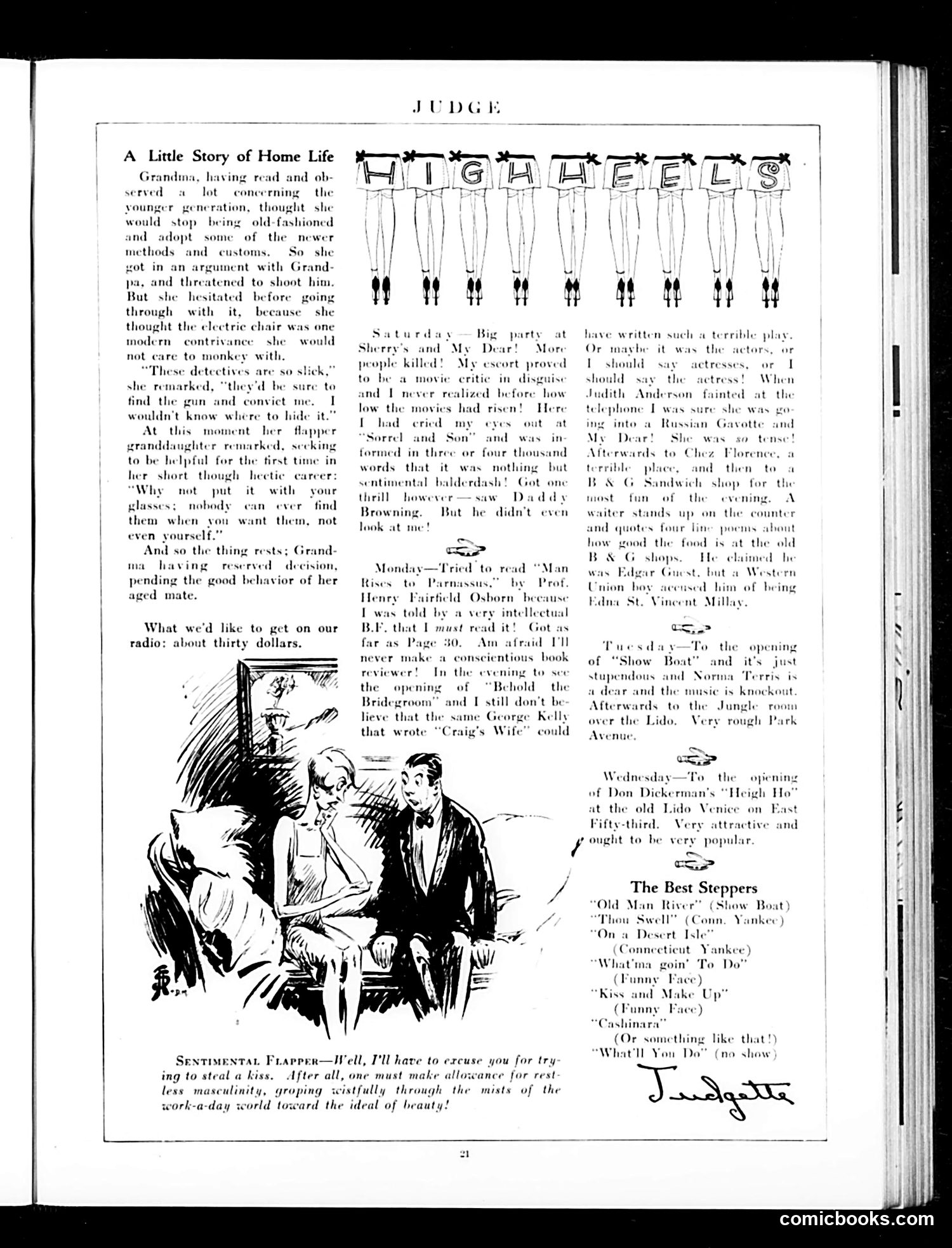
This page satirizes the "flapper" generation of the 1920s—young women adopting modern, unconventional behavior that shocked their elders. The main story depicts a grandmother who, after reading about younger generation trends, threatens to shoot her husband, then worries about the electric chair as an unwelcome modern contrivance. Her flapper granddaughter unhelpfully suggests hiding the gun. The accompanying diary entries mock flapper culture: attending Broadway shows (*Show Boat*, *Funny Face*), gossiping about theater critics, frequenting nightclubs, name-dropping celebrities like Judith Anderson and Daddy Browning, and generally treating serious literature (*Man Rises to Parnassus*) as obligatory rather than meaningful. The cartoon below depicts "Sentimental Flapper"—a young woman lecturing a man on allowing masculine advances, wrapping selfishness in pseudo-philosophical language about "the ideal of beauty." The satire targets both the flapper's contradictions and older generations' bewilderment at changing morality.
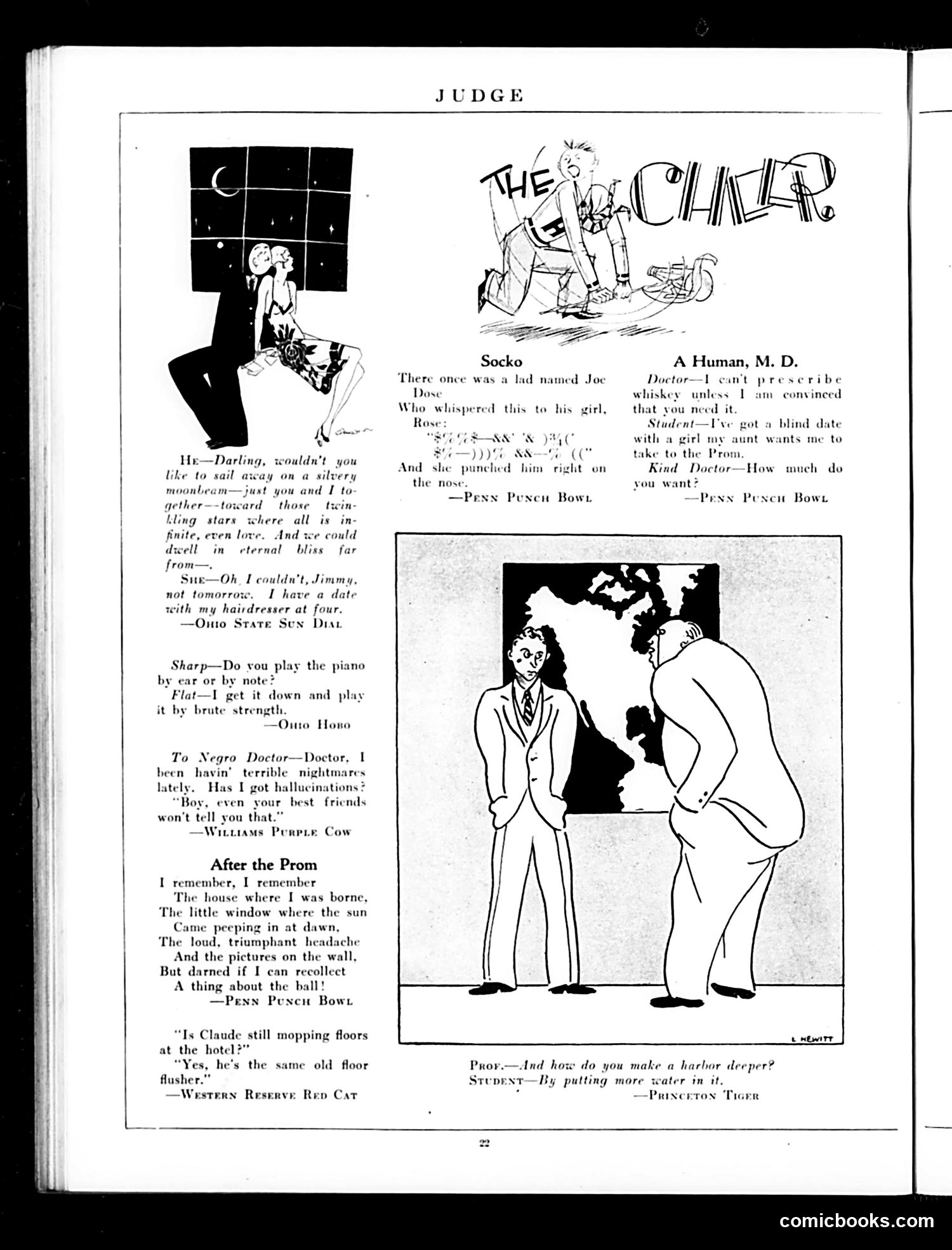
This page collects brief humorous jokes and cartoons typical of 1920s-era satirical humor. The content includes: **Social commentary**: References to dating culture (a man's romantic moonbeam fantasy interrupted by a woman's mundane hairdresser appointment), prom anxiety, and courtship rituals reflect post-WWI youth culture shifts. **Period-specific humor**: Jokes about Prohibition appear (a doctor reluctant to prescribe whiskey, a student wanting alcohol for a prom date), referencing the 18th Amendment era. **Workplace/class humor**: A "floor flusher" at a hotel suggests working-class characters; a student seeking doctor assistance for romance reflects college life. **One cartoon** (bottom right) shows two men in suits discussing "harbor deepening"—a student's literal answer to what appears an engineering question creates the joke's absurdist humor. The sources cite college publications (Ohio State, Princeton) and regional outlets, suggesting collegiate audience appeal. Overall, these are lightweight, observational gags about dating, alcohol, work, and education rather than hard political satire.
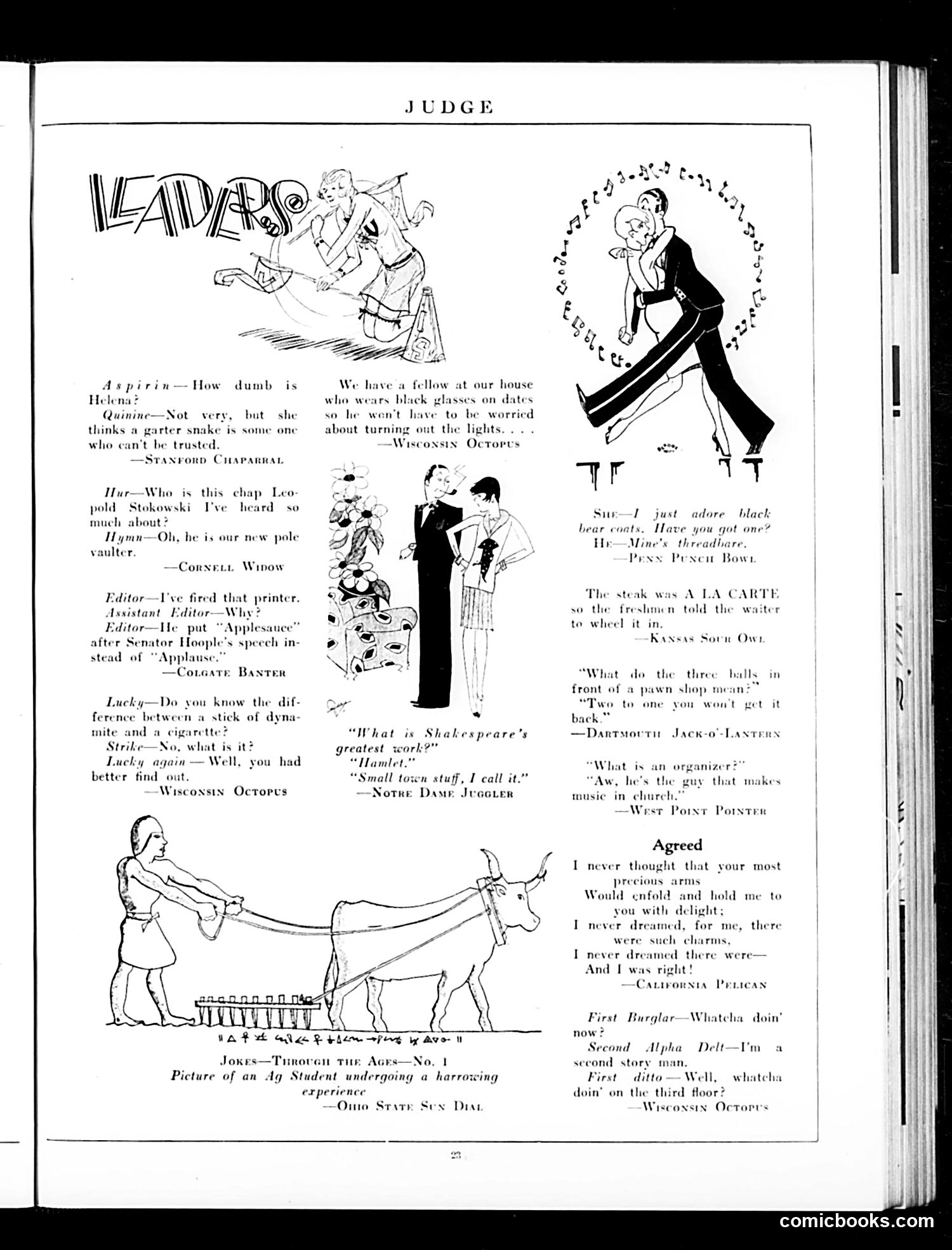
This page from *Judge* (an American satirical weekly) collects brief jokes and cartoons typical of the 1920s. Most are short quips on predictable topics: dating mishaps, college life, and gender dynamics. The main visual cartoon shows a man with a cow, captioned as "an Ag Student undergoing a harrowing experience"—likely mocking agricultural college students as unsophisticated or accident-prone. The jokes rely on period-specific references: "Leopold Stokowski" (a famous conductor) is confused with "pole vaulter" (a pun on "pole"); puns on "applause/applesauce"; wordplay about fraternity men ("Alpha Delt"), burglars, and pawn shops. The "Agreed" poem appears to be romantic verse, possibly satirizing sentimental poetry popular at the time. Overall, this reflects *Judge*'s humor style—lighthearted, collegiate in tone, and aimed at educated urban readers. The satire is gentle rather than political; references are now-obscure without historical context.
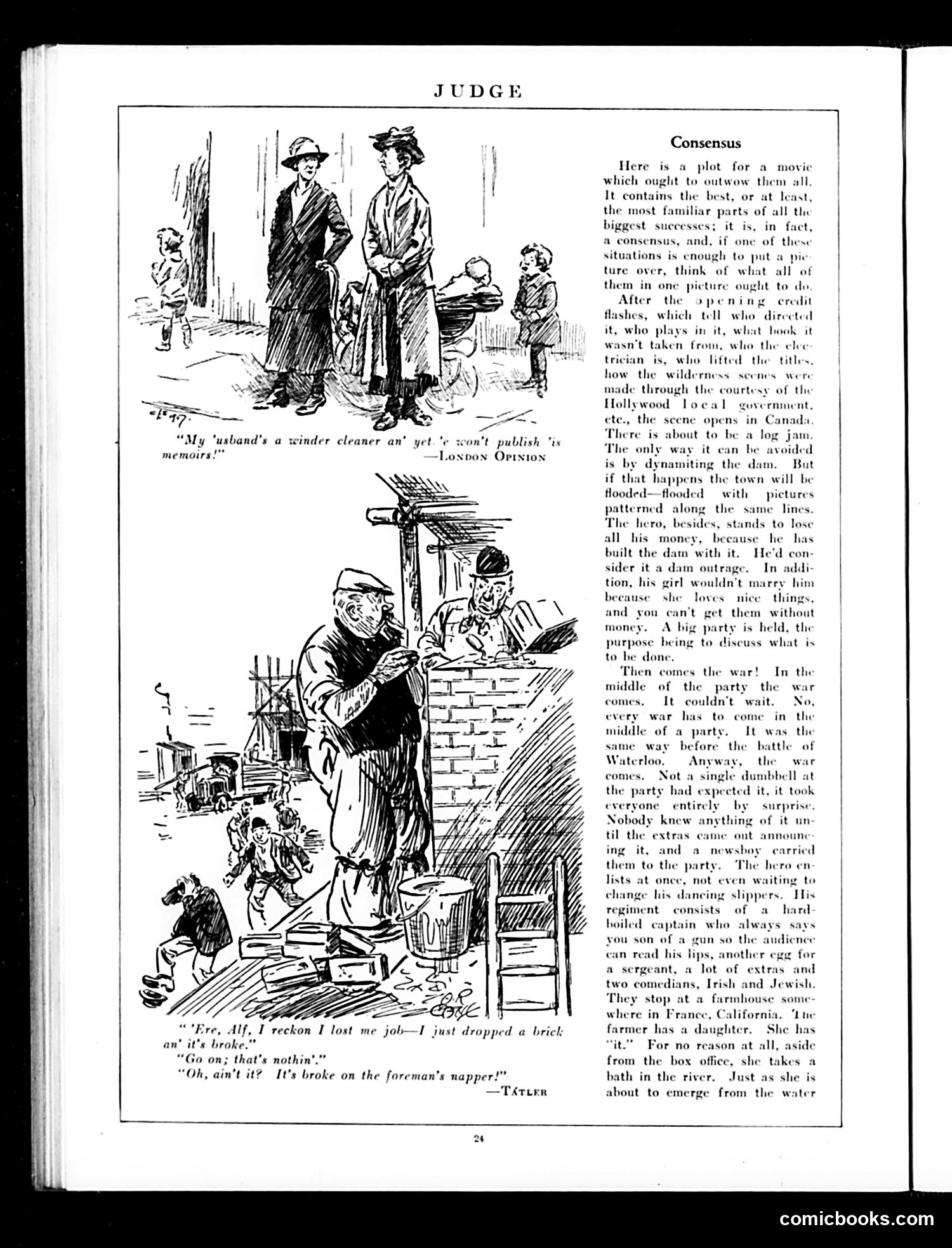
This page satirizes formulaic Hollywood filmmaking. The text "Consensus" describes a deliberately generic movie plot cobbled together from successful film tropes: wilderness scenes, a Canadian setting, a log-jam crisis, a romantic subplot with a poor hero and wealthy heroine, an unexpected wartime interruption mid-party, military stock characters (hard-boiled captain, comedic Irish and Jewish soldiers), and a bathing scene. The cartoons above illustrate class pretension and workplace mishaps—a London Opinion cartoon mocks a husband who won't publish memoirs while working as a window cleaner; the lower cartoon shows workers joking about breaking something on "the foreman's napper" (head). The satire targets studios' cynical assembly-line approach to hits: combining proven elements regardless of coherence. The page ridicules both Hollywood's creative bankruptcy and contemporary class anxieties. The specific film details and character types (Irish/Jewish comedians) reflect 1910s-1920s cinema conventions.
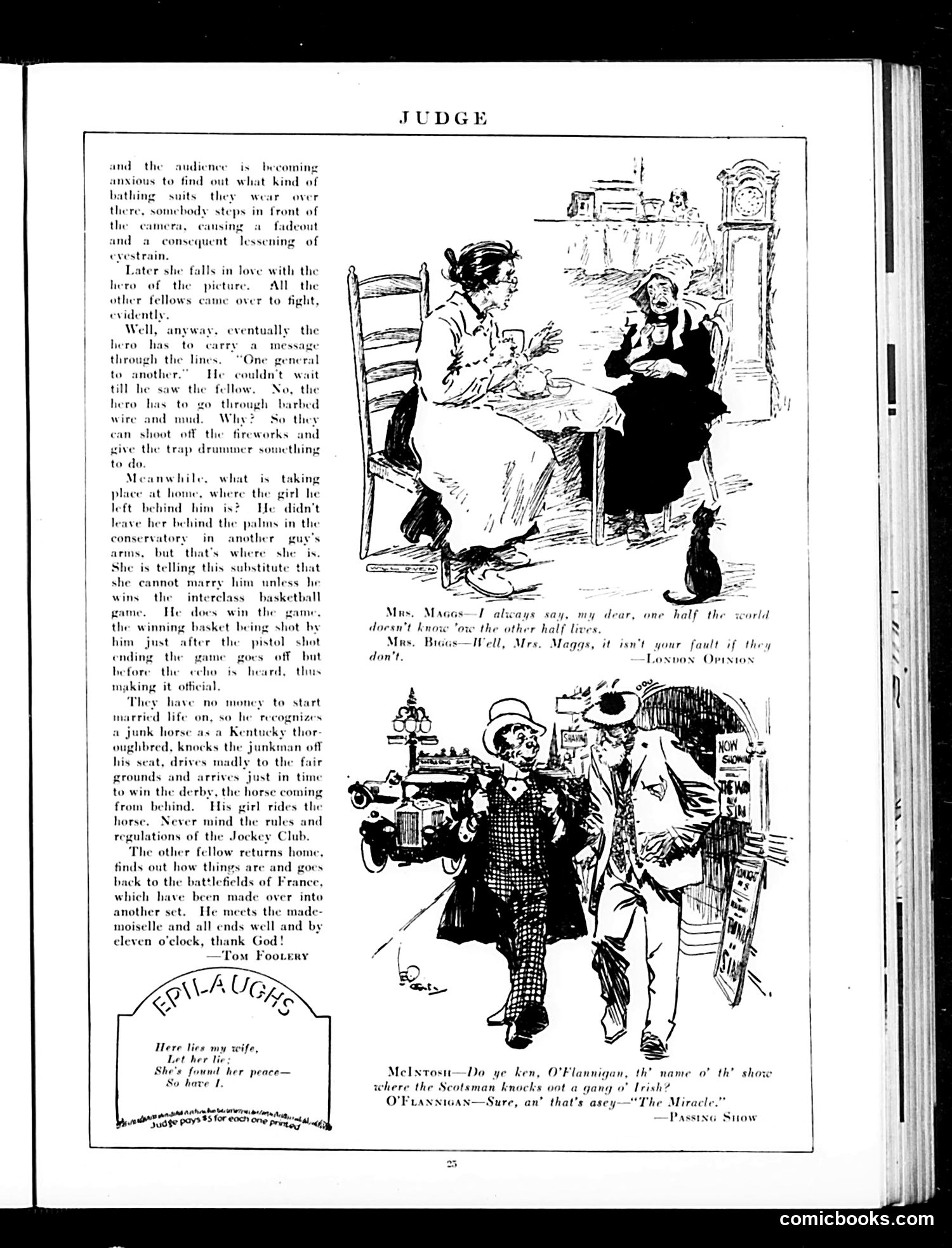
This page contains **film satire and social humor** typical of Judge magazine's satirical content. **Top section:** Tom Foley parodies melodramatic war movies—specifically criticizing their contrived plots. He mocks the clichéd narrative: a soldier carrying messages through danger, a girl back home who won't marry the hero unless he wins a basketball game, his miraculous victory, and his improbable success at a horse race using a junk horse he steals. Foley sarcastically notes the filmmakers prioritize dramatic spectacle (gunshots, drummers) over logic or realism. **Bottom cartoons:** Brief joke panels on class differences and ethnic humor. "Mrs. Maggs" boasts that half the world doesn't know how the other half lives—but she's doing a fine job telling them. The final joke plays on accent stereotypes, with a Scotsman and Irishman discussing "The Miracle" (a show where a Scotsman defeats Irish fighters). The page satirizes both **popular cinema's narrative absurdities** and **period social pretensions and ethnic stereotyping**.
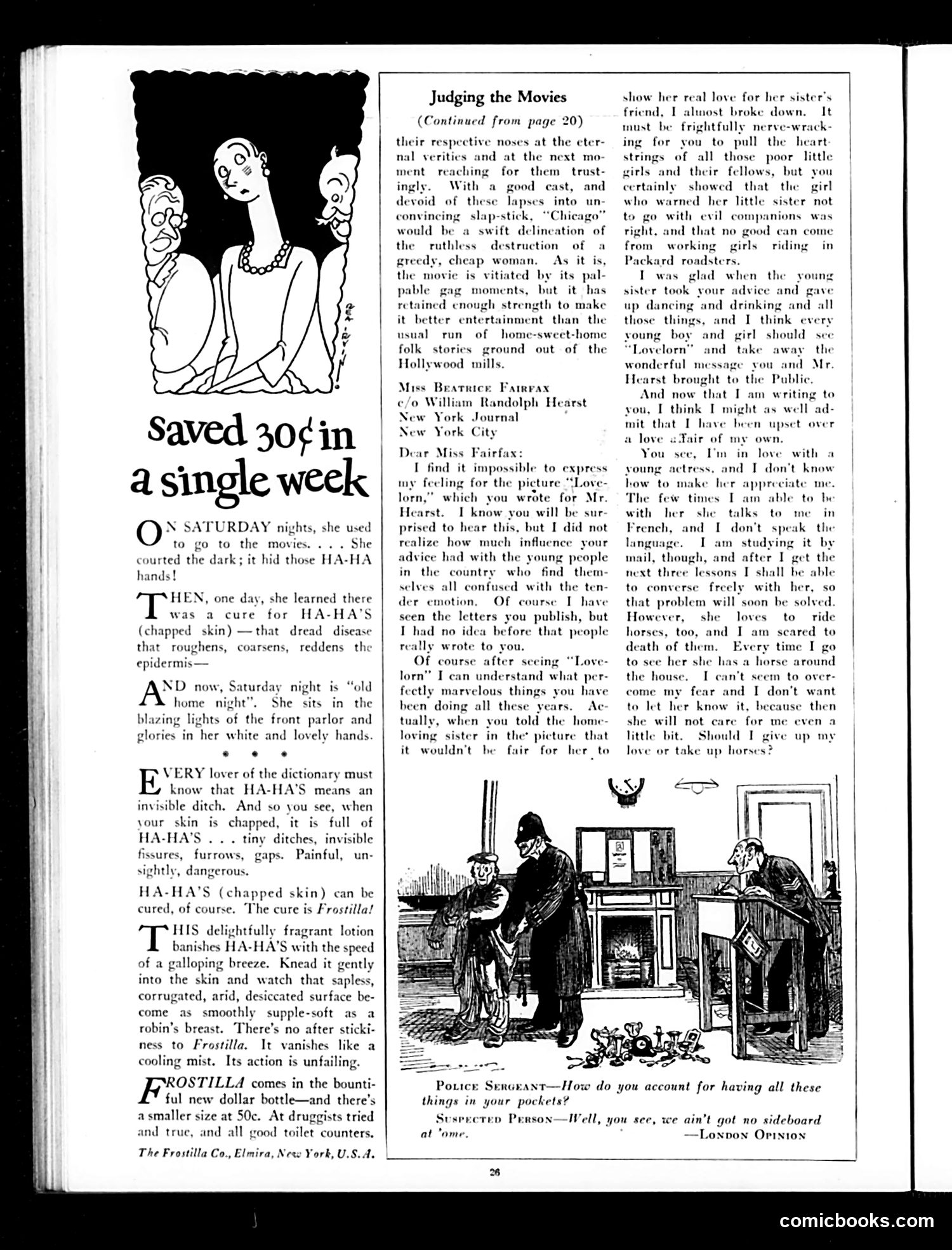
This page is primarily a **Frostilla skin cream advertisement** disguised as entertainment editorial content. The main cartoon depicts a woman who once avoided the front parlor because her chapped hands were unsightly ("HA-HA's"—the copywriter's pun for the tiny fissures in damaged skin). After using Frostilla lotion, she can now sit proudly in bright lighting, displaying her restored hands. The ad uses wordplay (HA-HA as both a laugh and dermatological term) and social shame as selling tactics: a woman's value depended on appearance, and chapped skin was presented as a serious social liability preventing courtship or public display. The "old home night" detail suggests she can now entertain suitors. The page also contains unrelated film reviews and an "advice column" letter, typical Judge magazine fare. The overall message: Frostilla solved a modern woman's embarrassment problem for just $1.
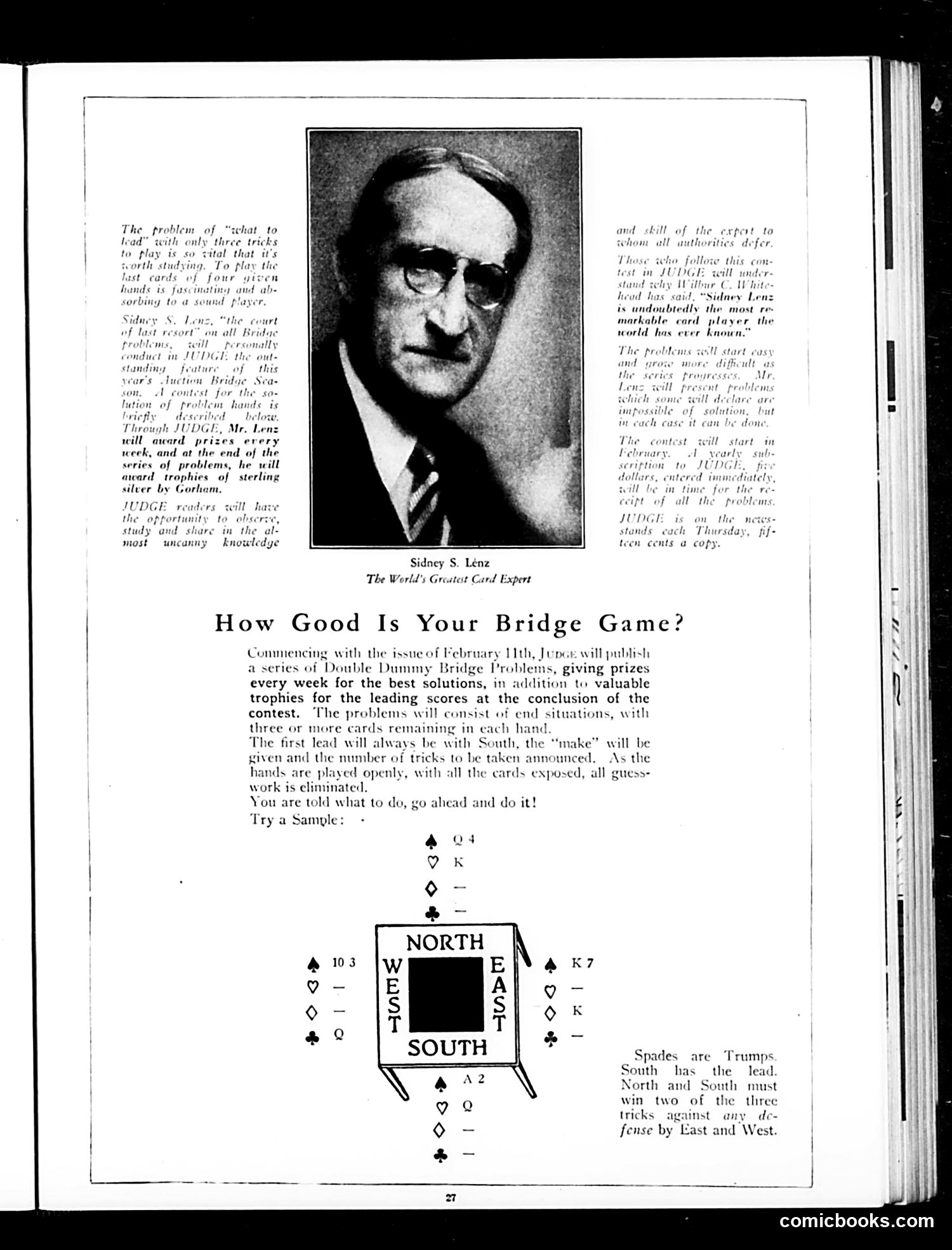
This page is not political satire but rather a recreational puzzle feature. It announces Judge magazine's new "Double Dummy Bridge Problems" contest, featuring weekly bridge card-game puzzles with prizes and sterling silver trophies. The prominent photograph shows Sidney S. Lenz, identified as "The World's Greatest Card Expert," who apparently sponsored or judged the competition. A sample bridge problem is provided below, showing card positions for North, South, East, and West players, with spades as trumps. This reflects the 1920s-30s popularity of bridge as an intellectual pastime among educated readers. The contest format—solving published problems and competing for prizes—was a common magazine feature of the era, similar to crossword puzzles today. There is no political commentary; it's purely entertainment content.
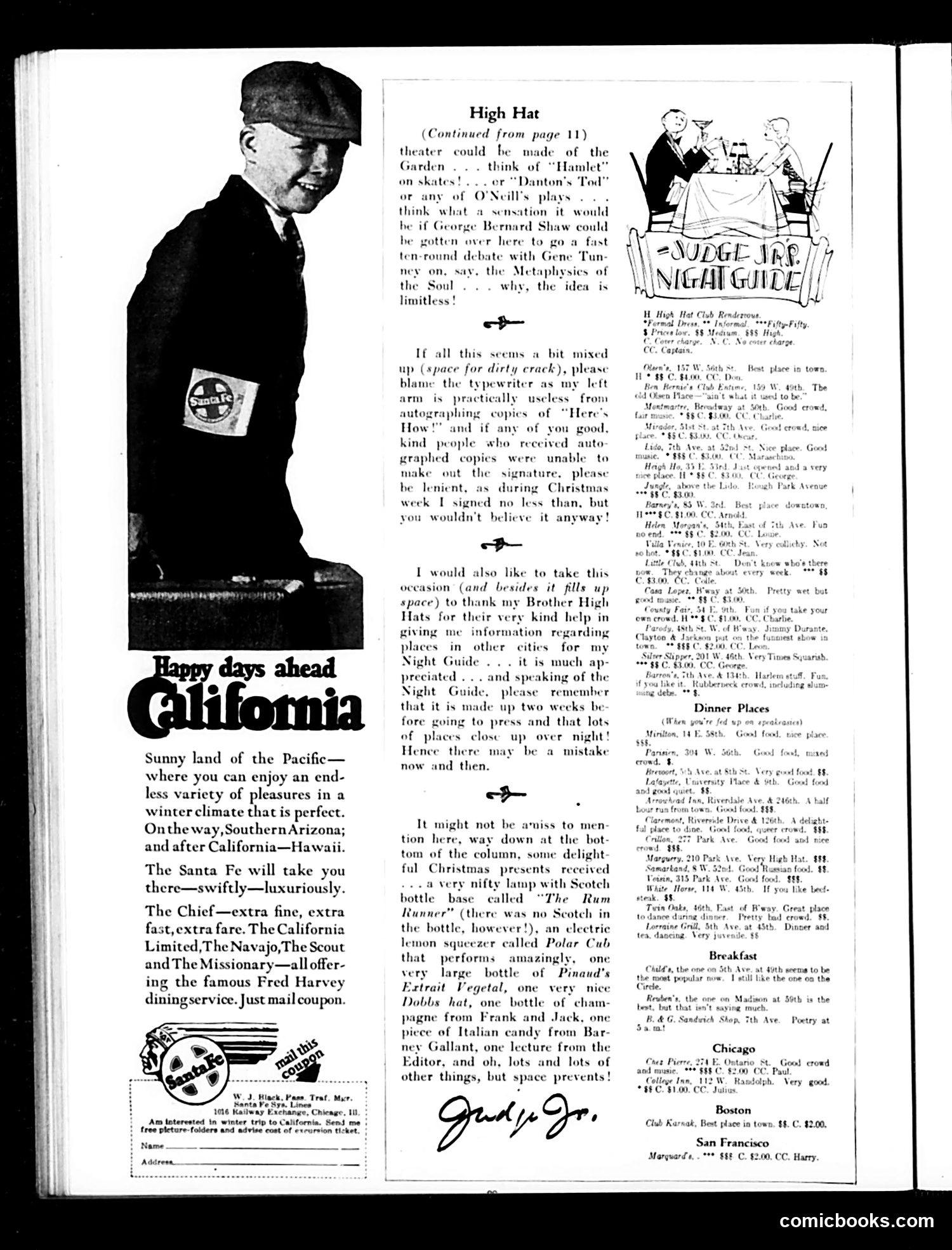
This page contains a personal column by the author (signature appears to be "Judge Jr.") discussing New York nightlife and entertainment venues. The left side advertises Santa Fe railway travel to California and Hawaii. The main content mocks the author's own pretensions and mixed-up ideas. He imagines absurd theatrical productions—like Shakespeare performed on ice skates—and fantasizes about hosting intellectual debates between playwright George Bernard Shaw and boxer Gene Tunney on metaphysics. The column self-deprecatingly blames his typewriter for the "mixed up" quality, claiming his left arm is useless from autographing copies of his book "Here's How!" The latter section lists Christmas gifts received (a "Rum Runner" lamp, electric lemon squeezer, cologne, hat, champagne) and provides restaurant/nightclub recommendations across American cities with pricing and crowd descriptions. This is largely personal gossip and social commentary aimed at a wealthy, urban readership interested in nightlife venues and fashionable entertainment.
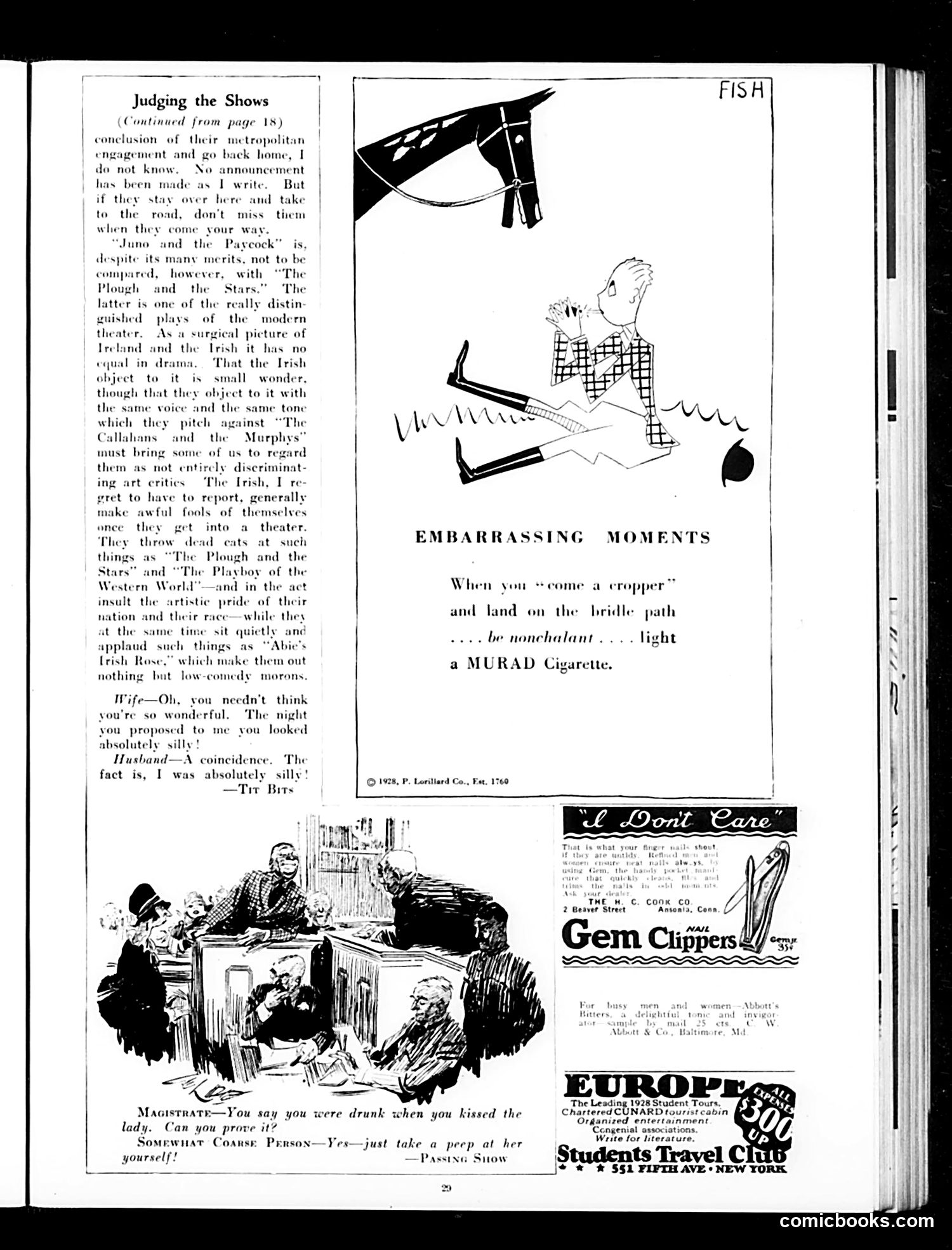
This Judge magazine page contains theater criticism and period humor typical of 1928. **"Judging the Shows"** critiques Irish theatrical productions, particularly praising "The Plough and the Stars" as superior drama. The author sarcastically laments that Irish audiences lack artistic discrimination—they heckle sophisticated plays like *Plough and the Stars* and *Playboy of the Western World* with the same vigor they calmly applaud lowbrow fare like *Abie's Irish Rose*, which the critic dismisses as "low-comedy morons" material. **The humor pieces** are standard domestic comedy: a husband-wife exchange about a silly proposal, and a courtroom scene where a drunk man kissed a woman and claims he can "prove" his drunkenness by looking at her. **The advertisements** (Murad Cigarettes, Gem Clippers, Students Travel Club) are period marketing, with the cigarette ad suggesting lighting up after an embarrassing fall maintains composure. The page reflects 1920s attitudes toward Irish-Americans, artistic gatekeeping, and casual sexism—all presented as routine entertainment humor for the magazine's readers.
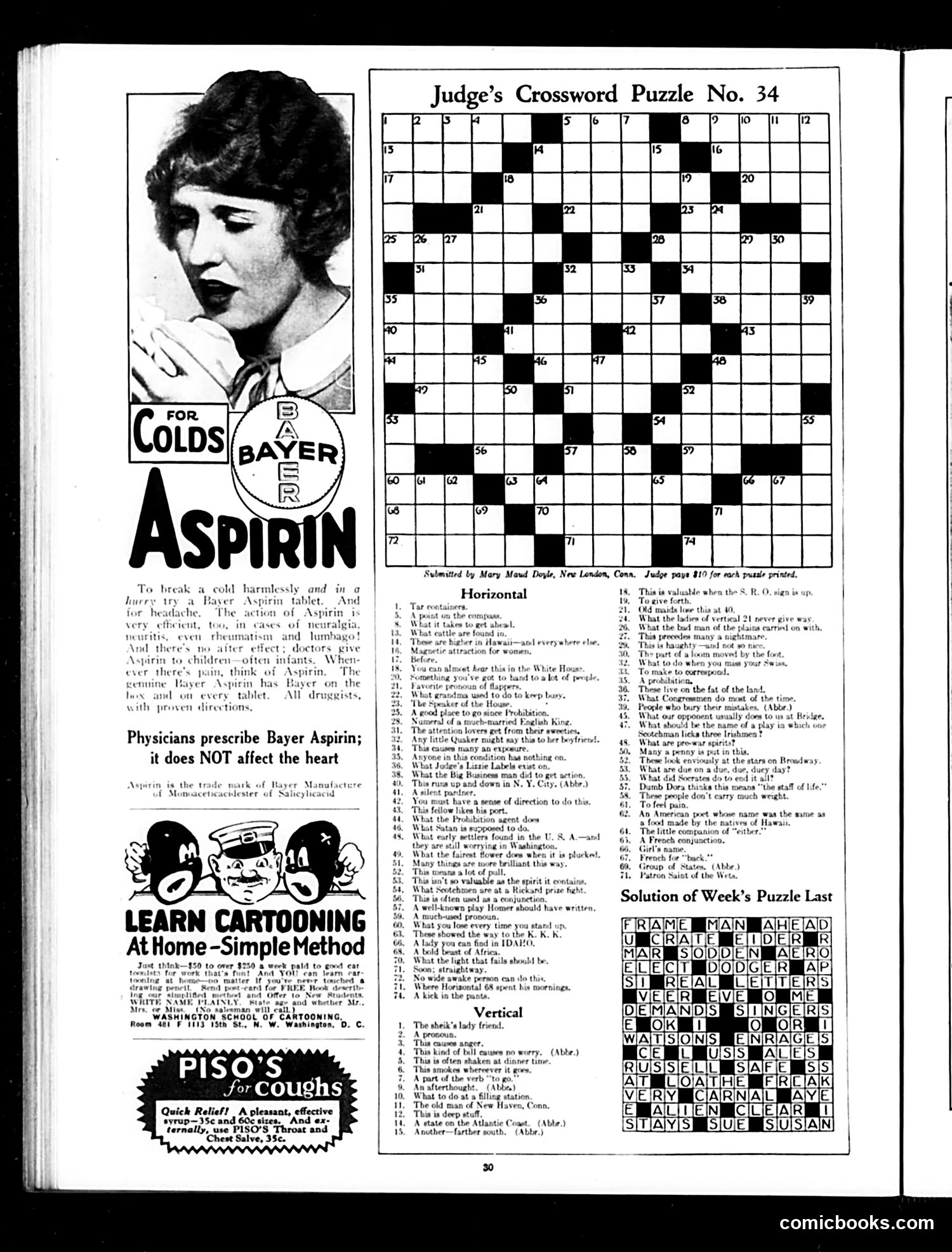
This page is primarily **advertising and puzzle content** from Judge magazine, a satirical American publication. The main elements are: **Advertisements:** - **Bayer Aspirin** dominates the left side, featuring a woman's portrait and marketing claims that aspirin "does NOT affect the heart"—likely addressing contemporary medical concerns about the drug's safety - **Piso's Cough Syrup** advertises throat/chest relief - **Learn Cartooning at Home** vocational school ad **Content:** The bulk of the page is **Judge's Crossword Puzzle No. 34**, submitted by Mary Maud Doyle. The clues are lighthearted wordplay typical of 1920s-era humor, referencing Prohibition ("What the Prohibition agent dons"), Hawaiian culture ("Islands of Hawaii"), and general comedic scenarios. **Historical Context:** This appears to be from the Prohibition era, given multiple references to alcohol and bootlegging in the puzzle clues. The advertisements reflect early 20th-century consumer marketing tactics and medical reassurances common to that period.
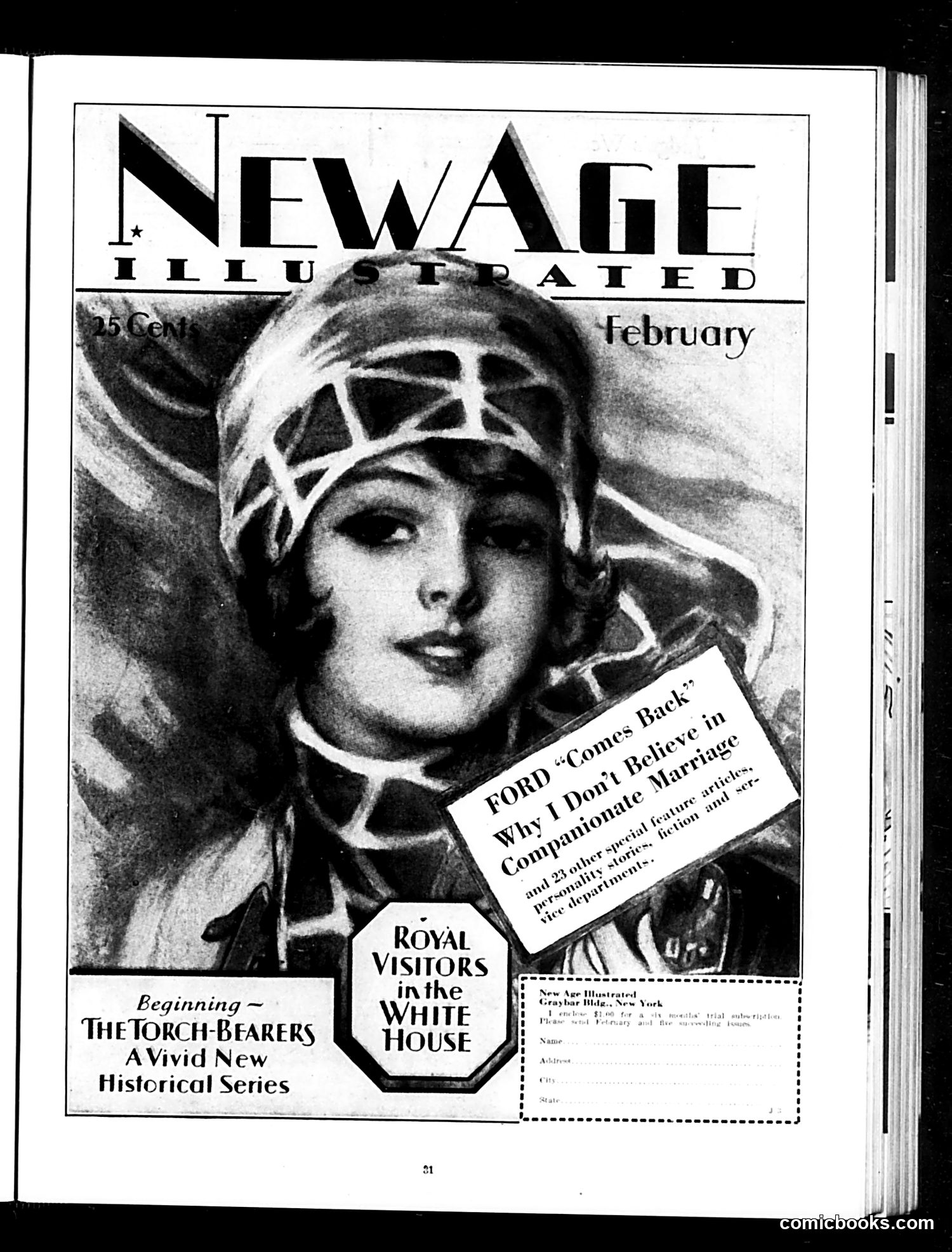
This is primarily a **magazine cover/advertisement page** from *New Age Illustrated* (February issue). The main content advertises two films: 1. **"Royal Visitors in the White House"** — a historical series called "The Torch-Bearers" 2. **Ford's "Comes Back" / "Why I Don't Believe in Companionate Marriage"** — featuring a woman in aviator gear with bandaged face, advertising Ford's film with details about "matrimonial" themes and "special feature" content The page is dominated by **entertainment advertisements rather than political satire**. The aviator imagery likely appeals to 1920s fascination with aviation and modernity. Without additional context about which "royal visitors" or Ford films are referenced, the specific satirical point remains unclear, though the juxtaposition of marriage skepticism with modern femininity (the aviator) may suggest commentary on changing social roles.
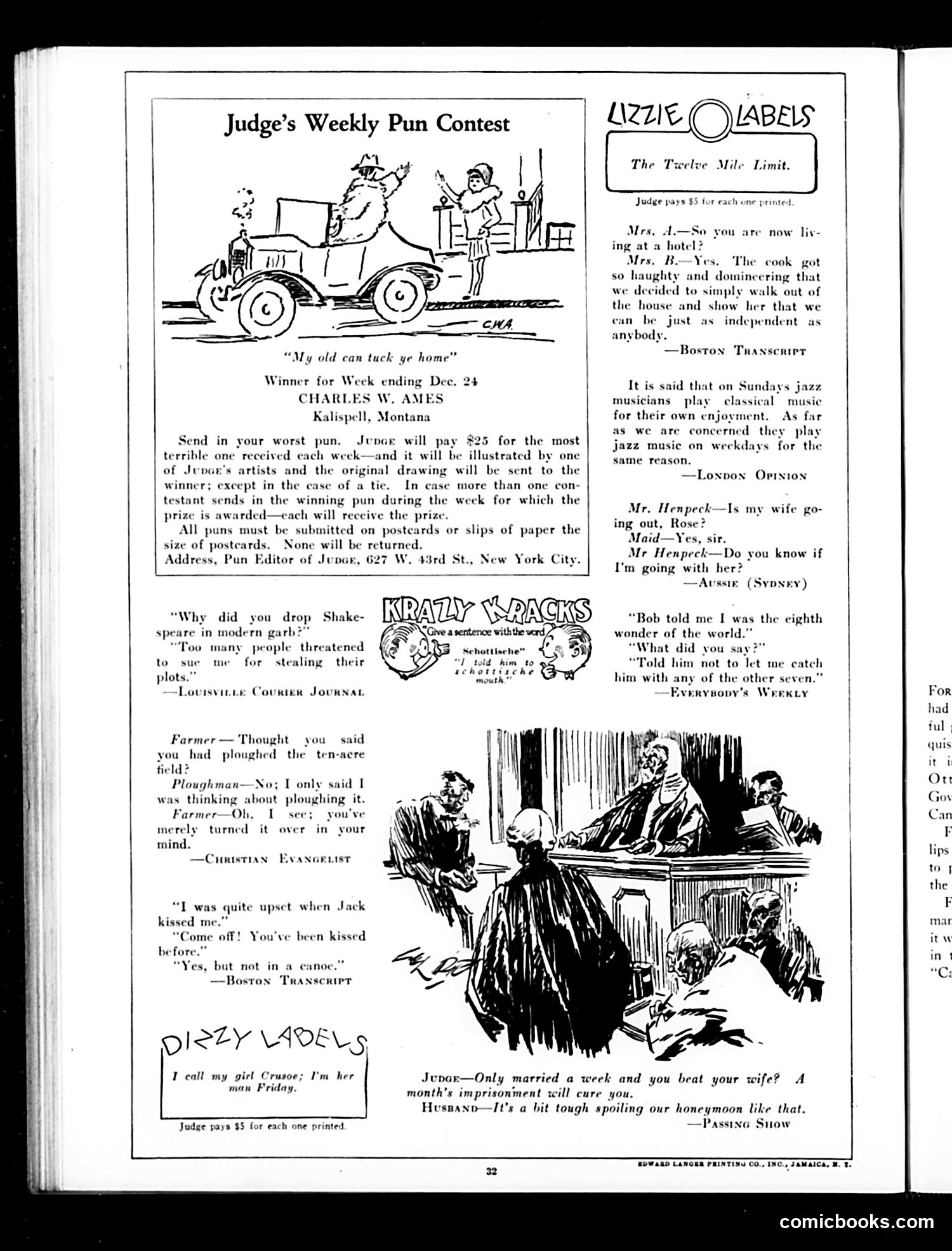
This page contains humorous short jokes and cartoons typical of Judge's satirical format. The main content includes: **"The Twelve Mile Limit"** references Prohibition-era "twelve-mile limits"—the offshore boundary beyond U.S. jurisdiction where alcohol remained legal. The caption suggests independence from domestic staff, though the joke's full meaning is unclear from the text alone. **Multiple short jokes** mock domestic life: henpecked husbands, servants, and marital discord. One depicts a newlywed husband imprisoned for beating his wife—dark humor about spousal abuse treated as comedic fodder. **"Judge's Weekly Pun Contest"** invites readers to submit terrible puns for $5 payment, illustrated by Judge artists—a participatory feature encouraging audience engagement. **"Krazy Wracks"** and **"Dizzy Labels"** are labeled joke sections offering one-liners on courtship, independence, and social pretense. The page reflects 1920s attitudes toward marriage, class relations, and Prohibition while showcasing Judge's mix of visual gags and written humor aimed at urban, educated readers.
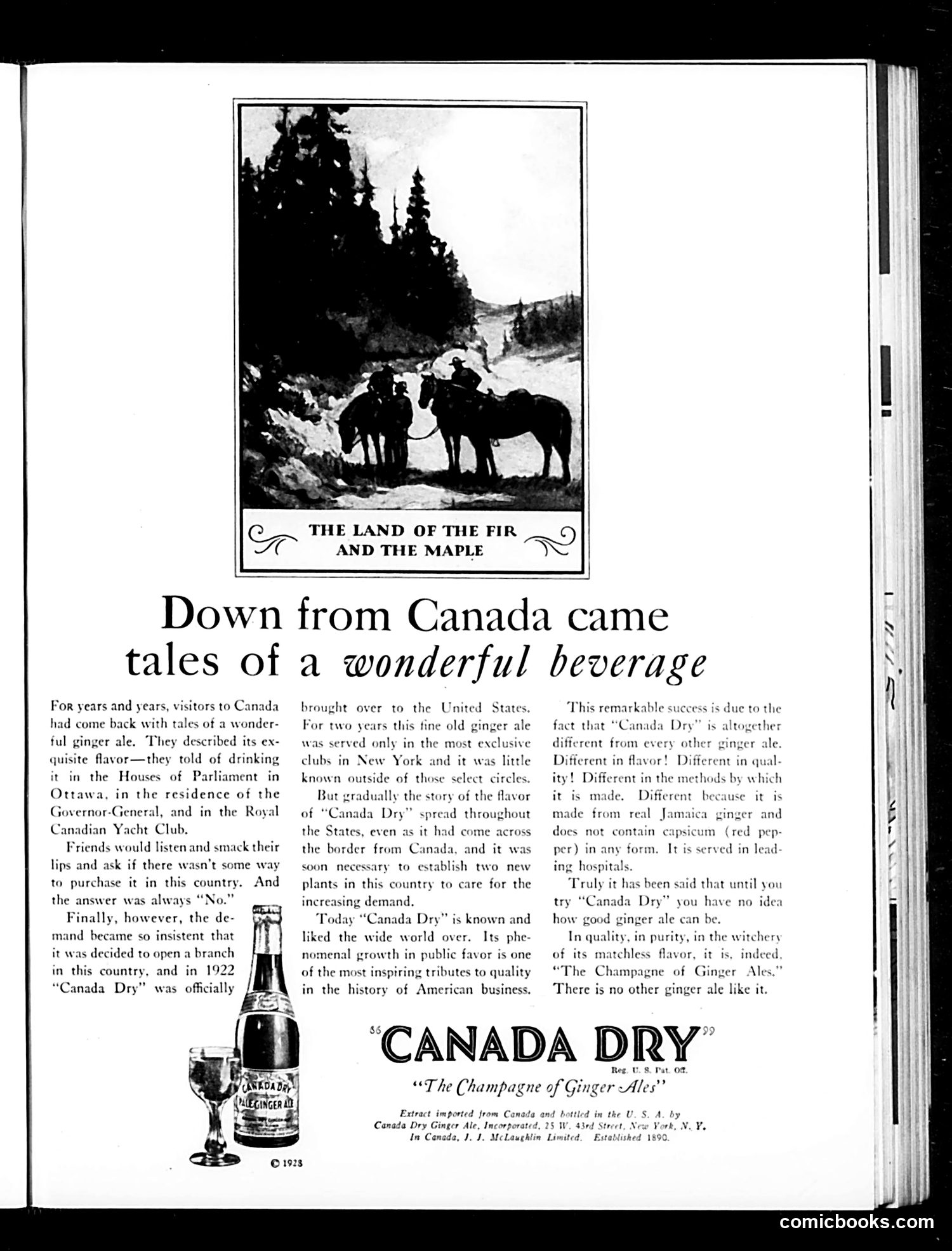
This is **not a cartoon or satire**, but rather a **straightforward advertisement** for Canada Dry ginger ale, disguised as editorial content in Judge magazine (circa 1923). The page uses a framing device—"Down from Canada came tales of a wonderful beverage"—to tell Canada Dry's origin story: the drink was exclusive in Canada, gradually gained American demand, and opened a U.S. branch in 1922. The accompanying image shows horses and travelers in a Canadian landscape ("The Land of the Fir and the Maple"), evoking prestige and exotic appeal. The "satire" is purely commercial: the text positions Canada Dry as superior to other ginger ales through exclusivity, purity, and use of Jamaican ginger rather than capsicum. The slogan "The Champagne of Ginger Ales" elevates it to luxury status. This represents **early advertorial practice**—blending advertising with magazine content to appear as editorial matter rather than explicit promotion.
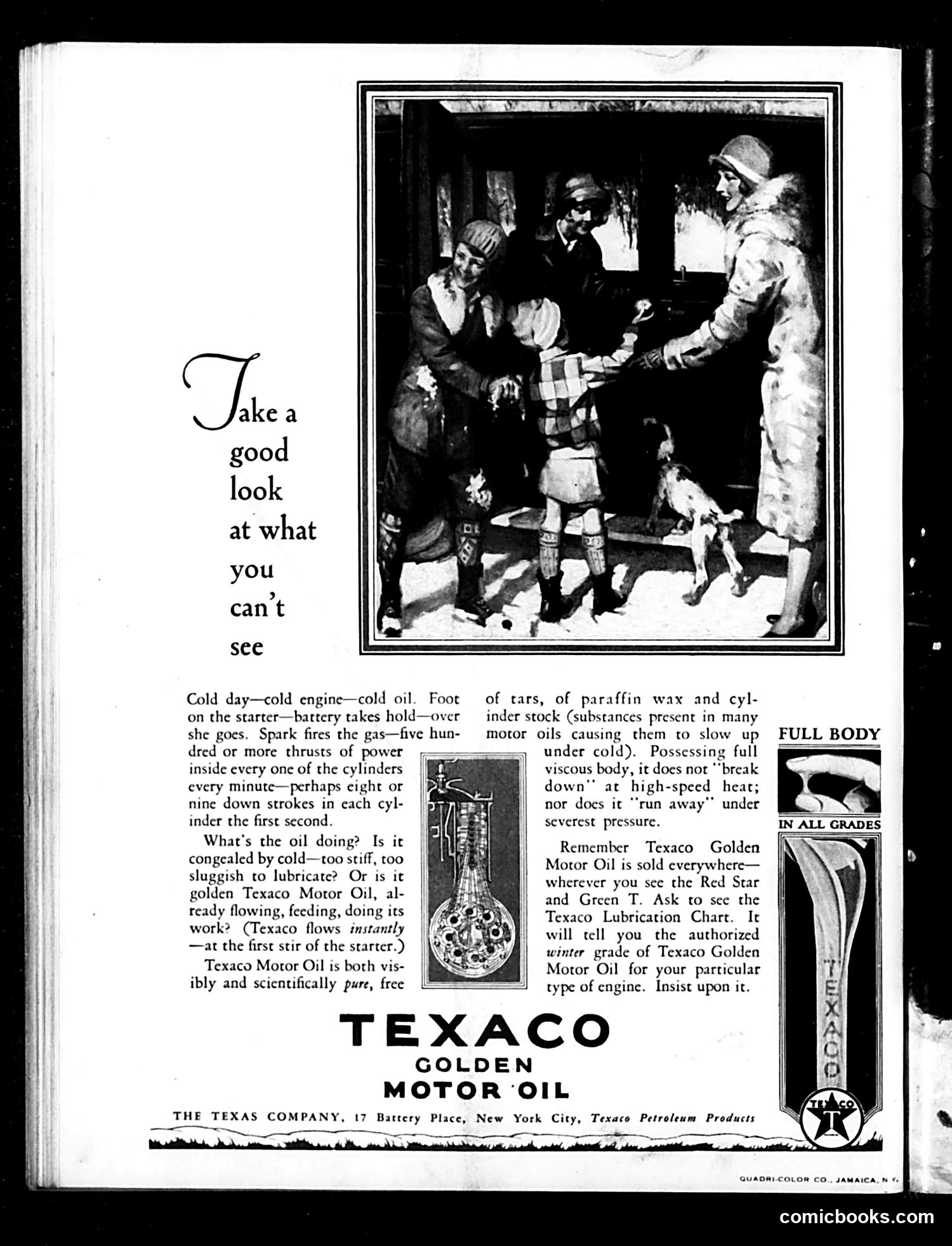
This is a **product advertisement**, not political satire. The page promotes Texaco Golden Motor Oil to American motorists, likely from the 1920s-30s era. The illustration depicts a family or group examining a child's leg or lower body, presumably to demonstrate the product's benefits—the headline "Take a good look at what you can't see" refers to oil flowing invisibly inside an engine. The advertisement's pitch centers on a practical problem: **cold weather**. In winter, inferior motor oils thicken and fail to lubricate properly, causing engine damage. Texaco claims its oil flows instantly in cold conditions ("Texaco flows instantly") and maintains consistent viscosity across temperature extremes—it won't congeale in winter or break down in summer heat. The ad emphasizes purity (free of paraffin wax) and scientific credibility, directing readers to consult Texaco's "Lubrication Chart" for proper winter grades. This represents early automotive marketing positioning premium oil as essential vehicle maintenance.