
Judge, 1928-01-14 · page 20 of 36
Judge — January 14, 1928 — page 20: what you’re looking at
What you’re looking at
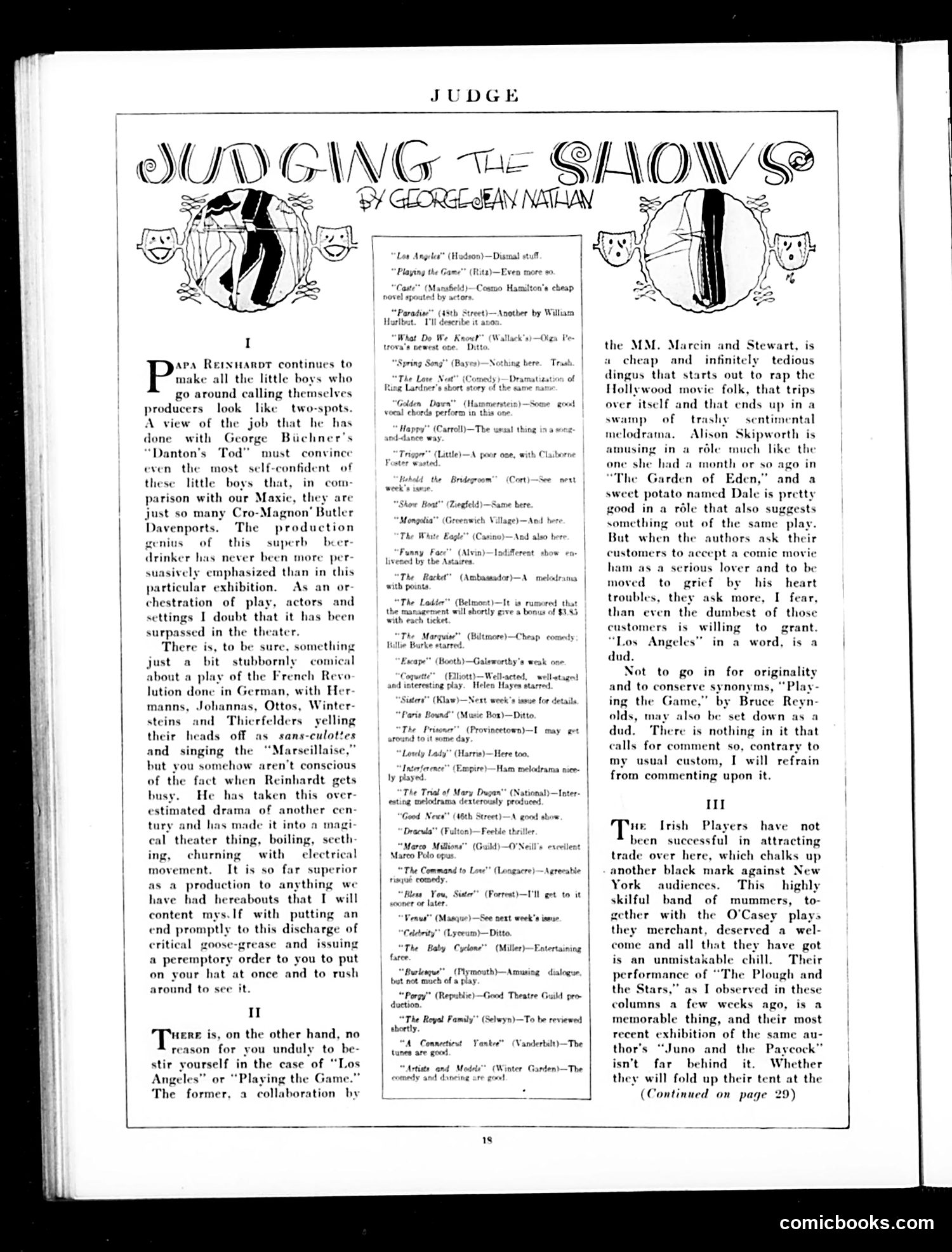
This page from *Judge* magazine contains theater reviews by George Jean Nathan, a prominent drama critic of the 1920s. The main content critiques Broadway productions. **Key Points:** Nathan praises Max Reinhardt's production of Büchner's *Danton's Tod* (a German play about the French Revolution), calling it theatrically superior despite the oddity of German actors singing "La Marseillaise." He dismisses two collaborations: *Los Angeles* and *Playing the Game*, calling them cheap, tedious melodramas exploiting Hollywood movie-folk gossip. He notes Alison Skipworth performs in a role similar to one from *The Garden of Eden*, and criticizes the sentimental plotting. The extensive list provides contemporary Broadway show titles with brief dismissive or approving commentary—typical *Judge* theater coverage mocking contemporary productions. **The Satire:** Nathan's witty, cutting reviews exemplify 1920s critical snobbishness toward commercial Broadway entertainment, contrasting "serious" artistic productions against trashy melodrama.
📄 Transcribed text from this page (OCR, searchable)
Machine-transcribed from the original scan — historical spelling and the odd misread are preserved.
JUDGE apa Retnuarot continues to make all the little boys who go around calling themselves producers look like two-spots. A view of the job that he has done with George Biichner's ‘Danton’s Tod" must convince even the most self-confident of these little boys that, in) com parison with our Mas just so many Cro- Davenports. The production genius of this superb beer drinker has never been more per- suasively emphasized than in this particular exhibition. As an or chestration of play, actors and settings I doubt that it has been surpassed in the theater, There is, to be sure, something just a bit stubbornly about a play of the French Revo lution done in German, with Her manns, Johannas, Ottos, Winter- steins and Thierfelders ling their heads off sans-culottes and singing the “Marseillaise,” but you somehow aren't conscious of the fact when Reinhardt gets busy. He has taken this over- estimated drama of another cen tury and has made it into a m cal theater thing, b ing, churning — with movement. they are on’ Butler comical ing, seeth electrical It is so far superior as a production to anything we have had hereabouts that I will content mys.If with putting an end promptly to this discharge of critical goose-grease and issuing a peremptory order to you to put on your hat at once and to rush around to see II Te is, on the other hand, no ason for you unduly to be- stir yourself in the case of “Los Angeles” or “Playing the Game. The former, a collaboration by f \ \ IG ae Loe Angeles” (H. —Dismal Playing the Game’ (Rita)—Even Cost mo Hamilton's cheap et}—Anotber by William (tate: Do We Know? rewest one. Ditto. Wallack's) Olea Pe “Spring Song’ (Bayes)—Nothing bere. Tras! “The Love Neat” ( Ring Lardner’s short Dramatizstion of wry of the sane nate Golden Dawn” (Harnme voral perform in Happy’* (Carroll) —The usual thing in a soe and-dance way (Little) —A poor ose, with Claiborne the Bridegroom’ (Cort)—See neat Showe Boat’* (Ziegfeld) —Same here Mongolia’ (( The Wht, —And bh Funny Face” (Alvin)—Indiferent show en- livened by the Astaires Racket” (Ambasador)—A- melodrama (Belmoet)—It is ru the management will shortly g:¥e a with each Gcket. + Marquise” (Bitmore)—Cheap commnty we Burke etarre Escape” (Boo (Blhott)—Well-acted, welletage! and interesting play. Helen Hayes starred. Sisters” (Klaw)—Ner “Paris Bound’ (M The Box)—Ditto. (Provineetown)—I may get ne day Lowly Lady’* (Harrie)—Here too. Interference’ Ham melodrama aiee- ly played The Trial of Mary Dugan" (National) —Inter esting melodrama dexterously produ Good News" b Street) —A e! Dracula" (Fulton)—Feetle thriller (Gaild) O'Neill's “Marco Million Mareo Polo opus : “The Command to Lovw’’ (Longacre)—Agreeable tinue comedy “Bless You, Sister” (Forrest)—I'll get to it sconer of later Venus" (Masyue)—See next week's iam Celebrity” (Lyceum)—Ditto. “The Baby Cyclone” (Miller)—Entertaining fare. “Burley (Plymouth)—Amusing dialogue ot much of a play Porgy" (Repablie)—Good Theatre Guild pro ‘he Royal Family’’ (Selwyn)—To be reviewed shortly. “A Connectiont Yankee tunes are good ‘Vanderbilt)—The “Artiate and Mo the MM. Marcin and Stewart, is a cheap and _ infinitely tedious dingus that starts out to rap the Hollywood movie folk, that trips over itself and that ends up ina swamp of trashy — sentimental melodrama. Alison Skipworth is amus, role much like the one she? had a month or so ago in ‘The Garden of Eden,” and a sweet potato named Dale is pretty good in a réle that also suggests something out of the same ple But when the authors ask th customers to accept a comic movi ham as a serious lover and to be moved to grief by his heart troubles, they ask more, I fear, than even the dumbest of those customers is willing to grant. “Los Angeles” in a word, is a dud. Not to go in for originality and to conserve synonyms, “Play- ing the Game,” by Bruce R olds, t also be set down as « dud. There is nothing in it that calls for comment so, contrary to my usual custom, I will refrain from commenting upon it. in r Il ue Irish Players have not been successful in attracting trade over here, which chalks up another black mark against New York audiences. This highly skilful band of mummers, to- gether with the O'Casey plays they merchant, deserved a wel- come and all that they have got is an unmistakable chill. Their performance of “The Plough and the Stars,” I observed in these columns a few weeks ago, is a memorable thing, and their most recent exhibition of the same au- thor’s “Juno and the Paycock” isn’t far behind it. Whether they fold up their tent at the (Continued on page 29) comicbooks.com |