
Judge, 1928-01-14 · page 26 of 36
Judge — January 14, 1928 — page 26: what you’re looking at
What you’re looking at
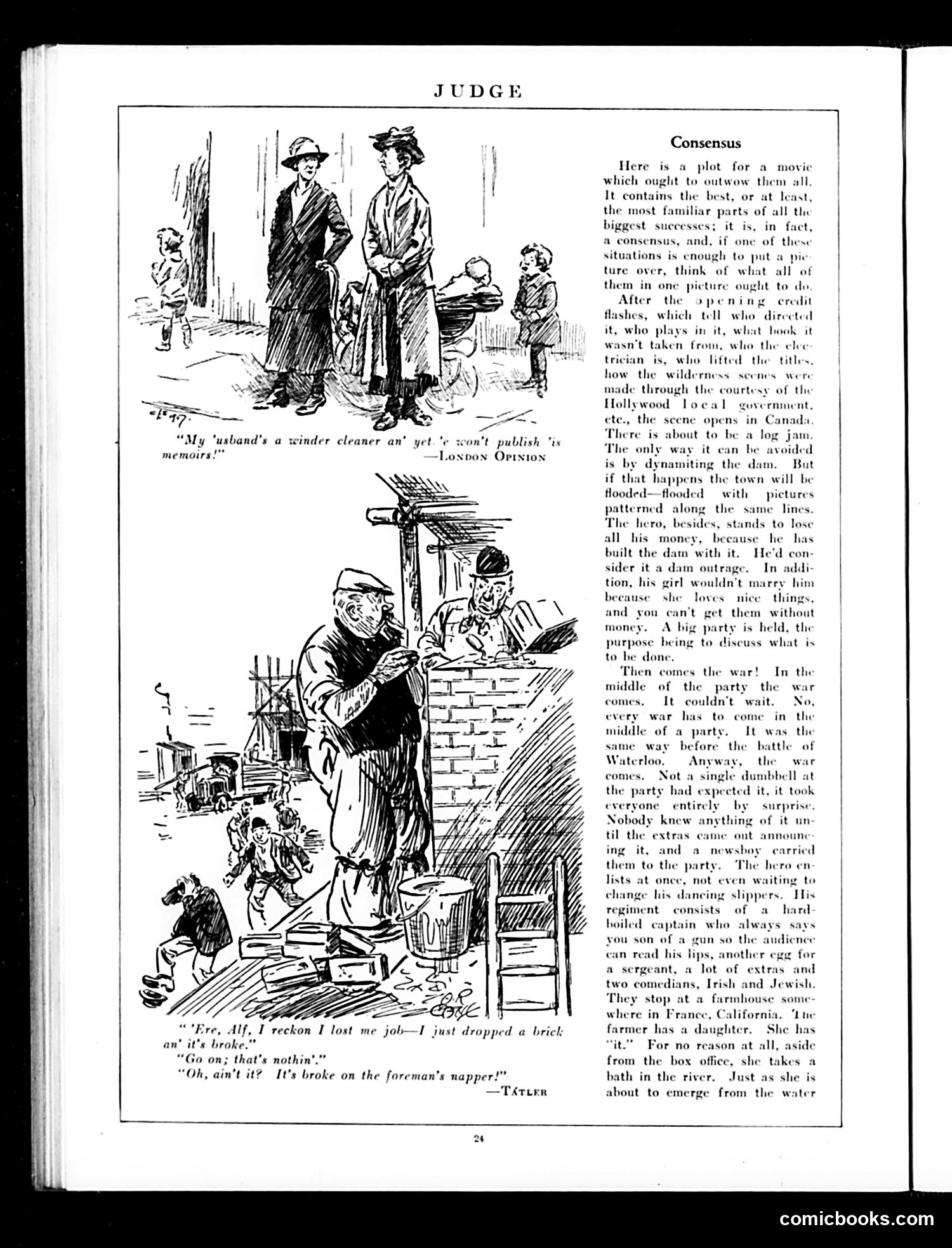
This page satirizes formulaic Hollywood filmmaking. The text "Consensus" describes a deliberately generic movie plot cobbled together from successful film tropes: wilderness scenes, a Canadian setting, a log-jam crisis, a romantic subplot with a poor hero and wealthy heroine, an unexpected wartime interruption mid-party, military stock characters (hard-boiled captain, comedic Irish and Jewish soldiers), and a bathing scene. The cartoons above illustrate class pretension and workplace mishaps—a London Opinion cartoon mocks a husband who won't publish memoirs while working as a window cleaner; the lower cartoon shows workers joking about breaking something on "the foreman's napper" (head). The satire targets studios' cynical assembly-line approach to hits: combining proven elements regardless of coherence. The page ridicules both Hollywood's creative bankruptcy and contemporary class anxieties. The specific film details and character types (Irish/Jewish comedians) reflect 1910s-1920s cinema conventions.
📄 Transcribed text from this page (OCR, searchable)
Machine-transcribed from the original scan — historical spelling and the odd misread are preserved.
JUDGE Consensus Here is a plot for a movie which ought to outwow them all It contains the best, or at least, the most familiar parts of all the biggest successes; it is, in fact, a consensus, and, if one of these situations is enough to put a pic ture over, think of what all of them in one picture ought to de. After the opening credit flashes, which tell who directed it, who plays in it, what book it asn’t taken from, who the elec trician is, who lifted the titles. the wilderness scenes were through the courtesy of the lywood local government, , the scene opens in Canada “My 'usband's a winder cleaner an’ yet.'e won't publish ‘is spitcre: ts about to be: a: tog jam memoirs!” “Loxnow Ortstox ne only way it can be avoided is by dynamiting the dam. But if that happens the town will be tlooded—flooded — with pictures patterned along the same lines. The hero, besides, stands to lose all his money, because he has built the dam with it. He'd con- sider it a dam outrage. In addi tion, his girl wouldn't marry him because she loves nice things, nd you can’t get them without money. A big party is held, the purpose being to discuss what is to be done, Then comes the war! In the middle of the party the war comes. It couldn't wait. No, every war has to come in’ the middle of a party. It was the ame way before the battle of Waterloo. Anyway, the — war comes, Not a single dumbbell at the party had expected it, it took everyone entirely by — surprise. Nobody knew anything of it un til the extras came out announce ing it, and a newsboy carried them to the party. The here en lists at once, not even waiting to his dancing slippers. His consists of a hard boiled captain who always says you son of a gun so the audience can read his lips, another egg for a sergeant, a lot of extras and two comedians, Irish and Jewish. They stop at a farmhouse some- where in France, California, ‘tne “'Ere, Alf, I reckon I lost me job—I just dropped a brick: farmer has a daughter. She has an’ it’s broke.” “it.” For no reason at all, aside “Go on; that's nothin’.” from the box office, she takes a “Oh, ain't it? It's broke on the foreman’s napper!” bath in the river. Just as she is —Tctrer about to emerge from the water comicbooks.com