
A complete issue · 36 pages · 1928
Judge — January 7, 1928
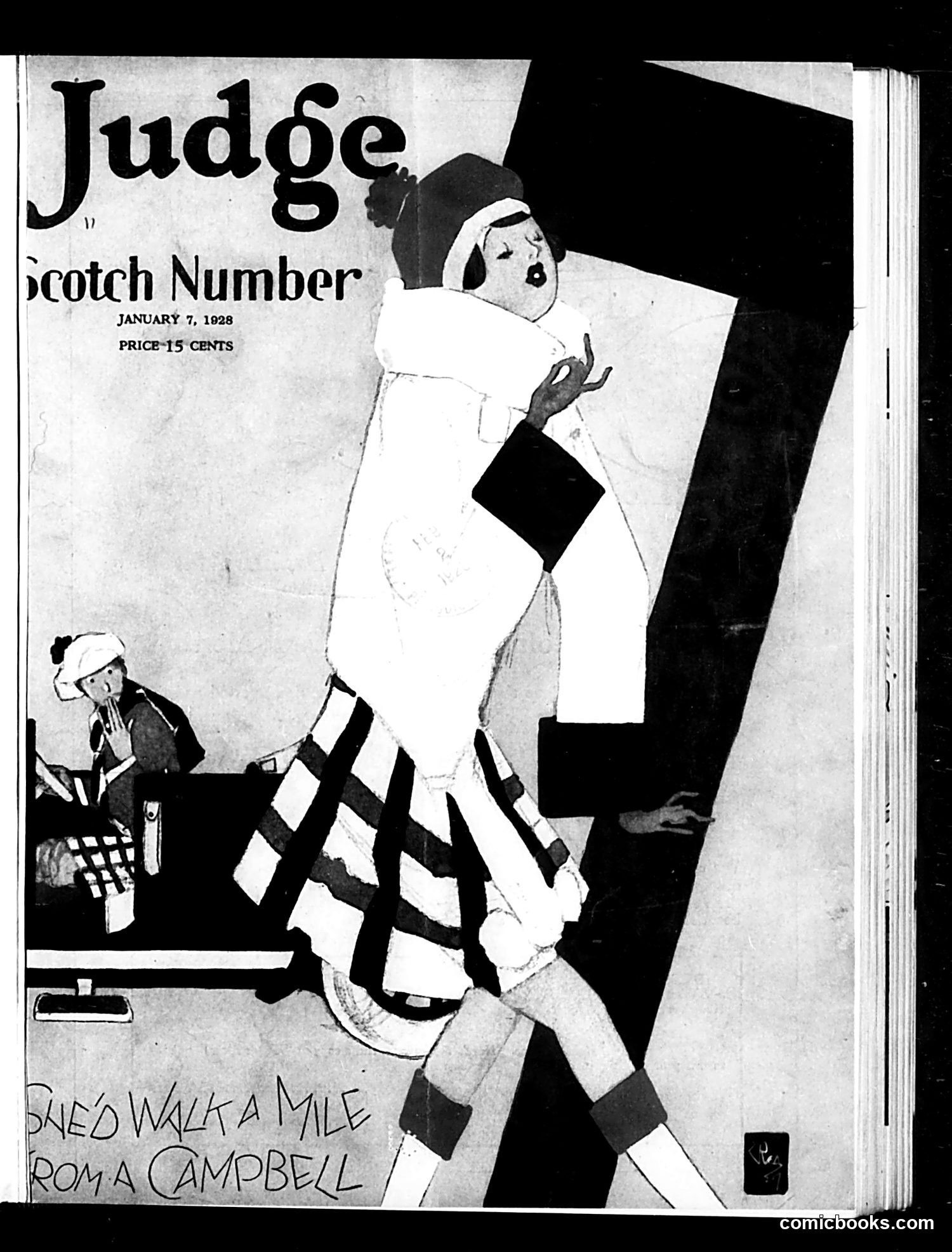
This is the cover of Judge's "Scotch Number." The main illustration depicts a woman in Scottish attire (tam o'shanter hat, tartan skirt with black-and-white diamond pattern, white blouse) dancing or kicking up her heels. A small figure in Scottish dress sits to the left, appearing to watch. The caption reads "SNED WALT A MILE FROM A CAMPBELL," likely a Scottish dialect phrase making a joke about Campbells (a prominent Scottish clan). The satire appears to target Prohibition-era attitudes toward Scottish whisky. Judge frequently lampooned Prohibition enforcement, and this "Scotch Number" likely uses Scottish stereotypes and references to bootleg liquor as comedic subject matter—humor that resonated with American readers during the 1920s.
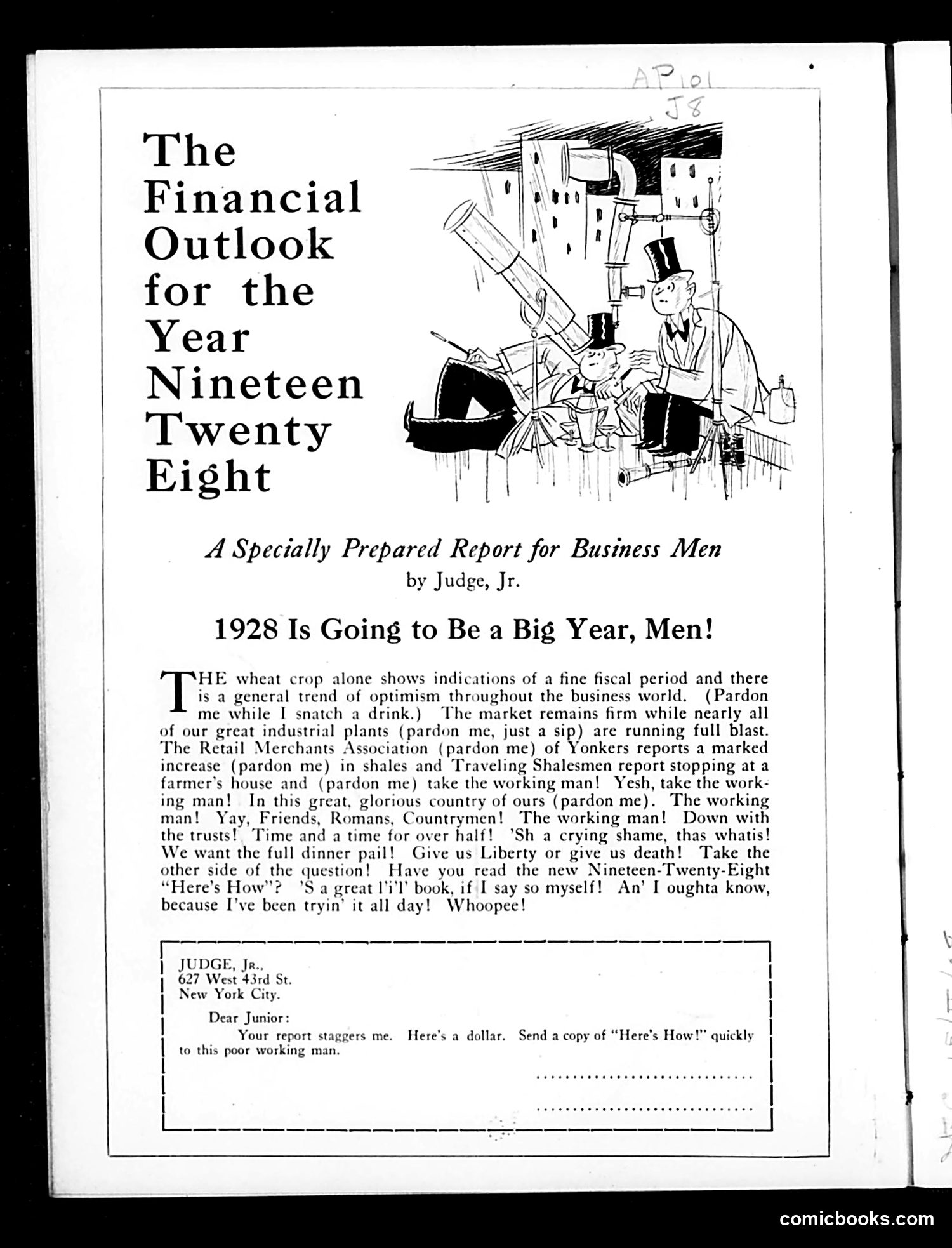
This 1928 *Judge* magazine page satirizes rosy economic predictions preceding the Great Depression. The main cartoon depicts wealthy businessmen in top hats celebrating with champagne and cigars amid rain (suggesting money falling from sky), embodying unfounded optimism about the economy. The text, attributed to "Judge, Jr.," mocks breathless boosterism about wheat crops, industrial production, and retail optimism. The repeated asides ("pardon me") and exclamatory tone ("Whoopee!") parody how businessmen justified unlimited confidence despite warning signs. The irony is devastating in hindsight—this celebratory forecast was published just months before the 1929 stock market crash. The included reader-response box suggests *Judge* was selling reprints of a "Here's How!" prosperity guide, further satirizing get-rich-quick mania of the era.
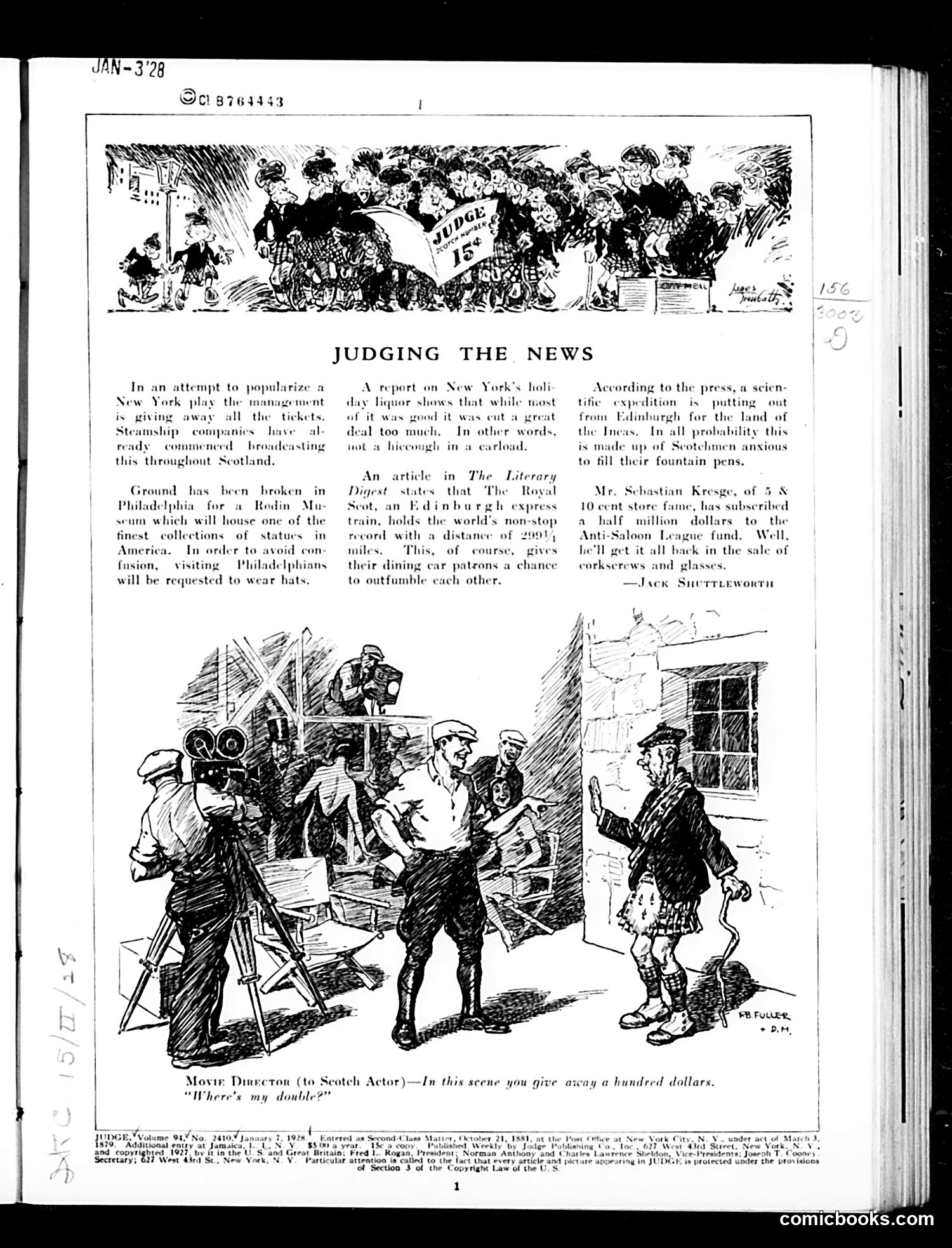
This Judge magazine page satirizes news stories through brief commentary and an illustration. The main cartoon depicts a movie director (labeled "Movie Director (to Scotch Actor)") on a film set, saying "In this scene you give away a hundred dollars. 'Where's my double?'" The joke plays on the term "double" — the actor requests a stunt double to perform the scene of giving away money, implying that even pretending to be generous requires someone else to do it. This satirizes actors' reluctance to perform charitable acts, even when scripted and fake. The surrounding text items mock various news stories: Broadway train speed records, New York liquor sales, and a Scottish store owner funding an anti-saloon league.
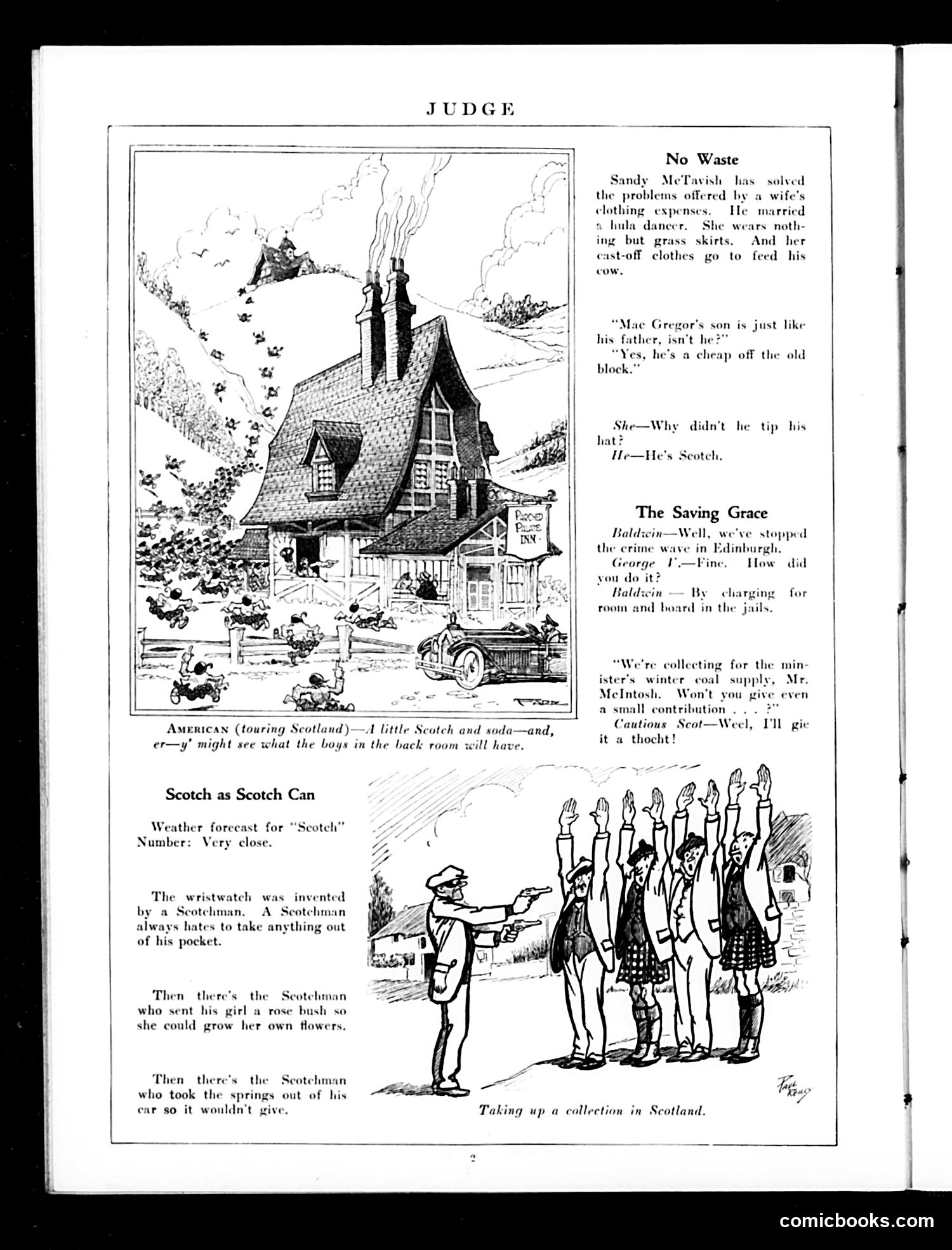
This page contains three separate humorous pieces satirizing Scottish frugality and American tourists in Scotland. **"No Waste"** mocks Sandy McTavish's penny-pinching: he married an inexpensive hula dancer to avoid clothing costs, feeding her cast-off garments to his cow. The punchline about Mac Gregor's son being "a cheap off the old block" plays on Scottish stereotypes about miserliness. **"The Saving Grace"** jokes about charging prisoners for jail room and board as crime prevention—dark fiscal humor. **"Scotch as Scotch Can"** presents three anecdotes embodying Scottish stinginess: the wristwatch invention to avoid pocket removal, gifting a rose bush instead of flowers, and disassembling car springs to prevent their use. The bottom cartoon depicts an American tourist collecting funds, humorously illustrating Scottish reluctance to part with money. Overall, the page relies on anti-Scottish ethnic stereotypes common to early 20th-century American humor.
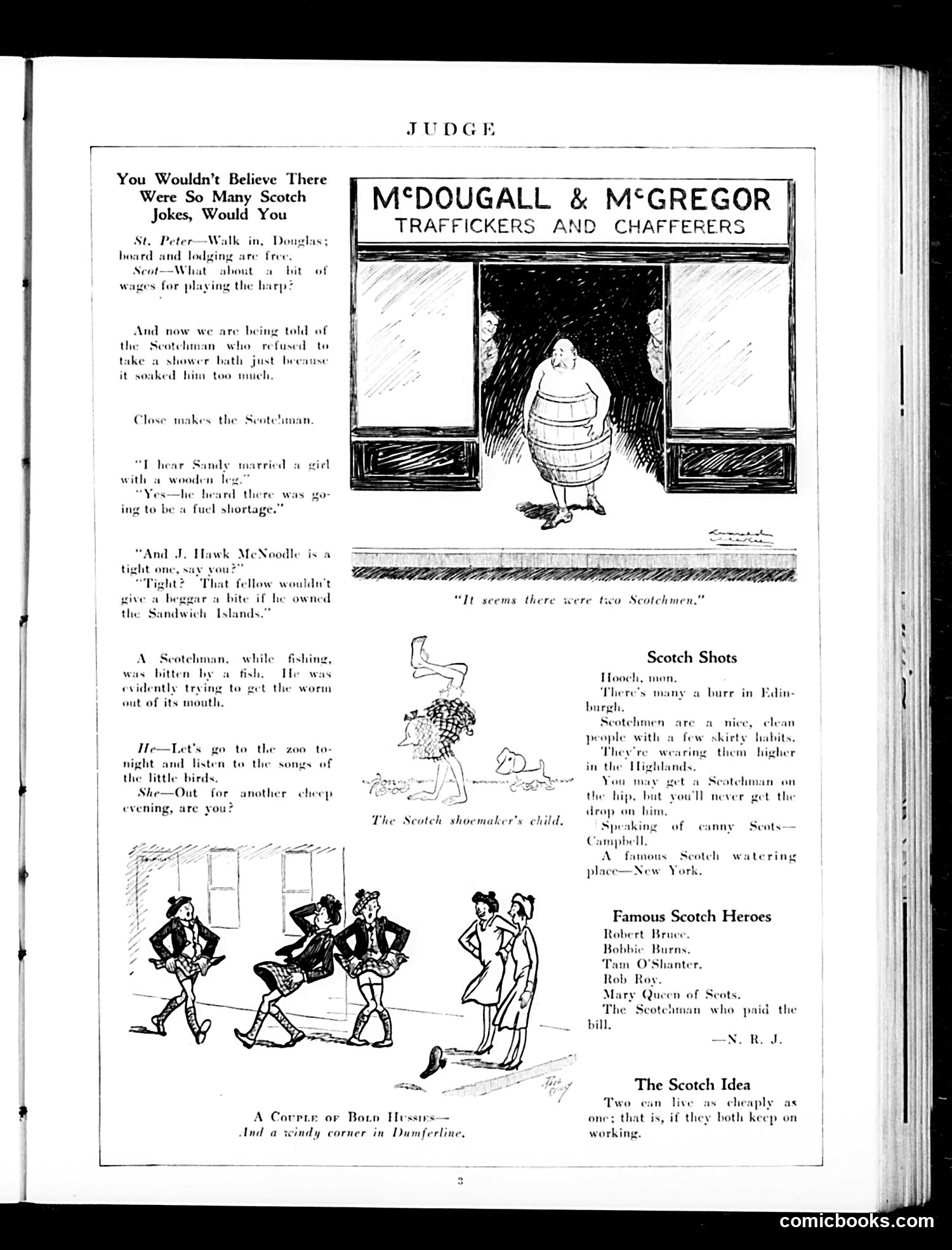
This page collects Scottish-themed humor typical of early 20th-century American satire. The main cartoon shows a stout man labeled "McDougall & McGregor—Traffickers and Chafferers," likely stereotyping Scottish merchants or traders as heavyset and comical. The surrounding jokes rely on ethnic stereotypes: a Scotsman refusing payment because water "soaked him too much," another bitten by a fish while fishing, and jokes about Scottish frugality ("tight one," "wouldn't give a beggar a bite"). The "Famous Scotch Heroes" list ironically includes "The Scotsman who paid the bill"—suggesting Scots were famously stingy. "Scotch Shots" mocks Scottish dialect and habits, while "The Scotch Idea" jokes about poverty ("two can live as cheaply as one"). This represents period humor stereotyping Scots as miserly, provincial, and comedically distinctive.
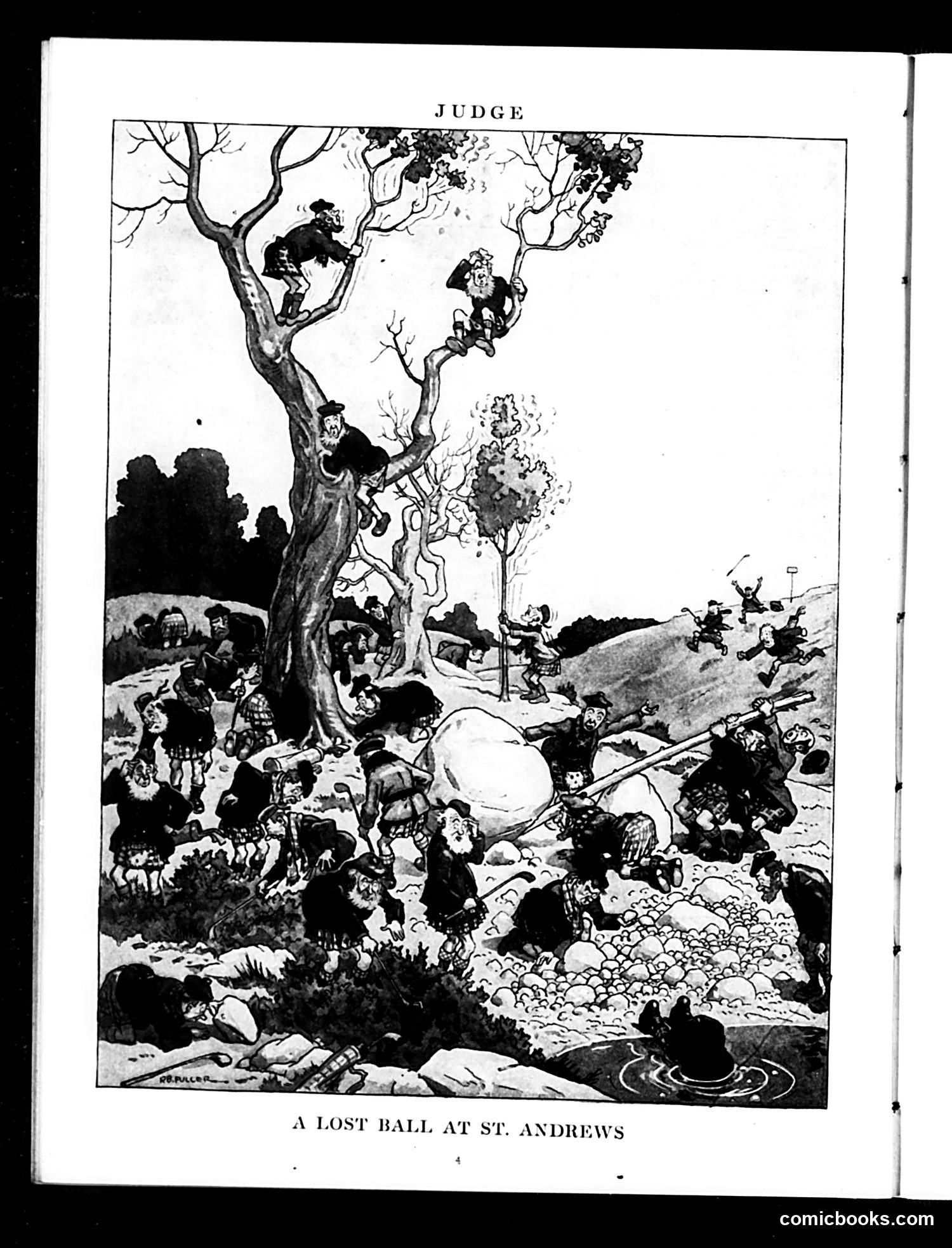
This cartoon depicts a chaotic scene at St. Andrews Golf Club in Scotland, one of golf's most prestigious courses. The title plays on the common golfing problem of a lost ball, but here the "lost ball" has apparently caused mayhem among the spectators and other golfers gathered around a large tree. The satirical point appears to mock either the aristocratic pretensions of golf culture or the chaos that erupts during important matches when crowds gather. The crowded, disorderly composition suggests the dignity of the sport has descended into undignified scrambling and confusion—a typical Judge magazine approach to puncturing the self-importance of the upper classes and their recreational pursuits.
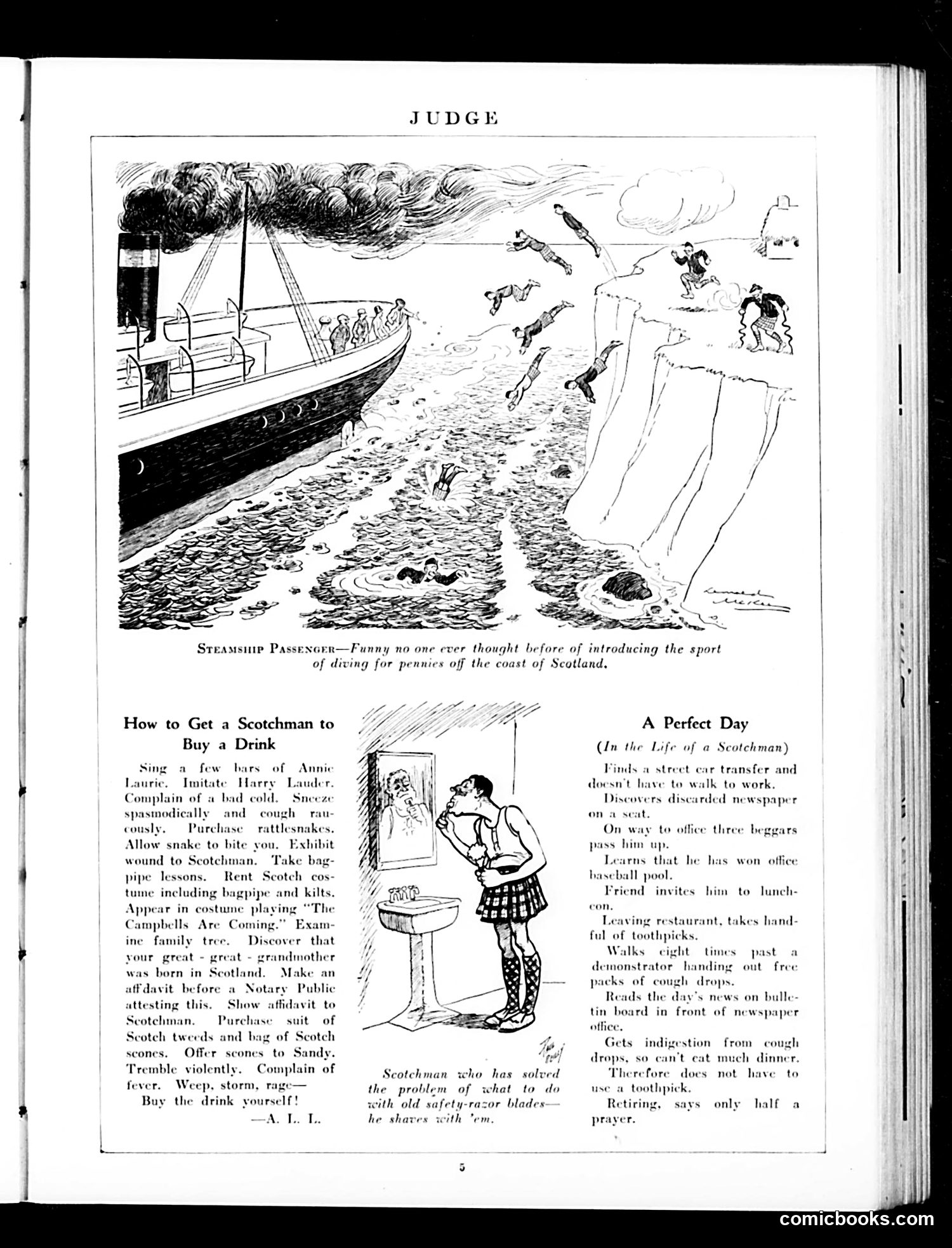
This page contains three separate humorous pieces mocking Scottish stereotypes: 1. **"Steamship Passenger"** (top): A satirical cartoon showing people diving off a ship near Scotland, with the caption suggesting "diving for pennies" as a new sport—a joke implying Scots are obsessively frugal and will pursue money at any cost. 2. **"How to Get a Scotsman to Buy a Drink"**: A comedic instruction list that mocks Scottish miserliness through absurdist advice (sing Annie Laurie, exhibit sword lessons, rent costumes). The punchline: "Buy the drink yourself!" 3. **"A Perfect Day (In the Life of a Scotsman)"**: Satirizes a Scottish man's penny-pinching lifestyle—avoiding paid transportation, finding free newspapers, and enduring cough drops rather than buying medicine. These pieces stereotype Scots as comically miserly, reflecting period American ethnic humor conventions.
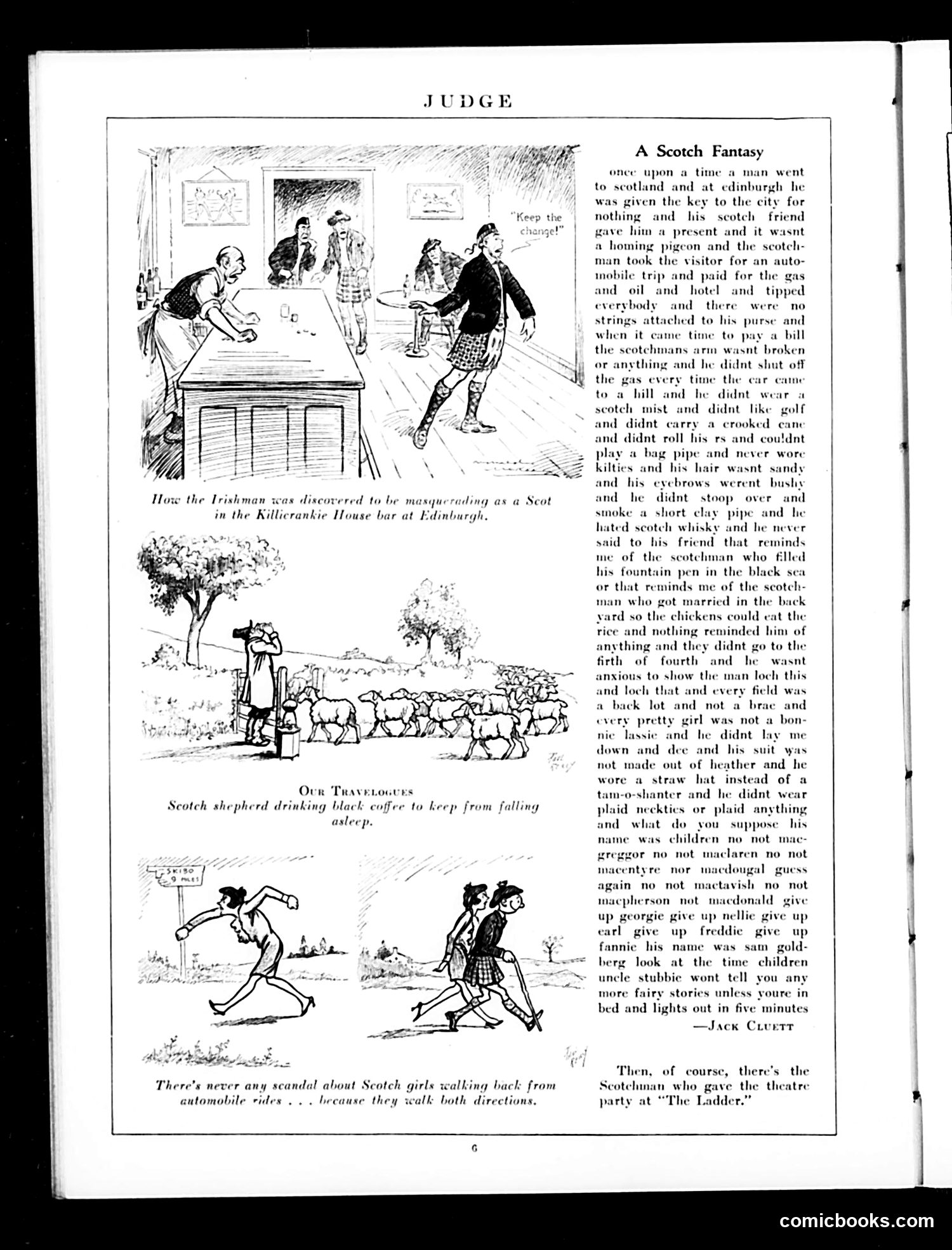
This piece satirizes Scottish national stereotypes through absurdist humor. The title story describes a visiting Irishman who is **mistaken for a Scot** at Edinburgh's Killicranckie House bar—the joke being he exhibits none of the stereotypical Scottish traits: he's generous (pays bills, tips), doesn't mention lochs or Scottish history, wears modern clothing instead of kilts, doesn't smoke pipes or drink whisky, and has a Jewish name (Sam Goldberg) rather than a Scottish one. The accompanying cartoons reinforce stereotypes about Scottish miserliness, love of golf, and distinctive dress (kilts, tam-o'-shanters). The humor relies on exaggerated national caricatures: Scots as penny-pinching, tradition-bound, and physically distinctive versus the unexpectedly cosmopolitan visitor. Jack Clueett's byline credits the piece. This represents typical early-20th-century American satirical humor mining ethnic and national stereotypes for comedic effect.
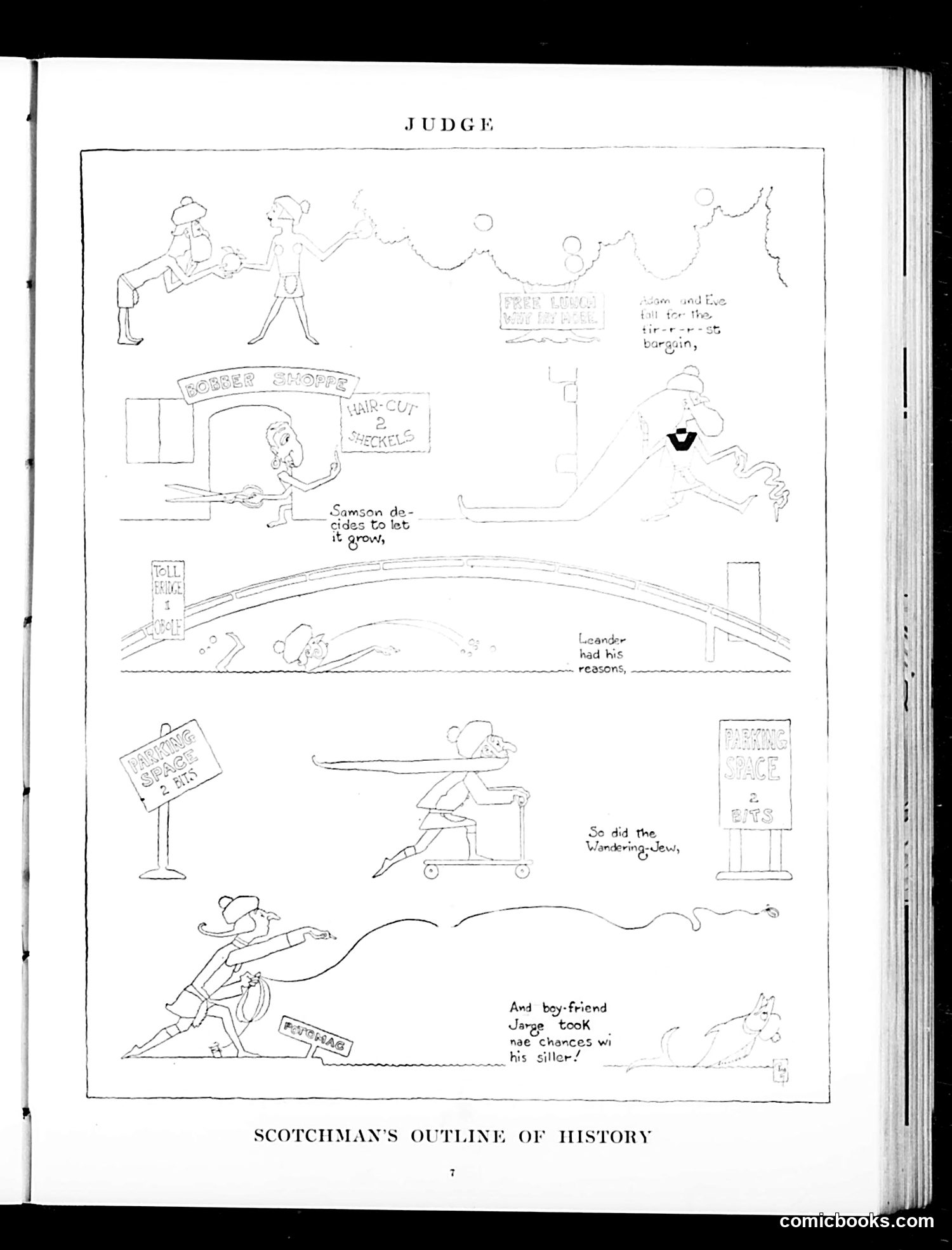
This is a satirical cartoon page titled "Scotchman's Outline of History," presenting biblical and historical figures through Scottish stereotypes. The sketches include: - **Samson** at a barber shop ("Hair-cut & Shackle"), deciding to let his hair grow - **The Wandering Jew**, depicted similarly - **Leander** swimming (with caption "had his reasons") - **Jorge** (likely a Spaniard), portrayed as miserly with money ("nae chances wi his siller") The humor relies on ethnic stereotyping—depicting famous historical/biblical figures as Scotsmen, emphasizing Scottish frugality (the "siller"/money joke) and accent ("nae"). The title suggests a humorous Scottish reinterpretation of major historical moments, typical of Judge magazine's casual use of national caricatures common in early 20th-century American humor.
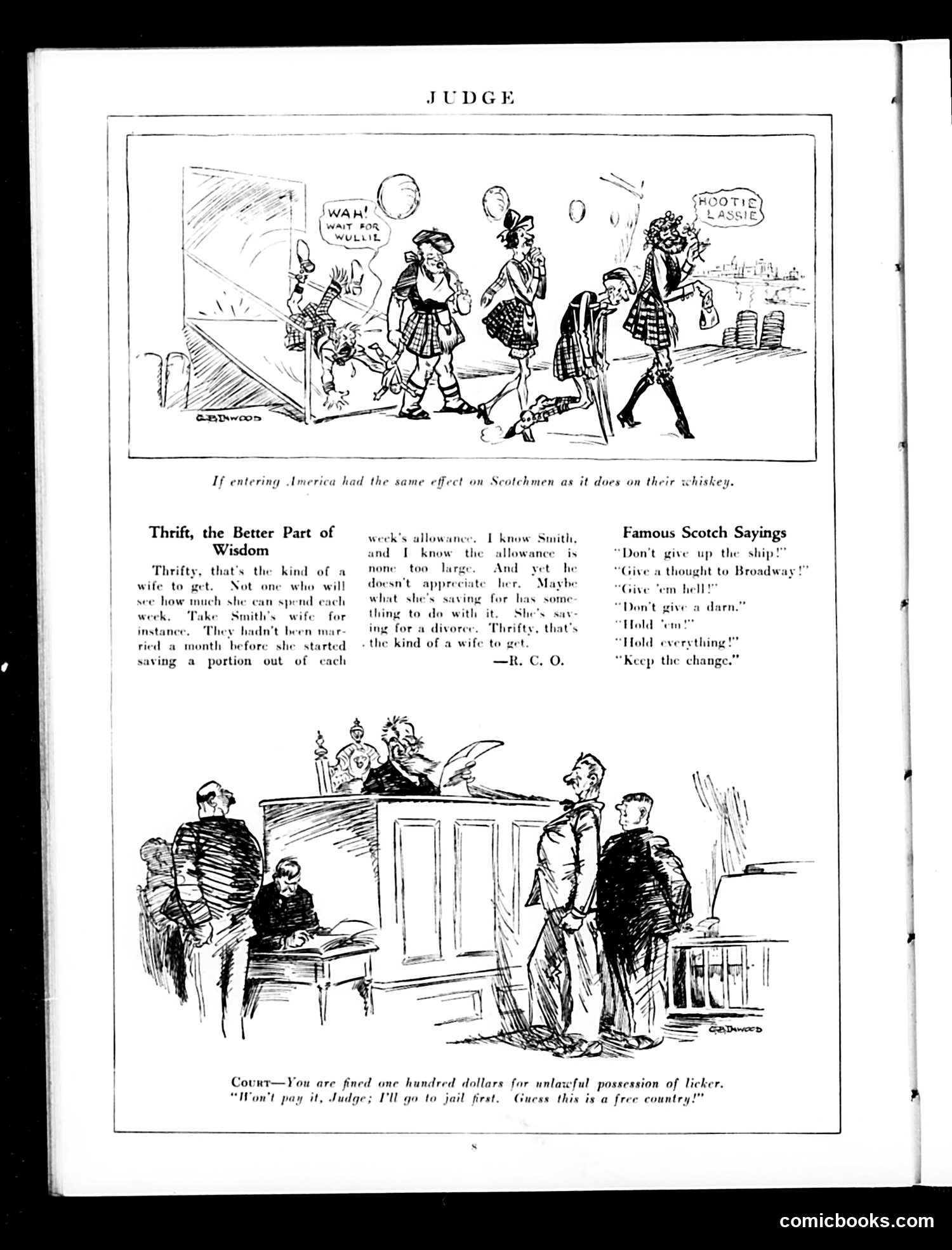
**Top cartoon:** Satirizes Scottish immigration to America. The caption jokes that entering America affects Scotsmen like it does their whiskey—weakening them. The drawing shows Scottish immigrants (identifiable by kilts) appearing to lose their characteristic thriftiness upon arrival. **Middle section:** A humorous essay praising thrift, using "Smith's wife" as an example. She began saving money immediately after marriage—reportedly for a divorce. The joke: even her thriftiness serves a mercenary purpose. Includes period Scottish catchphrases ("Keep the change," "Hold everything"). **Bottom cartoon:** Court scene satirizing Prohibition-era enforcement. A man fined for illegal liquor possession refuses to pay, preferring jail, declaring "this is a free country!" The irony: he invokes freedom while violating laws, mocking both Prohibition's unpopularity and the contradiction between American ideals and enforcement. All three mock Scottish stereotypes, American materialism, and Prohibition's unpopularity.
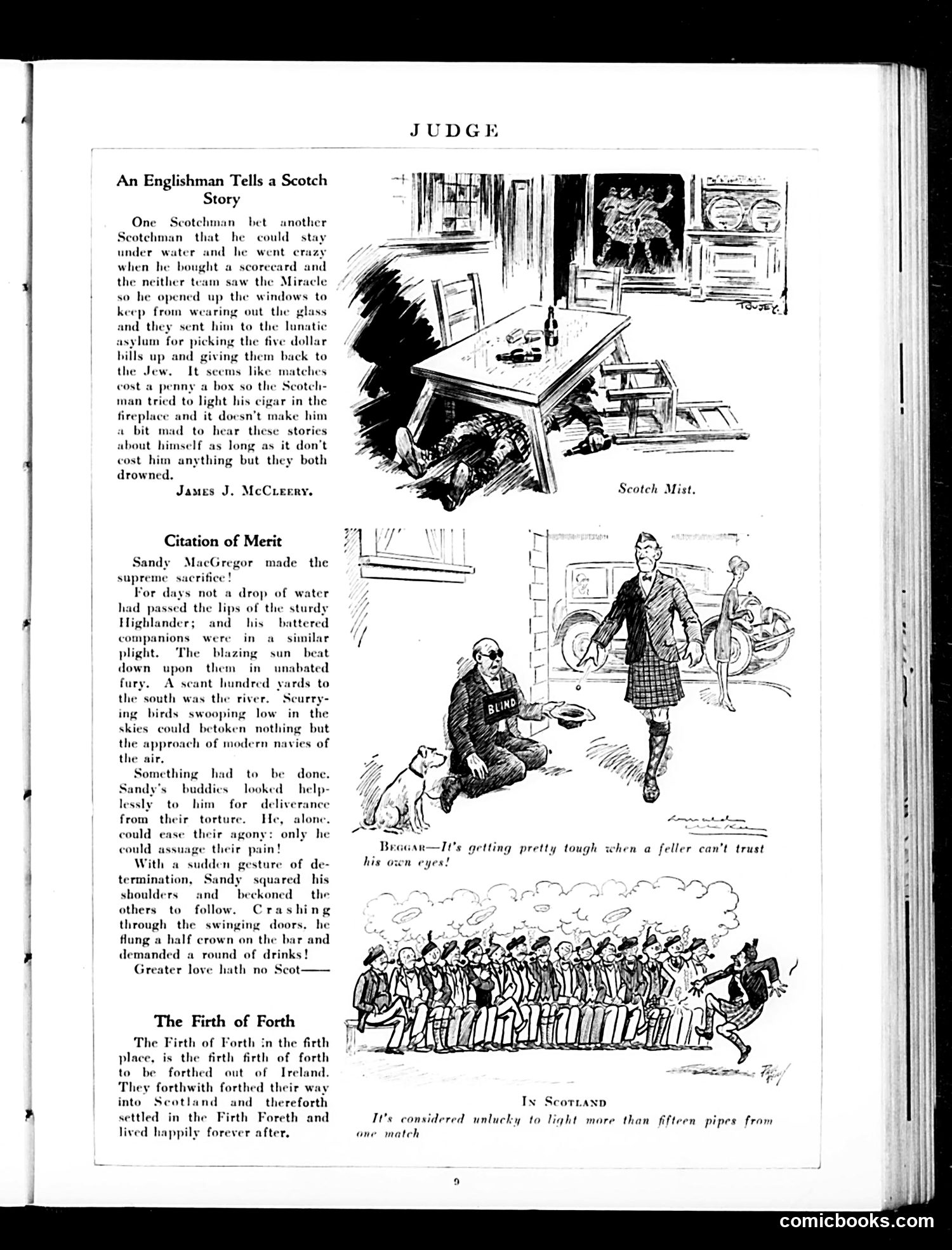
This page from *Judge* contains three separate pieces mocking Scottish stereotypes: 1. **"An Englishman Tells a Scotch Story"**: A nonsensical narrative (deliberately incoherent) where two Scotsmen bet on staying underwater and drown. The joke plays on the era's stereotype of Scots as foolish and willing to bet on anything. 2. **"Citation of Merit"**: Sandy MacGregor, a thirsty Scottish soldier, leads his suffering companions not to the nearby river for water, but through "swinging doors" to buy rounds of drinks instead—sacrificing his money rather than solving their actual problem. This ridicules Scots as heavy drinkers prioritizing alcohol over survival. 3. **"The Firth of Forth"**: A pun-heavy piece about Scotland's geography, wordplay on "firth/forth." The bottom cartoon warns it's unlucky to light more than fifteen pipes from one match—mocking Scottish thriftiness and pipe-smoking. All pieces rely on ethnic caricature: Scots portrayed as drunk, foolish, cheap, and irrational. This reflects early 20th-century American humor's casual reliance on national/ethnic stereotyping for laughs.
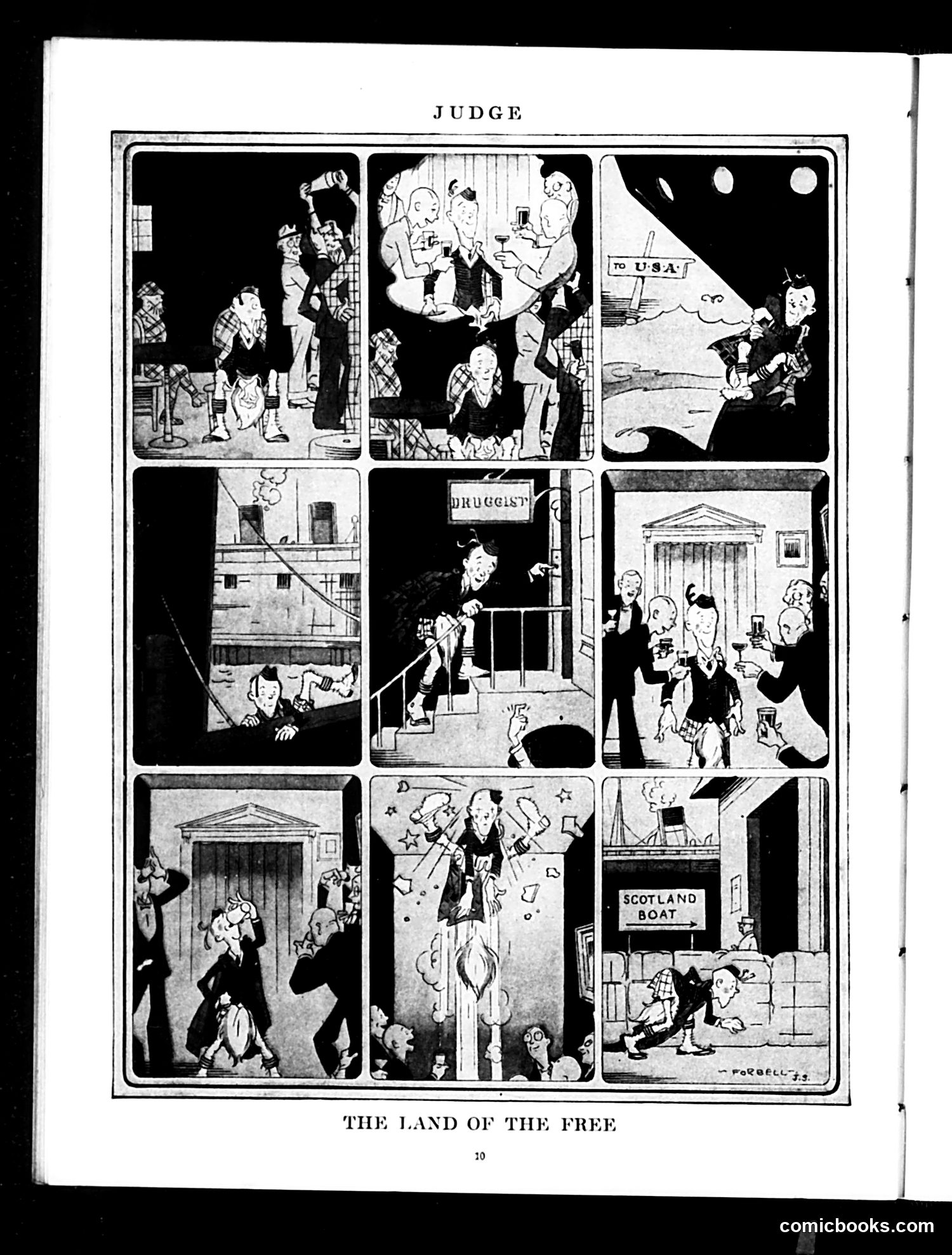
This is a nine-panel satirical comic strip from *Judge* magazine titled "The Land of the Free." The narrative appears to follow a character through various scenes of American bureaucratic and social obstacles—including encounters at a drugstore, government building, and courthouse. The strip seems to mock the gap between America's democratic ideals and the practical restrictions citizens face. While the OCR text is corrupted and illegible, the visual sequence suggests commentary on institutional red tape, legal proceedings, or regulatory hurdles that ironically undermine American freedom. The repeated architectural elements (government buildings with columns) and official settings reinforce the satire's focus on institutional constraint rather than liberty. The title's irony is the primary joke: depicting America as a place where formal freedom exists alongside substantial practical limitations.
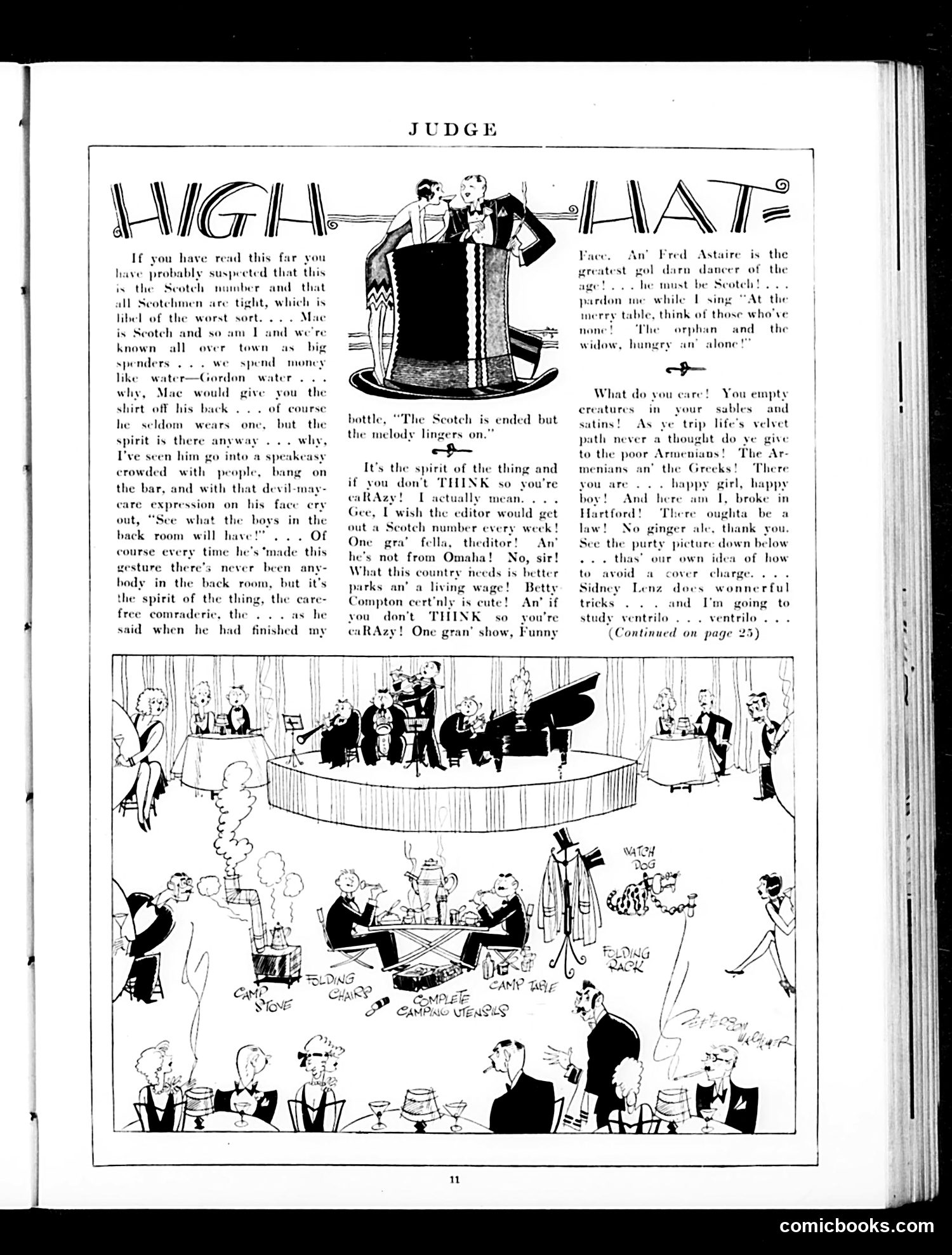
This page satirizes wealthy Scottish-American pretension and shallow patriotism. The main text mocks a character (likely named Mac) who brags about his extravagant spending and generous spirit while ironically admitting he rarely wears a shirt—exposing the gap between his claimed generosity and actual behavior. The satire extends to broader social commentary: the writer criticizes Americans who enthuse about entertainment (Fred Astaire, Betty Compton) and trivial concerns while ignoring serious issues like poor living conditions and the plight of Armenians. The phrase "What do you care? You empty creatures" directly attacks readers' indifference to suffering. The illustration shows a nightclub or restaurant scene with well-dressed patrons in various activities, visually reinforcing the theme of privileged excess amid larger human needs. The satire targets both Scottish-American stereotypes and American cultural superficiality during a period of significant social hardship.
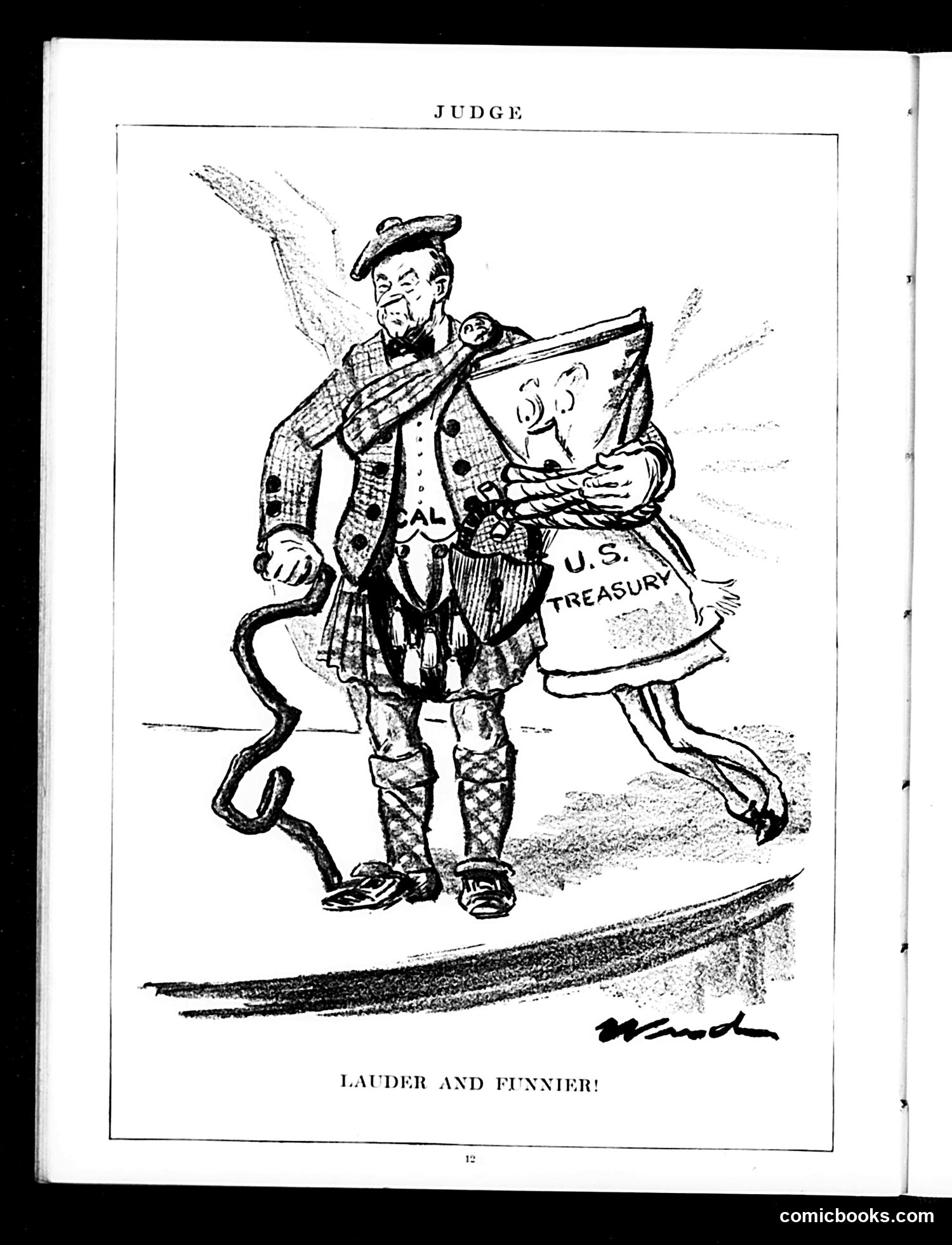
This political cartoon depicts a caricatured male figure in Scottish dress (kilt, cap) holding a rifle, being embraced by a female personification of the "U.S. Treasury." The caption "Lauder and Funnier" appears to be a pun. The cartoon likely references **Harry Lauder**, the famous Scottish entertainer and singer popular in early 20th-century America. The joke seems to satirize either Lauder's commercial success in the U.S. or possibly his involvement in fundraising activities. The "U.S. Treasury" embrace suggests commentary on American spending, financial dealings, or how foreign entertainers profited from American audiences. Without additional historical context, the specific political or financial reference remains unclear, though the satire targets the intersection of entertainment, nationality, and money.
This page features editorial commentary on post-flood policy, centered on a disagreement between President Coolidge and his predecessor Hoover regarding federal disaster relief. **The Main Argument:** After the Mississippi River devastated twelve million acres and displaced hundreds of thousands, Hoover promised federal action. Coolidge refuses, claiming government shouldn't "insure" citizens against natural disasters. The editorial attacks this position as absurd—if the federal government won't defend citizens against floods (which cross state boundaries), what good is it? The Mississippi basin drains half the nation; flood control is inherently a federal responsibility, like defense against armies. **The Stakes:** The Chamber of Commerce sided with federal funding, suggesting business leaders showed more "humanity" than elected officials. Only Hoover (now Commerce Secretary) offers hope for Southern relief. The page also includes brief notes on consumer credit and Harvard's experimental education policy, demonstrating the magazine's wide-ranging satirical coverage.
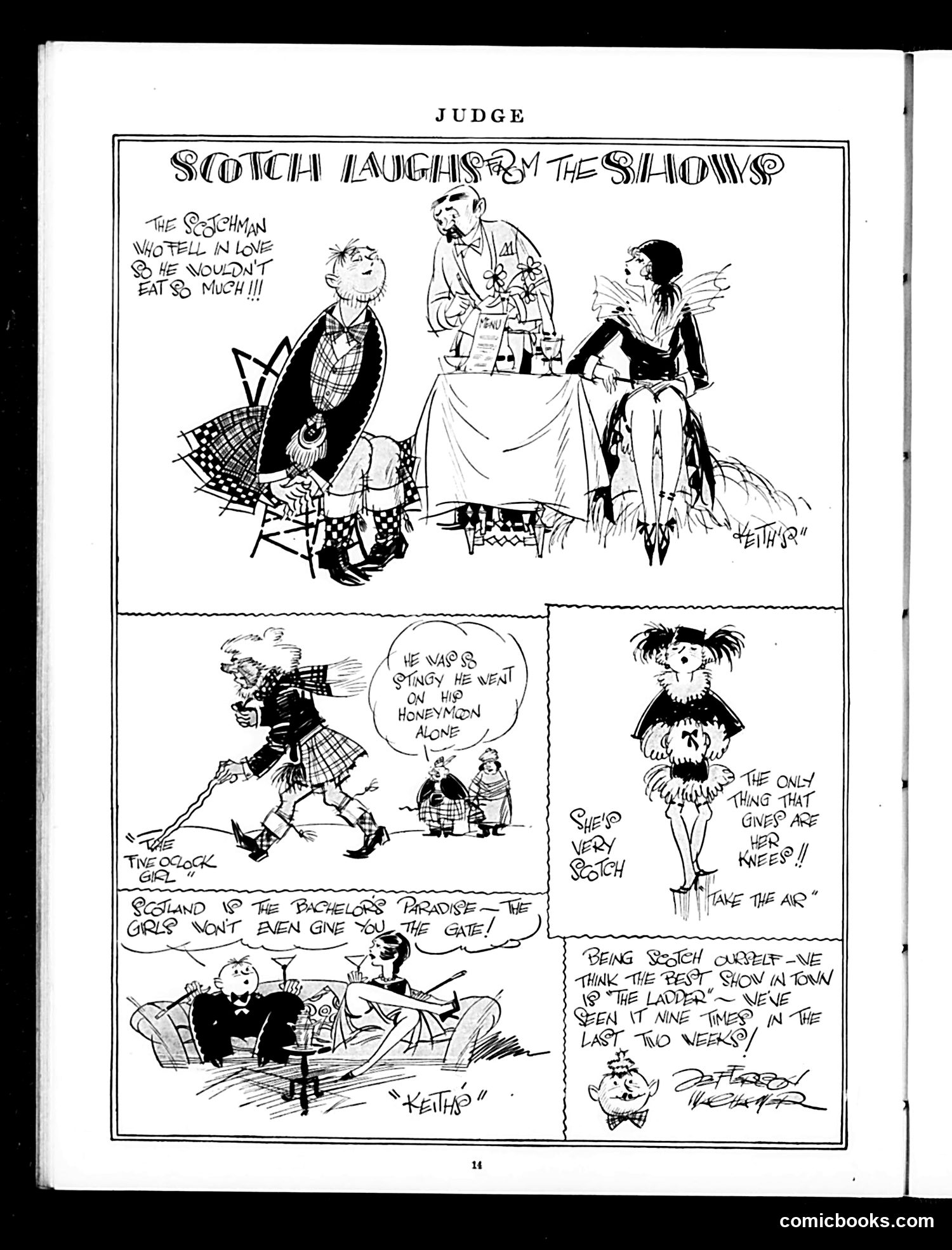
This is a satirical comic about Scottish stereotypes in early 20th-century entertainment. The humor hinges on caricatured Scottish characteristics: a Scotsman complains his love interest is too expensive ("he wouldn't eat as much"); jokes about Scottish stinginess appear throughout (refusing to pay for honeymoons, criticizing theatrical admission costs). The comic mocks both Scots and popular theater shows of the era. References to "the Ladder" (likely a popular stage production) and music hall entertainment suggest this targets contemporary shows that either featured Scottish characters or were popular among Scottish audiences. The satire operates on ethnic stereotypes—portraying Scots as cheap, frugal, and overly critical—typical of Judge magazine's approach to immigrant and regional groups. A modern reader would recognize this as crude ethnic humor now considered offensive.
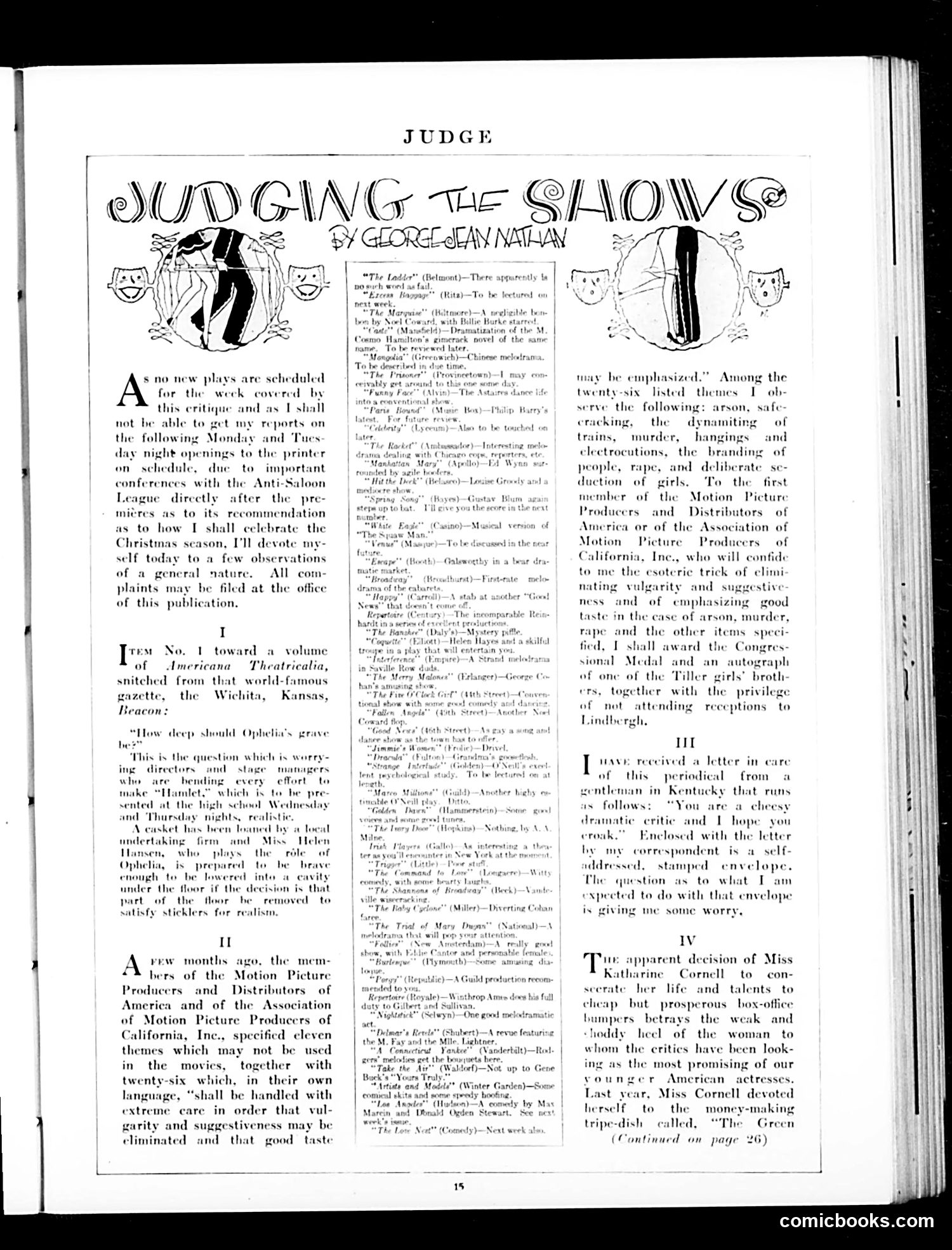
This is a theater criticism column by George Jean Nathan. The main content addresses film industry censorship rather than cartooning. **The Satire:** Nathan mocks the Motion Picture Producers and Distributors of America's newly established censorship guidelines (likely the Hays Code precursors). They prohibited eleven themes outright and required "extreme care" with twenty-six others—including murder, rape, arson, and electrocution—while claiming to "eliminate vulgarity and emphasize good taste." **The Joke:** Nathan sarcastically challenges anyone to explain how filmmakers can dramatize serious crimes (murder, rape, train dynamiting) while somehow eliminating "vulgarity and suggestiveness." The point: the guidelines are logically absurd—you cannot depict rape or murder while maintaining propriety. **Secondary Target:** Nathan also criticizes actress Katharine Cornell for choosing lucrative but artistically shallow commercial roles ("box-office bumpers") rather than serious theater, betraying her earlier promise as a leading American actress. The tone throughout is one of intelligent ridicule directed at both industry hypocrisy and artistic compromise.
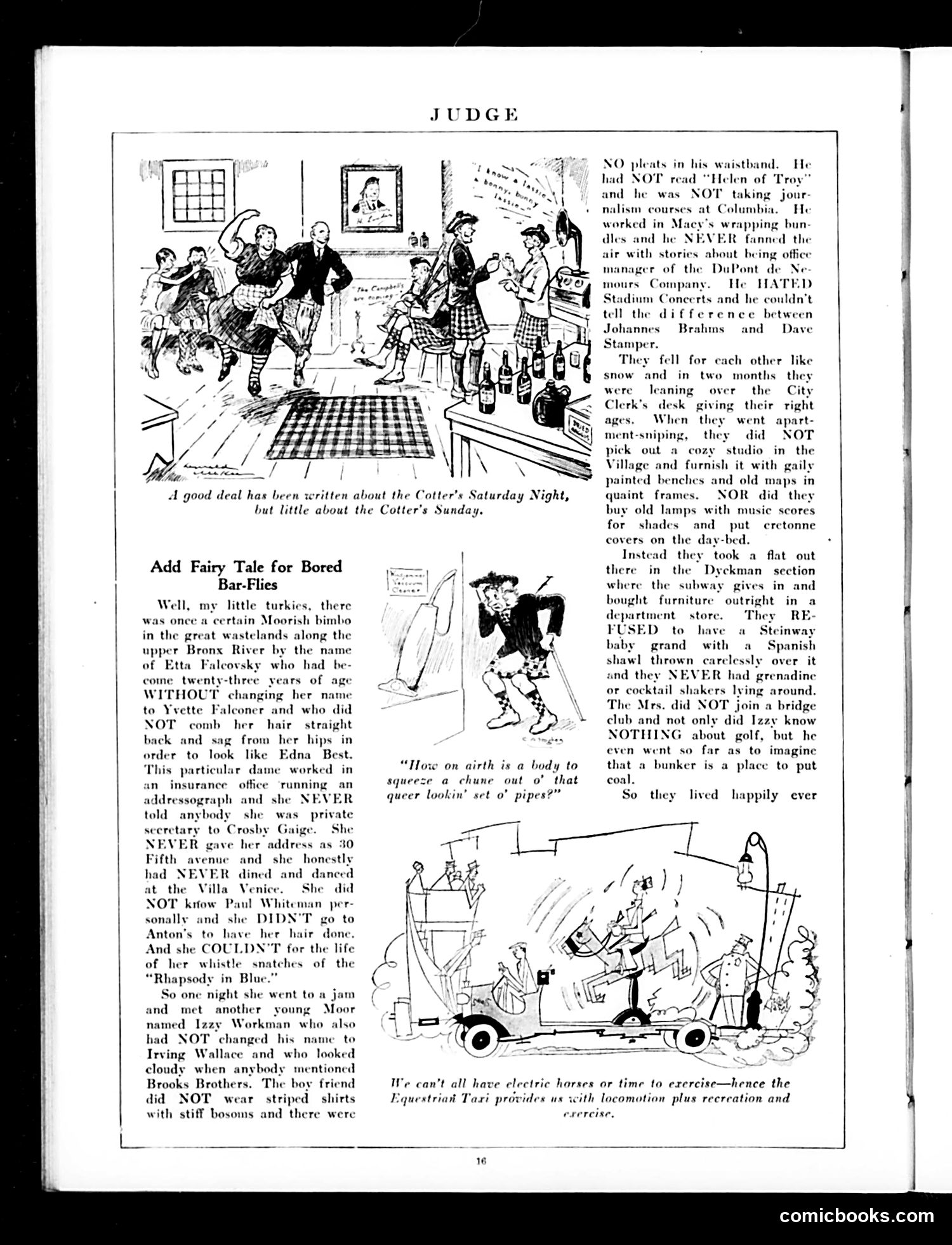
This page contains two distinct pieces of satirical commentary on 1920s urban middle-class aspirations. **"Add Fairy Tale for Bored Bar-Flies"** mocks pretentious New Yorkers who fabricate false identities and affected lifestyles. The story contrasts Etta and Izzy—working-class immigrants who *don't* pretend—with the typical Manhattan social climbers who lie about their addresses, adopt fake names, affect literary sophistication, and purchase conspicuous cultural markers (Steinway pianos, expensive furnishings, bridge clubs). The repeated "NEVER" and "NOT" structure emphasizes how refreshingly *honest* this couple is by rejecting the performative status-seeking endemic to NYC society. **The cartoon at bottom** satirizes wealthy New Yorkers who purchase an "Equestrian Taxi"—a motorized vehicle mimicking horseback riding—because they lack time for actual exercise. It mocks both leisure-class excess and modern technology's absurd solutions to self-created problems. Together, the page critiques upper-middle-class phoniness and conspicuous consumption as hallmarks of 1920s urban sophistication.
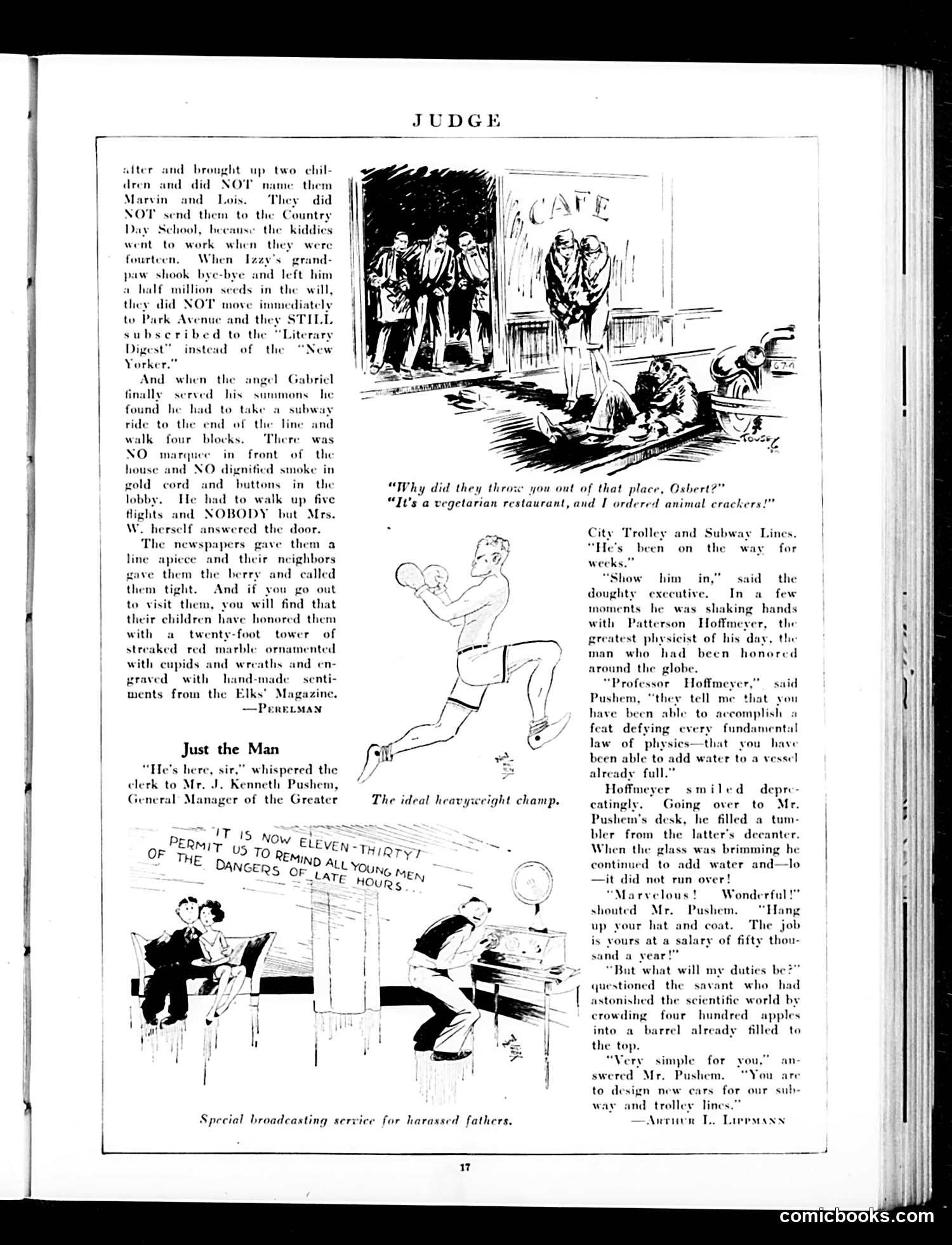
This page contains three satirical pieces mocking American pretension and wealth. **"Perlman's" story** ridicules newly rich immigrants who fail to display conspicuous consumption. Despite inheriting half a million dollars, "Izzy's" family doesn't move to Park Avenue, still reads *Literary Digest* instead of *The New Yorker*, and when an angel summons them, there's no fancy marquee—just a five-flight walk-up. Neighbors mock them as "tight" (stingy). The satire targets both the nouveau riche's expected ostentation and society's judgment of those who don't flaunt wealth. **"Just the Man"** cartoon mocks municipal bureaucracy—a broadcast service reminding fathers it's now 11:30 PM, young men should go home (referencing curfew laws). **The Hoffmeyer story** satirizes corporate America's misuse of genius. A brilliant physicist who defies physics by adding water to a full glass without overflow is hired—not for research—but to design subway cars. The joke exposes how business prioritizes practical applications over scientific advancement.
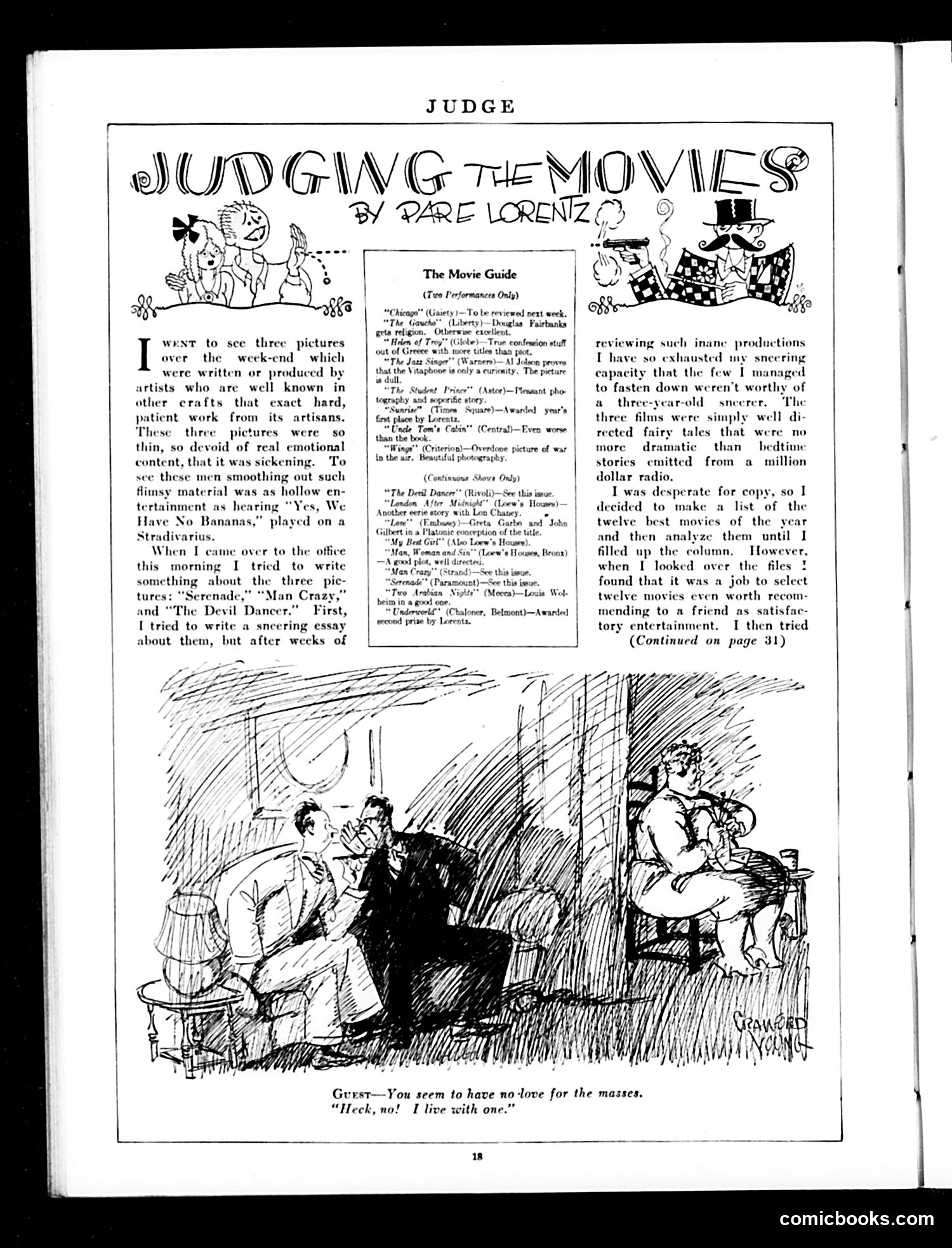
This page satirizes film criticism and the cultural pretensions of intellectuals. The author, Pare Lorentz, writes a column called "Judging the Movies" reviewing recent films. The main joke appears in the cartoon at bottom: a critic dismissively tells a guest "You seem to have no love for the masses," to which the guest replies "Heck, no! I live with one"—implying the critic's own wife or companion represents "the masses," mocking the critic's elitist disdain for popular entertainment. The article text reinforces this: Lorentz exhausted his "sneering capacity" reviewing mediocre films, yet struggled to identify twelve films worth recommending. The satire targets film critics who adopt an air of superiority while reviewing shallow Hollywood productions, suggesting their intellectual posturing is ridiculous given the poor quality of material they evaluate. The piece mocks both pretentious criticism and the mass-market entertainment it judges.
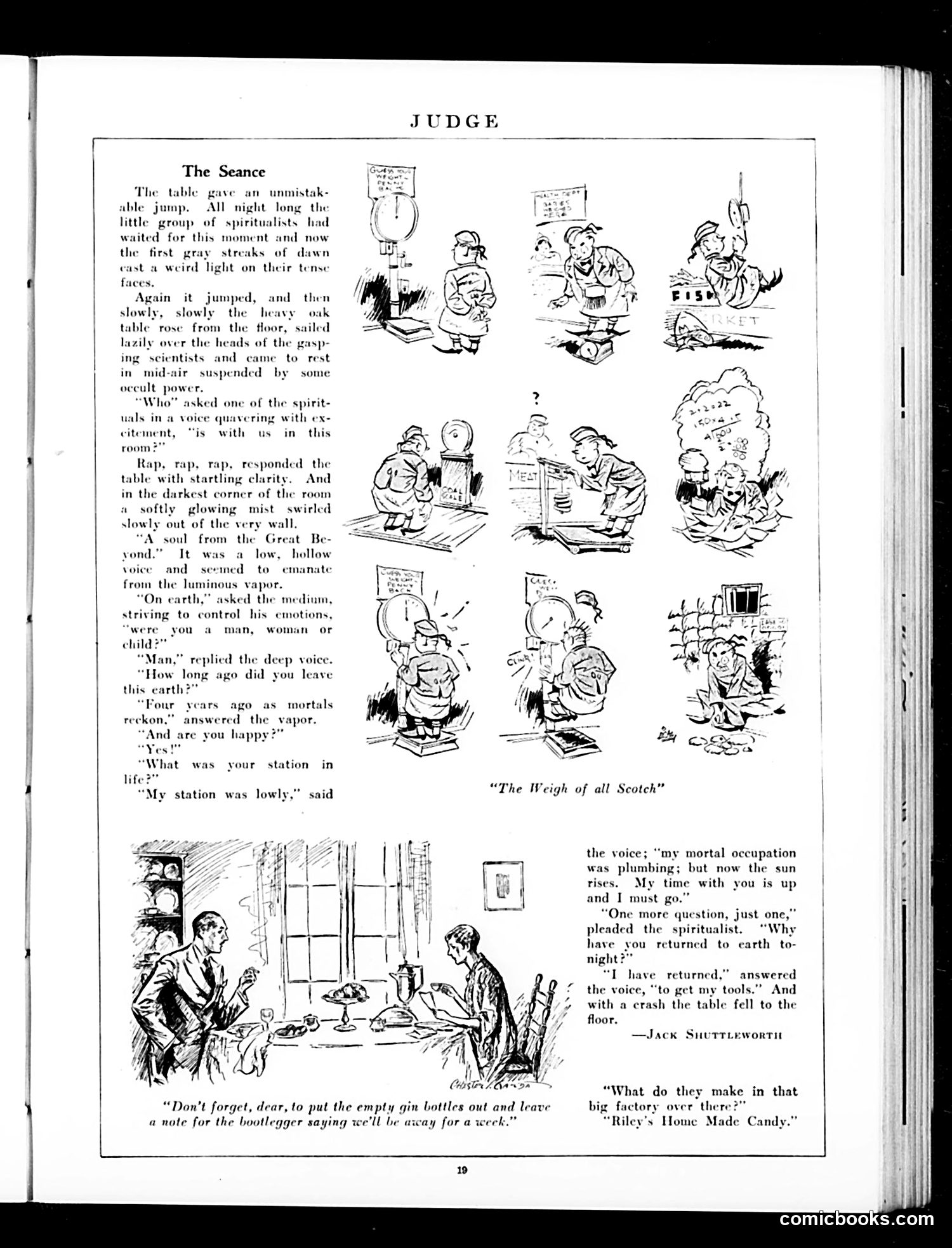
This satirical story mocks spiritualism, a popular pseudoscientific movement of the early 20th century where believers claimed to contact the dead through mediums and séances. The narrative follows a group of spiritualists conducting a séance where a table mysteriously levitates and a "spirit" communicates via rapping sounds. The joke's punchline undermines spiritualism's claims of supernatural contact: the supposed "soul from the Great Beyond" turns out to be an ordinary plumber who returned to earth simply **to retrieve his tools**—a deliberately mundane, materialistic reason rather than anything spiritual or profound. The accompanying cartoons appear to illustrate various comedic séance mishaps. The sidebar joke about bootleggers and gin bottles suggests Prohibition-era social commentary, while "Riley's Home Made Candy" reference is unclear without additional context, though it may reference contemporary commercial products used in advertising.
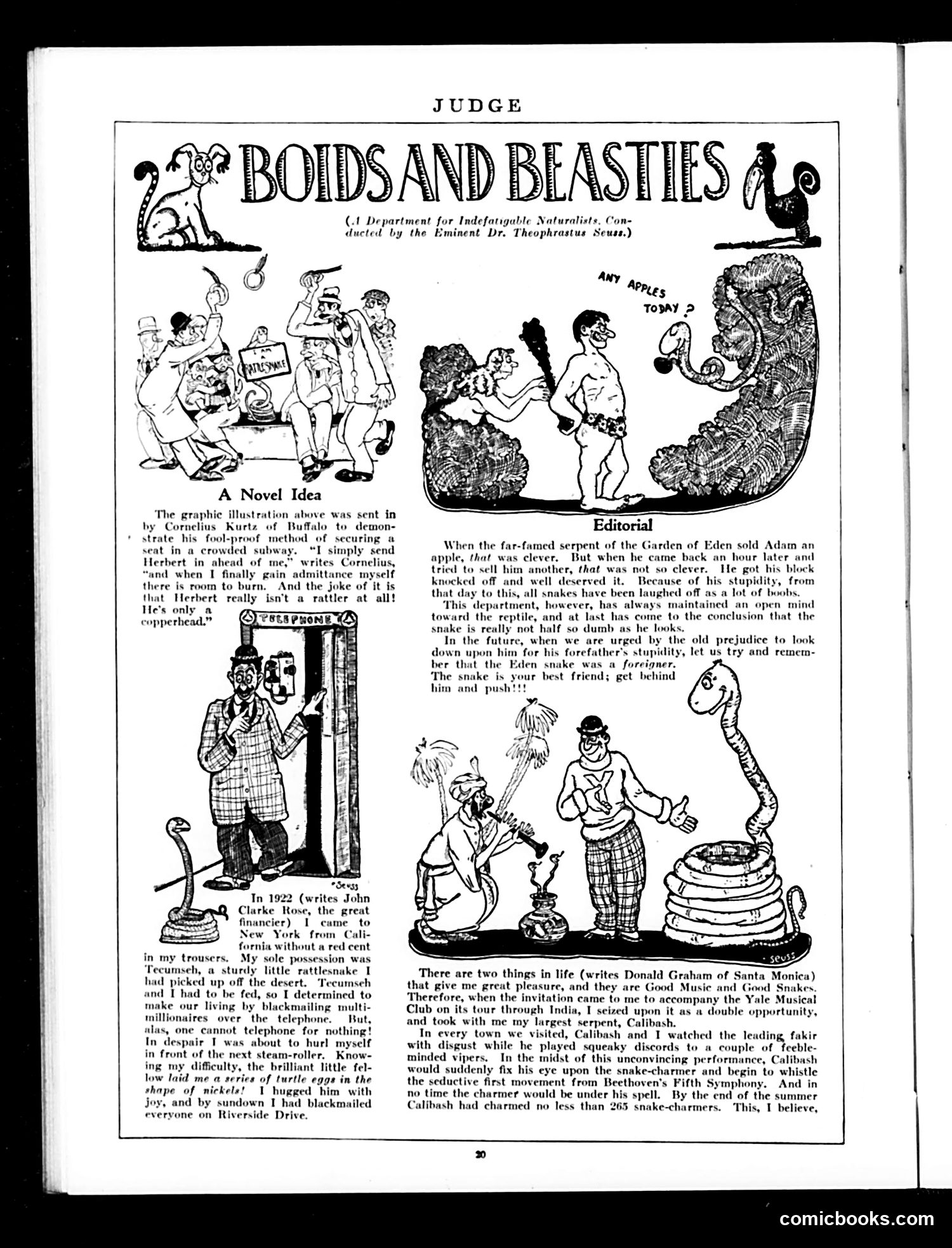
This Judge magazine page features humorous anecdotes celebrating snakes as intelligent creatures, departing from traditional prejudice. **"A Novel Idea"** satirizes subway crowding: a man sends his pet copperhead snake ahead to clear space by frightening passengers—working despite the snake being harmless. **The Editorial** reframes the biblical serpent as unfairly maligned. It argues snakes deserve rehabilitation, citing their intelligence and usefulness (the Garden of Eden snake was merely unlucky in its salesmanship). **"Good Snakes"** recounts a Yale musician who brought his snake "Calibash" to India. The snake supposedly outperformed actual fakir snakes by whistling Beethoven's Fifth Symphony to snake-charmers, "charming" 265 of them—a comedic inversion of the traditional snake-charmer dynamic. The page's running joke celebrates snakes as underappreciated and clever, mocking both superstition and the era's exotic entertainment culture. The satire targets prejudice and credulity.
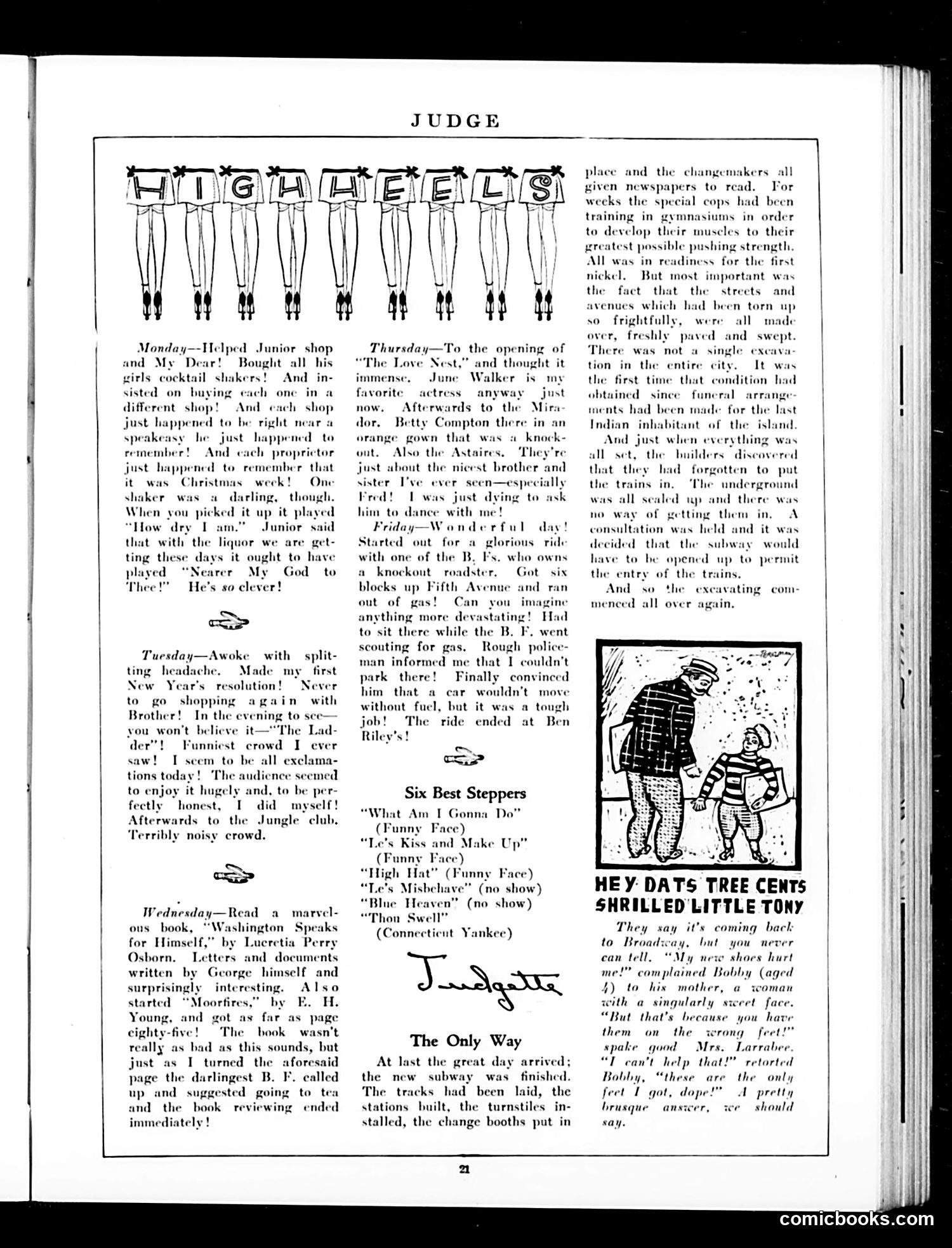
The page contains satirical diary entries mocking Jazz Age excess and New York social life. The "High Heels" illustration at top depicts flappers in high heels—a visual gag about fashionable women of the 1920s. The diary entries joke about Prohibition-era speakeasies ("liquor we are getting these days"), holiday shopping, Broadway theater-going, and a car running out of gas on Fifth Avenue—all markers of modern urban leisure. "The Only Way" satirizes the newly completed New York City subway system's opening. The joke: authorities spent weeks preparing—training police, paving streets—but forgot to actually *install the trains*. Construction must recommence just to let trains enter. This mocks bureaucratic incompetence and the city's infrastructure chaos. "Hey Dat's Tree Cents/Shrill Little Tony" is a child's joke: Tony complains his new shoes hurt; his mother says he's wearing them on the wrong feet; he protests he has no other feet. It's innocent humor for juvenile readers. The "Six Best Steppers" lists current Broadway shows, reflecting the era's entertainment obsessions.
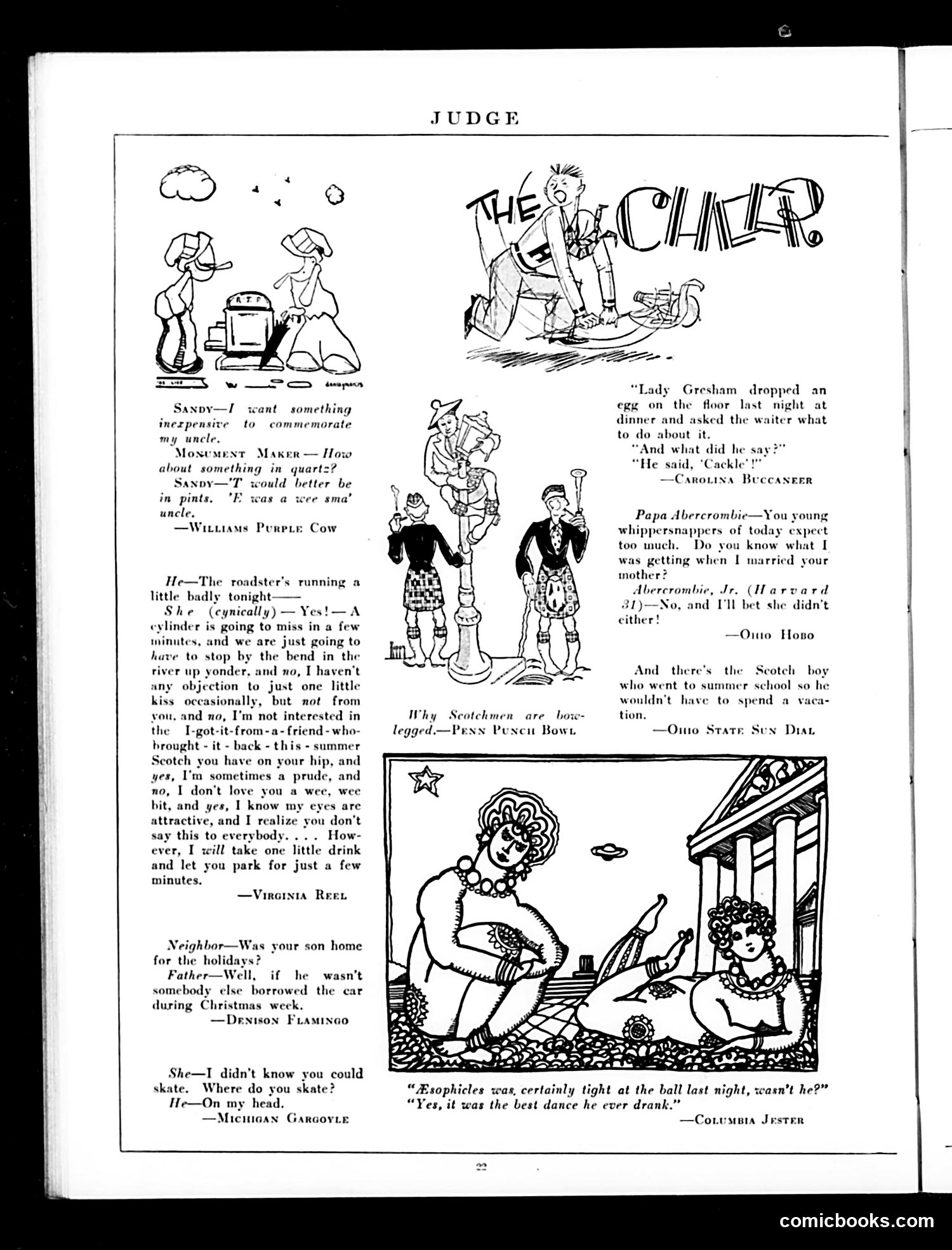
This page from *Judge* magazine collects brief satirical jokes and quips typical of early 20th-century American humor. The content targets common social situations and stereotypes: **Key jokes include:** - A pun on "cackle" when an egg drops (plays on hens) - A drunk uncle memorial joke (references drinking culture) - A cynical woman predicting car trouble to enable parking/kissing (gender dynamics satire) - Scottish stereotypes: cheapness (the "summer school" joke) and drinking ("bow-legged") - A father joking his son didn't come home for Christmas—someone else just borrowed the car (youth irresponsibility) - Wordplay about someone being "tight" (drunk) at a dance who "drank" the best dance **The cartoons** show domestic scenes and social encounters with period clothing and styling. The humor relies on assumptions about drinking, courtship rituals, class distinctions, and ethnic stereotypes now considered offensive. This represents typical *Judge* satirical content aimed at middle-class readers of that era.
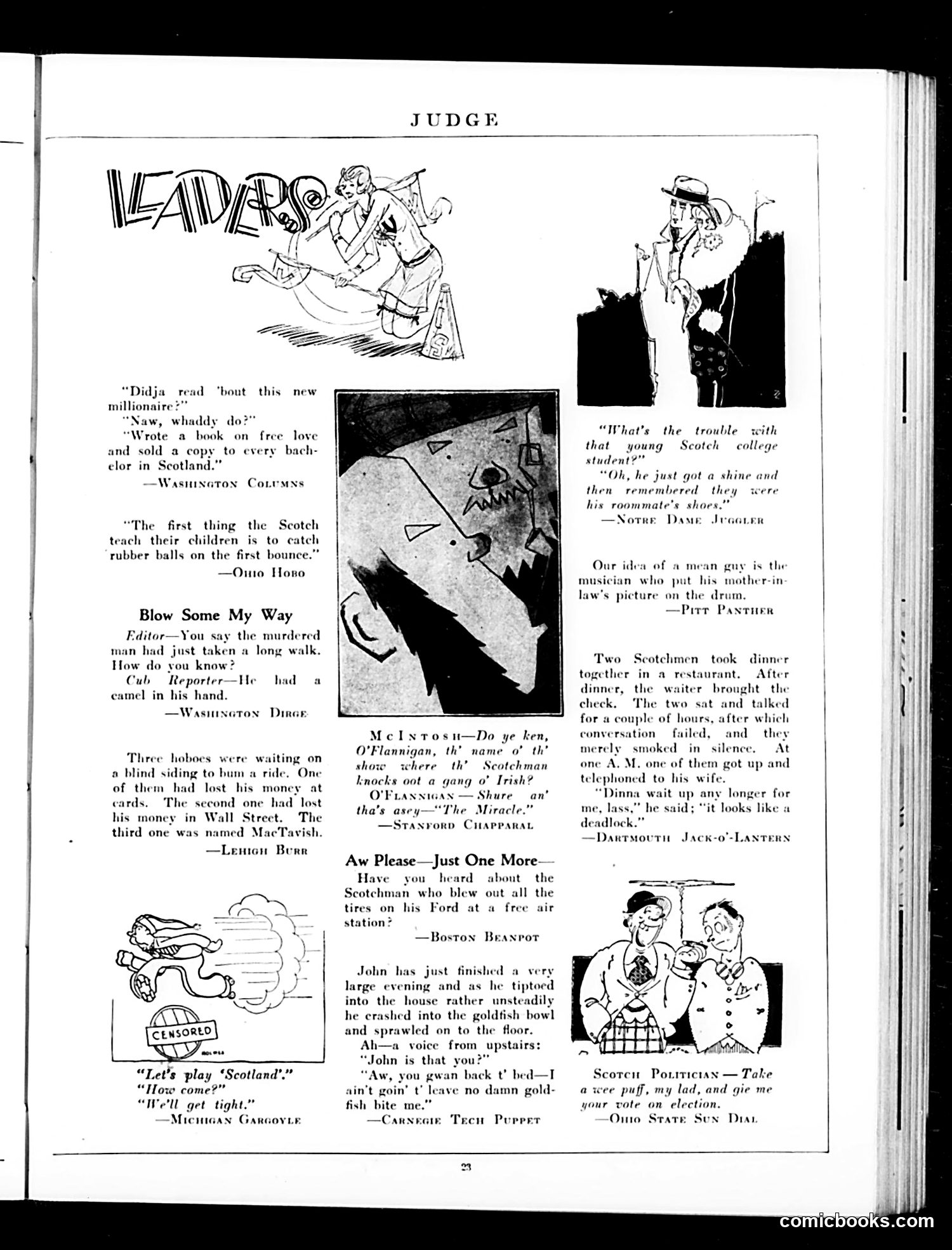
This page from *Judge* magazine consists primarily of short humorous anecdotes and jokes rather than political cartoons. The content heavily features **Scottish stereotypes** — a popular target of early 20th-century American humor. Jokes mock Scots as cheap (the "free love book" sold to bachelors; the restaurant check deadlock), drunk ("Let's play Scotland"/"We'll get tight"), and clumsy. Other humor targets include **Wall Street** (referencing financial speculation losses), **Irish-Scottish ethnic rivalry** (the McIntosh/O'Flannigan exchange), and **romance/domestic comedy** (the goldfish bowl incident, the musician's mother-in-law). One brief political reference appears: **"Scotch Politician"** advises trading votes for cigars — suggesting voter corruption or bribery as satire of electoral practices. The page reflects *Judge's* formula of brief, punchy jokes playing on ethnic caricatures and contemporary social observations, common to 1920s-era satirical magazines.
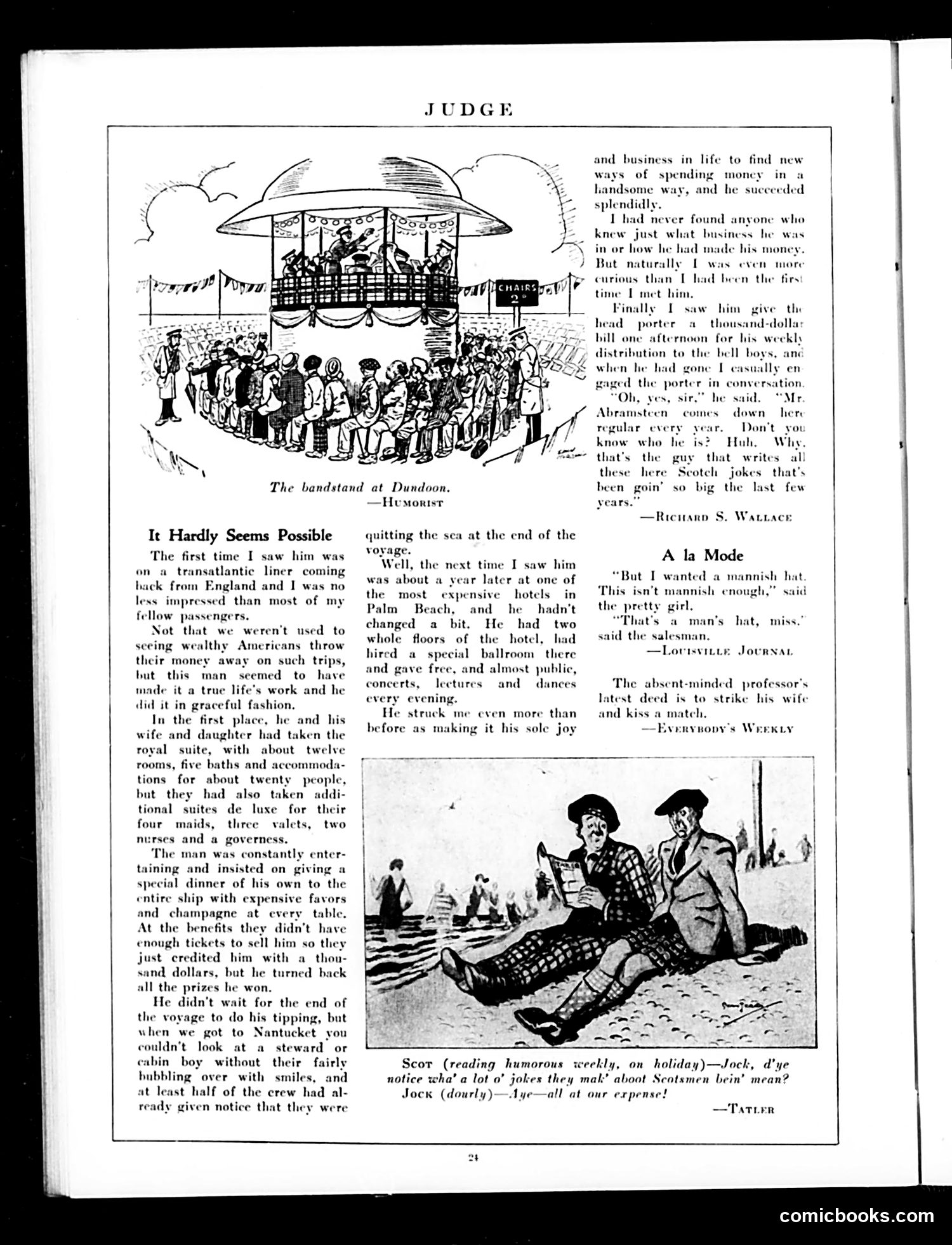
This page from *Judge* magazine contains three satirical pieces: 1. **"It Hardly Seems Possible"** (main story): Mocks a wealthy American named Abramsteen who obsessively spends money lavishly—chartering entire hotel floors, hiring staff, and hosting elaborate dinners. The punchline reveals he's famous not for actual business acumen but for *writing Scottish dialect jokes* that have become popular. The satire targets nouveau riche Americans who flaunt wealth without substance, and satirizes the era's popular "Scotch jokes" genre. 2. **"A la Mode"**: A brief joke about a woman requesting a "mannish hat" from a salesman, playing on fashion terminology. 3. **Bottom cartoon**: Scottish characters (Scot and Jock) reading humorous content, with Jock noting Scotsmen are frequently portrayed as miserly in jokes—a meta-joke about ethnic stereotyping in period humor. The page reflects early-20th-century American satire's focus on wealthy excess and ethnic humor conventions now considered offensive.
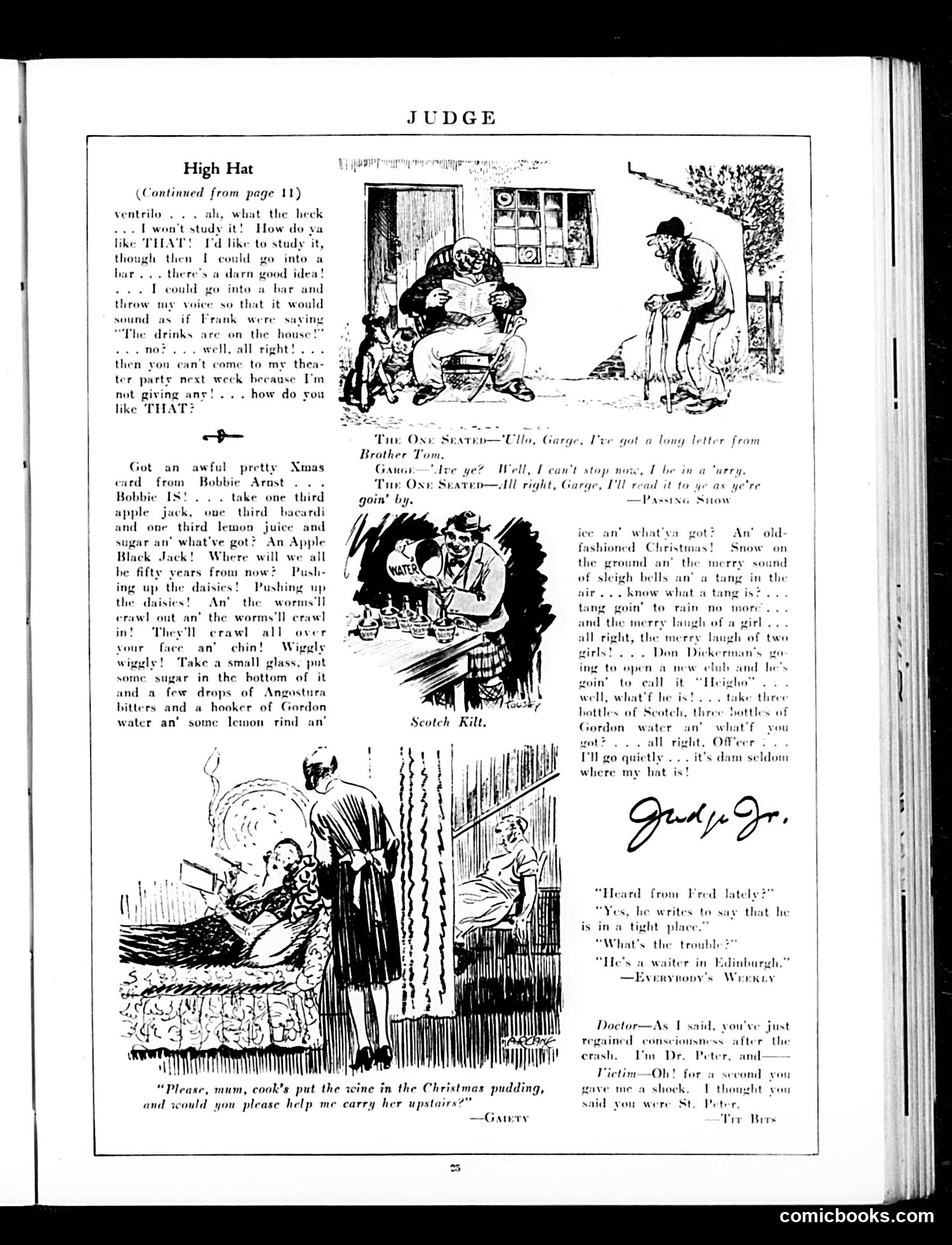
This page from *Judge* magazine contains several standalone humorous pieces rather than unified political cartoons: **"High Hat"** is a rambling monologue satirizing pretentious bar culture and drinking customs—mocking the affectations of someone trying to sound sophisticated while discussing cocktails and ventriloquism. **"The One Seated"** depicts working-class Londoners (indicated by "Garge" dialect and references to "Brother Tom") casually discussing Christmas preparations and Scottish whisky, satirizing lower-class attempts at holiday refinement. **"Scotch Kilt"** appears to show domestic chaos related to Christmas cooking—mocking servant incompetence or domestic disorder during holiday preparations. **The final two jokes** are pun-based: one about a waiter in Edinburgh being in a "tight place" (imprisoned/constrained), and a doctor/patient joke playing on religious confusion (St. Peter/Dr. Peter). The overall theme emphasizes class-based humor and satire of drinking culture and holiday excess across social strata. No specific political figures or events are referenced.
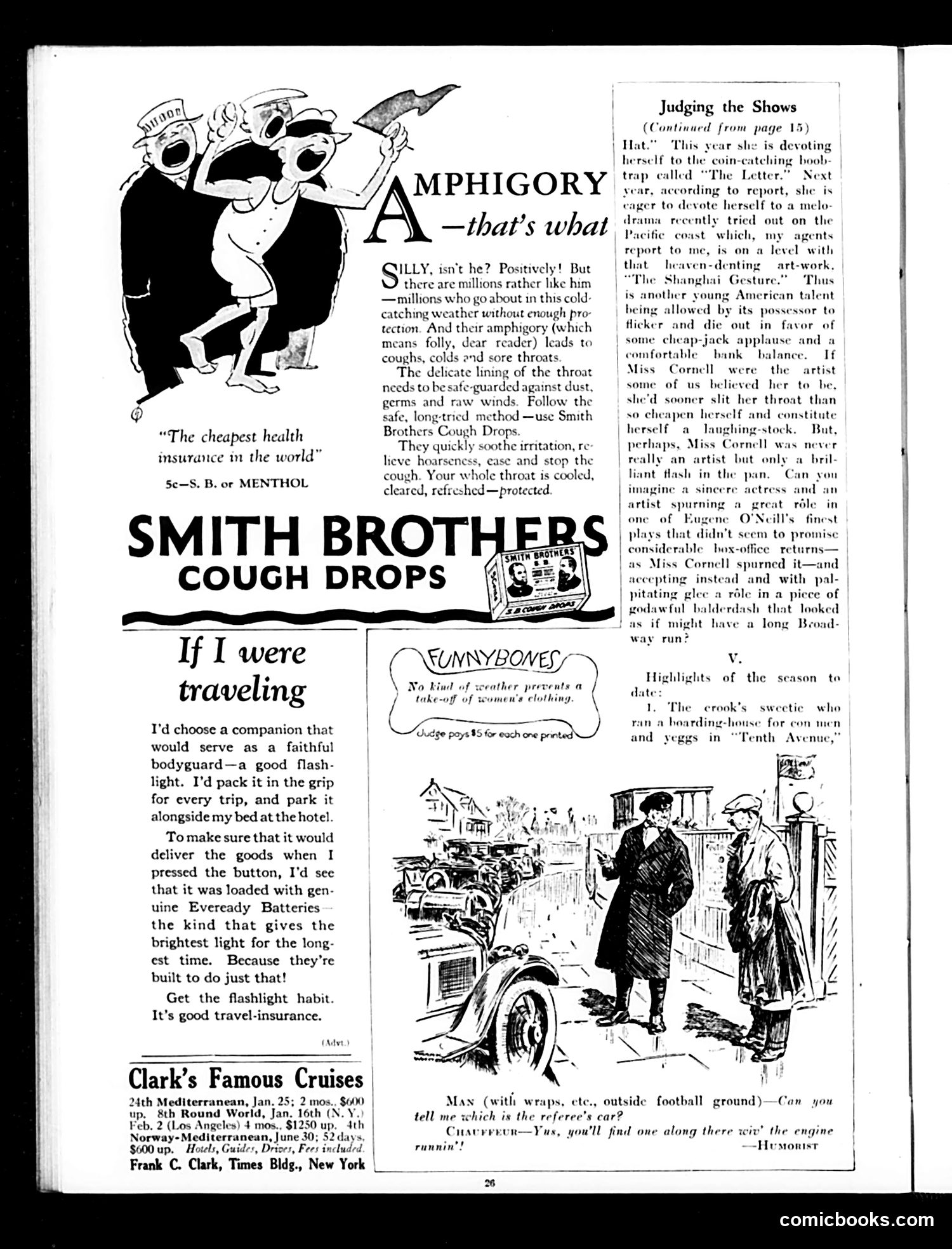
This is primarily an **advertisement page** for Smith Brothers Cough Drops, the dominant feature. The word "amphigory" (absurd nonsense) is used humorously to describe people foolishly going out in cold weather without throat protection—hence needing cough drops. The page also includes smaller ads for **Eveready Batteries** (flashlights for travelers) and **Clark's Famous Cruises** (luxury travel). A section titled "Judging the Shows" reviews theatrical performances, criticizing actress **Katharine Cornell** for accepting roles in mediocre commercial plays rather than serious art—squandering her talent for box-office returns. The humor section "Funnybones" invites reader submissions for jokes about women's clothing (paying $5 each). The cartoon at bottom depicts a **street scene** where a chauffeur assures a man he'll find a taxi "along there wiv' the engine runnin'"—gentle satire about urban transportation availability. Overall, this is a typical Judge magazine page mixing advertisements, theater criticism, and light social satire aimed at affluent early-20th-century readers.
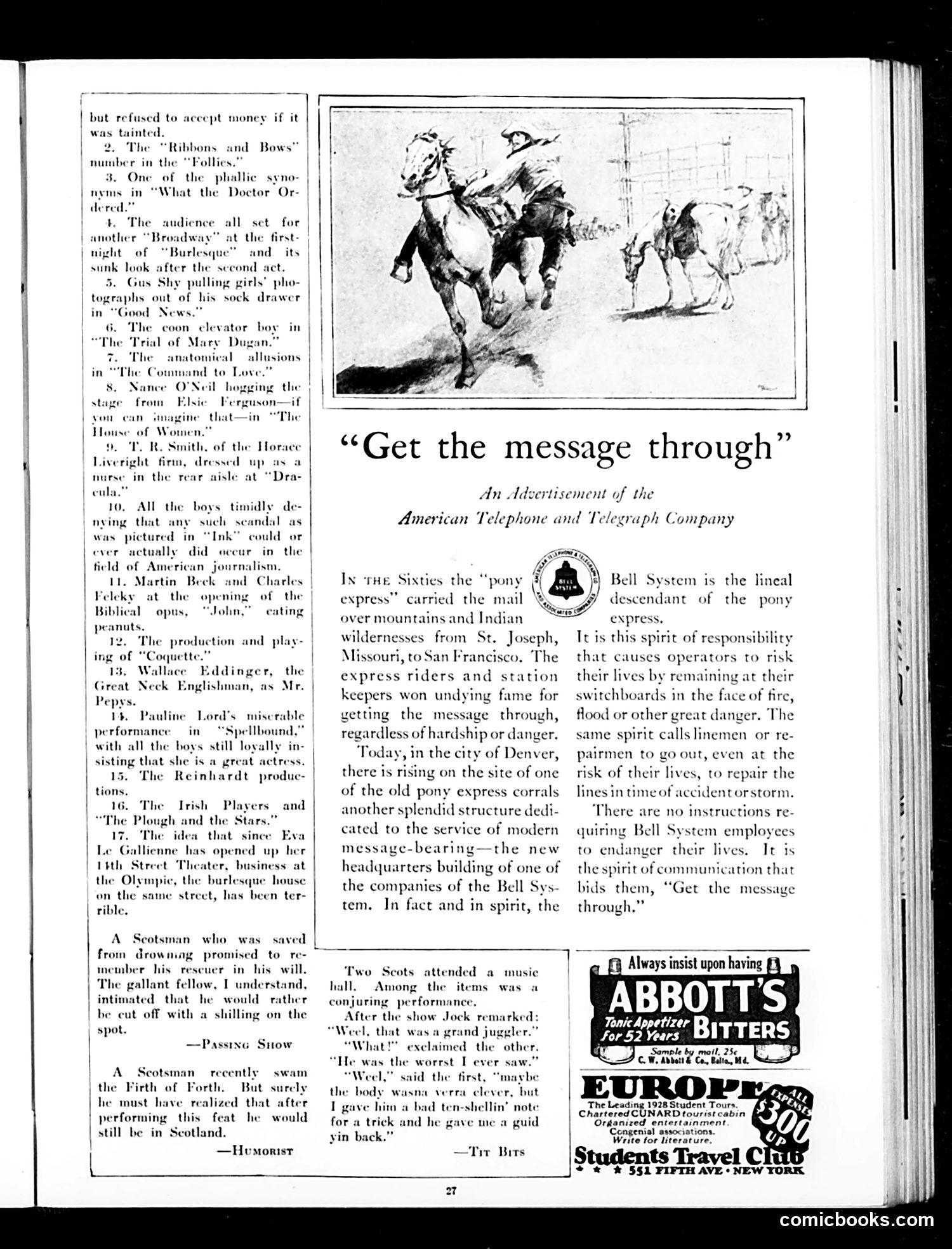
This page is primarily **advertising and miscellaneous content** rather than political satire. The main feature is a full-page advertisement for the **American Telephone and Telegraph Company**, comparing the Bell System to the historic Pony Express. The ad's conceit: just as Pony Express riders risked their lives to "get the message through" across 1860s wilderness, modern telephone operators and linemen maintain this same spirit of duty—remaining at switchboards during fires and venturing into storms to repair lines. The ad celebrates a newly built Bell headquarters in Denver, positioned on the former site of a Pony Express corral. The page also contains scattered **theatrical and social humor** items (numbered 1-17 on the left), briefly mocking Broadway shows, performances, and minor public figures, though most references are too fragmentary to identify precisely without additional context. Below the telephone ad are smaller advertisements (Abbott's Bitters, a student travel club) and two brief humorous anecdotes about Scottish characters—typical period humor.
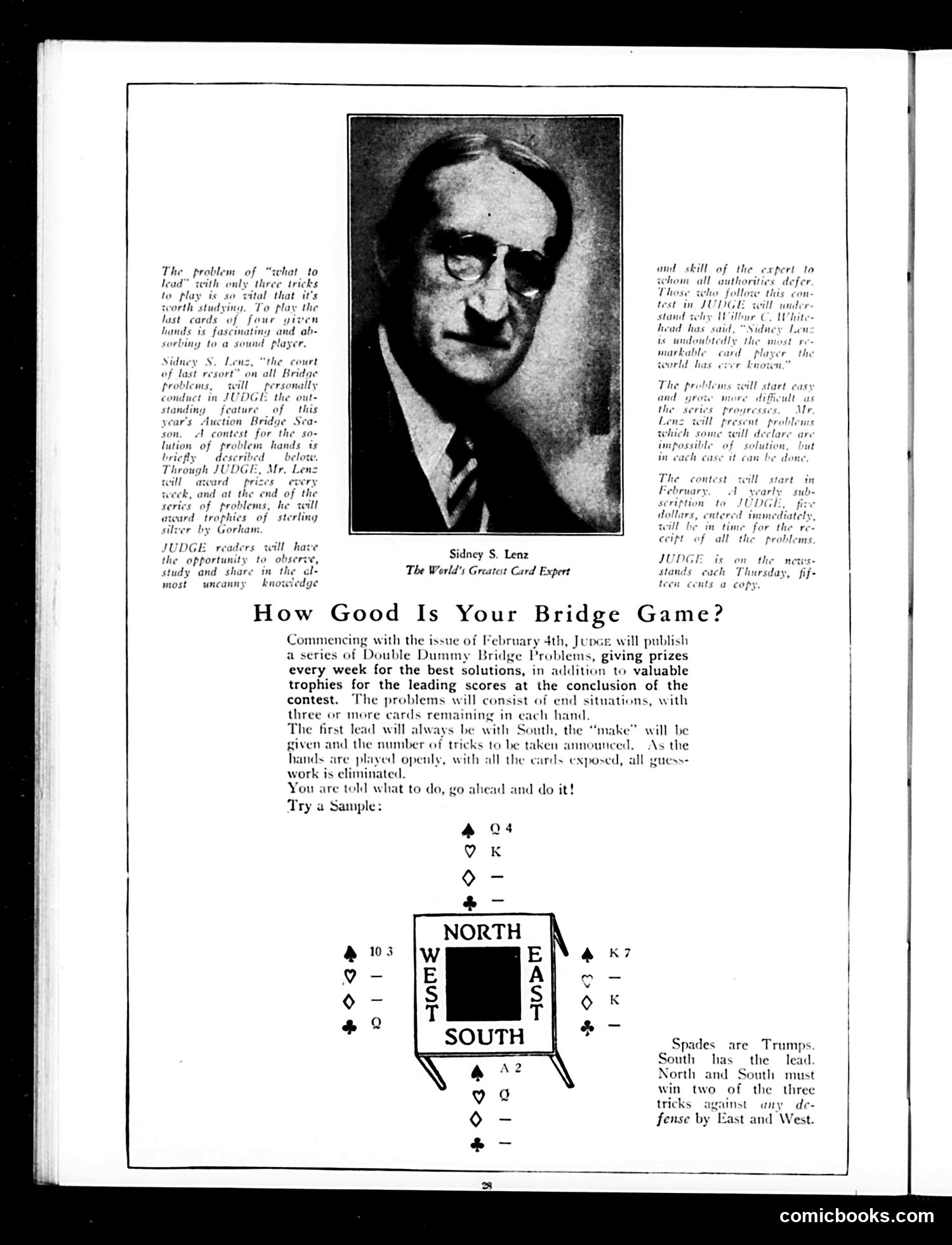
This page announces a new regular feature in *Judge* magazine: a weekly **bridge card game problem contest** starting February 4th. Sidney S. Lenz, identified as "The World's Greatest Card Expert," will oversee the competition. The feature invites readers to solve "Double Dummy Bridge Problems"—end-game card scenarios where all cards are visible, eliminating guesswork. Readers who submit correct solutions compete for weekly prizes and sterling silver trophies from Gorham. A sample problem is provided for readers to test themselves. This reflects the **1920s-30s bridge craze** among American middle and upper classes, when contract bridge was an enormously popular social game and intellectual pursuit. *Judge*, a satirical magazine for educated audiences, capitalized on this trend by offering competitive bridge content alongside humor and commentary. The feature essentially gamifies bridge expertise for its readership while driving magazine subscriptions through weekly contests.
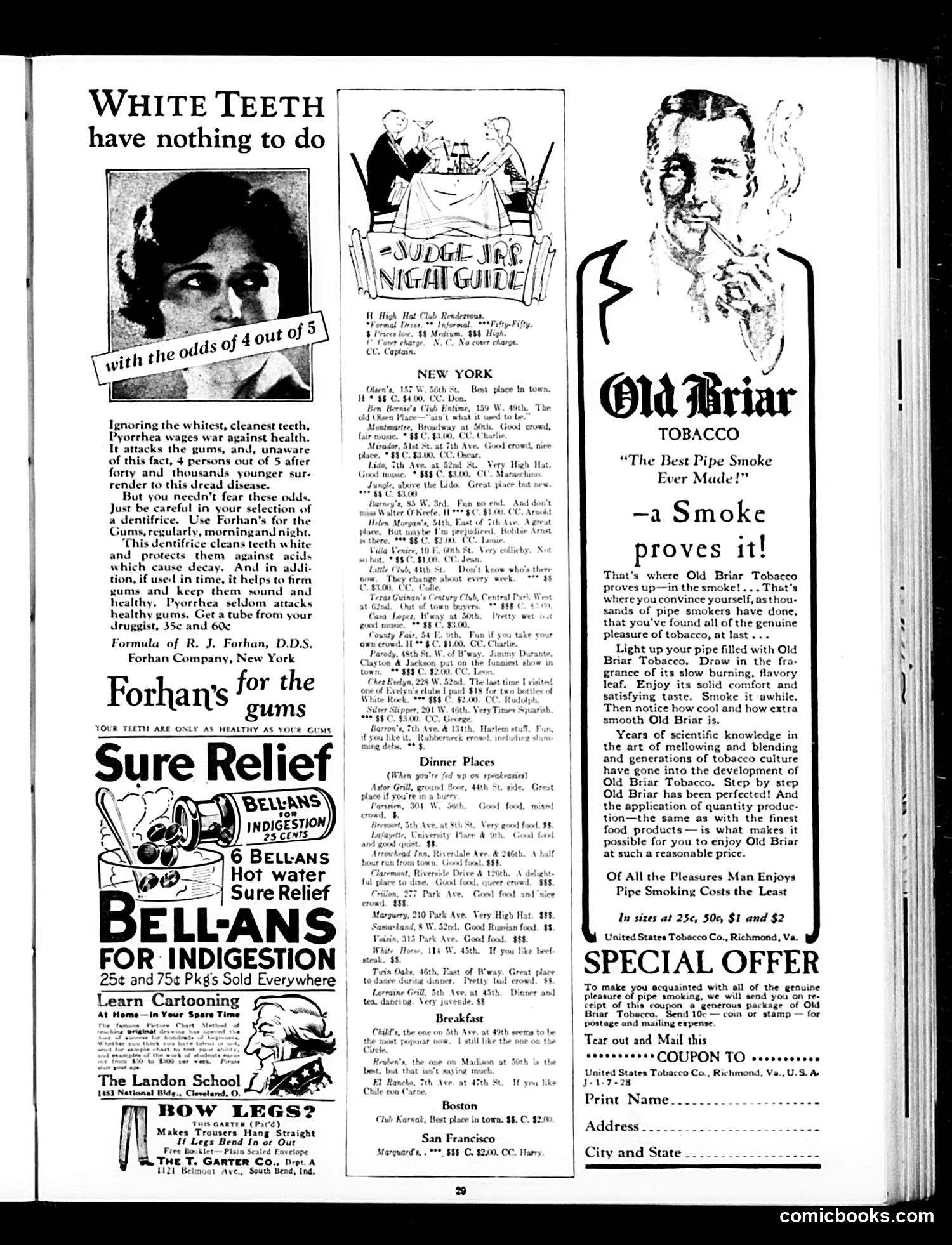
This page is primarily **advertising**, not political satire. It contains multiple product advertisements typical of 1920s-era magazines: 1. **Forhan's Dentifrice** - Promotes a toothpaste claiming to prevent pyorrhea (gum disease), emphasizing that "white teeth have nothing to do" with dental health; gum health matters more. 2. **Bellans Indigestion Relief** - Patent medicine advertisement for stomach upset treatment. 3. **Landon School** - Educational correspondence course. 4. **T. Garter Co.** - Garter/suspender advertisement. 5. **Old Briar Tobacco** - Pipe tobacco marketed as affordable luxury, emphasizing flavor and coolness. The page also includes what appears to be a "Night Guide" listing of New York dinner establishments and clubs (possibly speakeasies, given Prohibition-era context). No significant political cartoons or satire appear on this page—it's a standard advertising spread from Judge magazine.
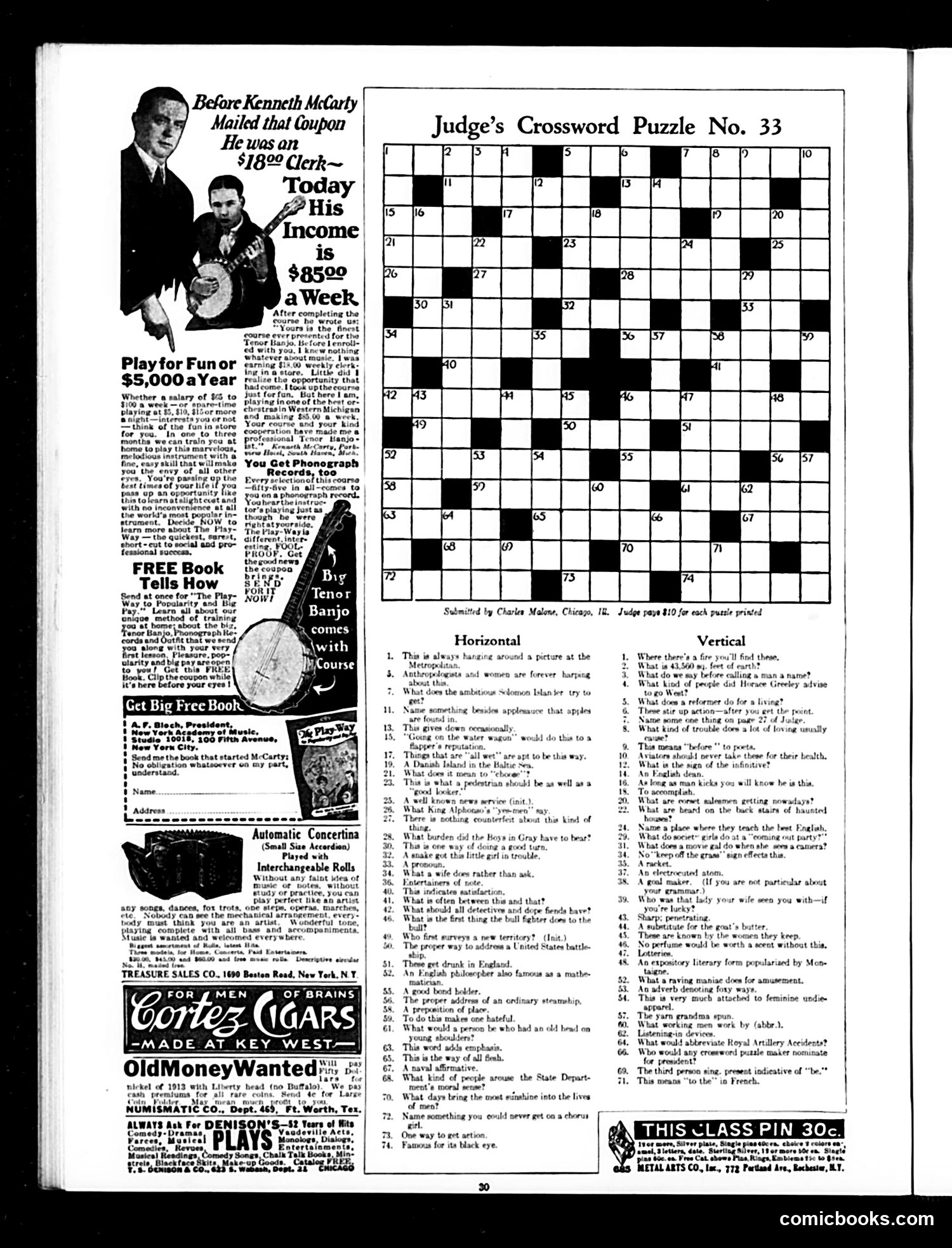
This page showcases typical Judge magazine content from the early 20th century. The dominant feature is an advertisement disguised as a success story: Kenneth McCarty, presented as a "$182 clerk," supposedly increased his income to "$5,000 a year" by completing a mail-order course in tenor banjo from the "Play-Way" institute. This is satire on the American self-improvement industry. The advertisement preys on working-class readers' aspirations, promising wealth through a musical skill with dubious earning potential. The before-and-after narrative (poor clerk → successful musician) was a common advertising trope that Judge mocked. The page also includes a crossword puzzle, vintage advertisements (Cortez cigars, coin-buying services), and an accordion course ad—all period-appropriate content. Together, these elements satirize consumer culture, mail-order schemes, and the gap between advertised promises and realistic outcomes. Judge's readership would recognize these ads as representative of schemes targeting economically vulnerable people.
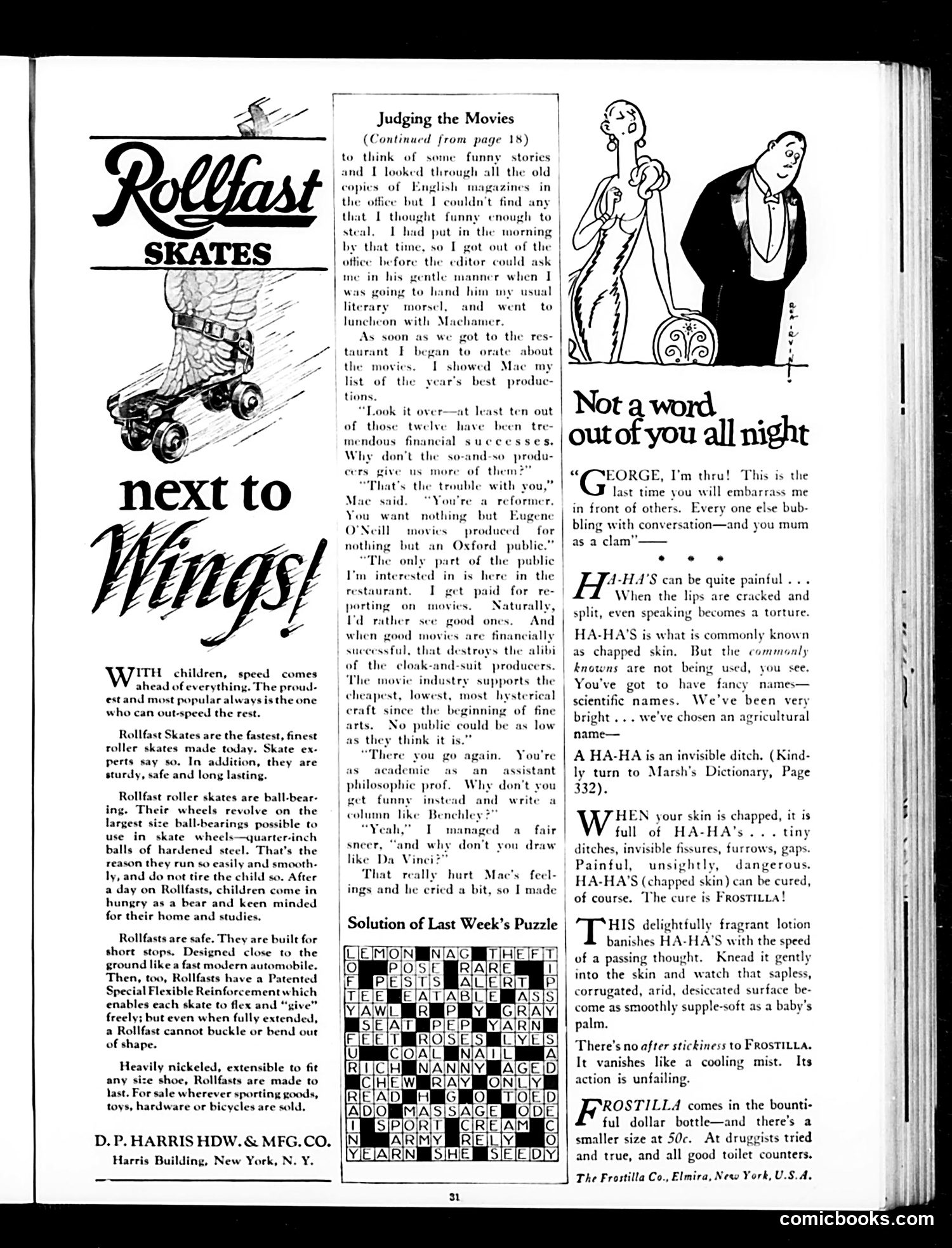
This page combines advertising with satirical content typical of 1920s Judge magazine. **Main Content - "Judging the Movies":** A humorous dialogue between two writers discussing why Hollywood produces financially successful but artistically mediocre films. One character advocates for quality Eugene O'Neill-style productions; the other pragmatically notes the public wants entertainment, not high art. The satire targets both pretentious intellectuals and commercial producers' lowest-common-denominator approach to cinema. **Cartoons:** A small cartoon shows a woman scolding a silent man ("Not a word out of you all night"), satirizing marital discord and the social expectation that men entertain their wives in public. **Advertising:** The page features ads for Rollfast Skates (emphasizing speed and safety for children) and Frostilla lotion (humorously naming chapped skin "HA-HA'S" as a pseudo-scientific agricultural term). These ads reflect 1920s consumer culture and marketing techniques. The juxtaposition reveals Judge's dual purpose: satirizing contemporary culture while monetizing reader attention through advertisements.
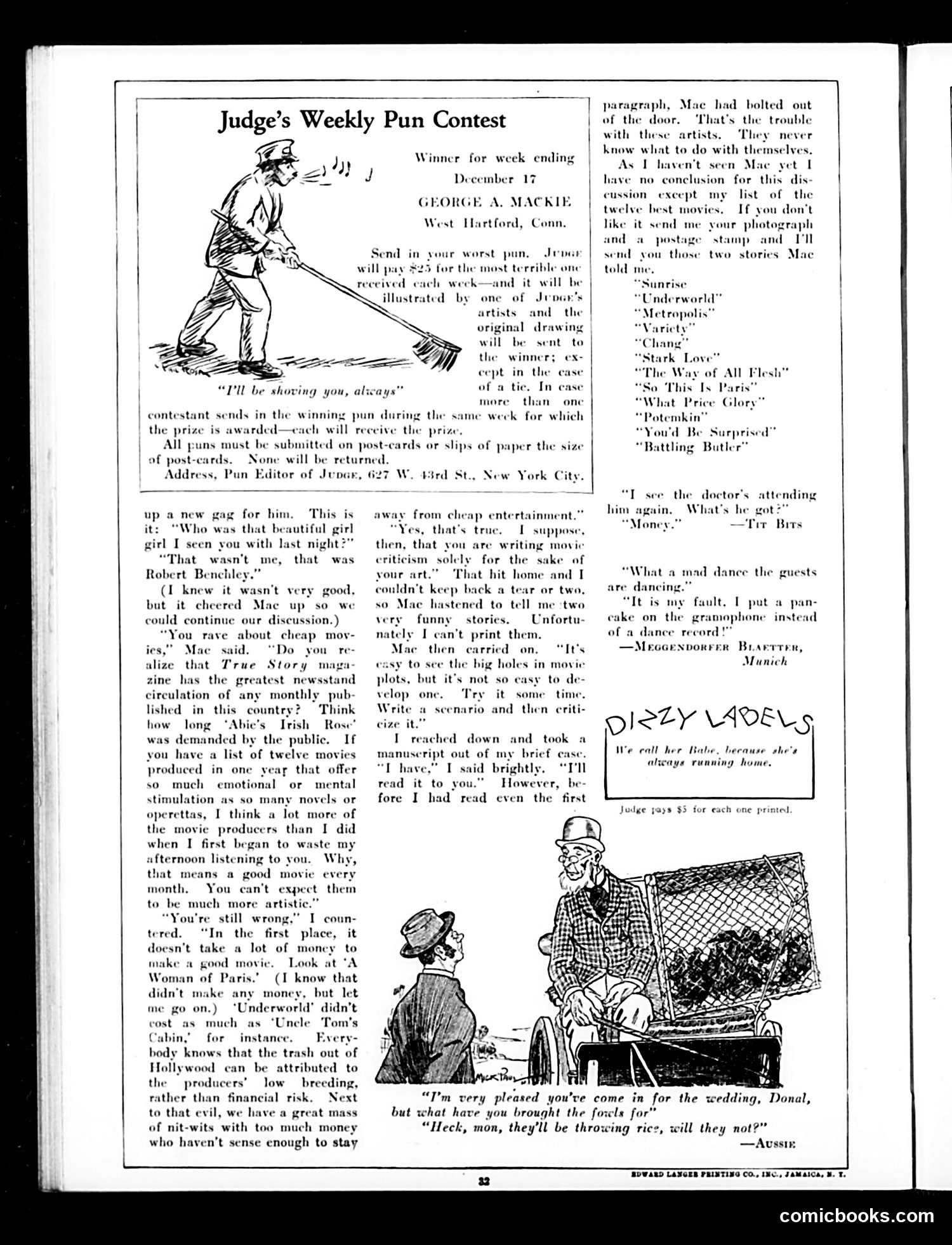
This page contains **Judge's Weekly Pun Contest**, a humor competition offering $25 for the "most terrible" submitted pun, with the winning entry illustrated by Judge's artists. Below that is a **dialogue piece** between two characters debating movie quality. One argues that cheap entertainment dominates Hollywood due to producers' lack of breeding and taste, while the other (Mac) defends the industry, citing successful productions like *True Story* magazine and films like *A Woman of Paris* and *Underworld*. The piece satirizes both pretentious film criticism and studio mediocrity. The page also includes three small **cartoon gags**: - One mocking absent-minded romance - One about a wedding guest bringing fowls (chickens) instead of gifts, with the Irish-accented punchline about rice-throwing - One titled "Dizzy Labels" about a runaway character The overall tone reflects 1920s concerns about Hollywood's artistic standards versus commercial success.
This is a **cigarette advertisement**, not satirical content. It's a 1927 Camel brand ad from R.J. Reynolds Tobacco Company featuring their iconic camel logo on the package. The ad makes straightforward marketing claims: Camel leads in sales ("by billions") and is what smokers want most. The smaller text argues that quality tobacco matters more than special throat treatments—a implicit jab at competitor claims. For modern readers: This represents pre-regulation tobacco advertising when health claims were unregulated and common. The phrase "good for the throat" now seems darkly ironic given cigarettes' actual health effects. The ad's confidence in cigarette superiority reflects an era before surgeon general warnings and smoking bans existed. Such advertisements would be illegal today.