
Judge, 1928-01-07 · page 15 of 36
Judge — January 7, 1928 — page 15: what you’re looking at
What you’re looking at
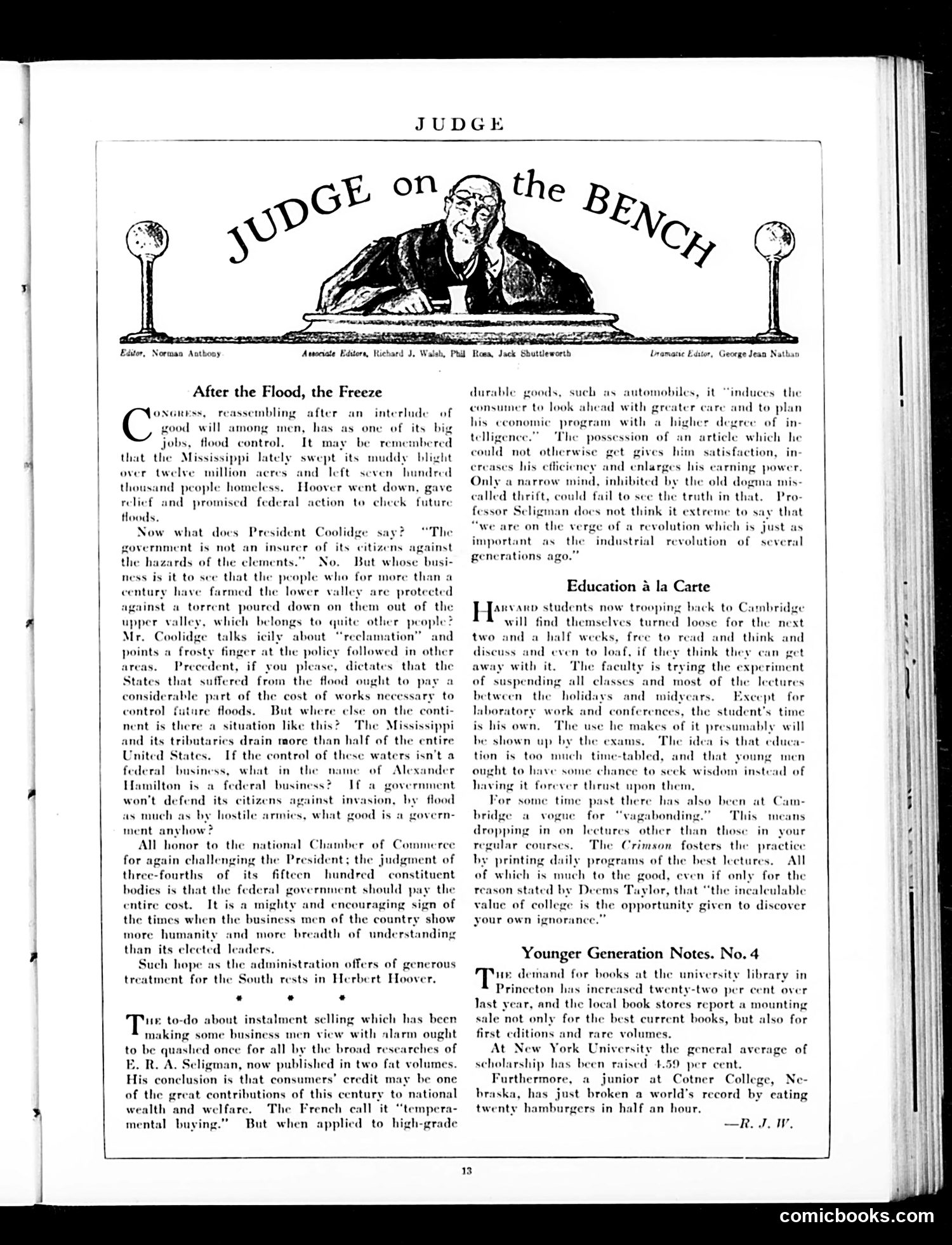
This page features editorial commentary on post-flood policy, centered on a disagreement between President Coolidge and his predecessor Hoover regarding federal disaster relief. **The Main Argument:** After the Mississippi River devastated twelve million acres and displaced hundreds of thousands, Hoover promised federal action. Coolidge refuses, claiming government shouldn't "insure" citizens against natural disasters. The editorial attacks this position as absurd—if the federal government won't defend citizens against floods (which cross state boundaries), what good is it? The Mississippi basin drains half the nation; flood control is inherently a federal responsibility, like defense against armies. **The Stakes:** The Chamber of Commerce sided with federal funding, suggesting business leaders showed more "humanity" than elected officials. Only Hoover (now Commerce Secretary) offers hope for Southern relief. The page also includes brief notes on consumer credit and Harvard's experimental education policy, demonstrating the magazine's wide-ranging satirical coverage.
📄 Transcribed text from this page (OCR, searchable)
Machine-transcribed from the original scan — historical spelling and the odd misread are preserved.
JUDGE After the Flood, the Freeze oNoness, reassembling after an of ‘dor, Norman Anthooy interlude C will among men, has as one of its | ; flood control. It may be remembered that the Mississippi lately swept its muddy blight over twelve million acres and left hundred thousand people homeless. Hoover went down, gave relief and promised federal action to check future floods. vod seven Now what does President Coolidge say? “The government is not an insurer of its citizens against the hazards of the clements.” No. But whose busi- ness is it to see that the people who for more than a century have farmed the lower valley are protected inst a torrent poured down on them out of the upper valley, which belongs to quite other people? Mr. Coolidge talks icily about “reclamati points a frosty finger at the policy followed in other areas. Pre nt, if you please, dictates that the tes that suffered from the flood ought to considerable part of the cost of works necessary control future floods. But where clse on the conti- nent is there a situation like this? The Mississippi and its tributaries drain more than half of the entire United St: If the control of these waters isn’t a federal business, what in’ the of Alexander Hamilton a federal business? If a government won't defend its citi against invasion, by flood as much as by hostile armies, what good is ment anyhow? All honor to the national Chamber of Commerce ng the President; the judgment of ourths of its fifteen hundred constituent hodies is that the federal government should pay the entire cost. It is a mighty and encouraging sign of the times when the business men of the country show more humanity and more breadth of understanding than its elected le Such hope as the administration offers of generous treatment for the South rests in Herbert Hoover, to be quashed once for all by the broad researches of E. R.A. Seligman, now published in two fat volumes. His conclusion is that consumers’ eredit may be one of the great contributions of this century to nation: th and welfare. The French call it “tempe ntal buying.” But when applied to high-grade and to cs. name govern- ders. * . . ue to-do about instalment selling which has been naking some business men view with 1 Ansociate Editors, Richard J, Walsh, Phil Rona, Jack Shuttleworth Uramane Editor, George Jean Nathan durable goods, such as automobiles, it “induces the consumer to look ahead with greater care and to plan his economic program with a higher de of in- tel The possession of an article which he could not otherwise get gives him satisfaction, in creases his efficiency and enlarges his earning power. Only a narrow mind, inhibited by the old dogma mis- called thrift, could fail to sce the truth in that. fessor Se nee Pro- nan docs not think it extreme to say that “we are on the verge of a revolution which is just as important the industrial revolution of generations ago. as several Education a la Carte aerate students now trooping back to Cambridge will find themselves turned loose for the two and a half weeks, free to read and think discuss and even to loaf, if they think they can away with it. The faculty is trying the experiment of suspending all classes and most of the lectures between the holidays and midyears. Exeept for laboratory work and conferences, the student's time is his own, next nd The use he makes of it presumably will be shown up by the exams, ‘The idea is that cduca- tion is too much time-tabled, and that young men ought to © some chance to seek wisdom instead of having it forever thrust upon them, For some time past there has also been at Cam- bridge a vogue for “vagabonding.” This) means dropping in on lectures other than those in’ your ar courses. The Crimson fosters the prac printing daily programs of the best lectures. of which is much to the good, even if only for the reason stated by Deems Taylor, that “the incalculable value of college is the opportunity given to discover your own ignorance. Younger Generation Notes. No. 4 TT demand for books at the university library in Princeton has increased twenty-two per cent over last year, and the local book stores report a mounting sale not only for the best current books, but also for first editions and rare volumes. At New York University the general average of scholarship has been raised 4.59 per cent. Furthermore, a junior at Cotner College, braska, has just broken a world’s record by cating twenty hamburgers in half an hour. —R. IW, 13 comicbooks.com