
A complete issue · 36 pages · 1927
Judge — December 10, 1927
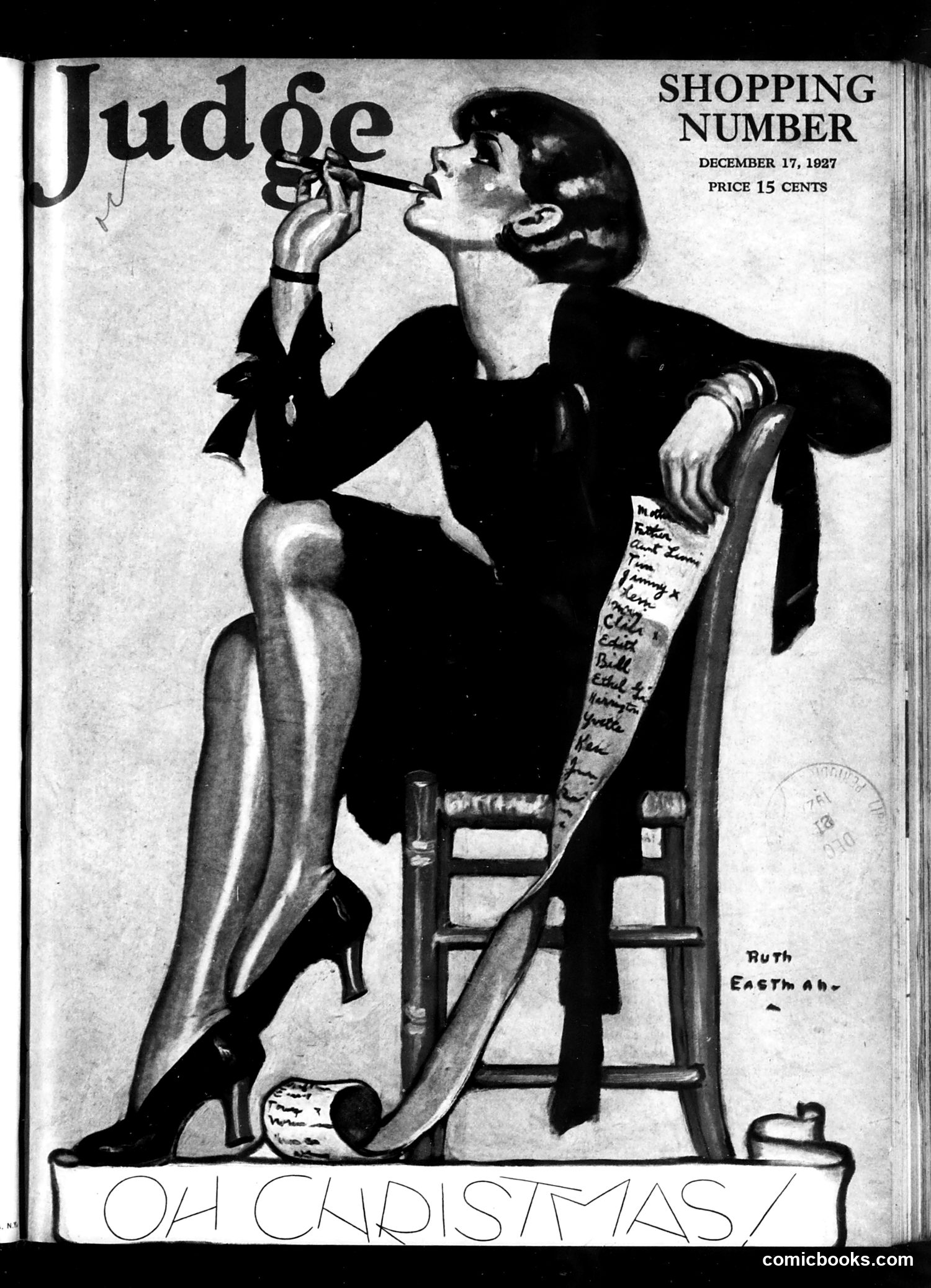
This is a **Christmas shopping satire** showing a stylishly dressed woman perched on a high stool, consulting what appears to be a shopping list while enjoying a beverage. The list on the chair beside her contains numerous handwritten items—suggesting an elaborate or demanding holiday shopping agenda. The humor targets **excessive Christmas consumerism** and the stress of holiday shopping, particularly on women expected to manage household gift-buying. The woman's relaxed posture with a drink suggests she's fortifying herself for the exhausting task ahead. The exaggerated list emphasizes how burdensome and commercial the holiday season had become by the 1920s. The title "Oh Christmas!" expresses weary resignation to this annual consumer obligation.
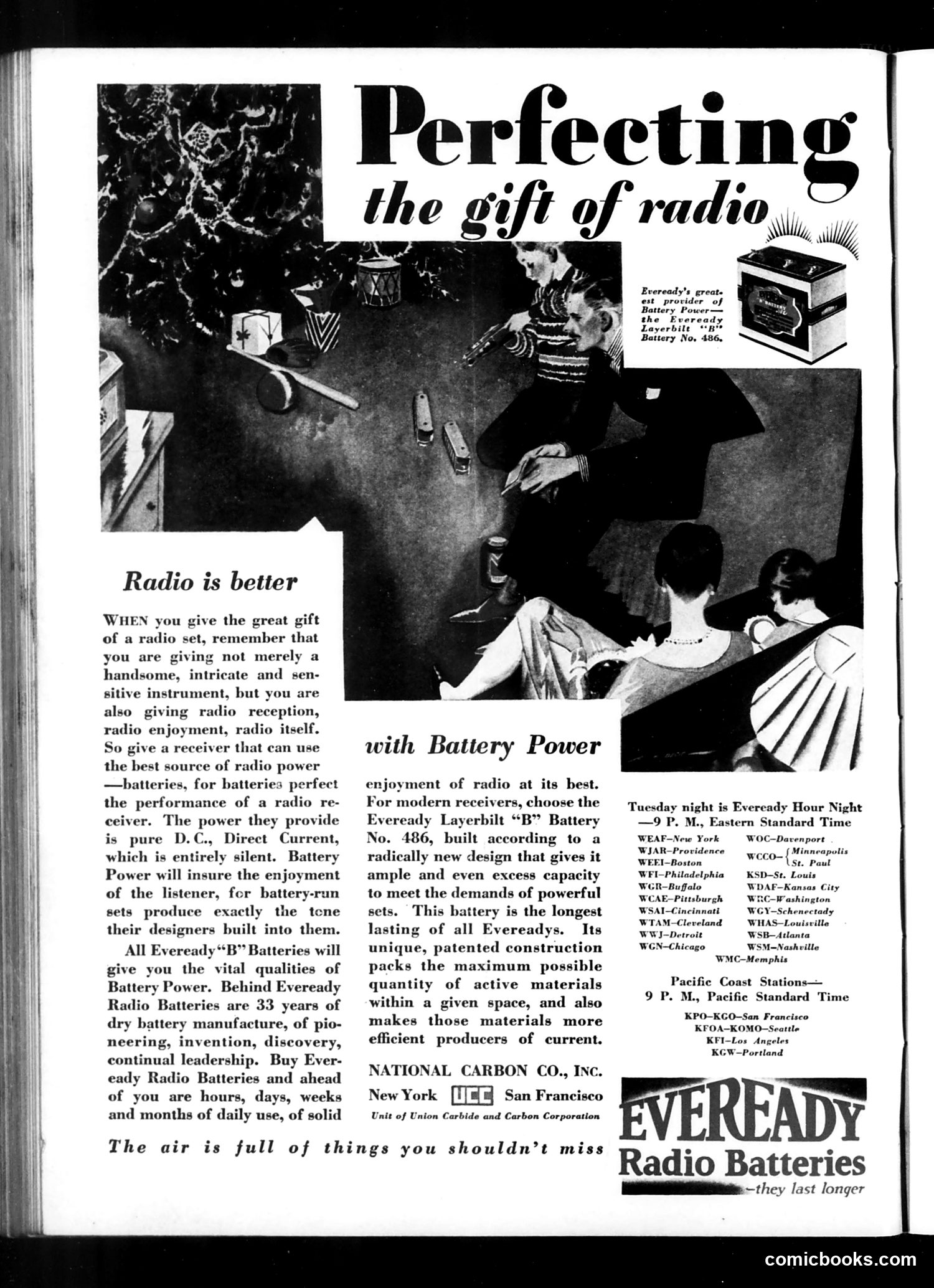
This page is **primarily advertising, not satire or political commentary**. It's an advertisement for Eveready Radio Batteries from National Carbon Co., Inc. The ad shows a family gathered around a radio receiver, positioning battery-powered radios as an ideal gift. The messaging emphasizes that giving a radio means giving "radio reception, radio enjoyment, radio itself"—not just a device but an entertainment experience. The small inset lists radio stations and broadcast times, including "Tuesday night is Eveready Hour Night," suggesting the company sponsored programming. The tagline "The air is full of things you shouldn't miss" reflects early radio's cultural appeal as a novel mass-communication medium. This appears to be from the 1920s-1930s era, when home radio ownership was still being promoted as desirable and batteries were essential components.
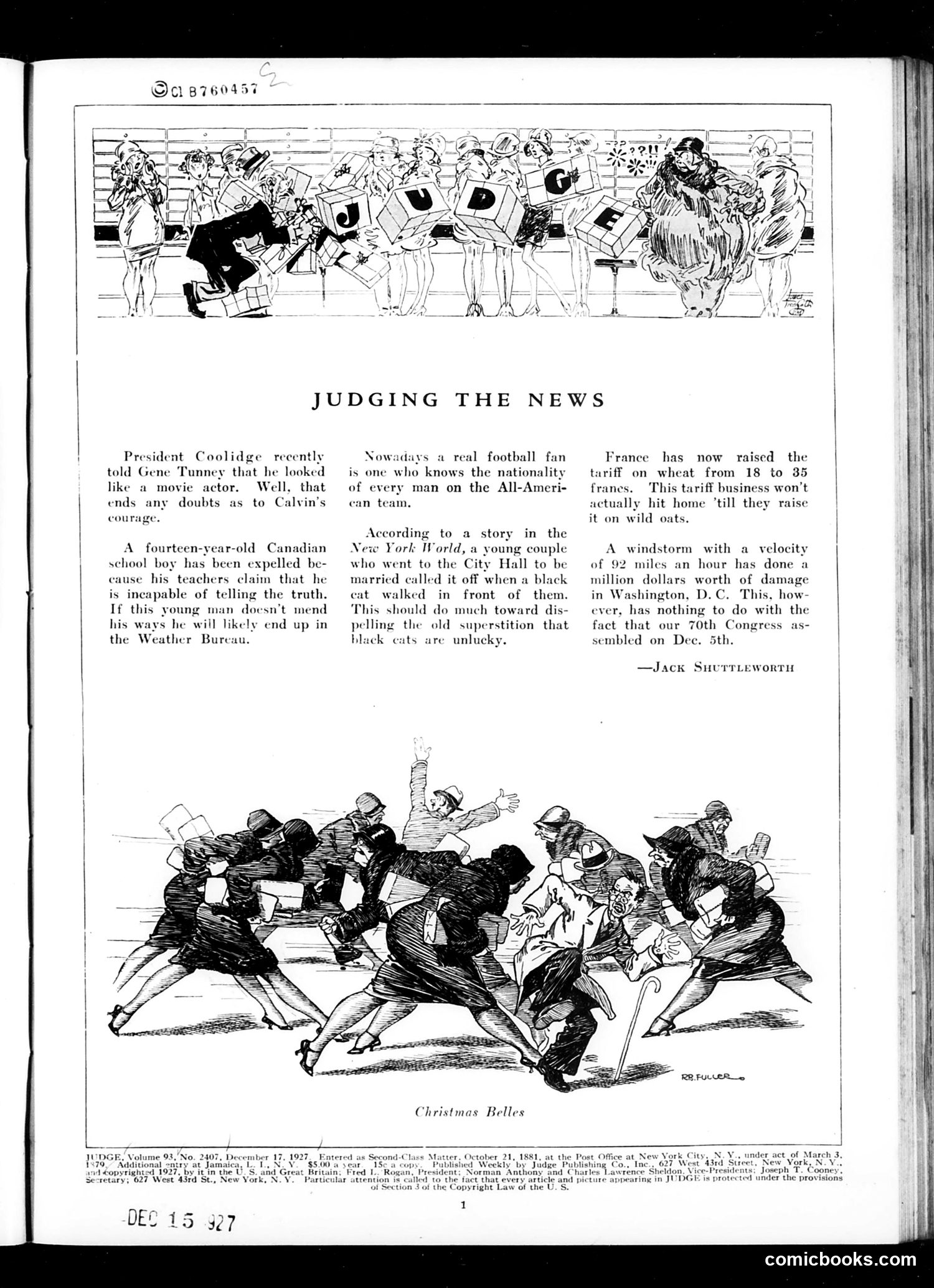
This satirical page comments on contemporary events: **Top section** features humorous news items: President Coolidge's acting ability, a Canadian boy's honesty problem, a couple's marital dispute involving a black cat superstition, France's tariff concerns, and a Washington windstorm. **Bottom cartoon titled "Christmas Belles"** depicts women in a chaotic scrum, apparently fighting or crowded together during holiday shopping. The illustration satirizes the frenzied, aggressive behavior of female holiday shoppers—a common satirical target of the 1920s that mocked both commercialism and women's public participation in consumer culture. The "belles" have transformed from refined ladies into combative figures, emphasizing the period's tension between traditional femininity and modern consumer behavior.
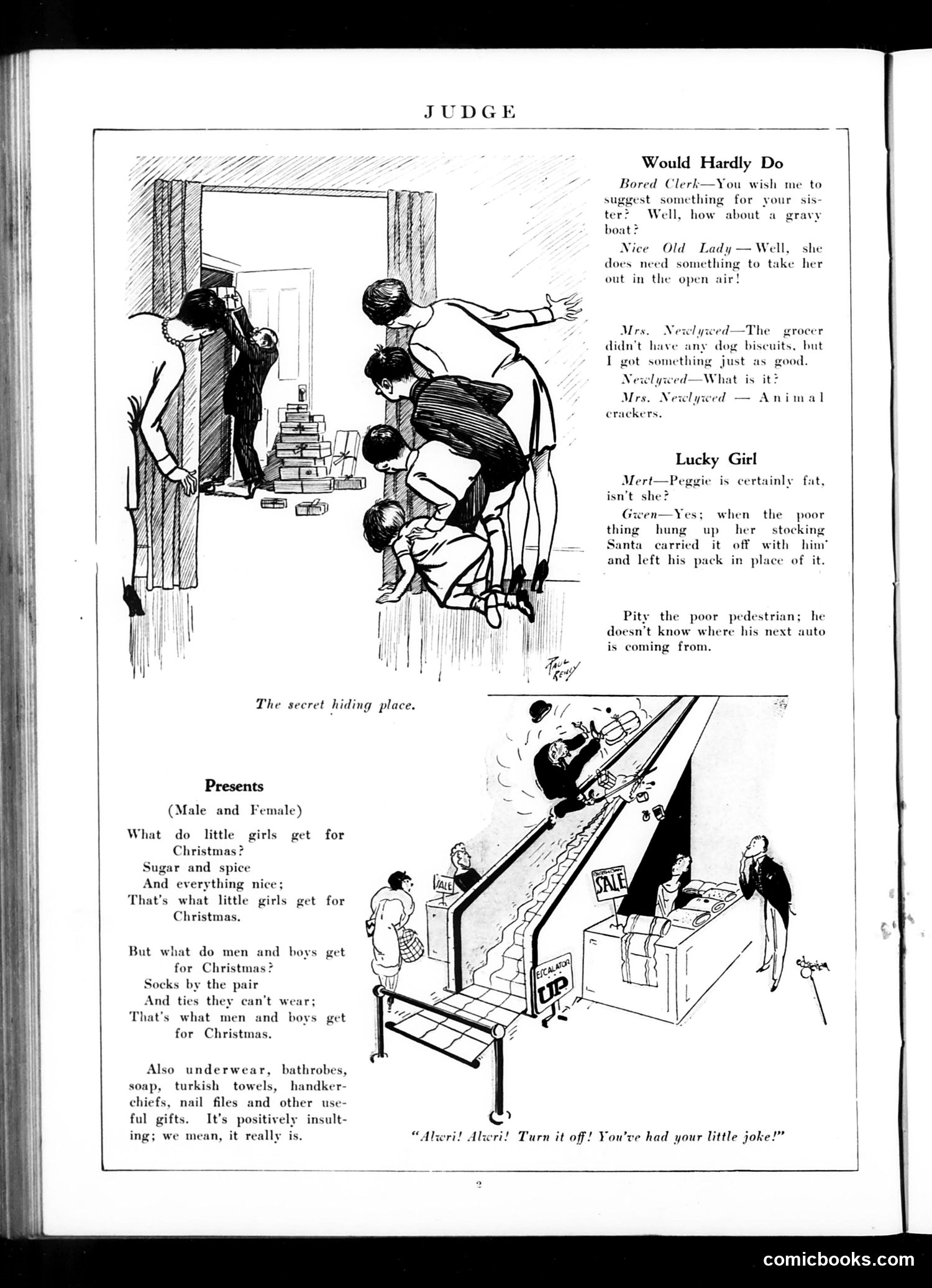
This page contains three separate satirical pieces: **"Would Hardly Do"** depicts a bored clerk and old lady discussing gift suggestions, with the punchline involving animal crackers instead of dog biscuits—gentle domestic humor. **"Lucky Girl"** jokes about a girl named Peggy who is "fat," with the humor centering on her stocking getting torn and replaced with a boy's sock—typical early-20th-century schoolyard comedy. **"Presents"** is a humorous poem contrasting Christmas gifts for girls (sugar, spice, nice things) versus boys (socks, ties, underwear)—mocking how boys received practical but unglamorous gifts. The bottom cartoon shows people at what appears to be a luggage counter or storage area, with someone discovering their hidden joke has been discovered ("Turn it off! You've had your little joke!")—suggesting practical joking among travelers or workers. The overall tone is light domestic and workplace humor typical of early-20th-century satirical magazines.
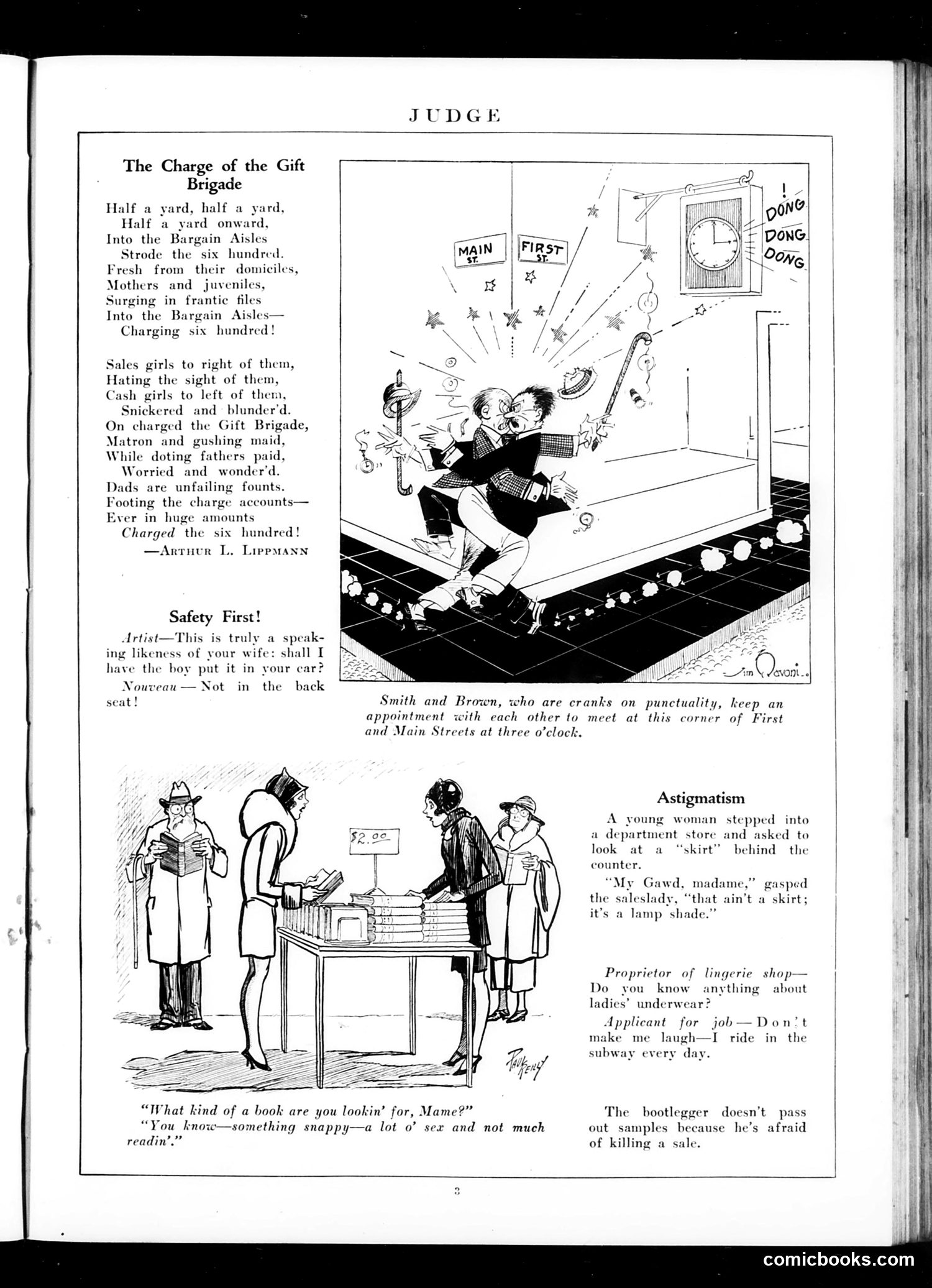
**Main Cartoon - "The Charge of the Gift Brigade":** This satirizes holiday shopping chaos, particularly the aggressive behavior of mothers and female shoppers during the Christmas season. The poem by Arthur L. Lippmann mocks the frenzy of "six hundred" women storming department store sales ("Bargain Aisles"), with mothers, juveniles, and salesgirls competing fiercely. The illustration shows women wielding umbrellas and parasols like weapons, creating mayhem in a store. The satire critiques both excessive consumerism and the stereotypical portrayal of women shoppers as wild, uncontrolled crowds—a common early-20th-century trope. **Secondary Content:** Lower sections contain brief humorous anecdotes about retail confusion and workplace absurdities, typical of Judge's short-joke format.
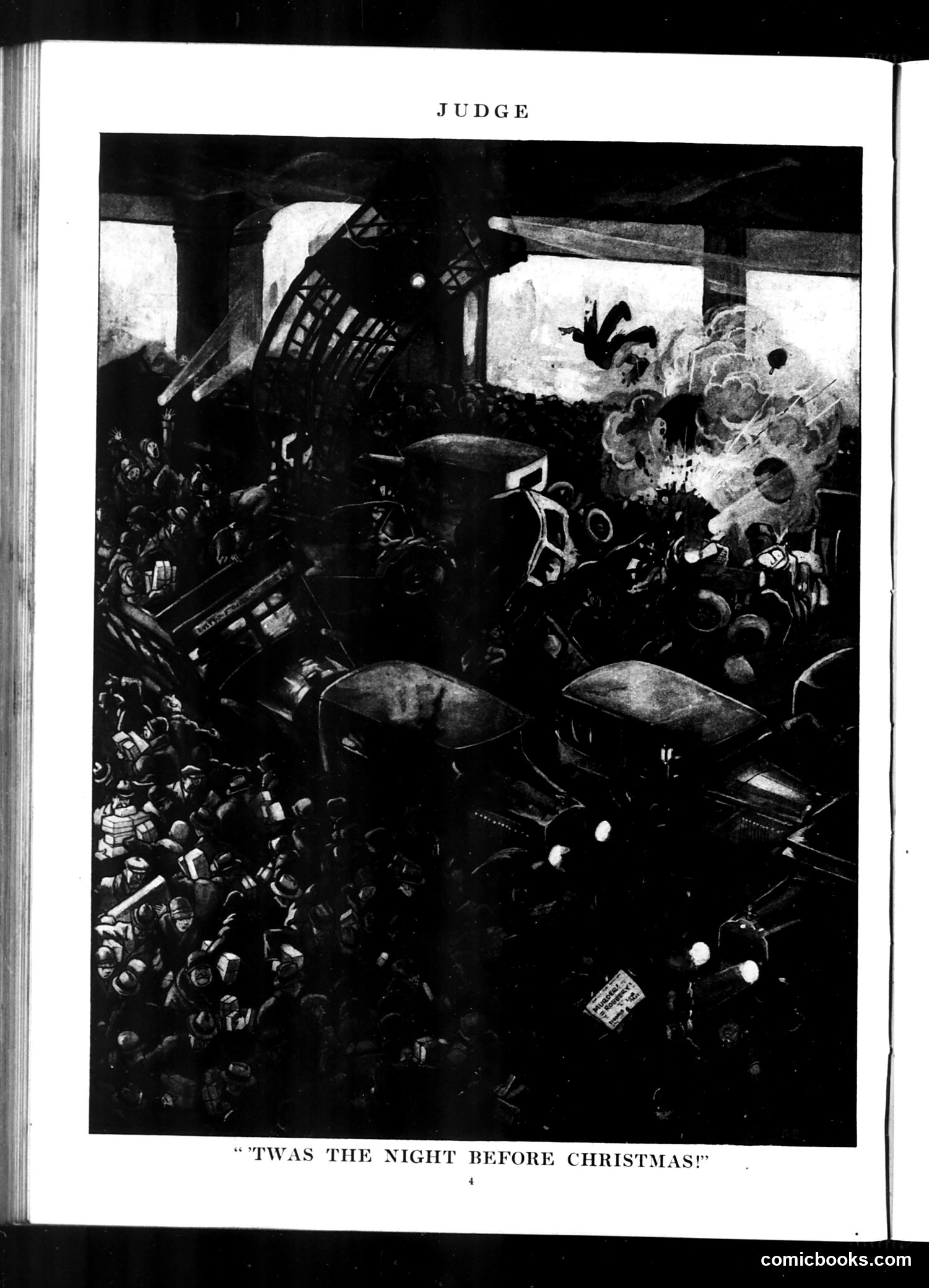
This is a satirical illustration reworking the famous Christmas poem. The image shows a chaotic industrial/mechanical scene rather than a peaceful household on Christmas Eve. Dense crowds of figures surround machinery, smoke, and mechanical devices—a stark contrast to the poem's cozy domestic setting. The satire appears to critique industrial capitalism and labor conditions during the Gilded Age/early 20th century. Rather than Santa's peaceful visit, the cartoon depicts the frantic, dehumanizing reality of factory work and mechanized production that dominated American life, especially during the Christmas season when commercial demands intensified. The juxtaposition of the beloved poem's title with this nightmarish industrial tableau emphasizes the gap between nostalgic American mythology and harsh economic realities.
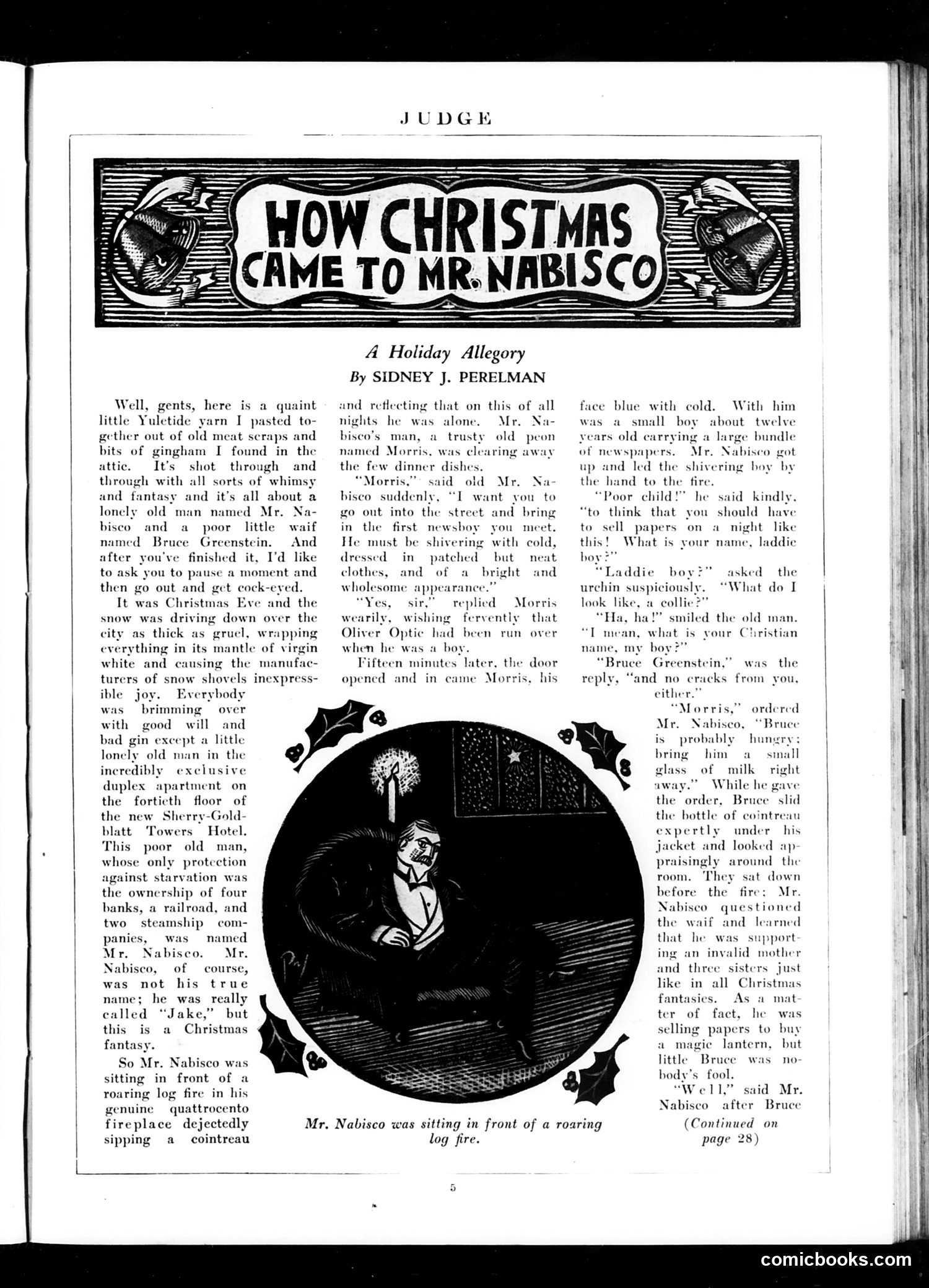
This is a holiday allegorical story by Sidney J. Perelman, not a political cartoon. The narrative describes Mr. Nabisco, a poor lonely old man living in a tenement, who receives an unexpected Christmas visit from a boy named Bruce Greenstein. The story appears to be a sentimental piece about charitable Christmas spirit—contrasting Mr. Nabisco's isolation and poverty with the kindness of strangers. The boy arrives bearing gifts (milk and newspapers), embodying the season's generosity toward the less fortunate. The illustration shows Mr. Nabisco by his fireplace, surrounded by holly decorations. This seems a straightforward, earnest holiday tale meant to appeal to Judge readers' sentimentality rather than satirize social conditions.
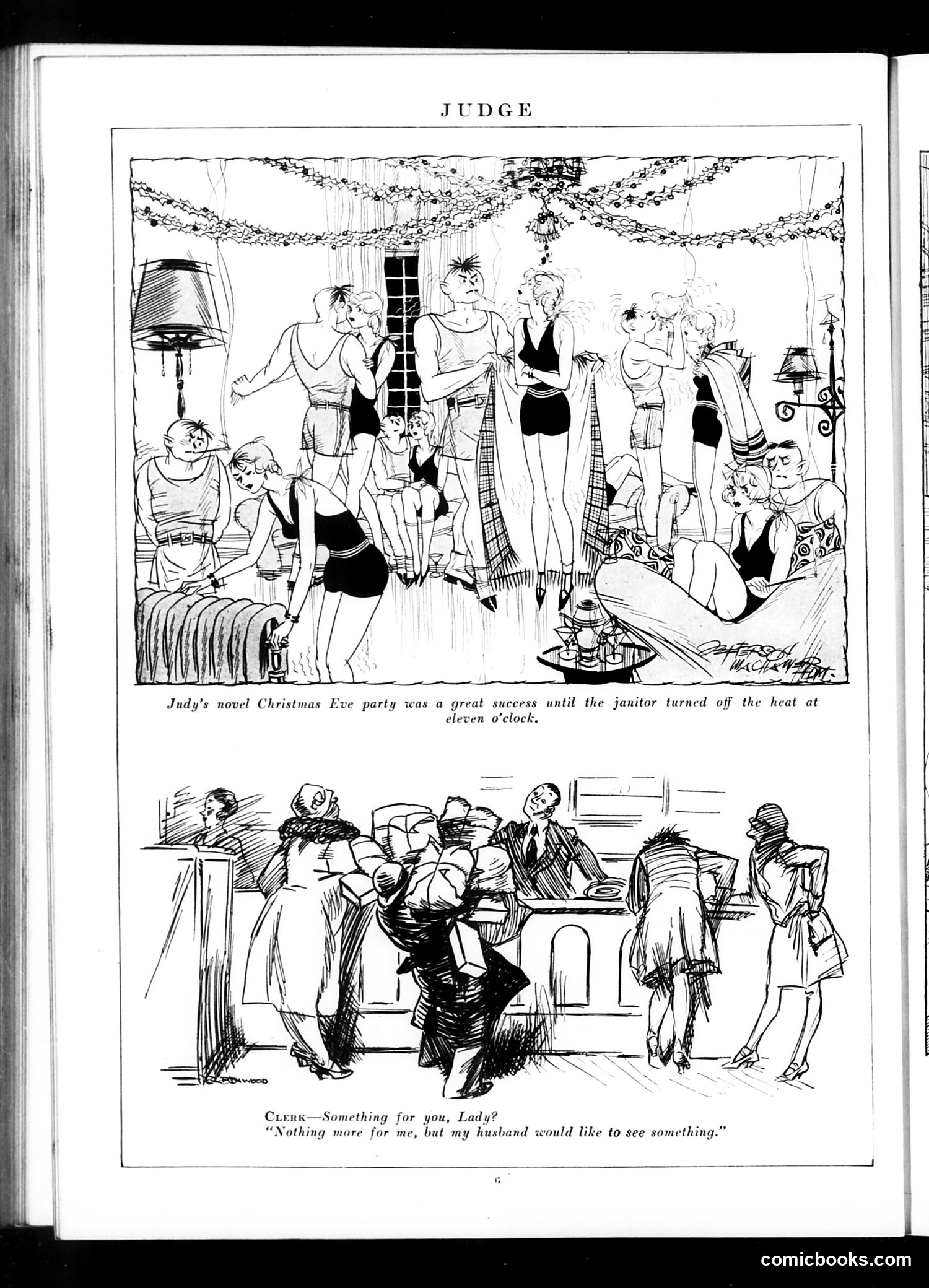
This page contains two separate gags satirizing social awkwardness and class dynamics during the 1920s-1930s era (based on the art style and fashion). **Top panel**: "Judy's" Christmas Eve party is disrupted when the janitor turns off the heat at 11 PM—an absurdist joke about a working-class employee's literal interpretation of duty, forcing well-dressed guests to endure cold. **Bottom panel**: At what appears to be a store or restaurant counter, a female customer requests service while her husband makes an innuendo-laden request to "see something," implying he wants to view the female clerk—a crude joke about masculine behavior and objectification that relied on period audience expectations. Both gags rely on social embarrassment and the clash between propriety and crude reality—typical of Judge magazine's satirical humor targeting middle-class manners and pretension.
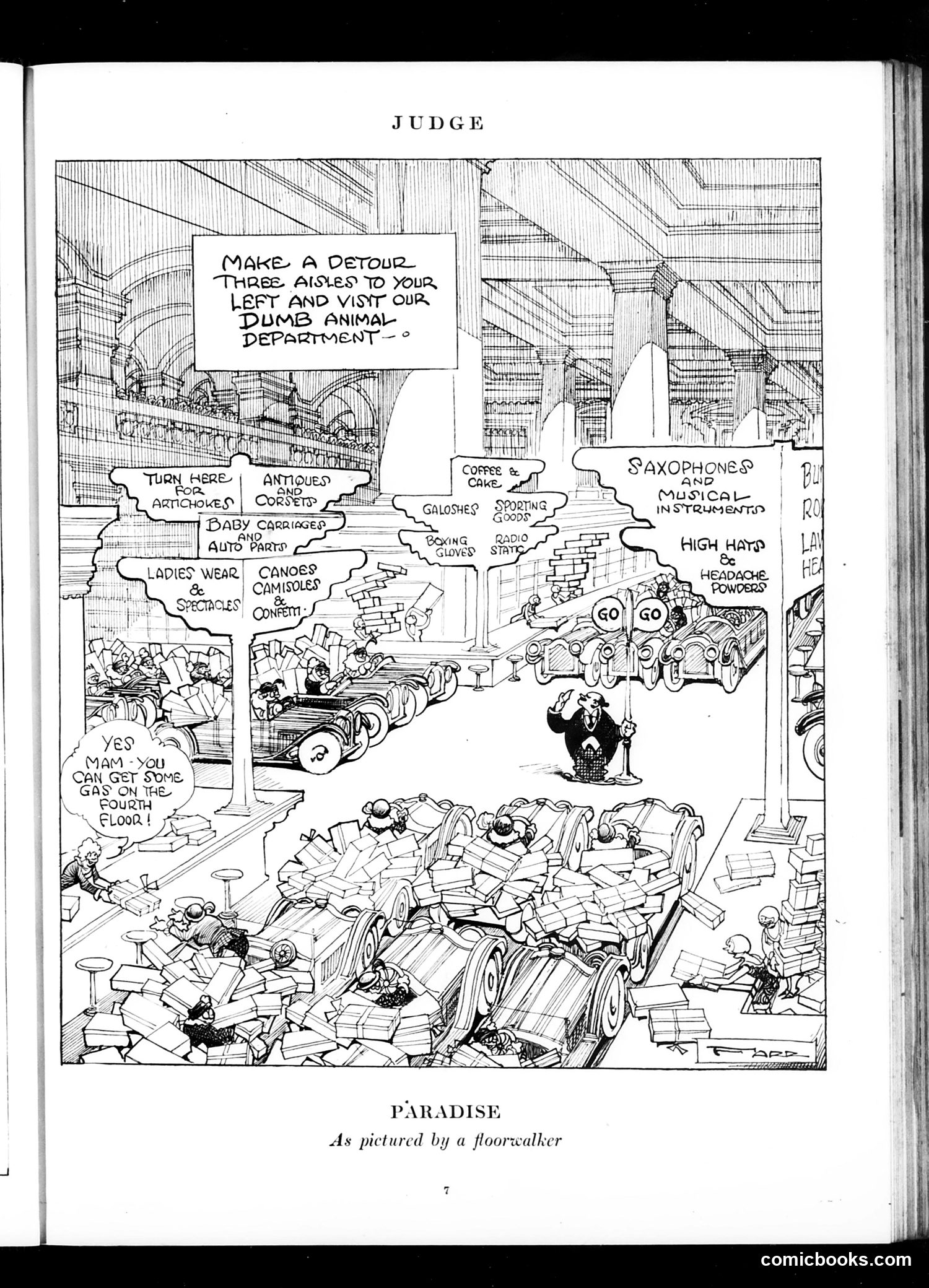
This Judge magazine cartoon satirizes the chaotic experience of shopping in a massive department store. The joke is presented as "Paradise as pictured by a floorwalker"—a store employee's fantasy of customer behavior. The humor lies in the absurdity: shoppers are literally drowning in merchandise and shopping bags, yet the floorwalker (visible in the center, directing traffic) cheerfully directs them to increasingly ridiculous departments like "Dumb Animal Department," "High Harp & Headache Powders," and mixing legitimate items with nonsense (saxophones, corsets, canoes, auto parts). The satirical point: early-to-mid 20th century department stores were overwhelming temples of consumption, where customers could lose themselves in endless aisles of goods. The "paradise" is simultaneously a consumer's dream (endless shopping variety) and a comedic nightmare (complete chaos and excess). The floorwalker epitomizes corporate optimism—happily guiding lost shoppers through commercial bedlam.
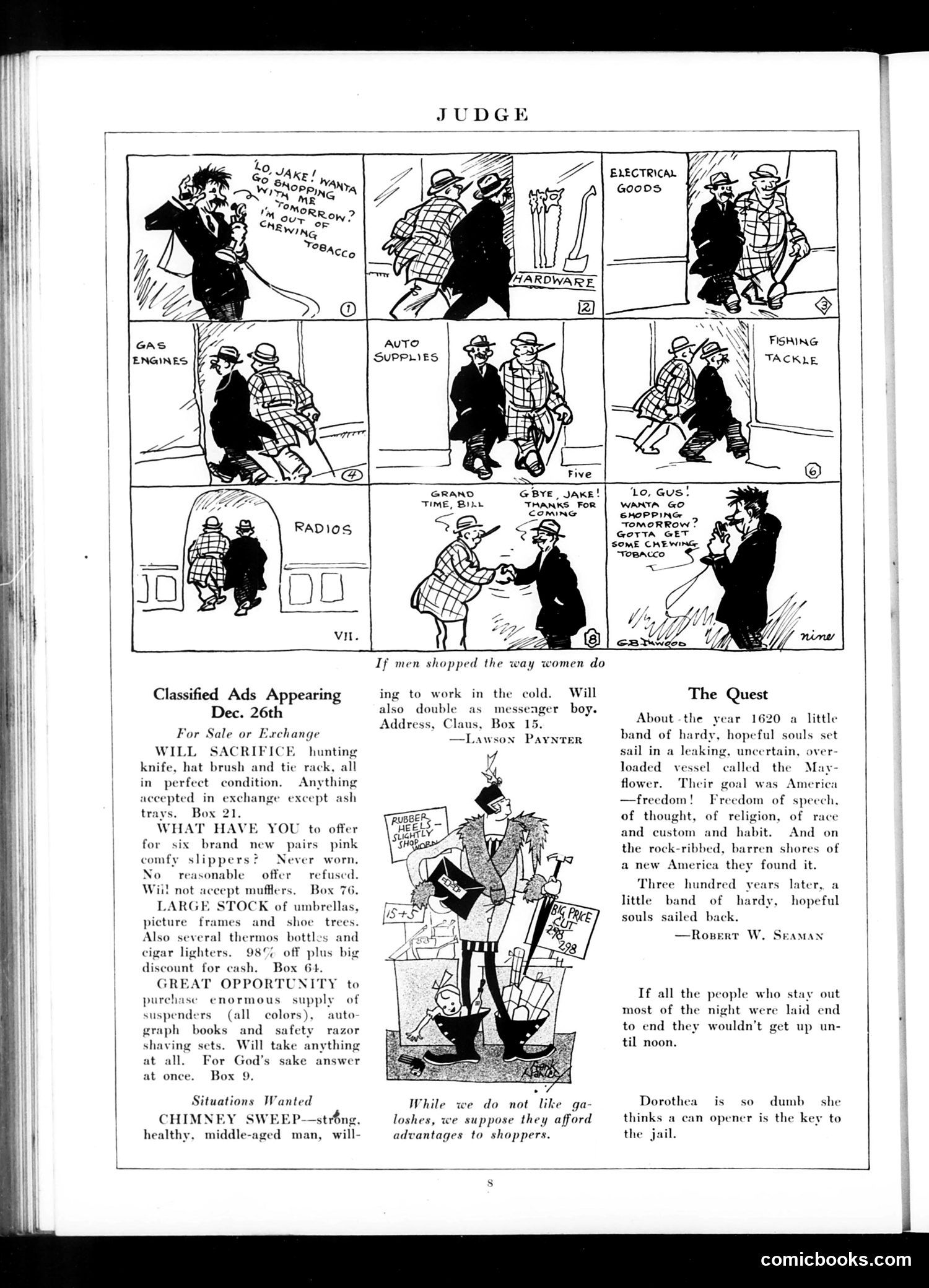
This page primarily contains **classified advertisements and humorous short quips** rather than political satire. The top comic strip shows two men (one in a suit, one in casual plaid clothing) visiting various shops—hardware, electrical goods, auto supplies, radios, fishing tackle—with the man in plaid repeatedly asking to go "chewing tobacco" shopping. The joke plays on the contrast between the suited man's shopping errands and his companion's single-minded focus on tobacco. The bottom section includes classified ads for household goods (umbrellas, slippers, thermoses) mixed with absurdist humor: a fake job posting for "Santa Claus" as a chimney sweep, and satirical one-liners mocking women's shopping habits and Christmas preparations. "The Quest" section offers a sentimental historical comparison between the Pilgrims' 1620 voyage seeking freedom and modern Americans' return voyage—implying contemporary life has become so burdensome that escape is desirable. Overall, this is **lighthearted domestic humor** focused on shopping, gender roles, and holiday frustrations rather than serious political commentary.
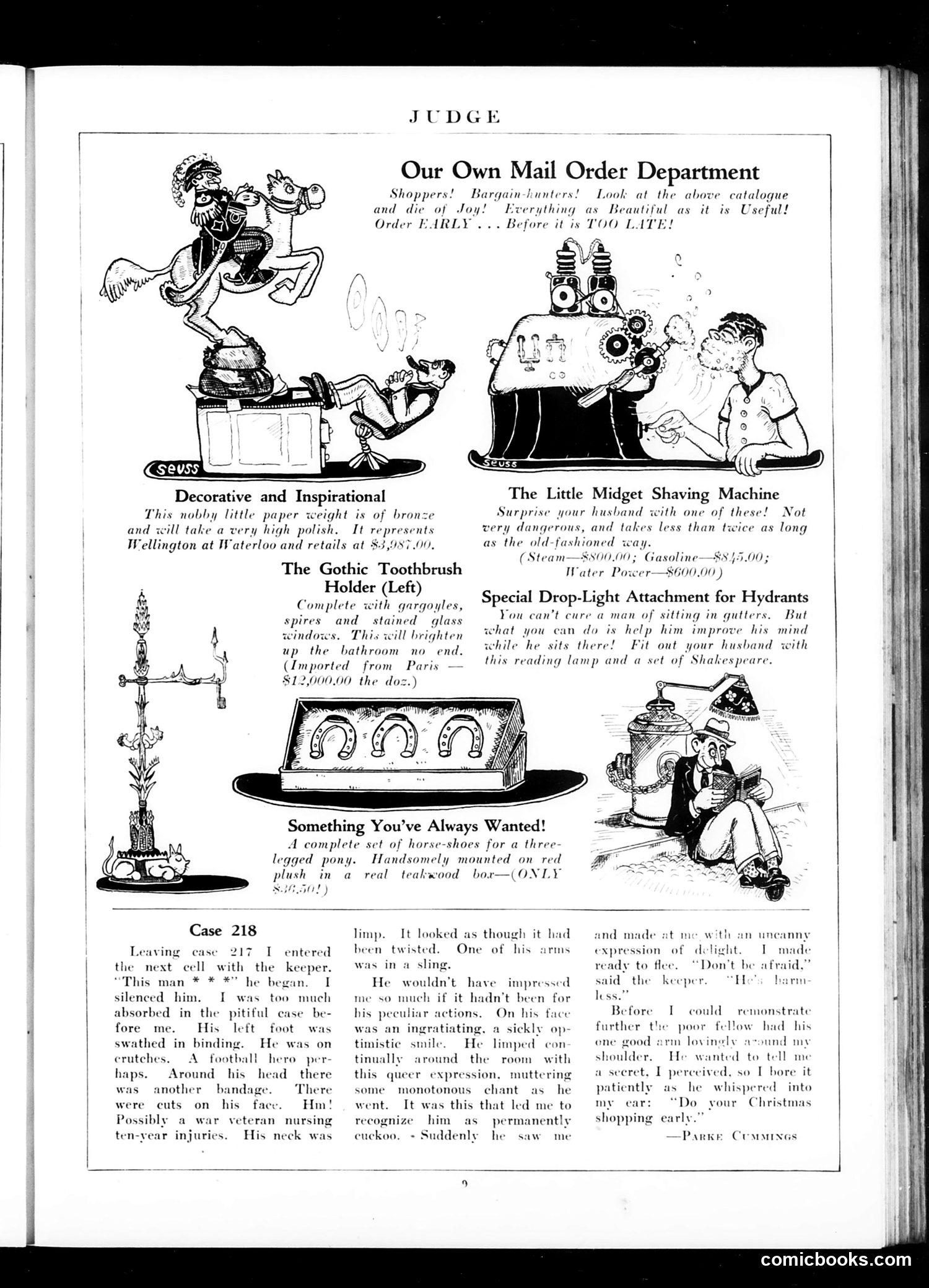
This page satirizes mail-order catalog culture through absurdist fake product advertisements. The joke is selling deliberately useless or ridiculous items as desirable purchases: - A $3,987 paperweight (Wellington at Waterloo figurine) - A "Little Midget Shaving Machine" (steam/gasoline-powered, unnecessarily complex) - An ornate Gothic toothbrush holder imported from Paris - A reading lamp attachment for hydrants (to improve men sitting in gutters) - Horseshoes for a three-legged pony The accompanying story "Case 218" appears unrelated—a narrative about a possibly deranged hospital patient. The overall effect mocks consumer excess and the gullibility of mail-order shoppers, using exaggeration and the incongruity between lavish descriptions and worthless products to create humor. This reflects early 20th-century skepticism toward aggressive advertising and catalog marketing.
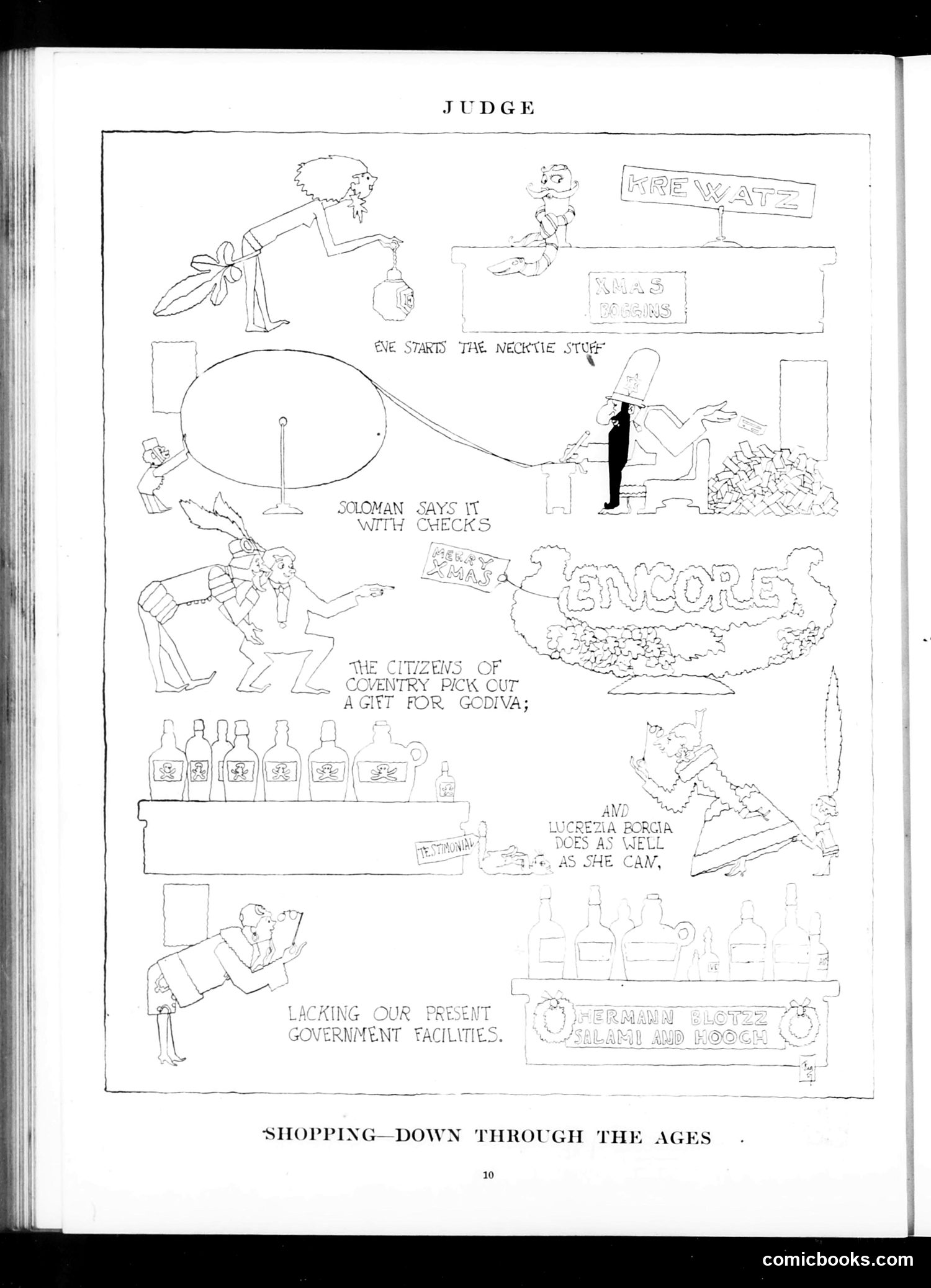
This Judge cartoon satirizes Christmas gift-giving across history. The title "Shopping—Down Through the Ages" frames various humorous vignettes: **Key scenes visible:** - Upper left: A figure with a large butterfly net catching gift ideas - References to "Krewatz" (unclear brand/reference) - "Xmas Goings" signage - Citizens of Coventry giving Godiva gifts - Multiple alcohol bottles displayed (suggesting liquor as gifts) - German brands "Glotz" and "Mooch" (likely mocking German imports) - Bottom: A figure "lacking our present government facilities" The satire appears to mock both consumer gift-buying culture and possibly wartime (references to German goods, government facilities shortage) economic conditions. The bottles and repeated product displays satirize commercialism's expansion into holiday tradition. However, **without knowing the specific publication date, the exact historical references remain unclear.**
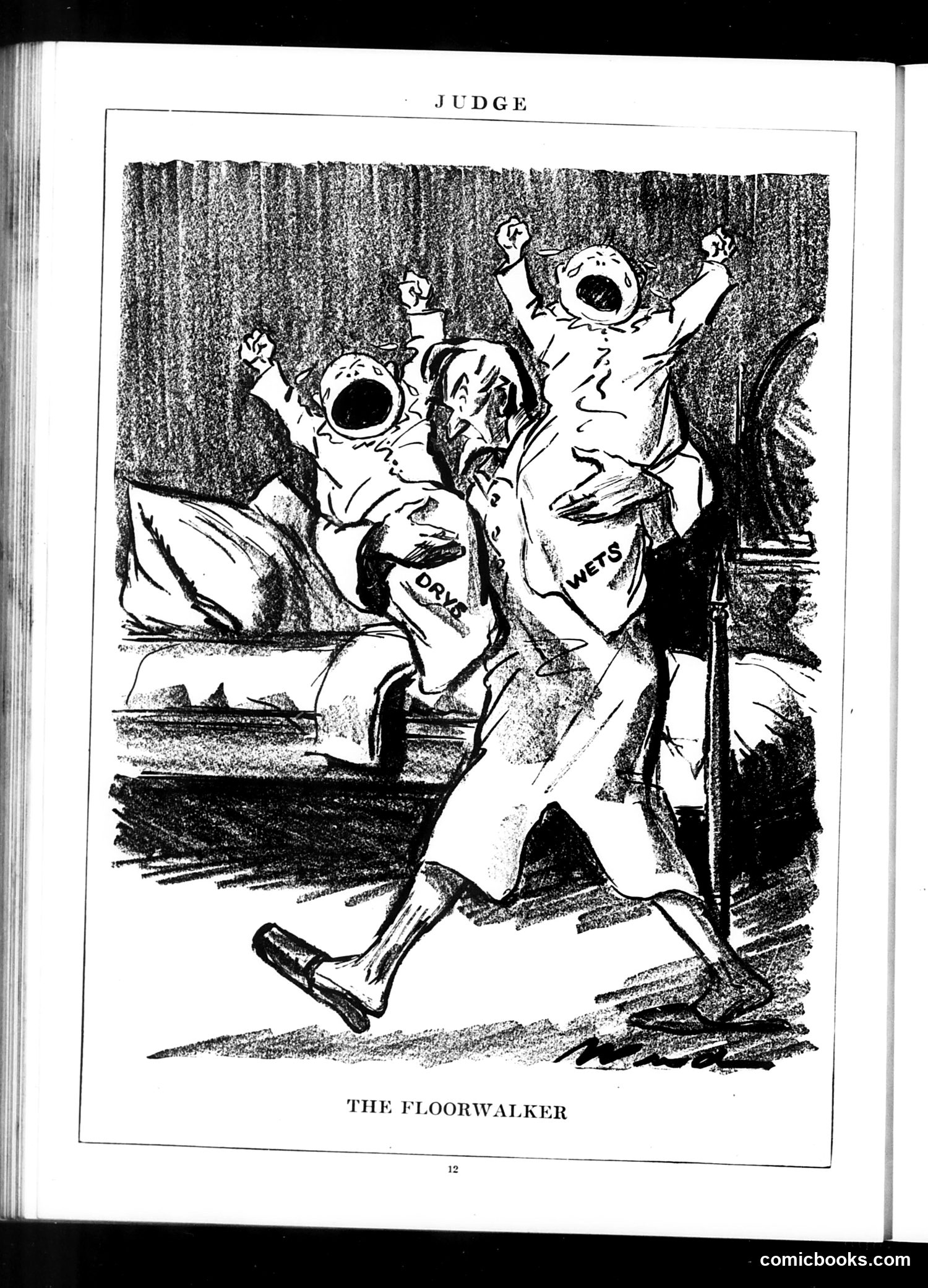
This cartoon depicts a figure labeled "The Floorwalker" who appears to be a judge or legal official, literally walking across a courtroom floor while carrying crying infants labeled "CRIES," "ORYX," and "WETS." The judge is depicted in a exaggerated, comedic manner—stumbling or dancing while struggling with the babies. The satire likely critiques judicial incompetence or frivolousness: the "floorwalker" (a department store employee who assists customers) suggests the judge treats serious legal matters casually or carelessly. By burdening him with crying, demanding infants, the cartoon implies the court creates noise and disruption rather than justice, or that judges behave immaturely when handling cases. The specific cases referenced by the infant labels remain unclear without additional context from Judge's contemporary issues.
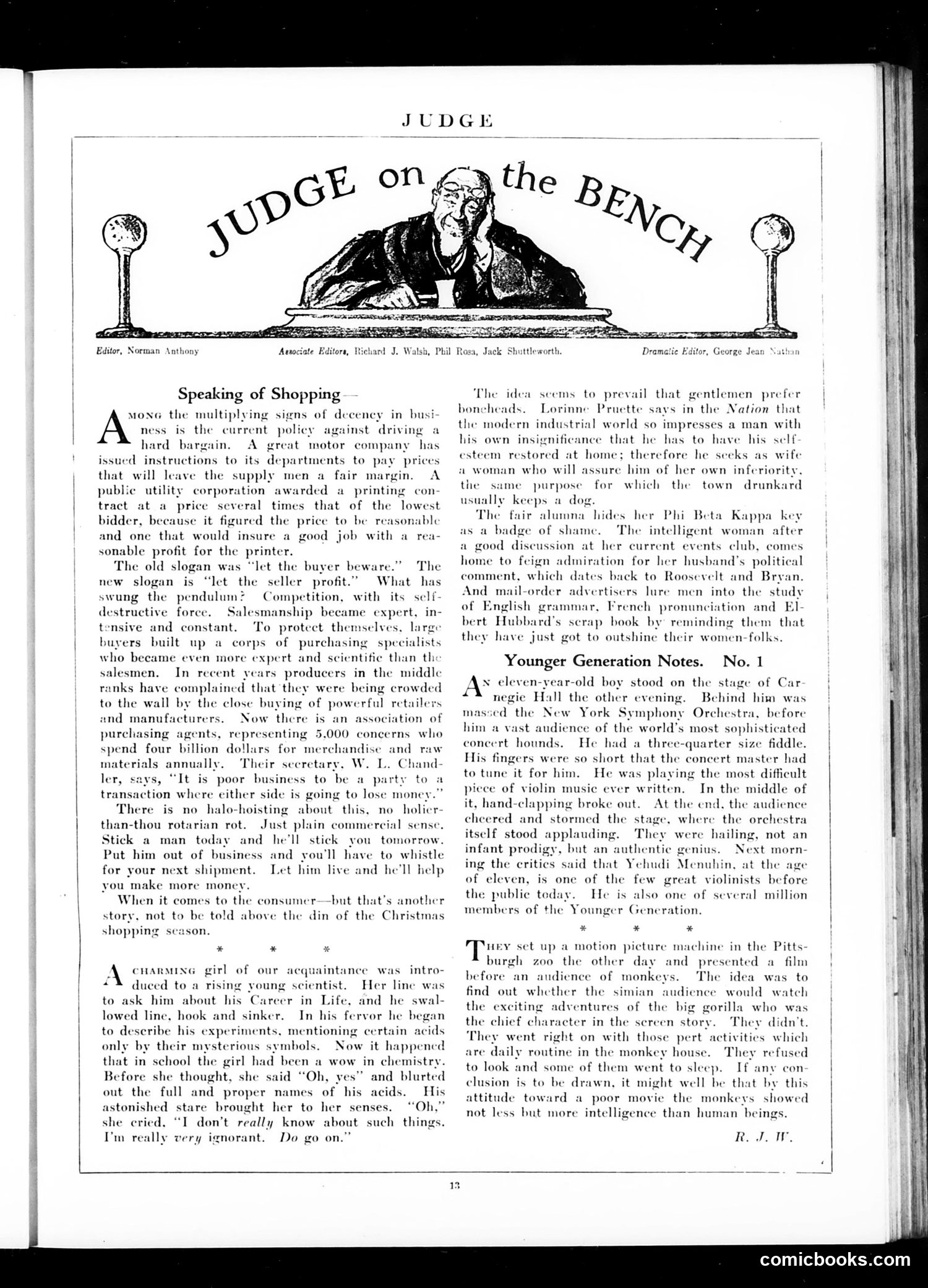
This page from *Judge* magazine contains social commentary rather than a single political cartoon. The "Judge on the Bench" header frames editorial content on three topics: **"Speaking of Shopping"** critiques the shift from "caveat emptor" (buyer beware) to fair pricing practices. The piece celebrates motor companies and utilities now paying suppliers reasonable margins instead of exploiting them—a reversal driven by purchasing agents' organized buying power. It's pragmatic rather than altruistic: mistreating suppliers backfires. **"Boneheads"** satirizes the social expectation that successful men prefer unintelligent wives. The anecdote mocks a young woman who hides her chemistry knowledge to seem appealingly ignorant—reflecting period anxieties about female education threatening male ego. **"Younger Generation Notes"** celebrates an eleven-year-old violin prodigy performing at Carnegie Hall, praising him as an authentic genius rather than merely a precocious infant. The satire targets genteel hypocrisy and social conventions restricting women's intellectual self-expression.
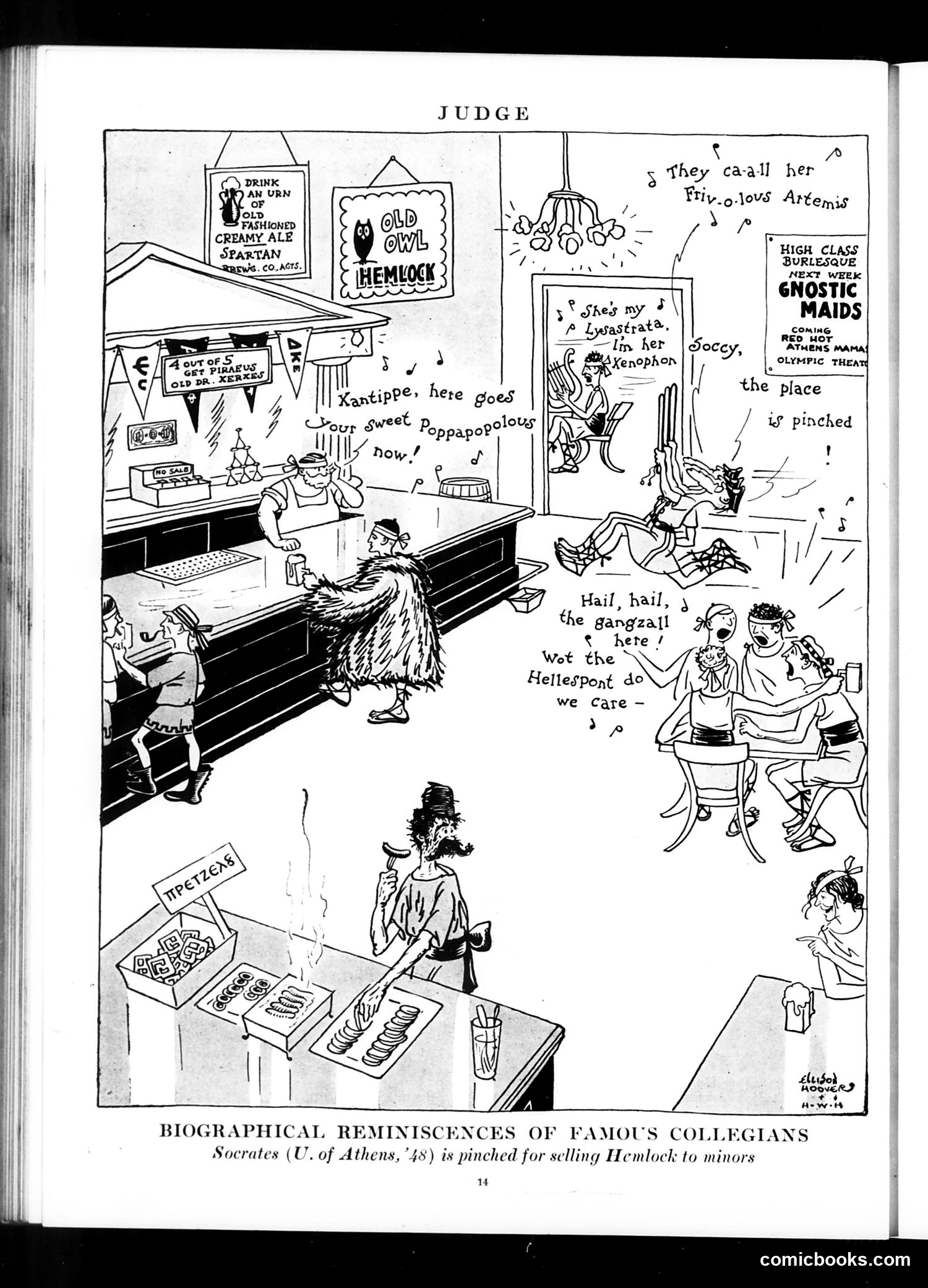
This is a satirical cartoon titled "Biographical Reminiscences of Famous Collegians," depicting **Socrates from ancient Athens** being arrested ("pinched") for selling hemlock to minors. The joke plays on several levels: 1. **Ancient philosophy meets modern crime**: Socrates is treated as a college alumnus in a contemporary setting—a bar/speakeasy with modern advertisements. 2. **The hemlock reference**: Socrates was famously executed by drinking hemlock poison in 399 BCE. The cartoon darkly jokes about him *selling* hemlock to young people, treating a historical tragedy as if it were a modern drug-dealing bust. 3. **Prohibition-era context**: Judge magazine ran during American Prohibition (1920-1933). The speakeasy setting and references to selling contraband to minors mock both ancient history and contemporary illegal alcohol sales. 4. **Irreverent tone**: The cartoon irreverently applies modern legal/criminal concepts to ancient figures, deflating serious historical and philosophical subjects through anachronistic humor typical of Judge's satirical style.
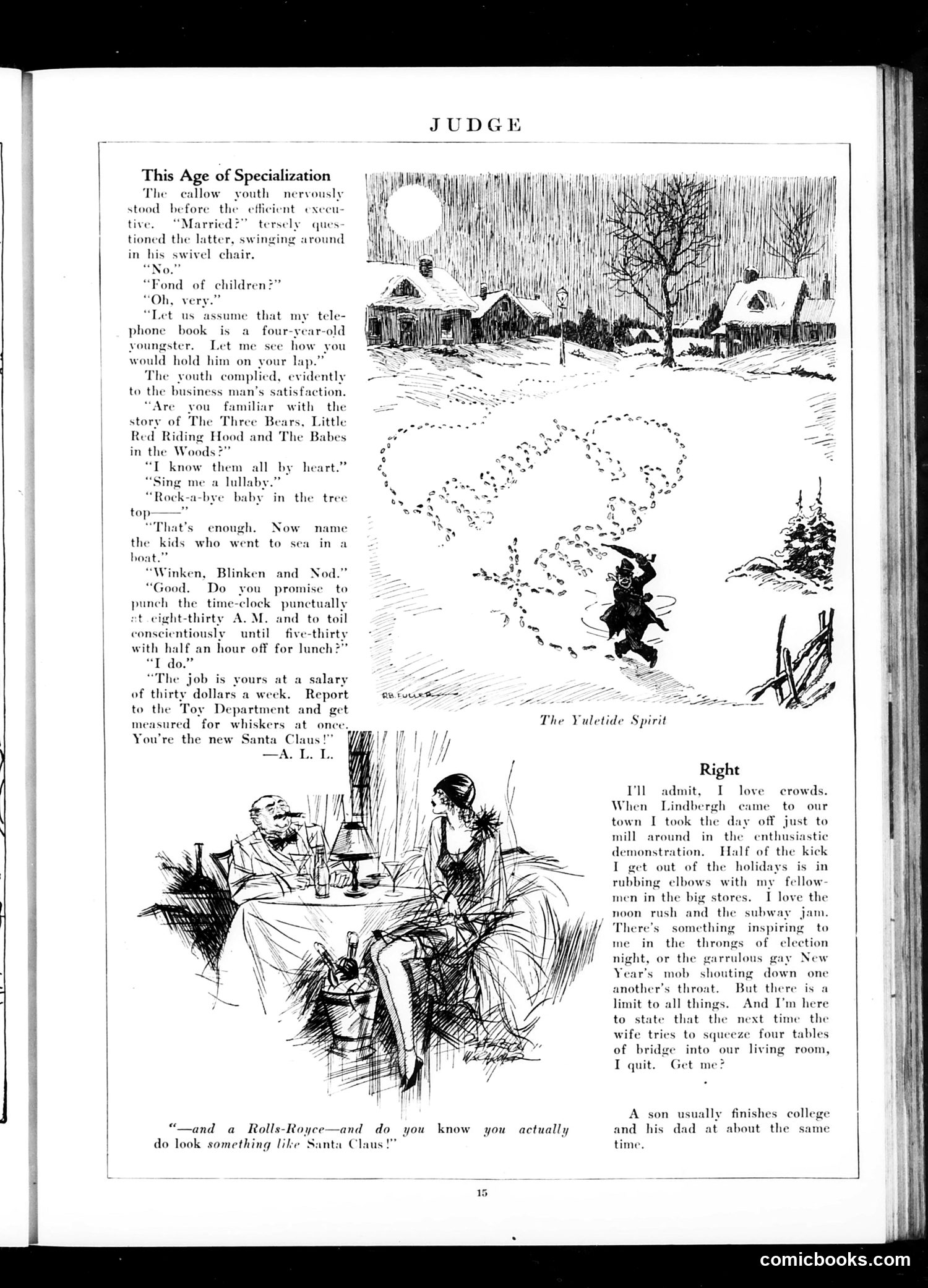
This Judge magazine page contains two satirical pieces about American social life. **"This Age of Specialization"** mocks the extreme narrowing of job requirements. A young man interviews for a Santa Claus position at what appears to be a department store. The executive interviews him not on general qualifications but on hyper-specific skills: ability to recite children's stories, sing lullabies, and name characters from nursery rhymes. The joke satirizes how modern business breaks jobs into rigid, specialized compartments rather than hiring well-rounded people. **"The Yuletide Spirit"** presents a contrasting complaint: a man admits he loves holiday crowds—Christmas shopping, election-night mobs, New Year's revelry, subway congestion—yet draws the line at his wife hosting bridge games in their living room. The satire targets bourgeois domestic life: he romanticizes public chaos but resents minor household inconvenience. Both pieces use humor to critique early 20th-century American values around work specialization and leisure culture.
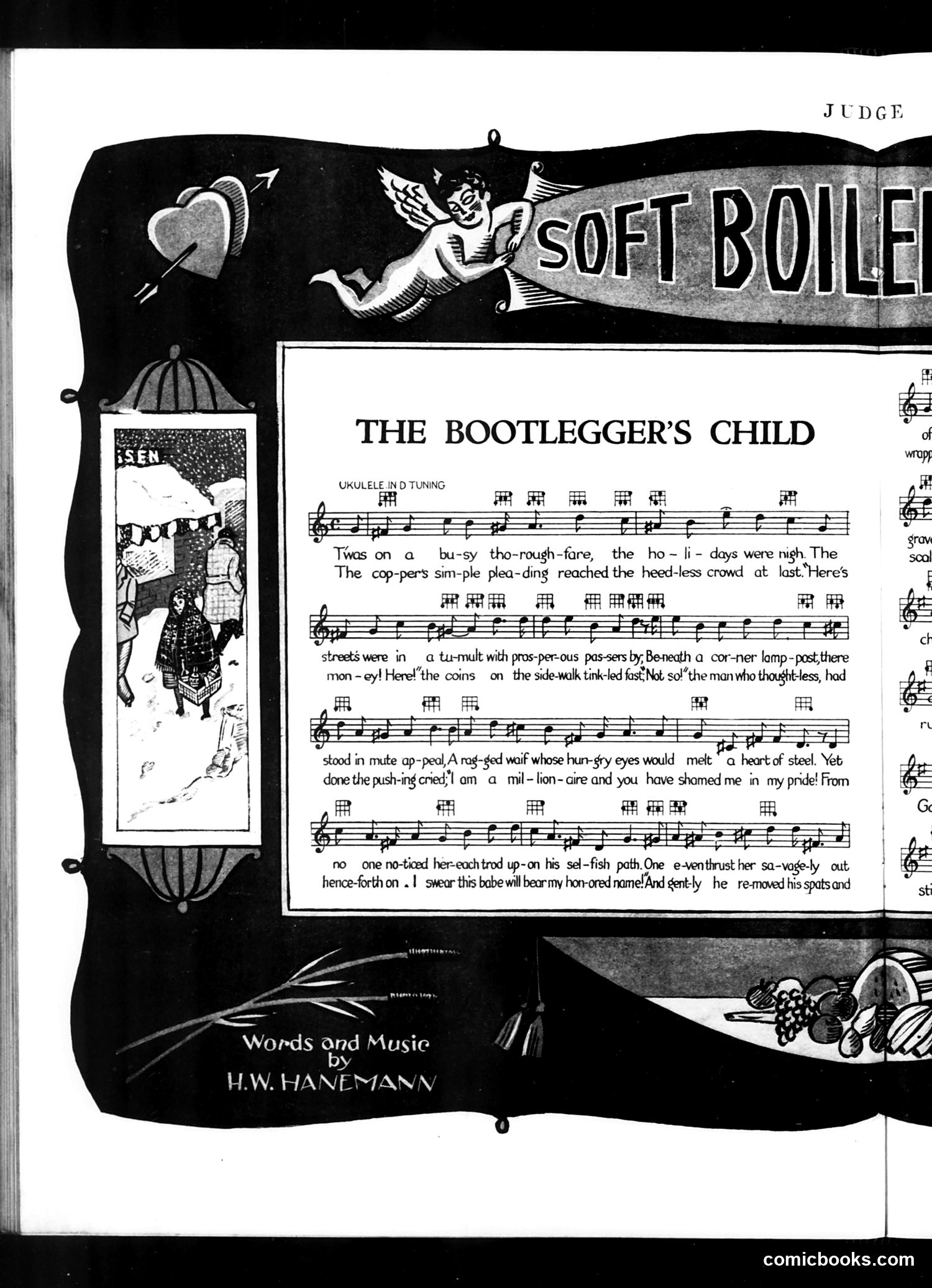
This is a satirical song from Judge magazine (America's premier humor publication) about Prohibition-era social hypocrisy. The narrative contrasts a wealthy, well-dressed man's indignation at being "shamed" by a hungry street child with the actual moral failing: his own callousness toward poverty. The illustration shows the beggar child on a busy street during the holidays. The song's irony is sharp: the affluent man claims offense at being "pushed" by this desperate waif, yet he and the passing crowd ignore her starvation. His dramatic response—swearing to give the child his "hon-ored name"—appears to mock the performative morality of the wealthy, who prioritize wounded pride over actual charity. The title references bootleggers (illegal alcohol producers during Prohibition), suggesting the man's wealth may derive from illicit sources, adding another layer of hypocrisy to his moral posturing.
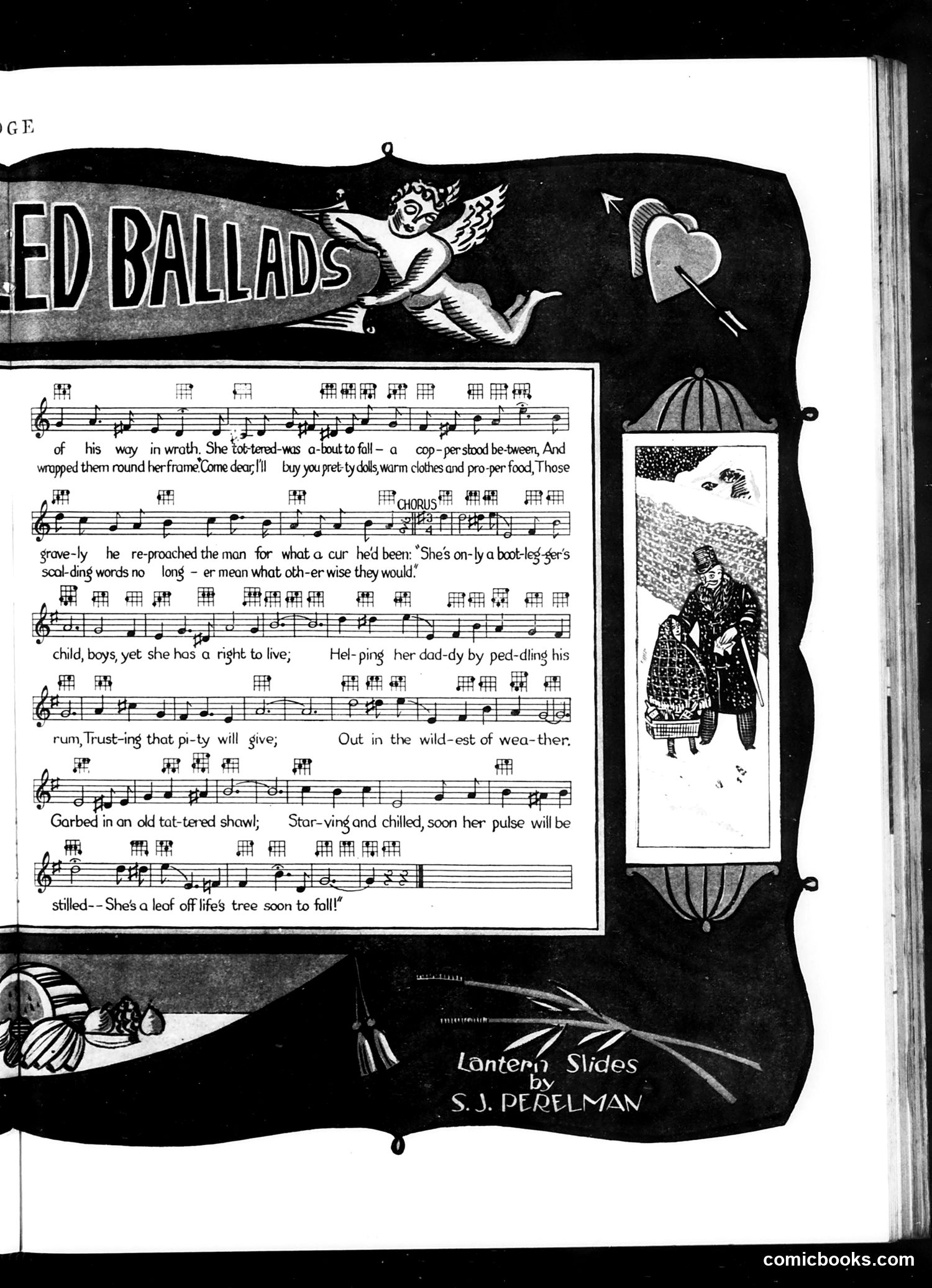
This page presents sheet music for a sympathetic ballad about a young girl forced into bootlegging during Prohibition. The narrative depicts a copper (police officer) stopping a man transporting illegal alcohol, then moralizing about the girl who helps her father distribute rum—describing her as impoverished, poorly clothed, and destined for early death. The satire targets the hypocrisy and cruelty of Prohibition enforcement. The "red ballad" (suggesting socialist or labor-sympathetic themes) uses melodrama to mock law enforcement's moral posturing while ignoring the desperation driving families into illegal alcohol trade. The cop's sanctimonious reproach rings hollow against the girl's actual circumstances: starvation, inadequate clothing, and exploitation. The accompanying illustration shows the girl with an umbrella in harsh weather, reinforcing her vulnerability. S.J. Perelman created these "Lantern Slides" (visual accompaniments to songs).
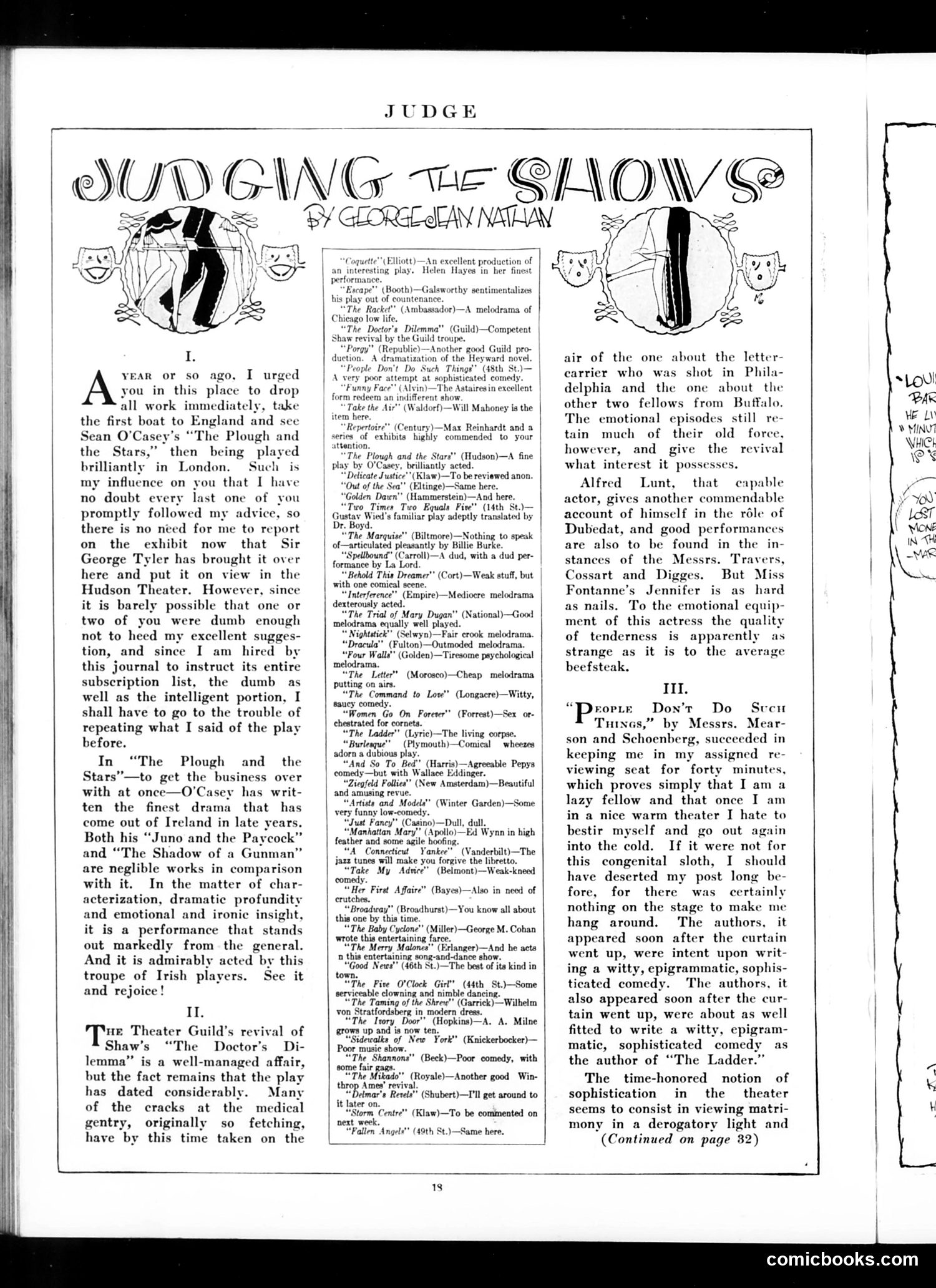
This is a theater review column, not a political cartoon. Nathan, a prominent drama critic, evaluates Broadway productions of the era (appears to be mid-1920s based on references to shows like the Ziegfeld Follies). **Key content:** Nathan enthusiastically recommends Sean O'Casey's Irish play "The Plough and the Stars" at the Hudson Theater, calling it the finest drama from Ireland in years. He also reviews Shaw's "The Doctor's Dilemma" revival, noting the play has aged poorly—its once-clever jabs at the medical profession now feel dated. The decorative theatrical masks and the lengthy list of show reviews reflect Judge's entertainment focus during this period. This represents mainstream theater criticism for educated readers interested in New York's vibrant stage scene, rather than political satire or social commentary.
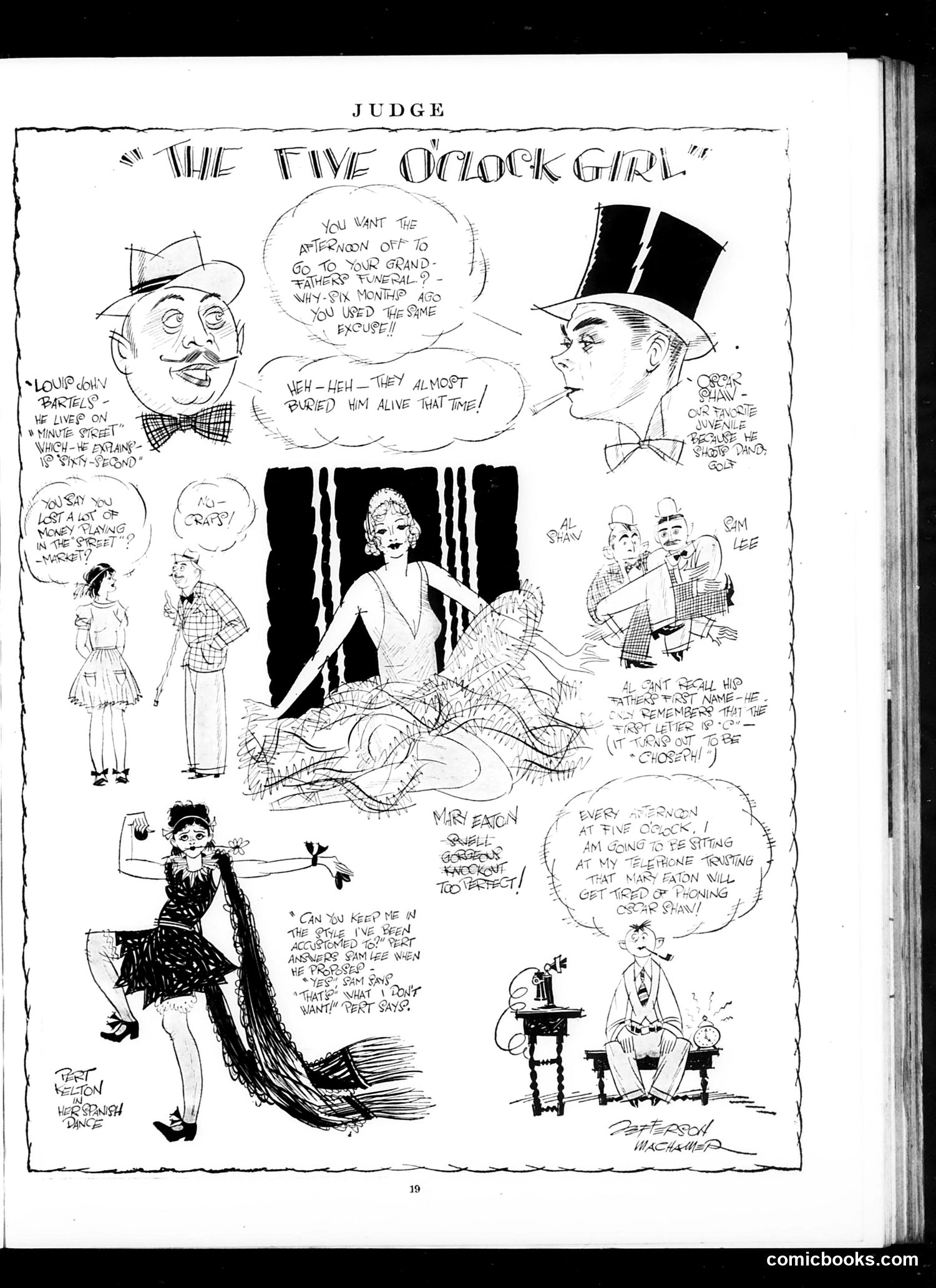
This page satirizes the famous 1927 incident where actress **Mary Pickford** publicly appeared in a scandalous short skirt that revealed her knees—shocking for the era. The central figure shows a woman in the controversial outfit. The surrounding vignettes mock various male reactions: two gentlemen in top hats discuss it as a funeral excuse; characters debate whether to attend social events where she'll appear; a man worries his wife will adopt the style; another fears being "kicked" by the fashion. The satire targets both the absurd overreaction to women's fashion and the double standard of male judgment. The "five o'clock girl" reference suggests women visible in public at that hour, implying impropriety. Judge mocks the prudishness of society figures scandalized by modest hemline changes, while depicting men's anxiety about women's increasing independence and fashion choices in the 1920s.
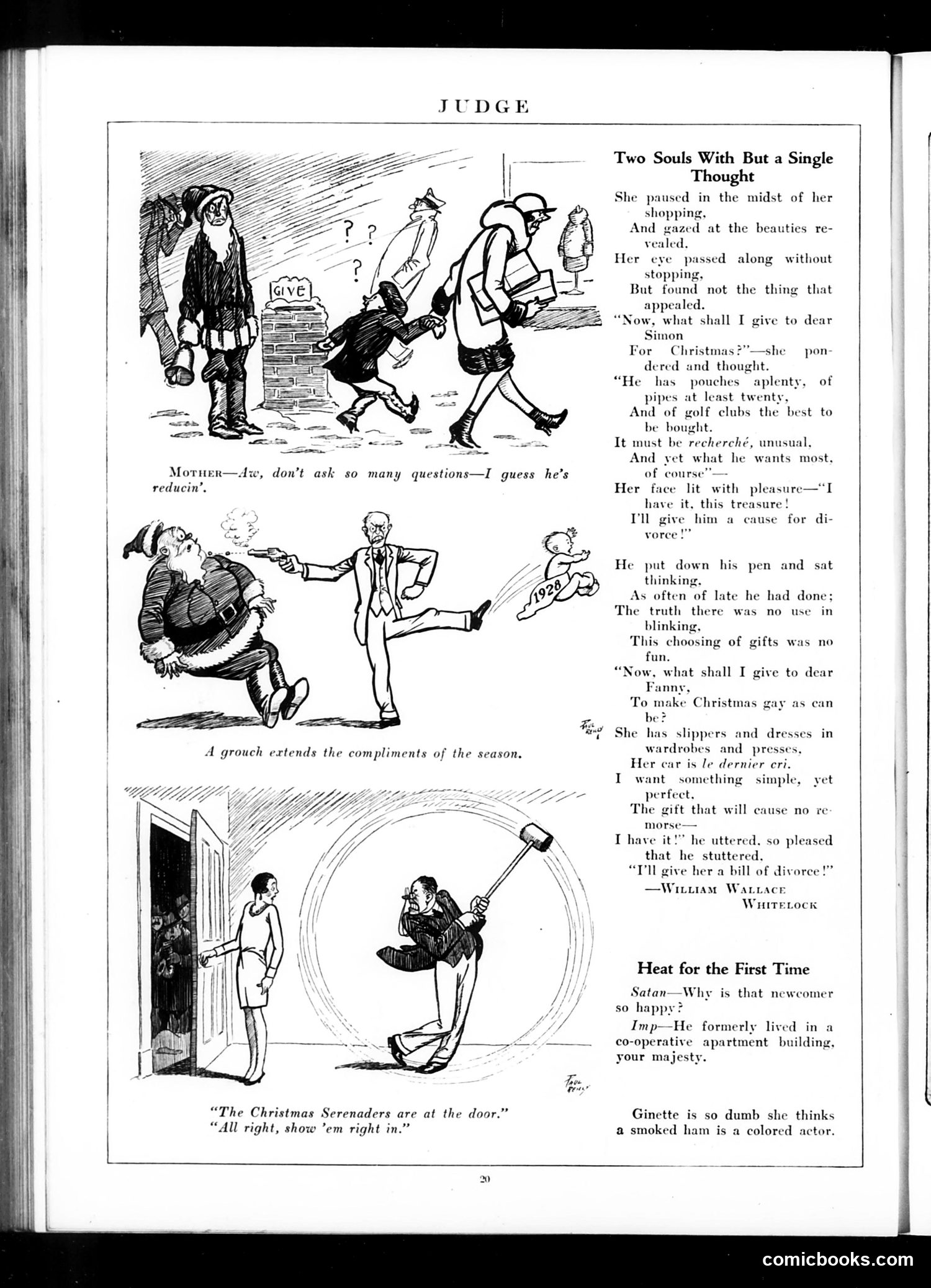
This page contains three distinct satirical pieces: **"Two Souls With But a Single Thought"** depicts a married couple independently arriving at the same Christmas gift solution: giving each other a divorce. The satire mocks both marital discord and the exhaustion of gift-giving—he's drowning in his golf clubs and pipes; she has excessive clothing and a fashionable car (le dernier cri). The joke suggests divorce is preferable to thoughtful gift-shopping, satirizing both marriage strain and consumer excess. **"Heat for the First Time"** jokes that a newcomer to Hell is happy because he previously endured co-operative apartment living—implying shared housing's discomforts rival damnation itself. **The opening cartoon** shows a beggar soliciting donations while two men discuss him "reducing" (losing weight), with the caption suggesting Christmas charity seekers. The page reflects 1920s-era concerns: marital friction, consumer materialism, apartment living's unpopularity, and Christmas obligation fatigue. The satirical tone is cynical about both relationships and modern life.
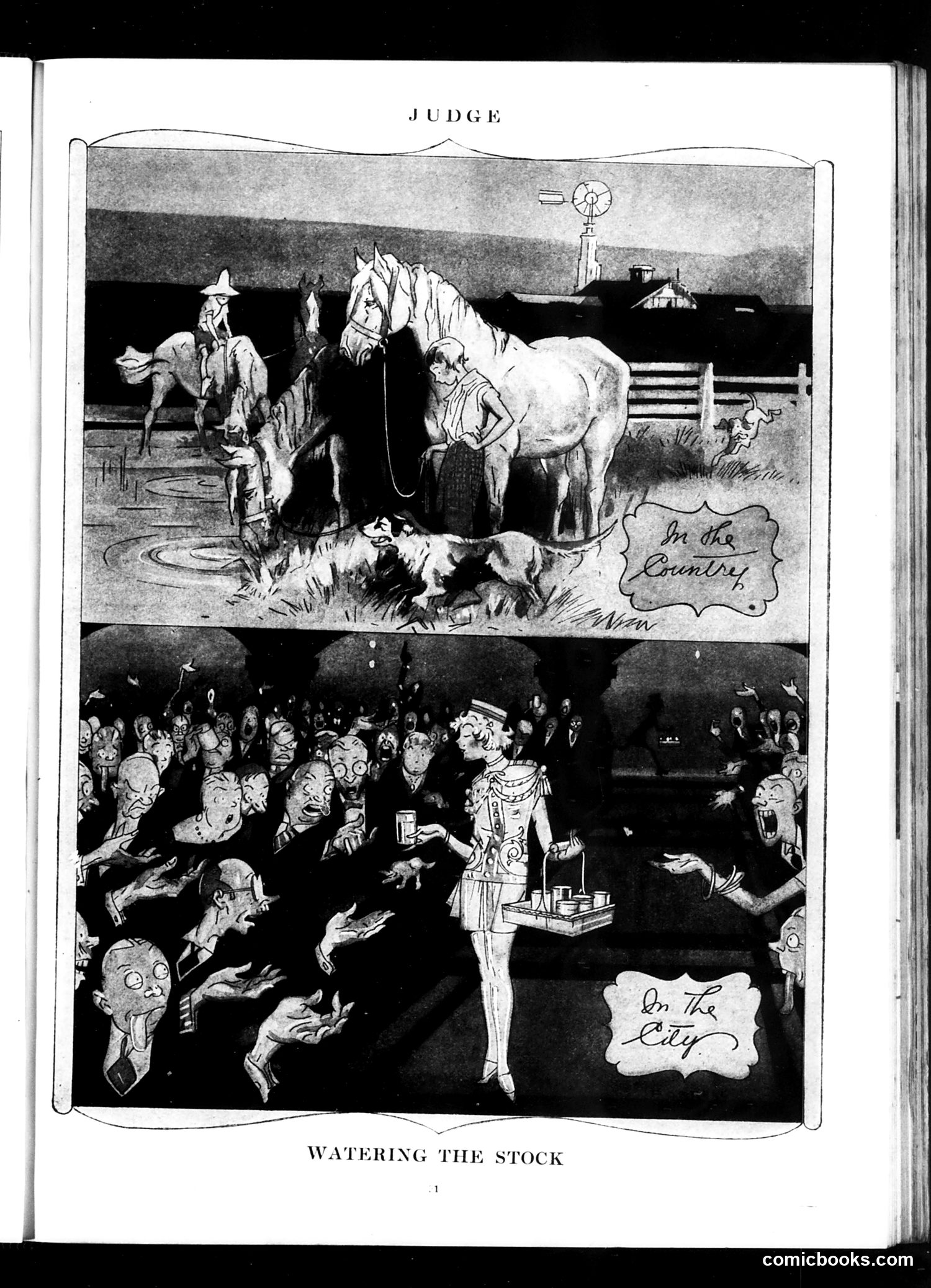
This two-panel political cartoon, titled "Watering the Stock," uses the metaphor of livestock care to satirize financial fraud. The top panel shows rural farmers literally watering horses—honest work "In the Country." The bottom panel depicts an elegantly dressed figure (likely a stock promoter or financier) among a crowd of eager city investors, "In the City." The contrast suggests that while farmers honestly tend their animals, city financial operators "water" their stock—a period term for inflating a company's value through deceptive practices. Investors eagerly consume the false promises, depicted as small dogs or creatures consuming offerings. The satire criticizes the gap between honest rural labor and dishonest urban financial manipulation, warning readers about stock market fraud schemes common in the Gilded Age.
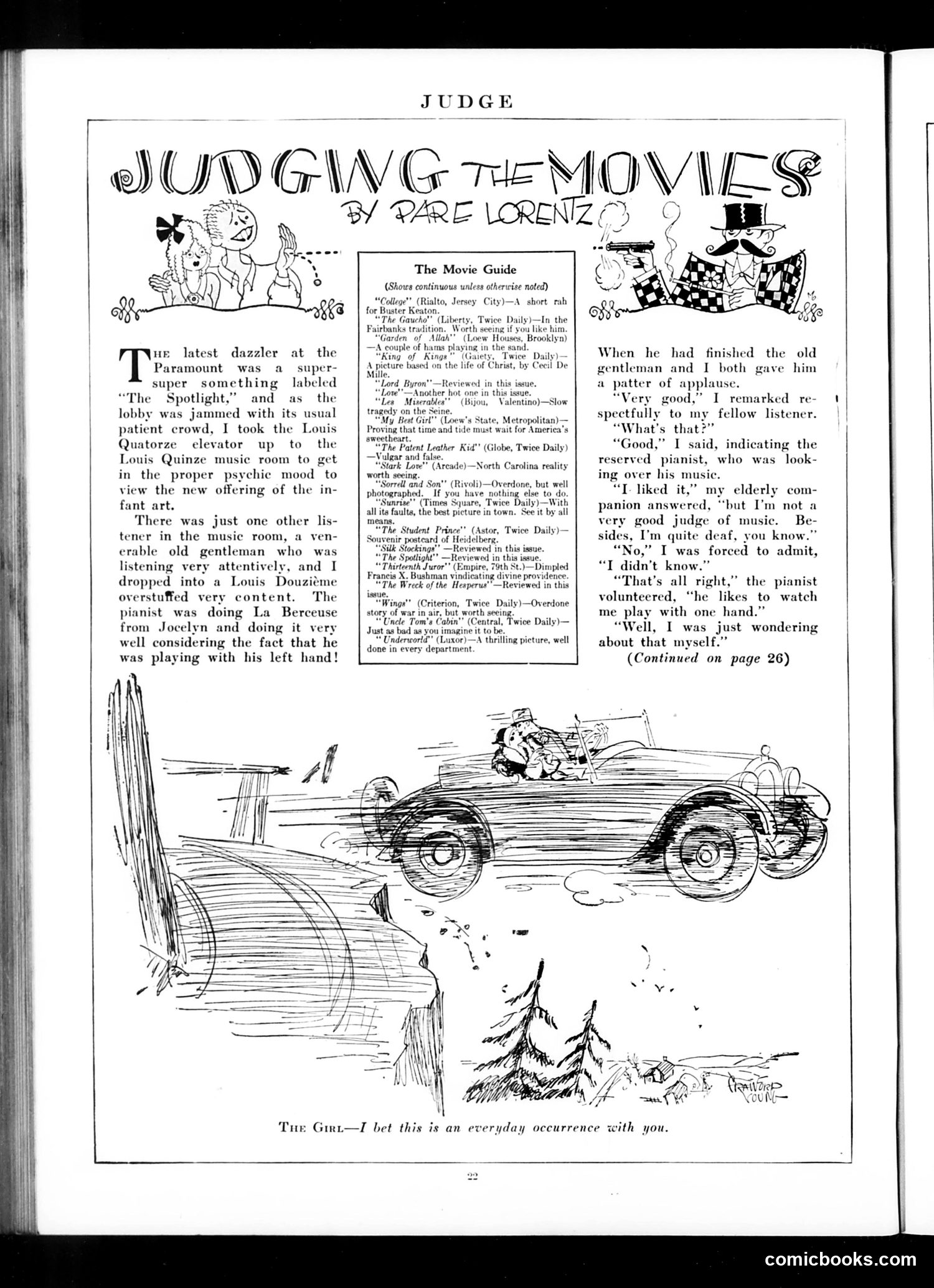
This page satirizes both movies and music criticism in the Jazz Age. The main joke concerns an elderly gentleman listening to a pianist play with only his left hand. When the narrator compliments the performance, the old man reveals he's "quite deaf"—meaning he cannot actually judge the music's quality at all. The satire operates on two levels: it mocks the pretense of film and music criticism (suggesting critics may lack genuine expertise), and it plays on the irony that a deaf person is positioned as an appreciative audience member. The "Movie Guide" sidebar lists contemporary 1920s Paramount films, including Douglas Fairbanks and Rudolf Valentino vehicles, indicating this is period entertainment journalism. The bottom cartoon depicts a car crash, with the caption suggesting such accidents are routine occurrences. Together, the page humorously questions whether modern audiences—or critics—truly know what they're evaluating.
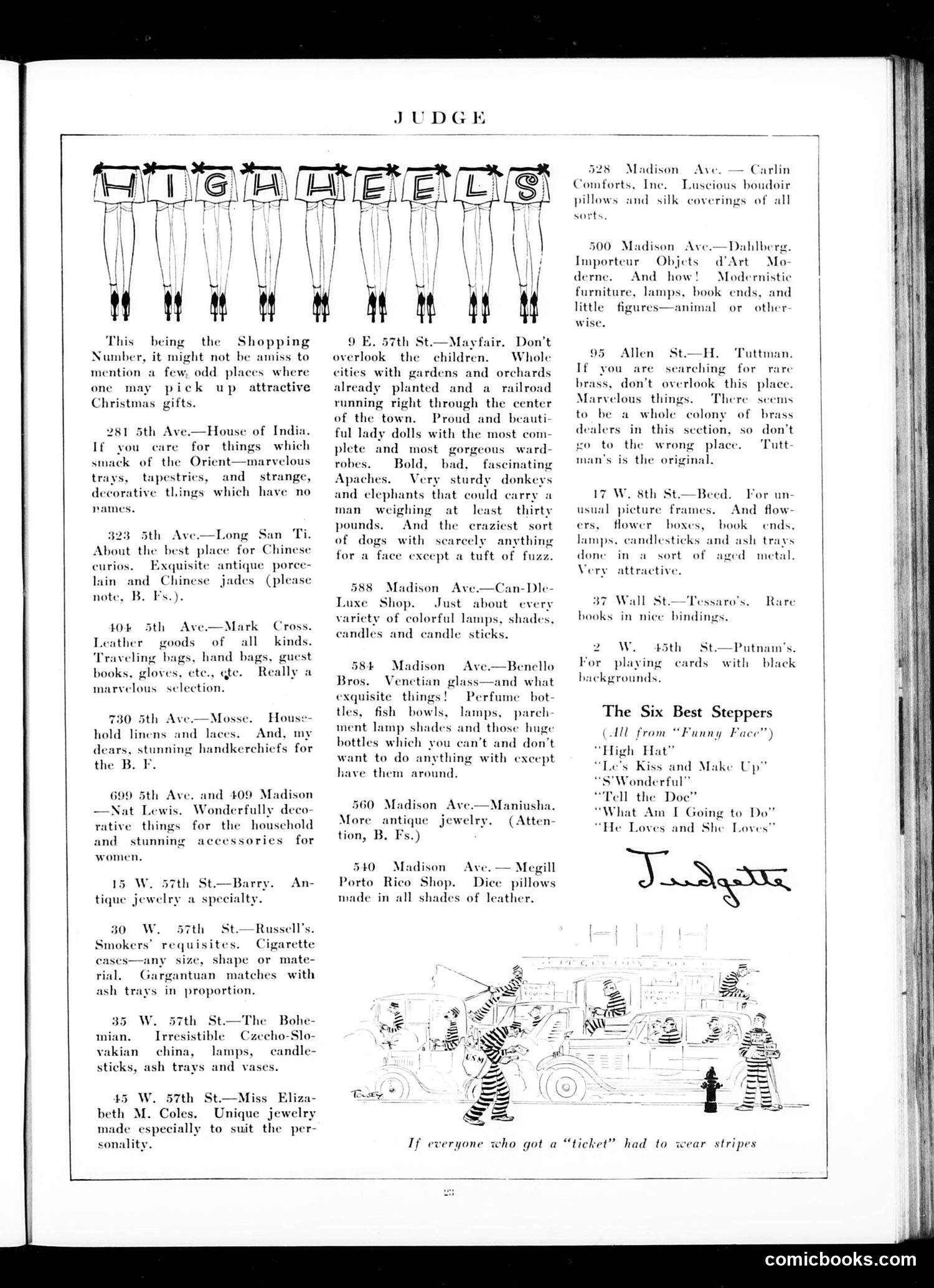
This page is primarily a **shopping guide** for Christmas gifts in 1920s New York, with a small cartoon at the bottom. The main cartoon depicts a street scene with pedestrians wearing striped clothing, captioned "If everyone who got a 'ticket' had to wear stripes." This appears to reference **Prohibition enforcement**: a "ticket" likely means a citation or arrest for violating alcohol laws. The joke is a dark satirical comment suggesting that if everyone who violated Prohibition were forced to wear identifying stripes (like convicts), the streets would be entirely striped—implying Prohibition was so widely flouted that enforcement was futile or absurd. The page also includes a boxed section titled "The Six Best Steppers" listing popular songs from the Broadway show "Funny Face," likely referencing both dance steps and the show's appeal. The bulk of the page is advertising copy for Fifth Avenue and Madison Avenue luxury shops selling furniture, jewelry, lamps, and decorative items—typical Judge magazine content mixing satire with commercial promotion.
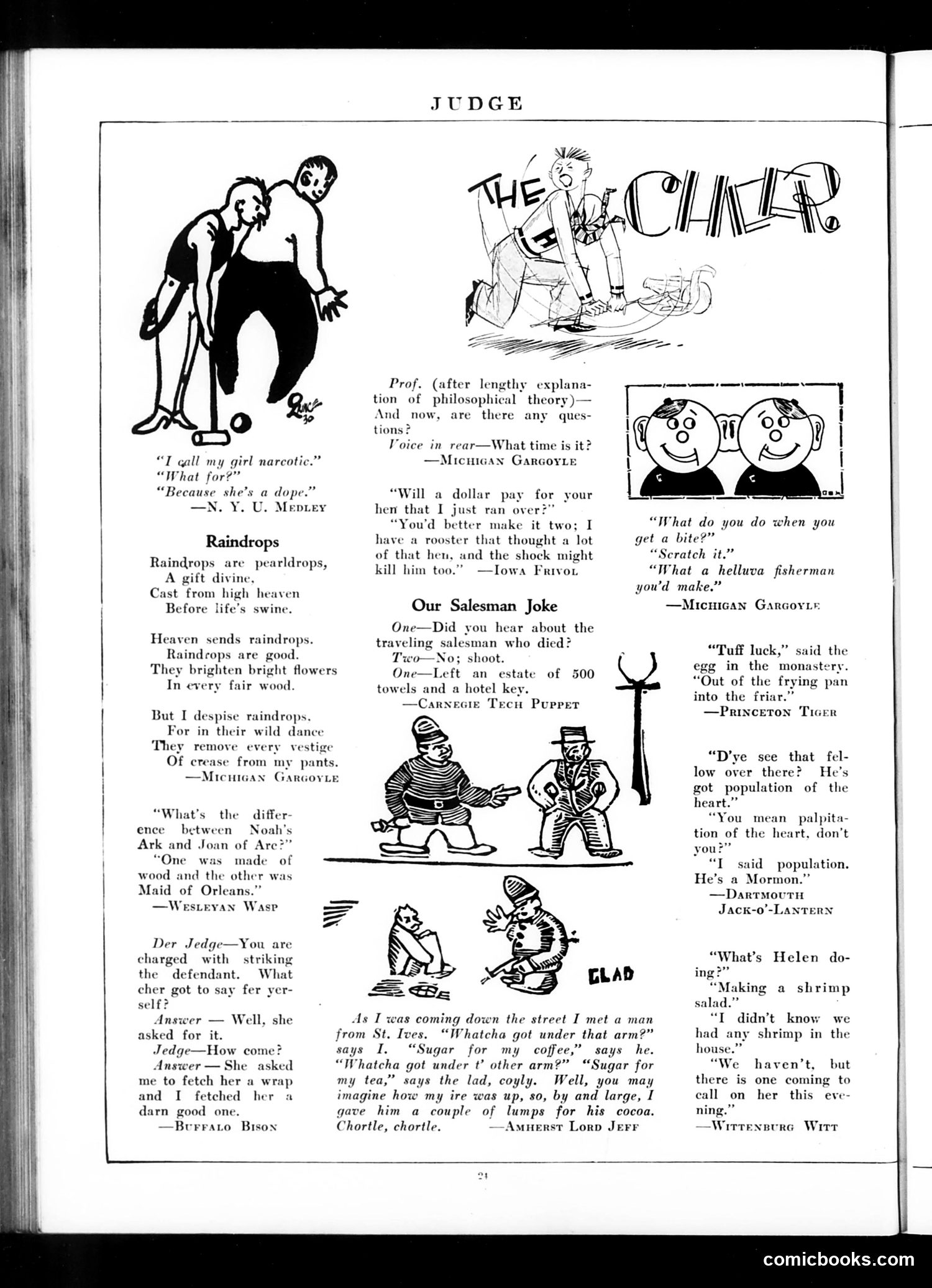
This is a humor-focused page from *Judge*, an American satirical magazine, featuring short jokes and comic verses rather than political cartoons. The content includes college humor (credited to various schools like N.Y.U., Wesleyan, Iowa, Princeton, Michigan), reflecting the magazine's appeal to educated, middle-class readers. The jokes are light and domestic: wordplay about girlfriends, rainfall ruining trouser creases, a traveling salesman's death, romantic misunderstandings, and religious humor (a Mormon joke about "population of the heart"). The single cartoon depicts two working-class figures—a judge and defendant—in a domestic violence scenario played for laughs. The woman "asked for it," establishing a victim-blaming joke that was acceptable in this era. Most content is sentimental verse mixed with puns and mild social satire. The humor relies on period-specific college references and assumes familiarity with common joke formats rather than current events.
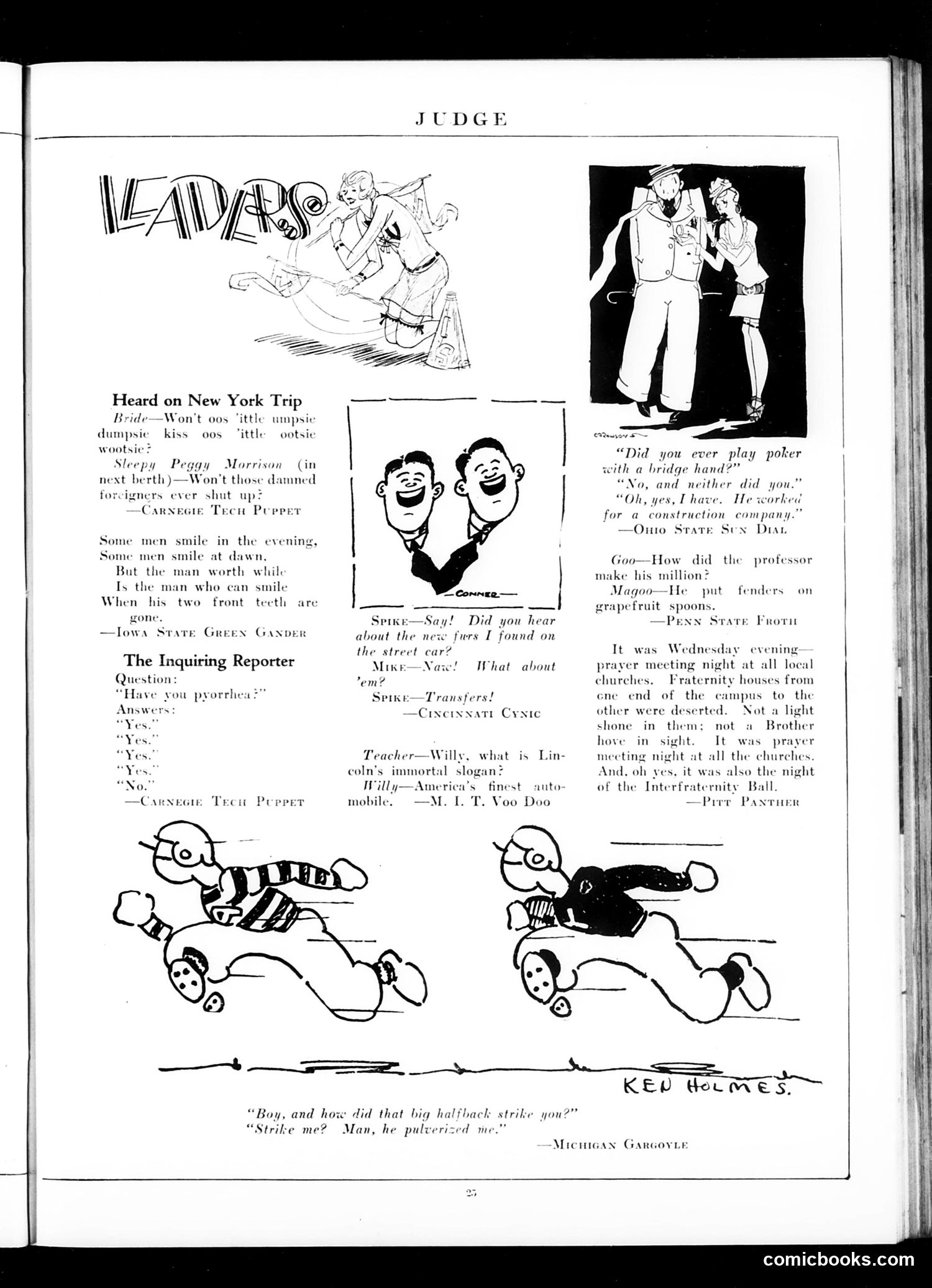
This page from Judge magazine presents multiple brief jokes and cartoons satirizing early 20th-century American social life. The "Heard on New York Trip" section mocks affected baby-talk between newlyweds and foreigners' accents—standard period humor. "The Inquiring Reporter" uses pyorrhea (gum disease) as a running joke. Several jokes target college students and fraternity life, including one about bridge (the card game) and construction workers, and another lampooning fraternity boys skipping prayer meeting for the Interfraternity Ball. The cartoon by Ked Holmes shows a football injury joke about being "pulverized." Minor jokes reference Lincoln's famous slogans and millionaires' wealth-building methods. The satire targets class anxieties, immigrant stereotypes, and college social hierarchies typical of Judge's audience—educated, middle-class Americans amused by genteel humor and mild social criticism.
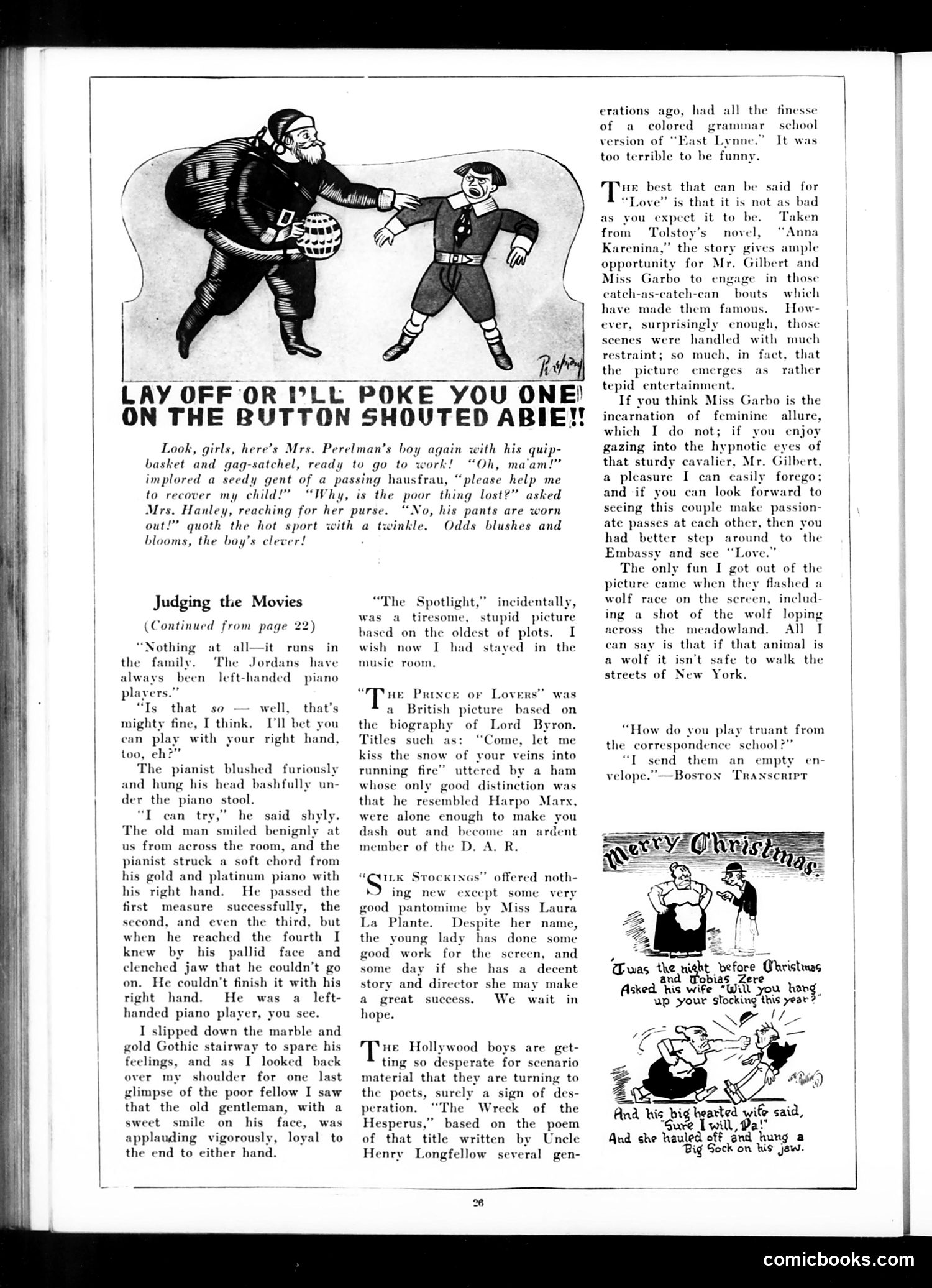
This page contains film reviews alongside ethnic humor typical of 1920s American satire. The top cartoon depicts "Abie," a Jewish character (recognizable by the Yiddish name and stereotypical caricature), threatening to punch someone—a common trope in Judge's "ethnic comedy" featuring exaggerated Jewish immigrants in conflict situations. The reviews below critique recent films including *Love* (starring Greta Garbo and John Gilbert), *The Prince of Lovers* (a Byron biography), and adaptations of literary works. The critic dismisses most films as derivative or poorly executed, particularly criticizing *The Spotlight* and a colorized version of *East Lynne*. The Christmas cartoon at bottom shows domestic humor unrelated to the films. The satire targets Hollywood's desperation for material and actors' limited range, while the ethnic humor reflects period attitudes treating Jewish characters and speech patterns as inherently comic. This reflects how Judge mixed film criticism with casual prejudice standard to 1920s publications.
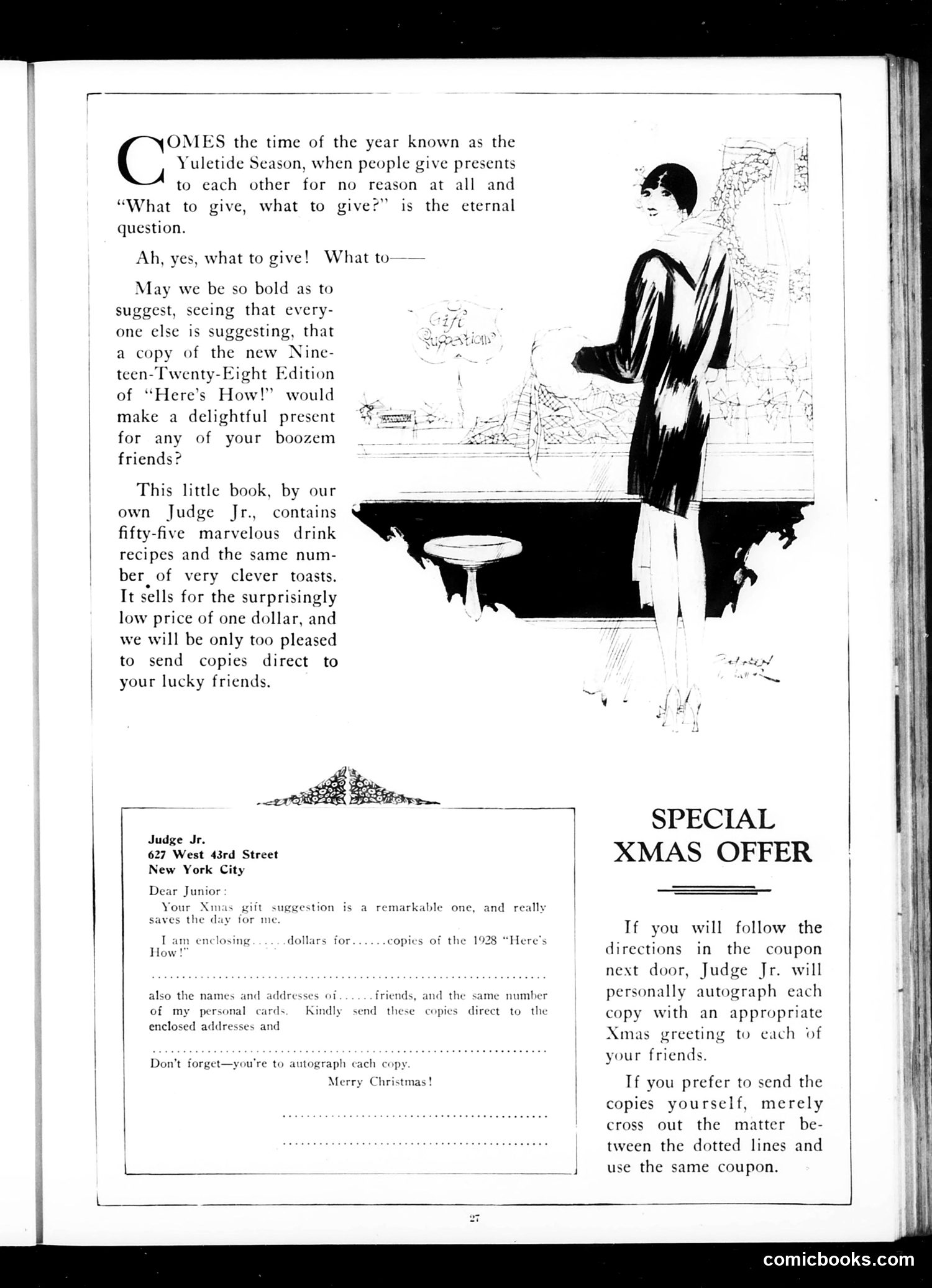
This is primarily **advertising disguised as editorial content** in Judge magazine (1928). There's no political cartoon here—instead, it's a promotional page for "Here's How!," a cocktail recipe book by "Judge Jr." The humor relies on Prohibition-era irony: during the actual Prohibition era (1920-1933), alcohol was illegal, yet Judge openly advertised a drink recipe book. The joke is the brazen audacity of selling cocktail guides while Prohibition supposedly banned such content. References to "boozem friends" and the emphasis on personal autographs suggest winking complicity with readers who want alcohol despite the law. The illustration shows a woman admiring what appears to be maps or recipes on a wall—likely representing the book's contents. The "Special Xmas Offer" positioning it as a gift for friends reinforces the magazine's tongue-in-cheek defiance of Prohibition restrictions. The one-dollar price point emphasizes accessibility. This reflects how Prohibition was widely flouted and mocked by mainstream publications and society.
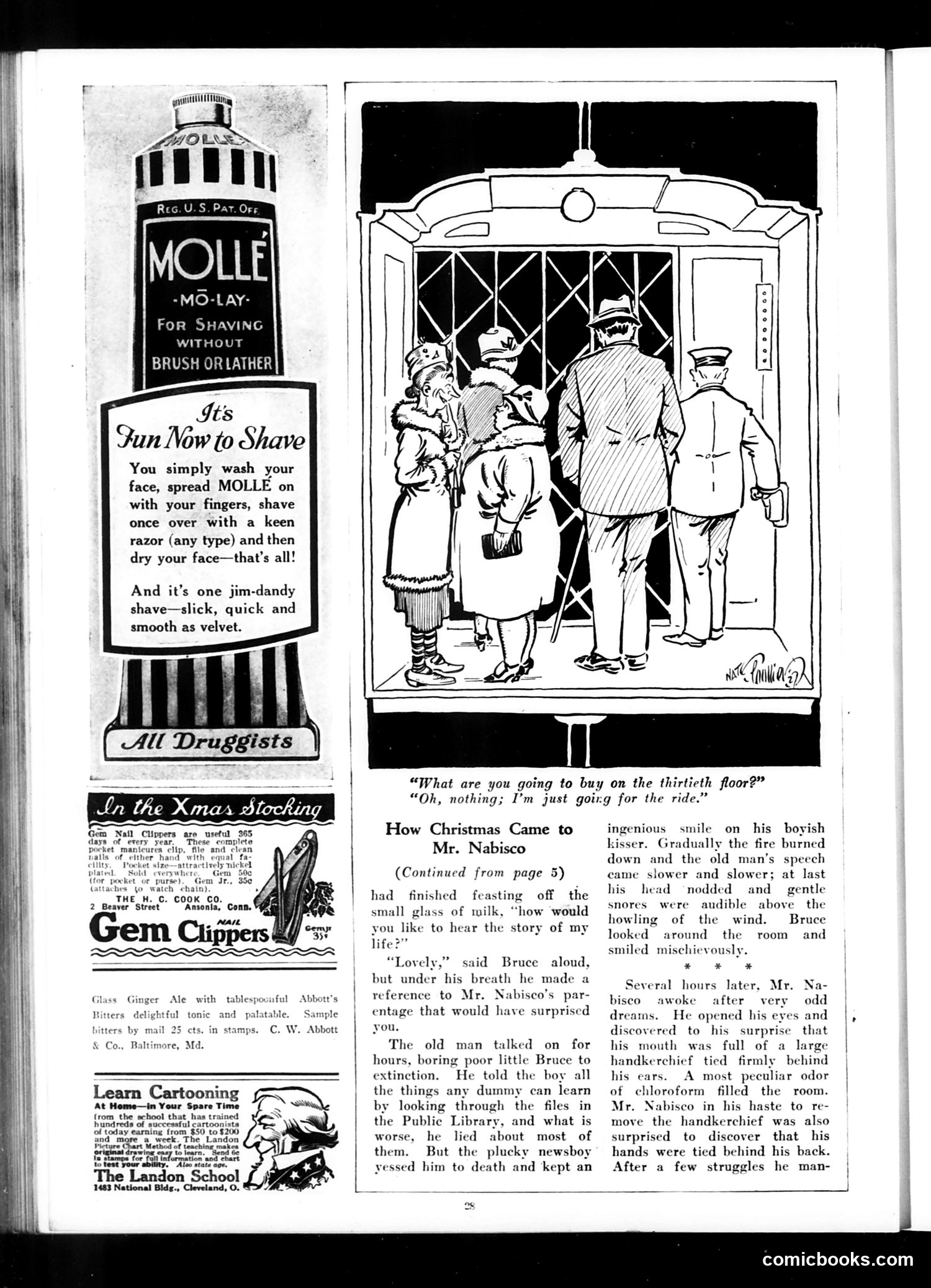
This page contains **advertisements and serialized fiction**, not political satire. The main cartoon shows an elevator scene with the caption joke: a man asks what someone will buy on the "thirtieth floor," and the reply is "nothing; I'm just going for the ride"—a Depression-era gag about riding elevators for entertainment when money is tight. The fiction excerpt continues "How Christmas Came to Mr. Nabisco," a serialized story about a newsboy named Bruce who meets a boring old man. The narrative mocks the elderly man's tedious life story and obvious lies. The scene ends with Bruce apparently chloroforming and binding Mr. Nabisco as a practical joke—typical of rough-edged humor from this era. The left side features **product advertising**: Mollé shaving cream (promoting brush-free shaving) and Gem Clippers, aimed at cost-conscious male readers.
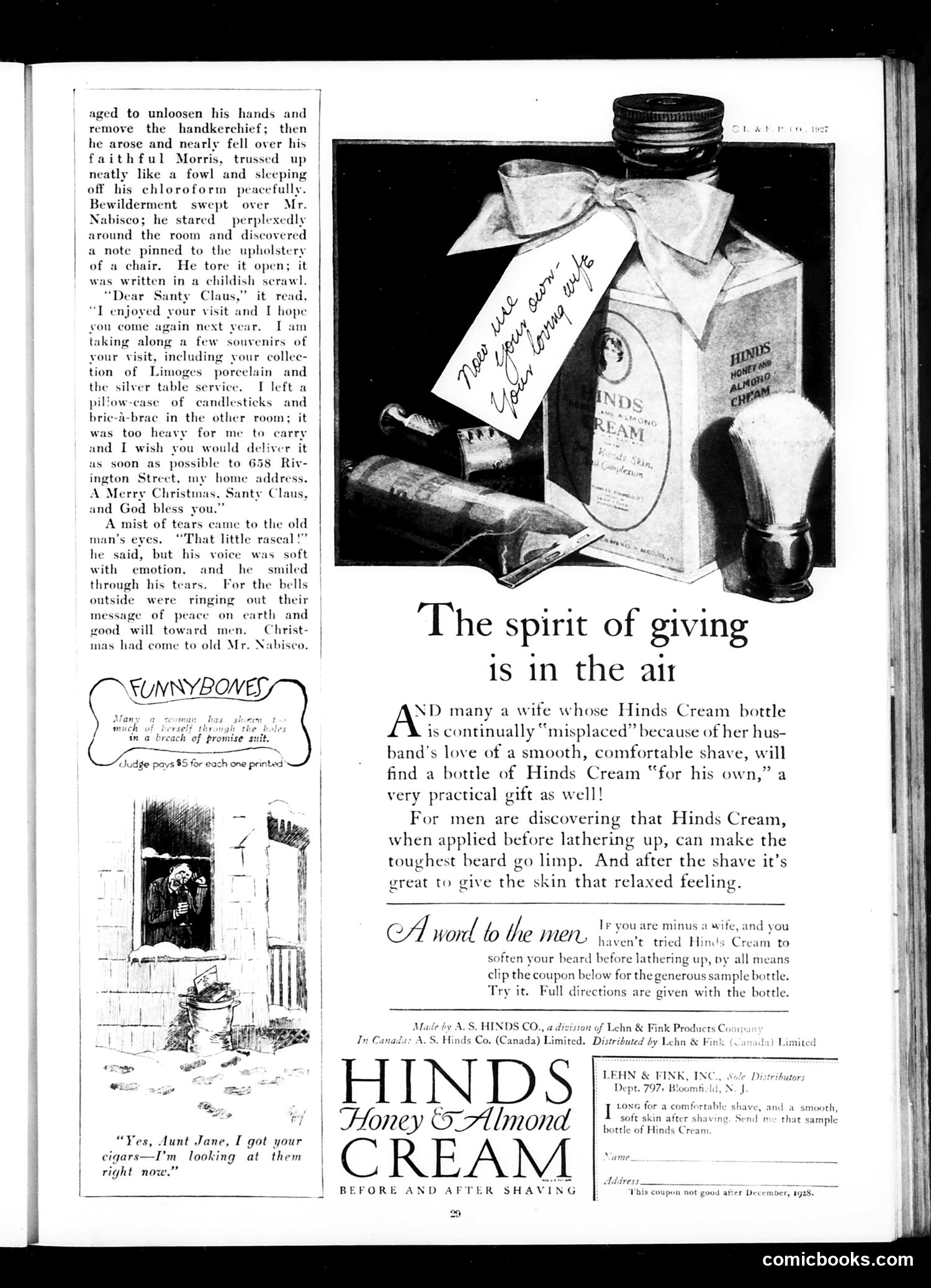
This page combines a serialized story with advertising. The main narrative (left) depicts a Christmas burglary: a thief, posing as Santa Claus, robs Mr. Nabisco's home while he's chloroformed. The thief leaves a cheeky note signed "Santy Claus," claiming the stolen items (porcelain, silverware) as "souvenirs." The story's sentimental ending reveals Mr. Nabisco finds emotional meaning in the child-like audacity rather than dwelling on material loss—a period-appropriate Christmas tale emphasizing goodwill over possessions. The page is primarily a **Hinds Cream advertisement** promoting shaving cream for men. The ad copy plays on the humorous notion that wives constantly "misplace" their husbands' shared Hinds Cream bottles, positioning it as an ideal gift. The copy emphasizes the product softens tough beards and leaves skin relaxed post-shave. A coupon offers a sample.
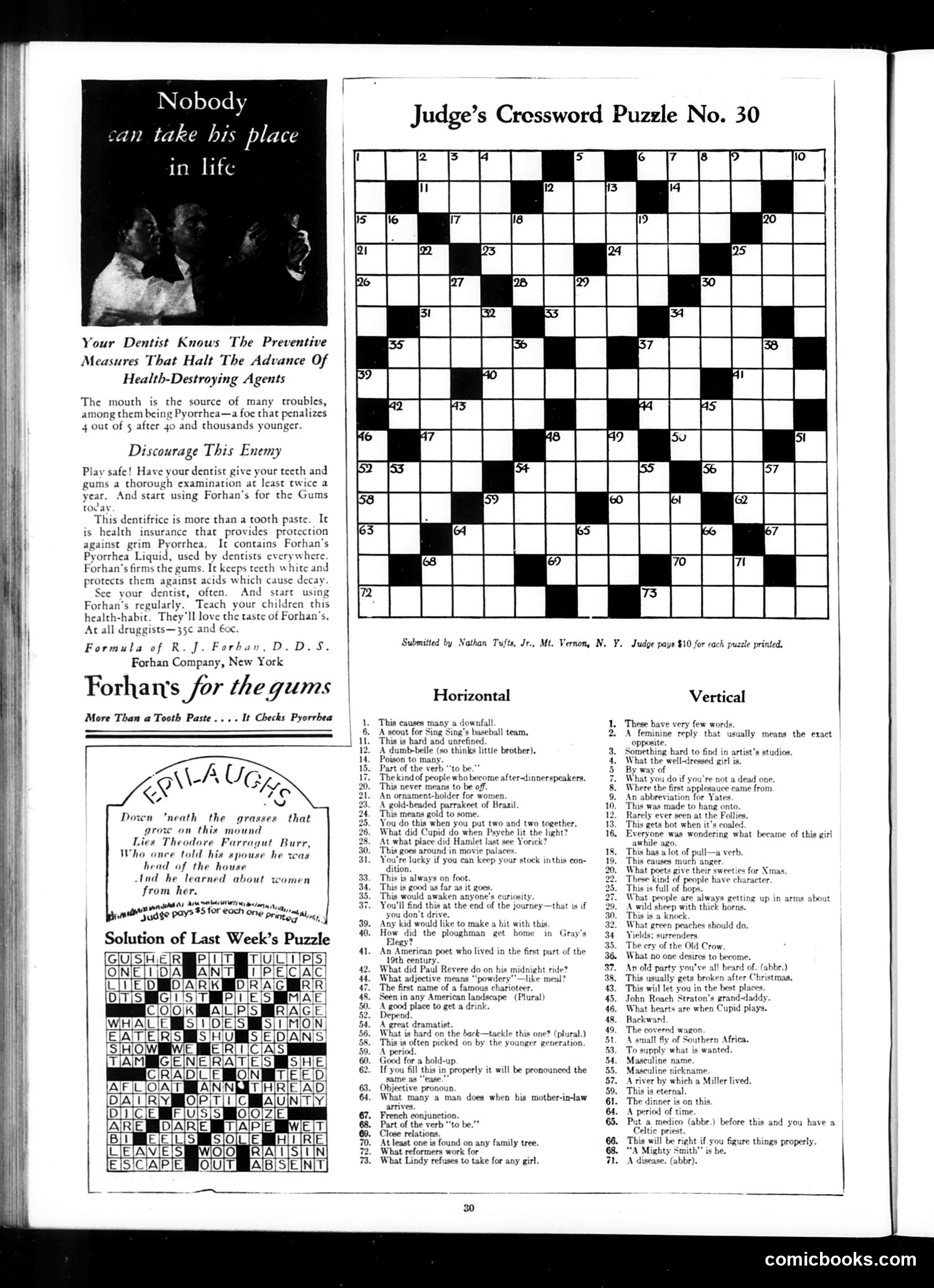
This page is primarily **advertising and puzzle content**, not political satire. **Main Content:** The dominant feature is a **Forhan's toothpaste advertisement** addressing pyorrhea (gum disease), presented as a public health concern affecting "4 out of 5 after 40." The ad urges regular dental checkups and daily use of Forhan's toothpaste as preventive medicine. **Supplementary Material:** - A brief humorous epitaph about Theodore Farragut Burr, a man who claimed to be "head of the house" but "learned about women from her"—a mild domestic comedy joke - A crossword puzzle (No. 30) with clues - The solution to the previous week's puzzle **No Political Satire:** This page contains no political cartoons, caricatures, or social commentary. It represents typical Judge magazine filler material: advertisements framed as health advice, light domestic humor, and puzzles designed to entertain readers while selling products.
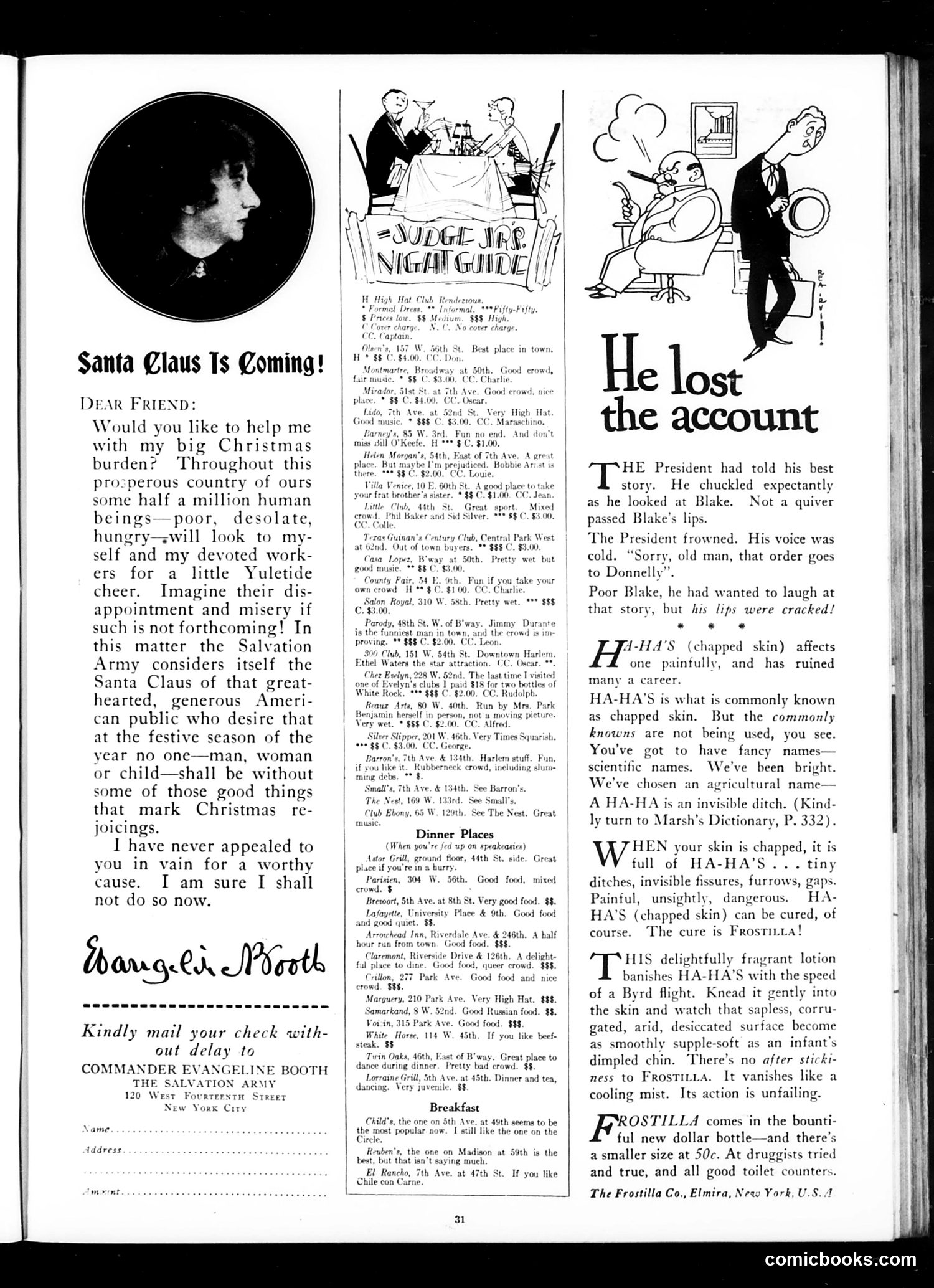
This page juxtaposes serious and comedic content typical of *Judge* magazine's satirical format. **The Main Cartoon ("He Lost the Account"):** A businessman fails to secure a crucial client contract because his chapped lips prevent him from laughing at the President's joke. The satire mocks both corporate culture's absurd power dynamics and the desperation of salesmen who must perform emotional labor to close deals. The punchline: a minor physical flaw costs him the account. **The Advertisement (Right):** For "Frostilla," a skin cream treating "HA-HA'S" (chapped skin). The ad humorously uses scientific pretension—inventing fancy names for common problems—while admitting this marketing strategy ("We've been bright"). It's satirizing advertising's tendency to dress up mundane products in pseudo-scientific language to inflate their importance and price. **The Left Side:** A fundraising appeal from the Salvation Army for Christmas charity, plus restaurant/nightclub listings—typical *Judge* content mixing serious civic messaging with entertainment coverage. The page's overall humor targets both business culture and advertising manipulation.
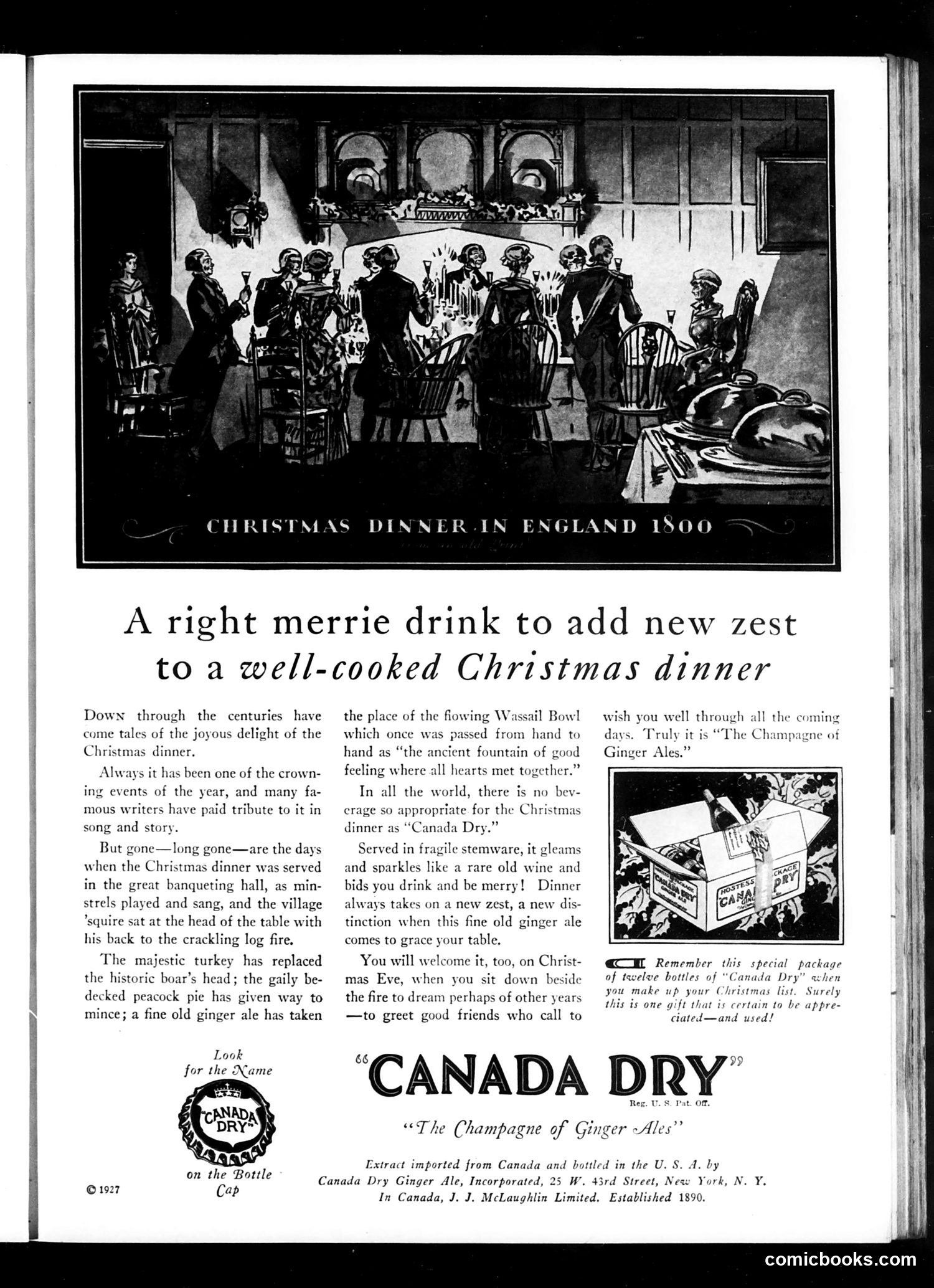
This is primarily a **Canada Dry ginger ale advertisement**, not political satire. The page appears in Judge magazine (©1927) but functions as sponsored content. The illustration depicts a formal Christmas dinner scene in historical England (1500), establishing nostalgic mood. The text contrasts old traditions—banqueting halls, minstrels, the Wassail Bowl—with modern celebrations, positioning Canada Dry ginger ale as the contemporary replacement for medieval punch bowls. The marketing strategy is subtle: by calling Canada Dry "The Champagne of Ginger Ales" and emphasizing its elegance in "fragile stemware," the ad suggests this non-alcoholic beverage offers sophistication equivalent to wine. This was likely strategic during Prohibition (1920-1933), when alcohol was illegal in the U.S.—ginger ale could provide festive refinement without legal risk. There is no political cartoon or satire here; instead, this is nostalgic advertising disguised as cultural commentary about dining traditions.
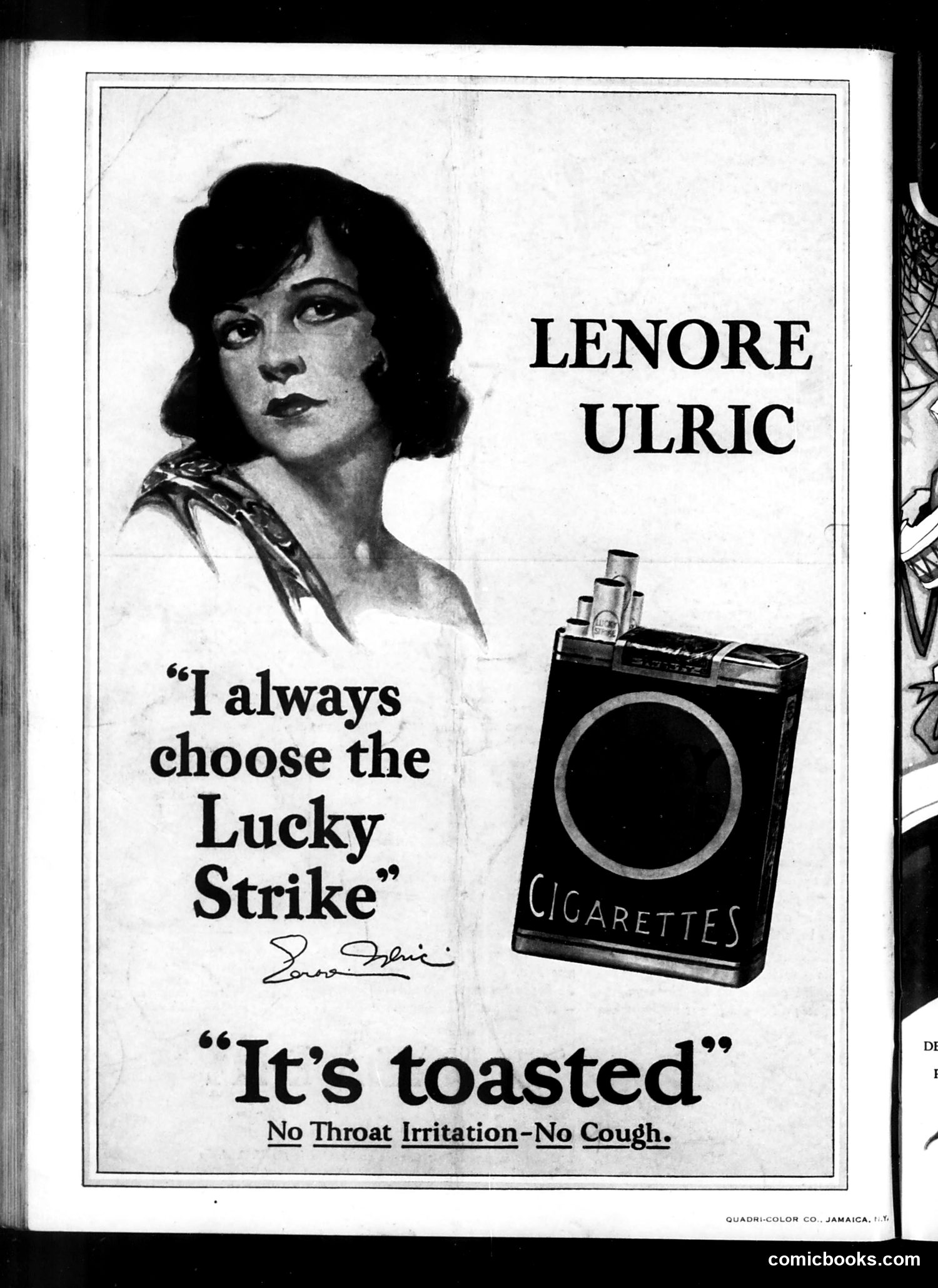
This is a **Lucky Strike cigarette advertisement**, not a political cartoon. It features actress **Lenore Ulric** (named at top) endorsing the product with her signature visible. The ad uses a common early 20th-century marketing strategy: celebrity testimonial. Ulric claims "I always choose the Lucky Strike" and promotes the brand's key selling point: "It's toasted—No Throat Irritation—No Cough." This reflects the era's aggressive cigarette marketing before health warnings were required. The "toasted" claim was Lucky Strike's actual advertising angle, suggesting the toasting process reduced irritation—a dubious health claim that would be illegal today. The ad targets consumers concerned about smoking's obvious negative effects, framing the product as a safer choice through celebrity endorsement and pseudo-scientific claims.