
Judge, 1927-12-10 · page 20 of 36
Judge — December 10, 1927 — page 20: what you’re looking at
What you’re looking at
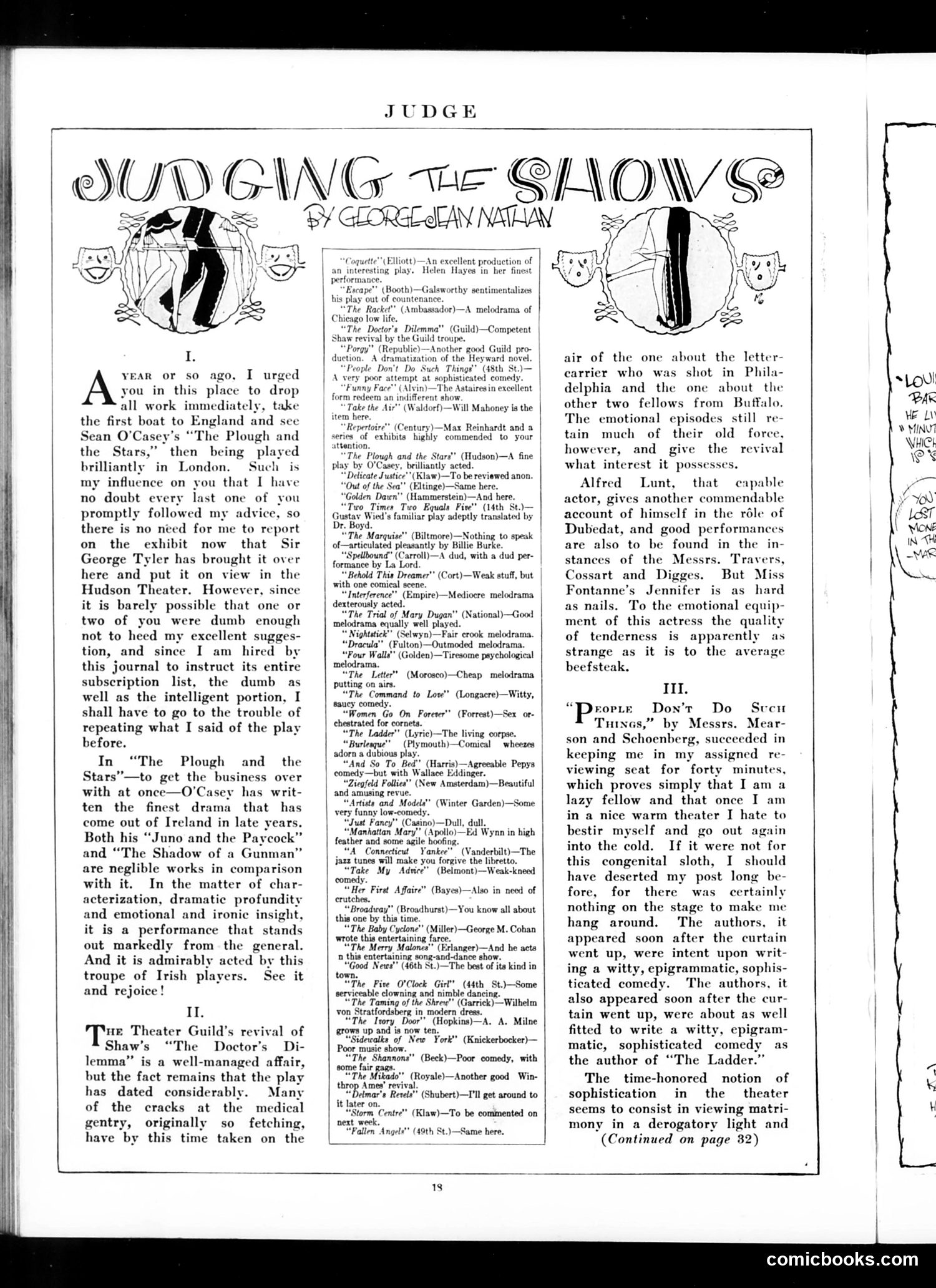
This is a theater review column, not a political cartoon. Nathan, a prominent drama critic, evaluates Broadway productions of the era (appears to be mid-1920s based on references to shows like the Ziegfeld Follies). **Key content:** Nathan enthusiastically recommends Sean O'Casey's Irish play "The Plough and the Stars" at the Hudson Theater, calling it the finest drama from Ireland in years. He also reviews Shaw's "The Doctor's Dilemma" revival, noting the play has aged poorly—its once-clever jabs at the medical profession now feel dated. The decorative theatrical masks and the lengthy list of show reviews reflect Judge's entertainment focus during this period. This represents mainstream theater criticism for educated readers interested in New York's vibrant stage scene, rather than political satire or social commentary.
📄 Transcribed text from this page (OCR, searchable)
Machine-transcribed from the original scan — historical spelling and the odd misread are preserved.
JUDGE year or so ago, I urged A ou in this place to drop 1 work immediately, take the first boat to England and see Sean O'Casey’s “The Plough and the Stars,” then being played brilliantly in London, Such is my influence on you that I have no doubt every last one of you promptly followed my advice, so there is no need for me to report on the exhibit now that Sir George Tyler has brought it over here and put it on view in the Hudson Theater. However, since it is barely possible that one or two of you were dumb enough not to heed my excellent sugges- tion, and since I am hired by this journal to instruct its entire subscription list, the dumb as well as the intelligent portion, I shall have to go to the trouble of repeating what I said of the play before. In “The Plough and _ the Stars”—to get the business over with at once—O'Casey has writ- ten the finest drama that has come out of Ireland in late years. Both his “Juno and the Paycock’ and “The Shadow of a Gunman” are neglible works in comparison with it. In the matter of char- acterization, dramatic profundity and emotional and ironic insight, it is a performance that stands out markedly from the general. And it is admirably acted by thi troupe of Irish players. See it and rejoice! Il. ne Theater Guild’s revival of Shaw’s “The Doctor's Di- lemma” is a well-managed affair, but the fact remains that the play has dated considerably. 3 of the cracks at the medical gentry, originally so fetching, have by this time taken on the = GEORGESEAN NATHAN (Elliott) —An excellent production of an interesting play. Helen Hayes in her finest performance. Escape” (Booth) —C his play out of countens “The Racket" (Ambassador)—A melodrama of ago low life. ‘he Doctor's Dilemma" (Guild)—Competent Shaw revival by the Guild troupe. “Porgy” (Republic)Another good Guild pro duction. A dramatization of the Heyward novel “People Don't Do Such Things’ (48th St.)— A very poor attempt at sophisticated comedy “Funny Face’ (Alvin)—The Astairesin excellent form redeem a diffe show. “Take the Air" (Waldorf)—Will Maboney is the item here. “Repertoire” (Century) —Max Reinhardt and a series of exhibits highly commended to your attention. “The Plough and the Stars" (Hudson)—A fine by O'Casey, brilliantly acted. "(Klaw)—To be reviewed anon. "* (Eltinge)—Same here. “Golden Daren" (Hammerstein)—And here. “Two Times Two Equals Fire® (14th St.)— Gustav Wied’s familiar play adeptly translated by 1. Boyd. “The Marquise" (Biltmore)—Nothing to speak of—articulated pleasantly by Billie Burke. “Spellbound” (Carroll)—A dud, with a dud per- formance by La Lord. “Behold This Dreamer" (Cort)—Weak stuff, but with one comical scene. “Interference” (Empire)—Mediocre melodrama dexterously act “The Trial of Mary Dugan’’ (National)—Good melodrama equally well played. “* Nightatick”” (Selwyn)—Fair crook melodrama. ‘Dracula’ (Fulton)—Outmoded melodrama. “Four Walls” (Golden)—Tiresome psychological melodrama. “The Letter (Morosco)—Cheap melodrama putting on airs. “The Command to Lov” (Longacre)—Wi saucy comedy. “Women Go On Forever" chestrated for cornets. “The Ladder" (Lyric)—The living corpse. “ Burlesque’ adorn a dubious pla; “And So To Bed" (Harris)—Agreeable Pepys comedy—but with Wallace Edinger. “Ziegfeld Follies” (New Amsterdam)—Beautiful and amusing revue. “Artiste and Models!” (Winter Garden)—Some very funny low-comedy. “Just Fancy” (Casino)—Du “Manhattan Mary" (Apollo feather and some agile hoofing. “A Connecticut Yankee (Vanderbilt) —The jazz tunes will make you forgive the libretto. “Take My Advice” (Belmont)—Weak-kneed comedy. "Her First Affaire” (Bayes)—Also in need of crutches. “Broadway” (Broadburst)—You know all about this one by this time. “The Baby Cyclone" (Miller)—George M. Cohan wrote this entertaining farce. “The Merry Malones” (Erlanger 1 this entertaining song-and-dance show. “Good News!" (46th St.) —The best of ita kind in The Fire O'Clock Girt” (44th St.)—Some iceable clowning and nimble dancing. "he Taming of the Shreve” (Garrick)-—Wilhelm von Stratfordsberg in modern dress. “The Itory Door’ (Hopkins)—A. A. Milne grows up and is now ten. “Sidewalks of New York” (Knickerbocker)— Poor music show. “The Shannons" (Beck)—Poor comedy, with some fair gags. “The Mikado" (Royale)—Another good Win- throp Ames’ revival “Delmar's Revels” (Shubert)—I'll get around to it later on. “Storm Centre” (Klaw)—To be commented on next week. “Pallen Angele” (49th St.)—Same here. lsworthy sentimentalizes dull. fd Wynn in high (Plymouth)—Comical wheezes | air of the one about the letter- carrier who was shot in Phila- delphia and the one about the other two fellows from Buffalo. The emotional episodes still r tain much of their old force however, and give the revival wl interest it possesses Alfred Lunt, — that actor, gives another commen account of himself in the réle of Dubedat, and good performance are also to be found in the in- stances of the Messrs. Travers, Cossart and Digge But Miss Fontanne’s Jennifer is hard as nails, To the emotional equip- ment of this actress the quality of tendern is apparently strange as it is to the ave beefsteak. capable le s II. “P opLE Don’t Do Sven Tunes,” by Messrs. Mear- son and Schoenberg, succeeded in keeping me in my assigned re- wing seat for forty minutes, which proves simply that I am a lazy fellow and that once I am in a nice warm theater I hate to bestir myself and go out into the cold. If it were not for this congenital sloth, I should have deserted my post long be- fore, for there was certainly nothing on the stage to make me hang around. The authors, it appeared soon after the curtain went up, were intent upon writ- ing a witty, epigrammatic, sophis ticated comedy. The authors, it also appeared soon after the cur- tain went up, were about as well fitted to write a witty, epigram- matic, sophisticated comedy as the author of “The Ladder.” The time-honored notion of sophistication in the theater seems to consist in viewing matri- mony in a derogatory light and (Continued on page 82) *Loul BAR VE LN Y MINU1 HICK Yves L&T vont -—_ KN comicbooks.com