
A complete issue · 36 pages · 1927
Judge — August 6, 1927
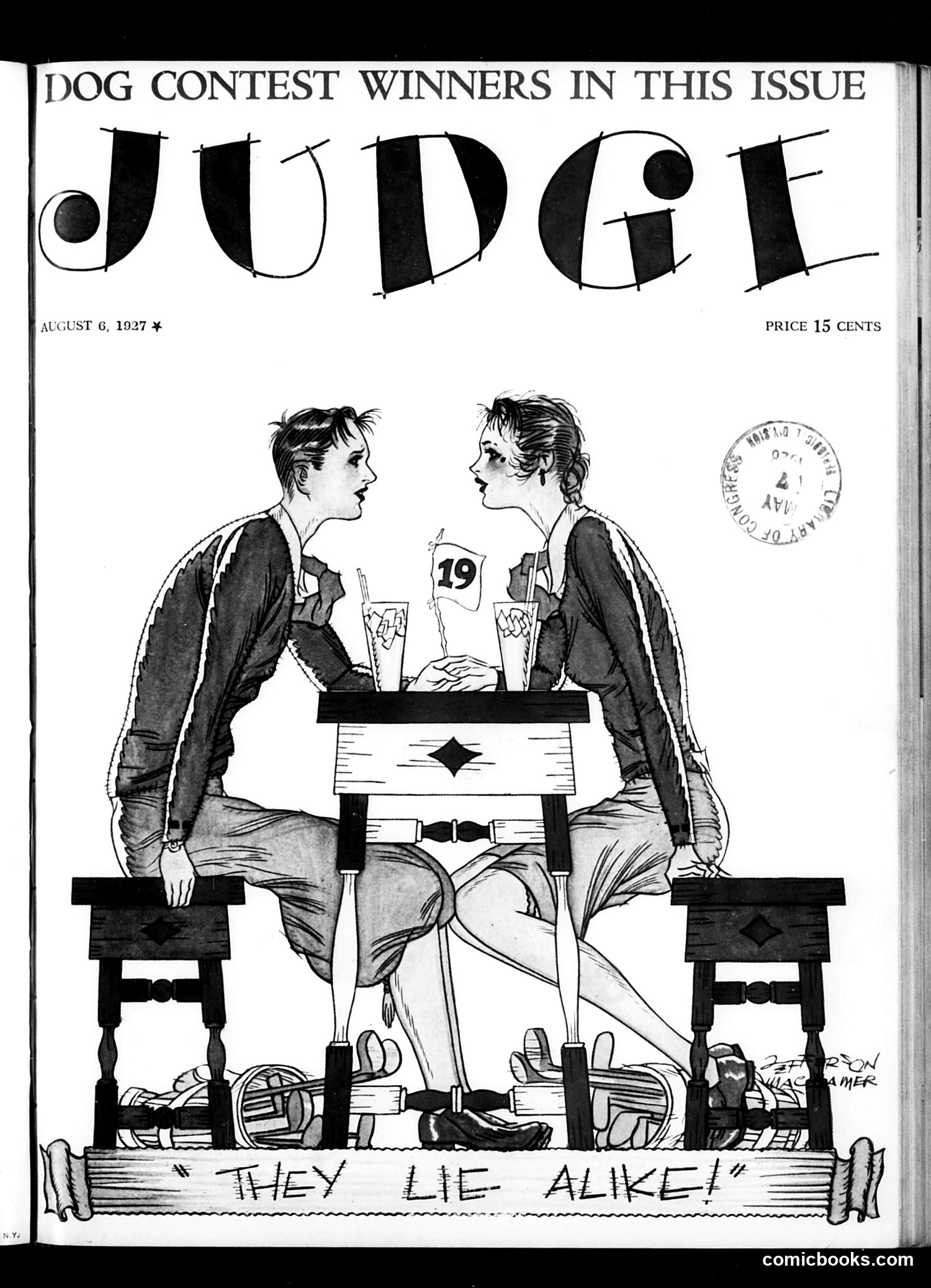
This cover features two women sitting at a small table playing cards, labeled "They Lie Alike!" The satire appears to address gender dynamics and dishonesty in 1920s courtship or social interactions. The women are dressed in androgynous clothing typical of the era's "modern woman" aesthetic, which itself was often satirized. The joke likely plays on contemporary anxieties about changing gender roles during the Jazz Age—specifically, the perception that modern women were becoming less truthful or more independent than previous generations. The title "Dog Contest Winners" suggests this is satirizing either competitive dating behavior or women's liberation, though the exact reference remains unclear without additional context from the magazine's contents.
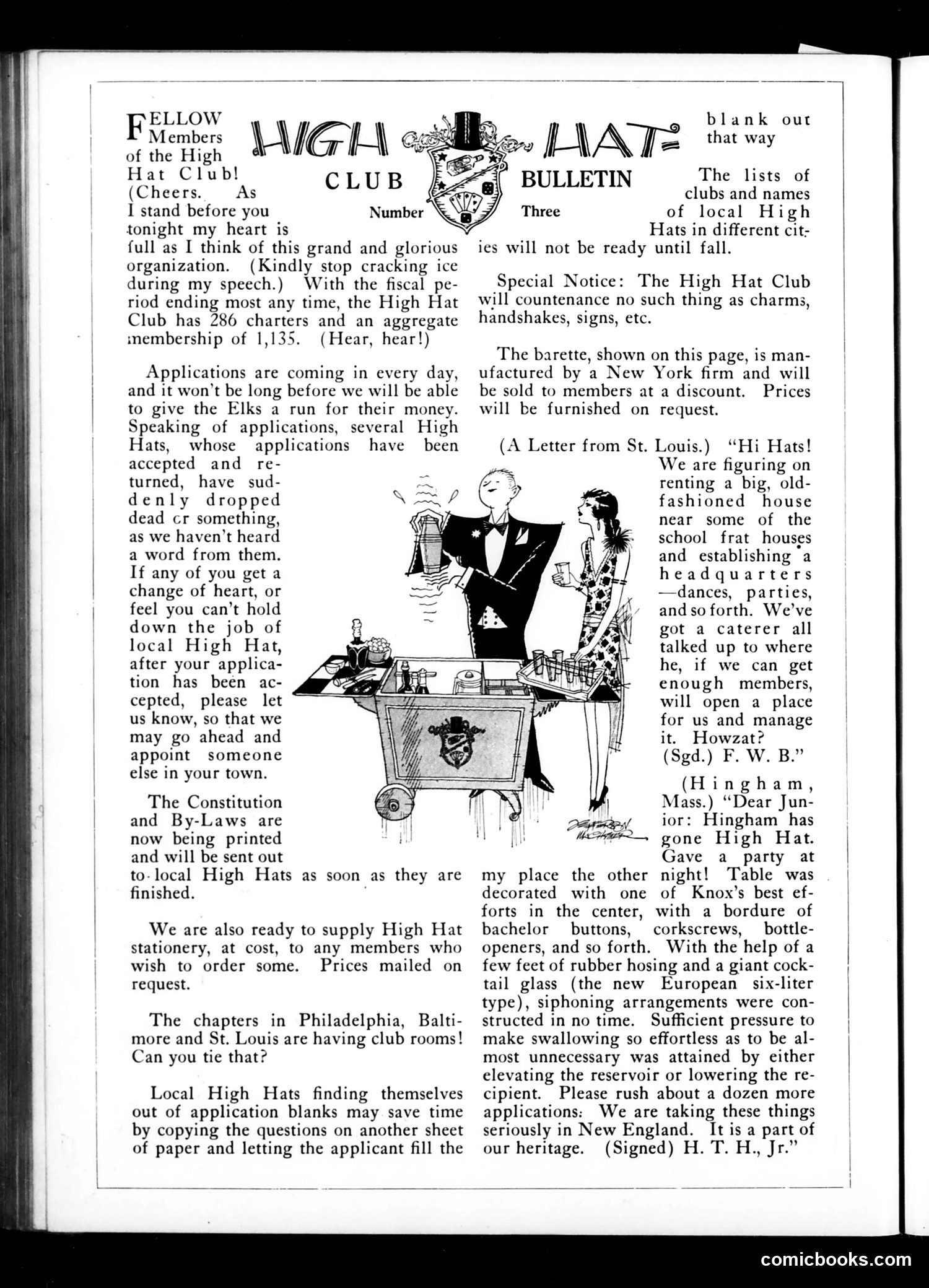
This page is primarily **club administration content**, not political satire. It's a bulletin for the "High Hat Club," a social organization for wealthy men. The central cartoon shows a **well-dressed gentleman hosting a cocktail party**, illustrating the club's social purpose. The illustrated barette and references to "handshakes, signs, etc." suggest fraternal or lodge-like rituals. The content includes membership announcements, chapter reports from Philadelphia, Baltimore, and St. Louis, and correspondence from members describing parties and social gatherings. References to "applications," "constitution," and "by-laws" indicate formal organizational structure. There's no evident political satire here—this is **social/lifestyle content** for an affluent leisure club, typical of 1920s-era Judge magazine advertising and member communications.
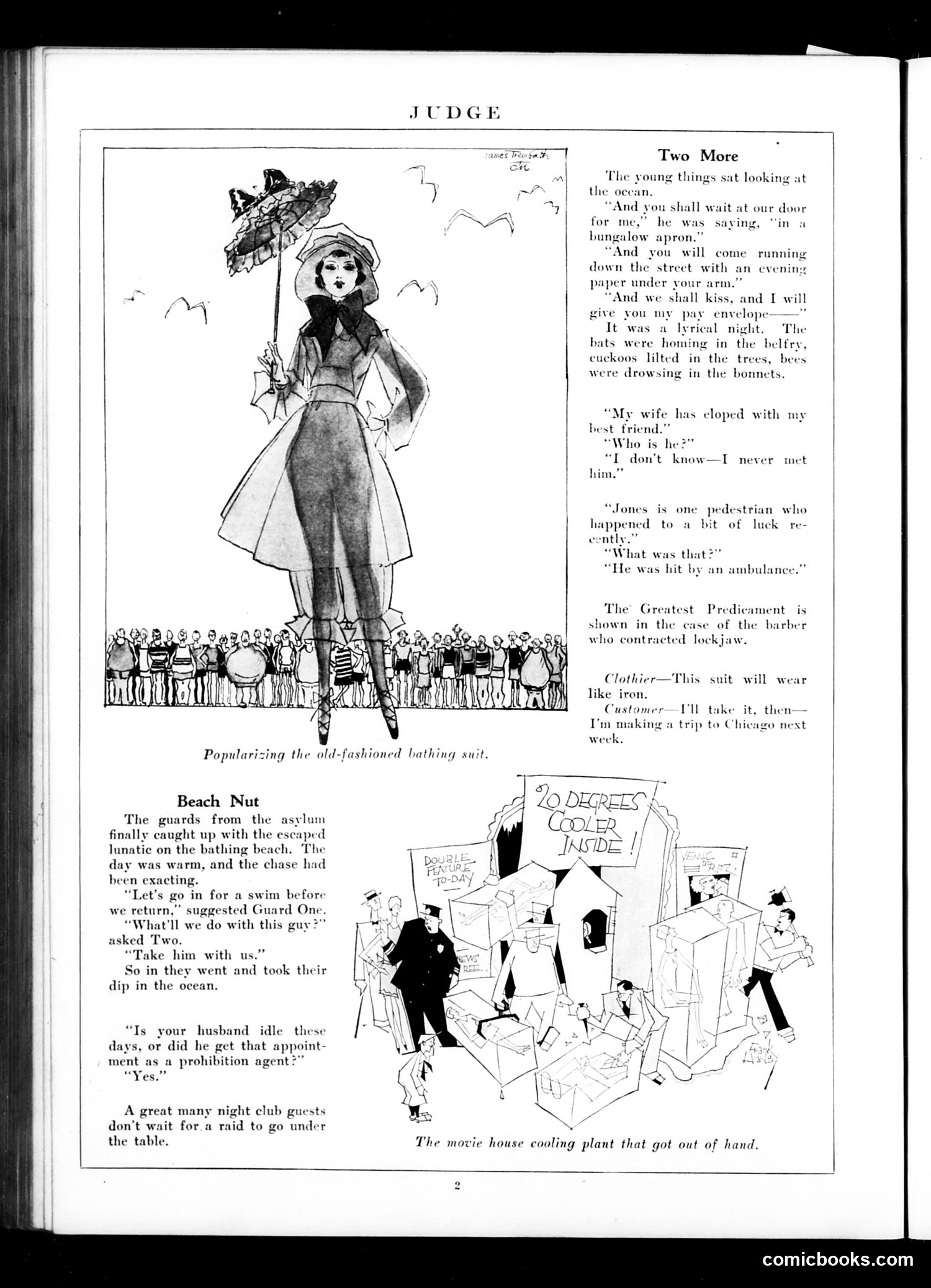
This page contains three separate satirical pieces: **"Popularizing the old-fashioned bathing suit"** shows a woman in modest vintage swimwear on a pedestal above a crowd, satirizing fashion trends of the era. **"Two More"** appears to be humorous anecdotes about infidelity and misfortune, typical of Judge's joke-column format. **"Beach Nut"** mocks asylum guards who capture an escaped patient on a beach, then casually invite him swimming—suggesting incompetence or darkly comic indifference. **"The movie house cooling plant that got out of hand"** depicts an overambitious theater air-conditioning system that has expanded wildly. This satirizes both technological optimism and commercial excess during the early air-conditioning era, when such systems were novel and sometimes malfunctioned spectacularly. The page reflects 1920s-30s concerns: fashion, domestic scandals, and industrial modernization.
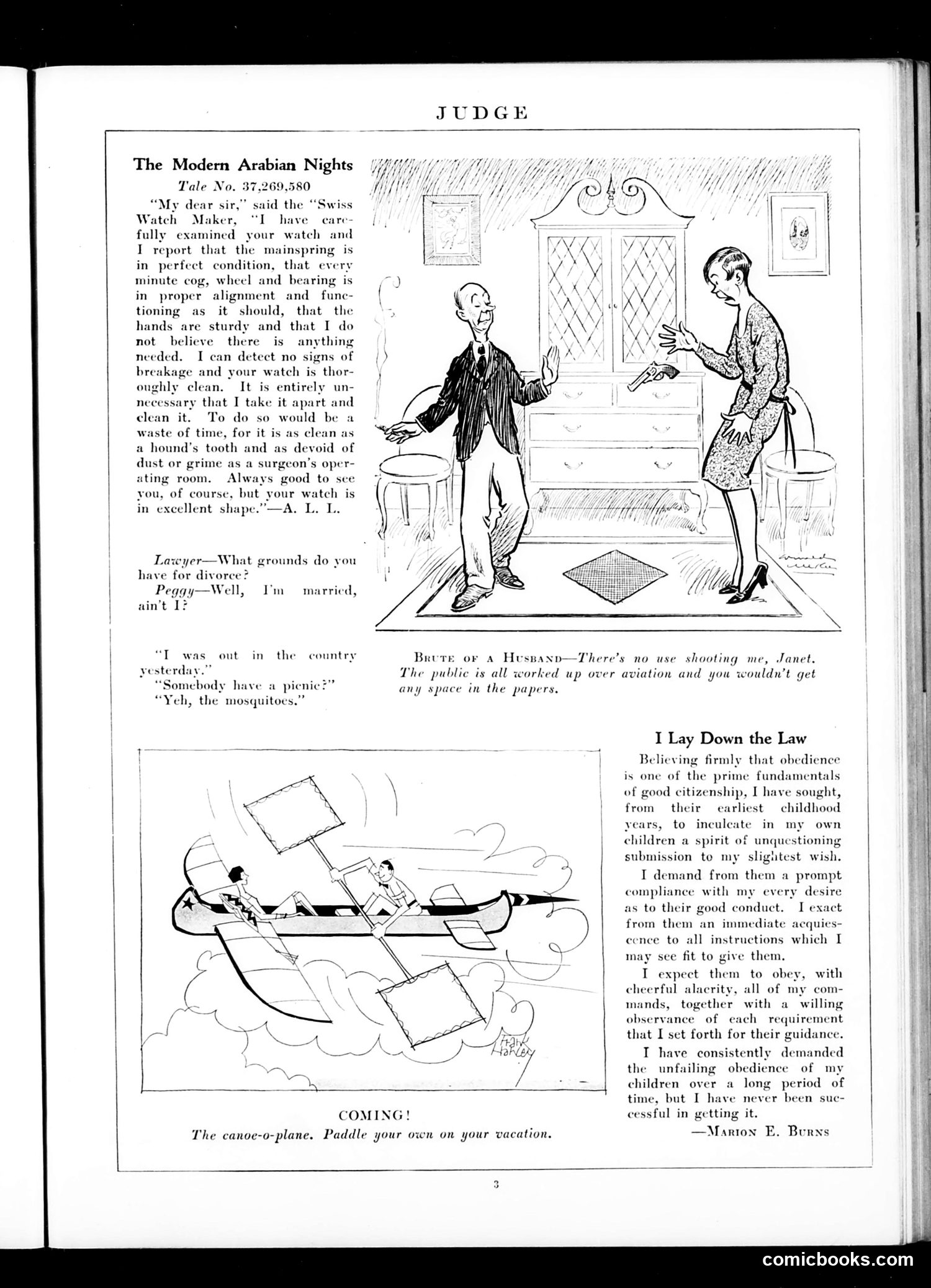
**"The Modern Arabian Nights"** presents a joke about a Swiss watchmaker repairing a customer's timepiece. The humor lies in the watchmaker's elaborate, flowery explanation—mimicking the ornate storytelling style of Arabian Nights tales—for what is actually simple maintenance work. This satirizes verbose professionals who overcomplicate routine services. **"I Lay Down the Law"** is an essay by Marion E. Burns about parental discipline and obedience, emphasizing strict household rules and children's unquestioning submission to parental authority—reflecting early 20th-century childrearing philosophy. **"Coming! The Canoe-o-Plane"** is a humorous illustration of a fantastical hybrid vehicle combining a canoe and airplane, presented as an absurd vacation concept—likely satirizing emerging aviation technology and travel trends of the era.
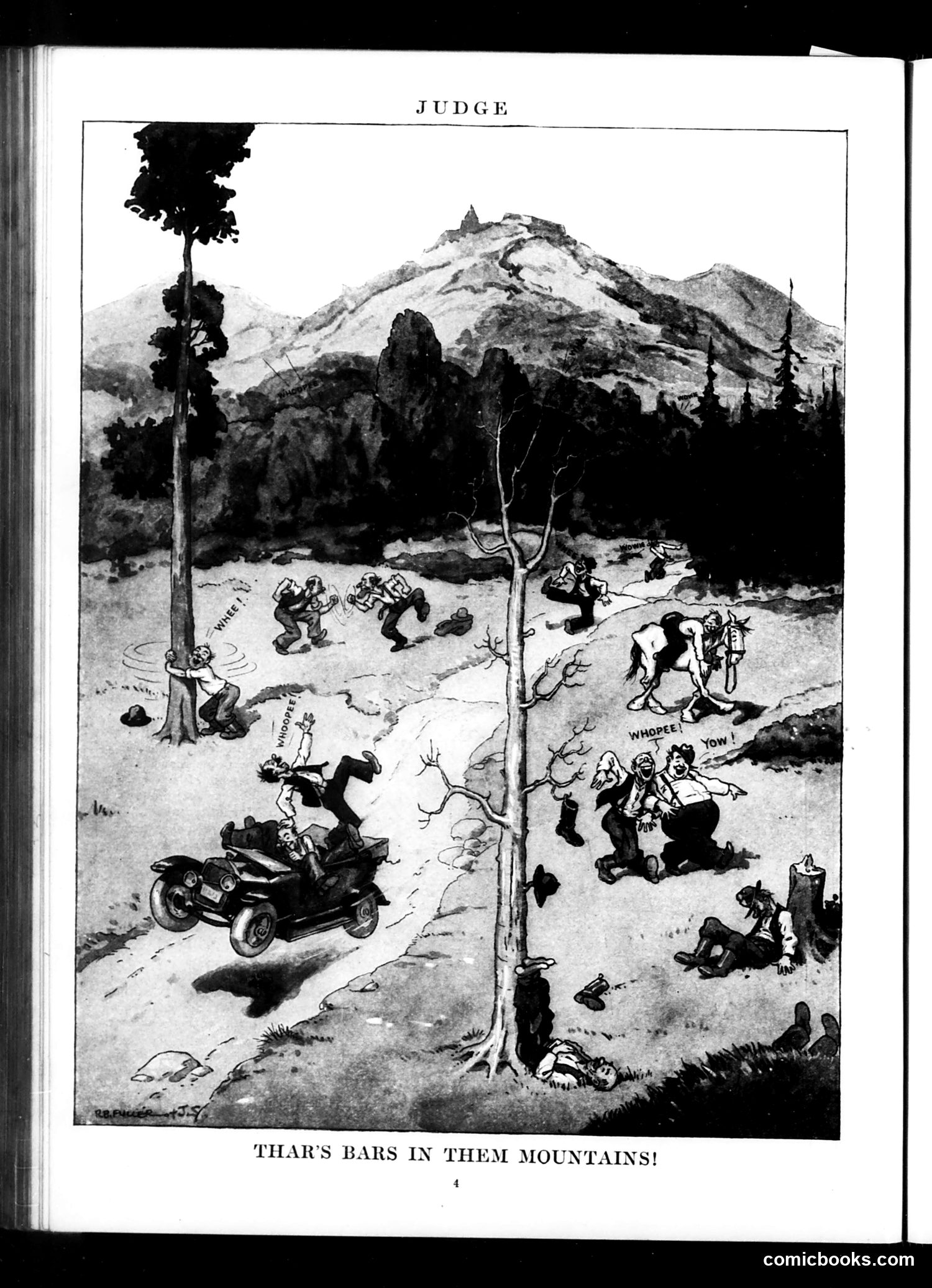
This cartoon satirizes early automobile safety concerns in mountainous terrain. The title "That's Bars in Them Mountains!" appears to be a pun on the common expression "there's gold in them hills," but substitutes "bars" — likely referencing both prison bars and the metal safety bars on early automobiles. The image depicts a chaotic mountain scene where numerous motorists have crashed or are in distress among scattered vehicles and fallen trees. The cartoon ridicules the dangers of early automotive travel on mountain roads, suggesting that driving in such terrain is tantamount to criminal recklessness or imprisonment. This reflects early-1900s anxieties about automobile safety, road conditions, and the technology's unpredictability, presented through Judge magazine's typical humorous exaggeration.
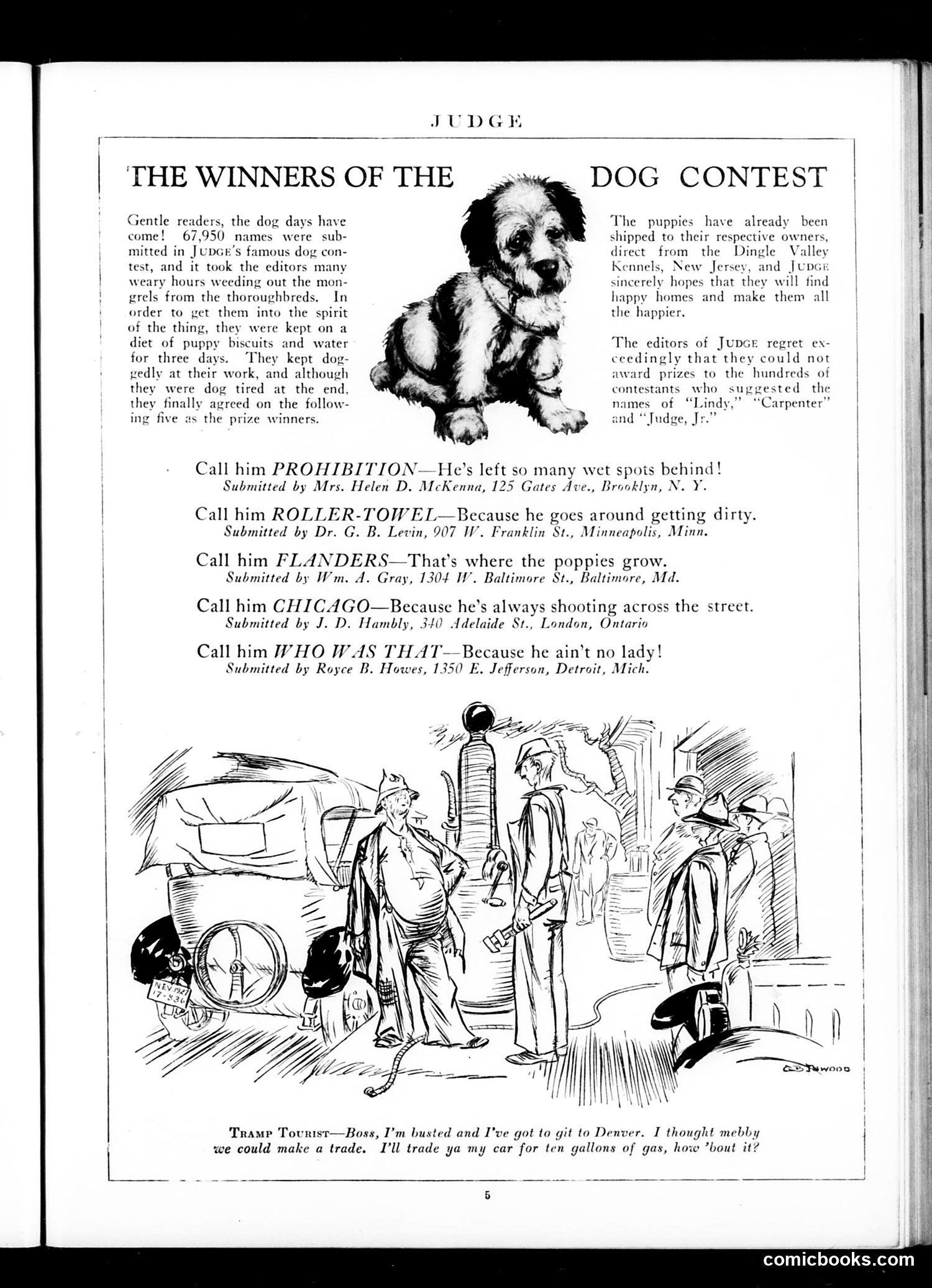
The page features a humorous dog-naming contest. The top half showcases five winning dog names submitted by readers, each with a joke explanation: - **Prohibition** (wet spots reference) - **Roller-Towel** (gets dirty) - **Flanders** (where poppies grow) - **Chicago** (shoots across streets) - **Who Was That** (he ain't no lady) The bottom cartoon depicts a "Tramp Tourist" attempting to trade his car for ten gallons of gas to reach Denver—a Depression-era joke about desperate travel and fuel scarcity. The satire reflects 1920s-30s American concerns: Prohibition's enforcement failures, industrial cleanliness standards, drug references (opium/poppies), Chicago's crime reputation, and economic hardship. The dog contest itself is lighthearted filler content typical of Judge's satirical approach to contemporary social issues.
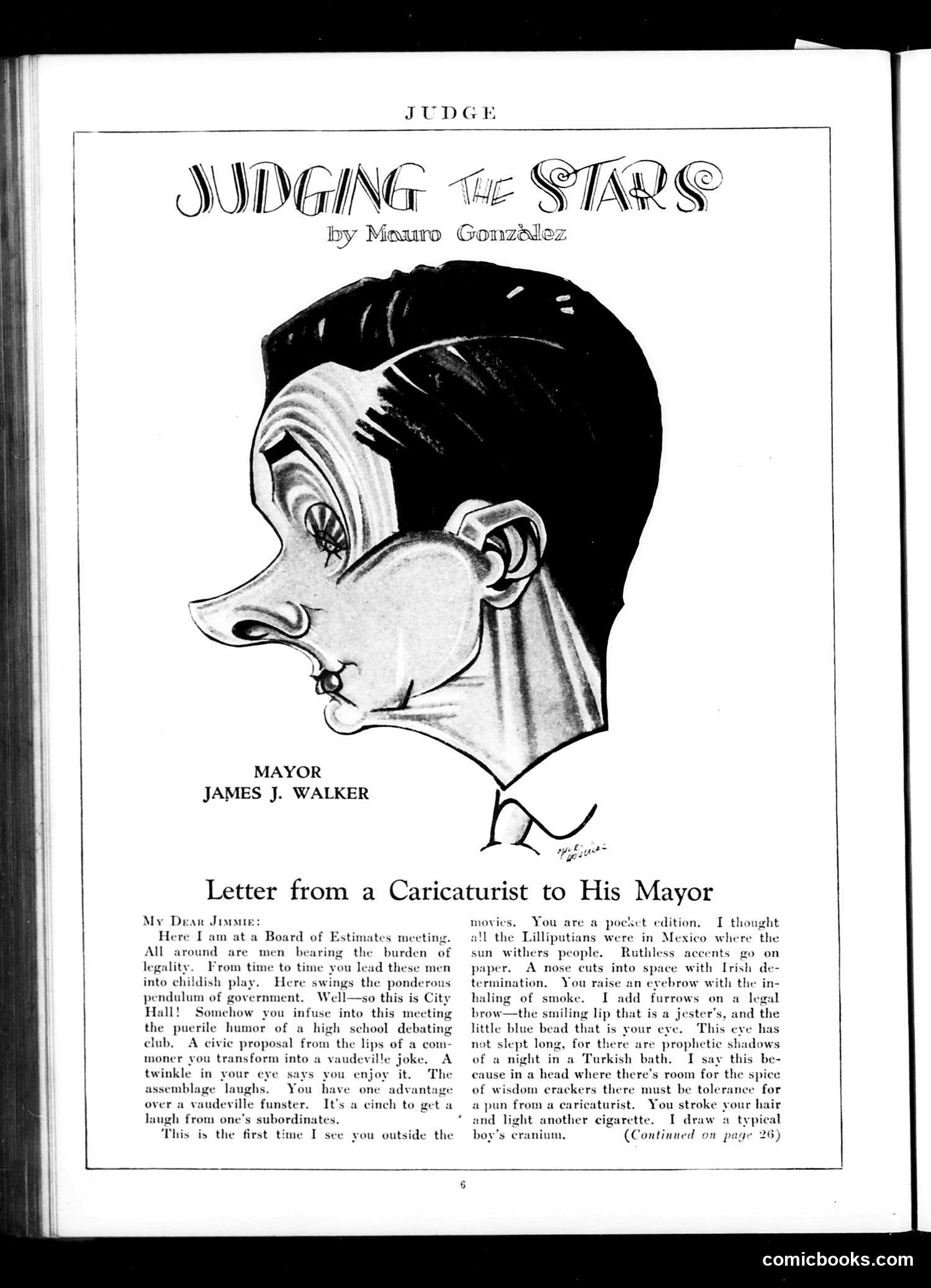
This is a satirical piece from Judge magazine targeting **Mayor James J. Walker** of New York City. The caricaturist (Mawro Gonzalez) critiques Walker's behavior at a Board of Estimates meeting—a serious governmental body overseeing city finances. The satire accuses Walker of: - Turning official proceedings into entertainment ("vaudeville joke," "high school debating club humor") - Using charm and joking to manipulate subordinates into laughing along with his proposals - Prioritizing levity over the "burden of legality" and proper governance The exaggerated facial caricature emphasizes Walker's theatrical features—his eyebrow, lips, and overall showmanship. The letter suggests Walker treats City Hall like a performance venue rather than a serious institution. This reflects Walker's actual historical reputation as a charming but controversial mayor (1926-1932) known for his nightlife, theatricality, and eventual resignation amid corruption scandals. Judge's critique captures contemporary concerns about his frivolous governing style undermining municipal authority.
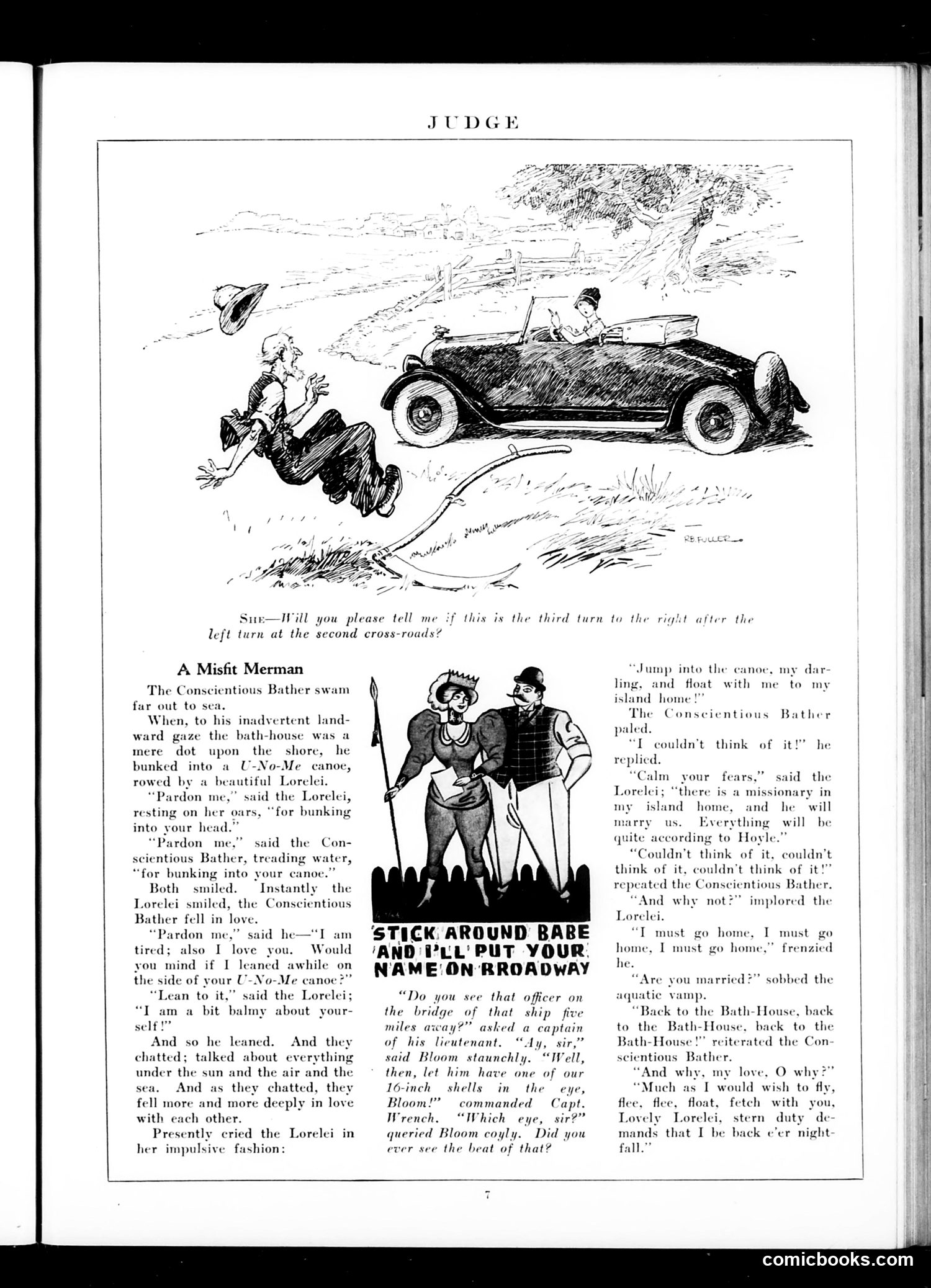
This page contains three separate comic sketches satirizing early 20th-century social conventions and propriety. **Top cartoon**: A man in a car asks directions from a pedestrian who appears disheveled—likely satirizing either confused tourists or the new awkwardness of automobile culture versus traditional transportation. **"A Misfit Merman"**: A morality tale mocking overly conscientious behavior. A swimmer meets a seductive "Lorelei" (mythological siren) who invites him to her island with promises of marriage. Despite her advances, he refuses—not from virtue but from rigid duty, repeatedly insisting he must return to the bathhouse. The satire targets men bound by social obligation so strictly they cannot even recognize opportunity or passion. **Lower vignette**: A naval joke about a gunnery officer named Bloom who asks which eye to shoot an enemy officer in—absurdist humor about military literalism. The page's recurring theme appears to be mocking excessive propriety and rigidity in American social life—suggesting such strictness prevents people from living fully, even when presented with romantic or exciting alternatives.
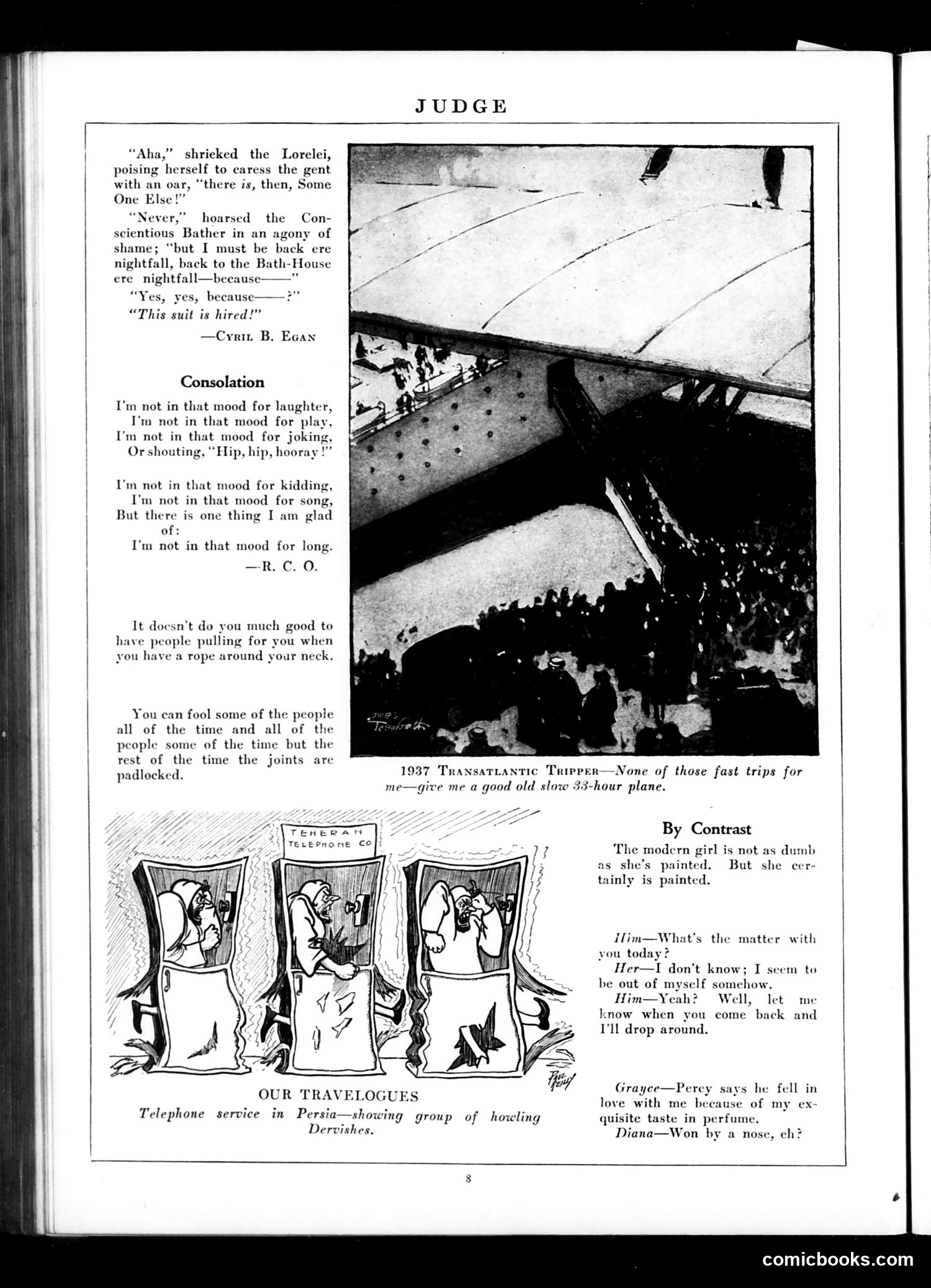
This page contains several satirical humor pieces typical of 1930s Judge magazine: **"This Suit Is Hired!"** — A man flirting with a woman (the "Lorelei," a mythological siren) panics because he's wearing a rented bathing suit and must return it by nightfall. The joke satirizes both the anxiety of rented formal wear and men's embarrassment about appearing unclothed. **"Our Travelogues"** — A cartoon showing three telephone booth users in Persia, captioned as "howling Dervishes." This is a crude ethnic joke equating Persian telephone users with the Islamic Sufi sect known for ecstatic whirling, suggesting their phone conversations sound like wailing. **Various comic snippets** including observations about moods, deception, and a perfume-related pun ("Won by a nose"). The 1937 ocean liner image humorously contrasts fast transatlantic travel with the speaker's preference for slower 33-hour flights—likely satirizing the era's competing transportation technologies and anxieties about modern speed.
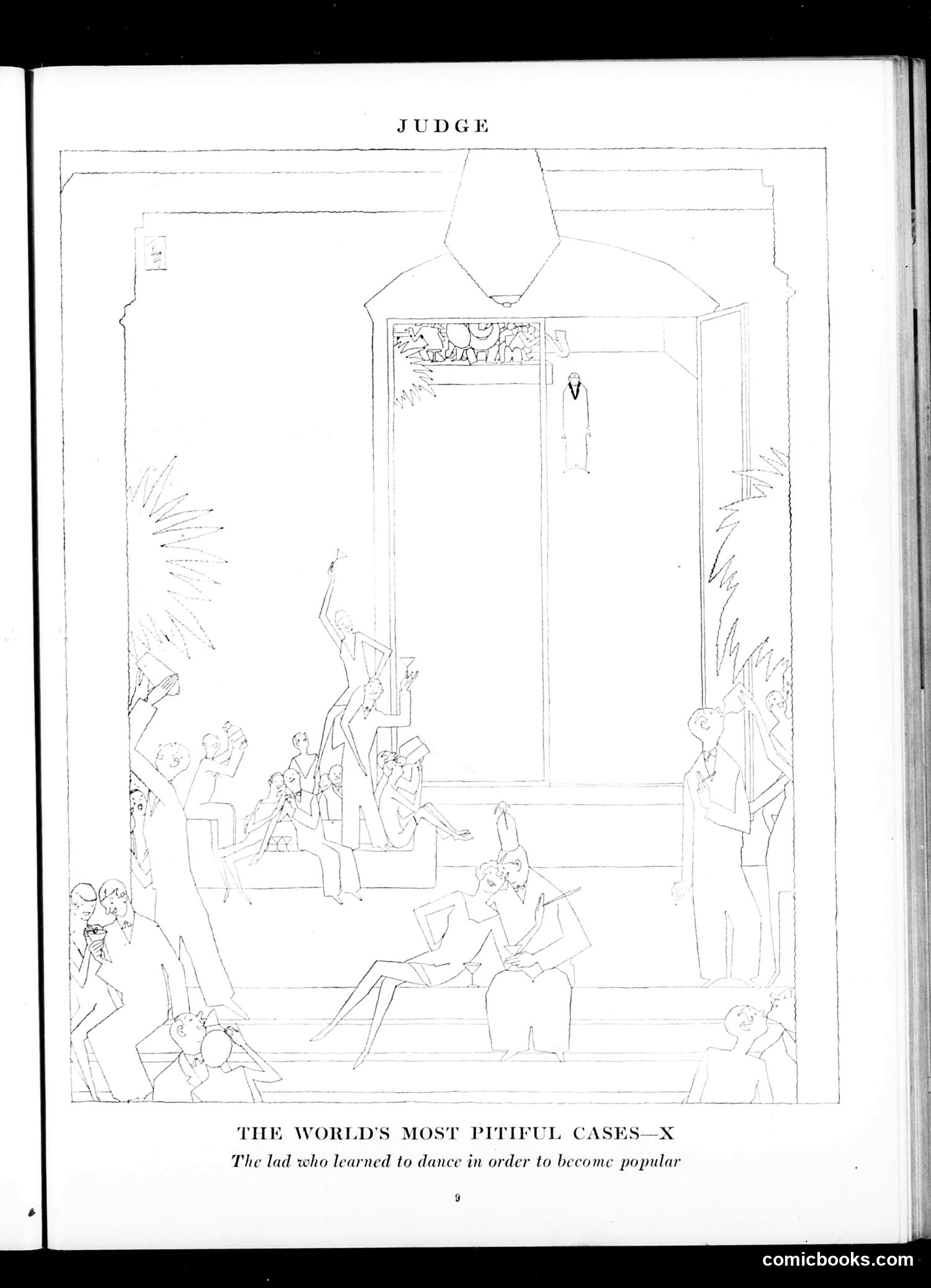
This cartoon satirizes social climbing and the desperation to achieve popularity. The sketch depicts a courtroom scene where a young man stands before a judge, apparently having learned to dance specifically to become popular—a pursuit the caption labels as one of "the world's most pitiful cases." The satire mocks the absurdity of someone pursuing such superficial means to social acceptance. The formal courtroom setting humorously frames this shallow goal as if it were a serious legal matter worthy of judicial consideration. The crowded gallery suggests society's fascination with such trivial social anxieties. This reflects early 20th-century *Judge* magazine's characteristic humor: mocking bourgeois social pretensions and the lengths people would go to fit in or gain status among their peers. The "pitiful cases" series appears to present exaggerated examples of modern social folly for satirical effect.
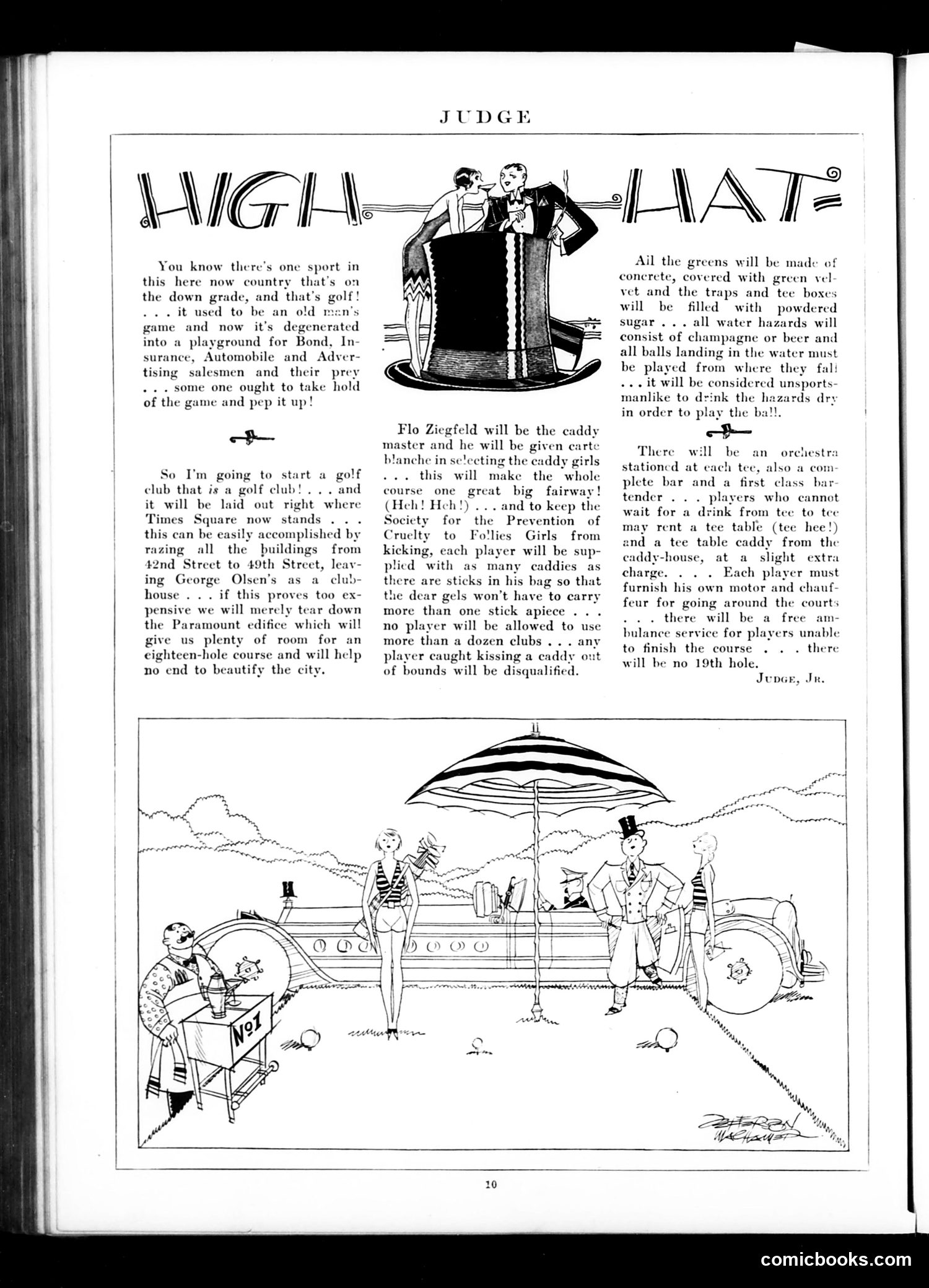
This 1920s satirical piece mocks the decline of golf from an exclusive gentleman's sport into a commercialized playground for salesmen and advertising hustlers. The unnamed speaker proposes an absurdly luxurious "golf club" occupying Times Square, demolishing major buildings for an eighteen-hole course. The joke is that this "real" golf club would actually be a parody of modern excess: concrete greens, champagne water hazards, powdered sugar bunkers, orchestras at each tee, full bars, chauffeur service, and an ambulance for exhausted players. The caddy girls detail mocks the sexualization of female workers. The final jab—"there will be no 19th hole" (traditionally the clubhouse bar where golfers socialize)—suggests that this commercialized version has lost golf's actual purpose: gentlemanly camaraderie. The satire targets 1920s American materialism, commercialization of leisure, and the erosion of class-based traditions by nouveau riche business culture.
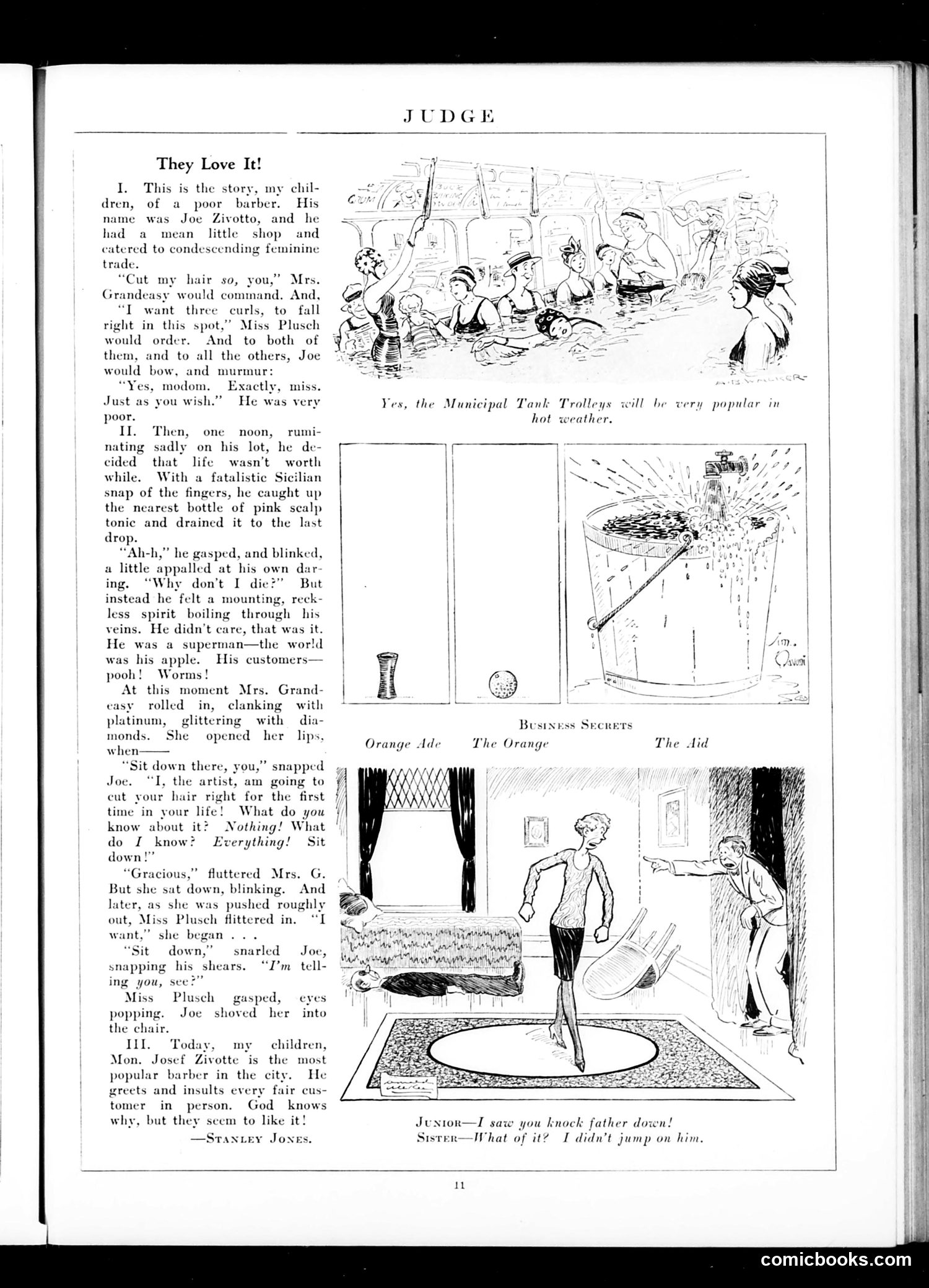
This humorous narrative by Stanley Jones satirizes changing attitudes toward service and authority in the early 20th century. Joe Zivotto, a meek immigrant barber catering to wealthy, demanding female customers (Mrs. Grandeasy, Miss Plusch), represents the deferential immigrant underclass. After accidentally drinking pink scalp tonic, Joe transforms into an aggressive "superman" who insults and orders customers around. The joke's point: paradoxically, his rude, domineering behavior makes him wildly popular. Women actually *prefer* being treated disrespectfully to being treated obsequiously. This reflects anxieties about masculinity, immigration, and class dynamics of the era—the ironic suggestion that traditional feminine desire rewards dominance over servility. The accompanying smaller cartoons about "Business Secrets" appear unrelated filler. The satire mocks both Joe's transformation and contemporary gender relations.
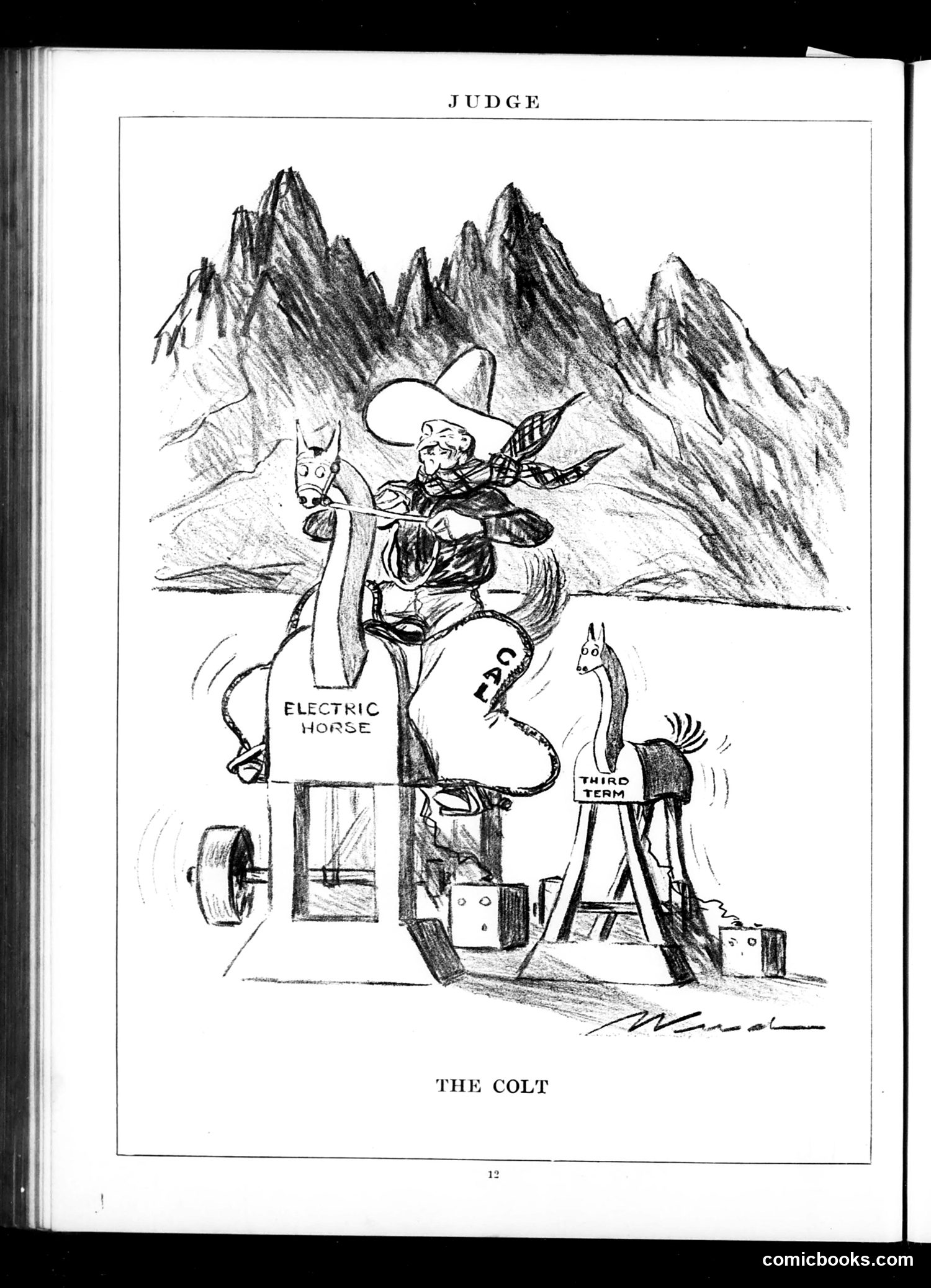
This political cartoon titled "The Colt" depicts a cowboy riding an "Electric Horse" labeled "The Colt," with mountainous terrain in the background. A support labeled "Third Term" props up the mechanical horse. The satire appears to reference Theodore Roosevelt's presidency and the political controversy surrounding a potential third term. The "electric horse" represents an artificially powered or artificially sustained political candidacy, while "The Colt" likely refers to Roosevelt (known for vigor and youthful energy despite his age). The "Third Term" support structure suggests the cartoon mocks the idea that Roosevelt's third-term ambitions require artificial propping up rather than natural political momentum. The mechanical nature of the horse emphasizes the artificiality of the endeavor.
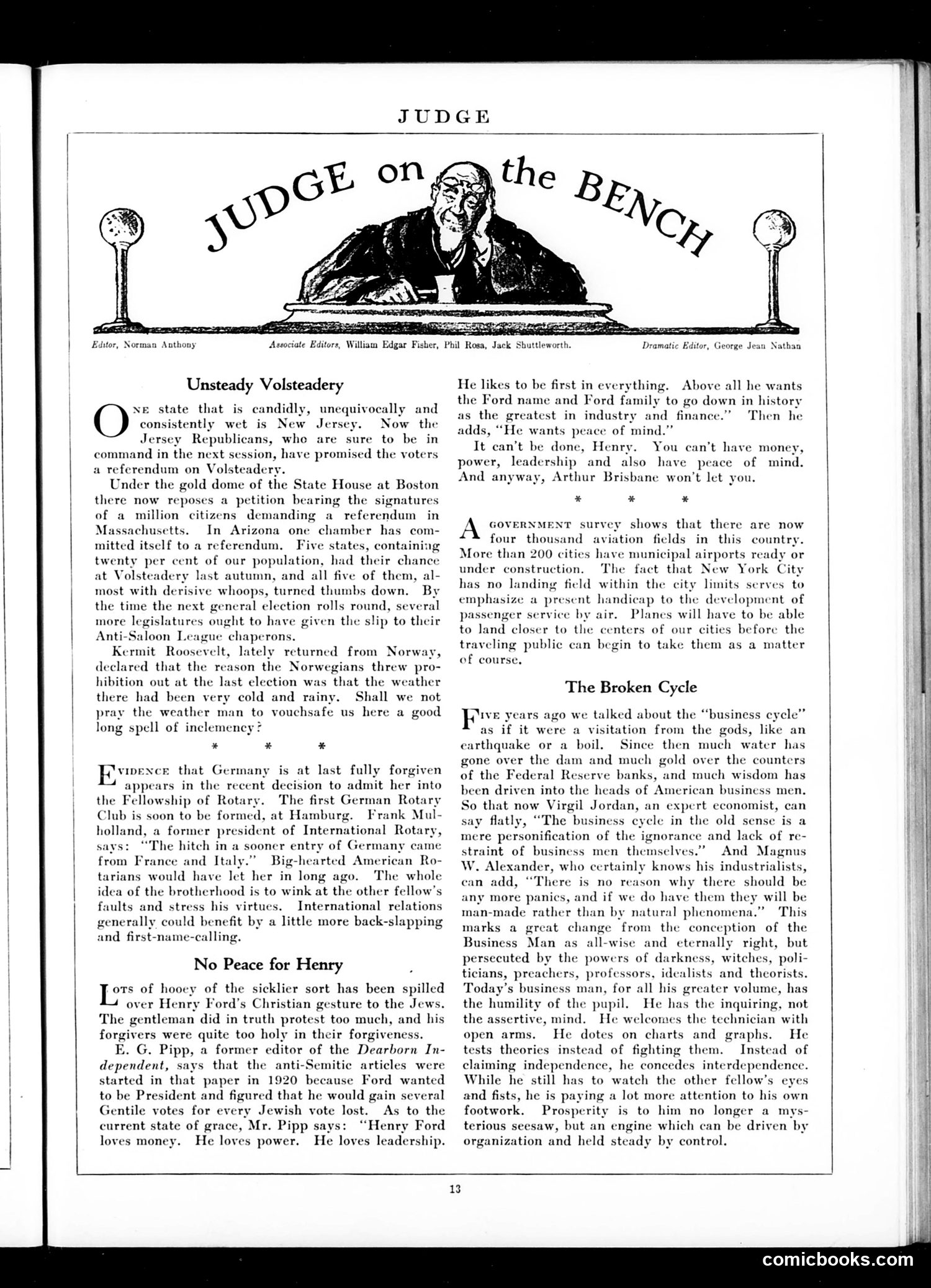
This page contains editorial commentary on several 1920s political issues: **Volsteadery (Prohibition)**: The lead article mocks the Volstead Act (Prohibition enforcement). It notes that despite efforts, multiple states are moving toward referendums to overturn prohibition, with citizens voting against it. The joke references Kermit Roosevelt claiming Norwegians rejected prohibition due to bad weather. **Germany and Rotary**: A brief note celebrates Germany's admission to the International Rotary Club, ironically suggesting America's forgiveness comes through business fellowship. **Henry Ford**: The article criticizes Ford's recent public apology to Jewish communities regarding anti-Semitic articles published in his *Dearborn Independent* (1920-1922). The satire suggests Ford's gesture was self-serving—motivated by presidential ambitions rather than genuine contrition. The concluding barb: Ford cannot simultaneously achieve money, power, leadership, *and* peace of mind. **Aviation**: A brief note on expanding airport infrastructure reflects contemporary technological optimism. The page exemplifies Judge's satirical approach to prominent figures and current events.
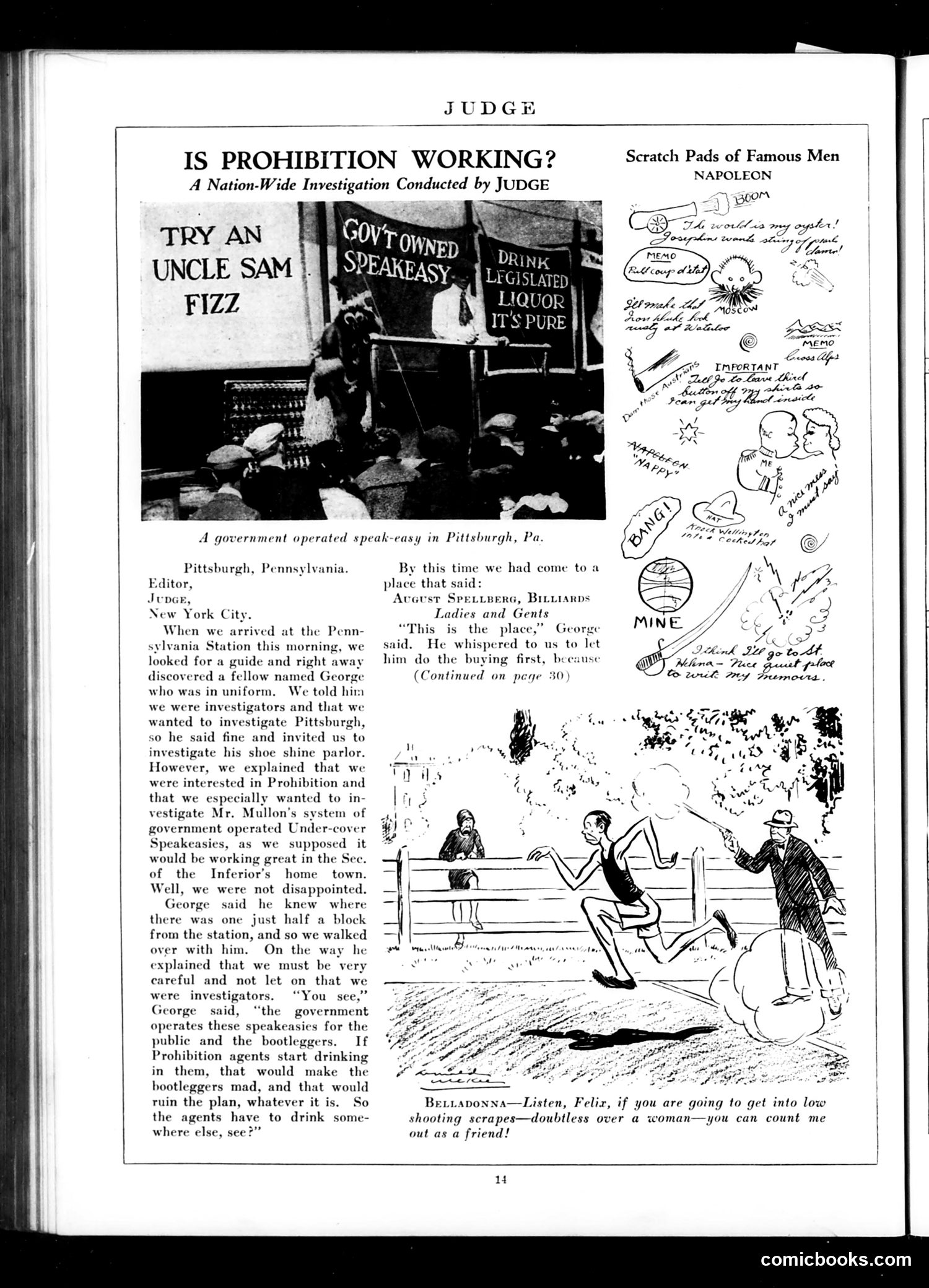
This Judge magazine article satirizes the failure of Prohibition through an investigation of Pittsburgh's government-operated "speak-easies" (illegal bars). The satire's core joke: the federal government supposedly runs secret bars ostensibly to combat bootlegging, but actually operates them *for* both the public and bootleggers. The guide "George" explains the absurd logic: Prohibition agents must drink elsewhere to avoid angering bootleggers and "ruining the plan." This exposes Prohibition's fundamental hypocrisy—rather than enforcing the law, government allegedly participates in illegal liquor sales. The accompanying cartoon shows a man chasing someone over a fence while a woman watches, with "Belladonna" promising to be his friend "if you are going to get into low shooting scrapes—doubtless over a woman." This contrasts personal violence with institutional corruption. The page mocks Prohibition's implementation as corrupt theater, not genuine reform.
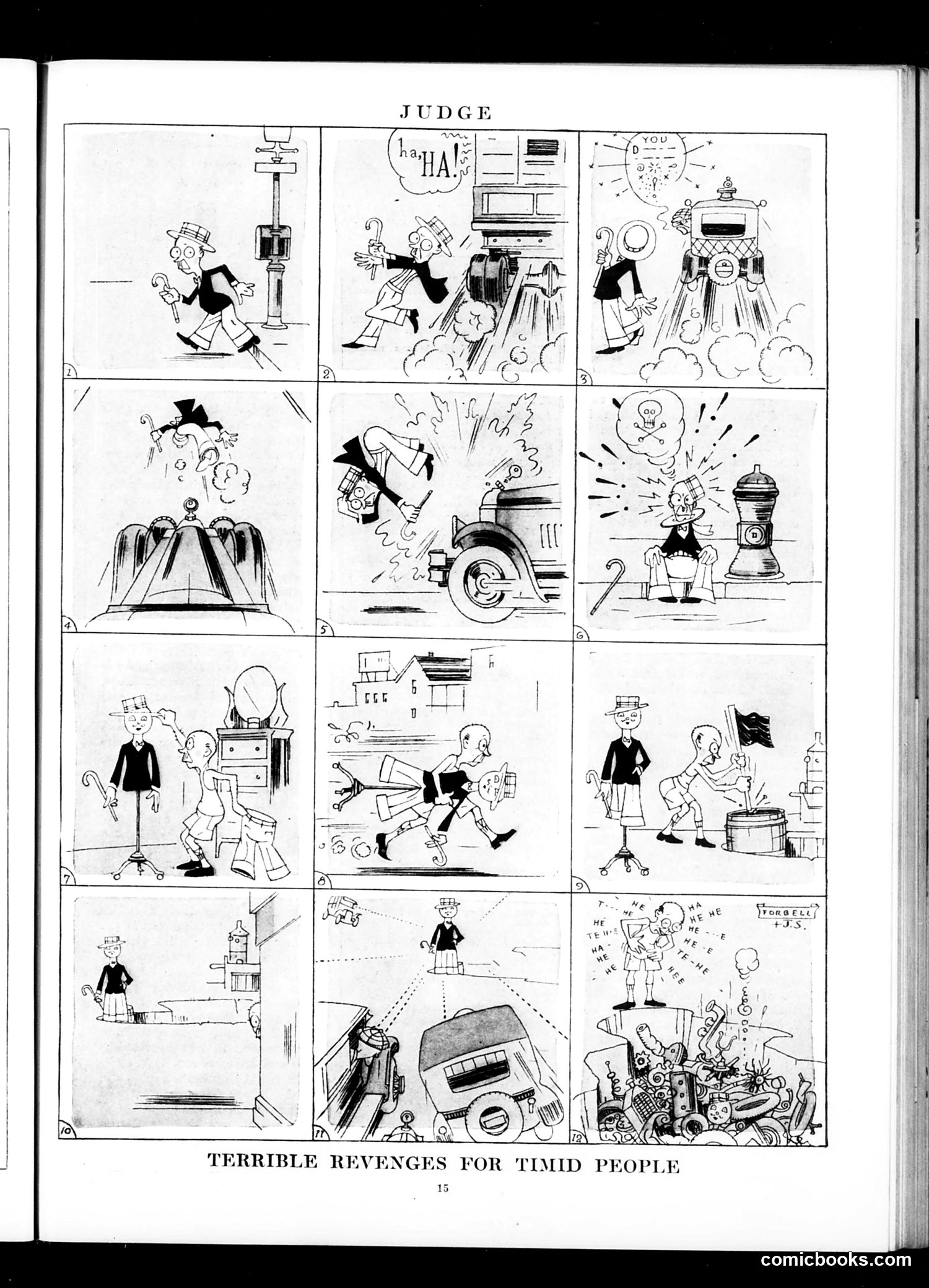
This is a satirical comic strip titled "Terrible Revenges for Timid People." The twelve-panel sequence depicts increasingly elaborate and absurd fantasies of revenge—each more fantastical than the last—imagined by a meek, mild-mannered character (shown in formal attire with a top hat). The humor works through escalation: he imagines confrontations involving mechanical contraptions, explosions, elaborate traps, and increasingly chaotic destruction. The final panel shows complete mayhem with machines and explosions. The satire targets timid, passive individuals who harbor secret violent fantasies as psychological compensation for their real-world meekness. It's a commentary on the gap between internal rage and external compliance—a common theme in early 20th-century humor. The exaggeration makes the fantasies absurd rather than genuinely threatening, emphasizing the victim's impotence.
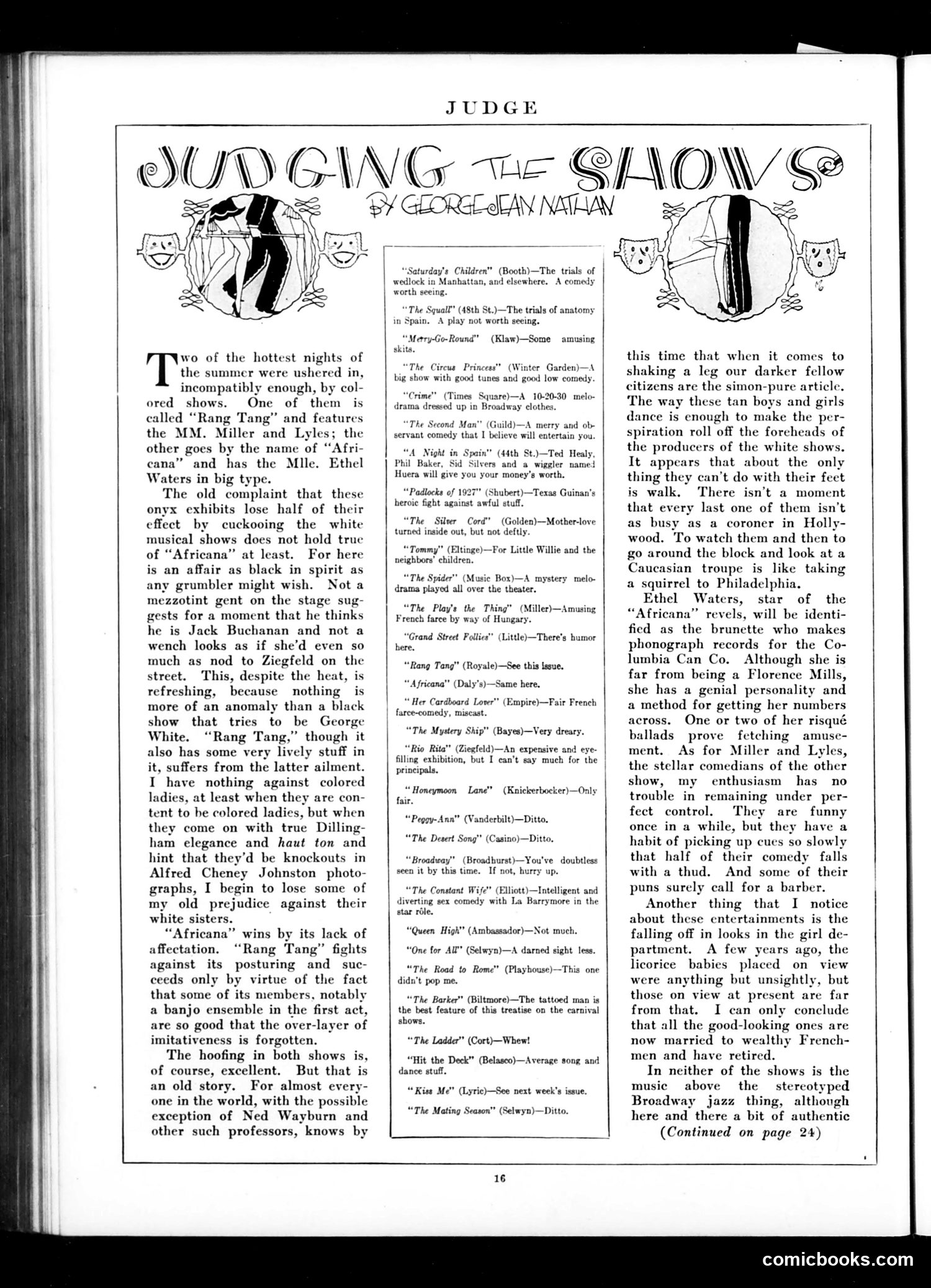
This is a theater review column by George Jean Nathan, a prominent drama critic of the 1920s. Rather than political satire, it's social commentary on Broadway musicals—specifically comparing two all-Black revues: "Rang Tang" and "Africana" (featuring Ethel Waters). Nathan's critique reveals period racial attitudes: he praises "Africana" for its authenticity, arguing Black performers shouldn't imitate white shows' "elegance and haut ton." He criticizes "Rang Tang" for its affectation and attempts to seem sophisticated like George White's productions. The column also lists brief reviews of other current Broadway productions. While Nathan's framing is paternalistic by modern standards—he presents himself as the arbiter of whether Black entertainers should aspire to white theatrical conventions—his actual preference is for authentic Black performance over imitation of white style. The page reflects 1920s segregated entertainment and the complex racial dynamics of the Jazz Age theater world.
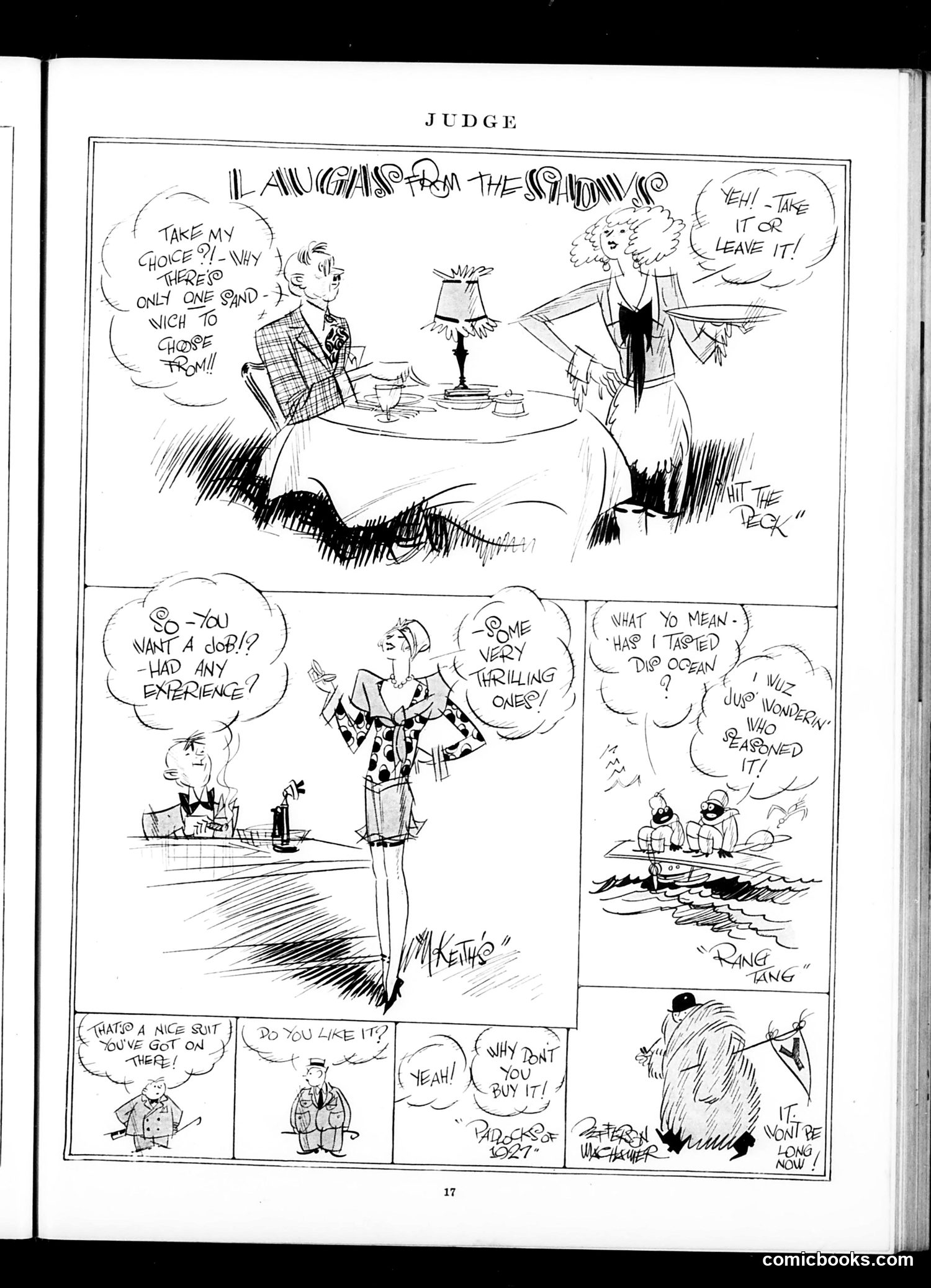
This multi-panel cartoon satirizes the social pretensions and contradictions of the newly wealthy during what appears to be the 1920s Jazz Age era. The narrative follows a man attempting to impress others through conspicuous consumption. In the opening panel, a woman offers him dining choices, establishing a scenario about decision-making. The subsequent panels show him encountering a woman at what appears to be a social venue, where he asks about her job experience—suggesting he's interviewing potential romantic or professional partners. The humor derives from the character's obvious lack of genuine sophistication despite his attempts at refinement. The final panels mock his pretension: he admires a suit, considers buying it, but when asked why he doesn't purchase it, his response reveals his actual financial limitations. The cartoon critiques the "nouveau riche"—those with recent wealth who lack the cultural education to match their spending, exposing the gap between their aspirations and reality through their fumbling social interactions and ultimate financial constraints.
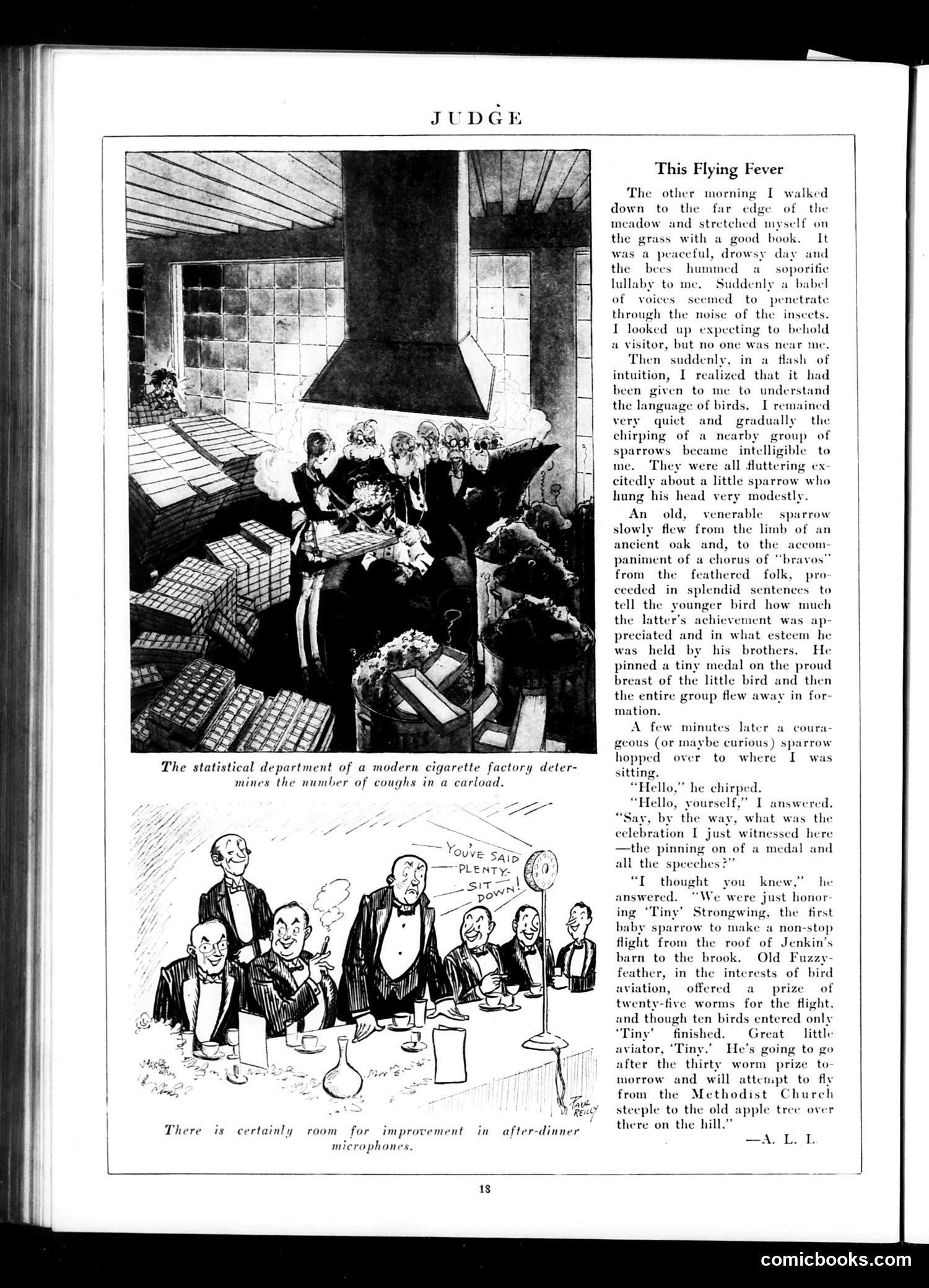
This page satirizes the contemporary aviation craze through anthropomorphized sparrows. The main story depicts birds honoring a young sparrow ("Tiny Strongwing") with a medal ceremony for completing a non-stop flight—a clear parody of human aviation achievement and medal-pinning ceremonies. The top illustration mocks industrial efficiency with a cigarette factory's "statistical department" counting coughs in a carload—satirizing how modern manufacturing obsesses over quantifying everything, even health hazards. The bottom cartoon ridicules after-dinner speeches, showing men at a table where one complains there's "plenty of room for improvement in after-dinner microphones," mocking the common bore of long-winded formal dinner speeches. The overall theme appears to be mocking early 20th-century fascinations: aviation mania, industrial quantification, and verbose social rituals—all presented with Judge's typical irreverent humor.
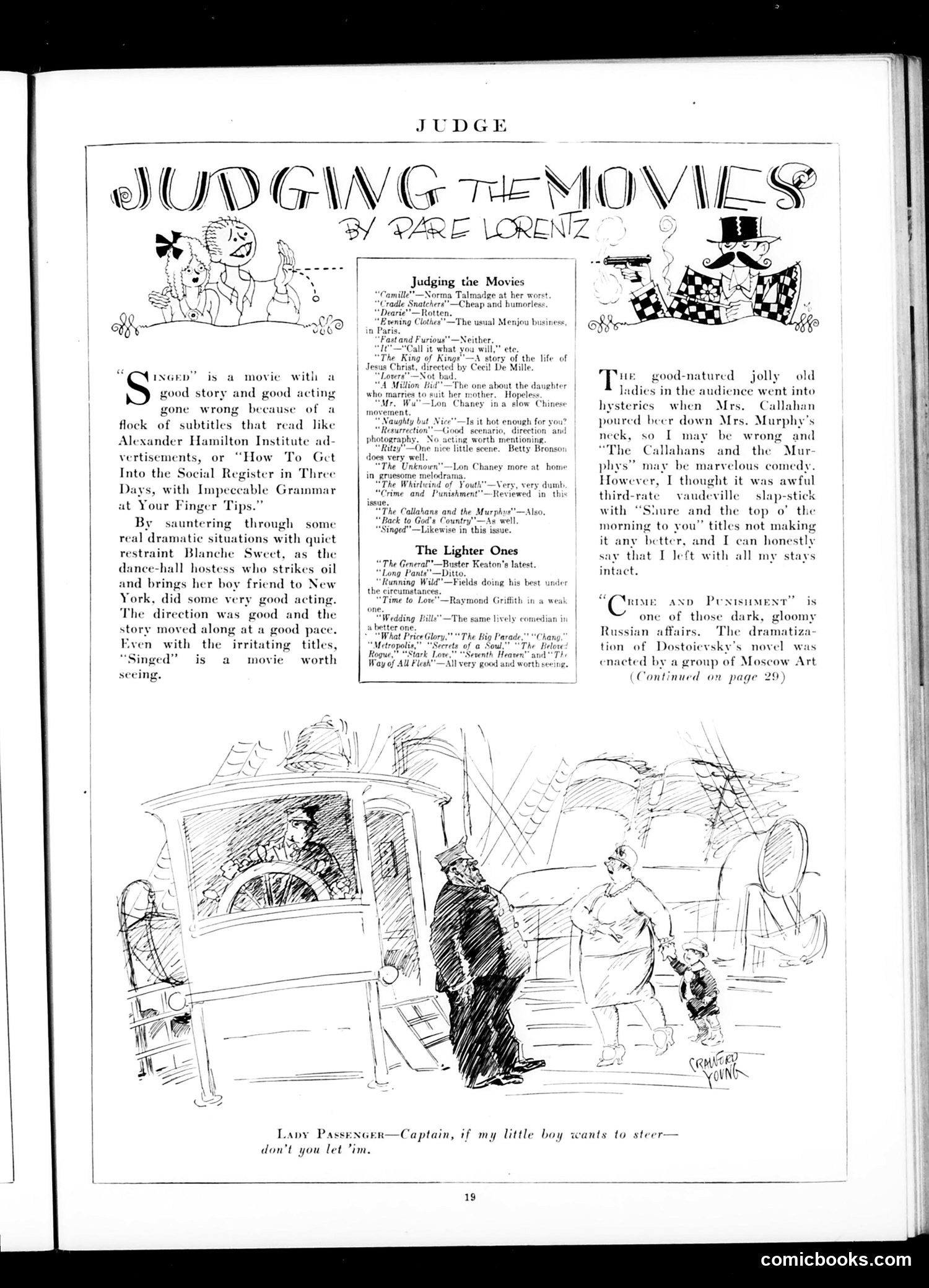
This page reviews several silent films, written by Pare Lorentz for Judge magazine's movie criticism column. The main cartoon depicts a ship scene with a lady passenger instructing a captain not to let her young son steer—a humorous domestic scene unrelated to the film reviews. The reviews themselves critique 1920s films including "Singed" (praised for its dramatic restraint and Blanche Sweet's acting despite annoying subtitle cards), "The King of Kings" (Cecil B. DeMille's biblical epic), and "Crime and Punishment" (a Russian adaptation of Dostoyevsky's novel). The critic dismisses some films as "dumb" or poor quality while praising others for good direction and acting. A notable joke mentions Mrs. Callahan pouring beer down Mrs. Murphy's neck during a comedy—clearly slapstick humor typical of 1920s films. The reviews represent typical early film criticism examining plot, acting, direction, and the then-novel use of title cards that frequently distracted audiences.
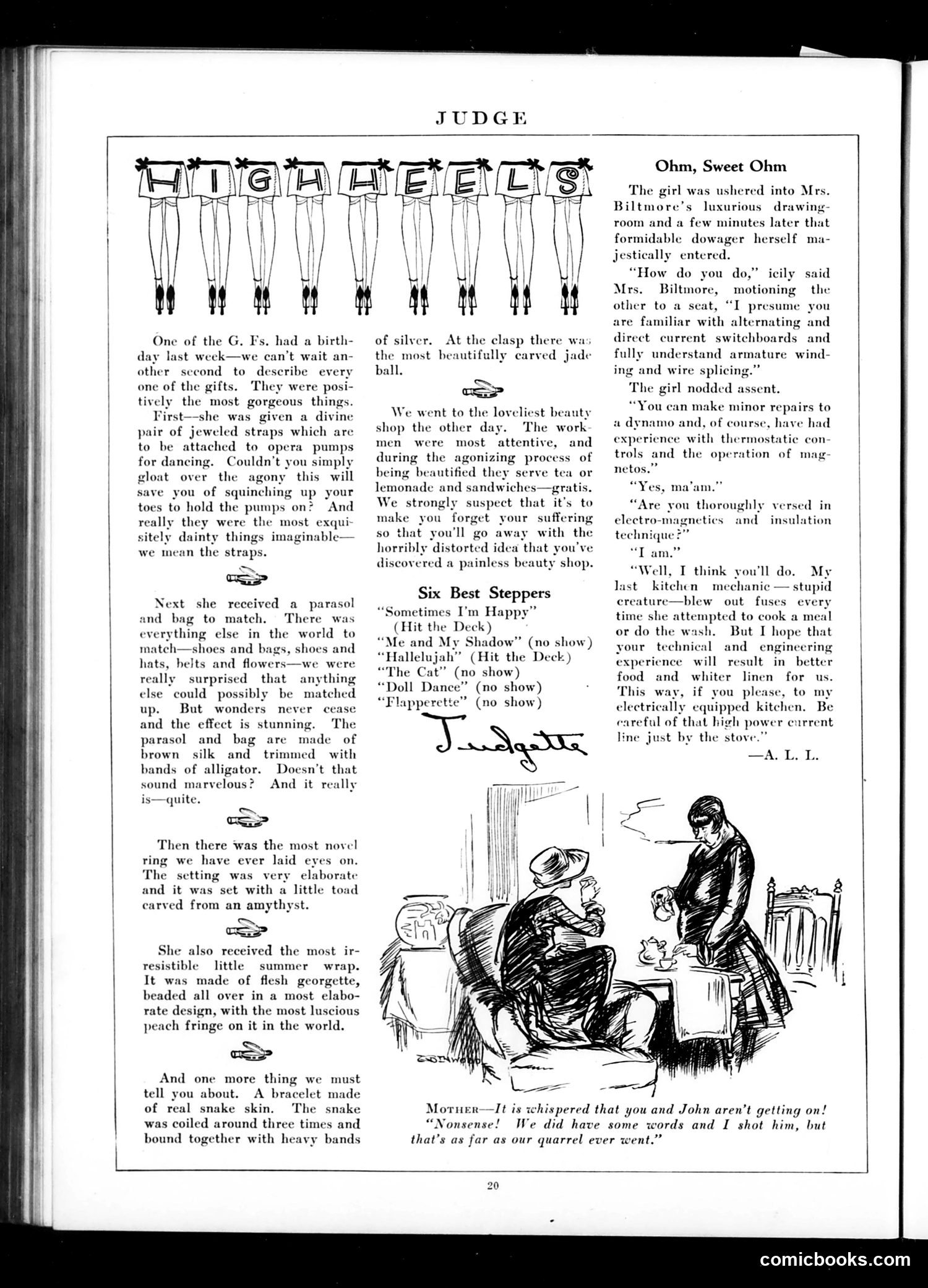
This page contains two distinct satirical pieces from the 1920s: **"Judge's Gifts"** (top): Social satire mocking wealthy women's obsession with luxury accessories. The piece ridicules the absurdity of high-end fashion items—jeweled opera pump straps, alligator-trimmed parasols, snake-skin bracelets with jade clasps—presented as thrilling solutions to mundane problems. The satire targets both the excessive materialism and the breathless, superficial tone of women's fashion magazines. **"Ohm, Sweet Ohm"** (bottom): Dark comedy about changing gender expectations. A society matron (Mrs. Biltmore) interviews a young woman for a kitchen position, but expects her to possess advanced electrical engineering skills—dynamo repair, circuit boards, magneto operation. The final cartoon shows the matron casually mentioning shooting her husband John during an argument, played for laughs. Together, these pieces satirize both the absurdity of demanding technical expertise from domestic workers and the era's changing (and confused) ideas about women's roles.
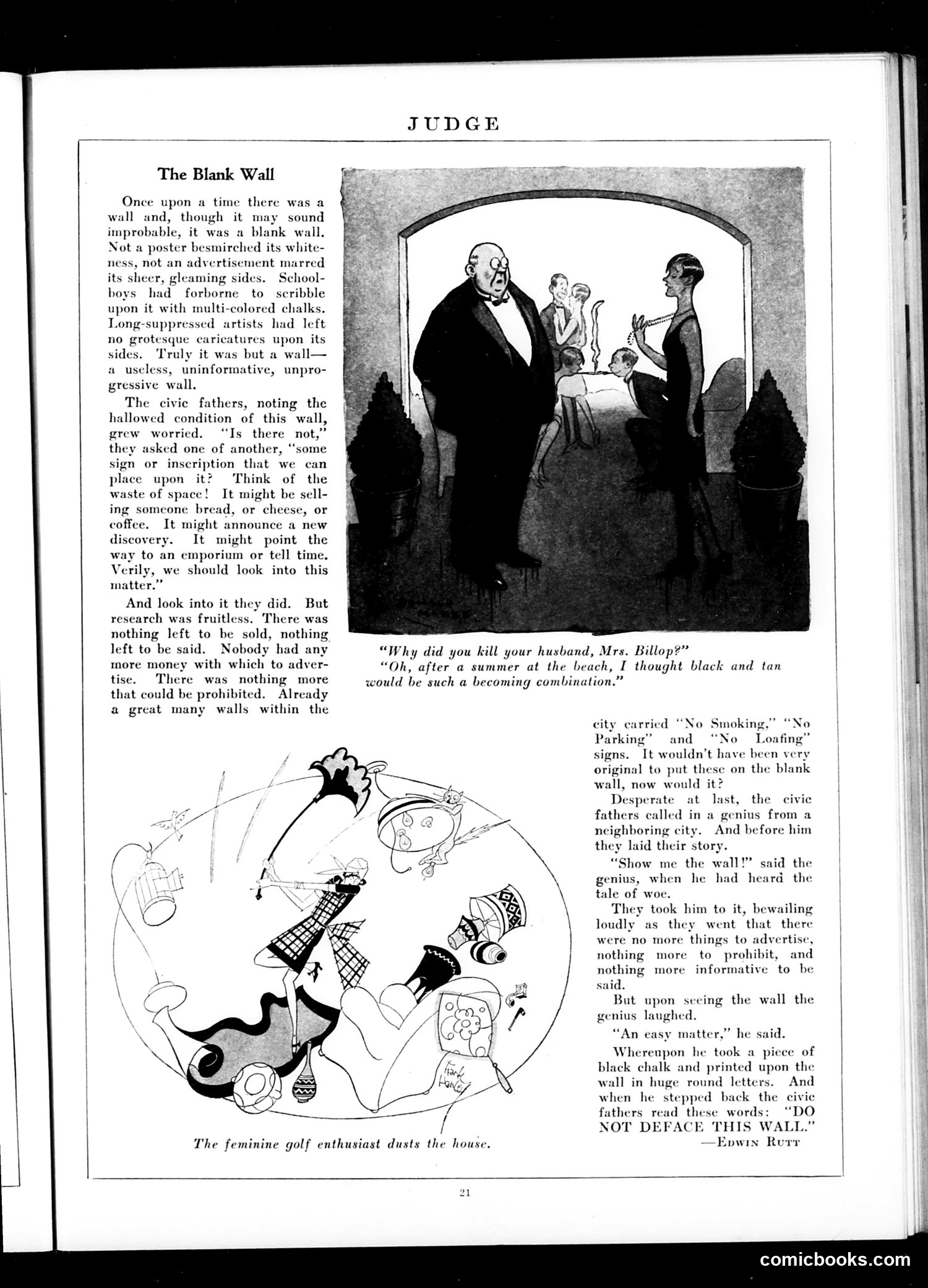
This story satirizes early 20th-century civic authorities' obsession with regulating public space. The "blank wall" represents unused urban surfaces—once a common sight. City officials, seeing wasted advertising potential, desperately seek something to place on it. Finding no commercial opportunities left (everything profitable already advertised), they're stymied. A hired "genius" solves their dilemma by posting "DO NOT DEFACE THIS WALL"—turning prohibition itself into the message. The satire's point: municipal government has become so regulation-obsessed that prohibiting defacement becomes the *only* remaining use for public space. Where once walls served commerce or information, they now merely enforce rules. The accompanying cartoon about "the feminine golf enthusiast" and the dark humor about the woman killing her husband (joking she wanted to look "black and tan") reflect period humor standards—crude by modern measures.
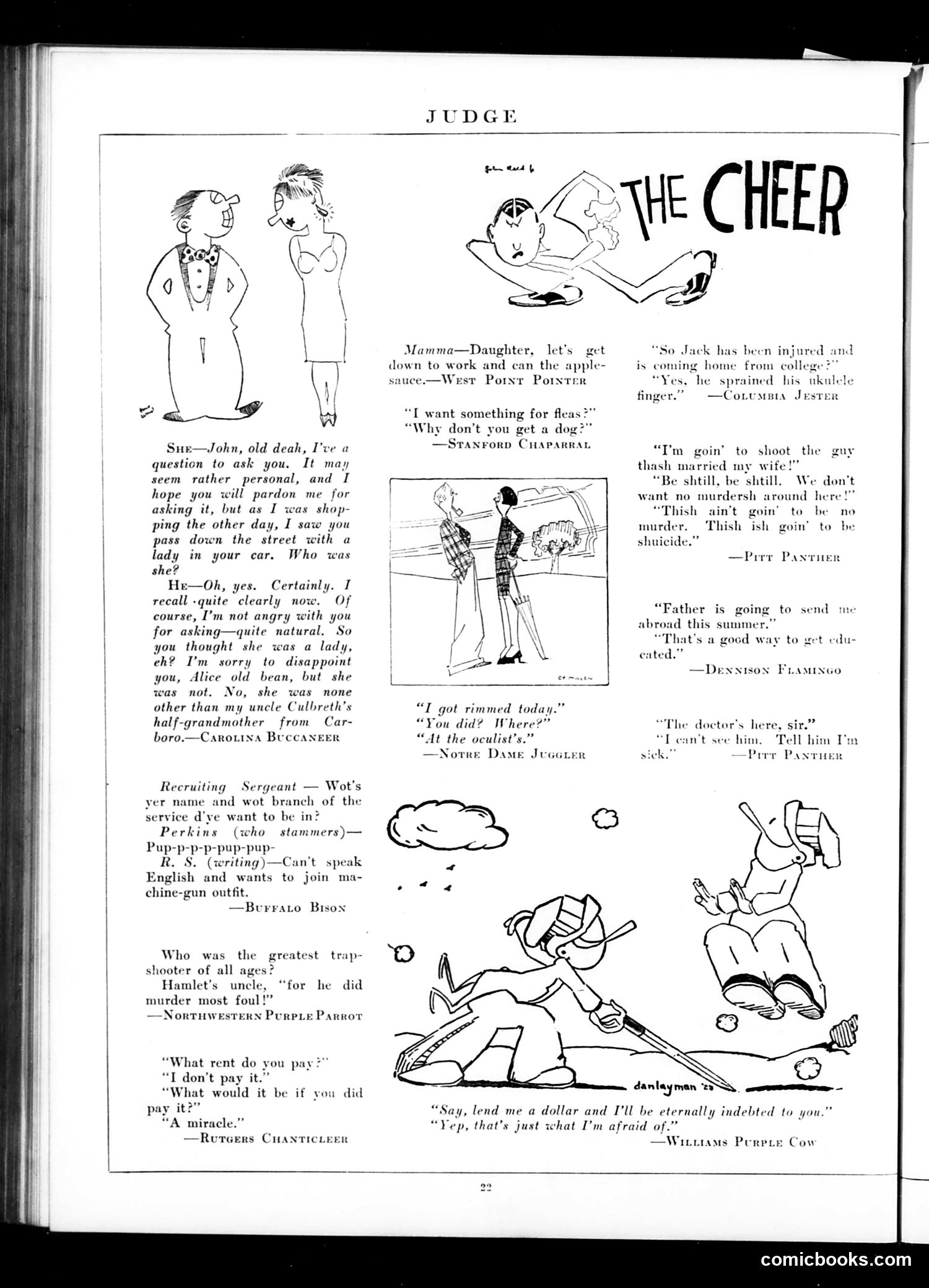
This page collects brief satirical jokes and comic vignettes typical of early 20th-century American humor magazines. The content targets: **Social/marital humor**: A husband deflects his wife's suspicion about a woman in his car with an absurd lie about his "uncle Culbreth's half-grandmother"—mocking both marital tension and male evasiveness. **Military recruiting**: A stammering recruit named "Pup-p-p-pup" is enlisted despite speaking poor English, satirizing either lax military standards or the absurdity of conscription. **College life**: A joke about someone spraining their "ukulele" (slang, unclear exact meaning here) when injured at college—mocking collegiate frivolity. **Violent humor**: Dark jokes about murder and suicide, reflecting period attitudes toward domestic violence. **Financial satire**: A final gag about lending money and permanent debt. The cartoons are crude line drawings. The overall tone is flip, sometimes cruel, and relies on wordplay, class stereotypes, and ethnic/regional dialects (stammering, drunken speech patterns). This reflects Judge's target audience of educated, upper-middle-class readers enjoying schadenfreude toward "lesser" groups.
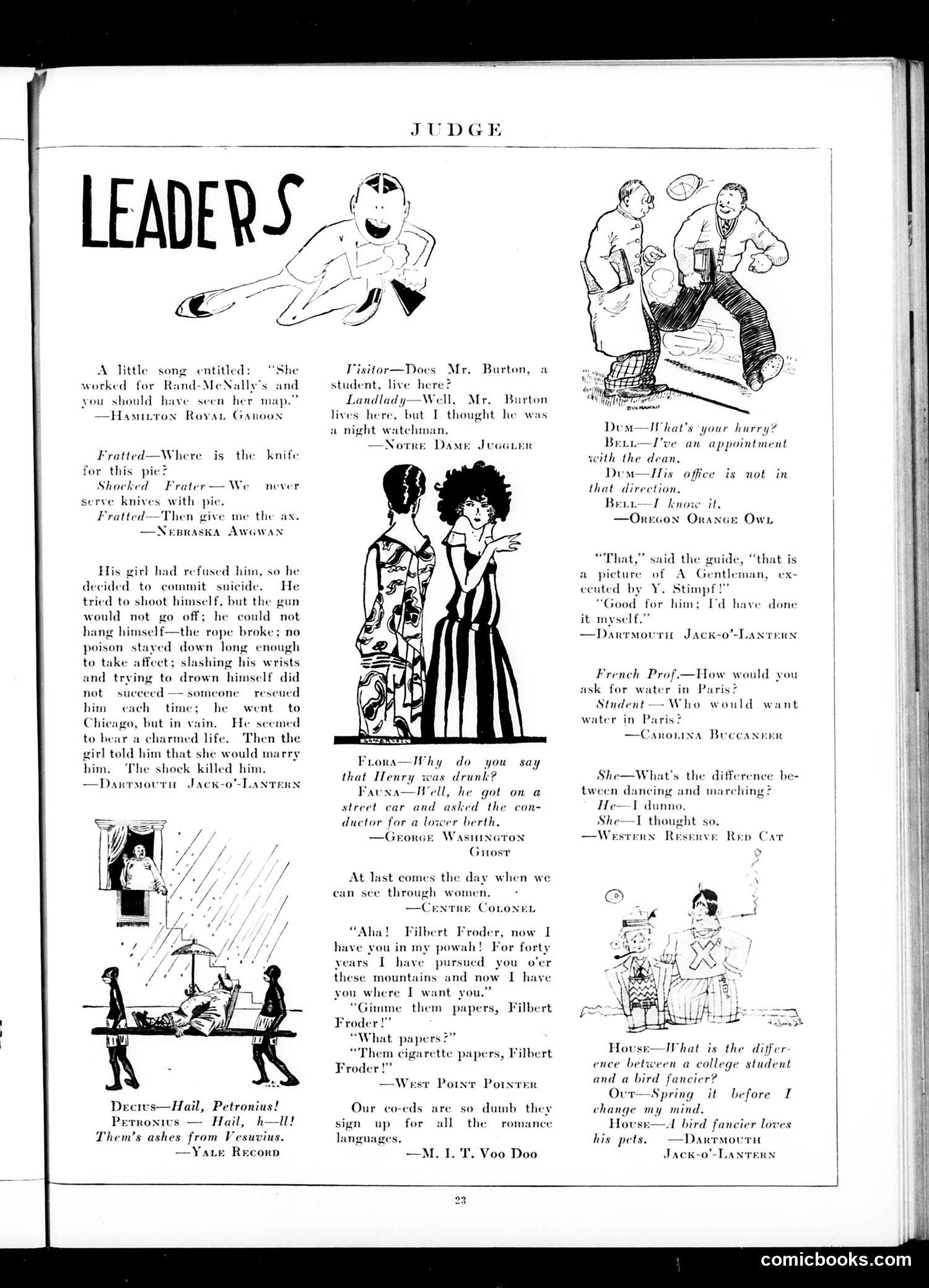
This is a humor page from *Judge* magazine featuring brief jokes and cartoons about college life, relationships, and social situations circa the early 20th century. **Key themes:** - **College stereotypes**: Dumb co-eds, absent-minded professors, disciplinary appointments with deans - **Romance mishaps**: A man's failed suicide attempts after romantic rejection (played for dark comedy) - **Class/social commentary**: References to servants, landlords, and working-class characters alongside students - **Absurdist humor**: Non-sequiturs like asking for water in Paris, or a 40-year mountain pursuit over cigarette papers **Notable elements:** The page includes what appears to be a classical/historical reference (Vesuvius, Petronius) alongside contemporary campus humor. Most jokes rely on wordplay, misunderstandings, and exaggeration rather than topical politics. The cartoons show period-appropriate clothing and settings. Overall, this represents *Judge's* satirical approach to American social life through comedic vignettes aimed at educated, affluent readers familiar with university culture.
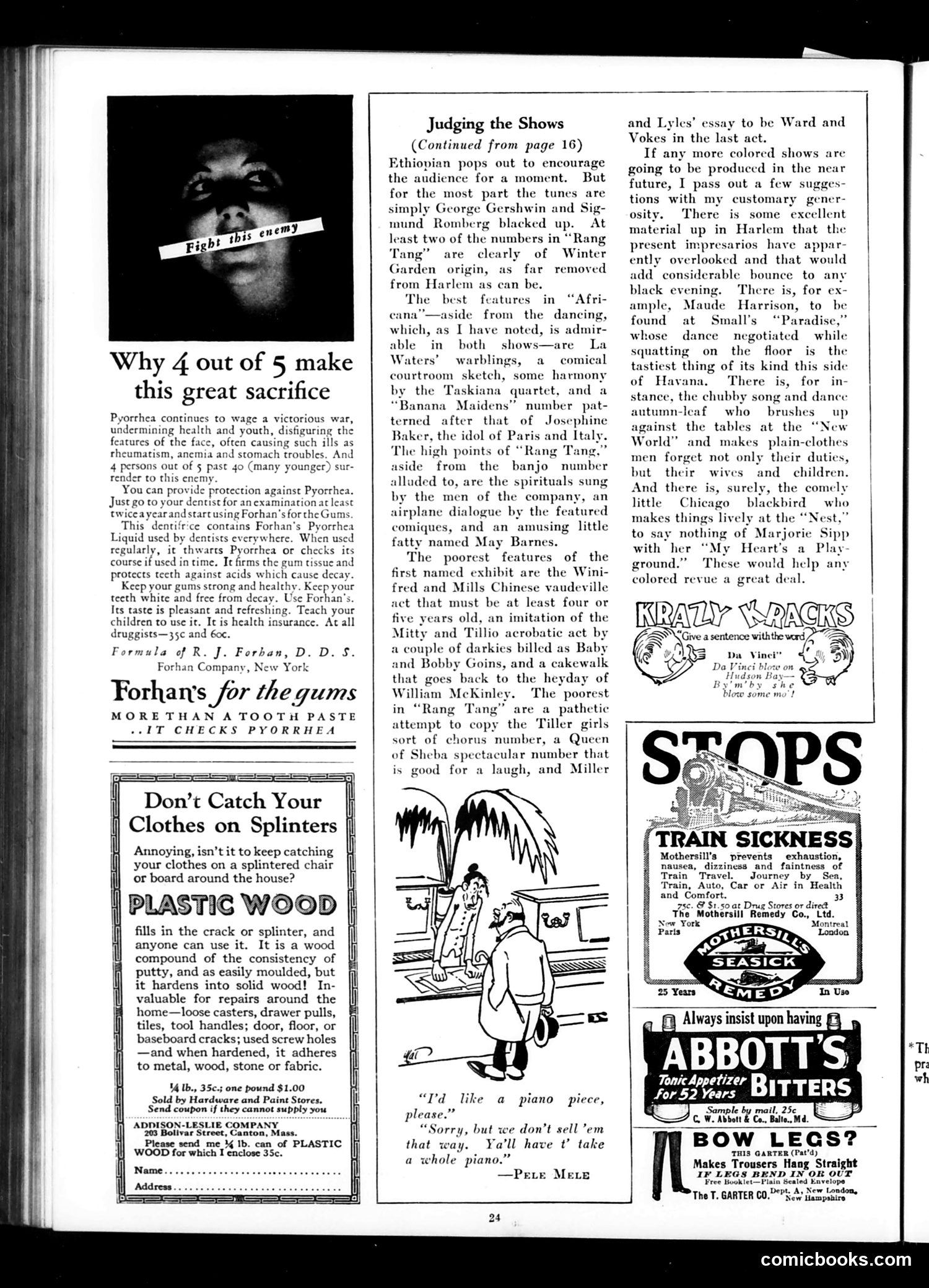
This page is primarily **advertising and theater criticism**, not political cartoons. The main content is a theater review titled "Judging the Shows," critiquing two Broadway productions featuring Black performers: "Africana" and "Rang Tang." The critic praises the dancing and some musical numbers but disparages dated acts and imitation routines, suggesting Harlem has better material overlooked by producers. The cartoons are incidental: one shows a Pele Mele joke about a pianist refusing to sell a single piano piece, and another illustrates a "Krazy Kracks" caption. The page is dominated by **product advertisements**: Forhan's toothpaste (for pyorrhea/gum disease), Plastic Wood filler, Mothersill's seasickness remedy, Abbott's Bitters, and Bow Legs treatment. The dated language and stereotyping in the theater review reflect 1920s racial attitudes, while the ads showcase period health concerns now considered quackery or obsolete.
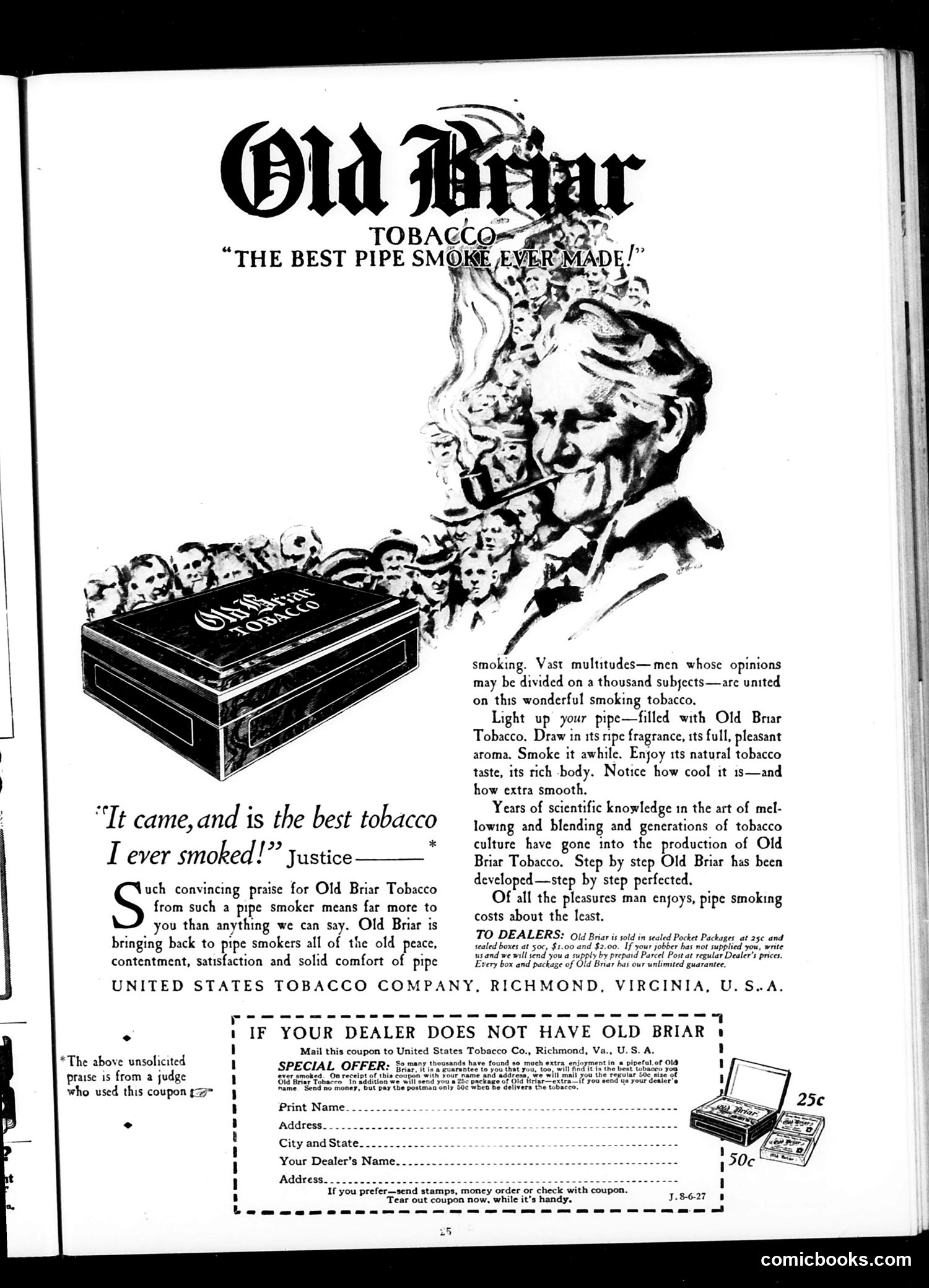
This is primarily a **tobacco advertisement**, not political satire. It ran in *Judge* magazine during the early 20th century. The page features a testimonial claiming a "Justice" (a judge) praised Old Briar Tobacco as "the best tobacco I ever smoked"—the asterisk notes this is "unsolicited praise." The advertisement uses this authority figure's endorsement to legitimize the product, arguing that if someone whose profession requires sound judgment endorses it, consumers should trust the recommendation. The imagery shows a distinguished older man smoking a pipe, surrounded by smaller faces (appearing to represent "vast multitudes" mentioned in text), suggesting widespread appeal across social classes and opinions. The central claim is that pipe smoking is affordable, satisfying, and has been "perfected" through generations of tobacco expertise. A coupon offers dealers ordering information. This reflects early 20th-century advertising practices: celebrity/authority endorsements, appeals to tradition and scientific progress, and direct-mail sales mechanisms.
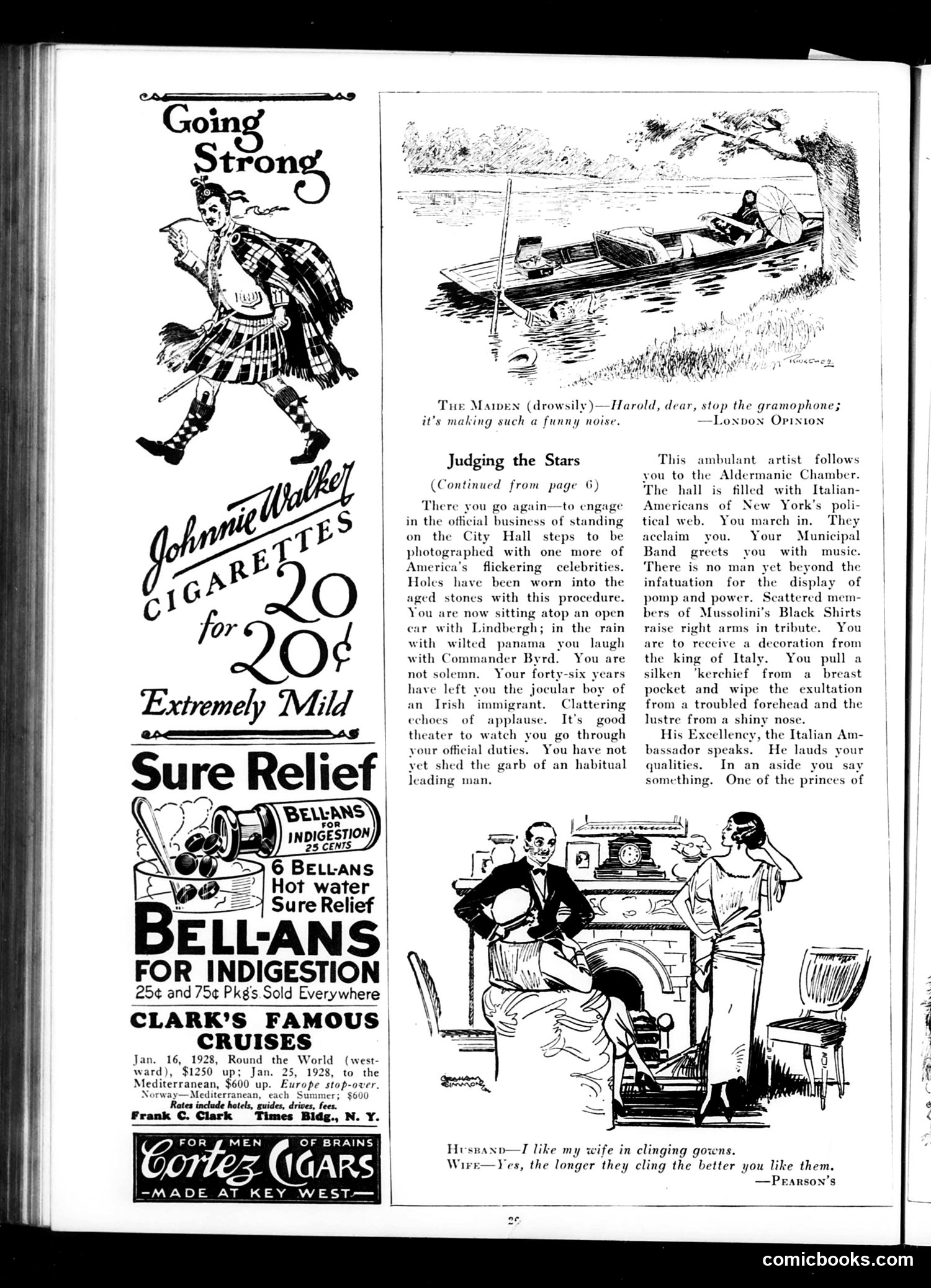
This page is primarily **advertising** with one cartoon feature. **Main Content:** The "Judging the Stars" article (continued from page 6) appears to satirize a prominent public figure—likely a mayor or city official—who poses with celebrities for photo opportunities. The text critiques his constant need for public acclaim and theatrical posturing, noting his "forty-six years" haven't diminished his "jocular boy" behavior. A notable detail: the piece mentions Italian-Americans, Mussolini's Black Shirts, and an Italian king's decoration, suggesting the subject may be courting Italian-American voters during the Fascist era. **The Single Cartoon:** A husband-wife joke about clinging gowns—a mild double entendre about marital preferences. **Advertisements:** Johnnie Walker Cigarettes, Bellans indigestion remedy, Clark's cruise packages, and Cortez cigars dominate the left column. The magazine appears to be from **January 1928** based on cruise dates visible.
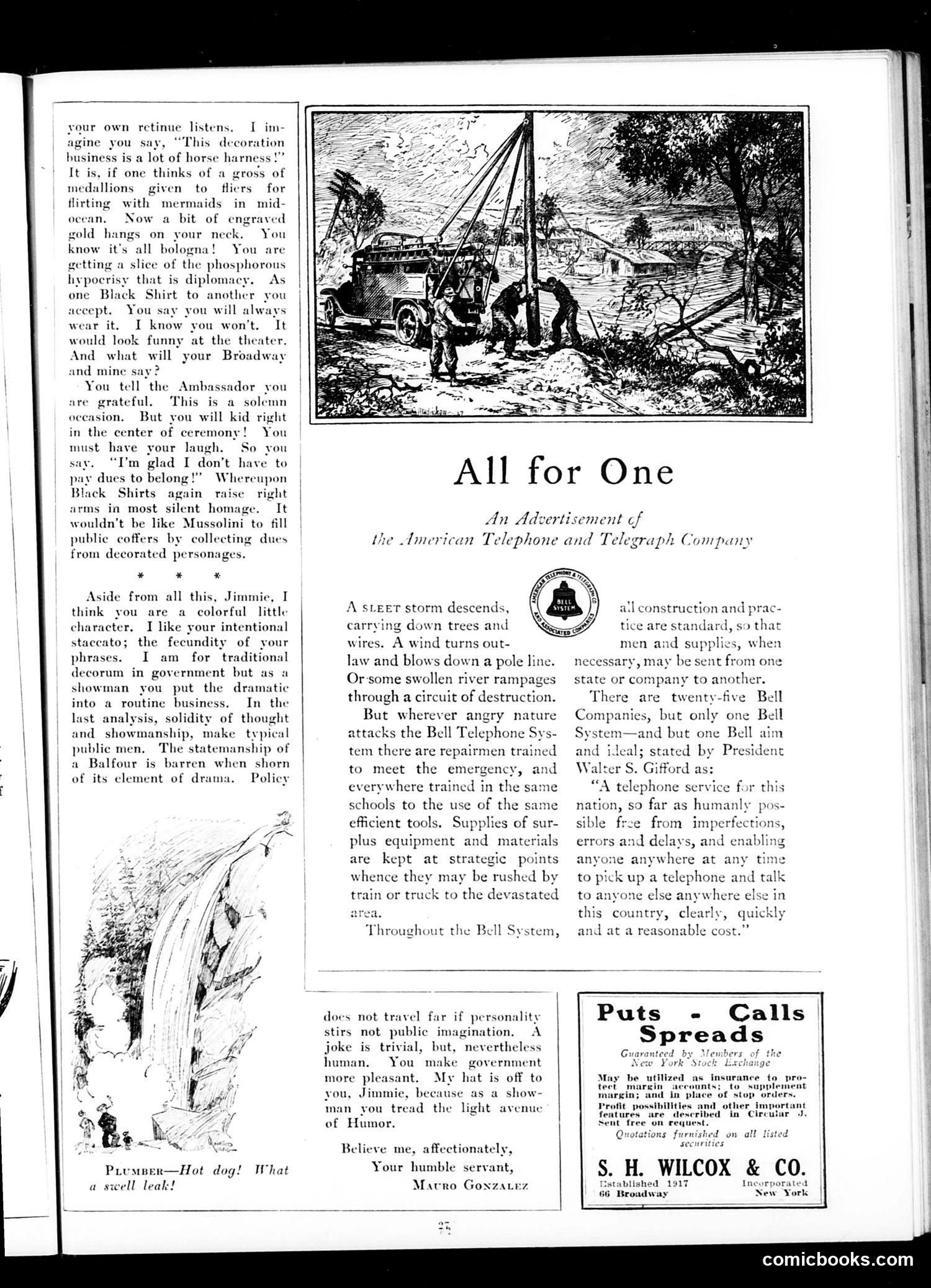
This page primarily contains **advertising content** rather than satirical cartoons. The dominant feature is a full advertisement for the American Telephone and Telegraph Company ("All for One"), highlighting the Bell System's standardized emergency response capabilities—how trained repairmen and shared equipment across twenty-five regional Bell Companies enable rapid disaster recovery. The left column contains a **political satire** by Mario Gonzalez addressing someone named "Jimmie" (likely a public figure, unclear which one from the image alone). The text criticizes what appears to be **fascist ceremonialism**—references to "Black Shirts," medallions, raises of right arms, and associations with Mussolini suggest satire of fascist pageantry and compulsory loyalty practices. Gonzalez mocks the hypocrisy of such "decoration business" while praising the subject's theatrical showmanship in government. A small illustration labeled "Plumber—Hot dog! What a swell leak!" provides minor visual humor unrelated to the main content. The page is primarily **commercial**, using patriotic messaging about unified national infrastructure to promote AT&T.
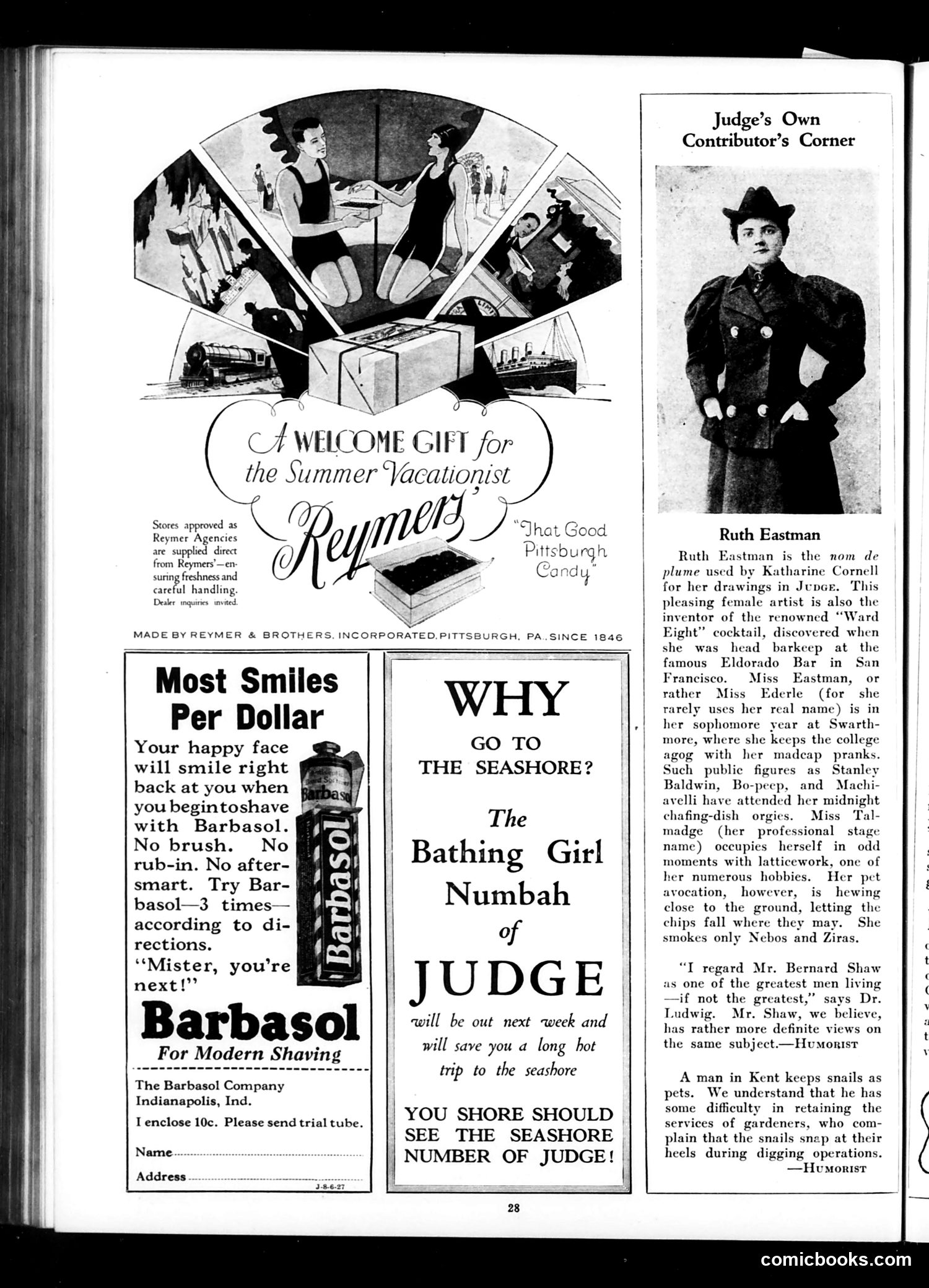
This page is primarily **advertising and contributor features** rather than political satire. The main content includes: **"Judge's Own Contributor's Corner"**: A profile of Ruth Eastman, a female artist and illustrator for Judge magazine. The text reveals she's actually Katharine Cornell (using a pen name) and invented the "Ward Eight" cocktail while working as a bartender in San Francisco. The piece humorously describes her college pranks and odd hobbies like latticework. **Advertisements**: - Reymer's candy ("A Welcome Gift for Summer Vacationist") - Barbasol shaving cream, emphasizing modern convenience - A teasing advertisement for Judge's next issue, promising a "Bathing Girl Numbah" **Humor column**: Brief anecdotes about Bernard Shaw and a man in Kent with pet snails. The page reflects 1920s-era magazine culture, celebrating modern products and showcasing the publication's creative contributors. There is no significant political commentary visible.
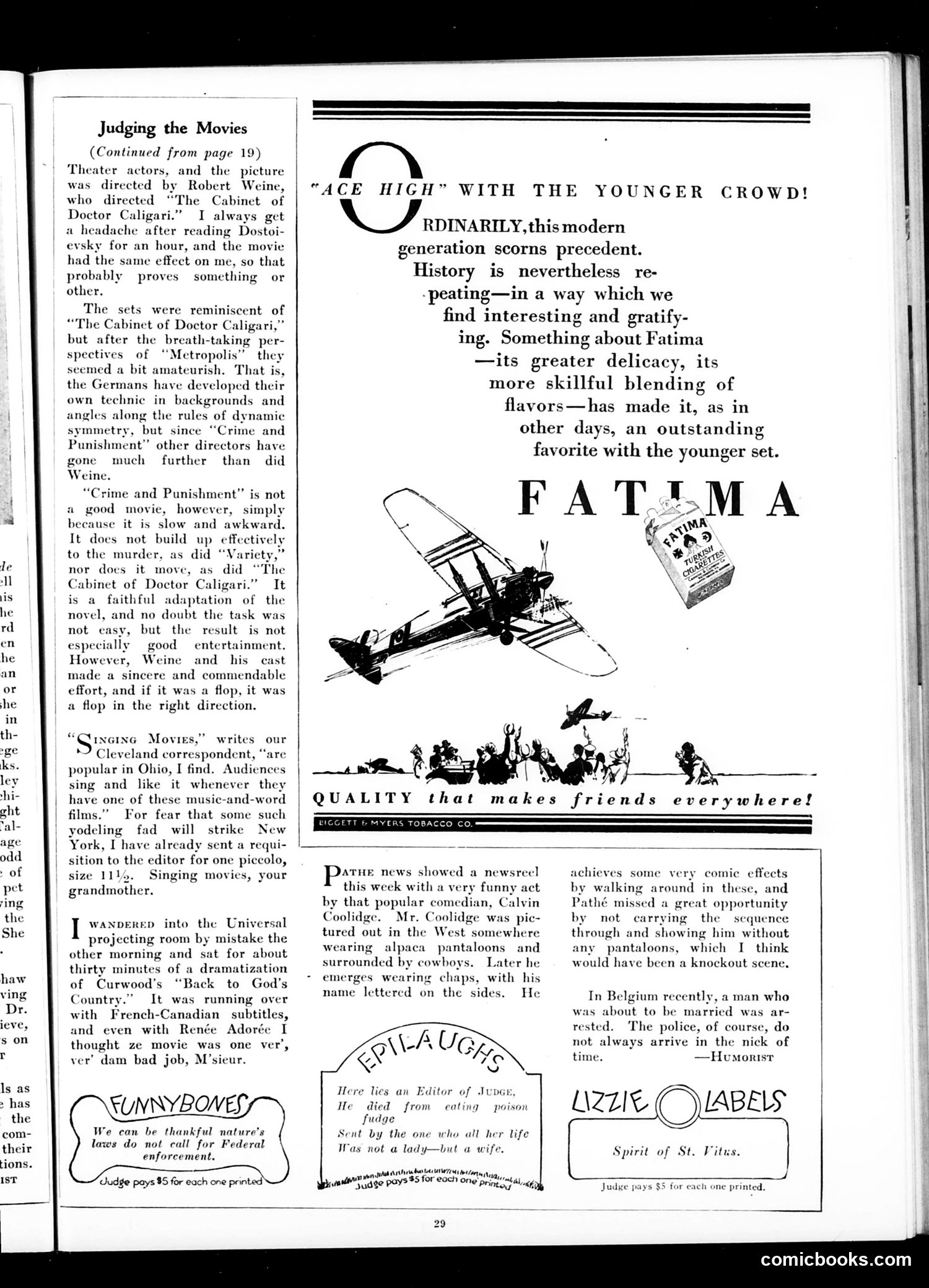
This page contains film criticism and advertisements from Judge magazine (likely 1920s). The main content critiques Robert Weine's "Crime and Punishment," a German expressionist film adaptation. The reviewer praises the actors' sincerity but criticizes the film as slow and poorly structured compared to contemporary works like "Metropolis" and "Variety." A sidebar anecdote mocks "singing movies"—early sound films—suggesting a correspondent fears this novelty trend will reach New York, joking about requisitioning ear protection. The page includes **three cigarette advertisements** for Fatima brand, featuring an airplane and silhouetted figures. The tagline emphasizes the product's appeal to "younger" consumers through claims of "delicacy" and "skillful blending." The humor sections ("Funnybones," "Epilaughs," and "Lizzie Labels") contain brief jokes, including one about Calvin Coolidge wearing alpaca pants in a newsreel—trivial celebrity humor typical of the era.
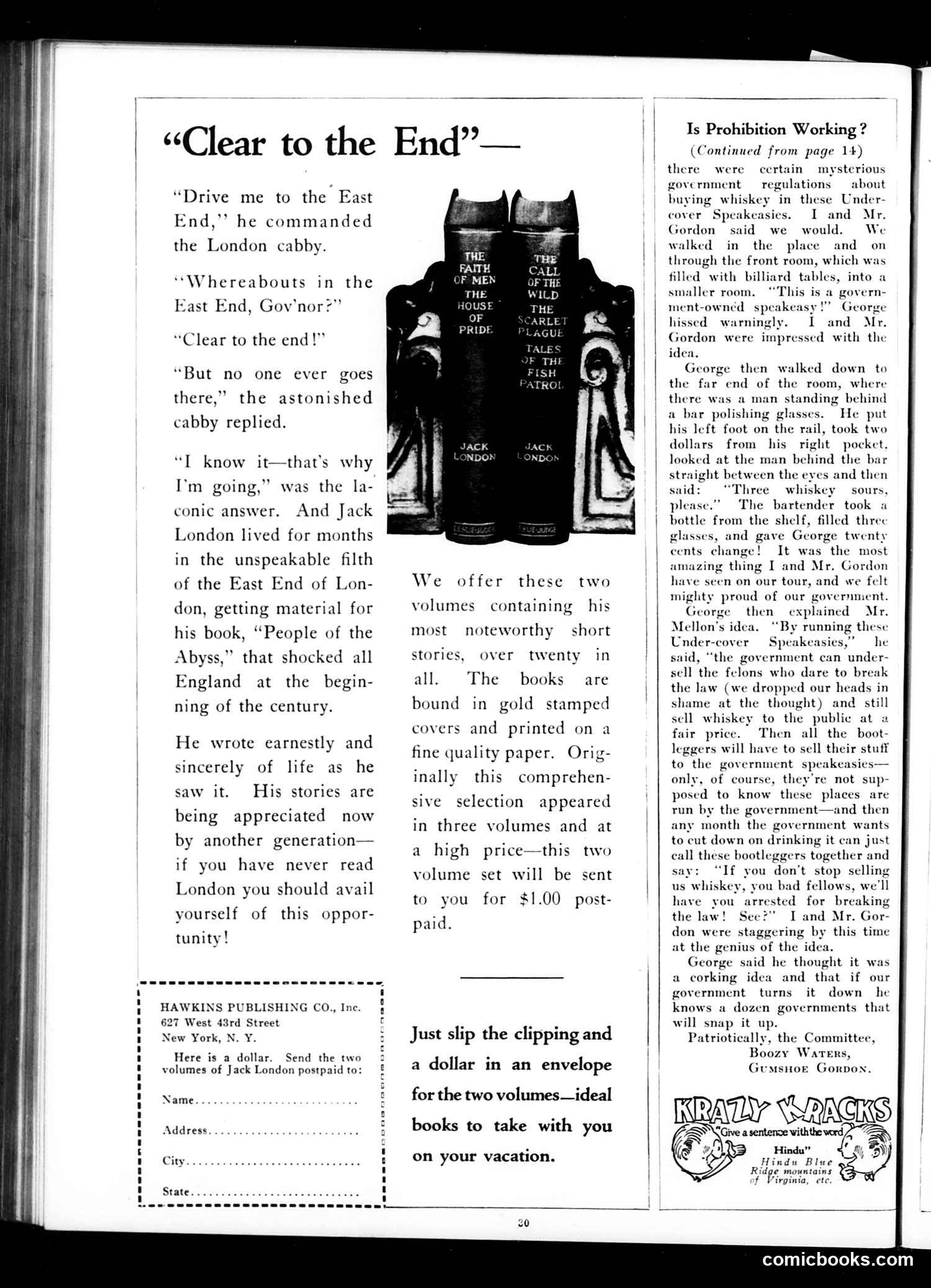
This page contains two distinct sections: **advertisement** (left/center) and **satirical commentary** (right). The **ad promotes Jack London's short story collections**, emphasizing his famous work *"People of the Abyss"*—his firsthand account of living in London's impoverished East End. The dialogue humorously frames London's decision to visit this dangerous, avoided neighborhood. The **right column satirizes Prohibition enforcement**. Under the heading "Is Prohibition Working?" the author describes visiting an apparent government-run speakeasy. The satire exposes the absurdity: the government supposedly operates illegal bars to catch and prosecute bootleggers while simultaneously selling them whiskey at fair prices—a circular logic where authorities pretend not to know their own establishments exist. The named contributors—"Boozy Waters" and "Gumshoe Gordon"—are obviously pseudonymous, mocking both drunk revelry and detective work. The satire targets Treasury Secretary Mellon's Prohibition strategy as idiotic, suggesting even foreign governments would adopt such a "corking idea." The piece ridicules Prohibition-era enforcement hypocrisy and governmental contradiction.
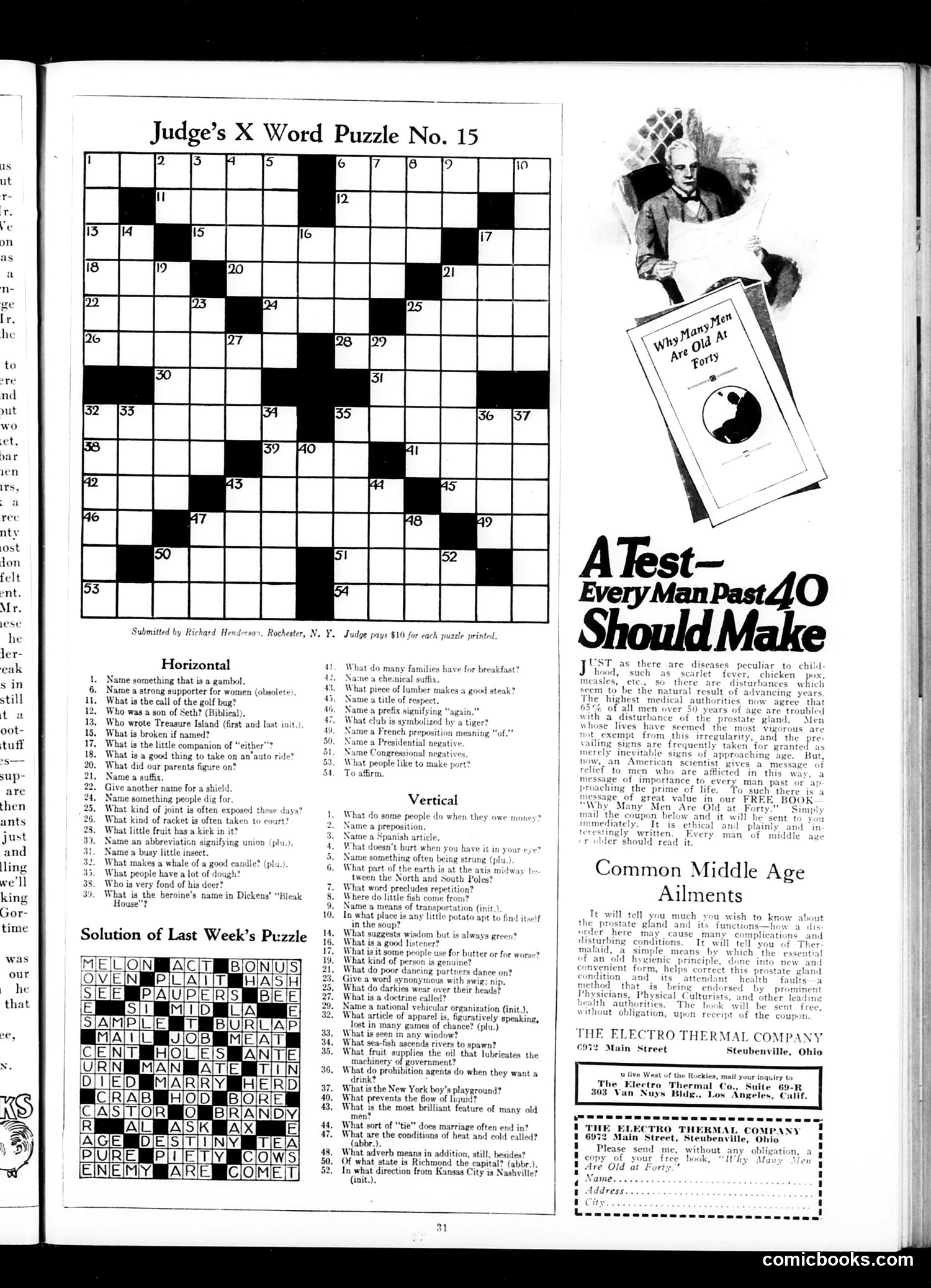
This page contains a **crossword puzzle** ("Judge's X Word Puzzle No. 15") and related advertisements—not political cartoons. The puzzle itself is a standard word game with clues referencing common knowledge, literature, and wordplay typical of 1920s-era puzzles. The significant content is the adjacent advertisement: **"A Test—Every Man Past 40 Should Make."** This promotes a free pamphlet from the Electro Thermal Company titled "Why Many Men Are Old at Forty." The ad reflects early 20th-century medical marketing that connected male aging to **prostate gland dysfunction**. It claims that 65% of men over 50 experience such disturbances and frames this as a treatable "ailment" rather than natural aging. The advertisement uses pseudo-scientific authority and free educational materials as sales tactics—a common approach in this era before modern medical regulation. The joke or satire (if intended) lies in the period's obsession with medicalizing normal aging and marketing dubious "treatments" to anxious middle-aged men.
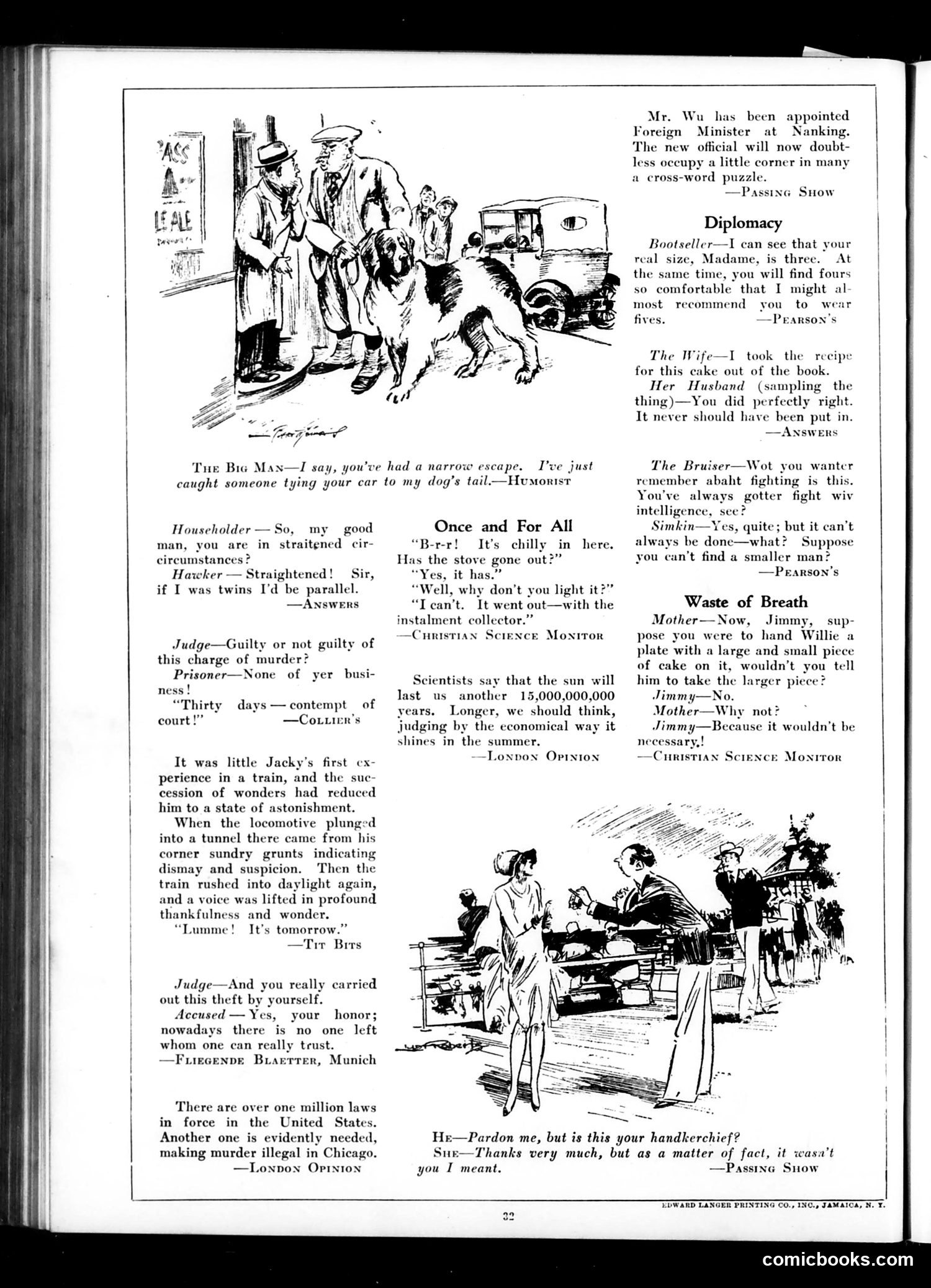
This is a humor-focused page from *Judge* magazine, a prominent American satirical publication. The content consists entirely of short jokes and comic vignettes rather than political cartoons. The illustrations depict everyday domestic and social scenarios: a man whose car is tied to a dog's tail, a poor householder, a courtroom exchange, a child's first train experience, and a woman discussing handkerchiefs. The humor is largely **wordplay and absurdist comedy** rather than satirical commentary. Examples include a prisoner claiming murder accusations are "none of yer business," a child exiting a train tunnel believing it's "tomorrow," and a woman defending her failed cake because "it never should have been put in" a cookbook. Brief topical references appear: Wu's appointment as Foreign Minister at Nanking (unclear historical context without dating), and London quips about the sun's longevity and Chicago's lawlessness. The page reflects *Judge*'s characteristic genteel, punning humor aimed at middle-class readers—prioritizing clever wordplay and domestic comedy over hard-hitting political satire.
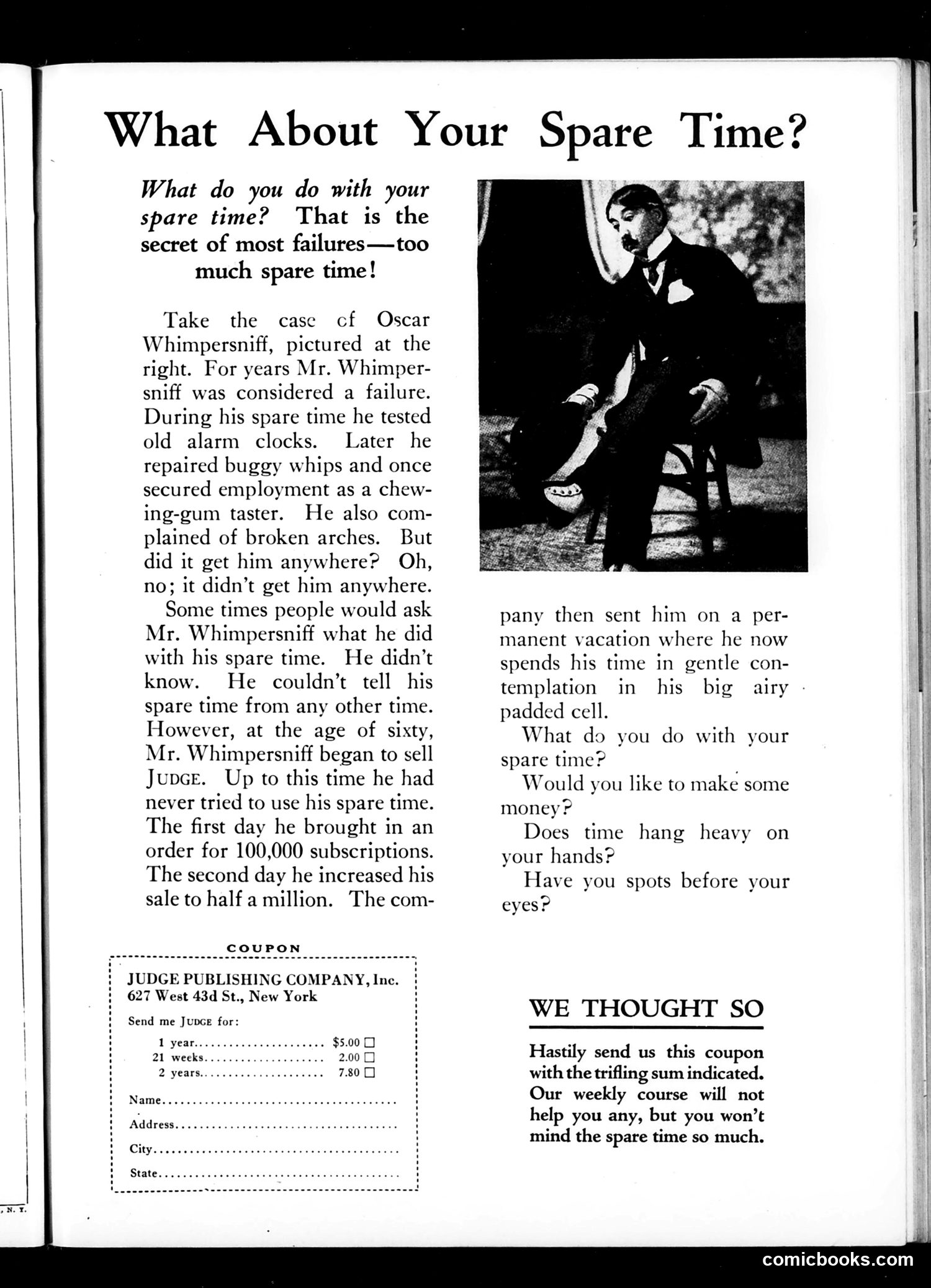
This is a satirical advertisement for *Judge* magazine masquerading as motivational content. The piece mocks the self-help industry and the American obsession with productivity. **The Satire:** Oscar Whimpersniff is a fictional "failure" who wastes his spare time on useless pursuits (testing alarm clocks, repairing buggy whips). The implication: idle hands lead to ruin. However, the punchline subverts this—when he finally uses spare time productively (selling *Judge* subscriptions), he becomes wildly successful almost overnight. **The Joke:** The ad then turns on itself cynically. It acknowledges that *Judge's* "weekly course will not help you any," but claims readers won't mind wasting spare time if they subscribe. This mocks contemporary mail-order self-improvement schemes that promised success but delivered little of value. **Context:** This reflects early 20th-century anxieties about leisure time, productivity, and the promise of mail-order success courses—a common target of *Judge's* satirical humor about American commercial culture and consumer gullibility.
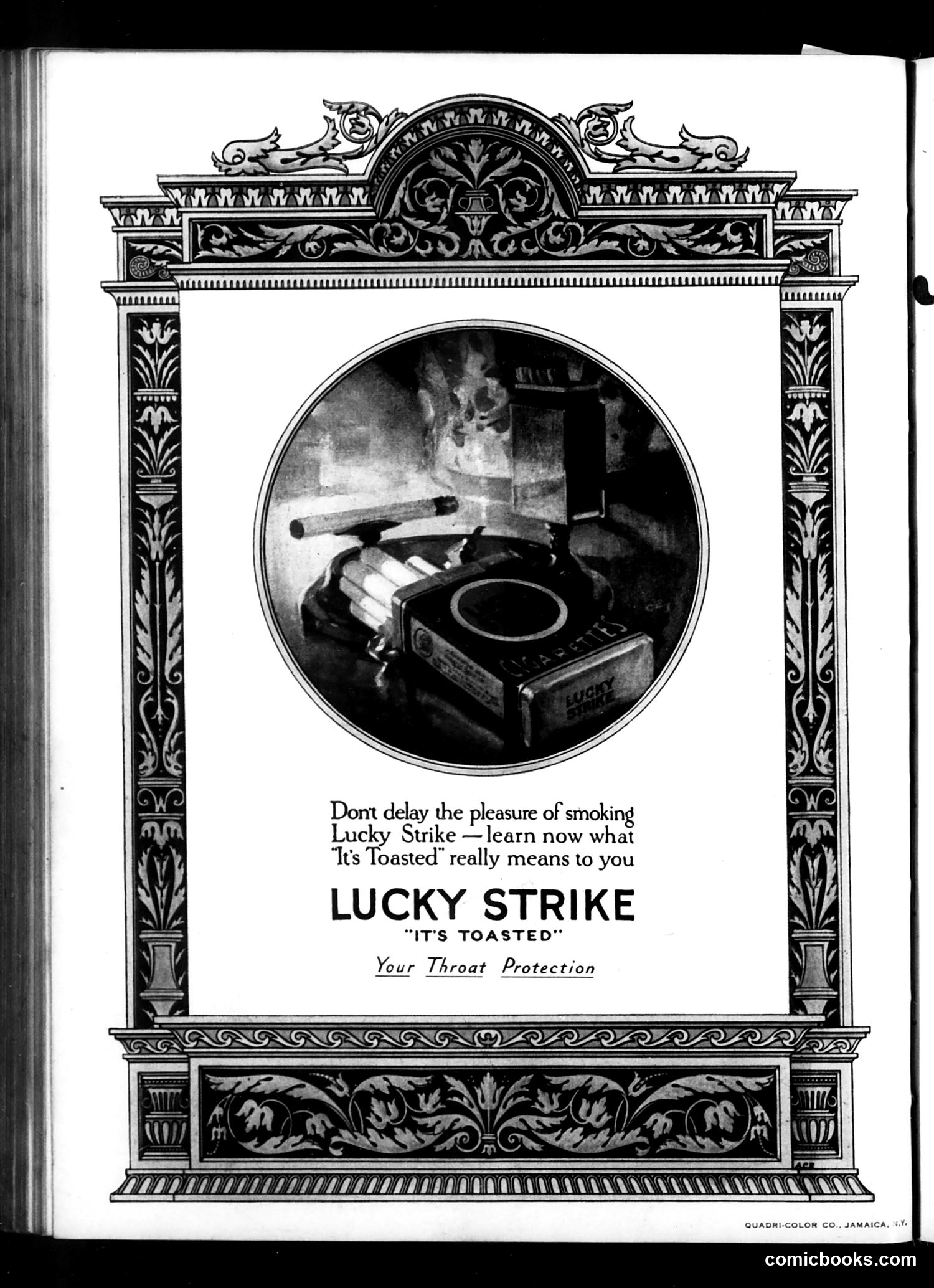
This is a **cigarette advertisement**, not political satire. It's a full-page ad for Lucky Strike cigarettes from Judge magazine, featuring an ornate decorative frame typical of early 20th-century advertising design. The ad promotes Lucky Strike's "It's Toasted" slogan, claiming this process provides "Your Throat Protection"—a marketing claim designed to address health concerns about smoking that were emerging even then. The circular photograph shows cigarettes, matches, and a lighter arranged as lifestyle props. The ad reflects the era when cigarette companies made health-related claims without scientific basis, before tobacco advertising restrictions. "It's Toasted" referred to the tobacco curing process, which the company marketed as uniquely protective—a claim that modern readers would recognize as misleading health messaging typical of mid-century tobacco marketing.