
Judge, 1927-08-06 · page 15 of 36
Judge — August 6, 1927 — page 15: what you’re looking at
What you’re looking at
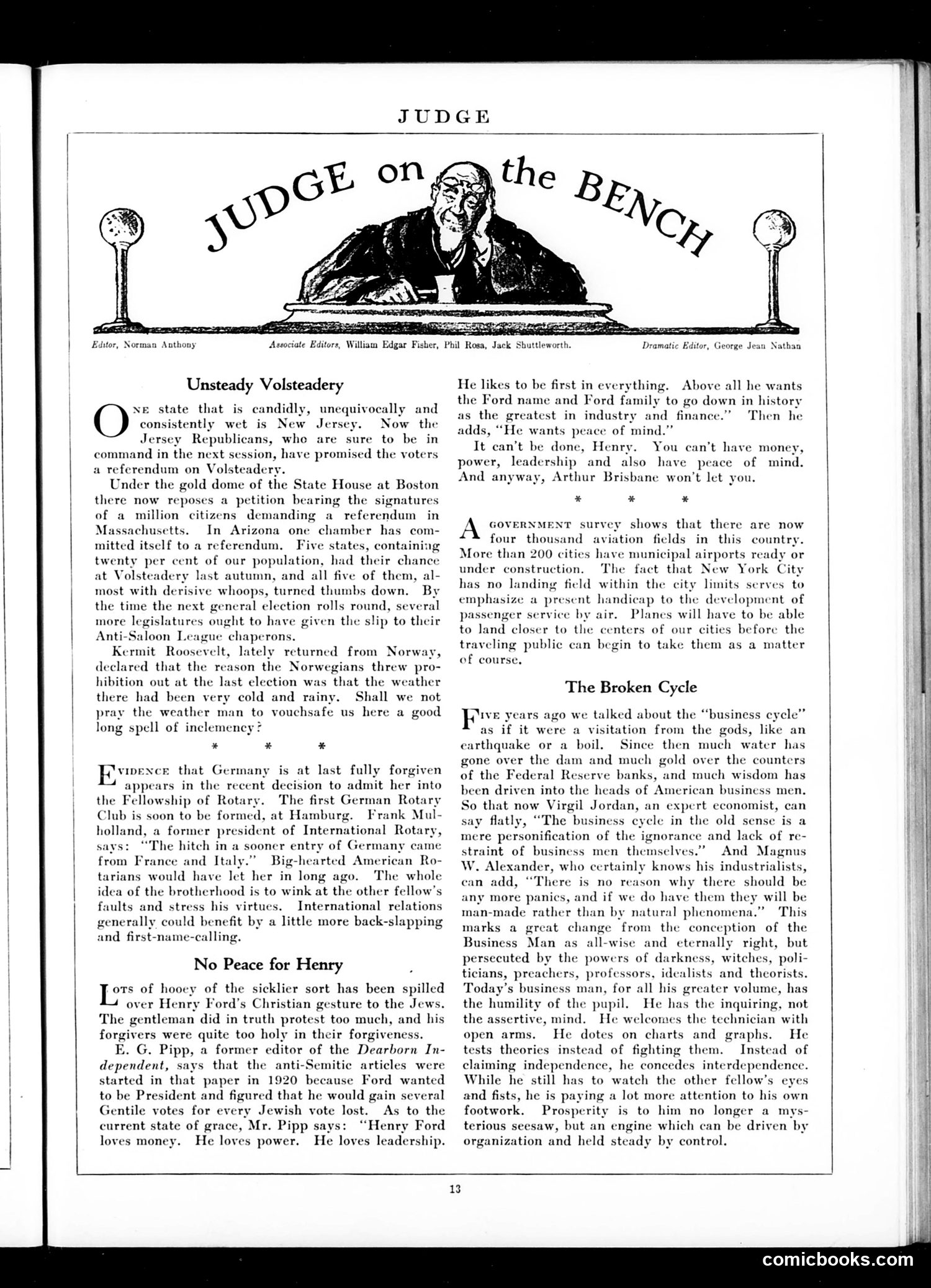
This page contains editorial commentary on several 1920s political issues: **Volsteadery (Prohibition)**: The lead article mocks the Volstead Act (Prohibition enforcement). It notes that despite efforts, multiple states are moving toward referendums to overturn prohibition, with citizens voting against it. The joke references Kermit Roosevelt claiming Norwegians rejected prohibition due to bad weather. **Germany and Rotary**: A brief note celebrates Germany's admission to the International Rotary Club, ironically suggesting America's forgiveness comes through business fellowship. **Henry Ford**: The article criticizes Ford's recent public apology to Jewish communities regarding anti-Semitic articles published in his *Dearborn Independent* (1920-1922). The satire suggests Ford's gesture was self-serving—motivated by presidential ambitions rather than genuine contrition. The concluding barb: Ford cannot simultaneously achieve money, power, leadership, *and* peace of mind. **Aviation**: A brief note on expanding airport infrastructure reflects contemporary technological optimism. The page exemplifies Judge's satirical approach to prominent figures and current events.
📄 Transcribed text from this page (OCR, searchable)
Machine-transcribed from the original scan — historical spelling and the odd misread are preserved.
JUDGE Editor, Norman Anthony Auociate Editors, William Edgar Fisher, Unsteady Volsteadery unequivocally and Ne state that is candidly, consistently wet is New Jersey. Now the Jersey Republicans, whe are sure to be in command in the next session, have promised the voters a referendum on Volsteadery. Under the gold dome of the State House there now reposes a petition be of million citizens demanding a referendum in Massachusetts. In Arizona one chamber has com- mitted itself to a referendum, states, contain twenty per cent of our population, had their chance at Volsteadery last autumn, and all five of them, al- most with derisive whoops, turned thumbs down. By the time the next general election rolls round, several more legislatures ought to have given the slip to their Anti-Saloon League chaperons. ermit Roosevelt, lately returned from Norway, declared that the reason the Norwegians threw pro- hibition out at the last election was that the weather there had been very cold and rainy. Shall we not pray the weather man to vouchsafe us here a good long spell of inclemency ? ing the * ¥ * Qivipence that Germany is at last fully forgiven appears in the recent decision to admit her into the Fellowship of Rotary. The first German Rotary Club is soon to be formed, at Hamburg. Frank Mul- holland, a former president of International Rotary, says: ‘The hitch in a sooner entry of Germany came from France and Italy.” Big-hearted American Ro- tarians would have let her in long ago. The whole idea of the brotherhood is to wink at the other fellow’s ults and stress his virtues. International rela generally could benefit by a little more back-slapping and first-name-calling. No Peace for Henry | ee of hooey of the sicklier sort has been spilled over Henry Ford’s Christian gesture to the Jews. The gentleman did in truth protest too much, and his forgivers were quite too holy in their forgiveness. E. G. Pipp, a former editor of the Dearborn In- dependent, says that the anti-Semitic articles were started in that paper in 1920 because Ford wanted to be President and figured that he would Gentile votes for every Jewish vote los current state of grace, Mr. Pipp say loves money. He loves power. ain several As to the Henry Ford He loves leadership. Phil Rosa, Jack Shuttleworth. Dramatic Editor, George Jean Nathan He likes to be first in everything. Above all he wants the Ford name and Ford family to go down in history s the greatest in industry and finance.” Then he adds, “He wants peace of mind.” It can’t be done, Henry. You can’t have money, power, leadership and also have peace of mind. And anyway, Arthur Brisbane won't let you. * * * iOVERNMENT survey shows that there are now four thousand aviation fields in this country. More than 200 cities have municipal airports ri under construction. The fact that New York City has no landing field within the city limits serves to emphasize a present handicap to the development of passenger service by air. Planes will have to be able to land closer to the centers of our cities before the traveling public can begin to take them as a matter of course. The Broken Cycle {IVE years ago we talked about the “business cycle” as if it were a visitation from the gods, like an earthquake or a boil. Since then much water has gone over the dam and much gold over the counters of the Federal Reserve banks, and much wisdom has been driven into the heads of American business men. So that now Virgil Jordan, an expert economist, can say flatly, “The business cycle in the old sense is a mere personification of the ignorance and lack of re- straint of business men themselves.” And Magnus v @ Alexander, who certainly knows his industrialists, n add, “There is no reason why there should be any more panics, and if we do have them they will be man-made rather than by natural phenomena.” This marks a great change from the conception of the Business Man as all-wise and eternally right, but persecuted by the powers of darkness, witches, poli- ticians, preachers, professors, idealists and theorists. Today’s business man, for all his greater volume, has the humility of the pupil. He has the inquiring, not the assertive, mind. He welcomes the technician with open arms. He dotes on charts and graphs. He tests theories instead of fighting them. Instead of claiming independence, he concedes interdependence. While he still has to watch the other fellow’s ¢ and fists, he is paying a lot more attention to his own footwork. Prosperity is to him no longer a mys- terious seesaw, but an engine which can be driven by organization and held steady by control. comicbooks.com