
Judge, 1927-08-06 · page 23 of 36
Judge — August 6, 1927 — page 23: what you’re looking at
What you’re looking at
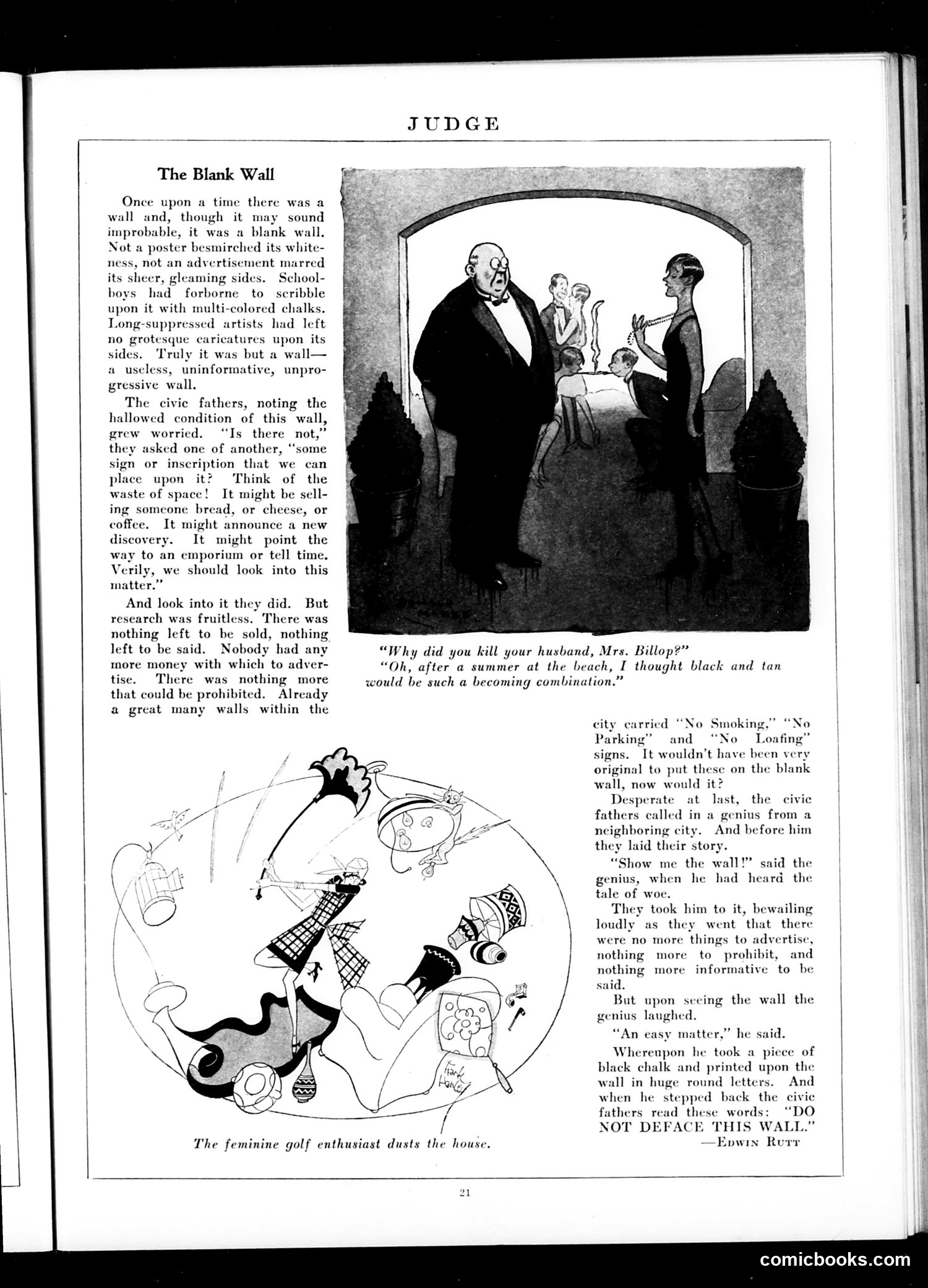
This story satirizes early 20th-century civic authorities' obsession with regulating public space. The "blank wall" represents unused urban surfaces—once a common sight. City officials, seeing wasted advertising potential, desperately seek something to place on it. Finding no commercial opportunities left (everything profitable already advertised), they're stymied. A hired "genius" solves their dilemma by posting "DO NOT DEFACE THIS WALL"—turning prohibition itself into the message. The satire's point: municipal government has become so regulation-obsessed that prohibiting defacement becomes the *only* remaining use for public space. Where once walls served commerce or information, they now merely enforce rules. The accompanying cartoon about "the feminine golf enthusiast" and the dark humor about the woman killing her husband (joking she wanted to look "black and tan") reflect period humor standards—crude by modern measures.
📄 Transcribed text from this page (OCR, searchable)
Machine-transcribed from the original scan — historical spelling and the odd misread are preserved.
The Blank Wall Once upon a time there was a wall and, though it may sound improbable, it was a blank wall. Not a poster besmirched its white- ness, not an advertisement marred its sheer, gleaming sides. School- boys had forborne to scribble upon it with multi-colored chalks. Long-suppressed artists had left no grotesque caricatures upon its sides. Truly it was but a wall— a useless, uninformative, unpro- gressive wall. The civie fathers, noting the hallowed condition of this wall, grew worried. “Is there not,” they asked one of another, “some sign or inscription that we can place upon it? Think of the waste of space! It might be sell- ing someone bread, or cheese, or coffee. It might announce a new discovery. It might point the way to an emporium or tell time. Verily, we should look into this matter.” And look into it they did. But research was fruitless. There was nothing left to be sold, nothing left to be said. Nobody had any more money with which to adver- tise. There was nothing more that could be prohibited. Already a great many walls within the “Why did you kill your husband, Mrs. Billop?” “Oh, after a summer at the beach, I thought black and tan would be such a becoming combination.” city carried “No Smoking,” “No Parking” and “No Loafing” signs. It wouldn’t have been very original to put these on the blank wall, now would it? Desperate at last, the civic fathers called in a genius from a neighbori y. And before him they laid their story. “Show me the wall!” said the genius, when he had heard the tale of woe. They took him to it, bewailing loudly as they went that there were no more things to advertise, nothing more to prohibit, and nothing more informative to be said. But upon seeing the wall the genius laughed. “An easy matter,” he said. Whereupon he took a piece of black chalk and printed upon the wall in huge round letters. And when he stepped back the civic fathers read these words: “DO NOT DEFACE THIS WALL.” —Epwin R comicbooks.com