
A complete issue · 36 pages · 1927
Judge — May 21, 1927
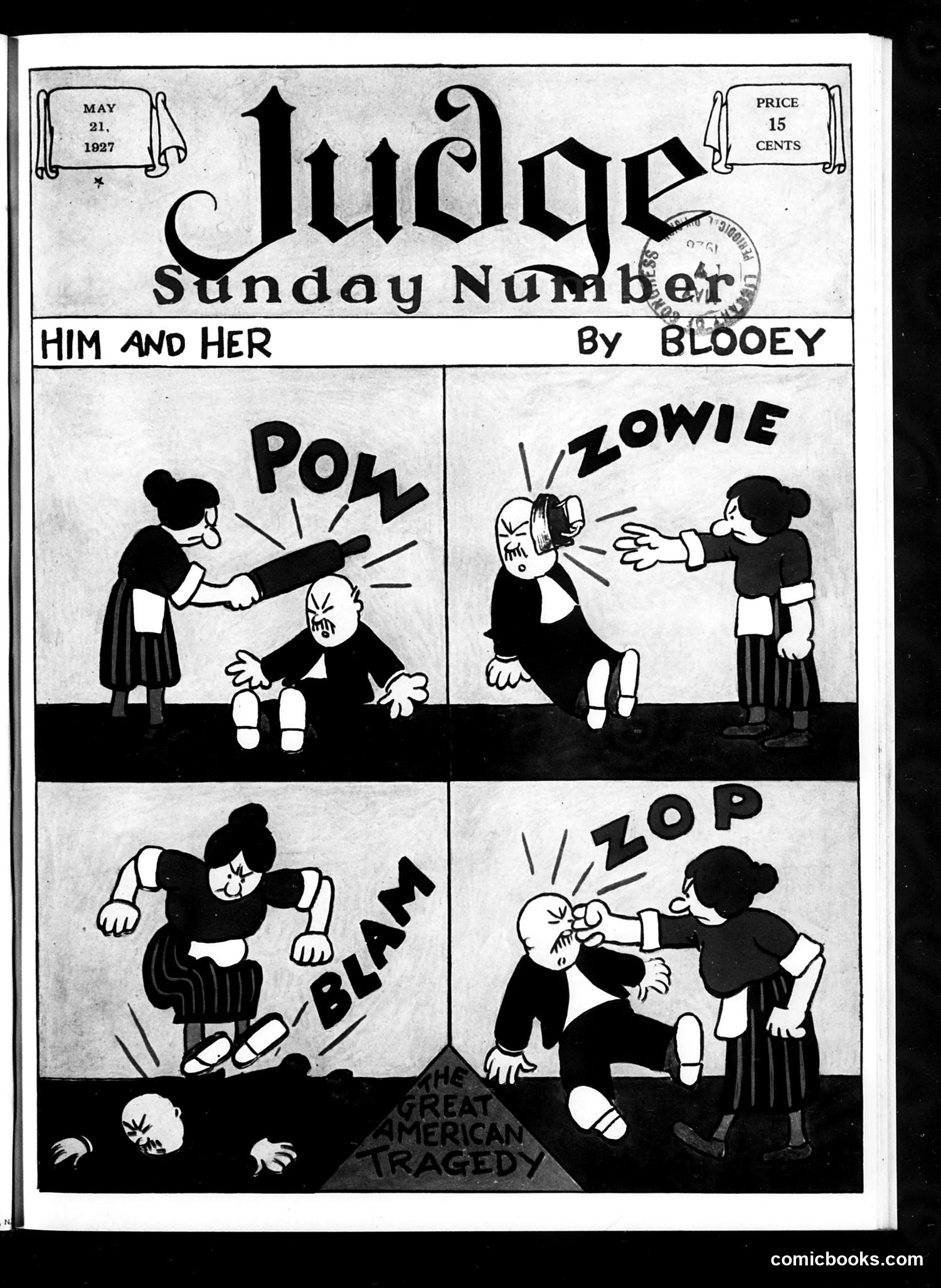
This comic strip satirizes domestic conflict through physical comedy. The four panels show escalating violence between a couple: the man "POW"s the woman, she retaliates with "ZOWIE," he strikes back with "BLAM," and she counters with "ZOP." The final panel labels this "THE GREAT AMERICAN TRAGEDY"—suggesting the cartoonist is darkly mocking American marriage as mutual combat rather than partnership. The title "Him and Her" emphasizes the symmetry of their conflict. This reflects 1920s anxieties about changing gender roles post-suffrage. Rather than condemning either party, the satire presents matrimonial violence as reciprocal farce, critiquing both spouses' behavior equally through slapstick absurdity.
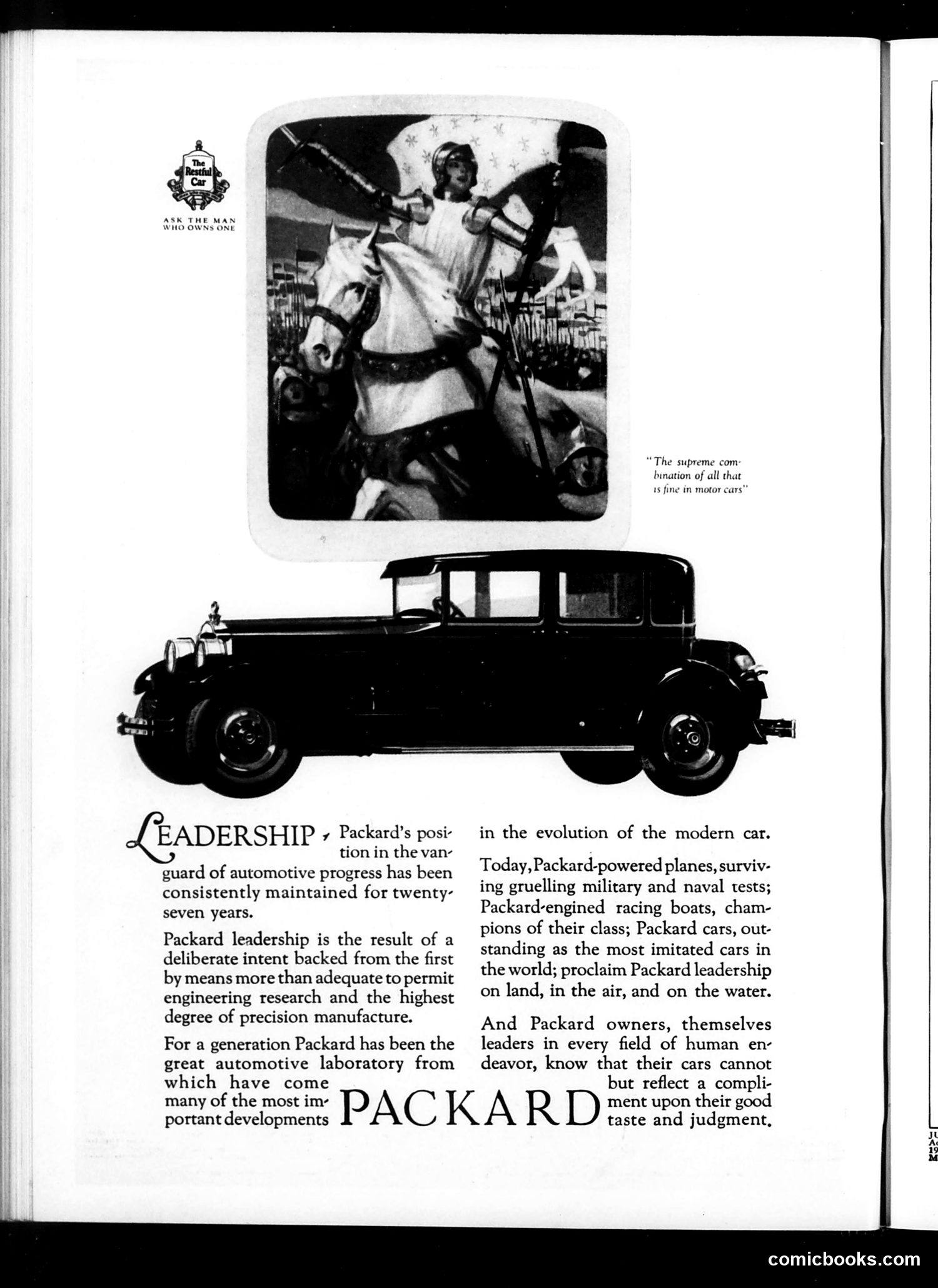
This page is primarily **advertising, not satire or political commentary**. It's a Packard automobile advertisement from *Judge* magazine. The image shows a vintage Packard car with an inset photograph depicting a man in aviation gear with a plane. The ad's text emphasizes Packard's "leadership" in automotive progress over twenty-seven years, claiming their engines power "planes, surviving gruelling military and naval tests; Packard-engined racing boats, champions of their class." The advertisement associates Packard ownership with sophistication and achievement, suggesting buyers are "leaders in every field of human endeavor" whose car choice reflects "good taste and judgment." This represents typical early 20th-century advertising strategy: linking consumer products to technological innovation and social status rather than functional features.
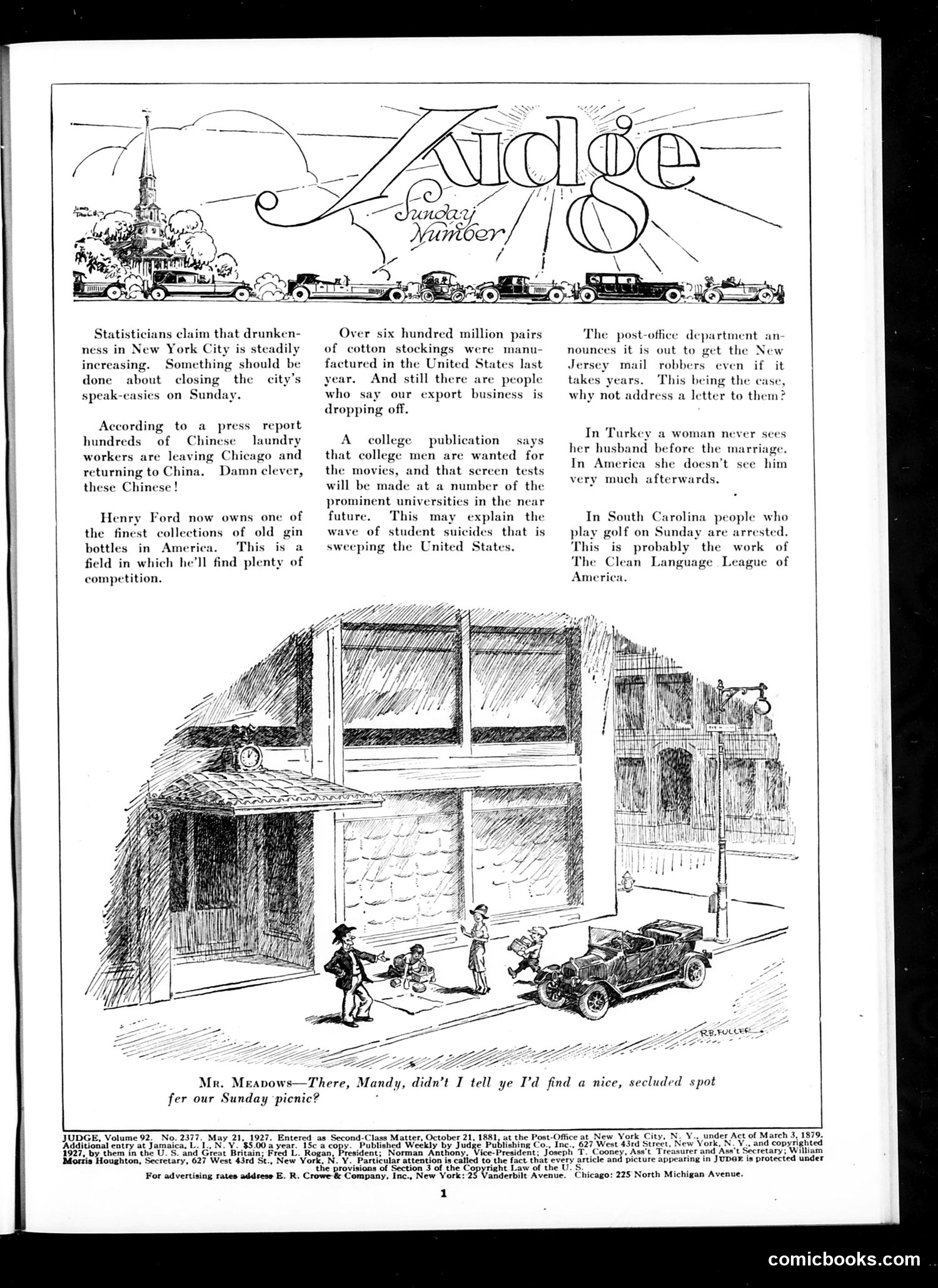
The main cartoon depicts a man and woman with children discovering a large empty storefront, with the man saying he found a "nice, secluded spot for our Sunday picnic." The joke satirizes urban overcrowding and lack of public spaces—even abandoned buildings become attractive as picnic locations. The scattered text items above mock various contemporary issues: drunkenness in New York City, Chinese laundry workers leaving Chicago, college suicide rates, Henry Ford's gin bottle collection, cotton stocking manufacturing, postal service inefficiency, and blue laws (Sunday restrictions on activities like golf in South Carolina). The satire targets American social anxieties of the 1920s: urbanization, immigration, mental health crises among students, and Prohibition-era contradictions.
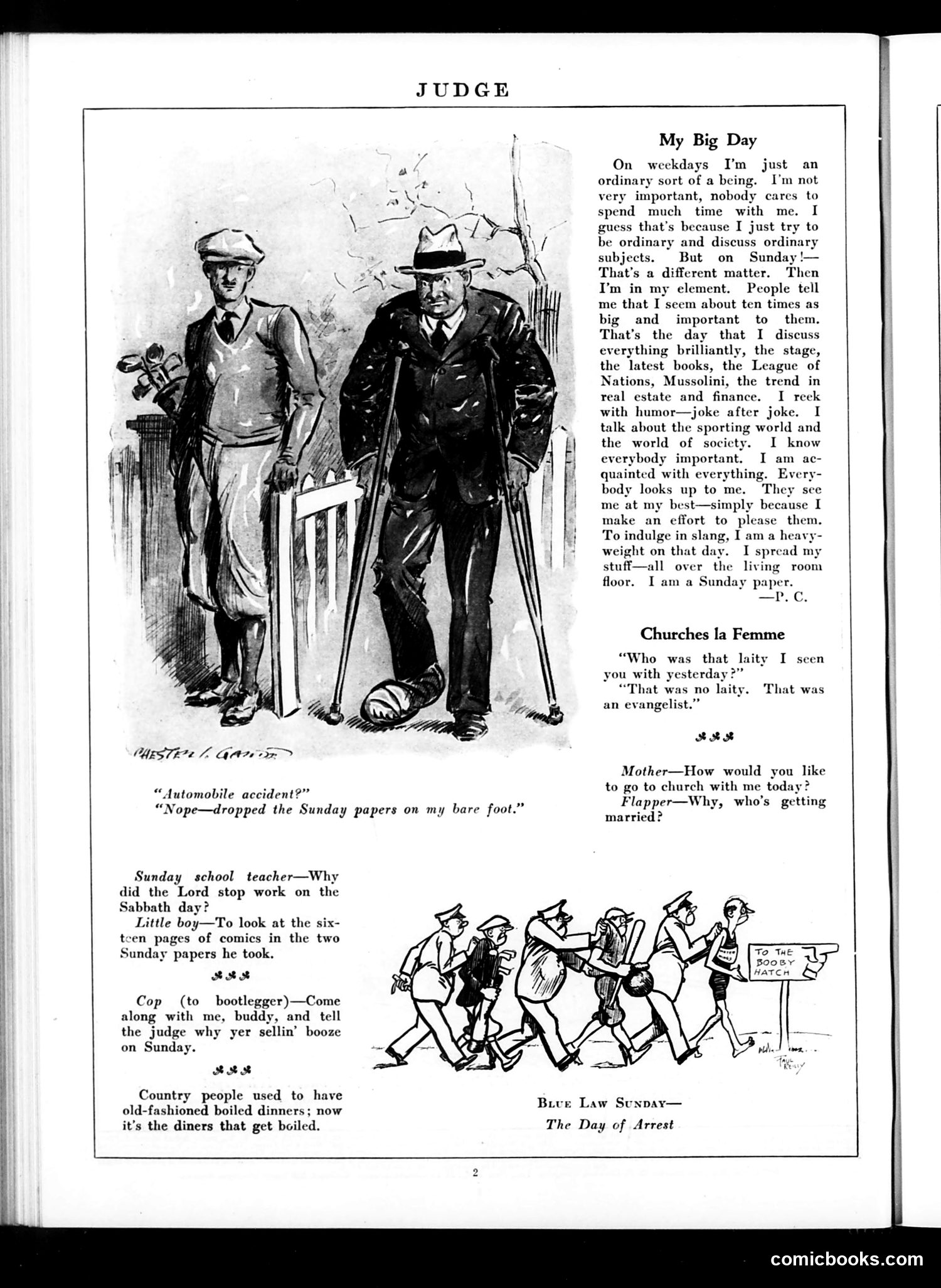
This page satirizes Sunday customs and behavior in early 20th-century America. The top cartoon shows two men in an "automobile accident" caused by dropped Sunday newspapers—mocking the era's expanding Sunday paper culture. The "My Big Day" essay humorously portrays someone who acts ordinary on weekdays but becomes self-importantly talkative on Sundays, discussing politics, books, and high society while spreading newspapers everywhere—satirizing the pretentious self-importance people adopt on the Sabbath. "Churches la Femme" jokes about religious hypocrisy (mistaking an evangelist for a "laity"). The "Blue Law Sunday" cartoon depicts arrests for violating blue laws—Sunday prohibitions on alcohol and certain activities. Overall, the page mocks Sunday hypocrisy, pretension, and the strict religious regulations governing American leisure time.
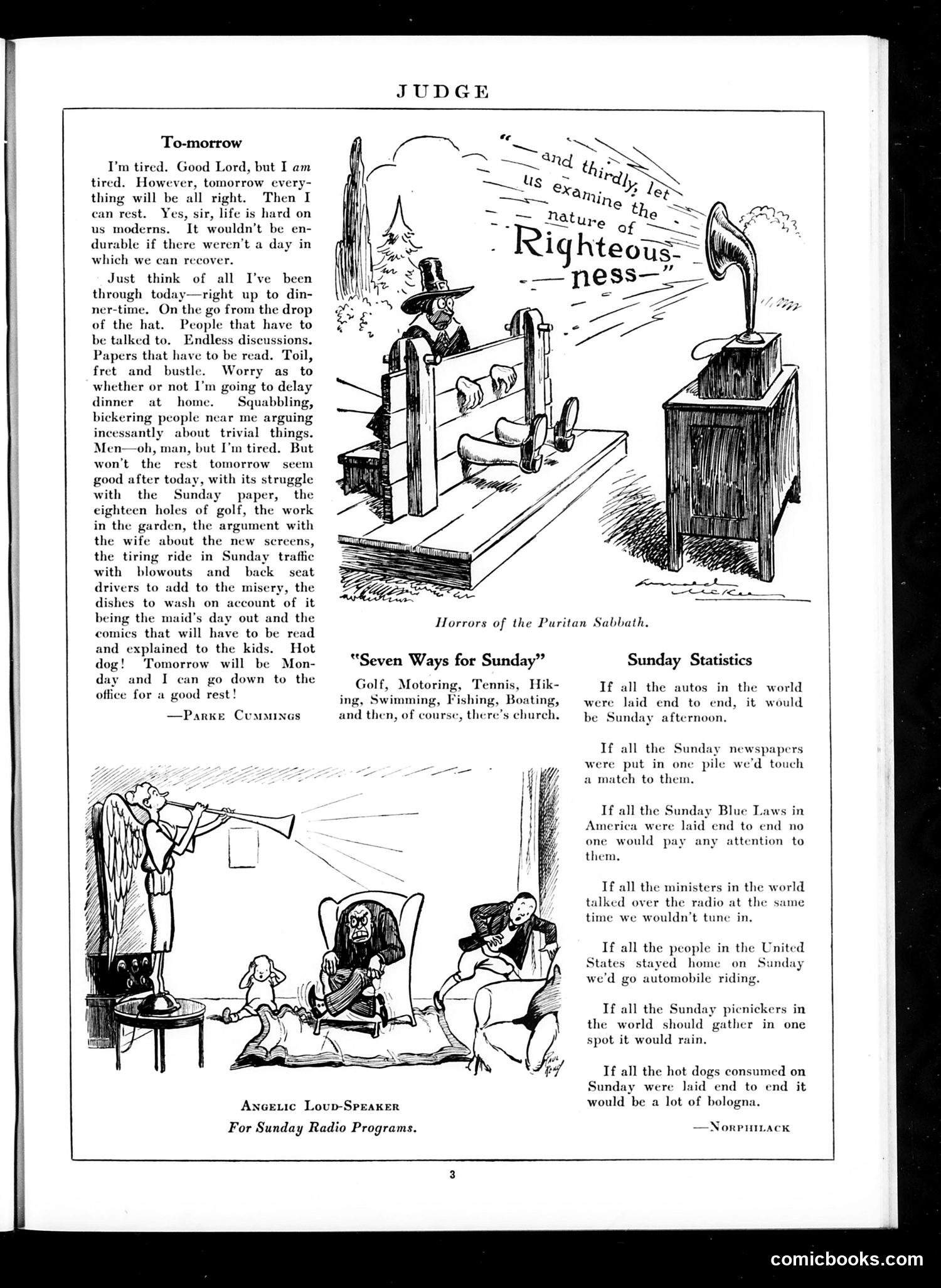
This page contains three distinct satirical pieces: **"To-morrow"** (text by Parke Cummings): A tired man fantasizes about tomorrow's rest, only to catalog the endless obligations awaiting him—golfing, arguing about trivial matters, domestic chores, and Sunday newspaper reading. The satire mocks middle-class male exhaustion and the false promise of weekend leisure. **"Horrors of the Puritan Sabbath"**: This cartoon depicts a contraption forcing righteousness examination, satirizing strict Sabbath observance and religious hypocrisy. **"Sunday Statistics"** (by Norphilack): Humorous conditional statements about Sundays—if all cars lined up end-to-end, if all ministers broadcast simultaneously, etc. This absurdist humor pokes fun at American excess and Sunday culture's contradictions. The overall theme critiques modern Sunday life: exhaustion, religious strictness, and society's chaotic relationship with leisure.
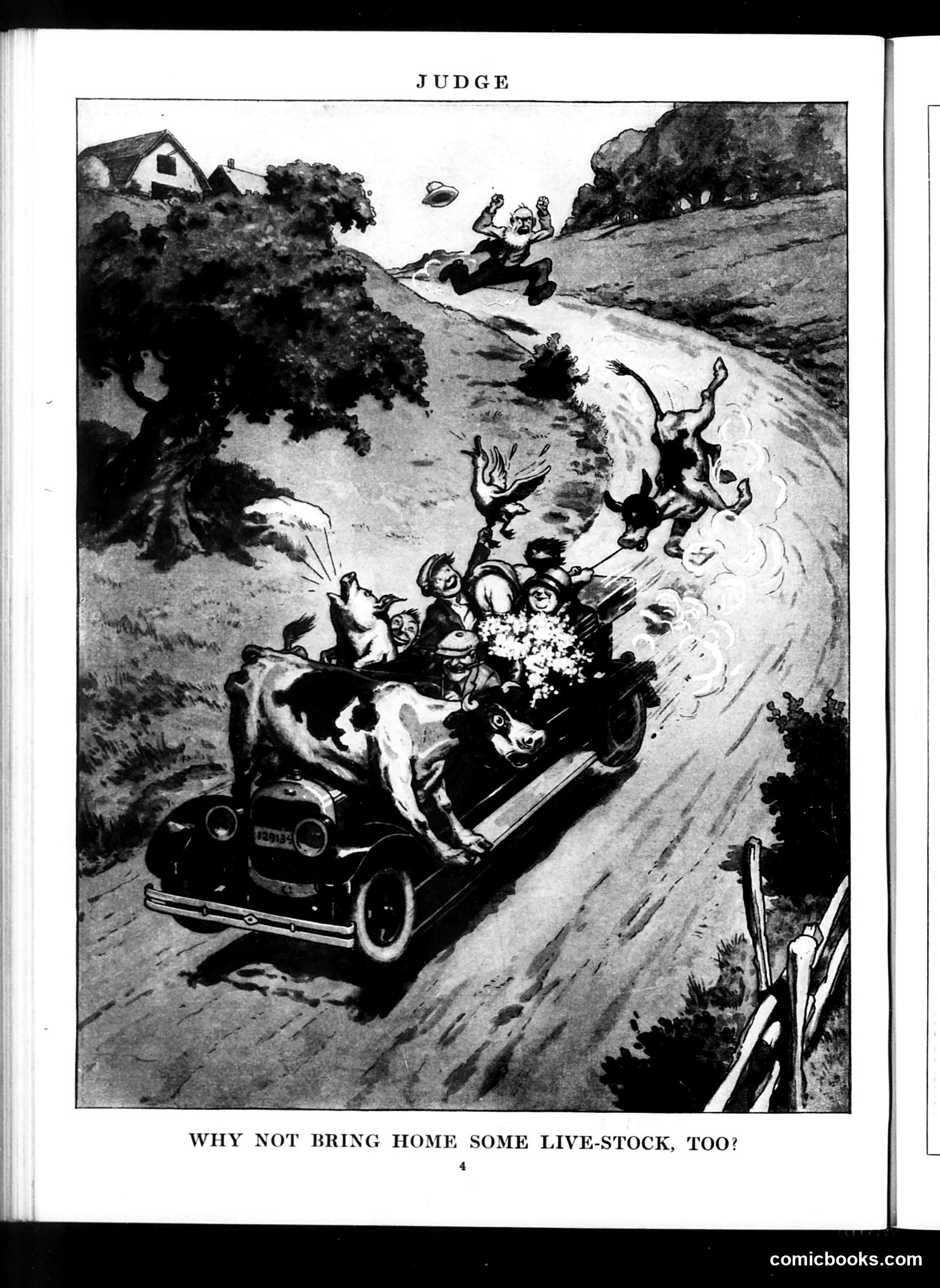
This cartoon satirizes the excesses of the Jazz Age and automobile culture of the 1920s. The image depicts wealthy revelers in an oversized car overflowing with passengers, animals, and flowers—literally packed to absurdity as they speed down a rural road. A figure in another vehicle ahead appears to be racing them. The caption "Why Not Bring Home Some Live-Stock, Too?" suggests mockery of wealthy urbanites' conspicuous consumption and increasingly outrageous behavior during leisure drives. The cartoon critiques both automobile excess and the perceived moral degradation of the era—the chaotic, uninhibited partying, the disregard for safety, and the wasteful display of wealth. It represents Judge magazine's conservative perspective on modern social trends.
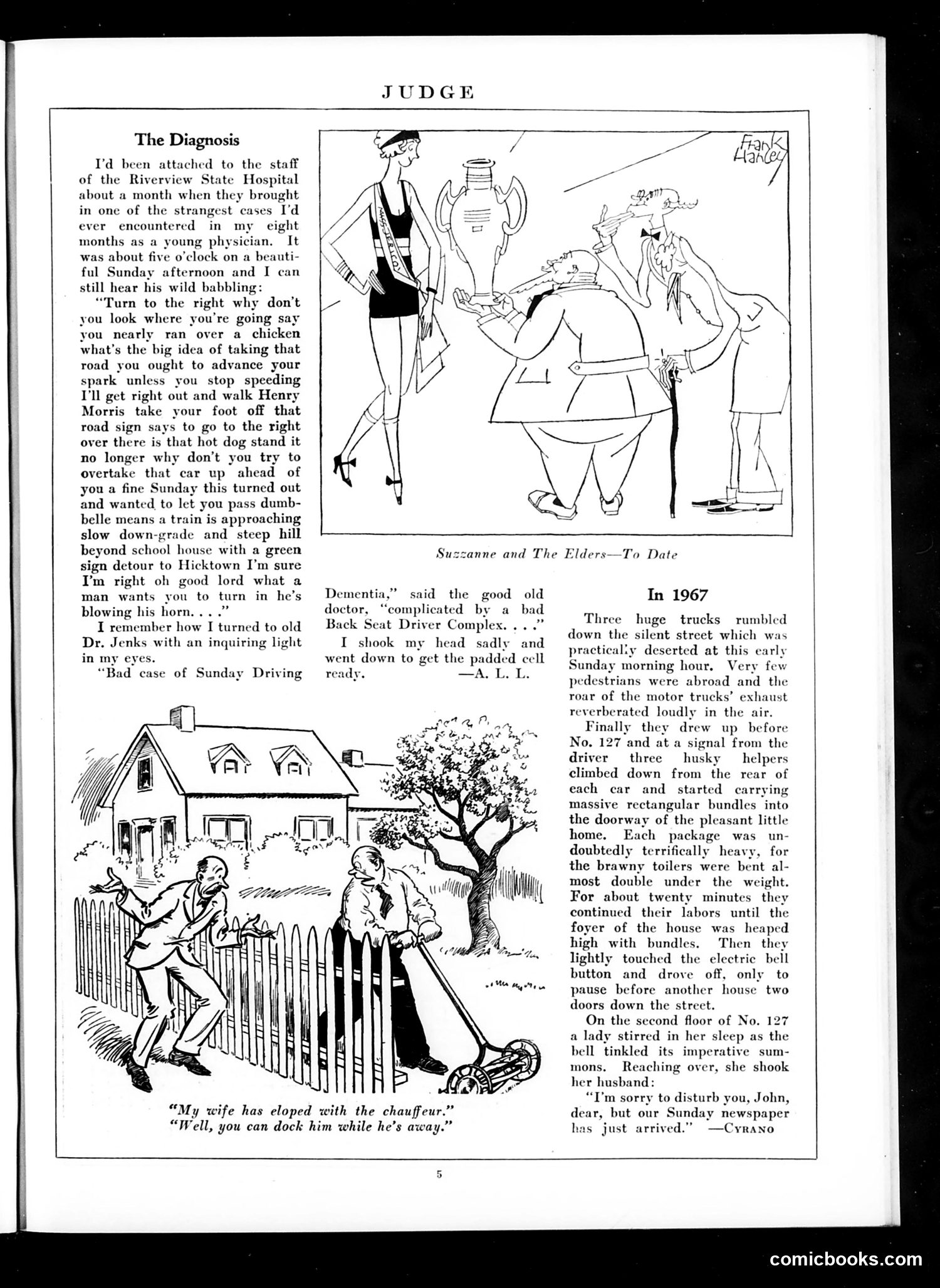
This page contains two unrelated humor pieces typical of Judge magazine's satirical content. **Top cartoon ("Suzzanne and The Elders—To Date"):** A modernized reference to the biblical story of Susanna and the Elders. Here, a fashionably dressed woman in 1920s attire is confronted by three older men in a car. The satire updates the classical tale of male authority figures pursuing a woman to contemporary automobile culture, mocking both old men's inappropriate behavior and the modern dating scene. **Bottom cartoon ("My wife has eloped with the chauffeur"):** A domestic comedy about class and infidelity. A man tells another that his wife ran away with their chauffeur (a servant). The other man's response—"dock him while he's away"—jokes about punishing the employee economically rather than addressing the wife's actions, satirizing male attitudes toward both marriage and working-class employees. Both reflect 1920s social anxieties about changing gender roles and class dynamics.
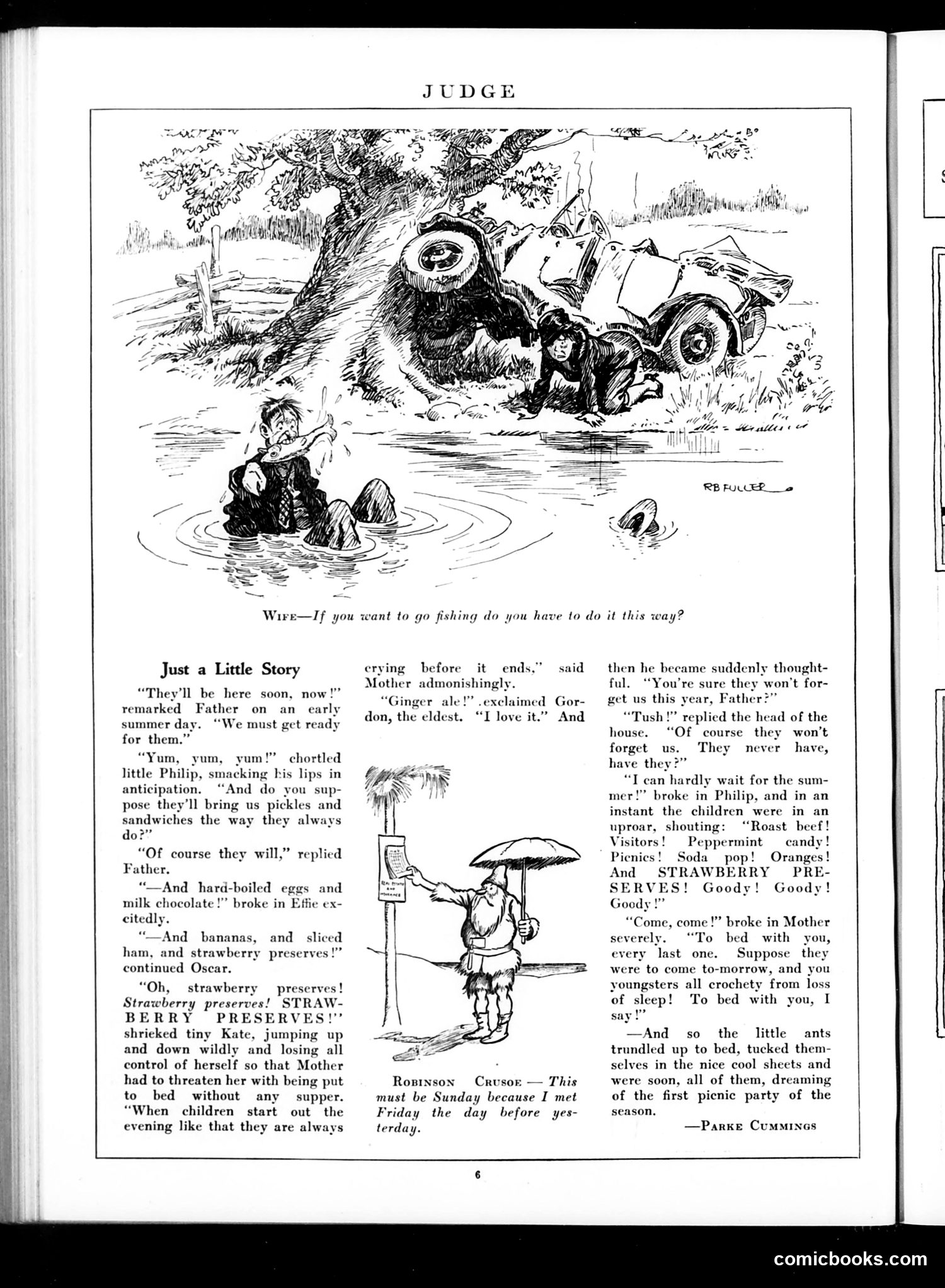
This is a sentimental children's story rather than political satire. The narrative follows a family preparing for visiting relatives or friends who will arrive with a picnic feast. The children excitedly anticipate food treats (strawberry preserves, roast beef, candy, soda pop), becoming so wound up that the mother must threaten bedtime without supper to calm them. The accompanying cartoons are whimsical illustrations: the top shows a comic mishap with a car and fishing trip ("Wire—If you want to go fishing do you have to do it this way?"), while the middle depicts a figure with an umbrella in a humorous pose. The story concludes sentimentally with the children dreaming of "the first picnic party of the season." The piece reflects early 20th-century middle-class family life and children's entertainment, written by Parke Cummings. It contains no political content—purely domestic humor and nostalgia.
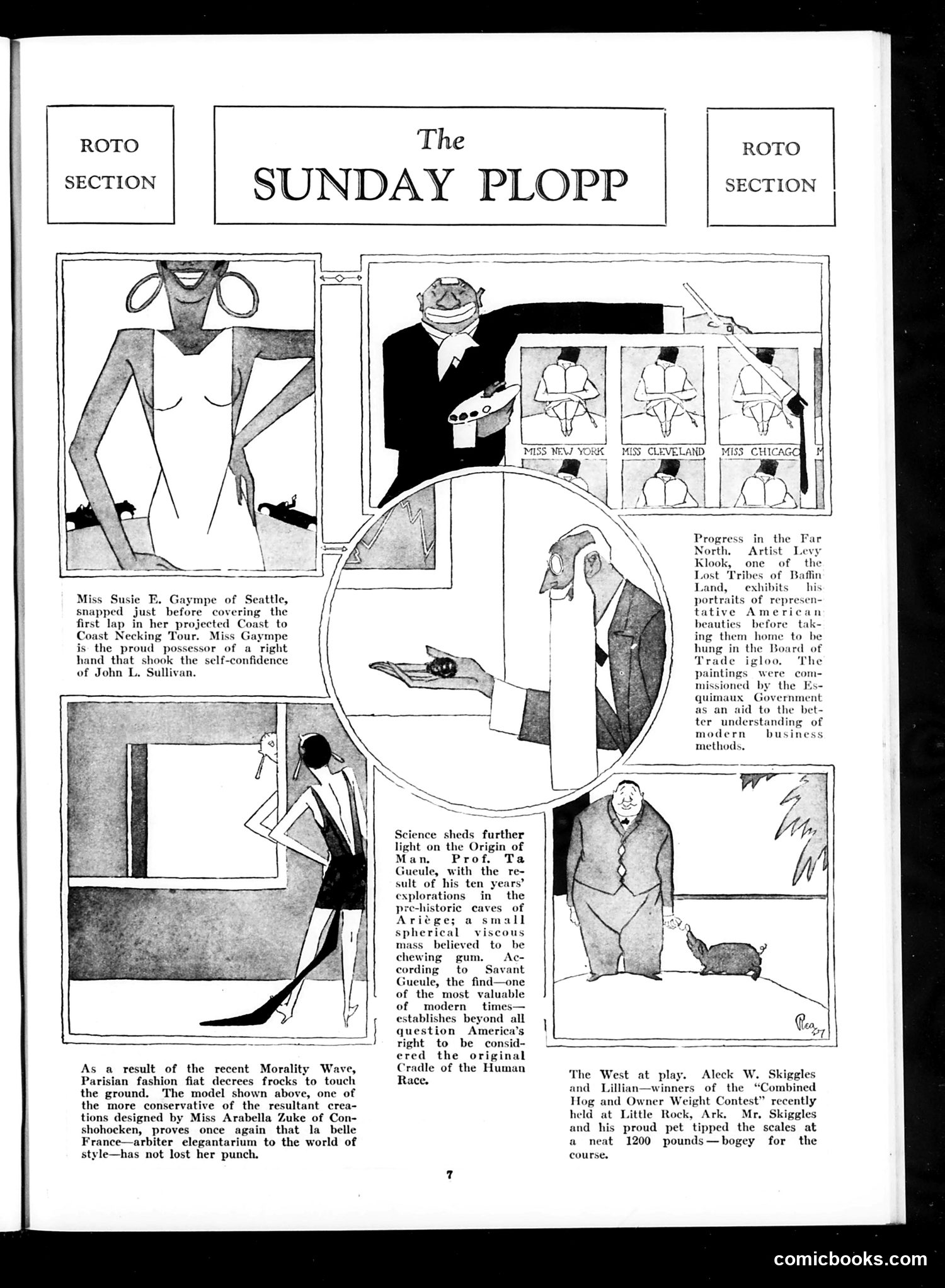
This is a satirical humor page from *Judge* magazine mixing social commentary with absurdist jokes typical of early 20th-century American humor. The top section mocks 1920s fashion trends, particularly the "Morality Wave" requiring longer skirts. The caption sarcastically notes that despite conservative dress reforms, French fashion "has not lost her punch"—implying women remain sexually provocative regardless. Other segments include mock-scientific satire (a professor claiming chewing gum proves America is civilization's cradle), ethnic stereotyping (an Inuit artist exhibiting to promote "modern business methods"), and celebrity gossip (Miss Gaympe's "Coast to Coast Necking Tour"). The final item jokes about a hog-weighing contest winner in Arkansas, with crude humor about weight. Overall, the page reflects 1920s attitudes: fascination with modern morality debates, ethnic caricature as humor, and sensationalized celebrity culture—content that would be considered offensive today due to its racial stereotyping and reductive gender humor.
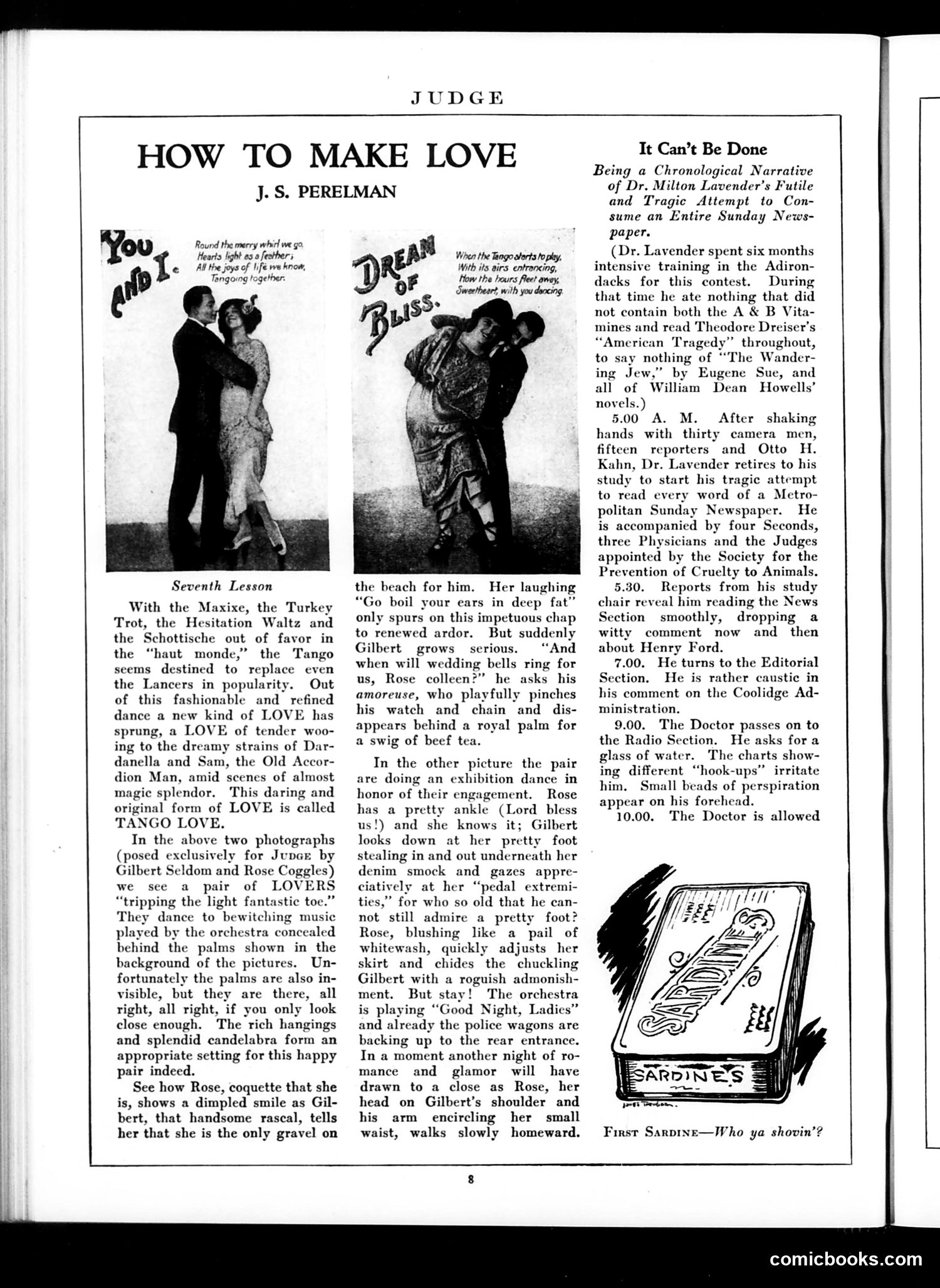
This is a humorous article about the "Tango Love"—a satirical commentary on how the then-fashionable Tango dance has become associated with romantic courtship. The piece features two photographs of actors Gilbert Seldom and Rose Coggles demonstrating tango dancing, with accompanying narrative describing their flirtation: she playfully insults him ("Go boil your ears in deep fat"), he proposes marriage, and she teases him further. The satire mocks the pretentiousness of "refined" dance culture and romantic conventions of the era. The accompanying piece "It Can't Be Done" describes an absurd endurance contest where Dr. Lavender attempts to read an entire Sunday Metropolitan newspaper cover-to-cover, attended by physicians and animal welfare observers—a joke about the newspaper's overwhelming length and tedium.
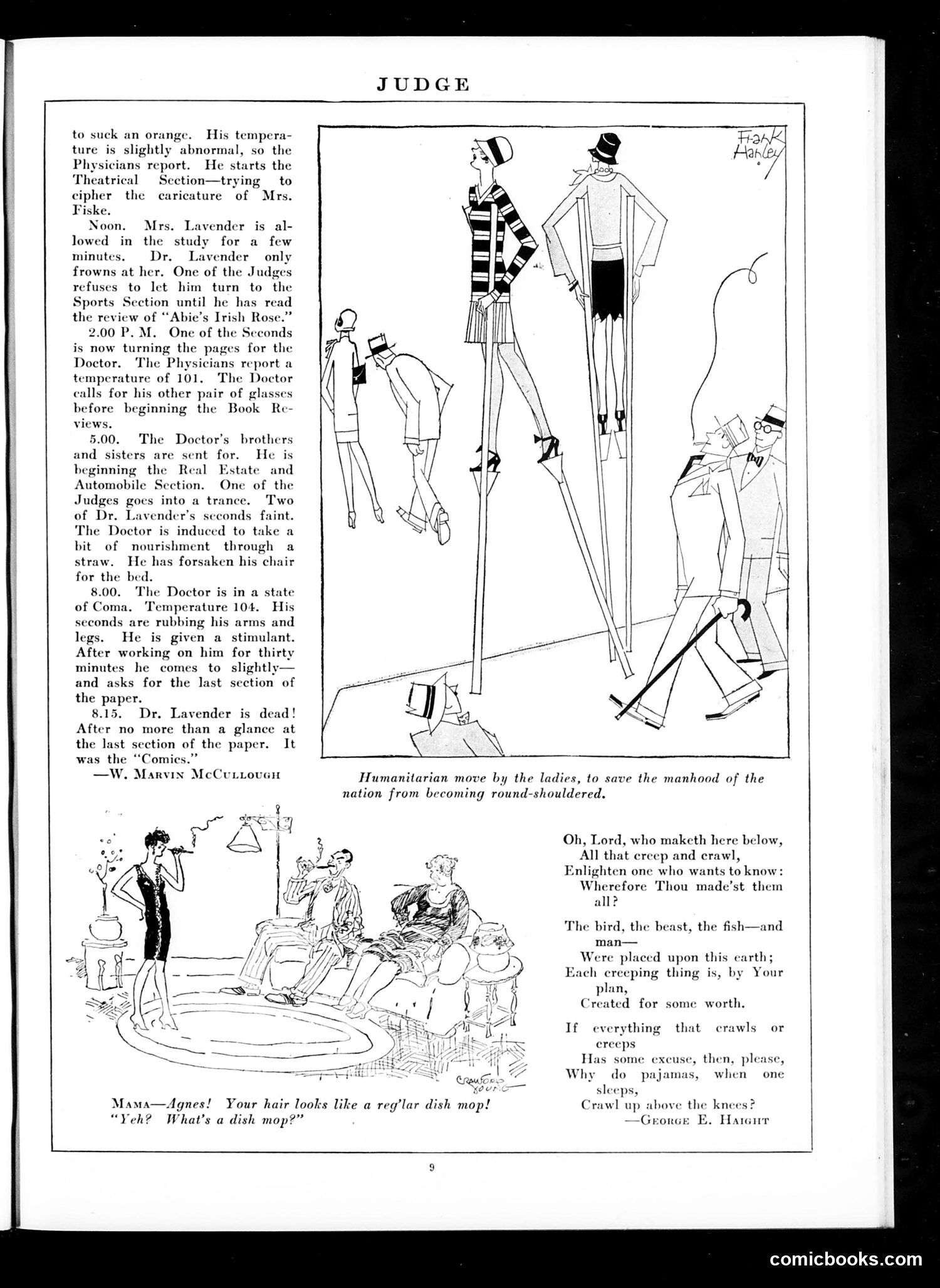
This page contains satirical content mocking early 20th-century American reading habits and social conventions. **Main Story ("Dr. Lavender")**: A humorous narrative about a doctor who literally becomes ill—progressively feverish and weak—while reading the Sunday newspaper from beginning to end. The joke escalates darkly: by 8:15 PM, he's dead. The punchline: he died immediately after glancing at the "Comics" section, suggesting the comics are so terrible they're lethal. This satirizes both newspaper addiction and the low regard for comic strips. **Fashion Cartoon (top right)**: Depicts women in 1920s-style clothing, titled "Humanitarian move by the ladies, to save the manhood of the nation from becoming round-shouldered"—satirizing how women's fashion (tight dresses, restrictive garments) supposedly affects men's posture. **Bottom Cartoon**: A domestic scene where a mother criticizes her daughter's messy hair, with a poem about God's creation, absurdly ending by questioning why pajamas ride up during sleep—mild absurdist humor. Overall, the page satirizes contemporary anxieties about reading habits, fashion, and domestic life.
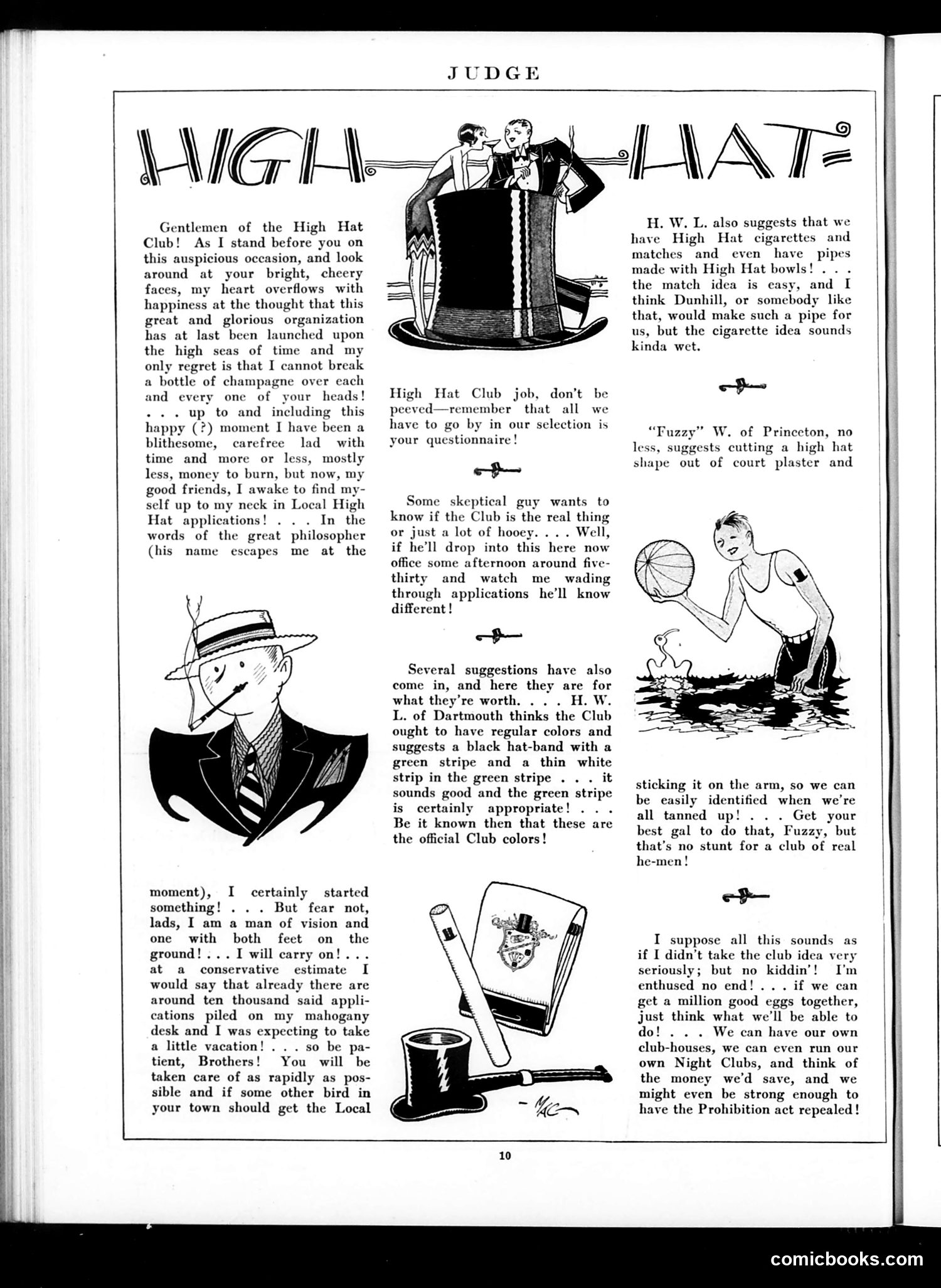
This page satirizes the founding of an exclusive "High Hat Club" for upper-class men. The speaker, apparently the club's organizer, humorously describes being overwhelmed by ten thousand applications despite having just launched the organization. The satire targets several aspects of 1920s elite culture: the pretentiousness of exclusive clubs, the absurdity of their rituals, and the frivolous merchandise suggestions (cigarettes, pipes, official colors with black hat-bands and green stripes). Notably, the final paragraph mocks the members' ambitions by suggesting the club might become powerful enough to repeal Prohibition—revealing that beneath the veneer of sophistication, these "gentlemen" are primarily motivated by wanting to drink alcohol legally again. The cartoon illustrations show well-dressed club members in top hats, reinforcing the upper-class setting. The humor relies on exaggeration and the contrast between the speaker's grandiose vision and the trivial reality of club administration.
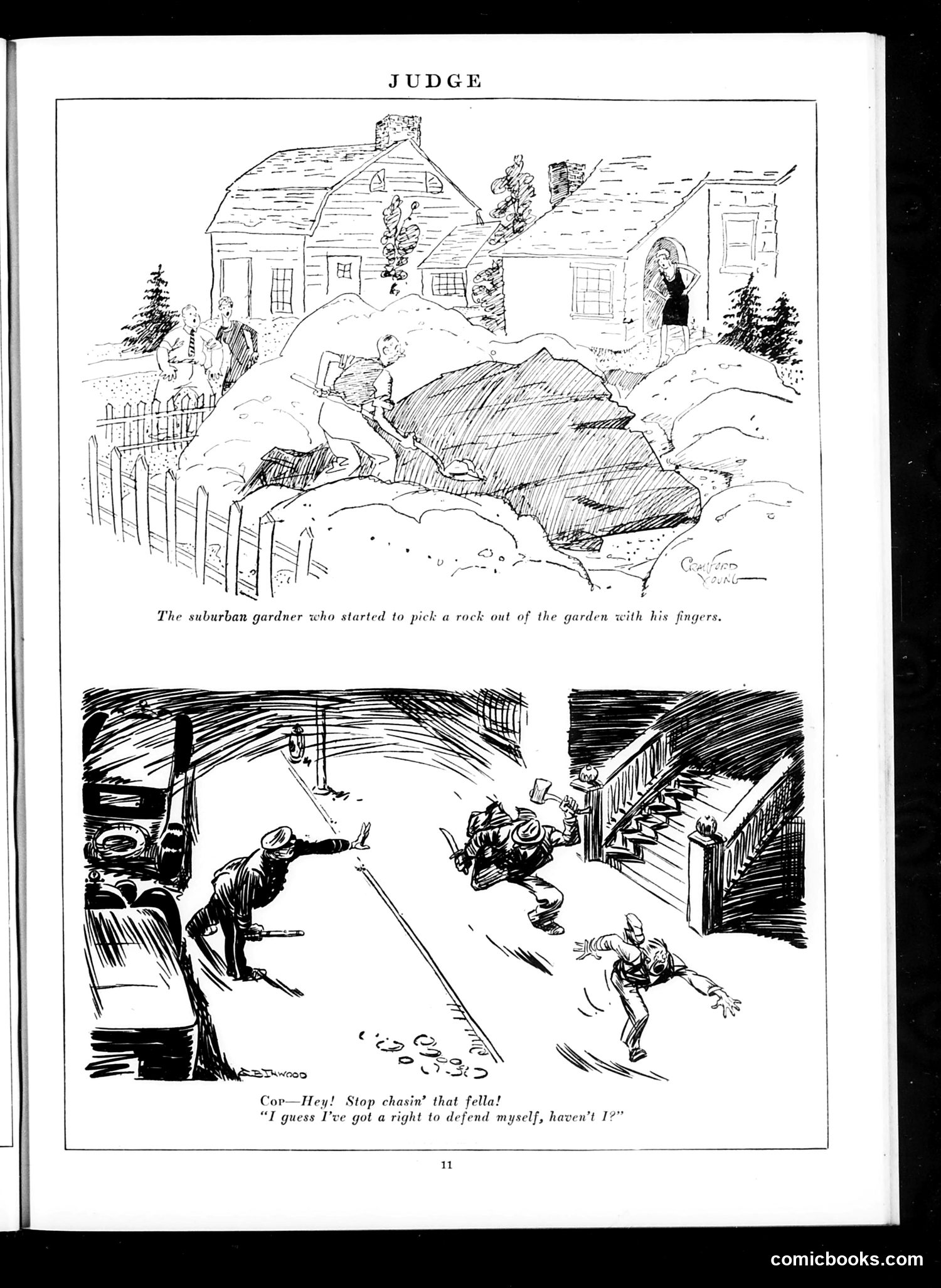
This page contains two unrelated cartoons from Judge magazine: **Top cartoon:** Shows a suburban homeowner attempting to remove a large rock from his garden by hand—a foolish, impractical approach. The satire mocks amateur gardeners who lack proper tools or knowledge. **Bottom cartoon:** Depicts a physical altercation, with one man chasing another while a third protests his own involvement in the fight, claiming self-defense rights. The humor appears to derive from the absurdity of his justification—suggesting someone who initiated trouble now claims victimhood. Both cartoons use everyday domestic/neighborhood scenarios to satirize human foolishness and flawed logic. Without specific historical dating visible, the exact topical references remain unclear, though both employ gentle social satire typical of Judge's humor style.
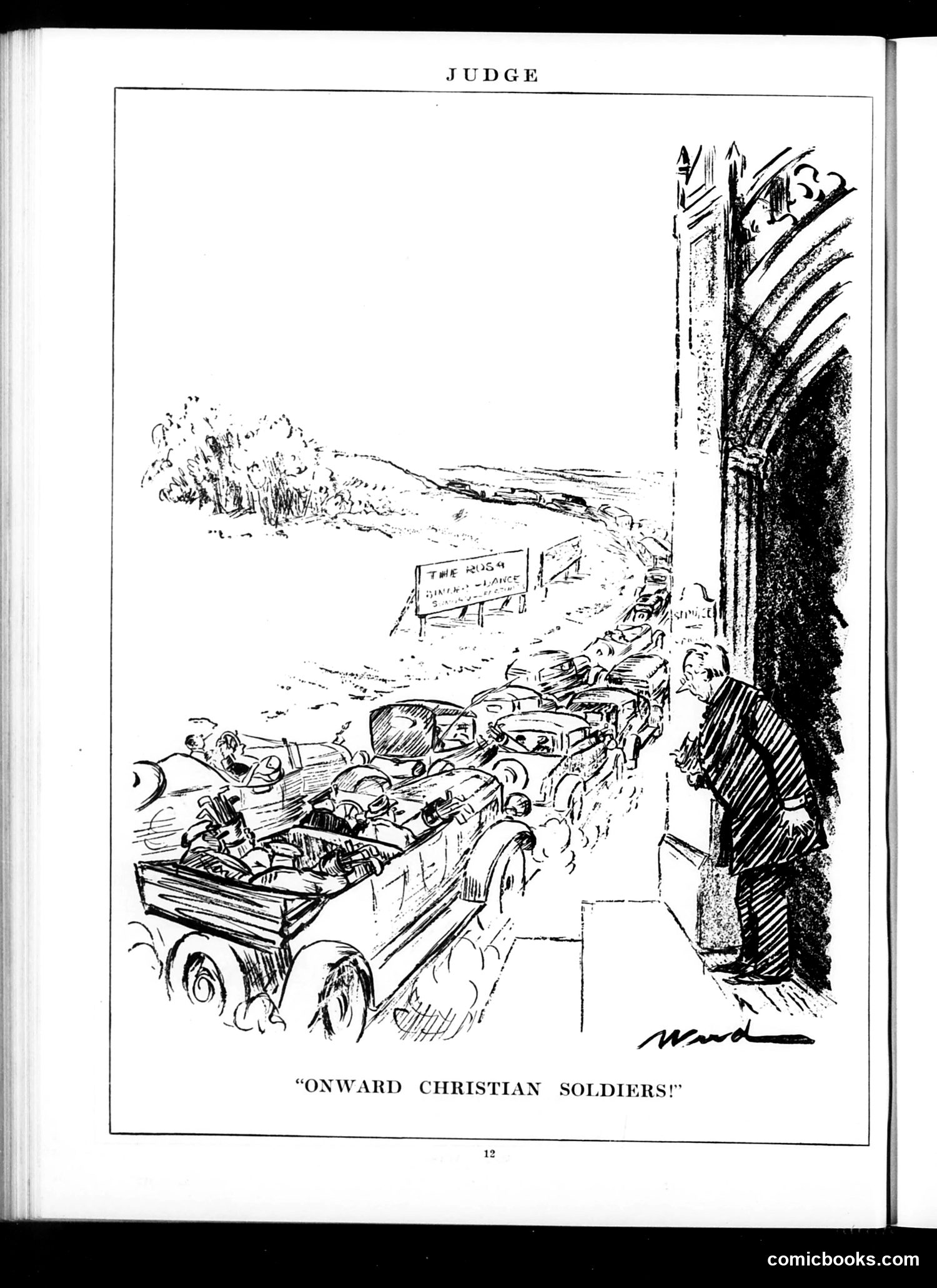
This Judge cartoon satirizes the militarization of Christian ideology. The image shows a truck overloaded with weapons, military equipment, and what appears to be armaments being transported, while a figure (likely representing the Church or Christian leadership) stands observing from the right side of the road. A sign reading "THE RUSH" is visible, suggesting urgency or haste. The title ironically invokes the famous hymn "Onward, Christian Soldiers" to criticize how Christian institutions or leaders were promoting or profiting from military buildup and warfare. The cartoon suggests a stark contradiction between Christian pacifist teachings and enthusiastic military preparation, likely referencing early 20th-century debates about religious institutions' relationship to militarism and warfare.
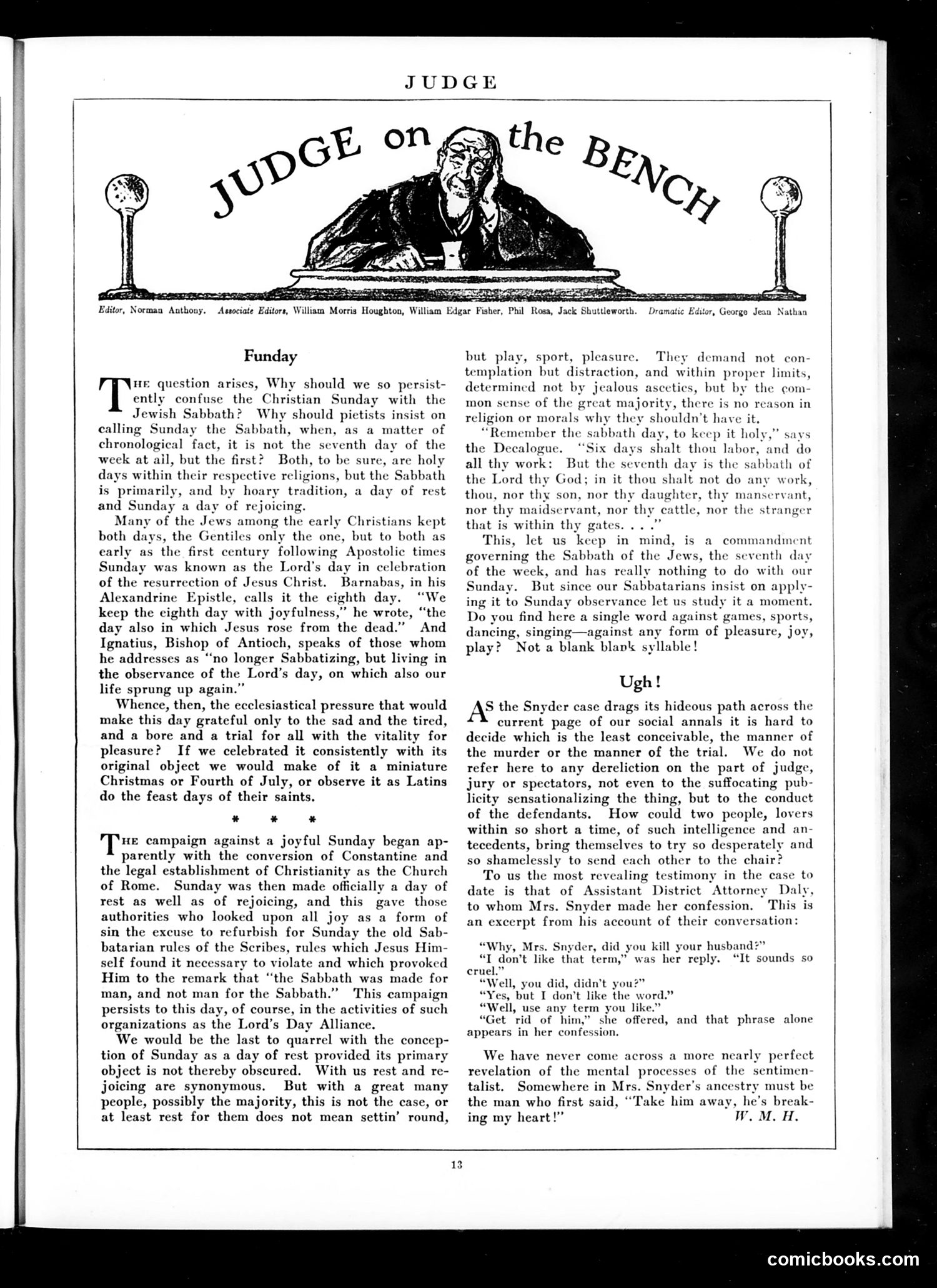
This editorial page from Judge magazine critiques religious observance practices, specifically attacking what the writer calls excessive Sabbatarianism imposed on Sunday. **The Main Argument:** The piece argues that Christians confuse the Jewish Sabbath (seventh day, a day of rest) with Sunday (the Lord's Day, celebrating Christ's resurrection), and that puritanical religious authorities have wrongly imposed strict Sabbatarian rules onto Sunday—transforming what should be a joyful celebration into a gloomy, restrictive day. **Historical Context:** The writer references Constantine's legalization of Christianity and groups like the "Lord's Day Alliance" (a real anti-entertainment advocacy organization). The piece supports recreational activities—sports, dancing, pleasure—as compatible with Sunday observance, citing biblical scholars like Barnabas and Ignatius to argue Jesus himself violated Sabbath rules. **The Satire:** Judge's position is anti-censorious and pro-leisure, mocking religious groups attempting to eliminate Sunday enjoyment as hypocritical legalism contrary to Christianity's actual teachings. The brief "Ugh!" section references the Snyder case—likely a contemporary scandal—but provides insufficient context to explain it here.
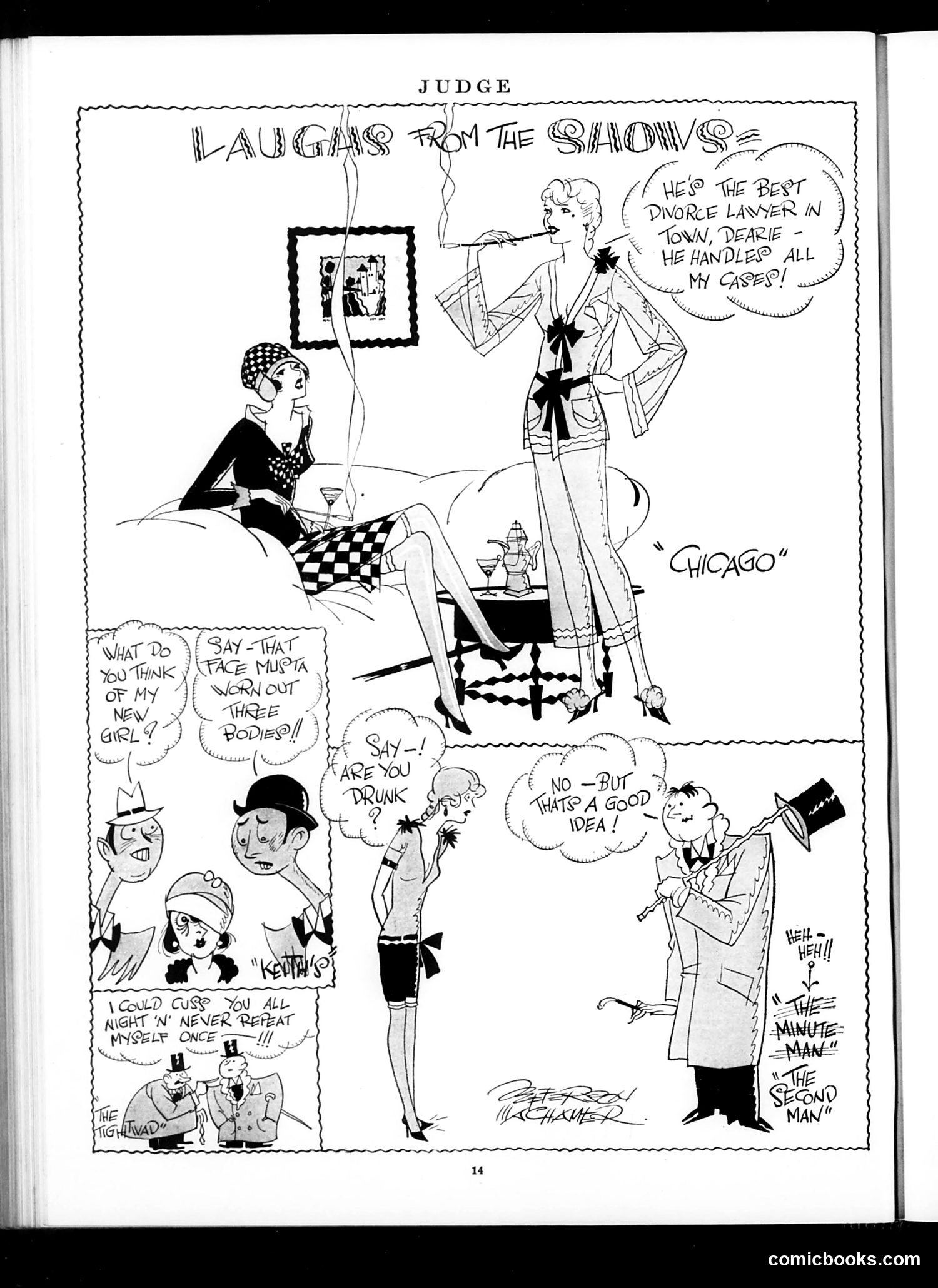
This is a satirical comic about Chicago's social scene, likely from the 1920s-30s based on the Art Deco styling and fashion. The main joke concerns a wealthy woman bragging about her "best divorce lawyer in town" who "handles all my cases"—implying she's been divorced multiple times. Her friend responds that such a lawyer would be excellent for handling frequent divorces. The lower panels show drunk men at what appears to be a speakeasy or nightclub (relevant given Prohibition era references), with one character claiming he could "cuss all night and never repeat myself." Another quips about "that's a good idea," while a third advertises himself as available—suggesting he'd be a good romantic/legal prospect. The satire targets wealthy socialites' casual attitudes toward divorce and the drinking culture of the era, presenting both as markers of questionable morality.
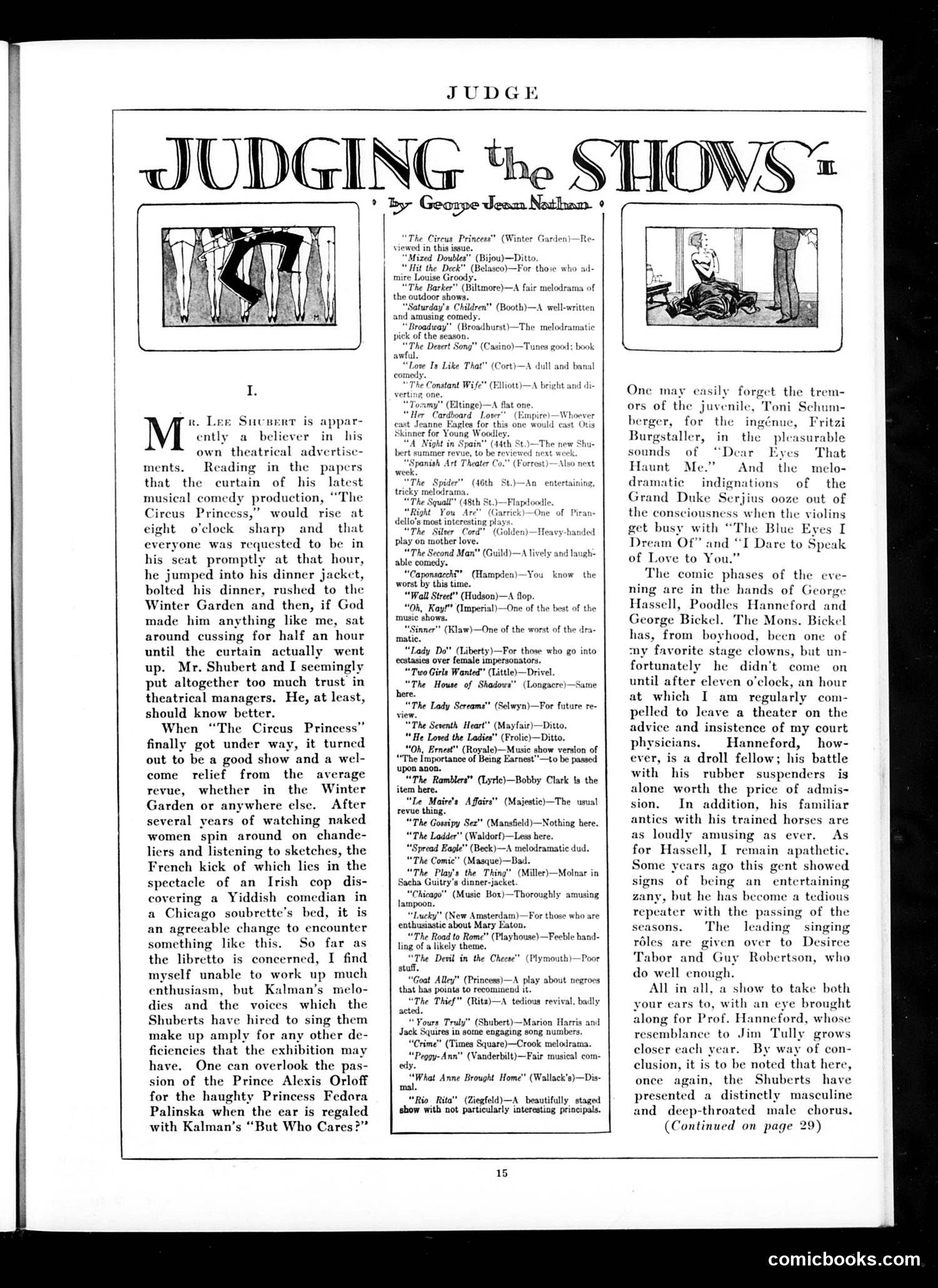
This is a theater review column by George Jean Nathan, a prominent drama critic of the 1920s. The page contains no political cartoons—it's primarily text with two small photographs of theatrical scenes. Nathan reviews "The Circus Princess" at the Winter Garden, praising its music and performances despite a weak libretto. He humorously criticizes theater manager Lee Shubert for advertising an 8 o'clock curtain time, then making audiences wait—suggesting theatrical managers are unreliable. The bulk of the page lists brief, often dismissive reviews of contemporary Broadway shows. Most judgments are scathing ("A flop," "Drivel," "Bad"). Nathan appears to favor comedies and musical shows with strong performances over melodramas. This reflects 1920s New York theater tastes and Nathan's influential but caustic critical voice. The content is theater criticism, not satire or political commentary.
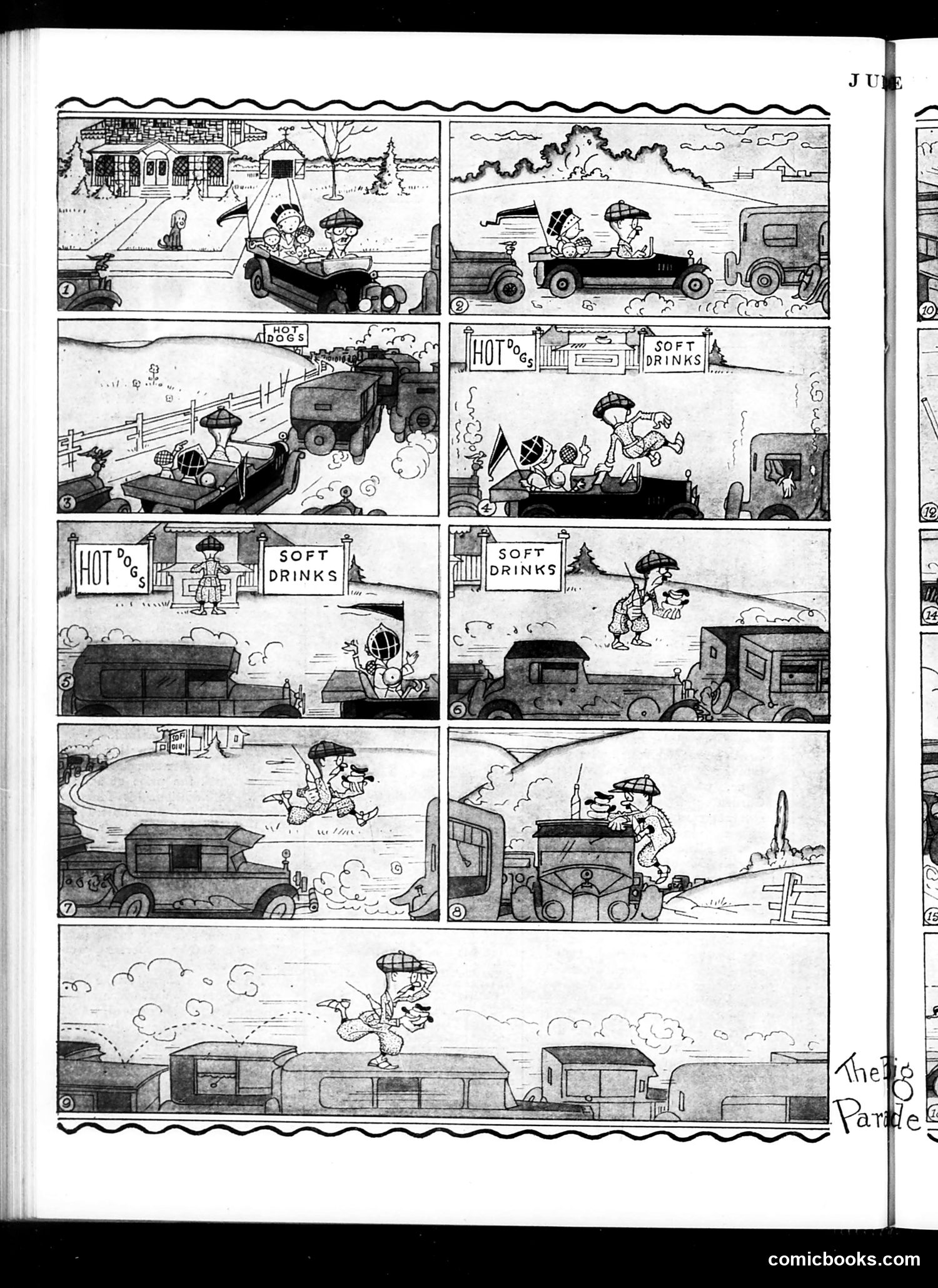
This appears to be a sequential comic strip titled "The Parade" (visible at bottom right) depicting a chaotic automotive procession. The narrative follows what seems to be a parade or convoy of early automobiles, with various vehicles including trucks selling "Hot Dogs" and "Soft Drinks." The humor appears to derive from slapstick situations: characters running, jumping between vehicles, and general vehicular mayhem. The strip satirizes the novelty and unpredictability of early motorized transportation, contrasting orderly civic parades with the disorder these newfangled automobiles create. The comic reflects 1920s-era American fascination with automobiles and mobile commerce (food trucks), while mocking both the vehicles' unreliability and drivers' incompetence. It's primarily visual slapstick comedy rather than political satire.
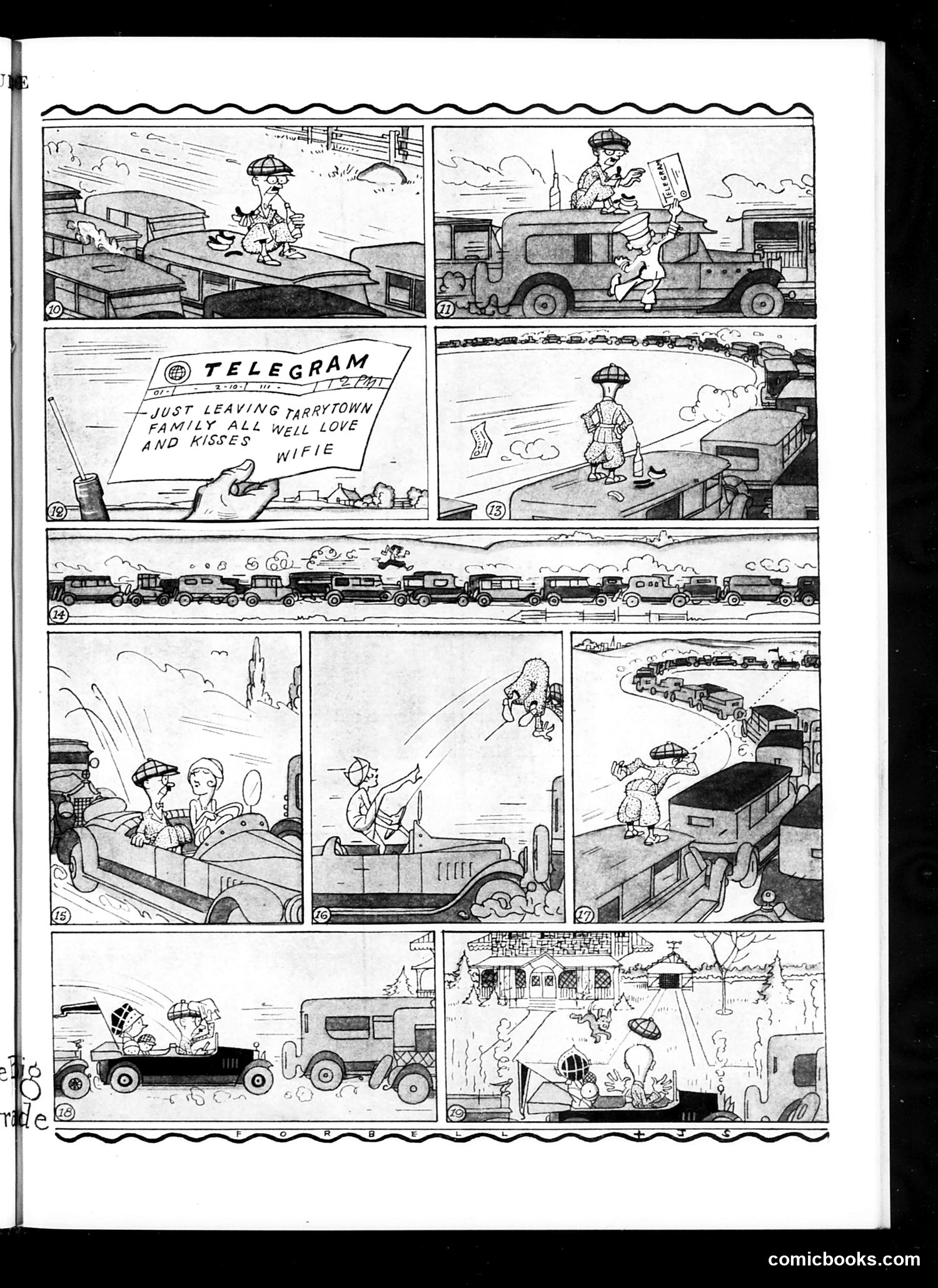
This appears to be a sequential comic strip showing a family's journey by truck, likely depicting Depression-era or Dust Bowl migration. The narrative follows characters leaving "Tarrytown" (a fictional location), with a telegram reading "JUST LEAVING TARRYTOWN / FAMILY ALL WELL LOVE AND KISSES / WIFIE" establishing the story. The strip satirizes nomadic travel and displacement—showing the family loading up, driving in a long convoy of similar vehicles, fishing, camping, and generally living on the road. The humor likely stems from the romanticization versus reality of such travels, depicting both the adventure and the hardship of traveling families during economically difficult times. The title "Judge" was a satirical magazine, so this strip probably mocks either the cheerfulness people affected while displaced or the absurdity of treating such difficult circumstances as a family vacation.
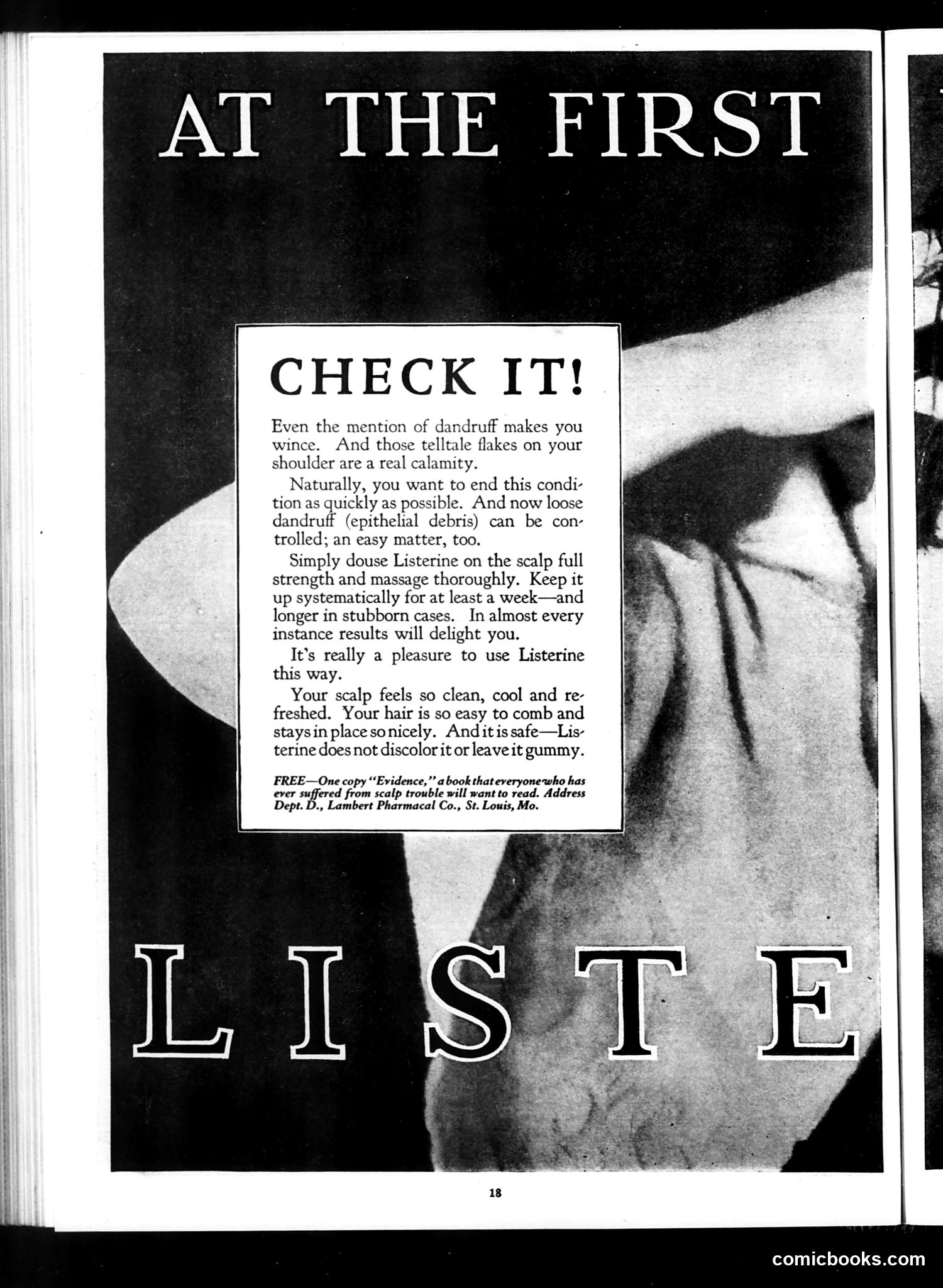
This is a **Listerine advertisement**, not a political cartoon or satire. It occupies page 18 of Judge magazine and promotes Listerine mouthwash as a dandruff treatment. The ad features a black-and-white photograph of a shoulder showing dandruff flakes, positioned dramatically to emphasize the "problem." The headline "AT THE FIRST CHECK IT!" frames dandruff as a social embarrassment requiring immediate action. The text recommends applying full-strength Listerine directly to the scalp and massaging thoroughly for at least a week. It promises the scalp will feel "clean, cool and refreshed" and that hair will be easier to comb and manage. A free booklet titled "Evidence" is offered to readers who write the Lambert Pharmacal Company in St. Louis. This reflects early 20th-century advertising's use of social anxiety—particularly around visible bodily conditions—to market consumer products. The appearance suggests this is vintage advertising rather than editorial content.
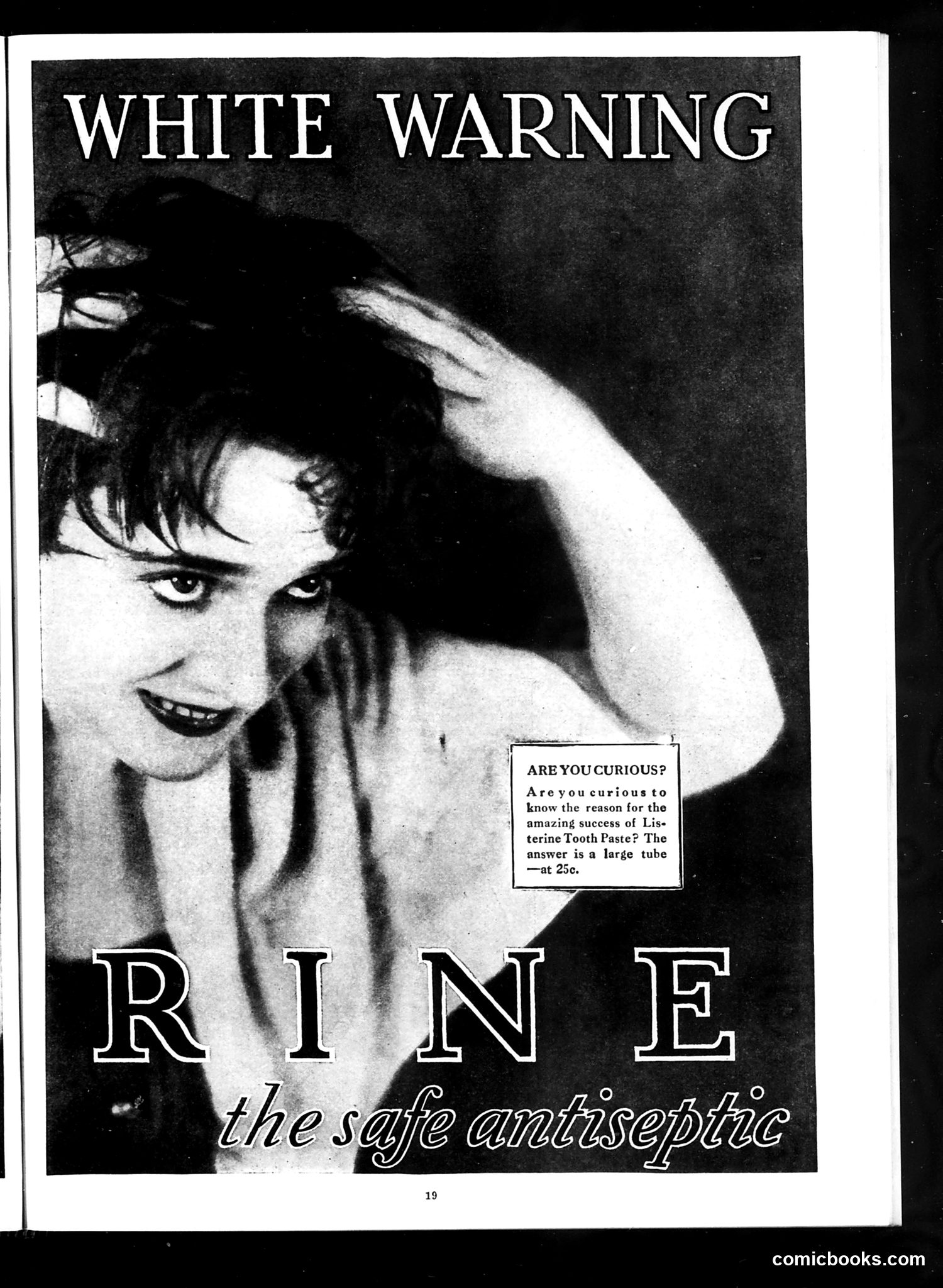
This page is primarily a **product advertisement** for Listerine Tooth Paste, not political satire. The headline "WHITE WARNING" appears to be a playful marketing reference to dental whiteness. The image shows a woman's face in close-up, styled in 1920s fashion (short dark hair, defined makeup). The accompanying text uses curiosity as a sales hook, suggesting the "amazing success" of the product comes down to a practical factor: it's sold in a large tube for 25 cents—implying value for money. The word "safe antiseptic" emphasizes the product's health benefits, which was a common advertising angle for oral care products of that era. There is no political cartoon or satire present; this is straightforward commercial advertising using an attractive female face and rhetorical questioning to market the toothpaste.
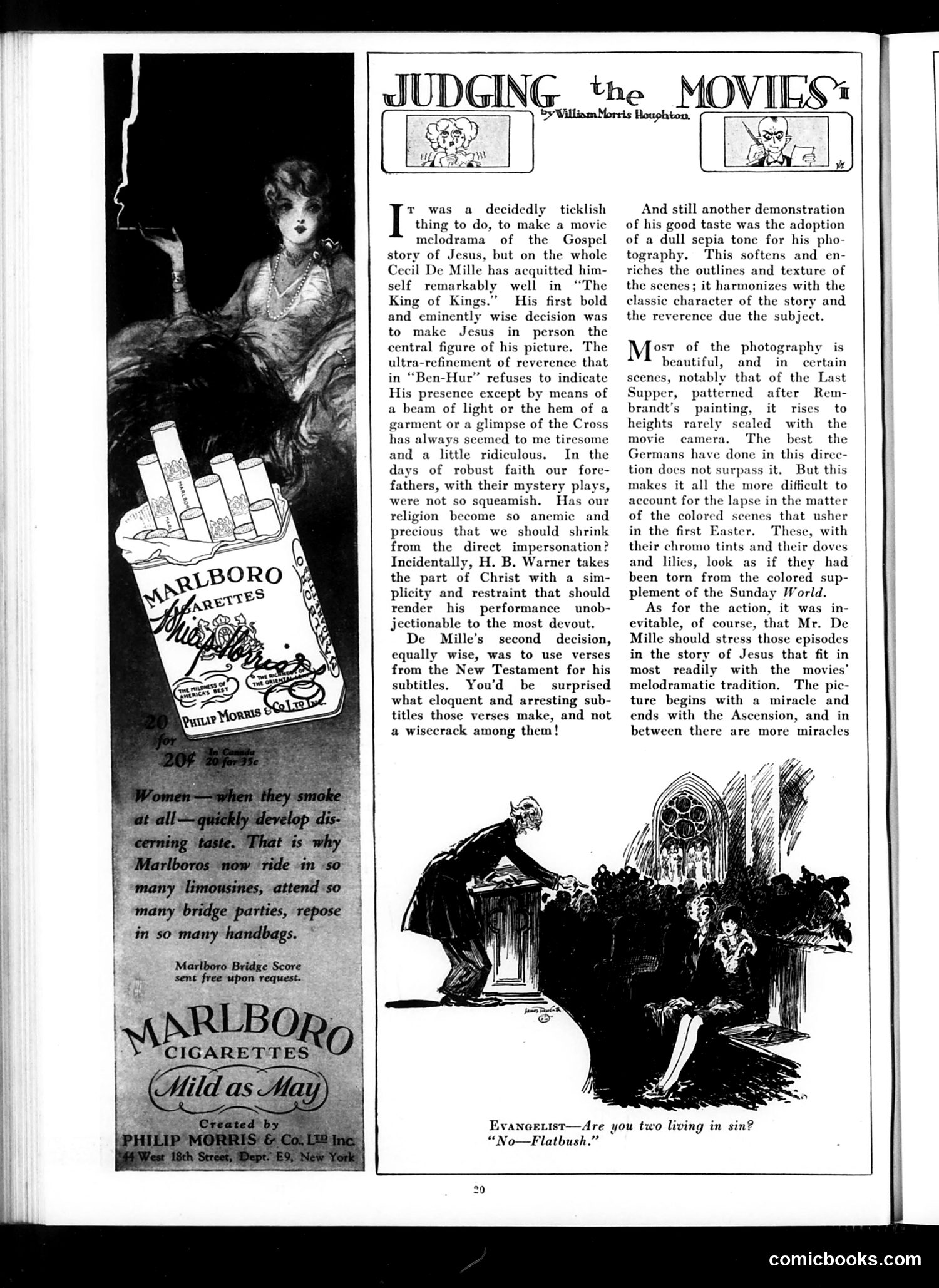
This is a film review of Cecil B. DeMille's *The King of Kings* (1927), discussing his cinematic adaptation of the Gospel story. The critic praises DeMille's decisions: depicting Jesus directly rather than symbolically (unlike *Ben-Hur*), using New Testament verses as subtitles, and employing muted sepia photography mimicking Rembrandt's *Last Supper*. However, he critiques the opening colored scenes as garishly commercial—looking like they're torn from the *Sunday World* newspaper's comic supplement, undermining the film's reverence. The small cartoon below shows an evangelist asking a couple "Are you two living in sin?" Their answer—"No—Flatbush"—is a contemporary joke: Flatbush (a Brooklyn neighborhood) was apparently synonymous with conventional, respectable living, making it the opposite of "sin." The Marlboro cigarette advertisement is period advertising unrelated to the review's content.
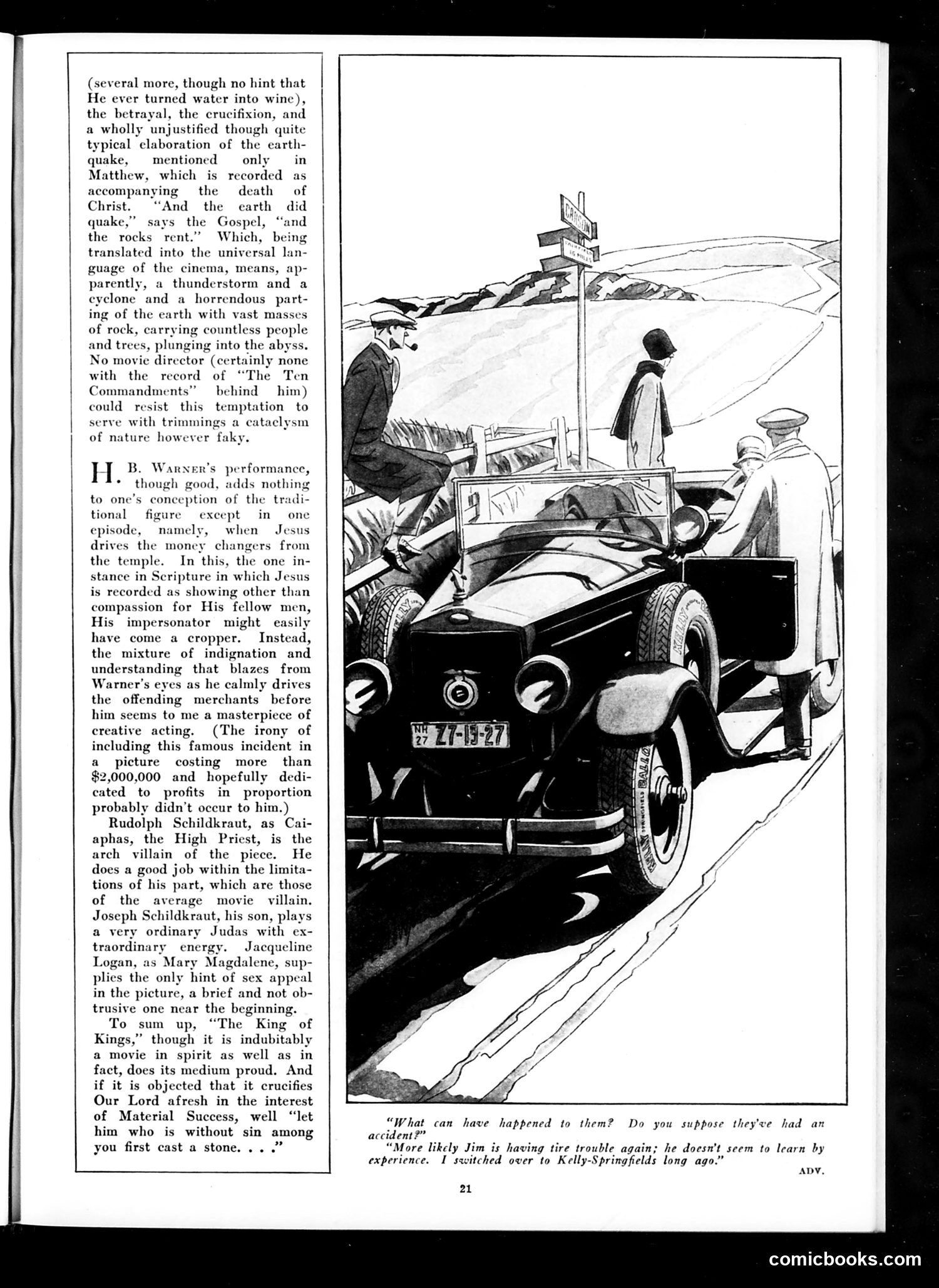
This page contains a film review of "The King of Kings" (a 1927 silent film by Cecil B. DeMille) alongside an automobile advertisement. The review critiques the film's spectacle and casting. It praises actor H.B. Warner's performance, particularly in the scene where Jesus drives money changers from the temple, calling it "a masterpiece of creative acting." However, the critic sardonically notes the irony: a film costing $2,000,000 and "dedicated to profits" depicts Jesus's sole act of righteous anger *against* commercial exploitation. The review also notes Rudolph Schildkraut as villain Caiaphas and mentions the film's modest sex appeal via actress Jacqueline Logan as Mary Magdalene. The bottom illustration is a Kelly-Springfield tires advertisement showing a stranded motorist, with dialogue suggesting tire failure—a common early-automotive concern. It humorously contrasts this with the speaker's switch to "reliable" Kelly-Springfields.
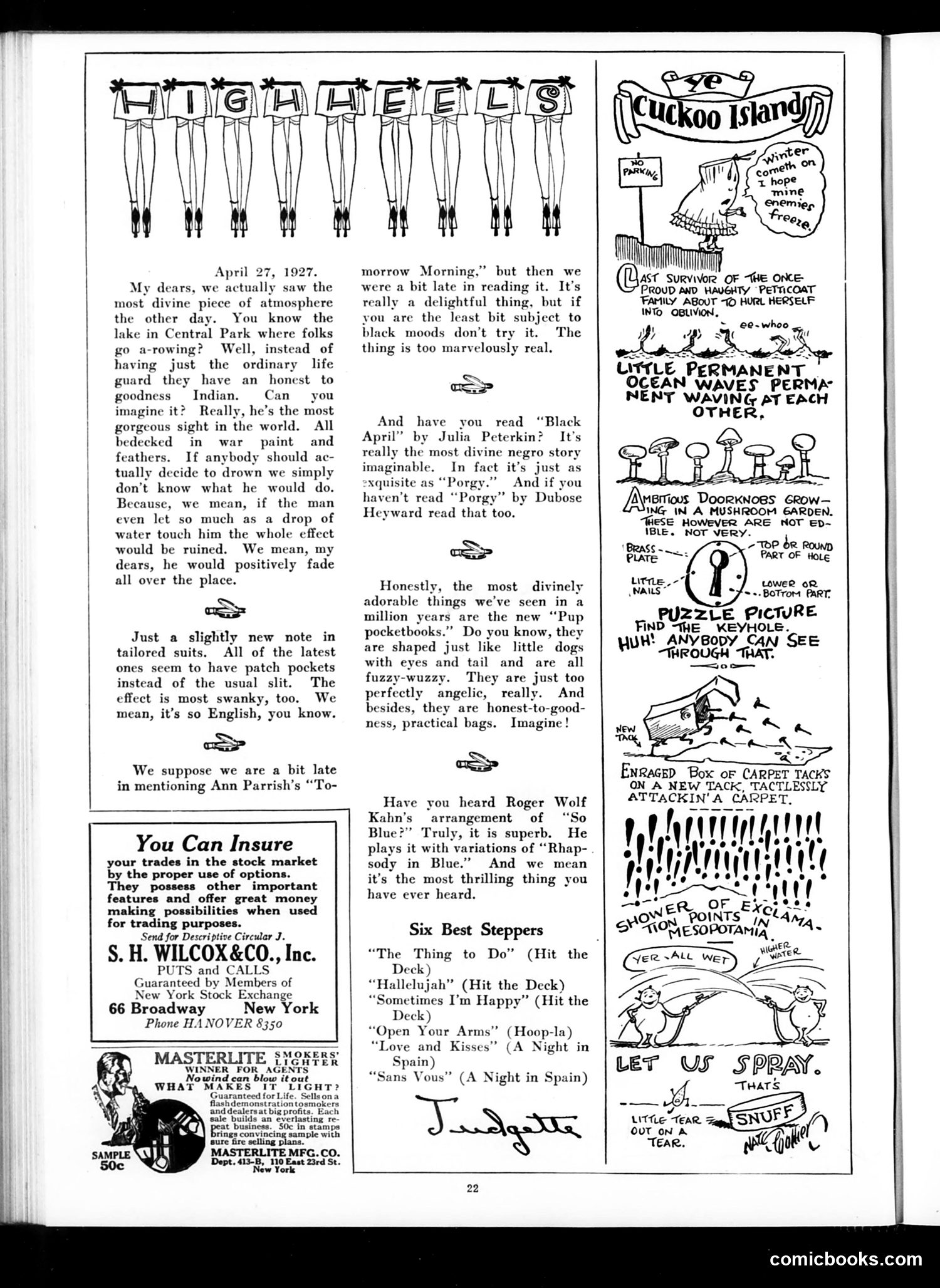
This page combines society gossip with satirical cartoons. The main text is a frivolous "letter" mocking upper-class affectations—praising an "authentic" Native American lifeguard at Central Park as exotic decoration, discussing new fashion (patch pockets), and recommending current books and music in breathless, affected language. The cartoons mock various 1920s trends: the declining "petticoat" (Victorian prudishness), novelty "pup pocketbooks" (dog-shaped purses), doorknob-shaped mushrooms, carpet-eating insects, and plants needing spray. One cartoon satirizes shower technology in Mesopotamia. The satire targets Jazz Age superficiality and consumerism—wealthy people treating culture, fashion, and even people (notably the Native American) as amusing novelties and status symbols. The cartoons extend this mockery to absurd modern inventions and trends. Period advertisements for stock trading options and cigarette lighters appear alongside.
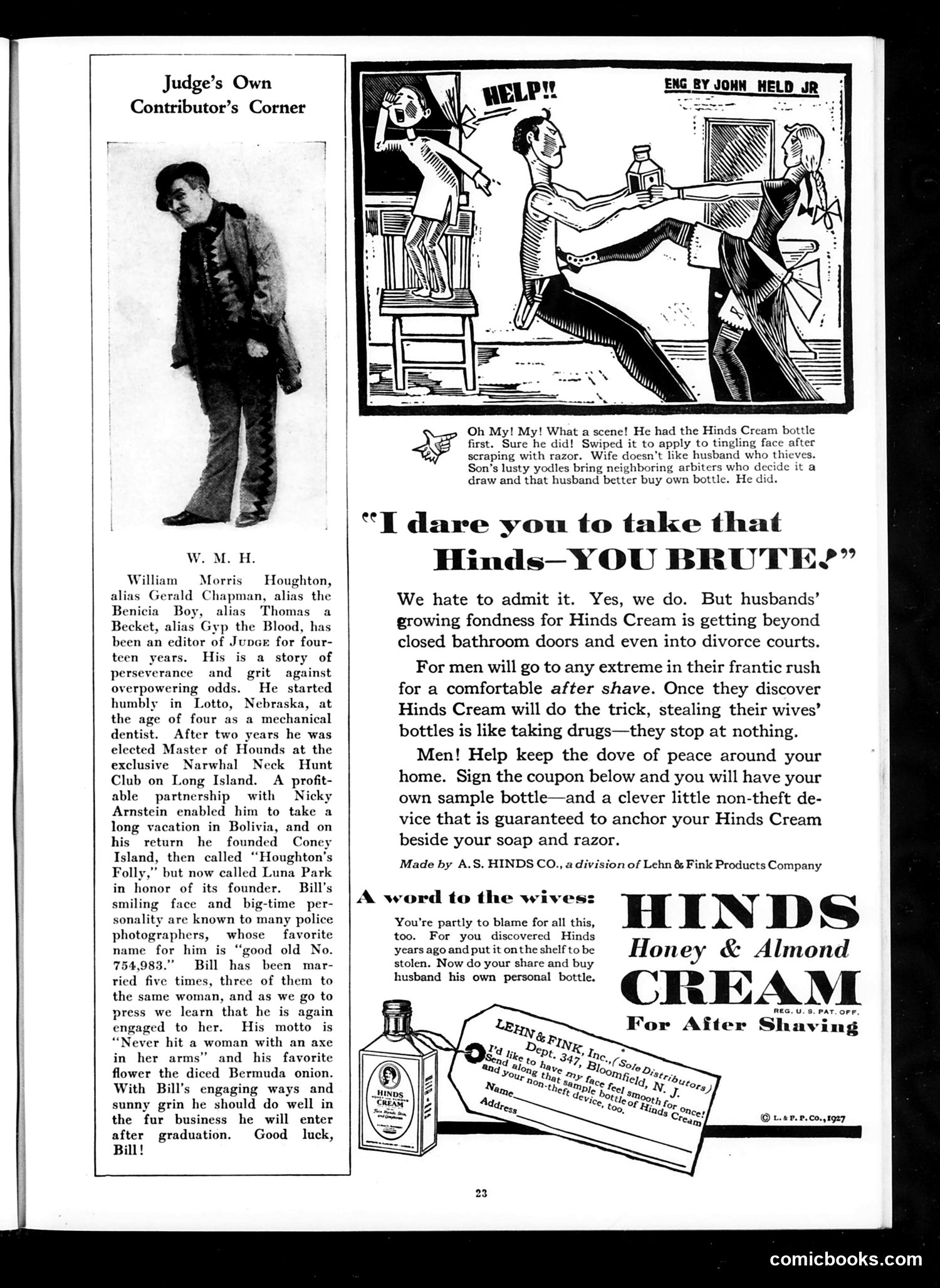
This page combines a humorous biographical sketch with a full-page advertisement for Hinds Cream aftershave. **Left side:** "Judge's Own Contributor's Corner" profiles W.M.H. (William Morris Houghton), a long-time Judge editor. The biography is entirely fictional and absurdist—claiming he founded Luna Park, was a "mechanical dentist" in Nebraska at age four, and has been married five times (three times to the same woman). It's a playful roast typical of magazine house humor. **Right side:** A comic strip advertisement depicting marital conflict over aftershave. A husband steals his wife's Hinds Cream bottle because he prefers it; she objects, calling him a "brute." The ad humorously frames the product as so desirable that men will resort to theft, then urges wives to buy their husbands their own bottles to preserve domestic peace. The satire targets both consumer product obsession and gender dynamics of the 1920s, using exaggeration to sell the cream while gently mocking both spouses' vanity.
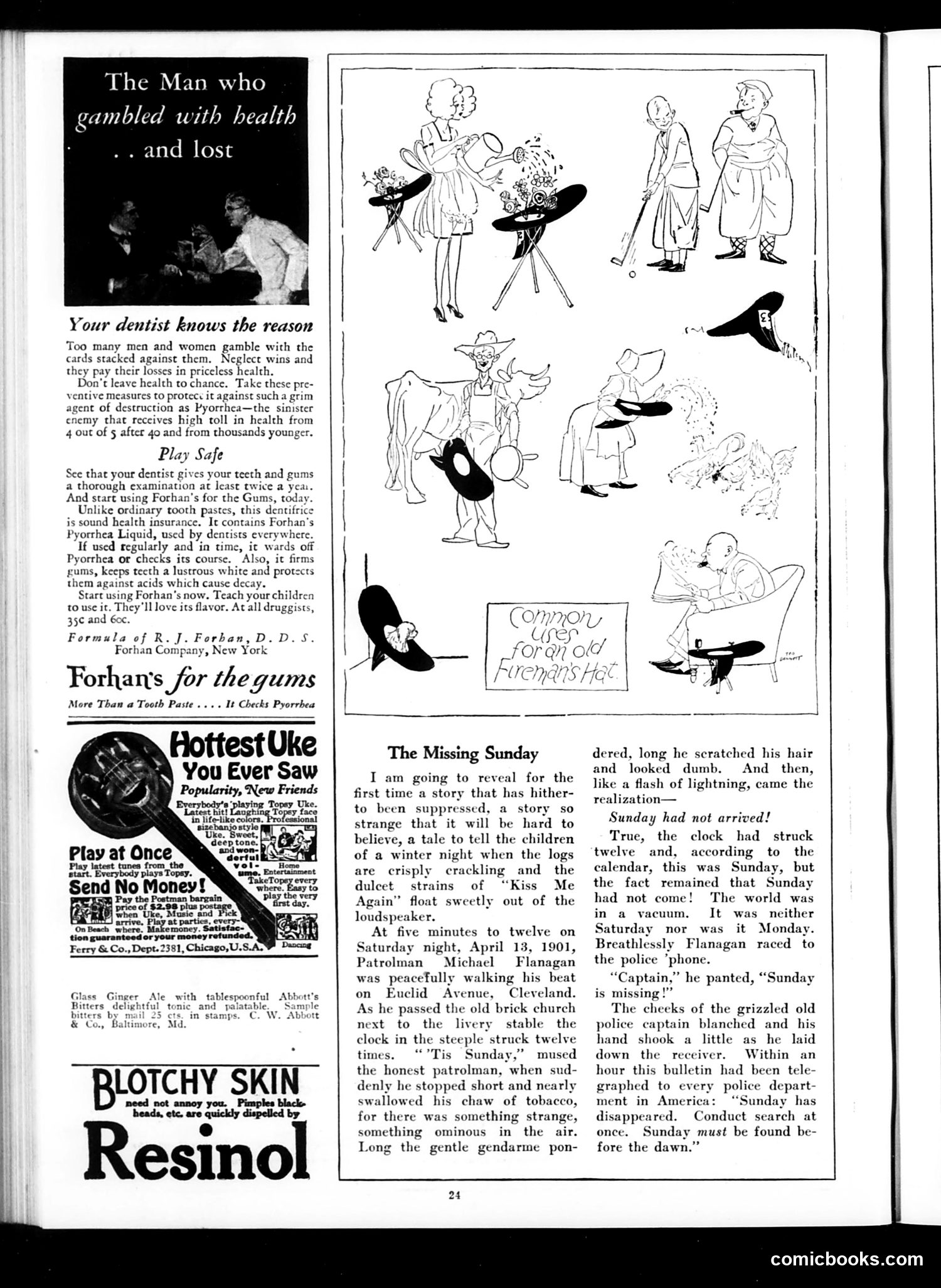
This page contains primarily **advertisements** rather than political satire, though one piece merits attention: **"The Missing Sunday"** is a whimsical April Fools' Day story (dated April 1, 1901) presented as mock-serious mystery fiction. A Cleveland patrolman named Michael Flanagan discovers that although the clock struck twelve at midnight, Sunday itself has vanished—the calendar says Sunday should exist, but it hasn't arrived. He alerts his captain, who initiates a nationwide police search. The joke exploits the absurdist humor of treating an abstract concept (a day of the week) as a missing person requiring actual investigation. It's a lighthearted April Fools' prank for readers, playing on the notion that Sunday could physically disappear. The remaining content consists of period advertisements: Forhan's toothpaste (promoting gum health), a ukulele ad, and Resinol skin cream—typical commercial content for a humor magazine of this era.
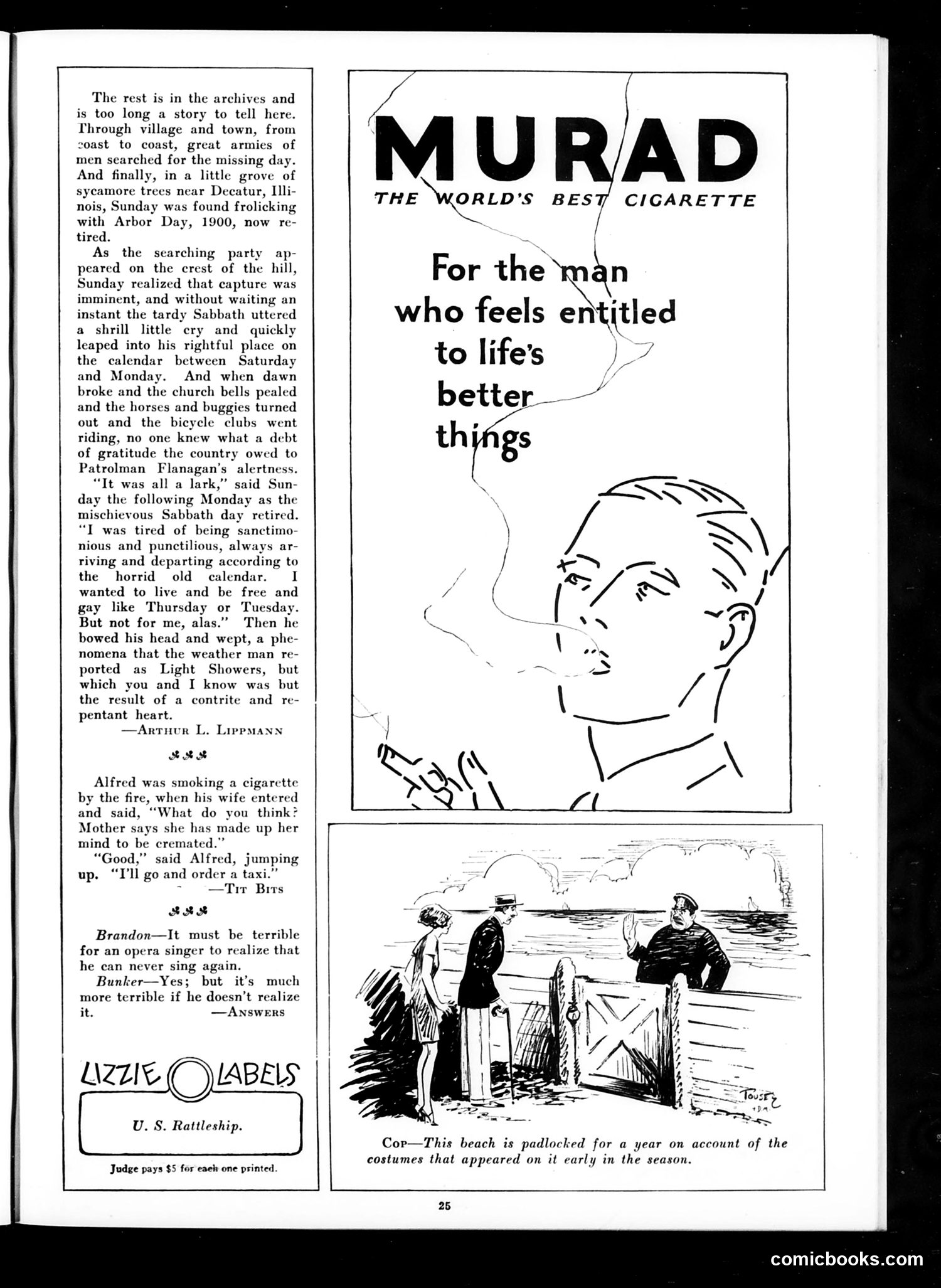
This page contains several unrelated items typical of Judge magazine's satirical format: **Main Content:** A whimsical story about "Sunday" (the day of the week personified) going missing and being found near Decatur, Illinois, frolicking with "Arbor Day, 1900." The narrative humorously depicts a search party retrieving Sunday back to its proper calendar position. The piece satirizes nothing specific—it's pure nonsense humor. **Advertisement:** A Murad cigarette ad featuring an illustrated man's face with copy about "life's better things." **Brief Jokes:** Short comedy items, including one where a man callously responds to his mother-in-law's cremation plans by offering to order a taxi. **"Lizzie Labels":** A contest offering $5 for submitted jokes about a U.S. battleship. **Beach Cartoon:** A sketch noting a beach is closed due to scandalous bathing costumes seen early in the season—likely referencing 1900s-era anxiety about women's revealing swimwear. The page reflects Judge's mix of absurdist humor, advertising, and social commentary on Victorian propriety concerns.
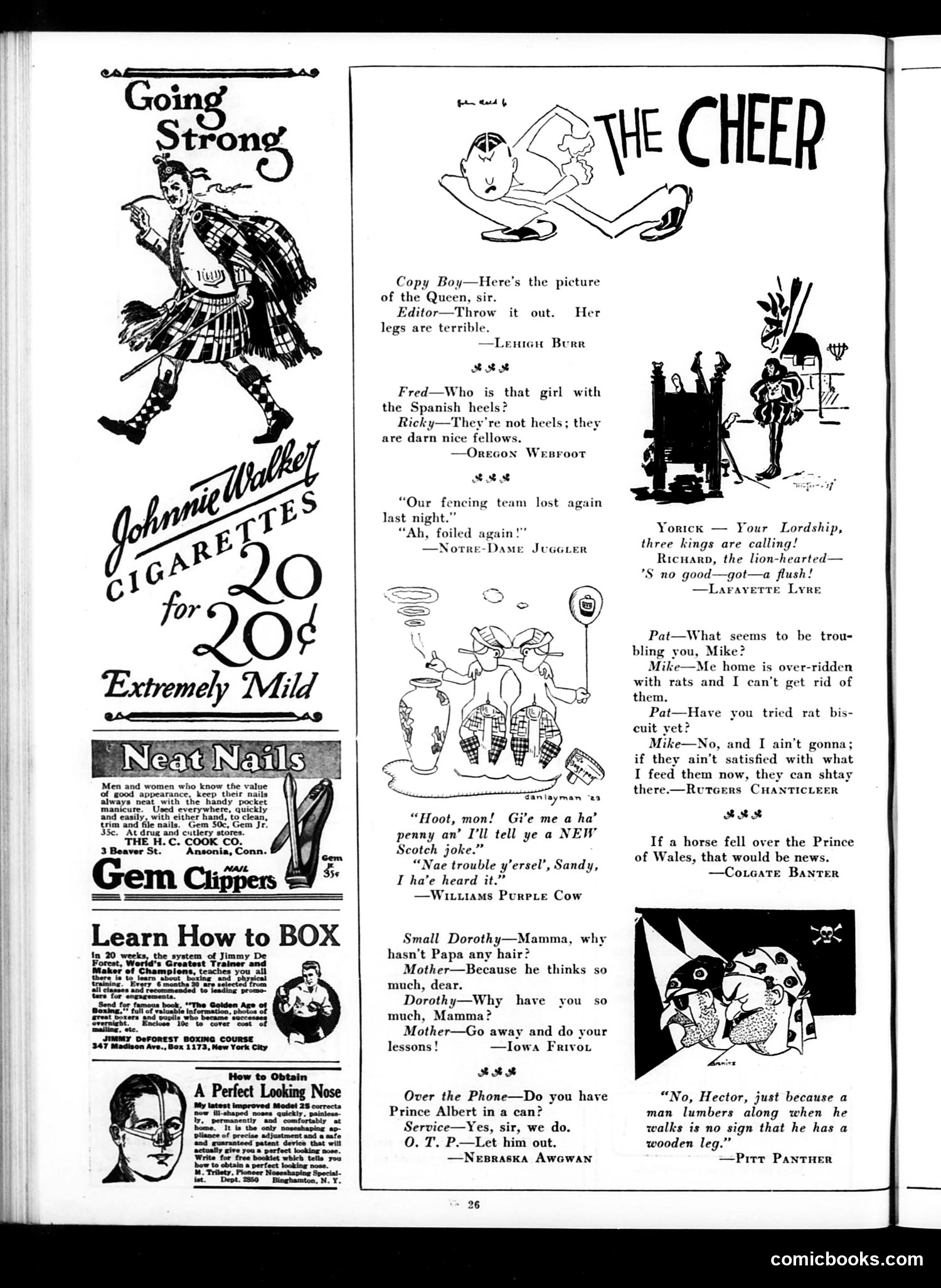
This page contains primarily **humorous one-liners and jokes** rather than political cartoons. The content represents early-20th-century American humor, featuring: **Joke subjects include:** - Editorial mishap about a queen's appearance - Puns on "Spanish heels" (actually Spaniards) - A fencing team "foiled" (wordplay) - Scottish dialect humor - Baldness attributed to thinking - A classic prank call setup ("Prince Albert in a can") - Domestic problems (rats, wooden legs) **The cartoons** show simple line drawings accompanying these jokes—mostly depicting characters mentioned in the quips. **Social context:** The humor reflects period attitudes toward class, nationality (Scottish stereotypes), and domestic life. The advertisements (cigarettes, nail clippers, boxing lessons, cosmetics) indicate this was marketed to general readers seeking light entertainment. This is essentially a **joke compilation page**—the magazine's signature format—rather than political satire.
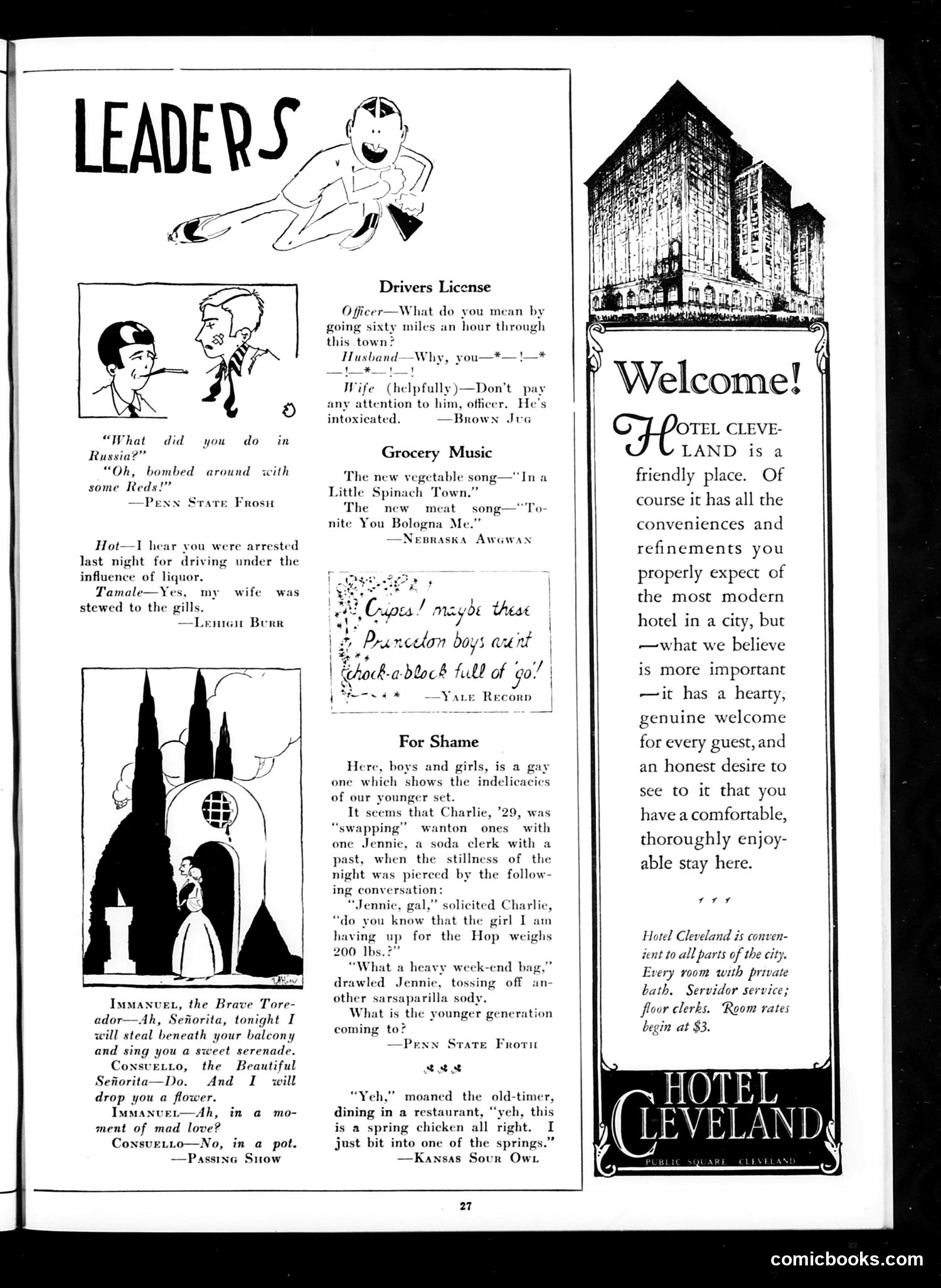
This page contains humor pieces satirizing 1920s American life, alongside a Hotel Cleveland advertisement. The jokes mock contemporary social issues: Prohibition-era drinking ("stewed to the gills"), reckless driving and traffic enforcement, and young people's dating behavior. The "For Shame" section criticizes younger generations for casual romantic "swapping"—suggesting moral decline among youth. One joke plays on the double meaning of "bag" (luggage vs. complaint), while another uses the "springs" pun about tough chicken meat. The cartoon-style drawings are simple line illustrations accompanying brief comedic dialogues, typical of Judge's satirical format. References like "Russia" and "Reds" likely allude to post-WWI anxieties about communism or soldiers' wartime experiences. The Hotel Cleveland advertisement occupies the right side, emphasizing modern amenities and hospitality—a stark contrast to the satirical, cynical humor dominating the rest of the page. This juxtaposition was standard in Judge's editorial layout.
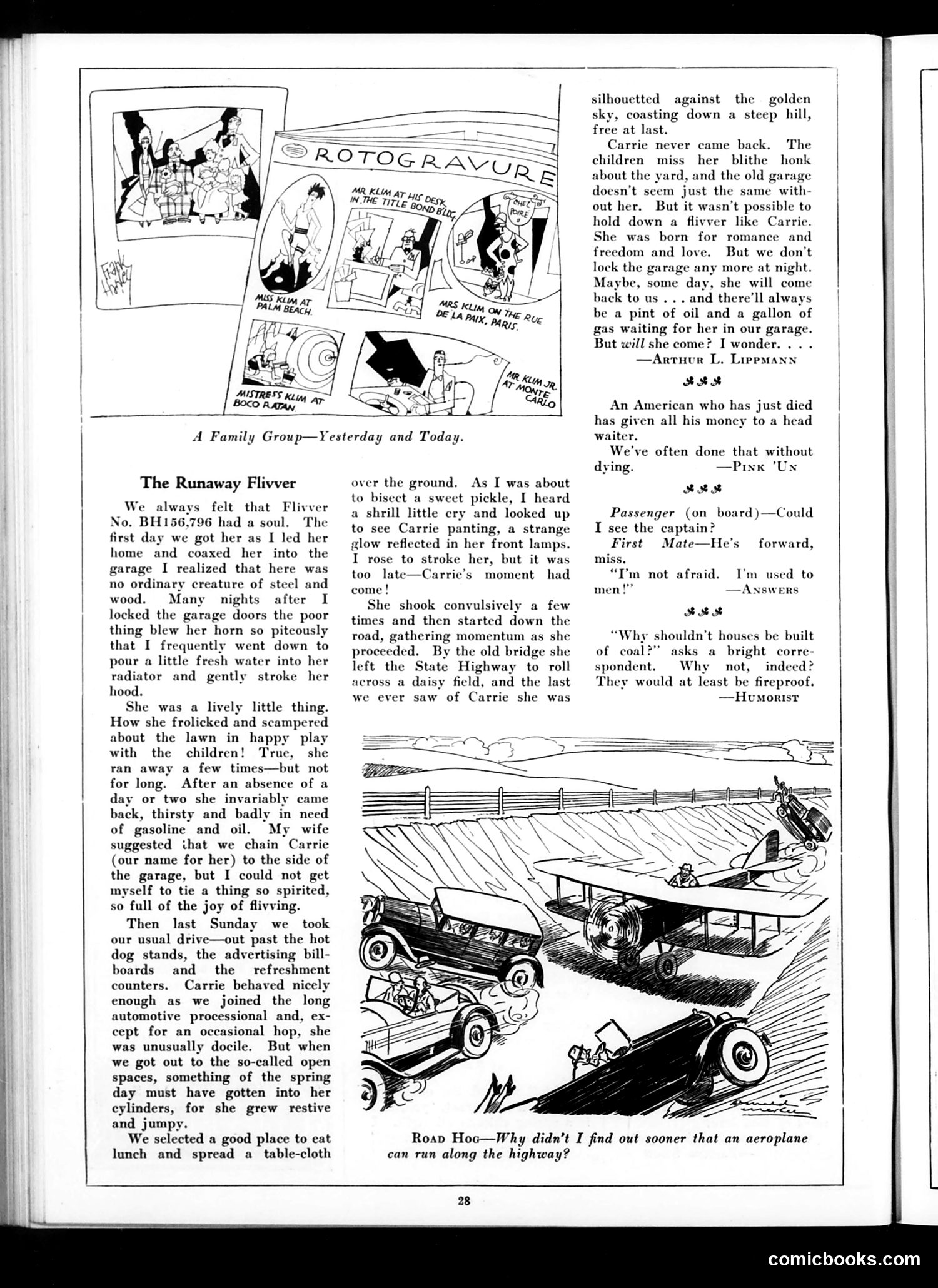
This humorous story anthropomorphizes a Model T Ford ("flivver"—period slang for cheap cars) as a spirited creature named Carrie. The narrator treats the car with affection, even stroking its hood and pouring water in its radiator like a beloved pet. The satire targets 1920s anxieties about modern technology and changing social values. Carrie's escape—abandoning the family during a picnic to race freely across an open field—represents a rebellion against domestication and constraint. The author's sentimental acceptance of her departure ("she was born for romance and freedom") suggests romantic nostalgia for wild, untamed life versus suburban conformity. The accompanying cartoon strip shows a family's leisure activities "yesterday and today," likely contrasting simpler pastimes with modern automobile culture. The "Road Hog" cartoon below jokes about the absurdity of using planes on highways—mocking the era's fascination with both new transportation technologies.
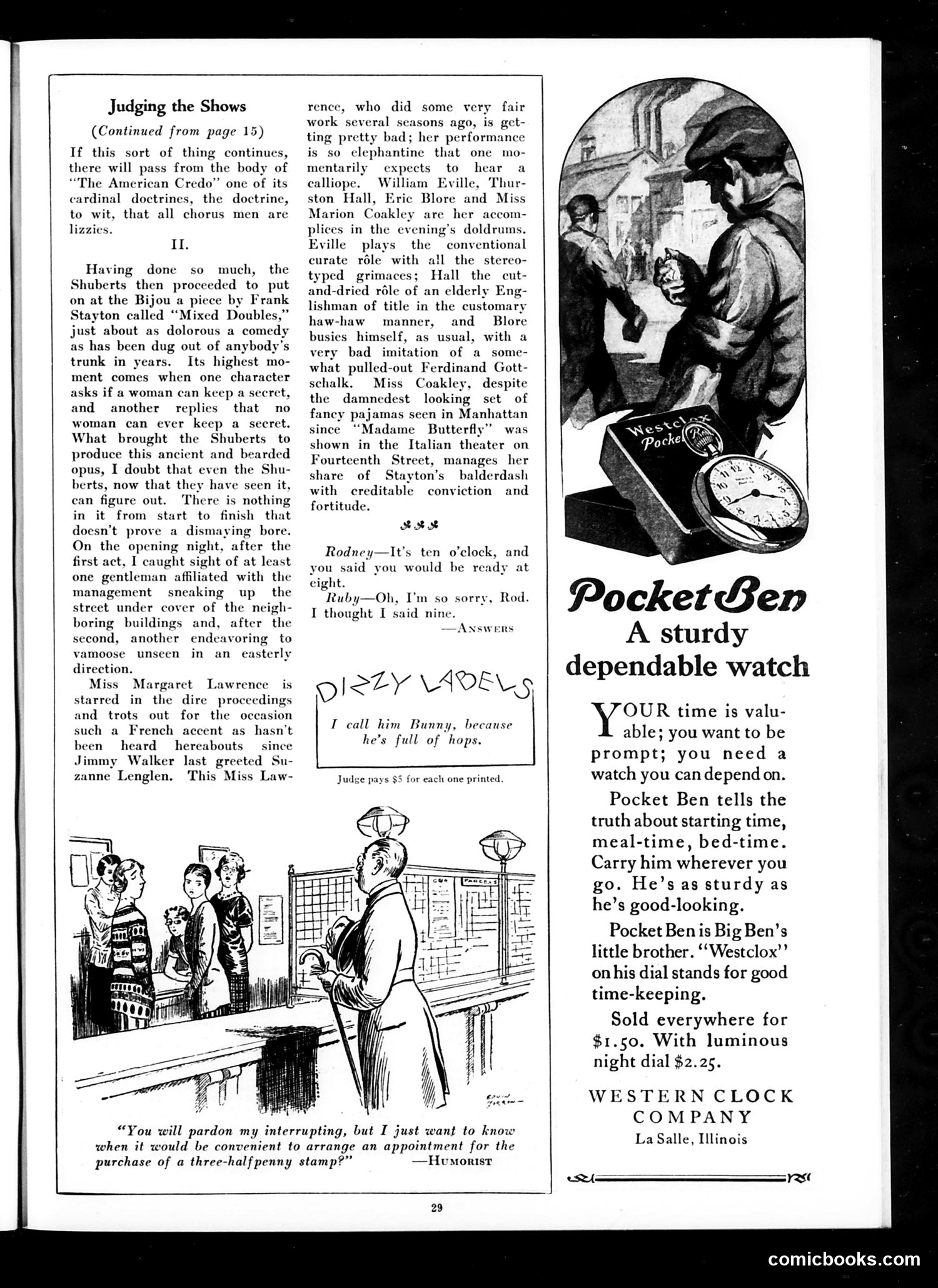
This page contains a theater critique and unrelated advertisement. The main article reviews Broadway shows produced by the Shuberts, particularly criticizing "Mixed Doubles" as an ancient, tedious comedy. The reviewer mocks actress Margaret Lawrence's exaggerated French accent (comparing it to Jimmy Walker greeting tennis player Suzanne Lenglen) and critiques the supporting cast's stereotypical performances. The satire targets both the Shuberts' poor artistic judgment in reviving outdated material and actors' reliance on tired theatrical conventions. A small cartoon joke plays on the double meaning of "hops" (beer ingredient/rabbit behavior). The right side contains an unrelated advertisement for Pocket Ben watches—a cheaper companion to the Big Ben clock brand, marketed as reliable and portable. The page represents typical Judge content: theatrical satire aimed at educated urban readers familiar with Broadway productions and performers of the era.
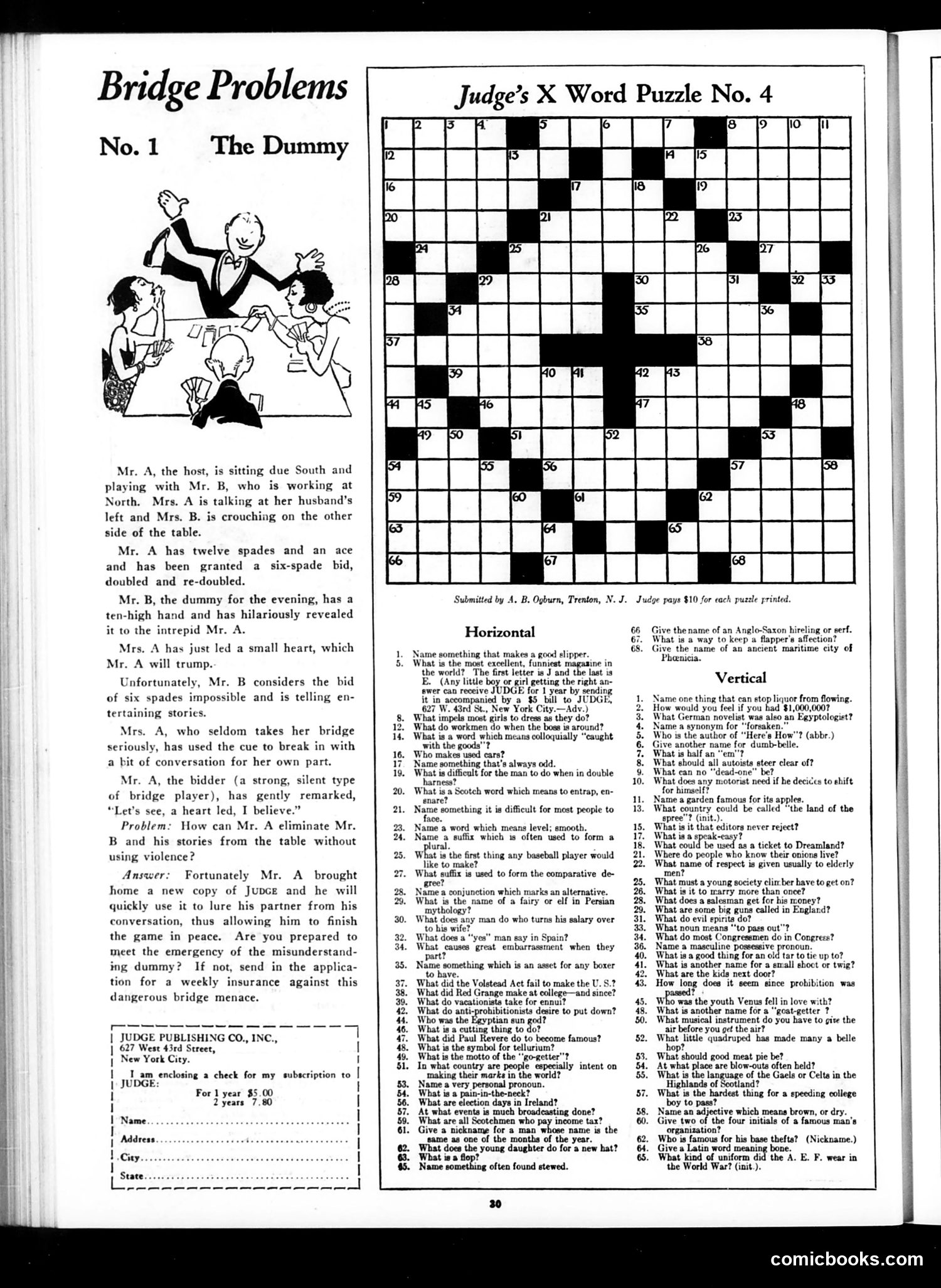
This page from *Judge* satirizes the social tensions of bridge playing—a popular parlor game of the era. "The Dummy" presents a relatable scenario: Mr. A is trying to concentrate on a difficult card hand, but his partner Mr. B won't stop telling entertaining stories, disrupting the game. The humor lies in the "solution": Mr. A will distract Mr. B by showing him a copy of *Judge* magazine itself—a clever self-promotional joke. The cartoon suggests that *Judge* is so entertaining and compelling that even an annoying storyteller cannot resist reading it. The accompanying word puzzle and subscription advertisement reinforce this meta-humor: the magazine is literally advertising itself as the solution to domestic bridge annoyances. The tone is lighthearted and self-aware, using bridge etiquette violations as a vehicle for promoting the magazine to readers.
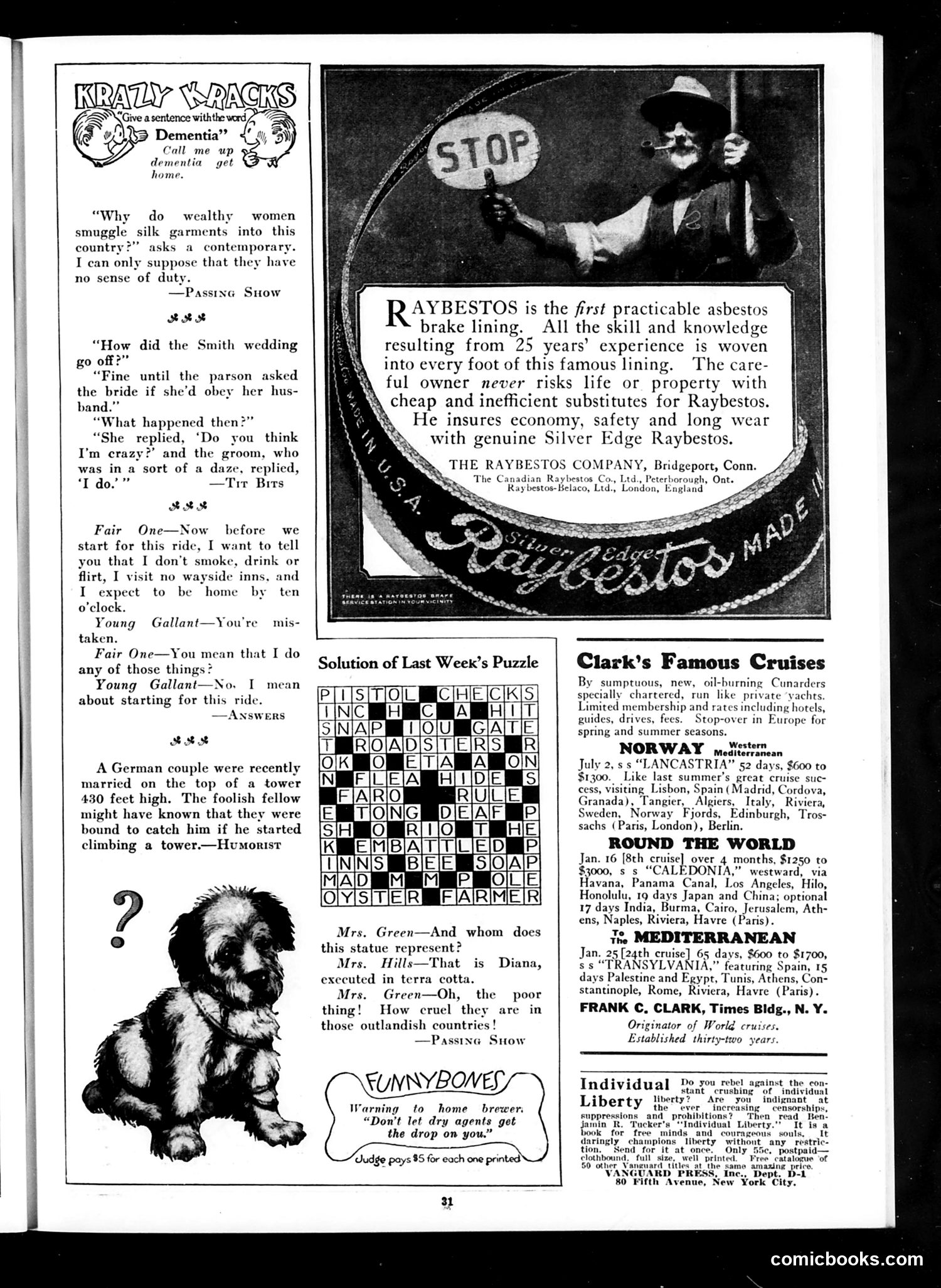
This page combines humor columns, advertisements, and social commentary typical of Judge magazine's format. **The Humor Sections:** The "Krazy Kracks" and dialogue pieces offer light domestic and courtship humor—jokes about wealthy women smuggling silk garments (likely referencing tariff evasion during the era of trade protectionism), wedding mishaps, and dating etiquette. The German couple climbing a tower joke plays on slapstick expectations. **Notable Advertisement:** A large Raybestos brake lining ad features a dramatic photograph of a man holding a "STOP" sign near a car wheel, emphasizing safety—clearly marketing automobile safety technology to early-20th-century car owners concerned about reliability. **Social Commentary:** The "Individual Liberty" advertisement by Benjamin R. Tucker promotes anarchist/libertarian philosophy, opposing Prohibition (the "dry agents" reference in the warning). This reflects the anti-Prohibition sentiment present in some American magazines of the 1920s-early 1930s period. **Travel Advertisements:** Clark's cruise line ads showcase luxury ocean voyages—expensive leisure available to wealthy readers, illustrating Judge's affluent audience. The page reflects pre-Depression era concerns: tariffs, automobile safety, Prohibition debates, and leisure consumption.
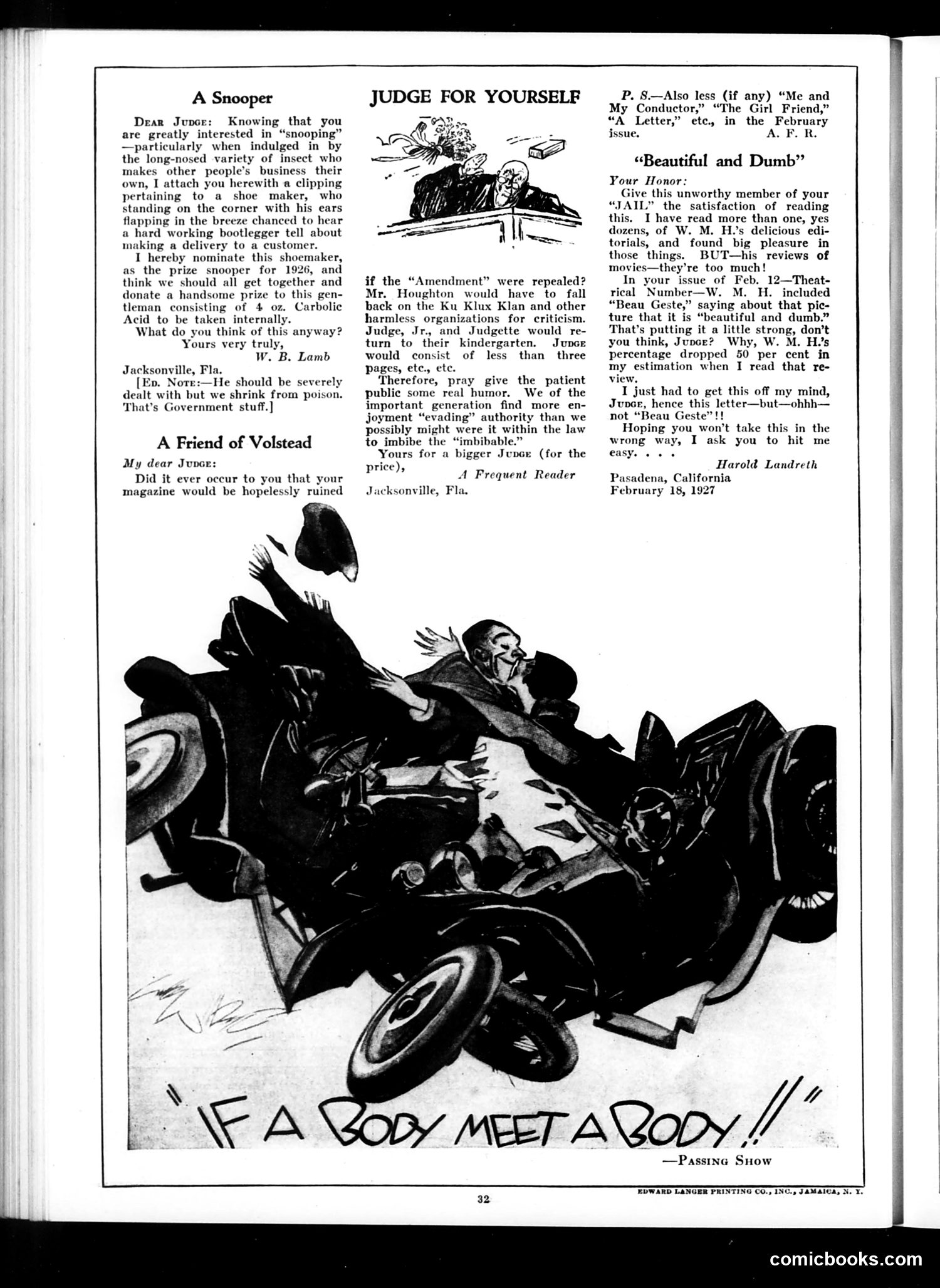
This page contains reader letters to Judge magazine's editor and one accompanying cartoon. The letters reveal anxieties about Prohibition enforcement (which was active 1920-1933). **"A Snooper"** criticizes informants reporting bootleggers to authorities—the writer sarcastically "nominates" a nosy shoemaker who overheard a bootlegger's conversation. Judge declines the poison suggestion but sympathizes. **"A Friend of Volstead"** argues Judge magazine depends on Prohibition for satirical material. The Volstead Act (enforcing Prohibition) provides targets like the KKK. The writer warns that if Prohibition repeals, Judge loses content and must shrink. This reveals how central alcohol prohibition was to 1920s satire. **"Beautiful and Dumb"** praises Judge's theater reviews but objects to critic W.M.H. calling "Beau Geste" (a 1926 film) "beautiful and dumb." The cartoon "If a Body Meet a Body" (by Passing Show) depicts a car crash—seemingly illustrating careless driving or accident-related humor, though context is limited.
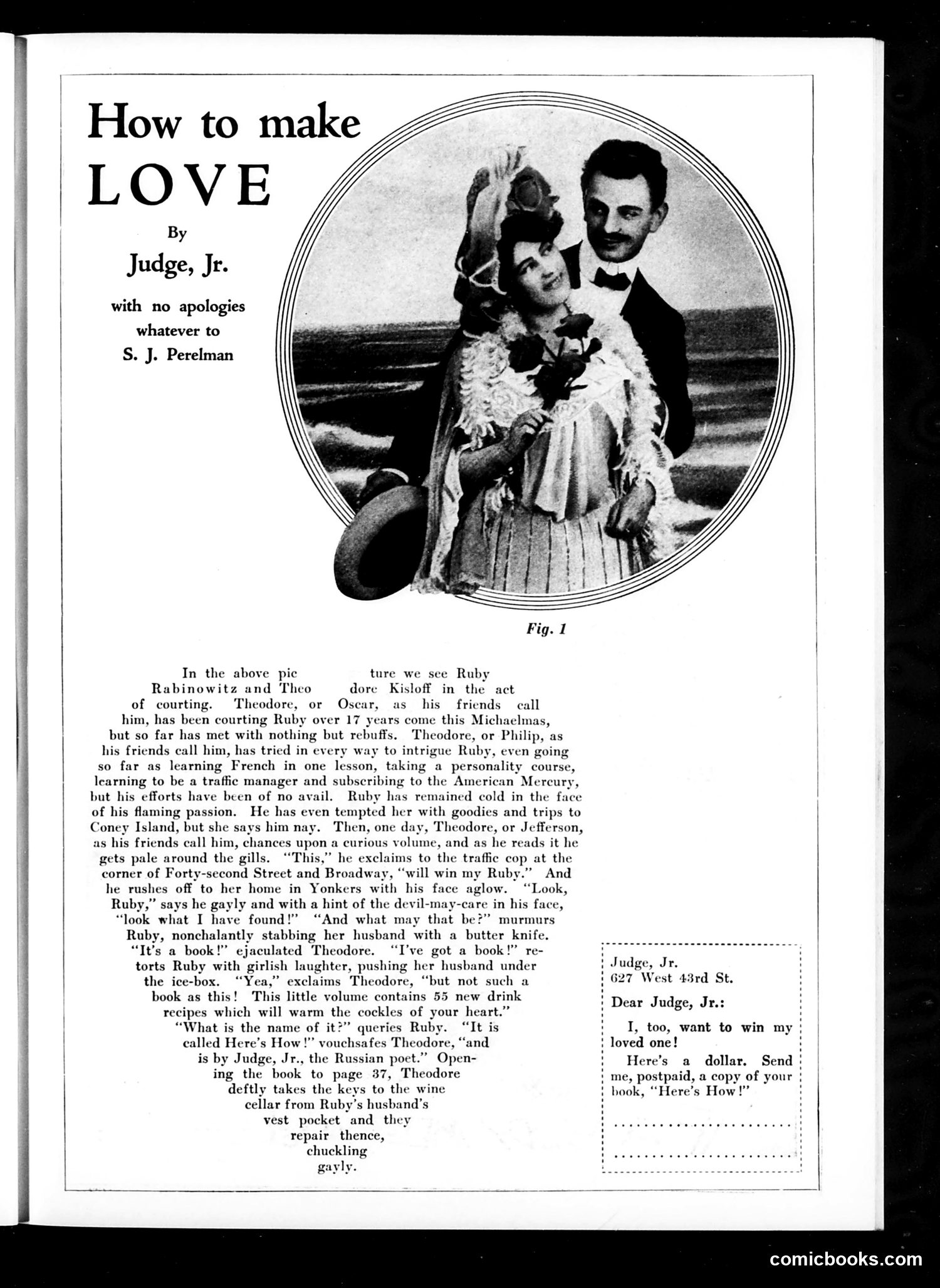
This is a comedic advertisement disguised as a satirical story, promoting a fictional book called "Here's How!" ostensibly by "Judge, Jr., the Russian poet." The narrative mocks romantic persistence: Theodore pursues Ruby for 17 years through increasingly absurd self-improvement schemes (French lessons, personality courses, traffic management training), all failing until he discovers a book of cocktail recipes. The humor lies in the absurd solution—that booze, not character improvement, will win romance. The story's exaggerated Jewish character names (Rabinowitz, Kisloff) and the mention of "no apologies to S. J. Perelman" suggest self-aware parody of sentimental Yiddish-American romantic tales popular in the era. The final page element is a reader response coupon, inviting people to order the book for one dollar—the "joke" being that readers are themselves being seduced by the same ridiculous premise as Theodore. It's meta-advertising: Judge magazine selling a fake book by pretending to satirize people who'd buy such a book.
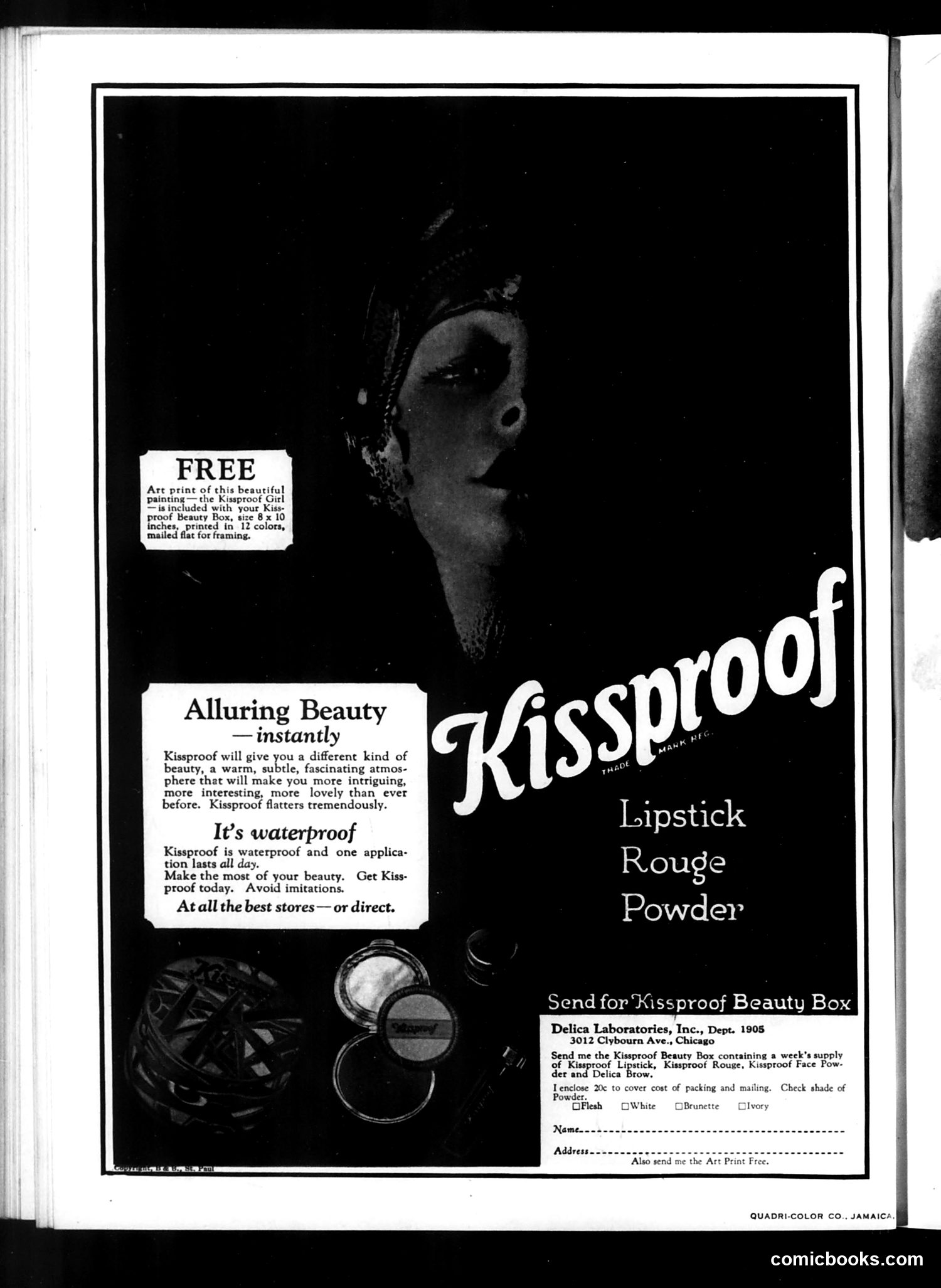
This page is **not satire or political commentary** — it's a straightforward vintage advertisement for Kissproof cosmetics, placed in *Judge* magazine. The ad promotes a waterproof makeup line (lipstick, rouge, powder) from Delica Laboratories in Chicago. The dramatic photograph shows a woman's profile in high contrast, emphasizing her lips and complexion to showcase the product's appeal. The key selling point stressed repeatedly is durability: "waterproof and one application lasts all day" — a notable advantage when reliable cosmetics were still developing. A free offer incentivizes purchase: customers ordering the "Beauty Box" receive a 12-color art print of "the Kissproof Girl" suitable for framing. The ad includes a mail-in coupon with shade options (Flesh, Brunette, Ivory, White). This represents early-20th-century beauty marketing targeting women interested in modern, long-lasting cosmetics.