
Judge, 1927-05-21 · page 17 of 36
Judge — May 21, 1927 — page 17: what you’re looking at
What you’re looking at
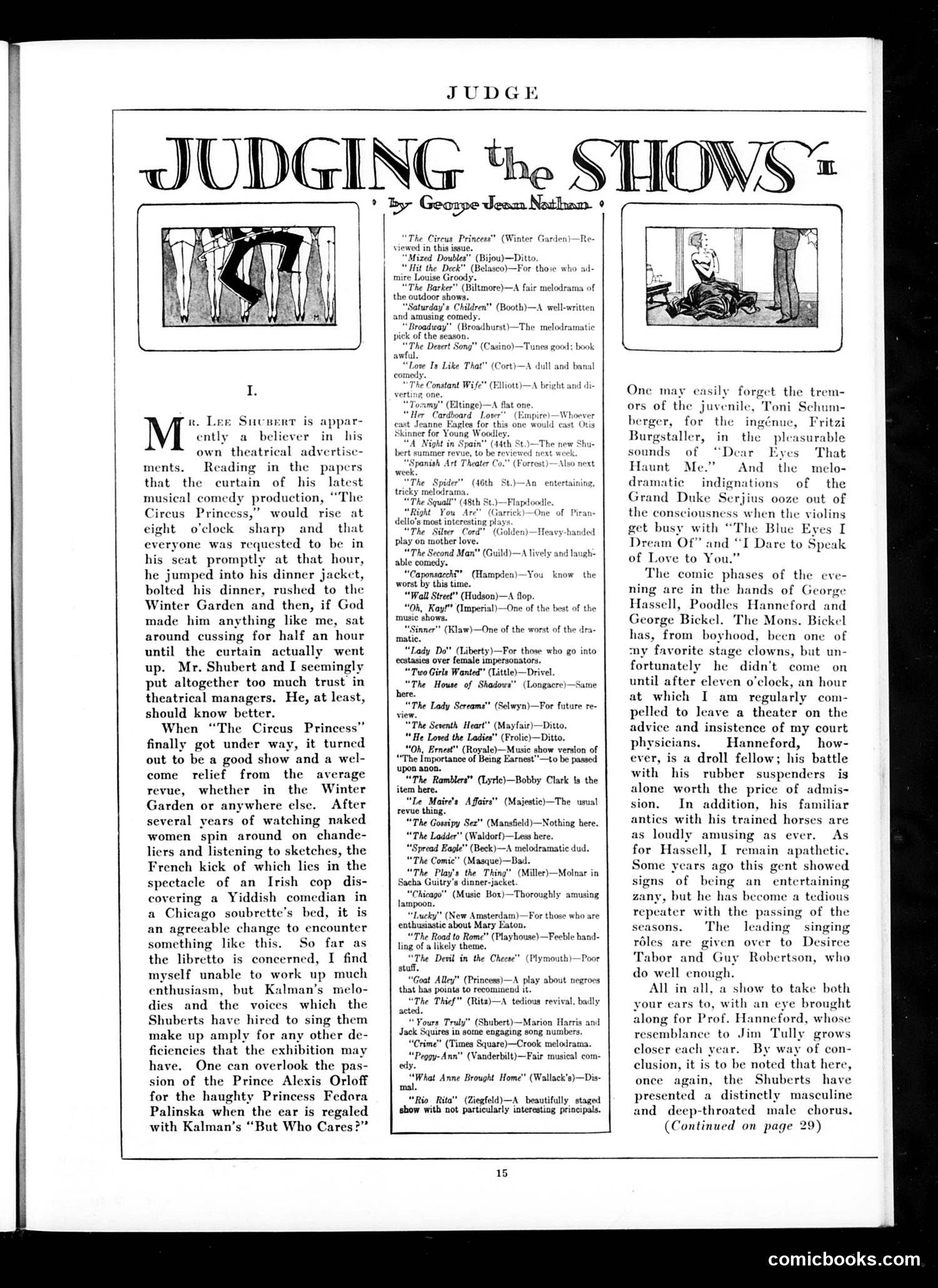
This is a theater review column by George Jean Nathan, a prominent drama critic of the 1920s. The page contains no political cartoons—it's primarily text with two small photographs of theatrical scenes. Nathan reviews "The Circus Princess" at the Winter Garden, praising its music and performances despite a weak libretto. He humorously criticizes theater manager Lee Shubert for advertising an 8 o'clock curtain time, then making audiences wait—suggesting theatrical managers are unreliable. The bulk of the page lists brief, often dismissive reviews of contemporary Broadway shows. Most judgments are scathing ("A flop," "Drivel," "Bad"). Nathan appears to favor comedies and musical shows with strong performances over melodramas. This reflects 1920s New York theater tastes and Nathan's influential but caustic critical voice. The content is theater criticism, not satire or political commentary.
📄 Transcribed text from this page (OCR, searchable)
Machine-transcribed from the original scan — historical spelling and the odd misread are preserved.
JUDGE UDGING ‘he SHOWS rn. Lee Suvnert is appar- M ently a believer in his own theatrical advertise- ments. Reading in the papers that the curtain of his latest musical comedy production, “The Cireus Princess,” would rise at eight o'clock sharp and that everyone was requested to be in his seat promptly at that hour, he jumped into his dinner jacket, bolted his dinner, rushed to the Winter Garden and then, if God made him anything like me, sat around cussing for half an hour until the curtain actually went up. Mr. Shubert and I seemingly put altogether too much trust in theatrical managers. He, at least, should know better. When “The Circus Princess” finally got under way, it turned out to be a good show and a wel- come relief from the average revue, whether in th Winter Garden or anywhere else. After several years of watching naked women spin around on chande- liers and listening to sketches, the French kick of which lies in the spectacle of an Irish cop d covering a Yiddish comedian in a Chicago soubrette’s bed, it is an agreeable change to encounter something like this. So far as the libretto is concerned, I find myself unable to work up much enthusiasm, but Kalman’s melo- dies and the voices which the Shuberts have hired to sing them make up amply for any other de- ficiencies that the exhibition may have. One can overlook the pas- sion of the Prince Alexis Orloff for the haughty Prine Fedora Palinska when the ear is regaled with Kalman’s “But Who Cares?” * by Georpe Jeam Nathan. ° “The Circus Princess” (Wint viewed in this issue. “Mixed Doubles” (Bijou)—Ditto Hit the Deck” (Belasco)—For those Louise Groody. The Barker" (Biltmore)—A fair melodrama of the outdoor shows. “Saturday's Children" (Booth)—A well-written and amusing comedy. Broadway" (Brc pick of the season. ‘nd Desert Song’’ (Casino)—Tunes good; book “Lowe To Like That” (Cort)—A dull and banal ie Constant Wife" (Elliott)—A bright and Garden)—Re- Jhurst)—The melodratm ‘ommy"” (Eltinge)—A Her Cardboard Lover” (Expire)—Whoever st Jeanne Eagles for this one would cast Otis Skinner for Young Woodley. “A. Night in Spain’ (44th St.)—The new Shu- bert summer revue, to be reviews week Also next at one. sining, Flapdoodle, One of Pi Silver Cord” y on mother love. The Second Man" (Guild)—A lively and la able comedy. “Caponsacchi” worst by this time. “Wall Street” (Hudson)—A flop. “Oh, Kay" (Imperial)—One of the best of the music shows. inner” (Klaw)—One of the worst of th Heavy-handed (Hampden)—You know the matic. Lady Do" (Liberty)—For those who go into ccstasies over female impersonators. “Two Girls Wanted" (Little)—Drivel. “The House of Shadows’ (Longacre)— here. “The Lady Screams” (Selwyn)—For future re- view. “The Seventh Heart" (Mayfair)—Ditto. “*He Loved the Ladies" (Frolic)—Ditto. “Oh, Ernest" (Royale)—Music show version of “The Importance of Being Earnest” —to be passed upon anon. “The Ramblers” (Lyric)—Bobby Clark {s the item here. “Le Maire's Affairs” (Majestic)—The usual revue thing. “The Gossipy Sex" (Mansfield)—Nothing here. The Ladder” (Waldorf)—Less bere. 'pread Eagle" (Beck)—A melodramatic dud. The Comic" (Masque)—Bad. “The Play's the Thing” (Millet)—Molnar in Sacha Guitry’s dinner-jacket. “Chicago” (Music Box)—Thoroughly amusing lampooi “Lucky” (New Amsterdam)— enthusiastic about Mary Eaton. “The Road to Rome” (Playhouse) —Feeble hand- ling of a likely theme. “The Devil in the Cheese’ stuff. “Goat Alley" (Princess)—A play about negroes that has points to recomunend it. “The Thief” (Ritz)—A tedious revival, badly acted. “Yours Truly” (Shubert)—Marion Harris and Jack Squires in some engaging song numbers “Crime” (Times Square)—Crook melodrama. “Pegmy-Ann” (Vanderbilt)—Fair musical com- edly. “What Anne Brought Home" (Wallack’s)—Dis- mal. “Rio Rita" (Ziegfeld)—A beautifully staged show with not particularly interesting principals. ‘or those who are (Plymouth)—Poor One may easily for ors of the juvenil get the trem- ; Toni Schum- berger, for the ingénue, Fritai Burgstaller, in the pleasurable sounds of “Dear Eyes That Haunt Me.” And the melo- dramatic indignations of the Grand Duke Serjius ooze out of the consciousness when the violins get busy with “The Blue Eyes I Dream Of” and “I Dare to Speak of Love to You.” The comic phases of the eve- ning are in the hands of George Hassell, Poodles Hanneford and George Bickel. The Mons. Bickel has, from boyhood, been one of my favorite e clowns, but un- fortunately he didn’t come on until after eleven o'clock, an hour at which I am regularly com- pelled to leave a theater on the advice and insistence of my court physicis Hanneford, ever, is a droll fellow; his battle with his rubber suspenders is alone worth the price of admis- sion. In addition, his antics with his trained horses are as loudly amusing as ever. As for Hassell, I remain apathetic: Some years ago this gent showed signs of being an_ entertaining zany, but he has become a tedious repeater with the passing of the seasons. The leading singing roles are given over to Desiree Tabor and Guy Robertson, who do well enough. All in all, a show to take both your ears to, with an eye brought along for Prof. Hanneford, whose resemblance to Jim Tully grows closer each year. By way of con- clusion, it is to be noted that here, ain, the Shuberts presented a distinctly masculine and deep-throated male chorus. (Continued on page 29) how- familiar once comicbooks.com