
Judge, 1927-05-21 · page 15 of 36
Judge — May 21, 1927 — page 15: what you’re looking at
What you’re looking at
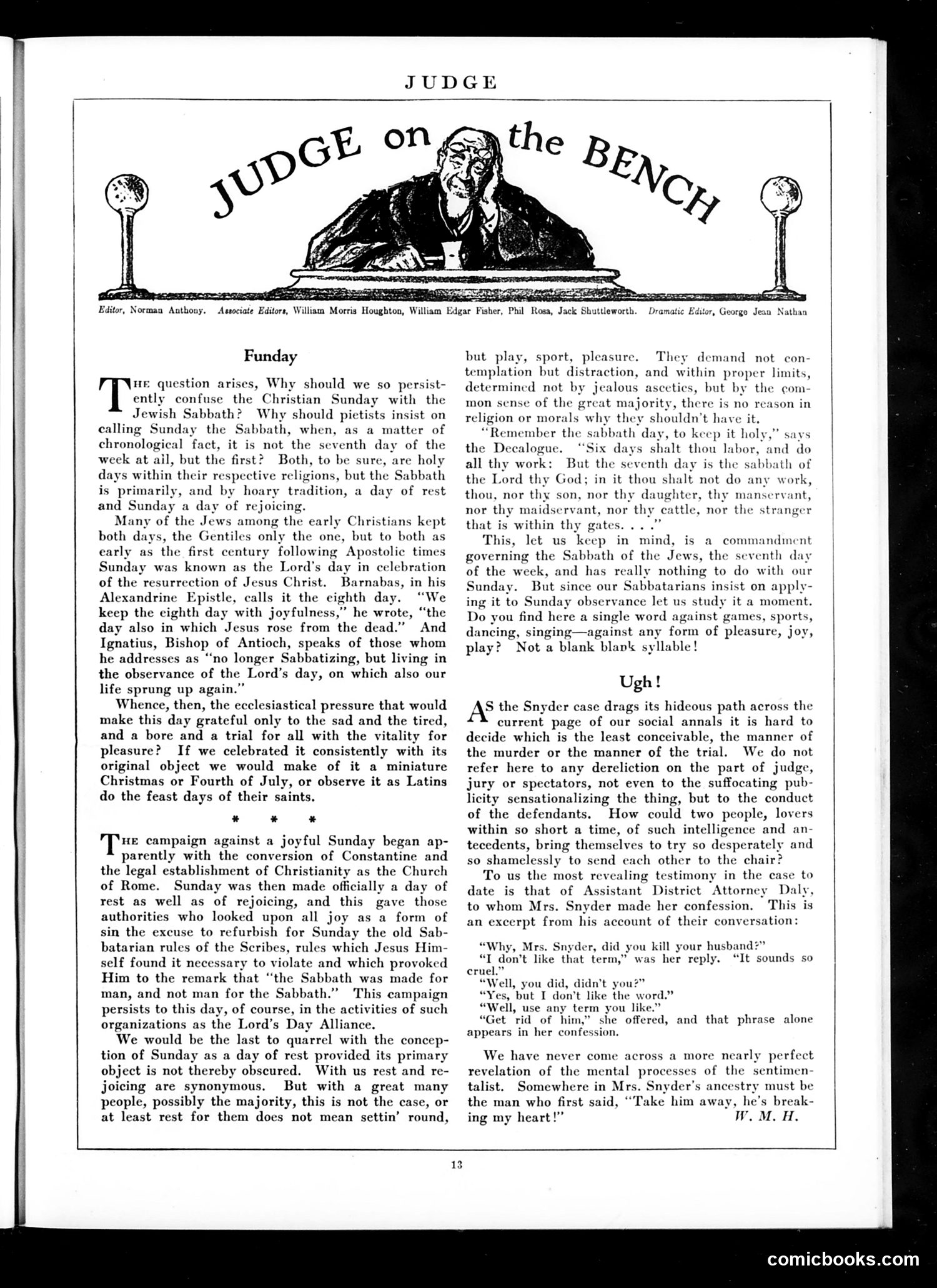
This editorial page from Judge magazine critiques religious observance practices, specifically attacking what the writer calls excessive Sabbatarianism imposed on Sunday. **The Main Argument:** The piece argues that Christians confuse the Jewish Sabbath (seventh day, a day of rest) with Sunday (the Lord's Day, celebrating Christ's resurrection), and that puritanical religious authorities have wrongly imposed strict Sabbatarian rules onto Sunday—transforming what should be a joyful celebration into a gloomy, restrictive day. **Historical Context:** The writer references Constantine's legalization of Christianity and groups like the "Lord's Day Alliance" (a real anti-entertainment advocacy organization). The piece supports recreational activities—sports, dancing, pleasure—as compatible with Sunday observance, citing biblical scholars like Barnabas and Ignatius to argue Jesus himself violated Sabbath rules. **The Satire:** Judge's position is anti-censorious and pro-leisure, mocking religious groups attempting to eliminate Sunday enjoyment as hypocritical legalism contrary to Christianity's actual teachings. The brief "Ugh!" section references the Snyder case—likely a contemporary scandal—but provides insufficient context to explain it here.
📄 Transcribed text from this page (OCR, searchable)
Machine-transcribed from the original scan — historical spelling and the odd misread are preserved.
Editor, Norman Anthony. Funday HE question arises, Why should we so persist- ently confuse the Christian Sunday with the Jewish Sabbath? Why should pietists insist on calling Sund. the Sabbath, when, as a matter of chronological fact, it is not the seventh day of the week at ail, but the first? Both, to be sure, days within their respective religions, but the is primarily, and by hoa and Sunday a day of rejoicing. Many of the Jews among the early Christians kept both days, the Gentiles only the one, but to both as early as the first century following Apostolic times Sunday was known as the Lord’s da ebration of the resurrection of Jesus Christ. Barnabas, in his Alexandrine Epistle, calls it the eighth day. “We keep the eighth day with joyfulness,” he wrote, “the day also in which Jesus rose from the dead.” And Ignatius, Bishop of Antioch, speaks of those whom he addres as “no longer Sabbatizing, but living in the observance of the Lord’s day, on which also our life sprung up again.” Whence, then, the ecclesiastical pressure that would make this day grateful only to the sad and the tired, and a bore and a trial for all with the vitality for pleasure? If we celebrated it consistently with its original object we would make of it a miniature Christmas or Fourth of July, or observe it as Latins do the feast days of their saints. e holy abbath y tradition, a day of rest icing, in c * * * T= campaign against a joyful Sunday began ap- parently with the conversion of Constantine and the legal establishment of Christianity as the Church of Rome. Sunday was then made officially a day of rest as well as of rejoicing, and this gave those authorities who looked upon all joy as a form of sin the excuse to refurbish for Sunday the old Sab- batarian rules of the Scribes, rules which Jesus Him- self found it necessary to violate and which provoked Him to the remark that “the Sabbath was made for man, and not man for the Sabbath.” This campaign sts to this day, of course, in the activities of such organizations as the Lord’s Day Alliance. We would be the last to quarrel with the concep- tion of Sunday as a day of rest provided its primary object is not thereby obscured. With us rest and re- joicing are synonymous. But with a great many people, possibly the majority, this is not the case, or at least rest for them does not mean settin’ round, Ausociate Editors, William Morris Houghton, William Edgar Fis! Phil Rosa, Jack Shuttleworth. Dramatic Editor, George Jean Nathan but play, sport, pleasure. They demand not con- templation but distraction, and within proper limits, determined not by jealous ascetics, but by the com- mon sense of the great majority, there is no reason in religion or morals why th shouldn't have it. “Remember the y, to keep it holy,” says the Decalogue. “Six days shalt thou labor, and do all thy work: But the seventh day is the sabbath of the Lord thy God; in it thou shalt not do any work, thou, nor thy son, nor thy daughter, thy manservant, nor thy maidservant, nor thy cattle, nor the stranger that is within thy gates. ...” This, let us keep in mind, is a commandment governing the Sabbath of the Jews, the seventh day of the week, and really nothing to do with our Sunday. But since our Sabbatarians insist on apply- ing it to Sunday observance let us study it a moment. Do you find here a single word against games, sports, dancing, singing—against any form of pleasure, joy, play? Not a blank blank syllable! Ugh! S the Snyder case drags its hideous path across the current page of our social annals it is hard to decide which is the least conceivable, the manner of the murder or the manner of the trial. We do not refer here to any dereliction on the part of judge, jury or spectators, not even to the suffocating pub- licity sensationalizing the thing, but to the conduct of the defendants. How could two people, lovers within so short a time, of such intelligence and an- tecedents, bring themselves to try so desperately and so shamelessly to send each other to the chair? To us the most revealing testimony in the case to date is that of Assistant District Attorney Daly, to whom Mrs. Snyder made her confession, This is an excerpt from his account of their conversation: “Why, Mrs. Snyder, did you kill your husband?” “I don’t like that term,” was her reply. “It sounds so cruel.” “Well, you did, didn’t you?” “Yes, but I don't like the word.” “Well, use any term you like.” “Get ‘rid of him,” she offered, and that phrase alone appears in her confession. We have never come across a more nearly perfect revelation of the mental processes of the sentimen- talist. Somewhere in Mrs. Snyder's ancestry must be the man who first said, “Take him away, he’s break- ing my heart!” W.M. H. comicbooks.com