
A complete issue · 36 pages · 1927
Judge — May 14, 1927
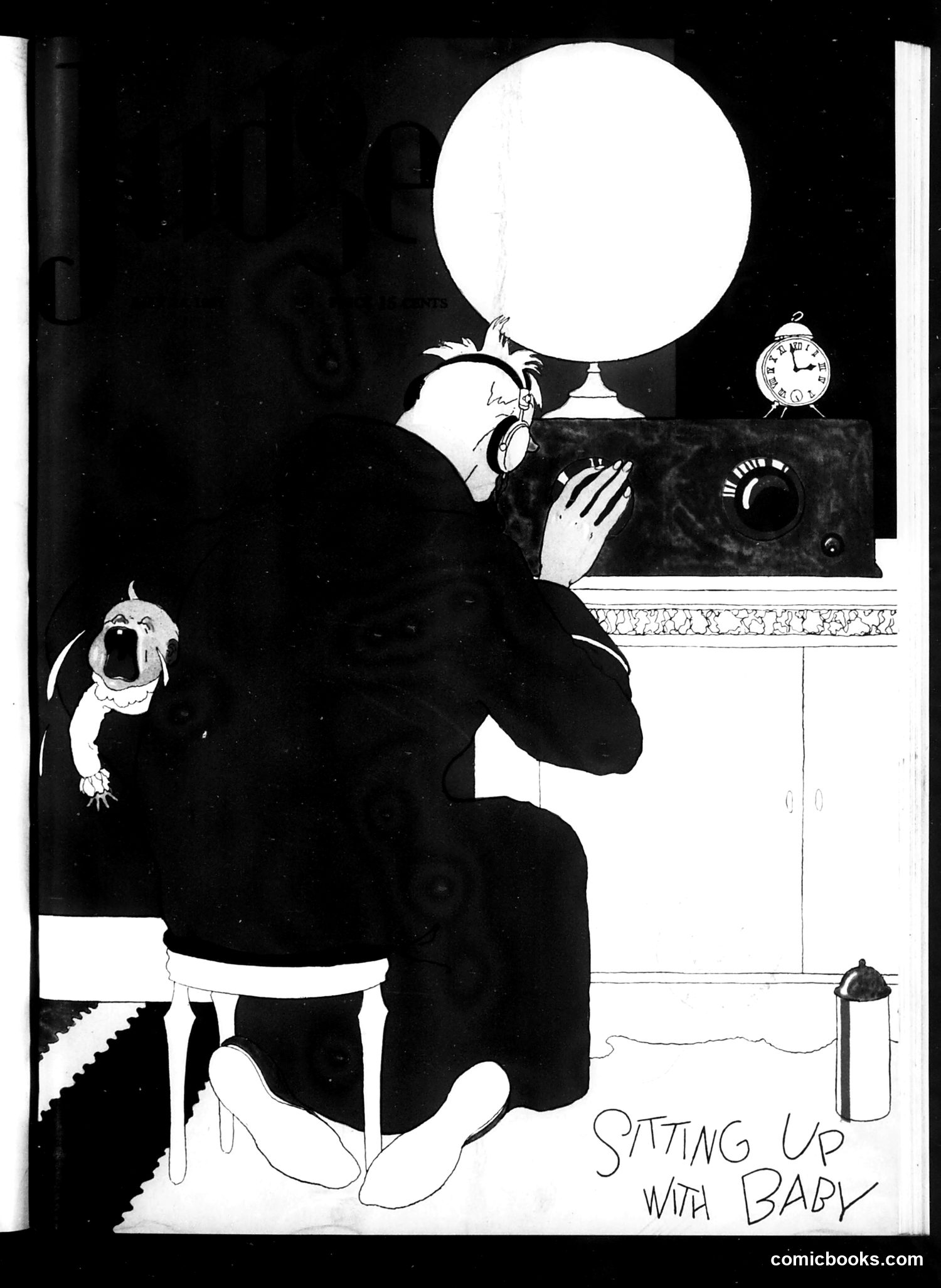
This cartoon depicts the common domestic experience of a parent staying awake through the night to care for an infant. The figure is shown exhausted, wearing headphones (likely a radio or early audio device), surrounded by nighttime accessories: an alarm clock, a lamp, and a bottle. The satire appears to target the sleep deprivation and tedium of nighttime childcare rather than any specific political event. The headphones suggest the parent is using entertainment or distraction to endure the vigil—a relatable humor about parental exhaustion that transcends its era. This reflects Judge magazine's frequent publication of domestic-life humor alongside its political satire, making it accessible to general audiences beyond political commentary.
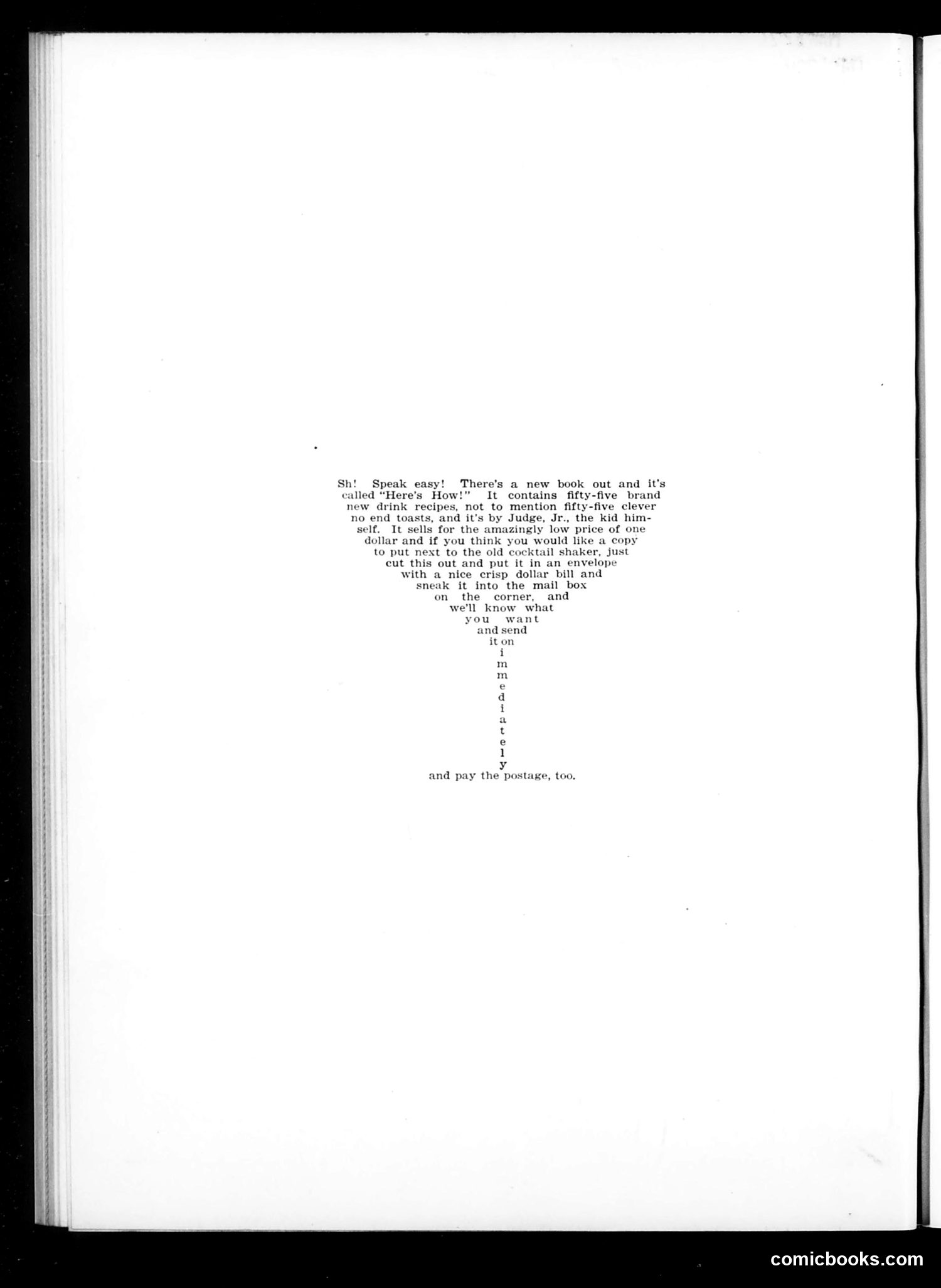
This page contains an advertisement disguised as editorial content. It promotes a book called "Here's How" by "Judge, Jr." (the kid himself), a cocktail recipe collection featuring fifty-five drink recipes and "clever no end toasts." The satirical hook is the instruction: readers should cut out this ad, place a dollar bill in an envelope with it, and mail it to an address listed vertically down the page. The final line, "and pay the postage, too," adds a humorous dig—the advertiser is essentially asking customers to pay extra just to send money for the product. This represents early-20th-century advertising disguised as judge magazine's own editorial voice, using self-deprecating humor to sell cocktail instruction during the Prohibition era (though the date is unclear from this page alone).
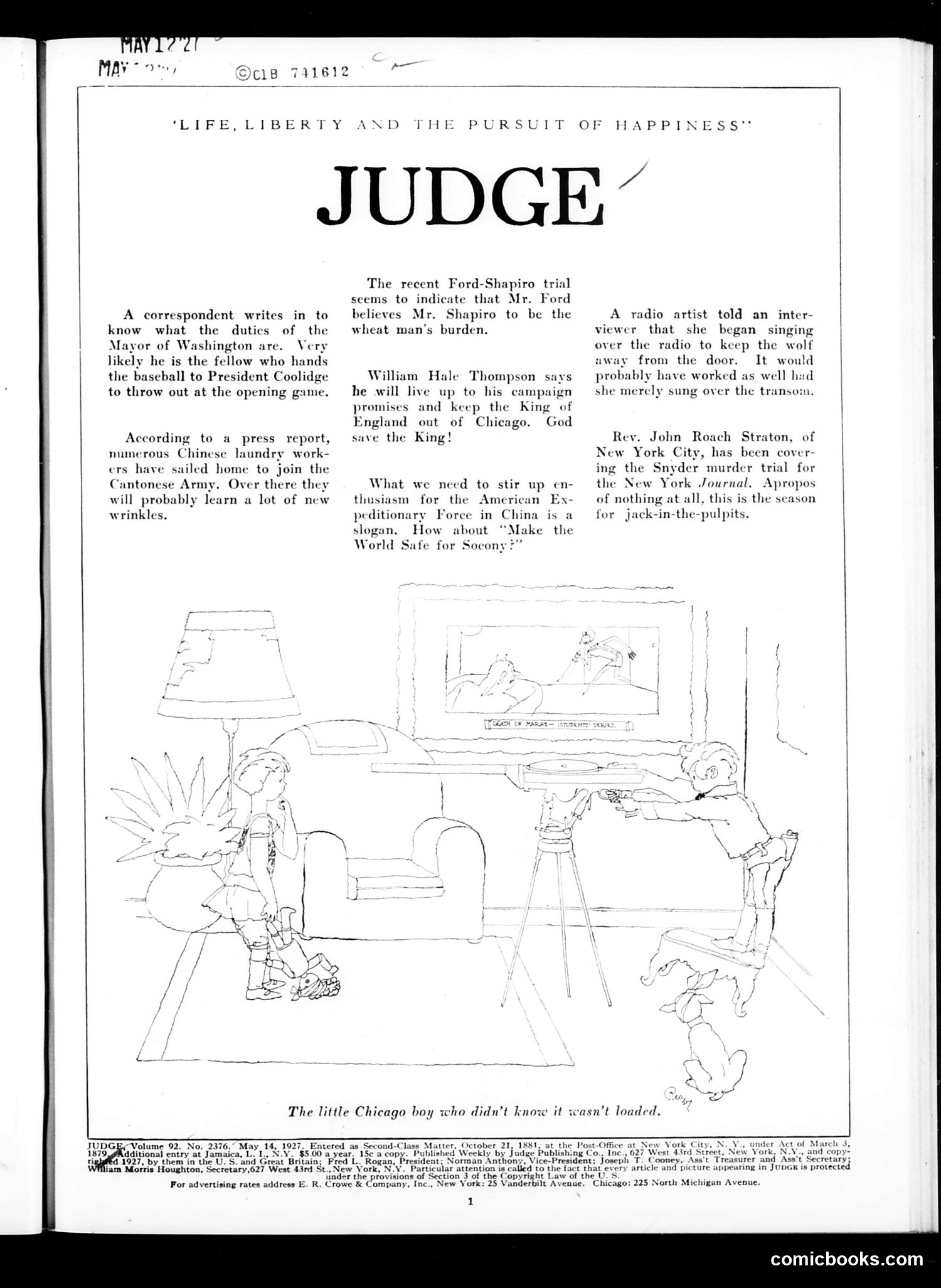
This page contains editorial commentary and a cartoon titled "The little Chicago boy who didn't know it wasn't loaded." **The Cartoon**: Shows a young boy in a living room accidentally shooting a gun at another child, with adults present. The title's dark humor suggests a tragic accident resulting from negligence—the gun was assumed unloaded but wasn't. **Editorial Items** include brief commentary on: - The Ford-Shapiro trial (appears to concern labor disputes) - Chinese laundry workers joining the Cantonese Army - Campaign slogans for American expeditionary forces in China ("Make the World Safe for Sonny?") - Coverage of the Snyder murder trial The page reflects 1920s concerns: labor unrest, foreign military intervention, and urban social issues. The cartoon's tragic scenario likely critiques parental negligence or gun safety indifference among American households.
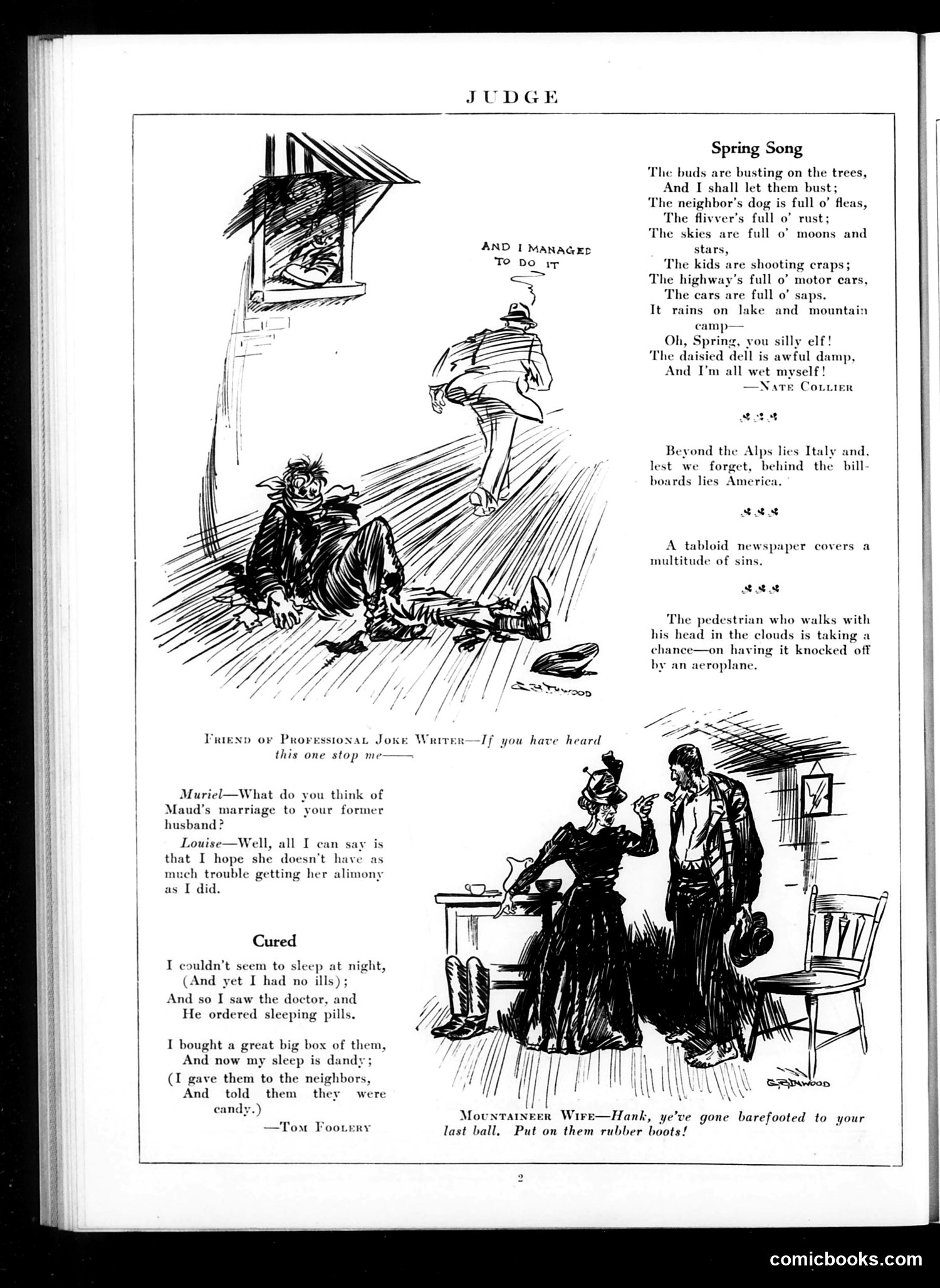
This page contains satirical poetry and humor rather than political cartoons. The content includes: **"Spring Song"** by Nate Collier—a humorous poem mocking spring's messiness (fleas, rust, motor cars, rain) rather than romanticizing it. **"Friend of Professional Joke Writer"**—a brief comic exchange where Louise discusses her ex-husband's new wife (Maud), hoping the marriage causes her trouble too. **"Cured"** by Tom Foolery—a joke about insomnia solved by giving sleeping pills to neighbors instead of taking them oneself. **"Mountaineer's Wife"**—a joke about a wife going barefoot to a ball, prompting her husband to suggest rubber boots. The illustrations accompany these pieces with period-appropriate sketches. The humor targets everyday domestic life and social absurdities rather than specific political events or figures.
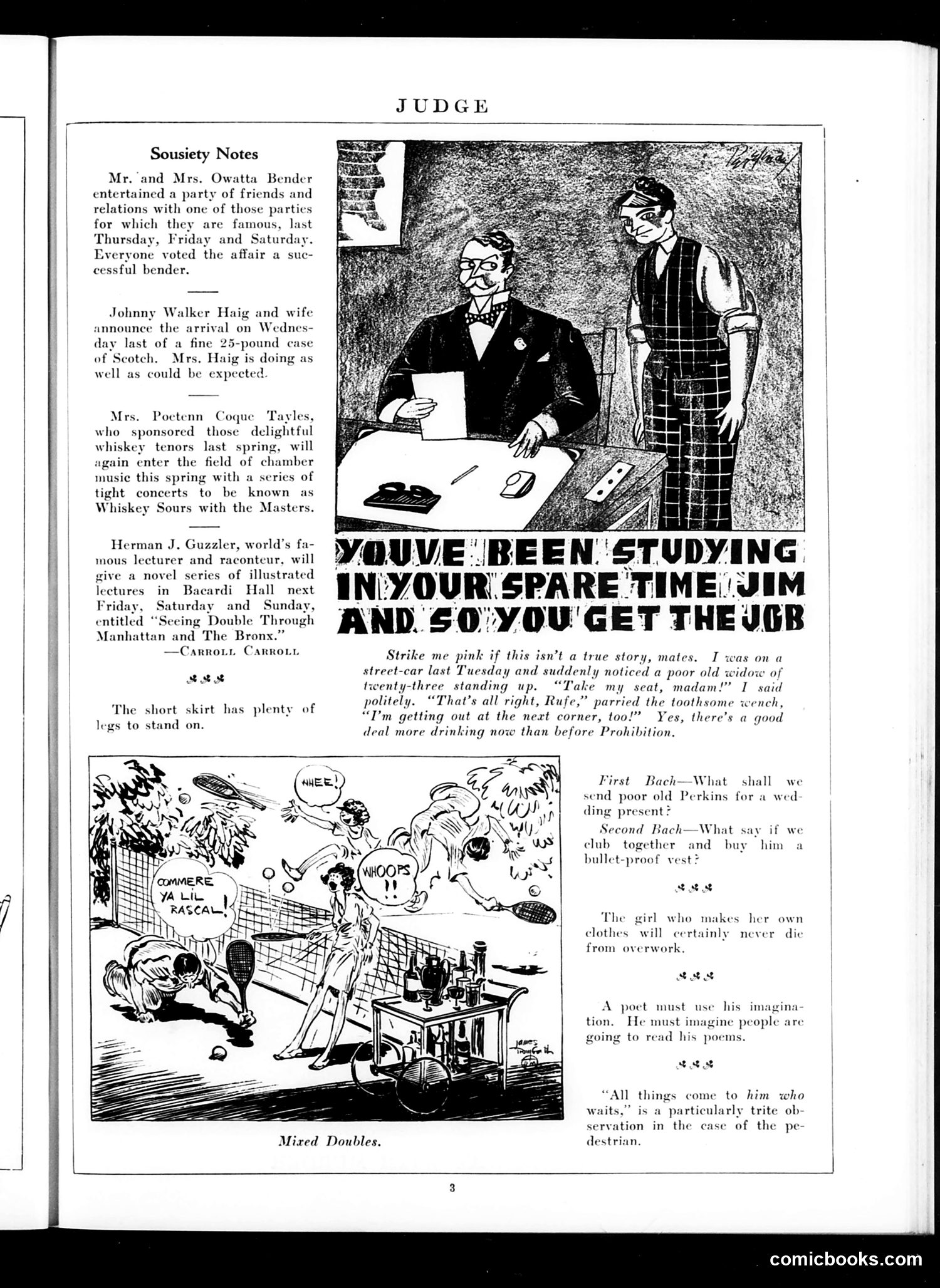
This page contains **society notes** and **humor pieces** rather than political cartoons. The main cartoon, "Mixed Doubles," depicts a tennis match scene with women in 1920s attire playing sports. The humor appears to satirize women's increasingly active participation in athletics and leisure activities—a notable social shift of the era. The illustrated story "You've Been Studying in Your Spare Time Jim" depicts a workplace interaction, likely satirizing Prohibition-era drinking culture and workplace dynamics. The scattered witticisms mock contemporary social conventions: women's fashion, poets' pretensions, and gender relations. **Context for modern readers**: This reflects 1920s anxieties about changing social roles, particularly women's expanding public presence in sports and work—topics considered amusing enough for satirical magazine commentary.
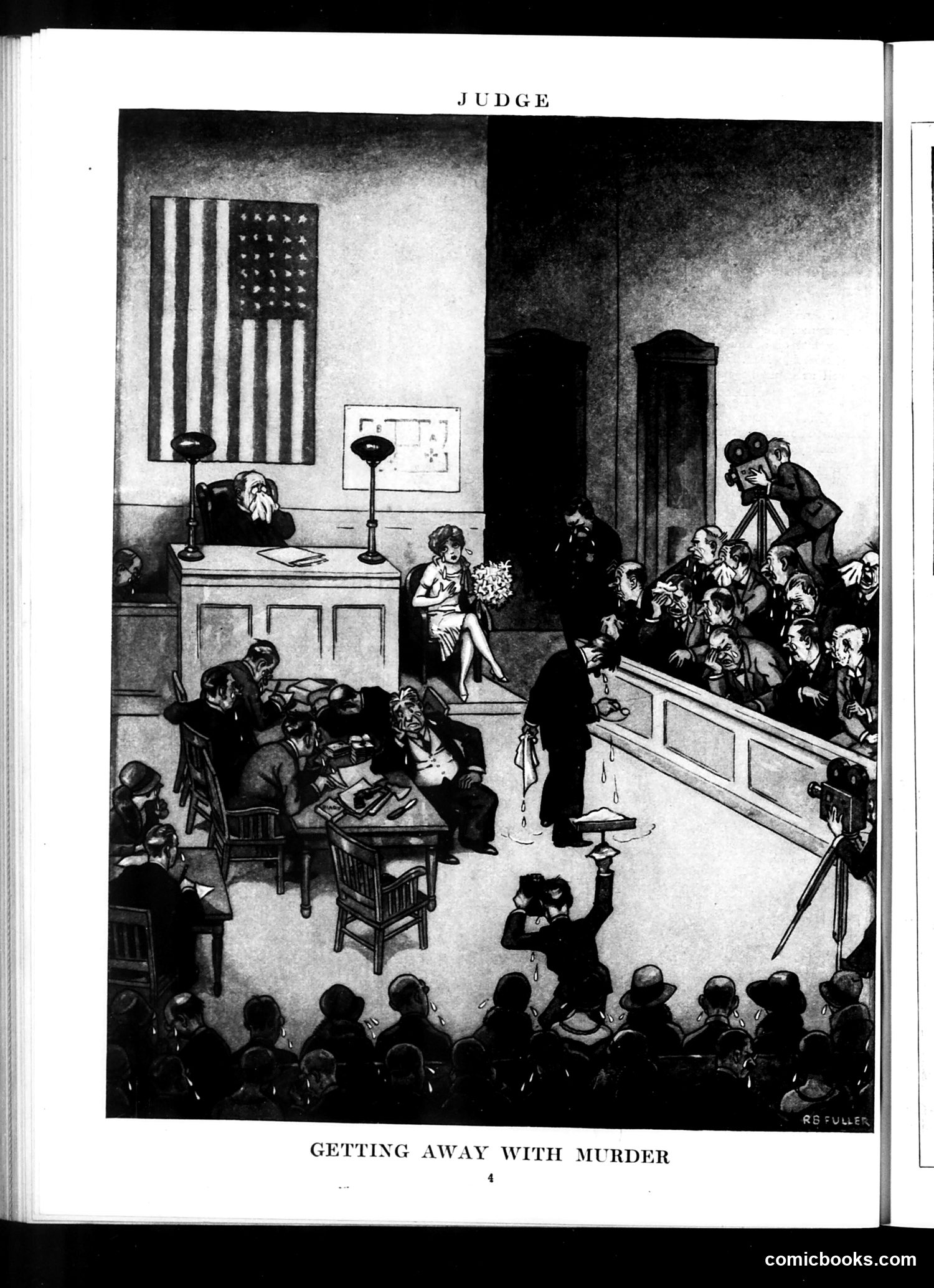
This Judge magazine cartoon depicts a courtroom scene satirizing judicial leniency or corruption. The title suggests that defendants are escaping serious consequences despite apparent guilt. The composition shows a judge presiding from an elevated bench (upper left), a defendant or accused person in the dock (center), and a crowded gallery of observers (right and bottom). The formal courtroom setting with American flag and judicial symbols is rendered in stark black and white. The satire likely critiques either: wealthy defendants evading justice through legal maneuvering, judicial bias favoring certain classes, or systemic failures in the legal system. Without knowing the specific date or event, the cartoon appears to comment on public frustration with perceived miscarriages of justice—a perennial topic in American political satire.
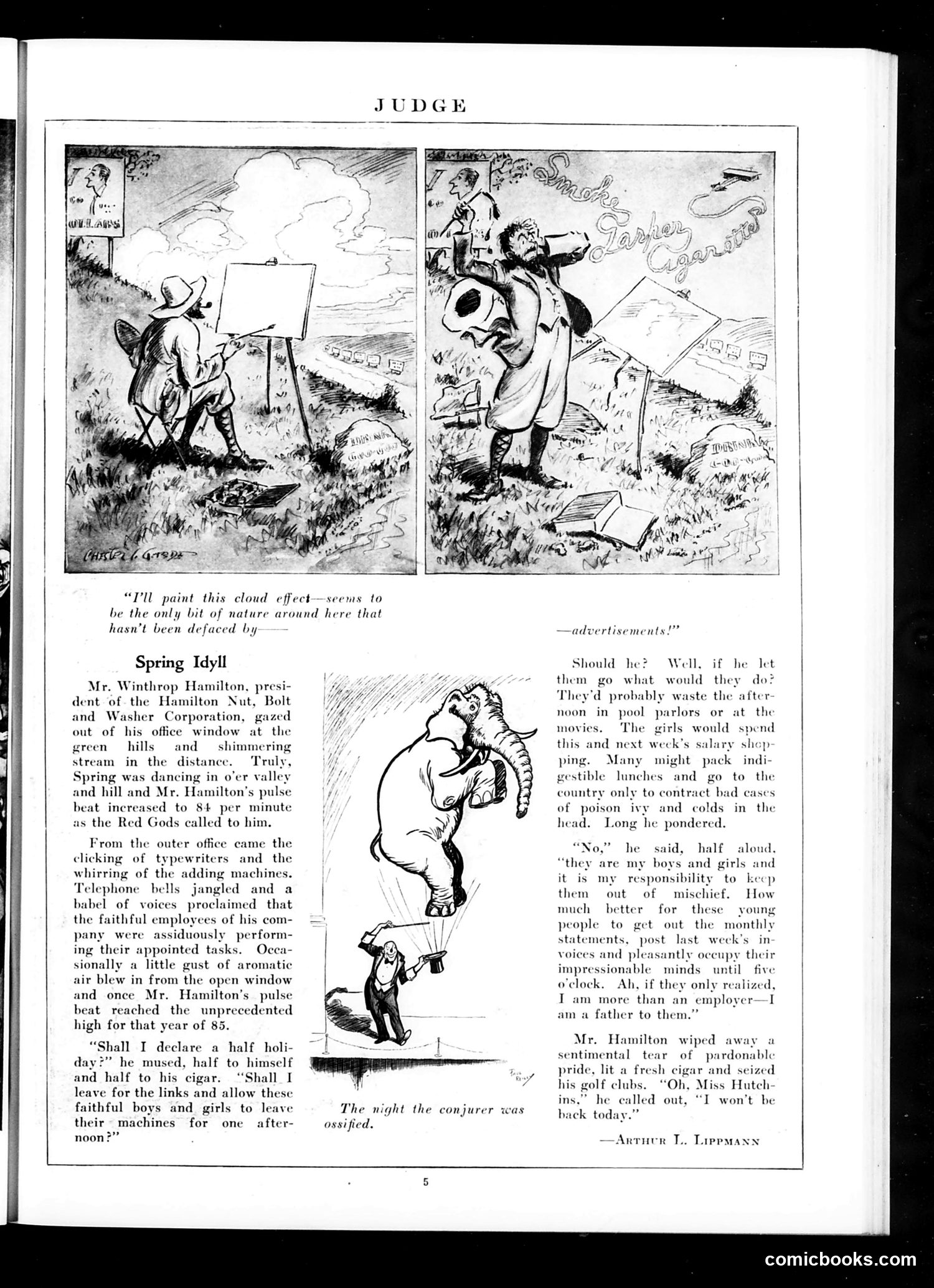
This page contains two distinct elements: **Top cartoon**: Satirizes advertising's pervasive influence on nature itself. An artist attempts to paint a landscape, but advertisements have literally invaded the scenery—billboards and commercial messages cover the terrain. The caption comments that advertisements are "the only bit of nature around here that hasn't been defaced," suggesting ironic despair about commercialism's dominance. **"Spring Idyll" story**: A narrative about Mr. Winthrop Hamilton, a company president, pondering whether to give employees a half-day holiday. He worries they'd spend time at movies or pool halls instead of productive leisure. The accompanying illustration shows a conjurer (magician), though its connection to the narrative text is unclear from this image alone. Both pieces critique early 20th-century American capitalism and leisure culture.
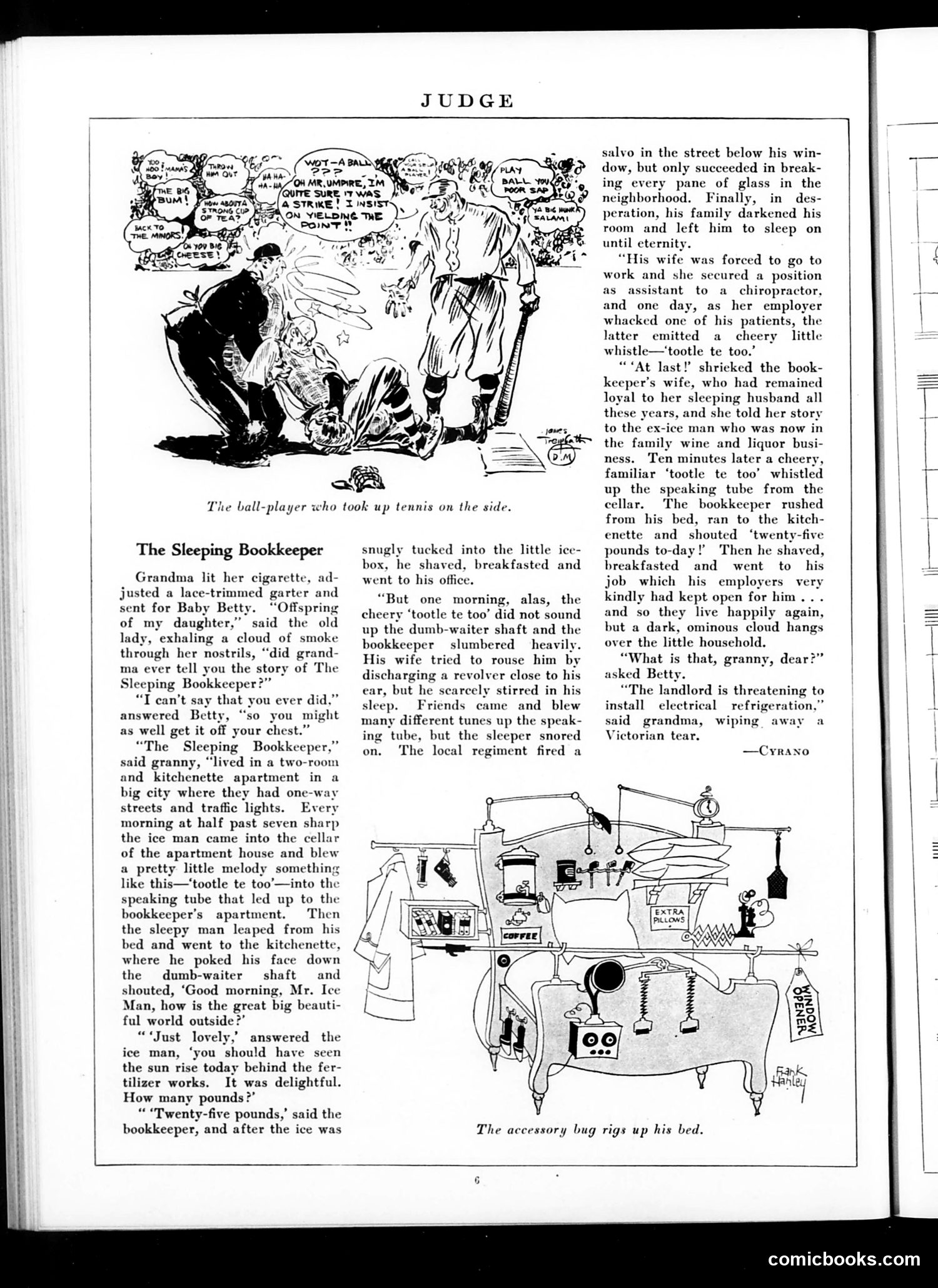
This page contains a humorous short story satirizing modern urban life and automation's disruption of human routine. The narrative follows a bookkeeper whose entire existence revolves around the ice man's daily "tootle te too" whistle—his sole alarm clock and life rhythm. When the ice man stops coming, the bookkeeper becomes catatonic, immune even to gunfire. The satire targets blind dependence on routine and the fragility of working-class life built on predictable systems. The punchline—that electrical refrigeration threatens to replace the ice man entirely—satirizes early 20th-century anxiety about technological displacement of labor and the loss of human connection in modernizing cities. The complementary cartoon "The ball-player who took up tennis on the side" (top left, barely visible) appears to mock amateur athleticism or dilettantism, though details are unclear. The illustration "The accessory bug rigs up his bed" depicts someone's elaborate Rube Goldberg contraption, likely mocking over-engineering domestic life.
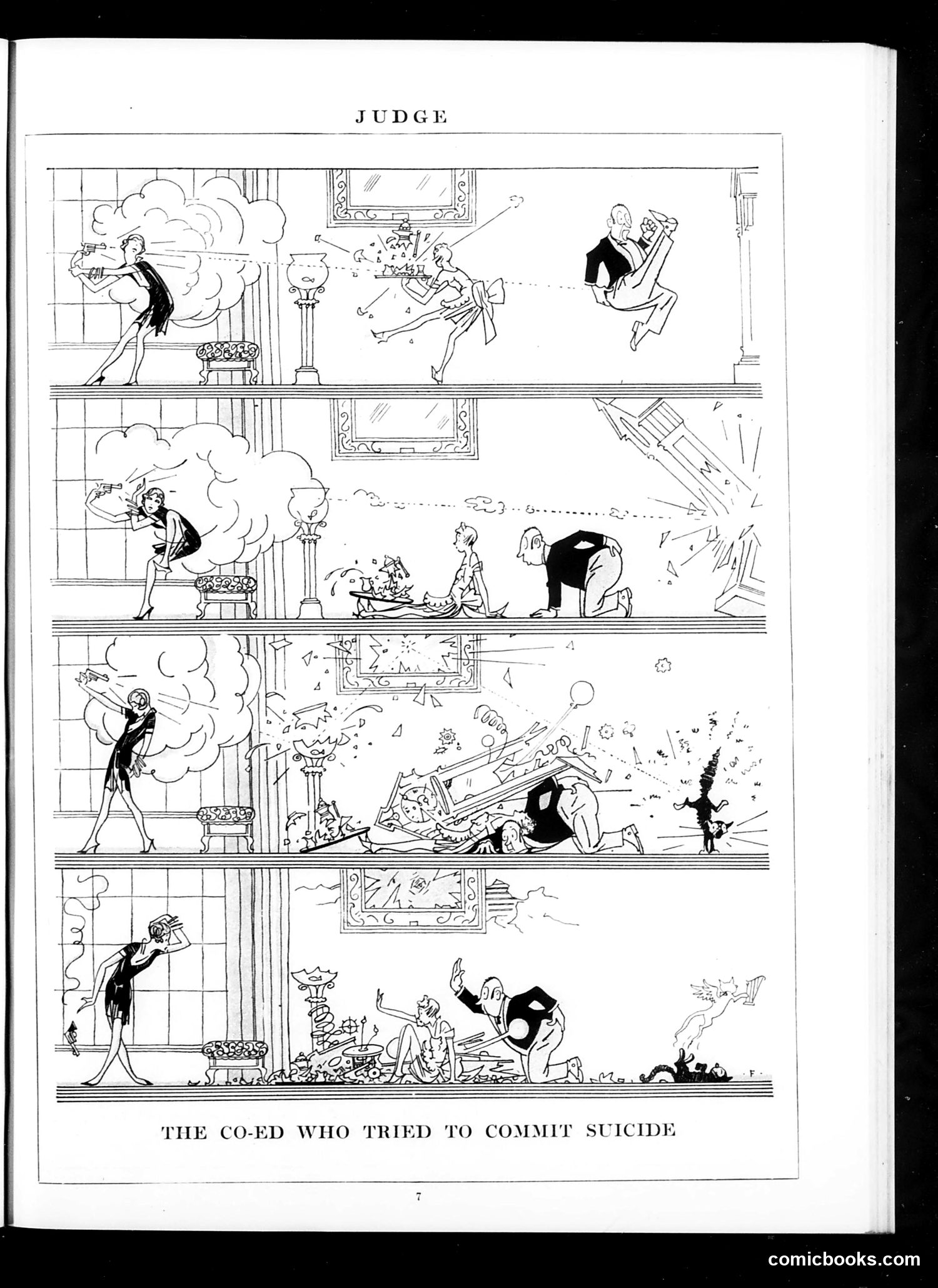
This satirical comic strip from Judge magazine depicts a young woman's attempted suicide through increasingly dramatic means across five panels. In each panel, set in what appears to be an elegant interior, she attempts self-harm while a suited man (possibly a judge, given the magazine's masthead) observes or reacts with exaggerated concern. The satire likely critiques both female melodrama and male judicial authority of the era. The woman's escalating, theatrical suicide attempts—shown with comedic absurdity—mock contemporary anxieties about young women's emotional instability and hysteria. The suited observer's reactions suggest commentary on how authority figures (judges, doctors, or society generally) responded to women's distress, treating dramatic female behavior as spectacle rather than genuine crisis.
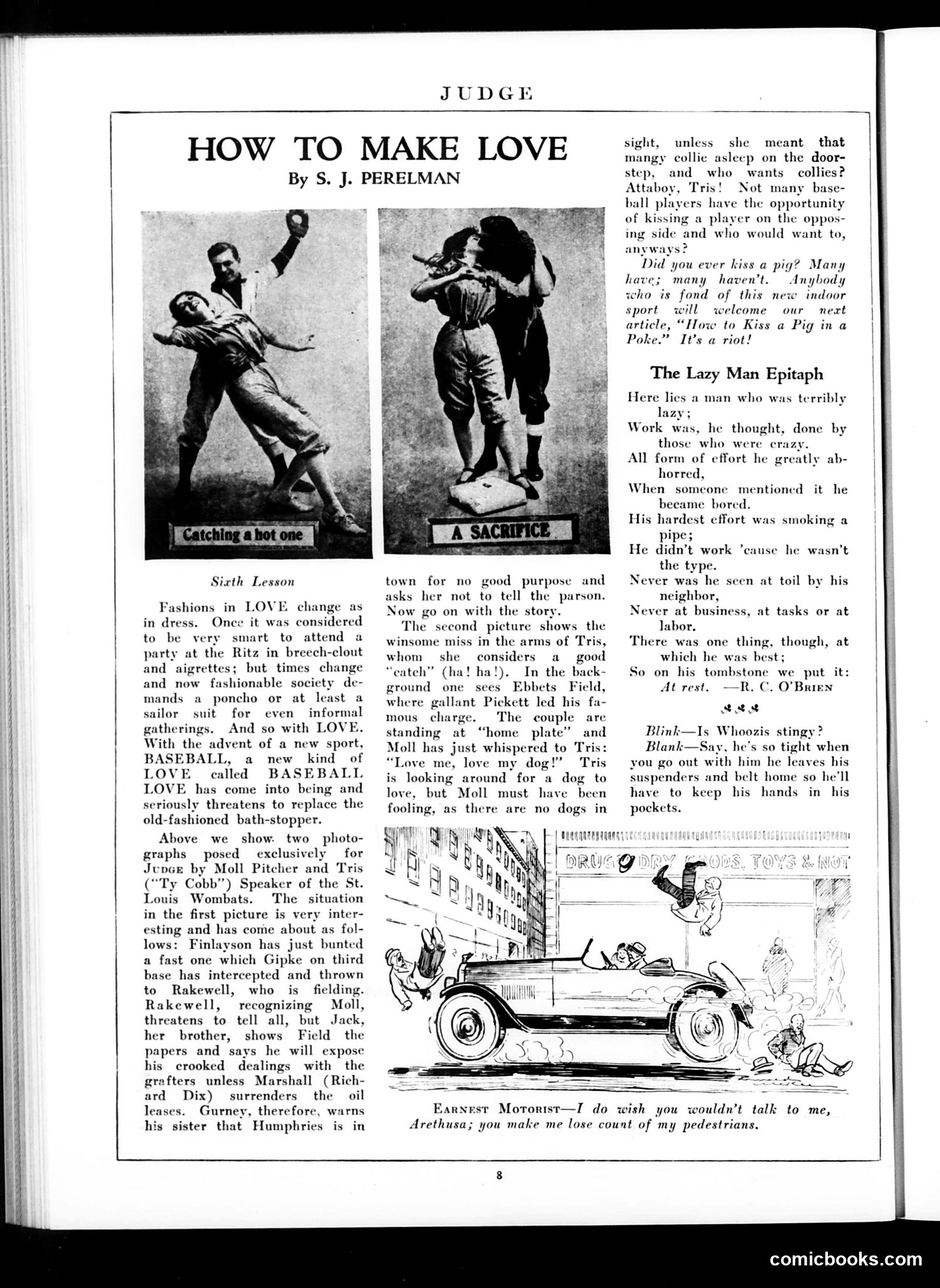
This is a humorous piece satirizing how courtship fashions evolve alongside other trends. Perelman mocks the notion that baseball—a newly popular sport—has spawned its own romantic etiquette, complete with baseball-themed seduction scenarios. The article references real baseball figures (Ty Cobb, Moll Pitcher, Tris Speaker) as characters in an absurdly convoluted melodrama involving oil leases, grafters, and exposed dealings—parodying the overwrought plot devices of contemporary serialized fiction and silent films. The joke hinges on treating baseball romance as a legitimate "new sport" requiring instructional articles, while the contrived plot becomes increasingly ridiculous. The "Lazy Man Epitaph" poem and "Earnest Motorist" cartoon are unrelated filler pieces typical of Judge's miscellaneous humor content. The satire targets both the earnestness with which magazines treated social trends and period fiction's tangled melodramas.
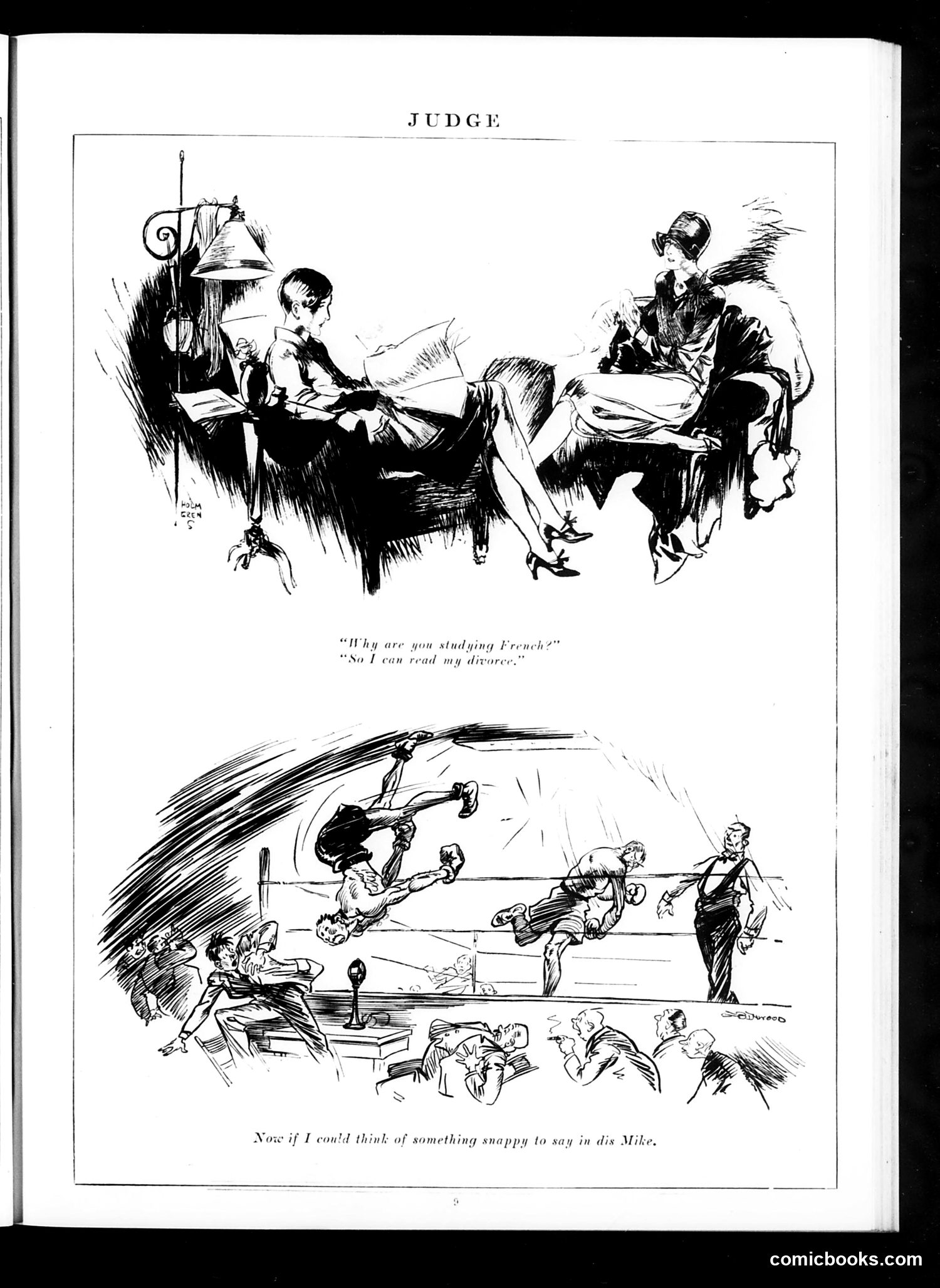
This page contains two satirical cartoons about divorce and language. **Top cartoon:** A judge presides over two people studying French together. The joke plays on "divorce" sounding like French: one person explains they're studying French "so I can read my divorce," suggesting divorce documents are incomprehensible (like a foreign language) or that divorce itself is a French/European concept Americans find alien. **Bottom cartoon:** Shows what appears to be a boxing or fighting scene with multiple figures tumbling. The caption references "something snappy to say in dis Mike," likely a pun on a boxer's name (possibly Mike Donlin, a contemporary sports figure), though the exact reference is unclear. Both cartoons mock American legal proceedings and contemporary culture through wordplay and physical comedy typical of Judge's satirical style.
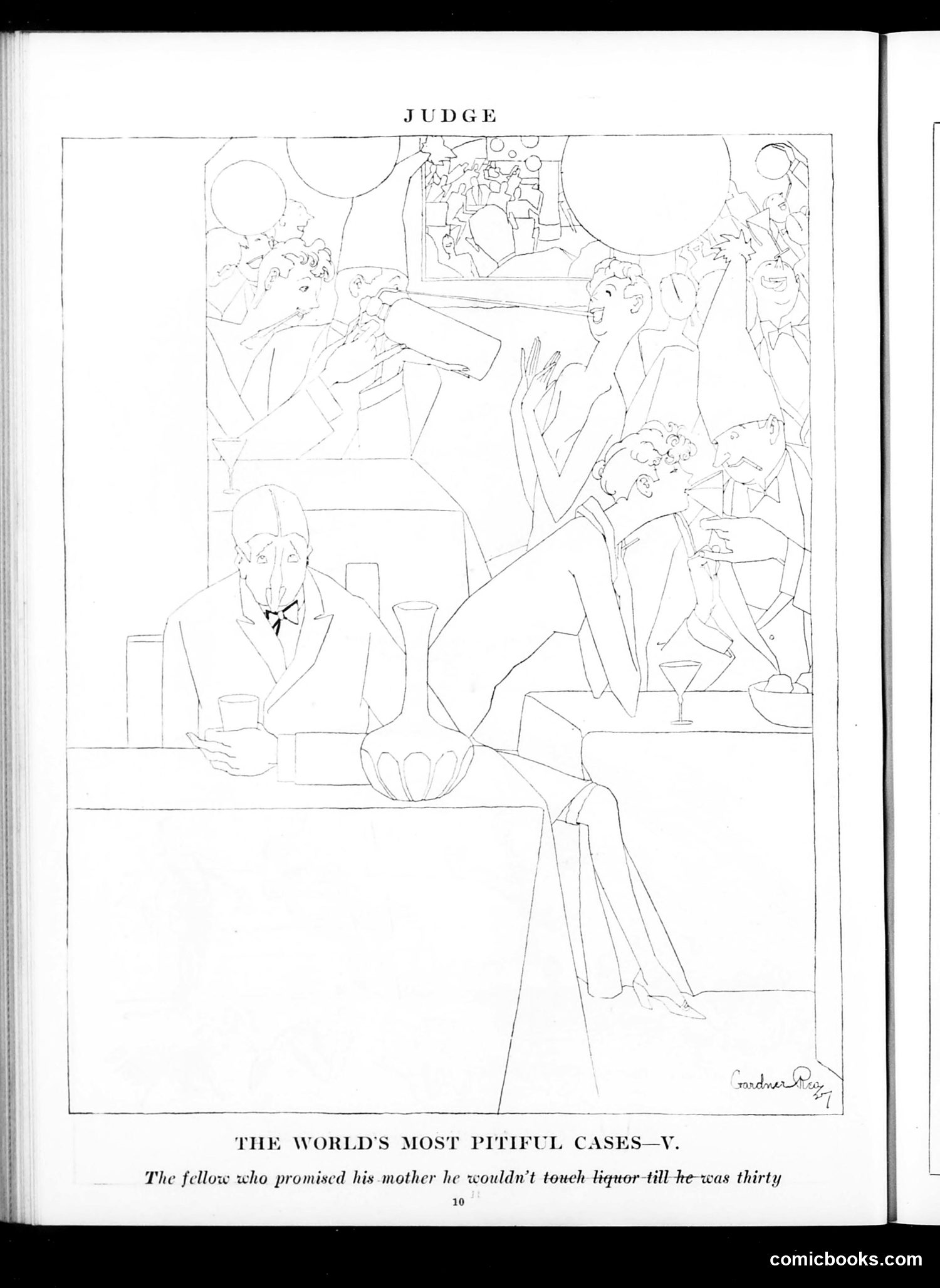
This is the fifth installment in a series titled "The World's Most Pitiful Cases." The cartoon depicts a courtroom or formal dining scene where a man in a suit sits at a table with a drink before him, looking uncomfortable or guilty. Other figures appear in the background, including what seems to be authority figures or observers. The satire targets a common moral pledge: a young man who promised his mother he wouldn't drink alcohol until age thirty. The "pitiful case" is the implied irony—he's either broken his promise or struggling with temptation before reaching that milestone. This satirizes the gap between moral promises made to family and actual behavior, particularly regarding alcohol consumption, which was a recurring theme in early 20th-century American humor. The joke assumes readers find both the promise naive and its violation predictable or sympathetic.
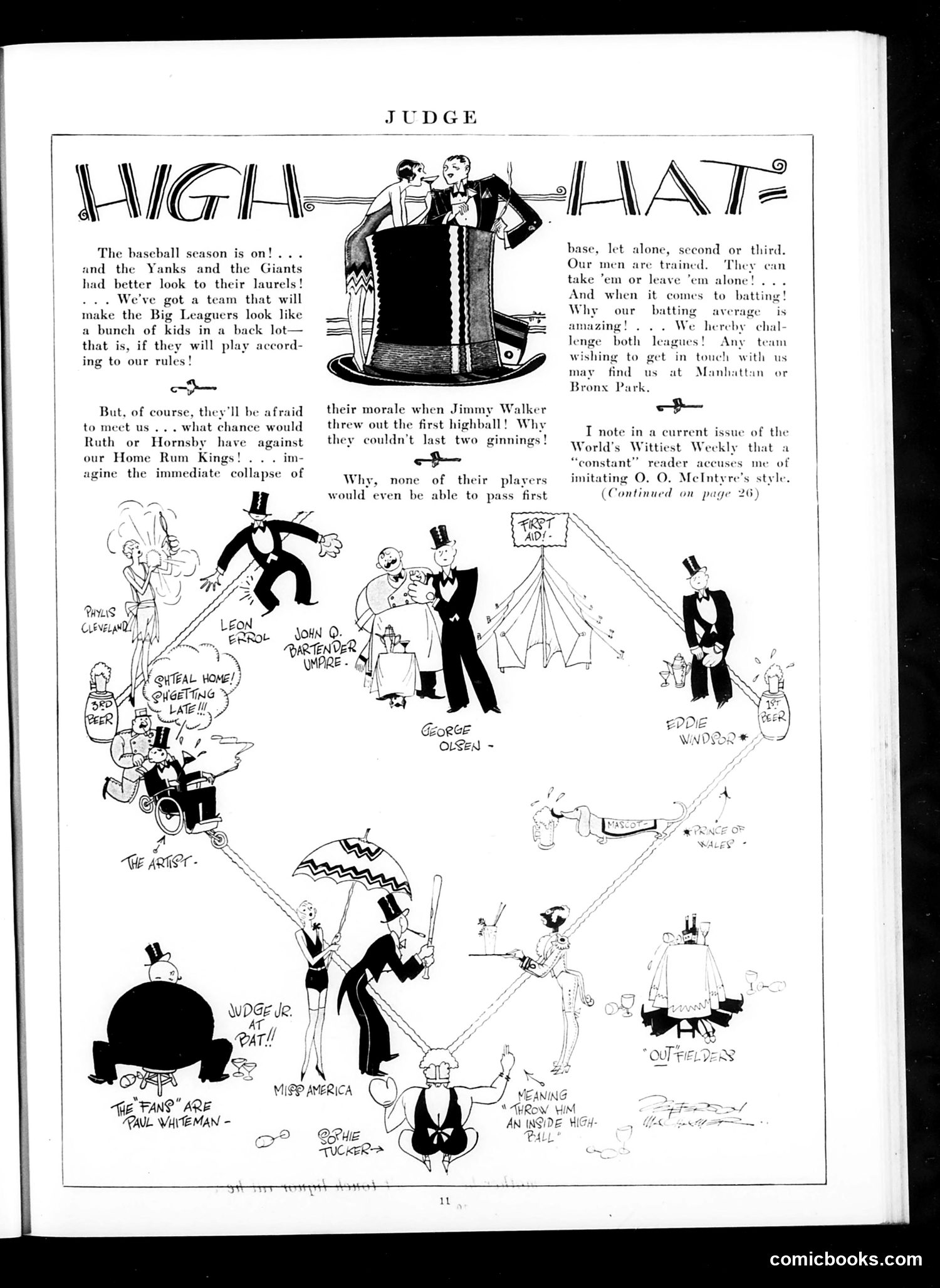
This Judge magazine page satirizes Prohibition-era New York society through a mock baseball challenge. The cartoon depicts wealthy, top-hatted socialites claiming their amateur team surpasses the professional Yankees and Giants. The satire operates on multiple levels: the socialites boast about players who are actually prominent figures (Jimmy Walker was NYC's mayor; names like "Leon Errol" and "George Olsen" reference entertainers). The joke centers on their reliance on alcohol—they reference "highballs" and "ginnings" (playing on "innings"), suggesting their "training" involves drinking rather than athletic skill. The "High Hat" title itself mocks their pretension. The diamond-shaped layout with various caricatured figures positioned as players emphasizes how absurd it is that these privileged dilettantes believe they could compete professionally. The humor exploits Depression-era resentment toward wealthy elites flouting Prohibition while ordinary citizens faced legal penalties.
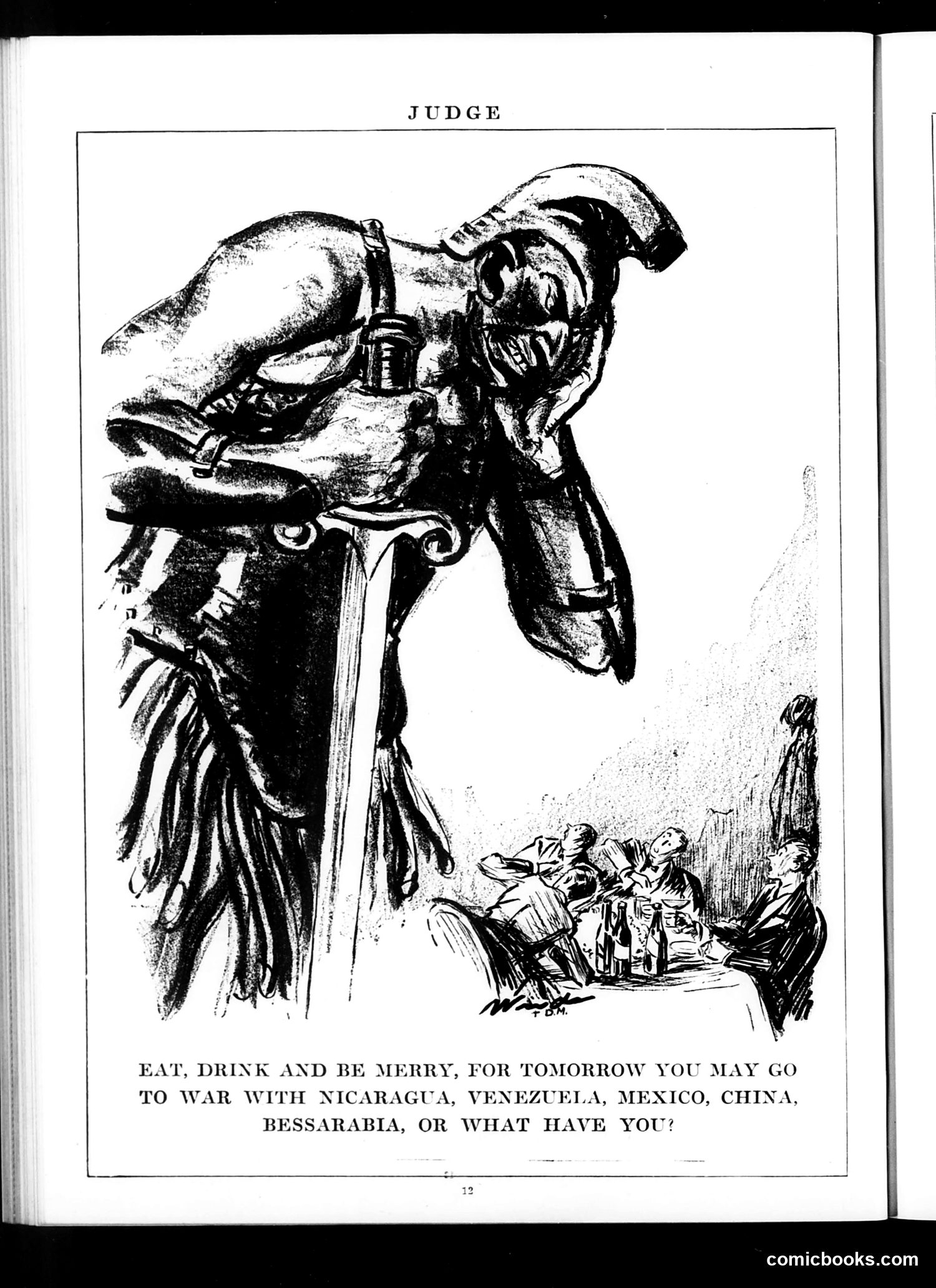
This political cartoon depicts a towering, menacing **Judge figure** (representing judicial authority or American power) wielding a sword above small businessmen dining below. The caption sarcastically urges: "Eat, drink and be merry, for tomorrow you may go to war with Nicaragua, Venezuela, Mexico, China, Bessarabia, or what have you?" The satire criticizes American military interventionism and foreign policy adventurism in the early 20th century. The listed nations represent actual or potential U.S. military conflicts of that era. The Judge's looming threat suggests the unpredictability and danger of warmongering to ordinary citizens and business interests. The cartoon mocks both American imperial ambitions and the casual attitude toward military entanglement, warning that war could strike at any moment against various global adversaries.
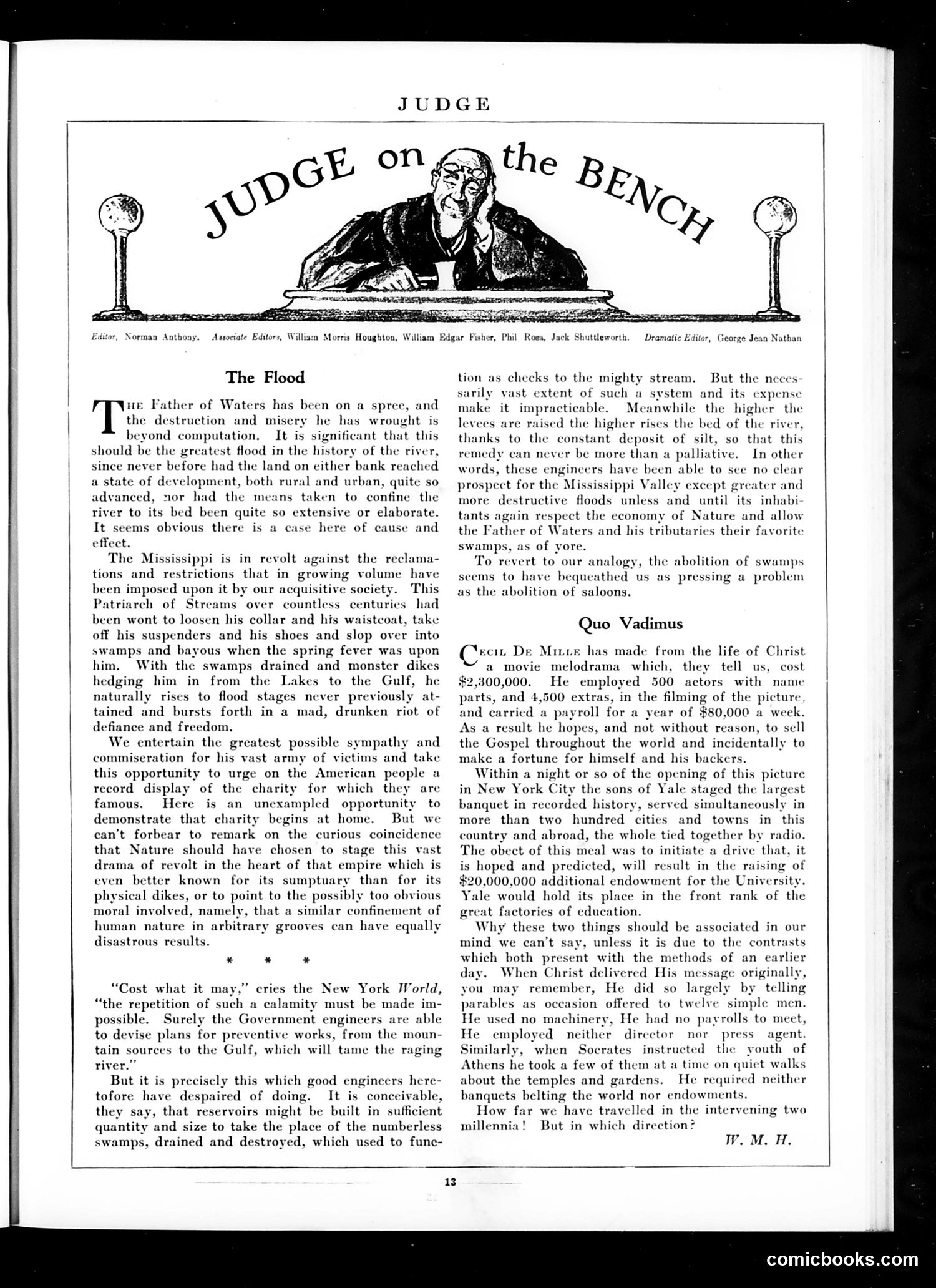
## Main Editorial: "The Flood" This editorial addresses the massive Mississippi River floods (likely 1927, though undated here). The satire argues that human engineering—draining swamps, building levees, confining the river—has provoked nature's "revolt." The piece draws an analogy: just as restraining human nature in "arbitrary grooves" causes social upheaval, restraining the Mississippi causes catastrophic flooding. The editorial mocks engineering confidence ("Cost what it may") while suggesting the real solution is accepting nature's logic rather than fighting it. The final paragraph compares abolishing swamps to abolishing saloons—implying both are misguided attempts at social control. ## Secondary Piece: "Quo Vadimus" This section satirizes Cecil B. DeMille's $2.3 million film about Christ's life (likely *The King of Kings*, 1927). The satire questions the contrast between Christ's simple teaching methods and DeMille's lavish, commercial production—500 actors, $80,000 weekly payroll. The point: profit-driven modernism versus Gospel simplicity.
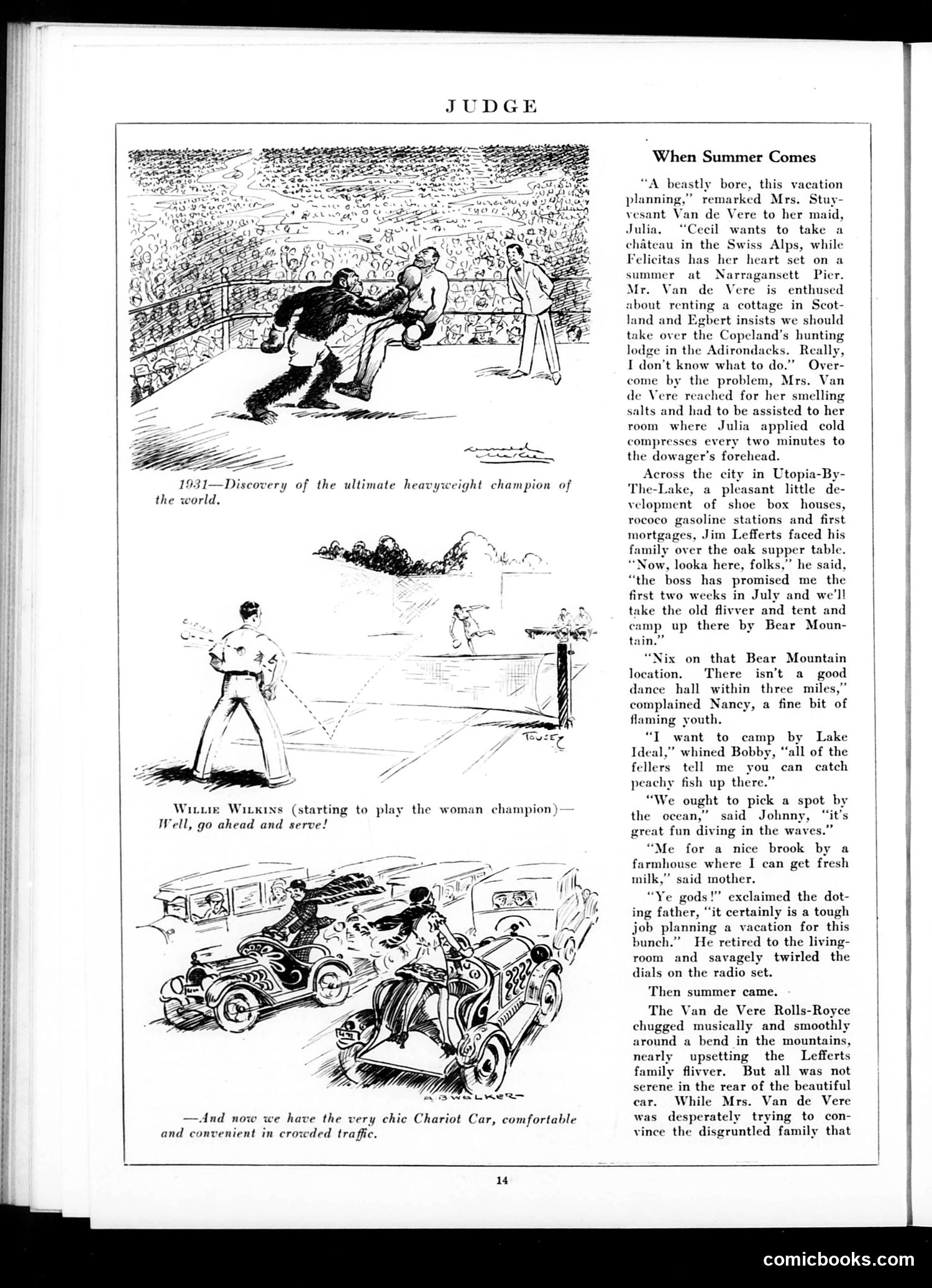
This page contains three satirical cartoons about summer vacation planning: 1. **Top cartoon**: Titled "Discovery of the ultimate heavyweight champion," it mocks women's athletics. It shows a woman boxer ("Willie Wilkins") about to serve in tennis, with the joke being the absurdity of women competing in traditionally male sports—treating female athleticism as novelty or spectacle. 2. **Middle cartoon**: "The Chariot Car" satirizes crowded urban traffic and automobile congestion, showing vehicles packed chaotically together. 3. **Main story, "When Summer Comes"**: Contrasts two families' vacation planning. The wealthy Van de Veres cannot decide between Swiss Alps, Scotland, or Adirondacks—the mother becomes so overwhelmed she needs smelling salts. Meanwhile, working-class Jim Lefferts's family (the Lefferts) squabbles over their modest camping trip options (Bear Mountain, Lake Ideal, the ocean, or a farmhouse brook). The irony: both families end up equally frustrated. The final image shows the wealthy family's Rolls-Royce nearly hitting the Lefferts' humble "flivver" (cheap car), suggesting class tensions and vacation season chaos.
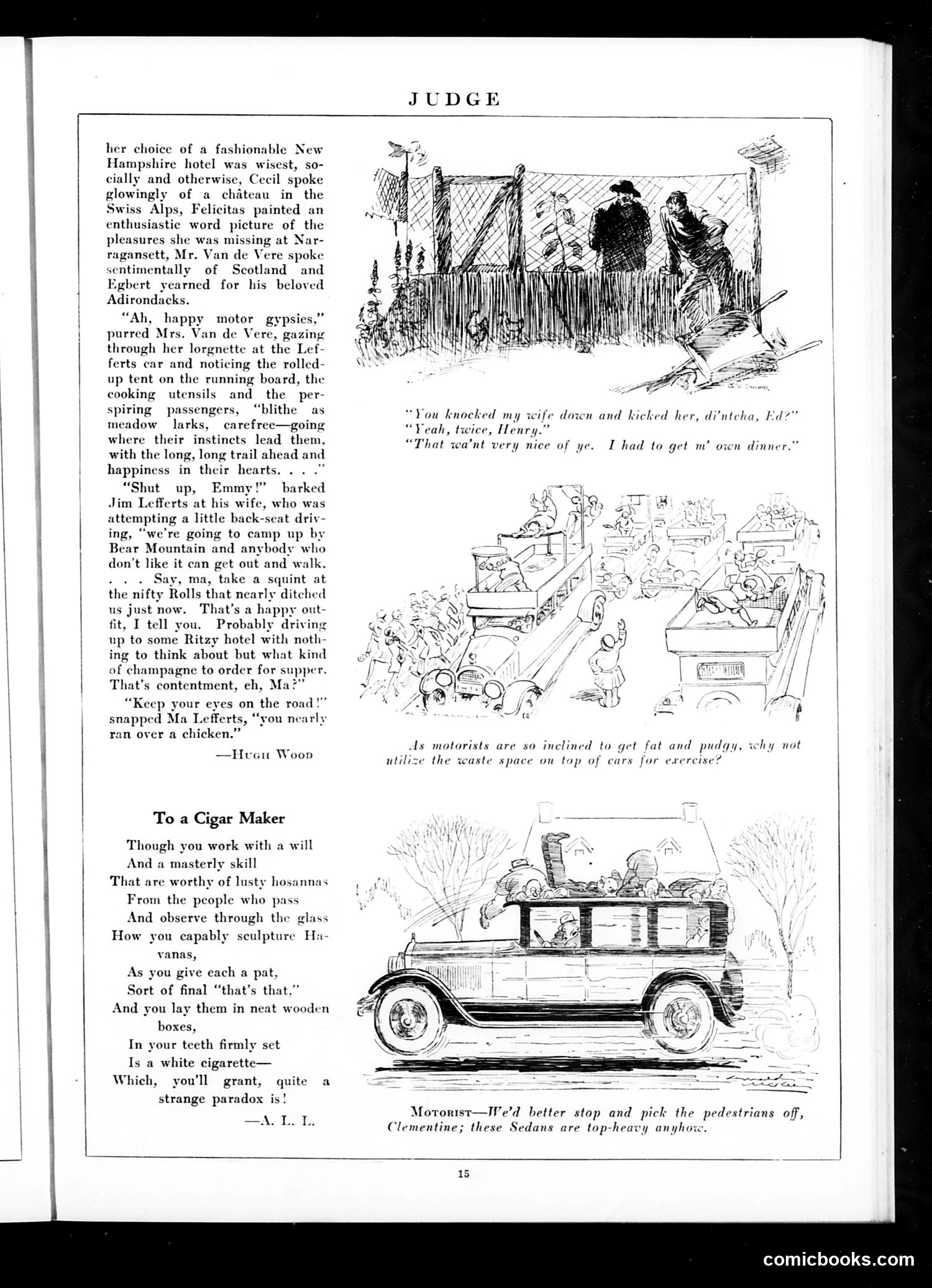
This page contains three distinct satirical pieces mocking early 1920s American leisure and social pretensions: **Top cartoon**: Contrasts wealthy hotel guests' romantic fantasies about "motor gypsies" camping freely with the reality of the Lefferts family's cramped, uncomfortable camping trip. The satire targets upper-class sentimentalization of roughing-it while they themselves pursue luxury (the "nifty Rolls"). The dialogue reveals tension between Jim's aggressive dominance and his wife's practical concerns. **Middle cartoon**: Mocks overcrowded automobiles packed with luggage and people, satirizing motorists' careless endangerment of pedestrians and suggesting cars' roofs be used for exercise—highlighting both obesity concerns and traffic danger. **"To a Cigar Maker" poem**: Points out the absurdity of cigar makers smoking cheap cigarettes while crafting premium cigars—a paradox about class and consumer culture. Overall, these pieces satirize 1920s motor culture, class pretension, and modern leisure activities.
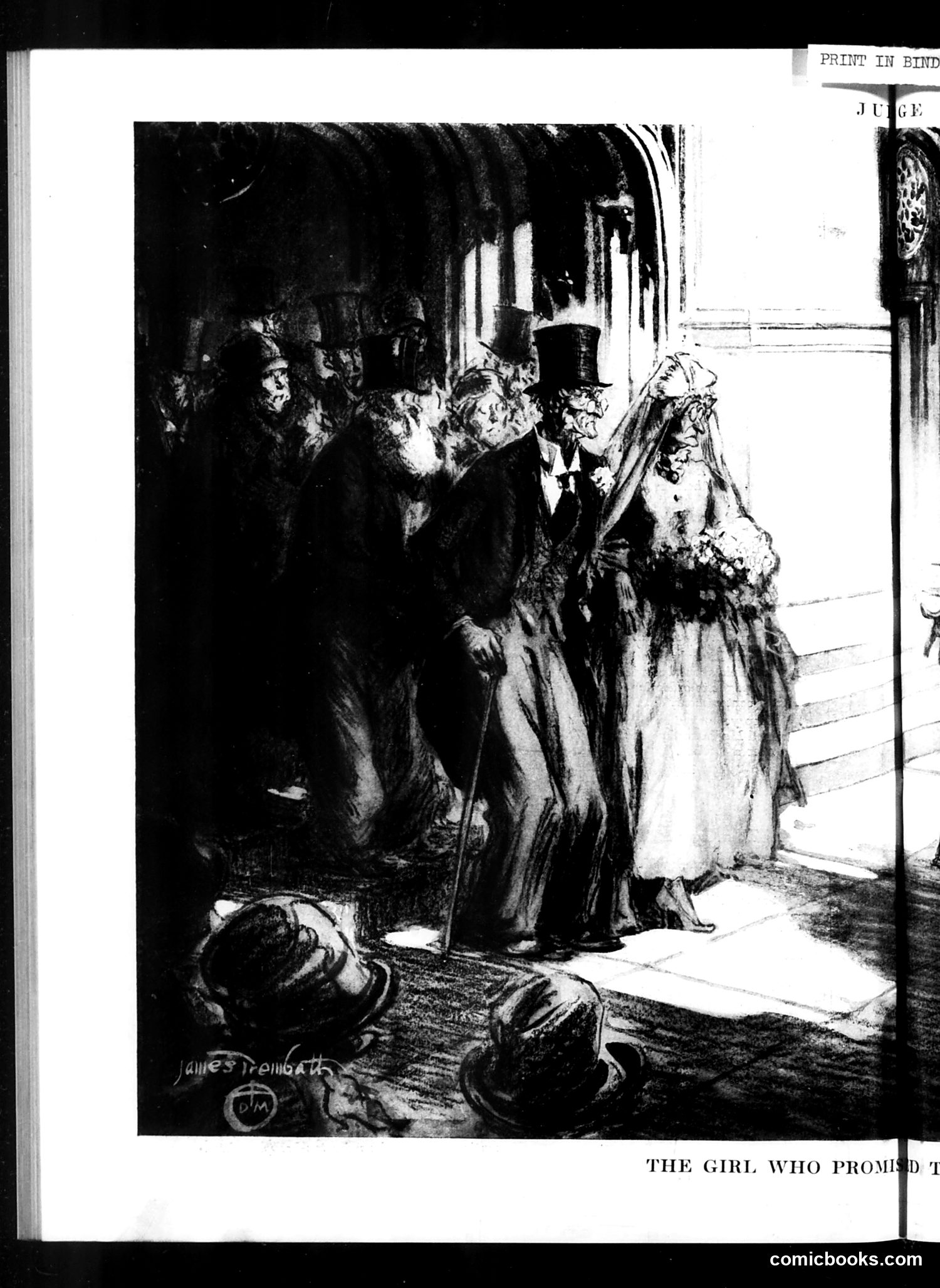
This appears to be an illustration from *Judge* magazine, signed by James Montgomery Flagg (visible as "JAMES DREISGACH" or similar in the lower left). The image depicts a formal social scene—likely a wedding or formal ceremony—with well-dressed figures in Victorian or Edwardian-era clothing gathered in an elegant interior space. The partially visible caption reads "THE GIRL WHO PROMI$ED T[O]..." The "$" symbol replacing the "S" in "PROMISED" is a satirical visual pun, suggesting broken financial promises or contractual deception rather than romantic promises. The cartoon likely satirizes a contemporary scandal involving a woman who failed to fulfill some public commitment—possibly financial or social. Without the complete caption and date, the specific reference remains unclear, though the formal setting and the focus on the well-dressed woman at center suggest this mocked a society figure's broken pledge or fraudulent claim.
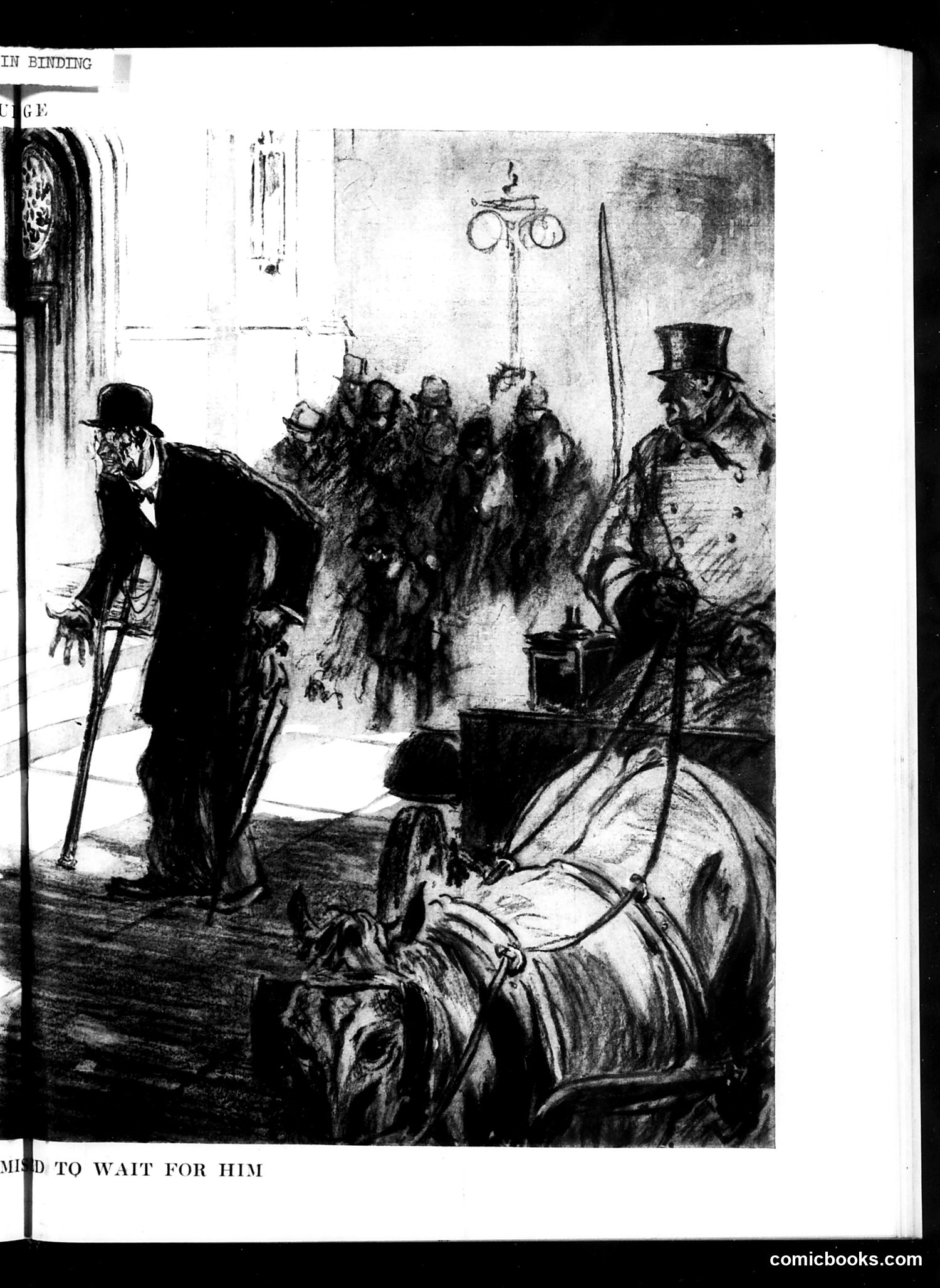
This satirical cartoon depicts a street scene with contrasting figures. On the left, a well-dressed man in a bowler hat and coat appears to be waiting or loitering. On the right, a figure in a top hat (possibly representing authority or wealth) stands near what appears to be a horse-drawn carriage. Between them is a group of poorly-dressed, shadowy figures—likely representing working-class or impoverished people. The caption "MIND TO WAIT FOR HIM" suggests social commentary on class divisions and economic inequality. The cartoon likely satirizes the gap between wealthy elites and struggling workers, or critiques those who must literally wait upon the rich for employment or survival. Without additional context about the specific publication date, the precise satirical target remains unclear, though the imagery clearly addresses class tension.
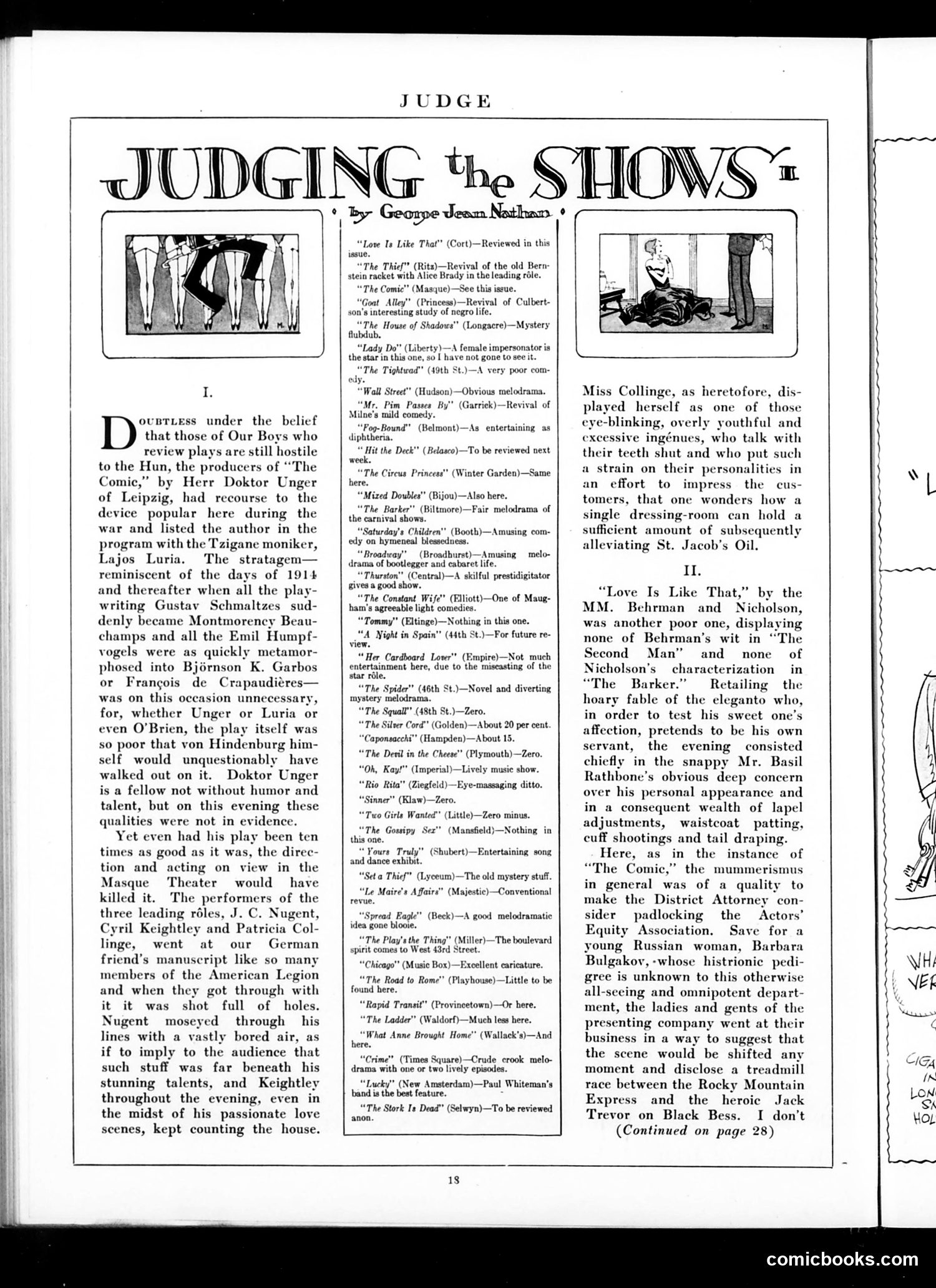
This is George Jean Nathan's theater column reviewing Broadway productions. The main article critiques "The Comic," a play by German author Herr Doktor Unger of Leipzig. Nathan sardonically notes the producers listed the author under a fake Hungarian name, "Lajos Luria," apparently fearing American audiences hostile to Germans post-WWI. He dismisses this deception as unnecessary—the play was so poor it failed regardless of authorship. The bulk of his scorn targets the performances by J.C. Nugent and Cyril Keightley, accusing them of phoning in their roles with obvious disinterest and boredom. The column also includes Nathan's capsule reviews of other Broadway shows, rating them from "zero" to moderately entertaining. The satire targets both German cultural presence in America and mediocre theatrical performances of the 1920s.
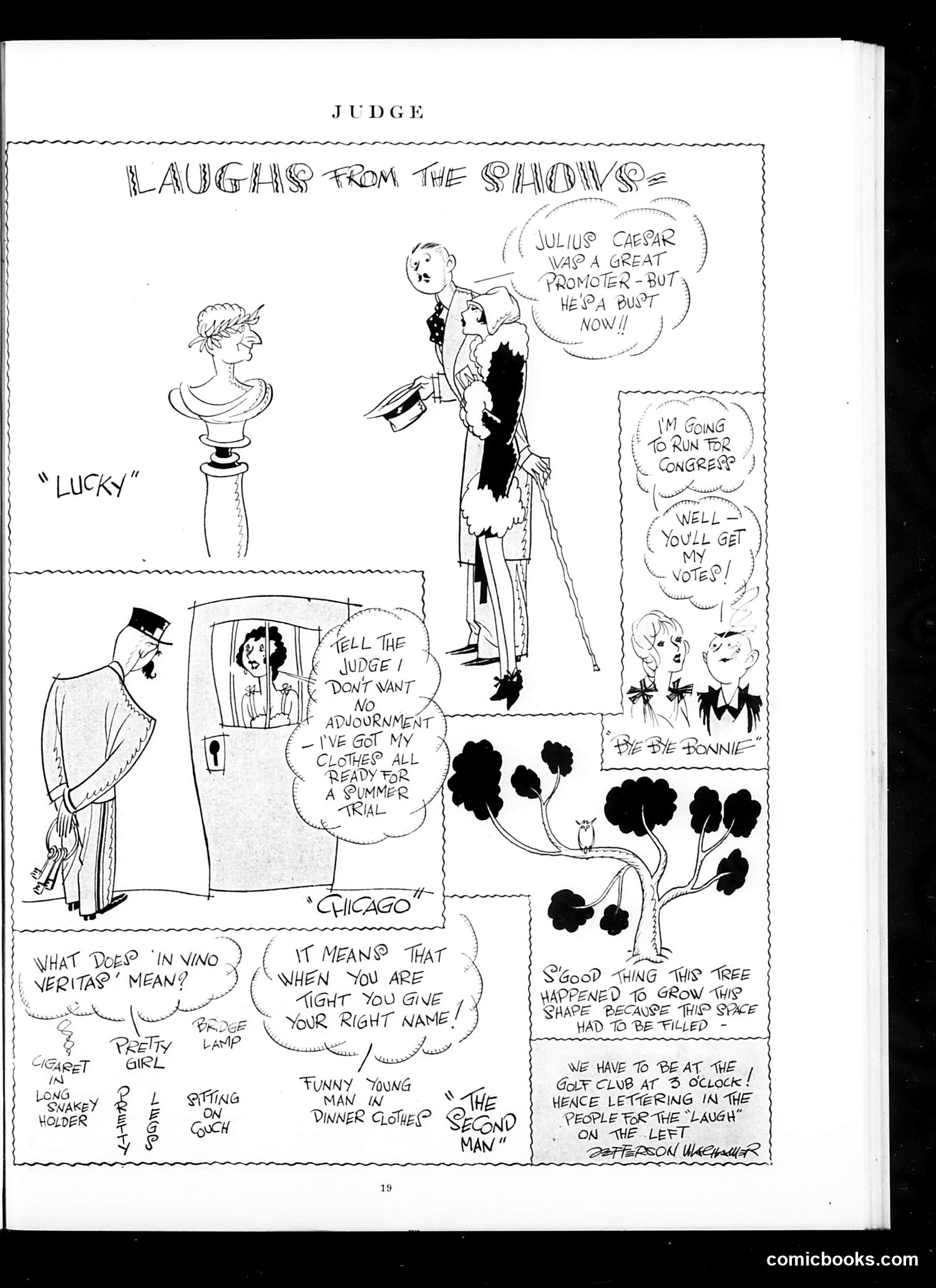
This Judge magazine page contains multiple satirical comic strips mocking various topics: **Top strip ("Lucky"):** A bust labeled "Lucky" and a man discussing Julius Caesar as a "great promoter" who "bust" now—likely satirizing a contemporary political or business figure compared unfavorably to Caesar. **"Chicago" strip:** A woman avoids a judge, claiming she needs her summer clothes ready, not wanting adjournment. This appears to satirize court delays or judicial inefficiency. **Lower left:** A dialogue about "in vino veritas" (Latin: "in wine, truth") and fashion terminology—mocking pretentious vocabulary usage among the upper classes. **Right panels:** Jokes about tree-shaping and golf club scheduling, seemingly absurdist humor about the leisure class's priorities. The overall theme targets pompous language, legal incompetence, and wealthy society's trivial concerns—typical Judge magazine satire of American social pretension and institutional folly.
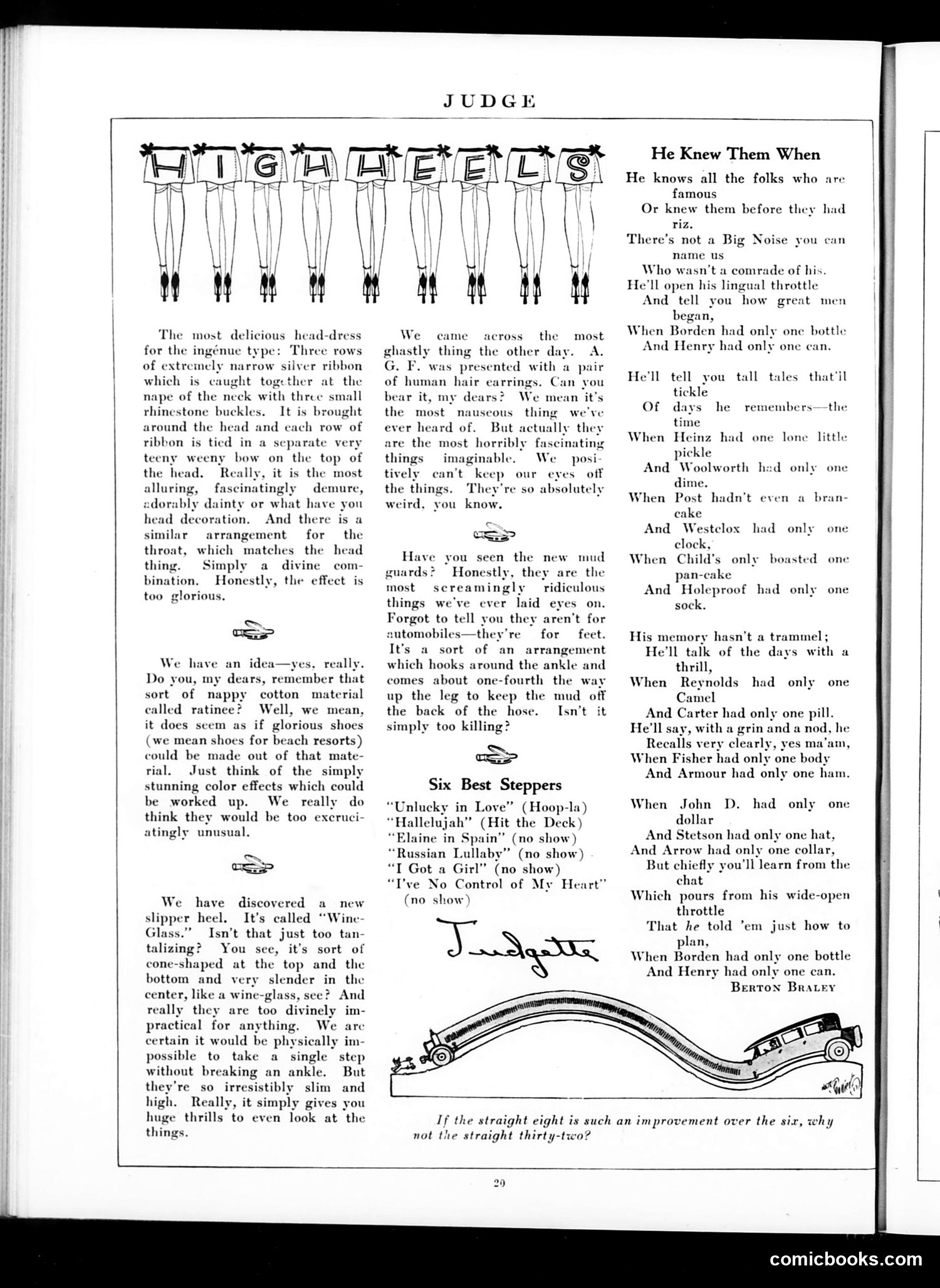
This page from **Judge** magazine (circa 1920s, based on references) contains two satirical sections: **Upper Half - Fashion Commentary:** Mockingly describes absurd women's fashion trends in deliberately overwrought language ("adorably dainty," "too gloriously"). The satire targets both the impractical designs (the "Wine-Glass" heel would break ankles) and fashion magazines' breathless promotion of ridiculous trends. The illustration shows identical female figures in a chorus line wearing these fashions—emphasizing conformity and the absurdity of trend-following. **Lower Half - "He Knew Them When":** A poem by Berton Braley satirizes **name-dropping blowhards**—men who claim intimate knowledge of famous industrialists (Heinz, Woolworth, Rockefeller, etc.) by reminiscing about their humble beginnings. The joke: he's a bore who constantly one-ups conversations with manufactured stories of knowing billionaires "when they had only one bottle/can/pickle/dime." It mocks both the pretentiousness of such people and Americans' obsession with business tycoons during the industrial boom era. Both sections mock contemporary obsessions: women's fashion conformity and social climbing/name-dropping.
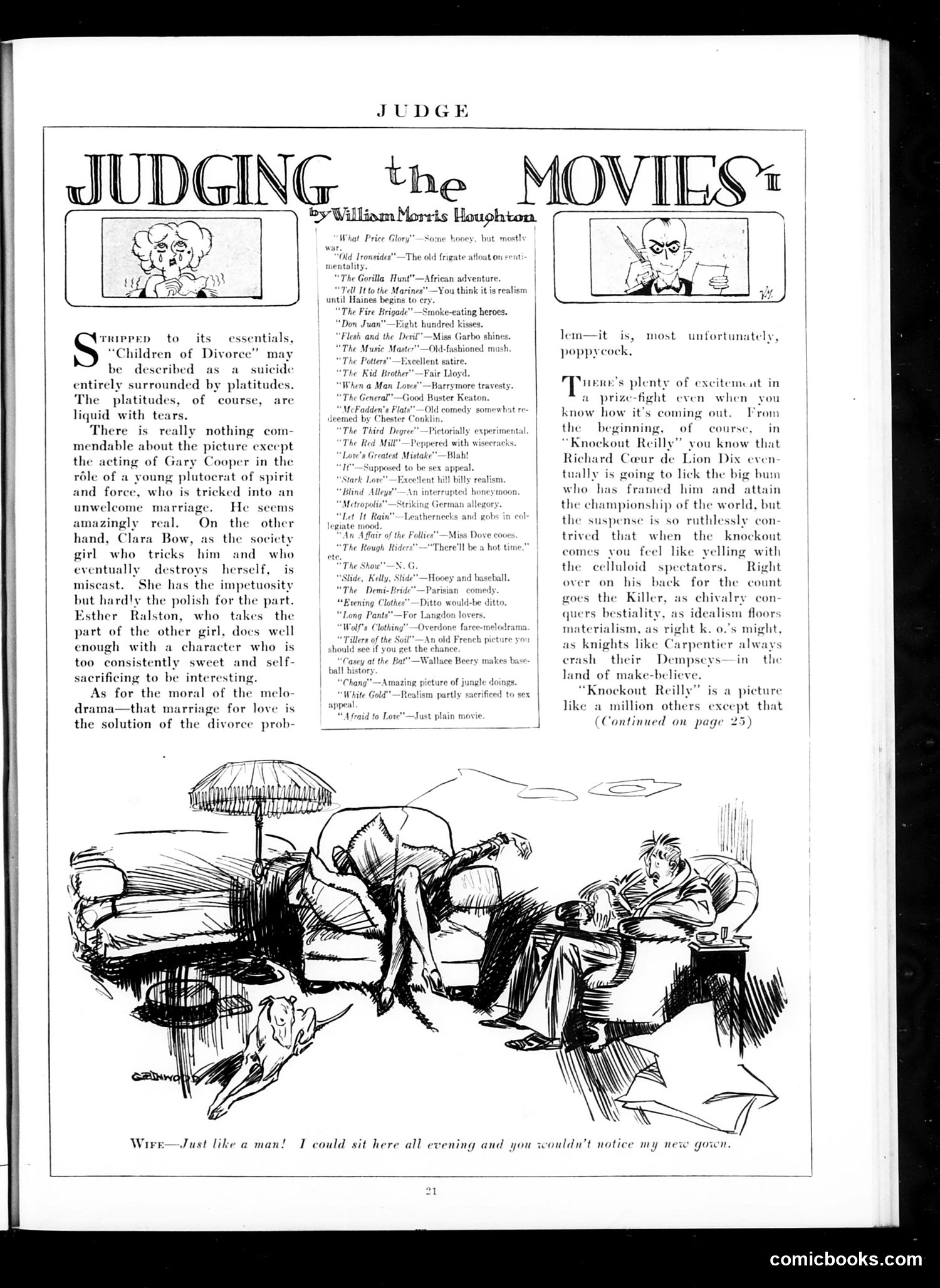
This page contains film reviews by William Morris Haughton for Judge magazine's "Judging the Movies" column. The layout lists contemporary movies with brief critical comments (appearing to be from the mid-1920s based on references to actors like Gary Cooper, Clara Bow, and Buster Keaton). The main cartoon illustrates a review of "Children of Divorce," criticizing the film as overly sentimental melodrama. The satire mocks both the movie's plot and the domestic situation it depicts: a wife complains her new gown goes unnoticed while her husband lounges indifferently—the cartoon's caption ("Just like a man!") suggests the film's moralistic message about marriage failing to address real marital problems. The reviews themselves are sardonic, dismissing many films as "hooey," "old-fashioned mush," and "poppycock," while praising exceptional performances. This reflects Judge's sophisticated, urbane critique of popular entertainment for educated readers skeptical of Hollywood sentimentality.
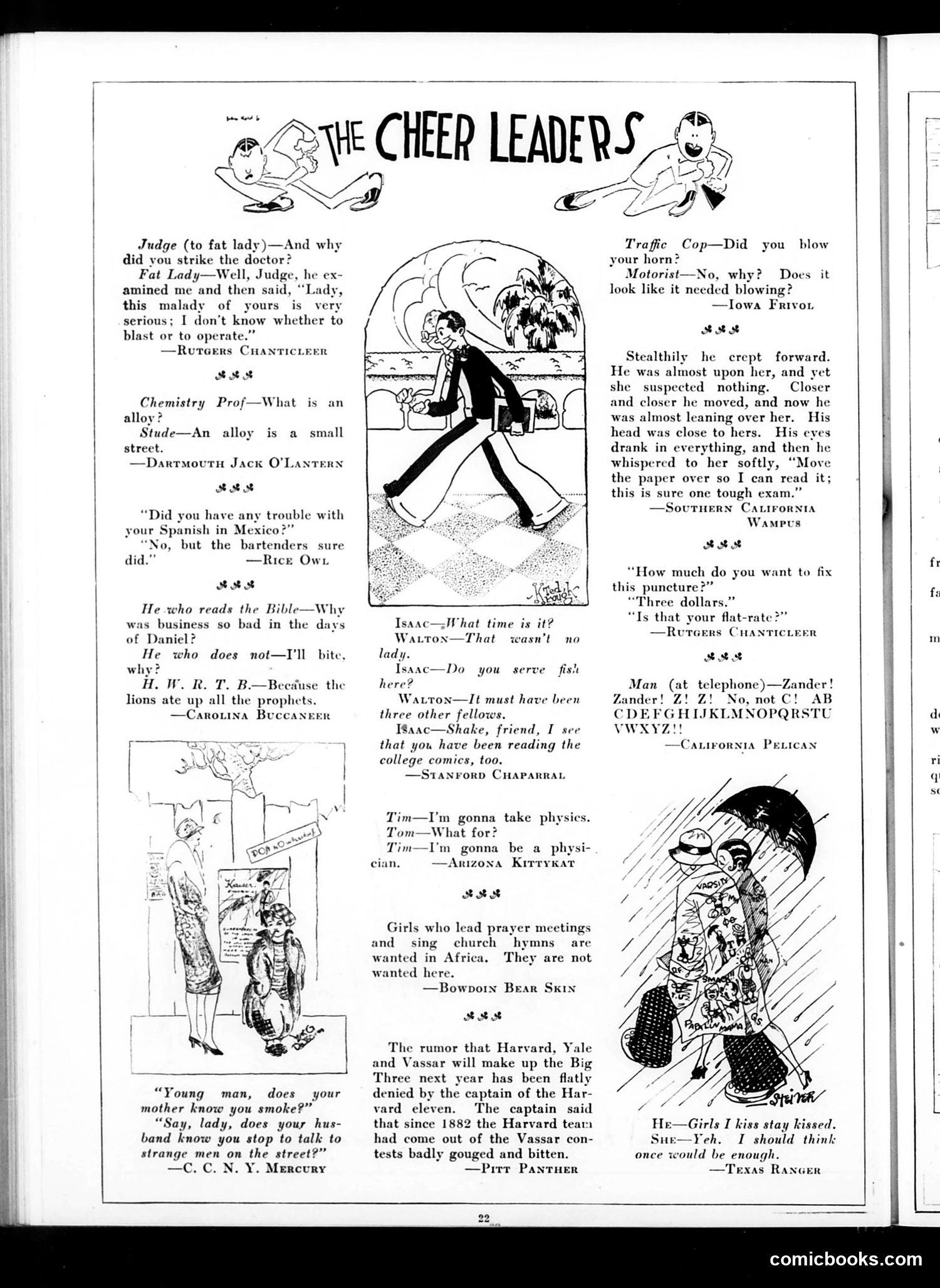
This page collects short jokes and humorous exchanges submitted by college newspapers across America (Dartmouth, Rice, Harvard, etc.). The content reflects early-20th-century campus humor: **Key themes:** - **Student wit**: Puns and wordplay dominate ("An alloy is a small street"; confusing "fish" service with romantic encounters) - **Doctor/medical satire**: A fat lady strikes a doctor after he's ambiguous about treatment ("blast or operate") - **College life**: References to exams, physics classes, prayer meetings - **Dating/flirtation humor**: A man creeping up to read a girl's exam paper; kissing jokes - **Sports rivalry**: Harvard-Vassar football competition portrayed as brutally physical **The cartoons** feature exaggerated figures in comedic situations—a man being chased, couples under umbrellas—supporting the ribald tone. The page satirizes both college students' pretensions and adult social conventions through crude wordplay and innuendo typical of 1920s-era American humor magazines.
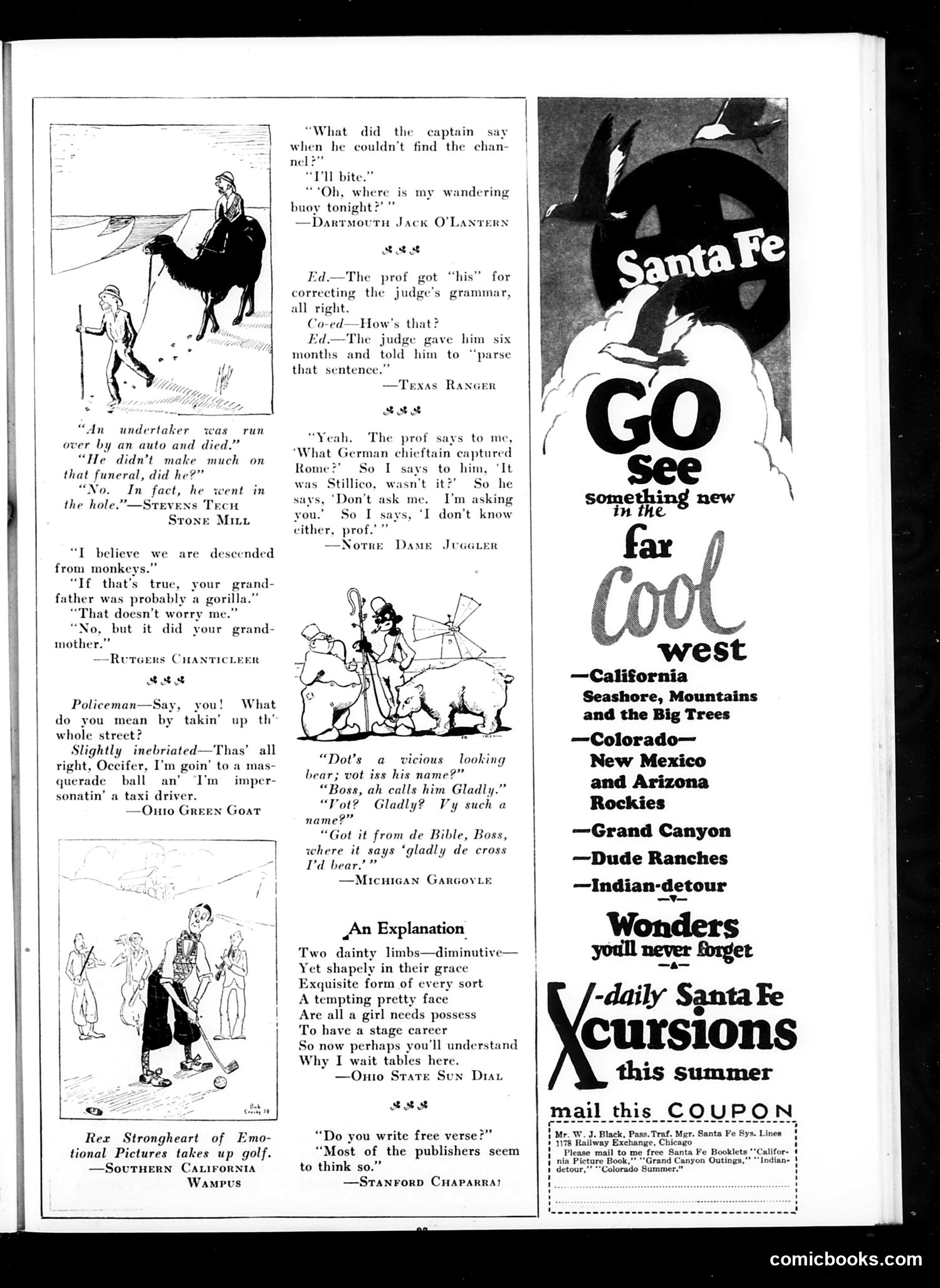
This page contains several short humor pieces typical of Judge's satirical style, plus a Santa Fe railway advertisement. The jokes mock various subjects: nautical incompetence ("I'll bite"), academic pedantry (a professor corrected a judge's grammar and received six months in jail for "parsing" the sentence), and the undertaker who profited nothing from a fatal auto accident. A dialogue about a German chieftain references confusion over "Stilico" (likely Stilicho, a Roman general)—the humor derives from academic pretension and misremembered history. Other pieces include evolution jokes, a drunk driver's confusion, and wordplay about a bear named "Gladly" (from the hymn phrase "gladly the cross I'd bear"). The bottom section critiques free verse poetry as commercially unviable. The right side is primarily a **Santa Fe Railway advertisement** promoting southwestern tourism—Grand Canyon, dude ranches, and scenic routes—with a mail-in coupon. This represents the magazine's revenue model: satirical content subsidized by travel and product advertising.
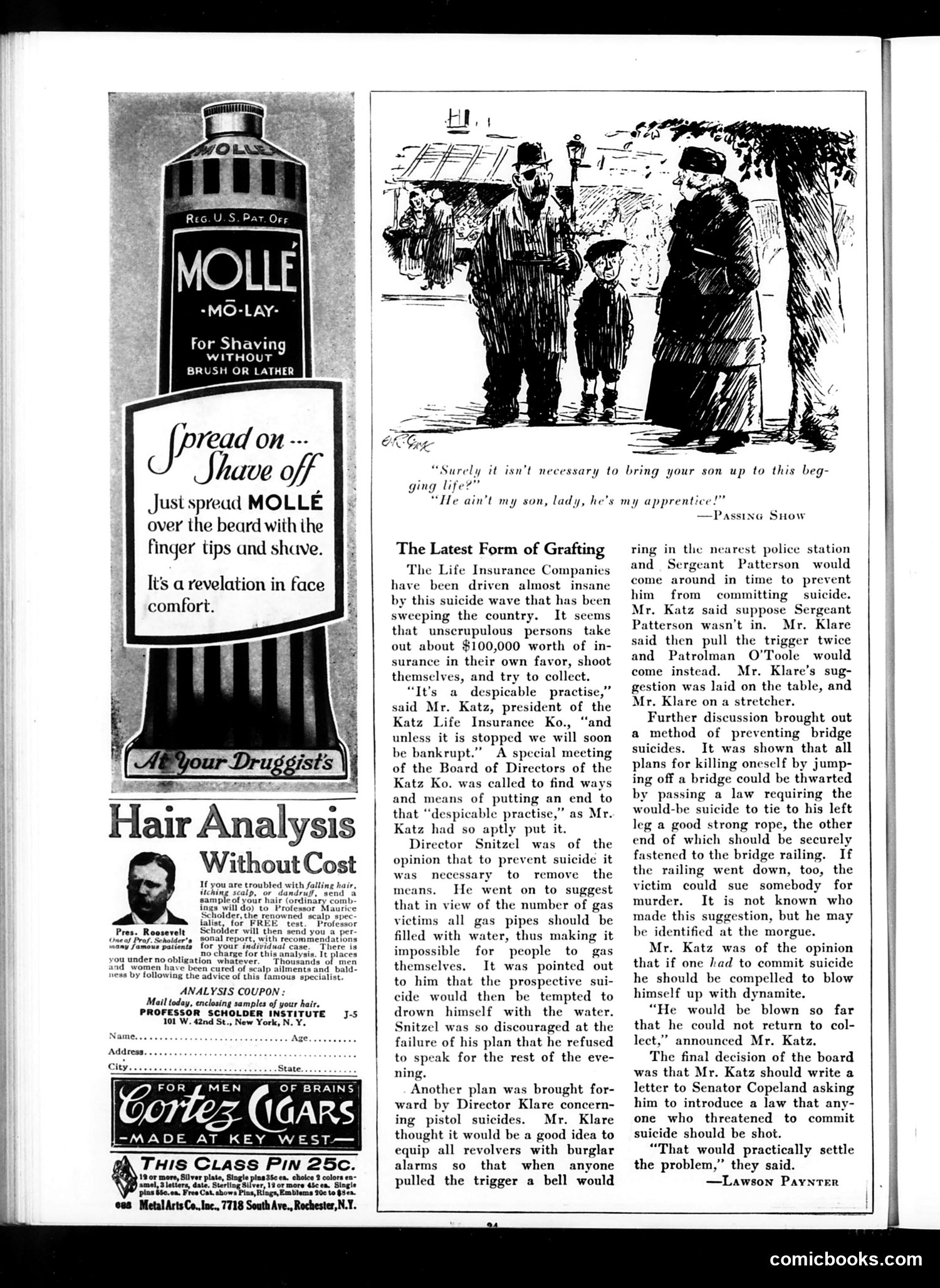
This page combines advertisements with satirical content addressing early 20th-century concerns about insurance fraud and suicide. **The Main Cartoon** ("The Latest Form of Grafting," by Lawson Paynter) satirizes life insurance companies' panic over a wave of suicides. The joke presents absurd "solutions" proposed by insurance executives: filling gas pipes with water, installing burglar alarms on revolvers, requiring ropes attached to suicidal bridge-jumpers, and ultimately suggesting the government shoot anyone threatening suicide. **The Satire:** Paynter mocks both the insurance industry's paranoia about fraudulent claims (people taking out large policies then collecting via suicide) and the bureaucratic absurdity of proposed "solutions." Each proposal is deliberately ridiculous, becoming increasingly outlandish—the humor escalates from impractical to obviously unconstitutional. **The Opening Cartoon** shows a street beggar telling a woman his young companion is an "apprentice," not his son—darkly suggesting child labor exploitation. The remaining content is straightforward period advertising (Mollé shaving cream, hair analysis, cigars, class pins).
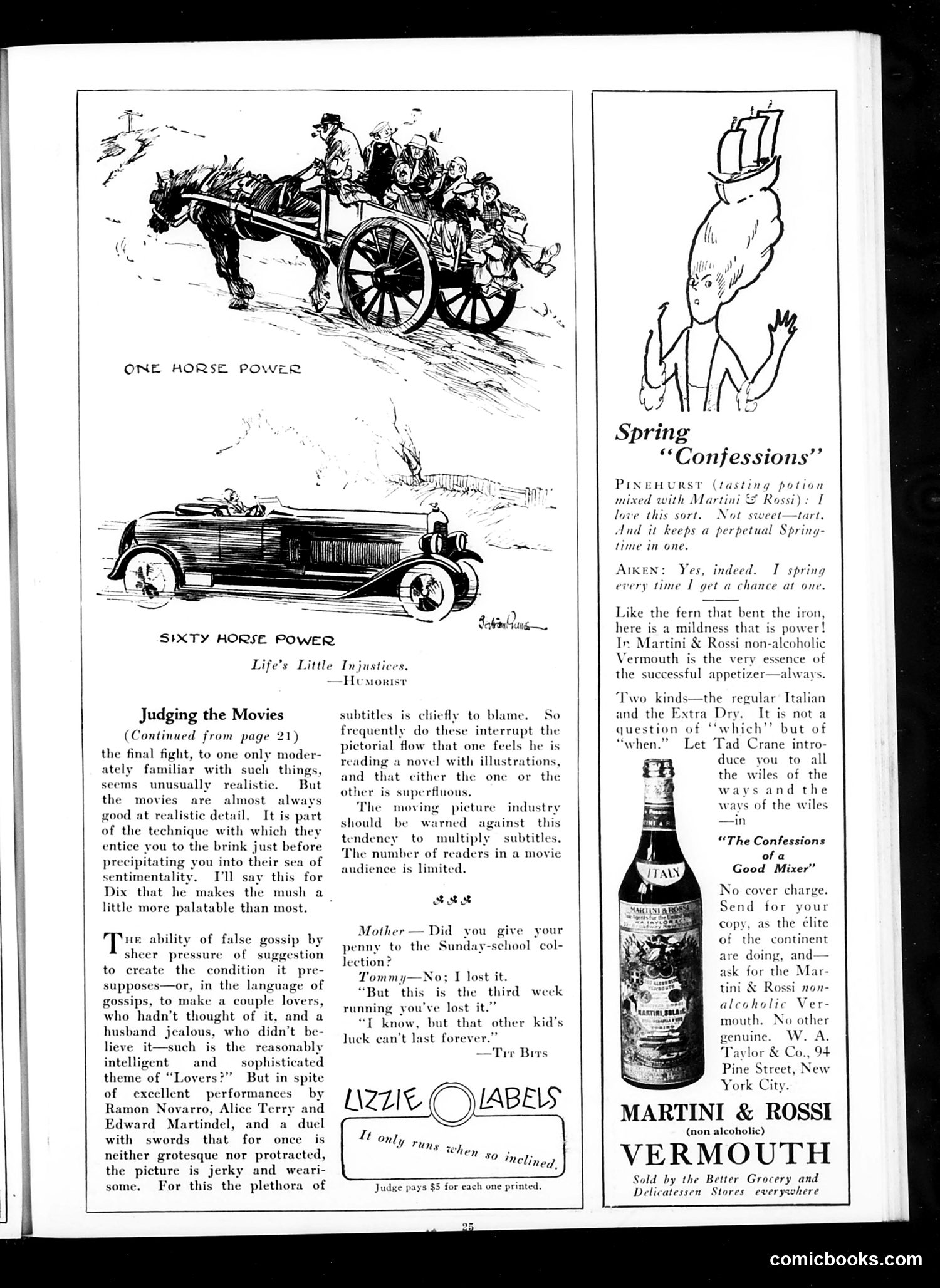
This Judge magazine page contains satirical cartoons and advertisements from the Prohibition era (likely 1920s). **Top cartoons**: "One Horse Power" vs. "Sixty Horse Power" contrasts old-fashioned horse-drawn wagons crowded with people to modern automobiles—satirizing technological progress and changing social mobility. **"Judging the Movies"**: A film critic discusses silent movies' reliance on excessive subtitles, arguing they interrupt the narrative flow. He critiques specific films, praising realistic detail but noting how movies manipulate emotion. This reflects early cinema's technical limitations and debates about the medium's artistic legitimacy. **"Lizzie Labels"**: A humor section where readers submit jokes (paid $5 each). **Martini & Rossi advertisement**: Notably advertises "non-alcoholic vermouth"—a direct response to Prohibition, which banned alcohol sales. The marketing ironically positions a non-alcoholic product as sophisticated and essential to the "good mixer," revealing how advertisers navigated legal restrictions while maintaining luxury brand positioning.
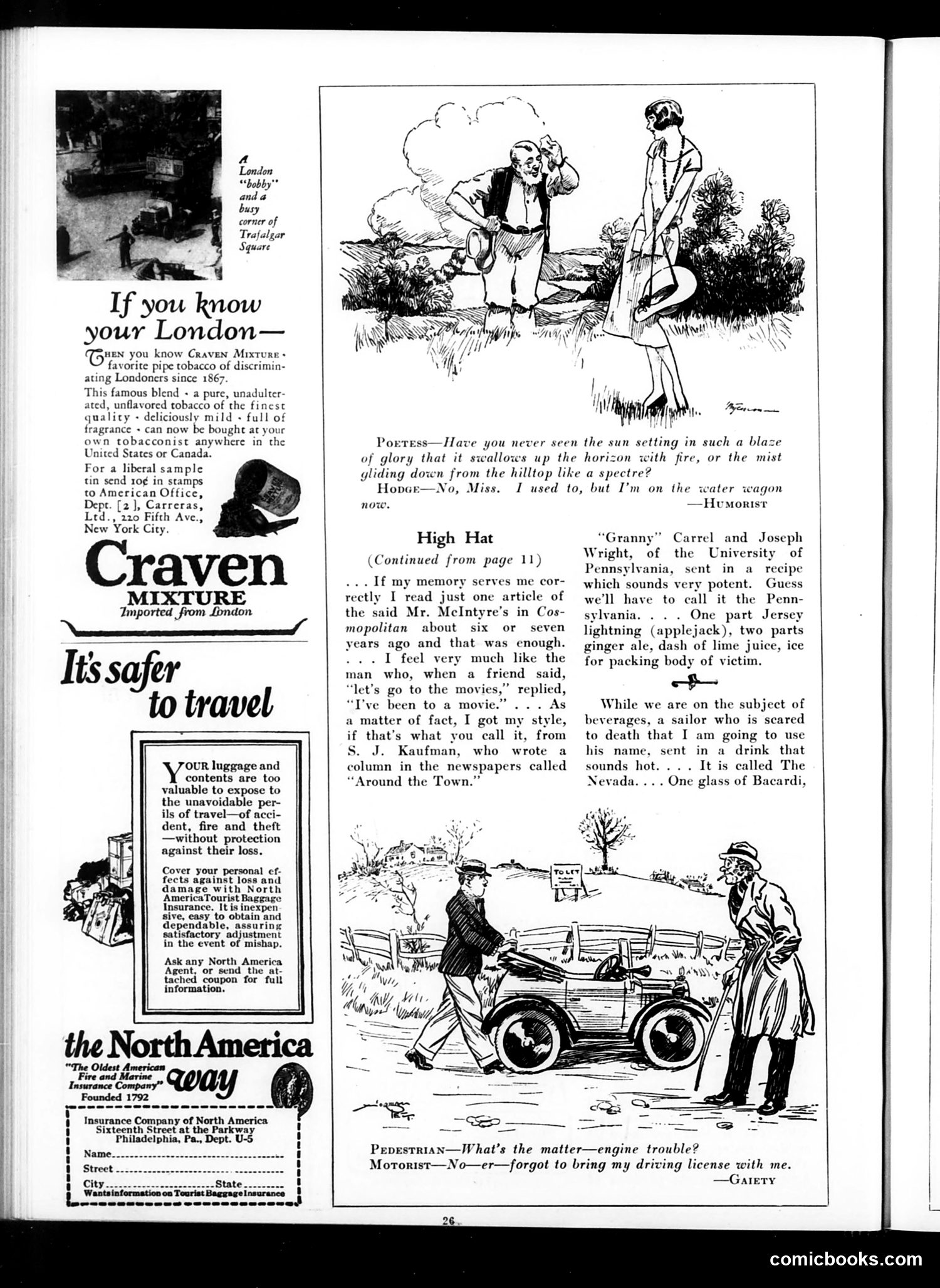
This page contains multiple elements: **Top cartoon**: A London police officer ("bobby") in Trafalgar Square—illustrating a Craven Mixture tobacco advertisement emphasizing British sophistication for American consumers. **Middle section**: "High Hat" column continuation, where the author dismisses theater-goers and claims his writing style derives from S.J. Kaufman's newspaper column "Around the Town." The accompanying humor involves readers sharing drink recipes, including one humorously called a "Pennsylvania" (applejack, ginger ale, lime juice, ice)—likely referencing Prohibition-era cocktails disguised as innocent recipes. **Bottom cartoon**: A motorist stopped by a policeman. The joke: the motorist claims engine trouble when actually he "forgot to bring my driving license"—satirizing drivers making excuses rather than admitting violations. **Sidebar**: North America Insurance Company advertisement about travel protection, appealing to anxious travelers concerned about luggage theft or accident damage. The page blends literary commentary, Prohibition-era humor, and traffic-safety satire typical of 1920s American magazines.
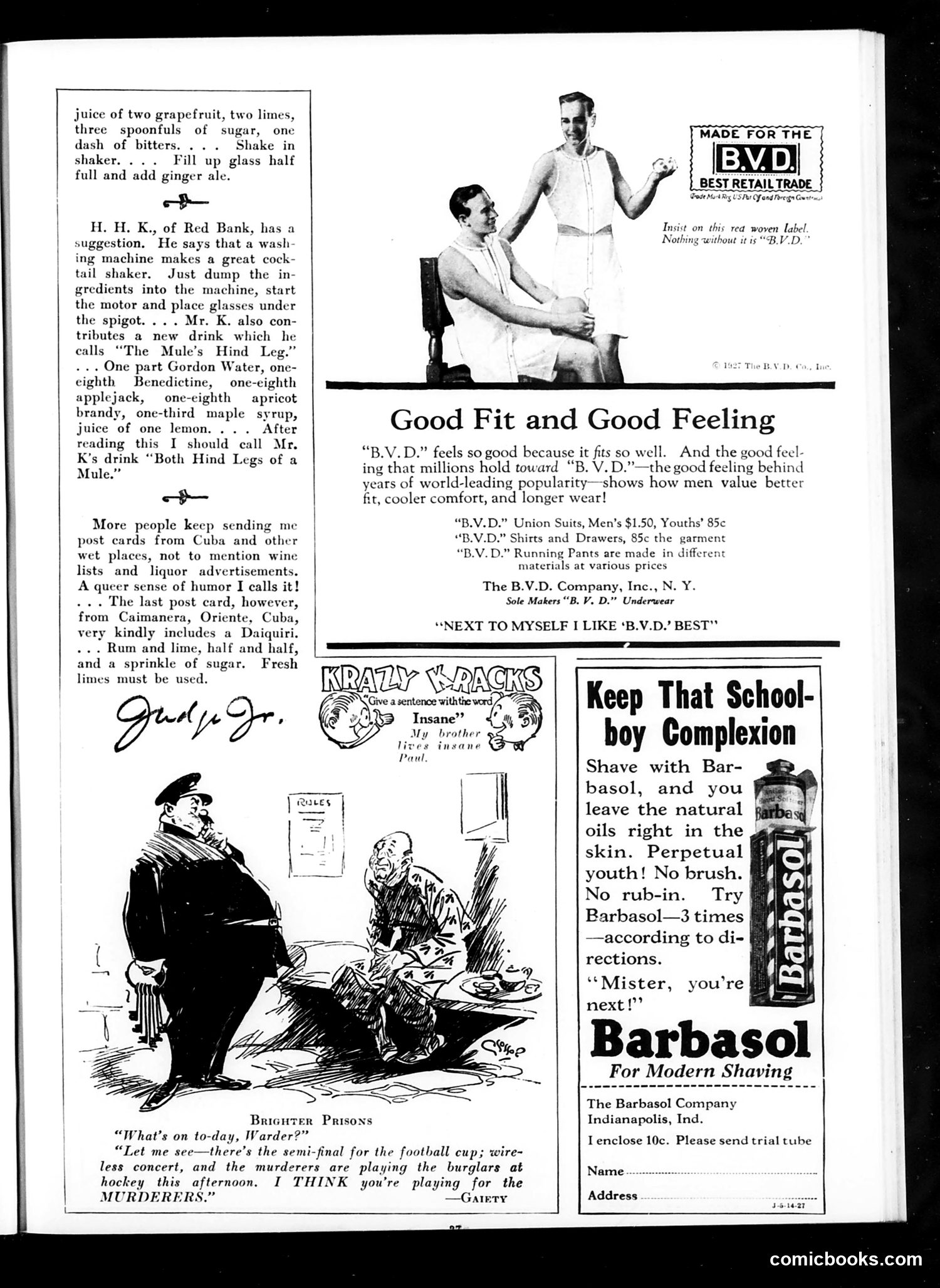
This page mixes humor content with period advertisements, primarily from the Prohibition era (based on cocktail recipes and references to "wet places"). **The Cartoons:** The main cartoon, "Brighter Prisons," depicts a prison guard and warden discussing the day's schedule. The dark humor suggests inmates are organizing sports events (football, hockey) against each other—the joke being that murderers and burglars now play recreational games together, treated almost like a normal sports league. This satirizes either prison reform efforts or the absurdity of normalizing criminal populations. The "Krazy Kracks" section is a simple word-play joke asking readers to create a sentence using "insane." **The Advertisements:** The B.V.D. underwear and Barbasol shaving cream ads are straightforward period marketing, emphasizing comfort, modern convenience, and youthful appearance—typical 1920s-30s advertising appeals. The cocktail recipes dominate the text, reflecting post-Prohibition nostalgia or pre-Prohibition indulgence (the magazine's actual date is unclear from this excerpt).
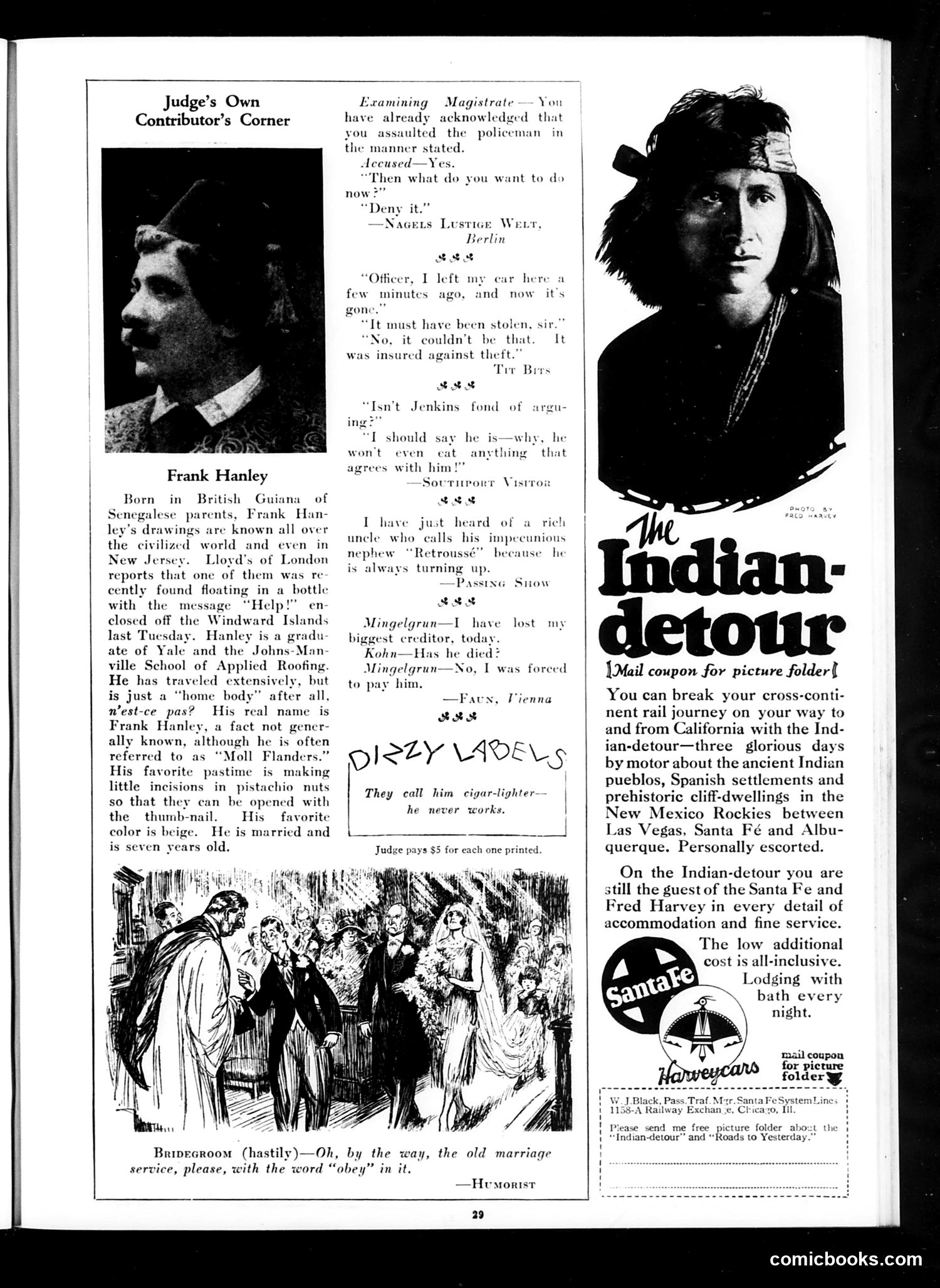
This page from *Judge* magazine contains two main elements: **"Judge's Own Contributor's Corner"** is a humorous biographical sketch of cartoonist Frank Hanley, using absurdist humor typical of the era. The jokes exaggerate his fame ("known all over the civilized world and even in New Jersey"), mock his biographical details playfully, and include a self-referential quip about him being "often referred to as 'Moll Flanders'"—likely a private joke among contributors. **The humor shorts** below are brief jokes on various topics: a magistrate courtroom scene, insurance fraud, argumentative Jenkins, and creditor avoidance—standard satirical fare mocking human folly, bureaucracy, and social pretension. **The advertisement** for "The Indian-detour" (Santa Fe Railway's motor tour through New Mexico pueblos and cliff-dwellings) appears to be the page's commercial content, offering tourists an "all-inclusive" experience marketed as authentic cultural tourism. The overall effect captures *Judge*'s blend of satirical humor, contributor celebration, and advertising typical of early 20th-century American magazines.
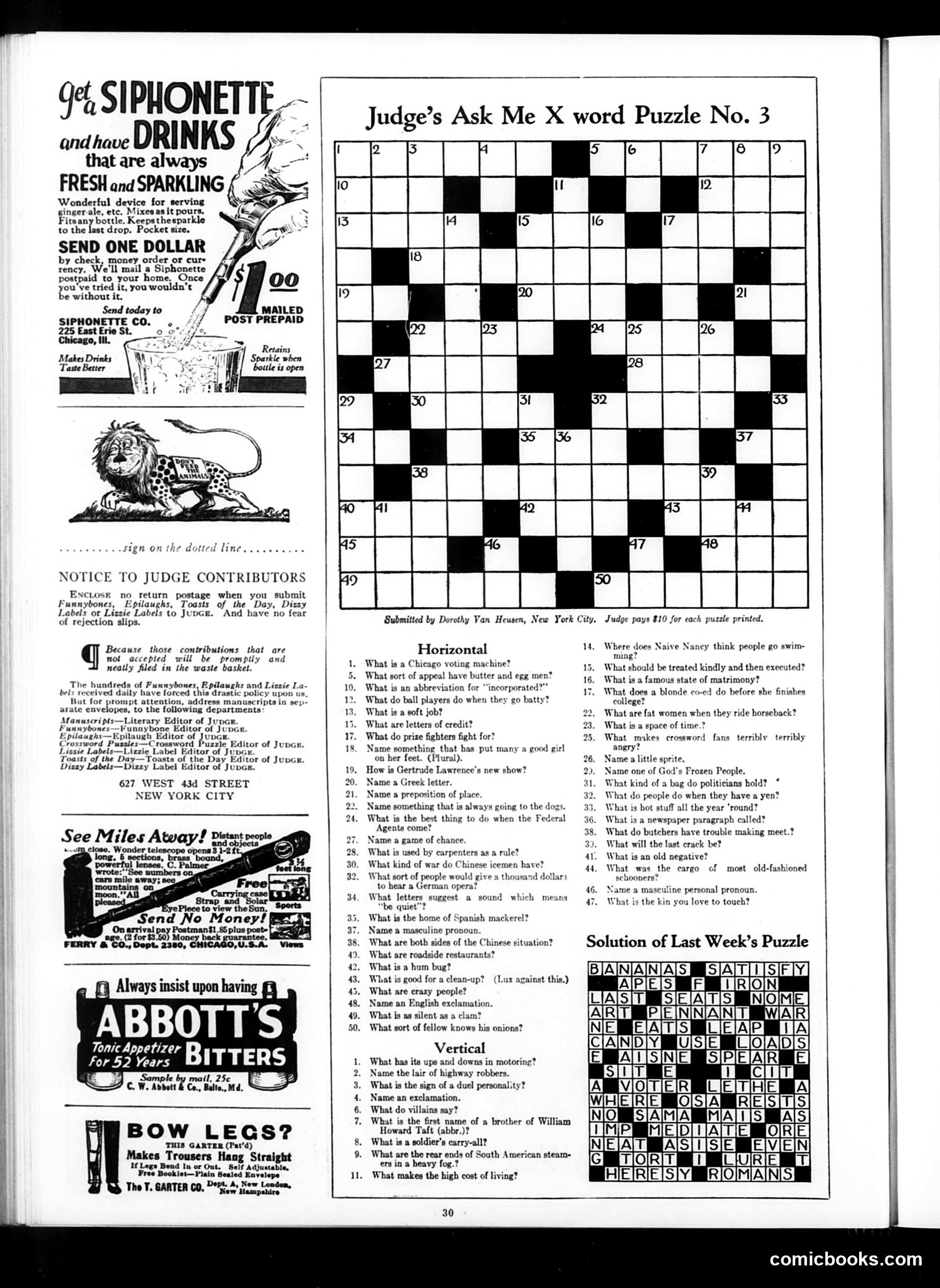
This page is primarily **advertising and puzzle content**, not political satire. It features Judge's "Ask Me X word Puzzle No. 3," a contemporary crossword with clues submitted by Dorothy Van Heusen. The clues are **topical wordplay** reflecting 1920s-30s American culture: references to Chicago voting machines, prize fighters, Federal Agents (Prohibition enforcement), and period slang ("hot stuff," "yen"). Some clues play on current celebrities like actress Gertrude Lawrence. The surrounding advertisements—for a Siphonette drink mixer, Abbott's Bitters, and a "Bow Legs" garter—represent typical magazine monetization of the era. **The satirical content is minimal here.** The page's humor derives from the puzzle's clever wordplay rather than political commentary. The brief "Notice to Judge Contributors" offers gentle self-mockery about rejecting submissions ("promptly and neatly filed in the waste basket").
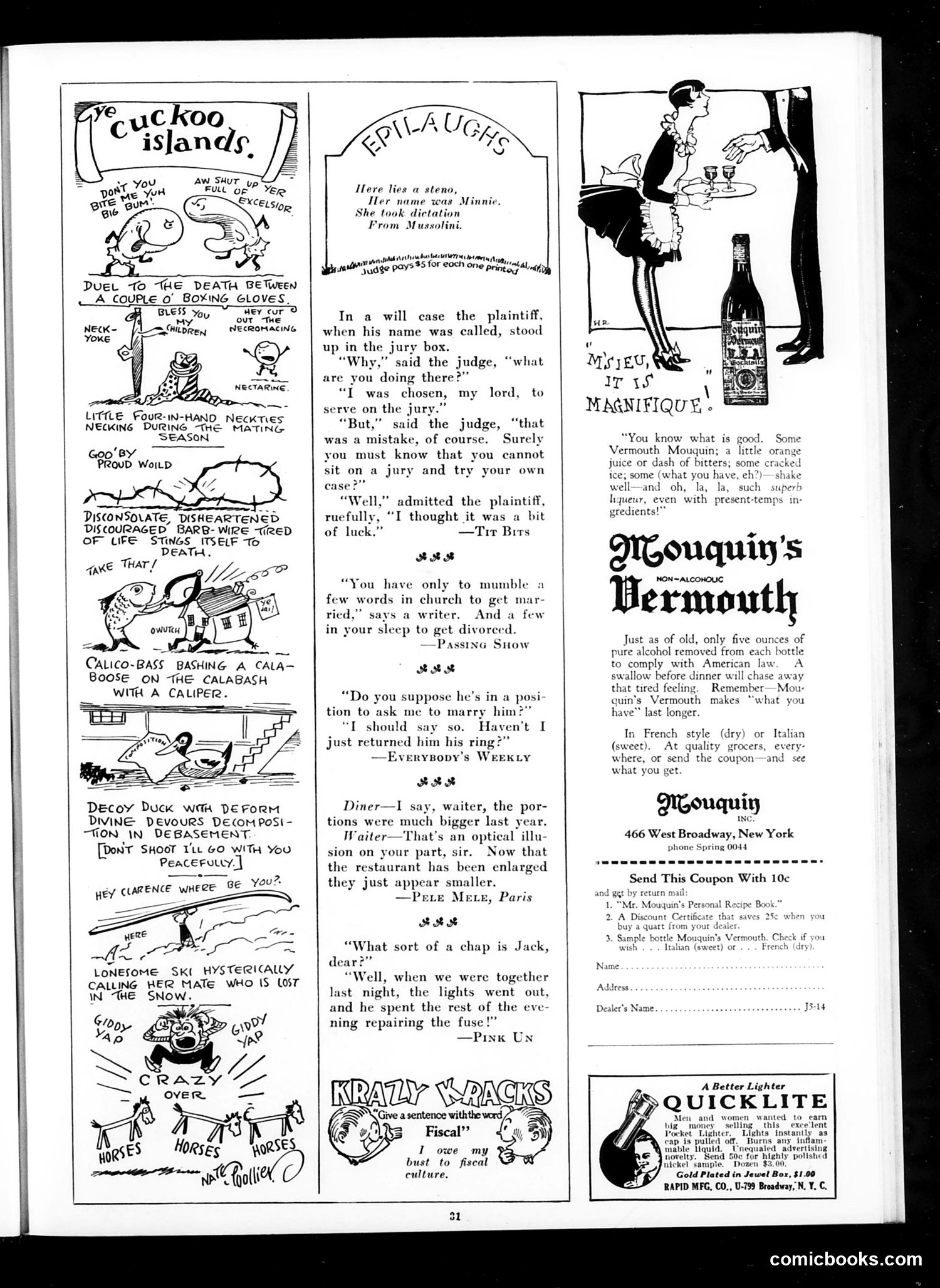
This is primarily a **humor and advertising page** rather than political commentary. The content consists of: **Left column**: A series of visual puns titled "Cuckoo Islands"—absurdist cartoons playing on animal names (calico-bass, decoy duck, etc.) with punny captions. These are nonsensical sight gags with no deeper meaning. **Center**: Brief humorous anecdotes and jokes about everyday situations—a judge discovering a plaintiff on his own jury, restaurant portions appearing smaller after enlargement, a failed marriage proposal. Standard period humor. **Right side**: Advertisements for **Mouquin's Vermouth** (a digestif liqueur) and **Quicklite lighters**, with an "Epi-Laughs" epitaph mocking Mussolini. The page reflects **1920s-30s magazine format**—light comedy and product promotion rather than sharp satire. The Mussolini reference is the only topical element, treating him as a figure of ridicule rather than serious political commentary. This is entertainment-focused content for general audiences.
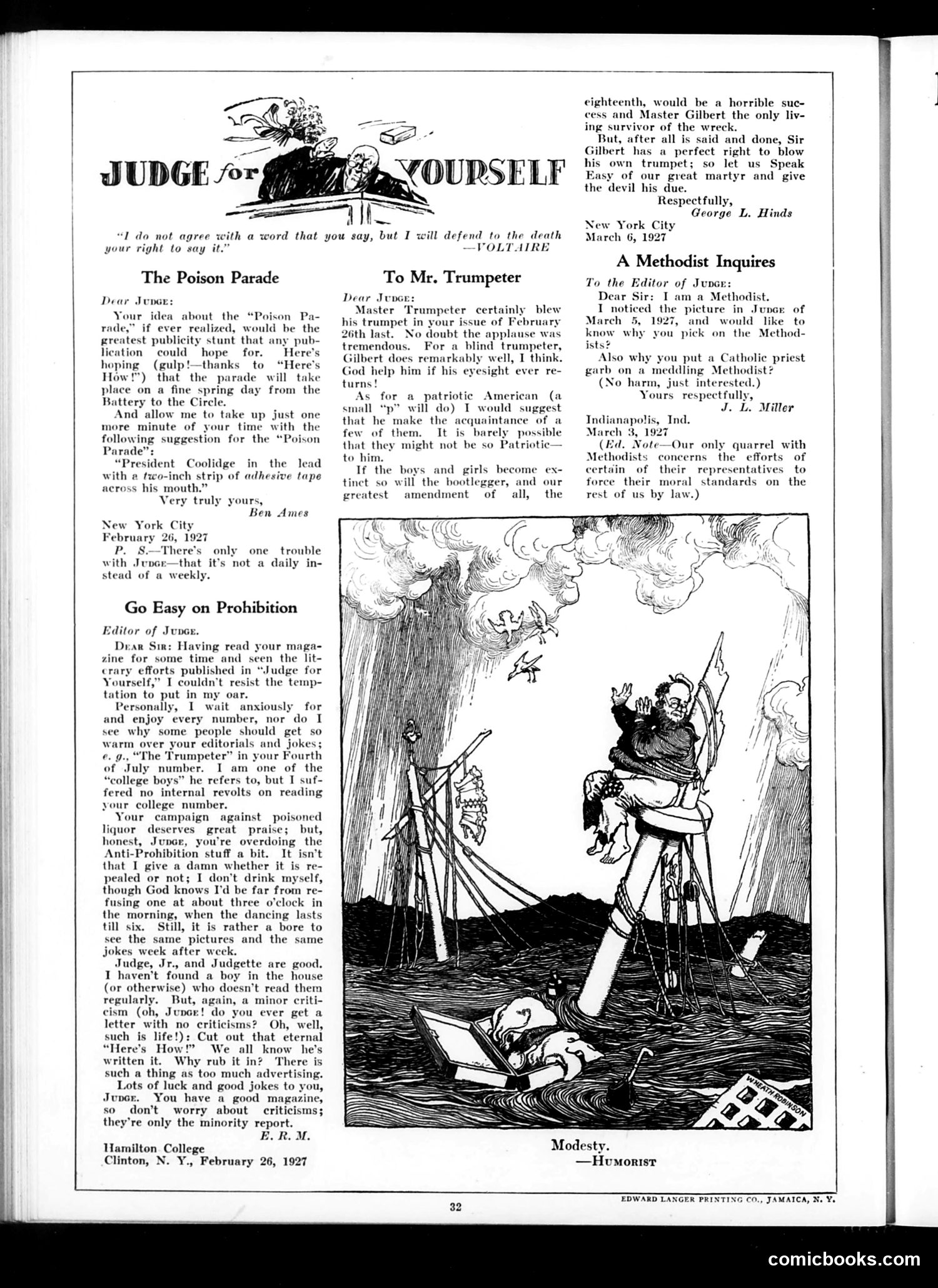
This page from Judge magazine (March 1927) comprises reader letters responding to prior editorials, plus one cartoon titled "Modesty." **Key Content:** The letters debate Judge's anti-Prohibition stance and editorials. One writer suggests a "Poison Parade" featuring President Coolidge with tape over his mouth—satirizing his silent public persona. Another defends Prohibition, noting Judge overdoes anti-Prohibition humor. A third criticizes an article called "The Trumpeter" for excessive patriotism. **The Cartoon ("Modesty"):** Shows a figure (appears female) being "carried away" into clouds by an angel or cherub figure. The title suggests ironic commentary on loss of modesty—likely mocking contemporary social changes or relaxed moral standards of the 1920s Jazz Age. **Historical Context:** This reflects 1920s culture wars: Prohibition enforcement, generational conflict over morality, and tensions between rural/conservative and urban/progressive America. Coolidge was famous for taciturn public behavior, making the tape-over-mouth joke particularly pointed.
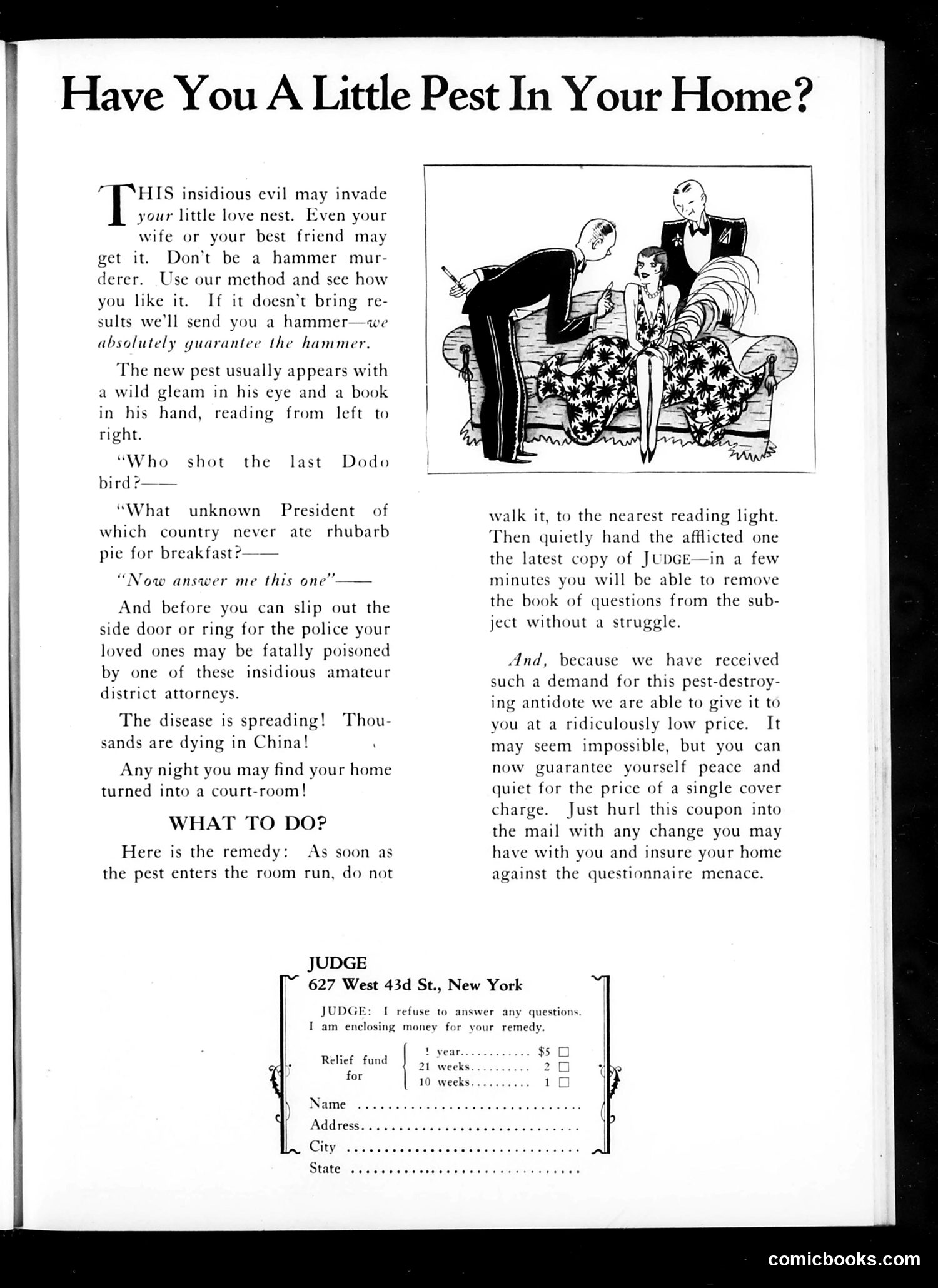
This is a humorous advertisement satirizing a contemporary social nuisance: people who ask endless trivia questions and riddles at social gatherings. The "pest" is an annoying guest who arrives with a book of questions, asking queries like "Who shot the last Dodo bird?" and refusing to stop, potentially "poisoning" the household with tedium. The joke mocks this behavior as an epidemic ("spreading! Thousands dying in China!") and proposes a tongue-in-cheek "cure": subscribing to *Judge* magazine itself. The remedy works by handing the question-asker the magazine—they become so absorbed reading that you can remove their question book without resistance. The cartoon depicts a formal family scene disrupted by the guest's interrogation. The satire targets early 20th-century parlor games and the social awkwardness of obsessive trivia enthusiasts, while using mock-serious language ("fatally poisoned," "court-room") to exaggerate the annoyance factor. It's essentially advertising *Judge* as relief from tedious social pests.
This is a cigarette advertisement rather than political satire. It promotes Lucky Strike cigarettes, emphasizing their "toasted" process as a selling point. The ad claims toasting enhances flavor from "the world's finest tobaccos" and appeals to consumers with the phrase "Your Throat Protection." This language is striking to modern readers because it makes a health claim—suggesting the product protects the throat—which would be illegal in contemporary advertising. Lucky Strike was famous in the early-to-mid 20th century for marketing cigarettes with such misleading health assurances. The ornate decorative border frames the product professionally, typical of vintage advertising aesthetics from this era.