
Judge, 1927-05-14 · page 20 of 36
Judge — May 14, 1927 — page 20: what you’re looking at
What you’re looking at
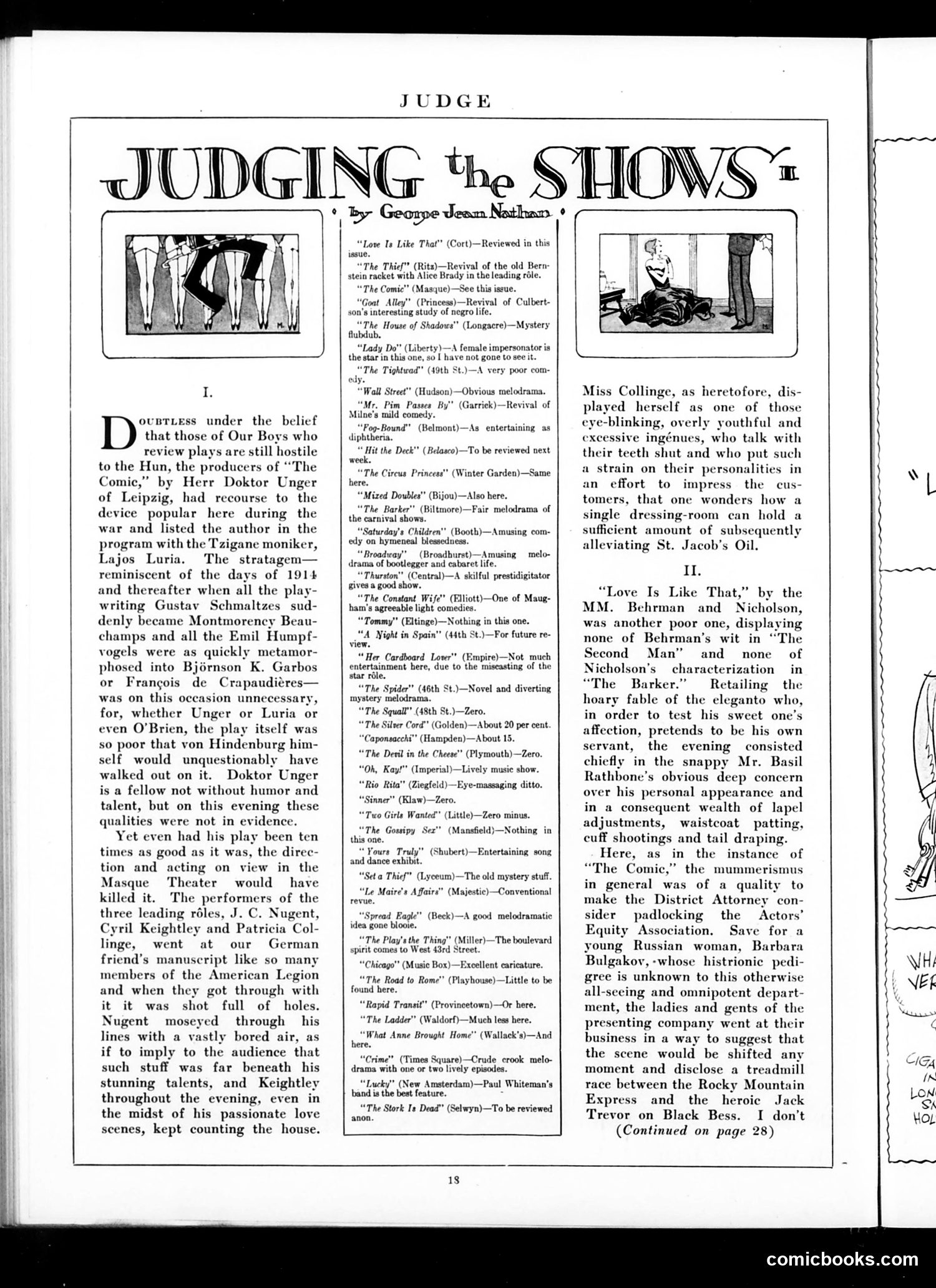
This is George Jean Nathan's theater column reviewing Broadway productions. The main article critiques "The Comic," a play by German author Herr Doktor Unger of Leipzig. Nathan sardonically notes the producers listed the author under a fake Hungarian name, "Lajos Luria," apparently fearing American audiences hostile to Germans post-WWI. He dismisses this deception as unnecessary—the play was so poor it failed regardless of authorship. The bulk of his scorn targets the performances by J.C. Nugent and Cyril Keightley, accusing them of phoning in their roles with obvious disinterest and boredom. The column also includes Nathan's capsule reviews of other Broadway shows, rating them from "zero" to moderately entertaining. The satire targets both German cultural presence in America and mediocre theatrical performances of the 1920s.
📄 Transcribed text from this page (OCR, searchable)
Machine-transcribed from the original scan — historical spelling and the odd misread are preserved.
oubTLess under the belief that those of Our Boys who review play till hostile to the Hun, the producers of “The Comic,” by Herr Doktor Unger of Leipzig, had recourse to the device popular here during the war and listed the author in the program with the Tzigane moniker, Lajos Luria. The stratagem— reminiscent of the days of 1914 and thereafter when all the pl writing Gustav Schmaltzes sud- me Montmorency Beau- nd all the Emil Humpf- vogels were quickly metamor- phosed into Bjérnson K. Garbos or Frangois de Crapaudiéres— was on this occasion unnecessary, for, whether Unger or Luria or ven O’Brien, the play itself was so poor that von Hindenburg him- self would unquestionably have walked out on it. Doktor Unger is a fellow not without humor and talent, but on this ev qualities were not in e Yet even had his y been ten times as good as it was, the direc- tion and acting on view in the Masque Theater would have killed it. The performers of the three leading réles, J. C. Nugent, Cyril Keightley and Patricia Col- linge, went at our German friend’s manuscript like so many members of the American Legion and when they got through with it it was shot full of holes. Nugent moseyed through _ his lines with a vastly bored air, as if to imply to the audience that such stuff was far beneath his stunning talents, and Keightley throughout the evening, even in the midst of his passionate love scenes, kept counting the house. JUDGE G the SHOWS” ¢ by Geonpe Jeam Nathan ¢ “Love Ta Like That” (Cort)—Reviewed in this issue. “The Thief” (Ritz)—Revival of the old Bern- stein racket with Alice Brady in the leading réle. ‘he Comic” (Masque)—See this issue. “Goat Alley’ (Princess)—Revival of Culbert- son's interesting study of negro life. “The House of Shadows" (Longacre)—Mystery flubdub. Lady Do" (Liberty)—A female impersonator is the star in this one, so | have not gone to see it. “The Tightwad” (49th St.)—A very poor com- Fall Street” (Hudson)—Obvious melodrama. “Mr. Pim Passes By" (Garrick)—Revival of Milne’s mild comedy. “Fog-Bound” (Belmont)—As entertaining as diphtheria. “Hit the Deck" (Belasco)—To be reviewed next week. “The Circus Princess" (Winter Garden)—Same here. Mized Doubles” (Bijou)—Also here. “The Barker’ (Biltmore)—Fair melodrama of the carnival shows. “Saturday's Children" (Booth)—Amusing com- edy on hymeneal blessedness. “Broadway” (Broadburst)—Amusing —melo- drama of bootlegger and cabaret life. “Thurston” (Central)—A skilful prestidigitator gives a good show. “The Constant Wife” (Elliott)—One of Maug- ham’s agreeable light comedies. “Tommy" (Eltinge)—Nothing in this one. A Night in Spain" (44th St.)—For future re- view. “Her Cardboard Lover (Empire)—Not much entertainment here, due to the miscasting of the star role, “The Spider (46th St.)\—Novel and diverting mystery melodrama. “The Squall” (48th St.)—Zero. “The Sileer Cord” (Golden)—About 20 per cent. “Caponsacchi"’ (Hampden)—About 15. “The Devil in the Cheese” (Plymouth) —Zero. “Oh, Kay!" (Imperial)—Lively musie show. Rio Rita’ (Ziegfeld) —Eye-massaging ditto. “Sinner (Klaw)—Zero. “Tuo Girls Wanted” (Little)—Zero minus. “The Gossipy Sez” (Mansfield)—Nothing in this one. “Yours Truly" (Shubert)—Entertaining song and dance exhibit. “Set a Thief” (Lyceum)—The old mystery stuff. “Le Maire’s Affairs” (Majestic)—Conventional revue. Spread Eagle” (Beck)—A good melodramatic idea gone blooie. “The Play's the Thing" (Miller)—The boulevard spirit comes to West 43rd Street, “Chicago” (Music Box)—Excellent caricature. “The Road to Rome’ (Playhouse)—Little to be found here. “Rapid Transit" (Provineetown)—Or here. The Ladder” (Waldorf)—Much less here. “What Anne Brought Home’ (Wallack's)\—And here. “Crime” (Times Square)—Crude crook melo- drama with one or two lively episodes. “Lucky” (New Amsterdam)—Paul Whiteman’s band is the best feature. “The Stork Is Dead” (Selwyn)—To be reviewed anon. Miss Collinge, as heretofore, dis- played herself as one of those eye-blinking, overly youthful and sive ingénues, who talk with their teeth shut and who put such a strain on their personalities in an effort to impress the cus- tomers, that one wonders how a single dressing-room can hold a mount of subsequently alleviating St. Jacob's Oil. Il. “Love Is Like That,” by the MM. Behrman and_ Nicholson, was another poor one, displaying none of Behrman’s wit in “The Second Man” and none of Nicholson’s characterization in “The Barker.” — Retailing the hoary fable of the eleganto who, in order to test his sweet one’s affection, pretends to be his own servant, the evening consisted chiefly in the snappy Mr. Basil Rathbone’s obvious deep concern over his personal appearance and in a consequent wealth of lapel adjustments, waistcoat patting, cuff shootings and tail draping. Here, as in the instance of “The Comic,” the mummerismus in general was of a quality to make the District Attorney con- sider padlocking the Actors’ Equity Association, Save for a young Russian woman, Barbara Bulgakov, -whose histrioniec pedi- gree is unknown to this otherwise all-seeing and omnipotent depart- ment, the ladies and gents of the presenting company went at their business in a way to suggest that the scene would be shifted any moment and disclose a treadmill race between the Rocky Mountain Express and the heroic Jack Trevor on Black Bess. I don’t (Continued on page 28) comicbooks.com