
Judge, 1927-05-14 · page 15 of 36
Judge — May 14, 1927 — page 15: what you’re looking at
What you’re looking at
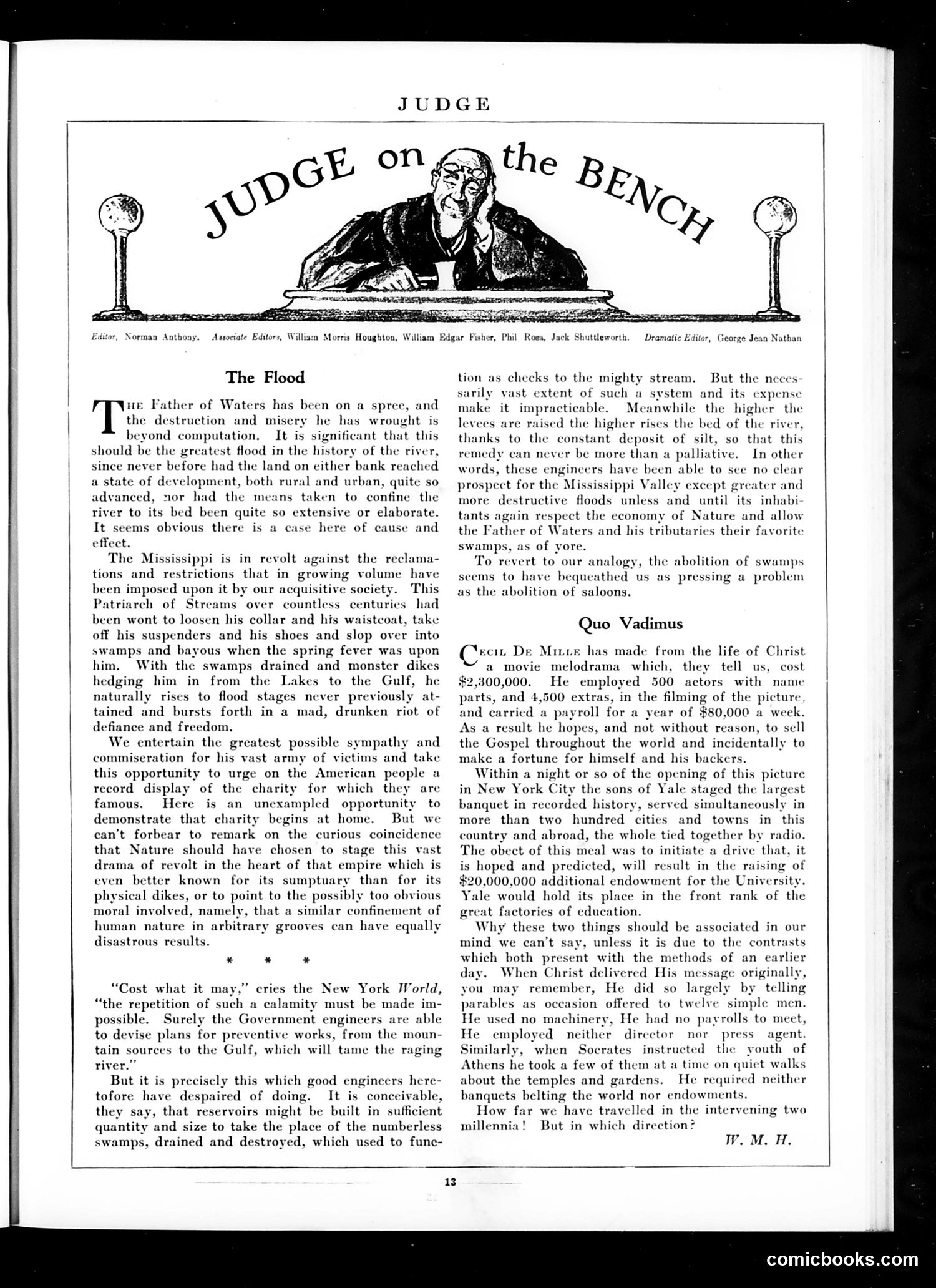
## Main Editorial: "The Flood" This editorial addresses the massive Mississippi River floods (likely 1927, though undated here). The satire argues that human engineering—draining swamps, building levees, confining the river—has provoked nature's "revolt." The piece draws an analogy: just as restraining human nature in "arbitrary grooves" causes social upheaval, restraining the Mississippi causes catastrophic flooding. The editorial mocks engineering confidence ("Cost what it may") while suggesting the real solution is accepting nature's logic rather than fighting it. The final paragraph compares abolishing swamps to abolishing saloons—implying both are misguided attempts at social control. ## Secondary Piece: "Quo Vadimus" This section satirizes Cecil B. DeMille's $2.3 million film about Christ's life (likely *The King of Kings*, 1927). The satire questions the contrast between Christ's simple teaching methods and DeMille's lavish, commercial production—500 actors, $80,000 weekly payroll. The point: profit-driven modernism versus Gospel simplicity.
📄 Transcribed text from this page (OCR, searchable)
Machine-transcribed from the original scan — historical spelling and the odd misread are preserved.
JUDGE Editor, Norman Anthony, The Flood ue Father of Waters has been on a spree, and the destruction and misery he has wrought is beyond computation. It is significant that this should be the greatest flood in the history of the river, since never before had the land on either bank reached a state of development, both rural and urban, quite so advanced, nor had the means taken to confine the river to its bed been quite so extensive or elaborate. It seems obvious there is a case here of cause and effect. The Mississippi is in revolt against the reclama- tions and restrictions that in growing volume have been imposed upon it by our acquisitive society. This Patriarch of Streams over countless centuries had been wont to loosen his collar and his waistcoat, take off his suspenders and his shoes and slop o swamps and bayous when the spring fever was upon him. With the swamps drained and monster dikes hedging him in from the Lakes to the Gulf, b naturally rises to flood stages never previously at- tained and bursts forth in a mad, drunken riot of defiance and freedom. We entertain the greatest possible s commiseration for his vast army of victims and take this opportunity to urge on the American people a record display of the charity for which they famous. Here is an unexampled opportunity to demonstrate that charity begins at home. But we can’t forbear to remark on the curious coincidence that Nature should have chosen to stage this vast dr: of revolt in the heart of that empire which is even better known for its sumptuary than for its physical dikes, or to point to the possibly too obvious involved, namely, that a similar confinement of human nature in arbitrary grooves can have equally disastrous results. into mpathy and are mora * * * “Cost what it may,” cries the New York World, “the repetition of such a calamity must be made im- possible. Surely the Government engineers are able to devise plans for preventive works, from the moun- tain sources to the Gulf, which will tame the raging river.” But it is precisely this which good engineers here- tofore have despaired of doing. It is con ble, they say, that reservoirs might be built in sufficient quantity and size to take the place of the numberless swamps, drained and destroyed, which used to func- Asociate Editors, Willian Morris Houghton, William Edgar Fisher, Phil Rosa, ttleworth. — Dramatic Editor, George Jean Nathan tion as checks to the mighty stream. But the neces- sarily vast extent of such a system and its expense make it impracticable. Meanwhile the higher the levees are raised the higher rises the bed of the river, thanks to the constant deposit of silt, so that this remedy can never be more than a palliative. In other words, these engincers have been able to see no ¢ prospect for the Mississippi Valley except greater and more destructive floods unless d until its inhabi ugain respect the economy of Nature and allow ther of Waters and his tributaries their favorite swamps, as of yore. To revert to our analogy, the abolition of swamps seems to have bequeathed us as pressing a problem as the abolition of saloons. Quo Vadimus Cru De Mitte has made from the life of Christ a movie melodrama which, they tell us, cost $2,300,000. He employed 500 actors with name parts, and 4,500 extras, in the filming of the picture and carried a payroll for a year of $80,000 a week. As a result he hopes, and not without reason, to sell the Gospel throughout the world and incidentally to make a fortune for himself and his backers. Within a night or so of the opening of this picture in New York City the sons of Yale staged the ls banquet in recorded history, served simultaneously in more than two hundred cities and towns in this country and abroad, the whole tied together by radio. The obect of this meal was to initiate a drive that, it is hoped and predicted, will result in the raising of $20,000,000 additional endowment for the University. Yale would hold its place in the front rank of the great factories of education. Why these two things should be associated in our mind we can’t say, unless it is due to the contrasts which both present with the methods of an earlier day. When Christ delivered His message originally, you may remember, He did so largely by telling gest parables as occasion offered to twelve simple men. He used no machinery, He had no payrolls to meet, He employed neither director agent. Similarly, when Socrates instructed the youth of Athens he took a few of them at a time on quict walks about the temples and gardens. He required neither banquets belting the world nor endowments. How far we have travelled in the intervening two millennia! But in which direction? nor press W. M. H. comicbooks.com