
A complete issue · 36 pages · 1926
Judge — November 20, 1926
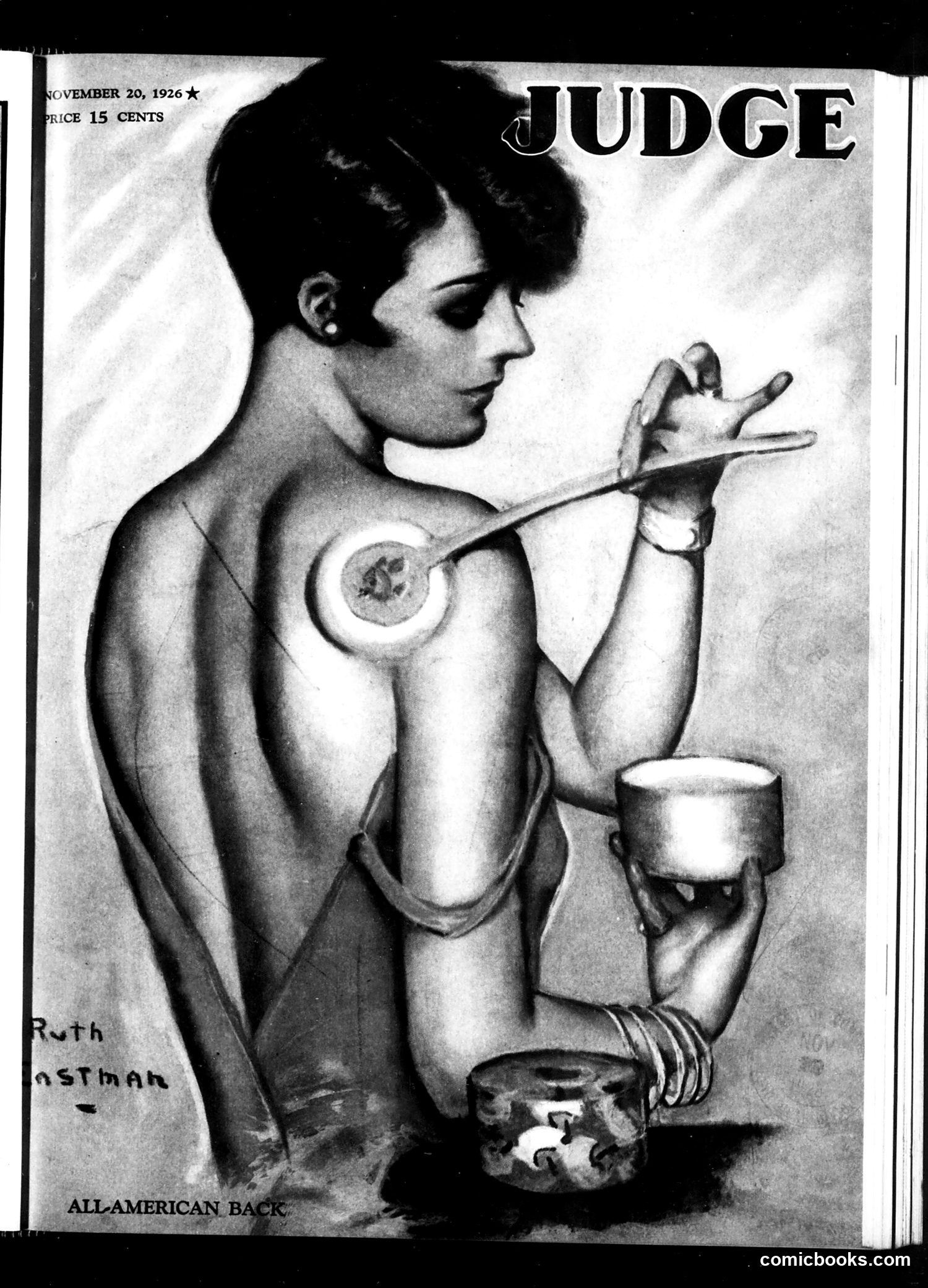
This November 20, 1926 Judge cover depicts a woman applying cosmetics, credited to artist Ruth Hestman. The circular marking on her back appears to reference a target or bullseye, suggesting commentary on women as objects of scrutiny or desire. The title "ALL-AMERICAN BACK" likely satirizes contemporary beauty standards and the commercialization of the female form. During the 1920s, Judge frequently mocked consumer culture, advertising, and evolving social attitudes toward women's appearance and sexuality during the Jazz Age. The image reflects the era's tension between traditional propriety and modern commercialism—women's bodies were increasingly used to sell products, while magazines like Judge both exploited and critiqued this trend through satire.
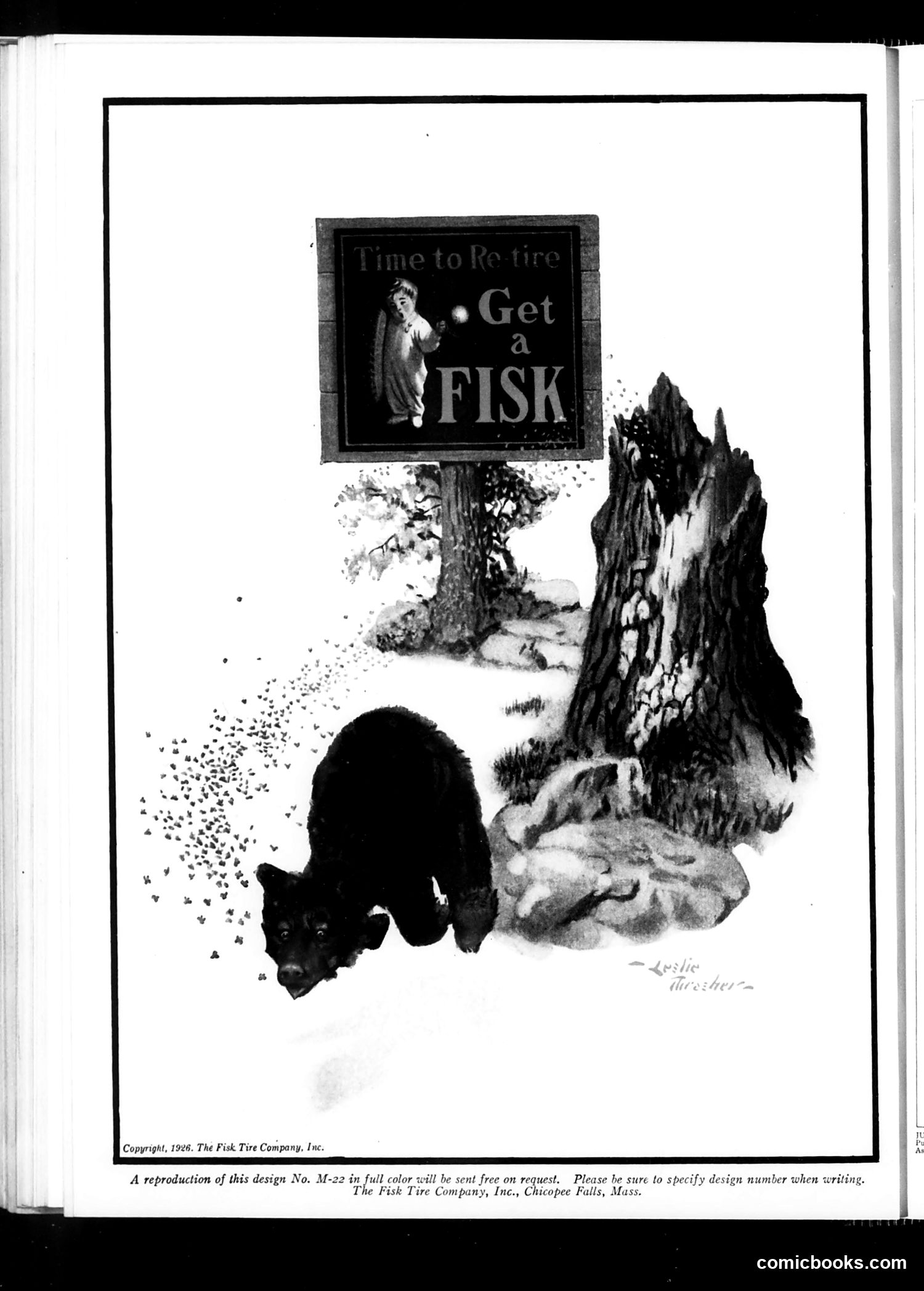
This is a **Fisk Tire Company advertisement**, not political satire. The image shows a black bear approaching a road sign advertising "Time to Retire—Get a FISK" tires, with rocky terrain and scattered small objects in the background. The ad employs a pun: "retire" (rest/stop working) versus tire (automobile part). The bear—a wild animal in its natural habitat—is presented as an unlikely customer, creating humor through incongruity. The implication is that even in remote, dangerous conditions, one should use Fisk tires for safety. The copyright shows 1906 and The Fisk Tire Company, Inc., Chicopee Falls, Massachusetts. This represents early automotive advertising using anthropomorphic humor and wordplay to promote product reliability.
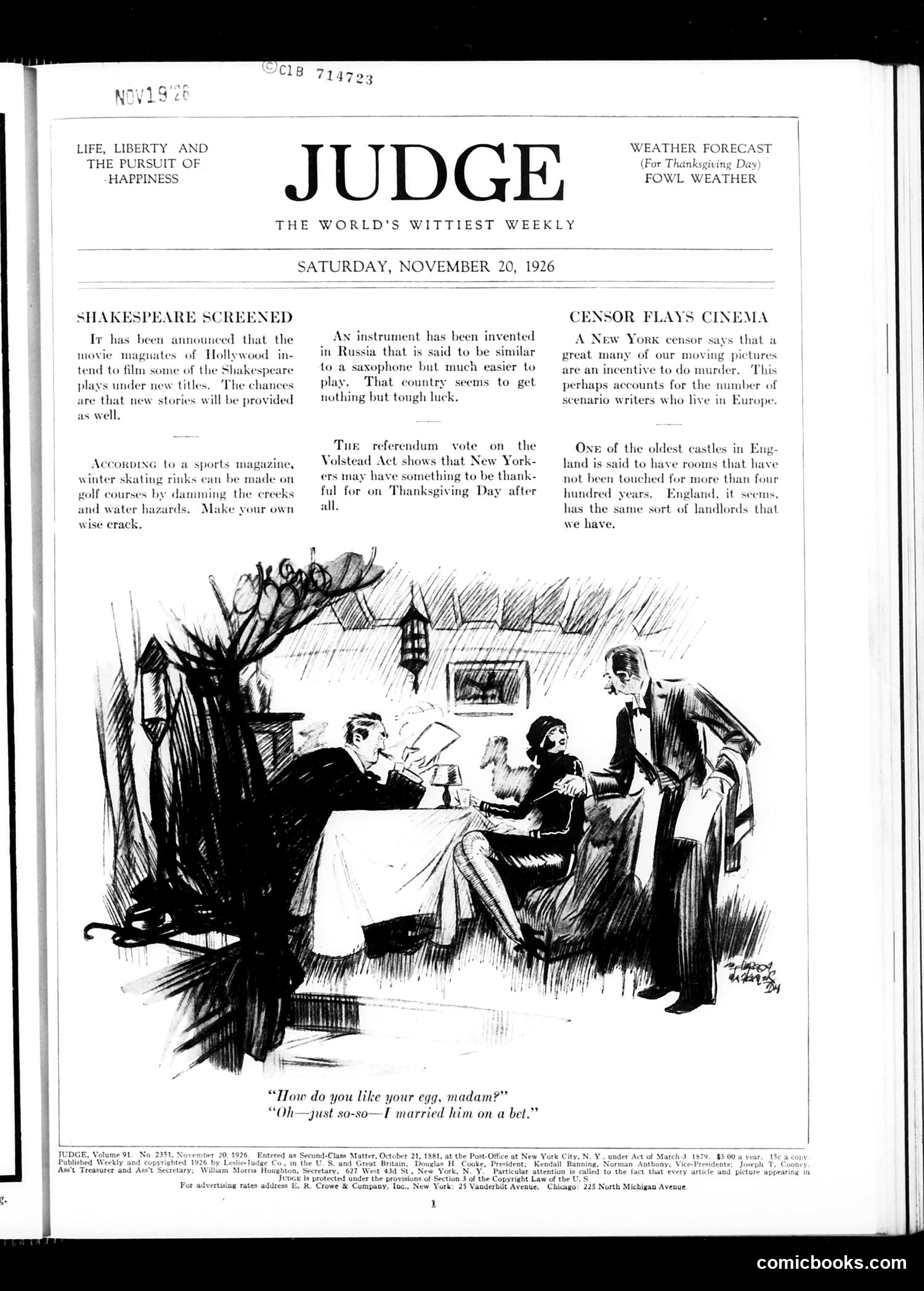
The main cartoon depicts a dinner scene with the caption: "How do you like your egg, madam?" / "Oh—just so-so—I married him on a bed." This is a marriage joke playing on a double meaning: the woman is punning on marrying her husband "on a bed" (likely meaning they eloped or married hastily/informally) while the host interprets it as a comment about how eggs are cooked—"in bed" (as in eggs Benedict). The humor relies on this verbal miscommunication typical of 1920s magazine humor. The accompanying text discusses unrelated topics: Shakespeare films, Russian cinema technology, New York's Volstead Act (Prohibition), and English castles. These appear to be standard magazine content rather than connected to the cartoon's satire.
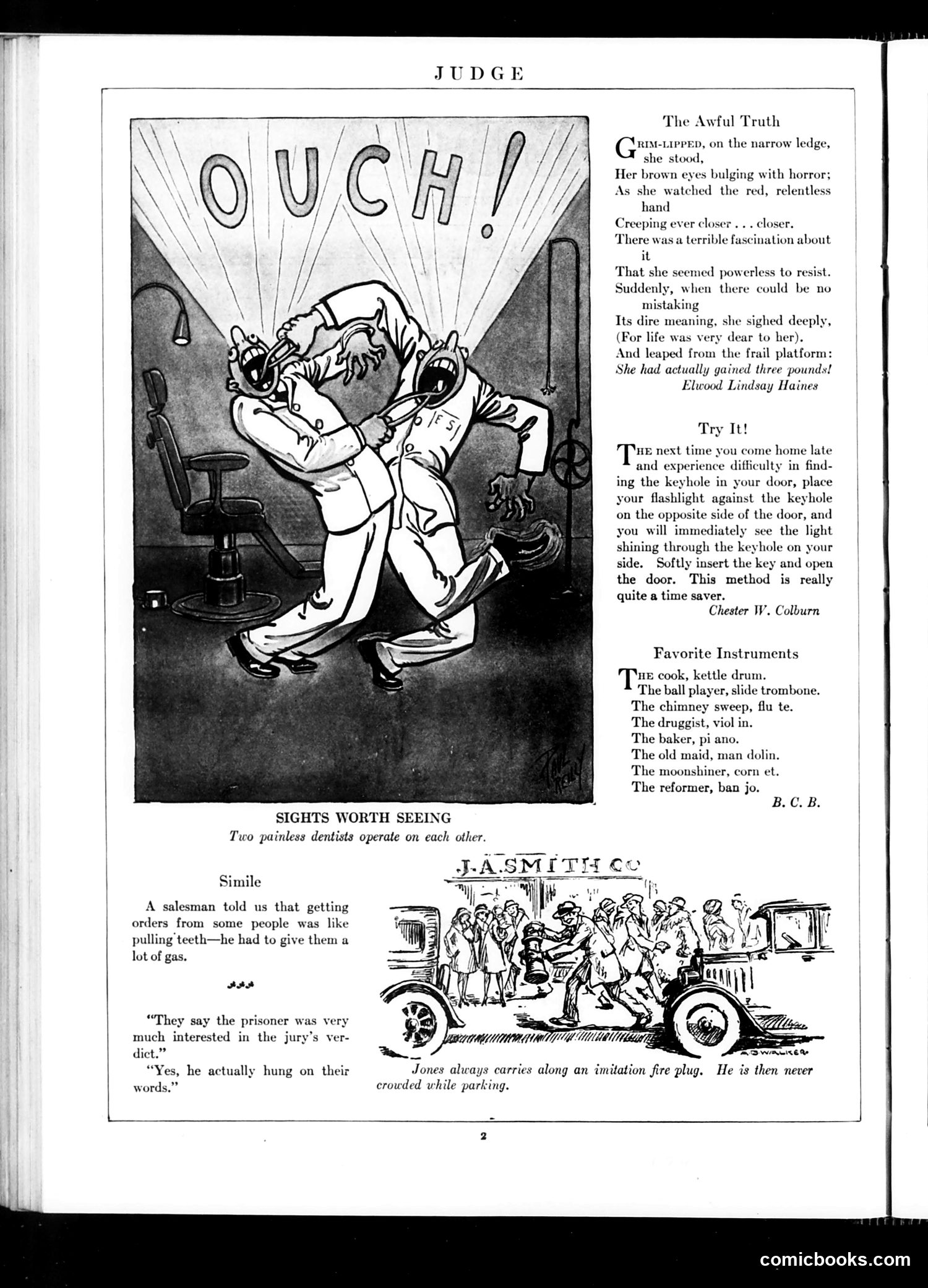
The main cartoon titled "OUCH!" depicts a woman on a narrow ledge experiencing what appears to be a weight-loss moment—she's celebrated gaining three pounds. The accompanying poem "The Awful Truth" satirizes the anxiety women faced regarding body image and weight. The "Try It!" section offers practical domestic advice about using a flashlight to locate keyholes, presumably targeting readers returning home late at night. "Favorite Instruments" is humorous wordplay listing kitchen and household items as if they were musical instruments (kettle drum, pie ano, etc.). The lower section contains brief comedic anecdotes about salesmen and jury duty, while the J.A. Smith & Co. illustration advertises an invitation fire plug—likely a novelty item for vehicles. The page reflects early 20th-century concerns about women's appearance and domestic life.
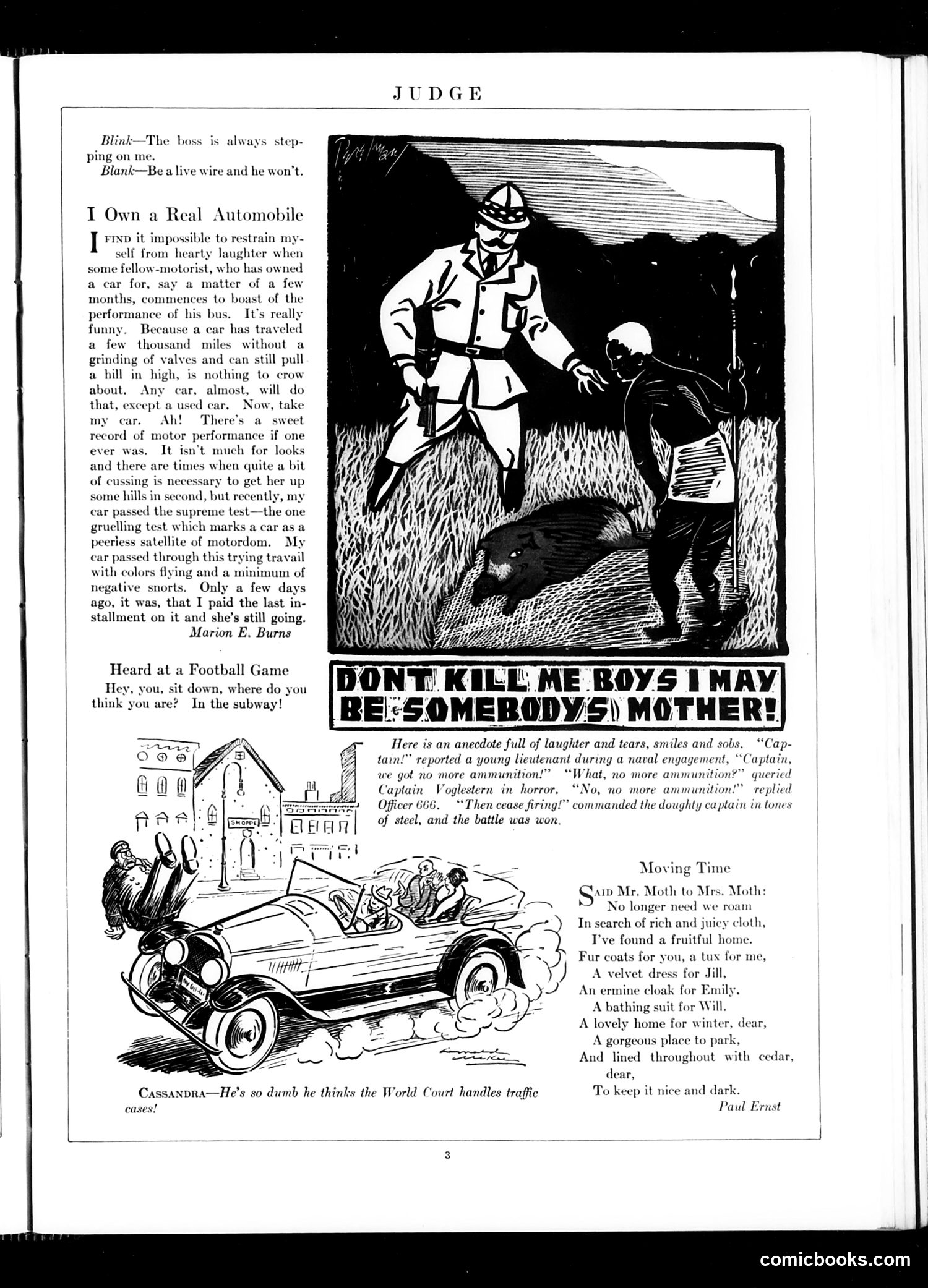
This page contains three humor pieces typical of early 20th-century American satire: 1. **"I Own a Real Automobile"**: Satirizes nouveau-riche motorists boasting about their vehicles' minor accomplishments—traveling thousands of miles without valve grinding—as if this were extraordinary. The joke mocks both car owners' pretentiousness and cars' unreliability. 2. **"Don't Kill Me Boys I May Be Somebody's Mother"**: A woodcut showing what appears to be a hunting scene with this plea. This likely satirizes sentimentality or dramatic overreaction, though the specific reference is unclear without additional context. 3. **"Moving Time"** and a football joke round out the page's miscellaneous humor offerings. The overall tone reflects Judge's characteristic mockery of contemporary social anxieties and class pretensions.
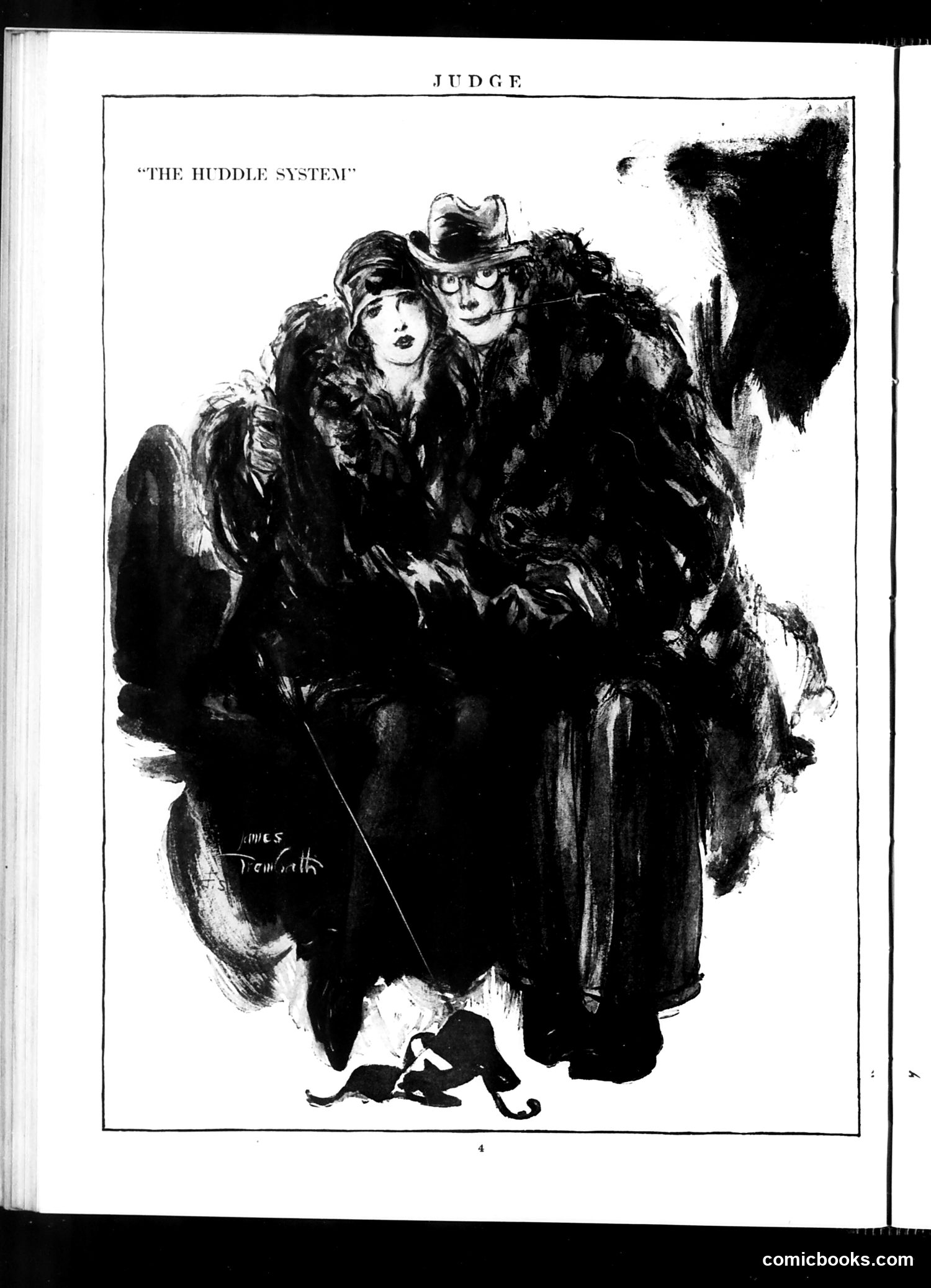
This cartoon satirizes what appears to be a political or social group huddling together secretively. The image shows three figures in heavy coats and fur, clustered closely and drawn in dark, shadowy tones that emphasize their conspiratorial nature. The title "The Huddle System" suggests they're plotting or coordinating behind closed doors—a common satirical theme in early 20th-century political cartooning. The small figure at bottom (possibly representing the common citizen or electorate) appears vulnerable or overlooked beneath this powerful huddle, suggesting the cartoon criticizes how powerful figures conspire while ordinary people are left out or harmed. Without additional context, the specific political figures or events referenced remain unclear, though the style suggests this addresses secretive political maneuvering or backroom dealing.
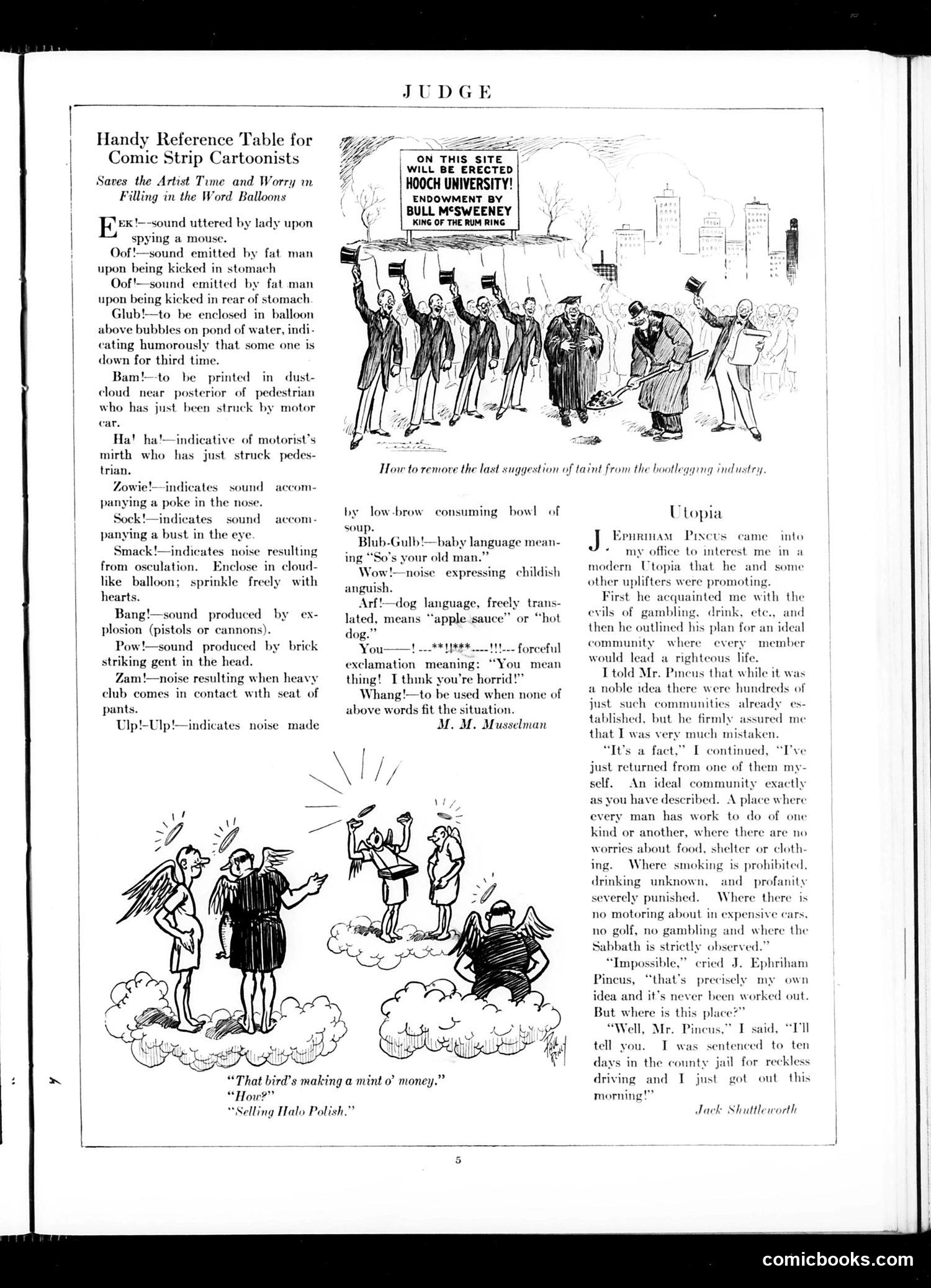
This page contains two distinct sections: **Left side:** A "Handy Reference Table for Comic Strip Cartoonists" providing sound effect definitions (Erk!, Oof!, Glub!, Bam!, etc.) with humorous explanations. This satirizes comic strips' overuse of onomatopoeia, mocking how cartoonists fill word balloons with exaggerated sound effects rather than dialogue. **Top cartoon:** Shows men holding a sign for "Hooch University" endorsed by "Bull McSweeney." The caption reads "How to remove the last suggestion of taint from the bootlegging industry"—satirizing Prohibition-era bootleggers attempting to gain respectability through fake educational institutions. **Bottom cartoon and "Utopia" story:** An unrelated piece about an idealistic community where smoking is prohibited, drinking punished, and leisure activities forbidden. This satirizes utopian social experiments of the era as unrealistic and oppressive.
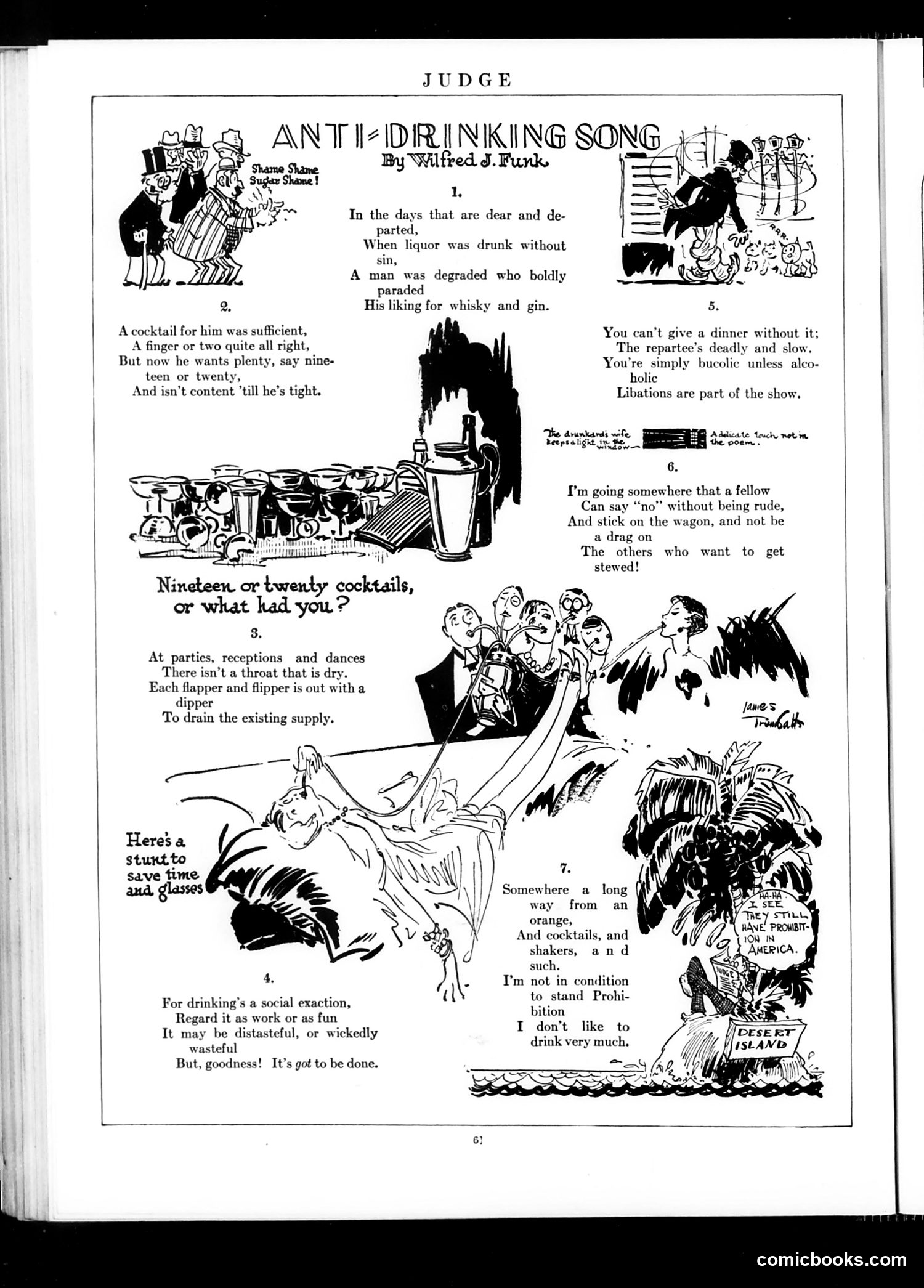
This satirical song by Alfred J. Funk mocks the social pressure to drink during Prohibition (implied by references to "Prohibition" in verse 7). The cartoon presents drinking as a mandatory social obligation that has escalated absurdly. The satire targets: 1. **Pre-Prohibition hypocrisy**: Verse 1 notes that drinking was once considered degrading; now it's fashionable. 2. **Escalating excess**: Men progressed from one cocktail to "nineteen or twenty," showing how social drinking became normalized excess. 3. **Social coercion**: Verses 3-4 show drinking is mandatory at parties and social events—a "social exaction" that "got to be done," regardless of personal preference. 4. **False sophistication**: Verse 5 suggests one cannot host dinner or participate socially without alcohol. The final verse shows someone escaping to remote locations to avoid the drinking culture. The cartoons depict drunken revelers and social gatherings centered entirely on alcohol consumption, mocking how drinking became a seemingly inescapable social requirement rather than a choice.
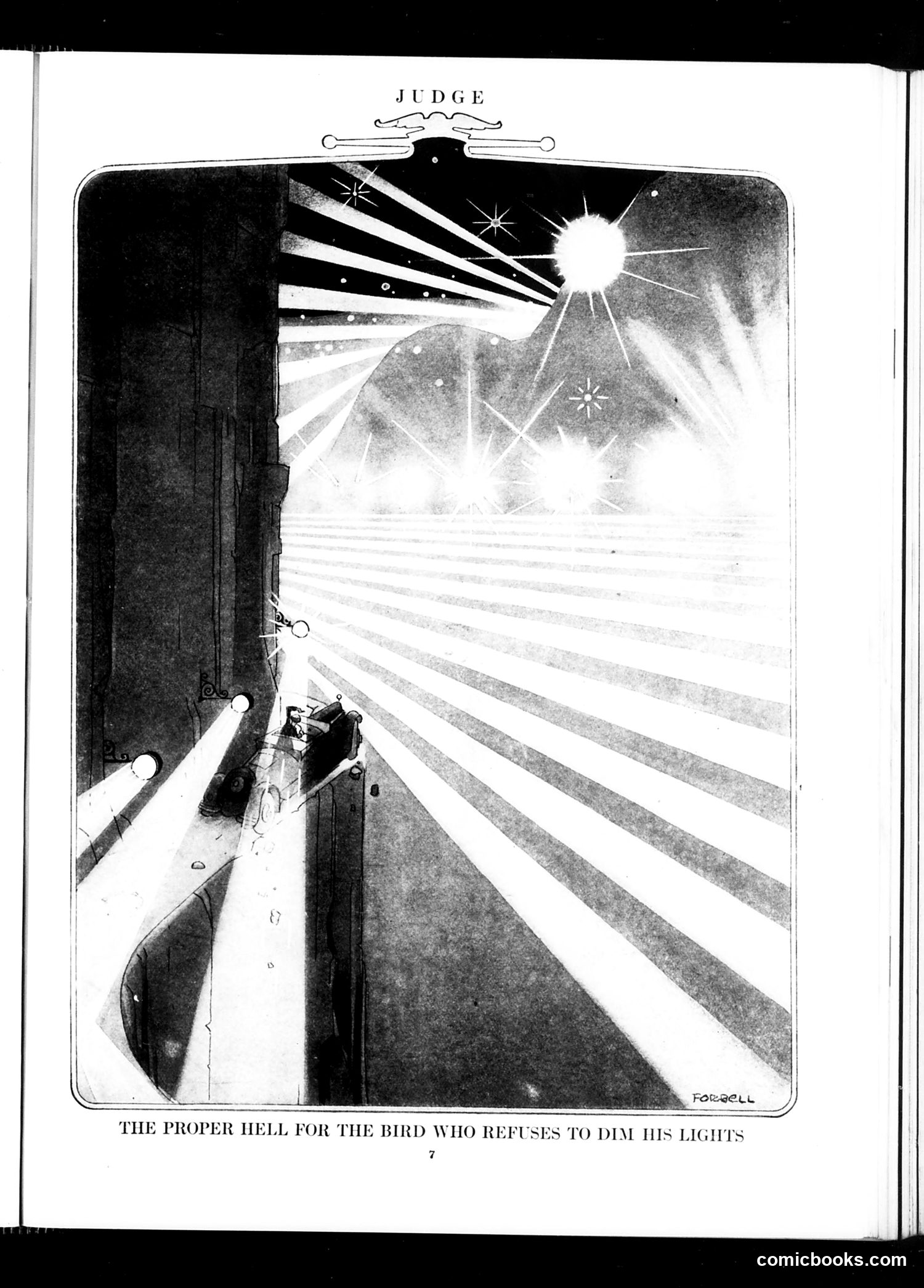
This is a satirical cartoon titled "The Proper Hell for the Bird Who Refuses to Dim His Lights." The image shows a small figure (a "bird" — slang for a person) in what appears to be an airplane cockpit or confined space, surrounded by intense light rays and brightness emanating from above. The cartoon criticizes someone who refuses to dim aircraft lights, likely during nighttime flying conditions. The satire addresses a safety or courtesy issue: pilots or aircraft operators who failed to dim their navigation or cabin lights as required. The cartoon depicts an ironic "hell" — being trapped in blinding light — as punishment for this refusal. This appears to reference early aviation safety practices or wartime blackout regulations. The artist's signature reads "Forsell" (or similar).
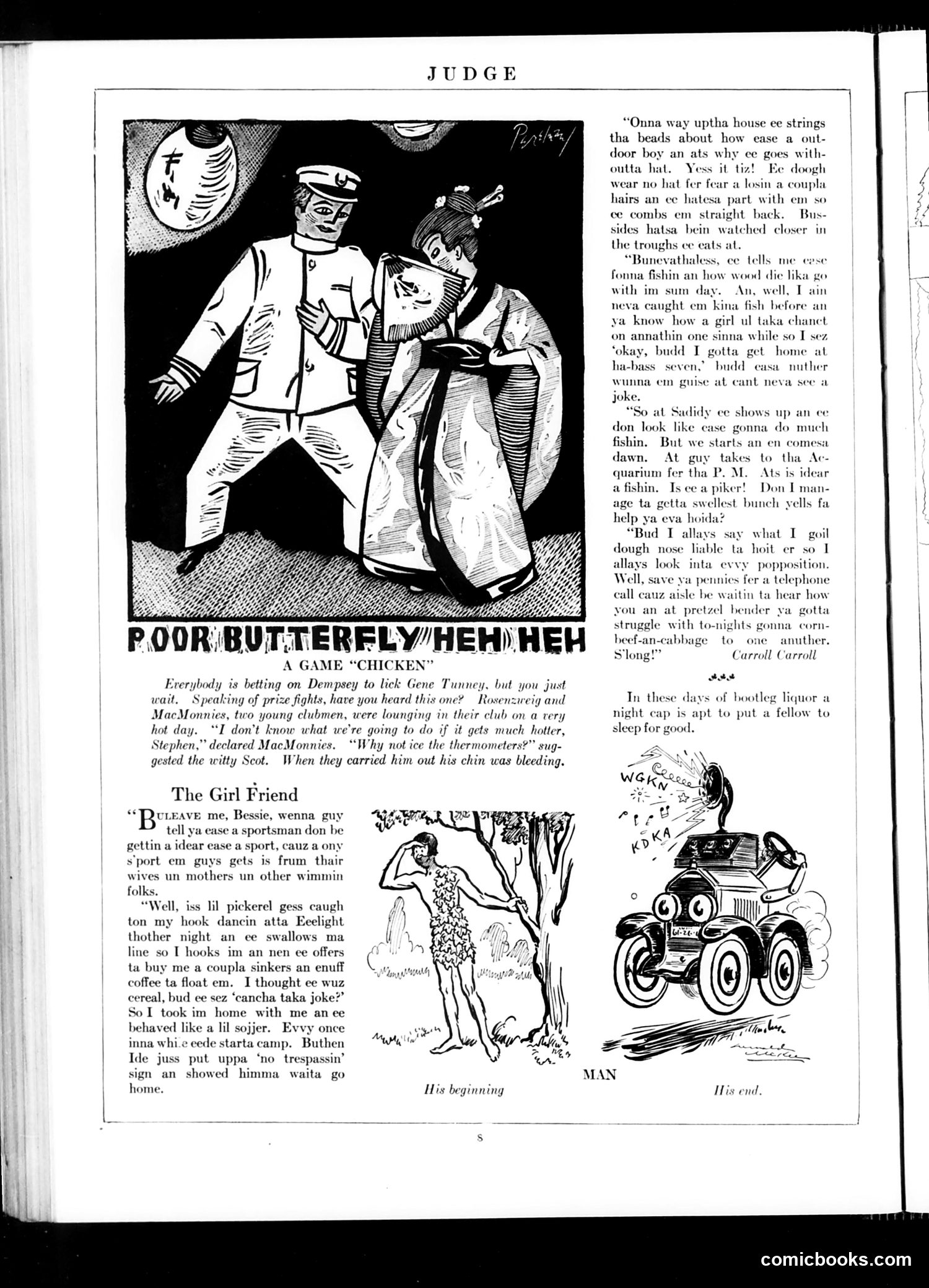
This page contains three separate pieces of humor from *Judge* magazine: **"A Game 'Chicken'"** (top): A cartoon about a prize fight between boxers Dempsey and Tunney, followed by a joke about two clubmen arguing over heat. One suggests "icing the thermometer" (lowering it artificially); the other responds violently, resulting in a bloody chin—satirizing absurd logic and masculine vanity in upper-class clubs. **"The Girl Friend"** (bottom): A dialect-heavy monologue in phonetic working-class speech. A woman describes dating an "outdoor boy" without a hat who takes her fishing and to an aquarium instead of traditional date venues. The humor relies on class stereotypes—mocking both the unsophisticated suitor and the woman's exaggerated speech patterns. The final cartoon labeled "MAN" shows his "beginning" (courting) versus "his end" (a wrecked car), suggesting male recklessness leads to disaster. The page reflects 1920s attitudes: boxing enthusiasm, class-based humor, and gender stereotypes presented as entertainment.
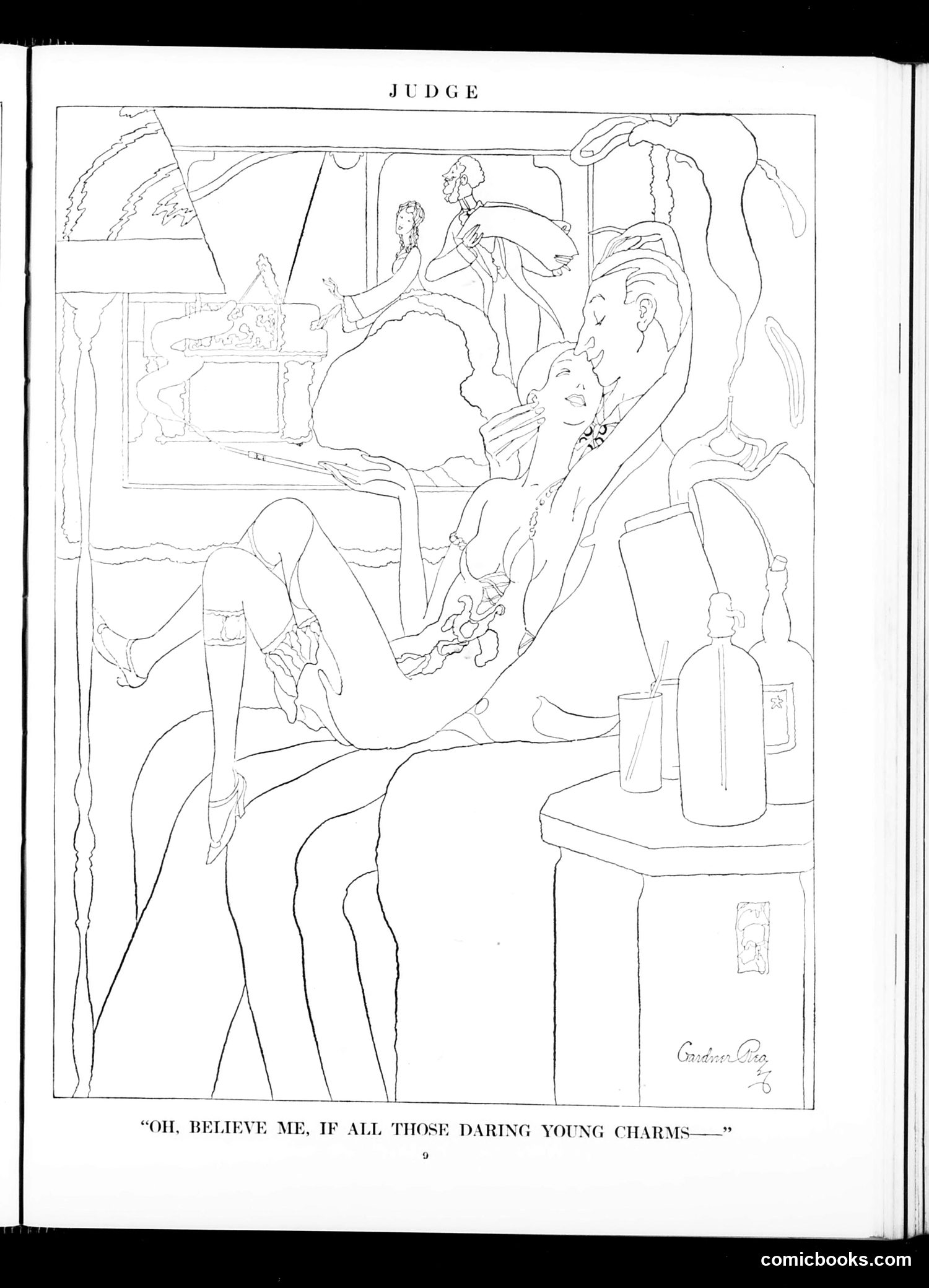
This appears to be a single-panel cartoon from Judge magazine satirizing women's behavior or attitudes, likely from the early 20th century based on the art style. The scene depicts women in what appears to be a social setting—possibly a dressing room or backstage area—with bottles visible on a table. The incomplete quoted text ("Oh, believe me, if all those daring young charms——") suggests commentary on women's vanity, attractiveness, or social pretensions. The cartoon likely mocks either: - Women's obsession with beauty and cosmetics - Young women's boldness or scandalous behavior - The gap between women's public propriety and private conduct Without additional context about the specific date or cultural moment, the exact satirical target remains unclear, though the tone suggests gentle social criticism typical of Judge's humor targeting upper-class or modern urban women.
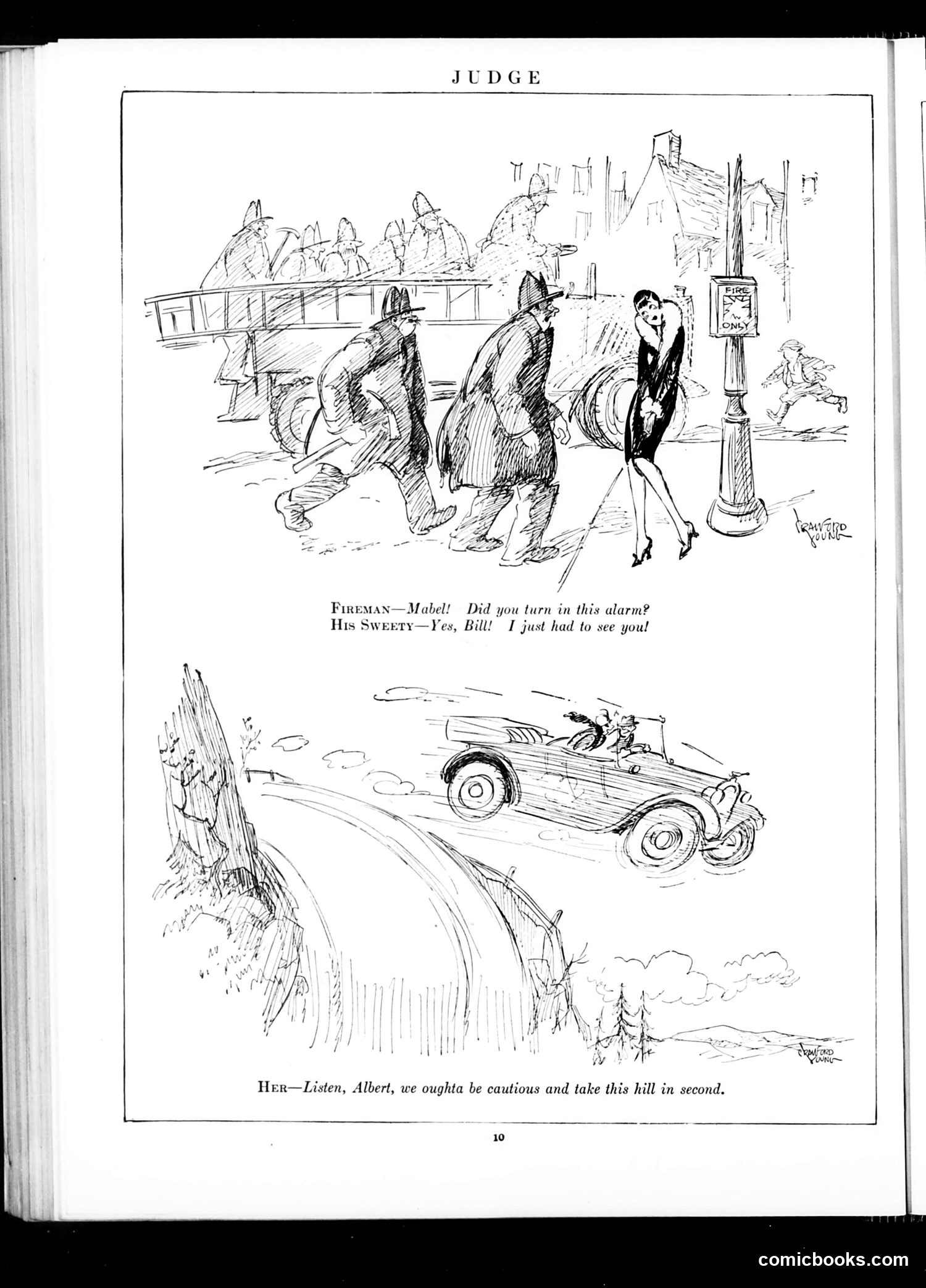
This page contains two satirical cartoon scenes about romantic behavior and safety concerns. The **top cartoon** depicts a woman (Mabel) who has deliberately triggered a fire alarm just to see her boyfriend, a fireman named Bill. The joke mocks romantic impulsiveness—she's created a false emergency for personal reasons, with firefighters and crowds gathering unnecessarily. The **bottom cartoon** shows the couple in a speeding car approaching a dangerous hill. The woman warns her boyfriend Albert to "take this hill in second" (drive cautiously), but this is ironic given her reckless behavior in the first cartoon. Together, these panels satirize the contradiction in romantic behavior: women who make dangerous, impulsive decisions for love while simultaneously expressing concern about safety. The humor targets early 20th-century gender stereotypes about female irrationality in matters of romance.
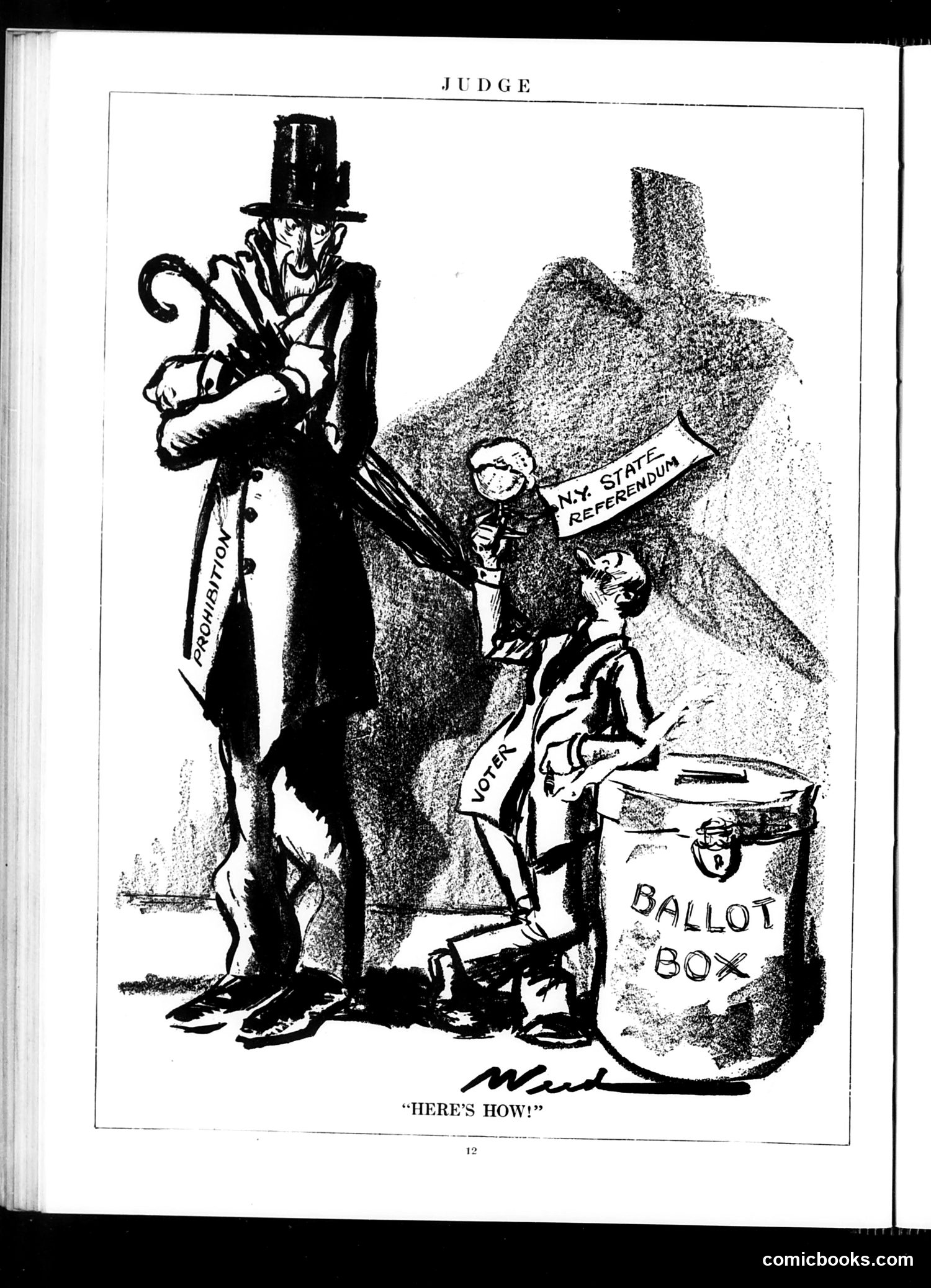
This Judge magazine cartoon satirizes Prohibition enforcement and voting rights. An emaciated, villainous figure labeled "PROHIBITION" looms over two small figures labeled "VOTER" who feed a "BALLOT BOX" while holding a banner reading "N.Y. STATE REFERENDUM." The satire suggests that Prohibition—depicted as a skeletal, menacing force—is controlling or manipulating the voting process itself. The tiny voters appear trapped or coerced by this larger threat. The cartoon likely critiques how Prohibition advocates were using the democratic process to impose unpopular policies, or conversely, mocks voters' inability to resist Prohibition's spread despite referendums. The caption "HERE'S HOW!" implies ironic commentary on the method or outcome of this political battle over alcohol regulation.
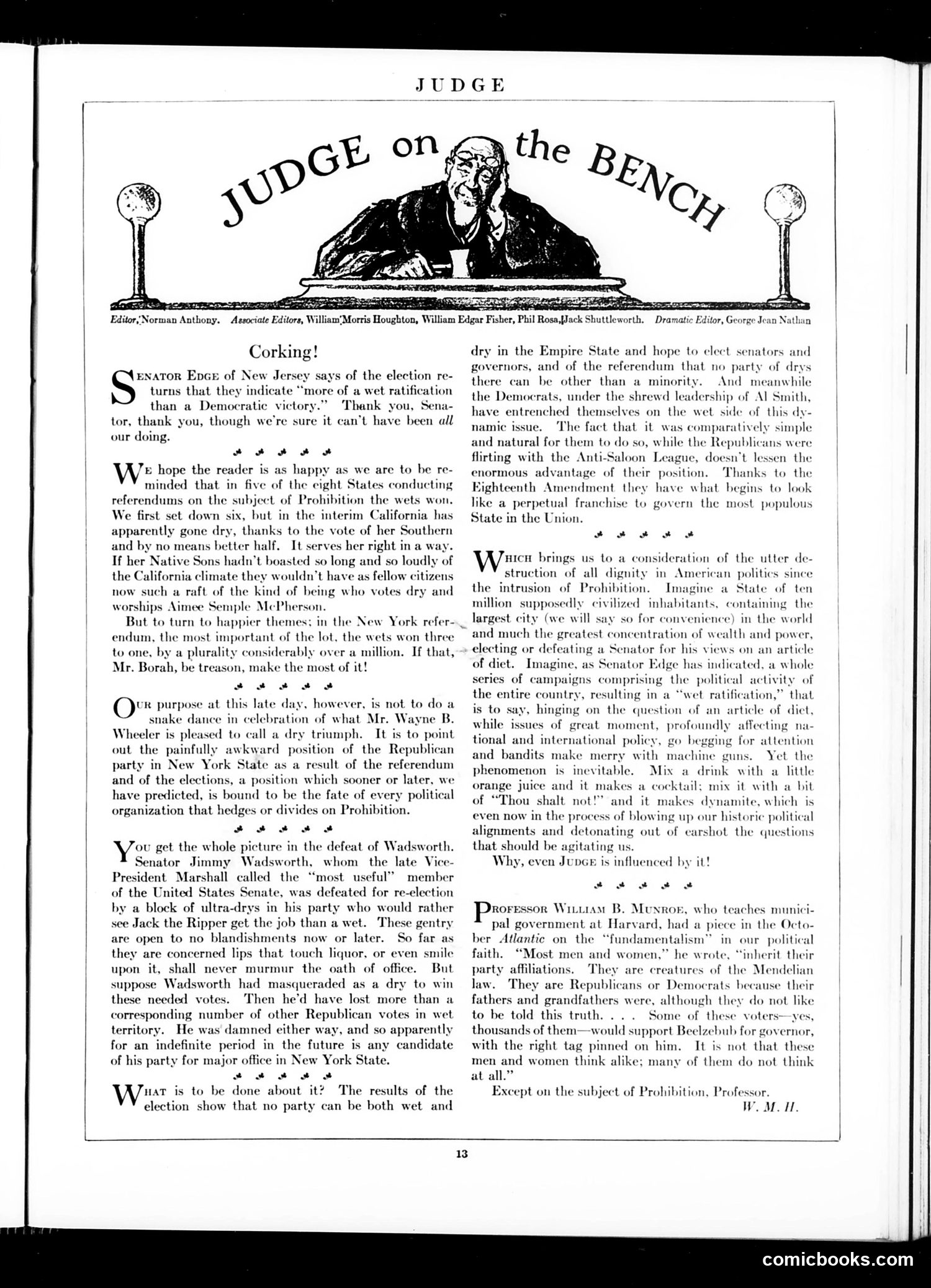
This satirical column mocks the Republican Party's political predicament over Prohibition in New York State. The piece celebrates that New York voters rejected Prohibition in a referendum ("wets won three to one"), embarrassing dry Republicans. The main target is Senator James Wadsworth, recently defeated for re-election by ultra-dry Republicans within his own party despite being a "wet" (anti-Prohibition). The satire's point: Wadsworth was trapped—he couldn't win either way. If he'd posed as a dry to appease the Anti-Saloon League faction, he'd lose wet Republican voters; staying wet cost him the dry zealots. The deeper argument: a political party cannot straddle Prohibition in New York without self-destruction. Democrats, unified behind "wet" Al Smith, gain permanent advantage. The piece concludes by lamenting that American politics has become absurdly reduced to debating what citizens can drink—destroying the dignity of governance.
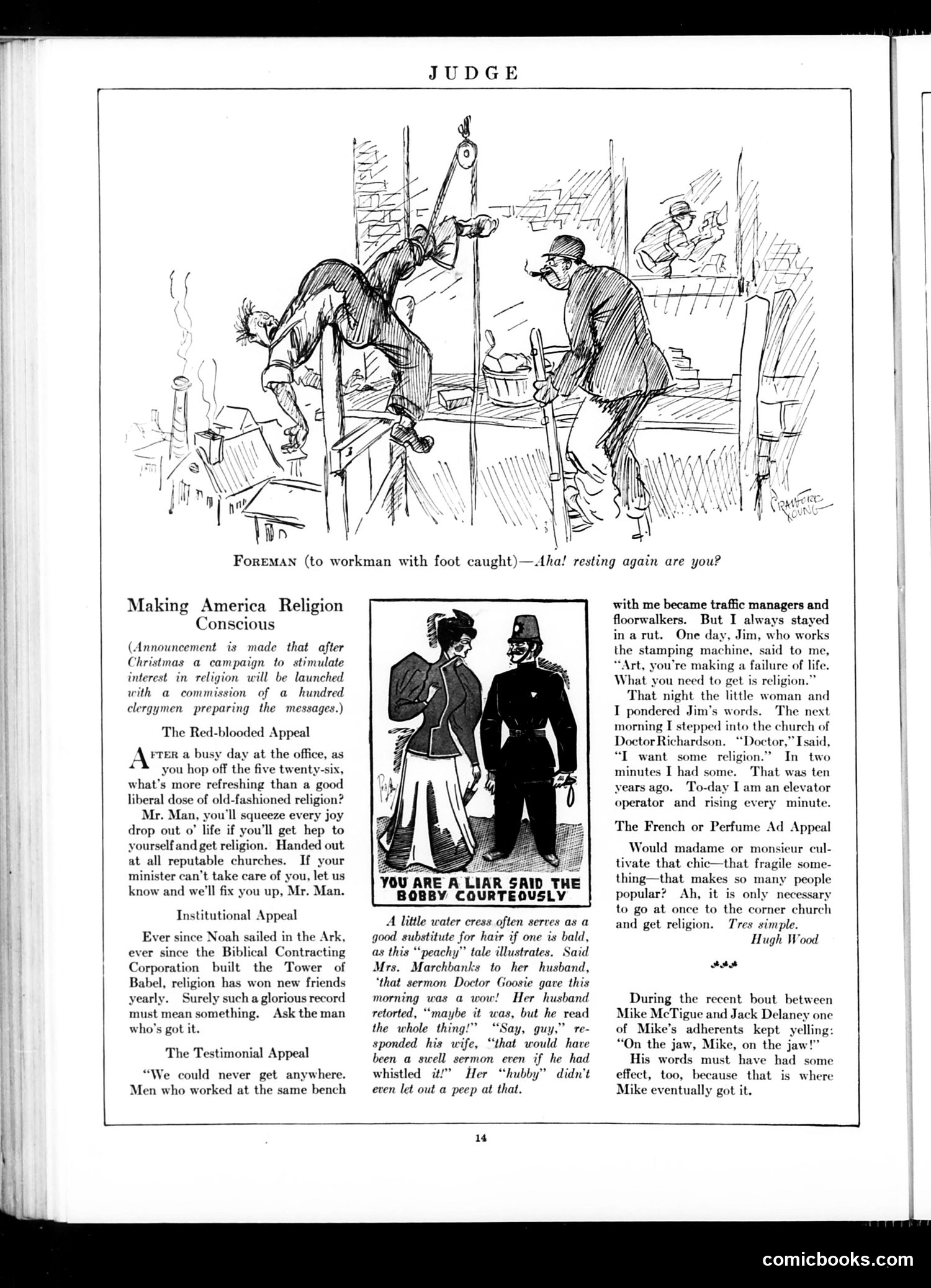
This page satirizes a planned 1920s religious campaign to "make America Religion Conscious." The centerpiece parodies advertising techniques being applied to religion itself—treating faith like a consumer product with "Red-blooded Appeal," "Institutional Appeal," and "Testimonial Appeal" sections that mimic sales pitches for everything from refreshments to career advancement. The humor targets American commercialism encroaching on spirituality: religion is pitched as a lifestyle upgrade promising joy, success, and social mobility (an worker becomes an elevator operator after finding faith). The "French or Perfume Ad Appeal" section mocks this most directly, presenting church attendance as acquiring "chic"—something fashionable rather than spiritually genuine. The top cartoon about a foreman catching a worker resting serves as visual commentary on labor exploitation. The overall message: organized religion was being co-opted by corporate-style marketing rather than addressing genuine spiritual or social needs.
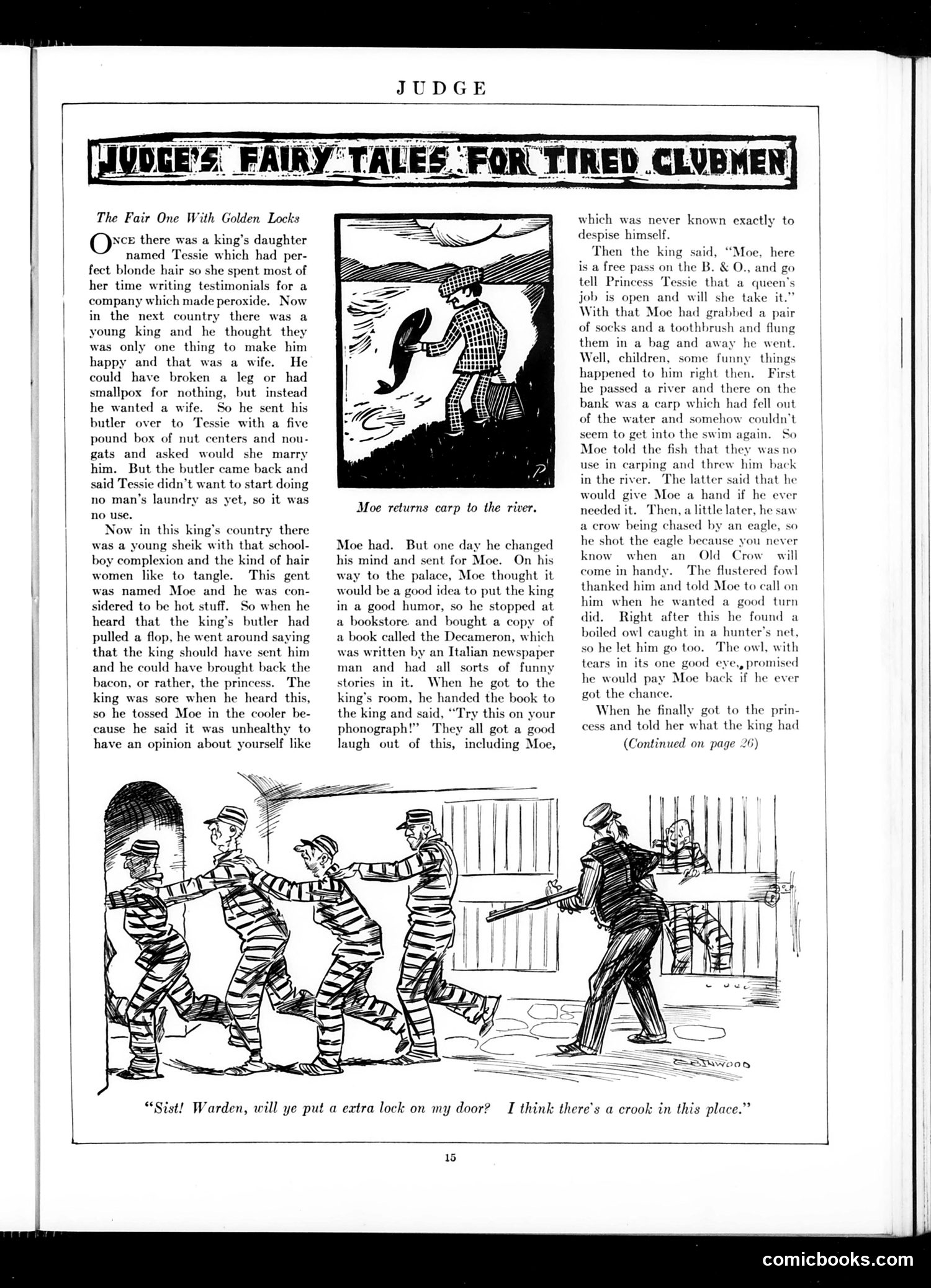
This page contains two distinct pieces: **Top: "The Fair One With Golden Locks"** — A fairy tale parody mocking early 20th-century advertising culture. Princess Tessie spends her time writing testimonials for peroxide (blonde hair dye), satirizing celebrity endorsements. The story follows Moe, a vain young man, who wins favor with a king by giving him *The Decameron* (a classic Italian book of bawdy stories) as a "phonograph" joke—likely mocking how people present themselves as cultured while enjoying crude humor. **Bottom: Prison Cartoon** — A single-panel gag showing prisoners wrapped in rope like mummies, with one asking the warden to add extra locks because "there's a crook in this place." This is a straightforward joke: among prisoners (themselves criminals), one fears an actual criminal/thief. Both pieces target vanity, pretension, and human contradiction—common Judge themes. The magazine used fairy-tale retellings to satirize contemporary American society and behavior.
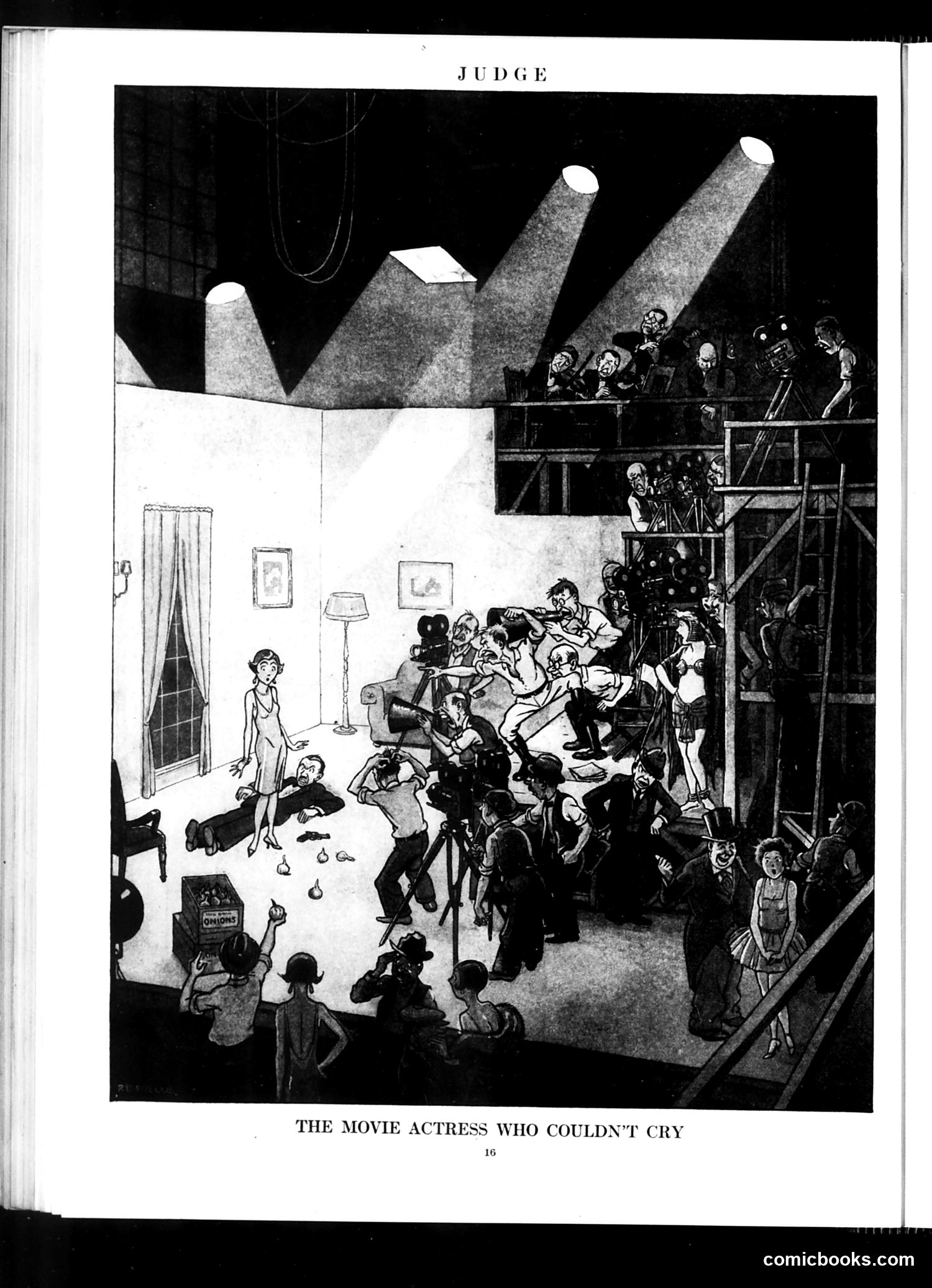
This Judge magazine illustration satirizes early Hollywood film production. The image depicts a movie set with theatrical lighting, cameras, and crew members surrounding an actress who appears unable to produce tears on command—a central requirement for dramatic film acting of the silent and early sound era. The joke targets the artificiality of cinema performance: despite the elaborate production apparatus and director's efforts, this actress cannot manufacture genuine emotion for the camera. The crowded, chaotic set contrasts with her isolated struggle, emphasizing the gap between the technical sophistication of filmmaking and an actor's fundamental inability to perform convincingly. This reflects contemporary anxieties about cinema's authenticity and whether actors were true artists or merely technical performers in an industrial process.
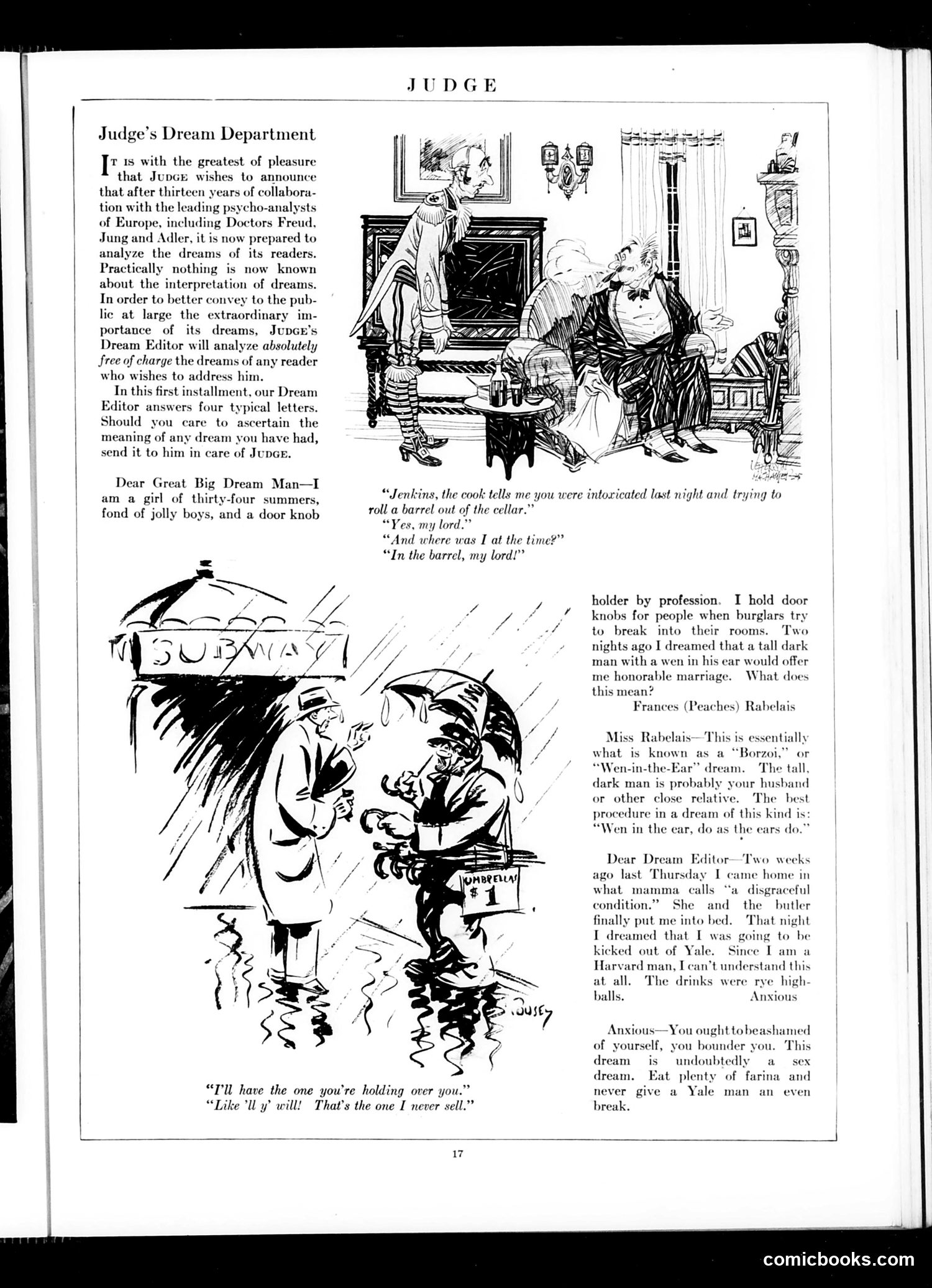
This page satirizes the early 20th-century American fascination with Freudian psychoanalysis. Judge's "Dream Department" mockingly offers dream interpretation "absolutely free of charge," claiming collaboration with famous psychoanalysts (Freud, Jung, Adler are named). The satirical responses reveal the absurdity of pop psychology analysis. A woman's dream about a dark man with a facial mark is analyzed as a "Borzoi" or "Wen-in-the-Ear" dream, with nonsensical advice ("Wen in the ear, do as the ears do"). A drunk Harvard student dreaming of Yale expulsion receives a diagnosis of "sex dream" and advice to eat farina and never help Yale men. The humor mocks both the pretension of armchair Freudianism and the ridiculous, unfalsifiable nature of dream interpretation as practiced by non-experts. The cartoon illustrations show upper-class subjects in domestic settings, emphasizing that this therapeutic trend primarily appealed to privileged Americans seeking fashionable explanations for their anxieties.
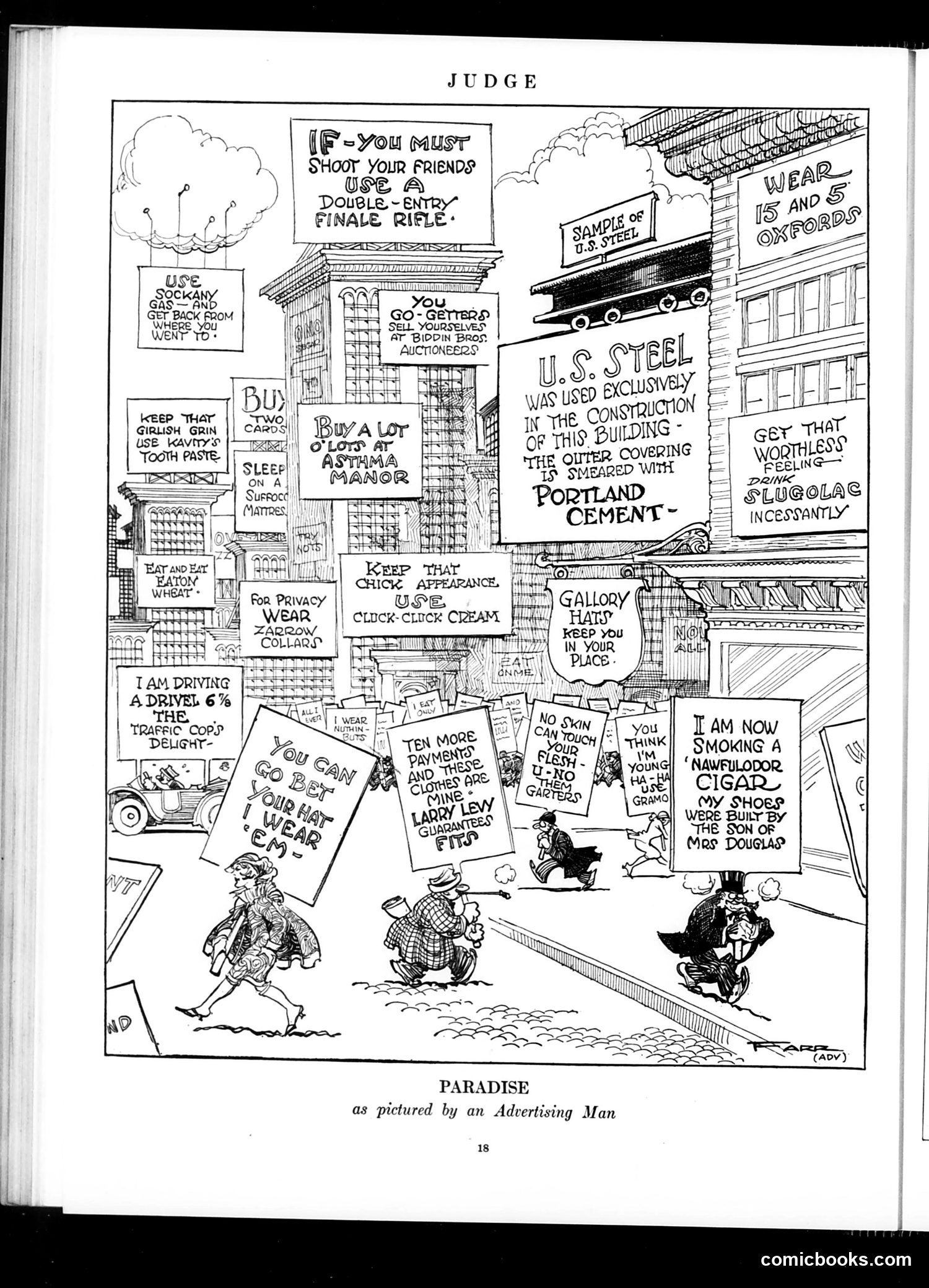
This Judge cartoon satirizes excessive advertising and consumerism in early 20th-century America. The scene depicts a crowded urban street where nearly every surface—buildings, vehicles, signs, even people's clothing—displays commercial advertisements and product endorsements. The satire shows how advertising has invaded every aspect of daily life. Characters walk around carrying or displaying ads for products like rifles, toothpaste, flour, steel, cement, and cigars. The sign-holders advertise mundane or ridiculous items (a driver advertises "traffic cops delight"), while overhead signs tout goods obsessively. The title's irony is key: this commercialized landscape represents an advertiser's "paradise"—a world where consumerism dominates everything—but it's portrayed as chaotic and absurd to Judge's readers. The cartoon critiques how advertising had become inescapable and arguably destructive to authentic human experience, turning the city into little more than a billboard.
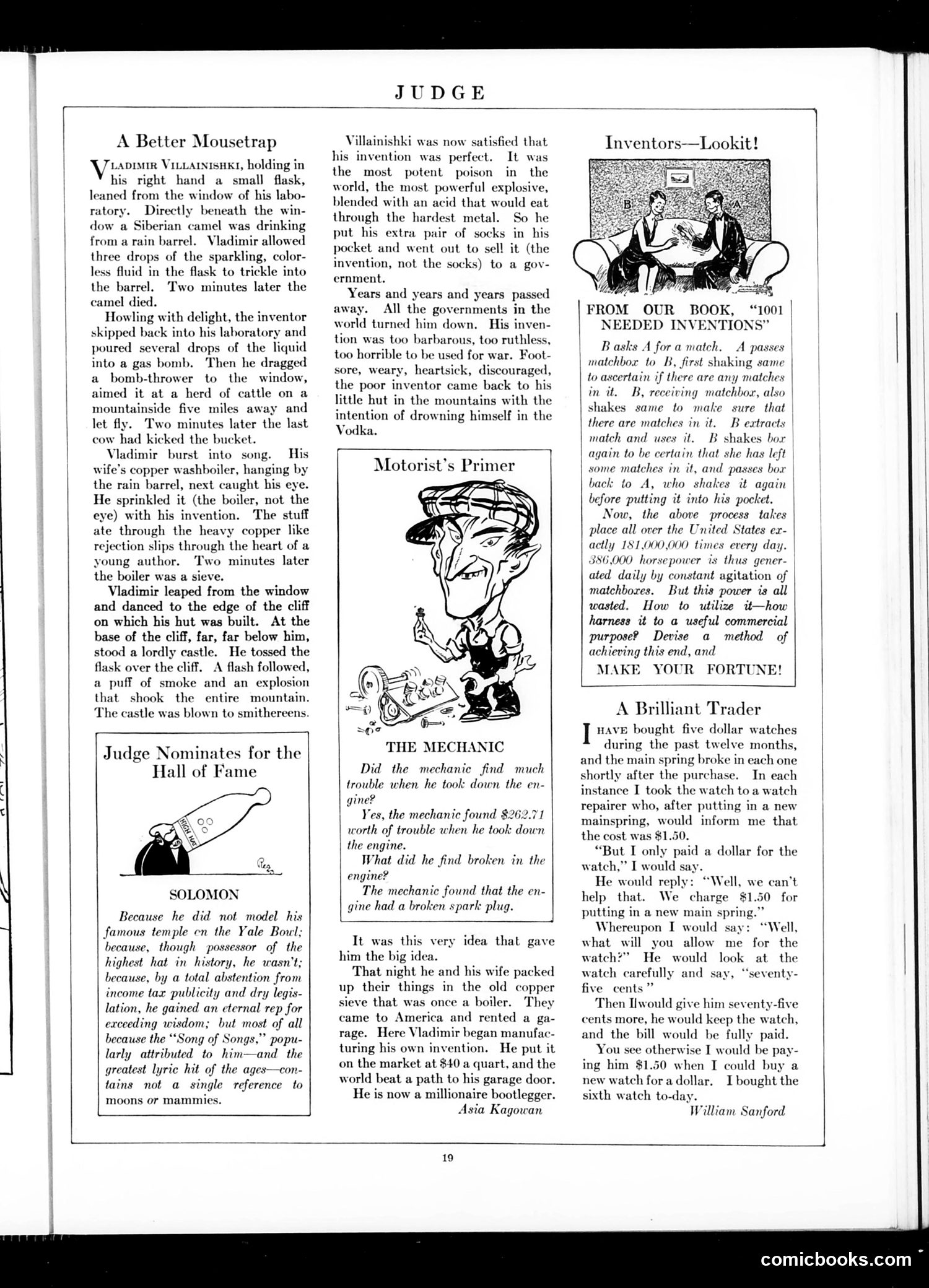
This page contains multiple satirical pieces mocking early 1920s America, particularly Prohibition (1920-1933). The main story, "A Better Mousetrap," is a dark joke about an inventor named Vladimir Villainishki who creates a substance that is simultaneously a poison, explosive, and corrosive acid. Governments refuse to buy it as a weapon because it's "too barbarous" for war—absurdly, the implication being that even wartime has limits. Undeterred, Vladimir relocates to America and sells it as bootleg alcohol at $40 a quart, becoming a millionaire. The satire targets Prohibition's perverse logic: a substance rejected as too dangerous for legitimate military use becomes wildly profitable illegally. The "Motorist's Primer" and other snippets continue this theme of American entrepreneurship during Prohibition. The "Hall of Fame" entry for Solomon humorously praises biblical wisdom while making period-specific jabs at modern excess ("moons or mammies"—likely references to contemporary fads or entertainment).
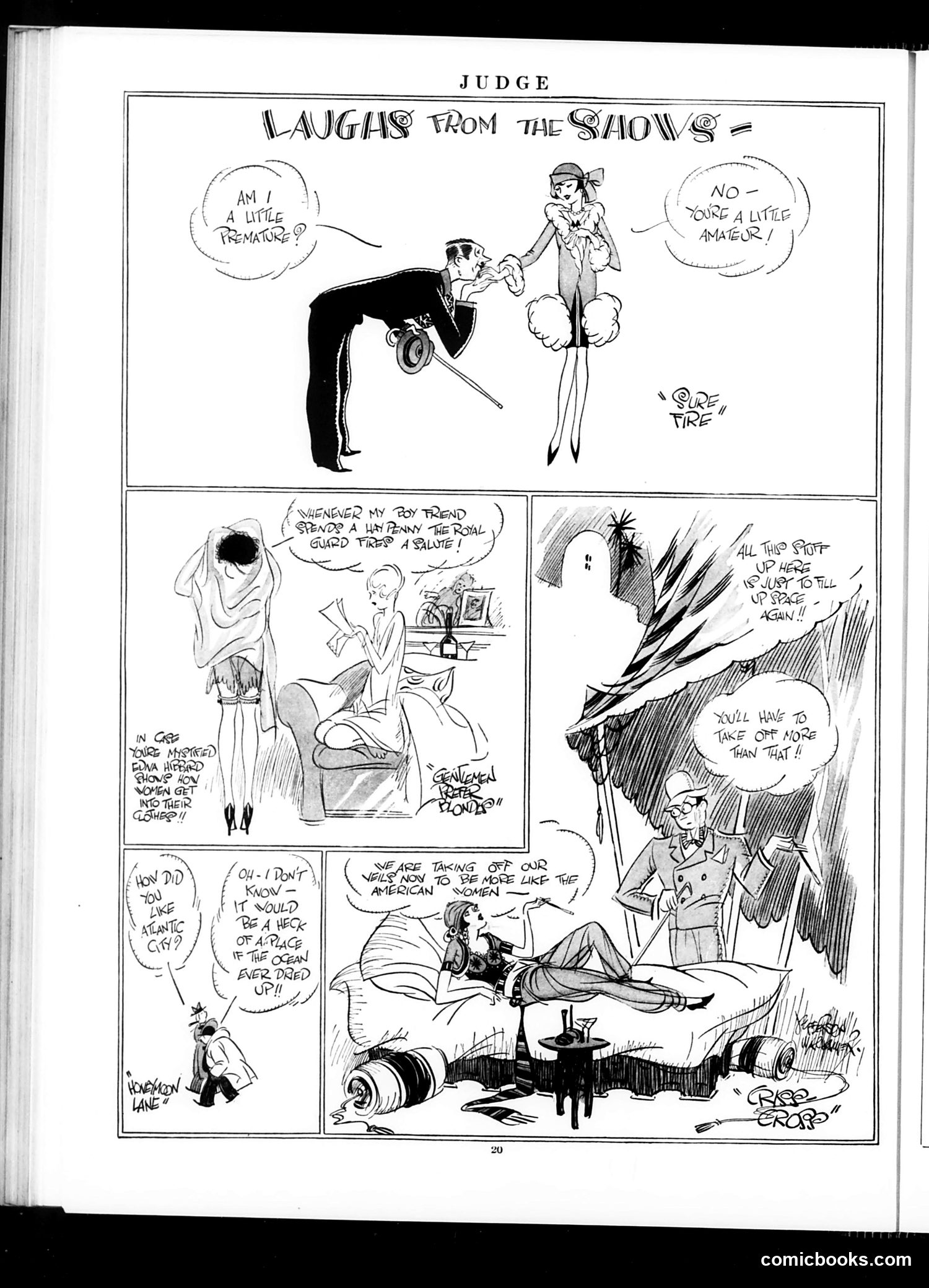
This Judge magazine page satirizes early 20th-century theatrical and social attitudes about gender and space exploration. The top panel mocks a man and woman discussing aviation—he calls himself "a little premature" while she dismissively labels him "a little amateur," inverting expected gender roles in technological pursuits. The lower panels appear to reference stage productions or popular entertainment depicting women in domestic spaces versus public spheres. One section mentions "women get no closer" to certain activities, suggesting satire of restrictive gender norms. Another panel jokes about making "American women" more like "American men," possibly mocking contemporary debates about women's changing social roles. The final large panel shows chaotic domestic disorder with references to space and distance, likely satirizing anxieties about women's expanding participation in public life and leisure activities during the early 1900s. The overall intent appears to be humorous commentary on evolving gender relations and women's growing independence during this period.
This page contains George Jean Nathan's theater column reviewing Broadway productions. Rather than political satire, it's entertainment criticism—a common Judge feature. Nathan critiques Owen Davis's "Gentle Grafters," arguing that while Davis drew from real life (referencing a "dramatic Lorelei Lee"), his play lacks imagination and artistic merit. He suggests Davis sacrificed theatrical quality to commercial success ("ticket-sill"), making him a cautionary tale of Broadway compromise. The right column continues reviewing C. C. Murray's "Autumn Fire" and discusses "The Ladder" by J. Frank Davis—a reincarnation play about a man proposing to a woman who observes his soul across lifetimes, culminating in a medieval tableau scene. The center contains brief capsule reviews of other Broadway shows, mostly dismissive in tone. This represents Judge's coverage of contemporary theater rather than political cartooning.
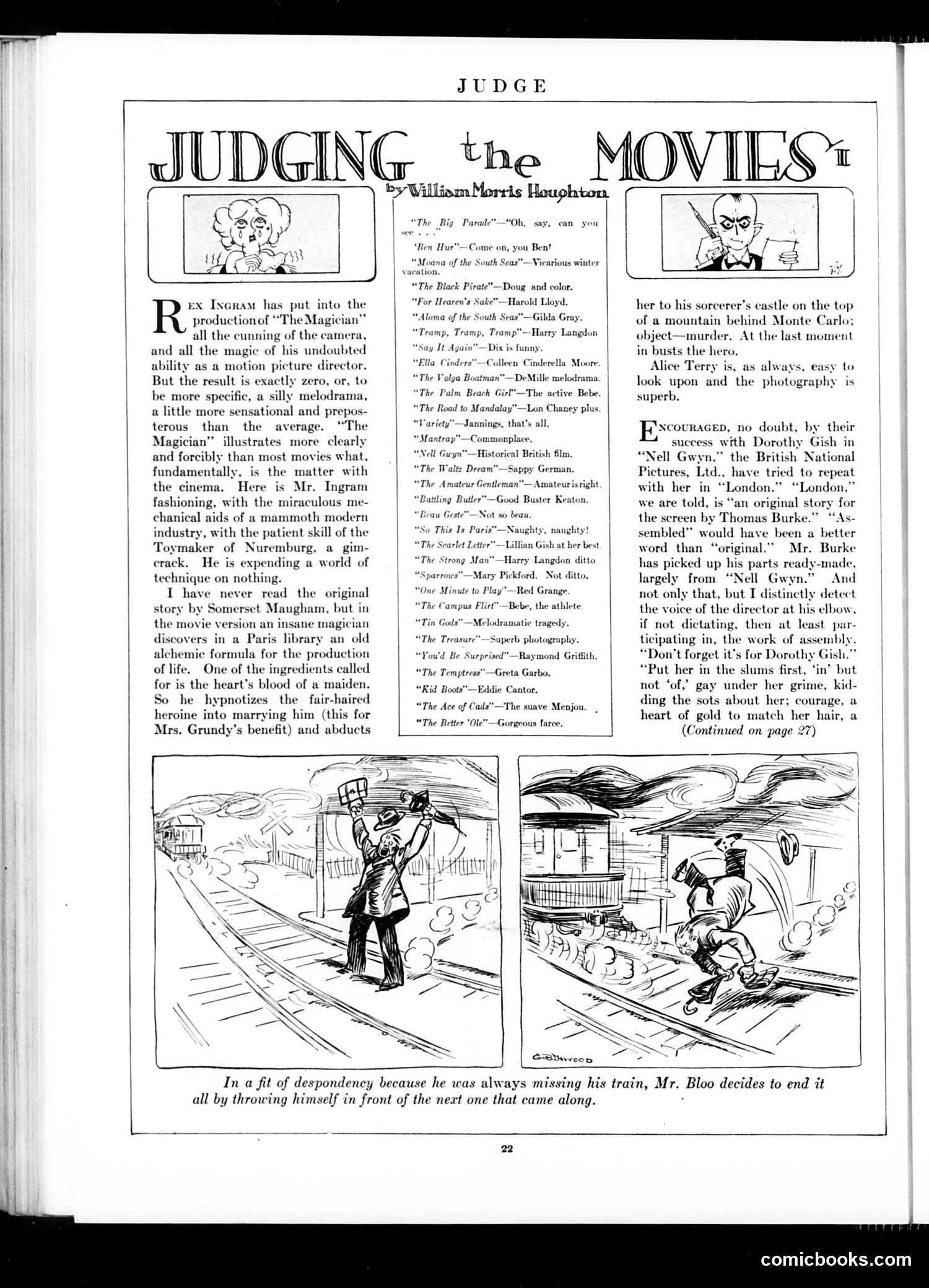
This page from Judge magazine contains two distinct elements: **Top Section**: A film review by William Morris Houghton critiquing Rex Ingram's "The Magician" as a technically accomplished but fundamentally empty melodrama—illustrating cinema's broader problem of expending great technical resources on trivial material. The review then lists contemporary films with brief, punchy jokes about their plots and stars (Buster Keaton, Greta Garbo, etc.). **Bottom Comics**: A two-panel gag strip about "Mr. Bloo," who repeatedly misses trains and, in desperation, decides to end his life by throwing himself in front of one—only to finally succeed at timing it right. This is darkly comedic social satire: the joke mocks modern anxieties about punctuality and transportation while treating suicide as absurdist punchline, reflecting early-20th-century attitudes toward such subject matter as acceptable humor fodder.
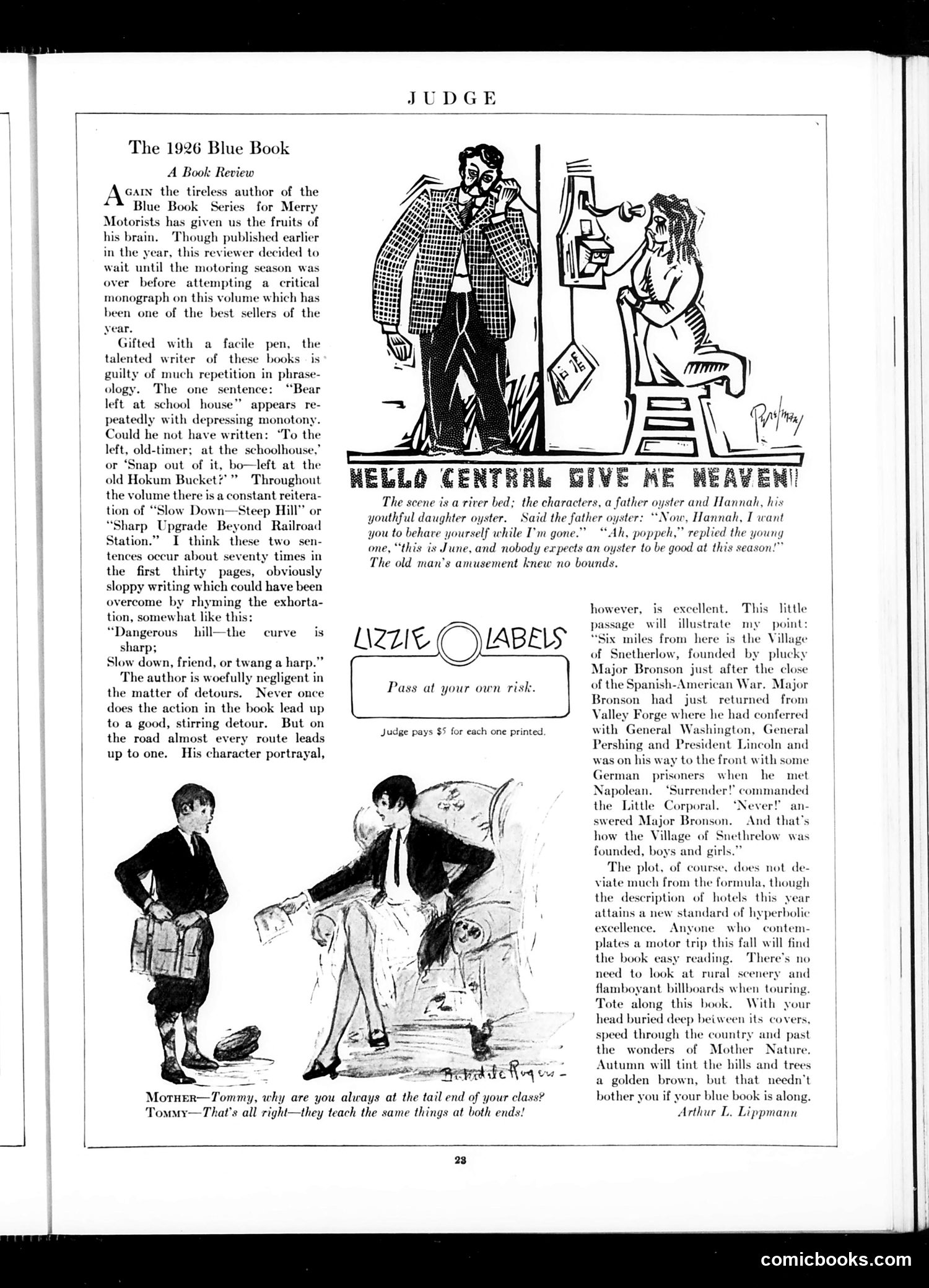
This page reviews the 1926 Blue Book, a motorist's travel guide series. The review is satirical, mocking the book's poor writing quality while ostensibly praising it. **The Satire:** The critic identifies repetitive, monotonous phrases ("Bear left at school house," "Slow Down—Steep Hill") that clutter the guide, then mockingly suggests these could be improved through rhyming. The character description of "Major Bronson" is absurdly anachronistic and historically impossible—he supposedly conferenced with Washington, then Pershing, then Lincoln, and met Napoleon—highlighting the guide's careless writing. **The Jokes:** - A oyster father-daughter exchange about June behavioral expectations (sexual innuendo) - A school joke about being last in class - The final barb: readers should keep their heads buried in the Blue Book rather than actually experiencing nature's beauty The review's tone is deadpan: it condemns the book while maintaining a veneer of recommendation, making the critique sharper through irony. This was typical Judge magazine satire targeting popular consumer products and their sloppy creators.
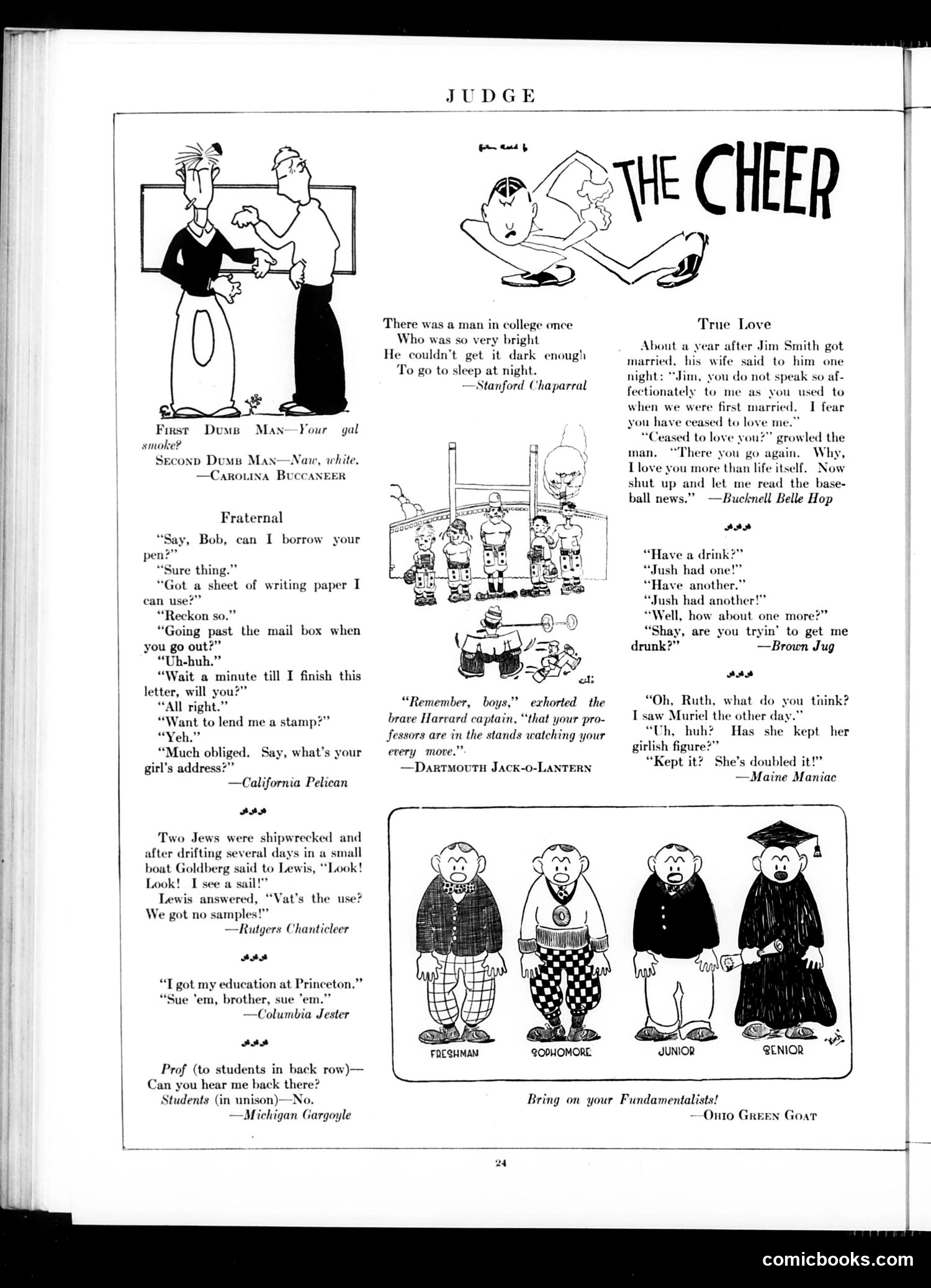
This is a humor compilation page from Judge featuring college-themed jokes and cartoons typical of early 20th-century American satirical magazines. **Main content:** - **"The Cheer"** illustration shows a cheerleader, representing campus spirit and athletics - Multiple brief jokes about college life: fraternity borrowing, Jewish characters in a shipwreck joke, Princeton education mockery - A cartoon showing academic progression (Freshman through Senior), illustrating how students change over four years, ending with a graduate—likely commenting on education's transformative (or corrupting) effect - Jokes about relationships, drinking, and women's appearances (the "Ruth/Muriel" joke about weight gain) - References to Harvard and Dartmouth sports culture - The final caption "Bring on your Fundamentalists!" appears to reference contemporary religious/educational debates **The satire targets:** college students' behavior, pretentious education, romantic disillusionment, and drinking culture—standard Judge magazine fare for college-age readers. The ethnic humor reflects period attitudes (now considered offensive).
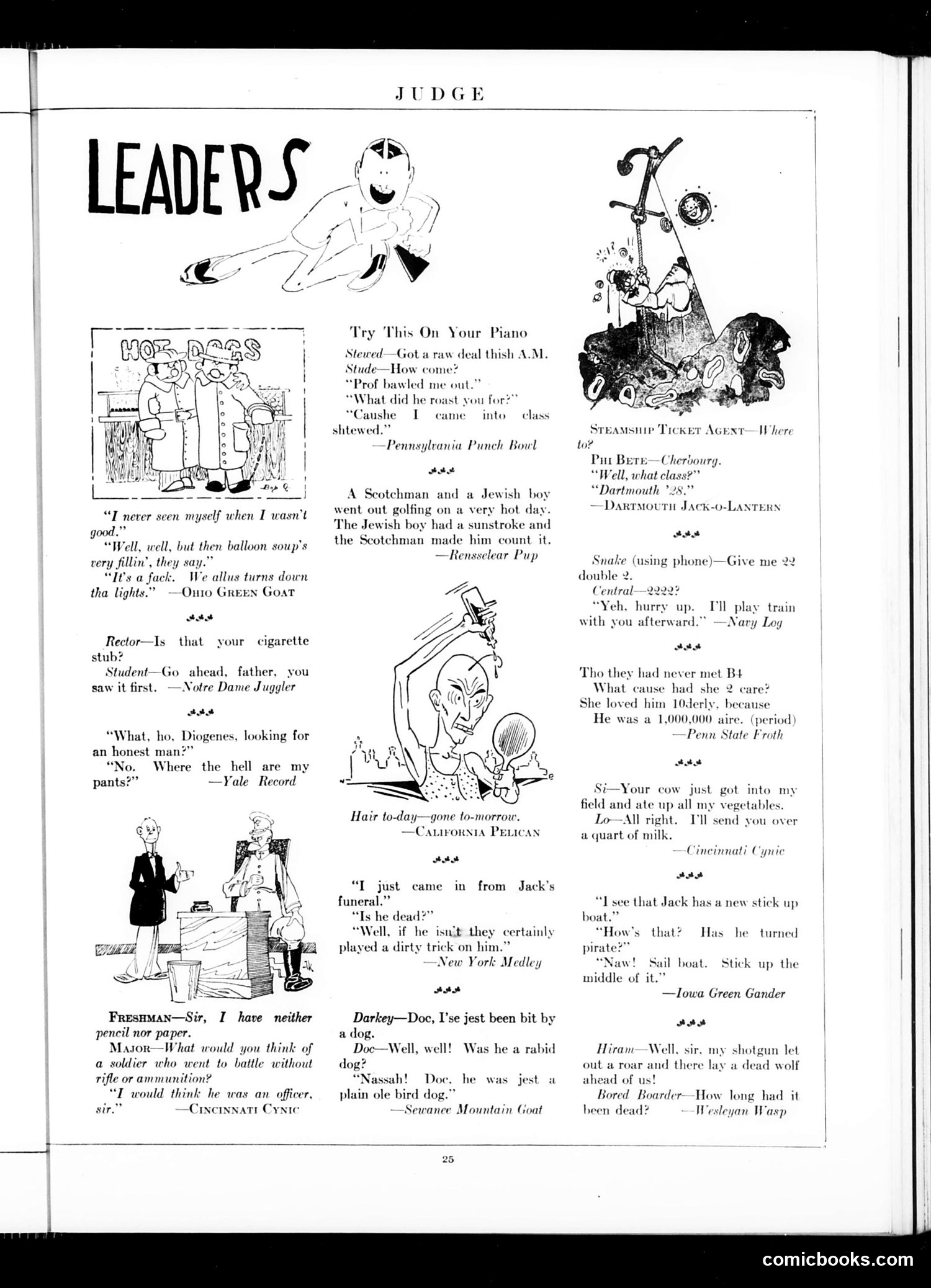
This page collects brief humorous anecdotes organized around the theme of "Leaders"—featuring cartoon vignettes of authority figures (rector, major, doctor) being outwitted or contradicted by subordinates (students, soldiers, patients). The humor relies on period stereotypes and class dynamics. Several jokes employ ethnic caricatures: a "Scotchman" portrayed as miserly, a "Darkey" (racial slur) depicted with dialect, and a Jewish character. A Cincinnati Cynic joke mocks matrimony as a transaction. Notable satire targets institutional figures: a professor who punishes drunk students, a rector accused of theft, a military major portrayed as incompetent. One joke mocks officers as unprepared for actual combat. The recurring format—authority figure asking a question, subordinate delivering an unexpected comeback—suggests Judge's middle-class readership finding humor in inverting social hierarchies, at least temporarily through wordplay. The page lacks clear dating but the printing style and advertising suggest early-to-mid 20th century. Overall, it represents period humor marked by class commentary alongside now-offensive ethnic stereotyping.
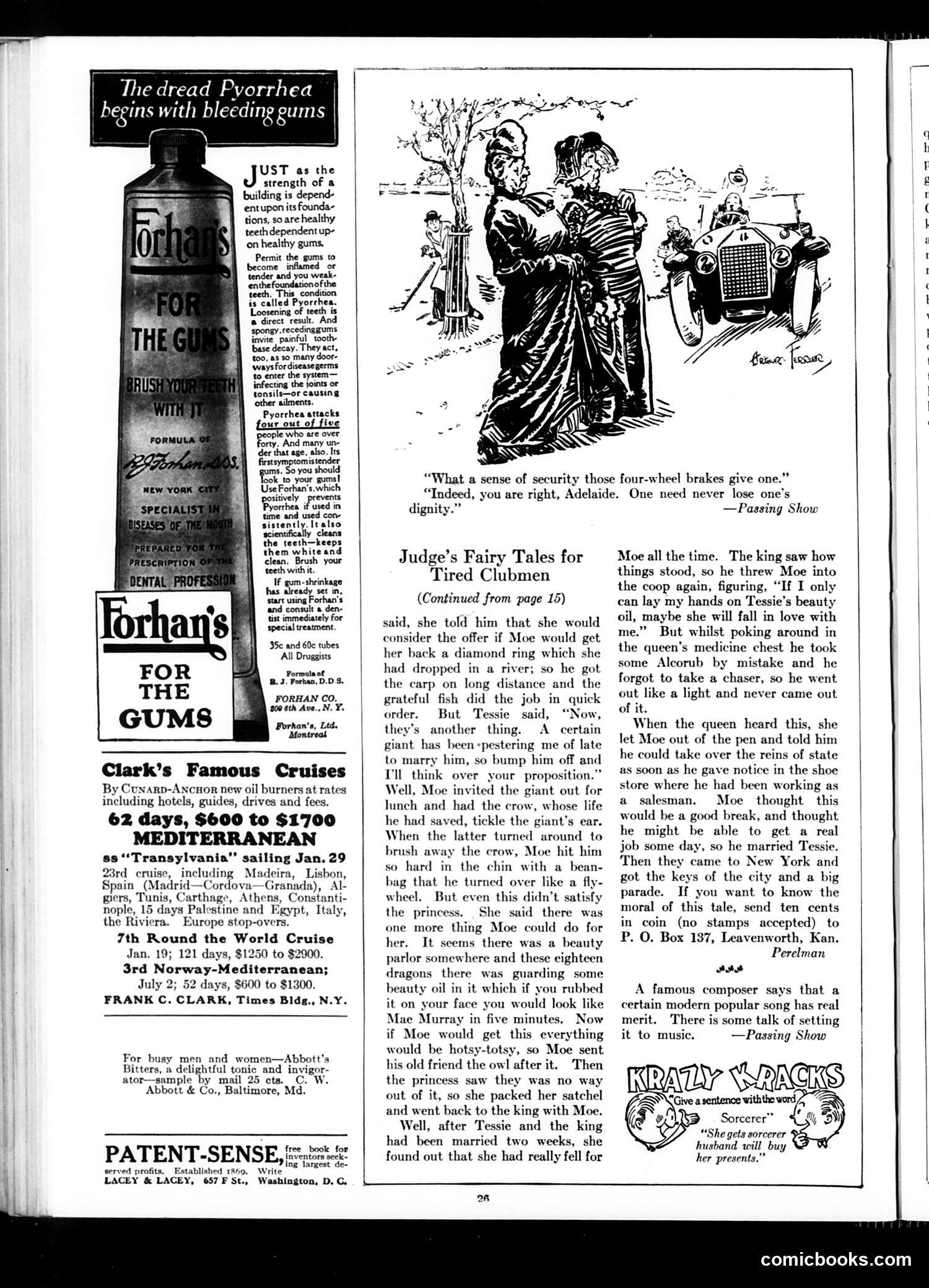
This page from *Judge* magazine contains mostly **advertisements and serialized fiction**, rather than political satire. The main cartoon depicts a wealthy couple in an automobile, with the woman remarking on the security of "four-wheel brakes." The satire is subtle: it's a gentle jab at how the affluent equate mechanical safety features with maintaining social *dignity*—suggesting vanity and class consciousness rather than genuine concern for safety. The "Judge's Fairy Tales for Tired Clubmen" is a humorous serialized story parodying fairy tales. It's written in deliberately crude, modern slang ("hotsy-totsy," "they's") for comic effect, undermining the grand tradition of classical fairy tales. The protagonist "Moe" performs magical feats to win a princess named "Tessie," but the ending subverts expectations—she falls for Moe anyway, and the king jealously locks him away. The advertisements (Forhan's toothpaste, Clark's Cruises, Abbott's Bitters) are period-typical marketing, targeting affluent readers of this satirical magazine.
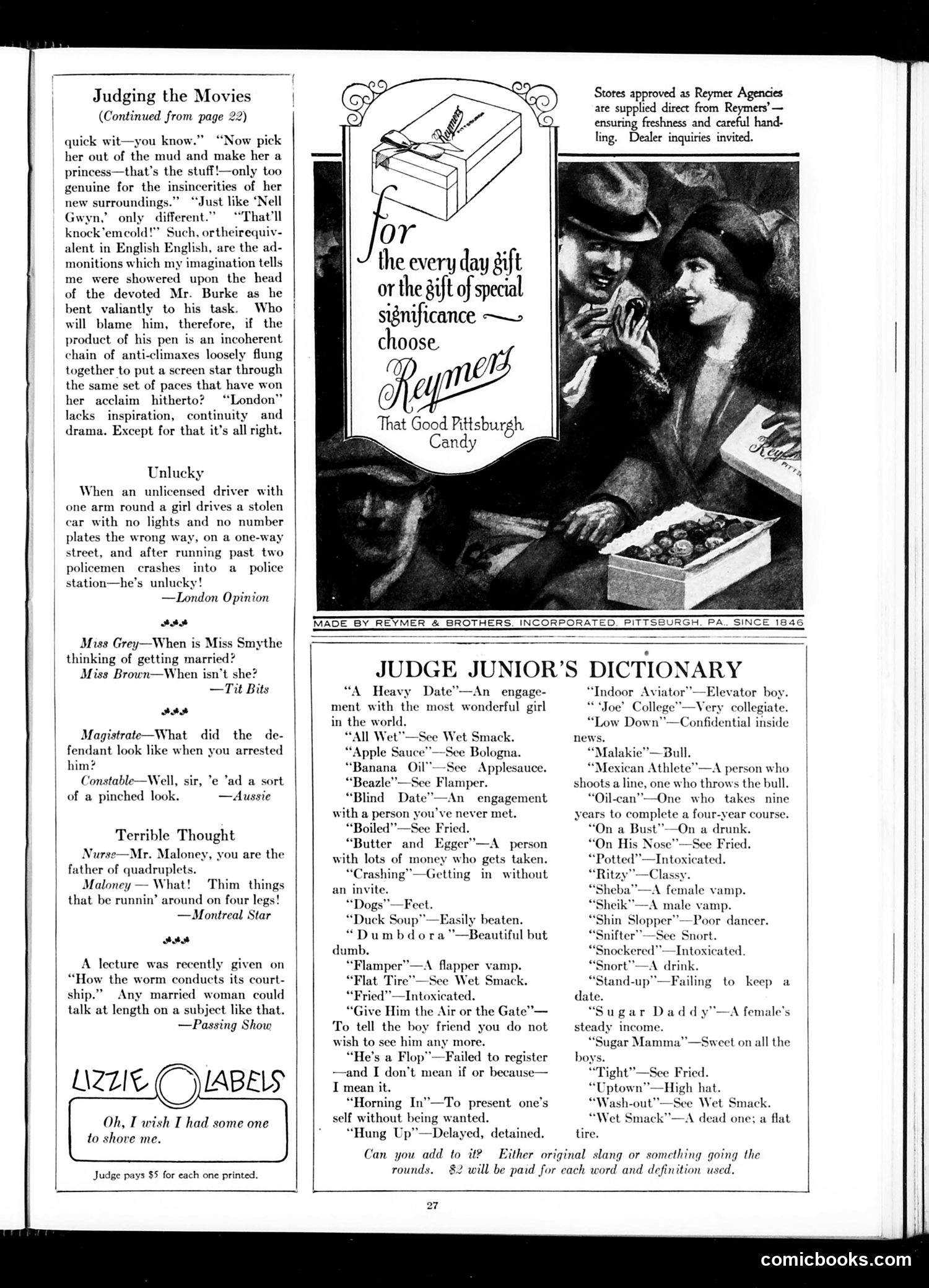
This page mixes film criticism with period slang and advertising. The main content includes: **"Judging the Movies"** critiques a film called "London," suggesting director Burke received conflicting creative notes that resulted in an incoherent, anti-climactic story despite efforts to make it work. **Humor snippets** mock everyday situations: an unlicensed one-armed driver stealing a car, a magistrate's confusion, a nurse dealing with quadruplets, and marital courtship. **"Judge Junior's Dictionary"** is the page's centerpiece—a glossary of 1920s slang terms targeting young people. Terms like "Heavy Date," "All Wet," "Banana Oil," and "Sugar Daddy" reflect Jazz Age youth culture and dating customs. "Mexican Athlete" (a braggart) and "Oil-can" (slow student) show period attitudes. **Reymers' Candy advertisement** occupies significant space, marketing Pittsburgh confections. The dictionary's invitation for readers to submit definitions ($2 payment) made this interactive content—typical of Judge's engagement strategy with its audience.
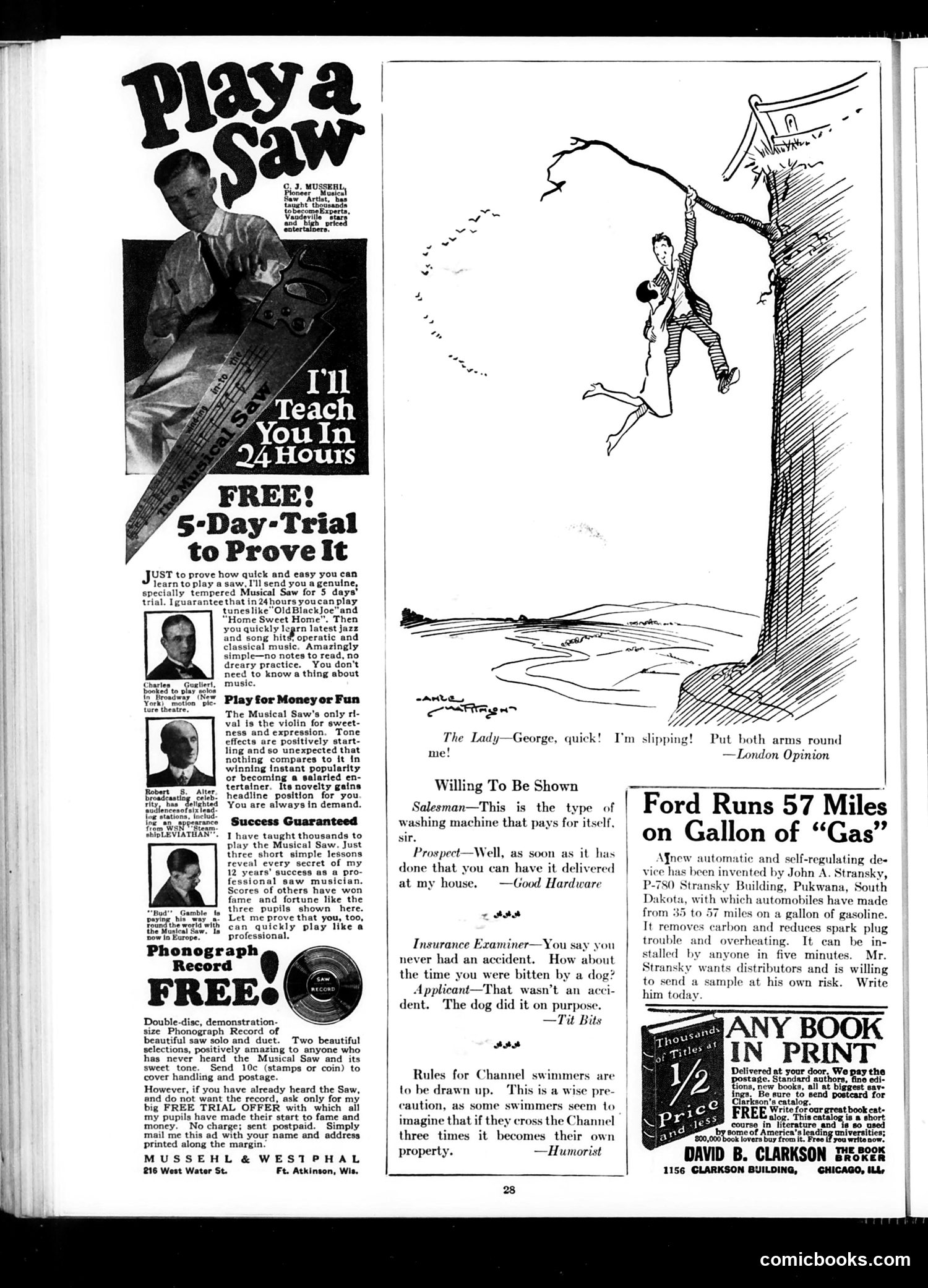
This page is primarily **advertising**, not political satire. It features multiple product promotions typical of early 20th-century magazines: **Main Content:** - **Musical Saw advertisement** (left): Promotes learning saw-playing in 24 hours with a 5-day free trial. Includes testimonials from "successful" musicians. - **Small joke cartoons** (center): Brief humorous exchanges—a woman slipping off a cliff, a salesman pitching a self-paying washing machine, an insurance examiner's exchange about a dog bite. These are generic gag humor, not political commentary. - **Ford efficiency advertisement** (right): Claims a new device allows cars to run 57 miles on one gallon of gasoline. - **Book catalog ad** (bottom right): Promotes "Thousands of Titles in Print" from Clarkson's. **Historical Context:** This reflects 1920s-era consumer culture and the period's fascination with labor-saving devices and automotive efficiency. The ads target middle-class aspirations for self-improvement and modern convenience. There is **no political satire or caricature** on this page—it's a standard advertising-heavy magazine layout from the era.
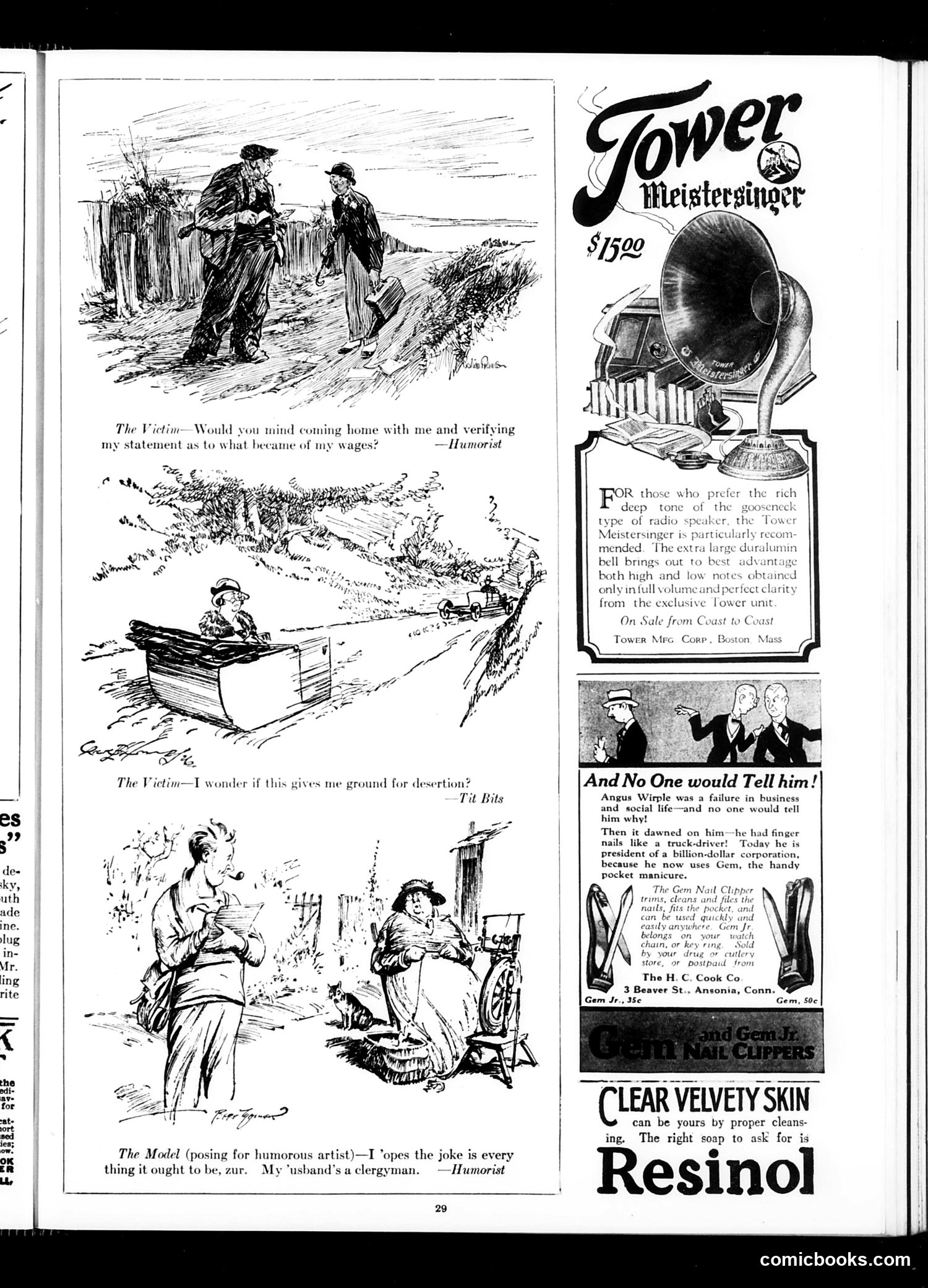
This page contains three satirical cartoons about marital discord, typical of Judge's humor. **"The Victim" cartoons** (top and middle) depict a working-class husband whose wages have disappeared—likely spent by his wife—asking a friend to verify his story to justify desertion or divorce. The humor targets both spendthrift wives and henpecked husbands, common themes in early-20th-century satire. **"The Model" cartoon** (bottom) shows a woman posing for a humorous artist, joking that her husband (a clergyman) shouldn't mind because the joke will be "every thing it ought to be"—suggesting clergy wives were expected to be prudish, making the irony comic. The surrounding advertisements (Tower Meistersinger radio speaker, Gem manicure sets, Resinol soap) are unrelated product placements typical of magazine monetization. The satire reflects era-specific gender anxieties: wives as financial burdens, class tensions, and assumptions about respectability tied to occupation.
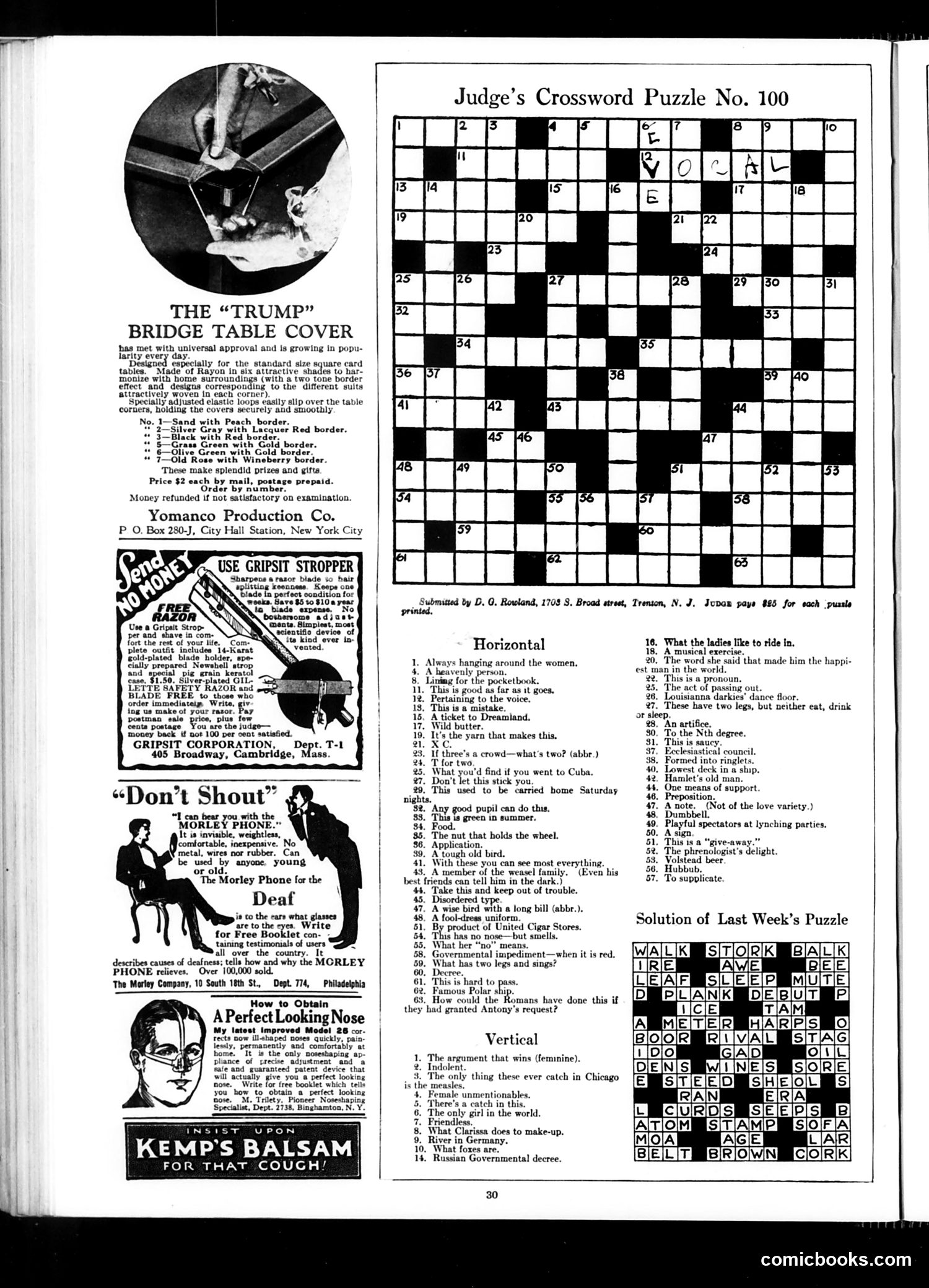
This page is primarily **advertisements and a crossword puzzle**, not political satire. The main content is "Judge's Crossword Puzzle No. 100"—a standard word puzzle with horizontal and vertical clues. The clues are humorous wordplay typical of 1920s puzzles (e.g., "Always hanging around the women" = BEAU; "This is a mistake" = ERROR). The advertisements include vintage products: a "Trump" bridge table cover (a functional furniture item, not political), a razor blade stropper, a hearing device for the deaf, and a nose-shaping apparatus. These reflect period consumer goods marketed through popular magazines. The one cartoon visible is "Don't Shout," promoting the Morley Phone hearing aid—a straightforward product advertisement with no political content. **There is no political satire or caricature on this page.** It's a typical 1920s-era magazine content mix of puzzles and period advertisements.
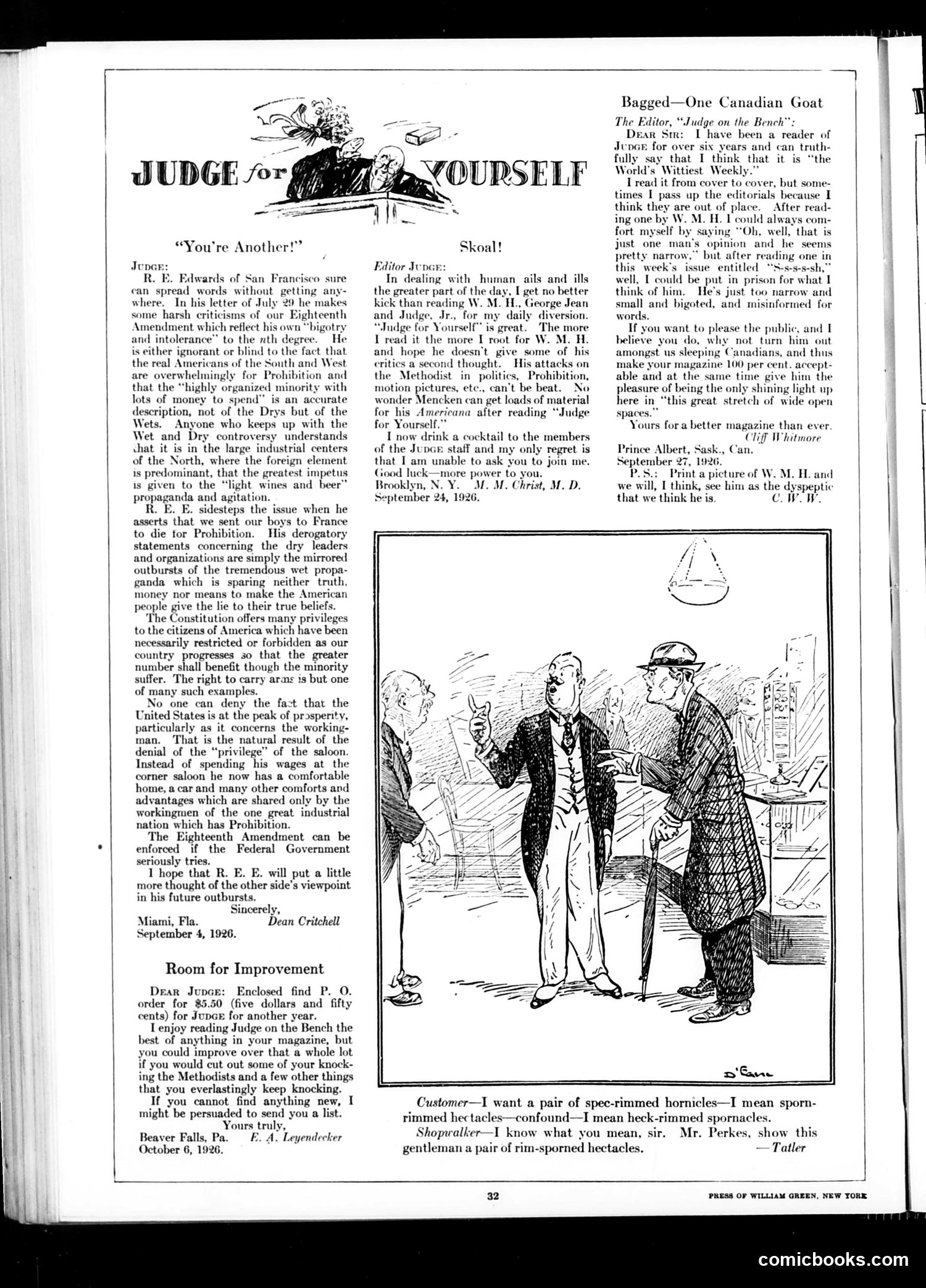
This page features reader letters debating **Prohibition**—the constitutional ban on alcohol (1920-1933). The cartoon depicts a businessman haggling with a shopkeeper over "spee-rimmed hornacles" (speakeasy-rimmed spectacles)—a joke about how Prohibition drove drinking underground into illegal speakeasies. The letters reveal the era's fierce Prohibition conflict. One writer defends the amendment, claiming it's made American workers prosperous with homes and cars instead of saloon spending. Another attacks this position as bigoted propaganda from "foreign elements" in Northern cities. A third reader praises Judge's columnist "W.M.H." for attacking Methodists and Prohibition advocates, suggesting the magazine balanced criticism of reform movements. The page captures how bitterly divided America was over Prohibition, with supporters claiming moral/economic benefits while opponents mocked enforcement and questioned government authority—a debate Judge covered satirically throughout the 1920s.
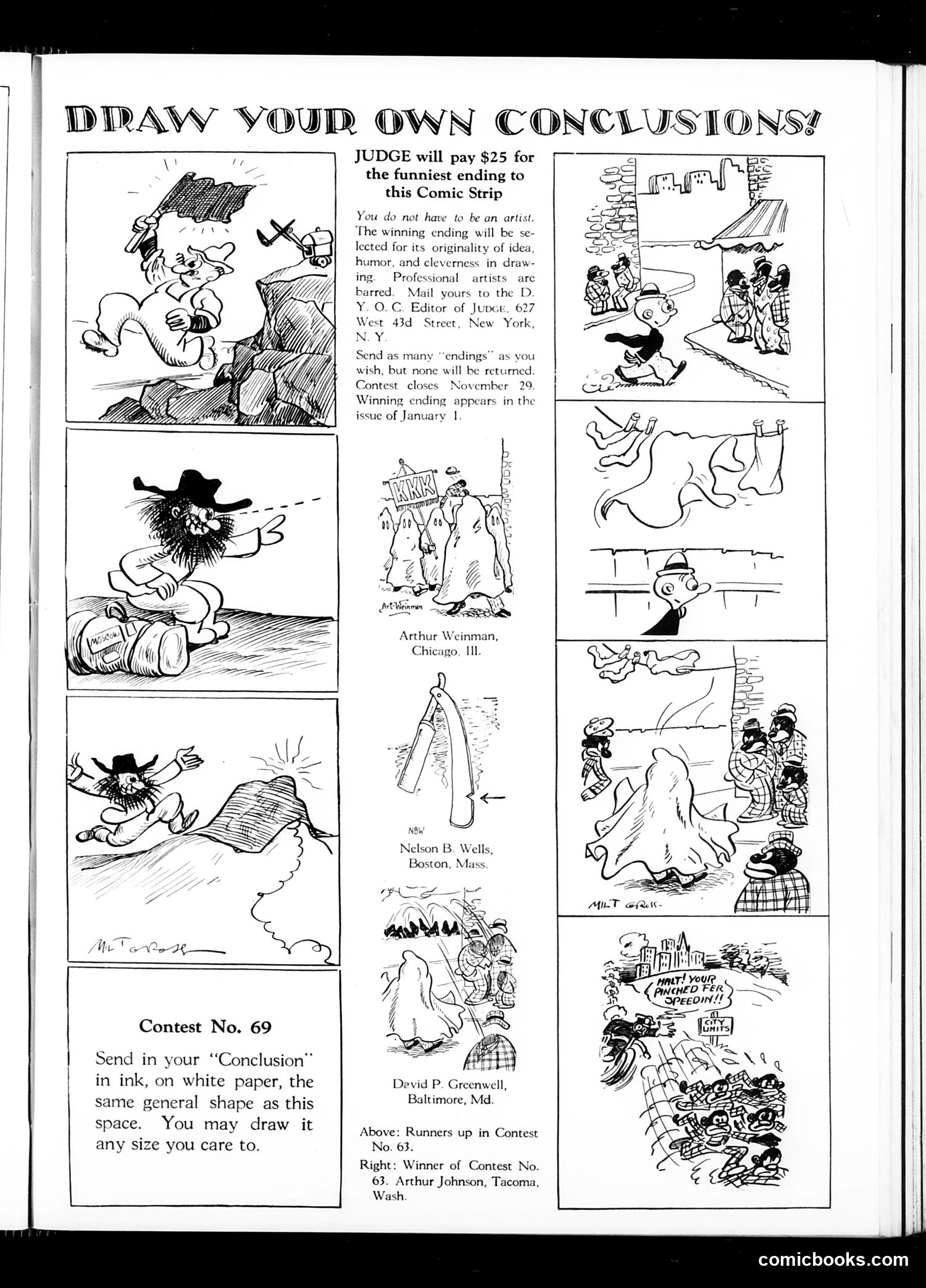
This page is a **reader participation contest** rather than editorial satire. Judge magazine invited readers to complete an incomplete comic strip, offering $25 for the funniest ending. The page shows: **Left side:** An unfinished four-panel strip featuring a character (appears to be a bearded man) in increasingly chaotic situations—fighting with another figure, encountering what looks like a barrel, and being knocked around—ending mid-action without resolution. **Center and right:** Examples from a previous contest (No. 63), showing submitted endings by readers Weinman, Wells, and Greenwell, plus the winning entry by Arthur Johnson from Tacoma, Washington. Johnson's winning strip shows a ghost-themed conclusion, appearing humorous in its surprise twist. **The point:** This was a democratic, participatory feature allowing non-professional cartoonists to contribute. Judge valued "originality of idea, humor, and cleverness" over artistic skill, explicitly barring professional artists to encourage amateur submissions.
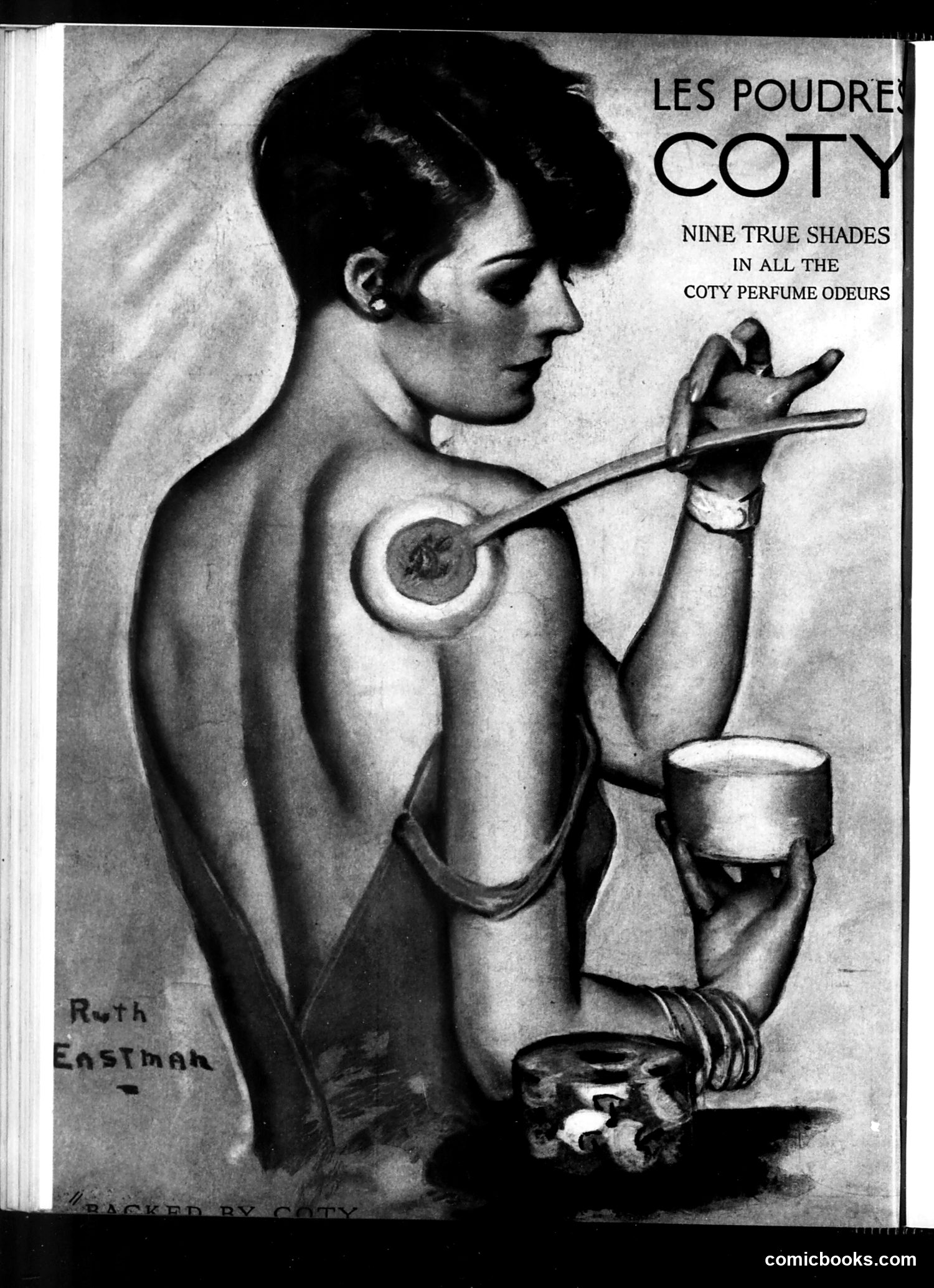
This is primarily **advertising copy, not political satire**. It's a full-page advertisement for Coty face powders and perfumes, illustrated by artist Ruth Eastman. The image depicts a stylized woman in profile applying or displaying powder, with various Coty cosmetic products arranged around her. The ad emphasizes that the powders come in "nine true shades" and coordinates with "all the Coty perfume odeurs" (scents). This represents early 20th-century beauty advertising targeting women consumers, using artistic illustration and French terminology to convey sophistication and elegance. The page has no satirical or political content—it's simply a luxury cosmetics marketing campaign appearing in Judge magazine.