
Judge, 1926-11-20 · page 23 of 36
Judge — November 20, 1926 — page 23: what you’re looking at
What you’re looking at
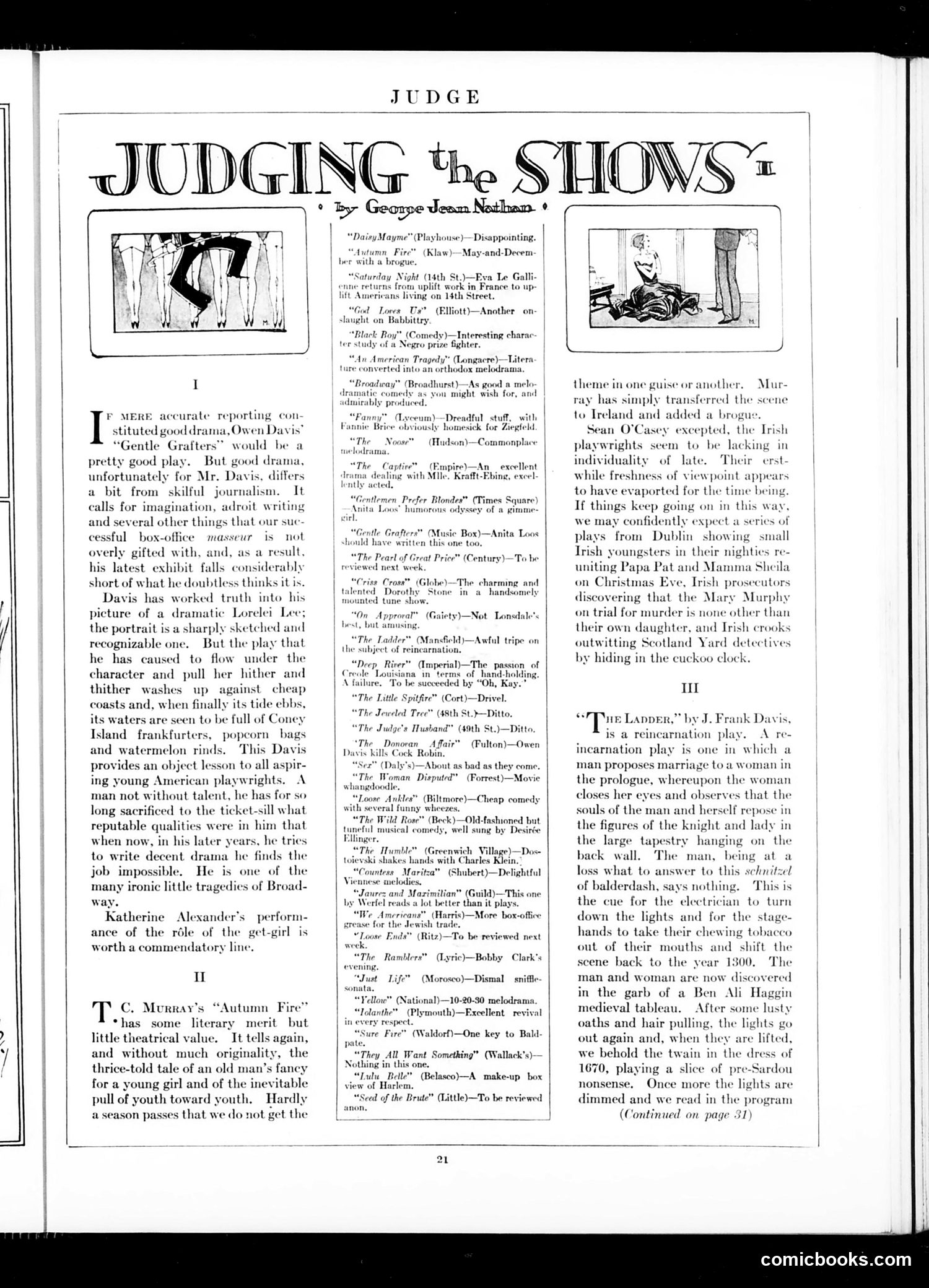
This page contains George Jean Nathan's theater column reviewing Broadway productions. Rather than political satire, it's entertainment criticism—a common Judge feature. Nathan critiques Owen Davis's "Gentle Grafters," arguing that while Davis drew from real life (referencing a "dramatic Lorelei Lee"), his play lacks imagination and artistic merit. He suggests Davis sacrificed theatrical quality to commercial success ("ticket-sill"), making him a cautionary tale of Broadway compromise. The right column continues reviewing C. C. Murray's "Autumn Fire" and discusses "The Ladder" by J. Frank Davis—a reincarnation play about a man proposing to a woman who observes his soul across lifetimes, culminating in a medieval tableau scene. The center contains brief capsule reviews of other Broadway shows, mostly dismissive in tone. This represents Judge's coverage of contemporary theater rather than political cartooning.
📄 Transcribed text from this page (OCR, searchable)
Machine-transcribed from the original scan — historical spelling and the odd misread are preserved.
=r JUDGE * MERE accurate reporting con- I stituted good drama, Owen Davis’ “Gentle Grafters” would be a pretty good play. But good drama, unfortunately for Mr. Davis, differs a bit from skilful journalism. It calls for imagination, adroit writing and several other things that our suc- cessful box-office masseur is not overly gifted with, and, as a result, his latest exhibit falls considerably short of what he doubtless thinks it is. Davis has worked truth into his picture of a dramatic Lorelei Lee; the portrait is a sharply sketched and recognizable one. But the play that he has caused to flow under the character and pull her hither and thither washes up against cheap and, when finally its tide ebbs, s waters are seen to be full of Coney Island frankfurters, popcorn bags and watermelon rinds. This Davis provides an object lesson to all aspir- ing young American playwrights. A man not without talent, he has for so long sacrificed to the ticket-sill what reputable qualities were in him that when now, in his later years, he tries to write decent drama he finds the job impossible. He is one of the many ironic little tragedies of Broad- way. Katherine Ale: ance of the réle of the get-girl is worth a commendatory line, anders perform- II C. Murray’s “Autumn Fire” *has some literary merit but little theatrical value. It tells again, and without much originality, the thrice-told tale of an old man’s fancy for a young girl and of the inevitable pull of youth toward youth, Hardly a season passes that we do not get the | mounted tu “DairyMayme” (Playhouse)—Disappointing. | * (Klaw) y-and-Decem “Saturday Night (14th St.\—Eva Le Galli- enne returns from uplift work in France to Americans living on 14th Street. xt Loves Us" (Elliott)—Another on: at on Babbittry. “Black Boy’ ter study of a (Comedy)—Interesting charac egro prize fighter, “An American Tragedy” (Longacre) —Ti ture converted into an orthodox melodi roadway” (Broadhurst)—As good a dramatic comedy as you might wish for, and admirably pro “Fanny )—Dreadful stuff, with Fannie Bric k for Ziegfeld “The — Noose — (Hudson)—Commonplace ” Captive” (F. Y—An__ excellent dn ama de aling with Mlle. Krafft-Ebing, excel- ntly acted, “Gentleme Anita 1 sil, refer Blondes” (Times Square) tle Grafters" (Music Box)—Anita Loos muld have written this one too. ‘he Pearl of Great Price” (Century)—To be eviewed next week, “Crise Cross” (Globe) talented Dorothy St how. The in harming and handsomely “On Approrat” (Gaiety)—Not Lonsdale’s best, but amusing. he Ladder (Mansfield) —Awful tripe on subject of reincarnation, “Deep River” (Imperial)—The passion Creole Louisiana in terms of hand-hi \ failure. To be succeeded by “Oh, Kay. ¢ Little Spitfire” (Cort)—Drivel. | “The Jeweled Tree™ (48th St.)—Ditto. “The Julge’s Husband” (49th St.)—Ditto. ‘The Donoran. Affair” (Pulton)—Owen Davis kills Cock Robin. “Ser” (Daly’s)—Abou! h an Disputed “Loose Ankles” (Biltmore)—Cheap comedy with I funny wheezes, “The Wild Rose” (Beck)—Old-fashioned but tuneful musical comedy, well sung by Desirée Ellinger. “The Humble” (Greenwich V ski shakes hands with Charles ‘Countess Maritza” (Shubert)—Delightful Viennese melodies, ad as they com (Forrest) —Movie “Jaurrz and Marimitian® (Guild)—This one by Werfel reads a lot better than it play “We nericans” (Harris)—More grease for t q “Loose Ends week, “The Ramblers” (Lyric)—Bobby Clark's evening. Just Life” (Morosco)—Dismal sniffle- Yellow" (National)—10-20-30 melodrama “Tolanthe* (Plymouth)—Excellent _ revival in every respect. “Sure Fire” (Waldorf)—One key to Bald- pate, “They All Want Something” (Wallack's) Nothing in this one. “Lulu Belle” (Belasco)—A make-up box view of Harlem, “Seed of the Brute” (Little)—To be reviewed (Ritz)—To be reviewed next J) theme in one guise or another. Mur- ray has simply transferred the scene to Ireland and added a brogu Sean O'Casey excepted, the Trish playwrights seem to be lacking in individuality of late. Their erst while freshness of viewpoint appears to have evaported for the time bei If things keep going on in this wa we m play: Irish youngsters in their nighties re- uniting Papa Pat and Mamma Sheila on Christmas Eve, Irish prosecutors discovering that the Mary Murphy confidently expect a series of from Dublin showing small on trial for murder is none other than their own daughter, and Irish crooks outwitting Scotland Yard detectives by hiding in the cuckoo clock. Il OTe Lanpen,” by J. Frank Davis, is a reincarnation play. A r incarnation play is one in which a man proposes marriage to a woman in the prologue, whereupon the woman closes her eyes and observes that the souls of the man and herself repose in the figures of the knight and lady in the large tapestry hanging on the back wall. The man, being at a loss what to answer to this schnitzel of balderdash, says nothing. This is the cue for the electrician to turn down the lights and for the stage- hands to ke their chewing tobacco out of their mouths and shift’ the scene back to the year 1300. The man and woman are now discovered in the garb of a Ben Ali Haggin medieval tableau. After some lusty oaths and hair pulling, the lights go out again and, when they are lifted, we behold the twain in the dress of 1670, playing a slice of pre-Sardou nonsense, Once more the lights are dimmed and we read in the program (Continued on page 31) comicbooks.com